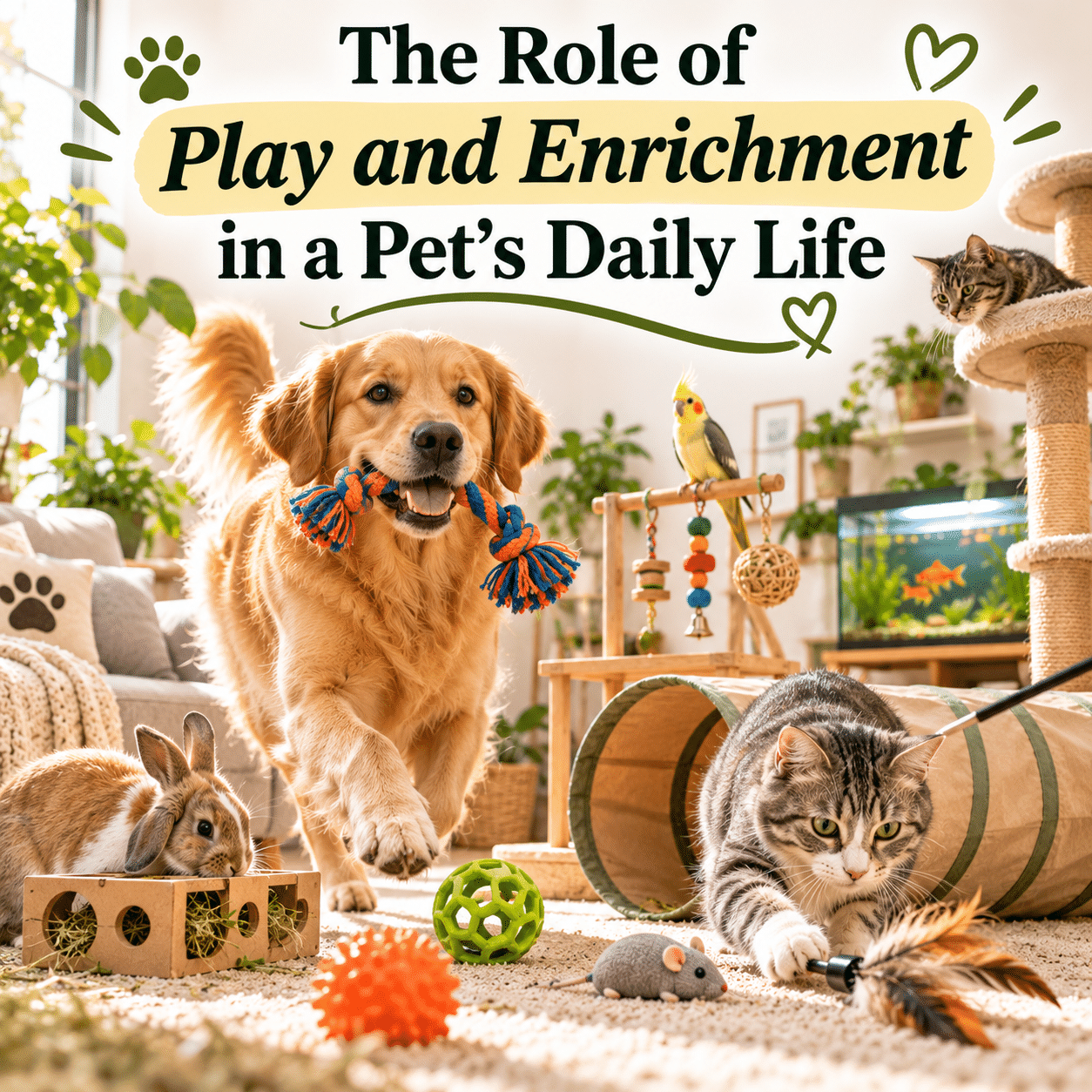
Play is one of the most enjoyable and recognizable parts of living with pets. A dog chasing a favorite toy, a cat stalking a moving feather, a rabbit exploring a cardboard tunnel, or a parrot investigating a puzzle can bring energy and personality into everyday household life.
Yet play is more than a source of entertainment. For many companion animals, it provides opportunities to move, explore, learn, interact, and express natural behaviors. Alongside play, environmental enrichment helps create living conditions that offer appropriate stimulation, choices, and opportunities for species-specific activities.
These two elements are closely connected, but they are not identical.
Play often involves voluntary, engaging activities that may include movement, exploration, social interaction, or interaction with objects. Enrichment is a broader approach to improving an animal’s environment and daily experiences by providing meaningful opportunities to perform appropriate behaviors.
A dog may enjoy a game of fetch, but it may also benefit from sniffing during walks, searching for food, and exploring different environments. A cat may chase a toy, but it also needs suitable scratching surfaces, resting places, hiding opportunities, and ways to explore its surroundings.
For smaller companion animals, enrichment can involve tunnels, safe digging materials, suitable foraging opportunities, and appropriate environmental complexity. Birds may benefit from safe objects to manipulate, opportunities for foraging, and activities that encourage natural movement and exploration.
The best activities depend on the animal’s species, age, health, temperament, preferences, and living conditions.
A playful activity that suits one animal may be unsuitable or stressful for another. Similarly, a toy that appears entertaining to a person may provide little meaningful benefit if it does not support the animal’s natural behavior.
Understanding the role of play and enrichment helps pet owners move beyond the idea that animals simply need food, water, and a comfortable place to sleep.
Responsible pet care also involves considering how animals experience their surroundings, what motivates them, and how their daily routines can provide suitable opportunities for physical activity, mental engagement, rest, and choice.
With thoughtful planning, play and enrichment can become practical, enjoyable parts of everyday household routines while supporting a more engaging and appropriate environment for companion animals.
1. Understanding What Play Means for Pets
Play is a form of voluntary behavior that can involve movement, exploration, interaction, and experimentation.
In many animals, play is especially noticeable during youth, although adults may continue to engage in playful activities throughout their lives.
Dogs may chase, retrieve, wrestle appropriately, or interact with toys.
Cats may stalk, pounce, bat at objects, or engage in short bursts of energetic movement.
Some birds manipulate objects, investigate materials, or participate in suitable interactive activities.
However, not every animal expresses play in the same way.
Certain species may show exploratory or foraging behaviors that are more important to their welfare than conventional toy-based play.
Owners should therefore understand what playful or engaging behavior looks like for the species in their care.
The goal is not to make every animal perform entertaining actions. It is to provide suitable opportunities for voluntary, rewarding activities.
2. What Environmental Enrichment Really Means
Environmental enrichment involves making an animal’s living conditions more supportive of its behavioral and welfare needs.
It can include changes to the physical environment, feeding arrangements, sensory experiences, social opportunities, and daily activities.
For example, a cat may benefit from climbing structures and scratching surfaces.
A rabbit may benefit from tunnels, hiding places, and safe opportunities to forage.
A parrot may benefit from appropriately designed foraging activities and objects that can be manipulated safely.
Enrichment should have a clear purpose.
Simply adding more toys or decorations does not necessarily improve an animal’s experience.
An effective enrichment activity should be appropriate for the species, safe for the individual, and connected to behaviors the animal is naturally motivated to perform.
Owners should observe whether the animal voluntarily uses the enrichment and whether it appears comfortable.
3. Why Play and Enrichment Are Different but Connected
Play and enrichment often overlap because many enrichment activities encourage playful behavior.
However, enrichment extends beyond play.
A dog exploring interesting scents during a walk may be engaged in a valuable enrichment activity without playing in the conventional sense.
A cat using an elevated resting platform may benefit from environmental choice and observation.
A rabbit digging in a suitable container may be expressing a natural behavior rather than engaging in a game.
Play can be one component of enrichment, but enrichment also includes opportunities for exploration, foraging, rest, retreat, and environmental control.
Understanding this distinction helps owners avoid relying exclusively on toys.
A well-enriched environment supports a range of appropriate behaviors throughout the day.
4. Supporting Natural Animal Behaviors
Every animal species has characteristic behavioral needs.
Dogs commonly explore their surroundings through smell, movement, and interaction.
Cats often engage in behaviors related to stalking, climbing, scratching, hiding, and resting in preferred locations.
Rabbits may dig, forage, explore tunnels, and seek sheltered areas.
Many birds naturally investigate objects, search for food, vocalize, and move through complex environments.
Enrichment should provide safe opportunities for these behaviors.
Preventing normal behavior without offering suitable alternatives may create frustration or welfare concerns.
For example, a cat that scratches furniture may need appropriate scratching surfaces rather than punishment for scratching itself.
The aim is to accommodate natural behavior in ways that are compatible with household safety and practical living.
5. The Importance of Physical Activity
Movement is an important part of daily life for many companion animals.
Appropriate physical activity can help animals use their bodies, explore their environments, and maintain functional abilities.
However, exercise needs vary considerably.
A young, healthy dog may enjoy energetic outdoor activities.
An older dog with mobility limitations may benefit from shorter, gentler movement.
Cats may prefer brief interactive play sessions rather than prolonged exercise.
Small mammals require sufficient space and opportunities for species-appropriate movement.
Owners should avoid assuming that more exercise is always better.
Activity should be adjusted to age, physical condition, environmental temperature, and veterinary recommendations when relevant.
Safe, suitable movement is more important than achieving an arbitrary duration or intensity.
6. Mental Engagement Through Everyday Activities
Mental engagement involves opportunities for animals to investigate, make choices, learn, and respond to their surroundings.
Food-searching activities, suitable puzzle feeders, scent exploration, and training exercises can provide different forms of engagement.
For example, a dog may search for a small portion of its regular food hidden in a safe location.
A cat may investigate a simple food puzzle.
A bird may manipulate a suitable foraging object.
These activities should be introduced at an appropriate difficulty level.
An enrichment task that is too difficult may create frustration rather than enjoyment.
Owners can begin with simple activities and gradually adjust them according to the animal’s response.
Mental engagement should complement, not replace, adequate physical care, rest, and social opportunities.
7. How Play Can Support Learning
Play can create opportunities for animals to practice skills and learn about their environments.
Young animals may experiment with movement, coordination, object interaction, and social communication.
Adults can also learn through suitable games and reward-based activities.
For example, a dog may practice responding to familiar cues during a short interactive session.
A cat may learn how to obtain food from a simple puzzle.
A bird may discover how to manipulate a safe object to access a reward.
Learning activities should be appropriate for the animal and should avoid fear, coercion, or unnecessary frustration.
The purpose is to create positive engagement rather than demand perfect performance.
8. The Value of Choice and Control
An important feature of effective enrichment is allowing animals appropriate choices.
A pet may prefer one toy over another, select a particular resting place, or decide when to approach an activity.
Providing options can help animals interact with their surroundings in ways that suit their preferences.
For example, a cat may choose between an elevated perch and a sheltered resting area.
A dog may prefer sniffing during a walk rather than repeatedly retrieving a ball.
A rabbit may move between a tunnel and an open exercise area.
Choice should always operate within safe boundaries.
Owners remain responsible for preventing access to hazards.
Nevertheless, allowing suitable voluntary participation is often more respectful than forcing animals to engage in activities they do not enjoy.
9. Recognizing Individual Preferences
Animals of the same species can have very different interests.
One dog may enjoy retrieving toys, while another prefers searching for scents.
One cat may enthusiastically chase a wand toy, while another responds more readily to slower movements.
Some birds enjoy manipulating objects, while others approach unfamiliar items cautiously.
Preferences may be influenced by temperament, previous experiences, age, health, and environment.
Owners can learn by observing which activities animals voluntarily approach and repeat.
It is also useful to notice when interest decreases.
A lack of enthusiasm does not necessarily mean an animal is lazy or difficult.
The activity may simply be unsuitable, unfamiliar, or poorly timed.
10. Understanding Play Behavior in Dogs
Dogs display a wide range of playful behaviors.
These may include chasing, retrieving, tugging, searching, and interacting with familiar people or compatible dogs.
Body language provides important information about whether an interaction is comfortable.
Loose movement, voluntary re-engagement, and appropriate pauses may indicate that an activity is welcome.
However, behavior must always be interpreted in context.
A dog that becomes stiff, repeatedly avoids interaction, or shows signs of distress may need the activity to stop.
Owners should select games suited to the dog’s size, health, and temperament.
Play should remain safe and enjoyable rather than becoming excessively intense or competitive.
11. Why Sniffing Matters for Dogs
Dogs use their sense of smell extensively to investigate their surroundings.
Sniffing can provide meaningful environmental information and opportunities for exploration.
A walk focused entirely on distance or speed may overlook this important behavior.
Allowing suitable sniffing opportunities can make outdoor activities more engaging.
Owners may also introduce safe scent-searching games at home.
For example, small portions of a dog’s regular food can be placed in accessible hiding locations.
The activity should be adjusted to the dog’s abilities and dietary needs.
Sniffing is not a replacement for all forms of exercise or enrichment.
It is one valuable component of a varied routine.
12. Interactive Games for Dogs
Interactive games can provide opportunities for movement, communication, and shared enjoyment.
Common examples include retrieving suitable toys, gentle tug games, and simple search activities.
The appropriateness of each game depends on the individual dog.
Retrieving should not involve excessive repetition or unsafe surfaces.
Tug games should use suitable equipment and allow controlled, voluntary interaction.
Search games should avoid hazardous hiding places or inappropriate food rewards.
Owners should watch for signs of fatigue, discomfort, or excessive arousal.
Short, enjoyable sessions may be more suitable than prolonged activity.
The goal is to support positive engagement rather than maximize intensity.
13. Understanding Play Behavior in Cats
Cats often engage in play that resembles elements of hunting behavior.
They may watch, stalk, chase, pounce, and capture moving objects.
Interactive wand toys and other suitable objects can provide opportunities for these behaviors.
Play sessions should allow the cat to participate voluntarily and experience successful interactions.
For example, repeatedly presenting an unreachable moving target may be less satisfying than allowing opportunities to catch a safe toy.
Owners should avoid using hands or feet as play targets because this may encourage unwanted biting or scratching.
Toys should be checked for loose parts, strings, and other hazards.
Supervision is important when using equipment that could become entangled or swallowed.
14. Creating Vertical Enrichment for Cats
Cats often use elevated locations for observation, movement, and rest.
Appropriate vertical structures can increase the usable complexity of an indoor environment.
Examples include stable cat trees, secure shelves, and suitable window perches.
These structures should be installed or positioned safely.
They must support the cat’s weight and allow comfortable access.
Older cats or animals with mobility limitations may need lower platforms or gradual steps.
Vertical enrichment should complement other resources, including scratching areas, hiding places, litter facilities, and comfortable resting locations.
A thoughtfully arranged environment provides choices rather than requiring every cat to use the same structure.
15. The Importance of Scratching Opportunities
Scratching is a normal behavior for cats.
It may contribute to claw maintenance, stretching, and communication through visual and scent-related signals.
Providing appropriate scratching surfaces is therefore an important part of environmental enrichment.
Different cats may prefer vertical posts, horizontal pads, or particular materials.
Owners can observe where and how their cats naturally scratch.
Suitable surfaces should be stable and placed in useful locations.
Punishing scratching behavior without providing alternatives does not address the underlying need.
A more practical approach is to offer appropriate options and encourage their use through positive experiences.
16. Enrichment for Rabbits
Rabbits benefit from environments that support movement, exploration, hiding, foraging, and other natural behaviors.
Suitable tunnels, shelters, safe digging opportunities, and appropriate foraging arrangements may provide meaningful engagement.
Rabbits also require adequate living space and suitable flooring.
Enrichment should not be used to compensate for housing that is too small.
Materials must be selected carefully because rabbits may chew or ingest objects.
Cardboard and other commonly used materials should be assessed for safety, including adhesives, coatings, and small components.
Owners should also consider social needs and veterinary guidance.
A rabbit’s daily environment should support natural behavior beyond occasional play sessions.
17. Enrichment for Guinea Pigs
Guinea pigs have distinct behavioral and environmental needs.
They may benefit from suitable hiding areas, tunnels, safe exploration, and opportunities to forage.
Because guinea pigs are prey animals, access to sheltered areas is especially important.
Enrichment should not require them to remain exposed in unfamiliar or stressful situations.
Their social needs must also be considered.
Appropriate companionship with compatible guinea pigs is generally important, subject to individual circumstances and professional guidance.
Food-based activities should reflect their nutritional requirements.
A good enrichment arrangement supports comfort, movement, and choice while maintaining suitable housing and hygiene.
18. Enrichment for Hamsters and Other Small Rodents
Small rodents require species-specific environmental arrangements.
For hamsters, appropriate bedding depth, suitable opportunities for burrowing, safe shelters, and properly sized exercise equipment can be important.
Some species are naturally more active during evening or nighttime periods.
Owners should respect these activity patterns rather than repeatedly waking animals for daytime interaction.
Exercise wheels and other equipment must be appropriately designed and sized.
Unsafe accessories can cause injury.
Different rodent species have different social and housing requirements, so they should not all be managed identically.
Enrichment should be based on reliable information about the particular animal.
19. Enrichment for Companion Birds
Many companion birds are naturally active, curious, and motivated to investigate their surroundings.
Suitable enrichment may include foraging opportunities, safe objects to manipulate, appropriate perches, and opportunities for movement.
Some birds also benefit from carefully managed social interaction.
However, needs vary significantly among species.
A small finch and a large parrot should not be expected to use the same enrichment arrangements.
Materials must be evaluated for toxicity, entanglement, and ingestion risks.
Birds may also be sensitive to household fumes and environmental hazards.
Enrichment should support species-appropriate behavior while allowing adequate rest and freedom from unnecessary stress.
20. Environmental Enrichment for Aquarium Fish
Fish also interact with their environments and may benefit from suitable environmental complexity.
Appropriate plants, shelters, substrate, water flow, and feeding arrangements can support natural behaviors for certain species.
However, aquarium enrichment must be designed around water quality and species compatibility.
An object that looks decorative may have sharp edges, unsuitable materials, or surfaces that interfere with safe movement.
Some fish need open swimming areas, while others use sheltered locations.
Water chemistry, temperature, filtration, and adequate space remain fundamental.
Enrichment cannot compensate for unsuitable aquatic conditions.
Owners should research the specific needs of the fish they keep.
21. Understanding Sensory Enrichment
Sensory enrichment involves appropriate opportunities to engage an animal’s senses.
These may include smell, sight, touch, sound, or other species-relevant sensory experiences.
For dogs, scent-based activities may be particularly meaningful.
Cats may respond to suitable visual movement and environmental observation.
Birds may investigate different safe textures and objects.
However, sensory stimulation should not be confused with overwhelming an animal.
Strong fragrances, loud sounds, flashing lights, and unfamiliar substances may create discomfort or risk.
Some essential oils and household scent products can be harmful to pets.
Sensory enrichment should be introduced cautiously and based on species-specific safety guidance.
22. Food-Based Enrichment and Foraging
Foraging activities can provide opportunities for animals to search, investigate, and work with appropriate food resources.
Examples include suitable puzzle feeders, food-searching games, and species-specific foraging arrangements.
These activities can make feeding more engaging for some animals.
However, food-based enrichment requires careful planning.
Treats and additional food should be included within an appropriate nutritional plan.
Some animals need unrestricted access to particular foods, while others have carefully controlled diets.
Food puzzles should not prevent an animal from obtaining necessary nutrition.
Activities should be accessible and suitable for the individual’s abilities.
The objective is meaningful engagement, not making essential food unnecessarily difficult to obtain.
23. Using Puzzle Feeders Appropriately
Puzzle feeders can encourage investigation and problem-solving when they are suitable for the animal.
Different designs require different actions, such as moving an object or manipulating a simple mechanism.
Beginners may need easy puzzles with clearly accessible rewards.
Difficulty can be increased gradually when the animal demonstrates interest and success.
Owners should observe for frustration or avoidance.
Some animals may not enjoy puzzle feeders, and that preference should be respected.
Equipment must also be checked for stability, durability, and ingestion hazards.
Puzzle feeders are one enrichment option among many, not an essential purchase for every pet.
24. The Value of Exploring New Environments
Environmental exploration can provide opportunities for animals to encounter appropriate sights, smells, textures, and experiences.
For dogs, this may involve suitable walking routes or safe outdoor locations.
For cats, it may involve investigating new objects or rearranged enrichment within a familiar home.
For small animals, exploration may occur in secure, species-appropriate areas.
Novelty should be introduced carefully.
Unfamiliar environments can be stressful for some pets.
Owners should provide opportunities to retreat and avoid forcing interaction.
A new experience is beneficial only when it is appropriate, safe, and compatible with the animal’s comfort.
25. Why Novelty Should Be Balanced With Familiarity
New objects and activities may attract interest, but constant change is not necessarily beneficial.
Many animals rely on familiar environmental features and predictable access to important resources.
Frequently moving food stations, hiding places, or resting areas may create unnecessary disruption.
A practical enrichment strategy preserves essential environmental stability while introducing suitable variety.
For example, a cat may keep its familiar resting locations while enjoying occasional changes in interactive toys.
A dog may follow a familiar walking routine with opportunities for different safe sniffing experiences.
Novelty should add meaningful choice rather than remove predictability.
26. Rotating Toys Without Creating Confusion
Toy rotation can help households manage supplies and provide occasional variety.
Rather than leaving every toy available at once, owners may offer a selection and periodically change some items.
However, not every toy should be removed simply to create novelty.
An animal may have a preferred comfort object or familiar item that contributes to its routine.
Owners should observe which toys are used and which are ignored.
Damaged toys should be removed or repaired only when safe and appropriate.
Rotation is most useful when it responds to the animal’s interests.
It should not become a rigid schedule that disregards individual preferences.
27. Creating Enrichment With Everyday Household Materials
Some enrichment activities can be created using ordinary materials already available at home.
Cardboard boxes, paper-based materials, and suitable containers may provide opportunities for exploration or simple food-searching games.
However, household materials are not automatically safe.
Staples, tape, adhesives, coatings, small detachable parts, sharp edges, and ingestible materials may create hazards.
Safety depends on the species and the individual animal.
For example, a cardboard box suitable for supervised cat exploration may not be appropriate for an animal that consumes unsafe materials.
Homemade enrichment should be inspected carefully and supervised when necessary.
The objective is useful engagement, not simply finding inexpensive objects for animals to interact with.
28. Understanding Social Enrichment
Social enrichment involves appropriate opportunities for interaction with humans or other animals.
Its importance varies considerably among species.
Dogs may benefit from positive interactions with familiar people and, when appropriate, compatible dogs.
Some birds have substantial social needs.
Guinea pigs generally require suitable companionship from their own species.
Many hamsters, by contrast, have social requirements that differ significantly and may need solitary housing.
Owners should never assume that adding another animal will automatically improve welfare.
Compatibility, species, sex, health, housing, and individual temperament must be considered.
Social enrichment should support positive experiences rather than force unwanted contact.
29. How Human Interaction Can Become Enrichment
Human interaction can provide valuable engagement for many companion animals.
Examples include gentle play, reward-based training, appropriate grooming, and calm companionship.
However, interaction should be guided by the animal’s behavior.
Some pets actively seek attention, while others prefer limited handling.
A dog may enjoy a short training game.
A cat may approach for brief interaction and then move away.
A bird may engage with a familiar caregiver through suitable activities.
Owners should recognize signs that the animal wants to stop.
Positive interaction respects choice and avoids treating pets as objects that must remain available for entertainment.
30. Teaching Through Positive Reinforcement
Reward-based training can be a useful form of enrichment for many animals.
It involves reinforcing desired behavior with something the animal finds rewarding.
Depending on the species and individual, rewards may include suitable food, play, or other positive experiences.
Training can provide opportunities for learning and communication.
For example, a dog may learn a simple cue, while a cat may learn to approach a target.
Sessions should remain manageable and appropriate to the animal’s attention and comfort.
Fear-based or coercive methods can create welfare concerns.
Training should encourage voluntary participation and support a positive relationship between the animal and caregiver.
31. Recognizing Signs of Enjoyable Engagement
Owners should observe how pets respond during enrichment activities.
Voluntary participation, repeated interest, relaxed movement, and appropriate engagement may suggest that an activity is welcome.
However, behavior varies by species and context.
A dog wagging its tail is not automatically relaxed.
A cat remaining still may be observing, resting, or feeling uncertain.
A bird investigating an object may be curious, but sudden avoidance may indicate discomfort.
Owners should learn species-specific body language and consider the entire situation.
An enrichment activity should be adjusted or stopped when the animal shows signs of distress, fear, or discomfort.
32. Recognizing Overstimulation and Fatigue
More stimulation is not always better.
Animals may become tired, frustrated, fearful, or excessively aroused during activities.
Possible signs include avoidance, changes in movement, defensive behavior, excessive panting in inappropriate contexts, or difficulty settling.
These signs must be interpreted according to species and circumstances.
Some animals may simply need a break.
Others may require a different activity or a quieter environment.
Owners should avoid repeatedly pushing pets to continue when they show discomfort.
Enrichment should include opportunities for rest and withdrawal.
A balanced routine allows animals to engage voluntarily and recover appropriately.
33. Adapting Play for Puppies and Kittens
Young dogs and cats often show high levels of curiosity and playful behavior.
Age-appropriate activities can provide opportunities for movement, exploration, and learning.
However, developing bodies and limited experience require careful supervision.
Puppies should not be pushed into excessive or unsuitable physical activity.
Kittens need safe toys and environments that reduce ingestion and entanglement hazards.
Play should also encourage appropriate interaction with people.
Using hands as targets for biting or scratching may create unwanted habits.
Short, positive sessions are often practical for young animals.
Owners should follow veterinary guidance regarding developmental needs and safe activity.
34. Enrichment for Senior Pets
Older animals may continue to enjoy play and enrichment, but their abilities and preferences can change.
Reduced mobility, sensory changes, chronic conditions, or fatigue may affect participation.
Activities should be adapted rather than automatically eliminated.
An older dog may enjoy gentle scent-searching games.
A senior cat may prefer accessible toys and lower climbing opportunities.
Small animals may need easier access to enrichment and resting areas.
Owners should avoid activities that cause discomfort or require unsafe movement.
Veterinary advice may be useful when mobility or behavior changes.
Meaningful engagement can remain part of daily life when it respects the animal’s current abilities.
35. Supporting Pets With Physical Limitations
Animals with disabilities, injuries, or medical conditions may require specialized enrichment arrangements.
A pet with limited mobility may benefit from accessible activities that do not require jumping or prolonged movement.
An animal with reduced vision may rely more heavily on familiar layouts and other sensory information.
A pet recovering from surgery may need temporary restrictions on physical activity.
Owners should follow veterinary instructions rather than introducing demanding activities independently.
Environmental modifications may include stable surfaces, accessible resting areas, and suitable interactive options.
The goal is to provide appropriate engagement while protecting comfort and safety.
36. Incorporating Enrichment Into Busy Household Schedules
Pet owners may have limited time during workdays.
However, enrichment does not always require long or elaborate sessions.
Short, suitable activities can be incorporated into existing routines.
A dog may enjoy a brief scent-searching game using part of its regular meal.
A cat may participate in an interactive play session before evening relaxation.
A bird may use a suitable foraging arrangement prepared in advance.
The amount and type of enrichment should reflect the animal’s actual needs.
Owners should not assume that brief activities can replace all necessary exercise, social care, or environmental requirements.
A practical routine combines manageable daily activities with an appropriately enriched living environment.
37. Balancing Independent and Interactive Enrichment
Some enrichment activities require direct human participation.
Others allow animals to engage independently within a safe environment.
Interactive activities may include play, training, and supervised exploration.
Independent opportunities may include suitable scratching surfaces, resting choices, safe foraging arrangements, and environmental structures.
Both approaches can be useful.
However, leaving an animal alone with an unsuitable toy or unsafe puzzle is not responsible enrichment.
Owners should assess whether equipment is appropriate for unsupervised use.
Independent enrichment should support normal behavior without replacing necessary caregiving and social interaction.
38. Evaluating Whether Enrichment Is Effective
The success of enrichment should be judged by the animal’s response rather than by the number of toys purchased.
Owners can observe whether the animal voluntarily approaches an activity, uses it appropriately, and appears comfortable.
Changes in activity patterns, engagement, or avoidance may provide useful information.
However, a single observation is not always conclusive.
Some animals need time to investigate unfamiliar objects.
Others may lose interest quickly because the activity does not match their preferences.
Owners should adjust activities based on repeated observations and reliable species-specific guidance.
Persistent behavioral changes or signs of distress may require veterinary or qualified behavioral assessment.
39. Avoiding the Pressure to Constantly Entertain Pets
Responsible enrichment does not mean keeping animals continuously occupied.
Rest, sleep, quiet observation, and independent behavior are also important.
A pet that is resting comfortably does not necessarily need to be awakened for another activity.
Similarly, an animal may prefer a familiar resting place over a new toy.
Owners should avoid measuring good care solely by how active or entertaining their pets appear.
The goal is to provide a suitable environment with meaningful opportunities for engagement and choice.
Balanced care recognizes that animals need both stimulation and recovery.
A calm, comfortable pet may be experiencing an entirely appropriate part of its daily routine.
40. Building a Sustainable Play and Enrichment Routine
A successful enrichment routine combines species-appropriate opportunities with flexibility and observation.
Owners should begin by understanding the animal’s natural behaviors and individual preferences.
They can then provide suitable activities that support movement, exploration, foraging, interaction, and rest.
The routine should be realistic enough to maintain consistently.
It should also change when the animal’s needs evolve.
An enrichment plan that works for a young, energetic pet may require adjustment as the animal matures or develops health limitations.
Safety, voluntary participation, and appropriate environmental conditions remain essential.
Ultimately, enrichment is not about filling every moment with activity.
It is about creating a daily life in which pets have meaningful opportunities to behave naturally, make appropriate choices, and experience a suitable balance of engagement and rest.
Practical Reference: Types of Pet Enrichment and Their Purposes
Environmental enrichment can take several forms.
| Enrichment Type | Main Purpose | Examples | Important Considerations |
|---|---|---|---|
| Physical | Supports appropriate movement | Walking, climbing, tunnels, suitable exercise equipment | Match activity to species, age, and health |
| Cognitive | Encourages learning and investigation | Simple puzzles, reward-based training, search activities | Avoid excessive difficulty and frustration |
| Sensory | Provides appropriate sensory experiences | Scent exploration, safe textures, environmental observation | Avoid overwhelming or hazardous stimuli |
| Feeding and Foraging | Encourages suitable food-related behaviors | Puzzle feeders, safe food-searching activities | Maintain appropriate nutrition and access |
| Social | Supports suitable interaction | Human play, compatible animal companionship | Respect species-specific social needs |
| Environmental | Improves living-space complexity | Hiding places, perches, scratching surfaces | Preserve safety and essential resources |
| Occupational | Encourages meaningful natural activities | Digging, chewing suitable materials, manipulating objects | Choose safe, species-appropriate materials |
| Rest and Choice | Supports retreat and environmental control | Shelters, resting areas, multiple suitable locations | Avoid forcing participation |
An effective enrichment plan may combine several categories rather than focusing exclusively on one.
Species-Specific Play and Enrichment Ideas
| Pet | Potential Enrichment Activities | Natural Behaviors Supported | Safety Considerations |
|---|---|---|---|
| Dogs | Sniffing walks, suitable retrieval, search games, reward-based training | Exploration, movement, learning | Avoid overexertion and unsafe objects |
| Cats | Wand play, scratching surfaces, climbing structures, food puzzles | Stalking, pouncing, scratching, climbing | Prevent string ingestion and unstable structures |
| Rabbits | Tunnels, safe digging areas, suitable foraging | Digging, hiding, exploring | Avoid unsafe materials and unsuitable flooring |
| Guinea Pigs | Shelters, tunnels, appropriate foraging | Hiding, movement, exploration | Provide secure housing and suitable companionship |
| Hamsters | Burrowing substrate, safe wheel, shelters | Burrowing, running, exploring | Use appropriately sized equipment |
| Companion Birds | Safe foraging toys, suitable perches, object manipulation | Foraging, movement, investigation | Avoid toxic materials and entanglement |
| Aquarium Fish | Species-appropriate plants, shelters, substrate | Exploration, hiding, natural movement | Maintain water quality and safe materials |
These examples are general. Owners should confirm that individual activities are appropriate for their particular species and animal.
A Step-by-Step Guide to Creating a Daily Pet Enrichment Plan
Step 1: Understand the Species
Research the animal’s natural behaviors, environmental needs, and activity patterns.
Avoid assuming that activities popular for one species are appropriate for another.
Step 2: Observe Individual Preferences
Notice which activities the pet approaches voluntarily.
Consider age, temperament, health, and previous experiences.
Step 3: Review the Existing Environment
Evaluate whether the animal has appropriate space, resting areas, hiding opportunities, and access to essential resources.
Enrichment should build on suitable basic care.
Step 4: Choose a Small Number of Appropriate Activities
Begin with manageable options that support different needs.
For example, a dog might enjoy both scent exploration and suitable interactive play.
Step 5: Check Safety
Inspect equipment for sharp edges, detachable parts, unsafe materials, and other hazards.
Consider whether supervision is required.
Step 6: Introduce Activities Gradually
Allow the animal to investigate at its own pace.
Do not force participation.
Step 7: Observe the Response
Look for voluntary engagement, comfort, and appropriate behavior.
Stop or modify activities that appear stressful or unsuitable.
Step 8: Balance Activity With Rest
Provide opportunities for undisturbed sleep and retreat.
Avoid constant stimulation.
Step 9: Adjust Difficulty and Variety
Introduce changes when appropriate.
Maintain familiar resources that the animal values.
Step 10: Review the Plan Over Time
Reassess enrichment as the animal grows, ages, or experiences changes in health or behavior.
A useful plan remains flexible and responsive.
Example: A Balanced Enrichment Day for a Dog
The following example illustrates how different activities might fit into a healthy adult dog’s routine.
| Time of Day | Example Activity | Enrichment Purpose |
|---|---|---|
| Morning | Suitable walk with sniffing opportunities | Movement and sensory exploration |
| Breakfast | Part of the meal offered through a safe food-searching activity | Foraging and cognitive engagement |
| Midday | Rest with access to comfortable surroundings | Recovery and environmental choice |
| Afternoon | Brief reward-based training or interactive game | Learning and social interaction |
| Evening | Appropriate walk or exploration | Movement and environmental engagement |
| Later Evening | Calm interaction or quiet rest | Comfort and relaxation |
The duration and intensity of activities should be adjusted to the individual dog.
Example: A Balanced Enrichment Day for an Indoor Cat
| Time of Day | Example Activity | Enrichment Purpose |
|---|---|---|
| Morning | Short interactive play session | Stalking and chasing behavior |
| Feeding Time | Suitable food puzzle or ordinary feeding arrangement | Optional foraging engagement |
| Daytime | Access to stable perches and resting places | Observation, climbing, and choice |
| Afternoon | Independent exploration of familiar safe areas | Environmental engagement |
| Evening | Interactive wand play with opportunities to capture the toy | Appropriate predatory-style play |
| Night | Quiet resting opportunities | Rest and recovery |
Cats vary in activity patterns and preferences. The schedule should be treated as an illustration rather than a universal requirement.
How to Choose Enrichment Based on a Pet’s Preferences
| Observed Preference | Possible Enrichment Direction | What to Watch |
|---|---|---|
| Enjoys sniffing | Safe scent-searching activities | Interest without frustration |
| Likes chasing | Suitable interactive movement games | Safe intensity and voluntary participation |
| Enjoys climbing | Stable elevated structures | Comfortable access and safe movement |
| Frequently explores objects | Safe manipulation or investigation activities | No ingestion or entanglement |
| Prefers hiding | Suitable shelters and retreat areas | Ability to enter and leave freely |
| Enjoys food searching | Species-appropriate foraging activities | Nutritional balance and accessibility |
| Likes gentle interaction | Calm play or reward-based activities | Comfortable body language |
| Prefers quiet observation | Safe viewing and resting areas | Freedom from unnecessary disturbance |
Preferences should guide enrichment choices, but they should not replace essential species-specific welfare requirements.
Common Mistakes in Pet Play and Enrichment
1. Assuming More Toys Always Means Better Enrichment
A large collection of toys does not guarantee meaningful engagement.
Focus on suitability, safety, and the animal’s response.
2. Using the Same Activities for Every Species
Dogs, cats, rabbits, birds, fish, and other animals have different behavioral needs.
Enrichment should reflect those differences.
3. Forcing Animals to Participate
An animal that avoids an activity may be uncomfortable or uninterested.
Respect voluntary participation.
4. Making Food Puzzles Too Difficult
Excessively challenging puzzles can create frustration.
Begin with accessible activities and adjust gradually.
5. Ignoring Safety Risks
Strings, small parts, unstable equipment, toxic materials, and inappropriate food can create hazards.
Inspect enrichment carefully.
6. Replacing Essential Care With Entertainment
Enrichment cannot compensate for inadequate housing, poor nutrition, insufficient rest, or missing veterinary care.
7. Overlooking the Importance of Rest
Continuous stimulation may be inappropriate.
Provide quiet opportunities for recovery.
8. Using Excessive Physical Activity
Activity should reflect the animal’s age, health, and physical abilities.
More exercise is not automatically better.
9. Introducing Too Many Changes at Once
Sudden environmental changes may be stressful for some animals.
Preserve important familiar resources and introduce novelty thoughtfully.
10. Ignoring Individual Preferences
An activity that works for one animal may not interest another.
Observe behavior rather than relying entirely on assumptions.
11. Leaving Unsafe Toys Unsupervised
Some toys are suitable only during direct interaction.
Remove equipment that presents ingestion, entanglement, or injury risks.
12. Treating Enrichment as an Occasional Luxury
Appropriate opportunities for natural behavior should be part of ordinary animal care.
They should not depend entirely on special purchases or occasional events.
Pet Play and Enrichment Checklist
Use this checklist to review whether a pet’s environment and daily routine provide appropriate opportunities for engagement.
Understanding the Animal
- I understand the animal’s species-specific behavioral needs.
- I consider the pet’s age, health, and physical abilities.
- I observe individual preferences.
- I recognize that different animals require different activities.
- I understand basic signs of comfort and distress for the species.
Physical Environment
- The animal has appropriate living space.
- Suitable resting and retreat areas are available.
- Environmental structures are stable and safe.
- Natural behaviors are supported where practical.
- Potential hazards are identified and managed.
- Essential resources remain accessible.
Daily Engagement
- Appropriate movement opportunities are available.
- The animal has suitable opportunities for exploration.
- Species-appropriate enrichment is provided.
- Interactive activities are offered when appropriate.
- Independent engagement is supported safely.
- The pet can decline or leave activities.
- Rest is respected.
Safety and Supervision
- Toys and equipment are checked for damage.
- Small detachable parts and unsafe materials are avoided.
- Food-based enrichment follows appropriate dietary guidance.
- Activities are adjusted for weather and physical condition.
- Supervision is provided when necessary.
- Signs of fear, fatigue, or frustration are taken seriously.
Long-Term Planning
- Enrichment is reviewed as the animal matures.
- Activities are adjusted when health changes.
- Familiar resources are maintained when useful.
- New activities are introduced gradually.
- I evaluate enrichment through the animal’s behavior.
- I seek qualified guidance when persistent welfare concerns arise.
The checklist is a general planning tool. It should be adapted to the needs of the particular animal.
Frequently Asked Questions
1. Why are play and enrichment important for pets?
Play and enrichment provide opportunities for animals to move, explore, learn, interact, and express appropriate natural behaviors. They can contribute to a more engaging environment when combined with suitable housing, nutrition, rest, and healthcare.
2. What is the difference between play and enrichment?
Play usually refers to voluntary activities involving interaction, movement, or exploration. Enrichment is broader and includes environmental arrangements that support natural behavior, choice, foraging, rest, and appropriate stimulation.
3. Do all pets need enrichment?
Companion animals generally benefit from environments that support their species-specific behavioral needs. However, suitable enrichment differs considerably among dogs, cats, birds, small mammals, fish, and other animals.
4. How much playtime does a pet need each day?
There is no universal duration. Needs depend on species, age, health, temperament, and activity type. Owners should follow appropriate guidance and observe the animal’s response rather than relying on one fixed number.
5. Can enrichment help indoor pets?
Yes. Suitable enrichment can provide opportunities for movement, exploration, and natural behavior in indoor environments. However, it must complement adequate space, appropriate resources, and other essential care.
6. Are puzzle feeders good for every pet?
Not necessarily. Some animals enjoy suitable puzzle feeders, while others may find them frustrating or inappropriate. Difficulty, safety, accessibility, and nutritional requirements should be considered.
7. Can household objects be used for pet enrichment?
Some household materials can be used safely when they are appropriate for the species and individual animal. However, sharp edges, adhesives, strings, coatings, and ingestible parts may create hazards.
8. Why do dogs enjoy sniffing during walks?
Dogs use smell extensively to investigate their surroundings. Suitable sniffing opportunities can provide meaningful sensory exploration as part of a varied activity routine.
9. Why do cats need scratching surfaces?
Scratching is a normal feline behavior associated with claw maintenance, stretching, and communication. Suitable scratching surfaces help cats express this behavior in appropriate locations.
10. Do senior pets still benefit from enrichment?
Many older pets continue to enjoy suitable enrichment. Activities should be adapted to mobility, sensory abilities, health, and individual preferences.
11. Can pets become overstimulated during play?
Yes. Some animals may experience fatigue, frustration, fear, or excessive arousal. Owners should recognize species-specific signs of discomfort and provide opportunities for rest.
12. Is it necessary to buy expensive enrichment toys?
No. Meaningful enrichment depends more on suitability and safety than price. Some simple activities and environmental arrangements can be useful without requiring expensive equipment.
13. Should pets always have access to every toy?
Not necessarily. Some toys require supervision, and rotating suitable items may provide variety. Familiar comfort objects and important environmental resources should not be removed unnecessarily.
14. How can owners tell whether enrichment is working?
Observe whether the animal voluntarily engages, appears comfortable, and uses the activity appropriately. Repeated observations are more informative than assuming that a particular product or activity must be beneficial.
15. What is the most important principle of pet enrichment?
Enrichment should support the animal’s natural behaviors and individual needs while prioritizing safety, choice, appropriate stimulation, and rest. The animal’s welfare matters more than the entertainment value of an activity.
Final Thoughts
Play and enrichment are meaningful parts of everyday pet care because animals need opportunities to do more than eat, sleep, and occupy a living space.
They benefit from environments that support appropriate movement, exploration, learning, interaction, and natural behavior.
For dogs, this may include sniffing, suitable games, and positive training experiences. For cats, it may involve stalking-style play, scratching, climbing, and environmental observation. Rabbits, guinea pigs, hamsters, birds, fish, and other companion animals have their own distinct behavioral needs that require equally thoughtful consideration.
The most effective enrichment does not depend on the number of toys in a home or the amount of money spent.
It depends on understanding the animal.
A simple activity that supports a natural behavior may be more meaningful than an elaborate product that the pet does not enjoy.
Safety and choice are essential. Animals should be able to participate voluntarily, withdraw when uncomfortable, and enjoy adequate opportunities for rest.
Enrichment should also remain flexible throughout an animal’s life. Young pets, healthy adults, senior animals, and pets with physical limitations may require very different activities.
By observing preferences, providing suitable environmental opportunities, and adapting routines over time, owners can make enrichment a dependable part of everyday care.
Ultimately, play and enrichment are not simply ways to keep pets occupied. They are ways to recognize animals as individuals with their own behavioral needs, abilities, and preferences.
A truly enriching daily life gives pets more than things to play with—it gives them safe opportunities to explore, learn, choose, rest, and express the natural behaviors that make them who they are.