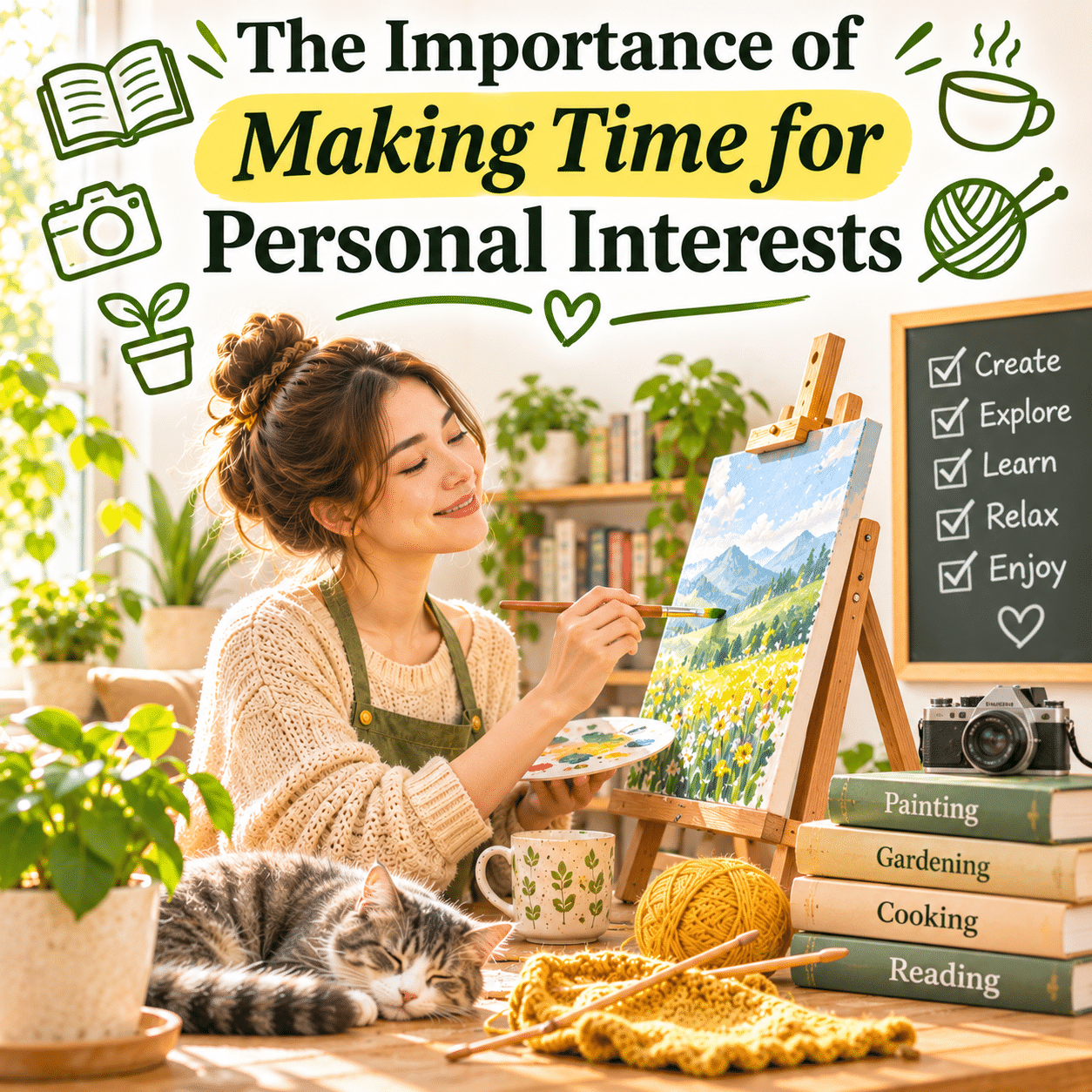
Everyday life is filled with responsibilities that require time, attention, and energy. Work commitments, household tasks, family obligations, financial responsibilities, and practical routines can occupy much of a person’s schedule. Even when these activities are meaningful, they may leave limited opportunities for exploring personal interests.
As a result, hobbies and enjoyable activities are often treated as optional extras—things to pursue only after everything else has been completed.
Someone who loves reading may repeatedly postpone opening a book. A person interested in gardening may struggle to find time for their plants. Someone who enjoys photography, music, cooking, crafts, or outdoor activities may gradually stop participating because other responsibilities seem more urgent.
Over time, personal interests can become something people remember enjoying rather than something they actively experience.
However, making time for personal interests is not simply about filling empty hours or adding more activities to an already busy schedule.
It is about recognizing that everyday life includes more than responsibilities and measurable accomplishments.
Personal interests provide opportunities for enjoyment, curiosity, learning, self-expression, and meaningful experiences. They can help people maintain a sense of individuality while participating in work, relationships, and household life.
These activities do not need to be expensive, impressive, or productive.
Reading a few pages of a favorite book, caring for a small garden, exploring a new recipe, listening closely to music, or taking photographs during a neighborhood walk can all be worthwhile ways to spend time.
Some interests involve developing skills. Others offer companionship, relaxation, physical activity, or opportunities to explore unfamiliar subjects.
The value of personal interests also changes throughout life. A hobby that once required several hours may eventually fit into shorter sessions. New responsibilities may influence how often someone participates, while changing preferences may lead to entirely different activities.
Maintaining personal interests therefore requires flexibility rather than rigid scheduling.
Understanding why these activities matter can help people create a more balanced relationship between obligations, leisure, and personal fulfillment.
Making time for personal interests is not about escaping everyday life.
It is about ensuring that everyday life continues to include activities that reflect who we are, what we enjoy, and what we remain curious to discover.
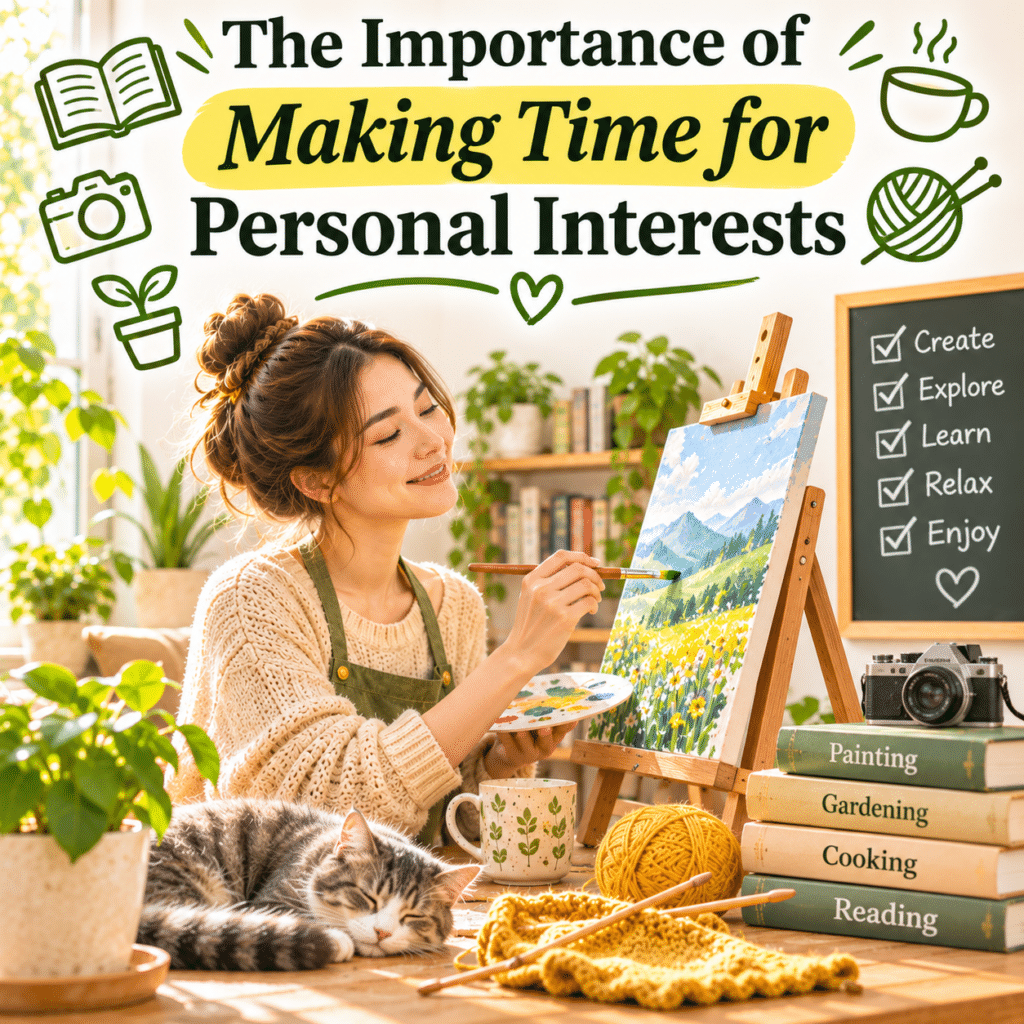
1. Understanding What Personal Interests Really Mean
Personal interests are activities, subjects, or experiences that attract someone’s attention because they find them enjoyable, meaningful, or engaging.
They may involve creative hobbies, intellectual curiosity, physical activities, practical skills, or social experiences.
Examples include reading, gardening, photography, cooking, painting, hiking, music, collecting, crafting, writing, and learning about unfamiliar subjects.
Some interests require regular practice, while others can be enjoyed occasionally.
A person may spend years developing musical skills or simply enjoy discovering new artists.
Someone may maintain an elaborate garden or care for a few indoor plants.
Neither approach is inherently more valuable.
Personal interests are defined primarily by genuine curiosity and enjoyment rather than external expectations.
2. Why Personal Interests Matter in Everyday Life
Responsibilities are essential parts of daily living, but they do not represent every aspect of a person’s identity.
Personal interests create opportunities to engage with activities chosen for their own appeal.
Someone who spends the workday completing professional assignments may enjoy painting in the evening.
A person responsible for household organization may appreciate reading fiction or exploring nature.
These activities provide variety and opportunities for personal expression.
They can also create experiences that are not governed by deadlines, evaluations, or obligations.
The importance of personal interests lies partly in allowing people to participate in life beyond what they are required to do.
3. The Difference Between Responsibilities and Personal Interests
Responsibilities generally involve commitments that need to be fulfilled.
They may include employment, caregiving, financial management, household maintenance, and other practical obligations.
Personal interests are usually pursued because someone wants to participate.
However, the distinction is not always absolute.
A person may enjoy cooking while also being responsible for preparing meals.
Someone may love gardening while maintaining an outdoor space.
An activity can contain both obligation and enjoyment.
The important consideration is whether individuals have opportunities to make personal choices and participate in activities that feel meaningful to them.
4. Why Personal Interests Are Often Postponed
Personal interests may be postponed for many practical reasons.
Work schedules can be demanding.
Family responsibilities may require immediate attention.
Household tasks can accumulate.
Some people have limited financial resources, transportation options, or access to suitable spaces.
Others may feel that enjoyable activities are less important than productive tasks.
These circumstances can make leisure difficult to prioritize.
However, postponing every personal interest until all responsibilities disappear may be unrealistic.
Daily obligations rarely end completely.
A more sustainable approach involves finding manageable opportunities for personal activities within existing circumstances.
5. The Problem With Waiting for Perfect Free Time
People sometimes imagine returning to their hobbies when life becomes less busy.
They may plan to start reading again after completing a major project or resume painting when their schedule becomes easier.
Occasional delays are normal.
However, waiting for a completely open schedule can make personal interests difficult to maintain.
There may always be another task requiring attention.
Instead of expecting ideal conditions, people can consider smaller opportunities.
A short reading session, occasional creative project, or weekend walk may be more realistic than an elaborate schedule.
Meaningful leisure does not always require uninterrupted hours.
6. Personal Interests and Individual Identity
People often describe themselves through their professions, relationships, or responsibilities.
Personal interests provide additional ways to understand and express individuality.
Someone may identify as a reader, gardener, photographer, musician, or nature enthusiast.
These interests can reflect personal values, preferences, and curiosity.
They may also change over time.
A person who once enjoyed competitive sports may later prefer photography or walking.
An interest does not need to become a permanent identity.
Its value lies in providing opportunities for exploration and personal expression beyond assigned roles.
7. The Freedom to Enjoy Something Without Achievement
Many areas of modern life emphasize measurable results.
Work may involve performance goals.
Education often includes assessments.
Household responsibilities require completed tasks.
Personal interests can provide a different experience.
A person may read without tracking the number of books completed.
Someone may paint without displaying the artwork.
A gardener may experiment with plants without creating a perfect landscape.
These activities can be worthwhile because they are enjoyable.
Personal interests do not need to become another system of targets and evaluations.
8. Why Hobbies Do Not Need to Become Profitable
Some personal interests can develop into professional opportunities.
A photographer may begin accepting paid assignments.
Someone who enjoys baking may establish a small business.
A craft enthusiast may sell handmade products.
These developments can be rewarding when they reflect genuine personal goals.
However, earning money from a hobby is not a requirement.
Commercial activity may introduce customer expectations, deadlines, and administrative responsibilities.
A person may prefer to keep certain interests separate from work.
Choosing not to monetize a hobby does not make it less meaningful.
9. The Role of Enjoyment in a Balanced Life
Enjoyment is a legitimate part of everyday living.
People do not need to justify every pleasant activity through productivity or practical benefits.
Listening to music, reading fiction, watching birds, or creating a simple craft may provide satisfaction without producing a measurable result.
Different people enjoy different activities.
An experience that feels relaxing to one person may seem uninteresting to another.
Personal interests should therefore reflect individual preferences.
A balanced life makes room for responsibilities while recognizing that enjoyable experiences also deserve consideration.
10. Personal Interests as Opportunities for Curiosity
Curiosity encourages people to explore unfamiliar ideas, materials, places, and activities.
Personal interests can provide opportunities for this exploration.
Someone interested in cooking may investigate different ingredients.
A photography enthusiast may experiment with lighting.
A person who enjoys gardening may learn about plant varieties.
These discoveries can make ordinary activities more engaging.
Curiosity does not require formal study or advanced expertise.
People can explore subjects casually, ask questions, and learn at a comfortable pace.
11. Learning Without Academic Pressure
Many personal interests involve learning.
A person may study a foreign language, practice a musical instrument, or develop woodworking skills.
However, learning through leisure can differ from formal education.
There may be no examination, qualification, or fixed curriculum.
People can focus on subjects that interest them and revisit difficult topics when necessary.
Some individuals enjoy structured courses.
Others prefer informal experimentation.
Both approaches can be appropriate.
The value lies in maintaining opportunities to discover and understand new things.
12. The Satisfaction of Developing Skills
Developing a skill can be enjoyable.
Someone learning photography may gradually understand composition.
A beginner knitter may become more comfortable with different stitches.
A home cook may discover techniques that make preparing meals easier.
These improvements can provide a sense of progress.
However, skill development should not become a requirement for every personal interest.
Some people enjoy practicing toward advanced goals.
Others prefer casual participation.
Personal satisfaction matters more than meeting an external standard of achievement.
13. Creative Interests and Self-Expression
Creative interests allow people to explore ideas, preferences, and imagination.
Painting, writing, music, crafting, photography, and decorating can provide opportunities for self-expression.
A person may choose colors that reflect their preferences.
Someone may write fictional stories inspired by personal curiosity.
Another may arrange plants or household objects in a distinctive way.
Creative expression does not need an audience.
The activity can remain private and personally meaningful.
14. Physical Interests and Everyday Movement
Some personal interests involve physical movement.
Walking, cycling, swimming, dancing, gardening, and recreational sports are examples.
These activities may combine enjoyment with opportunities for movement.
However, their suitability depends on individual abilities, health circumstances, and environmental conditions.
People should choose activities that are appropriate for their needs.
Physical interests do not need to become competitive training programs.
A leisurely walk or informal dance session can be enjoyable without requiring performance targets.
15. Intellectual Interests and Lifelong Curiosity
Personal interests can also involve exploring ideas.
Reading history, studying languages, learning about astronomy, researching local architecture, or solving puzzles may appeal to intellectually curious individuals.
These activities can be pursued at different levels of depth.
Someone may read an occasional article about a favorite subject.
Another person may spend years studying the same topic.
Both approaches can provide enjoyment.
Lifelong curiosity does not require formal credentials.
It involves remaining open to questions, discoveries, and changing perspectives.
16. Social Interests and Shared Experiences
Some personal interests provide opportunities to connect with others.
Book clubs, craft groups, recreational sports, community gardening, and photography outings can bring people together around shared activities.
These settings may encourage conversation and the exchange of ideas.
However, social participation should remain a choice.
Some people prefer solitary hobbies.
Others enjoy alternating between independent and group activities.
A meaningful personal interest does not need to involve a large community.
The appropriate level of social interaction depends on individual preferences.
17. Why Solitary Interests Can Be Meaningful
Activities enjoyed alone can provide opportunities for personal reflection and independent decision-making.
Reading, drawing, journaling, gardening, and photography may be practiced without companions.
Solitary interests allow people to choose their own pace and direction.
Someone may spend an afternoon exploring a book without interruptions.
Another may work quietly on a craft project.
Enjoying solitary activities does not necessarily indicate loneliness.
Personal interests can provide meaningful independent experiences while existing alongside healthy relationships.
18. Making Room for Interests Within Family Life
Family responsibilities can influence how much time people have for personal activities.
Parents, caregivers, and other household members may need to coordinate schedules and share responsibilities.
Making time for individual interests may require practical communication.
Family members can discuss suitable periods for hobbies and consider one another’s needs.
Some interests can also be shared.
However, shared activities should not completely replace individual preferences.
A balanced household can recognize that different members may enjoy different forms of leisure.
19. Personal Interests in Shared Households
People living together may have different schedules, interests, and space requirements.
One person may enjoy music.
Another may prefer reading or crafting.
Some hobbies involve noise, equipment, or materials that require storage.
Respectful coordination can help everyone participate comfortably.
Possible arrangements include designated storage areas, agreed quiet periods, or shared use of a work surface.
The goal is not to create identical hobbies.
It is to make reasonable space for individual interests within shared living arrangements.
20. Personal Interests for People Living Alone
Living alone can provide flexibility in choosing activities and schedules.
A person may enjoy gardening, cooking, reading, photography, or creative projects according to personal preferences.
However, living alone does not automatically mean having abundant free time.
Work, household responsibilities, and other commitments still require attention.
Personal interests can provide structure and variety without needing to become rigid routines.
They may also offer opportunities for community participation when desired.
A satisfying leisure routine can combine independent activities with occasional shared experiences.
21. The Importance of Personal Space for Hobbies
Some interests benefit from a dedicated physical area.
A painter may need a table with suitable lighting.
A reader may appreciate a comfortable chair.
Someone who enjoys sewing may require safe storage for tools and materials.
However, a separate hobby room is not essential.
A small desk, portable supply box, or temporary workspace may be sufficient.
The arrangement should reflect the activity, available space, and household needs.
A practical environment can make it easier to begin and maintain an interest.
22. Starting With the Resources Already Available
People sometimes delay beginning a hobby because they believe they need expensive equipment.
However, many interests can be explored with basic supplies.
Drawing may begin with pencils and paper.
Photography can be explored using an existing camera or suitable phone.
Reading may be supported by public libraries.
Cooking experiments may use familiar kitchen tools.
Some activities genuinely require specialized equipment or instruction, particularly when safety is involved.
A sensible approach is to begin with suitable essentials and expand gradually.
23. Making Personal Interests Affordable
Personal interests should fit within realistic financial circumstances.
Some hobbies involve ongoing costs for materials, memberships, transportation, or equipment.
Others can be enjoyed with relatively modest resources.
People can compare options, reuse appropriate materials, borrow equipment when available, or explore community facilities.
However, affordability should not come at the expense of safety.
Protective equipment and suitable tools may be essential for certain activities.
A hobby does not need to be expensive to be personally meaningful.
24. Finding Time in Short Everyday Sessions
Not every personal interest requires several uninterrupted hours.
Someone may read for fifteen minutes.
A person may practice sketching during a quiet break.
Another may care for plants before beginning the workday.
Short sessions can make certain activities easier to maintain.
However, some hobbies require preparation, cleanup, or sustained attention.
These activities may be better suited to longer sessions.
The most practical schedule depends on the hobby and individual circumstances.
Consistency can be helpful, but flexibility remains important.
25. Using Weekends Without Overloading Them
Weekends may provide opportunities for personal interests.
However, they often include household tasks, family commitments, and necessary rest.
Filling every available hour with planned activities can create unnecessary pressure.
A more balanced approach is to select a manageable number of enjoyable experiences.
Someone may reserve part of a morning for gardening.
Another may attend an occasional workshop.
A person may simply choose to read or listen to music.
Personal interests should add enjoyment rather than make leisure feel like another demanding schedule.
26. Building Gentle Personal Routines
A familiar routine can make an interest easier to revisit.
Someone may read before bed.
Another may paint on Sunday mornings.
A person may enjoy photography during regular neighborhood walks.
These routines can provide predictable opportunities for participation.
However, strict adherence is not necessary.
Busy periods, changing energy levels, and unexpected responsibilities may interrupt plans.
A flexible routine supports an interest without turning it into an obligation.
27. Recognizing the Value of Occasional Hobbies
Not every personal interest needs to be practiced regularly.
Someone may enjoy making handmade decorations during certain seasons.
Another may take photographs only during occasional outings.
A person may return to a favorite craft several times a year.
These activities can remain meaningful despite their irregular frequency.
The value of an interest is not determined solely by how often it is pursued.
Occasional hobbies allow people to maintain variety without committing to a demanding schedule.
28. Rediscovering Interests From Earlier Life Stages
People sometimes stop participating in hobbies they once enjoyed.
Education, employment, family responsibilities, or changing circumstances may influence these decisions.
Later, an earlier interest may become appealing again.
Someone may return to drawing after many years.
Another may resume playing a musical instrument.
A person may rediscover a childhood interest in nature or photography.
Returning to a familiar hobby does not require recovering previous skill levels immediately.
The activity can be approached with fresh curiosity and realistic expectations.
29. Allowing Personal Interests to Change
Interests naturally evolve.
Someone who once enjoyed collecting may become interested in gardening.
A person who previously focused on competitive sports may prefer recreational walking.
Another may move from traditional crafts to digital illustration.
These changes are not necessarily signs of inconsistency.
They may reflect new experiences, abilities, responsibilities, or preferences.
People should feel free to explore different interests.
A hobby does not need to remain permanent to have been worthwhile.
30. Avoiding Comparison With Other Hobbyists
Creative communities and online platforms can provide inspiration.
However, they may also encourage comparison.
Someone beginning photography may compare their pictures with professional images.
A casual gardener may feel discouraged by elaborate garden designs.
These comparisons can create unrealistic expectations.
People have different experience levels, resources, schedules, and goals.
A personal interest should be evaluated primarily according to what the individual hopes to experience.
Professional-level results are not necessary for meaningful participation.
31. Balancing Personal Goals With Enjoyment
Some people enjoy setting goals for their hobbies.
They may want to finish a book series, complete a craft project, or learn a new musical technique.
Goals can provide direction and satisfaction.
However, they should remain compatible with enjoyment.
An overly ambitious schedule may make leisure feel demanding.
People can adjust goals when circumstances change.
They can also participate without setting measurable targets.
Personal interests can include achievement without being defined entirely by it.
32. When a Hobby Begins to Feel Like Work
A hobby may gradually become associated with pressure.
Someone may accept too many requests for handmade items.
A person may feel obligated to post creative work online.
Another may set demanding performance targets.
These expectations can change the experience.
When an interest begins to feel burdensome, it may be useful to reconsider commitments.
Possible adjustments include reducing deadlines, limiting requests, or returning to simpler projects.
A hobby can become professional work when that is a deliberate choice.
However, personal enjoyment deserves consideration throughout the process.
33. The Importance of Taking Breaks From Hobbies
Even enjoyable activities can become tiring.
Someone may lose interest temporarily.
A complicated project may become frustrating.
Life circumstances may leave limited energy for leisure.
Taking a break does not mean abandoning an interest permanently.
People can return when they feel ready.
They may also discover that a different activity better suits their current needs.
A sustainable relationship with hobbies allows for periods of activity, rest, and change.
34. Personal Interests During Busy Life Transitions
Major changes can affect leisure routines.
Moving, changing jobs, caring for family members, or adapting to a new household may reduce available time.
During these periods, maintaining a full hobby schedule may be unrealistic.
However, smaller forms of participation may remain possible.
Someone may listen to favorite music while organizing a new home.
Another may continue reading in shorter sessions.
The goal is not to preserve every previous routine.
It is to remain open to manageable opportunities for personal enjoyment.
35. The Role of Interests in Later Adulthood
Personal interests can remain meaningful throughout adulthood.
As work responsibilities, household arrangements, and physical abilities change, people may explore new activities or adapt familiar ones.
Someone may begin painting after retirement.
Another may continue gardening with modified tools.
A person may discover an interest in writing, music, or local history.
Age does not determine whether someone can develop a new hobby.
Practical accessibility and personal preferences should guide activity choices.
Meaningful leisure can continue to evolve across different life stages.
36. Adapting Hobbies to Different Abilities
Physical abilities and accessibility needs can influence suitable activities.
Someone with limited hand mobility may benefit from modified tools.
A person with visual limitations may prefer accessible digital features or tactile materials.
Someone who cannot stand for long periods may choose seated activities.
Adaptations should reflect individual circumstances.
Certain hobbies may require professional guidance, training, or specific safety precautions.
The objective is not to force everyone into identical activities.
It is to support participation in personally meaningful interests through appropriate methods.
37. Sharing Personal Interests With Others
Sharing an interest can create opportunities for connection.
A person may invite a friend to a photography walk.
Family members may cook together.
Neighbors may exchange gardening ideas.
These experiences can encourage conversation and mutual learning.
However, not everyone needs to share the same hobbies.
An individual may prefer to keep certain interests private.
Respecting different preferences helps maintain enjoyable relationships.
Shared interests can strengthen connections, but independent interests are equally legitimate.
38. Respecting Other People’s Personal Interests
A balanced household or relationship recognizes that people may value different activities.
One person may enjoy reading.
Another may prefer sports, crafts, or music.
These differences do not necessarily indicate incompatible lifestyles.
Respectful communication can help people understand one another’s preferences.
It may also be useful to discuss time, spending, noise, and shared-space considerations.
Supporting another person’s interests does not require participating in every activity.
Sometimes respect simply means allowing appropriate time and space.
39. Protecting Leisure From Constant Productivity Pressure
Personal interests can become difficult to enjoy when every activity is evaluated according to measurable results.
Someone may feel pressured to finish more books, improve skills rapidly, or create content for an audience.
However, leisure does not need to function like professional work.
A person can read slowly, experiment with materials, or enjoy an activity without documenting progress.
Productive outcomes may occur naturally.
They do not need to become the primary purpose.
Protecting personal interests from unnecessary expectations helps preserve their role as chosen experiences.
40. Creating a Sustainable Place for Personal Interests
A sustainable approach to personal interests reflects real circumstances.
It considers available time, finances, responsibilities, physical abilities, and changing preferences.
Some people may enjoy daily activities.
Others may prefer weekly or occasional participation.
A hobby may involve structured learning or casual exploration.
There is no universal schedule that works for everyone.
The important principle is to preserve reasonable opportunities for activities that feel personally meaningful.
Making time for interests should support everyday life rather than compete with it unnecessarily.
Practical Reference: Why Personal Interests Matter
Personal interests can contribute to everyday life in several ways.
| Area of Value | How Personal Interests May Contribute | Everyday Examples |
|---|---|---|
| Personal Enjoyment | Provide activities chosen for pleasure | Reading, music, gardening |
| Self-Expression | Allow exploration of individual preferences | Painting, writing, photography |
| Curiosity | Encourage discovery of unfamiliar ideas | Learning history, exploring recipes |
| Skill Development | Offer opportunities to practice abilities | Sewing, woodworking, playing music |
| Physical Activity | Provide enjoyable forms of movement | Walking, dancing, cycling |
| Social Connection | Create shared experiences | Book clubs, hobby groups |
| Independent Leisure | Allow time for personal activities | Journaling, sketching |
| Creativity | Encourage experimentation and imagination | Crafting, decorating |
| Personal Identity | Support interests beyond assigned responsibilities | Gardening, collecting, photography |
| Everyday Variety | Introduce experiences beyond routine tasks | Local exploration, creative projects |
These are potential benefits rather than guaranteed outcomes. The experience depends on individual preferences and circumstances.
Choosing Personal Interests That Fit Your Lifestyle
| Personal Interest | Main Appeal | Time Flexibility | Practical Considerations |
|---|---|---|---|
| Reading | Stories, ideas, and learning | High | Books, library access, suitable lighting |
| Gardening | Plants and natural processes | Moderate | Space, water, sunlight, maintenance |
| Drawing | Visual creativity | High | Basic supplies and workspace |
| Photography | Observation and visual expression | High | Camera access, privacy considerations |
| Cooking | Practical creativity and experimentation | Moderate | Ingredients, equipment, food safety |
| Knitting | Tactile creative activity | High | Materials, hand comfort |
| Music | Listening, performance, or composition | Variable | Instruments, noise levels |
| Walking | Outdoor exploration and movement | High | Suitable routes and conditions |
| Creative Writing | Imagination and expression | High | Preferred writing tools |
| Painting | Colors and artistic experimentation | Moderate | Materials, cleanup, ventilation |
| Learning Languages | Intellectual curiosity | High | Learning resources and practice |
| Birdwatching | Nature observation | Moderate | Suitable locations and accessibility |
| Scrapbooking | Personal memory-keeping | High | Materials and storage |
| Woodworking | Hands-on construction | Variable | Training, equipment, safety |
| Community Activities | Shared interests and participation | Variable | Scheduling and accessibility |
The most suitable interest is one that reflects genuine curiosity and practical circumstances.
A Step-by-Step Guide to Making Time for Personal Interests
Step 1: Identify Activities You Genuinely Enjoy
Consider interests that attract your attention without external pressure.
Think about activities you currently enjoy or would like to explore.
Step 2: Review Your Existing Schedule
Notice where time is already committed to essential responsibilities.
Avoid assuming that every available minute can be filled with another activity.
Step 3: Choose a Manageable Starting Point
Begin with one or two interests rather than attempting to pursue many hobbies simultaneously.
Step 4: Match the Activity to Available Time
Some hobbies fit short sessions.
Others require longer periods.
Choose a realistic arrangement.
Step 5: Prepare Suitable Materials
Keep essential supplies accessible when practical.
Avoid unnecessary purchases before understanding your level of interest.
Step 6: Create a Comfortable Environment
Choose a safe, practical space that supports the activity.
A temporary workspace may be sufficient.
Step 7: Communicate With Household Members
When responsibilities and spaces are shared, discuss suitable arrangements.
Respect everyone’s needs.
Step 8: Allow Flexibility
Busy periods may interrupt planned activities.
Adjust your schedule without treating every missed session as failure.
Step 9: Focus on Enjoyment
Notice what you appreciate about the experience.
Avoid requiring constant measurable progress.
Step 10: Revisit Your Interests Over Time
As circumstances change, adapt your activities.
Remain open to new interests and different forms of participation.
Example: A Flexible Week of Personal Interests
The following example illustrates how different activities might fit into an ordinary week.
It is not a schedule everyone should follow.
| Day | Possible Personal Interest | Approximate Time | Main Purpose |
|---|---|---|---|
| Monday | Read a favorite book | 15–20 minutes | Personal enjoyment |
| Tuesday | Practice drawing | 20–30 minutes | Creative exploration |
| Wednesday | Listen attentively to music | 15 minutes | Enjoyment and discovery |
| Thursday | Care for indoor plants | 15–20 minutes | Gardening interest |
| Friday | Try a new recipe | 30–60 minutes | Practical creativity |
| Saturday | Photography walk | 30–60 minutes | Observation and exploration |
| Sunday | Work on a craft project | 30–45 minutes | Independent leisure |
Someone with limited time may choose only one or two activities.
Another person may prefer longer weekend sessions.
The objective is to find a manageable rhythm rather than complete a fixed number of hobbies.
Personal Interests for Different Everyday Situations
| Situation | Suitable Possibilities | Practical Approach |
|---|---|---|
| Busy Professional | Reading, sketching, music | Short flexible sessions |
| Parent With Young Children | Simple crafts, gardening, reading | Coordinate personal and shared activities |
| Person Living Alone | Cooking, photography, writing | Choose activities according to personal preferences |
| Small Apartment Resident | Drawing, embroidery, digital art | Use compact or portable supplies |
| Limited Budget | Walking, journaling, paper crafts | Begin with existing resources |
| Frequent Traveler | Photography, travel journaling | Choose portable activities |
| Remote Worker | Gardening, walking, painting | Create variety beyond work routines |
| Retired Adult | Gardening, music, crafts, learning | Explore interests at a comfortable pace |
| Person With Limited Mobility | Adapted crafts, writing, accessible digital activities | Select suitable tools and methods |
| Social Hobby Enthusiast | Book clubs, community classes | Choose manageable group commitments |
These examples are suggestions rather than fixed categories.
Simple Ways to Reconnect With Forgotten Interests
1. Revisit an Old Favorite Book
Return to a genre or author you once enjoyed.
2. Try a Familiar Creative Activity
Use basic materials to explore drawing, painting, or crafting again.
3. Listen to Music You Once Loved
Rediscover familiar artists or explore related styles.
4. Prepare a Favorite Recipe
Revisit cooking techniques or dishes associated with earlier interests.
5. Explore a Nearby Natural Space
Take a walk and observe plants, birds, or seasonal changes.
6. Look Through Earlier Creative Projects
Review old photographs, notebooks, or handmade objects for inspiration.
7. Begin a Small Gardening Project
Care for one suitable plant rather than starting an elaborate garden.
8. Join an Occasional Workshop
Explore a subject without immediately committing to a long-term course.
9. Keep a Personal Interest Notebook
Record ideas, subjects, or activities you would like to explore.
10. Invite a Friend to Share an Activity
Choose an experience both people genuinely enjoy.
11. Experiment With a New Technique
Try a different approach within a familiar hobby.
12. Allow Yourself to Start Again
Return to an old interest without expecting to perform at your previous level.
How to Keep Personal Interests Enjoyable Rather Than Demanding
| Common Pressure | More Balanced Approach |
|---|---|
| I must practice every day | Choose a realistic, flexible rhythm |
| I need expensive equipment | Start with suitable essentials |
| My hobby should make money | Treat monetization as optional |
| I must become highly skilled | Allow casual participation |
| I should finish every project | Recognize the value of experimentation |
| I need to share everything online | Keep activities private when preferred |
| Other people are better than me | Focus on personal enjoyment and learning |
| I have too many interests | Explore a manageable number at a time |
| I missed a session | Resume when circumstances allow |
| My interests have changed | Allow hobbies to evolve naturally |
| Leisure must be productive | Recognize enjoyment as a valid purpose |
| I need a perfect schedule | Make use of practical opportunities |
A personal interest should remain something you choose, not another responsibility you feel compelled to complete.
Common Mistakes When Making Time for Personal Interests
1. Waiting Until Every Responsibility Is Finished
Daily responsibilities rarely disappear entirely.
Look for realistic opportunities rather than perfect conditions.
2. Planning Too Many Activities
An overly ambitious hobby schedule may become difficult to maintain.
Begin with a manageable number of interests.
3. Comparing Your Progress With Others
Different people have different resources, abilities, and goals.
Focus on your own experience.
4. Spending Too Much Before Starting
Expensive equipment does not guarantee enjoyment.
Explore an activity before making major purchases.
5. Turning Every Hobby Into a Productivity Goal
Personal interests do not always need measurable outcomes.
Allow room for casual participation.
6. Ignoring Household Responsibilities
Leisure should be balanced with necessary commitments.
Coordinate schedules when responsibilities are shared.
7. Choosing Hobbies Only Because They Are Popular
Trends may introduce interesting activities, but personal preferences should guide decisions.
8. Expecting Immediate Expertise
Learning takes time.
Beginners can enjoy an activity without producing advanced results.
9. Refusing to Take Breaks
Changing circumstances may require temporary pauses.
Rest and flexibility are part of sustainable participation.
10. Feeling Guilty About Enjoyment
Reasonable leisure is a legitimate part of everyday life.
Not every activity must serve a practical purpose.
11. Ignoring Safety and Accessibility
Choose suitable tools, environments, and methods.
Certain hobbies require training or protective equipment.
12. Believing Interests Must Remain Permanent
People change.
It is reasonable for hobbies to change as well.
Personal Interest Balance Checklist
Use this checklist to reflect on whether personal interests have a comfortable place in everyday life.
Identifying Interests
- I recognize activities that genuinely interest me.
- I allow myself to explore unfamiliar subjects.
- I do not choose hobbies solely for external approval.
- I recognize that personal interests can change.
- I value enjoyment as well as skill development.
Managing Time
- I consider personal interests when planning leisure time.
- I choose realistic activity durations.
- I avoid overloading my schedule.
- I allow flexibility during busy periods.
- I can return to a hobby after taking a break.
Managing Expectations
- I do not require every hobby to become profitable.
- I accept ordinary beginner mistakes.
- I avoid unnecessary comparisons.
- I can enjoy activities without measurable achievements.
- I recognize that unfinished projects may still have value.
Practical Arrangements
- I use suitable materials and equipment.
- My hobby spending fits my circumstances.
- I consider safety and accessibility.
- I respect shared household spaces.
- I communicate about leisure time when necessary.
Long-Term Enjoyment
- I maintain room for curiosity.
- I appreciate both independent and shared activities.
- I allow interests to evolve.
- I avoid turning every hobby into an obligation.
- I recognize that leisure contributes to a balanced everyday life.
This checklist is a reflection tool rather than another set of tasks to complete.
Frequently Asked Questions
1. Why is making time for personal interests important?
Personal interests provide opportunities for enjoyment, curiosity, self-expression, learning, and experiences beyond everyday responsibilities.
2. What counts as a personal interest?
Reading, gardening, cooking, photography, music, crafts, sports, writing, and exploring unfamiliar subjects can all be personal interests when pursued through genuine curiosity or enjoyment.
3. How can I make time for hobbies with a busy schedule?
Begin with manageable activities, use short sessions when appropriate, and maintain flexibility around essential responsibilities.
4. Do hobbies need to be productive?
No. Personal interests can be meaningful simply because they are enjoyable or engaging.
5. Is it okay to have several different interests?
Yes. People may enjoy multiple activities, although pursuing too many simultaneously can become demanding. A manageable balance is helpful.
6. What if I do not have a particular hobby?
Explore activities that attract your curiosity. Personal interests do not need to begin as formal hobbies or long-term commitments.
7. Can personal interests change over time?
Yes. Interests may evolve with experience, age, circumstances, abilities, and preferences.
8. Should I turn my hobby into a business?
Only if doing so aligns with your goals. Commercializing a hobby can create opportunities but may also introduce additional responsibilities.
9. Are inexpensive hobbies worthwhile?
Absolutely. The value of a personal interest depends on the experience it provides, not the amount of money spent.
10. Can personal interests be enjoyed alone?
Yes. Many activities, including reading, journaling, drawing, and gardening, can be meaningful independent experiences.
11. How can families support individual hobbies?
Family members can communicate about schedules, share responsibilities appropriately, and respect different interests and space requirements.
12. Is it normal to lose interest in a hobby?
Yes. Interests can change naturally. Taking a break or exploring something new does not necessarily indicate failure.
13. How much time should I spend on personal interests?
There is no universal requirement. The appropriate amount depends on available time, responsibilities, preferences, and the activity itself.
14. Can personal interests help people connect with others?
Yes. Shared hobbies can provide opportunities for conversation, cooperation, and community participation, although social involvement is optional.
15. What is the most important principle when making time for personal interests?
Choose activities that genuinely matter to you and maintain a flexible balance with everyday responsibilities. Personal enjoyment does not need to be justified through productivity.
Final Thoughts
Personal interests are easy to overlook when everyday responsibilities demand constant attention.
Work, household tasks, family commitments, and practical obligations are important, but they do not represent every aspect of a meaningful life.
People also need opportunities to explore what they enjoy, follow their curiosity, express their preferences, and participate in activities chosen for personal reasons.
These experiences can take many forms.
A person may find enjoyment in reading, painting, gardening, cooking, photography, music, writing, or exploring nature.
Some interests involve learning and improvement.
Others offer simple pleasure, companionship, or quiet independent time.
Not every hobby needs to become a business, produce an impressive result, or develop into an advanced skill.
The experience itself can be worthwhile.
Making time for personal interests does not require abandoning responsibilities or creating an elaborate leisure schedule.
It often begins with realistic choices.
A short reading session, an occasional creative afternoon, a familiar weekend walk, or a small personal project can provide opportunities to reconnect with activities that matter.
The most sustainable approach is flexible.
Interests may change, schedules may become busy, and some hobbies may be temporarily set aside.
What matters is maintaining the possibility of returning to enjoyable activities without unnecessary guilt or pressure.
Personal interests also remind us that individuality extends beyond professional roles and household responsibilities.
They allow people to remain curious, discover new preferences, revisit earlier passions, and experience different aspects of everyday life.
Ultimately, making time for personal interests is not about doing more.
It is about ensuring that the time available for living includes activities that reflect personal enjoyment, curiosity, and meaning.
A fulfilling everyday life is not defined only by what we accomplish or what others need from us. It is also shaped by the interests we choose to explore simply because they make life more enjoyable and personally meaningful.