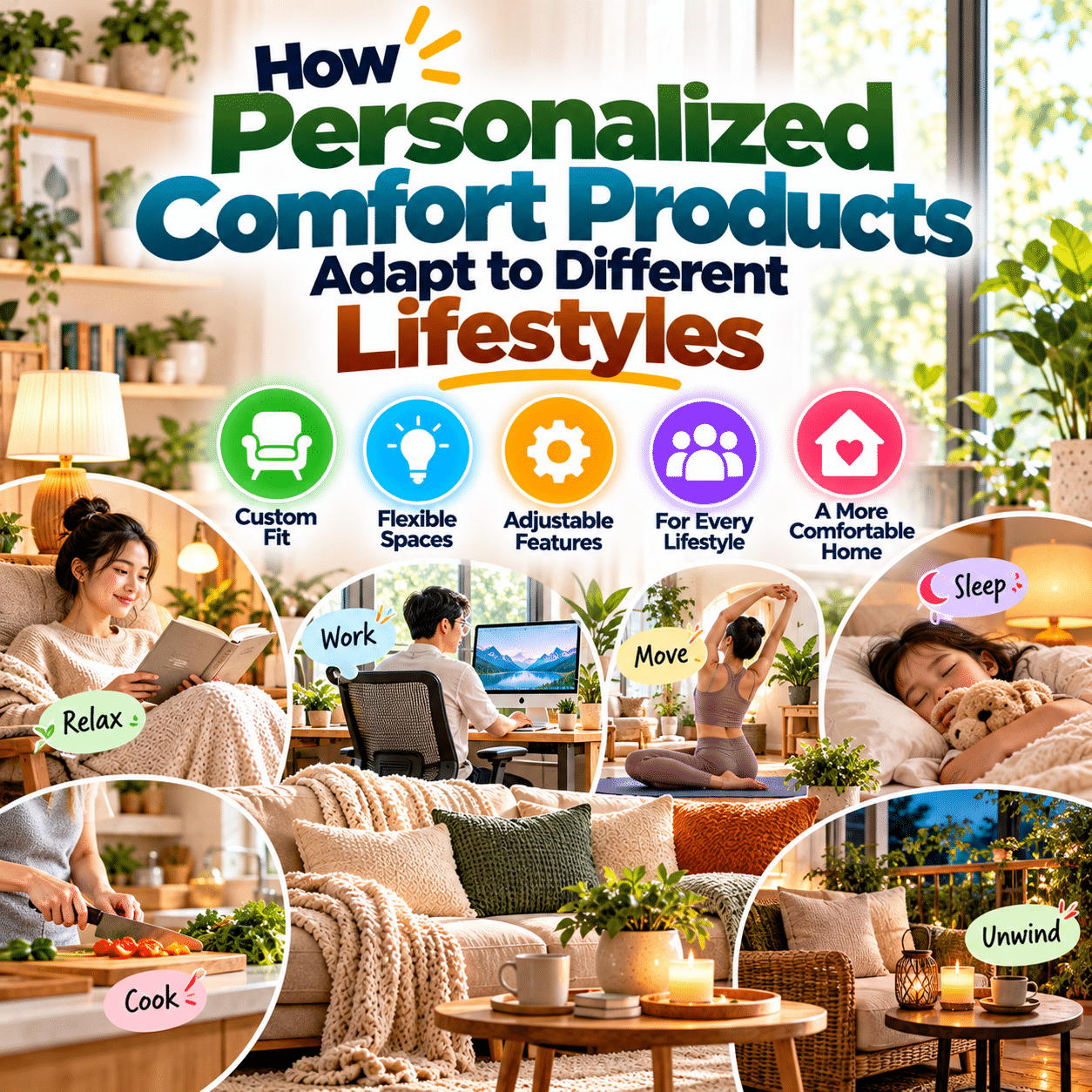
Comfort is personal.
A chair that feels supportive to one person may be uncomfortable for another. A soft pillow may suit one sleeping position but feel unsuitable for someone with different preferences. A brightly lit room may be ideal for detailed work yet unpleasant during a quiet evening.
These differences help explain the appeal of personalized comfort products.
Rather than expecting everyone to use the same arrangement, these products offer ways to adjust physical support, lighting, temperature, texture, or other features according to individual needs.
Some are simple. An adjustable reading lamp can direct light toward a book. A removable cushion can change the feel of a chair. A layered bedding system allows someone to add or remove warmth.
Others incorporate more complex mechanisms, such as height-adjustable desks, configurable seating, or programmable home controls.
The value of personalization does not necessarily come from advanced technology.
It comes from having the right options for the person, activity, and environment.
However, not every adjustable product is useful, and more settings do not automatically produce greater comfort.
The best personalized comfort products address real differences between users while remaining practical, safe, and easy to maintain.
Understanding how these products adapt to different lifestyles can help households make thoughtful decisions that remain useful as routines change.
1. What Are Personalized Comfort Products?
Personalized comfort products are items that allow users to select or adjust features to better match their preferences, physical characteristics, activities, or surroundings.
Personalization can take several forms.
Adjustable Products
These allow changes to height, angle, firmness, brightness, or other settings.
Examples include adjustable chairs, monitor arms, and dimmable lamps.
Configurable Products
These use removable or interchangeable components.
Examples include modular cushions, sectional furniture, and certain bedding systems.
Size-Specific Products
These are available in different dimensions to accommodate different users.
Examples include pillows, footrests, and seating.
Adaptive Products
Some devices adjust their operation based on schedules, environmental measurements, or user-selected preferences.
Portable Products
Movable accessories can provide comfort in different locations.
Simple Personal Choices
Selecting a fabric texture, cushion thickness, or blanket weight is also a form of personalization.
A product does not need to collect personal data or connect to an application to be personalized.
2. Why One-Size-Fits-All Comfort Has Limitations
People differ in ways that affect how they experience products.
Body Dimensions
Height, limb proportions, and body shape can influence furniture fit.
Physical Capabilities
Grip strength, mobility, reach, and other abilities affect usability.
Sensory Preferences
People have different responses to lighting, sound, temperature, and texture.
Daily Activities
Reading, working, resting, and cooking require different arrangements.
Household Conditions
Available space, climate, noise, and other environmental factors influence comfort.
Shared Spaces
Multiple household members may need different settings.
Changing Circumstances
Preferences and needs can change over time.
These differences make flexibility valuable.
The goal is not to design a product that perfectly suits everyone in every situation.
It is to provide meaningful choices that accommodate the intended users.
3. Personalization Begins With Understanding the User
Before choosing an adjustable product, it helps to identify the actual comfort requirement.
What Activity Will the Product Support?
A reading chair has different priorities from a desk chair.
How Long Will It Be Used?
An item used for a few minutes may have different requirements from one used for several hours.
What Currently Feels Uncomfortable?
Identify whether the problem involves height, pressure, temperature, glare, reach, or another factor.
Who Will Use It?
A shared product may need a broader adjustment range.
What Space Is Available?
A large adjustable mechanism may not fit a compact room.
How Much Maintenance Is Acceptable?
Powered features, removable components, and specialized materials may require additional care.
Is a New Purchase Necessary?
An existing item may already be adjustable or suitable with a simple modification.
Useful personalization begins with a specific need rather than a long list of features.
4. Adjustable Chairs Support Different Bodies and Activities
Seating is one of the clearest examples of personalized comfort.
A suitable chair should support its intended user and activity.
Seat Height
Height adjustment can help accommodate different leg lengths and work surfaces.
Seat Depth
Appropriate depth allows the seat to support the thighs without uncomfortable pressure.
Backrest Position
An adjustable backrest may accommodate different preferences and sitting positions.
Lumbar Support
Some chairs offer adjustable lower-back support.
Its placement and usefulness depend on individual fit.
Armrests
Adjustable armrests can help accommodate different desk arrangements and body proportions.
Recline Settings
Reclining features may support different seated activities.
Cushioning
Firmness and upholstery affect comfort, although preferences vary.
Stability
Adjustment mechanisms should remain stable and operate as intended.
A chair with numerous controls is not necessarily better than a simpler chair that fits well.
The most important feature is appropriate support for the actual user.
5. Personalized Desk Setups Support Flexible Work
A comfortable workspace involves more than choosing one piece of furniture.
The chair, desk, monitor, keyboard, and other equipment should work together.
Height-Adjustable Desks
These can accommodate different working heights and allow changes in position.
Monitor Arms
An adjustable arm can help position a display according to the user’s viewing needs.
Keyboard Placement
A suitable keyboard arrangement may reduce awkward reaching or wrist positions.
Footrests
A footrest can provide support when the user’s feet do not rest comfortably on the floor.
Task Lighting
Adjustable lamps can direct light toward different activities.
Flexible Storage
Movable organizers can keep frequently used items accessible.
Movement Opportunities
Even a well-adjusted workspace should allow changes in position and activity.
Personalized workspace design focuses on the relationship between the user, equipment, and task.
6. Pillows Offer Different Types of Personal Comfort
Pillows are commonly marketed with promises of better sleep or specialized support.
In practice, comfort depends on several individual factors.
Loft
Pillow height influences how the head and neck are supported.
Firmness
Some users prefer soft pillows, while others prefer firmer support.
Shape
Traditional, contoured, and other shapes provide different experiences.
Sleeping Position
A preferred sleeping position may influence the type of support that feels comfortable.
Material
Foam, fiberfill, latex, and other materials differ in texture, resilience, and care requirements.
Adjustable Fill
Some pillows allow users to remove or add filling.
Temperature Preferences
Cover fabrics and construction can affect perceived warmth.
Maintenance
Removable covers and suitable cleaning instructions can improve practicality.
No pillow guarantees relief from neck pain, insomnia, or other medical conditions.
The best choice is one that provides appropriate comfort without creating new problems.
7. Layered Bedding Allows Comfort to Change With the Season
Personalization does not always require an adjustable mechanism.
Bedding can be customized by combining suitable layers.
Lightweight Sheets
Different fabrics offer different textures and thermal experiences.
Blankets
Additional blankets provide flexible warmth.
Duvets and Comforters
Different fill types and constructions influence insulation and weight.
Removable Covers
Covers may simplify cleaning and allow changes in fabric preference.
Seasonal Rotation
Some households use lighter bedding during warm periods and heavier options in cooler conditions.
Shared Beds
People sharing a bed may prefer different levels of warmth.
Separate blankets can sometimes accommodate those differences.
Care Requirements
Materials should suit realistic washing and storage routines.
A layered approach can provide flexibility without requiring frequent replacement of the entire bedding system.
8. Adjustable Lighting Supports Different Daily Activities
Lighting needs change throughout the day.
A bright desk lamp may be useful for detailed tasks, while softer illumination may suit quiet evening activities.
Dimmable Lights
Brightness adjustment can support different tasks and preferences.
Directional Lamps
Movable lamp heads allow users to direct light where it is needed.
Adjustable Color Appearance
Some lighting products offer different color-temperature settings.
Reading Lights
Focused illumination can improve visibility without requiring every light in the room to be bright.
Smart Lighting
Connected systems may support schedules or preset scenes.
Manual Controls
Simple switches and dimmers may provide enough flexibility without an app.
Glare Reduction
Good positioning matters as much as the number of available settings.
Accessibility
Controls should be easy for intended users to understand and operate.
Personalized lighting is useful when it improves visibility and comfort for specific activities.
9. Temperature-Control Products Reflect Different Comfort Preferences
Temperature preferences vary between individuals and activities.
Some people prefer a cooler environment during sleep, while others enjoy additional warmth when reading or relaxing.
Fans
Adjustable airflow can provide different levels of air movement.
Programmable Thermostats
Where compatible with the home’s heating or cooling system, programmable controls can follow selected schedules.
Smart Thermostats
Some models can adjust settings based on user preferences, schedules, or occupancy information.
Window Coverings
Shades and curtains can help manage sunlight and some aspects of thermal comfort.
Throws and Blankets
Portable layers provide personal warmth without changing the entire room’s settings.
Heated Products
Electric blankets and similar products require careful attention to safety instructions and product condition.
Climate Matters
The usefulness and operating cost of temperature-control equipment depend on the building and local conditions.
Avoid Universal Comfort Settings
No single temperature is ideal for every person.
The most practical approach balances individual comfort, household needs, equipment compatibility, and energy use.
10. Adjustable Seating and Furniture Support Relaxation
Relaxation spaces benefit from furniture that accommodates different activities.
Reclining Chairs
Adjustable backrests or footrests may provide different sitting positions.
Modular Sofas
Some designs allow seating sections to be rearranged.
Ottomans
A movable ottoman may provide foot support or additional seating when designed for that use.
Adjustable Headrests
Certain sofas and chairs offer configurable head support.
Movable Side Tables
Portable surfaces can serve different seating arrangements.
Floor Seating
Some users enjoy floor cushions or low seating, although these options are not suitable for everyone.
Room Dimensions
Furniture must fit the available space in all intended configurations.
Mechanism Safety
Moving furniture should be used according to manufacturer instructions, with attention to pinch points, stability, and children or pets nearby.
Flexible furniture works best when its adjustments are genuinely useful.
11. Personalized Comfort Can Improve Small-Space Living
Compact homes often require one room to support several activities.
Personalized products may help spaces adapt throughout the day.
Foldable Furniture
A folding table can create temporary work or hobby space.
Portable Lighting
A movable lamp can serve a desk, bedside area, or reading corner.
Adjustable Seating
One chair may accommodate different activities when its design is suitable.
Modular Storage
Adjustable shelves can change as household needs evolve.
Multipurpose Cushions
A removable cushion may provide comfort in different seating locations.
Compact Climate Accessories
Portable fans may support comfort in particular areas.
Easy Storage
Products should be simple to put away when no longer needed.
Avoid Excessive Complexity
A product with many configurations may still be inconvenient if changing between them requires too much effort.
The best small-space solutions provide flexibility without making everyday routines cumbersome.
12. Shared Households Benefit From Easy Adjustments
Products used by several people need to accommodate different preferences.
Shared Workstations
Chairs, monitor arms, and desks may need quick adjustments between users.
Family Living Rooms
Movable cushions and flexible seating can accommodate different activities.
Shared Bedrooms
Lighting and bedding preferences may differ.
Kitchens
Adjustable storage and accessible tools may suit household members with different reaches and abilities.
Bathrooms
Handheld showerheads and accessible storage can provide practical flexibility.
Simple Controls
A product is easier to share when settings are intuitive.
Remembering Preferences
Some devices allow users to save preferred settings.
Respect Individual Needs
One person’s preferred arrangement should not automatically become the household standard.
Personalization can make shared spaces more adaptable without requiring every person to own separate equipment.
13. Different Lifestyles Call for Different Comfort Solutions
Personalized comfort is most meaningful when it responds to how someone actually lives.
Remote Workers
Adjustable workstations, task lighting, and supportive seating may be useful.
Students
Portable desk accessories and flexible lighting may suit changing study environments.
Frequent Travelers
Compact pillows, portable organizers, and suitable travel accessories may provide familiar convenience.
People With Active Routines
Comfortable recovery spaces, accessible storage, and adaptable seating may be priorities.
Older Adults
Stable seating, accessible controls, and appropriate lighting can support everyday usability.
Households With Children
Durability, safety, and adjustable storage may be especially important.
People With Sensory Preferences
Lighting, textures, and sound levels may need more careful consideration.
People Living in Small Apartments
Compact products that serve several activities can provide flexibility.
These examples are not fixed categories.
Individual preferences matter more than assumptions about age, occupation, or lifestyle.
14. Personalized Comfort and Accessibility Are Related but Different
Comfort products may offer features that support accessibility, but the two concepts should not be confused.
Personalization
Personalization allows users to select settings or features that suit their preferences.
Accessibility
Accessibility focuses on enabling people with different abilities to use products and environments.
Adjustable Height
A suitable height range may accommodate users of different statures or mobility needs.
Easy-Grip Controls
Controls requiring less force may help some users.
Clear Interfaces
Readable labels and straightforward operation can improve usability.
Stable Furniture
Secure construction is important for users who rely on furniture for support.
Reachable Storage
Accessible placement can reduce unnecessary stretching.
Individual Assessment
People with specific disabilities or functional limitations may need professional guidance or specialized products.
A product marketed as adjustable is not automatically accessible to everyone.
15. Smart Personalization Versus Manual Adjustment
Personalized comfort products can use simple physical controls or connected technology.
Neither approach is universally superior.
| Consideration | Manual adjustment | Smart or connected adjustment |
|---|---|---|
| Operation | Physical controls or switches | May include apps, sensors, schedules, or automation |
| Setup | Often straightforward | May require configuration and compatibility checks |
| Power | Some products need no electricity | Connected features generally require power |
| Privacy | Usually little or no data collection | May involve account or usage data |
| Flexibility | Depends on available controls | May support presets or automated changes |
| Maintenance | Mechanical care may be sufficient | May include software updates and connectivity |
| Long-term usability | Depends on durability and parts | Also depends on software and service support |
A manual dimmer may be ideal for one household.
Another household may appreciate scheduled lighting scenes.
The right choice depends on whether the additional technology provides meaningful convenience.
16. Personalization Does Not Always Require Buying Something New
One of the most practical aspects of personalized comfort is that it can begin with existing products.
Rearrange Furniture
Move a chair closer to natural light or away from a distracting area.
Adjust Existing Equipment
Check whether a chair, monitor, or lamp already has unused adjustment options.
Change Textile Layers
Use available blankets or cushions to adapt comfort.
Reposition Storage
Move frequently used objects within easier reach.
Modify Lighting
Change lamp placement before buying additional fixtures.
Improve Ventilation
Use appropriate existing controls and address sources of discomfort.
Create Different Activity Zones
A small rearrangement may separate work and relaxation more effectively.
Test One Change at a Time
This helps identify which adjustments are genuinely useful.
Personalization is a process of improving fit, not necessarily increasing consumption.
17. Common Mistakes When Choosing Personalized Comfort Products
More features can create more opportunities for poor purchasing decisions.
Assuming More Settings Mean Better Comfort
A product may have dozens of options without addressing the user’s actual needs.
Ignoring Adjustment Range
A chair or desk may be adjustable but still not fit a particular person.
Overlooking Ease of Use
Complicated controls can discourage regular adjustment.
Trusting Universal Comfort Claims
Products cannot guarantee the same experience for everyone.
Choosing Based Only on Appearance
Visual style does not establish physical suitability.
Ignoring Cleaning and Maintenance
Removable components and mechanisms may require additional care.
Forgetting Shared Users
A product may fit one household member but not another.
Assuming Technology Is Necessary
Manual alternatives may provide adequate functionality.
Overlooking Privacy
Connected products may collect usage or occupancy information.
Expecting Medical Results
Comfort products should not be assumed to diagnose, prevent, or treat health conditions.
The best purchase is the one that provides useful adjustment without unnecessary complexity.
18. How to Choose Personalized Comfort Products Wisely
A simple evaluation process can make purchasing decisions more effective.
Step 1: Identify the Comfort Need
Describe the problem as specifically as possible.
Step 2: Define the Activity
Determine when, where, and how the product will be used.
Step 3: Identify the Users
Consider body dimensions, preferences, and any relevant accessibility needs.
Step 4: Check Available Adjustments
Confirm that the settings cover the required range.
Step 5: Measure the Space
Consider product dimensions in all intended configurations.
Step 6: Evaluate Materials
Review texture, durability, cleaning, and suitability.
Step 7: Test the Controls
Adjustments should be easy to understand and operate.
Step 8: Review Safety
Check stability, electrical requirements, weight limits, and manufacturer warnings.
Step 9: Compare Simple Alternatives
An existing item or less complicated product may solve the problem.
Step 10: Consider Long-Term Value
Assess repairability, maintenance, replacement parts, and likely frequency of use.
Step 11: Review Privacy for Connected Products
Understand what data is collected and how settings are managed.
Step 12: Reevaluate After Use
A product is successful when it improves everyday comfort in practice.
A thoughtful choice prioritizes the experience of the user over the number of advertised features.
19. A Practical Example: One Room, Three Different Routines
Consider a small living room used for working, reading, and relaxing.
The room does not need three complete furniture arrangements.
Instead, selected products can adapt to each activity.
Morning: Computer Work
A supportive chair is adjusted for desk use.
A task lamp provides sufficient illumination.
Frequently used equipment is positioned within comfortable reach.
Afternoon: Reading
The chair or seating arrangement changes to a more relaxed position.
A directional lamp is aimed toward the reading material.
A cushion provides additional support if needed.
Evening: Relaxation
General lighting is softened while maintaining safe visibility.
A throw blanket provides warmth if desired.
Work equipment is stored or moved out of sight.
Shared Household Considerations
Another user may prefer different seating or lighting settings.
Simple adjustments allow the space to accommodate those preferences.
The Practical Lesson
The most valuable products are not necessarily those with the greatest number of functions.
They are those that make transitions between real activities easier.
20. The Future of Personalized Comfort Products
Personalized comfort products are likely to remain relevant because individual needs and daily routines will continue to vary.
Several priorities may shape their development.
Wider Adjustment Ranges
Products may be designed to accommodate more body types and preferences.
Easier Configuration
Controls may become more intuitive and accessible.
Modular Components
Replaceable or interchangeable parts can support changing needs.
Better Shared-Use Features
Quick adjustments and optional presets may make products easier for several people to use.
Thoughtful Automation
Technology may help simplify routine changes when it is reliable and appropriate.
Greater Privacy Awareness
Connected products may face stronger expectations around transparent data handling.
Durable Construction
Long-lasting mechanisms and repairable components can improve value.
More Inclusive Design
Products may better account for differences in physical abilities and sensory preferences.
Reduced Complexity
The strongest designs may offer fewer, more useful options rather than overwhelming users with settings.
Greater Emphasis on Real-World Fit
Comfort will continue to depend on how well products suit actual people and activities.
The future of personalized comfort is not about making every household device intelligent.
It is about making everyday products more adaptable, understandable, and useful.
Frequently Asked Questions
What are personalized comfort products?
Personalized comfort products are items that can be selected or adjusted to suit individual preferences, body characteristics, activities, or environmental conditions. Examples include adjustable chairs, customizable pillows, dimmable lights, and configurable furniture.
Are personalized comfort products the same as ergonomic products?
Not exactly. Ergonomic design focuses on fitting products and tasks to human capabilities. Personalized comfort is broader and may also involve temperature, lighting, texture, and other preferences.
Do personalized comfort products need smart technology?
No. Manual adjustments, interchangeable components, and appropriately selected materials can provide useful personalization without connected technology.
Are adjustable pillows better than regular pillows?
Not necessarily. Adjustable pillows offer flexibility, but a conventional pillow may already provide suitable comfort. Individual fit matters more than the number of adjustments.
Can one comfort product work for several people?
Sometimes. Products with appropriate adjustment ranges and easy controls may accommodate different users, but no product fits everyone.
Are personalized comfort products worth the extra cost?
They may be when the adjustments solve a real problem and are used regularly. Additional features that provide little benefit may not justify a higher price.
How can I personalize my home without buying many products?
Start by rearranging existing furniture, adjusting lighting, changing textile layers, improving storage placement, and testing small changes to your routines.
Conclusion: The Best Comfort Products Adapt to Real People
Personalized comfort products reflect a simple principle: people have different needs, and those needs can change throughout the day and over time.
Adjustable seating, flexible workstations, configurable bedding, movable lighting, and practical home accessories can help living spaces accommodate those differences.
Their value comes from improving fit, convenience, and usability rather than offering the largest number of features.
Some households benefit from advanced connected controls. Others may find that a simple cushion, adjustable lamp, or better furniture arrangement provides everything they need.
Personalization should make daily life easier, not more complicated.
The most thoughtful approach begins with understanding the person, the activity, and the environment before choosing a product.
The future of everyday comfort is not one perfect solution for everyone. It is the freedom to create practical, comfortable spaces that adapt to the way different people actually live.