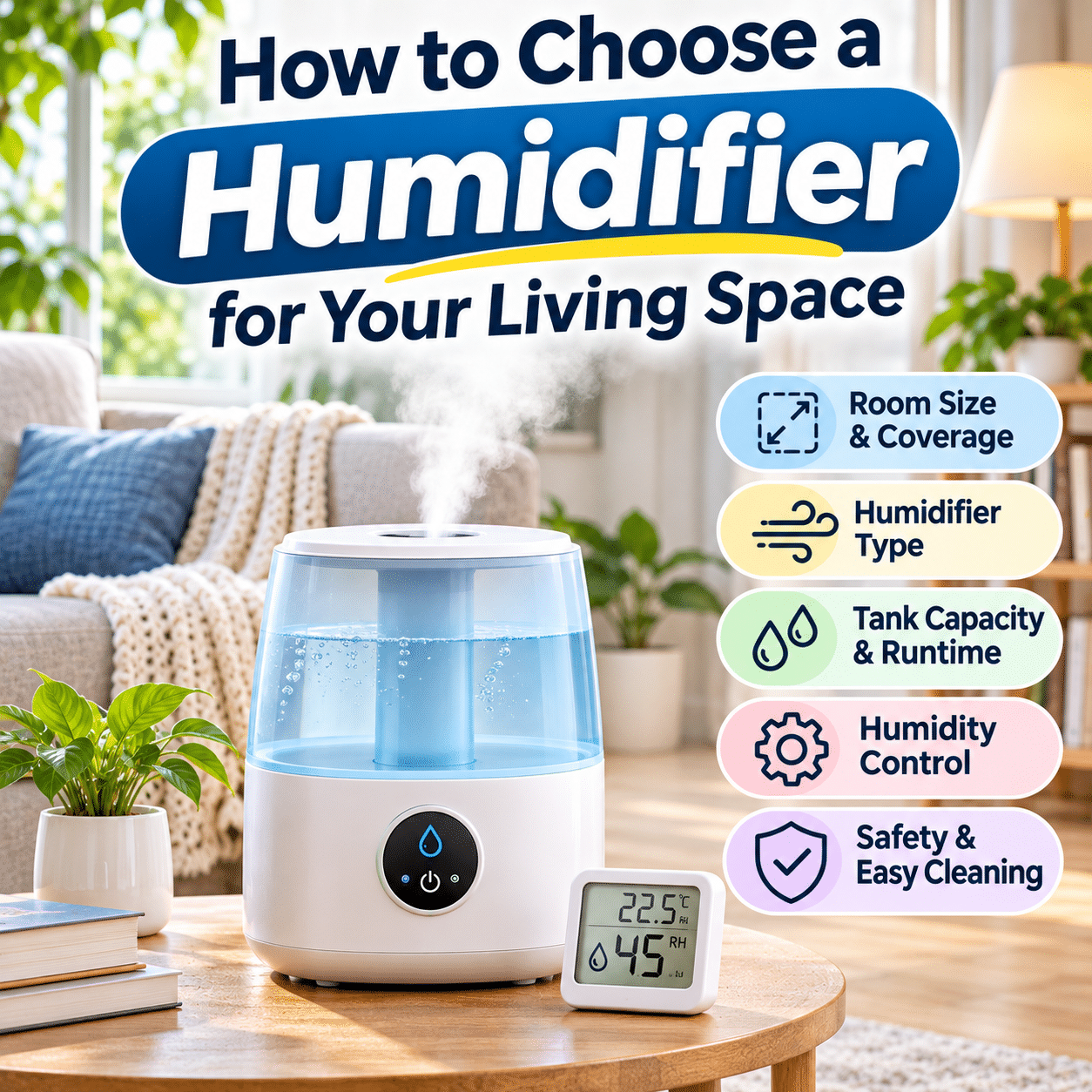
Creating a comfortable indoor environment involves more than choosing the right furniture, lighting, and temperature. Humidity also plays an important role in how a living space feels and how moisture-sensitive materials behave.
When indoor air becomes excessively dry, some people may experience dry skin, irritated nasal passages, or general discomfort. Wooden furniture, musical instruments, and certain indoor materials may also respond to changes in moisture levels. However, adding too much humidity can create different problems, including condensation, musty odors, and conditions that encourage mold and dust mites.
A home humidifier can help manage dry indoor conditions by introducing moisture into the air. Yet choosing the right humidifier requires careful consideration of room size, humidification technology, water quality, maintenance, noise, safety, and humidity control.
Not every humidifier is suitable for every room or household. A compact desktop unit may be appropriate for a small personal space, while a larger bedroom or living room may require greater moisture output and more consistent control.
This comprehensive guide explains how to choose a humidifier for your living space, compare different humidifier technologies, understand important specifications, avoid common buying mistakes, and maintain a comfortable indoor humidity level over time.
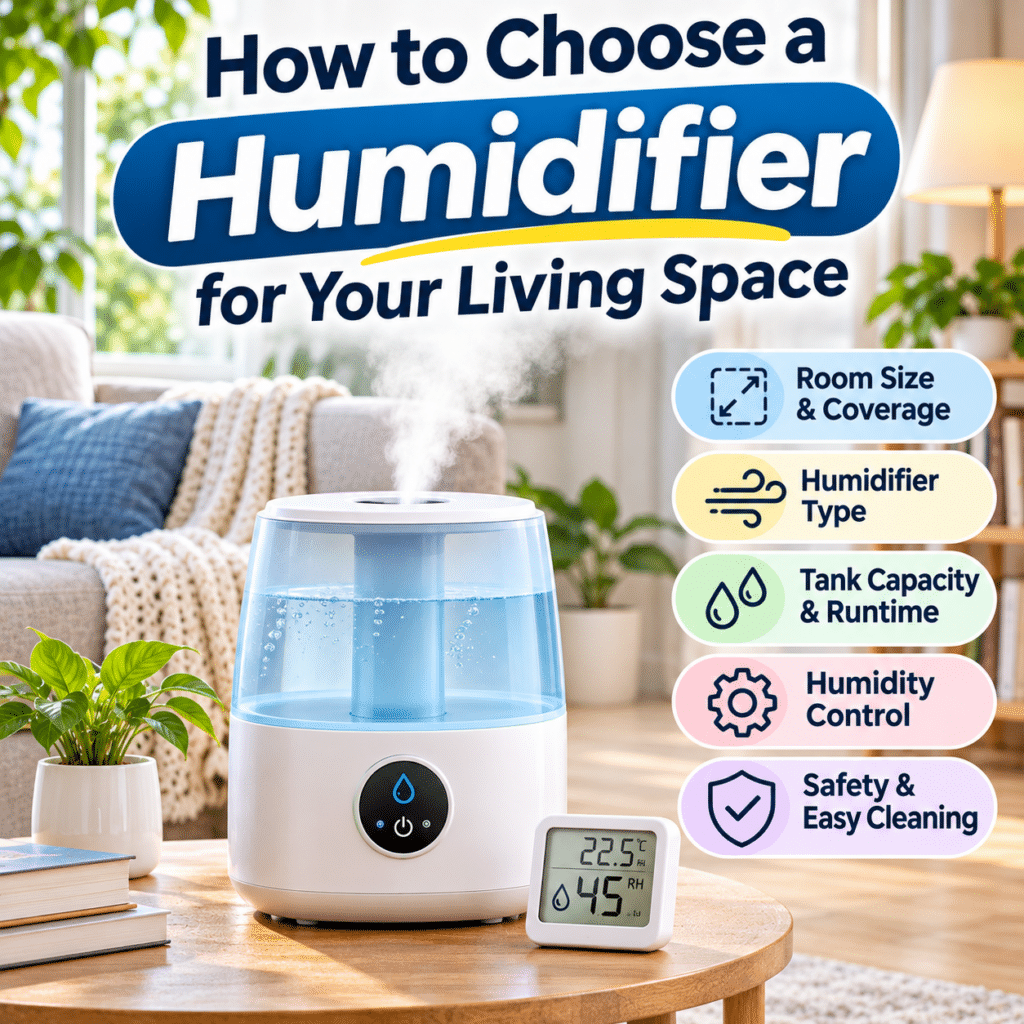
1. Understand What a Humidifier Does
A humidifier is a household appliance designed to increase the amount of water vapor in indoor air.
It accomplishes this by releasing moisture through evaporation, ultrasonic vibration, steam generation, or another humidification process.
The purpose is not to make the room feel wet or damp. It is to help maintain a suitable level of relative humidity when indoor air is too dry.
What Is Relative Humidity?
Relative humidity, commonly abbreviated as RH, describes the amount of water vapor present in the air relative to the maximum amount the air could hold at the same temperature.
It is expressed as a percentage.
For example, 40% relative humidity means that the air contains approximately 40% of the water vapor needed to reach saturation at its current temperature.
Relative humidity changes with temperature, even when the actual amount of water vapor remains unchanged.
Why Indoor Humidity Changes
Indoor humidity is influenced by several factors:
- Outdoor weather conditions.
- Indoor heating.
- Air conditioning.
- Ventilation.
- Occupancy.
- Cooking and bathing.
- Building insulation and air leakage.
- Local climate.
- Seasonal temperature changes.
Heating cold outdoor air can substantially reduce its relative humidity unless additional moisture is introduced.
Air conditioning, on the other hand, often removes moisture from indoor air as part of its cooling process.
When a Humidifier May Be Useful
A humidifier may be helpful when indoor air is consistently too dry and additional moisture can be introduced safely.
However, a humidifier is not automatically beneficial in every home.
In naturally humid climates or rooms with existing moisture problems, adding humidity may be unnecessary or counterproductive.
2. Measure Indoor Humidity Before Buying
One of the most important steps in choosing a humidifier is determining whether your living space actually needs additional moisture.
Use a Hygrometer
A hygrometer measures relative humidity.
Digital hygrometers are widely available as standalone devices or as part of indoor temperature and humidity monitors.
Place the hygrometer in a representative location away from direct sunlight, heating vents, windows, and obvious moisture sources.
Observe Humidity Over Time
Humidity can fluctuate throughout the day.
Rather than relying on a single reading, observe conditions over several days under normal household use.
Consider checking:
- Morning humidity.
- Afternoon humidity.
- Evening humidity.
- Conditions while heating or air conditioning is operating.
- Humidity in frequently occupied rooms.
Understand a Practical Humidity Range
For many homes, maintaining relative humidity somewhere around 30% to 50% is a reasonable general guideline.
The most appropriate level depends on indoor temperature, outdoor conditions, building characteristics, and individual comfort.
Humidity should generally be kept below 60% to reduce conditions that favor mold growth.
During cold weather, even humidity within a commonly recommended range may cause condensation on poorly insulated windows or cold surfaces.
Do Not Assume Discomfort Means Dry Air
Dry skin, nasal irritation, or other discomfort can have multiple causes.
A hygrometer provides a more useful starting point than purchasing a humidifier based only on how the room feels.
3. Identify Your Main Reason for Using a Humidifier
Different households have different humidification needs.
Clarifying your purpose will help you choose the appropriate device.
Improving Comfort in Dry Indoor Air
If your living space becomes dry during heating season, a humidifier may help maintain a more comfortable moisture level.
Look for a device with reliable humidity control and sufficient output for the room.
Managing Bedroom Humidity
A bedroom humidifier should provide stable moisture output without excessive noise, bright lights, or inconvenient maintenance.
Ease of cleaning is especially important for equipment used frequently near sleeping areas.
Supporting Moisture-Sensitive Household Items
Certain wooden objects, musical instruments, and other materials can respond to humidity fluctuations.
However, the appropriate humidity range depends on the material and manufacturer recommendations.
Avoid assuming that more humidity is always better.
Addressing Dry Conditions in a Home Office
A compact humidifier may be useful in a small workspace if measured humidity is consistently low.
Choose a device that will not create moisture around computers, documents, or electrical equipment.
Humidifying a Larger Living Area
Larger spaces may require greater moisture output, larger water tanks, or multiple appropriately placed units.
The room’s ventilation and air leakage can strongly affect how much moisture is needed.
4. Understand the Main Types of Humidifiers
Humidifiers use different methods to introduce moisture into the air.
The four common portable categories are:
- Evaporative humidifiers.
- Ultrasonic humidifiers.
- Warm-mist or steam humidifiers.
- Impeller humidifiers.
Each technology has distinct advantages and maintenance considerations.
5. Evaporative Humidifiers
Evaporative humidifiers use a wick, filter, or other wet surface to allow water to evaporate into the surrounding air.
Many models use a fan to move air through a moistened wick.
How They Work
Water is absorbed into a wick or filter.
A fan moves air across the wet material, increasing evaporation.
The resulting moisture enters the room primarily as water vapor.
Advantages
- Often provide practical room humidification.
- Generally release fewer dissolved water minerals into the air than ultrasonic mist devices.
- Do not require boiling water.
- Available in a range of room capacities.
- Can be suitable for continuous operation with proper maintenance.
Limitations
- Fan noise may be noticeable.
- Wicks or filters require replacement.
- Mineral buildup can affect the wick.
- Water reservoirs and wet components require frequent cleaning.
- Performance depends on room conditions and airflow.
Best For
Evaporative humidifiers are worth considering for households that want a conventional room humidifier and prefer to minimize airborne mineral dispersion associated with some mist-producing designs.
6. Ultrasonic Humidifiers
Ultrasonic humidifiers use a vibrating component to create very small water droplets.
These droplets are released into the air as a visible or nearly invisible mist.
How They Work
A high-frequency vibrating element breaks water into fine droplets.
A fan or airflow mechanism distributes the mist into the room.
Advantages
- Often operate quietly.
- Available in compact designs.
- May offer adjustable mist output.
- Commonly include modern digital controls.
- Do not require heating water to create mist.
Limitations
- Can disperse dissolved minerals from tap water into indoor air.
- May produce white mineral dust.
- Can disperse microorganisms or contaminants present in poorly maintained water.
- Require careful water management and cleaning.
- Excessive output may wet nearby surfaces.
White Dust Explained
When ultrasonic humidifiers aerosolize water containing dissolved minerals, those minerals can enter the air with the droplets.
After the water evaporates, mineral particles may remain suspended or settle on surfaces.
This is commonly called white dust.
Best For
Ultrasonic humidifiers may be suitable for people prioritizing quiet operation and compact design, provided they are willing to use appropriate water and follow a careful cleaning routine.
7. Warm-Mist and Steam Humidifiers
Warm-mist humidifiers heat water to generate steam or warm vapor.
Some designs cool the vapor before it exits the appliance, while others release warm moisture.
Advantages
- Can provide humidification without dispersing minerals in the same manner as ultrasonic mist.
- May offer a warm vapor experience.
- Some designs do not require a fan.
- Heating water can reduce some microorganisms in the water during operation.
Limitations
- Hot water and steam can cause burns.
- Electricity consumption may be higher.
- Mineral deposits can accumulate in heating components.
- Regular cleaning is still required.
- Not ideal for locations where children or pets may contact the appliance.
Important Safety Consideration
Warm-mist humidifiers can create burn hazards.
Hot-water reservoirs, heating components, and steam outlets require particular care.
For homes with young children, cool-mist designs are generally preferable.
Best For
Warm-mist models may be considered by adults who understand the safety requirements and can position and maintain the appliance appropriately.
8. Impeller Humidifiers
Impeller humidifiers use a rotating mechanism to throw water toward a diffuser, producing droplets that enter the air.
Advantages
- Do not require boiling water.
- Can provide cool mist.
- May have relatively simple operating mechanisms.
Limitations
- Can disperse minerals and contaminants from the water.
- Require regular cleaning.
- Performance and noise vary by design.
- May produce surface moisture if poorly positioned or oversized.
Best For
Impeller models may suit selected applications, but water quality, output control, and maintenance remain important.
9. Compare Humidifier Technologies
| Humidifier Type | Moisture Production | Main Advantages | Main Considerations |
|---|---|---|---|
| Evaporative | Evaporation through a wet wick or surface | Practical humidification, less mineral aerosolization | Fan noise, wick replacement |
| Ultrasonic | Fine droplets created by vibration | Often quiet, compact designs | Mineral dust, water quality, cleaning |
| Warm mist/steam | Water heated to produce vapor | No ultrasonic mineral mist | Burn risk, energy use, mineral buildup |
| Impeller | Droplets produced mechanically | Cool-mist operation | Mineral dispersion, cleaning |
| Whole-home humidifier | Integrated with HVAC or building system | Can serve multiple rooms | Installation, system compatibility, maintenance |
No single technology is universally best.
The right choice depends on the room, household safety requirements, water quality, and willingness to maintain the appliance.
10. Choose a Humidifier Based on Room Size
Room size is an important consideration because a humidifier must supply enough moisture to compensate for the room’s existing moisture losses.
Measure the Room
For a rectangular room:
Room Area = Length × Width
For example:
A room measuring 4 meters by 5 meters has an area of:
4 × 5 = 20 m²
Consider Ceiling Height
Rooms with high ceilings contain more air.
Calculate approximate room volume:
Room Volume = Length × Width × Ceiling Height
For a room measuring:
- Length: 4 meters.
- Width: 5 meters.
- Ceiling height: 2.5 meters.
The volume is:
4 × 5 × 2.5 = 50 m³
Why Room Volume Matters
A larger volume of air generally requires more water vapor to produce a given change in humidity.
However, room volume alone does not determine the necessary humidifier output.
Air exchange, outdoor humidity, indoor temperature, and moisture sources also influence the requirement.
Avoid Relying Only on Advertised Coverage
Manufacturers may use different assumptions when stating room coverage.
A humidifier advertised for a particular floor area may perform differently in a drafty room, an open-plan living area, or a space with unusually high ceilings.
Look for output specifications and consider the actual conditions in your home.
11. Understand Humidification Output
Humidification output describes how much moisture a device can add to the air over a given period.
Common units include:
- Milliliters per hour (mL/h).
- Liters per day (L/day).
- Gallons per day.
Convert Between Output Units
For example:
A humidifier rated at 250 mL/h has a theoretical maximum output of:
250 × 24 = 6,000 mL/day
This equals:
6 L/day
The calculation assumes the device operates continuously at the rated output for 24 hours.
Actual output may be lower because of automatic humidity control, operating speed, water availability, and room conditions.
Why Output Matters
A small humidifier with limited output may struggle to maintain humidity in a large or frequently ventilated room.
Conversely, a high-output humidifier used in a small enclosed space may increase humidity too quickly.
Choose Adjustable Output
Multiple output settings provide flexibility as room conditions change.
For many households, reliable automatic humidity control is more useful than maximum output alone.
12. Understand the Difference Between Tank Capacity and Output
Water tank capacity and humidification output are related but different specifications.
Tank Capacity
Tank capacity describes how much water the reservoir holds.
It is commonly expressed in liters or gallons.
Moisture Output
Output describes how quickly water is released into the air.
Why the Difference Matters
A humidifier with a large tank does not necessarily provide stronger humidification.
It may simply operate longer between refills.
Calculate Approximate Runtime
Use the formula:
Runtime (Hours) = Usable Tank Volume (mL) ÷ Water Consumption (mL/h)
For example:
- Tank capacity: 3,000 mL.
- Water consumption: 250 mL/h.
Estimated runtime:
3,000 ÷ 250 = 12 hours
This is a simplified calculation.
Actual runtime depends on usable tank volume, output setting, automatic cycling, and device design.
13. Choose an Appropriate Water Tank Size
The ideal tank size depends on how long you want the humidifier to operate between refills.
Small Tanks
Smaller tanks are common in compact personal humidifiers.
Advantages:
- Lightweight.
- Easier to carry.
- May fit on smaller surfaces.
Limitations:
- More frequent refilling.
- Limited operating duration at high output.
Medium Tanks
Medium-capacity reservoirs can provide a balance between portability and runtime.
They are often practical for bedrooms and modest living areas.
Large Tanks
Larger reservoirs may reduce refill frequency.
However, they can be heavier, more difficult to carry, and harder to clean.
Bigger Is Not Always Better
A large tank that is difficult to empty, dry, and clean may encourage poor maintenance.
Choose a reservoir size that fits both your operating schedule and cleaning routine.
14. Look for Automatic Humidity Control
A humidistat is a device or sensor-based control system that monitors humidity and adjusts humidifier operation.
How a Humidistat Works
The user selects a desired humidity level.
The humidifier increases or reduces moisture output based on the measured conditions.
Benefits
Automatic humidity control may help:
- Reduce excessive humidification.
- Maintain more consistent conditions.
- Improve convenience.
- Reduce unnecessary water consumption.
- Limit operation when additional moisture is not needed.
Understand Sensor Limitations
A humidifier’s built-in humidity sensor may measure conditions near the appliance rather than across the entire room.
Readings can be affected by mist, airflow, and placement.
Use a Separate Hygrometer
A standalone hygrometer positioned elsewhere in the room can provide an additional reference.
This is particularly useful when checking whether the humidifier is creating uneven moisture levels.
15. Avoid Excessive Indoor Humidity
Over-humidification is one of the most important risks associated with humidifier use.
Potential Problems
Excessive indoor moisture can contribute to:
- Window condensation.
- Damp walls.
- Musty odors.
- Mold growth.
- Dust mite proliferation.
- Moisture damage to furnishings.
- Deterioration of some building materials.
Watch for Warning Signs
Reduce or stop humidification if you notice:
- Persistent condensation.
- Damp surfaces.
- Water droplets around the appliance.
- Musty smells.
- Visible mold.
- Humidity readings that remain too high.
Consider Cold Surfaces
Even when average room humidity appears acceptable, condensation can occur on colder windows and walls.
The appropriate indoor humidity setting may need to be lower during cold weather.
Humidity Is Not a More-Is-Better Feature
A humidifier should correct excessive dryness, not maximize moisture.
Controlled output is more important than producing the largest possible mist cloud.
16. Consider Water Quality
Water quality strongly influences humidifier maintenance and the particles that some devices may release.
Tap Water
Tap water can contain dissolved minerals.
The amount varies by local water supply.
In ultrasonic and impeller humidifiers, these minerals may be dispersed into indoor air.
Distilled Water
Distilled water generally contains far fewer dissolved minerals than ordinary tap water.
Using distilled water can reduce mineral dust and mineral accumulation.
It does not eliminate the need for cleaning or guarantee that the water remains free from contamination after handling.
Demineralized Water
Appropriately demineralized water can also reduce mineral-related problems.
However, water quality varies by treatment method and product.
Filtered Water
Not every household water filter removes dissolved minerals.
For example, common activated carbon drinking-water filters may improve taste or reduce selected contaminants without substantially reducing mineral content.
Follow Manufacturer Instructions
Some humidifiers specify acceptable water types or require particular cartridges.
Use the water recommended for the specific device.
17. Understand Humidifier Hygiene
Humidifiers contain water and moisture-exposed components, which can support microbial growth if not maintained properly.
A poorly maintained humidifier may disperse contaminants into indoor air.
Empty and Refill Regularly
For portable humidifiers, emptying, drying, and refilling the tank with fresh water daily is a prudent routine, consistent with widely used public health guidance.
Do not simply keep topping up old water indefinitely.
Clean the Device Frequently
Follow the manufacturer’s instructions.
For portable humidifiers, cleaning approximately every three days is a commonly recommended public health practice, with more frequent attention when necessary.
Remove Mineral Deposits
Mineral buildup can affect operation and create surfaces where deposits accumulate.
Use only cleaning methods and products approved for the appliance.
Rinse Thoroughly
Cleaning residues should not be released into indoor air.
Follow the manufacturer’s rinsing and drying instructions.
Never Mix Cleaning Chemicals
Combining cleaning chemicals can produce hazardous reactions or gases.
Use only appropriate products and never mix disinfectants with other cleaners unless explicitly directed by the product instructions.
18. Choose a Humidifier That Is Easy to Clean
Ease of cleaning should be a major buying criterion, not an afterthought.
Wide Tank Openings
A wide opening makes it easier to access interior surfaces.
Removable Components
Removable tanks and accessible parts can simplify maintenance.
Smooth Interior Surfaces
Smooth surfaces with fewer inaccessible corners may be easier to clean.
Accessible Water Channels
Some humidifiers contain narrow passages or internal chambers that are difficult to inspect.
Evaluate whether these areas can be cleaned according to the manufacturer’s instructions.
Clear Maintenance Guidance
A good product should include understandable cleaning and descaling instructions.
Avoid Designs That Encourage Stagnant Water
Complicated reservoirs that cannot be emptied fully may require additional care.
Choose a design you can realistically maintain throughout the year.
19. Compare Top-Fill and Bottom-Fill Humidifiers
Refilling convenience can affect everyday satisfaction.
Top-Fill Humidifiers
Top-fill models allow water to be added through an opening at the top.
Potential advantages:
- Convenient refilling.
- Less need to invert the tank.
- May be easier to use in a fixed location.
However, top-fill does not automatically mean easy to clean.
Bottom-Fill Humidifiers
Bottom-fill models often require removing and inverting the tank.
Potential advantages:
- Familiar, straightforward construction.
- Removable reservoir.
Potential limitations:
- Awkward handling.
- Potential dripping during refilling.
- More difficult access for some users.
What Matters Most
Choose based on the actual reservoir design, not only the refill method.
A removable, wide-opening tank may be easier to clean than a narrow top-fill reservoir with inaccessible internal areas.
20. Consider Noise Levels
Humidifier noise can influence comfort, particularly in bedrooms and workspaces.
Common Noise Sources
Depending on the technology, noise may come from:
- Fans.
- Water movement.
- Ultrasonic mechanisms.
- Pumps.
- Heating elements.
- Vibrations.
- Mechanical components.
Ultrasonic Models
Ultrasonic humidifiers are often relatively quiet, but individual designs vary.
Some may produce audible humming or water sounds.
Evaporative Models
Fan-based evaporative humidifiers may produce continuous airflow noise.
Noise generally changes with fan speed.
Warm-Mist Models
Heating systems may produce occasional bubbling or other operating sounds.
Compare Noise at Useful Output Settings
A humidifier may be quiet at minimum output but insufficient for the intended room.
Look for noise information at the operating settings you expect to use.
21. Choose a Humidifier for Bedroom Use
Bedrooms often benefit from appliances that operate quietly and consistently.
Prioritize Humidity Control
Automatic control can help avoid excessive overnight humidification.
Evaluate Noise
Choose a model that remains comfortable during sleep.
Consider Display Lighting
Bright indicators may disturb some sleepers.
A display-dimming or lights-off function can be useful.
Check Runtime
Choose a tank that can support the intended operating period without unnecessary refilling.
Avoid Moisture Near Bedding
Position the appliance so mist does not directly wet pillows, mattresses, curtains, or nearby furniture.
Maintain Hygiene
A humidifier used regularly in a bedroom requires consistent cleaning and fresh water.
22. Choose a Humidifier for Living Rooms
Living rooms may have larger floor areas, open layouts, and greater air movement.
Consider the Connected Space
A living room connected to a kitchen or dining area may require more moisture output than an enclosed room of the same nominal size.
Evaluate Placement
Choose a location with sufficient clearance and a stable surface.
Consider Appearance and Size
The appliance should fit the room without obstructing walkways.
Look for Adjustable Output
Living room conditions can change with occupancy, ventilation, and weather.
Flexible output control is useful.
Avoid Excessive Mist Near Electronics
Keep mist away from televisions, speakers, electrical outlets, and other moisture-sensitive equipment.
23. Choose a Humidifier for a Home Office
Home offices often contain computers, documents, and other moisture-sensitive belongings.
Prioritize Controlled Output
A humidifier with a reliable humidistat may be preferable to a device that continuously produces mist without feedback.
Consider Placement
Avoid directing mist toward:
- Computers.
- Monitors.
- Keyboards.
- Power strips.
- Paper documents.
- Electrical outlets.
Evaluate Noise
Choose a model that does not interfere with calls or focused work.
Consider Compact Designs
A smaller humidifier may be appropriate if the workspace is enclosed and the measured humidity is low.
Monitor Local Moisture
Check nearby surfaces for dampness or condensation.
24. Consider Humidifiers for Homes With Children
Households with children should pay particular attention to safety.
Prefer Cool-Mist Designs
Cool-mist humidifiers avoid the hot-water and steam burn hazards associated with warm-mist models.
Choose Stable Placement
Position the humidifier where it cannot easily be tipped over or pulled down.
Keep Cords Secure
Electrical cords should not create tripping or pulling hazards.
Avoid Excessive Humidity
More moisture is not necessarily better for children.
Maintain appropriate indoor humidity and avoid damp conditions.
Follow Pediatric Guidance When Relevant
Humidifiers should not be treated as substitutes for medical care.
If a child has persistent respiratory symptoms or a medical condition, consult an appropriate healthcare professional.
25. Consider Humidifiers for Homes With Pets
Pets can interact with humidifiers in unexpected ways.
Choose a Stable Design
Avoid narrow or top-heavy appliances that may tip over easily.
Protect Electrical Cords
Keep cords away from areas where pets may chew or pull them.
Avoid Hot Steam
Warm-mist humidifiers can create burn hazards for curious animals.
Do Not Add Essential Oils Without Considering Pet Safety
Some essential oils and fragrances can be harmful to pets, especially when inhaled, ingested, or deposited on fur.
Do not assume that a humidifier’s fragrance feature is safe for every animal.
Maintain Water Hygiene
Prevent pets from drinking from the humidifier reservoir.
Keep the appliance clean and follow appropriate water handling practices.
26. Understand Humidifiers and Indoor Plants
Indoor plants are sometimes associated with humidifier use, particularly species that prefer relatively humid conditions.
However, plant requirements vary widely.
Different Plants Have Different Needs
Some tropical plants may benefit from higher humidity, while many succulents and drought-adapted plants prefer drier conditions.
Avoid Excessive Room Humidity
Increasing humidity for plants should not create condensation or mold problems in the home.
Consider Localized Solutions
Grouping compatible plants or using an appropriate enclosed growing environment may be more practical than raising humidity throughout an entire room.
Avoid Direct Wetting
Do not position mist so that leaves, soil, or surrounding surfaces remain persistently wet.
Monitor Actual Conditions
Use a hygrometer rather than assuming that visible mist indicates suitable humidity.
27. Consider Humidifiers and Wooden Furniture
Wood responds to changes in moisture content.
Large or rapid humidity fluctuations can contribute to expansion, contraction, or other dimensional changes in some wooden objects.
Maintain Stable Conditions
Consistent indoor conditions may be more beneficial than frequent changes between very dry and very humid air.
Avoid Direct Mist Exposure
Do not direct humidifier mist onto wooden furniture, flooring, or decorative objects.
Follow Product-Specific Guidance
Manufacturers of wooden flooring, musical instruments, and furniture may provide recommended environmental conditions.
These recommendations should take priority for sensitive items.
Avoid Over-Humidification
Excessive moisture can damage wood and surrounding materials.
28. Understand Portable Versus Whole-Home Humidifiers
Humidification can be provided by portable room appliances or systems integrated into a building.
Portable Humidifiers
Portable units are designed for individual rooms or limited areas.
Advantages:
- Flexible placement.
- No major installation.
- Room-specific operation.
- Available in multiple technologies.
Limitations:
- Require manual water handling.
- Need frequent cleaning.
- May not serve separate rooms effectively.
Whole-Home Humidifiers
Whole-home systems may be integrated with HVAC equipment or installed as dedicated systems.
Advantages:
- Can provide centralized humidity management.
- May serve multiple rooms.
- Reduce the need for separate portable devices.
Limitations:
- Require professional evaluation and installation.
- Depend on building and HVAC compatibility.
- Need ongoing maintenance.
- Can contribute to moisture problems if improperly controlled.
Which Is Better?
Portable humidifiers are often practical for isolated dry rooms.
Whole-home systems may be considered when humidity management is needed across a larger building and appropriate professional installation is available.
29. Consider Energy Consumption
Energy consumption varies considerably by humidifier technology.
Ultrasonic Humidifiers
Many ultrasonic models use relatively little electricity compared with devices that heat water.
Actual consumption depends on output, controls, and design.
Evaporative Humidifiers
Fan-based evaporative models consume electricity primarily through their fans and control systems.
Warm-Mist Humidifiers
Heating water requires energy.
Warm-mist models may therefore use substantially more electricity than comparable cool-mist devices.
Calculate Energy Use
Use the formula:
Energy Consumption (kWh) = Power (W) × Operating Hours ÷ 1,000
For example:
A humidifier rated at 30 watts operating for 10 hours uses:
30 × 10 ÷ 1,000 = 0.3 kWh
Over 30 days:
0.3 × 30 = 9 kWh
Actual energy use depends on operating conditions and automatic cycling.
Consider Efficiency Alongside Output
A low-power device is not necessarily economical if it cannot maintain the desired humidity in the intended space.
30. Evaluate Smart Humidifier Features
Some humidifiers include connected controls and automation.
Common features include:
- App-based operation.
- Remote humidity adjustment.
- Scheduling.
- Automatic modes.
- Water-level notifications.
- Maintenance reminders.
- Voice assistant compatibility.
- Humidity history.
Are Smart Features Necessary?
Not necessarily.
A humidifier with reliable manual controls and a functioning humidistat may meet most household needs.
Check Connectivity Requirements
Smart devices may require particular Wi-Fi networks, mobile operating systems, or cloud services.
Consider Long-Term Support
Software updates, app compatibility, and service availability may change over time.
Prioritize Core Performance
Smart features should not outweigh effective moisture output, easy cleaning, and safe humidity control.
31. Consider Safety Features
A humidifier should be safe and practical for routine household use.
Automatic Shutoff
Many humidifiers stop operating when the water level becomes too low.
This can help protect the appliance.
Stable Base
A wide, stable base reduces the likelihood of accidental tipping.
Secure Tank Design
The water reservoir should fit properly and resist unnecessary leaking.
Electrical Safety
Look for appropriate electrical safety information and certification relevant to your market.
Overheating Protection
Heating-based humidifiers should include appropriate thermal safety mechanisms.
Safe Placement
Keep the appliance away from:
- Unprotected electrical equipment.
- Unstable furniture.
- Areas where it may be knocked over.
- Locations where mist can wet floors.
- Children’s reach when hot components are present.
32. Understand Humidifier Placement
Even a well-designed humidifier may create problems if positioned incorrectly.
Use a Stable Surface
Choose a level, water-resistant surface capable of supporting the filled appliance.
Avoid Direct Mist Contact
Mist should not continuously wet nearby walls, curtains, bedding, furniture, or electronics.
Allow Air Circulation
Follow the manufacturer’s clearance recommendations.
Avoid Heating and Cooling Vents
Strong nearby airflow may affect humidity readings or distribute mist unevenly.
Consider Floor Placement Carefully
Some devices are designed for floor use, while others require an elevated surface.
Follow the specific product instructions.
Monitor Nearby Surfaces
After operating the humidifier, inspect surrounding surfaces for moisture.
If dampness appears, reduce output or change placement.
33. Compare Humidifiers by Household Need
| Household Need | Suitable Features | Main Priority |
|---|---|---|
| Small bedroom | Quiet operation, humidistat, easy cleaning | Comfort and controlled humidity |
| Large living room | Higher output, adjustable settings | Sufficient moisture delivery |
| Home office | Compact design, automatic control | Protecting electronics and documents |
| Home with children | Cool mist, stable construction | Burn prevention and safe placement |
| Home with pets | Stable design, secure cords | Safety and easy maintenance |
| Hard-water household | Evaporative design or suitable water management | Limiting mineral dispersion |
| Frequent overnight use | Appropriate tank capacity, automatic control | Runtime and hygiene |
| Dry winter environment | Adjustable output, reliable humidity monitoring | Avoiding excessive dryness and condensation |
| Humid climate | Hygrometer and careful evaluation | Avoiding unnecessary humidification |
| Whole-home humidity needs | Professionally evaluated integrated system | Building compatibility and maintenance |
34. Evaluate Durability and Build Quality
Humidifiers contain water reservoirs, seals, electrical components, and sometimes fans or heating elements.
Construction quality affects reliability and maintenance.
Examine the Reservoir
Look for:
- Secure seals.
- Smooth interior surfaces.
- Accessible openings.
- Durable handles.
- Stable tank attachment.
Check Moving Parts
Fans, pumps, and other mechanical components should operate smoothly.
Evaluate Control Quality
Buttons, displays, and adjustment mechanisms should be easy to use.
Consider Replacement Parts
Check whether filters, wicks, cartridges, and other replaceable components are available.
Review Warranty Terms
A warranty can provide additional protection, but coverage varies.
Understand exclusions related to mineral buildup, cleaning, and maintenance.
35. Understand the Total Cost of Ownership
A humidifier’s purchase price is only part of its long-term cost.
Initial Purchase
Compare the appliance price with its output, controls, and construction.
Water Requirements
Some models may benefit from distilled or demineralized water, which can add ongoing expense.
Filter Replacement
Evaporative humidifiers commonly require replacement wicks or filters.
Cleaning Supplies
Regular cleaning and descaling may require approved maintenance products.
Electricity
Energy consumption depends on the humidification method and operating schedule.
Replacement Components
Cartridges, seals, and other parts may eventually need replacement.
Long-Term Comparison
A less expensive humidifier may cost more to maintain if it requires frequent replacement components or specialized water.
Choose based on realistic operating expenses rather than purchase price alone.
36. Common Mistakes to Avoid When Buying a Humidifier
Mistake 1: Buying Without Measuring Humidity
A humidifier may be unnecessary if indoor humidity is already adequate.
Better approach: Measure relative humidity before purchasing.
Mistake 2: Choosing Based Only on Tank Capacity
A large reservoir does not guarantee sufficient moisture output.
Better approach: Compare output capacity and room suitability separately.
Mistake 3: Ignoring Cleaning Requirements
Poor maintenance can allow microbial contamination.
Better approach: Choose a device with accessible components and clear cleaning instructions.
Mistake 4: Using Hard Tap Water Without Considering the Technology
Ultrasonic and impeller devices may disperse dissolved minerals.
Better approach: Follow water recommendations and consider mineral-related maintenance.
Mistake 5: Assuming Visible Mist Means Better Performance
A large mist plume does not necessarily indicate effective or appropriate humidification.
Better approach: Monitor actual room humidity.
Mistake 6: Choosing Maximum Output for a Small Room
Excessive moisture can create condensation and damp surfaces.
Better approach: Choose adjustable output and automatic control.
Mistake 7: Ignoring Noise
A device may be inconvenient during sleep or work.
Better approach: Compare noise at useful operating settings.
Mistake 8: Placing the Humidifier Near Electronics
Direct mist can introduce moisture around sensitive equipment.
Better approach: Maintain suitable distance and airflow.
Mistake 9: Leaving Water in the Tank for Extended Periods
Stagnant water can support contamination.
Better approach: Empty, dry, and refill regularly.
Mistake 10: Adding Essential Oils to an Incompatible Humidifier
Oils can damage components or introduce unwanted airborne substances.
Better approach: Do not add oils unless the manufacturer explicitly permits them, and consider household health and pet safety.
Mistake 11: Ignoring Cold-Weather Condensation
Indoor humidity that seems acceptable may still cause moisture accumulation on cold surfaces.
Better approach: Adjust humidity targets to actual building conditions.
Mistake 12: Choosing Features Over Maintenance Practicality
Smart controls cannot compensate for a reservoir that is difficult to clean.
Better approach: Prioritize hygiene, output control, and safe operation.
37. How to Choose a Humidifier: Step by Step
A structured buying process can help you select a humidifier that fits your living space.
Step 1: Measure Existing Humidity
Use a hygrometer to determine whether the room is consistently too dry.
Step 2: Identify the Intended Room
Measure the room’s area and ceiling height.
Step 3: Consider the Building Environment
Evaluate ventilation, heating, air conditioning, and seasonal humidity patterns.
Step 4: Choose the Humidification Technology
Compare evaporative, ultrasonic, warm-mist, and other designs.
Step 5: Evaluate Moisture Output
Choose an output capacity appropriate for the room and expected moisture losses.
Step 6: Compare Tank Capacity
Estimate runtime and consider refill convenience.
Step 7: Look for Automatic Humidity Control
A humidistat can help maintain more consistent conditions.
Step 8: Evaluate Cleaning Access
Inspect the reservoir design and maintenance instructions.
Step 9: Consider Water Quality
Determine whether distilled, demineralized, or another recommended water type is practical.
Step 10: Check Noise and Energy Use
Compare performance at the settings you expect to use.
Step 11: Review Safety Features
Consider automatic shutoff, stability, electrical safety, and burn hazards.
Step 12: Confirm Placement Requirements
Ensure that the appliance can operate without wetting nearby surfaces.
Step 13: Compare Long-Term Costs
Include filters, water, electricity, and maintenance.
Step 14: Select the Most Practical Model
Choose the humidifier that balances suitable output, humidity control, ease of cleaning, safety, and long-term usability.
38. Practical Humidifier Buying Checklist
Use this checklist before purchasing a humidifier.
Indoor Humidity and Room Suitability
- I have measured indoor relative humidity.
- I have confirmed that additional moisture is needed.
- I know the room’s approximate dimensions.
- The humidifier’s output is suitable for the intended space.
- I understand that ventilation and air leakage affect performance.
Humidifier Technology
- I understand the main technology used.
- I have considered mineral dispersion and water quality.
- I have evaluated any hot-water or steam hazards.
- The humidification method suits my household.
Water Tank and Maintenance
- The tank capacity meets my expected runtime needs.
- The reservoir is easy to refill.
- Interior surfaces are accessible for cleaning.
- Cleaning instructions are clear.
- Replacement filters or components are available.
- I can maintain the required cleaning routine.
Controls and Comfort
- The device has appropriate output settings.
- Automatic humidity control is available if needed.
- Noise is acceptable for the intended room.
- Display lights and controls are convenient.
- The appliance fits the intended location.
Safety and Long-Term Value
- The humidifier has suitable electrical safety features.
- The design is stable and resistant to accidental tipping.
- I can position it away from moisture-sensitive belongings.
- I have considered energy consumption.
- I understand the expected maintenance expenses.
- Warranty and support information are available.
39. Frequently Asked Questions
What Is the Best Type of Humidifier for a Living Room?
The best type depends on room size, existing humidity, water quality, noise tolerance, and maintenance preferences.
Evaporative and ultrasonic humidifiers are common choices, but each has different advantages and limitations.
Do I Really Need a Humidifier?
Not necessarily.
A humidifier is most useful when indoor humidity is consistently too low.
Measure humidity before deciding whether additional moisture is appropriate.
What Is a Good Indoor Humidity Level?
For many homes, approximately 30% to 50% relative humidity is a useful general range.
The appropriate target depends on temperature, building conditions, and condensation risk.
Can Indoor Humidity Be Too High?
Yes.
Excessive humidity can contribute to condensation, mold growth, dust mites, and moisture damage.
Is Cool Mist Better Than Warm Mist?
Neither technology is universally better for humidification.
However, cool-mist humidifiers avoid the hot-water and steam burn hazards associated with warm-mist designs.
Are Ultrasonic Humidifiers Safe?
Ultrasonic humidifiers can be used appropriately, but water quality and cleaning are particularly important.
They may disperse minerals and contaminants present in the water.
What Causes White Dust Around a Humidifier?
White dust commonly results from dissolved minerals in water dispersed by ultrasonic or impeller humidifiers.
Using appropriately demineralized water can reduce this problem.
Should I Use Distilled Water in My Humidifier?
Distilled water can reduce mineral buildup and airborne mineral dispersion, especially in ultrasonic and impeller models.
Follow the manufacturer’s water recommendations.
Can I Use Tap Water?
Some humidifiers permit tap water, but mineral content varies.
Tap water may contribute to deposits or airborne mineral particles depending on the technology.
Is Filtered Water the Same as Distilled Water?
No.
Many household water filters do not remove dissolved minerals to the same extent as distillation.
How Often Should I Clean My Humidifier?
Follow the manufacturer’s instructions.
For portable humidifiers, emptying and drying the tank daily and cleaning approximately every three days are commonly recommended practices.
Can I Leave Water in a Humidifier Overnight?
Water may remain in the reservoir during normal overnight operation.
After use, empty and dry the appliance according to the manufacturer’s instructions rather than allowing unused water to remain stagnant for extended periods.
Can a Humidifier Cause Mold?
Excessive indoor humidity or poorly maintained equipment can contribute to conditions that encourage mold growth.
Monitor humidity and prevent damp surfaces.
Can a Humidifier Make a Room Too Wet?
Yes.
An oversized device, excessive output, or poor placement can cause condensation or surface moisture.
Should I Run a Humidifier All Night?
Overnight operation may be appropriate when indoor humidity is low and the device can maintain safe moisture levels.
Use suitable humidity control and follow maintenance and placement instructions.
Is a Humidistat Important?
A humidistat can help prevent unnecessary operation and maintain more consistent humidity.
It is especially useful when room conditions change frequently.
Do I Need a Separate Hygrometer?
A separate hygrometer can help verify room conditions independently of the humidifier’s built-in sensor.
How Big Should My Humidifier Be?
Choose based on the room’s dimensions, moisture output requirements, ventilation, and desired operating time.
Tank capacity alone is not a reliable indicator of room suitability.
Does a Bigger Tank Mean More Humidity?
No.
Tank capacity determines available water storage, while moisture output determines how quickly humidity can be added.
What Does mL/h Mean on a Humidifier?
It indicates the amount of water the humidifier can release per hour under specified operating conditions.
How Long Will a Humidifier Run on One Tank?
Approximate runtime depends on usable tank capacity and water consumption.
Automatic controls and operating settings can change actual runtime.
Are Top-Fill Humidifiers Easier to Use?
Top-fill designs can simplify refilling, but ease of cleaning depends on the complete reservoir construction.
Which Humidifier Is Easiest to Clean?
Look for wide openings, removable components, smooth surfaces, and accessible water-contact areas.
No single technology guarantees easy maintenance.
Are Humidifiers Noisy?
Noise varies by design.
Evaporative models often produce fan noise, while ultrasonic models are frequently quieter.
Individual product measurements are more useful than general assumptions.
Can I Put Essential Oils in My Humidifier?
Do not add essential oils unless the manufacturer explicitly permits them.
Even when a device supports fragrances, consider potential respiratory irritation and pet safety.
Can a Humidifier Help With Dry Skin?
Maintaining appropriate humidity may reduce environmental dryness that contributes to discomfort for some people.
However, skin symptoms have multiple causes, and a humidifier is not a substitute for medical evaluation when needed.
Can a Humidifier Help With a Dry Nose?
Appropriate indoor humidity may help reduce discomfort associated with dry air.
Persistent symptoms should be evaluated by a healthcare professional.
Can a Humidifier Help Indoor Plants?
Some plants benefit from moderately higher humidity, but requirements vary by species.
Avoid increasing whole-room humidity to levels that create moisture problems.
Can a Humidifier Damage Furniture?
Excessive humidity or direct mist exposure can damage certain materials.
Proper placement and humidity control are important.
Is a Humidifier Useful in a Humid Climate?
Often, additional humidification is unnecessary when indoor humidity is already adequate or high.
Measure indoor conditions before purchasing.
Can I Use a Humidifier With Air Conditioning?
Yes, when indoor humidity is genuinely too low.
However, air conditioning often removes moisture, and adding humidity may increase cooling-related energy demand or create moisture problems if poorly controlled.
Can I Use a Humidifier and Air Purifier Together?
Yes.
The appliances serve different purposes: humidifiers add moisture, while air purifiers remove certain airborne pollutants.
Position them so mist does not directly enter the air purifier, wet its filters, or interfere with sensors.
Are Smart Humidifiers Worth Buying?
Smart features can improve convenience, but they do not replace appropriate moisture output, accurate control, and regular cleaning.
Do Humidifiers Use a Lot of Electricity?
Energy use varies by technology and operating mode.
Warm-mist models generally require more energy for heating water than many cool-mist designs.
How Long Does a Humidifier Last?
Service life depends on construction quality, water conditions, maintenance, and usage.
Regular cleaning and proper operation can help maintain performance.
What Should I Do if My Humidifier Smells Musty?
Stop using it and follow the manufacturer’s cleaning instructions.
Inspect accessible components for contamination and replace parts when necessary.
Do not continue operating a device that cannot be cleaned adequately.
Is an Expensive Humidifier Always Better?
No.
Higher prices may reflect design, connectivity, or additional features rather than superior humidification.
Compare output, cleaning access, humidity control, safety, and long-term costs.
What Is the Most Important Feature in a Home Humidifier?
The most important considerations are appropriate moisture output, reliable humidity control, easy cleaning, and safe operation.
A humidifier that is difficult to maintain or frequently causes excess moisture may be unsuitable regardless of its other features.
Final Thoughts
Choosing a humidifier for your living space begins with understanding whether your home actually needs additional moisture.
Indoor humidity should be measured rather than guessed, because both excessively dry and excessively humid conditions can affect comfort and the home environment.
Once you have confirmed a need for humidification, focus on the technology, moisture output, room suitability, tank capacity, humidity controls, and maintenance requirements.
Evaporative, ultrasonic, warm-mist, and other humidifier designs each offer different advantages. The best choice depends on your household’s safety needs, water quality, noise preferences, and willingness to perform regular cleaning.
Automatic humidity control and a separate hygrometer can help maintain appropriate conditions, while careful placement can prevent mist from damaging furniture, electronics, or surrounding surfaces.
Above all, hygiene should remain a priority. A humidifier is a water-handling appliance, and consistent cleaning, fresh water, and proper maintenance are essential for safe everyday use.
The best humidifier is not the one that produces the most mist or holds the most water. It is the one that maintains comfortable indoor humidity safely, consistently, and with maintenance requirements you can realistically manage for years to come.