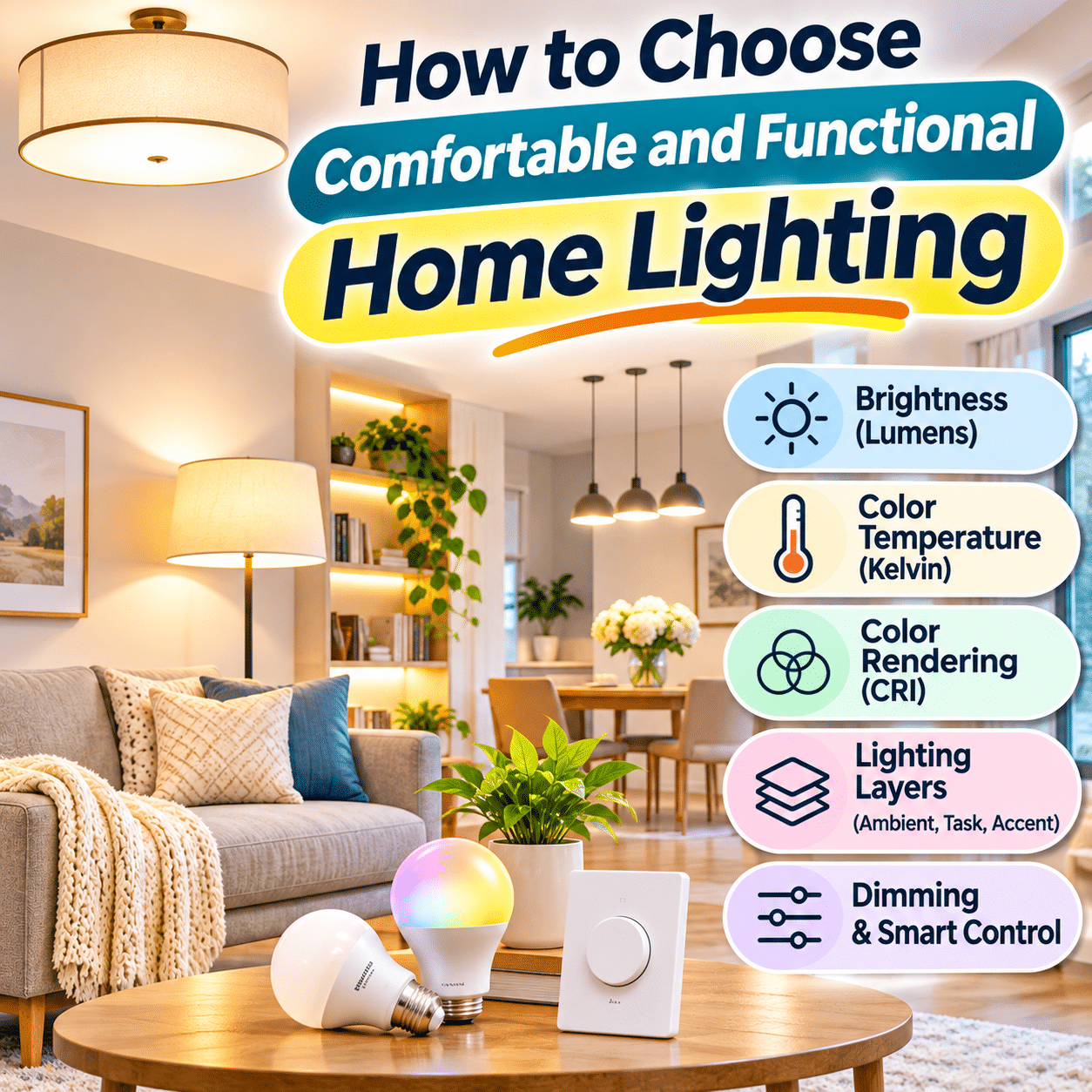
Lighting is one of the most important elements of a comfortable and functional home. It influences how clearly you can see, how easily you perform everyday tasks, how welcoming a room feels, and how different spaces can be used throughout the day.
A well-lit home is not necessarily one filled with the brightest possible lights. Effective home lighting combines appropriate brightness, comfortable color temperature, thoughtful fixture placement, reliable light quality, and flexibility for different activities.
The lighting needed for preparing meals is different from the lighting that makes a bedroom feel relaxing. A home office may require focused illumination for reading and computer work, while a living room often benefits from several light sources that can be adjusted for conversation, entertainment, and quiet evenings.
Choosing home lighting can feel complicated because products are described using specifications such as lumens, watts, Kelvin, color rendering index, beam angle, and dimming compatibility. Understanding these terms makes it easier to compare lighting options and avoid purchasing fixtures that look attractive but perform poorly in everyday use.
This comprehensive guide explains how to choose comfortable and functional home lighting, compare different lighting technologies, select appropriate fixtures for each room, reduce glare, improve energy efficiency, and create a flexible lighting arrangement that remains practical over time.
1. Understand the Purpose of Good Home Lighting
Before selecting bulbs or fixtures, consider what you want lighting to accomplish.
Effective residential lighting should support several goals.
Visibility
Lighting should provide enough illumination for people to move safely, recognize objects, and complete everyday activities.
Visual Comfort
Good lighting minimizes unnecessary glare, harsh contrasts, and distracting reflections.
Functionality
Different tasks require different lighting conditions.
Reading, cooking, cleaning, relaxing, and working at a computer may benefit from different combinations of brightness and direction.
Atmosphere
Lighting contributes to the character of a room.
Warm, softly distributed light can create a welcoming environment, while brighter, more focused illumination can support practical tasks.
Flexibility
A room often serves several purposes.
Lighting that can be adjusted for different activities is generally more useful than a single fixed setting.
Energy Efficiency
Efficient lighting can reduce electricity consumption without sacrificing appropriate illumination.
The goal is to balance all these considerations rather than maximizing only one.
2. Start by Evaluating Each Room
A useful lighting plan begins with understanding how each space is used.
Walk through your home and identify the activities performed in each room.
Consider:
- How much natural daylight enters the room.
- When the room is used most frequently.
- Whether detailed visual tasks are performed.
- Where people sit, stand, or work.
- Whether the room contains reflective surfaces.
- Whether existing lighting creates shadows or glare.
- Whether adjustable lighting would improve comfort.
For example, a kitchen may need bright task lighting over countertops, while a living room may benefit from softer ambient lighting and a focused reading lamp.
Avoid assuming that every room should use the same bulbs, fixtures, or brightness levels.
3. Understand the Three Main Layers of Home Lighting
One of the most useful principles in residential lighting design is layering.
Layered lighting combines different types of illumination to support multiple activities and create visual balance.
Ambient Lighting
Ambient lighting provides general illumination throughout a room.
Common examples include:
- Ceiling-mounted fixtures.
- Recessed downlights.
- Pendant lights.
- Wall-mounted uplights.
- Indirect ceiling lighting.
Ambient lighting makes it easier to move around and see the overall space.
However, it may not provide sufficient illumination for detailed tasks.
Task Lighting
Task lighting directs light toward specific activities.
Examples include:
- Desk lamps.
- Reading lamps.
- Under-cabinet kitchen lights.
- Vanity lighting.
- Workbench lights.
- Adjustable floor lamps.
Task lighting improves visibility where additional illumination is needed.
Accent Lighting
Accent lighting highlights particular features or creates visual interest.
Examples include:
- Artwork lighting.
- Shelf lighting.
- Decorative wall lights.
- Display cabinet lighting.
- Architectural lighting.
Accent lighting is generally supplemental rather than the primary source of illumination.
Why Layering Matters
A room with only one bright ceiling fixture may appear flat and produce uncomfortable shadows.
Combining ambient, task, and accent lighting allows different parts of the room to be illuminated appropriately.
It also provides flexibility when activities change.
4. Understand Lumens and Brightness
Lumens describe the total amount of visible light emitted by a light source.
When comparing bulbs, lumens are generally more useful than watts for understanding light output.
Lumens Versus Watts
Lumens measure light output.
Watts measure electrical power consumption.
A bulb that uses fewer watts can produce the same or greater light output if it is more efficient.
For example, two bulbs may each produce approximately 800 lumens while consuming different amounts of electricity.
Why Lumens Matter
A bulb with insufficient output may leave a room dim.
A bulb with excessive output, especially in an exposed fixture, may create uncomfortable brightness.
Approximate LED Bulb Brightness Categories
| Light Output | General Brightness Description | Common Applications |
|---|---|---|
| 250–450 lumens | Low to moderate | Small lamps, decorative lighting |
| 450–800 lumens | Moderate | Bedside lamps, smaller fixtures |
| 800–1,100 lumens | Moderate to bright | General household bulbs |
| 1,100–1,600 lumens | Bright | Larger fixtures, selected task applications |
| Above 1,600 lumens | High output | Larger spaces or specialized fixtures |
These are broad reference categories, not fixed recommendations for every room.
Actual suitability depends on fixture design, room dimensions, light distribution, and the number of light sources.
5. Understand Illuminance and Lux
Lumens describe the light produced by a source, but they do not tell you exactly how much light reaches a surface.
Illuminance describes the amount of light falling on a surface.
It is measured in lux.
What Is One Lux?
One lux equals one lumen distributed over one square meter.
However, real lighting arrangements are affected by distance, fixture direction, beam spread, reflections, and losses.
Why Lux Matters
A desk may need more illumination than the surrounding room.
Similarly, a kitchen countertop may benefit from brighter local lighting than a seating area.
Illustrative Residential Illuminance Ranges
| Area or Activity | Approximate Illuminance Range |
|---|---|
| Relaxed ambient living room lighting | 100–300 lux |
| General bedroom illumination | 100–300 lux |
| Kitchen general lighting | 200–300 lux |
| Kitchen countertop tasks | 300–500 lux |
| Reading and desk work | 300–500 lux |
| Detailed visual tasks | 500 lux or more, depending on task |
| Hallways and circulation areas | 50–150 lux |
These are general planning references rather than universal standards.
Individual needs, visual acuity, contrast, age, and task difficulty can change the appropriate level.
Local building or workplace requirements may also apply.
6. Understand Color Temperature
Color temperature describes the visual appearance of white light.
It is measured in Kelvin, abbreviated K.
Lower Kelvin values generally appear warmer or more yellowish.
Higher Kelvin values generally appear cooler or more bluish.
Warm White Lighting
Approximately 2,700–3,000 K.
Warm white lighting is commonly used in:
- Living rooms.
- Bedrooms.
- Dining areas.
- Relaxation spaces.
It can create a comfortable, welcoming appearance.
Neutral White Lighting
Approximately 3,500–4,000 K.
Neutral white lighting is often suitable for:
- Kitchens.
- Bathrooms.
- Home offices.
- Utility spaces.
It provides a more neutral appearance that some people prefer for practical activities.
Cool White and Daylight-Like Lighting
Approximately 5,000–6,500 K.
Cooler lighting may be useful for selected tasks where a daylight-like appearance is desired.
However, higher color temperature does not automatically mean better visibility or higher light quality.
Color Temperature Comparison
| Color Temperature | Appearance | Common Household Uses |
|---|---|---|
| 2,200–2,700 K | Very warm | Decorative and evening accent lighting |
| 2,700–3,000 K | Warm white | Bedrooms, living rooms, dining areas |
| 3,500–4,000 K | Neutral white | Kitchens, bathrooms, workspaces |
| 4,000–5,000 K | Neutral to cool | Utility areas, selected task lighting |
| 5,000–6,500 K | Cool, daylight-like | Specialized tasks and personal preference |
The best color temperature depends on the activity, surrounding colors, and desired atmosphere.
7. Choose Color Temperature Based on Room Function
A consistent lighting plan does not require every room to have identical color temperature.
However, transitions between nearby spaces should feel intentional.
Living Rooms
Warm white lighting often creates a comfortable atmosphere for conversation and relaxation.
Adjustable color temperature can provide additional flexibility.
Bedrooms
Warm lighting is commonly preferred during the evening.
Bright, cool-looking light may feel less relaxing close to bedtime, particularly when it is intense.
Kitchens
Warm-neutral or neutral white lighting can support food preparation while maintaining a welcoming appearance.
Bathrooms
Neutral white lighting may help with grooming tasks and accurate visual assessment.
Home Offices
Neutral lighting can support a clear working environment.
Personal preference and task requirements remain important.
Hallways
Choose lighting that provides safe visibility while maintaining a comfortable transition between rooms.
8. Understand Color Rendering Index (CRI)
Color Rendering Index, commonly called CRI, describes how accurately a light source renders the colors of selected reference samples compared with a reference illuminant.
The commonly reported general CRI value is Ra.
Why Color Rendering Matters
Lighting affects how objects appear.
Poor color rendering can make clothing, food, artwork, and interior finishes look unnatural.
Understanding CRI Values
For many residential applications, a CRI of at least 80 is a reasonable starting point.
A CRI of 90 or higher may be desirable in areas where color appearance is particularly important.
Applications Where Higher CRI Can Be Useful
- Kitchen food preparation.
- Bathroom grooming.
- Makeup application.
- Art and craft activities.
- Clothing selection.
- Artwork displays.
- Color-sensitive hobbies.
CRI Limitations
CRI does not describe every aspect of color quality.
Two lights with similar CRI values can still render certain saturated colors differently.
For color-sensitive applications, additional metrics such as TM-30 may provide more detailed information when available.
9. Compare Common Home Lighting Technologies
Different lighting technologies vary in efficiency, heat generation, lifespan, and compatibility.
LED Lighting
Light-emitting diode technology is widely used in modern residential lighting.
Advantages include:
- High energy efficiency.
- Long potential service life.
- Wide availability of color temperatures.
- Multiple fixture designs.
- Dimming options.
- Compact form factors.
However, performance varies by product quality and design.
Incandescent Lighting
Traditional incandescent bulbs produce light by heating a filament.
They provide familiar warm light and excellent color rendering but consume substantially more electricity for a given amount of light.
Their service life is generally shorter than that of many LEDs.
Halogen Lighting
Halogen bulbs are a type of incandescent technology.
They can provide good color rendering but generate considerable heat and are less energy-efficient than modern LEDs.
Compact Fluorescent Lighting
Compact fluorescent lamps, or CFLs, were widely used as an energy-saving alternative to incandescent bulbs.
They can be efficient but may have warm-up characteristics and contain small amounts of mercury, requiring appropriate disposal.
Lighting Technology Comparison
| Technology | Energy Efficiency | Typical Characteristics | Main Considerations |
|---|---|---|---|
| LED | High | Versatile, long potential lifespan | Quality, driver, dimmer compatibility |
| Incandescent | Low | Warm light, familiar appearance | High energy use, shorter lifespan |
| Halogen | Low to moderate | Good color rendering | Heat and energy consumption |
| CFL | Moderate to high | Efficient compared with incandescent | Mercury handling, warm-up behavior |
For most new household lighting purchases, quality LED products are a practical starting point.
10. Understand LED Light Quality
Not all LED bulbs produce the same lighting experience.
Two products with similar lumens and color temperature may differ in comfort and visual appearance.
Light Distribution
Some LED bulbs distribute light broadly.
Others concentrate light in a narrow beam.
Choose a distribution pattern appropriate for the fixture and application.
Diffusion
A frosted or diffused bulb can reduce the appearance of individual bright light sources.
However, diffusion does not automatically eliminate glare.
Flicker
Some LEDs produce light output that varies over time.
This may be associated with the electronic driver, dimming method, or electrical conditions.
Excessive temporal light modulation can be uncomfortable for some people.
Color Consistency
Products from different manufacturers or batches may have slightly different color appearances despite sharing the same nominal Kelvin rating.
Driver Quality
LED drivers regulate electrical power.
Poor-quality drivers may contribute to flicker, noise, unreliable dimming, or premature failure.
11. Understand Glare and Visual Comfort
Glare occurs when bright light sources or reflections interfere with comfortable vision.
A lighting arrangement can have sufficient brightness while still feeling unpleasant because of glare.
Direct Glare
Direct glare occurs when a bright source is visible within the field of view.
Examples include:
- Exposed high-output bulbs.
- Bright ceiling downlights.
- Poorly positioned desk lamps.
- Unshielded decorative fixtures.
Reflected Glare
Reflected glare occurs when light reflects from shiny surfaces.
Common examples include:
- Computer monitors.
- Glossy countertops.
- Glass tables.
- Polished flooring.
- Reflective artwork.
How to Reduce Glare
Consider:
- Diffused light sources.
- Shielded fixtures.
- Indirect lighting.
- Adjustable lamp positioning.
- Appropriate brightness.
- Matte surfaces where practical.
- Multiple moderate-output fixtures instead of one exposed high-output source.
Avoid Excessive Contrast
A very bright task area surrounded by darkness may create uncomfortable visual contrast.
Provide enough ambient lighting to balance the scene.
12. Choose the Right Beam Angle
Beam angle describes the spread of light from a directional source.
It is especially relevant for spotlights, recessed downlights, and accent lighting.
Narrow Beam
A narrow beam concentrates light over a smaller area.
It may be useful for:
- Highlighting artwork.
- Illuminating a specific display.
- Focused accent lighting.
Medium Beam
A medium beam can provide a balance between focused and broader illumination.
Wide Beam
A wide beam distributes light across a larger area.
It is often useful for general lighting and reducing overly concentrated bright spots.
Why Beam Angle Matters
A narrow beam may create strong pools of light and dark areas between fixtures.
A wider beam may produce more uniform illumination but less concentrated intensity.
Choose based on fixture height, spacing, and intended purpose.
13. Understand Direct and Indirect Lighting
The direction of light strongly influences visual comfort.
Direct Lighting
Direct lighting sends light toward the intended surface or activity.
Examples include:
- Desk lamps.
- Under-cabinet lights.
- Downlights.
- Reading lights.
It is useful for tasks requiring focused illumination.
Indirect Lighting
Indirect lighting directs light toward walls, ceilings, or other surfaces that reflect it into the room.
Examples include:
- Uplighting.
- Concealed ceiling lighting.
- Wall-washing fixtures.
- Selected cove lighting systems.
Indirect lighting can produce softer, more distributed illumination.
Combine Both Approaches
A comfortable home often benefits from indirect ambient lighting combined with direct task lighting.
This arrangement can reduce harsh contrasts while maintaining practical visibility.
14. Choose Comfortable Living Room Lighting
Living rooms are multifunctional spaces.
They may be used for conversation, reading, entertainment, hobbies, and relaxation.
Start With Ambient Lighting
Use ceiling fixtures, wall lights, or indirect lighting to provide general visibility.
Add Reading Lights
Position adjustable lamps near seating areas used for reading.
The light should illuminate the reading material without shining directly into the eyes.
Consider Entertainment Lighting
Soft background lighting can reduce the contrast between a bright television screen and a dark room.
Avoid placing bright fixtures where they reflect directly on the screen.
Add Decorative Accent Lighting
Accent lights can highlight shelves, artwork, or architectural features.
Use Multiple Controls
Separate lighting circuits or adjustable lamps allow the room to change with different activities.
15. Choose Functional Kitchen Lighting
Kitchen lighting must support safe food preparation and everyday cooking.
General Illumination
Provide enough ambient light for moving around the kitchen and identifying objects.
Countertop Task Lighting
Countertops often need dedicated lighting because overhead fixtures may cast shadows when someone stands in front of them.
Under-cabinet lighting is a common solution.
Sink Lighting
Ensure that the sink area receives adequate illumination for washing and cleaning tasks.
Cooking Area Lighting
Cooking surfaces should be well illuminated without creating glare or interfering with ventilation equipment.
Choose Suitable Color Rendering
Good color rendering helps food and ingredients appear more natural.
Consider Cleaning and Durability
Kitchen fixtures may be exposed to grease, moisture, and cleaning products.
Choose designs and materials suitable for the environment.
16. Choose Comfortable Bedroom Lighting
Bedroom lighting should support both practical activities and relaxation.
Soft Ambient Lighting
Warm, diffused light can create a calm atmosphere.
Bedside Reading Lamps
Adjustable bedside lights allow focused illumination without requiring the entire room to be brightly lit.
Wardrobe Lighting
Additional lighting inside or near wardrobes can improve visibility when selecting clothing.
Dimmable Controls
Dimming allows lighting to be reduced during quiet evening activities.
Avoid Unnecessary Glare
Position fixtures so bright sources are not directly visible when lying in bed.
Consider Nighttime Navigation
Low-level lighting can help people move safely without turning on the brightest fixtures.
17. Choose Home Office Lighting
Home office lighting should support concentration, visual comfort, and screen-based work.
Combine Ambient and Task Lighting
A desk lamp alone may create excessive contrast between the work surface and surrounding room.
Use sufficient ambient lighting to balance the environment.
Position Desk Lamps Carefully
For writing tasks, place the lamp where it minimizes shadows from the writing hand.
Reduce Screen Reflections
Avoid positioning bright fixtures where they reflect directly on monitors.
Choose Appropriate Brightness
Detailed paperwork may require more local illumination than screen viewing.
Consider Adjustable Fixtures
Adjustable lamps can accommodate different tasks and desk arrangements.
Maintain Comfortable Color Temperature
Neutral white lighting is often suitable, but personal preference and time of day may influence the best setting.
18. Choose Bathroom Lighting
Bathrooms require lighting that supports grooming, cleaning, and safe movement.
General Bathroom Lighting
Provide even illumination throughout the room.
Vanity Lighting
Lighting positioned around the face can reduce harsh shadows.
Wall-mounted fixtures beside a mirror or carefully designed integrated mirror lighting may provide more balanced illumination than a single overhead spotlight.
Consider Color Rendering
Good color rendering can be helpful for grooming and makeup application.
Evaluate Moisture Protection
Bathroom fixtures may require specific protection ratings depending on their installation location and applicable electrical codes.
Avoid Unsafe Installations
Fixtures near showers, bathtubs, and other wet areas should be selected and installed according to local electrical requirements.
19. Choose Dining Room Lighting
Dining room lighting should provide sufficient visibility while supporting a welcoming atmosphere.
Pendant Lighting
A pendant fixture can create a focal point above the dining table.
Avoid Direct Glare
Choose a fixture that does not expose excessively bright bulbs at seated eye level.
Consider Dimming
Adjustable brightness allows the room to accommodate everyday meals and gatherings.
Balance the Surroundings
Supplementary lighting may prevent the table from appearing excessively bright compared with the rest of the room.
Coordinate With Table Dimensions
Fixture size and placement should suit the table without obstructing sightlines.
20. Choose Hallway and Staircase Lighting
Circulation areas require reliable lighting for safe movement.
Provide Consistent Visibility
Avoid strong transitions between very bright and very dark sections.
Illuminate Steps Clearly
Stair lighting should help users distinguish tread edges and changes in elevation.
Consider Motion Sensors
Motion-activated lighting may be convenient in hallways and circulation spaces.
Avoid Harsh Glare
Fixtures should not shine directly into the eyes when approaching stairs or turning corners.
Ensure Reliable Controls
Light switches should be conveniently located and suitable for the space.
21. Choose Lighting for Small Rooms
Small rooms benefit from carefully distributed lighting rather than simply adding more fixtures.
Use Multiple Light Sources Selectively
A combination of ceiling lighting and one or two task lights may provide better flexibility than a single bright fixture.
Consider Wall-Mounted Lighting
Wall-mounted lamps can preserve desk or floor space.
Use Indirect Light
Lighting that reflects from walls or ceilings can create a softer sense of openness.
Avoid Oversized Fixtures
Large fixtures may visually dominate a compact room.
Maintain Functional Illumination
Decorative lighting should not replace sufficient task lighting.
22. Consider Lighting for Open-Plan Living Spaces
Open-plan homes often combine living, dining, and kitchen functions.
These spaces benefit from lighting zones.
Define Functional Areas
Use different fixtures or controls for:
- Cooking.
- Dining.
- Relaxing.
- Reading.
- Working.
Coordinate Color Temperature
Nearby fixtures do not necessarily need identical specifications, but large unintended color differences can create a disconnected appearance.
Use Separate Controls
Independent switches or dimming zones allow different activities to occur without illuminating the entire space equally.
Consider Daylight Variation
Areas near windows may require less artificial lighting during the day than interior zones.
23. Understand Dimmable Lighting
Dimming changes the amount of light produced by a compatible fixture.
It can improve comfort and flexibility.
Benefits of Dimming
- Adjusts brightness for different activities.
- Creates softer evening lighting.
- Reduces unnecessary light output.
- May reduce energy consumption.
- Supports multifunctional rooms.
Check Compatibility
Not every LED bulb is dimmable.
Even dimmable LEDs may not work properly with every dimmer.
Common Compatibility Problems
Incompatible combinations can produce:
- Flicker.
- Buzzing.
- Limited dimming range.
- Unexpected shutoff.
- Unstable brightness.
Choose Compatible Components
Check the bulb, driver, fixture, and dimmer specifications.
For integrated LED fixtures, follow the manufacturer’s recommended control system.
24. Understand Tunable White Lighting
Tunable white lighting allows the color temperature of a light source to change.
For example, a fixture may shift between warm and cool white light.
Potential Benefits
Tunable white lighting can support different activities and preferences.
A household may prefer brighter neutral lighting for daytime tasks and warmer lighting during the evening.
Understand the Limitations
Changing color temperature does not automatically produce better sleep, concentration, or health outcomes.
Light intensity, timing, exposure duration, and individual characteristics also matter.
Check Control Options
Tunable systems may use:
- Wall controls.
- Remote controls.
- Mobile applications.
- Smart home systems.
- Built-in fixture controls.
Choose a system that is convenient for everyday use.
25. Consider Smart Home Lighting
Smart lighting can add automation and remote control.
Common features include:
- App-based brightness adjustment.
- Color temperature control.
- Scheduling.
- Motion activation.
- Voice assistant integration.
- Lighting scenes.
- Remote access.
- Energy monitoring.
When Smart Lighting Is Useful
Smart lighting may be valuable when:
- Several lighting zones need coordinated control.
- Schedules are used regularly.
- Accessibility is important.
- Users want adjustable scenes.
- Remote operation provides practical convenience.
When Conventional Lighting Is Enough
A conventional LED lighting system with reliable switches and dimmers may meet many household needs.
Consider Connectivity
Some smart products require Wi-Fi, Bluetooth, a compatible hub, or another wireless protocol.
Check Long-Term Support
Software compatibility and service availability can change.
Choose systems that maintain essential lighting functions even when connectivity is unavailable.
26. Understand Lighting and Everyday Routines
Lighting needs often change throughout the day.
Morning
Brighter illumination may support visibility during morning routines.
Daytime
Natural daylight can reduce the need for artificial lighting.
Task lighting may still be necessary in shaded areas.
Evening
Lower brightness and warmer-looking light may feel more comfortable during relaxation.
Nighttime
Low-level lighting can support safe movement without unnecessary brightness.
Consider Personal Needs
There is no universal lighting schedule suitable for every household.
Work patterns, age, visual needs, and individual preferences influence lighting choices.
27. Make Better Use of Natural Daylight
Artificial lighting should complement natural daylight where practical.
Observe Window Orientation
Different windows receive different amounts and directions of daylight throughout the day.
Use Adjustable Window Coverings
Curtains, blinds, and shades can help control excessive brightness and glare.
Position Workspaces Thoughtfully
Avoid placing screens directly opposite strong window reflections.
Consider Light-Colored Surfaces
Lighter walls and ceilings can reflect more light, potentially improving the distribution of available illumination.
Avoid Assuming Daylight Is Always Sufficient
Natural light varies with weather, season, and time of day.
Artificial task lighting may still be needed.
28. Consider Lighting for Different Age Groups and Visual Needs
Lighting comfort is not identical for everyone.
Older Adults
Some older adults may benefit from increased task illumination because visual sensitivity and contrast perception can change with age.
However, additional brightness should be combined with careful glare control.
Children
Study and activity areas should provide adequate visibility without harsh reflections or exposed hot light sources.
People With Light Sensitivity
Adjustable brightness, diffusion, and careful fixture placement may improve comfort.
Shared Households
Lighting with separate zones or adjustable controls can accommodate different preferences.
Accessibility
Consider switch placement, control simplicity, and reliable illumination along walking routes.
29. Understand Flicker and Temporal Light Modulation
Some electric light sources vary in brightness rapidly over time.
This variation is called temporal light modulation.
Why It Matters
Depending on frequency, depth, and other characteristics, temporal light modulation can contribute to visual discomfort or other effects for some people.
Possible Signs
Some users may notice:
- Visible flicker.
- Unstable dimming.
- Discomfort under certain fixtures.
- Stroboscopic effects with moving objects.
However, not all problematic modulation is directly visible.
What to Look For
Choose products with credible flicker-related performance information when available.
Avoid Oversimplified Claims
Labels such as “flicker-free” may use different definitions or testing methods.
Evaluate the supporting specifications where possible.
Check Dimmer Compatibility
Incompatible dimming systems can introduce or worsen modulation.
30. Understand Light Distribution and Fixture Design
A light source’s total lumens do not fully describe how a room will be illuminated.
Omnidirectional Bulbs
These distribute light broadly and are often used in table lamps and general fixtures.
Directional Bulbs
These concentrate light in selected directions.
They are useful for downlights, spotlights, and task applications.
Diffused Fixtures
Diffusers spread light and can reduce the visibility of individual bright sources.
Reflectors
Reflectors redirect light toward intended areas.
Indirect Fixtures
Indirect designs use surrounding surfaces to distribute illumination.
Choose Based on Purpose
The best distribution pattern depends on room geometry, fixture placement, and activity.
31. Consider Fixture Size and Placement
Even a high-quality fixture may perform poorly if it is incorrectly positioned.
Ceiling Height
Ceiling height affects the spread and intensity of light reaching the occupied area.
Furniture Arrangement
Lighting should correspond to actual furniture placement.
A reading lamp is most useful near the reading location.
Pendant Height
Pendant fixtures should provide appropriate illumination without obstructing sightlines or movement.
Wall Fixture Position
Wall-mounted lights should be positioned to avoid unnecessary glare and shadows.
Recessed Lighting Layout
Spacing and beam angle influence whether downlights create even illumination or isolated bright spots.
Avoid Overcrowding
More fixtures do not necessarily create better lighting.
A thoughtful arrangement is more valuable than an excessive number of light sources.
32. Consider Lighting in Moisture-Prone Areas
Kitchens, bathrooms, laundry rooms, and outdoor-adjacent spaces may expose fixtures to moisture.
Understand IP Ratings
Ingress Protection, or IP, ratings describe specified levels of protection against solid objects and water intrusion.
For example, different IP ratings indicate different degrees of protection.
Match the Rating to the Location
The appropriate protection depends on the installation environment and applicable electrical requirements.
Avoid Assuming Every LED Fixture Is Waterproof
LED technology alone does not make a fixture suitable for wet locations.
Follow Local Electrical Codes
Fixtures installed near water sources must comply with applicable regulations.
Seek Qualified Installation
Electrical work in wet areas should be performed by appropriately qualified professionals.
33. Evaluate Energy Efficiency
Energy-efficient lighting can reduce operating costs.
Understand Luminous Efficacy
Luminous efficacy compares light output with electrical power consumption.
It is commonly expressed in lumens per watt (lm/W).
Calculate Efficacy
Luminous Efficacy = Lumens ÷ Watts
For example:
A bulb producing 900 lumens while consuming 9 watts has an efficacy of:
900 ÷ 9 = 100 lm/W
Compare Similar Products
Higher efficacy generally means more light output per unit of electrical power.
However, lighting quality, distribution, and comfort should also be considered.
Avoid Choosing Solely by Wattage
A very low-wattage bulb may not provide enough light for the intended task.
Consider Controls
Dimmers, occupancy sensors, and appropriate scheduling can reduce unnecessary operation.
34. Calculate Home Lighting Electricity Costs
Understanding electricity consumption helps compare lighting options.
Basic Formula
Energy Consumption (kWh) = Power (W) × Operating Hours ÷ 1,000
Example
Suppose five LED bulbs each consume 10 watts and operate for five hours per day.
Total power:
5 × 10 = 50 watts
Daily energy consumption:
50 × 5 ÷ 1,000 = 0.25 kWh
Over 30 days:
0.25 × 30 = 7.5 kWh
Multiply the result by the applicable electricity rate to estimate the cost.
Compare Long-Term Use
A more efficient bulb may cost more initially but consume less electricity over time.
Actual savings depend on operating hours, energy prices, and product performance.
35. Understand LED Lifespan and Reliability
LED products are often advertised with long operating lifespans.
However, lifespan claims require interpretation.
Rated Lifespan
Manufacturers may describe lifespan using operating hours or light-output maintenance metrics.
Lumen Depreciation
LED light output can gradually decrease over time.
A light may continue operating even after becoming noticeably dimmer.
Driver Failure
Electronic components may fail before the LED light source reaches its expected lumen-maintenance life.
Heat Management
Excessive operating temperature can reduce reliability.
Enclosed Fixtures
Not all LED bulbs are suitable for enclosed fixtures.
Check manufacturer compatibility information.
Real-World Lifespan
Actual service life depends on product design, temperature, electrical conditions, operating patterns, and installation.
36. Compare Replaceable Bulbs and Integrated LED Fixtures
Home lighting products may use replaceable bulbs or built-in LED modules.
Replaceable Bulb Fixtures
Advantages:
- Easier bulb replacement.
- Greater flexibility in brightness and color temperature.
- Potentially simpler maintenance.
Limitations:
- Bulb and fixture compatibility must be checked.
- Some fixture designs restrict bulb size or output.
Integrated LED Fixtures
Advantages:
- Compact designs.
- Optimized light distribution.
- Potentially efficient thermal management.
Limitations:
- Replacement may be more complicated.
- Some products require replacing the entire fixture if the LED module or driver fails.
What to Consider
Check whether replacement components are available and whether the fixture can be repaired.
Long-term serviceability is an important part of value.
37. Choose Lighting Materials and Finishes
Fixture materials influence appearance, maintenance, and durability.
Metal
Metal fixtures can provide structural strength and a range of finishes.
Consider corrosion resistance in moisture-prone environments.
Glass
Glass shades can provide diffusion or decorative effects.
They require careful handling and may show dust or fingerprints.
Fabric
Fabric shades can create soft light distribution.
However, they may collect dust and require appropriate cleaning.
Plastic and Acrylic
These materials can be lightweight and versatile.
Quality varies, and some materials may discolor or degrade with heat and age.
Wood and Natural Materials
Natural finishes can create warmth and texture.
Ensure the fixture is designed for electrical safety and appropriate heat management.
38. Consider Maintenance and Cleaning
Lighting fixtures accumulate dust and may require periodic maintenance.
Accessible Designs
Choose fixtures that can be cleaned without unnecessary difficulty.
Removable Shades
Removable components may simplify cleaning.
Replacement Availability
For fixtures using replaceable bulbs, check bulb availability and compatibility.
Electrical Safety
Turn off power and follow manufacturer instructions before cleaning or replacing components.
Avoid Inappropriate Cleaning Products
Some finishes, diffusers, and electronic components can be damaged by harsh cleaners.
Plan for Long-Term Use
A fixture that is difficult to clean or repair may become inconvenient despite its attractive appearance.
39. Compare Home Lighting by Room
| Room | Main Lighting Priorities | Useful Lighting Options |
|---|---|---|
| Living room | Comfort, flexibility, atmosphere | Ambient lights, floor lamps, accent lights |
| Bedroom | Relaxation, reading, nighttime visibility | Warm ambient lights, bedside lamps |
| Kitchen | Safe food preparation, clear visibility | Ceiling lights, under-cabinet task lights |
| Bathroom | Grooming, even illumination, moisture safety | Vanity lights, suitable ceiling fixtures |
| Home office | Task visibility, low glare | Desk lamps, balanced ambient lighting |
| Dining room | Comfortable meals, adjustable atmosphere | Pendant lighting, dimmable ambient lights |
| Hallway | Safe movement | Ceiling lights, wall lights, motion sensors |
| Staircase | Step visibility, reduced glare | Wall lights, integrated step lighting |
| Laundry room | Practical visibility | General and task lighting |
| Reading corner | Focused illumination | Adjustable floor or table lamp |
40. Common Mistakes to Avoid When Buying Home Lighting
Mistake 1: Choosing Bulbs Based Only on Watts
Watts measure power consumption, not brightness.
Better approach: Compare lumens and light distribution.
Mistake 2: Using the Same Lighting Everywhere
Different rooms have different functional needs.
Better approach: Choose lighting according to room activities.
Mistake 3: Installing Only One Bright Ceiling Fixture
A single source may create shadows and uneven illumination.
Better approach: Combine ambient and task lighting.
Mistake 4: Ignoring Glare
Exposed bright sources can reduce visual comfort.
Better approach: Use suitable diffusion, shielding, and placement.
Mistake 5: Choosing Color Temperature Without Considering Atmosphere
Very cool lighting may feel uncomfortable in some relaxation spaces.
Better approach: Match color temperature to activities and personal preference.
Mistake 6: Ignoring Color Rendering
Poor color rendering may make food, clothing, and furnishings appear unnatural.
Better approach: Check CRI and additional color-quality information when relevant.
Mistake 7: Buying Incompatible Dimmable Bulbs
Not all LED bulbs and dimmers work together.
Better approach: Verify compatibility before purchasing.
Mistake 8: Overlooking Beam Angle
Narrow beams may create bright spots and dark gaps.
Better approach: Match beam angle to fixture placement and intended coverage.
Mistake 9: Ignoring Flicker
Poor drivers or incompatible controls may produce uncomfortable temporal light modulation.
Better approach: Choose products with credible performance information.
Mistake 10: Using Unsuitable Fixtures in Wet Areas
Moisture exposure can create electrical safety concerns.
Better approach: Select fixtures appropriate for the installation location and local requirements.
Mistake 11: Choosing Appearance Over Function
A decorative fixture may not provide adequate task illumination.
Better approach: Evaluate lighting performance alongside design.
Mistake 12: Ignoring Maintenance
Integrated fixtures and unusual bulb formats may be difficult to service.
Better approach: Consider replacement parts and long-term availability.
Mistake 13: Overlighting Small Rooms
Excessive brightness can create glare and discomfort.
Better approach: Use appropriately sized fixtures and adjustable controls.
Mistake 14: Forgetting Natural Daylight
Artificial lighting needs change throughout the day.
Better approach: Consider window placement and daylight availability.
Mistake 15: Buying Too Many Smart Features
Connectivity does not automatically improve lighting quality.
Better approach: Prioritize brightness, comfort, reliability, and usability.
41. How to Choose Comfortable and Functional Home Lighting: Step by Step
A structured approach can simplify the selection process.
Step 1: Identify Each Room’s Activities
List the main tasks and uses of the space.
Step 2: Evaluate Existing Lighting
Identify dark areas, glare, shadows, and inconvenient controls.
Step 3: Consider Natural Daylight
Observe how daylight changes throughout the day.
Step 4: Plan Lighting Layers
Determine where ambient, task, and accent lighting are needed.
Step 5: Estimate Brightness Requirements
Use lumens and appropriate illuminance references to guide selection.
Step 6: Choose Color Temperature
Match the appearance of light to the room’s function and desired atmosphere.
Step 7: Check Color Rendering
Prioritize suitable color quality, especially in kitchens, bathrooms, and creative workspaces.
Step 8: Select Fixture Types
Choose ceiling lights, lamps, pendants, wall lights, or other fixtures based on placement and function.
Step 9: Evaluate Glare and Beam Distribution
Avoid exposed bright sources and inappropriate beam angles.
Step 10: Consider Adjustable Controls
Determine whether dimming, separate switches, or tunable lighting would improve flexibility.
Step 11: Review Energy Efficiency
Compare lumens per watt and expected electricity consumption.
Step 12: Check Compatibility and Safety
Verify bulb bases, fixture ratings, dimmer compatibility, and installation requirements.
Step 13: Evaluate Maintenance
Consider cleaning access, replaceable components, and serviceability.
Step 14: Compare Total Costs
Include fixtures, bulbs, installation, electricity, and future replacement.
Step 15: Test the Lighting in Real Use
Evaluate the result during different activities and times of day.
Adjust brightness, placement, or controls as necessary.
42. Practical Home Lighting Buying Checklist
Use this checklist before purchasing bulbs or fixtures.
Room and Function
- I have identified the main activities in the room.
- I understand the existing lighting problems.
- I have considered natural daylight.
- I know where task lighting is needed.
- The lighting arrangement supports comfortable movement.
Light Quality
- The brightness is appropriate for the intended use.
- I have checked lumen output.
- The color temperature suits the room.
- The color rendering is suitable for the activities.
- The beam angle and distribution are appropriate.
- I have considered glare and reflections.
- Flicker-related performance is acceptable where information is available.
Fixture Compatibility
- The bulb base or connection type is correct.
- The fixture supports the selected bulb.
- Dimming compatibility has been verified.
- The fixture is suitable for its installation environment.
- Required electrical safety information is available.
Comfort and Flexibility
- The lighting can accommodate different activities.
- Controls are conveniently located.
- Brightness can be adjusted where useful.
- The arrangement avoids unnecessary harsh contrasts.
- The lighting is comfortable during evening use.
Energy and Long-Term Value
- I have compared energy efficiency.
- I understand expected electricity consumption.
- Replacement bulbs or components are available.
- Maintenance requirements are practical.
- I have considered long-term ownership costs.
43. Frequently Asked Questions
What Is the Best Lighting for a Comfortable Home?
A comfortable home generally benefits from layered lighting that combines appropriate ambient illumination with focused task lighting and optional accent lighting.
Brightness, color temperature, glare control, and adjustable settings should match the activities performed in each room.
Is Warm White or Cool White Better for Home Lighting?
Neither is universally better.
Warm white is often preferred for relaxation spaces, while neutral or cooler lighting may suit selected practical tasks.
Personal preference and room function are important.
What Color Temperature Is Best for a Living Room?
Warm white lighting around 2,700–3,000 K is a common choice for living rooms.
Adjustable lighting can provide additional flexibility.
What Color Temperature Is Best for a Bedroom?
Warm white lighting is often comfortable for bedrooms, particularly during evening use.
Brightness and fixture placement also influence comfort.
What Color Temperature Is Best for a Kitchen?
Warm-neutral or neutral white lighting is commonly used in kitchens.
Adequate task illumination and good color rendering are more important than selecting one exact Kelvin value.
What Color Temperature Is Best for a Home Office?
Neutral white lighting is often practical for home offices.
However, task requirements, daylight, and personal preference should guide the choice.
How Many Lumens Do I Need for a Room?
The required lumens depend on room size, fixture efficiency, light distribution, surface reflectance, and intended activities.
A room’s total lumen requirement cannot be determined reliably from floor area alone without considering these factors.
Are More Lumens Always Better?
No.
Excessive brightness can create glare and discomfort.
The goal is sufficient illumination in the right locations.
What Is the Difference Between Lumens and Lux?
Lumens measure the total visible light emitted by a source.
Lux measures the amount of light reaching a surface per square meter.
Is LED Lighting Better Than Incandescent Lighting?
LED lighting generally offers substantially better energy efficiency and longer potential service life.
However, product quality, light distribution, and compatibility still matter.
What Does CRI Mean?
CRI stands for Color Rendering Index.
It describes how a light source renders selected colors compared with a reference illuminant.
Is CRI 90 Better Than CRI 80?
A higher general CRI can indicate improved color rendering under the standard test method.
However, overall color quality also depends on characteristics not fully represented by a single CRI value.
What Is the Best Lighting for Reading?
Reading generally benefits from focused, adjustable task lighting with sufficient illuminance and minimal glare.
The ideal brightness depends on the reader and material.
How Can I Reduce Glare From Ceiling Lights?
Consider diffused fixtures, shielding, appropriate beam angles, lower brightness, and better placement.
Indirect lighting can also help.
Why Do Some LED Bulbs Flicker?
Flicker can result from driver design, electrical conditions, or incompatible dimming controls.
Are Flicker-Free LED Bulbs Worth Considering?
Low temporal light modulation can be beneficial for visual comfort.
Look for credible testing information rather than relying only on marketing labels.
Do LED Bulbs Get Hot?
LED bulbs generally use less energy than incandescent bulbs, but their components can still become hot.
Follow fixture compatibility and handling instructions.
Can I Put Any LED Bulb in an Enclosed Fixture?
No.
Some LED bulbs are not rated for enclosed fixtures because of heat-management requirements.
Check the manufacturer’s specifications.
Are Dimmable LED Bulbs Compatible With Every Dimmer?
No.
Dimming compatibility varies by bulb, driver, and dimmer design.
Do Dimmer Switches Save Electricity?
Reducing LED light output through compatible dimming systems generally reduces power consumption, although the relationship is not always perfectly proportional.
Is Smart Lighting Necessary?
No.
Smart lighting can add convenience, but conventional fixtures and controls can provide excellent lighting.
What Is Tunable White Lighting?
Tunable white lighting allows the color temperature to be adjusted between different white-light appearances.
Can Lighting Make a Small Room Feel Larger?
Thoughtful lighting distribution, reduced glare, and illumination of walls or ceilings can influence the perceived openness of a space.
However, lighting does not physically change room dimensions.
Is Indirect Lighting Better Than Direct Lighting?
Neither is universally better.
Indirect lighting can provide soft ambient illumination, while direct lighting is useful for focused tasks.
Combining both is often effective.
What Is the Best Lighting for Watching Television?
Soft ambient lighting that does not reflect directly on the screen can help reduce extreme brightness contrast.
What Is the Best Lighting for Makeup?
Evenly distributed light with good color rendering is useful for makeup application.
Avoid harsh shadows and strong color casts.
Should All Bulbs in a Room Have the Same Color Temperature?
Not necessarily.
However, coordinating color appearance can create a more cohesive lighting environment.
How Do I Choose the Right Beam Angle?
Choose based on the area being illuminated, fixture height, and whether the light is intended for general, task, or accent use.
Are Recessed Lights Good for Every Room?
Recessed lighting can be useful, but poor placement or narrow beams may create glare and uneven illumination.
Other fixture types may be more suitable for certain activities.
How High Should Pendant Lights Be Installed?
The appropriate height depends on ceiling height, furniture dimensions, fixture design, and sightlines.
Follow manufacturer guidance and ensure adequate clearance.
What Lighting Is Best for Older Adults?
Older adults may benefit from sufficient task illumination, clear contrast, and careful glare control.
Adjustable lighting can accommodate individual needs.
What Is the Most Energy-Efficient Home Lighting?
High-quality LED lighting generally provides strong energy efficiency for residential applications.
Compare luminous efficacy and actual performance rather than relying only on technology labels.
How Long Do LED Lights Last?
Lifespan varies by product design, operating temperature, driver quality, and use.
Manufacturer ratings should be interpreted as estimates under specified conditions rather than guaranteed service life.
Are Integrated LED Fixtures Worth Buying?
Integrated fixtures can provide efficient, compact designs.
However, consider whether the LED module or driver can be replaced if it fails.
How Can I Improve Home Lighting Without Replacing Every Fixture?
Consider changing suitable bulbs, adding task lamps, adjusting fixture placement, improving glare control, and using compatible dimmers.
Small changes can significantly improve usability.
What Is the Most Common Home Lighting Mistake?
A common mistake is relying on one general light source without considering specific tasks, glare, and the need for adjustable illumination.
How Can I Make Home Lighting More Comfortable at Night?
Reduce unnecessary brightness, use warmer-looking light where preferred, and provide low-level illumination for safe movement.
Avoid direct glare and overly bright exposed fixtures.
Is Expensive Lighting Always Better?
No.
Higher prices may reflect design, materials, or connectivity rather than superior lighting performance.
Compare measurable specifications, durability, safety, and usability.
What Should I Prioritize When Buying Home Lighting?
Prioritize sufficient brightness, appropriate color temperature, good light distribution, visual comfort, reliable construction, and compatibility with the intended fixture and controls.
Final Thoughts
Choosing comfortable and functional home lighting requires more than selecting attractive fixtures or bright bulbs.
The most effective lighting arrangements begin with understanding how each room is used and providing illumination that supports those activities.
Layering ambient, task, and accent lighting creates flexibility, while appropriate brightness, color temperature, and color rendering help make spaces both practical and welcoming.
Glare control, thoughtful placement, and reliable dimming can improve everyday comfort. Energy-efficient LED technology can also reduce electricity consumption, but product quality, compatibility, and maintenance should remain part of the decision.
Rather than using identical lighting throughout the home, choose solutions that reflect the purpose of each space. A kitchen may need focused task illumination, a bedroom may benefit from softer adjustable lighting, and a living room may require several independently controlled light sources.
Finally, remember that good lighting should adapt to the people who use the space. Visual needs, personal preferences, natural daylight, and daily routines all influence the most suitable arrangement.
The best home lighting is not simply the brightest or most decorative option. It is a thoughtfully balanced system that makes everyday activities easier, reduces visual discomfort, supports a welcoming atmosphere, and remains efficient and practical for years to come.