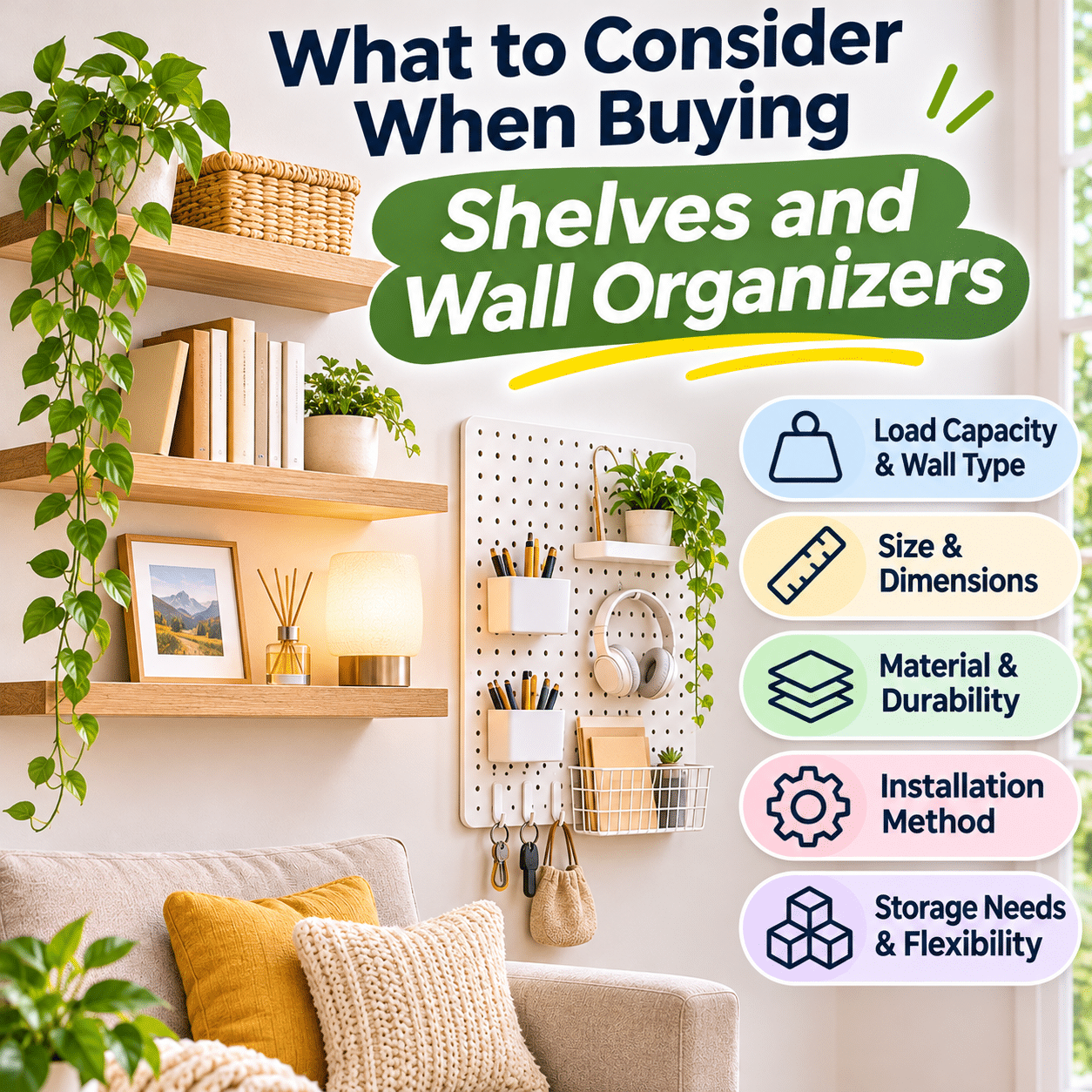
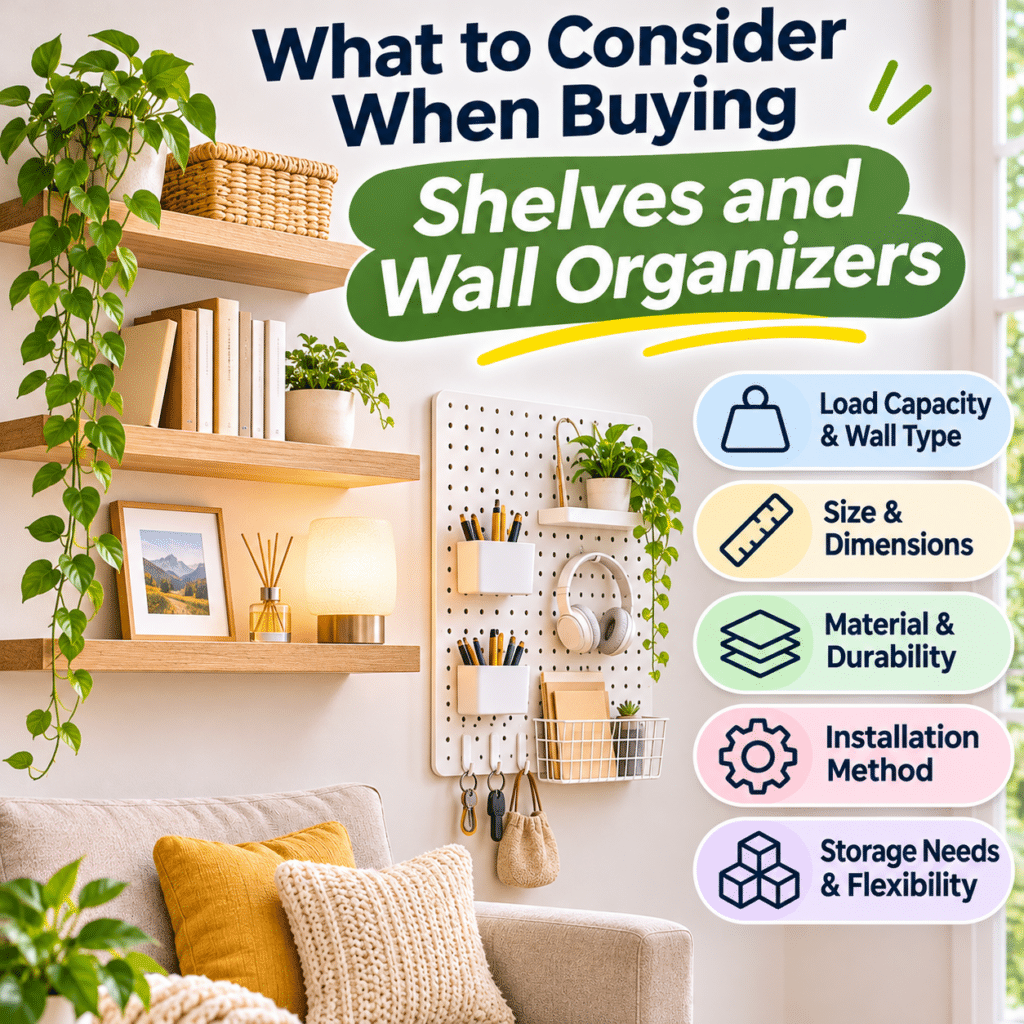
Shelves and wall organizers are among the most practical ways to improve storage, reduce clutter, and make better use of available space at home. Whether you live in a compact apartment, a family house, or a home with limited built-in storage, the right wall-mounted solutions can help keep everyday belongings organized without occupying valuable floor space.
However, choosing shelves and wall organizers involves more than finding an attractive design. Materials, load capacity, wall construction, installation methods, shelf dimensions, accessibility, and long-term durability all influence how well a storage system performs.
A floating shelf may look elegant in a living room but may not be suitable for heavy books without adequate structural support. A wall-mounted organizer may provide convenient storage in a kitchen but require moisture-resistant materials and an installation method appropriate for the wall.
The best solution depends on what you need to store, how frequently you use those items, where the organizer will be installed, and how much weight the wall and mounting system can safely support.
This comprehensive guide explains how to choose shelves and wall organizers for different living spaces, compare common materials and mounting systems, understand weight capacity, plan practical layouts, avoid installation mistakes, and create storage arrangements that remain functional and attractive over time.
1. Understand the Different Purposes of Shelves and Wall Organizers
Although shelves and wall organizers are often grouped together, they serve somewhat different purposes.
Shelves
Shelves provide horizontal surfaces for storing, displaying, or arranging objects.
Common uses include:
- Books and magazines.
- Decorative objects.
- Kitchen supplies.
- Bathroom essentials.
- Small plants.
- Office materials.
- Collectibles.
- Everyday household accessories.
Shelves are especially useful when items need to remain visible and accessible.
Wall Organizers
Wall organizers typically combine compartments, hooks, pockets, rails, or other storage features.
They are designed to keep different items separated and easy to retrieve.
Common uses include:
- Keys and mail.
- Kitchen utensils.
- Cleaning supplies.
- Craft materials.
- Office stationery.
- Accessories.
- Entryway essentials.
- Small household tools.
Shelves Versus Wall Organizers
| Feature | Shelves | Wall Organizers |
|---|---|---|
| Primary purpose | Support and display objects | Sort and organize belongings |
| Typical structure | Horizontal surfaces | Hooks, compartments, rails, pockets |
| Best for | Books, decor, containers, household items | Small accessories and frequently used items |
| Visual appearance | Open display | Functional organization |
| Accessibility | Depends on shelf height and depth | Often designed for quick retrieval |
| Installation | Floating, bracketed, rail-mounted | Adhesive, screw-mounted, rail-based, pegboard |
| Flexibility | Varies by design | Often includes modular options |
Many homes benefit from combining both types.
For example, an entryway may use a small shelf for decorative objects and a wall organizer with hooks for keys, bags, and accessories.
2. Identify Your Storage Needs Before Shopping
The first step is deciding what the shelf or organizer must accomplish.
Avoid choosing a product based only on appearance.
Identify the Items You Want to Store
Make a list of the objects that will occupy the storage area.
Consider their:
- Dimensions.
- Weight.
- Quantity.
- Shape.
- Frequency of use.
- Sensitivity to moisture.
- Need for ventilation.
- Fragility.
- Visibility requirements.
Separate Everyday Items From Occasional Items
Frequently used objects should generally remain within comfortable reach.
Items used less often can be placed higher or in less accessible locations, provided storage remains safe.
Decide Between Display and Concealment
Open shelves keep belongings visible.
This can be attractive for books, plants, and decorative objects.
However, open storage may also expose clutter.
Wall organizers with compartments, baskets, or covered sections may be more suitable for miscellaneous items.
Plan for Future Storage Needs
A storage system should accommodate reasonable changes over time.
Modular or adjustable designs can be particularly useful when your belongings or room layout may change.
3. Measure the Available Wall Space
Accurate measurements are essential for choosing shelves that fit properly.
Measure Width
Determine the horizontal area available for installation.
Consider nearby:
- Doors.
- Windows.
- Cabinets.
- Light switches.
- Electrical outlets.
- Wall fixtures.
- Furniture.
Measure Height
Identify the vertical space available and the height at which stored objects can be reached comfortably.
Measure Depth Clearance
Shelf depth affects how far the shelf extends into the room.
This is especially important in:
- Narrow hallways.
- Small bathrooms.
- Compact kitchens.
- Entryways.
- Spaces above furniture.
Account for Movement
A shelf should not obstruct normal movement, door operation, or access to nearby equipment.
Measure the Items Themselves
Do not assume that a shelf will fit your belongings simply because its overall dimensions seem adequate.
Measure the tallest, widest, and deepest objects you plan to store.
Allow Practical Clearance
Leave enough space to lift, remove, and replace objects without difficulty.
4. Understand Shelf Width, Depth, and Height
Three dimensions strongly influence storage usability.
Shelf Width
Width determines how much horizontal storage space is available.
Longer shelves may provide more storage but can require additional support to resist bending.
Shelf Depth
Depth determines the size of objects that can fit securely.
A shallow shelf may work well for:
- Picture frames.
- Small decorative items.
- Spice containers.
- Compact accessories.
Deeper shelves may be needed for:
- Large books.
- Storage baskets.
- Kitchen appliances.
- Folded towels.
- Larger containers.
Shelf Thickness
Thickness can influence stiffness, appearance, and the compatibility of mounting hardware.
However, thickness alone does not determine load capacity.
Material properties, span length, bracket spacing, and construction also matter.
Vertical Spacing
Spacing between shelves should accommodate stored objects and allow comfortable access.
For adjustable systems, choose a design with enough height positions to support changing storage needs.
5. Understand the Main Types of Wall Shelves
Different shelf designs offer different combinations of appearance, strength, flexibility, and installation complexity.
Floating Shelves
Floating shelves use concealed or minimally visible supports.
They create a clean, streamlined appearance.
Advantages:
- Minimalist design.
- Suitable for decorative displays.
- Useful in contemporary interiors.
- Can fit into compact spaces.
Limitations:
- Load capacity varies significantly.
- Installation may require precise alignment.
- Concealed supports must match the shelf and wall construction.
- Some models are unsuitable for heavy objects.
Floating shelves are best selected with particular attention to mounting specifications.
Bracket Shelves
Bracket shelves use visible supports beneath the shelf surface.
Advantages:
- Many sizes and configurations.
- Support arrangements are visible.
- Often suitable for practical storage.
- Easier to inspect mounting points.
Limitations:
- Brackets remain visible.
- Hardware must be matched to the expected load.
- Installation requires appropriate anchors and fasteners.
Adjustable Track Shelving
Track systems use vertical rails or standards with movable shelf brackets.
Advantages:
- Adjustable shelf heights.
- Flexible configurations.
- Useful for changing storage needs.
- Suitable for closets, offices, and utility areas.
Limitations:
- Rails are visible.
- Correct installation is essential.
- Compatibility between components must be verified.
Modular Wall Shelving
Modular systems use interchangeable shelves, rails, cabinets, or compartments.
Advantages:
- Adaptable layouts.
- Expandable storage.
- Multiple organizational options.
Limitations:
- Components may use proprietary connections.
- Expansion parts may not remain available indefinitely.
- Costs can increase as the system grows.
Corner Shelves
Corner shelves use wall intersections that might otherwise remain unused.
Advantages:
- Efficient use of corners.
- Suitable for compact decorative arrangements.
- Can provide additional storage in small rooms.
Limitations:
- Irregular shapes may restrict usable space.
- Installation and support requirements vary.
Picture Ledges
Picture ledges are shallow shelves, often with a raised front edge.
They are commonly used for:
- Framed artwork.
- Photographs.
- Small books.
- Lightweight decorative objects.
Their narrow depth generally limits their suitability for bulky storage.
6. Compare Common Wall Organizer Types
Wall organizers vary widely in design.
Pegboards
Pegboards use regularly spaced holes that accept hooks, shelves, containers, or other accessories.
They are useful for:
- Craft rooms.
- Workshops.
- Home offices.
- Kitchens.
- Hobby spaces.
Their main advantage is flexibility.
Wall-Mounted Hooks
Hooks provide simple storage for items such as bags, coats, towels, and accessories.
Their suitability depends on the mounting system and the weight and shape of the stored items.
Rail Systems
Rails support movable hooks, baskets, or other accessories.
They are useful when storage needs change frequently.
Pocket Organizers
Pocket organizers use fabric, plastic, or other compartments.
They can store lightweight items such as stationery, small accessories, and personal care supplies.
Wall-Mounted Baskets
Baskets provide contained storage while keeping items accessible.
They are useful for grouping related objects.
Mail and Key Organizers
These combine small shelves, hooks, slots, or compartments.
They are particularly useful near entrances.
Magnetic Organizers
Magnetic systems can hold compatible metal objects.
Their holding strength depends on magnet design, surface conditions, and load orientation.
They should not be used for heavy or potentially dangerous objects unless specifically designed and rated for that purpose.
7. Compare Shelving and Organizer Designs
| Storage Type | Best Uses | Main Advantages | Main Considerations |
|---|---|---|---|
| Floating shelves | Decor, small displays | Clean appearance | Concealed mounting strength |
| Bracket shelves | Books, general storage | Flexible support options | Visible hardware |
| Adjustable tracks | Closets, offices, utility rooms | Adjustable height | Rail installation |
| Modular shelving | Changing storage needs | Expandability | Component compatibility |
| Corner shelves | Unused corners | Space efficiency | Limited object shapes |
| Picture ledges | Frames, small displays | Shallow profile | Limited depth |
| Pegboards | Tools, crafts, accessories | Reconfigurable | Accessory compatibility |
| Hook rails | Coats, bags, towels | Quick access | Hook and anchor capacity |
| Pocket organizers | Lightweight small items | Compartmentalized storage | Material durability |
| Wall baskets | Household essentials | Contained storage | Depth and weight limits |
8. Understand Shelf Weight Capacity
Weight capacity is one of the most important considerations when buying wall-mounted storage.
A shelf must safely support both its own weight and the objects placed on it.
Load Capacity Is a System Property
The safe capacity depends on several components working together:
- Shelf material.
- Shelf dimensions.
- Brackets or concealed supports.
- Fasteners.
- Wall anchors.
- Wall construction.
- Installation quality.
- Load placement.
A strong shelf board cannot compensate for inadequate wall anchors.
Manufacturer Ratings
Look for a clearly stated load rating.
Determine whether the rating applies to:
- One shelf.
- One bracket.
- One hook.
- The complete system.
- A specific wall construction.
- A particular installation configuration.
Distributed Versus Concentrated Loads
A uniformly distributed load spreads weight across the shelf.
A concentrated load places more force in one location.
For example, several small containers distributed across a shelf may affect it differently from one heavy object placed near the outer edge.
Avoid Assuming Ratings Are Universal
A product tested on a solid structural wall may not support the same load when installed on hollow drywall.
Follow the manufacturer’s installation conditions.
9. Understand How Shelf Depth Affects Stability
Shelf depth influences both storage capacity and the forces acting on mounting hardware.
Deeper Shelves Create Greater Leverage
Objects placed farther from the wall create greater turning forces on the mounting system.
This is particularly important for floating shelves.
Heavy Items Near the Wall
When appropriate, placing heavier objects closer to the wall can reduce leverage on shelf supports.
However, this does not increase the manufacturer’s rated capacity.
Avoid Excessive Overhang
Objects extending beyond the shelf edge may be easier to knock over.
Consider Bracket Length
For bracketed shelves, support dimensions should match the shelf depth and intended load.
Follow manufacturer requirements rather than relying on a universal bracket-to-shelf ratio.
10. Understand Wall Construction Before Installation
Different walls require different mounting approaches.
Solid Concrete Walls
Concrete can provide strong structural support when appropriate anchors are correctly selected and installed.
However, concrete quality, edge distances, drilling depth, and anchor specifications matter.
Brick Walls
Brick may be solid or hollow.
Anchor suitability depends on the brick type, condition, and installation method.
Mortar joints may not provide the same holding characteristics as the surrounding masonry.
Drywall
Drywall is a panel material commonly used over wood or metal framing.
For substantial loads, fastening into suitable structural framing is often preferable.
Specialized hollow-wall anchors may be appropriate for selected lighter loads when used within their rated conditions.
Plaster Walls
Plaster construction varies.
Older walls may contain wood lath, masonry, or other supporting structures.
Installation requires identifying the actual wall assembly.
Tile-Covered Walls
Tile is a surface finish, not necessarily the structural support.
The mounting system must be suitable for the underlying wall.
Drilling tile also requires care to prevent cracking and damage to waterproofing.
Unknown Wall Construction
If you cannot confidently identify the wall material or appropriate mounting method, seek professional advice before installing a load-bearing shelf.
11. Choose the Right Mounting Hardware
Mounting hardware determines how the shelf transfers weight to the wall.
Screws
Screws must be suitable for the support material and mounting configuration.
Wall Anchors
Wall anchors help fasteners engage certain wall materials.
Different anchors are designed for different substrates and loads.
Masonry Anchors
These are designed for specified masonry or concrete applications.
Hollow-Wall Anchors
These may be used in appropriate drywall assemblies.
Their performance depends on wall thickness, condition, and anchor type.
Stud-Mounted Fasteners
Fastening into suitable structural studs can provide strong support when installed correctly.
Brackets
Brackets should be compatible with the shelf dimensions and expected load.
Complete Mounting Kits
Some shelving products include hardware.
However, included hardware may not suit every wall type.
Always verify compatibility before installation.
12. Compare Screw-Mounted and Adhesive Organizers
Not every wall organizer requires drilling.
Adhesive systems can be convenient for lightweight applications.
Screw-Mounted Storage
Advantages:
- Wide range of structural mounting options.
- Suitable for many medium and heavy-duty applications when properly engineered.
- Often provides more predictable mechanical attachment.
Limitations:
- Requires drilling.
- May leave holes.
- Installation depends on wall conditions.
- Incorrect fastening can cause failure.
Adhesive-Mounted Storage
Advantages:
- No drilling in many applications.
- Convenient for lightweight accessories.
- Can be suitable for selected smooth surfaces.
Limitations:
- Bond strength depends on surface preparation.
- Paint, texture, moisture, and temperature can affect adhesion.
- Removal may damage finishes.
- Load capacity may be limited.
Adhesive Mounting Is Not Universally Damage-Free
Some adhesives can remove paint or leave residue.
Follow the manufacturer’s surface compatibility, curing time, and removal instructions.
Avoid Adhesive Mounting for Critical Loads
Do not use an unrated adhesive organizer to support heavy, fragile, sharp, or hazardous objects.
13. Evaluate Shelving Materials
Material selection influences strength, appearance, weight, moisture resistance, and maintenance.
Solid Wood
Solid wood shelves offer a natural appearance and can be durable when appropriately designed.
Advantages:
- Warm visual character.
- Multiple finishing options.
- Potential for repair or refinishing.
Considerations:
- Can expand or contract with humidity.
- May warp under unsuitable conditions.
- Strength varies by species and construction.
- Requires suitable surface protection.
Plywood
Plywood is manufactured from bonded wood veneers.
Advantages:
- Often dimensionally stable.
- Available in various thicknesses and grades.
- Suitable for many practical shelving applications.
Considerations:
- Quality varies.
- Exposed edges may require finishing.
- Moisture resistance depends on grade and construction.
MDF
Medium-density fiberboard is an engineered wood product.
Advantages:
- Smooth surface.
- Consistent appearance.
- Commonly used in painted or laminated shelving.
Considerations:
- Can be heavy.
- May sag under sustained loads.
- Standard MDF is vulnerable to moisture damage.
- Fastener holding strength depends on design.
Particleboard
Particleboard is commonly used in economical furniture and shelving.
Advantages:
- Affordable.
- Available with decorative laminates.
- Consistent manufactured dimensions.
Considerations:
- Moisture can cause swelling.
- Load capacity varies.
- Edge damage and repeated disassembly can affect durability.
Metal
Metal shelves may use steel, aluminum, or other alloys.
Advantages:
- Strong designs are available.
- Suitable for utility and industrial-style spaces.
- Can provide relatively slim structural profiles.
Considerations:
- Corrosion resistance varies.
- Edges and finishes require attention.
- Metal surfaces may scratch or dent.
Glass
Glass shelves can create a light, open appearance.
Advantages:
- Visually unobtrusive.
- Easy-to-wipe surfaces.
- Suitable for decorative applications.
Considerations:
- Require appropriate safety glass and supports.
- Can chip or break.
- Load ratings must be respected.
- May show fingerprints and water marks.
Plastic and Composite Materials
These materials are common in lightweight organizers.
Advantages:
- Lightweight.
- Available in many shapes.
- Some are moisture-resistant.
- Often easy to clean.
Considerations:
- Quality varies.
- Some materials become brittle over time.
- Heat and ultraviolet exposure may affect durability.
14. Compare Shelving Materials
| Material | Appearance | Strength Considerations | Moisture Considerations | Typical Uses |
|---|---|---|---|---|
| Solid wood | Natural, warm | Depends on species and dimensions | Movement with humidity | Living rooms, bedrooms |
| Plywood | Versatile | Depends on grade and thickness | Moisture-resistant grades available | General shelving |
| MDF | Smooth, uniform | Sagging and fastener limitations | Standard grades vulnerable | Decorative and cabinet shelving |
| Particleboard | Laminated finishes | Depends on density and construction | Swelling risk | Budget furniture systems |
| Metal | Modern, industrial | Design and gauge determine capacity | Corrosion protection matters | Utility and storage areas |
| Glass | Light, minimal | Requires rated safety glass and supports | Generally water-resistant surface | Decorative displays |
| Plastic/composite | Varied | Product-specific ratings | Often moisture-resistant | Lightweight organizers |
15. Consider Long-Term Shelf Sagging
Shelf sagging occurs when a shelf bends under load.
Some deflection may be temporary, while prolonged loading can cause permanent deformation.
Factors That Affect Sagging
- Shelf material.
- Thickness.
- Unsupported span.
- Weight of stored items.
- Load distribution.
- Temperature and humidity.
- Duration of loading.
Longer Spans Require Care
A long shelf may need additional brackets or structural reinforcement.
Books Can Be Surprisingly Heavy
A fully loaded bookshelf can place substantial weight on its supports.
Avoid Universal Thickness Rules
There is no single shelf thickness suitable for every material, span, and load.
Use manufacturer specifications or appropriate structural design guidance.
Inspect Shelves Periodically
Check for:
- Visible bending.
- Loose brackets.
- Cracks.
- Separation at joints.
- Movement at mounting points.
Reduce loading and correct the problem if deterioration appears.
16. Choose Shelves for Small Living Spaces
Small homes benefit from storage that uses vertical space efficiently without making rooms feel crowded.
Prioritize Shallow Storage Where Appropriate
Shallow shelves can provide storage while preserving walking space.
Use Wall Space Above Furniture Carefully
Potential locations include:
- Above desks.
- Beside wardrobes.
- Near entryway consoles.
- Above low storage cabinets.
Avoid placing heavy or unstable objects where they could fall onto people.
Choose Multipurpose Organizers
A wall organizer with hooks, shelves, and compartments may replace several separate accessories.
Consider Visual Simplicity
A few well-organized shelves can look calmer than many small units scattered across a wall.
Avoid Overfilling
Leaving some open space can improve visibility and access.
17. Choose Shelves for Living Rooms
Living room shelves often combine practical storage and decoration.
Floating Display Shelves
These may work well for lightweight decorative objects.
Bookshelves
Books require sturdy support and sufficient shelf depth.
Media Wall Shelves
Shelves near entertainment equipment should account for:
- Equipment dimensions.
- Ventilation.
- Cable management.
- Electrical access.
- Weight capacity.
Decorative Groupings
Group objects by purpose, size, or visual relationship.
Maintain Safe Placement
Avoid placing heavy objects on high shelves directly above frequently occupied seating areas.
18. Choose Wall Organizers for Entryways
Entryways benefit from simple, accessible storage.
Key Hooks
Hooks provide a consistent location for keys and small accessories.
Mail Compartments
Separate incoming mail, documents, and items requiring attention.
Bag and Coat Hooks
Choose hooks and anchors suitable for the expected weight.
Small Shelves
A compact shelf may hold everyday essentials.
Consider Reachability
Storage should be comfortable for the people using it.
Avoid Blocking Doors
Ensure hooks and hanging items do not interfere with door swings or narrow passages.
19. Choose Kitchen Shelves and Wall Organizers
Kitchen storage must balance accessibility, cleanliness, and moisture exposure.
Open Kitchen Shelves
These can hold:
- Frequently used dishes.
- Cups.
- Dry food containers.
- Lightweight kitchen accessories.
Spice Racks
Shallow shelves or racks can keep spice containers organized.
Avoid locations with excessive heat, steam, or direct sunlight.
Utensil Rails
Rails with hooks can keep frequently used utensils accessible.
Pot and Pan Storage
Cookware can be heavy.
Use only mounting systems specifically rated for the intended load.
Consider Grease and Cleaning
Open kitchen storage may accumulate grease and dust.
Choose surfaces that can be cleaned easily.
Avoid Heat-Sensitive Materials Near Cooking Equipment
Follow appliance clearance requirements and applicable fire safety guidance.
20. Choose Bathroom Shelves and Organizers
Bathrooms introduce moisture, humidity, and cleaning challenges.
Moisture-Resistant Materials
Consider materials and finishes suitable for humid environments.
Shower Organizers
Shower storage should be designed for wet locations.
Wall-Mounted Baskets
These can hold towels, toiletries, and personal care items.
Avoid Water Traps
Designs that retain water may encourage residue buildup and require frequent cleaning.
Consider Corrosion Resistance
Metal components should have suitable corrosion protection.
Protect Waterproofing
Drilling through bathroom tile or waterproofed surfaces can create water intrusion risks.
Use appropriate installation methods and professional assistance where needed.
21. Choose Shelves for Bedrooms
Bedroom storage should support organization without creating unnecessary visual clutter.
Bedside Wall Shelves
A small shelf can provide a surface for books and personal items where floor space is limited.
Decorative Shelves
Use them for lightweight displays and personal objects.
Wardrobe-Adjacent Storage
Hooks or organizers can hold accessories and everyday clothing items.
Avoid Heavy Overhead Storage
Do not place heavy objects on inadequately secured shelves above beds.
Consider Nighttime Safety
Storage should not create protrusions or obstacles in areas used when visibility is low.
22. Choose Home Office Wall Organizers
Home offices often contain numerous small objects that benefit from dedicated storage.
Pegboards
Pegboards can hold stationery, accessories, and lightweight office supplies.
Document Organizers
Wall-mounted file holders can free desk space.
Small Shelves
Shelves can store reference books, notebooks, and supplies.
Cable Organizers
Cable management accessories can reduce clutter around equipment.
Keep Frequently Used Items Accessible
Place daily supplies within comfortable reach.
Avoid Overloading Above Electronics
Heavy items should not be positioned where falling objects could damage equipment or injure users.
23. Choose Shelves for Craft and Hobby Rooms
Craft spaces often require flexible storage for materials of different sizes.
Pegboard Systems
Pegboards allow hooks, baskets, and tool holders to be rearranged.
Small Compartment Organizers
These help separate:
- Thread.
- Brushes.
- Markers.
- Craft tools.
- Adhesive accessories.
- Small hardware.
Adjustable Shelves
Adjustable heights accommodate containers and materials as collections change.
Consider Visibility
Clear or labeled containers can simplify retrieval.
Store Hazardous Materials Appropriately
Sharp tools, chemicals, and other potentially hazardous supplies require suitable secure storage.
24. Choose Shelving for Laundry and Utility Rooms
Laundry and utility areas often need durable, practical storage.
Cleaning Supply Shelves
Use shelves suitable for the weight and packaging of stored products.
Wall-Mounted Baskets
These may hold lightweight laundry accessories.
Hooks and Rails
Useful for cleaning tools and selected household accessories.
Moisture Resistance
Consider humidity and possible water exposure.
Safe Chemical Storage
Cleaning chemicals should be stored according to their labels and kept inaccessible to children and pets where appropriate.
Do not place incompatible chemicals together simply for convenience.
25. Choose Garage and Workshop Wall Storage
Garages and workshops may require heavier-duty storage systems.
Heavy-Duty Shelving
Choose products rated for the intended loads and installation conditions.
Tool Pegboards
Pegboards provide visibility and flexible tool placement.
Wall Rails
Rails can hold compatible storage accessories.
Hooks for Large Items
Large tools and equipment require appropriately rated hooks and anchors.
Consider Impact and Vibration
Garage environments may expose storage to movement, temperature changes, and accidental contact.
Keep Heavy Objects Low When Possible
Heavy equipment is generally safer and easier to handle at lower storage heights.
Follow Structural Requirements
For substantial loads, consult qualified professionals rather than relying on generic mounting advice.
26. Consider Adjustable and Modular Storage Systems
Adjustable systems are useful when storage requirements change.
Adjustable Shelf Heights
These allow shelves to accommodate objects of different heights.
Interchangeable Accessories
Some systems support:
- Hooks.
- Baskets.
- Shelves.
- Containers.
- Tool holders.
- Rails.
Expandable Configurations
Additional sections can sometimes be added later.
Check Component Compatibility
Not all accessories fit all systems.
Consider Long-Term Availability
Proprietary components may become difficult to replace.
Avoid Unnecessary Complexity
A simple fixed shelf may be preferable when storage needs are unlikely to change.
27. Consider Open Shelves Versus Enclosed Wall Storage
Open and enclosed storage serve different purposes.
Open Shelves
Advantages:
- Easy visibility.
- Quick access.
- Decorative potential.
- Often visually lightweight.
Limitations:
- Dust accumulation.
- Visible clutter.
- Less protection for sensitive items.
Enclosed Wall Cabinets
Advantages:
- Concealed storage.
- Better visual organization.
- Some protection from dust.
- Doors may provide additional containment.
Limitations:
- Require clearance for opening.
- May appear visually heavier.
- Often involve more complex installation.
Hybrid Storage
Combining open shelves with closed compartments can balance accessibility and appearance.
28. Consider Storage Accessibility and Ergonomics
Storage should be easy to use without unnecessary stretching, bending, or reaching.
Frequently Used Items
Place everyday objects within comfortable reach.
Heavy Items
Store heavy objects at heights where they can be handled safely.
High Shelves
Reserve high storage for lightweight, infrequently used belongings when appropriate.
Children
Storage intended for children should be accessible without encouraging climbing.
Older Adults
Avoid arrangements that require frequent use of step stools or awkward reaching.
Shared Households
Consider the different heights and abilities of household members.
29. Understand Child Safety and Tip Hazards
Wall-mounted storage can create hazards if improperly installed or overloaded.
Falling Objects
Items may fall if shelves are unstable, overloaded, or exposed to impact.
Climbing Hazards
Children may attempt to climb shelves or use nearby furniture to reach objects.
Sharp Corners
Protruding corners can create injury risks in narrow spaces.
Secure Installation
Follow manufacturer instructions and use appropriate structural supports.
Avoid Heavy Items Above Beds or Play Areas
Keep potentially dangerous objects away from locations where people spend extended periods.
Furniture Anchoring
Freestanding storage furniture should be anchored where recommended to reduce tip-over hazards.
Wall-mounted shelves and freestanding furniture require different safety considerations.
30. Consider Pet Safety
Pets may jump, climb, pull, or interact with wall storage.
Avoid Unstable Displays
Fragile objects can be knocked from shelves.
Consider Climbing Behavior
Cats and other climbing animals may access shelves that appear out of reach.
Keep Hazardous Objects Secure
Store sharp tools, medications, chemicals, and other dangerous items appropriately.
Protect Hanging Accessories
Loose cords, straps, and dangling objects may attract pets.
Evaluate Plant Storage
Some decorative plants are toxic to pets.
Choose safe placement and suitable plant species.
31. Consider Moisture and Humidity
Humidity can affect shelving materials and mounting systems.
Wood-Based Materials
Some engineered wood products swell or deteriorate when exposed to water.
Solid Wood
Changes in humidity can cause dimensional movement.
Metal
Unprotected metal may corrode in humid environments.
Adhesives
Moisture and temperature can influence adhesive performance.
Bathroom and Laundry Storage
Choose materials intended for the expected environmental conditions.
Ventilation
Allow adequate airflow around moisture-sensitive items.
32. Consider Shelf Finishes and Surface Durability
The finish affects both appearance and maintenance.
Painted Finishes
Painted shelves can coordinate with interior colors.
However, paint quality and surface preparation influence durability.
Laminates
Laminated surfaces can be easy to clean.
Edge sealing and substrate quality matter.
Natural Wood Finishes
Wood finishes can highlight grain and provide varying degrees of protection.
Powder-Coated Metal
Powder coating can provide a durable finish when properly applied.
Glass Surfaces
Glass is easy to wipe but may show fingerprints and scratches.
Evaluate Cleaning Requirements
Choose finishes appropriate for the room and stored objects.
33. Choose Colors and Styles That Fit Your Home
Shelving contributes to the overall visual character of a room.
Minimalist Interiors
Simple floating shelves or slim metal systems may complement uncluttered spaces.
Traditional Interiors
Wood shelves and decorative brackets can provide a classic appearance.
Modern Interiors
Clean lines and coordinated finishes can create a cohesive look.
Industrial Interiors
Metal brackets and wood surfaces are common combinations.
Natural Interiors
Wood tones and organic textures can add warmth.
Avoid Choosing Style Alone
A shelf should meet structural and functional requirements before decorative preferences.
34. Plan a Balanced Wall Storage Layout
A thoughtful layout can improve both appearance and usability.
Consider Visual Weight
Large or dark shelves may appear more prominent than slim or light-colored designs.
Avoid Overcrowding
Leave sufficient space between objects and storage sections.
Align With Existing Furniture
Shelves can be positioned in relation to desks, cabinets, and other furniture.
Use Repetition Carefully
Repeating similar materials or dimensions can create visual consistency.
Combine Different Heights
Different shelf heights may accommodate objects of varying sizes.
Prioritize Function
The most attractive arrangement should still allow comfortable access to stored items.
35. Understand Installation Difficulty
Installation requirements vary by product and wall type.
Simple Hook Systems
Some lightweight organizers require minimal installation.
Floating Shelves
Concealed supports may require precise measurements and drilling.
Track Systems
Multiple rails must be correctly aligned and secured.
Heavy-Duty Shelving
Substantial loads may require structural assessment and specialized fasteners.
Tile Installations
Drilling through tile can be difficult and may compromise waterproofing if performed incorrectly.
When to Hire a Professional
Professional installation is advisable when:
- Wall construction is uncertain.
- Heavy loads are involved.
- Electrical or plumbing services may be concealed.
- Waterproofed surfaces require drilling.
- Structural support is unclear.
- The manufacturer requires professional installation.
36. Check for Hidden Electrical and Plumbing Services
Drilling into walls can damage concealed utilities.
Potential hazards include:
- Electrical wiring.
- Water pipes.
- Gas lines.
- Communication cables.
- Heating or cooling services.
Review Available Building Information
Construction plans may help identify service routes, although they may not reflect every modification.
Use Appropriate Detection Methods
Suitable detection equipment may help identify certain hidden services, but no consumer detector guarantees that a drilling location is safe.
Avoid Guessing
Do not assume a wall is clear simply because no outlet or fixture is visible nearby.
Seek Professional Assistance
If hidden services cannot be reliably identified, consult a qualified professional before drilling.
37. Evaluate Installation Hardware Included With the Product
Some shelves include mounting hardware, while others require separate purchases.
Check the Package Contents
Look for:
- Brackets.
- Screws.
- Wall anchors.
- Mounting plates.
- Templates.
- Instructions.
- Required connectors.
Verify Wall Compatibility
Included anchors may be designed for only certain wall materials.
Confirm Load Ratings
The stated capacity may depend on using specific fasteners or mounting configurations.
Check Tool Requirements
Some installations require drills, levels, measuring tools, or specialized equipment.
Avoid Improvised Substitutions
Replacing specified hardware with unverified alternatives can compromise safety.
38. Understand Maintenance and Long-Term Durability
Shelves and organizers should remain stable and functional over time.
Inspect Mounting Points
Check for looseness, movement, or visible deterioration.
Watch for Sagging
Reduce loading if shelves begin to bend.
Check for Moisture Damage
Look for swelling, peeling finishes, corrosion, or discoloration.
Clean Appropriate Surfaces
Follow material-specific cleaning instructions.
Avoid Overloading
Storage needs may increase over time.
Do not exceed the manufacturer’s rated capacity.
Replace Damaged Components
Cracked brackets, weakened anchors, or damaged shelf boards should be addressed promptly.
39. Understand the Total Cost of Ownership
The initial purchase price does not represent the full cost of a shelving system.
Product Cost
Consider the price of shelves, organizers, brackets, and accessories.
Mounting Hardware
Specialized anchors or fasteners may be required.
Installation
Professional installation can add expense.
Maintenance
Some materials require periodic refinishing, cleaning, or component replacement.
Expansion
Modular systems may require additional proprietary components.
Repairs
Wall damage or failed mounting points may create repair costs.
Long-Term Value
A durable, appropriately installed system may offer better value than a cheaper product that requires frequent replacement.
40. Compare Storage Solutions by Household Need
| Household Need | Suitable Storage Options | Main Priority |
|---|---|---|
| Small apartment | Shallow shelves, compact organizers | Preserve floor space |
| Living room decor | Floating shelves, picture ledges | Appearance and safe support |
| Heavy books | Properly supported bracket shelves | Load capacity |
| Entryway essentials | Hooks, key organizers, small shelves | Easy access |
| Kitchen utensils | Rails, hooks, shallow racks | Cleaning and convenience |
| Bathroom toiletries | Moisture-resistant shelves and baskets | Water resistance |
| Home office supplies | Pegboards, document holders | Organization and flexibility |
| Craft materials | Modular shelves, compartment organizers | Adaptability |
| Laundry supplies | Utility shelves, wall baskets | Durability and safety |
| Garage tools | Rated heavy-duty systems | Structural support |
| Children’s rooms | Secure, accessible storage | Safety |
| Changing storage needs | Adjustable tracks, modular systems | Reconfiguration |
41. Common Mistakes to Avoid When Buying Shelves and Wall Organizers
Mistake 1: Choosing Based Only on Appearance
A beautiful shelf may not support the intended items.
Better approach: Evaluate load capacity, dimensions, and mounting requirements first.
Mistake 2: Ignoring Wall Construction
Different walls require different fastening methods.
Better approach: Identify the wall material before choosing hardware.
Mistake 3: Assuming All Anchors Have the Same Capacity
Anchor performance varies significantly.
Better approach: Use anchors rated for the actual wall and load.
Mistake 4: Buying Shelves That Are Too Deep
Deep shelves can obstruct movement and create greater leverage on supports.
Better approach: Match depth to stored objects and available clearance.
Mistake 5: Overlooking Shelf Sagging
Long shelves may bend under sustained loads.
Better approach: Consider material, span, thickness, and support spacing.
Mistake 6: Using Adhesive Storage for Heavy Items
Adhesive strength depends on surface conditions and product specifications.
Better approach: Use appropriately rated mechanical mounting for substantial loads.
Mistake 7: Ignoring Moisture Exposure
Unsuitable materials can swell, corrode, or deteriorate.
Better approach: Choose materials appropriate for the environment.
Mistake 8: Placing Heavy Objects Too High
High storage can make lifting and retrieval unsafe.
Better approach: Keep heavy items at practical handling heights.
Mistake 9: Installing Shelves Above Unsafe Locations
Falling objects can cause injury.
Better approach: Avoid placing heavy or fragile items above beds, seating, or play areas.
Mistake 10: Forgetting Accessibility
Storage that is difficult to reach may be inconvenient.
Better approach: Organize according to frequency of use.
Mistake 11: Buying Incompatible Modular Components
Not all rails, brackets, and accessories fit together.
Better approach: Confirm compatibility before purchasing.
Mistake 12: Ignoring Hidden Utilities
Drilling can damage wiring or plumbing.
Better approach: Verify drilling locations and seek professional assistance when uncertain.
Mistake 13: Overcrowding Open Shelves
Too many visible objects can make a room feel cluttered.
Better approach: Use grouping, containers, and appropriate spacing.
Mistake 14: Forgetting Maintenance
Loose hardware or damaged materials can create hazards.
Better approach: Inspect storage systems periodically.
Mistake 15: Choosing the Cheapest Option Without Considering Durability
Low initial cost does not guarantee long-term value.
Better approach: Compare construction quality, repairability, and expected maintenance.
42. How to Choose Shelves and Wall Organizers: Step by Step
A structured buying process can help you select practical storage solutions.
Step 1: Identify Your Storage Goals
Decide what items need to be stored and how frequently they will be used.
Step 2: Measure the Available Space
Record wall width, height, and usable depth.
Step 3: Measure the Items
Determine the dimensions and approximate total weight of the belongings.
Step 4: Identify the Wall Construction
Confirm whether the wall is concrete, brick, drywall, plaster, or another material.
Step 5: Choose the Storage Type
Compare floating shelves, bracket shelves, tracks, pegboards, hooks, and modular organizers.
Step 6: Evaluate Load Capacity
Check the manufacturer’s ratings and installation conditions.
Step 7: Choose Suitable Materials
Consider durability, appearance, moisture resistance, and maintenance.
Step 8: Evaluate Mounting Requirements
Confirm that suitable fasteners and supports are available.
Step 9: Consider Accessibility
Place frequently used items at comfortable heights.
Step 10: Review Safety
Avoid hazardous overhead storage and unstable mounting arrangements.
Step 11: Plan the Layout
Coordinate shelf dimensions and spacing with furniture and room circulation.
Step 12: Consider Future Flexibility
Determine whether adjustable or modular storage would be useful.
Step 13: Compare Total Costs
Include installation, accessories, and maintenance.
Step 14: Verify Product Specifications
Review dimensions, load ratings, material information, and warranty terms.
Step 15: Install and Inspect Properly
Follow the manufacturer’s instructions and confirm that the completed installation is secure before loading it.
43. Practical Shelves and Wall Organizers Buying Checklist
Use this checklist before making a purchase.
Storage Needs
- I know which items I want to store.
- I have estimated their combined weight.
- I have measured the largest objects.
- I know how frequently the items will be accessed.
- I have decided between open and enclosed storage.
Dimensions and Layout
- I have measured the available wall width.
- I have checked vertical clearance.
- Shelf depth will not obstruct movement.
- The layout accommodates nearby furniture.
- Doors, switches, and outlets remain accessible.
- Stored objects can be removed comfortably.
Structural Safety
- I have identified the wall construction.
- The mounting system is suitable for the wall.
- The shelf has an appropriate load rating.
- I understand the required load distribution.
- Mounting hardware is compatible.
- Hidden utilities have been considered.
- Heavy objects will be stored safely.
Materials and Durability
- The material suits the room environment.
- Moisture resistance is adequate where needed.
- The surface is easy to clean.
- Shelf thickness and support spacing are appropriate.
- The finish is suitable for long-term use.
Convenience and Value
- The organizer provides practical access.
- The design fits the room.
- Adjustable features are available if needed.
- Replacement accessories can be obtained.
- Installation costs are understood.
- Warranty information is available.
- The total cost fits my budget.
44. Frequently Asked Questions
What Is the Best Type of Shelf for a Small Room?
The best type depends on what needs to be stored.
Shallow floating shelves, compact bracket shelves, and modular wall organizers can make good use of vertical space while preserving floor area.
Are Floating Shelves Strong Enough for Books?
Some floating shelves are designed to support books, but capacity varies.
Check the complete mounting system’s rated load and the wall construction.
Are Bracket Shelves Stronger Than Floating Shelves?
Not necessarily.
Strength depends on the design, materials, fasteners, installation, and load conditions.
A properly engineered floating shelf may support substantial weight, while an inadequately mounted bracket shelf may fail.
How Much Weight Can a Wall Shelf Hold?
There is no universal weight limit.
Capacity depends on the shelf, mounting hardware, wall material, and installation configuration.
Use the manufacturer’s stated rating for the specific conditions.
Can I Install Shelves on Drywall?
Yes, but the installation method must be appropriate.
Substantial loads often benefit from fastening into suitable structural framing.
Hollow-wall anchors may be appropriate for selected applications within their rated limits.
Can I Install Shelves on Concrete Walls?
Yes.
Concrete walls can support shelving when appropriate anchors are selected and installed correctly.
Can Adhesive Shelves Hold Heavy Items?
Most adhesive storage products are intended for limited loads.
Do not assume an adhesive system can support heavy objects without a verified rating for the exact surface and installation conditions.
Are No-Drill Wall Organizers Reliable?
They can be useful for lightweight items on compatible surfaces.
Reliability depends on the product, surface preparation, environmental conditions, and load.
Will Adhesive Organizers Damage Paint?
Some adhesives can damage paint or leave residue during removal.
Check surface compatibility and removal instructions.
What Is the Best Material for Wall Shelves?
There is no universally best material.
Wood, plywood, metal, glass, and engineered boards each offer different advantages.
Choose according to load, environment, appearance, and maintenance requirements.
Is Solid Wood Better Than MDF?
Solid wood and MDF have different characteristics.
Solid wood offers a natural appearance and potential repairability, while MDF provides a smooth, consistent surface.
Strength and durability depend on the specific design and application.
Are Metal Shelves Better for Heavy Storage?
Some metal shelving systems are designed for substantial loads.
However, material alone does not determine capacity.
The complete structure and mounting system must be appropriately rated.
Are Glass Shelves Safe?
Glass shelves can be safe when designed with suitable safety glass, compatible supports, and appropriate load ratings.
Avoid using damaged glass or exceeding specified capacities.
What Causes Shelves to Sag?
Sagging can result from excessive loading, long unsupported spans, insufficient stiffness, or prolonged stress.
Material properties and environmental conditions also matter.
How Can I Prevent Shelf Sagging?
Use appropriately rated materials, suitable support spacing, and proper load distribution.
Follow manufacturer specifications.
What Is the Ideal Shelf Depth?
The ideal depth depends on the items being stored and available room clearance.
Shallow shelves work well for small objects, while larger belongings require deeper storage.
How High Should Wall Shelves Be Installed?
Installation height depends on accessibility, stored items, furniture placement, and safety.
Frequently used objects should remain within comfortable reach.
Should Heavy Items Be Stored on High Shelves?
Heavy objects are generally safer and easier to handle at lower heights.
High storage should not create falling-object or lifting hazards.
Can I Put Shelves Above a Bed?
Wall shelves above beds require particular caution because falling objects can cause injury.
Avoid heavy or unstable overhead storage.
What Is the Difference Between a Pegboard and a Rail Organizer?
Pegboards use a perforated panel with compatible accessories.
Rail organizers use mounted rails that support hooks, baskets, or other attachments.
Both can provide flexible organization.
Are Pegboards Good for Home Offices?
Yes.
Pegboards can organize stationery, accessories, and lightweight supplies while keeping desk surfaces clear.
What Is the Best Wall Organizer for an Entryway?
A combination of hooks, a small shelf, and compartments for keys or mail is often practical.
Choose a configuration based on household routines.
What Is the Best Wall Storage for a Kitchen?
Open shelves, utensil rails, spice racks, and wall baskets can be useful.
Consider load capacity, heat exposure, moisture, and cleaning requirements.
Can I Use Wooden Shelves in a Bathroom?
Wooden shelves may be suitable when properly finished and protected.
However, prolonged moisture exposure can cause deterioration.
What Materials Are Best for Bathroom Organizers?
Materials designed for humid or wet environments are generally preferable.
Corrosion-resistant metals, suitable plastics, and properly protected surfaces are common options.
Are Modular Shelves Worth Buying?
Modular shelves can be useful when storage needs change.
However, check component compatibility and long-term availability.
Are Adjustable Shelves Better Than Fixed Shelves?
Adjustable shelves provide flexibility.
Fixed shelves may be simpler and entirely adequate when storage needs are stable.
Can Wall Organizers Replace Cabinets?
They can replace some cabinet functions, especially for lightweight, frequently used items.
However, enclosed cabinets may be preferable for concealed or protected storage.
Do Open Shelves Make a Room Look Cluttered?
They can if overcrowded.
Thoughtful grouping, suitable spacing, and consistent organization can create a cleaner appearance.
How Do I Organize Small Items on Wall Shelves?
Use compatible containers, baskets, dividers, and labels where useful.
Group objects by function or frequency of use.
Are Corner Shelves Useful?
Corner shelves can make use of otherwise underutilized areas.
However, their shape may limit storage flexibility.
Can I Install Shelves Without Professional Help?
Some lightweight systems can be installed by people with suitable skills and tools.
For heavy loads, uncertain wall construction, concealed utilities, or complex installations, professional assistance may be advisable.
How Do I Know if a Wall Has Hidden Pipes or Wires?
Building information, suitable detection equipment, and professional assessment may help.
No simple method guarantees that every concealed service will be identified.
What Should I Do if a Shelf Feels Loose?
Remove stored items and stop using the shelf until the mounting system has been inspected and corrected.
How Often Should I Inspect Wall Shelves?
Inspect them periodically and whenever you notice movement, sagging, cracks, corrosion, or changes in loading.
Can Wall Shelves Damage Walls?
Yes.
Drilling, unsuitable anchors, excessive loads, or moisture intrusion can damage wall materials and finishes.
Are Expensive Shelves Always Better?
No.
Price does not guarantee superior structural performance or durability.
Compare materials, mounting systems, ratings, and construction quality.
What Should I Prioritize When Buying Wall Organizers?
Prioritize suitable dimensions, safe mounting, adequate load capacity, convenient access, durable materials, and compatibility with the intended room.
Final Thoughts
Choosing shelves and wall organizers is about creating storage that works safely and comfortably within your living space.
The best solution begins with understanding what you need to store, how much space is available, and how frequently the items will be used.
Floating shelves, bracket shelves, adjustable tracks, pegboards, hooks, and modular organizers each offer different advantages. Their suitability depends on the intended load, room conditions, wall construction, and installation requirements.
Material quality and appearance are important, but structural safety should always come first. A shelf must be supported by suitable hardware and installed according to the conditions for which it was designed.
Thoughtful placement also improves everyday usability. Frequently used objects should remain accessible, heavy items should be stored safely, and wall-mounted storage should not obstruct movement or create hazards.
For long-term value, choose durable materials, practical dimensions, easy-to-maintain surfaces, and systems that can accommodate reasonable changes in your storage needs.
The best shelves and wall organizers are not simply those that hold the most belongings. They are the ones that use space efficiently, keep everyday items accessible, complement your home, and provide reliable, safe storage for years to come.