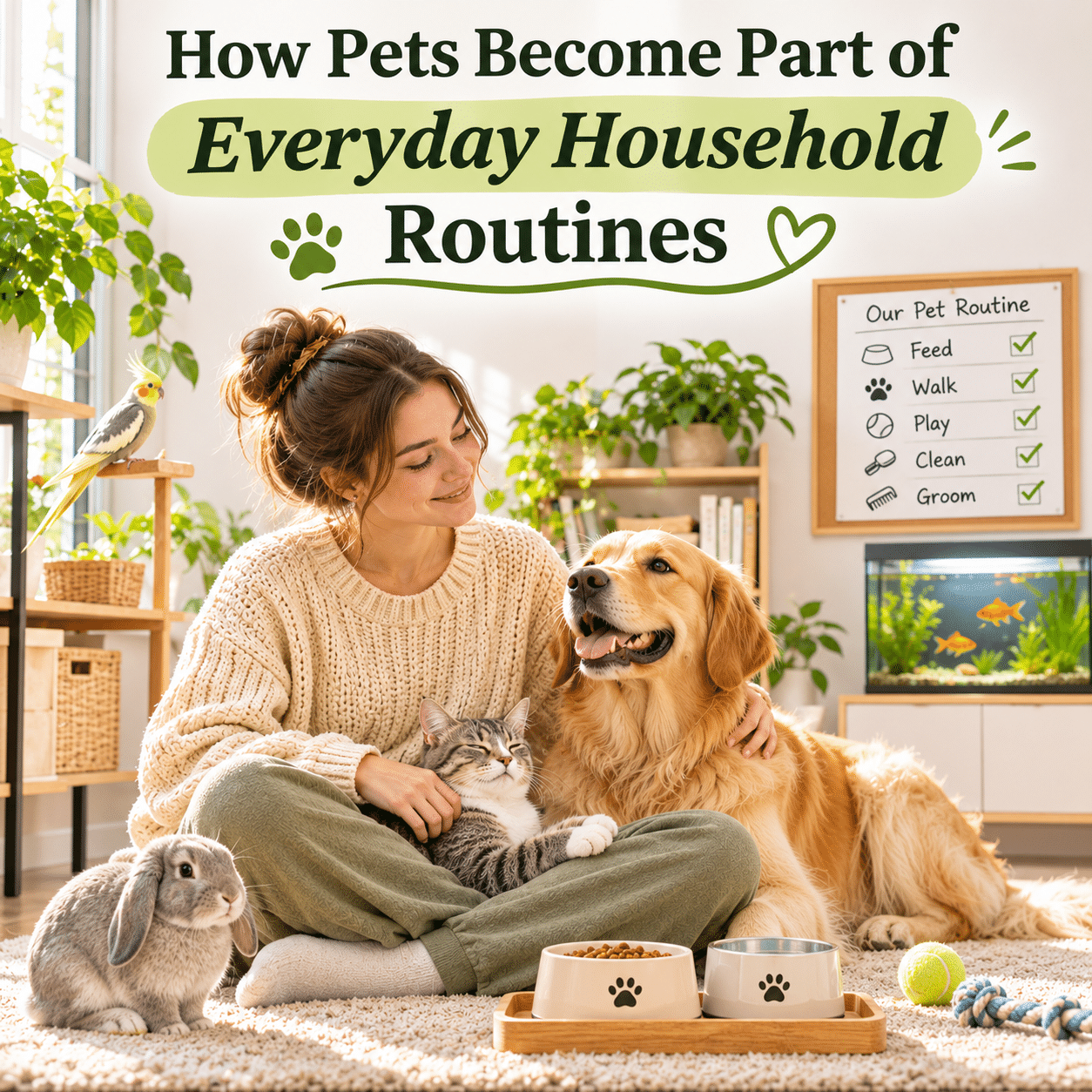
Pets have a remarkable way of becoming part of everyday life. What may begin as the decision to welcome an animal into a home gradually develops into a collection of familiar habits, shared experiences, and daily responsibilities. Feeding times, morning greetings, walks, play sessions, grooming, and quiet moments together can become as recognizable as preparing breakfast or settling down for the evening.
For many households, pets are more than animals living under the same roof. They become familiar companions whose needs, preferences, and behaviors influence how people organize their time and use their living spaces.
A dog may encourage regular outdoor walks. A cat may develop a habit of waiting near the kitchen at breakfast. A rabbit may become accustomed to a predictable feeding and exercise schedule. Birds, fish, and other companion animals can also become part of daily household rhythms through feeding, cleaning, observation, and appropriate interaction.
These routines are not always consciously planned. Some develop naturally as people learn to recognize their pets’ behavior and adapt to their needs. Others require deliberate organization to ensure that animals receive appropriate nutrition, exercise, enrichment, rest, hygiene, and veterinary attention.
The relationship works in both directions. Pets adapt to household schedules, while household members adjust their habits to accommodate the animals in their care.
This interaction can influence family responsibilities, home organization, leisure activities, travel planning, and even the way people spend quiet moments at home.
However, integrating pets into everyday routines involves more than enjoying companionship. Responsible pet care requires consistency, flexibility, attention to species-specific needs, and realistic expectations about time and resources.
Understanding how pets become part of household life can help people create routines that support animal welfare while remaining practical and enjoyable for everyone sharing the home.
1. Understanding the Role of Pets in Household Life
Pets occupy a distinctive place in domestic environments because they are living beings with needs, preferences, and behaviors of their own.
Unlike household objects that can simply be stored when not in use, animals require ongoing care and attention.
Their needs may include appropriate food, clean water, suitable living conditions, exercise or movement, enrichment, social interaction where appropriate, and preventive healthcare.
These responsibilities naturally become part of household planning.
A family may organize its morning schedule around feeding a dog before leaving for work. Someone living alone may establish a daily routine of checking a cat’s water, cleaning the litter box, and spending time playing.
The exact activities depend on the animal.
What connects these experiences is the gradual integration of pet care into ordinary household life.
Pets become part of the rhythm of the home because their well-being depends on consistent human attention and appropriate environmental conditions.
2. How Daily Pet Care Becomes a Familiar Habit
Many household routines develop through repetition.
People become accustomed to preparing meals, cleaning living spaces, and completing tasks at certain times.
Pet care follows a similar pattern.
Feeding, checking water, cleaning enclosures, walking, grooming, and observing behavior may gradually become familiar parts of the day.
Initially, new pet owners may need reminders or written schedules.
Over time, these responsibilities can become easier to remember because they are associated with existing activities.
For example, someone may refill a pet’s water after preparing breakfast or check an enclosure before beginning an evening routine.
However, familiarity should not replace attention.
Pets’ needs can change with age, health, activity level, and environmental conditions.
A good routine combines consistency with regular observation and appropriate adjustments.
3. The Importance of Predictable Feeding Times
Feeding is one of the most recognizable ways pets become integrated into household routines.
Many animals benefit from consistent access to appropriate nutrition and feeding practices suited to their species.
For dogs and cats, scheduled meals may help owners monitor appetite and food intake.
Other animals have different dietary patterns and requirements.
For example, rabbits need continuous access to appropriate hay, while certain fish and birds require carefully selected diets and feeding practices.
A feeding routine should reflect veterinary guidance, life stage, body condition, and species-specific needs rather than a universal timetable.
Household members should also understand who is responsible for feeding.
Without coordination, an animal may accidentally receive duplicate meals or be overlooked.
Predictable feeding arrangements help make care more organized and allow changes in appetite to be noticed more readily.
4. Why Fresh Water Becomes an Everyday Priority
Providing appropriate access to clean water is a fundamental responsibility in pet care.
Water needs vary according to species, diet, temperature, activity, and health.
For many common companion mammals, fresh drinking water should be readily available throughout the day.
Aquatic animals require a different approach because water quality is part of their living environment.
A practical household routine includes checking water availability, cleaning containers, and observing whether drinking behavior changes.
Water bowls may become dirty through food particles, dust, or other contamination.
Some pets may prefer particular bowl locations or drinking arrangements.
The important goal is to provide safe, suitable hydration rather than assuming that one setup works for every animal.
Regular water checks are a small but essential part of responsible household care.
5. Morning Greetings and Familiar Pet Behaviors
Many pet owners notice that their animals develop recognizable morning behaviors.
A dog may approach its owner after waking.
A cat may wait near a bedroom door or feeding area.
A bird may become more active as daylight increases.
These behaviors can become familiar parts of the household’s morning atmosphere.
However, animal behavior should be interpreted carefully.
A pet approaching a person may be seeking food, attention, access to another area, or another familiar outcome.
It is not always possible to determine an animal’s emotional state from a single behavior.
Owners can learn by observing patterns over time and considering body language, environment, and individual temperament.
Morning interactions can provide opportunities to check that a pet appears comfortable, active, and behaving normally.
6. How Dogs Influence Walking Routines
Dogs often introduce regular outdoor activities into household schedules.
Depending on age, breed characteristics, health, and individual needs, dogs may require opportunities for exercise, toileting, exploration, and appropriate social experiences.
Walks can become familiar morning, afternoon, or evening activities.
These outings may also influence how owners organize work, meals, and leisure.
However, exercise requirements vary considerably.
A young, active dog may need different activities from an older dog with mobility limitations.
Weather conditions, pavement temperature, traffic, and local regulations also matter.
Walks should be planned around the dog’s welfare rather than simply following a fixed distance or duration.
For many households, dog walking becomes both a care responsibility and a recurring outdoor routine.
7. How Cats Shape Indoor Household Habits
Cats often influence household routines in ways that differ from dogs.
Their daily needs may include feeding, litter box maintenance, play, scratching opportunities, resting places, and access to suitable enrichment.
Many cats develop preferences for particular locations and activities.
A cat may regularly rest near a window, follow someone into a room, or become active around familiar feeding times.
Owners may gradually arrange furniture and supplies around these patterns.
A suitable scratching surface may be placed near a commonly used area.
A comfortable resting location may be established away from excessive noise.
Indoor cats also need opportunities for movement, exploration, and species-appropriate behavior.
Thoughtful environmental arrangements help integrate their needs into ordinary home life.
8. Understanding Routines for Small Companion Animals
Rabbits, guinea pigs, hamsters, and other small companion animals have distinct care requirements.
Their routines should not be treated as simplified versions of dog or cat care.
Different species require appropriate diets, housing, environmental conditions, opportunities for natural behavior, and suitable handling.
For example, rabbits need substantial space for movement and access to appropriate fiber-rich food.
Guinea pigs have specific nutritional and social needs.
Hamsters may be most active during evening or nighttime periods.
Household routines should respect these biological differences.
Cleaning, feeding, observation, and enrichment can become regular activities, but their timing and methods should suit the animal.
Reliable species-specific veterinary and welfare guidance is important when planning care.
9. How Birds Become Part of Household Rhythms
Companion birds can influence household routines through feeding, vocal activity, interaction, and environmental care.
Different bird species have very different social, dietary, housing, and enrichment needs.
Some birds require substantial opportunities for appropriate social engagement and mental stimulation.
Others may be sensitive to changes in lighting, noise, or household activity.
Daily responsibilities may include preparing suitable food, replacing water, cleaning enclosures, and providing safe enrichment.
Bird owners must also consider household hazards such as fumes, unsafe materials, and unsuitable cooking environments.
A bird’s routine should support adequate rest and species-appropriate behavior.
Integrating birds into household life requires understanding their needs rather than expecting them to adapt completely to human schedules.
10. The Special Routine of Caring for Fish
Fish may not participate in household activities in the same way as dogs or cats, but their care still becomes part of daily life.
Aquarium maintenance requires attention to feeding, water quality, filtration, temperature, and the needs of the species being kept.
Owners may develop a routine of observing fish behavior and checking equipment.
Regular testing and maintenance may also be necessary, depending on the aquarium system.
Overfeeding and inappropriate water conditions can create serious problems.
An aquarium should not be considered maintenance-free simply because fish do not require walks or grooming.
For some households, observing an aquarium becomes an enjoyable quiet activity.
Responsible care combines this enjoyment with consistent attention to the aquatic environment.
11. Establishing a Comfortable Pet Resting Area
Rest is an important part of animal welfare.
Pets need suitable places where they can sleep or relax without unnecessary disturbance.
The ideal arrangement depends on the species.
Dogs may benefit from a comfortable resting area away from heavy household traffic.
Cats often appreciate choices among different resting locations, including elevated or sheltered areas.
Small animals require species-appropriate housing and hiding opportunities.
A resting area should be safe, clean, and suitable for the animal’s size and physical condition.
Household members should also respect the animal’s need for undisturbed rest.
A pet’s resting place becomes part of the home’s organization while supporting comfort and security.
12. Creating Consistent Playtime Opportunities
Play can be an important part of everyday pet care.
For many animals, appropriate play provides opportunities for movement, exploration, learning, and natural behavior.
Dogs may enjoy retrieving, searching, or interactive games suited to their abilities.
Cats often respond to activities that allow stalking, chasing, and pouncing.
Other animals may benefit from species-specific enrichment rather than conventional toys.
Play sessions should be adapted to the animal’s age, health, and preferences.
Not every pet enjoys the same activity.
Owners should watch for signs of fatigue, fear, frustration, or overstimulation.
Regular, appropriate play can become an enjoyable household ritual while contributing to an animal’s overall quality of life.
13. How Pets Influence Family Time
Pets can become a shared point of interest within a household.
Family members may participate in walks, play sessions, grooming, or preparing appropriate enrichment activities.
These experiences can create opportunities for cooperation and conversation.
For example, household members may discuss a dog’s training progress or work together to improve a cat’s play environment.
However, interaction should remain appropriate for the animal.
Pets should not be expected to tolerate unwanted handling or constant attention.
Children require supervision and guidance when interacting with animals.
The goal is to create positive shared experiences while respecting the pet’s welfare and individual temperament.
14. Dividing Pet Care Responsibilities Fairly
In households with multiple residents, pet care responsibilities should be clearly understood.
Without coordination, some tasks may be overlooked while others are duplicated.
A practical arrangement identifies who handles feeding, cleaning, exercise, grooming, and veterinary appointments.
Responsibilities can be divided according to schedules, abilities, and experience.
Children may participate in age-appropriate tasks, but adults should retain responsibility for ensuring that essential care is completed.
Written schedules can be helpful when several people share duties.
The system should remain flexible enough to accommodate illness, travel, and unexpected changes.
Clear responsibility helps ensure that the animal’s needs are met consistently.
15. Teaching Children About Responsible Pet Care
Living with pets can provide opportunities for children to learn about care, observation, and respectful behavior.
Children may help prepare supplies, observe feeding routines, or participate in supervised play.
However, responsibility must match the child’s age and maturity.
Young children should not be expected to manage essential animal care independently.
Adults must ensure appropriate supervision and protect both the child and the animal.
Children can be taught to recognize when a pet needs rest, avoid rough handling, and respect feeding or hiding areas.
They can also learn that animals have needs that continue even when caring for them is inconvenient.
These lessons are most meaningful when supported by consistent adult guidance.
16. How Pets Affect Household Time Management
Pets introduce recurring responsibilities that influence daily schedules.
Feeding, exercise, cleaning, medication when prescribed, and other care activities require time.
Some tasks are brief, while others need substantial planning.
For example, a dog may require outdoor breaks even during busy workdays.
A pet recovering from illness may need closer observation and additional care.
Households benefit from considering these commitments when planning routines.
Time management should include realistic allowances for unexpected needs.
A schedule that works only when everything goes perfectly may be difficult to maintain.
Thoughtful planning makes pet care more dependable without turning every interaction into a rigid obligation.
17. Balancing Pet Care With Work Schedules
Work commitments can affect how pets receive care throughout the day.
People working outside the home may need to plan feeding, exercise, supervision, or other arrangements around their absence.
Remote workers may have more opportunities for interaction but still need boundaries during meetings and concentrated tasks.
The appropriate solution depends on the species, age, health, and individual animal.
Some pets may require assistance from another household member or a qualified caregiver.
Others may be comfortable with an appropriate environment and routine during shorter absences.
Owners should not assume that every animal can safely remain alone for the same amount of time.
Pet welfare should be considered when establishing work-related arrangements.
18. Understanding Pets’ Responses to Predictable Schedules
Many animals learn to associate environmental cues with familiar activities.
A pet may respond when someone prepares food, picks up a leash, or opens a particular cupboard.
These learned associations can make household routines recognizable to the animal.
Predictability may help some pets anticipate ordinary events.
However, animals also need appropriate flexibility and should not become dependent on an unnecessarily rigid schedule.
Changes in routine can sometimes affect behavior, particularly for sensitive individuals.
Gradual adjustments may be helpful when circumstances allow.
Owners should observe how their pets respond rather than assuming that every animal experiences routine changes in the same way.
19. Why Flexibility Is Important in Pet Routines
Consistency is valuable, but everyday life is not perfectly predictable.
Work schedules change, visitors arrive, weather conditions vary, and household members become ill or travel.
A practical pet care system should accommodate reasonable changes without compromising essential needs.
For example, a dog’s outdoor activities may need adjustment during extreme weather.
A feeding arrangement may need modification following veterinary advice.
A pet may require additional rest during recovery.
Flexibility also helps owners respond to changes in behavior or health.
The objective is dependable care, not strict adherence to a schedule regardless of circumstances.
20. Integrating Grooming Into Household Habits
Grooming requirements vary widely among companion animals.
Some dogs need regular brushing to manage their coats.
Cats may benefit from appropriate coat care, especially when they have difficulty grooming themselves.
Certain animals require nail, skin, feather, or other specialized care.
Grooming should be performed using suitable methods and equipment.
It should not cause unnecessary discomfort or fear.
Owners may incorporate short grooming sessions into familiar daily or weekly routines.
However, professional assistance may be necessary for certain coat types, procedures, or behavioral challenges.
Regular grooming also provides opportunities to notice visible changes that may require veterinary attention.
21. Maintaining Clean Pet Living Areas
Pet-related hygiene becomes part of ordinary household maintenance.
Food bowls, bedding, litter boxes, enclosures, and frequently used surfaces may require regular cleaning.
Cleaning frequency depends on the animal, environment, and type of equipment.
For example, cat litter boxes require consistent attention, while aquarium maintenance follows water-quality needs rather than ordinary household cleaning practices.
Cleaning products must be appropriate for the animal and used according to safety instructions.
Some substances that are suitable for general household use may be harmful to pets.
Good hygiene protects both animals and people while making shared living spaces more pleasant.
22. Managing Pet Hair and Everyday Mess
Some pets shed hair, scatter bedding materials, track dirt, or create other routine cleaning challenges.
These realities should be considered when organizing the home.
Washable textiles, suitable floor surfaces, and practical cleaning tools may make maintenance easier.
Regular grooming can help manage shedding for some animals, although it does not eliminate normal coat changes.
Households should also avoid expecting pets to remain perfectly clean or still.
Animals naturally move, explore, and interact with their environments.
The goal is a manageable home that accommodates normal animal behavior while maintaining appropriate hygiene.
23. Organizing Pet Supplies Efficiently
Pet supplies can accumulate over time.
Food, grooming tools, toys, carriers, cleaning materials, and veterinary records all need suitable storage.
Keeping these items organized can simplify daily care.
Frequently used supplies should be accessible to responsible household members.
Food should be stored according to its instructions and protected from contamination.
Medications and potentially hazardous products must be kept securely away from pets and children.
A designated storage area can also make it easier to monitor supplies and avoid unnecessary duplicate purchases.
Good organization supports consistency without requiring elaborate storage systems.
24. Creating a Pet-Friendly Home Environment
A pet-friendly home should support natural behavior while reducing avoidable hazards.
Different species require different environmental arrangements.
Dogs may need safe resting places and suitable access to exercise.
Cats may benefit from scratching surfaces, climbing opportunities, hiding areas, and appropriate litter box locations.
Small mammals require suitable enclosures and enrichment.
Birds and fish have specialized environmental needs.
Household safety may involve securing electrical cords, checking plants for toxicity, storing chemicals properly, and preventing access to unsafe objects.
The goal is not to remove every ordinary household item.
It is to identify realistic risks and create an environment appropriate for the animal.
25. Respecting Pets’ Need for Personal Space
Pets are social in different ways and to different degrees.
Even animals that enjoy human companionship may need opportunities to withdraw from interaction.
A dog may prefer resting undisturbed after exercise.
A cat may retreat to a quiet elevated location.
Small animals may use hiding areas as part of normal behavior.
Household members should learn to recognize when an animal does not want to be handled or approached.
Forcing interaction can create stress and may increase the risk of defensive behavior.
Providing suitable retreat areas is an important part of a respectful household routine.
Companionship works best when the animal’s boundaries are considered alongside human preferences.
26. Learning to Recognize Individual Pet Preferences
Animals of the same species can behave differently.
One dog may enjoy energetic games, while another prefers slower exploration.
One cat may seek frequent interaction, while another approaches people selectively.
These differences may reflect temperament, age, previous experiences, health, and environment.
Owners can learn about preferences through careful observation.
Notice which activities the animal voluntarily approaches, which situations appear uncomfortable, and how behavior changes over time.
Avoid interpreting every behavior through human assumptions.
An animal’s body language should be considered in context.
Understanding individual preferences helps households create routines that are more suitable and enjoyable for their pets.
27. How Pets Become Part of Relaxation Time
Pets often share quiet moments with household members.
A dog may rest nearby while someone reads.
A cat may settle on a familiar chair during the evening.
A person may enjoy observing fish in an aquarium or listening to appropriate bird vocalizations.
These interactions can become pleasant parts of home life.
Some people find companionship with animals relaxing, although experiences vary.
Pets should not be expected to provide emotional comfort on demand.
They may prefer rest, independent activity, or distance at certain times.
A balanced routine allows peaceful companionship without requiring constant interaction.
28. Pets and Everyday Outdoor Activities
Some pets encourage households to spend more time outdoors.
Dog walking is a common example, but other animals may also benefit from carefully managed outdoor experiences when appropriate.
Outdoor activities should reflect species-specific welfare needs and safety considerations.
For dogs, this may involve suitable walking routes, controlled exploration, and appropriate weather precautions.
Cats should not be allowed into unsafe outdoor environments without suitable safeguards.
Small animals may require secure, supervised conditions if outdoor access is appropriate.
Local regulations and environmental hazards also matter.
Outdoor routines should be designed around animal welfare rather than assuming that all pets benefit from the same experiences.
29. Planning Household Activities Around Pet Needs
Pets influence decisions about errands, social gatherings, and time away from home.
Owners may need to arrange care before attending an extended event or traveling.
Household activities may also need adjustment when animals are sensitive to noise, unfamiliar visitors, or changes in routine.
For example, a dog that becomes distressed around large gatherings may benefit from a safe, quiet resting area.
A cat may prefer access to a familiar room when visitors arrive.
Planning ahead can reduce unnecessary disruption.
The goal is not to organize every household activity around the pet.
It is to ensure that the animal’s essential needs remain protected while people continue their normal lives.
30. Managing Visitors in a Home With Pets
Visitors introduce new sounds, smells, movement, and interactions.
Some pets enjoy meeting familiar guests, while others may be cautious or fearful.
Owners should not assume that an animal wants to greet everyone.
A suitable routine may include providing a quiet retreat, supervising introductions, and explaining appropriate interaction to visitors.
Guests should avoid forcing contact or offering food without permission.
Children require particular supervision around animals.
Households should also consider allergies, fears, and other visitor needs.
A welcoming pet-friendly home respects both animal welfare and the comfort of people entering the space.
31. Including Pets in Evening Routines
Evening activities often provide opportunities for familiar pet care.
A dog may need an appropriate final outdoor break.
A cat may enjoy interactive play before settling into a quieter period.
Other animals may require feeding, enclosure checks, or environmental adjustments according to their species.
Evening routines can also include checking water, cleaning necessary areas, and preparing supplies for the following day.
However, animals have different natural activity patterns.
A nocturnal or crepuscular species should not be expected to follow a human sleep schedule completely.
Evening care should support the animal’s biological needs while fitting reasonably into household life.
32. Understanding Pets’ Sleep and Rest Patterns
Sleep and rest requirements differ among species and individuals.
Dogs and cats may sleep or rest at various times throughout the day.
Some small mammals are more active at night.
Birds may require appropriate periods of darkness and undisturbed rest.
Owners should learn what is normal for their particular animal.
A suitable sleeping environment should provide safety, comfort, and appropriate conditions.
Sudden or significant changes in sleep-related behavior may warrant attention, especially when accompanied by other signs of illness.
Household routines should avoid repeatedly disturbing animals during necessary rest.
Respecting natural activity patterns is part of responsible pet care.
33. The Role of Training in Daily Household Life
For some companion animals, appropriate training can make everyday routines easier and safer.
Dogs may learn cues related to walking, waiting, settling, and responding to familiar household situations.
Cats and other animals can also learn through suitable reward-based approaches, although training goals differ.
Effective training should consider the animal’s abilities and welfare.
Reward-based methods are generally preferred over approaches that rely on fear or unnecessary discomfort.
Training sessions may be short and incorporated into ordinary activities.
For example, a dog might practice waiting calmly before a walk.
Training should support communication and cooperation rather than demand unrealistic obedience.
34. Monitoring Health Through Familiar Routines
Daily interaction provides opportunities to notice changes in a pet’s condition.
Owners may observe appetite, drinking, movement, grooming, elimination, energy, and behavior.
Because these activities occur regularly, unusual changes may become easier to recognize.
However, observation does not replace veterinary care.
Some illnesses develop gradually or show few obvious signs.
Preventive examinations, appropriate vaccinations, parasite prevention, and other healthcare measures should follow professional guidance suited to the animal.
Owners should seek veterinary advice when concerning changes appear.
Familiar routines can support early recognition of problems, but they should not be used to diagnose conditions independently.
35. Adapting Routines as Pets Grow Older
Pet care needs change throughout life.
Young animals may require frequent feeding, supervision, socialization, and age-appropriate activity.
Adults may settle into more predictable routines.
Older animals may experience changes in mobility, energy, appetite, or health.
Household arrangements should adapt accordingly.
An older dog may benefit from shorter, more comfortable walks.
A cat with mobility limitations may need easier access to resting places and litter facilities.
Veterinary guidance can help determine appropriate adjustments.
Maintaining familiar routines may remain useful, but owners should avoid insisting on activities that are no longer comfortable or suitable.
36. Planning for Pet Care During Travel
Travel requires additional planning when animals depend on household members for daily care.
Some pets may accompany their owners when travel conditions and the animal’s needs make this appropriate.
Others may be better cared for in a familiar environment or a suitable boarding arrangement.
Owners should consider feeding, medication, exercise, housing, supervision, and emergency contact information.
Caregivers need clear instructions and access to necessary supplies.
Species-specific requirements are especially important for animals with specialized diets or environmental needs.
Planning should begin before departure rather than immediately before leaving.
Reliable arrangements help maintain essential care when ordinary household routines are interrupted.
37. Preparing for Unexpected Household Changes
Unexpected events can disrupt pet care.
Illness, emergencies, work changes, severe weather, or temporary housing difficulties may affect normal routines.
Households benefit from having a practical contingency plan.
This may include identifying a trusted caregiver, keeping veterinary contact information accessible, maintaining suitable supplies, and ensuring that another responsible person understands essential care requirements.
Emergency preparation should reflect local conditions and the animal’s needs.
Transport carriers, identification, and necessary records may be important.
A contingency plan does not eliminate every risk.
It improves the household’s ability to respond when ordinary arrangements are unavailable.
38. Understanding the Financial Side of Everyday Pet Care
Pets create recurring expenses.
Food, preventive healthcare, grooming, cleaning supplies, enrichment, housing, and other necessities may require regular spending.
Unexpected veterinary care can also create significant costs.
A realistic household budget should account for both routine and less predictable needs.
Expenses vary widely according to species, size, age, health, location, and individual circumstances.
Choosing the least expensive product is not always the most suitable approach.
Quality, safety, nutritional appropriateness, and durability should be considered.
Responsible financial planning helps households maintain consistent care without relying on unrealistic assumptions about future expenses.
39. Recognizing the Long-Term Commitment of Pet Ownership
Welcoming a pet into a home is a commitment that extends beyond the initial excitement.
Animals may live for many years, and some species have particularly long lifespans.
Their needs may change as they mature or develop health conditions.
Households should consider whether they can provide appropriate care through foreseeable changes in work, housing, finances, and family circumstances.
Pet ownership should not be based solely on the appeal of companionship.
It requires an understanding of the animal’s welfare needs and the responsibilities involved.
A long-term perspective encourages thoughtful decisions and more dependable routines.
40. Building a Household Routine That Works for Pets and People
A successful pet-friendly household balances animal welfare with the practical needs of the people who provide care.
The goal is not to create a rigid schedule in which every minute revolves around the pet.
Instead, it is to establish dependable habits that support essential care while allowing reasonable flexibility.
Feeding, exercise, hygiene, enrichment, rest, observation, and healthcare should be organized according to the animal’s needs.
Household members should understand their responsibilities and communicate when arrangements need to change.
Over time, these activities can become familiar parts of everyday life.
Pets become integrated into household routines not simply because people enjoy their company, but because caring for them becomes an ongoing expression of responsibility, attention, and companionship.
Practical Reference: How Different Pets Influence Household Routines
Different animals require different forms of daily care.
| Pet Type | Common Daily Activities | Household Considerations | Important Reminder |
|---|---|---|---|
| Dogs | Feeding, water checks, exercise, toileting, interaction | Outdoor schedules, walking equipment, resting areas | Activity needs vary by age, health, and individual |
| Cats | Feeding, water checks, litter maintenance, play | Scratching areas, resting places, safe enrichment | Indoor environments should support natural behaviors |
| Rabbits | Appropriate feeding, water, enclosure care, movement | Space, safe materials, suitable flooring | Continuous access to appropriate hay is important |
| Guinea Pigs | Feeding, water, habitat care, observation | Suitable housing, social needs, temperature | Species-specific nutrition and companionship matter |
| Hamsters | Food and water checks, habitat monitoring, enrichment | Appropriate enclosure, bedding, quiet location | Respect natural activity patterns |
| Companion Birds | Feeding, water, cleaning, enrichment, observation | Air quality, safe materials, suitable rest | Needs differ considerably by species |
| Aquarium Fish | Feeding, equipment observation, environmental checks | Water quality, filtration, temperature | Aquarium stability is essential |
| Other Companion Animals | Species-specific feeding, housing, observation | Specialized environmental requirements | Research care needs before adoption |
This table is a general overview rather than a complete care guide. Owners should follow reliable species-specific guidance and qualified veterinary advice.
A Step-by-Step Guide to Creating a Practical Pet Care Routine
Step 1: Understand the Animal’s Needs
Begin with reliable information about the species.
Consider diet, housing, activity, enrichment, social needs, rest, hygiene, and healthcare.
Individual age and health should also influence the plan.
Step 2: Identify Essential Daily Tasks
List responsibilities that must be completed regularly.
These may include feeding, water checks, cleaning, exercise, and observation.
Separate daily tasks from weekly or occasional activities.
Step 3: Connect Care Tasks With Existing Household Habits
Look for natural opportunities to integrate pet care into ordinary routines.
For example, water checks may be associated with morning household activities.
Avoid arrangements that depend on someone remembering an unfamiliar schedule without support.
Step 4: Assign Responsibilities Clearly
In shared households, identify who is responsible for each task.
Make backup arrangements when the primary caregiver is unavailable.
Step 5: Prepare Suitable Supplies
Keep necessary equipment organized and accessible.
Store food, medications, and potentially hazardous items appropriately.
Step 6: Create Comfortable Activity and Resting Areas
Provide spaces suited to feeding, resting, movement, and enrichment.
Ensure that the environment is safe and appropriate for the species.
Step 7: Allow Time for Interaction and Enrichment
Include activities that support natural behavior and individual preferences.
Avoid forcing interaction when the animal needs rest or distance.
Step 8: Monitor Everyday Behavior
Observe appetite, movement, elimination, activity, and other relevant behaviors.
Become familiar with the animal’s normal patterns.
Step 9: Prepare for Schedule Changes
Identify practical alternatives for busy days, travel, illness, and emergencies.
Step 10: Review the Routine Regularly
Adjust care as the animal grows, ages, or experiences changes in health or environment.
A useful routine should remain dependable without becoming inflexible.
Example: A Household Routine With a Dog
The following is an illustrative schedule for a healthy adult dog. Actual timing and activities should be adjusted to individual needs.
| Time of Day | Possible Activity | Purpose |
|---|---|---|
| Morning | Outdoor toileting and suitable walk | Supports elimination, movement, and exploration |
| After Morning Activity | Appropriate meal and water check | Supports nutrition and hydration |
| Midday | Rest, suitable enrichment, and necessary toileting | Supports welfare during the day |
| Afternoon | Interaction or age-appropriate activity | Provides stimulation and engagement |
| Evening | Meal according to feeding plan | Maintains nutritional routine |
| Later Evening | Suitable walk or toileting opportunity | Supports comfort before nighttime rest |
| Throughout the Day | Water access, observation, rest | Supports ongoing care |
This example should not be treated as a universal schedule. Puppies, senior dogs, animals with medical conditions, and individuals with different activity needs may require substantially different arrangements.
Example: A Household Routine With an Indoor Cat
| Activity | Practical Approach | Why It Matters |
|---|---|---|
| Feeding | Follow an appropriate nutritional plan | Supports consistent nutrition |
| Water | Provide suitable access and clean containers | Supports hydration |
| Litter Care | Check and clean regularly | Supports hygiene and comfort |
| Interactive Play | Offer suitable opportunities according to preference | Encourages movement and natural behavior |
| Scratching | Provide appropriate scratching surfaces | Supports normal behavior |
| Rest | Maintain quiet, comfortable resting choices | Supports undisturbed sleep |
| Enrichment | Offer safe climbing, hiding, and exploration opportunities | Supports environmental engagement |
| Observation | Notice changes in appetite, activity, or elimination | Helps identify potential concerns |
A cat’s routine should reflect individual preferences and veterinary guidance.
Balancing Pet Care With Different Household Lifestyles
| Household Lifestyle | Potential Challenge | Practical Consideration |
|---|---|---|
| Single-Person Household | One person handles most responsibilities | Develop backup care arrangements |
| Couple With Different Schedules | Tasks may be duplicated or missed | Divide responsibilities clearly |
| Family With Children | Children may need supervision around pets | Keep adults responsible for essential care |
| Multigenerational Household | Different expectations about animal care | Agree on handling, feeding, and shared spaces |
| Remote-Working Household | Frequent interaction may interrupt work | Establish suitable activity and rest areas |
| Household With Long Workdays | Limited daytime availability | Evaluate species-specific care and supervision needs |
| Frequent Travelers | Routine disruption | Arrange reliable caregivers in advance |
| Small Apartment Household | Limited space for equipment and activity | Prioritize suitable housing and enrichment |
The most important consideration is whether the household can consistently meet the animal’s needs.
How Pets Influence Different Areas of the Home
Living Room
Pets may spend time resting, playing, or interacting with household members.
Appropriate bedding, scratching surfaces, or enrichment items can be integrated without obstructing movement.
Kitchen
Feeding supplies and water containers may be located nearby.
Food safety, secure storage, and separation from hazardous cooking activities are important.
Bedroom
Some pets rest near their owners, while others have separate sleeping areas.
Arrangements should consider comfort, hygiene, allergies, safety, and individual preferences.
Entryway
Leashes, carriers, outdoor cleaning supplies, or walking equipment may be stored here.
Organization can simplify departures and arrivals.
Balcony or Outdoor Area
Some animals may use outdoor spaces when conditions are suitable and secure.
Fall prevention, temperature, supervision, and species-specific safety must be considered.
Utility Area
Cleaning supplies and pet-related equipment may be stored here.
Potentially hazardous substances should remain inaccessible to animals.
Common Mistakes When Integrating Pets Into Household Routines
Assuming All Pets Need the Same Care
Different species have distinct biological and behavioral requirements.
A routine suitable for a dog may be inappropriate for a rabbit, bird, or fish.
Creating an Overly Rigid Schedule
Consistency is helpful, but routines should allow reasonable adjustments for health, weather, and changing circumstances.
Forgetting to Divide Responsibilities
Unclear arrangements can result in missed or duplicated care.
Assign responsibilities explicitly.
Treating Play as a Substitute for All Other Needs
Play is valuable, but animals also require appropriate nutrition, rest, hygiene, healthcare, and environmental conditions.
Ignoring Signs of Discomfort
Changes in appetite, behavior, movement, or elimination may indicate a problem.
Do not assume that unusual behavior is simply part of a pet’s personality.
Overlooking the Need for Rest
Pets should have suitable opportunities to sleep or withdraw from interaction.
Using Unsafe Household Products
Some cleaning agents, plants, foods, and other materials may be harmful to animals.
Check suitability before use.
Expecting Children to Manage Essential Care Alone
Children can participate in supervised tasks, but adults must ensure that the animal’s needs are met.
Failing to Prepare for Absences
Travel, illness, and emergencies can disrupt routines.
Backup arrangements are important.
Underestimating Long-Term Costs
Pet ownership involves ongoing and sometimes unexpected expenses.
Financial planning is part of responsible care.
Everyday Pet Care Checklist
Use this checklist as a general organizational guide. Specific requirements depend on the animal.
Daily Care
- Appropriate food has been provided according to the animal’s needs.
- Drinking water or aquatic environmental conditions have been checked as applicable.
- The animal’s living area is safe and suitable.
- Necessary cleaning tasks have been completed.
- Appropriate exercise or movement opportunities are available.
- Suitable enrichment has been provided.
- The animal has opportunities for undisturbed rest.
- Appetite, behavior, and general condition have been observed.
Household Organization
- Pet supplies are stored appropriately.
- Care responsibilities are clearly assigned.
- Feeding is coordinated to avoid accidental duplication.
- Potential hazards are secured.
- Resting and activity areas remain suitable.
- Household members understand appropriate handling and interaction.
- Backup care arrangements are available when needed.
Health and Safety
- Veterinary care follows an appropriate professional plan.
- Preventive healthcare requirements are reviewed.
- Medications, when prescribed, are administered correctly.
- Unusual changes are not ignored.
- Grooming and hygiene needs are addressed.
- Identification and emergency arrangements are appropriate.
- Environmental conditions remain suitable for the species.
Long-Term Planning
- The household can accommodate changing care needs.
- Pet-related expenses are considered in the budget.
- Travel arrangements include appropriate animal care.
- Enrichment and activity routines are reviewed.
- Housing remains appropriate as the animal grows or ages.
- Household responsibilities are adjusted when circumstances change.
The checklist is intended to support consistent care, not replace professional advice or species-specific guidance.
Frequently Asked Questions
1. How do pets become part of everyday household routines?
Pets become integrated into household life through recurring activities such as feeding, exercise, cleaning, grooming, play, and rest. Over time, these responsibilities and interactions become familiar parts of daily schedules.
2. Why are routines important for pets?
Predictable routines can help owners provide consistent care and may help animals anticipate familiar activities. However, routines should remain flexible and reflect species-specific needs, health, and individual preferences.
3. Do all pets need the same daily schedule?
No. Different species have different dietary, activity, social, and environmental requirements. Even animals of the same species may need different routines depending on age, health, and temperament.
4. How can families divide pet care responsibilities?
Families can identify essential tasks, assign responsible caregivers, and establish backup arrangements. Children may help with age-appropriate activities, but adults should remain accountable for essential care.
5. Can pets influence household time management?
Yes. Feeding, exercise, cleaning, healthcare, and supervision require time. Pet owners often adjust their schedules to accommodate these responsibilities.
6. How can busy households maintain consistent pet care?
Clear schedules, organized supplies, shared responsibilities, and reliable backup caregivers can help. The routine must still meet the animal’s needs rather than simply fitting the household’s convenience.
7. Why do some pets seem to recognize feeding times?
Animals can learn associations between environmental cues and familiar events. Sounds, movements, and repeated patterns may signal that feeding or another activity is approaching.
8. Should pets have their own resting areas?
Pets should have access to suitable places for rest and retreat. The arrangement depends on the species and individual animal, but safety, comfort, and freedom from unnecessary disturbance are important.
9. How can pets become part of family activities?
Household members may participate in appropriate walks, play, training, grooming, or enrichment activities. Interaction should be voluntary where possible and respectful of the animal’s needs.
10. What household changes are common after adopting a pet?
Households may need to adjust schedules, organize supplies, secure hazards, create resting areas, establish cleaning routines, and plan for ongoing expenses and veterinary care.
11. Can pets fit into small apartment routines?
Some pets can live comfortably in smaller homes when their environmental, activity, and welfare needs are fully met. Suitability depends on the species, individual animal, household schedule, and available resources.
12. How can owners recognize when a pet’s routine needs adjustment?
Changes in appetite, activity, behavior, elimination, mobility, or comfort may indicate that care needs have changed. Concerning changes should be discussed with a veterinarian.
13. How should households manage pet care during travel?
Owners should arrange suitable care in advance, provide clear instructions, prepare necessary supplies, and ensure that caregivers understand the animal’s health and environmental requirements.
14. Do pets need interaction every day?
Interaction and enrichment needs vary by species and individual. Many companion animals require regular opportunities for appropriate social engagement or environmental stimulation, but the form and amount should suit the animal.
15. What is the most important part of a successful household pet routine?
The most important principle is meeting the animal’s welfare needs consistently while maintaining reasonable flexibility. A successful routine combines appropriate care, observation, preparation, and respect for the pet’s individual requirements.
Final Thoughts
Pets become part of everyday household routines through a combination of responsibility, familiarity, and companionship.
What begins with essential tasks such as feeding, providing water, cleaning living areas, and arranging exercise gradually becomes woven into the household’s daily rhythm.
Morning greetings, familiar play sessions, quiet evenings, and shared activities can become meaningful experiences for the people who care for animals.
At the same time, responsible pet ownership requires more than affection.
Animals depend on suitable nutrition, appropriate environments, enrichment, rest, hygiene, veterinary care, and careful observation.
Their needs vary according to species, age, health, temperament, and living conditions.
A successful household routine recognizes these differences rather than expecting every pet to fit into the same schedule.
Clear responsibilities, organized supplies, flexible planning, and reliable backup arrangements can make everyday care more manageable.
Households should also remain willing to adapt as pets grow older, develop new needs, or experience changes in health.
The most rewarding routines are not necessarily elaborate or perfectly timed. They are dependable habits that support animal welfare while allowing people to enjoy the companionship of the animals sharing their homes.
Over time, these ordinary activities can become part of what makes a household feel familiar and complete.
Pets become part of everyday home life not only through the moments of companionship they share, but through the consistent care, thoughtful routines, and mutual familiarity that develop day after day.