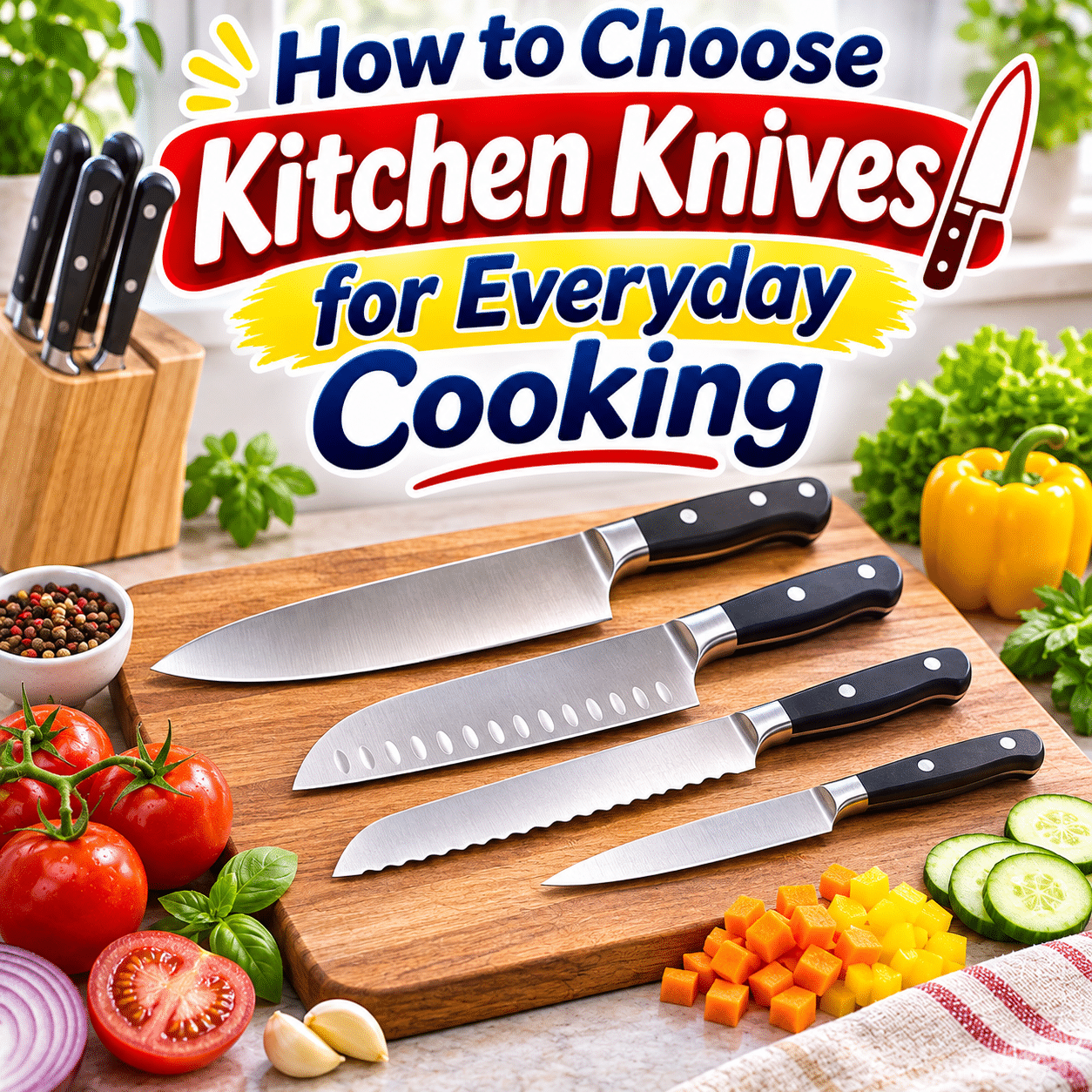
A reliable kitchen knife is one of the most useful tools in everyday cooking. From slicing vegetables and preparing fruit to chopping herbs, trimming meat, and preparing ingredients for family meals, the right knife can make food preparation easier, more precise, and more comfortable.
However, choosing kitchen knives can be confusing. There are many blade shapes, materials, sizes, handle designs, and construction methods available. Some knives are designed for versatile everyday tasks, while others serve specialized purposes.
A chef’s knife may handle most chopping and slicing needs, while a paring knife provides greater control for small ingredients. A serrated bread knife works particularly well with crusty bread and delicate foods with firm exteriors, and a utility knife can bridge the gap between larger and smaller cutting tools.
The goal is not to collect as many knives as possible. It is to choose a practical combination that matches your cooking habits, feels comfortable in your hand, and can be maintained safely over time.
This comprehensive guide explains the different types of kitchen knives, compares blade materials and construction methods, explores important design features, and provides practical advice for choosing a dependable knife collection for everyday cooking.
1. Understand Your Everyday Knife Needs
Before comparing knife styles, consider the foods you prepare most often.
Different cooking routines place different demands on kitchen knives.
Someone who regularly prepares vegetables may prioritize a comfortable chopping knife, while someone who frequently cooks meat may benefit from a dedicated trimming or slicing knife.
Identify Your Most Common Preparation Tasks
Think about whether you frequently:
- Chop onions and garlic.
- Slice tomatoes and other vegetables.
- Prepare leafy greens.
- Cut fruit.
- Mince herbs.
- Trim meat.
- Slice cooked proteins.
- Prepare fish.
- Cut bread.
- Prepare sandwiches.
- Handle small, delicate ingredients.
The more clearly you understand your regular tasks, the easier it becomes to identify the knives you actually need.
Consider How Often You Cook
Daily cooking places greater importance on comfort, durability, and edge maintenance.
Occasional cooking may require only a few versatile knives.
Think About Your Cooking Style
If you prepare meals from fresh ingredients, a chef’s knife or santoku may become your most frequently used tool.
If you often prepare bread, sandwiches, and fruit, a serrated knife and a smaller utility knife may be especially useful.
Choose based on actual cooking habits rather than the number of knives included in a set.
2. Understand the Main Types of Kitchen Knives
Kitchen knives are designed with different blade shapes and purposes.
The most common categories include:
- Chef’s knives.
- Santoku knives.
- Paring knives.
- Utility knives.
- Bread knives.
- Nakiri knives.
- Boning knives.
- Fillet knives.
- Carving and slicing knives.
- Cleavers.
Some of these knives are highly versatile, while others are designed for specific ingredients or cutting techniques.
For most households, a small selection of general-purpose knives can handle the majority of everyday food preparation.
3. Chef’s Knives: The Most Versatile Everyday Option
A chef’s knife is often considered the foundation of a practical kitchen knife collection.
It typically features a broad blade with a curved cutting edge and a pointed tip.
Common Uses
A chef’s knife can handle:
- Chopping vegetables.
- Slicing onions.
- Mincing garlic.
- Cutting herbs.
- Preparing fruit.
- Slicing boneless meat.
- Dicing ingredients.
- General food preparation.
Advantages
- Versatile design.
- Suitable for many ingredients.
- Efficient for larger preparation tasks.
- Supports different cutting techniques.
- Reduces the need for multiple specialized knives.
Limitations
- May feel large for users with smaller hands.
- Less convenient for delicate trimming.
- Requires adequate cutting-board space.
- Can feel heavy depending on construction.
Typical Blade Length
Many chef’s knives have blades approximately 15–25 cm long, with around 20 cm being a common general-purpose size.
A shorter blade may feel easier to control.
A longer blade can accommodate larger ingredients but requires more workspace.
Who Should Choose a Chef’s Knife?
A chef’s knife is an excellent starting point for most home cooks.
If you plan to purchase only one versatile kitchen knife, a comfortable chef’s knife is often a practical choice.
4. Santoku Knives: A Practical Alternative to Chef’s Knives
Santoku knives are commonly associated with Japanese-style kitchen knife designs.
They typically have a relatively broad blade, a flatter cutting edge, and a tip that curves downward.
The name is often associated with three general cutting tasks: slicing, dicing, and chopping.
Advantages
- Versatile for everyday ingredients.
- Often shorter than traditional Western chef’s knives.
- Convenient for vegetable preparation.
- Suitable for controlled downward cutting.
- Frequently available in lightweight designs.
Limitations
- Less suited to pronounced rocking motions.
- Some designs have delicate edges.
- May not be ideal for very large ingredients.
- Blade geometry varies significantly between manufacturers.
Chef’s Knife Versus Santoku
A chef’s knife often has a more curved cutting edge, supporting rocking motions.
A santoku commonly has a flatter edge, making it convenient for push-cutting and chopping.
Neither design is universally better.
The ideal choice depends on your cutting technique, hand comfort, and preferred ingredients.
5. Paring Knives: Essential for Small and Detailed Tasks
A paring knife is a small knife designed for precise food preparation.
It typically has a short, narrow blade.
Common Uses
- Peeling certain fruits.
- Trimming strawberries.
- Removing blemishes.
- Cutting small ingredients.
- Preparing garnishes.
- Performing detailed trimming.
Advantages
- Easy to maneuver.
- Useful for precision tasks.
- Compact.
- Convenient for small ingredients.
- Complements larger knives.
Limitations
- Not suitable for large chopping tasks.
- Short blade limits cutting capacity.
- Requires careful handling during handheld preparation.
Typical Blade Length
Paring knives commonly have blades around 7–10 cm long.
The ideal size depends on comfort and intended use.
Why a Paring Knife Is Useful
A chef’s knife can handle many tasks, but it may be unnecessarily large for small, delicate work.
A paring knife provides additional control when preparing smaller ingredients.
6. Utility Knives: A Flexible Middle Ground
Utility knives generally fall between paring knives and chef’s knives in size.
They are designed for smaller slicing tasks that do not require a full-size chef’s knife.
Common Uses
- Slicing sandwiches.
- Cutting small vegetables.
- Preparing fruit.
- Slicing cheese.
- Trimming smaller portions of boneless meat.
Advantages
- Compact and convenient.
- Suitable for quick preparation.
- Easier to handle than larger knives for certain tasks.
- Useful for smaller cutting boards.
Limitations
- Less versatile for heavy chopping.
- May overlap with existing knives.
- Not essential in every kitchen.
A utility knife can be helpful, but it is often optional when you already own a comfortable chef’s knife and paring knife.
7. Bread Knives: Designed for Crusty and Delicate Foods
Bread knives typically feature long, serrated blades.
Their teeth help cut through firm surfaces without requiring excessive downward pressure.
Common Uses
- Slicing crusty bread.
- Cutting baguettes.
- Slicing soft sandwich loaves.
- Cutting certain cakes.
- Slicing large tomatoes.
- Preparing foods with firm exteriors and soft interiors.
Advantages
- Effective on crusty surfaces.
- Helps reduce compression of soft bread.
- Useful for certain delicate foods.
- Requires less frequent sharpening than some plain-edge knives under typical use.
Limitations
- Less suitable for precise chopping.
- Serrated edges can be difficult to sharpen at home.
- Not ideal for every ingredient.
Blade Length
Bread knives commonly have blades approximately 20–25 cm long.
A longer blade can make it easier to slice wide loaves using smooth sawing motions.
8. Nakiri Knives: Specialized for Vegetable Preparation
A nakiri is a Japanese-style vegetable knife.
It usually features a rectangular blade with a relatively straight cutting edge.
Advantages
- Efficient for vegetable chopping.
- Supports straight downward cuts.
- Broad blade helps transfer chopped ingredients.
- Useful for repetitive preparation tasks.
Limitations
- Less versatile than a chef’s knife for some tasks.
- Not designed for cutting bones.
- May be unnecessary for occasional vegetable preparation.
Best Uses
Nakiri knives are particularly useful for:
- Chopping cabbage.
- Slicing carrots.
- Preparing leafy vegetables.
- Dicing onions.
- Cutting herbs.
A nakiri can be a valuable addition for someone who prepares vegetables frequently.
However, a chef’s knife or santoku can handle many of the same tasks.
9. Boning Knives: Useful for Meat Preparation
Boning knives are designed to separate meat from bones and trim connective tissue.
They typically have narrow blades that allow controlled cutting around joints and contours.
Common Uses
- Trimming meat.
- Removing bones from certain cuts.
- Separating connective tissue.
- Preparing poultry.
- Working around irregular shapes.
Flexible Versus Stiff Blades
Some boning knives have flexible blades, while others are relatively stiff.
Flexible blades may help follow curved surfaces.
Stiffer blades can provide additional control for certain trimming tasks.
Who Needs a Boning Knife?
A boning knife is useful if you regularly prepare raw meat from larger cuts.
It is less necessary if you usually purchase boneless, ready-to-cook ingredients.
10. Fillet Knives: Designed for Fish Preparation
Fillet knives generally feature narrow blades, often with substantial flexibility.
They are designed to follow the contours of fish.
Common Uses
- Filleting fish.
- Removing skin.
- Trimming delicate flesh.
- Separating flesh from bones.
Advantages
- Precise cutting.
- Flexible blade options.
- Suitable for delicate preparation.
- Helpful for frequent fish preparation.
Limitations
- Specialized purpose.
- Requires careful technique.
- Thin blades may be vulnerable to misuse.
If you regularly prepare whole fish, a fillet knife may be worthwhile.
For occasional fish preparation, a suitable general-purpose knife may be sufficient.
11. Carving and Slicing Knives: For Clean, Even Slices
Carving and slicing knives are designed to cut cooked meats and other large foods into even portions.
They commonly feature long, relatively narrow blades.
Common Uses
- Slicing roast beef.
- Carving turkey.
- Cutting cooked chicken.
- Slicing ham.
- Portioning large cooked proteins.
Advantages
- Longer cutting strokes.
- Cleaner slices.
- Reduced need for repeated sawing.
- Useful for serving larger meals.
Limitations
- Specialized function.
- Requires storage space.
- May be unnecessary for small households.
A carving knife is most useful when you frequently prepare large roasts or special-occasion meals.
12. Understand Cleavers and Their Different Purposes
Cleavers are broad-bladed knives, but not all cleavers are designed for the same tasks.
Meat Cleavers
Heavy meat cleavers are designed for specific butchery tasks.
Some are suitable for cutting through certain bones, depending on construction and manufacturer instructions.
They require careful handling and appropriate technique.
Chinese-Style Vegetable Cleavers
Many broad rectangular Chinese-style kitchen knives are designed primarily for vegetables and boneless ingredients.
Despite their appearance, they may not be suitable for cutting bones.
Important Distinction
Never assume that a broad blade is intended for heavy chopping through bone.
Always follow the manufacturer’s intended-use guidance.
13. Compare Kitchen Knife Types Side by Side
| Knife type | Main purpose | Typical blade characteristic | Everyday usefulness |
|---|---|---|---|
| Chef’s knife | General chopping and slicing | Broad, curved edge | Very high |
| Santoku | Chopping, slicing, dicing | Broad, relatively flat edge | Very high |
| Paring knife | Small precision tasks | Short, narrow blade | Very high |
| Utility knife | Smaller slicing tasks | Medium-length blade | Moderate |
| Bread knife | Bread and firm exteriors | Long, serrated edge | High |
| Nakiri | Vegetable preparation | Rectangular, straight edge | Moderate to high |
| Boning knife | Meat trimming | Narrow blade | Specialized |
| Fillet knife | Fish preparation | Narrow, often flexible blade | Specialized |
| Carving knife | Slicing cooked meats | Long, narrow blade | Specialized |
| Cleaver | Specific chopping tasks | Broad blade | Depends on design |
A chef’s knife, paring knife, and bread knife can cover many common household needs.
14. Understand Kitchen Knife Blade Materials
Blade material influences edge retention, corrosion resistance, sharpening requirements, and durability.
Common materials include:
- Stainless steel.
- High-carbon stainless steel.
- Carbon steel.
- Ceramic.
Each has advantages and limitations.
15. Stainless Steel Knives: Convenient Everyday Maintenance
Stainless steel knives are widely used because they offer corrosion resistance and practical maintenance.
Advantages
- Generally resistant to rust.
- Suitable for everyday food preparation.
- Available across many price ranges.
- Often easier to maintain than traditional carbon steel.
- Offered in many blade shapes.
Limitations
- Edge retention varies significantly by steel grade and heat treatment.
- Some lower-quality blades dull relatively quickly.
- Corrosion resistance is not absolute.
Important Consideration
Not all stainless steel knives perform the same way.
Steel composition, heat treatment, blade geometry, and manufacturing quality all influence performance.
16. High-Carbon Stainless Steel Knives
High-carbon stainless steel is a broad term used for stainless steel formulations containing carbon and corrosion-resistant alloying elements.
Many kitchen knives use steels marketed under this description.
Potential Advantages
- Good balance of hardness and corrosion resistance.
- Suitable for precise cutting.
- Can offer strong edge retention.
- Available in versatile everyday designs.
Important Limitations
The term does not identify a single steel grade or guarantee a particular level of quality.
Performance depends on the exact alloy, heat treatment, and blade construction.
Avoid assuming that every knife labeled high-carbon stainless steel is automatically superior.
17. Carbon Steel Knives: Sharpness With Additional Maintenance
Traditional carbon steel knives are valued for their cutting characteristics and ability to develop a sharp edge.
Advantages
- Can achieve excellent sharpness.
- Often responds well to sharpening.
- Available in specialized knife designs.
- Favored by some experienced cooks.
Limitations
- More susceptible to corrosion.
- May develop patina.
- Requires prompt cleaning and drying.
- Can react with certain acidic foods.
- Some hard blades are more vulnerable to chipping.
Who Should Choose Carbon Steel?
Carbon steel may appeal to cooks who enjoy maintaining their tools and are comfortable with additional care.
For users prioritizing convenience, stainless steel may be more practical.
18. Ceramic Knives: Lightweight but Specialized
Ceramic knives use extremely hard ceramic blade materials, commonly zirconia-based formulations.
Advantages
- Lightweight.
- Resistant to corrosion.
- Can retain a sharp edge during suitable use.
- Useful for certain soft ingredients.
Limitations
- Brittle compared with many steel knives.
- Can chip or break under lateral stress.
- Not suitable for bones or frozen foods.
- Sharpening often requires specialized equipment.
Best Uses
Ceramic knives may be useful for:
- Slicing fruit.
- Preparing certain vegetables.
- Light cutting tasks.
They are generally not the best choice as the only knife in a kitchen.
19. Compare Common Blade Materials
| Blade material | Main advantage | Main limitation | Suitable user |
|---|---|---|---|
| Stainless steel | Corrosion resistance | Performance varies by grade | Everyday home cooks |
| High-carbon stainless steel | Potential balance of hardness and corrosion resistance | Quality varies | General and frequent cooking |
| Carbon steel | Sharpness and sharpening characteristics | Requires additional care | Maintenance-conscious cooks |
| Ceramic | Lightweight and corrosion-resistant | Brittle | Specialized light cutting |
Material is important, but blade geometry, heat treatment, and overall construction also deserve attention.
20. Understand Knife Hardness and Edge Retention
Knife hardness is often measured using the Rockwell C scale, commonly abbreviated HRC.
Hardness influences how a blade responds to wear and deformation.
Softer Blades
Relatively softer blades may be:
- More forgiving under certain conditions.
- Easier to hone or sharpen.
- Less likely to chip in some applications.
However, they may require more frequent edge maintenance.
Harder Blades
Harder blades may offer:
- Greater resistance to certain types of edge wear.
- Longer edge retention under suitable use.
- Potential for thin, precise cutting geometries.
However, some harder blades can be more vulnerable to chipping when misused.
Is Higher Hardness Always Better?
No.
Hardness alone does not determine knife quality.
Steel composition, heat treatment, edge angle, blade geometry, and intended use all matter.
A well-designed moderately hard knife may be more practical for everyday cooking than an extremely hard knife requiring specialized care.
21. Understand Blade Thickness and Geometry
Blade thickness influences how a knife moves through ingredients.
Thin Blades
Thin blades can reduce resistance when slicing.
They may be particularly useful for:
- Vegetables.
- Fruit.
- Delicate ingredients.
- Precise slicing.
However, thin blades may be less tolerant of twisting or lateral force.
Thicker Blades
Thicker blades may offer greater structural strength for appropriate tasks.
However, they can require more force when cutting dense ingredients.
Why Geometry Matters
A sharp knife with poor geometry for a particular task may still feel difficult to use.
Look for a blade shape and thickness that match your regular cooking needs.
22. Compare Western and Japanese Knife Styles
Western and Japanese kitchen knives often differ in design traditions.
However, modern products vary considerably, and many combine characteristics from both approaches.
Western-Style Knives
Common tendencies include:
- Curved cutting edges.
- Versatile blade shapes.
- Designs suited to rocking motions.
- A range of blade weights.
- Relatively robust general-purpose construction.
Japanese-Style Knives
Common tendencies include:
- Specialized blade profiles.
- Relatively thin cutting geometries on many models.
- Designs suited to push-cutting or precise slicing.
- A wide range of hardness levels.
- Both double-bevel and specialized single-bevel edges.
Which Style Is Better?
Neither style is universally superior.
Choose based on:
- Cutting technique.
- Preferred ingredients.
- Hand comfort.
- Maintenance expectations.
- Blade durability requirements.
23. Choose the Right Blade Length
Blade length affects control, reach, and cutting efficiency.
Shorter Blades
Shorter knives can feel easier to maneuver.
They are useful for:
- Small ingredients.
- Compact cutting boards.
- Precision tasks.
- Users who prefer lighter tools.
Longer Blades
Longer knives can provide:
- More cutting length.
- Greater efficiency with large ingredients.
- Longer slicing strokes.
- Additional space for certain chopping techniques.
However, they require more workspace.
Practical Starting Point
For many home cooks, a chef’s knife around 18–20 cm long offers a useful balance between versatility and control.
A smaller or larger knife may be preferable depending on personal comfort.
24. Understand Knife Weight and Balance
Weight influences how a knife feels during repeated use.
Lightweight Knives
Potential advantages include:
- Easy maneuverability.
- Reduced effort during some tasks.
- Convenient handling.
- Greater comfort for users who prefer lighter tools.
Heavier Knives
Potential advantages include:
- A substantial feel.
- Additional momentum during certain cutting motions.
- Stability for some users.
However, heavier knives can become tiring during prolonged preparation.
Balance Point
Knife balance describes how weight is distributed between the blade and handle.
Some users prefer blade-heavy knives.
Others prefer handle-heavy or more neutral balance.
There is no universally ideal balance point.
The best knife should feel stable and controllable in your hand.
25. Evaluate Handle Materials and Design
The handle affects comfort, control, hygiene, and safety.
Common handle materials include:
- Wood.
- Stabilized or composite wood.
- Synthetic polymers.
- Resin-based composites.
- Stainless steel.
Wooden Handles
Wood can provide a warm, traditional feel.
However, care requirements vary depending on the finish and construction.
Some wooden handles should not be soaked or placed in dishwashers.
Synthetic Handles
Synthetic materials can offer:
- Moisture resistance.
- Consistent texture.
- Easy cleaning.
- Durable everyday construction.
Metal Handles
Metal handles may provide durability and a modern appearance.
However, grip comfort can vary, especially when wet.
What Matters Most
Look for:
- Comfortable shape.
- Secure grip.
- Smooth transitions.
- Appropriate handle length.
- Stable construction.
- Easy cleaning.
Handle comfort is often more important than decorative appearance.
26. Understand Full Tang and Partial Tang Construction
The tang is the portion of the blade material that extends into the handle.
Full Tang
A full-tang knife typically has blade steel extending through much or all of the handle length.
Potential advantages include:
- Robust construction.
- Secure handle attachment when properly manufactured.
- Balanced weight distribution in certain designs.
Partial Tang
A partial tang extends only partway into the handle.
This construction can still be durable when properly designed and manufactured.
Is Full Tang Always Better?
No.
Tang design alone does not determine quality.
A well-made partial-tang knife may perform reliably, while a poorly constructed full-tang knife may have other weaknesses.
Evaluate the complete knife rather than relying on one construction feature.
27. Compare Forged and Stamped Kitchen Knives
Kitchen knives are commonly described as forged or stamped.
Forged Knives
Forged knives are shaped through manufacturing processes involving deformation of metal.
They may feature substantial bolsters or thicker construction, although designs vary.
Stamped Knives
Stamped knives are cut from sheet or plate material and then processed into finished blades.
They can be lightweight and economical to manufacture.
Common Misconception
Forged knives are not automatically better than stamped knives.
Modern manufacturing can produce high-quality knives using either method.
Performance depends on:
- Steel quality.
- Heat treatment.
- Blade geometry.
- Edge finishing.
- Handle construction.
- Quality control.
28. Understand Knife Bolsters
A bolster is the thickened transition area between the blade and handle on certain knife designs.
Potential Benefits
- Can contribute to balance.
- May provide a defined grip transition.
- Can add structural support in some constructions.
Potential Limitations
A full bolster extending to the cutting edge may make certain sharpening methods more difficult.
Some users prefer knives with minimal or no bolster for easier edge maintenance.
What to Look For
Choose a bolster design that supports comfortable gripping and practical sharpening.
29. Evaluate Knife Edge Design
Kitchen knives use different edge configurations.
Plain Edges
Plain edges are common on chef’s knives, santoku knives, and paring knives.
They are versatile and can be sharpened using appropriate methods.
Serrated Edges
Serrated edges are useful for bread and foods with firm exteriors.
They require different sharpening techniques.
Granton-Style or Scalloped Blade Features
Some knives include shallow indentations along the blade sides.
These may help reduce food adhesion in certain situations.
However, their effectiveness depends on the food, blade geometry, and cutting technique.
Do not assume that blade indentations eliminate sticking.
30. Consider Knife Sharpening and Maintenance
A kitchen knife requires maintenance to perform well.
Even high-quality blades gradually lose cutting efficiency.
Sharpening
Sharpening removes a small amount of blade material to restore the cutting edge.
Common sharpening methods include:
- Whetstones.
- Manual sharpening systems.
- Guided sharpening systems.
- Professional sharpening services.
Honing
Honing and sharpening are related but different maintenance processes.
A honing rod can help maintain certain edges, but it does not replace sharpening when significant edge wear has occurred.
Some hard or delicate blades may not be suitable for conventional steel honing rods.
Choose a Manageable Maintenance Routine
If you prefer simple maintenance, consider a knife that can be sharpened using accessible methods.
Specialized knives may require more careful sharpening techniques.
31. Understand Knife Edge Angles
The angle of the cutting edge influences sharpness, durability, and cutting performance.
Different knives use different edge geometries.
Narrower Edge Angles
Narrower angles can reduce cutting resistance.
However, they may be less tolerant of certain types of misuse.
Wider Edge Angles
Wider angles may provide greater edge stability for demanding tasks.
However, they can increase cutting resistance.
Practical Consideration
Follow the manufacturer’s recommended sharpening angle when available.
Do not assume that one edge angle is ideal for every knife.
32. Choose Knives That Match Your Cutting Technique
Knife design should complement how you prepare food.
Rocking Motion
A rocking technique uses a curved cutting edge.
It is commonly associated with Western-style chef’s knives.
Push Cutting
Push cutting moves the blade forward and downward through food.
It can work well with relatively flat-edged knives.
Straight Downward Chopping
Some vegetable knives are designed for controlled vertical cuts.
Slicing
Long, smooth strokes can help produce clean slices.
Avoid Misuse
Do not twist a thin knife inside dense food or use a general-purpose kitchen knife to pry, chop bones, or cut frozen ingredients unless specifically designed for those tasks.
33. Consider Knife Safety During Everyday Cooking
A suitable knife should support safe, controlled use.
Comfortable Grip
Choose a handle that allows secure control without excessive squeezing.
Appropriate Blade Size
A knife that feels too large or too heavy may be difficult to maneuver.
Sharpness
A properly maintained sharp knife generally requires less force than a dull knife.
However, sharp knives can cause serious injuries and must be handled carefully.
Stable Cutting Surface
Use a stable cutting board on a secure surface.
A nonslip mat beneath the board can help prevent movement.
Safe Cutting Technique
Keep fingers away from the cutting path and use controlled motions.
Avoid Catching Falling Knives
Never attempt to catch a falling knife.
Step away and allow it to fall.
Safe Cleaning
Wash knives carefully and keep blades visible.
Avoid leaving sharp knives hidden in sinks filled with water.
34. Choose the Right Cutting Board for Your Knives
Cutting boards influence edge wear, stability, and hygiene.
Wooden Cutting Boards
Wooden boards can provide a comfortable cutting surface.
They require appropriate cleaning and drying.
Plastic Cutting Boards
Plastic boards are often lightweight and easy to clean.
Some are dishwasher-safe, depending on manufacturer instructions.
Deeply damaged boards may require replacement because grooves can become difficult to clean thoroughly.
Hard Surfaces
Glass, stone, and some ceramic cutting surfaces can accelerate knife edge wear.
They may also provide less secure cutting contact.
Practical Recommendation
Choose a stable, food-safe cutting board that is appropriate for your knives and easy to maintain.
Use suitable cleaning practices to reduce cross-contamination.
35. Understand Knife Storage Options
Proper storage protects blades and reduces accidental contact.
Knife Blocks
Knife blocks keep knives organized and accessible.
However, slots should be kept clean and dry.
Magnetic Knife Strips
Magnetic strips can save counter space.
They should be securely installed and positioned safely.
Drawer Organizers
Dedicated knife trays protect blades and keep sharp edges separated.
Blade Guards
Blade guards are useful when knives are stored in drawers or transported.
Avoid Loose Storage
Do not store unprotected knives loosely among other utensils.
This can damage edges and create injury risks.
36. Consider Kitchen Space and Storage Requirements
A large knife set may occupy more space than necessary.
Before buying, evaluate:
- Countertop space.
- Drawer capacity.
- Available wall storage.
- Knife block dimensions.
- Blade lengths.
- Accessibility.
Small Kitchen Strategy
For compact kitchens, a chef’s knife, paring knife, and bread knife may cover most common preparation tasks.
A suitable drawer organizer or magnetic strip can reduce clutter.
Avoid Unnecessary Duplication
Several knives with nearly identical functions may provide little additional value.
Prioritize versatility and comfort.
37. Decide Between Buying a Knife Set and Individual Knives
Kitchen knife sets are widely available, but they are not always the best option.
Advantages of Knife Sets
- Convenient coordinated purchase.
- Matching appearance.
- Multiple blade styles.
- Included storage in some packages.
- Potentially lower cost per knife.
Limitations
- May include unnecessary knives.
- Quality can vary between pieces.
- Storage requirements may be substantial.
- Some sets emphasize quantity over performance.
Advantages of Buying Individual Knives
- Greater flexibility.
- Ability to choose different brands or designs.
- Better alignment with cooking habits.
- Opportunity to prioritize quality.
- Less unnecessary duplication.
A Practical Approach
Start with the knives you use most often.
Add specialized knives only when your cooking routine creates a clear need.
38. Build a Practical Starter Knife Collection
Most home kitchens do not require a large collection.
A few carefully selected knives can handle a wide variety of ingredients.
Essential Knife 1: Chef’s Knife or Santoku
Choose one as your primary everyday knife.
It should feel comfortable and support your preferred cutting technique.
Essential Knife 2: Paring Knife
Use it for small ingredients and detailed preparation.
Essential Knife 3: Serrated Bread Knife
Useful for bread, certain cakes, and foods with firm exteriors.
Optional Knife 4: Utility Knife
Helpful for quick slicing tasks.
Optional Knife 5: Boning or Fillet Knife
Worth considering if you frequently prepare raw meat or whole fish.
Optional Knife 6: Carving Knife
Useful for households that regularly prepare large roasts.
Key Principle
Choose quality and practical usefulness over the number of knives.
39. Choose Kitchen Knives for Different Cooking Lifestyles
Different households benefit from different knife combinations.
For Beginners
Prioritize:
- A comfortable chef’s knife.
- A small paring knife.
- A serrated bread knife.
- Easy maintenance.
- Safe storage.
Avoid purchasing specialized knives before understanding your needs.
For Busy Home Cooks
Look for:
- Versatile blades.
- Comfortable handles.
- Corrosion-resistant materials.
- Convenient cleaning.
- Reliable edge maintenance.
For Vegetable-Focused Cooking
Consider:
- Chef’s knife.
- Santoku.
- Nakiri.
- Paring knife.
You may not need all four.
Choose the designs that best match your cutting techniques.
For Frequent Meat Preparation
Useful options may include:
- Chef’s knife.
- Boning knife.
- Carving knife.
Select specialized knives based on the types of meat you prepare.
For Small Kitchens
Prioritize a compact collection with versatile functions and secure storage.
40. Evaluate Knife Comfort Before Buying
Comfort is one of the most important purchasing considerations.
Whenever possible, hold a knife before purchasing.
Check the Grip
The handle should feel secure without excessive pressure.
Evaluate Balance
The knife should feel controllable rather than awkwardly weighted.
Consider Blade Length
Make sure the blade suits your hand, cutting board, and common ingredients.
Check Handle Shape
Avoid handles that create uncomfortable pressure points.
Evaluate Weight
A knife should feel manageable during repeated cutting.
Consider Your Preferred Grip
Some cooks use a pinch grip near the blade, while others hold the handle differently.
The knife should support safe, comfortable control.
41. Understand Long-Term Knife Durability
Knife durability depends on more than the steel name.
Important factors include:
- Blade material.
- Heat treatment.
- Edge geometry.
- Handle construction.
- Manufacturing quality.
- Intended use.
- Maintenance.
- Storage.
Common Causes of Damage
- Cutting on hard surfaces.
- Twisting blades.
- Using knives for inappropriate tasks.
- Improper storage.
- Dropping knives.
- Exposure to corrosion.
- Aggressive sharpening methods.
Long-Term Value
A well-maintained, appropriately used knife can remain useful for many years.
However, durability varies by product and usage.
42. Consider the Total Cost of Knife Ownership
The purchase price is only part of the long-term cost.
Additional considerations may include:
- Sharpening tools.
- Professional sharpening.
- Blade guards.
- Storage accessories.
- Cutting boards.
- Maintenance supplies.
- Replacement components.
Cost Per Use
A dependable knife used daily may offer better value than an inexpensive knife that is uncomfortable or difficult to maintain.
However, higher price does not automatically guarantee better performance.
Prioritize Your Main Knife
If your budget is limited, consider allocating more toward the knife you will use most frequently.
Other specialized knives can be added later.
43. Common Mistakes to Avoid When Buying Kitchen Knives
Choosing Based Only on Appearance
An attractive knife may not feel comfortable or suit your cooking style.
Buying Too Many Knives
A large collection can create clutter without improving everyday cooking.
Ignoring Handle Comfort
An uncomfortable handle can make food preparation tiring.
Assuming Harder Steel Is Always Better
Hardness must be balanced with edge stability, maintenance, and intended use.
Choosing the Longest Blade Available
Long blades are not necessarily more practical for small kitchens.
Ignoring Sharpening Requirements
Some knives require specialized maintenance.
Assuming Forged Knives Are Always Superior
Manufacturing method alone does not determine quality.
Using Specialized Knives for Incorrect Tasks
Thin slicing knives should not be used for heavy chopping or prying.
Overlooking Safe Storage
Loose knives can damage blades and create injury risks.
Buying a Set Without Evaluating Individual Pieces
A coordinated set may contain knives you rarely use.
44. How to Choose Kitchen Knives Step by Step
A structured approach can make the selection process easier.
Step 1: Identify Your Main Cooking Tasks
List the ingredients and foods you prepare most frequently.
Step 2: Choose Your Primary Knife
Select a chef’s knife or santoku that suits your cutting technique.
Step 3: Determine Which Supporting Knives You Need
Consider a paring knife and bread knife.
Step 4: Select a Suitable Blade Material
Balance corrosion resistance, edge retention, and maintenance requirements.
Step 5: Choose an Appropriate Blade Length
Consider your hand comfort, cutting board, and kitchen space.
Step 6: Evaluate Handle Design
Look for a secure, comfortable grip.
Step 7: Check Weight and Balance
Choose a knife that feels controlled and manageable.
Step 8: Review Sharpening Requirements
Make sure you can maintain the blade properly.
Step 9: Plan Safe Storage
Choose an appropriate knife block, magnetic strip, drawer organizer, or blade guard.
Step 10: Compare Long-Term Value
Prioritize comfort, useful performance, durability, and maintenance over unnecessary features.
45. Practical Kitchen Knife Buying Checklist
Use this checklist before purchasing kitchen knives.
Cooking Needs
- I know which ingredients I prepare most often.
- I have identified my primary cutting tasks.
- I know whether I prefer a chef’s knife or santoku.
- I have considered which specialized knives are necessary.
- I am avoiding unnecessary duplication.
Blade Characteristics
- The blade material suits my maintenance preferences.
- The blade length is appropriate.
- The edge geometry supports my cutting tasks.
- The knife is designed for its intended use.
- Sharpening requirements are manageable.
Comfort and Handling
- The handle feels secure.
- The knife is comfortable to grip.
- The weight is manageable.
- The balance feels natural.
- The blade shape supports my preferred technique.
Safety and Maintenance
- I have a suitable cutting board.
- I understand safe knife handling.
- I have a secure storage solution.
- I know how to clean and dry the knife.
- I have a practical sharpening plan.
Long-Term Value
- The knife fits my budget.
- Construction quality meets my needs.
- The knife serves a regular purpose.
- Maintenance costs are reasonable.
- I have considered warranty and manufacturer support.
46. Frequently Asked Questions About Choosing Kitchen Knives
1. What is the most important kitchen knife to own?
A chef’s knife or santoku is often the most useful because it can handle many everyday chopping and slicing tasks.
2. What size chef’s knife is best for home cooking?
A blade around 18–20 cm long is a practical starting point for many home cooks, but comfort and cutting-board space matter more than a specific measurement.
3. Is a chef’s knife better than a santoku?
Neither is universally better. Chef’s knives often support rocking motions, while santoku knives commonly suit push-cutting and chopping.
4. Do I need a paring knife?
A paring knife is useful for small ingredients and detailed preparation tasks that may be awkward with a larger knife.
5. Is a bread knife necessary?
A serrated bread knife is especially useful if you regularly slice crusty bread, soft loaves, or certain delicate foods.
6. Are expensive kitchen knives worth buying?
They may be worthwhile when they offer better comfort, construction, edge performance, or durability. However, price alone does not guarantee quality.
7. Is stainless steel better than carbon steel?
Stainless steel generally requires less corrosion-related maintenance, while carbon steel may appeal to cooks who value its sharpening characteristics and are comfortable with additional care.
8. What does high-carbon stainless steel mean?
It describes a broad category of stainless steel formulations containing carbon. The term alone does not establish a specific quality level.
9. Are ceramic knives good for everyday cooking?
Ceramic knives can be useful for light slicing tasks, but their brittleness makes them less versatile than many steel knives.
10. What does HRC mean on a kitchen knife?
HRC refers to hardness measured using the Rockwell C scale. It provides information about hardness but does not independently determine overall knife quality.
11. Are harder knives always sharper?
No. Sharpness depends on edge geometry and sharpening quality, while hardness influences wear and edge stability.
12. What is the difference between forged and stamped knives?
Forged knives are shaped through metal deformation processes, while stamped knives are cut from metal stock. Both methods can produce quality knives.
13. Is a full-tang knife always better?
No. Full-tang construction can provide certain structural advantages, but overall quality depends on the complete design.
14. What is the best handle material for kitchen knives?
There is no universal best material. Comfort, grip security, durability, and cleaning requirements are more important than material alone.
15. How often should kitchen knives be sharpened?
Sharpening frequency depends on use, blade material, cutting surfaces, and maintenance. Sharpen when cutting performance noticeably declines.
16. Is honing the same as sharpening?
No. Honing can help maintain certain edges, while sharpening removes material to restore the cutting edge.
17. Can I sharpen Japanese-style knives at home?
Many can be sharpened at home using appropriate tools and techniques. However, specialized blade geometries may require additional skill.
18. Are Japanese knives better than Western knives?
Neither category is universally superior. Each includes designs suited to different cutting techniques and preferences.
19. What knife is best for chopping vegetables?
Chef’s knives, santoku knives, and nakiri knives are all useful options.
20. What knife should I use for cutting bread?
A long serrated bread knife is generally the most practical choice.
21. What knife is best for preparing fish?
A fillet knife can be useful for whole-fish preparation, while a chef’s knife or suitable utility knife may handle simpler tasks.
22. Do I need a boning knife?
A boning knife is useful if you frequently trim meat or remove bones. It may be unnecessary when using pretrimmed ingredients.
23. Can a chef’s knife cut through bones?
General-purpose chef’s knives are not designed for heavy bone chopping. Use tools specifically rated for the intended task.
24. Why do some knives have indentations along the blade?
These features may reduce food adhesion in certain situations, but results vary by design and ingredient.
25. What cutting board is best for kitchen knives?
Wooden and suitable plastic cutting boards are common choices. Avoid very hard cutting surfaces that can accelerate edge wear.
26. Can kitchen knives go in the dishwasher?
Many manufacturers recommend handwashing, especially for knives with delicate edges or handles. Follow the specific care instructions.
27. How should I store kitchen knives safely?
Use a knife block, secure magnetic strip, drawer organizer, or blade guard.
28. How many knives does a beginner need?
A chef’s knife or santoku, paring knife, and serrated bread knife can cover many everyday tasks.
29. Are lightweight knives better for beginners?
Lightweight knives may feel easier to maneuver, but balance and grip comfort are more important than weight alone.
30. How do I know whether a knife fits my hand?
The handle should feel secure and comfortable, with enough space for a controlled grip and no obvious pressure points.
31. What causes kitchen knives to become dull?
Repeated cutting, contact with hard surfaces, improper storage, and normal edge wear can reduce sharpness.
32. Can a dull knife be more dangerous than a sharp knife?
A dull knife may require more force and can slip unexpectedly. Sharp knives also require careful handling because they can cause serious cuts.
33. What is the best kitchen knife for a small kitchen?
A versatile chef’s knife or santoku is often a good starting point because it can replace several specialized tools.
34. Should I buy a knife set or individual knives?
Individual knives allow more customization, while sets offer convenience. Choose based on the pieces you will actually use.
35. How long should a good kitchen knife last?
A well-made knife can remain useful for many years with proper maintenance, although lifespan depends on construction, use, sharpening, and care.
47. Final Thoughts: Choosing Kitchen Knives That Make Everyday Cooking Easier
Choosing the right kitchen knives is about finding tools that match your cooking habits, feel comfortable to use, and remain practical to maintain.
For most households, a versatile chef’s knife or santoku provides a strong foundation. A paring knife handles small precision tasks, while a serrated bread knife makes cutting bread and certain delicate foods easier. Specialized knives can be added when your cooking routine creates a clear need.
Blade material, hardness, geometry, weight, balance, and handle construction all influence the experience of using a knife. However, no single specification guarantees that a knife will be the best choice for everyone.
Comfort and control deserve particular attention. A knife that feels natural in your hand and suits your preferred cutting technique is often more useful than one selected solely for appearance, brand reputation, or technical specifications.
Proper maintenance also matters. Regular cleaning, careful storage, suitable cutting boards, and appropriate sharpening help preserve cutting performance and extend useful life.
A practical knife collection does not need to be large or expensive. A few dependable knives can support a remarkable variety of everyday meals.
The best kitchen knives are not necessarily the sharpest-looking, most expensive, or most specialized tools. They are the knives that fit your hands, suit your cooking needs, provide reliable cutting performance, and make everyday food preparation safer, easier, and more enjoyable over time.