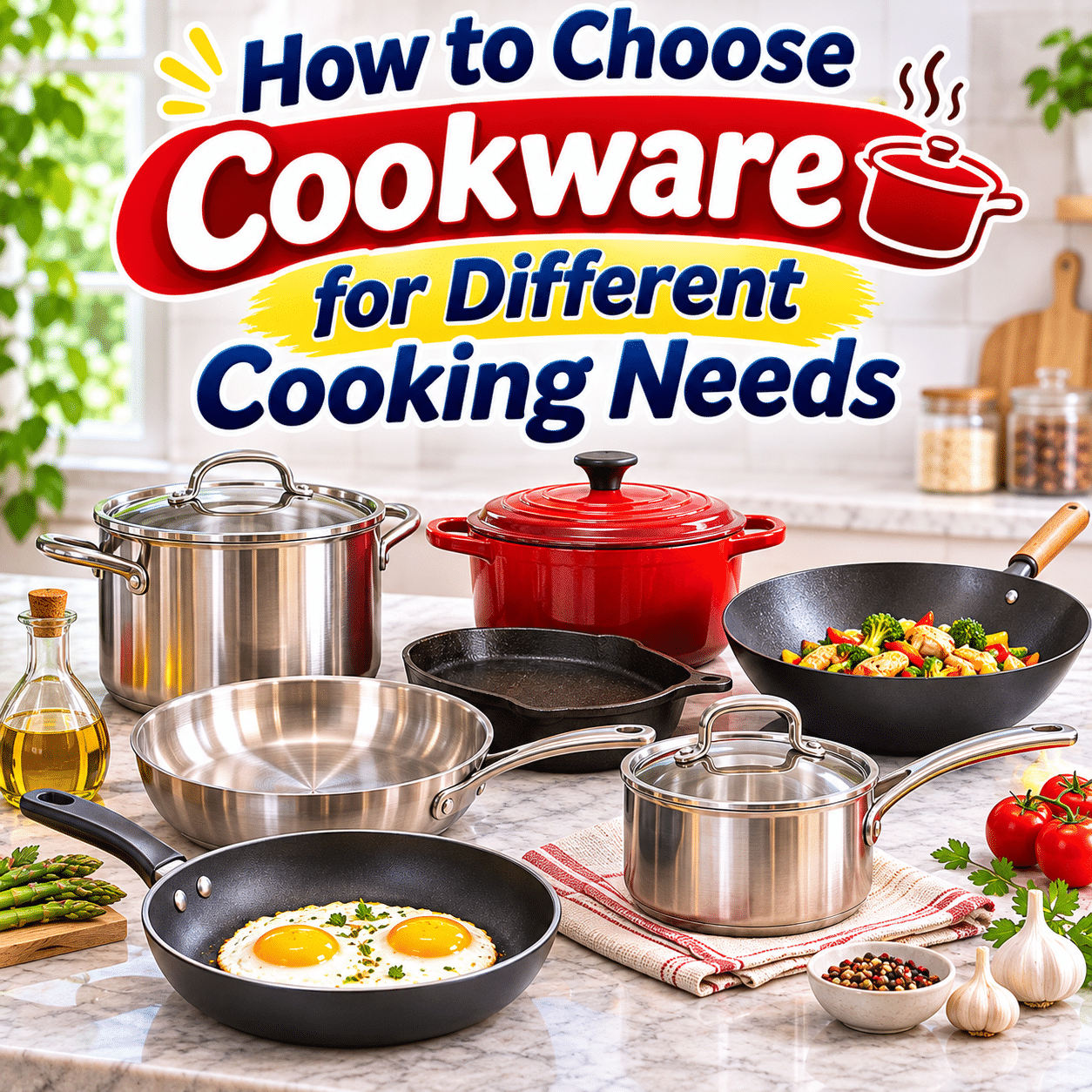
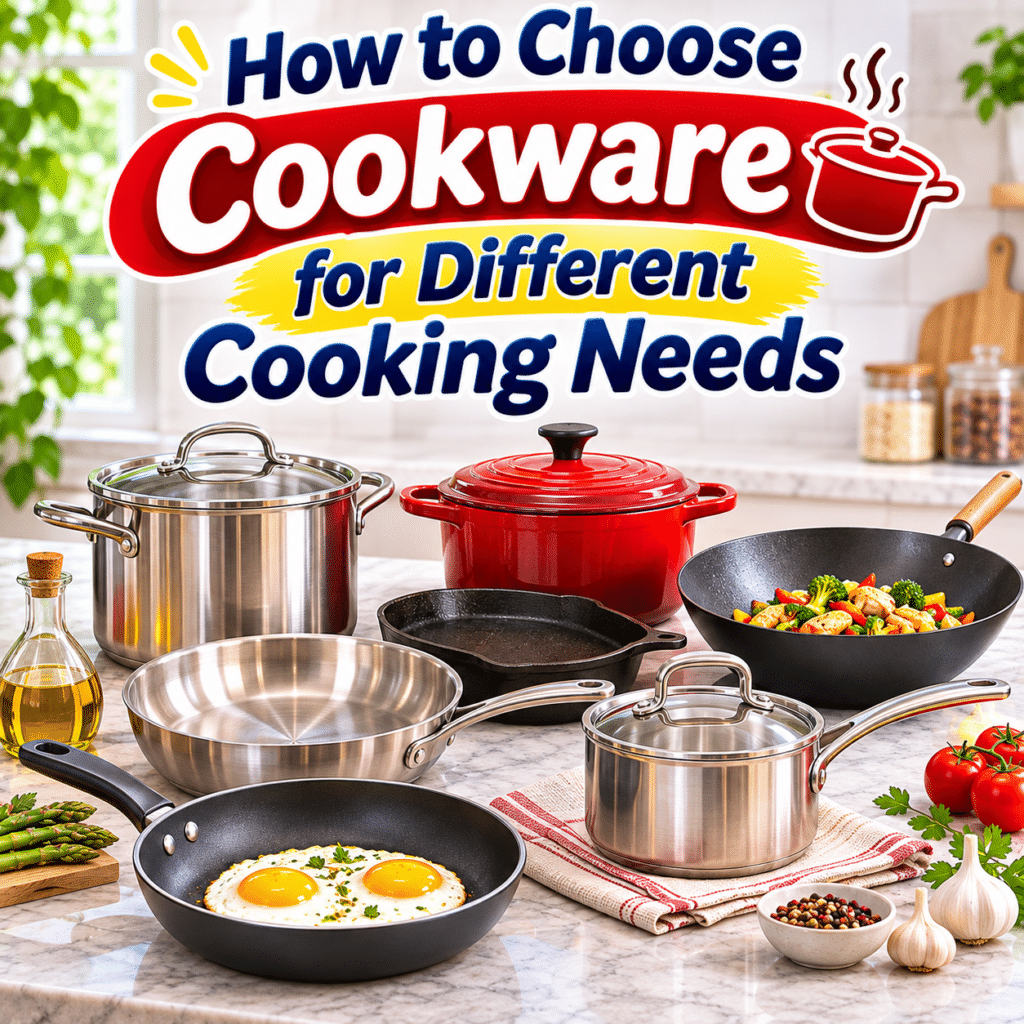
Choosing the right cookware can make everyday cooking easier, more efficient, and more enjoyable. Whether you are preparing a quick breakfast, simmering a comforting soup, searing vegetables, or cooking a family dinner, the pots and pans you use influence how food heats, browns, releases, and cooks.
However, not all cookware is designed for the same purpose. A lightweight nonstick frying pan may be ideal for delicate eggs, while a stainless steel skillet may be better suited for browning meat and preparing pan sauces. Cast iron offers excellent heat retention, whereas enameled Dutch ovens are particularly useful for slow cooking, braising, and one-pot meals.
The challenge is finding cookware that matches your cooking habits without filling your kitchen with unnecessary pieces.
Cookware materials, construction, size, weight, heat distribution, stovetop compatibility, cleaning requirements, and long-term durability all deserve consideration. Understanding these factors helps you make practical decisions and build a collection that supports the meals you prepare most often.
This comprehensive guide explores the main types of cookware, explains their advantages and limitations, compares materials for different cooking techniques, and provides practical advice for choosing pots and pans that fit your kitchen and lifestyle.
1. Start by Understanding Your Everyday Cooking Needs
Before comparing cookware materials or brands, consider what you cook most frequently.
The best cookware collection is not necessarily the largest or most expensive. It is the one that supports your regular meals.
Identify Your Most Common Cooking Methods
Think about whether you frequently:
- Fry eggs or prepare breakfast foods.
- Sauté vegetables.
- Sear meat or fish.
- Boil pasta.
- Prepare soups and stews.
- Simmer sauces.
- Cook rice or grains.
- Braise tougher cuts of meat.
- Bake dishes in the oven.
- Prepare meals in larger batches.
Each cooking method places different demands on cookware.
For example, high-temperature searing benefits from a pan with good heat retention and a surface suited to browning. Delicate foods may be easier to prepare in a nonstick pan.
Consider Household Size
Someone cooking for one person may prefer smaller, lighter cookware.
A family may benefit from larger pots, deeper sauté pans, and cookware that accommodates multiple portions.
Evaluate Your Cooking Frequency
If you cook daily, durability and cleaning convenience may be especially important.
If you cook occasionally, a few versatile pieces may be more practical than an extensive collection.
2. Understand the Main Cookware Materials
Cookware materials influence heating behavior, cooking performance, maintenance, and durability.
The most common options include:
- Stainless steel.
- Aluminum.
- Hard-anodized aluminum.
- Cast iron.
- Enameled cast iron.
- Carbon steel.
- Copper.
- Ceramic-coated cookware.
- Nonstick-coated cookware.
Each material offers different advantages.
No single material is ideal for every cooking technique.
3. Stainless Steel Cookware: Versatile and Durable
Stainless steel cookware is widely used in home and professional kitchens.
It is valued for durability, corrosion resistance, and compatibility with many cooking methods.
Advantages of Stainless Steel
- Durable construction.
- Suitable for browning and sautéing.
- Generally resistant to rust under normal care.
- Compatible with many utensils.
- Often oven-safe, depending on handles and construction.
- Does not rely on a nonstick coating.
Limitations
- Food may stick without proper technique.
- Some designs heat unevenly.
- Cleaning browned residue may require soaking.
- High-quality multilayer construction can be relatively expensive.
Best Uses
Stainless steel is particularly useful for:
- Searing chicken.
- Browning meat.
- Sautéing vegetables.
- Preparing pan sauces.
- Simmering acidic sauces.
- Cooking foods that benefit from surface browning.
Why Construction Matters
Stainless steel itself is not an especially efficient heat conductor compared with aluminum or copper.
For this reason, many stainless steel pans incorporate conductive metal layers.
These layers help distribute heat across the cooking surface.
A well-constructed stainless steel pan can provide more consistent results than a thin pan made from stainless steel alone.
4. Nonstick Cookware: Convenient for Delicate Foods
Nonstick cookware is designed to reduce food adhesion during cooking.
It is especially useful for foods that tend to stick to conventional metal surfaces.
Advantages
- Easy food release.
- Convenient for eggs and pancakes.
- Often requires less added cooking fat.
- Usually simple to clean.
- Useful for gentle everyday cooking.
Limitations
- Coatings can wear over time.
- High heat may be restricted.
- Metal utensils may damage certain surfaces.
- Abrasive cleaning can shorten coating life.
- Some pans are not suitable for high-temperature searing.
Best Uses
Nonstick cookware is well suited for:
- Scrambled eggs.
- Omelets.
- Pancakes.
- Delicate fish.
- Soft tofu.
- Foods cooked over low to moderate heat.
Important Safety Considerations
Different nonstick products use different coating technologies.
For PTFE-coated cookware, follow the manufacturer’s temperature limits and avoid overheating empty pans.
Do not assume that all nonstick cookware has identical heat tolerance or maintenance requirements.
Replace cookware when its coating becomes significantly damaged or when the manufacturer recommends replacement.
5. Cast Iron Cookware: Excellent Heat Retention
Cast iron cookware is known for its substantial weight and ability to retain heat.
It is commonly used for searing, frying, roasting, and certain oven-based cooking methods.
Advantages
- Excellent heat retention.
- Durable construction.
- Suitable for many high-temperature cooking tasks.
- Can transition from stovetop to oven when designed for it.
- Develops a seasoned cooking surface with proper care.
Limitations
- Heavy.
- Slower to respond to temperature adjustments.
- Requires maintenance.
- Can rust if improperly dried or stored.
- May heat unevenly without sufficient preheating.
Best Uses
Cast iron is useful for:
- Searing steaks.
- Cooking burgers.
- Pan-roasting vegetables.
- Preparing cornbread.
- Cooking certain skillet meals.
- Shallow frying.
Understanding Seasoning
Seasoning is a layer formed when cooking oils undergo chemical changes during heating and bond to the metal surface.
A well-maintained seasoning layer helps protect the cookware and improves food release.
Seasoned cast iron is not identical to modern nonstick cookware, but it can become increasingly convenient for many cooking tasks.
6. Enameled Cast Iron: Ideal for Braising and Slow Cooking
Enameled cast iron combines the heat retention of cast iron with a protective enamel coating.
It is commonly used for Dutch ovens, casseroles, and deep cooking vessels.
Advantages
- Excellent heat retention.
- Suitable for soups and stews.
- Convenient for braising.
- Compatible with acidic ingredients.
- Does not require traditional cast iron seasoning.
- Often suitable for oven cooking.
Limitations
- Heavy.
- Enamel can chip if mishandled.
- May require careful cleaning.
- Quality models can be expensive.
- Sudden temperature changes may damage some finishes.
Best Uses
Enameled cast iron is particularly suitable for:
- Beef stew.
- Braised chicken.
- Slow-simmered soups.
- Tomato-based dishes.
- One-pot meals.
- Certain bread-baking applications.
A Dutch oven can be a versatile addition for households that regularly prepare comforting, slow-cooked meals.
7. Carbon Steel Cookware: Responsive and Versatile
Carbon steel shares several characteristics with cast iron but is often thinner and lighter.
It is commonly used for frying pans, woks, and specialty cookware.
Advantages
- Suitable for high-temperature cooking.
- Generally lighter than comparable cast iron.
- Responds relatively quickly to temperature changes.
- Develops seasoning.
- Durable when properly maintained.
Limitations
- Requires seasoning.
- Can rust.
- May react with acidic foods.
- Requires drying after washing.
- Cooking performance improves with experience.
Best Uses
Carbon steel works well for:
- Stir-frying.
- Searing.
- Sautéing.
- Cooking certain egg dishes after seasoning develops.
- Preparing foods that benefit from rapid temperature adjustments.
A carbon steel wok can be especially useful for frequent stir-frying.
However, the ideal wok design depends on your stovetop and heat source.
8. Aluminum Cookware: Lightweight and Heat-Conductive
Aluminum is widely used in cookware because it conducts heat efficiently and is relatively lightweight.
It is often found in the core of stainless steel cookware and in nonstick pans.
Advantages
- Good heat conductivity.
- Lightweight construction.
- Relatively affordable.
- Responsive to temperature changes.
- Suitable for many everyday cooking tasks.
Limitations
- Bare aluminum may react with certain acidic or alkaline foods.
- Softer surfaces can scratch or dent.
- Not naturally compatible with induction cooktops.
- Construction quality varies.
Best Uses
Aluminum-based cookware is useful for:
- Everyday sautéing.
- Heating sauces.
- Cooking vegetables.
- Preparing foods requiring responsive temperature control.
For versatile everyday use, many shoppers prefer aluminum cookware with a suitable protective surface or stainless steel construction.
9. Hard-Anodized Aluminum: Durable Everyday Cookware
Hard-anodized aluminum undergoes an electrochemical treatment that creates a hardened oxide surface.
This can improve surface durability and resistance to wear.
Advantages
- Good heat conductivity.
- Relatively lightweight.
- Harder surface than untreated aluminum.
- Suitable for many everyday cooking tasks.
- Often available with nonstick coatings.
Limitations
- Not all models are induction-compatible.
- Some products still rely on coatings that can wear.
- Dishwasher compatibility varies.
- Oven temperature limits depend on construction.
Important Distinction
Hard anodization and nonstick coating are not the same thing.
A hard-anodized pan may also have a separate nonstick layer.
When comparing products, identify both the underlying material and the cooking surface.
10. Copper Cookware: Precise Temperature Response
Copper is an excellent conductor of heat.
It is valued for its ability to respond quickly to changes in burner output.
Advantages
- Excellent heat conductivity.
- Responsive temperature control.
- Useful for delicate cooking techniques.
- Attractive appearance.
- Often used in specialized cookware.
Limitations
- Can be expensive.
- Requires maintenance.
- Some exterior finishes tarnish.
- Bare copper can react with food.
- Many copper pans require a suitable interior lining.
Best Uses
Copper cookware may be useful for:
- Delicate sauces.
- Temperature-sensitive preparations.
- Controlled simmering.
- Specialized pastry and confectionery tasks.
For most home kitchens, copper is a specialized choice rather than an essential material.
11. Understand Ceramic-Coated Cookware
Ceramic-coated cookware generally uses a nonstick-style coating applied to a metal body.
Many products use silica-based sol-gel coatings.
These should not be confused with cookware made entirely from ceramic.
Advantages
- Convenient food release when new.
- Often easy to clean.
- Available in lightweight designs.
- Useful for low- to moderate-temperature cooking.
Limitations
- Nonstick performance may decline with use.
- Coatings can be damaged by improper cleaning.
- Heat limits vary.
- Durability depends on formulation and care.
Ceramic-Coated Versus Traditional Nonstick
Neither category is universally superior.
Performance depends on coating quality, underlying construction, temperature exposure, and maintenance.
Choose based on verified product information rather than broad marketing claims.
12. Compare Cookware Materials Side by Side
| Material | Main strength | Main limitation | Suitable cooking needs |
|---|---|---|---|
| Stainless steel | Durability and versatility | Food can stick | Searing, sautéing, sauces |
| Nonstick-coated | Easy food release | Coating wear | Eggs, pancakes, delicate foods |
| Cast iron | Heat retention | Weight and maintenance | Searing, roasting, frying |
| Enameled cast iron | Braising and simmering | Heavy construction | Stews, soups, one-pot meals |
| Carbon steel | High-heat versatility | Requires seasoning | Stir-frying, searing |
| Aluminum | Heat conductivity | Surface durability varies | Everyday cooking |
| Hard-anodized aluminum | Hardened surface | Product specifications vary | General cooking |
| Copper | Temperature responsiveness | Cost and maintenance | Delicate sauces |
| Ceramic-coated | Convenient food release | Coating performance may decline | Gentle everyday cooking |
The most practical cookware collection often combines more than one material.
13. Understand Heat Conductivity and Heat Retention
Heat conductivity and heat retention are related but different properties.
Heat Conductivity
Heat conductivity describes how readily heat moves through a material.
Materials such as copper and aluminum conduct heat efficiently.
This can help distribute heat and improve responsiveness.
Heat Retention
Heat retention describes how well cookware maintains thermal energy during cooking.
Heavy cast iron cookware often retains substantial heat because of its mass and thermal properties.
This can be useful when adding cold ingredients to a hot pan.
Why Both Matter
A responsive pan may be ideal for delicate sauces.
A heavy pan with substantial heat retention may be preferable for searing.
Neither characteristic is universally better.
The ideal balance depends on the cooking task.
14. Look Beyond the Material: Evaluate Cookware Construction
Two pans made from the same general material can perform differently.
Construction influences:
- Heat distribution.
- Weight.
- Durability.
- Responsiveness.
- Warping resistance.
- Compatibility with cooking surfaces.
Fully Clad Cookware
Fully clad cookware incorporates conductive layers through the base and sides.
This can promote more consistent heating across a larger portion of the vessel.
Encapsulated Base Cookware
Some cookware uses a conductive base attached to stainless steel walls.
This construction can provide effective heating at the bottom of the pan.
However, sidewall heating may differ from fully clad designs.
Thickness and Weight
Thicker cookware can resist rapid temperature changes and may reduce certain hot spots.
However, additional thickness also increases weight and may slow heating response.
Choose construction based on practical cooking requirements.
15. Choose Cookware That Matches Your Stovetop
Stovetop compatibility is essential.
Not every pan works equally well on every cooking surface.
Gas Cooktops
Gas burners provide flame-based heating.
They are compatible with many cookware materials.
Consider:
- Stable pan placement.
- Appropriate burner size.
- Heat-resistant handles.
- Efficient flame coverage.
Avoid allowing flames to extend unnecessarily beyond the pan base.
Electric Coil Cooktops
Electric coil burners work best with stable cookware that makes good contact with the heating element.
Flat-bottomed cookware generally performs well.
Smooth Electric Cooktops
Glass-ceramic electric cooktops benefit from flat, stable cookware.
Heavy or rough-bottomed pans should be handled carefully to avoid scratching or damaging the surface.
Induction Cooktops
Induction cooking requires cookware with a suitable magnetic base.
Common compatible materials include certain stainless steel constructions and cast iron.
Aluminum and copper cookware generally require an induction-compatible magnetic layer.
Simple Compatibility Test
A magnet that attaches firmly to the cookware base suggests that the pan may be suitable for induction.
However, magnetic attraction alone does not guarantee optimal performance.
Always check manufacturer specifications and cooktop requirements.
16. Select the Right Frying Pan
A frying pan, also called a skillet, is one of the most frequently used pieces of cookware.
It typically has a broad cooking surface and relatively low sides.
Common Uses
- Frying eggs.
- Sautéing vegetables.
- Cooking fish.
- Browning meat.
- Preparing pancakes.
- Making quick skillet meals.
Material Considerations
Nonstick: Convenient for delicate foods.
Stainless steel: Useful for browning and pan sauces.
Cast iron: Excellent for heat retention and searing.
Carbon steel: Suitable for versatile high-temperature cooking.
Size Considerations
A smaller skillet may be suitable for individual portions.
A larger skillet provides more space for cooking multiple ingredients without overcrowding.
However, the cooking surface should match the size of your burner.
17. Understand the Difference Between Frying Pans and Sauté Pans
Frying pans and sauté pans may appear similar, but their shapes serve different purposes.
Frying Pans
Frying pans generally have sloped sides.
These make it easier to:
- Flip food.
- Toss ingredients.
- Slide food onto plates.
- Evaporate moisture.
Sauté Pans
Sauté pans usually have straighter, taller sides.
They provide more usable volume and help contain liquids.
They are useful for:
- Cooking saucy dishes.
- Preparing larger portions.
- Shallow braising.
- Combining proteins and vegetables.
- Simmering meals.
Which Should You Choose?
A frying pan is often more versatile for quick cooking.
A sauté pan may be more practical if you frequently prepare one-pan meals with sauces.
18. Choose the Right Saucepan
Saucepans are designed for heating liquids and cooking smaller quantities of food.
They typically feature relatively tall sides and a long handle.
Common Uses
- Heating milk.
- Preparing sauces.
- Cooking oatmeal.
- Simmering grains.
- Boiling eggs.
- Reheating soup.
- Preparing small portions of pasta.
What to Look For
Consider:
- Suitable capacity.
- Comfortable handle.
- Stable base.
- Well-fitting lid.
- Convenient pouring.
- Even heating.
A medium saucepan is often one of the most useful pieces in a basic cookware collection.
19. Understand Stockpots and Large Cooking Pots
Stockpots are tall cooking vessels designed for larger quantities of liquid.
They are commonly used for:
- Preparing stock.
- Cooking soup.
- Boiling pasta.
- Simmering broth.
- Cooking large batches of food.
Important Features
Look for:
- Adequate capacity.
- Stable construction.
- Comfortable side handles.
- A secure lid.
- Suitable stovetop compatibility.
- Manageable weight when filled.
Why Handle Design Matters
A large stockpot can become very heavy when filled with water or food.
Strong side handles and balanced construction are important for safe handling.
20. Consider a Dutch Oven for Versatile Cooking
A Dutch oven is a heavy, deep cooking pot with a fitted lid.
It is commonly made from cast iron or enameled cast iron.
Useful Cooking Methods
- Braising.
- Simmering.
- Stewing.
- Roasting.
- One-pot cooking.
- Certain bread-baking methods.
Advantages
A Dutch oven can transition between stovetop and oven when its construction permits.
Its heavy body helps retain heat, while the lid reduces moisture loss during cooking.
What to Consider
Evaluate:
- Capacity.
- Weight.
- Lid fit.
- Handle design.
- Oven temperature rating.
- Cleaning requirements.
A Dutch oven is particularly valuable for households that regularly prepare slow-cooked meals.
21. Choose the Right Wok for Stir-Frying
A wok is designed for cooking with a relatively deep, curved cooking surface.
It is commonly associated with stir-frying but can support several cooking techniques.
Carbon Steel Woks
Carbon steel is a popular wok material because it is durable, relatively responsive, and suitable for high-temperature cooking.
Flat-Bottomed Woks
Flat-bottomed woks are generally more compatible with common household cooktops.
Round-Bottomed Woks
Round-bottomed woks are traditionally used with suitable wok burners or supporting equipment.
They may not sit safely on ordinary flat cooktops.
What Matters Most
Consider:
- Stovetop compatibility.
- Wok diameter.
- Weight.
- Handle configuration.
- Seasoning requirements.
- Available burner output.
A large wok is not automatically better if your stovetop cannot heat it effectively.
22. Match Cookware to Different Cooking Techniques
Different cooking methods benefit from different cookware characteristics.
| Cooking technique | Useful cookware | Important feature |
|---|---|---|
| Frying eggs | Nonstick skillet | Easy food release |
| Searing steak | Cast iron or stainless steel skillet | Heat retention and browning |
| Sautéing vegetables | Stainless steel or carbon steel pan | Responsive heating |
| Simmering sauces | Saucepan | Controlled heating |
| Cooking soup | Stockpot or Dutch oven | Capacity |
| Braising meat | Dutch oven | Heat retention and fitted lid |
| Stir-frying | Carbon steel wok | Suitable shape and responsive heating |
| Boiling pasta | Large pot | Adequate water capacity |
| Cooking delicate fish | Nonstick or suitable stainless steel skillet | Controlled cooking |
| Preparing one-pan meals | Sauté pan | Broad base and higher sides |
| Slow cooking | Enameled cast iron | Stable simmering |
| Preparing delicate sauces | Responsive saucepan | Temperature control |
These are practical starting points rather than strict rules.
Many dishes can be prepared successfully using different cookware materials.
23. Consider Cookware Size and Capacity
Cookware size affects cooking efficiency and food quality.
Why Surface Area Matters
A pan with insufficient cooking area can become overcrowded.
Overcrowding may trap moisture and reduce browning.
This is particularly important when searing meat or sautéing vegetables.
Why Depth Matters
Deeper cookware helps contain:
- Liquids.
- Sauces.
- Large quantities of ingredients.
- Foods requiring simmering.
Common Size Considerations
| Cookware type | Common size range | Typical purpose |
|---|---|---|
| Small skillet | Approximately 20–24 cm | Individual portions |
| Medium skillet | Approximately 24–28 cm | Everyday cooking |
| Large skillet | Approximately 28–32 cm | Multiple servings |
| Saucepan | Approximately 1–3 liters | Sauces and small batches |
| Sauté pan | Approximately 3–5 liters | One-pan meals |
| Dutch oven | Approximately 4–7 liters | Braising and stews |
| Stockpot | Approximately 6–12 liters | Soups and larger batches |
These are broad reference ranges.
Actual needs depend on portion sizes, cooking methods, and household habits.
24. Evaluate Cookware Weight and Handling
Weight influences comfort and safety.
Heavy cookware may offer substantial heat retention, but it can also be difficult to lift, tilt, or wash.
Questions to Ask
- Can I lift the empty pan comfortably?
- Will it become difficult to handle when filled?
- Can I move it safely between stovetop and oven?
- Are the handles secure?
- Is the weight balanced?
Consider Physical Convenience
Someone who cooks frequently may prefer lighter cookware for everyday tasks.
A heavy Dutch oven may still be useful for occasional slow cooking.
A balanced collection can provide both convenience and specialized performance.
25. Examine Handles and Lid Design
Handles and lids are often overlooked during cookware shopping.
However, they strongly influence daily usability.
Handle Comfort
Look for handles that:
- Feel secure.
- Provide a comfortable grip.
- Are appropriately sized.
- Remain stable during use.
- Suit the weight of the cookware.
Heat Resistance
Metal handles may become hot, particularly during oven cooking or prolonged stovetop use.
Some handles are designed to remain cooler under certain conditions, but they should not be assumed safe to touch without checking.
Lid Design
A well-fitting lid helps:
- Reduce moisture loss.
- Support simmering.
- Retain heat.
- Reduce splattering.
- Improve cooking flexibility.
Glass Versus Metal Lids
Glass lids allow visual monitoring.
Metal lids may offer durability and different oven temperature capabilities.
Always verify the temperature rating of both the lid and its handle.
26. Understand Oven-Safe Cookware
Some cookware can move directly from stovetop to oven.
This is useful for:
- Finishing seared meats.
- Baking skillet dishes.
- Braising.
- Roasting vegetables.
- Preparing certain casseroles.
Check the Entire Construction
Oven compatibility depends on more than the pan body.
Consider:
- Handles.
- Lids.
- Knobs.
- Coatings.
- Seals.
- Manufacturer temperature limits.
A metal pan may have a lower oven temperature rating because of its handle or coating.
Never assume cookware is oven-safe based only on appearance.
27. Consider Cookware for Acidic Foods
Acidic ingredients include:
- Tomatoes.
- Citrus juice.
- Vinegar.
- Wine-based sauces.
- Certain fruit preparations.
Some reactive cookware materials may interact with acidic ingredients during prolonged cooking.
Suitable Options
Stainless steel and properly maintained enameled cookware are commonly used for acidic dishes.
Materials Requiring More Attention
Bare aluminum, unlined copper, and seasoned cast iron may react with acidic foods under certain conditions.
Occasional short cooking may differ from prolonged simmering.
For frequent tomato sauces or other acidic dishes, nonreactive cookware is generally a practical choice.
28. Understand Nonstick Coatings and Long-Term Durability
Nonstick coatings can improve convenience, but they are not permanent.
Their useful life depends on:
- Coating formulation.
- Manufacturing quality.
- Cooking temperature.
- Utensil choice.
- Cleaning methods.
- Frequency of use.
Ways to Reduce Coating Wear
- Follow recommended temperature limits.
- Avoid unnecessary overheating.
- Use suitable utensils.
- Avoid abrasive cleaning tools.
- Store pans carefully.
- Follow manufacturer instructions.
When to Replace Nonstick Cookware
Consider replacement when:
- Coating is peeling or flaking.
- The cooking surface is significantly damaged.
- Food release has deteriorated substantially.
- The manufacturer recommends replacement.
A small nonstick skillet may be treated as a specialized piece rather than the foundation of an entire cookware collection.
29. Evaluate Cleaning and Maintenance Requirements
Different cookware materials require different care routines.
Stainless Steel
Stainless steel can usually tolerate thorough washing.
Stubborn residue may require soaking or appropriate cleaning products.
Nonstick Cookware
Use cleaning methods recommended for the coating.
Soft sponges and mild detergents are often appropriate.
Cast Iron
Clean according to manufacturer guidance, dry thoroughly, and maintain seasoning when needed.
Avoid prolonged moisture exposure.
Carbon Steel
Dry thoroughly and maintain the seasoned surface.
Enameled Cast Iron
Avoid impacts, thermal shock, and cleaning methods that may damage enamel.
Copper
Copper exteriors may require specialized cleaning to maintain their appearance.
Interior care depends on the lining material.
Dishwasher Compatibility
Even when cookware is labeled dishwasher-safe, repeated dishwasher use may affect certain finishes or coatings.
Follow the manufacturer’s care instructions.
30. Consider Cookware Storage and Kitchen Organization
Cookware storage matters, especially in small kitchens.
Large sets may occupy significant cabinet space.
Evaluate Your Storage Area
Consider:
- Cabinet dimensions.
- Drawer depth.
- Shelf strength.
- Hanging storage options.
- Lid organization.
- Accessibility.
Stackable Cookware
Stackable designs can save space.
However, direct contact between cooking surfaces may cause scratches.
Use protective separators when appropriate.
Avoid Unnecessary Duplication
A compact collection of versatile pieces is often easier to store and maintain than a large set containing several rarely used pans.
31. Decide Between Buying a Cookware Set and Individual Pieces
Cookware sets can offer convenience, but they are not always the most practical choice.
Advantages of Cookware Sets
- Coordinated appearance.
- Multiple pieces purchased together.
- Potentially lower cost per piece.
- Convenient starting point for a new kitchen.
Limitations
- May include unnecessary items.
- Some pieces may be too small or too large.
- One material may not suit every cooking task.
- Storage requirements can be substantial.
Advantages of Buying Individual Pieces
- Greater flexibility.
- Better alignment with cooking habits.
- Ability to combine materials.
- Less unnecessary duplication.
- Easier gradual expansion.
A Practical Approach
Consider beginning with a few essential pieces and adding specialized cookware when a recurring cooking need becomes clear.
This approach helps prevent unnecessary purchases.
32. Build a Practical Starter Cookware Collection
For many home kitchens, a small collection can cover a wide range of cooking tasks.
Essential Piece 1: Medium Frying Pan
Useful for:
- Eggs.
- Vegetables.
- Fish.
- Quick meals.
- Everyday sautéing.
Choose the material according to your cooking habits.
Essential Piece 2: Medium Saucepan With Lid
Useful for:
- Sauces.
- Grains.
- Oatmeal.
- Reheating.
- Small portions of soup.
Essential Piece 3: Large Pot
Useful for:
- Pasta.
- Soups.
- Boiling.
- Larger batches.
Essential Piece 4: Versatile Sauté Pan or Skillet
A stainless steel sauté pan or skillet can handle browning, one-pan meals, and pan sauces.
Optional Piece 5: Dutch Oven
Worth considering if you frequently prepare:
- Stews.
- Braised dishes.
- Slow-cooked meals.
- Large soups.
Optional Piece 6: Carbon Steel Wok
Useful for households that regularly stir-fry.
The ideal collection depends on your cooking routine.
Not every kitchen needs every item.
33. Choose Cookware for Small Kitchens
Limited kitchen space makes versatility especially important.
Prioritize Multipurpose Pieces
A medium stainless steel skillet can handle several cooking techniques.
A saucepan can prepare sauces, grains, and small soups.
A Dutch oven may replace the need for multiple large cooking vessels in some households.
Avoid Oversized Sets
Large cookware collections can become difficult to organize.
Purchase specialized pieces only when they serve a recurring purpose.
Consider Storage-Friendly Features
Useful options may include:
- Stackable designs.
- Removable handles on compatible systems.
- Compact lids.
- Multipurpose cooking vessels.
Always verify the safety and oven compatibility of removable-handle systems.
34. Choose Cookware for Family Cooking
Families often benefit from cookware that accommodates larger portions.
Useful Priorities
- Adequate cooking surface.
- Larger pot capacity.
- Durable construction.
- Comfortable handles.
- Easy cleaning.
- Suitable lids.
Avoid Overcrowding
Cooking large quantities in a small pan may reduce browning and increase cooking time.
A larger skillet or sauté pan may improve results.
Consider Batch Cooking
A stockpot or Dutch oven can be useful for preparing meals in advance.
Choose sizes that remain manageable when filled.
35. Choose Cookware for Health-Conscious Cooking
Cookware can support different cooking methods, but no single cookware material automatically makes a meal healthy.
Food choices, preparation techniques, portion sizes, and overall dietary patterns matter more.
Useful Considerations
- Nonstick cookware may help reduce added cooking fat for certain foods.
- Steaming equipment can support cooking without direct frying.
- Stainless steel is useful for preparing vegetables and lean proteins.
- Oven-safe cookware supports roasting and baking.
- Durable cookware may reduce the need for frequent replacement.
Avoid Misleading Claims
Be cautious of products that promise health benefits without credible evidence.
Material safety should be evaluated using verified specifications, applicable standards, and proper use instructions.
36. Consider Environmental and Long-Term Value
Cookware durability can influence resource use over time.
A pan that performs reliably for many years may reduce replacement frequency.
Factors Worth Considering
- Expected durability.
- Repairability.
- Replacement parts.
- Coating lifespan.
- Cleaning requirements.
- Packaging.
- Responsible disposal options.
Durable Does Not Always Mean Best
A heavy cast iron pan may last a long time, but it may not be practical for every household.
Choose cookware that you can use and maintain consistently.
A durable item provides the greatest value when it actually meets your needs.
37. Understand the Total Cost of Cookware Ownership
Purchase price is only one consideration.
Long-term ownership may involve:
- Cleaning supplies.
- Seasoning oil.
- Replacement lids.
- Replacement handles.
- Coating wear.
- Storage accessories.
- Maintenance time.
- Eventual replacement.
Evaluate Cost Per Use
An expensive pan used daily for many years may provide better value than a cheaper pan that requires frequent replacement.
However, high price alone does not guarantee durability or cooking performance.
Prioritize High-Use Pieces
If your budget is limited, consider investing more in cookware you use most frequently.
Specialized pieces can be added gradually.
38. Common Mistakes to Avoid When Buying Cookware
Choosing an Entire Set Based on Appearance
A coordinated set may look attractive but contain pieces that do not match your cooking habits.
Assuming One Material Is Best for Everything
Different materials perform better for different tasks.
A combination of materials may be more practical.
Ignoring Stovetop Compatibility
A pan that does not work with your cooktop may be unusable.
Buying Oversized Cookware
Large pans require more storage space and may be difficult to handle.
Choosing Lightweight Cookware Without Checking Construction
Lightweight cookware can be convenient, but very thin construction may contribute to uneven heating or warping.
Overlooking Handle Comfort
Poorly designed handles can make cooking and cleaning inconvenient.
Assuming Every Pan Is Oven-Safe
Temperature limits depend on handles, lids, coatings, and other components.
Ignoring Maintenance Requirements
Cookware that requires more care than you are willing to provide may not be a good choice.
Paying for Unnecessary Pieces
A smaller collection of useful cookware may offer better value than a large set.
Believing Marketing Claims Without Verification
Terms such as professional-grade, premium, or ultra-durable do not automatically establish performance.
Evaluate construction and specifications instead.
39. How to Choose Cookware Step by Step
A structured process can simplify cookware shopping.
Step 1: List Your Most Common Meals
Identify the cooking techniques you use regularly.
Step 2: Determine Which Cookware Types You Need
Choose frying pans, saucepans, stockpots, or specialty cookware based on actual cooking requirements.
Step 3: Select Suitable Materials
Match materials to cooking techniques.
For example, consider stainless steel for versatile sautéing and nonstick for delicate foods.
Step 4: Check Stovetop Compatibility
Verify that the cookware works with your cooking surface.
Step 5: Choose Appropriate Sizes
Consider household size, portion requirements, and burner dimensions.
Step 6: Evaluate Construction
Review the base, walls, handles, lids, and overall stability.
Step 7: Consider Weight and Handling
Make sure the cookware is comfortable to lift and maneuver.
Step 8: Review Cleaning Requirements
Choose materials and finishes you can maintain consistently.
Step 9: Check Safety and Oven Compatibility
Verify temperature limits and manufacturer instructions.
Step 10: Compare Long-Term Value
Prioritize useful, durable cookware rather than unnecessary features or excessive quantities.
40. Practical Cookware Buying Checklist
Use this checklist before purchasing cookware.
Cooking Needs
- I know which cooking methods I use most often.
- I have identified the cookware types I actually need.
- I have considered my typical portion sizes.
- I know whether I need specialized cookware.
- I have avoided unnecessary duplication.
Material and Construction
- The material suits my cooking techniques.
- The cookware has appropriate heat distribution.
- The construction appears stable and durable.
- The cooking surface meets my needs.
- Coating care requirements are acceptable.
Kitchen Compatibility
- The cookware works with my stovetop.
- The size matches my burners.
- I have adequate storage space.
- The weight is manageable.
- The handles are comfortable.
Safety and Maintenance
- Oven temperature limits are clearly specified.
- Lid and handle materials are suitable.
- Cleaning instructions are practical.
- I understand any seasoning requirements.
- The cookware can be handled safely when hot.
Long-Term Value
- The purchase fits my budget.
- The cookware serves a recurring purpose.
- Warranty terms are understood.
- Replacement components are available when relevant.
- I have considered durability and maintenance costs.
41. Frequently Asked Questions About Choosing Cookware
1. What cookware material is best for everyday cooking?
Stainless steel is a versatile choice for many cooking methods, while nonstick cookware can be convenient for delicate foods. The best option depends on your cooking habits.
2. Is stainless steel better than nonstick cookware?
Neither is universally better. Stainless steel is durable and useful for browning, while nonstick surfaces simplify cooking foods that tend to stick.
3. Is cast iron worth buying?
Cast iron can be valuable for searing, roasting, and heat retention. However, its weight and maintenance requirements may not suit everyone.
4. What is the difference between cast iron and carbon steel?
Both can develop seasoning and support high-temperature cooking. Carbon steel is often thinner and lighter, while cast iron commonly has greater mass and heat retention.
5. Is ceramic-coated cookware better than traditional nonstick?
Performance varies by product. Ceramic-based coatings and traditional nonstick coatings have different characteristics, but neither is universally superior.
6. Can stainless steel cookware be used on induction cooktops?
Some stainless steel cookware is induction-compatible, while other constructions are not. Check for a suitable magnetic base.
7. Is aluminum cookware safe?
Food-contact safety depends on the cookware’s construction, condition, and intended use. Bare aluminum can react with certain foods, so follow manufacturer guidance.
8. What cookware is best for cooking eggs?
A nonstick skillet is often convenient for eggs. Well-seasoned carbon steel or cast iron can also work with appropriate technique.
9. What pan is best for searing steak?
Cast iron and stainless steel skillets are commonly used because they can support effective browning when properly preheated.
10. What cookware is best for tomato sauce?
Stainless steel and enameled cookware are practical choices for acidic tomato-based dishes.
11. What is the difference between a frying pan and a sauté pan?
A frying pan usually has sloped sides, while a sauté pan has taller, straighter sides that help contain liquids.
12. Do I need a Dutch oven?
A Dutch oven is useful if you regularly prepare stews, braised dishes, soups, or certain oven-cooked meals. It is not essential for every kitchen.
13. What size frying pan should I buy?
A medium skillet of approximately 24–28 cm is a practical starting point for many households, although ideal size depends on portion requirements.
14. Is expensive cookware always better?
No. Higher prices may reflect materials, construction, branding, or design, but they do not guarantee better performance for every cooking task.
15. Should I buy a cookware set or individual pieces?
Individual pieces provide flexibility, while sets offer convenience. Choose based on the cookware you actually need.
16. Is fully clad cookware worth considering?
Fully clad cookware can provide more consistent heating through the base and sides. Its value depends on your cooking methods and budget.
17. Can cast iron be used on a glass cooktop?
Many cast iron pans can be used on compatible glass cooktops, but they should be handled carefully to avoid scratching or impact damage. Follow cooktop manufacturer instructions.
18. Can I put nonstick cookware in the oven?
Only when the manufacturer specifies that it is oven-safe. Temperature limits depend on coatings, handles, and lids.
19. How do I prevent food from sticking to stainless steel?
Use appropriate preheating, suitable cooking fat, and proper temperature control. Allow foods to brown before attempting to move them.
20. How long should cookware last?
Useful life varies by material, construction, coating, frequency of use, and maintenance. There is no universal lifespan.
21. Are heavy pans always better?
No. Heavy pans may retain heat well, but they can be inconvenient for tasks requiring frequent movement or temperature adjustments.
22. What cookware is best for stir-frying?
A carbon steel wok is a common choice, provided it is compatible with the stovetop and available heat source.
23. Can I use metal utensils on stainless steel?
Stainless steel generally tolerates metal utensils, although scratching can occur. Follow manufacturer recommendations.
24. Can I use metal utensils on nonstick cookware?
Many nonstick coatings can be damaged by metal utensils. Use utensils recommended by the manufacturer.
25. Is dishwasher-safe cookware always better?
Not necessarily. Dishwasher compatibility improves convenience, but some cookware may last longer or maintain its finish better with handwashing.
26. How do I know if cookware works with induction?
Check the manufacturer’s induction compatibility information. A magnetic base is an important requirement, but performance also depends on design.
27. What cookware should a beginner buy first?
A medium frying pan, a saucepan with a lid, and a larger pot can cover many basic cooking tasks.
28. Is copper cookware necessary for home cooking?
No. Copper offers excellent temperature responsiveness, but other materials can handle most everyday cooking tasks effectively.
29. What is the best cookware for a small kitchen?
Choose versatile pieces that support multiple cooking methods and fit your storage space.
30. How can I make cookware last longer?
Follow manufacturer care instructions, avoid inappropriate overheating, clean cookware properly, and store pieces to prevent damage.
42. Final Thoughts: Choosing Cookware That Supports Your Everyday Cooking
Choosing cookware is ultimately about understanding the relationship between materials, construction, cooking techniques, and everyday convenience.
A stainless steel skillet may be a reliable foundation for versatile cooking. A nonstick pan can simplify delicate breakfast foods, while cast iron or carbon steel may be valuable for high-temperature cooking. A saucepan, stockpot, or Dutch oven can support everything from quick sauces to slow-simmered family meals.
Rather than assuming one material is ideal for every purpose, consider building a balanced collection that combines complementary strengths.
Pay attention to stovetop compatibility, usable cooking surface, weight, handle comfort, cleaning requirements, and long-term durability. These practical details often matter more than appearance or the number of pieces included in a set.
It is also worth remembering that good cooking results depend on more than cookware alone. Ingredient quality, heat management, preparation techniques, and experience all contribute to successful meals.
A thoughtful cookware collection does not need to be extensive. A few reliable, well-chosen pieces can handle a remarkable variety of everyday cooking tasks.
The best cookware is not necessarily the most expensive or elaborate. It is the cookware that fits your cooking habits, performs reliably, feels comfortable to use, and makes preparing everyday meals easier for years to come.