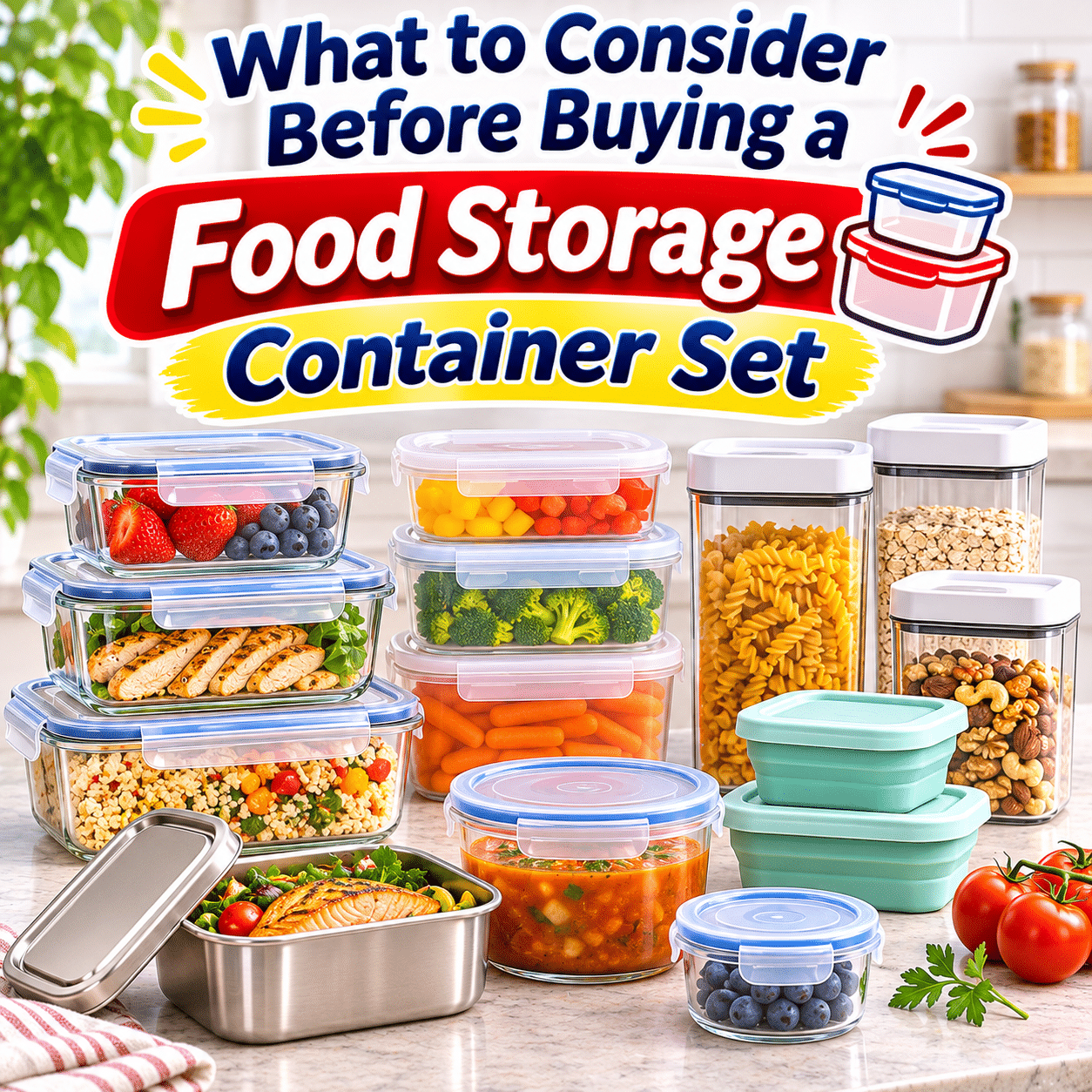
Food storage containers are among the most frequently used items in a modern kitchen. From storing leftovers and organizing pantry staples to preparing meals in advance and keeping ingredients fresh, the right containers can make everyday food management easier, cleaner, and more convenient.
However, choosing a food storage container set involves more than selecting attractive containers with matching lids. Materials, sizes, sealing mechanisms, durability, cleaning requirements, storage efficiency, and food safety all influence how well a set performs over time.
A container that works perfectly for dry pasta may not be suitable for carrying soup. A lightweight plastic container may be convenient for everyday lunches, while a glass container may be preferable for reheating leftovers. Airtight pantry containers can help protect dry ingredients from moisture, but they do not replace appropriate refrigeration or safe food handling.
The best food storage container set should match your cooking habits, fit your available kitchen space, and support the types of food you store most frequently.
This comprehensive buying guide explains the most important features to evaluate, compares common container materials, explores different lid and sealing designs, and provides practical advice for choosing a versatile, durable, and easy-to-maintain food storage system.
1. Understand Your Food Storage Needs Before Buying
Before comparing container sets, consider how you currently store food.
Different households have different requirements depending on cooking frequency, family size, available space, and food preparation habits.
Identify What You Store Most Often
Common storage needs include:
- Leftover cooked meals.
- Fresh fruits and vegetables.
- Dry pantry ingredients.
- Homemade sauces and dressings.
- Prepared lunches.
- Meal-prep portions.
- Baking ingredients.
- Snacks.
- Frozen foods.
- Small quantities of herbs and seasonings.
Each category may benefit from different container characteristics.
For example, dry flour benefits from a clean, moisture-resistant container, while leftover soup requires a secure, leak-resistant design.
Consider How Frequently You Use Containers
If you cook daily, you may need containers that are easy to open, wash, and reuse.
If you prepare meals several days in advance, stackability, portion size, and refrigerator organization become especially important.
Think About Your Main Storage Locations
Determine whether the containers will primarily be used in:
- Kitchen cabinets.
- Pantry shelves.
- Refrigerators.
- Freezers.
- Lunch bags.
- Kitchen drawers.
The best set should fit the spaces where you actually plan to use it.
2. Compare the Main Food Storage Container Materials
Material is one of the most important purchasing considerations.
Common food storage container materials include:
- Plastic.
- Glass.
- Stainless steel.
- Silicone.
- Ceramic.
Each offers different advantages and limitations.
The right choice depends on whether you prioritize weight, visibility, heating compatibility, durability, portability, or ease of cleaning.
3. Plastic Food Storage Containers: Lightweight and Convenient
Plastic containers are popular because they are lightweight, widely available, and offered in many sizes and shapes.
Advantages
- Lightweight and easy to carry.
- Often affordable.
- Available in stackable designs.
- Less likely to shatter than glass.
- Convenient for lunches and everyday storage.
- Offered in many compartment configurations.
Limitations
- Some plastics may stain.
- Odors can remain after storing strongly flavored foods.
- Surfaces may scratch.
- Heat tolerance varies.
- Certain containers may warp with improper use.
- Some products are not suitable for microwaves or dishwashers.
What to Look For
Choose plastic containers specifically intended for food contact.
Check manufacturer information regarding:
- Food-contact suitability.
- Microwave compatibility.
- Freezer compatibility.
- Dishwasher safety.
- Temperature limitations.
- Intended use.
Avoid assuming that every plastic container is suitable for reheating food.
Best Uses
Plastic containers can be practical for:
- Packed lunches.
- Snacks.
- Refrigerator organization.
- Lightweight meal preparation.
- Transporting food.
- Everyday leftovers.
4. Glass Food Storage Containers: Durable and Versatile
Glass containers are often chosen for their nonporous surfaces, visibility, and resistance to staining.
Many are designed for refrigerator storage, reheating, and certain oven applications.
Advantages
- Generally resistant to food staining.
- Less likely to retain odors.
- Easy to see contents.
- Convenient for reheating when rated for microwave use.
- Often durable under appropriate handling.
- Suitable for many acidic foods.
Limitations
- Heavier than plastic.
- Can break if dropped.
- May occupy more storage space.
- Some glass types are sensitive to sudden temperature changes.
- Lids may have different temperature limits from the glass body.
Tempered Glass Versus Borosilicate Glass
Food storage containers may use different types of glass.
Tempered glass is treated to improve certain strength characteristics.
Borosilicate glass has relatively low thermal expansion, which can improve resistance to certain temperature changes.
However, performance depends on the specific product and its design.
Neither material should be assumed unbreakable or suitable for every temperature transition.
Best Uses
Glass containers are particularly useful for:
- Storing leftovers.
- Refrigerating prepared meals.
- Reheating food.
- Storing tomato-based dishes.
- Keeping foods with strong flavors.
- Organizing visible refrigerator contents.
5. Stainless Steel Containers: Durable and Portable
Stainless steel food storage containers are commonly used for lunches, snacks, and reusable food storage.
Advantages
- Durable construction.
- Resistant to many stains.
- Generally lightweight compared with thick glass.
- Suitable for repeated use.
- Less vulnerable to breakage.
- Useful for portable meals.
Limitations
- Contents are not visible through the container walls.
- Standard stainless steel containers are not microwave-safe.
- Some designs are not fully leakproof.
- Certain lids or seals require additional maintenance.
- Not all stainless steel grades offer identical corrosion resistance.
Best Uses
Stainless steel containers can be useful for:
- Lunchboxes.
- Sandwiches.
- Snacks.
- Dry foods.
- Picnics.
- Outdoor meals.
- Everyday reusable storage.
Choose food-grade products and check the manufacturer’s guidance for acidic or salty foods and prolonged storage.
6. Silicone Food Storage Containers: Flexible and Space-Saving
Silicone containers are often designed to be flexible, collapsible, or reusable.
Some resemble traditional rigid containers, while others function more like reusable storage bags.
Advantages
- Flexible construction.
- Lightweight.
- Often space-saving.
- Available in collapsible designs.
- Convenient for certain freezer applications.
- Reusable when properly maintained.
Limitations
- Some designs are less stable when filled.
- Soft walls may make stacking difficult.
- Certain products may retain odors.
- Cleaning folds and corners can require attention.
- Temperature compatibility varies.
Best Uses
Silicone storage products may be useful for:
- Snacks.
- Freezer portions.
- Travel food storage.
- Small kitchen organization.
- Reducing reliance on disposable storage bags.
Always verify food-contact suitability and manufacturer temperature ratings.
7. Ceramic Food Storage Containers: Useful for Selected Kitchen Needs
Ceramic containers are commonly used for countertop storage, pantry organization, and certain refrigerated foods.
Advantages
- Attractive appearance.
- Often resistant to staining.
- Suitable for selected dry ingredients.
- Available in decorative designs.
- Can provide a stable storage vessel.
Limitations
- Often heavy.
- Can chip or break.
- Contents may not be visible.
- Sealing quality varies.
- Not all decorative ceramics are food-safe.
Best Uses
Ceramic containers may be practical for:
- Sugar.
- Tea.
- Coffee.
- Dry snacks.
- Countertop organization.
Check food-contact suitability, glaze safety, and lid construction before purchasing.
8. Compare Food Storage Container Materials Side by Side
| Material | Main advantages | Main limitations | Suitable uses |
|---|---|---|---|
| Plastic | Lightweight, affordable, portable | May stain, scratch, or warp | Lunches, leftovers, snacks |
| Glass | Visible, nonporous, stain-resistant | Heavy and breakable | Refrigerated meals, reheating |
| Stainless steel | Durable, reusable, portable | Opaque, not microwave-safe | Lunchboxes, snacks |
| Silicone | Flexible, space-saving | May be less rigid or stable | Freezer portions, reusable bags |
| Ceramic | Attractive, stable | Heavy, breakable | Pantry and countertop storage |
Many households benefit from combining materials rather than relying on one type for every storage task.
9. Understand Airtight, Leakproof, and Watertight Designs
These terms are frequently used in food storage marketing, but they describe different performance characteristics.
Airtight Containers
An airtight container is designed to limit air exchange between the inside and outside.
This can help protect certain foods from moisture exposure and environmental odors.
However, airtight does not mean vacuum-sealed or sterile.
Leakproof Containers
Leakproof containers are designed to prevent liquids from escaping when properly closed and used within their intended limits.
This is particularly important for:
- Soups.
- Sauces.
- Dressings.
- Yogurt.
- Wet meal-prep dishes.
Watertight Containers
Watertight generally describes resistance to water entering or escaping under specified conditions.
The term does not automatically guarantee performance when a container is inverted, shaken, or placed under pressure.
Why the Difference Matters
A pantry container may have an effective airtight seal but still leak if filled with liquid and tipped sideways.
If you transport liquid foods, choose a product specifically rated for leak-resistant or leakproof food transport.
10. Evaluate Lid and Sealing Mechanisms
Lid design influences convenience, food protection, and long-term durability.
Common designs include:
- Snap-lock lids.
- Press-fit lids.
- Screw-top lids.
- Hinged lids.
- Clamp-style lids.
- Silicone-sealed lids.
Snap-Lock Lids
These use locking tabs or clips.
Advantages:
- Often provide secure closure.
- Convenient for refrigerated leftovers.
- Common in meal-prep sets.
Limitations:
- Clips may wear or break.
- Hinges can become difficult to clean.
- Closure force varies.
Press-Fit Lids
These rely on friction or flexible sealing.
Advantages:
- Simple operation.
- Fewer mechanical components.
- Convenient for quick access.
Limitations:
- Sealing strength varies.
- Some are unsuitable for liquids.
- Lids may loosen over time.
Screw-Top Lids
These use threaded closures.
Advantages:
- Secure when properly fitted.
- Useful for certain liquids and dry ingredients.
- Often easy to recognize as fully closed.
Limitations:
- Threads require cleaning.
- Some designs are less convenient for frequent access.
Silicone Gaskets
Silicone gaskets can improve sealing performance.
However, they require cleaning and may eventually need replacement.
11. Look for Removable and Easy-to-Clean Seals
Sealing gaskets are important but can also become areas where food residue accumulates.
Why Removable Gaskets Help
Removable seals may allow more thorough cleaning.
This is useful when containers regularly hold:
- Tomato sauces.
- Curries.
- Soups.
- Oily foods.
- Strongly flavored meals.
What to Check
Before purchasing, consider:
- Can the gasket be removed safely?
- Is it easy to reinstall?
- Are replacement gaskets available?
- Does the lid contain difficult-to-clean channels?
- Can all components dry completely?
Follow manufacturer instructions to avoid damaging the seal.
12. Choose the Right Container Sizes
Container capacity influences how useful a set will be.
A set containing many containers is not necessarily better if the sizes do not match your needs.
Small Containers
Useful for:
- Sauces.
- Dressings.
- Nuts.
- Small snacks.
- Chopped herbs.
- Individual ingredients.
Medium Containers
Useful for:
- Lunch portions.
- Leftover vegetables.
- Prepared grains.
- Fruit.
- Sandwich components.
- Single-meal portions.
Large Containers
Useful for:
- Family leftovers.
- Batch-cooked meals.
- Large salads.
- Pasta.
- Dry pantry ingredients.
- Meal-prep batches.
Practical Size Reference
| Approximate capacity | Common uses |
|---|---|
| 100–300 mL | Dressings, sauces, small snacks |
| 300–700 mL | Side dishes, fruit, smaller portions |
| 700 mL–1.2 L | Individual meals, leftovers |
| 1.2–2 L | Larger portions, batch preparation |
| 2–4 L | Family leftovers, dry pantry storage |
| Above 4 L | Bulk ingredients, larger food quantities |
These are general references rather than strict requirements.
Choose sizes according to the foods and portions you regularly store.
13. Consider Container Shape and Storage Efficiency
Shape affects how efficiently containers use space.
Rectangular Containers
Rectangular containers often fit well in refrigerators, cabinets, and lunch bags.
They can reduce unused gaps when arranged together.
Square Containers
Square containers can provide efficient stacking and shelf organization.
They are particularly useful for pantry storage.
Round Containers
Round containers can be convenient for:
- Soups.
- Sauces.
- Mixing.
- Certain leftovers.
However, they may leave more unused space when placed side by side.
Choose Based on Storage Location
For crowded refrigerators and pantry shelves, rectangular or square containers may offer greater space efficiency.
For certain foods and mixing tasks, round containers may be more convenient.
14. Understand Stackable and Nesting Container Designs
Stacking and nesting are related but different storage features.
Stackable Containers
Stackable containers are designed to sit securely on top of one another.
This can improve organization when containers are filled.
Nesting Containers
Nesting containers fit inside one another when empty.
This can reduce cabinet storage requirements.
Why Both Matter
A set may stack well when full but occupy substantial space when empty.
Another set may nest compactly but be less stable when filled.
Practical Considerations
Look for:
- Stable bases.
- Compatible lid shapes.
- Consistent dimensions.
- Secure stacking.
- Easy separation when nested.
Avoid stacking containers beyond the manufacturer’s recommendations.
15. Evaluate Refrigerator Compatibility
Refrigerator storage is one of the most common uses for food containers.
Important Features
Look for:
- Compact shapes.
- Stable stacking.
- Clear visibility.
- Secure lids.
- Easy access.
- Smooth, cleanable surfaces.
Avoid Overcrowding
Containers should not block necessary refrigerator airflow.
Overcrowding can interfere with temperature consistency.
Consider Refrigerator Shelf Height
Measure available shelf clearance before purchasing tall containers.
A container may fit the refrigerator overall but be inconvenient to access on a particular shelf.
Choose Visibility When Helpful
Transparent containers make it easier to identify leftovers and reduce forgotten food.
However, labeling remains useful when foods look similar.
16. Consider Freezer-Safe Containers
Freezer storage requires attention to temperature resistance, expansion, and sealing.
Why Freezer Compatibility Matters
Some materials become brittle or may crack at low temperatures.
Containers not designed for freezing may be damaged.
Allow Space for Expansion
Water-rich foods expand as they freeze.
Soups, sauces, and other liquids should not be filled to the brim.
Follow the manufacturer’s recommended fill limits.
Choose Suitable Portion Sizes
Smaller portions can make thawing and meal planning more convenient.
Useful Freezer Features
- Freezer-rated materials.
- Secure lids.
- Stable stacking.
- Suitable headspace.
- Clear labeling areas.
- Durable construction.
Avoid Thermal Shock
Do not move frozen glass containers directly into high heat unless the manufacturer explicitly permits the specific temperature transition.
17. Understand Microwave-Safe Food Storage
Microwave compatibility is especially important if you regularly reheat leftovers.
Check the Container and Lid Separately
A container body may be microwave-safe while its lid is not.
Some lids must be removed or vented before heating.
Follow Manufacturer Instructions
Check:
- Microwave suitability.
- Maximum heating temperature.
- Lid venting requirements.
- Recommended heating duration.
- Restrictions on oily or sugary foods.
Why Venting Matters
Heating sealed containers can create pressure.
Use lids only as directed and avoid heating tightly sealed containers.
Heat Distribution
Microwave heating can be uneven.
Stir food when appropriate, allow standing time, and check that leftovers are heated thoroughly.
For food safety, many official guidelines recommend reheating leftovers to 74°C (165°F).
18. Consider Oven-Safe Containers
Some glass and ceramic containers are designed for oven use.
However, not every food storage container can withstand oven temperatures.
Important Questions
- Is the container body oven-safe?
- What is the maximum rated temperature?
- Is the lid oven-safe?
- Can the container move between refrigerator and oven?
- Are there restrictions on broilers or direct heat?
Never Assume Glass Is Automatically Oven-Safe
Different glass products have different thermal characteristics.
Use only products explicitly rated for oven use.
Plastic and Silicone Components
Plastic lids and sealing gaskets often have lower temperature limits than glass or metal bodies.
Remove components as required by the manufacturer.
19. Understand Dishwasher Compatibility
Dishwasher-safe containers can simplify cleanup.
However, compatibility varies by material and construction.
Plastic Containers
Some plastic containers are dishwasher-safe but may have placement restrictions.
High temperatures can damage unsuitable products.
Glass Containers
Many glass bodies are dishwasher-safe.
Lids and gaskets may require different care.
Stainless Steel Containers
Some stainless steel containers can be washed in dishwashers, while others require handwashing.
Silicone Containers
Many food-grade silicone products tolerate dishwasher cleaning, but folds and seals may require extra attention.
Check the Entire Set
Do not assume that every component has the same cleaning requirements.
20. Consider Stain and Odor Resistance
Certain foods can leave visible stains or lingering odors.
Common examples include:
- Tomato sauce.
- Curry.
- Turmeric.
- Garlic.
- Onion.
- Strong spices.
- Oily foods.
Glass
Glass is generally resistant to staining and odor absorption.
Plastic
Some plastics may retain color or odors, especially after repeated exposure.
Silicone
Some silicone products may retain odors or flavors depending on formulation and use.
Stainless Steel
Stainless steel is generally resistant to staining, although surface discoloration and residue can occur.
Practical Buying Advice
If you frequently store strongly colored or aromatic foods, prioritize materials and designs that are easy to clean thoroughly.
21. Evaluate Food-Contact Safety
Food storage containers should be designed for contact with food.
Look for Reliable Product Information
Consider whether the manufacturer clearly identifies:
- Materials.
- Intended food-contact use.
- Temperature limits.
- Cleaning instructions.
- Applicable regulatory compliance.
- Restrictions on certain foods or uses.
Understand BPA-Free Claims
BPA-free indicates that a product is represented as not containing bisphenol A.
However, the absence of BPA does not independently establish that every material or use condition is safe.
Evaluate the complete product and its intended use.
Avoid Unverified Claims
Be cautious of broad marketing statements such as completely chemical-free or universally safe at any temperature.
All materials have chemical compositions and practical use limitations.
22. Consider Containers for Dry Pantry Storage
Dry ingredients benefit from organized storage that helps limit moisture exposure and contamination.
Common pantry items include:
- Rice.
- Flour.
- Sugar.
- Pasta.
- Oats.
- Cereal.
- Nuts.
- Dried beans.
- Baking ingredients.
Useful Features
Look for:
- Secure lids.
- Appropriate capacity.
- Wide openings.
- Stable bases.
- Clear visibility.
- Easy cleaning.
- Stackable shapes.
Airtight Storage Benefits
Airtight designs can help reduce exposure to humidity and certain pantry pests.
However, they do not guarantee indefinite freshness or eliminate the need for proper storage conditions.
Consider Ingredient Quantity
Choose containers large enough for the amount you normally purchase, while leaving space for convenient scooping.
23. Choose Containers for Flour, Sugar, and Baking Ingredients
Baking ingredients often require different storage considerations.
Flour
Flour benefits from clean, dry storage.
A wide-opening container makes measuring and scooping easier.
Sugar
Sugar should be protected from moisture.
Suitable containers can help reduce clumping.
Baking Powder and Baking Soda
These ingredients should be stored according to package instructions, away from excess moisture.
Nuts and Seeds
Nuts and seeds contain oils that can become rancid.
Depending on the ingredient and expected storage duration, refrigeration or freezing may be preferable to room-temperature pantry storage.
Labeling Matters
Use labels to distinguish ingredients that look similar.
This is especially useful for different types of flour, sugar, and grains.
24. Choose Containers for Fresh Produce
Fresh fruits and vegetables have different moisture and airflow requirements.
Not All Produce Benefits From Airtight Storage
Some produce requires ventilation to reduce moisture accumulation.
Other items benefit from controlled humidity.
Leafy Greens
Leafy greens may benefit from storage that manages excess surface moisture.
Berries
Berries are delicate and can deteriorate quickly when exposed to excess moisture or improper storage.
Cut Vegetables
Cut produce generally requires refrigeration and clean, food-safe storage.
Specialized Produce Containers
Some containers include:
- Ventilation controls.
- Elevated trays.
- Drainage inserts.
- Moisture-management features.
These features may be useful, but their effectiveness depends on the produce and storage conditions.
Practical Principle
Choose produce containers based on the specific fruit or vegetable rather than assuming one sealed design is ideal for everything.
25. Consider Meal-Prep Containers
Meal preparation often involves cooking several portions in advance.
Suitable containers can simplify portioning, refrigeration, freezing, and reheating.
Important Features
- Consistent portion sizes.
- Secure lids.
- Stackable shapes.
- Microwave compatibility when needed.
- Freezer suitability.
- Easy cleaning.
- Durable construction.
Single-Compartment Containers
These offer flexibility for meals that can be mixed together.
Divided Containers
Compartment containers can help separate:
- Proteins.
- Vegetables.
- Grains.
- Sauces.
- Snacks.
However, dividers do not always prevent liquid transfer unless specifically designed for that purpose.
Choose Based on Your Meals
If you regularly prepare rice bowls, a single-compartment container may be sufficient.
If you prefer separate foods, divided containers may be more convenient.
26. Evaluate Food Containers for Lunches and Travel
Portable food storage requires additional attention to weight and sealing.
Useful Features
- Lightweight construction.
- Secure closure.
- Leak-resistant design.
- Appropriate portion capacity.
- Compact shape.
- Easy opening.
- Durable materials.
Consider the Lunch Bag
Check whether containers fit your lunch bag or cooler.
Temperature Control Matters
Food storage containers alone do not necessarily keep perishable foods at safe temperatures.
Use appropriate insulated bags, ice packs, or other temperature-control methods when necessary.
Avoid Relying Only on Tight Lids
A secure lid prevents spills but does not replace refrigeration.
27. Understand Food Safety and Storage Duration
Containers help organize and protect food, but safe storage depends on temperature, handling, and time.
Refrigeration
Perishable foods should generally be refrigerated promptly.
Common food safety guidance recommends keeping refrigerators at or below 4°C (40°F).
Freezing
Freezers should generally be maintained at or below -18°C (0°F).
Cooling Cooked Foods
Large quantities of hot food should be divided into shallow containers to promote faster cooling.
Refrigerate promptly rather than leaving perishable foods at room temperature for extended periods.
Leftover Storage
Many cooked leftovers can generally be refrigerated for approximately 3–4 days when handled and stored properly.
However, safe storage duration varies by food type and preparation conditions.
Important Reminder
Airtight containers do not make improperly stored food safe.
Follow reliable food safety guidance for specific foods.
28. Consider Labeling and Date Tracking
Labels can improve food organization and reduce unnecessary waste.
Useful Information to Record
- Food name.
- Preparation date.
- Storage date.
- Freezing date.
- Relevant use-by information.
Labeling Options
Common options include:
- Removable labels.
- Freezer-safe labels.
- Washable markers.
- Reusable labeling systems.
Why Labels Help
Prepared foods may look similar after refrigeration or freezing.
Clear labeling reduces confusion and makes it easier to use older food first.
29. Evaluate Container Visibility
Transparent containers make it easier to identify contents without opening them.
Advantages
- Faster ingredient identification.
- Easier inventory checks.
- Reduced unnecessary opening.
- Better visibility of remaining quantities.
Limitations
Transparent containers may expose light-sensitive foods to light.
Certain ingredients, such as some oils, spices, and coffee products, may benefit from storage away from light.
Practical Approach
Use transparent containers where visibility improves convenience.
For light-sensitive ingredients, consider opaque containers or storage inside closed cabinets.
30. Consider Lid Interchangeability
Some container sets use standardized lids across multiple sizes.
Advantages
- Easier lid matching.
- Reduced storage clutter.
- Convenient replacement.
- Faster everyday use.
Limitations
Not every set uses interchangeable lids.
Similar-looking lids may not seal correctly on different containers.
What to Check
Look for:
- Clear size compatibility.
- Consistent lid design.
- Replacement lid availability.
- Easy identification.
- Secure fit.
A set with fewer lid sizes may be easier to manage than one requiring a unique lid for every container.
31. Evaluate Durability and Long-Term Performance
A durable container set should withstand normal repeated use within its intended conditions.
Common Wear Points
- Lid hinges.
- Locking clips.
- Silicone seals.
- Plastic corners.
- Container rims.
- Glass edges.
- Flexible folding sections.
Signs of Poor Durability
Potential concerns include:
- Lids that do not fit consistently.
- Weak hinges.
- Rough or uneven edges.
- Unstable stacking.
- Excessive flexing in rigid components.
- Poorly attached seals.
Replacement Parts
A set may offer better long-term value if replacement lids and gaskets are available.
32. Consider Ease of Opening and Closing
A container should be secure without being unnecessarily difficult to operate.
Questions to Ask
- Can the lid be opened comfortably?
- Does the seal require excessive force?
- Are locking clips easy to use?
- Can the container be opened with clean, dry hands?
- Is the lid practical for frequent access?
Different Users Have Different Needs
People with limited hand strength or mobility may prefer larger tabs, easy-grip lids, or simpler closures.
However, easy opening should be balanced with the sealing performance required for the intended food.
33. Think About Kitchen Organization
A food storage container set should improve organization rather than create clutter.
Consider the Entire Storage System
Evaluate:
- Cabinet dimensions.
- Drawer height.
- Refrigerator shelves.
- Pantry depth.
- Lid storage.
- Container stacking.
- Accessibility.
Keep Frequently Used Sizes Accessible
Place everyday containers where they are easy to reach.
Store occasional-use pieces separately.
Avoid Excessive Variety
A smaller collection of compatible shapes and lids can be easier to organize than many unrelated containers.
Plan for Empty Containers
Consider where containers will go when they are not in use.
A set that occupies excessive cabinet space may become inconvenient.
34. Decide Whether to Buy a Set or Individual Containers
Container sets can be convenient, but they are not always the best choice.
Advantages of Sets
- Coordinated sizes.
- Matching appearance.
- Potentially lower cost per piece.
- Consistent lid designs.
- Convenient starting point.
Limitations
- May include unnecessary sizes.
- Some pieces may rarely be used.
- Storage requirements can be substantial.
- Not every container may suit your needs.
Advantages of Individual Containers
- Greater customization.
- Ability to choose specific capacities.
- Less unnecessary duplication.
- Easier replacement of frequently used sizes.
Practical Recommendation
Choose a set only when most of its containers match your actual storage needs.
Otherwise, buying individual pieces may offer better long-term value.
35. Understand How Container Sets Are Counted
Some manufacturers count containers and lids as separate pieces.
For example, a set advertised as containing 20 pieces may include 10 containers and 10 lids.
What to Verify
Before purchasing, check:
- Actual number of containers.
- Number of lids.
- Capacity of each container.
- Whether accessories are included.
- Whether all containers have matching lids.
Avoid Comparing Sets by Piece Count Alone
A larger advertised piece count does not necessarily mean more usable storage capacity.
Compare the actual container sizes and quantities.
36. Consider the Total Cost of Ownership
Purchase price is only one part of long-term value.
Other factors include:
- Expected lifespan.
- Replacement lids.
- Replacement gaskets.
- Cleaning requirements.
- Storage accessories.
- Frequency of use.
- Potential replacement due to wear.
Cost Per Use
A durable container used frequently over several years may provide better value than a cheaper container that requires regular replacement.
However, expensive containers are not automatically better.
Prioritize Useful Features
Pay for features that support your actual routine.
For example, leakproof performance may be worth prioritizing if you regularly transport soup.
For dry pantry ingredients, a simpler airtight container may be sufficient.
37. Consider Environmental Impact and Reusability
Reusable food storage containers can reduce dependence on disposable packaging when used consistently.
However, environmental impact depends on several factors.
Relevant Considerations
- Material production.
- Durability.
- Frequency of reuse.
- Cleaning requirements.
- Transportation.
- Replacement frequency.
- End-of-life disposal.
Choose Long-Lasting Products
A container that remains useful for many years may reduce repeated purchasing.
Avoid Buying More Than Necessary
Purchasing a large collection of unused containers can create unnecessary material consumption.
Use Existing Containers Appropriately
Some clean, food-safe containers can be reused for suitable purposes.
However, avoid reusing disposable packaging beyond its intended conditions, particularly for heating or repeated long-term use.
38. Common Mistakes to Avoid When Buying Food Storage Containers
Choosing Based Only on Appearance
Attractive containers may not provide the sealing, capacity, or durability you need.
Assuming Airtight Means Leakproof
A container designed for dry ingredients may not safely transport liquids.
Ignoring Lid Quality
A durable container body is less useful if its lid fails.
Buying Too Many Small Containers
Small containers are useful, but an excessive number can create clutter.
Overlooking Actual Capacity
A container may appear large but hold less food than expected.
Ignoring Microwave and Freezer Ratings
Not all containers tolerate the same temperatures.
Assuming Every Glass Container Is Oven-Safe
Oven compatibility must be verified.
Buying Sets With Unnecessary Sizes
A large set may include pieces you rarely use.
Forgetting Storage Space
Empty containers and lids can occupy substantial cabinet space.
Overlooking Cleaning Difficulty
Complex seals and narrow openings may make routine cleaning inconvenient.
Ignoring Replacement Parts
Unavailable lids or gaskets can shorten the useful life of a set.
Believing Containers Extend Food Safety Indefinitely
Proper refrigeration, freezing, and handling remain essential.
39. How to Choose a Food Storage Container Set Step by Step
A structured approach can simplify the buying process.
Step 1: Identify Your Main Storage Needs
Decide whether you primarily store leftovers, dry ingredients, meal-prep portions, or packed lunches.
Step 2: Choose Suitable Materials
Select plastic, glass, stainless steel, silicone, or ceramic based on your intended use.
Step 3: Determine the Sizes You Need
Consider typical portion sizes and ingredient quantities.
Step 4: Evaluate Sealing Requirements
Decide whether you need airtight, leak-resistant, or specifically leakproof designs.
Step 5: Check Temperature Compatibility
Verify refrigerator, freezer, microwave, dishwasher, and oven ratings as relevant.
Step 6: Consider Shape and Storage Efficiency
Choose shapes that fit your shelves, cabinets, and lunch bags.
Step 7: Examine Lid Construction
Look for secure closures and practical cleaning.
Step 8: Review Food-Contact Safety
Check materials, intended uses, and manufacturer guidance.
Step 9: Evaluate Durability and Replacement Options
Consider hinges, seals, lids, and overall construction.
Step 10: Compare Long-Term Value
Choose a set that fits your routine without unnecessary pieces.
40. Practical Food Storage Container Buying Checklist
Use this checklist before making a purchase.
Storage Needs
- I know which foods I store most frequently.
- I have identified my main storage locations.
- I have considered typical portion sizes.
- I know whether I need containers for liquids.
- I am avoiding unnecessary quantities.
Materials and Safety
- The materials are suitable for food contact.
- Temperature limits are clearly specified.
- Microwave compatibility is verified if needed.
- Freezer suitability is confirmed if needed.
- Oven compatibility is verified separately where relevant.
Sealing and Design
- The lids close securely.
- Sealing performance matches my needs.
- Gaskets are easy to clean.
- Container shapes fit my storage spaces.
- Stackability or nesting is practical.
Cleaning and Maintenance
- The containers are easy to wash.
- Lid components can be cleaned thoroughly.
- Dishwasher compatibility is clear.
- Materials resist the types of staining I commonly encounter.
- Replacement lids or seals are available when relevant.
Long-Term Value
- The actual number of containers is clear.
- The sizes are useful.
- The set fits my budget.
- The construction appears durable.
- I have considered storage and replacement costs.
41. Frequently Asked Questions About Food Storage Container Sets
1. What is the best material for food storage containers?
There is no single best material. Glass is useful for visible storage and reheating, plastic is lightweight and portable, and stainless steel is durable for many lunch and snack applications.
2. Are glass containers better than plastic containers?
Glass offers good stain resistance and visibility, while plastic is lighter and less likely to shatter. The better choice depends on your needs.
3. Are plastic food storage containers safe?
Food-contact plastic containers can be suitable when used according to manufacturer instructions and applicable safety requirements.
4. What does BPA-free mean?
BPA-free indicates that the product is represented as not containing bisphenol A. It does not independently guarantee suitability for every use.
5. Are airtight containers completely sealed?
Airtight containers are designed to limit air exchange, but they are not necessarily vacuum-sealed or sterile.
6. Are airtight containers also leakproof?
Not necessarily. A container may seal well against air but still leak when filled with liquid and tilted.
7. What containers are best for meal preparation?
Stackable containers with appropriate portion sizes, secure lids, and suitable refrigerator or freezer compatibility are practical choices.
8. What containers are best for storing soup?
Choose containers specifically designed for liquids, with secure leak-resistant or leakproof closures and suitable temperature ratings.
9. Can glass containers go in the freezer?
Some can. Check freezer compatibility and allow sufficient space for liquid expansion.
10. Can frozen glass containers go directly into the oven?
Do not assume this is safe. Follow the manufacturer’s instructions regarding temperature changes.
11. Are all plastic containers microwave-safe?
No. Microwave compatibility depends on the material and product design.
12. Can food storage lids go in the microwave?
Some can, often with venting requirements. Others must be removed. Check the manufacturer’s guidance.
13. Are stainless steel containers microwave-safe?
Standard stainless steel food containers should not be used in conventional microwave ovens unless the microwave and container manufacturers specifically authorize that use.
14. Are silicone food storage containers safe?
Food-grade silicone containers can be suitable when designed for food contact and used within their specified temperature limits.
15. Are ceramic containers good for pantry storage?
They can be useful for dry ingredients, provided they are food-safe and offer suitable sealing.
16. What size food storage containers should I buy?
Choose sizes based on typical portions, leftovers, and ingredient quantities rather than purchasing a set solely because it includes many pieces.
17. Are square containers better than round containers?
Square containers often use shelf space efficiently, while round containers may be convenient for soups, sauces, and mixing.
18. What is the difference between stackable and nesting containers?
Stackable containers sit securely on one another, while nesting containers fit inside one another when empty.
19. Are expensive food storage containers worth buying?
They may offer better seals, construction, or durability, but price alone does not guarantee performance.
20. How do I prevent food storage containers from smelling?
Clean containers promptly, follow manufacturer instructions, and allow all components to dry thoroughly.
21. Why do plastic containers become stained?
Certain pigments and oils in food can interact with plastic surfaces, causing visible discoloration.
22. Can I store tomato sauce in plastic containers?
Food-safe plastic containers may be suitable, but some can stain. Glass is often more resistant to discoloration.
23. How should I store flour and sugar?
Use clean, dry, food-safe containers with appropriate moisture protection, following any storage instructions provided with the ingredients.
24. Do airtight containers prevent pantry pests?
They can help reduce access when properly sealed, but they do not eliminate pests already present in ingredients.
25. Should vegetables be stored in airtight containers?
Not always. Different vegetables require different humidity and ventilation conditions.
26. Are produce storage containers worth buying?
They may be useful when their ventilation and moisture-management features match the produce being stored.
27. Can food storage containers keep food fresh indefinitely?
No. Food quality and safety depend on storage temperature, handling, time, and the type of food.
28. How long can cooked leftovers stay in the refrigerator?
Many cooked leftovers can generally be stored for about 3–4 days under appropriate refrigeration, although recommendations vary by food.
29. Should I label food storage containers?
Labeling can help identify contents, track preparation dates, and reduce forgotten leftovers.
30. Are removable silicone gaskets better?
They can make thorough cleaning easier, but they must be correctly reinstalled to maintain sealing performance.
31. How do I know if a container is dishwasher-safe?
Check the manufacturer’s labeling and instructions for the container body, lid, and gasket.
32. Why do some container lids become difficult to close?
Possible causes include deformation, damaged seals, food residue, or misalignment.
33. Can I replace a broken lid without replacing the container?
Some manufacturers sell replacement lids. Availability depends on the product line.
34. Is it better to buy a food storage set or individual containers?
A set is convenient when its sizes match your needs. Individual containers allow more precise customization.
35. Why do some sets advertise more pieces than containers?
Manufacturers may count lids and accessories as separate pieces.
36. What containers are best for a small kitchen?
Stackable or nesting containers with compatible lids can help reduce clutter.
37. Are reusable food containers environmentally friendly?
Repeated use can reduce reliance on disposable packaging, but overall environmental impact depends on material, production, cleaning, durability, and actual use.
38. How often should food storage containers be replaced?
Replace containers when damage, deformation, failed seals, or other deterioration makes them unsuitable for safe and effective use.
39. Can I store hot food directly in plastic containers?
Only when the product is rated for the relevant temperature. Follow manufacturer instructions and cool or portion food appropriately.
40. What is the most important feature in a food storage container set?
The most important feature is suitability for your actual storage needs, including safe materials, appropriate sizes, reliable lids, and practical maintenance.
42. Final Thoughts: Choosing Food Storage Containers That Make Everyday Life Easier
Choosing the right food storage container set is about finding a practical balance between food safety, convenience, durability, and efficient kitchen organization.
Plastic containers can offer lightweight portability, while glass containers provide visibility and resistance to staining. Stainless steel is useful for durable lunch storage, silicone offers flexible alternatives, and ceramic containers can support selected pantry and countertop needs.
Beyond material, pay close attention to lid design, sealing performance, container capacity, temperature compatibility, and cleaning requirements. These details often determine whether a set remains convenient after months or years of everyday use.
It is also important to choose containers that fit your available storage space. Stackable shapes, nesting designs, and interchangeable lids can make a meaningful difference in kitchens where cabinet and refrigerator space is limited.
Remember that food storage containers are tools for organizing and protecting food, not substitutes for proper refrigeration, freezing, or safe handling. Using the right container together with appropriate storage practices helps preserve food quality and reduce unnecessary waste.
A thoughtfully selected collection does not need to include dozens of pieces. A manageable combination of useful sizes and reliable materials can support everyday leftovers, meal preparation, pantry organization, and portable meals.
The best food storage container set is not necessarily the largest, most expensive, or most decorative. It is the one that fits your kitchen, protects food appropriately, simplifies everyday routines, and provides dependable value through repeated use.