Everyday products are often designed around convenience. A bottle of hand soap is purchased, used, and replaced. A cleaning spray comes in a new plastic container each time. Food is packaged for easy transportation, storage, and disposal. These familiar routines have shaped the way households shop and manage daily necessities.
But another approach is attracting attention: choosing products and packaging that can be used repeatedly instead of being discarded after a single cycle.
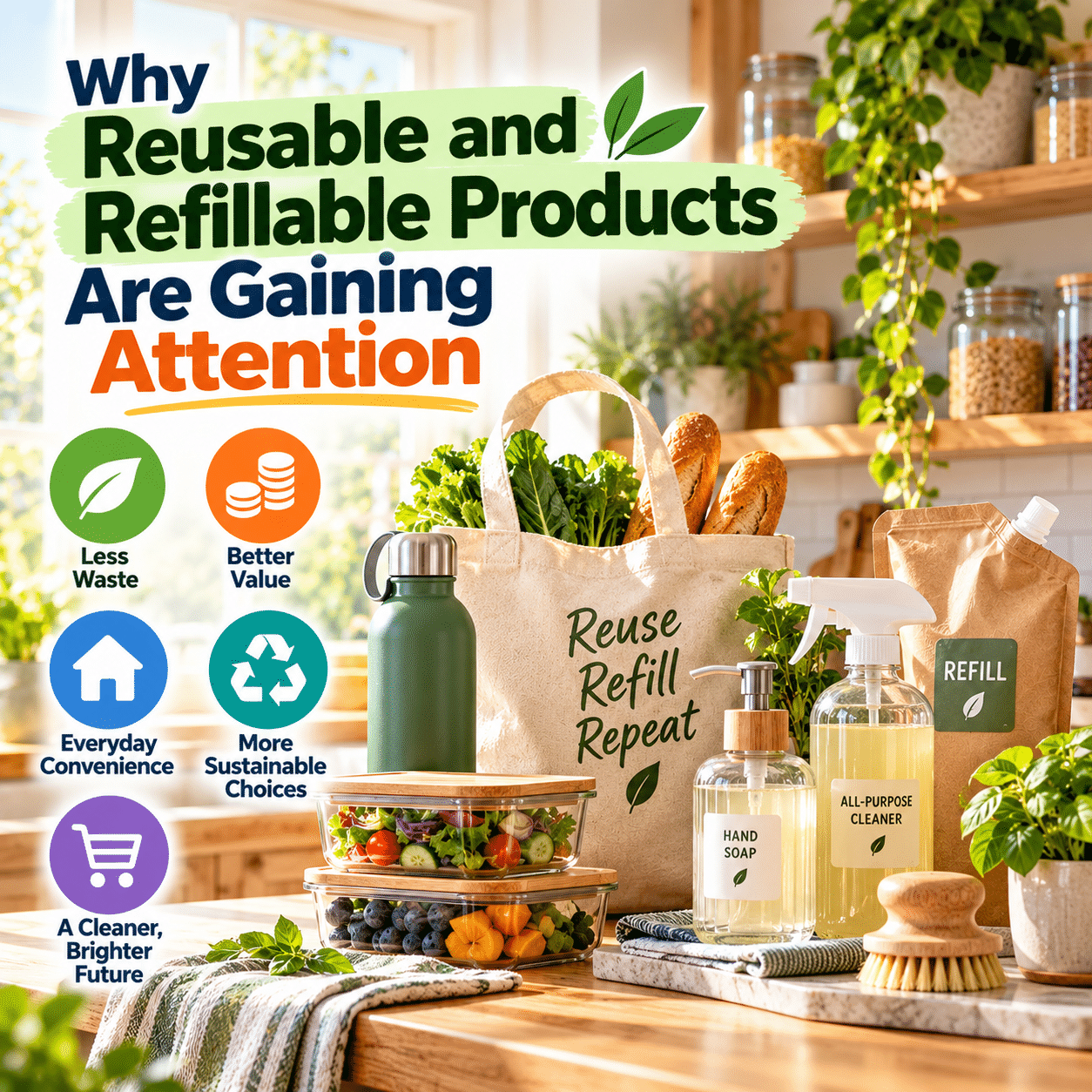
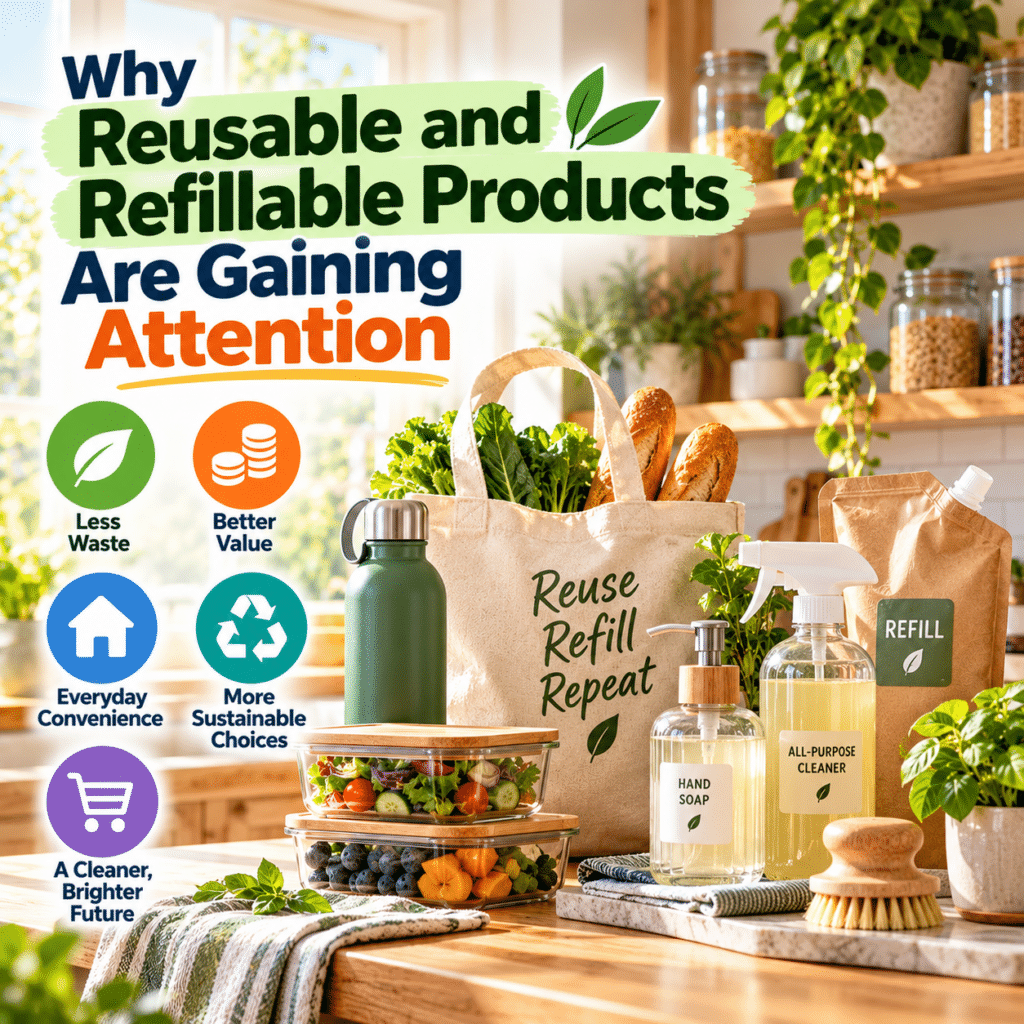
Reusable shopping bags, refillable cleaning bottles, durable food containers, concentrated household products, and refillable personal-care packaging are becoming more visible across different areas of everyday life.
Their appeal extends beyond environmental concerns. Many people appreciate the potential convenience of keeping familiar containers, reducing unnecessary packaging, organizing household supplies, and developing more predictable purchasing routines.
For businesses, reusable and refillable formats offer opportunities to rethink packaging, customer relationships, and product delivery. For consumers, they introduce new choices about durability, cost, hygiene, convenience, and long-term practicality.
However, reusable does not automatically mean environmentally superior, and refillable does not always mean less expensive. The real benefits depend on how products are manufactured, transported, cleaned, refilled, and eventually disposed of.
A reusable container that is rarely used may offer little advantage over a suitable single-use alternative. A refill system that requires excessive transportation or complicated maintenance may create different trade-offs.
Understanding these details helps consumers move beyond marketing claims and evaluate which products genuinely fit their needs.
This guide explores why reusable and refillable products are gaining attention, how they work, their potential advantages and limitations, and how to make thoughtful choices that support convenience, value, and responsible consumption.
1. What Are Reusable and Refillable Products?
Reusable and refillable products are related concepts, but they are not identical.
A reusable product is designed to perform its intended function multiple times rather than being discarded after one use.
Examples include:
- Reusable shopping bags.
- Durable food storage containers.
- Reusable water bottles.
- Washable cleaning cloths.
- Reusable lunch containers.
- Durable travel cups.
- Rechargeable household devices.
A refillable product is designed so that its contents can be replenished while the main container or dispensing system remains in use.
Examples include:
- Refillable hand soap dispensers.
- Cleaning spray bottles used with refill concentrates.
- Refillable shampoo containers.
- Refillable cosmetic packaging.
- Reusable beverage containers filled at suitable stations.
- Household dispensers supplied by bulk refills.
Some products are both reusable and refillable.
A durable water bottle, for example, can be refilled many times and reused for years when maintained properly.
The distinction matters because the environmental and economic performance of each product depends on its design and use.
2. Why People Are Reconsidering Single-Use Products
Single-use products can provide important benefits, including hygiene, portability, convenience, and controlled packaging.
They are particularly valuable in certain medical, food-safety, and other applications where reuse may be impractical or unsafe.
However, many everyday products also create packaging waste that households must manage repeatedly.
Consumers are increasingly exposed to questions about:
- Packaging disposal.
- Material consumption.
- Household waste.
- Product durability.
- Long-term purchasing costs.
- Storage efficiency.
- Recycling limitations.
- Resource use.
Reusable and refillable formats offer alternatives in situations where repeated use is practical.
The Appeal of Reducing Repetition
Purchasing a new dispenser every time a product runs out can feel unnecessary when the existing container remains functional.
Refill systems attempt to separate the consumable contents from the durable packaging.
The Appeal of More Durable Products
Some consumers prefer purchasing a well-made item that can be used repeatedly rather than replacing a disposable equivalent.
The Appeal of Simpler Household Routines
Keeping a consistent set of containers may make storage and organization easier.
These preferences do not mean that every disposable product should be eliminated.
The more useful question is where reuse provides a genuine advantage without compromising safety, hygiene, or convenience.
3. The Difference Between Reuse, Refill, Recycling, and Reduction
These terms are often grouped together, but they describe different approaches to managing materials.
Reuse
Reuse involves using a product or container again for its intended purpose, or another appropriate purpose, without necessarily transforming its material.
A durable shopping bag used repeatedly is an example.
Refill
Refill involves replenishing a container or dispensing system with new contents.
A hand soap dispenser filled from a compatible refill package is an example.
Recycling
Recycling involves collecting and processing materials into feedstock for new products.
The original product generally loses its existing form during this process.
Reduction
Reduction focuses on avoiding unnecessary material use or consumption in the first place.
Choosing an appropriately sized product or avoiding unnecessary packaging may support this goal.
Why the Differences Matter
A recyclable container is not necessarily reusable.
A refill pouch is not necessarily recyclable.
A reusable item may still require significant resources to manufacture.
A refillable system may reduce certain packaging materials while introducing other impacts.
These approaches can complement one another, but they should not be treated as interchangeable.
4. Why Refillable Packaging Is Appealing to Modern Households
Refillable packaging can make sense when a product is used frequently and its container remains in good condition.
Consider a household that regularly purchases liquid hand soap.
Instead of replacing the entire dispenser each time, the household may choose a durable dispenser and purchase compatible refills.
This approach can provide several practical advantages.
Familiar Containers
A preferred dispenser can remain part of the household’s routine.
Consistent Organization
Matching containers can create a more uniform appearance in bathrooms, kitchens, and laundry areas.
Potential Packaging Reduction
Some refill formats use less packaging material than equivalent quantities sold in new rigid containers.
The actual difference depends on packaging design and the amount of product delivered.
Convenient Stock Management
Larger refill packages may reduce the frequency of purchasing individual dispensers.
Flexible Product Formats
Refills may be available as liquids, concentrates, tablets, powders, or other forms.
However, the convenience of a refill system depends on compatibility, availability, cleaning requirements, and ease of use.
A refill process that is messy or unreliable may not be suitable for every household.
5. The Role of Reusable Products in Everyday Convenience
Reusable products are sometimes presented primarily as environmental choices.
Yet their practical value can be equally important.
A reusable shopping bag can be kept near the front door or in a vehicle.
A durable lunch container can become part of a daily meal-preparation routine.
A reusable water bottle can provide convenient access to drinking water where safe refill sources are available.
Convenience Through Familiarity
Using the same item repeatedly can reduce the need to choose or purchase a replacement each time.
Convenience Through Durability
A well-designed product may withstand repeated handling and cleaning.
Convenience Through Organization
Standardized containers can make cabinets, drawers, and shelves easier to arrange.
Convenience Through Portability
Reusable products designed for travel may include leak-resistant closures, compact shapes, or easy-carry features.
However, reusable items also require cleaning, storage, and remembering to bring them when needed.
The best products make these responsibilities manageable.
6. Refillable Cleaning Products and Household Maintenance
Cleaning products are one of the most visible applications of refillable packaging.
Many households regularly use surface cleaners, dishwashing liquids, and other cleaning solutions.
Refill formats may include:
- Ready-to-use liquid refills.
- Concentrated liquid refills.
- Dissolvable cleaning tablets.
- Powdered cleaning formulations.
- Bulk dispensing systems.
- Manufacturer-specific refill cartridges.
Why Concentrates Attract Interest
Some concentrates contain less water than ready-to-use products.
This can reduce the amount of liquid transported for an equivalent amount of prepared solution.
However, the complete environmental impact also depends on formulation, packaging, transportation, and use.
Compatibility Is Essential
Cleaning concentrates must be diluted according to manufacturer instructions.
Using an incorrect concentration may reduce effectiveness, damage surfaces, or create safety risks.
Never Mix Incompatible Chemicals
Household cleaners should not be combined unless the manufacturer explicitly permits it.
Mixing bleach with acids or ammonia-containing products, for example, can release hazardous gases.
Label Refilled Containers
Containers should clearly identify their contents and any necessary safety information.
Never transfer household cleaning chemicals into food or beverage containers.
Refillable cleaning systems can be useful, but safe handling and accurate instructions are essential.
7. Refillable Personal-Care Products
Personal-care products are another category where refillable packaging is receiving attention.
Examples include:
- Hand soap.
- Shampoo.
- Conditioner.
- Body wash.
- Certain lotions.
- Selected cosmetic products.
- Some deodorant formats.
These products may use durable outer packaging combined with replaceable inner cartridges or refill containers.
Potential Advantages
A refillable format may reduce the need to purchase a new outer container each time.
It can also allow consumers to keep packaging they find attractive or convenient.
Hygiene Considerations
Personal-care products can be vulnerable to contamination if containers are handled improperly.
Water, residue, and repeated contact with unclean surfaces may introduce microorganisms.
Follow Product-Specific Instructions
Some manufacturers design containers for direct refilling.
Others require replacing a sealed cartridge.
These approaches should not be treated as equivalent.
Avoid Improvised Refilling
Refilling a container not designed for reuse may compromise product stability, hygiene, or dispensing performance.
For products such as sunscreen, sterile preparations, or other formulations where packaging integrity is particularly important, follow the manufacturer’s directions rather than transferring contents into arbitrary containers.
Refillable personal care is most practical when the product and packaging are designed to work together safely.
8. Reusable Food Storage Containers
Food storage is one of the most familiar areas of household reuse.
Durable containers can support meal preparation, leftover storage, and transporting food.
Common materials include:
- Glass.
- Stainless steel.
- Food-contact-approved plastics.
- Silicone components.
- Other materials designed for repeated food contact.
Each material has different characteristics.
Glass Containers
Glass can be useful for food storage and is generally easy to clean.
However, it is heavier than many alternatives and can break.
Not every glass container is suitable for ovens, freezers, or sudden temperature changes.
Stainless Steel Containers
Stainless steel can be durable and resistant to breakage.
However, ordinary metal containers are not suitable for microwave use unless specifically designed and approved for that purpose.
Plastic Containers
Suitable food-grade plastic containers can be lightweight and convenient.
Their heat resistance, durability, and intended uses vary.
Silicone Components
Silicone lids and seals may improve flexibility or closure performance.
Material quality and product design matter.
Food Safety Remains Essential
Reusable containers should be cleaned thoroughly and used within their specified temperature and food-contact limits.
Damaged containers, deteriorated seals, or surfaces that cannot be cleaned adequately may need replacement.
A reusable container is valuable only when it remains safe and functional.
9. Reusable Water Bottles and Travel Cups
Reusable beverage containers are among the most recognizable examples of products designed for repeated use.
They are available in different materials, capacities, shapes, and insulation styles.
Practical Benefits
A suitable reusable bottle can provide convenient access to drinking water.
An insulated travel cup may help maintain beverage temperature for a period of time.
A durable container may reduce repeated purchases of disposable beverage packaging when safe refill options are available.
Choosing the Right Design
Consider:
- Ease of cleaning.
- Lid construction.
- Leak resistance.
- Weight.
- Durability.
- Material suitability.
- Replacement part availability.
- Intended beverage temperature.
Cleaning Is Important
Bottles, lids, seals, and drinking spouts can accumulate residue and microorganisms.
Clean them according to manufacturer instructions.
Insulation Has Trade-Offs
Double-wall insulated containers may be heavier and more expensive than simpler designs.
Their usefulness depends on how the container will be used.
The most practical reusable bottle is one that fits daily routines and can be maintained properly.
10. Reusable Shopping Bags and Everyday Carry Items
Reusable shopping bags are widely associated with efforts to reduce disposable bag use.
They can be made from cotton, woven synthetic materials, nonwoven fabrics, or other durable materials.
Durability Matters
A bag intended for repeated use should withstand normal loads and handling.
Portability Matters
A foldable bag may be easier to carry regularly than a bulky alternative.
Cleaning Matters
Bags used for groceries may become contaminated by food residues or spills.
Wash or clean them according to material and manufacturer guidance.
Use Frequency Matters
Different bag materials have different manufacturing impacts.
A heavier reusable bag may require more uses to offset certain impacts compared with a lightweight single-use bag.
There is no universal number of uses that applies to every material, environmental indicator, and disposal scenario.
Practical Habits
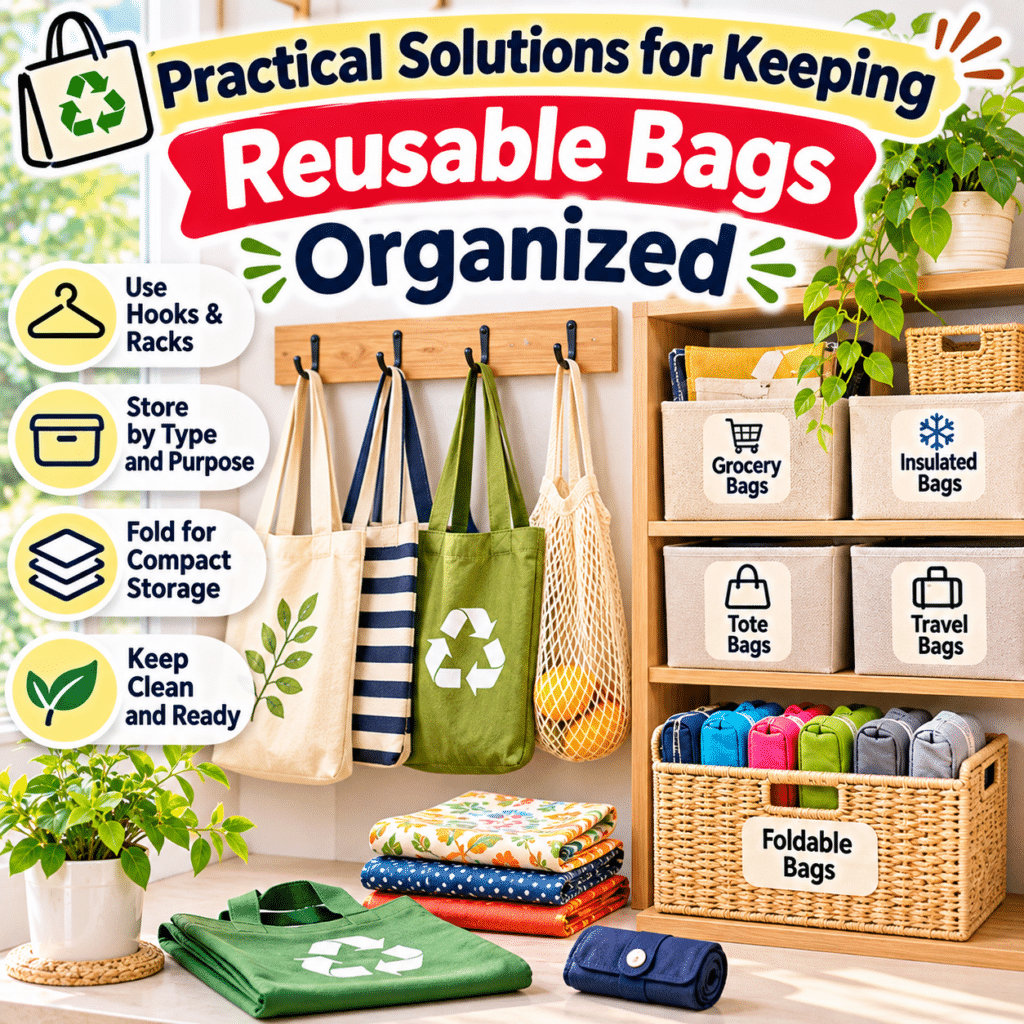
Keeping reusable bags in a consistent location can make them easier to remember.
A reusable bag that is repeatedly forgotten provides little practical benefit.
The environmental and convenience advantages depend heavily on actual use.
11. Refillable Products and Modern Home Organization
Reusable and refillable products can influence how household supplies are stored and displayed.
Instead of accumulating many differently shaped packages, some households prefer standardized dispensers and storage containers.
Consistent Visual Design
Matching containers can create a more cohesive appearance.
Easier Inventory Checks
Transparent or clearly labeled containers may make it easier to see when supplies are running low.
Reduced Packaging Clutter
Some refill systems allow households to store fewer rigid containers.
More Predictable Storage
A consistent set of containers may fit shelves and cabinets more efficiently.
Important Limitations
Transferring products into decorative containers can create identification and safety problems.
Cleaning chemicals, personal-care formulations, and food products have different storage requirements.
Original labels may contain essential information about ingredients, hazards, expiration dates, and safe use.
Home organization should never come at the expense of product identification or safety.
12. How Refill Stations Work
Refill stations allow consumers to obtain products using reusable containers or other approved dispensing arrangements.
They may be found in certain retail stores, specialty shops, or organized distribution systems.
A Typical Refill Process
Depending on the system, a customer may:
- Bring an approved clean container.
- Have the container checked or weighed.
- Select the product.
- Dispense the required quantity.
- Receive appropriate labeling or product information.
- Pay according to the store’s pricing method.
Some systems provide standardized reusable containers instead of allowing customers to bring their own.
Potential Advantages
Refill stations may reduce certain forms of disposable packaging.
They can also allow customers to purchase quantities suited to their needs.
Practical Challenges
Availability may be limited.
Travel distance can affect convenience and environmental performance.
Hygiene procedures must be appropriate for the product.
Dispensing equipment requires maintenance.
Product-Specific Rules
Food, cosmetics, and household chemicals may be subject to different regulations and hygiene requirements.
A refill station should follow applicable rules rather than relying solely on the assumption that reuse is beneficial.
13. The Economics of Reusable and Refillable Products
Reusable products often involve a different cost structure from disposable alternatives.
The initial purchase price may be higher, while repeated use may reduce certain replacement expenses.
Refillable systems may also require purchasing a durable container before buying refills.
Initial Cost
A reusable bottle, dispenser, or storage container may cost more than a single disposable equivalent.
Ongoing Cost
Refills, cleaning supplies, replacement parts, and maintenance can contribute to operating expenses.
Cost Per Use
A useful comparison is:
Cost per use = Total ownership cost ÷ Number of actual uses
For example, a reusable item costing $20 and used 200 times has an initial purchase cost of $0.10 per use.
This illustrative calculation excludes cleaning, maintenance, and replacement expenses.
Refill Cost Comparison
Compare refill products using a consistent unit, such as cost per liter or cost per 100 milliliters of prepared product.
For concentrates, account for the amount of usable product produced after correct dilution.
Avoid Assuming Refills Are Always Cheaper
Some refills cost more per unit than conventional packaging.
Price depends on product formulation, brand, distribution, packaging, and market conditions.
The most reliable approach is to compare total costs over a realistic period of use.
14. Understanding the Environmental Impact of Reuse
Reusable products are often promoted as environmentally preferable because they can reduce the need for repeated manufacturing and disposal.
However, environmental performance depends on the complete product life cycle.
Manufacturing
Durable products may require more materials or energy to produce than lightweight disposable alternatives.
Transportation
Product weight, shipping distance, and distribution methods influence transportation impacts.
Use
Cleaning, heating water, electricity, and maintenance can contribute to ongoing environmental impacts.
Lifespan
A reusable item generally needs to be used enough times for its durability to provide meaningful value.
End of Life
Recycling, disposal, repairability, and material recovery also matter.
Life-Cycle Assessment
Life-cycle assessment, or LCA, is a method used to evaluate environmental impacts across defined stages of a product’s life.
Different assessments may examine greenhouse gas emissions, water use, energy demand, or other environmental indicators.
A product can perform well on one indicator and less favorably on another.
Therefore, broad claims that all reusable products are better for the environment are not sufficiently precise.
The strongest conclusions come from comparisons with clearly defined assumptions and realistic use patterns.
15. Why Reuse Frequency Matters
A reusable product only provides its intended repeated-use benefits when it is actually used repeatedly.
This may seem obvious, but it is one of the most important factors in evaluating reusable products.
A Durable Item Used Once
If a reusable bag is purchased but rarely used, its manufacturing impacts may not be offset by avoided disposable bags.
A Durable Item Used Regularly
Repeated use spreads the initial manufacturing impact across more uses.
Cleaning Requirements
The environmental cost of washing can influence the comparison.
Replacement Frequency
A product that breaks quickly may provide less value than a durable alternative.
Practical Design
Products that are comfortable, convenient, and easy to maintain are more likely to be used consistently.
This suggests an important purchasing principle:
Choose reusable products that fit existing habits well enough to become part of everyday life.
A product’s actual use is more important than its marketing promise.
16. Refill Packaging: Less Material Does Not Always Mean Less Impact
Some refill packages use less material than the original container.
For example, a flexible refill pouch may weigh less than a rigid bottle.
However, packaging weight is only one part of environmental performance.
Material Composition
Multi-layer packaging may be difficult to recycle in some locations.
Product Concentration
Concentrated products can reduce the amount of water transported, but they must be evaluated according to formulation and use.
Transportation
Packaging shape and weight influence shipping efficiency.
Product Protection
Packaging must protect the contents from contamination, leakage, and deterioration.
Disposal Infrastructure
A package described as recyclable may not be accepted by local recycling facilities.
Overall Performance
The most appropriate comparison considers the full product system, including manufacturing, transportation, use, and end-of-life treatment.
A refill format may provide real advantages without being superior in every environmental category.
17. Hygiene and Safety in Refillable Systems
Refillable products introduce responsibilities that may not be as visible with sealed single-use packaging.
Containers can accumulate residue, moisture, or microorganisms.
The appropriate cleaning method depends on the product.
Food and Beverage Containers
Use containers suitable for food contact.
Clean and dry them as directed.
Personal-Care Containers
Follow manufacturer instructions for refilling and hygiene.
Do not assume that every dispenser can be safely refilled indefinitely.
Household Cleaning Containers
Maintain accurate labels and avoid mixing incompatible formulations.
Bulk Refill Stations
Use approved containers and follow store procedures.
Product Stability
Some formulations rely on specific packaging to maintain stability, prevent contamination, or control dispensing.
Transferring them into another container may compromise performance.
When Not to Refill
Do not reuse containers that are damaged, difficult to clean, chemically incompatible, or specifically designated for single use.
Hygiene and safety should always take priority over packaging reduction.
18. Choosing Materials for Reusable Products
Material selection influences durability, weight, cleaning, and suitability.
| Material | Common applications | Important considerations |
|---|---|---|
| Glass | Food containers, bottles, dispensers | Easy to clean but heavier and breakable |
| Stainless steel | Bottles, lunch containers, travel cups | Durable; check compatibility with intended use |
| Food-contact-approved plastic | Storage containers, bottles | Lightweight; temperature and wear limits vary |
| Silicone | Lids, seals, selected reusable accessories | Flexible; quality and heat limits vary |
| Cotton fabric | Shopping bags, cleaning cloths | Washable; production and laundering impacts matter |
| Synthetic fabric | Foldable bags, reusable accessories | Lightweight and durable; material shedding and disposal considerations |
| Ceramic | Dispensers, storage containers | Attractive but potentially fragile |
| Aluminum | Selected bottles and containers | Lightweight; coatings and product construction matter |
No material is ideal for every application.
The best choice depends on intended use, durability, safety, maintenance, and the number of expected uses.
19. Reusable Products and the Problem of Overconsumption
An important contradiction can arise when reusable products become fashionable.
Consumers may purchase multiple reusable bottles, bags, containers, or dispensers even when existing items remain functional.
This can undermine the intended benefits of reuse.
Reusable Does Not Mean Unlimited Consumption
A durable product still requires resources to manufacture.
Avoid Replacing Functional Items Unnecessarily
If an existing container is safe and suitable, replacing it solely for appearance may provide little practical benefit.
Choose Versatile Designs
Products that work across multiple situations may reduce the need for specialized alternatives.
Prioritize Durability
A well-made item that remains useful for years may be preferable to repeatedly purchasing inexpensive replacements.
Consider Repairability
Replaceable lids, seals, and other components can extend product life.
Responsible consumption is not about owning the largest collection of reusable products.
It is about making good use of the items already available.
20. Refillable Products and Product Design Innovation
Refill systems require manufacturers to think differently about packaging.
Traditional packaging is often designed to contain, protect, transport, display, and dispense a product before being discarded.
Refillable systems separate some of these functions.
Durable Outer Packaging
A container may be designed for repeated handling and long-term use.
Replaceable Inner Components
Some products use cartridges or inserts that can be replaced without discarding the outer shell.
Concentrated Refills
Some formulations are supplied in smaller packages and diluted before use.
Modular Design
Components may be designed for replacement, cleaning, or repair.
Standardized Dispensing
A refill system may use compatible containers or dispensing equipment.
Design Challenges
Manufacturers must consider contamination, leakage, compatibility, user error, cost, and supply availability.
A refillable design is successful only when it remains convenient, safe, and reliable throughout repeated use.
21. The Role of Businesses in Refill Systems
Reusable and refillable models require coordination beyond the consumer.
Manufacturers, retailers, distributors, and service providers may all influence the system.
Manufacturers
They design packaging, formulations, and compatibility requirements.
Retailers
They may provide refill stations, replacement cartridges, or bulk products.
Logistics Providers
They transport products, packaging, and sometimes returned containers.
Cleaning and Processing Facilities
Some returnable packaging systems require industrial cleaning and inspection.
Consumers
They use, maintain, return, or refill containers according to the system.
Why System Design Matters
A returnable container program may perform differently depending on collection rates, transportation distances, washing processes, and container durability.
A successful reuse system requires more than a durable container.
It requires a practical process that people can use consistently.
22. Refill-at-Home Versus Return-and-Reuse Systems
Two common approaches to reusable packaging are home refilling and returnable packaging.
Refill-at-Home
Consumers keep a container and replenish it using compatible refill products.
Examples include hand soap dispensers and cleaning spray bottles.
Advantages: Convenient for products used regularly; may reduce repeated purchases of rigid containers.
Challenges: Requires suitable refills, correct handling, and cleaning.
Return-and-Reuse
Consumers return empty containers to a collection point.
The containers are inspected, cleaned, and prepared for another use cycle when appropriate.
Advantages: Professional cleaning and standardized packaging may support repeated circulation.
Challenges: Requires collection infrastructure, logistics, and reliable return participation.
Which Is Better?
Neither model is universally superior.
Performance depends on product type, infrastructure, transportation, cleaning, and user behavior.
The most practical system is one that works reliably within the local context.
23. How Refillable Products Can Support Better Household Planning
Refillable products can encourage households to think about supply management more systematically.
Tracking Consumption
Regularly used products have relatively predictable replacement patterns.
Purchasing Appropriate Quantities
Refills may be available in different sizes, allowing households to select quantities suited to their needs.
Reducing Emergency Purchases
Keeping a reasonable reserve can help avoid running out unexpectedly.
Avoiding Excessive Stockpiling
Buying too much can create storage problems or lead to products expiring before use.
Organizing Supplies
Clearly labeled containers and designated storage areas can make household routines more efficient.
Monitoring Product Condition
Reusable dispensers and containers should be inspected for damage, leaks, and cleanliness.
The goal is not to build an elaborate inventory system.
It is to make everyday household management more predictable and convenient.
24. Common Misconceptions About Reusable and Refillable Products
Several assumptions can lead to unrealistic expectations.
Misconception 1: Reusable Products Are Always Better for the Environment
Actual impacts depend on manufacturing, use frequency, cleaning, transportation, and disposal.
Misconception 2: Refills Are Always Cheaper
Some refill products have higher unit prices than conventional alternatives.
Misconception 3: Every Container Can Be Refilled Safely
Compatibility, hygiene, and product stability matter.
Misconception 4: Recyclable and Reusable Mean the Same Thing
Recycling involves material processing, while reuse involves repeated use of an item.
Misconception 5: Concentrated Products Are Automatically More Sustainable
Concentration can reduce certain transportation or packaging requirements, but overall performance depends on the complete product system.
Misconception 6: Reusable Products Require No Maintenance
Cleaning, inspection, and replacement of worn components are often necessary.
Misconception 7: Buying More Reusable Products Is Always Responsible
Unnecessary purchases still consume resources.
Understanding these distinctions supports more informed purchasing decisions.
25. How to Evaluate a Refillable Product Before Buying
A practical evaluation begins with the product’s intended use.
Step 1: Identify the Refill Method
Does the product use a liquid refill, concentrate, cartridge, tablet, or bulk dispensing system?
Step 2: Check Compatibility
Confirm that the refill is intended for the container or device.
Step 3: Review Cleaning Requirements
Determine whether the container can be cleaned and maintained appropriately.
Step 4: Compare Unit Costs
Calculate the cost of the usable product, including any required dilution.
Step 5: Check Refill Availability
A durable container provides limited convenience if compatible refills are difficult to obtain.
Step 6: Consider Packaging
Evaluate the refill packaging without assuming that lighter packaging is always environmentally superior.
Step 7: Review Safety Instructions
Follow all labeling, storage, and handling requirements.
Step 8: Consider Long-Term Use
Ask whether the system will remain convenient after repeated refills.
The best refillable product is one that performs reliably and fits ordinary household routines.
26. How to Evaluate a Reusable Product Before Buying
Reusable products should be assessed according to expected use rather than appearance alone.
Durability
Can the product withstand repeated use under normal conditions?
Functionality
Does it perform its intended purpose effectively?
Cleaning
Can it be cleaned easily and safely?
Portability
Is it convenient to carry or store?
Repairability
Are replacement parts available?
Material Suitability
Is the material appropriate for food, beverages, heat, chemicals, or other intended uses?
Expected Frequency of Use
Will the product be used often enough to justify its purchase?
End-of-Life Options
Can components be repaired, reused, recycled, or disposed of appropriately?
A practical product that is used consistently is generally more valuable than an attractive item that remains unused.
27. Starting With Small, Practical Changes
Adopting reusable and refillable products does not require replacing everything in a household.
A gradual approach is often more economical and manageable.
Begin With Frequently Used Items
Identify products purchased or discarded regularly.
Use Existing Containers When Appropriate
If a container is designed for reuse and remains safe, there may be no need to replace it.
Try One Refill System
Choose a product with clear instructions and readily available refills.
Evaluate Convenience
Consider whether the new routine is easier, equally convenient, or more complicated.
Track Actual Costs
Compare spending over time rather than assuming savings.
Maintain Products Properly
Clean, inspect, and store reusable items according to their requirements.
Expand Selectively
Adopt additional products only when they offer meaningful benefits.
Small changes that become lasting habits are often more practical than an ambitious overhaul that is difficult to maintain.
28. Challenges That Can Limit Adoption
Despite their appeal, reusable and refillable products face several barriers.
Limited Availability
Compatible refills or refill stations may not be accessible in every area.
Higher Initial Costs
Durable containers and specialized systems may require greater upfront spending.
Inconvenient Cleaning
Some designs contain narrow openings or complex components that are difficult to maintain.
Compatibility Restrictions
Proprietary cartridges or refills may limit consumer choice.
Storage Requirements
Bulk refills can require additional storage space.
Hygiene Concerns
Improper cleaning or refilling may introduce contamination.
Consumer Habits
Remembering reusable items and maintaining refill routines requires consistency.
Unclear Environmental Claims
Consumers may struggle to compare products when manufacturers provide incomplete information.
Addressing these barriers is essential for making reusable systems genuinely practical.
29. The Future of Reusable and Refillable Products
Reusable and refillable products may continue to develop as manufacturers and consumers explore alternatives to conventional packaging.
Several directions are worth watching.
More Convenient Refill Formats
Concentrates, cartridges, and modular packaging may offer different ways to replenish products.
Better Container Durability
Design improvements may extend the useful life of reusable packaging.
More Standardized Systems
Compatible packaging formats could make some refill systems easier to use across different products or retailers.
Improved Cleaning and Return Logistics
Returnable packaging systems may benefit from more efficient collection and processing.
Greater Product Transparency
Clearer information about materials, refill compatibility, and environmental performance could help consumers make informed decisions.
More Thoughtful Packaging Design
Manufacturers may increasingly consider repeated use, repairability, and end-of-life handling during product development.
These are possible directions rather than guaranteed outcomes.
The success of any system will depend on affordability, convenience, safety, infrastructure, and actual consumer participation.
30. Finding the Right Balance Between Convenience and Responsible Consumption
Reusable and refillable products are most valuable when they work well in everyday life.
A system that is difficult to clean, inconvenient to refill, or expensive to maintain may not provide the intended benefits.
Likewise, a durable product that is rarely used may not justify the resources required to manufacture it.
The most practical approach is to evaluate products according to several questions:
- Does this product solve a real need?
- Will it be used repeatedly?
- Is it safe and easy to maintain?
- Are refills or replacement parts accessible?
- Is the total cost reasonable?
- Does the product reduce unnecessary purchases or waste?
- Are environmental claims supported by meaningful information?
These questions encourage thoughtful decisions without treating reusable products as automatically superior.
Responsible consumption does not require perfection.
It requires understanding trade-offs and choosing options that remain practical over time.
Frequently Asked Questions About Reusable and Refillable Products
1. Why are reusable and refillable products becoming more popular?
Reusable and refillable products attract attention because they can offer alternatives to repeatedly purchasing disposable items and packaging. Depending on the product, they may support convenience, household organization, cost management, and reduced material consumption. Their actual benefits depend on design, use frequency, maintenance, and the complete product system.
2. Are refillable products always better for the environment?
No. Refillable systems can reduce certain packaging requirements, but their environmental performance depends on materials, transportation, cleaning, refill frequency, and disposal. A complete life-cycle comparison is more informative than packaging weight alone.
3. Are refill products cheaper than buying new containers?
Sometimes, but not always. Refills may offer lower unit costs, especially when sold in larger quantities or concentrated formats. However, some cost more than conventional alternatives. Compare the total cost of the usable product, including containers, maintenance, and any required dilution.
4. Is it safe to refill any plastic bottle or dispenser?
No. Containers should only be refilled when they are suitable for the intended product and use. Material compatibility, hygiene, labeling, and product stability are important. Follow manufacturer instructions and avoid reusing containers that are damaged or designated for single use.
5. What reusable products are easiest to introduce into daily life?
Reusable shopping bags, suitable water bottles, durable food storage containers, and washable cleaning cloths are common starting points. The best option depends on existing habits and whether the item can be cleaned and used consistently.
6. What is the difference between reusable and recyclable packaging?
Reusable packaging is intended to be used multiple times while retaining its functional form. Recyclable packaging is designed to be processed into materials for new products where suitable recycling systems exist. A product may be reusable, recyclable, both, or neither.
7. How can I tell whether a reusable product is worth buying?
Consider durability, expected frequency of use, cleaning requirements, total cost, material suitability, and replacement part availability. A reusable product is most worthwhile when it performs reliably and becomes part of an established routine rather than remaining unused.
Conclusion: Rethinking Everyday Products Through Reuse and Refill
Reusable and refillable products are gaining attention because they offer a different way to approach familiar household needs.
Instead of treating every container or accessory as something to replace after a single use, these products encourage consumers to consider durability, repeated use, and more thoughtful purchasing routines.
Their potential advantages are practical as well as environmental.
A durable food container can simplify meal preparation. A refillable soap dispenser can support consistent bathroom organization. A reusable water bottle can provide everyday convenience. A compatible cleaning concentrate may reduce the need to purchase a new spray bottle each time.
However, these benefits are not automatic.
Reusable products require sufficient use to justify their manufacture. Refillable systems must be safe, convenient, and properly maintained. Environmental performance depends on the complete life cycle, while financial value depends on actual costs and purchasing habits.
The most effective approach is not to replace every disposable item immediately.
It is to identify everyday products where reuse or refilling offers a meaningful improvement, choose durable and appropriate designs, and maintain them responsibly.
Over time, these decisions can support a more intentional relationship with the products used at home.
The real value of reusable and refillable products is not simply that they can be used again. It is that thoughtful design and consistent use can make everyday consumption more practical, efficient, and responsible.