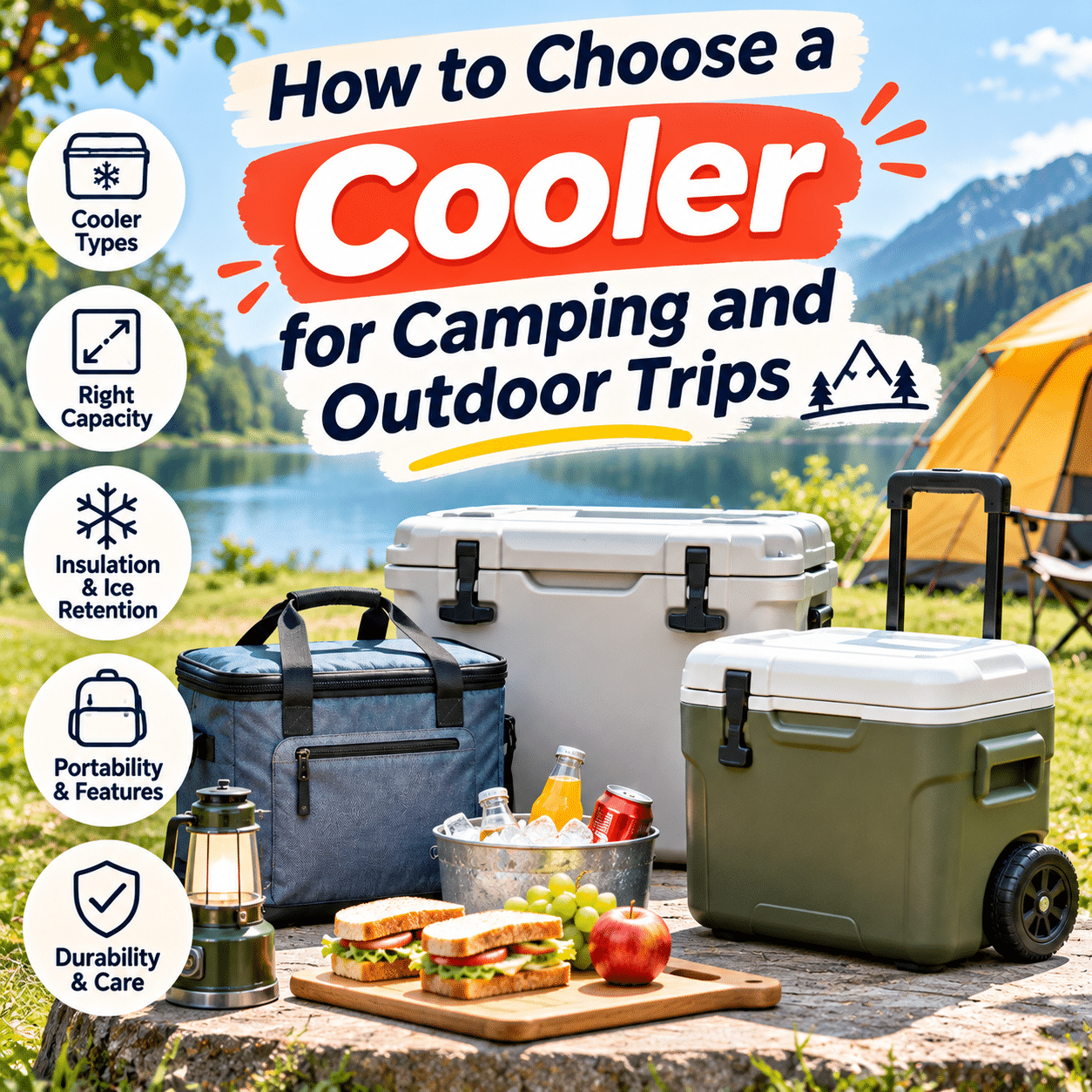
A reliable cooler can make camping, road trips, picnics, beach outings, and other outdoor adventures more comfortable and enjoyable. Whether you need to keep beverages refreshing, protect perishable food, or transport ingredients for an outdoor meal, the right cooler helps maintain suitable temperatures while making food and drink storage more convenient.
However, choosing a cooler involves more than finding a container large enough to hold your supplies. Coolers differ significantly in insulation performance, construction materials, portability, storage capacity, cooling methods, durability, and ease of maintenance.
A compact soft-sided cooler may be ideal for a short picnic, while a heavily insulated hard-sided cooler may be more practical for a multi-day camping trip. Travelers with access to vehicle power may prefer an electric cooler, while backpackers may prioritize lightweight and flexible designs.
Understanding these differences helps you choose a cooler that matches your outdoor activities without adding unnecessary weight, expense, or complexity.
This comprehensive buying guide explains how to choose a cooler for camping and outdoor trips, compare different cooler types, evaluate insulation and cooling performance, understand important features, and maintain your cooler for reliable long-term use.
1. Understand Your Outdoor Cooling Needs
Before comparing cooler models, identify how you plan to use the cooler.
The best choice depends on several practical factors:
- Type of outdoor activity
- Trip duration
- Number of people
- Food and beverage requirements
- Expected outdoor temperatures
- Availability of ice or electricity
- Transportation method
- Available storage space
- Frequency of use
- Physical carrying requirements
A cooler designed for a family camping trip may be unnecessarily large for a solo day hike.
Similarly, a lightweight picnic cooler may not provide enough capacity or insulation for several days at a remote campsite.
Questions to Ask Before Buying
Consider the following:
- Will I use the cooler mainly for camping, picnics, beach trips, fishing, or road travel?
- How long will I need to keep food and drinks cold?
- How many people will share the cooler?
- Will I transport it by car, boat, or on foot?
- Will I have access to replacement ice?
- Do I need refrigeration or actual freezing capability?
- How much space is available in my vehicle or campsite?
- Will the cooler be exposed to direct sunlight or high temperatures?
- Do I need to carry it over uneven terrain?
- How frequently will I use it?
Answering these questions creates a practical foundation for choosing the right cooler.
2. Understand the Main Types of Outdoor Coolers
Outdoor coolers are available in several major categories.
Each design offers different advantages and limitations.
| Cooler Type | Main Advantages | Potential Limitations | Common Uses |
|---|---|---|---|
| Hard-sided cooler | Durable, structured, often strong insulation | Can be heavy and bulky | Camping, fishing, road trips |
| Soft-sided cooler | Lightweight, flexible, easy to carry | Often less insulation capacity | Picnics, beach outings, short trips |
| Backpack cooler | Hands-free transportation | Limited capacity and carrying comfort | Hiking, parks, walking excursions |
| Wheeled cooler | Easier movement over suitable surfaces | Wheels may struggle on rough terrain | Family outings, campgrounds |
| Electric thermoelectric cooler | Powered cooling without loose ice | Cooling depends on ambient conditions | Vehicle travel |
| Compressor cooler | Can provide controlled refrigeration and freezing | Requires power, higher cost and weight | Extended road trips, vehicle camping |
| Passive insulated bag | Compact and convenient | Limited cooling duration | Lunches, short outings |
No single cooler type is ideal for every outdoor situation.
The most appropriate choice depends on your mobility requirements, cooling needs, and available resources.
3. Choose Between Hard-Sided and Soft-Sided Coolers
One of the first major decisions is whether to choose a hard-sided or soft-sided cooler.
Hard-Sided Coolers
Hard-sided coolers use rigid exterior shells, commonly made from molded plastics.
They are often designed for durability and substantial insulation.
Advantages
- Strong exterior structure
- Often thicker insulation
- Suitable for larger quantities of food and beverages
- Good resistance to routine outdoor impacts
- Many models include drainage systems
- Some designs offer secure latches and reinforced handles
Potential limitations
- Heavier empty weight
- Larger storage footprint
- Less flexible for vehicle packing
- May require two people to carry when fully loaded
Hard-sided coolers are often useful for extended camping trips, fishing excursions, and vehicle-based adventures.
Soft-Sided Coolers
Soft-sided coolers use flexible insulated fabric construction.
Advantages
- Lightweight design
- Easier transportation
- Compact storage
- Convenient shoulder straps or handles
- Often suitable for short outdoor activities
Potential limitations
- Cooling performance varies widely
- Flexible walls may offer less protection
- Some designs are difficult to clean thoroughly
- Zippers and seams may be vulnerable to wear
- Not all models prevent leakage
Soft-sided coolers are often practical for picnics, beach outings, and short trips.
Hard-Sided Versus Soft-Sided Comparison
| Feature | Hard-Sided Cooler | Soft-Sided Cooler |
|---|---|---|
| Structure | Rigid | Flexible |
| Empty weight | Often heavier | Often lighter |
| Insulation | Often thicker | Varies by design |
| Portability | Depends on handles and wheels | Often easier to carry |
| Storage | Requires fixed space | Some models collapse |
| Cleaning | Often straightforward | Depends on lining |
| Impact protection | Generally stronger | More limited |
| Best suited for | Vehicle-based and longer trips | Short trips and mobile activities |
Construction quality matters more than the category alone.
A well-designed soft cooler may outperform a poorly insulated hard cooler under certain conditions.
4. Understand Cooler Capacity
Cooler capacity determines how much food, beverages, ice, and other supplies the container can accommodate.
Capacity may be expressed in:
- Liters
- Quarts
- Internal dimensions
- Approximate beverage-can counts
Why Capacity Labels Can Be Misleading
Manufacturers may calculate capacity differently.
A cooler advertised as holding a certain number of cans may assume little or no space for ice.
Other products may use specific can dimensions or packing arrangements.
For practical use, consider how much space remains after adding the ice or cooling elements required.
General Capacity Categories
| Cooler Capacity | Typical Applications |
|---|---|
| Under 10 liters | Individual lunches and very short outings |
| 10–20 liters | Small picnics and personal use |
| 20–35 liters | Day trips and small groups |
| 35–50 liters | Weekend camping and family outings |
| 50–75 liters | Longer camping trips and larger groups |
| Over 75 liters | Extended vehicle-based trips and equipment-heavy use |
These ranges are illustrative rather than standardized recommendations.
Actual requirements depend on the quantity of supplies and the cooling method.
5. Estimate the Right Cooler Size for Your Group
The number of travelers influences cooler capacity, but group size alone is not enough.
Solo Travelers
A compact cooler may accommodate drinks, snacks, and a small quantity of perishable food.
Prioritize portability and manageable weight.
Couples
A medium-small cooler may provide sufficient capacity for a day trip or overnight camping.
Consider whether you will prepare full meals or mainly carry drinks.
Small Families
Family trips may require separate space for meals, beverages, and children’s snacks.
A medium cooler can be useful, depending on trip duration.
Larger Groups
Large coolers may reduce the number of containers needed, but can become difficult to transport.
Multiple smaller coolers may offer better organization and flexibility.
Consider Separate Food and Beverage Coolers
For longer trips, separating food from beverages can reduce how frequently the food cooler is opened.
This may help limit warm-air exposure and simplify organization.
6. Match Cooler Capacity to Trip Duration
Trip duration affects both storage needs and the amount of cooling material required.
Short Outings
For picnics and brief beach visits, compact coolers may be sufficient.
Full-Day Activities
Longer day trips may require more cooling capacity, especially in hot weather.
Weekend Camping
A medium or large cooler may be useful for multiple meals and beverages.
Multi-Day Camping
Extended trips require careful planning for:
- Food quantities
- Ice availability
- Cooling duration
- Weather conditions
- Cooler opening frequency
- Food safety
Avoid Assuming Bigger Always Means Better
A larger cooler can hold more supplies, but it also requires more space and may be heavier.
If the cooler is mostly empty, unused space can reduce packing efficiency.
Choose capacity based on realistic requirements rather than maximum advertised volume.
7. Understand How Cooler Insulation Works
Passive coolers do not create cold temperatures.
Instead, they slow the transfer of heat from the surrounding environment into the cooler.
Heat Transfer Basics
Heat can enter through:
- Cooler walls
- Lid
- Seams
- Gaskets
- Openings
- Contact with warm surfaces
Insulation reduces the rate of heat transfer.
However, no conventional passive cooler can prevent warming indefinitely.
Important Insulation Factors
Cooling performance depends on:
- Insulation material
- Insulation thickness
- Lid construction
- Seal quality
- Exterior temperature
- Initial contents temperature
- Amount and condition of ice
- Frequency of opening
Understanding these factors helps explain why two coolers of similar size may perform differently.
8. Compare Common Cooler Insulation Materials
Coolers commonly use foam insulation.
Polyurethane Foam
Polyurethane foam is widely used in insulated hard-sided coolers.
It can provide effective thermal resistance when properly manufactured.
Expanded Polystyrene
Expanded polystyrene is lightweight and commonly used in economical insulated containers.
Its performance depends on thickness, density, and construction.
Polyethylene Foam
Polyethylene foam may be used in flexible insulated products.
It offers cushioning and insulation characteristics.
Reflective Insulation Layers
Some soft-sided coolers incorporate reflective materials.
These can help reduce certain forms of radiant heat transfer when used appropriately.
However, reflective layers alone do not determine overall cooling performance.
Material Quality Versus Overall Design
Insulation material is only one part of cooler performance.
Lid sealing, wall thickness, construction quality, and how the cooler is used also matter.
9. Understand Insulation Thickness
Thicker insulation can reduce heat transfer, but thickness alone does not guarantee superior performance.
Benefits of Thicker Insulation
- Greater thermal resistance when materials are comparable
- Potentially slower warming
- Improved suitability for longer passive cooling
Tradeoffs
- Reduced internal capacity relative to external size
- Increased bulk
- Potentially greater weight
- Larger storage footprint
Compare Internal and External Dimensions
Two coolers with similar exterior dimensions may offer very different usable capacities.
A heavily insulated cooler may have less interior space than expected.
Always evaluate insulation and storage capacity together.
10. Understand Ice Retention Claims
Cooler manufacturers may advertise how long their products can retain ice.
These claims can be useful for comparison, but testing conditions vary.
Factors Affecting Ice Retention
- Starting ice quantity
- Ice type
- Ambient temperature
- Sun exposure
- Cooler preparation
- Lid opening frequency
- Contents temperature
- Air circulation
- Cooler construction
Why Advertised Durations May Differ From Real Use
A cooler tested under controlled conditions may perform differently at a hot campsite.
Frequent opening, warm beverages, and direct sunlight can significantly reduce cooling duration.
Important Distinction
Ice remaining inside a cooler does not guarantee that all food has stayed at a safe temperature.
Food safety depends on the actual temperature of the food and its storage conditions.
Use an appropriate thermometer when storing temperature-sensitive foods.
11. Understand the Importance of Cooler Seals
A cooler’s lid and closure system influence insulation performance.
Lid Gaskets
Some coolers use rubber or similar gaskets to improve sealing.
Latches
Secure latches help keep the lid closed during transportation.
Hinges
Strong hinges support repeated opening and closing.
Lid Alignment
A poorly aligned lid may allow unnecessary air exchange.
Inspect Closure Quality
Look for:
- Even lid contact
- Secure latches
- Durable hinges
- Smooth operation
- Minimal visible gaps
A good seal can support cooling performance, but does not make a cooler automatically airtight or waterproof.
12. Understand Rotomolded Coolers
Rotomolded coolers are manufactured using rotational molding processes that create hollow plastic structures.
These designs are often associated with rugged outdoor coolers.
Potential Advantages
- Durable shell construction
- Thick walls
- Reinforced corners
- Strong overall structure
Potential Limitations
- Higher weight
- Bulky exterior
- Higher cost in many product categories
- Reduced usable space relative to external dimensions
Are Rotomolded Coolers Always Better?
Not necessarily.
Cooling performance depends on insulation, lid sealing, design, and usage conditions.
Other manufacturing methods can also produce durable and well-insulated coolers.
Choose based on actual performance and suitability rather than manufacturing terminology alone.
13. Compare Injection-Molded and Rotomolded Designs
Some hard-sided coolers use injection-molded components or other molded construction methods.
| Feature | Rotomolded Cooler | Injection-Molded Cooler |
|---|---|---|
| Construction | Rotational molding | Injection molding |
| Typical design emphasis | Rugged structural construction | Design flexibility and production precision |
| Weight | Often relatively heavy | Varies considerably |
| Insulation | Depends on wall design and filling | Depends on wall design and filling |
| Durability | Depends on complete construction | Depends on complete construction |
| Best choice | Rugged use when suitable | General or specialized use depending on model |
Manufacturing method alone does not establish overall quality.
Compare actual construction, hardware, insulation, and intended use.
14. Evaluate Cooler Weight
Cooler weight is especially important because ice, beverages, and food can add substantial mass.
Empty Weight
A cooler that feels manageable when empty may become difficult to move when fully packed.
Loaded Weight
Consider the combined weight of:
- Cooler
- Ice
- Food
- Beverages
- Accessories
Transportation Requirements
A large cooler may be practical when it remains near a vehicle.
The same cooler may be inconvenient when carried across a beach or campsite.
Practical Buying Advice
Evaluate whether you can safely lift and transport the cooler at its expected loaded weight.
For larger coolers, consider wheels or shared carrying arrangements.
15. Choose Between Carrying Handles and Shoulder Straps
Coolers use different transportation systems.
Side Handles
Common on larger hard-sided coolers.
They may allow two-person carrying.
Top Handles
Useful for compact coolers.
Shoulder Straps
Common on soft-sided coolers.
They provide hands-free carrying but can become uncomfortable with heavy loads.
Backpack Straps
Useful for longer walking distances.
Evaluate Comfort
Look for:
- Secure attachment points
- Appropriate grip size
- Comfortable padding
- Durable stitching
- Balanced weight distribution
16. Consider Wheeled Coolers
Wheeled coolers can simplify transportation when carrying heavy supplies.
Advantages
- Reduced need for lifting
- Convenient movement through campgrounds
- Useful for larger beverage quantities
- Easier transportation over suitable surfaces
Potential Limitations
- Increased weight
- Additional mechanical components
- Larger external dimensions
- Reduced performance on sand or rough terrain
Wheel Size Matters
Larger wheels may handle some uneven surfaces better than small wheels.
However, wheel design, material, and mounting quality also matter.
Handle Design
A comfortable pulling handle should allow the cooler to move without excessive bending or awkward posture.
17. Choose a Cooler for Beach Trips
Beach environments create specific challenges.
Sand
Small wheels can sink into soft sand.
Backpack coolers or lightweight soft-sided coolers may be easier to transport.
Sun Exposure
Direct sunlight increases heat exposure.
Keep the cooler shaded whenever possible.
Saltwater and Moisture
Saltwater exposure may accelerate corrosion of vulnerable metal components.
Easy Cleaning
Choose materials that can be rinsed and cleaned according to manufacturer instructions.
Portability
For longer walks from parking areas, weight and carrying comfort may matter more than maximum capacity.
18. Choose a Cooler for Car Camping
Car camping allows greater flexibility in cooler size and weight.
Useful Features
- Generous capacity
- Strong insulation
- Durable exterior
- Secure lid
- Drainage system
- Stable base
- Convenient handles
Consider Vehicle Space
Measure the available cargo area.
Account for other camping equipment.
Evaluate Access
A cooler that fits inside a vehicle may still be difficult to open when surrounded by gear.
Consider Food Organization
Separate food categories using suitable containers or organizers.
19. Choose a Cooler for Tent Camping
Tent camping may involve transporting supplies from a vehicle to a campsite.
Consider Distance
A large cooler may be inconvenient if the campsite is far from parking.
Prioritize Manageable Weight
Choose capacity that you can transport safely.
Protect Against Wildlife
Coolers containing food can attract animals.
Follow local campsite food-storage rules.
In areas requiring bear-resistant storage, use equipment specifically approved for the applicable requirements or designated storage facilities.
Do not assume that a rugged or tightly latched cooler is bear-resistant.
Keep Food Away From Sleeping Areas
Follow local wildlife safety guidance and campground regulations.
20. Choose a Cooler for Hiking and Walking Excursions
Traditional hard-sided coolers are often impractical for extended walking.
Backpack Coolers
These can provide hands-free transportation.
Soft-Sided Coolers
Lightweight insulated bags may work well for short hikes or park outings.
Important Features
- Comfortable straps
- Compact capacity
- Secure closures
- Lightweight construction
- Leak-resistant lining
- Stable load distribution
Consider Total Weight
Beverages and ice can become heavy quickly.
Avoid carrying more than is practical for your route and physical capabilities.
21. Choose a Cooler for Fishing Trips
Fishing often involves prolonged outdoor exposure and potentially wet environments.
Useful Features
- Durable exterior
- Strong insulation
- Secure closures
- Easy-clean surfaces
- Drainage system
- Stable base
- Corrosion-resistant hardware
Separate Food and Catch Storage
For hygiene, keep ready-to-eat food separate from raw fish and potentially contaminated equipment.
Maintain Appropriate Temperatures
Fresh fish should be kept adequately chilled according to applicable food safety guidance.
Clean Thoroughly
Remove residues and sanitize food-contact surfaces after use.
22. Choose a Cooler for Boating
Marine environments require careful consideration of stability, moisture, and corrosion.
Important Features
- Secure lid
- Stable base
- Corrosion-resistant components
- Durable handles
- Easy cleaning
- Appropriate insulation
Prevent Movement
Coolers should be positioned or secured to prevent shifting during boat movement.
Consider Drainage
A drainage system can simplify cleaning, but ensure the cooler is used and secured appropriately.
Saltwater Exposure
Rinse suitable exterior surfaces after exposure to saltwater.
Follow manufacturer maintenance instructions.
23. Choose a Cooler for Picnics
Picnics generally require portability and convenient access.
Prioritize
- Compact size
- Lightweight construction
- Easy carrying
- Simple organization
- Leak-resistant lining
- Convenient cleaning
Soft Coolers
Soft-sided coolers are often suitable for picnic use.
Hard Coolers
Compact hard coolers may be useful when structure and impact resistance are priorities.
Consider Food Types
A picnic containing sandwiches and beverages may require different storage arrangements from one carrying raw ingredients or temperature-sensitive prepared foods.
24. Choose a Cooler for Road Trips
Road trips often involve repeated access to drinks and snacks.
Useful Features
- Vehicle-friendly dimensions
- Easy-opening lid
- Organized interior
- Manageable weight
- Stable placement
- Convenient cleaning
Consider Accessibility
Position the cooler where it can be accessed safely during stops.
Do not place it where it interferes with vehicle controls, passenger safety, or emergency exits.
Secure the Cooler
Prevent movement during sudden braking or turns.
Electric Options
Vehicle-powered coolers may be useful for extended road travel when appropriate power is available.
25. Understand Electric Coolers
Electric coolers use powered systems to maintain or reduce internal temperatures.
They differ from passive ice coolers.
Common Types
- Thermoelectric coolers
- Compressor-based coolers
Each uses a different cooling mechanism.
Benefits
Depending on the design, electric coolers may reduce the need for loose ice and offer more consistent cooling while adequate power is available.
Limitations
They require a suitable power source and may be heavier, more expensive, or more complex than passive coolers.
26. Understand Thermoelectric Coolers
Thermoelectric coolers commonly use the Peltier effect to move heat from one side of a thermoelectric module to another.
Advantages
- Compact cooling system
- No conventional compressor
- Often relatively simple operation
- Useful for certain vehicle applications
Limitations
Cooling performance is often specified relative to ambient temperature.
For example, a manufacturer may describe a maximum temperature difference rather than an independently controlled refrigerator temperature.
Important Food Safety Consideration
A thermoelectric cooler may struggle to maintain safe temperatures for perishable foods in very hot conditions.
Do not assume it provides refrigerator-equivalent performance.
Verify actual internal temperatures with an appropriate thermometer.
27. Understand Compressor Coolers
Compressor coolers use refrigeration systems similar in principle to household refrigerators.
Advantages
- Active temperature control
- Potential freezing capability
- Better ability to maintain selected temperatures under suitable operating conditions
- Useful for extended vehicle-based travel
Limitations
- Requires electrical power
- Often higher initial cost
- Greater mechanical complexity
- Potential operating noise
- Additional weight
Consider Power Requirements
Check compatibility with:
- Vehicle electrical systems
- Portable power stations
- Suitable AC adapters
- Other manufacturer-approved power sources
Ventilation
Compressor systems require appropriate airflow.
Follow manufacturer clearance and ventilation instructions.
28. Compare Passive, Thermoelectric, and Compressor Coolers
| Feature | Passive Cooler | Thermoelectric Cooler | Compressor Cooler |
|---|---|---|---|
| Cooling method | Ice or cold packs | Powered thermoelectric system | Powered refrigeration system |
| Electricity required | No | Yes | Yes |
| Active temperature control | No | Usually limited | Often available |
| Freezing capability | No active freezing | Generally not designed for freezing | Available on suitable models |
| Portability | Varies | Depends on power source | Often vehicle-oriented |
| Maintenance | Relatively simple | Electrical components require care | Mechanical and electrical maintenance |
| Best suited for | General outdoor use | Certain vehicle trips | Extended powered travel |
The best choice depends on the availability of power and the level of temperature control required.
29. Evaluate Power Consumption
Power consumption matters when using an electric cooler away from household electricity.
Consider
- Rated power requirements
- Typical operating consumption
- Ambient temperature
- Temperature setting
- Frequency of opening
- Insulation quality
- Available power capacity
Portable Power Stations
A portable power station may operate compatible electric coolers.
However, runtime depends on battery capacity, conversion losses, cooler demand, and operating conditions.
Vehicle Batteries
Operating a cooler from a vehicle battery can discharge the battery.
Use appropriate power management and follow vehicle and cooler manufacturer guidance.
Avoid Assuming Advertised Runtime Is Universal
Actual runtime can vary significantly.
30. Consider Dual-Zone Electric Coolers
Some compressor coolers provide separate temperature zones.
Potential Uses
- Refrigerated food in one compartment
- Frozen food in another compartment
- Different temperature settings for different supplies
Advantages
- Flexible food organization
- More specialized temperature control
Limitations
- Increased complexity
- Potentially greater size and weight
- Higher power demands depending on operation
When Dual-Zone Cooling Makes Sense
It may be useful for extended vehicle trips where both refrigeration and freezing are genuinely required.
For occasional camping, a simpler cooler may be more practical.
31. Understand Ice Types for Passive Coolers
Different ice forms affect packing and cooling behavior.
Cubed Ice
Easy to distribute around containers and food packages.
However, it may create meltwater as it warms.
Block Ice
Large blocks often melt more slowly than small cubes under comparable conditions because of their lower surface-area-to-volume ratio.
Reusable Ice Packs
Reusable packs can reduce loose meltwater and simplify organization.
Their cooling performance depends on the pack material, size, and starting temperature.
Frozen Water Bottles
Frozen bottles can serve as cooling elements when suitable containers are used.
Allow adequate expansion space and follow bottle manufacturer guidance.
Dry Ice
Dry ice can provide extremely low temperatures, but it requires specialized precautions.
It can cause cold burns, release carbon dioxide gas, and create pressure hazards in sealed containers.
Use it only with appropriate equipment, ventilation, handling procedures, and transportation compliance.
Never place dry ice in an airtight cooler.
32. Understand Ice-to-Contents Ratios
Some cooler manufacturers recommend allocating substantial space to ice.
However, no single ratio is appropriate for every trip.
Factors That Affect Ice Requirements
- Ambient temperature
- Trip duration
- Cooler insulation
- Starting food temperature
- Opening frequency
- Ice form
- Food safety requirements
Why More Ice Can Help
Additional ice increases the available cooling reserve.
However, it also reduces storage space and adds weight.
Practical Approach
Follow manufacturer guidance and plan sufficient cooling capacity for your specific conditions.
Monitor actual food temperatures rather than relying only on ice quantity.
33. Learn Why Pre-Chilling Matters
Placing warm items into a cooler consumes some of its cooling capacity.
Pre-Chill Food and Beverages
Refrigerate appropriate items before packing.
Pre-Chill the Cooler
When practical, cool the interior before loading.
Use Frozen Cooling Elements
Start with properly frozen ice packs or suitable ice.
Avoid Loading Warm Containers
Warm containers can transfer heat to surrounding contents.
Benefits
Pre-chilling can help reduce the initial heat load and improve cooling efficiency.
34. Understand Cooler Placement
Where you place a cooler affects its performance.
Avoid Direct Sunlight
Sun exposure can increase heat transfer.
Use Shade
Position the cooler in a shaded, well-ventilated area when possible.
Avoid Hot Surfaces
Extremely hot pavement, vehicle interiors, and exposed metal surfaces can increase warming.
Keep the Lid Closed
Frequent opening allows warmer air to enter.
Consider Airflow for Electric Coolers
Powered refrigeration equipment requires appropriate ventilation around heat-dissipating components.
Follow manufacturer instructions.
35. Evaluate Drainage Systems
Drain plugs are common on larger hard-sided coolers.
Advantages
- Convenient removal of meltwater
- Easier cleaning
- Reduced need to tip a heavy cooler
Important Features
- Secure closure
- Durable plug
- Accessible placement
- Reliable sealing
- Easy maintenance
Should Meltwater Be Drained?
The answer depends on how the cooler is being used.
Cold meltwater can remain near the temperature of melting ice and may contribute to heat transfer within the cooler.
However, standing water can contaminate food packaging and create hygiene concerns.
Keep food protected from contaminated water and follow appropriate food safety practices.
36. Consider Leak Resistance
Leak resistance is particularly important for soft-sided coolers.
Potential Leakage Points
- Zippers
- Seams
- Lining joints
- Drain plugs
- Lid openings
Leak-Resistant Versus Leakproof
These terms may describe different levels of protection.
A cooler described as leak-resistant may still allow water to escape under certain conditions.
Test Carefully
Follow manufacturer instructions regarding allowable orientation and liquid storage.
Do not assume a cooler can be tipped or carried upside down without leaking.
37. Evaluate Cooler Interior Design
A well-designed interior can improve organization and hygiene.
Smooth Interior Surfaces
These are generally easier to wipe clean.
Removable Baskets
Baskets can help separate food from loose ice or meltwater.
Dividers
Dividers can organize different food categories.
Removable Liners
Some soft coolers include removable liners for easier cleaning.
Avoid Unnecessary Complexity
Extra compartments can reduce usable capacity.
Choose features that support your actual packing habits.
38. Consider Food-Safe Storage Materials
Food storage requires appropriate materials and hygienic handling.
Food-Contact Surfaces
If food will directly contact cooler surfaces, verify that the materials are suitable for the intended food-contact use.
Use Sealed Containers
For most camping situations, storing food in suitable sealed containers is preferable to placing it directly against the cooler interior.
Separate Raw and Ready-to-Eat Foods
Prevent raw meat, seafood, and poultry juices from contacting ready-to-eat food.
Clean After Use
Wash and sanitize food-contact surfaces as appropriate.
Follow Manufacturer Guidance
Not all cooler materials are intended for direct food contact.
39. Understand Outdoor Food Safety
Maintaining safe food temperatures is one of the most important reasons to use a cooler.
Keep Perishable Foods Cold
A widely used food safety benchmark is to keep refrigerated perishable foods at or below 40°F (4°C).
Use a Thermometer
A cooler thermometer helps determine whether the storage environment remains adequately cold.
For foods requiring strict temperature control, monitor the food temperature as appropriate.
Limit Time in Unsafe Temperature Conditions
Under commonly used U.S. food safety guidance, perishable foods should generally not remain above 40°F (4°C) for more than two hours, or more than one hour when surrounding temperatures exceed 90°F (32°C).
These are general safety guidelines; follow applicable local requirements and product-specific instructions.
Keep Raw Foods Separate
Use sealed containers and organize raw foods to prevent cross-contamination.
Do Not Rely on Appearance or Smell
Food can become unsafe without obvious changes in appearance or odor.
When safe storage conditions cannot be verified, discard potentially unsafe perishable food rather than taking unnecessary risks.
40. Organize Food and Drinks Efficiently
Organization reduces unnecessary searching and repeated lid opening.
Group Similar Items
Separate beverages, snacks, and meal ingredients.
Keep Frequently Used Items Accessible
Place commonly needed items near the top when appropriate.
Protect Delicate Foods
Use suitable containers to prevent crushing.
Separate Raw Ingredients
Keep raw meat and seafood securely packaged and separated from ready-to-eat foods.
Consider Two Coolers
For longer trips, separate food and beverage coolers can improve organization.
41. Choose a Cooler for Hot Weather
High ambient temperatures increase cooling demands.
Prioritize Insulation
A well-insulated cooler may help reduce heat transfer.
Increase Cooling Reserves
Plan sufficient ice or cooling elements for expected conditions.
Pre-Chill Supplies
Avoid placing warm food and beverages into the cooler when possible.
Keep the Cooler Shaded
Reduce direct solar heating.
Monitor Temperatures
Use a thermometer for perishable food storage.
Plan for Ice Replacement
For extended trips, identify reliable ice sources before departure.
42. Choose a Cooler for Cold Weather
Coolers can also be useful in cold environments.
Temperature Stability
Insulated containers slow heat transfer in either direction.
This can help moderate temperature changes.
Prevent Unwanted Freezing
Some foods and beverages may freeze when exposed to very low outdoor temperatures.
Insulation can slow freezing, but does not prevent it indefinitely.
Consider Lid and Latch Performance
Cold temperatures may affect the flexibility of some materials.
Follow Product Temperature Limits
Check manufacturer guidance for use in extreme conditions.
43. Evaluate Cooler Durability
Outdoor coolers may experience repeated handling, impacts, moisture, and temperature changes.
Important Components
- Exterior shell
- Lid
- Hinges
- Latches
- Handles
- Drain plugs
- Wheels
- Seals
- Interior lining
Check High-Stress Areas
Handles and hinges experience repeated mechanical stress.
Consider Repairability
Replaceable components can extend the useful life of a cooler.
Avoid Assuming Heavy Means Durable
Weight alone does not establish structural quality.
44. Consider Cooler Lid Design
The lid influences access, insulation, and overall convenience.
Hinged Lids
Provide attached opening and closing.
Removable Lids
May simplify access or cleaning, depending on the design.
Latching Systems
Help secure the lid during transport.
One-Handed Opening
Can be convenient for frequent access.
Lid Stability
Check whether the lid remains safely positioned during use.
Avoid Using the Lid as a Seat Unless Approved
Some coolers are designed to support seated loads.
Others are not.
Only use the cooler as seating when the manufacturer explicitly specifies an appropriate load rating and intended use.
45. Consider Cooler Color
Color can influence appearance, visibility, and solar heat absorption.
Light-Colored Coolers
Lighter exterior surfaces may absorb less solar radiation than darker surfaces under comparable conditions.
Dark-Colored Coolers
Dark surfaces may absorb more solar energy when exposed to direct sunlight.
Practical Importance
Color is only one factor.
Insulation, shade, construction, and usage habits generally play major roles in cooling performance.
Choose a color that suits your preferences while prioritizing practical features.
46. Evaluate Storage Space at Home
Coolers can occupy significant storage space between trips.
Measure Available Storage
Consider closets, garages, utility areas, or other suitable locations.
Check Exterior Dimensions
Thick insulation may create a large exterior footprint.
Consider Collapsible Designs
Some soft-sided coolers can be folded for compact storage.
Store Dry
Ensure the cooler is thoroughly cleaned and dried before storage.
Avoid Excessive Compression
Do not compress insulated components beyond manufacturer recommendations.
47. Understand Cooler Maintenance Requirements
Regular cleaning helps maintain hygiene and extend product life.
Clean After Each Trip
Remove food debris and spilled liquids.
Wash Appropriate Surfaces
Use mild detergent and water according to manufacturer instructions.
Sanitize When Necessary
Follow appropriate food-contact surface sanitation guidance, especially after raw food contamination.
Dry Thoroughly
Allow the cooler to dry before storage.
Inspect Seals
Check gaskets and closure surfaces for damage or debris.
Maintain Drain Plugs
Keep plugs clean and ensure they seal properly.
Inspect Handles and Hardware
Address loose or damaged components promptly.
48. Prevent Cooler Odors
Unpleasant odors can develop when food residues or moisture remain inside.
Remove Contents Promptly
Empty the cooler after returning home.
Clean Thoroughly
Wash interior surfaces and removable components.
Dry Completely
Moisture trapped in closed coolers can contribute to odor and microbial growth.
Store With Appropriate Ventilation
When practical and safe, leave the lid slightly open during storage.
Avoid Strong Fragrances
Masking odors does not replace proper cleaning.
49. Understand Cooler Warranty Coverage
Warranty terms vary by manufacturer and product.
Check Coverage For
- Manufacturing defects
- Hinges
- Latches
- Handles
- Drain systems
- Shell construction
- Electrical components, when applicable
Review Exclusions
Normal wear, accidental damage, misuse, and environmental damage may be excluded.
Consider Replacement Parts
Access to replacement latches, hinges, plugs, and handles can improve long-term value.
Evaluate Service Availability
A warranty is more useful when practical repair or replacement support is accessible.
50. Compare Budget and Premium Coolers
Cooler prices can vary substantially.
Budget Coolers
May provide adequate functionality for occasional outings.
Potential limitations can include thinner insulation, simpler hardware, or fewer repair options.
Mid-Range Coolers
May offer a balance of insulation, portability, and durability.
Premium Coolers
May include rugged construction, thicker insulation, specialized closures, and more extensive service support.
Evaluate Practical Value
Consider:
- Frequency of use
- Typical trip duration
- Cooling requirements
- Portability
- Durability
- Maintenance
- Warranty
- Repairability
A premium cooler is not automatically necessary for short picnics or occasional day trips.
51. Consider Sustainability and Long-Term Ownership
A durable cooler that remains useful for many years can reduce unnecessary replacement.
Prioritize Durability
Choose construction suited to your activities.
Look for Repairable Components
Replaceable hardware may extend product life.
Avoid Oversizing
An unnecessarily large cooler can increase material use, storage requirements, and transportation weight.
Maintain Existing Equipment
Cleaning and repairs can preserve functionality.
Consider Energy Use
For powered coolers, evaluate electricity consumption alongside cooling performance.
Recycled Materials
Some manufacturers incorporate recycled materials.
However, recycled content alone does not establish overall environmental performance.
52. Common Mistakes to Avoid When Buying a Cooler
Choosing Capacity Based Only on Can Count
Advertised beverage capacity may not account for ice.
Better approach: Evaluate actual usable capacity.
Assuming All Coolers Keep Ice for the Same Duration
Insulation and testing conditions vary.
Better approach: Compare design features and realistic performance information.
Buying an Oversized Cooler
Large coolers can be difficult to transport and store.
Better approach: Match capacity to typical group size and trip duration.
Ignoring Empty Weight
A heavy cooler becomes even more difficult to move when filled.
Better approach: Consider expected loaded weight.
Overlooking Lid Seals
Poor sealing can reduce cooling performance.
Better approach: Inspect gasket and closure construction.
Assuming Water Resistance Means Leakproof Construction
Some coolers leak when tipped.
Better approach: Check manufacturer specifications.
Relying Only on Ice Retention Claims for Food Safety
Remaining ice does not guarantee safe food temperatures.
Better approach: Use an appropriate thermometer.
Choosing Wheels Without Considering Terrain
Small wheels may struggle on sand and uneven surfaces.
Better approach: Match wheel design to travel conditions.
Ignoring Cleaning Requirements
Complex interiors can be difficult to maintain.
Better approach: Choose accessible, easy-clean surfaces.
Buying Electric Cooling Equipment Without Checking Power Needs
Powered coolers require suitable electrical support.
Better approach: Evaluate power consumption and available energy sources.
53. How to Choose the Right Cooler: Step by Step
Step 1: Identify Your Primary Activity
Determine whether the cooler will mainly be used for camping, picnics, road trips, fishing, boating, or beach outings.
Step 2: Estimate Trip Duration
Consider how long cooling must be maintained.
Step 3: Determine Group Size
Estimate realistic food and beverage quantities.
Step 4: Calculate Storage Requirements
Include space for ice or cooling elements.
Step 5: Choose a Cooler Type
Compare hard-sided, soft-sided, backpack, wheeled, and powered designs.
Step 6: Evaluate Insulation
Review construction, insulation thickness, seals, and realistic performance information.
Step 7: Consider Portability
Assess empty weight, loaded weight, handles, straps, and wheels.
Step 8: Check Interior Organization
Look for useful compartments, baskets, or dividers.
Step 9: Evaluate Durability
Inspect hinges, latches, handles, seams, and structural components.
Step 10: Consider Food Safety
Choose a design that supports proper temperature monitoring and hygienic storage.
Step 11: Review Maintenance Requirements
Check cleaning, drying, and drainage convenience.
Step 12: Evaluate Warranty and Repairability
Consider long-term ownership.
Step 13: Compare Practical Value
Choose the cooler that best balances performance, portability, capacity, and durability.
54. Cooler Recommendations by Outdoor Activity
| Outdoor Activity | Suitable Cooler Type | Main Priorities |
|---|---|---|
| Solo picnic | Compact soft cooler | Lightweight and easy carrying |
| Family picnic | Medium soft or hard cooler | Capacity and organization |
| Beach day | Backpack or portable soft cooler | Mobility and easy cleaning |
| Weekend camping | Medium hard-sided cooler | Insulation and durability |
| Multi-day camping | Well-insulated hard cooler | Cooling reserves and capacity |
| Car camping | Hard cooler or powered cooler | Storage and convenience |
| Road trip | Compact hard or electric cooler | Vehicle compatibility |
| Hiking excursion | Small backpack cooler | Carrying comfort |
| Fishing trip | Durable hard cooler | Cleaning and insulation |
| Boating | Stable hard-sided cooler | Secure placement and corrosion resistance |
| Extended vehicle travel | Compressor cooler | Temperature control and power efficiency |
| Large group outing | Large or multiple coolers | Capacity and manageable transportation |
These suggestions are general starting points.
Actual requirements depend on weather, food quantities, transportation, and access to cooling resources.
55. Practical Cooler Buying Checklist
Outdoor Requirements
- I have identified my primary outdoor activities.
- I know the typical duration of my trips.
- I have estimated group size.
- I understand my food and beverage requirements.
- I have considered expected weather conditions.
Capacity and Cooling
- The cooler has sufficient usable capacity.
- There is appropriate space for ice or cooling elements.
- Insulation suits my expected conditions.
- The lid closes securely.
- Cooling performance claims are realistic for my needs.
- I can monitor perishable food temperatures.
Portability
- Empty weight is manageable.
- Expected loaded weight is practical.
- Handles are comfortable and secure.
- Shoulder straps are appropriate if included.
- Wheels suit my typical terrain if needed.
- The cooler fits my vehicle and storage space.
Construction
- Exterior materials suit outdoor conditions.
- Hinges and latches appear durable.
- Seals are properly fitted.
- Drainage is convenient if needed.
- Interior surfaces are easy to clean.
- Leak resistance meets my requirements.
Long-Term Ownership
- Maintenance requirements are manageable.
- Replacement parts are available when appropriate.
- Warranty terms are clear.
- The cooler is versatile enough for future trips.
- The overall value matches my expected usage.
56. Frequently Asked Questions
What size cooler is best for camping?
The best size depends on group size, trip duration, food quantities, and ice requirements.
A medium cooler may be suitable for a weekend trip, while extended camping may require larger or multiple coolers.
Are hard-sided coolers better than soft-sided coolers?
Hard-sided coolers often provide greater structural durability and substantial insulation.
Soft-sided coolers are generally lighter and easier to carry.
The better option depends on your activities.
How long can a cooler keep food cold?
Cooling duration varies according to insulation, ambient temperature, ice quantity, contents, and opening frequency.
Use a thermometer to verify safe food storage temperatures.
Are expensive coolers worth buying?
Premium coolers may provide stronger construction, insulation, and repair support.
However, occasional users may find simpler coolers sufficient.
What is the difference between a cooler and a portable refrigerator?
A passive cooler relies on ice or cooling packs.
A portable refrigerator uses powered refrigeration to actively control temperature.
Do electric coolers need ice?
Many electric coolers operate without ice when supplied with appropriate power.
However, performance depends on the cooling technology and operating conditions.
Can a thermoelectric cooler keep food safely refrigerated?
It may under suitable conditions, but performance is often limited by ambient temperature.
Always verify actual internal temperatures rather than assuming refrigerator-equivalent cooling.
Are compressor coolers suitable for camping?
They can be useful for vehicle-based camping when sufficient electrical power and ventilation are available.
Is a rotomolded cooler always more durable?
Rotomolded construction can provide rugged structural characteristics.
However, durability depends on the complete design and component quality.
Do thicker cooler walls always mean better insulation?
Not necessarily.
Insulation material, sealing, construction, and usage conditions also influence performance.
Should I drain melted ice water?
The appropriate approach depends on hygiene and cooling conditions.
Keep food protected from potentially contaminated water and follow safe storage practices.
Can I use frozen water bottles instead of ice?
Suitable frozen bottles can provide cooling while reducing loose meltwater.
Use appropriate containers and allow for expansion during freezing.
Are backpack coolers good for hiking?
They can be practical for short walking excursions.
However, their suitability depends on capacity, weight, carrying comfort, and terrain.
What cooler is best for the beach?
Lightweight soft-sided or backpack coolers are often convenient when walking across sand.
For larger groups, a wheeled cooler may be useful if its wheels suit the terrain.
Can I use a cooler for hot food?
Insulated containers slow heat transfer in both directions.
However, safe hot-food holding requires appropriate temperatures and suitable food-contact equipment.
Do not assume a conventional cooler will maintain safe hot-food temperatures without verification.
Are all coolers leakproof?
No.
Leak resistance depends on the design, closures, seams, and intended orientation.
Check manufacturer specifications.
Can a cooler be used as a seat?
Only if the manufacturer explicitly approves the cooler for seating and specifies an appropriate load capacity.
How do I prevent food from getting wet inside a cooler?
Use sealed containers, suitable waterproof bags, and organizational baskets where appropriate.
How do I prevent cooler odors?
Clean promptly after use, remove food residues, dry thoroughly, and store with appropriate ventilation.
How often should I replace a cooler?
There is no fixed replacement schedule.
Replace or repair a cooler when damaged insulation, broken closures, hygiene problems, or structural failures make continued use impractical.
What is the most important cooler feature?
The most important feature depends on intended use.
For extended passive cooling, insulation and sealing are critical.
For walking excursions, portability may be the priority.
For perishable food storage, maintaining and verifying safe temperatures is essential.
57. How to Pack a Cooler Efficiently
Proper packing can improve cooling performance and organization.
Step 1: Pre-Chill the Cooler
Cool the interior before packing when practical.
Step 2: Start With Cold Supplies
Refrigerate appropriate food and beverages in advance.
Step 3: Add Cooling Elements
Use sufficient ice or frozen packs for expected conditions.
Step 4: Organize Food Safely
Separate raw foods from ready-to-eat items.
Step 5: Use Sealed Containers
Prevent leaks and contamination.
Step 6: Position Frequently Used Items Conveniently
Reduce unnecessary searching.
Step 7: Close the Lid Securely
Check latches and seals.
Step 8: Keep the Cooler Shaded
Avoid unnecessary heat exposure.
Step 9: Monitor Temperature
Use a thermometer when storing perishable food.
Step 10: Replenish Cooling Materials
Replace ice or cooling elements when necessary to maintain safe conditions.
58. How to Extend Cooling Performance During Outdoor Trips
Even a well-insulated cooler benefits from careful use.
Reduce Lid Opening
Open the cooler only when necessary.
Keep Contents Cold Before Packing
Avoid introducing unnecessary heat.
Use Appropriate Ice Quantities
Plan cooling reserves according to conditions.
Maintain Good Sealing
Keep lid surfaces clean and properly closed.
Avoid Direct Sun Exposure
Use shade whenever possible.
Organize Supplies
Reduce time spent searching inside the cooler.
Separate Frequently Used Beverages
Consider a second cooler for drinks during longer trips.
Monitor Food Temperatures
Do not assume that remaining ice guarantees food safety.
59. How to Clean and Store a Cooler After Camping
Proper cleaning helps preserve hygiene and product life.
Empty the Cooler
Remove food, beverages, ice, and packaging.
Drain Water
Use the drain plug when appropriate.
Wash Interior Surfaces
Follow manufacturer instructions using suitable cleaning products.
Sanitize When Necessary
Use appropriate food-contact sanitation methods after contamination.
Clean Exterior Components
Remove dirt, sand, and other debris.
Inspect Hardware
Check handles, hinges, latches, wheels, and drain plugs.
Dry Thoroughly
Allow all surfaces to dry completely.
Store Properly
Keep the cooler in a clean, dry environment.
Avoid excessive heat, prolonged direct sunlight, and unsuitable stacking.
Maintain Electric Coolers Carefully
Disconnect power before cleaning and follow manufacturer instructions regarding electrical components, ventilation, and storage.
60. Build a Practical Outdoor Cooling System
For frequent outdoor travelers, a combination of cooling solutions may be more useful than relying on one large cooler.
Compact Soft Cooler
Useful for short outings and personal beverages.
Medium Hard-Sided Cooler
Suitable for weekend camping and family activities.
Large Insulated Cooler
Useful for longer vehicle-based trips.
Powered Cooler
May be appropriate when consistent refrigeration is needed and reliable power is available.
Reusable Ice Packs
Provide convenient supplemental cooling.
Food Thermometer
Helps verify safe food storage conditions.
Protective Containers
Support hygiene and organization.
Not every traveler needs all these items.
Start with the cooler that best matches your regular activities and add equipment only when a genuine need arises.
61. Think About Long-Term Outdoor Needs
A cooler is often purchased for a specific trip, but it may serve many different activities over time.
Consider whether you may eventually use it for:
- Family picnics
- Weekend camping
- Beach outings
- Fishing trips
- Road vacations
- Outdoor gatherings
- Vehicle-based adventures
A versatile cooler can reduce the need for multiple purchases.
However, trying to accommodate every possible activity may lead to unnecessary size, weight, or complexity.
Choose the features that matter most for your regular outdoor lifestyle.
Final Thoughts
Choosing the right cooler for camping and outdoor trips requires balancing insulation performance, capacity, portability, durability, cooling method, and ease of maintenance.
A compact soft-sided cooler may be ideal for picnics and beach outings, while a durable hard-sided cooler may be better suited to multi-day camping and fishing trips. Wheeled coolers can simplify transportation over suitable terrain, while electric compressor coolers may provide convenient temperature control for extended vehicle-based adventures.
Before purchasing, consider how long you need to keep supplies cold, how much food and ice you must carry, and how the cooler will be transported. Examine insulation, seals, handles, drainage systems, and overall construction rather than relying only on advertised ice-retention claims.
Most importantly, remember that a cooler is part of a broader food-storage system. Proper pre-chilling, sufficient cooling materials, hygienic packing, and temperature monitoring are essential for protecting perishable food.
A thoughtfully selected cooler can make outdoor meals easier to organize, reduce unnecessary inconvenience, and provide dependable service across many adventures.
The best cooler is not simply the one that holds the most ice—it is the one that keeps your supplies appropriately chilled while fitting comfortably into the way you travel, camp, and enjoy the outdoors.