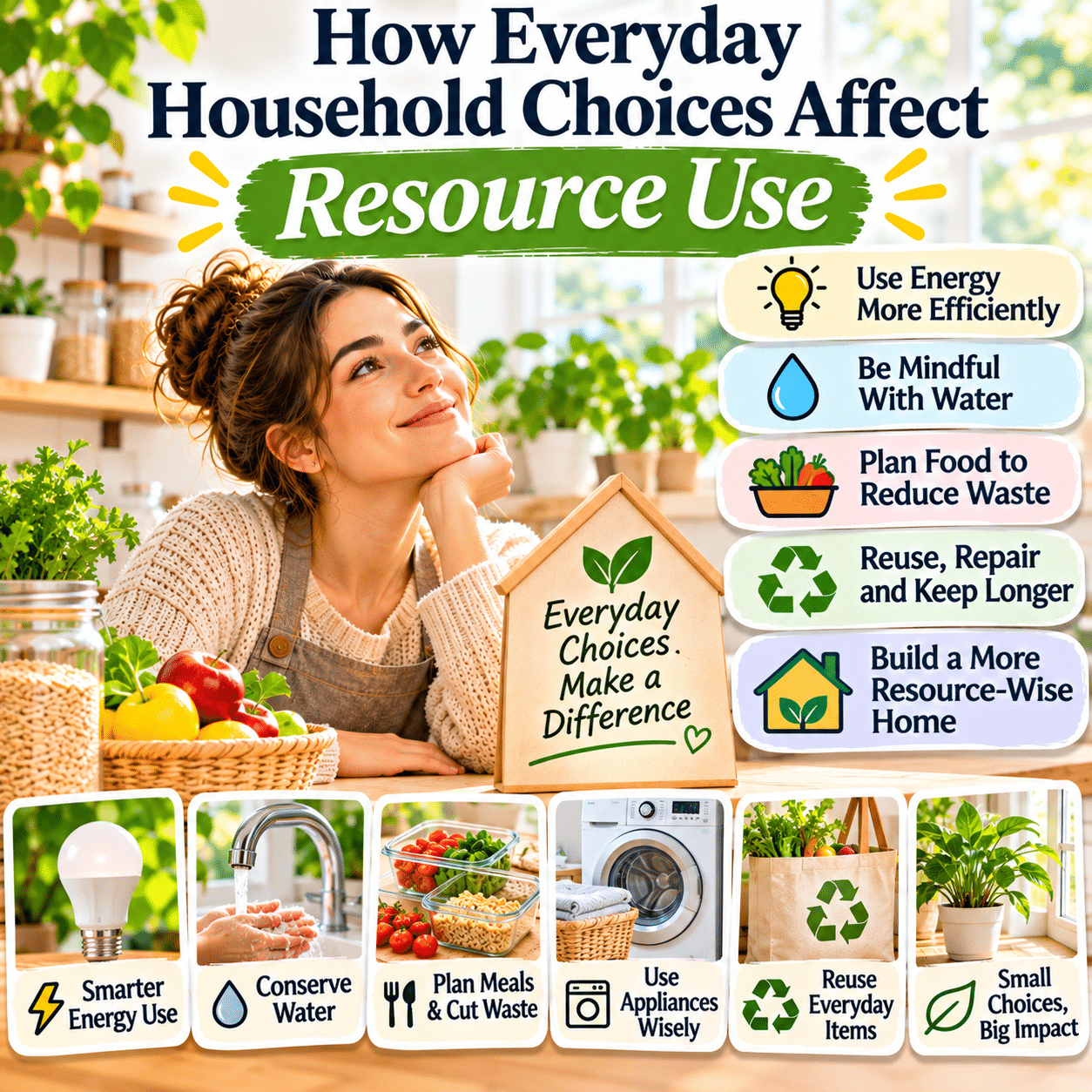
Every household depends on resources to support daily life. Water flows through kitchens and bathrooms, electricity powers appliances and lighting, food arrives through complex agricultural and transportation systems, and countless products are manufactured from materials gathered around the world.
Most of these resources are used through ordinary activities that rarely attract much attention. Preparing breakfast, washing clothes, cooling a room, charging a phone, shopping for groceries, and disposing of packaging all involve decisions that influence how materials, energy, and water are consumed.
These decisions may seem small when considered individually. Yet household routines are repeated throughout the year, making them an important part of how resources are used over time.
Understanding resource use does not mean that every household must follow strict conservation rules or sacrifice comfort. People need reliable access to water, electricity, nutritious food, suitable housing, transportation, and essential products.
Instead, the goal is to recognize where everyday choices create unnecessary waste, where more efficient alternatives may be practical, and how household needs can be met responsibly.
Resource use is also more complicated than it first appears. A product that uses less electricity during operation may require more materials to manufacture. Reusable items may need cleaning, while disposable alternatives may involve repeated production and waste management. An older appliance may remain functional but consume substantially more energy than a newer model.
These tradeoffs mean that thoughtful household decisions should consider more than a single environmental claim or isolated habit.
Financial circumstances, local infrastructure, climate, household size, accessibility, and personal responsibilities also influence which choices are realistic.
A family living in a hot climate may require extensive cooling. A household caring for young children may have greater laundry and hygiene needs. Someone living in an apartment may have limited control over building systems or waste collection services.
There is no universal formula for ideal household resource consumption.
However, learning how everyday decisions affect resource use can help people identify practical opportunities to improve efficiency, reduce avoidable waste, and make better use of what they already have.
1. Understanding What Household Resource Use Means
Household resource use includes the materials, energy, water, and services required to support everyday living.
Some resources are consumed directly.
Examples include drinking water, cooking gas, and electricity used by appliances.
Other resources are used indirectly through products and services.
A piece of furniture requires materials and energy during manufacturing, while groceries involve agricultural production, packaging, and transportation.
Understanding both direct and indirect consumption provides a broader perspective on everyday household choices.
2. Everyday Decisions Influence Resource Demand
Households make frequent decisions about what to purchase, how products are used, and when they are replaced.
These decisions influence demand for resources.
For example, choosing to maintain a functional appliance may delay the need for manufacturing a replacement.
Planning grocery purchases may reduce avoidable food waste.
Using appropriate lighting controls may reduce unnecessary electricity consumption.
The effect of each decision depends on context.
However, repeated habits can influence resource use over time.
3. Direct and Indirect Resource Use Are Different
Direct resource use occurs when households consume resources through their own activities.
Electricity, water, and cooking fuel are familiar examples.
Indirect resource use occurs earlier or elsewhere in a product’s lifecycle.
Manufacturing clothing, growing food, producing packaging, and transporting goods all require resources.
A household may not see these activities, but purchasing decisions can influence demand for them.
Recognizing indirect resource use helps explain why responsible consumption involves more than reducing utility bills.
4. Household Size Influences Consumption Patterns
Larger households often use more total resources than smaller households.
More people generally require additional food, water, clothing, and personal supplies.
However, total consumption and consumption per person are not the same.
Shared appliances, heating, cooling, and household equipment may create efficiencies when used by several people.
Individual circumstances also matter.
Resource comparisons should account for household size rather than assuming that lower total consumption always indicates greater efficiency.
5. Climate Shapes Household Resource Needs
Weather and local climate influence energy and water consumption.
Hot climates may require cooling and ventilation.
Cold climates may require heating.
Dry conditions can affect garden watering needs, while humid environments may increase demand for moisture control.
These requirements are not simply matters of personal preference.
They can be essential for health, comfort, and building maintenance.
Thoughtful resource use involves meeting these needs efficiently rather than eliminating necessary services.
6. Housing Design Affects Energy Demand
A home’s construction influences how much energy is needed to maintain comfortable indoor conditions.
Insulation, window placement, shading, ventilation, building materials, and air leakage can affect heating and cooling requirements.
Residents may have limited control over these features, particularly in rented properties.
However, understanding building performance can help explain why two similar households may have different energy bills.
Where feasible, improvements should prioritize safety, comfort, and appropriate building practices.
7. Electricity Supports Nearly Every Modern Household
Electricity powers lighting, refrigeration, communication, entertainment, and many household appliances.
It also supports essential equipment in some homes.
Electricity consumption depends on appliance efficiency, operating time, power demand, and household habits.
Reducing unnecessary use may lower expenses.
However, essential equipment should never be switched off merely to achieve lower consumption.
The objective is appropriate and efficient use.
8. Appliance Efficiency Influences Long-Term Energy Use
Two appliances performing similar tasks may consume different amounts of electricity.
Efficiency depends on design, capacity, operating conditions, and technology.
Energy labels can help consumers compare suitable products where standardized information is available.
However, a more efficient appliance is not automatically the best purchase.
Initial cost, durability, repairability, capacity, and expected use also matter.
Evaluating total ownership can provide a more balanced decision.
9. Refrigeration Is an Important Continuous Energy Use
Refrigerators and freezers operate throughout the day to maintain safe food storage temperatures.
Their energy consumption can be influenced by size, efficiency, room temperature, ventilation, and maintenance.
Keeping door seals in good condition and following manufacturer installation guidance may support efficient operation.
Food safety remains the priority.
Refrigerator or freezer temperatures should not be raised beyond safe recommendations simply to save electricity.
10. Cooling and Heating Choices Affect Energy Demand
Air conditioners, heaters, and other climate-control systems can represent substantial household energy use.
Their consumption depends on climate, building conditions, equipment efficiency, and operating settings.
Appropriate shading, maintenance, and suitable temperature settings may improve efficiency.
However, indoor conditions must remain safe for occupants.
Children, older adults, and people with certain health needs may require particular attention during extreme weather.
Energy conservation should complement essential comfort and safety.
11. Fans and Ventilation Serve Different Purposes
Fans move air and can improve perceived comfort in suitable conditions.
Ventilation exchanges indoor and outdoor air.
Air conditioning actively cools and often dehumidifies indoor spaces.
These functions are related but not interchangeable.
A fan may help occupants feel more comfortable, but it does not lower room temperature in the same way as an air conditioner.
Ventilation choices should also consider outdoor air quality, humidity, and weather.
Selecting the appropriate approach can help avoid unnecessary energy use.
12. Lighting Choices Influence Electricity Consumption
Lighting is an everyday necessity.
Electricity use depends on lamp technology, brightness, operating time, and the number of fixtures.
Efficient lighting products may provide comparable illumination while using less electricity than older technologies.
Turning off lights when they are not needed can also reduce unnecessary consumption.
However, adequate lighting remains important for safety, reading, cooking, and other tasks.
Efficiency should not compromise visibility.
13. Natural Light Can Reduce Some Lighting Needs
Daylight can provide useful illumination during suitable hours.
Window placement, curtains, blinds, and room arrangements influence how effectively daylight enters a home.
Using natural light may reduce the need for artificial lighting.
However, direct sunlight can also increase indoor heat and cooling demand.
Glare and ultraviolet exposure may affect comfort and furnishings.
The best approach balances daylight, shading, and temperature control.
14. Standby Electricity Is Worth Understanding
Some electronic devices continue consuming electricity when they are not actively being used.
This is commonly called standby power.
The amount varies significantly by product.
Some devices use very little electricity, while others consume more.
Smart plugs or suitable power controls may help manage certain devices.
However, essential equipment, network systems, and products requiring continuous operation should not be disconnected without considering their purpose and manufacturer instructions.
15. Laundry Habits Affect Water and Energy Use
Washing clothes requires water, electricity, detergents, and equipment.
Consumption depends on machine design, load size, wash temperature, cycle selection, and drying method.
Choosing appropriate settings can help avoid unnecessary resource use.
However, laundry must still meet hygiene requirements.
Heavily soiled items and certain fabrics may require specific cleaning conditions.
Care labels and appliance instructions should guide decisions.
16. Drying Clothes Involves Practical Tradeoffs
Clothes can be dried using outdoor lines, indoor racks, or mechanical dryers.
Each method has different requirements.
Air drying may reduce electricity consumption compared with powered drying, but it depends on weather, space, ventilation, and local conditions.
Indoor drying can increase humidity if ventilation is inadequate.
Mechanical drying offers convenience but uses energy.
The most suitable choice depends on household circumstances and fabric requirements.
17. Dishwashing Choices Influence Resource Consumption
Washing dishes involves water, cleaning products, and sometimes electricity.
Efficient dishwashers may use less water than some handwashing methods, particularly when operated with appropriate loads.
However, actual results depend on appliance efficiency and user behavior.
Handwashing can also be practical when performed thoughtfully.
Food safety and adequate cleaning remain essential.
The objective is to avoid unnecessary waste while maintaining hygiene.
18. Cooking Methods Affect Energy Use
Cooking requires energy through electricity, gas, or other fuels.
Consumption depends on cooking equipment, preparation time, cookware, and the type of food.
Using suitable pot sizes, appropriate lids, and efficient equipment may help.
However, food must reach safe cooking temperatures.
Energy efficiency should never involve undercooking food or using equipment outside its intended operating conditions.
19. Meal Planning Can Reduce Indirect Resource Waste
Food production involves land, water, energy, labor, and transportation.
When edible food is discarded, resources used throughout its production and distribution have also been expended.
Planning meals around realistic household needs may reduce avoidable waste.
Flexible menus can accommodate changing schedules.
Checking existing ingredients before shopping is a simple starting point.
20. Food Storage Influences Resource Efficiency
Proper storage helps maintain food quality and safety.
When ingredients spoil unnecessarily, replacement purchases may be required.
Organized refrigerators, appropriate containers, and attention to storage guidance can help households use food effectively.
However, food safety must always come first.
Food that may be unsafe should not be consumed merely to avoid waste.
Efficient resource use includes safe handling.
21. Grocery Quantities Should Match Realistic Needs
Bulk purchasing may reduce packaging or unit costs in some circumstances.
However, buying excessive quantities can increase spoilage, storage requirements, or unnecessary spending.
A household with limited space may benefit from smaller purchases.
Larger households may find bulk quantities practical for frequently used products.
The best choice depends on consumption patterns, shelf life, storage, and affordability.
22. Food Packaging Has Both Costs and Benefits
Packaging requires materials and manufacturing resources.
It can also protect food from damage, contamination, and spoilage.
Reducing packaging is not always environmentally preferable if it causes greater food waste.
Thoughtful purchasing considers whether packaging serves a useful purpose and whether alternatives are practical.
Local recycling availability also matters.
The goal is to evaluate packaging function rather than judging products solely by visible material quantity.
23. Household Water Use Extends Beyond Drinking
Water supports cooking, cleaning, bathing, laundry, sanitation, and gardening.
Different activities account for different portions of household consumption.
Water use also varies by climate, plumbing equipment, household size, and personal needs.
Understanding where water is used can help identify unnecessary losses.
However, drinking water, sanitation, and hygiene must remain adequate.
Conservation should never compromise essential health needs.
24. Plumbing Leaks Can Waste Resources
A leaking faucet, pipe, or toilet may consume water without providing any useful service.
Small leaks can accumulate over time.
Regularly noticing unusual dripping, running water, or unexpected consumption may help identify problems.
Repairs should be completed appropriately.
Some plumbing work requires qualified professionals.
Addressing leaks can support both resource efficiency and property maintenance.
25. Bathroom Fixtures Influence Water Consumption
Showers, faucets, and toilets vary in their water-use characteristics.
Efficient fixtures may reduce consumption while maintaining suitable performance.
However, product suitability depends on plumbing conditions, accessibility, and household needs.
Low-flow equipment should not compromise necessary hygiene or function.
Proper installation and maintenance are important.
26. Garden Watering Depends on Plant and Climate Needs
Outdoor plants require different amounts of water depending on species, soil, weather, and growth stage.
Overwatering can waste water and damage plants.
Underwatering can also cause problems.
Understanding plant requirements and observing soil conditions can support more appropriate watering.
Suitable containers, drainage, and plant selection matter.
Watering practices should also respect local restrictions where applicable.
27. Cleaning Products Involve Material and Chemical Use
Household cleaning relies on detergents, disinfectants, cloths, brushes, and other supplies.
Using more product than directed does not necessarily improve cleaning.
Excessive chemical use may create waste or safety concerns.
Following product instructions helps support effective use.
Cleaning chemicals should never be mixed unless the manufacturer explicitly indicates that doing so is safe.
Proper ventilation and storage may also be necessary.
28. Reusable Cleaning Supplies Have Practical Benefits and Limits
Reusable cloths, mops, and cleaning tools can serve multiple cleaning sessions.
They may reduce repeated purchases of disposable alternatives.
However, reusable materials require appropriate washing and drying.
Some tasks, particularly those involving hazardous contamination, may require specialized or disposable supplies.
The best choice depends on hygiene requirements and practical conditions.
Reuse should never compromise safety.
29. Product Durability Influences Material Demand
Household products require materials and energy during manufacturing.
Items that remain useful for longer may reduce the frequency of replacement purchases.
Durability is especially relevant for furniture, appliances, clothing, and frequently used tools.
However, longer lifespan is not the only consideration.
An inefficient product may consume substantial resources during operation.
Evaluating durability alongside performance provides a more complete picture.
30. Repairing Products Can Extend Their Useful Life
Some household items can be repaired when components fail.
Repair may delay replacement and reduce demand for new products.
However, repairability depends on parts availability, cost, safety, and technical requirements.
Electrical and mechanical repairs may require professional assistance.
Not every item is worth repairing.
The decision should balance safety, practical value, and expected remaining lifespan.
31. Reusing Items Can Reduce Unnecessary Purchases
Suitable containers, bags, furniture, and other household objects may serve multiple purposes.
Reuse can help households make better use of existing belongings.
However, materials must be appropriate for their new functions.
Containers previously used for hazardous chemicals should not be repurposed for food.
Damaged items should not be kept in service when unsafe.
Practical reuse involves extending meaningful usefulness.
32. Recycling Depends on Local Infrastructure
Recycling can recover materials from certain discarded products.
However, collection and processing systems vary by location.
Not every item labeled recyclable is accepted locally.
Sorting requirements, contamination, and material composition influence outcomes.
Learning local recycling rules helps households dispose of materials appropriately.
Reducing unnecessary purchases and maintaining products can complement recycling.
33. Waste Sorting Can Support Better Disposal
Separating household waste may help materials reach appropriate collection systems.
Common categories can include recyclables, general waste, organic materials, and hazardous waste.
However, exact categories depend on local services.
Batteries, electronics, chemicals, and other potentially hazardous materials may require special handling.
Following local guidance is more useful than assuming universal sorting rules.
34. Online Shopping Involves Hidden Resource Use
Online purchases involve packaging, warehousing, transportation, and delivery services.
The environmental effects depend on many factors, including delivery routes, packaging, product characteristics, and consumer behavior.
Consolidating appropriate purchases may sometimes reduce repeated deliveries.
However, slower shipping or fewer packages do not automatically guarantee lower environmental impact.
The most effective first question is whether the purchase is genuinely useful.
35. Transportation Choices Affect Household Resource Use
Household transportation may involve fuel, electricity, vehicle manufacturing, and maintenance.
Walking, cycling, public transportation, shared travel, and private vehicles have different practical requirements.
Accessibility, safety, distance, weather, and local infrastructure influence available choices.
There is no single suitable transportation method for every household.
Thoughtful decisions consider realistic alternatives without compromising safety or essential mobility.
36. Digital Services Also Require Resources
Streaming, cloud storage, online communication, and digital entertainment depend on devices and data infrastructure.
These systems consume electricity and require physical equipment.
However, their environmental effects are complex and depend on technology, infrastructure, and energy sources.
Simple claims about the impact of individual digital actions can be misleading.
A practical approach includes maintaining suitable devices, reviewing unnecessary subscriptions, and avoiding purchases that provide little value.
37. Household Purchasing Decisions Influence Upstream Resources
Many resource impacts occur before a product enters the home.
Raw material extraction, agriculture, manufacturing, packaging, and transportation may all contribute.
Consumers cannot directly control every stage.
However, purchasing suitable products, avoiding unnecessary duplication, and considering durability can influence demand.
Reliable product information is important.
Broad environmental claims should be evaluated critically.
38. Resource Efficiency Should Not Mean Deprivation
Efficient resource use is sometimes confused with reducing consumption at any cost.
However, households require adequate lighting, safe temperatures, nutritious food, clean water, and suitable hygiene.
These needs should not be sacrificed.
Efficiency involves obtaining necessary services while avoiding unnecessary resource use.
A comfortable, healthy household can still practice thoughtful consumption.
39. Financial and Practical Constraints Shape Household Choices
Not everyone can replace appliances, install efficient fixtures, or make structural improvements.
Renters may have limited authority over building systems.
Some households face restricted budgets or limited access to repair services.
Thoughtful resource management should recognize these realities.
Low-cost habits, maintenance, and avoiding unnecessary waste may be more practical than major purchases.
The goal is realistic improvement rather than comparison with an idealized household.
40. Small Household Habits Can Support Long-Term Awareness
Resource use is shaped by repeated decisions.
Checking supplies before shopping, maintaining appliances, addressing leaks, and using products appropriately can become familiar routines.
Each action may have a modest effect.
However, consistent awareness can help households make more informed decisions over time.
The most sustainable habits are those that fit real needs and remain easy to maintain.
Thoughtful resource use is an ongoing practice rather than a one-time project.
Understanding the Main Types of Household Resources
Everyday household activities involve several interconnected resource categories.
| Resource category | Everyday examples | Main considerations |
|---|---|---|
| Electricity | Lighting, refrigeration, electronics | Efficiency, operating time, equipment suitability |
| Heating and cooking fuels | Cooking, water heating, space heating | Safety, equipment efficiency, ventilation |
| Water | Drinking, cleaning, bathing, gardening | Adequate supply, leaks, appropriate use |
| Food | Groceries, meals, ingredients | Planning, storage, safety, waste prevention |
| Raw materials | Furniture, clothing, household goods | Durability, production, maintenance |
| Packaging | Food containers, shipping materials | Protection, reuse, disposal |
| Transportation resources | Fuel, electricity, vehicles | Distance, accessibility, efficiency |
| Digital infrastructure | Streaming, communication, cloud services | Device use, infrastructure, service value |
| Land and agricultural resources | Food and natural materials | Production methods, demand, waste |
| Household chemicals | Cleaning and maintenance products | Safe use, appropriate quantities, disposal |
These categories overlap.
For example, washing clothes uses electricity, water, cleaning products, and appliance equipment.
Understanding these connections can help households avoid focusing on one resource while overlooking others.
How Everyday Activities Use Different Resources
| Household activity | Direct resources used | Additional resource considerations |
|---|---|---|
| Preparing breakfast | Electricity or cooking fuel, water | Food production and packaging |
| Taking a shower | Water, energy for heating | Plumbing efficiency |
| Washing clothes | Water, electricity, detergent | Clothing wear and drying |
| Refrigerating groceries | Electricity | Appliance manufacturing and maintenance |
| Cleaning the home | Water, cleaning supplies | Packaging and disposal |
| Working from home | Electricity, digital services | Device manufacturing and replacement |
| Shopping online | Household spending | Packaging, warehousing, delivery |
| Gardening | Water, soil, supplies | Plant suitability and climate |
| Replacing furniture | New materials and transportation | Existing furniture condition |
| Disposing of waste | Collection services | Sorting, recycling, landfill or treatment |
The table illustrates why resource use is best understood as part of interconnected daily systems.
How to Evaluate Household Resource Use Step by Step
A household resource review does not need to be complicated.
The following process provides a practical starting point.
Step 1: Identify Major Household Activities
Consider activities that occur frequently.
These may include cooking, cooling, heating, laundry, cleaning, transportation, and shopping.
Focus first on familiar routines rather than trying to evaluate every product in the home.
Step 2: Review Available Utility Information
Electricity, gas, and water bills may help reveal consumption patterns.
Compare periods carefully because weather, occupancy, and household activity can change.
A higher bill does not always indicate waste.
Prices and billing structures may also influence costs.
Step 3: Look for Unnecessary Losses
Check for obvious problems such as plumbing leaks, poorly maintained appliances, or unused services.
Address issues that are safe and practical to resolve.
Step 4: Evaluate Frequently Used Equipment
Consider whether appliances are appropriate for household needs.
Review maintenance instructions and efficiency information where available.
Avoid replacing functional products solely because newer models exist.
Step 5: Examine Purchasing Habits
Look for repeated purchases of unused food, duplicate household items, or unnecessary supplies.
Simple inventory checks may help.
Step 6: Consider Safety and Comfort
Any proposed change should preserve adequate hygiene, food safety, lighting, ventilation, and indoor comfort.
Efficiency is not useful when it creates unsafe conditions.
Step 7: Choose Manageable Improvements
Begin with practical changes that require little disruption.
Examples may include repairing leaks, planning groceries more carefully, or maintaining equipment.
Step 8: Review Results Over Time
Notice whether changes improve convenience, reduce waste, or help manage expenses.
Keep useful habits and adjust those that do not fit household needs.
Understanding the Difference Between Resource Efficiency and Resource Reduction
These concepts are related but not identical.
| Concept | Meaning | Example |
|---|---|---|
| Resource efficiency | Using fewer resources to provide a comparable service | Efficient lighting providing suitable illumination |
| Resource reduction | Lowering total resource consumption | Avoiding unnecessary lighting |
| Resource conservation | Managing resources to avoid unnecessary depletion or waste | Repairing a water leak |
| Reuse | Using an existing item again | Reusing a durable shopping bag |
| Repair | Restoring a product’s functionality | Replacing a worn appliance component |
| Recycling | Processing materials for new production | Recycling accepted packaging |
| Responsible consumption | Making informed choices about needs and impacts | Purchasing suitable, durable household goods |
A household may combine several approaches.
For example, an efficient washing machine may reduce resources per cycle, while appropriate laundry habits may reduce unnecessary cycles.
Both can influence total consumption.
A Room-by-Room Guide to Household Resource Awareness
Kitchen
The kitchen involves food, water, electricity, cooking fuel, packaging, and cleaning supplies.
Practical priorities include safe food storage, realistic grocery planning, suitable appliance maintenance, and avoiding unnecessary food waste.
Bathroom
Bathrooms involve water, energy for hot water, hygiene products, and cleaning supplies.
Maintaining plumbing and using suitable fixtures can support efficiency.
Adequate hygiene must remain the priority.
Laundry Area
Laundry involves water, electricity, detergent, and clothing maintenance.
Appropriate machine settings, suitable loads, and fabric care can help avoid unnecessary use.
Living Room
Lighting, cooling, heating, entertainment equipment, and furniture contribute to resource consumption.
Practical choices include appropriate lighting, suitable climate control, and maintaining useful belongings.
Bedroom
Lighting, fans, air conditioning, textiles, and electronics may influence resource use.
Comfortable sleeping conditions should remain essential.
Home Office
Computers, monitors, lighting, printers, and digital services require resources.
Choosing suitable equipment and maintaining it appropriately can support long-term use.
Balcony or Garden
Plants may require water, soil, containers, and maintenance supplies.
Selecting suitable plants and watering according to actual needs can help avoid waste.
Everyday Examples of Thoughtful Resource Decisions
Example 1: Reducing Food Waste
A household frequently discards vegetables because it buys more than it can use.
It begins checking the refrigerator before shopping and choosing smaller quantities.
This may reduce spoilage and unnecessary replacement purchases.
Example 2: Maintaining an Air Conditioner
An air conditioner begins performing less effectively.
Rather than immediately replacing it, the household follows appropriate maintenance guidance and arranges servicing when needed.
Maintenance may improve performance if the problem is related to a serviceable condition.
Example 3: Choosing a Washing Machine
A family needs a replacement washing machine.
Instead of selecting only by purchase price, it considers capacity, energy and water efficiency, durability, and service availability.
The decision reflects long-term household needs.
Example 4: Reusing Existing Storage
Someone wants to buy additional organizers.
After reviewing existing containers, they discover that several can serve the intended purpose.
This avoids an unnecessary purchase.
Example 5: Addressing a Plumbing Leak
A household notices a faucet that continues dripping.
The issue is repaired appropriately.
This reduces unnecessary water loss and may prevent additional property problems.
Example 6: Reviewing Digital Subscriptions
A person discovers several services that are no longer used regularly.
They cancel unnecessary subscriptions.
This primarily improves spending awareness, while any resource implications depend on how services and infrastructure operate.
These examples show that thoughtful resource use often begins with ordinary household management.
Household Resource Choices and Their Practical Tradeoffs
| Choice | Potential benefit | Important tradeoff |
|---|---|---|
| Keeping an older appliance | Avoids immediate replacement | May involve higher operating energy use |
| Buying an efficient appliance | May reduce operating consumption | Requires manufacturing and purchase expense |
| Using reusable containers | May reduce disposable packaging | Requires suitable cleaning and maintenance |
| Buying groceries in bulk | May reduce unit cost or packaging | Can increase spoilage or storage needs |
| Air drying laundry | May reduce dryer electricity use | Depends on space, humidity, and weather |
| Using natural daylight | May reduce lighting needs | Direct sunlight can increase heat |
| Repairing furniture | May extend useful life | Repair cost and structural safety matter |
| Purchasing secondhand goods | Extends use of existing products | Condition and safety must be checked |
| Consolidating deliveries | May reduce repeated delivery activity | Actual transport impacts vary |
| Reducing water use | May lower consumption | Must preserve hygiene and health |
These tradeoffs demonstrate why resource decisions should be evaluated according to actual circumstances rather than simple universal rules.
Common Mistakes When Trying to Reduce Household Resource Use
Mistake 1: Focusing Only on Utility Bills
Electricity and water bills show direct household consumption but not the resources used to manufacture products or produce food.
Better approach: Consider both household operations and purchasing habits.
Mistake 2: Replacing Every Appliance Immediately
Newer equipment may be more efficient, but replacement also requires materials and manufacturing.
Better approach: Compare operating costs, condition, repairability, and expected remaining lifespan.
Mistake 3: Reducing Consumption at the Expense of Safety
Unsafe temperatures, inadequate hygiene, or poor lighting can create serious problems.
Better approach: Maintain essential health and safety standards.
Mistake 4: Assuming Reusable Products Are Always Better
Reusable products require manufacturing, cleaning, and appropriate use.
Better approach: Evaluate actual frequency of use and suitability.
Mistake 5: Buying Excessive Quantities to Save Money
Bulk purchases may spoil or remain unused.
Better approach: Match quantities to realistic needs and storage capacity.
Mistake 6: Ignoring Maintenance
Poorly maintained equipment may perform inefficiently or fail prematurely.
Better approach: Follow appropriate maintenance guidance.
Mistake 7: Believing Recycling Eliminates Environmental Impact
Recycling requires collection, processing, and suitable infrastructure.
Better approach: Combine appropriate recycling with thoughtful purchasing and product care.
Mistake 8: Comparing Households Without Context
Climate, household size, accessibility, and housing conditions influence consumption.
Better approach: Evaluate resource use according to actual circumstances.
Mistake 9: Making Changes That Are Too Complicated
Elaborate conservation routines may be difficult to maintain.
Better approach: Prioritize simple improvements with clear practical value.
Mistake 10: Expecting Perfect Resource Efficiency
Every household requires resources, and most decisions involve tradeoffs.
Better approach: Focus on realistic, informed improvements rather than perfection.
Everyday Household Resource Awareness Checklist
Electricity and Energy
- Frequently used appliances are maintained appropriately.
- Lighting is suitable without unnecessary operation.
- Heating and cooling settings balance comfort and efficiency.
- Equipment capacity matches household needs.
- Essential devices remain powered when required.
- Energy efficiency is considered during major purchases.
Water
- Visible plumbing leaks are addressed.
- Water fixtures function properly.
- Laundry and dishwashing practices avoid unnecessary waste.
- Garden watering reflects plant and weather conditions.
- Drinking water and hygiene needs remain fully supported.
Food and Groceries
- Existing ingredients are checked before shopping.
- Grocery quantities match realistic needs.
- Food is stored according to safety guidance.
- Meal plans allow reasonable flexibility.
- Avoidable food waste is reviewed without compromising safety.
Products and Materials
- Existing belongings are considered before buying replacements.
- Durability matters for frequently used products.
- Items are maintained according to their requirements.
- Safe repairs are considered when practical.
- Reuse is appropriate for the intended purpose.
- Waste is handled according to local requirements.
Long-Term Household Habits
- Changes fit the household’s budget and circumstances.
- Essential comfort and accessibility are preserved.
- Resource-saving efforts remain manageable.
- Environmental claims are evaluated critically.
- Habits are reviewed and adjusted over time.
The checklist is intended to support awareness rather than create rigid household rules.
Frequently Asked Questions About Household Resource Use
1. What is household resource use?
Household resource use includes the energy, water, materials, food, and services consumed directly or indirectly through everyday living.
2. Why do everyday household choices matter?
Repeated decisions influence how resources are purchased, used, maintained, and discarded. Their effects can accumulate over time, although the significance of individual choices varies.
3. What uses the most electricity in a home?
The answer depends on climate, equipment, household size, and behavior. Heating, cooling, water heating, and major appliances can be significant in many homes, but actual usage varies.
4. How can households reduce unnecessary water use?
Addressing leaks, maintaining plumbing fixtures, and using water appropriately during cleaning and gardening may help. Drinking water, sanitation, and hygiene should never be compromised.
5. Does reducing food waste conserve resources?
Avoiding unnecessary food waste can help make better use of resources involved in food production, transportation, and storage. Safe food handling remains essential.
6. Are energy-efficient appliances always worth buying?
Not automatically. The decision depends on purchase price, operating costs, durability, repairability, and expected usage.
7. Is it better to keep an old appliance or replace it?
It depends on the appliance’s condition, energy consumption, repair costs, and the impacts associated with manufacturing a replacement. No single answer applies to every product.
8. Can reusable household items reduce resource use?
They may, particularly when they replace repeated purchases and are used consistently. However, manufacturing and cleaning requirements also matter.
9. Does recycling solve household waste problems?
No. Recycling can recover certain materials, but it depends on local infrastructure and does not eliminate the impacts of manufacturing or consumption.
10. How does household size affect resource use?
Larger households often consume more total resources, but shared equipment and services can influence per-person consumption.
11. Do digital activities consume resources?
Yes. Devices, networks, and data centers require electricity and physical infrastructure. Their impacts vary depending on technology and operating conditions.
12. Can small household changes make a difference?
Small changes may reduce avoidable waste or expenses, especially when repeated. Their actual effects depend on the activity and household circumstances.
13. Is reducing resource use always cheaper?
Not necessarily. Some changes save money, while others involve higher initial costs or maintenance requirements. Financial outcomes should be evaluated individually.
14. How can renters improve household resource efficiency?
Renters may be able to manage appliance use, avoid food waste, report leaks, and maintain belongings. Structural changes generally depend on property rules and owner approval.
15. What is the best first step toward more thoughtful household resource use?
Begin by observing current routines and identifying obvious unnecessary waste, such as unused purchases, food spoilage, or plumbing leaks. Choose practical improvements that preserve comfort and safety.
Final Thoughts
Everyday household choices influence resource use through a wide range of ordinary activities.
Cooking, cleaning, cooling, shopping, transportation, and maintaining belongings all depend on energy, water, materials, and services.
Although these activities may seem routine, they connect households to larger systems of production, distribution, infrastructure, and waste management.
Understanding these connections can encourage more informed decisions.
However, responsible resource use is not about eliminating consumption or treating every convenience as unnecessary.
Households require safe drinking water, nutritious food, comfortable living conditions, suitable hygiene, reliable equipment, and essential services.
The goal is to meet these needs while avoiding waste that serves no meaningful purpose.
Practical improvements may include maintaining appliances, repairing leaks, purchasing appropriate grocery quantities, using existing belongings effectively, and considering durability when choosing new products.
These decisions should reflect real household circumstances.
Climate, housing conditions, income, family responsibilities, and accessibility all influence which approaches are suitable.
Resource efficiency also involves tradeoffs. A reusable product may require cleaning, an older appliance may consume more energy, and packaging may protect food from spoilage.
For this reason, thoughtful decisions are usually more valuable than rigid rules.
The most effective habits are those that combine practicality, safety, comfort, and long-term awareness.
By paying attention to how resources support everyday life, households can make more intentional choices without sacrificing the things that make a home functional and welcoming.
Responsible household resource use begins not with perfection, but with understanding what we use, why we use it, and how everyday choices can make better use of the resources that support our lives.