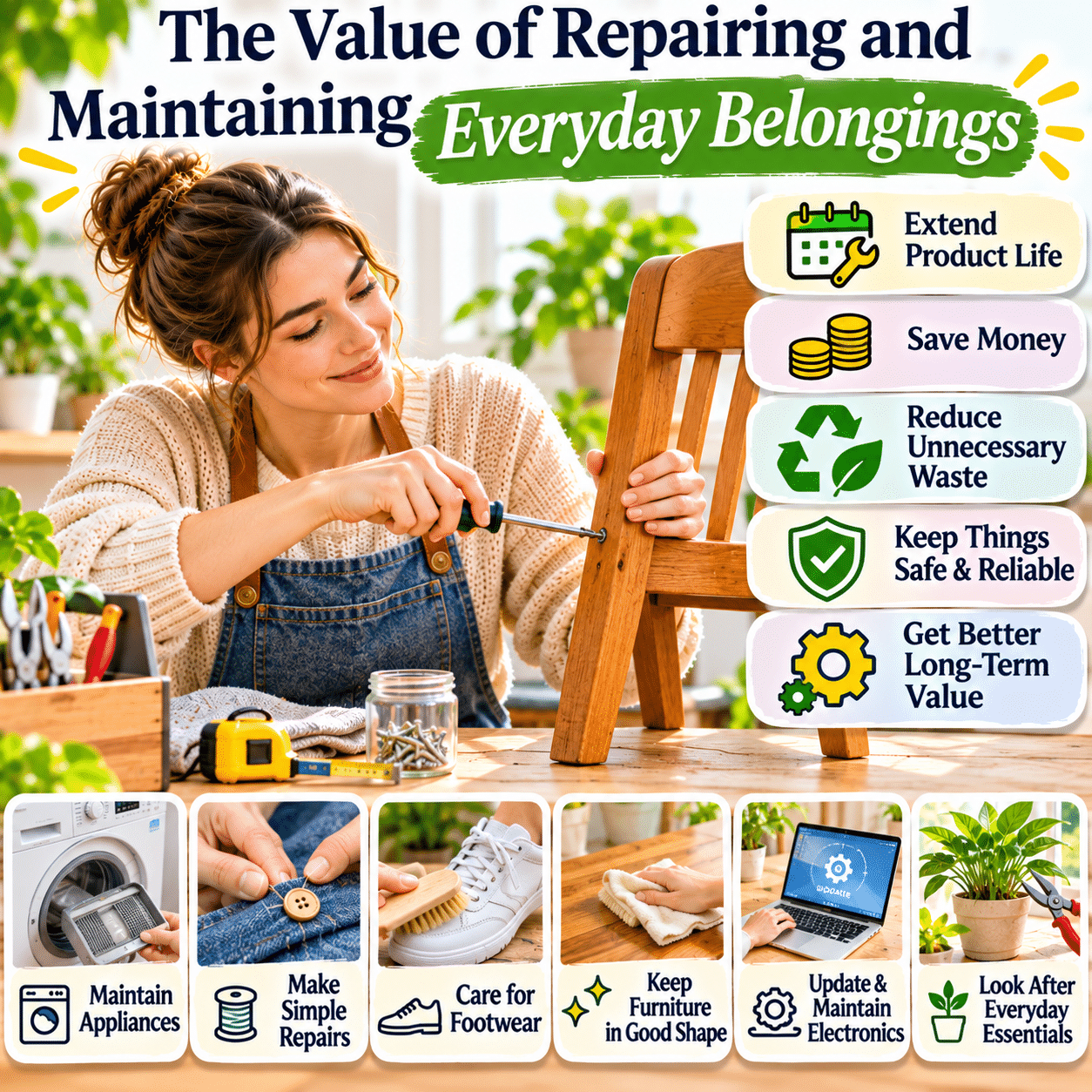
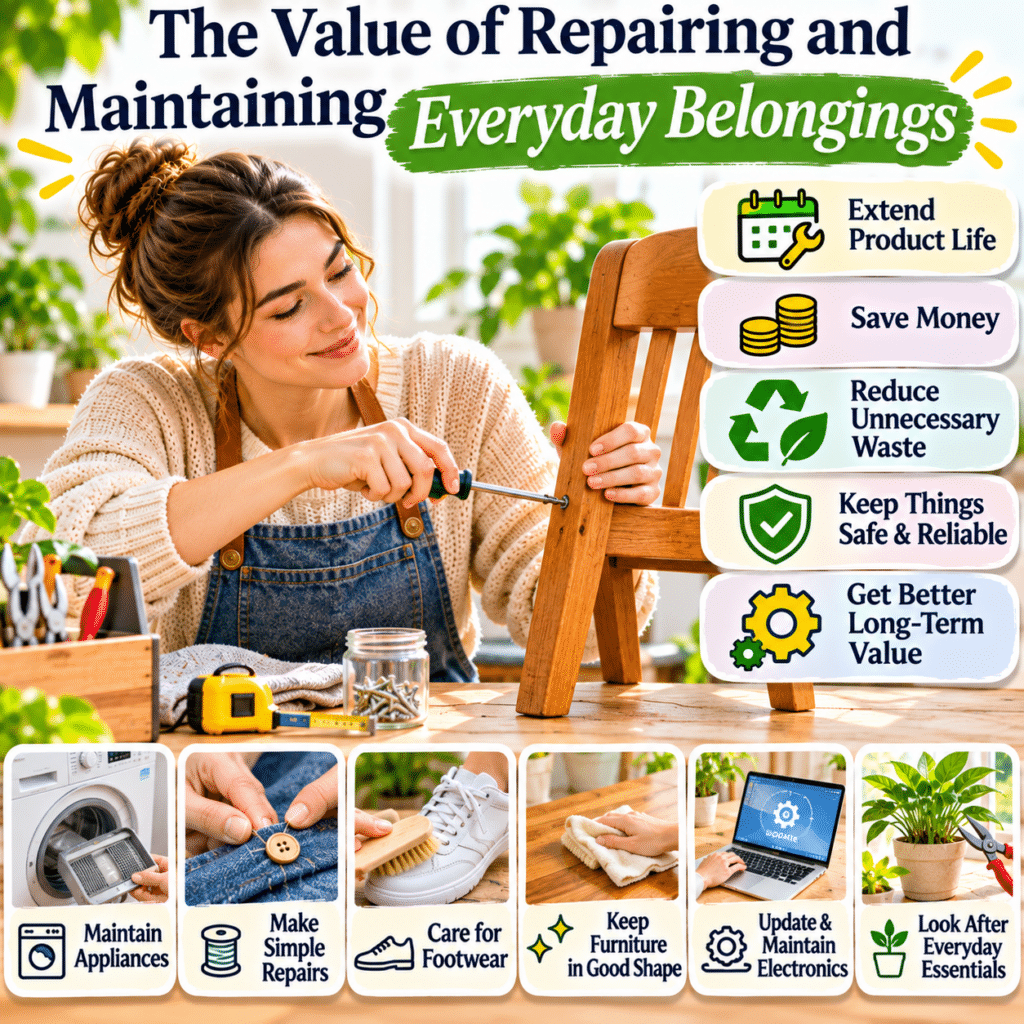
Everyday belongings play an important role in making life comfortable, organized, and convenient. From kitchen appliances and furniture to clothing, footwear, electronics, and household tools, people depend on a wide range of products to support familiar routines.
These items are often purchased with the expectation that they will remain useful for a reasonable period. However, even well-designed products experience wear, require cleaning, or develop minor problems after repeated use.
A loose button, a squeaking door hinge, a clogged appliance filter, or a worn furniture fitting may seem like a small inconvenience. Yet these issues can influence how effectively an item performs and, in some cases, how long it remains useful.
Repairing and maintaining everyday belongings offers an opportunity to preserve the value of products that households already own.
Maintenance involves caring for items to help keep them functioning properly. Repair involves correcting damage, wear, or malfunction so that an item can continue serving its intended purpose.
Although these activities are closely related, they serve different roles. Maintenance may help prevent avoidable problems, while repair can sometimes restore an item after something goes wrong.
Both practices can contribute to thoughtful consumption, household financial management, and more dependable daily routines.
However, repairing everything is not always practical or advisable. Some products become unsafe, technologically obsolete, or excessively expensive to restore. Others may consume substantial energy during operation, making replacement worth considering.
The most useful approach is to understand when maintenance is worthwhile, when repair offers reasonable value, and when replacing an item is the safer or more practical decision.
By developing realistic care habits and learning to evaluate common household problems, people can make better use of their belongings without turning ordinary maintenance into a demanding responsibility.
1. Understanding the Difference Between Repair and Maintenance
Repair and maintenance are related but distinct activities.
Maintenance generally involves actions intended to preserve an item’s condition or performance.
Examples include cleaning appliance filters, caring for footwear, inspecting furniture fittings, and following recommended servicing schedules.
Repair occurs when an item needs attention because something is damaged, worn, loose, or no longer functioning as intended.
Replacing a broken zipper or restoring a damaged chair joint are examples of repair.
Understanding the difference helps households recognize that not every problem requires replacement.
2. Everyday Belongings Experience Gradual Wear
Most household products are affected by repeated use.
Furniture supports weight and movement. Clothing experiences friction and washing. Appliances contain components that operate repeatedly.
Over time, materials may loosen, wear, fade, or deteriorate.
Some wear is normal and unavoidable.
Other problems may develop more quickly because of unsuitable use, poor storage, or neglected maintenance.
Recognizing how products age helps people establish realistic expectations about care and useful lifespan.
3. Maintenance Can Help Prevent Avoidable Problems
Preventive maintenance involves caring for an item before a significant problem develops.
For example, keeping an appliance’s accessible filters clean according to its instructions may support proper operation.
Cleaning and drying footwear appropriately may help preserve materials.
Inspecting frequently used furniture can reveal loose fittings before they become more serious.
Preventive maintenance cannot eliminate all failures.
However, it can reduce some forms of avoidable deterioration.
4. Repair Can Extend the Useful Life of Products
Some damaged products retain substantial value because most of their components remain functional.
A chair with a repairable joint may continue serving its purpose.
A garment with a loose seam may remain wearable after appropriate stitching.
A household appliance with a replaceable component may be restored without purchasing an entirely new unit.
Repair can extend usefulness when the item remains safe, suitable, and economical to maintain.
The goal is not to keep products indefinitely but to avoid unnecessary replacement.
5. Caring for Belongings Can Protect Household Spending
Replacing household products requires money.
When appropriate maintenance or repair extends useful life, households may delay or avoid some replacement expenses.
However, maintenance also has costs.
Cleaning supplies, replacement components, professional labor, and time may all contribute.
A repair is financially worthwhile when its total cost is reasonable compared with the expected benefit.
The lowest immediate expense is not always the best long-term decision.
6. Purchase Price Is Only One Part of Ownership Cost
A product’s initial price does not fully describe its financial impact.
Ownership may involve energy consumption, consumable supplies, servicing, repairs, and eventual replacement.
For example, a household appliance may be inexpensive to purchase but costly to operate or maintain.
Another may cost more initially but have readily available replacement parts.
Understanding total ownership costs helps consumers make better purchasing and repair decisions.
7. Small Repairs Can Prevent Larger Inconveniences
Minor damage may sometimes worsen when ignored.
A loose furniture fitting can place additional stress on surrounding components.
A damaged zipper may become harder to use.
A leaking plumbing connection may contribute to property damage.
Not every minor issue will develop into a major problem, but early attention can make some repairs easier.
Potentially hazardous issues should be assessed promptly by qualified professionals.
8. Reliable Belongings Support Consistent Daily Routines
Household products are most valuable when they perform their intended functions dependably.
A functioning washing machine, stable desk, comfortable chair, or reliable kitchen tool supports daily activities.
Unexpected failures can interrupt routines and require additional planning.
Appropriate maintenance may reduce certain disruptions.
Reliability is especially important for products used frequently or required for essential tasks.
9. Maintenance Encourages Awareness of Product Condition
Regular care creates opportunities to observe how belongings are performing.
People may notice unusual noises, loose components, damaged surfaces, or declining functionality.
These observations can help identify problems before they become more serious.
However, inspection should remain appropriate to the product.
Some equipment should not be opened or examined internally by untrained users.
Manufacturer guidance and safety precautions should determine what is suitable.
10. Cleaning Is an Important Form of Maintenance
Cleaning helps remove dust, dirt, grease, and other substances that may affect product condition.
Different materials require different cleaning methods.
Wood, glass, textiles, electronics, metal, and plastic may respond differently to moisture, chemicals, and abrasion.
Using unsuitable cleaning products can cause damage.
Appropriate cleaning involves following care instructions rather than assuming stronger chemicals or more frequent washing are always better.
11. Proper Storage Helps Preserve Belongings
Storage conditions can influence product lifespan.
Excessive heat, humidity, sunlight, dust, and physical pressure may damage certain materials.
Clothing may benefit from dry, suitable storage.
Some tools require protection from moisture.
Electronics should be stored according to manufacturer recommendations.
Organized storage can also reduce accidental damage and make belongings easier to locate.
The best storage method depends on the item and its environment.
12. Using Products Correctly Is Part of Maintenance
Products are generally designed for particular purposes and operating conditions.
Using an item beyond its stated capacity or outside its intended environment may accelerate wear or create hazards.
A shelf should not be overloaded.
A kitchen appliance should not be operated in ways prohibited by its instructions.
A cleaning tool should be used only with compatible materials.
Appropriate use supports both safety and durability.
13. Furniture Maintenance Supports Stability and Comfort
Furniture experiences repeated movement, pressure, and handling.
Tables, chairs, cabinets, and shelving units may require occasional inspection and appropriate cleaning.
Loose components can sometimes be tightened or repaired.
However, structural damage requires careful evaluation.
An unstable chair or heavily damaged shelf should not remain in use until its safety is established.
Professional repair may be necessary for important structural components.
14. Upholstery Care Can Help Preserve Furniture
Upholstered furniture may experience staining, friction, dust accumulation, and fabric wear.
Suitable cleaning and care can help maintain appearance and comfort.
However, upholstery materials vary.
Some fabrics require specialized cleaning methods.
Excessive moisture or unsuitable chemicals may cause discoloration, shrinkage, or damage.
Following manufacturer care guidance is particularly important for delicate materials.
15. Wooden Furniture Requires Material-Appropriate Care
Wooden furniture may respond to changes in temperature and humidity.
Surface finishes can also be affected by moisture, heat, and cleaning products.
Using appropriate cleaning methods and protecting surfaces from unsuitable conditions may help preserve their appearance.
However, different woods and finishes have different requirements.
A treatment suitable for one piece of furniture may damage another.
Repairs involving structural joints or significant damage may require professional assistance.
16. Clothing Repairs Can Extend Wearability
Clothing may develop loose buttons, damaged seams, small tears, or worn closures.
Some problems can be addressed through basic sewing or professional alterations.
A simple repair may allow a garment to remain useful.
However, fabric condition matters.
A garment with extensive deterioration may not be worth repairing.
The decision should consider comfort, fit, cost, and expected future use.
17. Clothing Maintenance Begins With Appropriate Washing
Washing and drying affect garment condition.
Water temperature, detergents, mechanical movement, and drying methods may influence fabric wear.
Care labels provide guidance suited to the garment’s construction and materials.
Washing more aggressively than necessary may shorten the life of certain fabrics.
However, hygiene remains essential.
Appropriate care balances cleanliness with material preservation.
18. Footwear Maintenance Supports Continued Use
Shoes experience repeated friction, pressure, and exposure to different surfaces.
Cleaning, drying, and storing footwear appropriately may help preserve materials.
Some footwear can be repaired through replacement of components such as soles, heels, or fasteners.
However, repair suitability depends on construction and condition.
Footwear that no longer provides safe traction, support, or fit may require replacement.
Comfort and safety should remain priorities.
19. Bags and Accessories Benefit From Regular Inspection
Backpacks, handbags, luggage, and accessories often rely on zippers, straps, handles, and stitching.
These components may experience significant wear.
Inspecting attachment points and avoiding excessive loads can help reduce damage.
Minor repairs may be practical when the surrounding material remains sound.
However, damaged straps or handles may create hazards when carrying heavy belongings.
Repairs should restore dependable function.
20. Kitchen Tools Require Safe Maintenance
Kitchen utensils, cookware, cutting boards, and small appliances are used repeatedly.
Proper cleaning, storage, and use can help preserve performance.
Food-contact surfaces must remain hygienic and suitable for their intended purpose.
Damaged coatings, cracked containers, or difficult-to-clean surfaces may require evaluation or replacement.
Not every kitchen product can be safely restored.
Food safety should always take priority over extending product life.
21. Appliance Maintenance Can Support Efficient Operation
Many appliances require periodic cleaning or servicing.
Examples may include accessible filters, ventilation areas, and components identified in manufacturer instructions.
Maintenance can sometimes support efficiency and reduce operational problems.
However, appliances vary considerably.
Users should not open electrical housings, bypass safety features, or perform repairs beyond their competence.
Professional servicing is appropriate when required.
22. Refrigerators Need Consistent Care
Refrigerators are essential for safe food storage.
Door seals, ventilation requirements, cleanliness, and temperature settings can influence performance.
Manufacturer guidance should determine maintenance procedures.
Food-safe storage temperatures must be maintained.
Energy-saving efforts should never involve unsafe refrigeration conditions.
If cooling performance becomes unreliable, professional evaluation may be necessary.
23. Washing Machines Benefit From Appropriate Maintenance
Washing machines experience repeated mechanical movement and exposure to water and detergents.
Routine care may involve cleaning accessible components, using suitable detergent quantities, and following loading recommendations.
Overloading can affect performance and place stress on equipment.
Unusual noises, leaks, or electrical problems may require professional attention.
Maintenance should follow the appliance’s instructions.
24. Vacuum Cleaners Require Practical Upkeep
Vacuum cleaners may lose performance when filters, collection containers, or accessible airflow pathways become obstructed.
Cleaning or replacing components according to manufacturer guidance can help maintain functionality.
However, filter types and maintenance procedures vary.
Some filters are washable, while others are not.
Using incompatible replacement parts or improper cleaning methods may damage the appliance.
25. Electronics Require Both Physical and Digital Maintenance
Electronic devices combine hardware, software, batteries, and connectors.
Physical care may include appropriate cleaning, protection from moisture, and avoiding excessive heat.
Digital maintenance may involve software updates, security patches, and suitable storage management.
Updates can support continued functionality and security.
However, device-specific instructions should guide maintenance.
Opening devices or attempting battery repairs can create serious hazards.
26. Battery Condition Influences Electronic Lifespan
Rechargeable batteries gradually age.
Their capacity and performance may decline over time.
For some devices, professional battery replacement can extend practical usefulness.
However, damaged, swollen, leaking, or overheating batteries require special caution.
Users should stop using potentially hazardous devices and follow manufacturer safety guidance.
Battery repair or disposal should be handled through appropriate services.
27. Software Support Is Part of Long-Term Product Care
Modern devices often depend on software for functionality and security.
A physically intact device may become less practical if essential software is no longer supported.
Installing appropriate updates can help maintain compatibility and security.
However, software support has limits.
Consumers should consider these limits when deciding whether to maintain, repair, or replace electronics.
28. Household Tools Need Appropriate Care
Hand tools and equipment may require cleaning, inspection, lubrication, or suitable storage.
Rust, worn handles, loose components, and damaged cutting edges can affect performance and safety.
Maintenance procedures depend on the tool.
Sharp or powered equipment may require special precautions.
Damaged tools should not be used when their condition creates hazards.
29. Plumbing Maintenance Can Prevent Water Waste
Faucets, pipes, seals, and fixtures may develop leaks or wear.
Prompt attention can reduce unnecessary water loss and may prevent property damage.
Some minor tasks are straightforward, while others require qualified plumbers.
Households should avoid repairs that could compromise plumbing safety or building systems.
Regular awareness of unusual leaks or moisture is valuable.
30. Doors, Windows, and Household Fixtures Need Attention
Doors, windows, locks, hinges, and fittings experience repeated use.
Some components may become loose or difficult to operate.
Appropriate maintenance can support smooth function and security.
However, structural issues, damaged glass, and security-related problems may require professional service.
Residents should follow property rules and avoid unsafe modifications.
31. Outdoor Belongings Face Additional Wear
Outdoor furniture, gardening tools, and equipment may experience sunlight, rain, humidity, and temperature changes.
These conditions can accelerate deterioration.
Cleaning, suitable storage, and material-appropriate protection may help.
However, weather-resistant products still have limitations.
Manufacturer instructions should guide care.
32. Repairability Should Influence Purchasing Decisions
Some products are easier to repair than others.
Replaceable components, accessible servicing, available spare parts, and clear maintenance instructions can support longer use.
Repairability may be particularly valuable for expensive or frequently used products.
However, the availability and cost of repairs can vary by location.
Consumers should consider realistic service options rather than assuming every item can be repaired conveniently.
33. Replacement Parts Can Determine Product Longevity
A small damaged component may make an otherwise functional product unusable.
If compatible replacement parts are available, repair may be straightforward.
If parts are unavailable or prohibitively expensive, replacement may become necessary.
For major purchases, checking the availability of common wear components can provide useful information.
Long-term support is an important part of practical ownership.
34. Professional Repairs Can Be Worth the Cost
Some repairs require specialized tools, technical knowledge, or safety procedures.
Qualified professionals may be able to restore appliances, furniture, electronics, or household systems.
The decision should consider repair cost, product value, safety, and expected remaining lifespan.
Professional service is especially important when electrical, gas, structural, or other hazardous systems are involved.
Attempting unsafe repairs can create greater problems than replacing the item.
35. Repairing Belongings Can Reduce Some Forms of Waste
When an item is repaired successfully, disposal may be delayed.
This can reduce the need for immediate replacement and the associated waste.
However, repairs may require new components, materials, transportation, and energy.
Environmental benefits depend on the circumstances.
Repair is often worth considering, but it is not automatically the lowest-impact option.
36. Maintenance Can Support More Thoughtful Consumption
Caring for existing belongings encourages awareness of their value.
Instead of viewing products as easily replaceable, households may consider how to preserve their usefulness.
This can influence future purchasing habits.
Consumers may begin prioritizing durability, repairability, and manageable maintenance.
Thoughtful consumption involves both choosing products carefully and caring for them after purchase.
37. Repair Is Not Always Better Than Replacement
Some products become unsafe, inefficient, or impractical to restore.
Repair costs may exceed the value of continued use.
Replacement parts may be unavailable.
An older appliance may also consume substantially more energy than an efficient alternative.
In these situations, replacement may be reasonable.
The decision should reflect total costs, safety, functionality, and expected future use.
38. Emotional Value Can Influence Repair Decisions
Some belongings carry sentimental significance.
A family heirloom, meaningful gift, or favorite piece of furniture may be worth maintaining even when repair costs exceed its market value.
Emotional value is a legitimate consideration.
However, safety must remain essential.
A cherished item may sometimes be preserved as a keepsake rather than returned to functional use.
39. Maintenance Habits Should Be Realistic
Not every household has the time, budget, tools, or expertise for extensive maintenance.
Care routines should match actual circumstances.
Simple tasks such as appropriate cleaning, organized storage, and noticing signs of damage may be manageable.
More specialized work can be delegated when necessary.
The goal is not to create a demanding schedule for every possession.
It is to establish useful habits that support dependable ownership.
40. The Greatest Value Is Preserving Meaningful Usefulness
Repairing and maintaining belongings is ultimately about preserving their ability to serve practical purposes.
An item that remains safe, functional, and suitable can continue contributing to everyday life.
Maintenance may help prevent avoidable deterioration.
Repair may restore an item after damage occurs.
However, continued ownership should remain worthwhile.
The most effective approach balances durability, safety, affordability, convenience, and actual household needs.
Understanding the Main Types of Household Maintenance
Maintenance can take several forms depending on the product and its intended use.
| Maintenance type | Meaning | Everyday example |
|---|---|---|
| Routine cleaning | Removing dirt and buildup | Cleaning suitable appliance surfaces |
| Preventive maintenance | Caring for an item before problems develop | Following recommended service schedules |
| Inspection | Checking visible condition and performance | Looking for loose furniture fittings |
| Corrective maintenance | Addressing a developing problem | Adjusting a suitable loose component |
| Repair | Restoring damaged functionality | Fixing a garment seam |
| Component replacement | Replacing worn or failed parts | Installing a compatible appliance filter |
| Protective care | Reducing exposure to damaging conditions | Storing tools in a dry location |
| Software maintenance | Maintaining digital functionality and security | Installing supported device updates |
| Professional servicing | Specialist inspection or repair | Qualified appliance maintenance |
Different products require different approaches.
The appropriate level of care depends on manufacturer guidance, product condition, safety requirements, and household circumstances.
Why Repair and Maintenance Matter: Main Benefits
| Potential benefit | How it works | Important limitation |
|---|---|---|
| Longer useful lifespan | Helps products remain functional | Not every product can be restored |
| Reduced replacement spending | May delay purchasing new items | Repair and maintenance have costs |
| Greater reliability | Can reduce certain avoidable failures | Unexpected failures remain possible |
| Improved convenience | Reduces repeated shopping and setup | Some repairs require time |
| Better household organization | Encourages awareness of belongings | Excessive maintenance systems can become burdensome |
| Reduced waste | May delay disposal | Environmental effects depend on circumstances |
| Preservation of sentimental value | Maintains meaningful possessions | Safety may limit functional reuse |
| Better purchasing judgment | Reveals which products are easy to maintain | Past experience cannot guarantee future performance |
| Practical skills | Encourages suitable problem-solving | Hazardous repairs require professionals |
| More thoughtful consumption | Emphasizes value beyond initial purchase | Continued use must remain appropriate |
These benefits are most meaningful when maintenance and repair support genuine household needs.
How to Decide Whether to Repair or Replace an Item
A practical decision process can help avoid unnecessary expenses and unsafe choices.
Step 1: Identify the Problem
Determine what is no longer working as intended.
Is the issue cosmetic, functional, structural, or safety-related?
Do not attempt to diagnose hazardous equipment without appropriate expertise.
Step 2: Consider Safety
Check whether continued use presents a risk.
Damaged electrical equipment, unstable furniture, compromised safety products, and leaking gas systems require particular caution.
Stop using potentially hazardous items and seek qualified assistance.
Step 3: Evaluate the Item’s Overall Condition
Consider whether the remaining components are in reasonable condition.
A minor repair may be worthwhile when most of the product remains functional.
Extensive deterioration may make replacement more practical.
Step 4: Estimate Repair Costs
Include parts, labor, transportation, and any necessary servicing.
Avoid comparing only the price of a replacement part with the cost of a new product.
Step 5: Consider Expected Remaining Lifespan
Ask how long the item is reasonably expected to remain useful after repair.
A repair that provides only a brief extension may offer limited value.
Step 6: Review Replacement Alternatives
Compare suitable replacement products according to price, efficiency, durability, warranty, and maintenance requirements.
Step 7: Consider Convenience and Downtime
Some repairs require significant waiting periods.
If the item is essential, downtime may influence the decision.
Step 8: Make a Balanced Choice
Repair when it is safe, practical, and worthwhile.
Replace when continued use is unsafe, repair is uneconomical, or the product no longer meets essential needs.
Repair Versus Replacement: A Practical Comparison
| Consideration | Repair may be preferable when | Replacement may be preferable when |
|---|---|---|
| Safety | The item can be restored safely | Safety cannot be reliably restored |
| Cost | Repair is reasonably priced | Repair costs approach or exceed practical value |
| Product condition | Most components remain sound | Extensive deterioration is present |
| Remaining lifespan | Continued use is likely to be meaningful | Further failures are likely |
| Replacement parts | Compatible parts are available | Essential parts are unavailable |
| Energy efficiency | Existing operation remains reasonable | A replacement offers substantial practical efficiency benefits |
| Convenience | Repair can be completed promptly | Repair causes excessive disruption |
| Sentimental value | Preservation matters to the owner | Functional use is no longer appropriate |
| Environmental considerations | Repair avoids unnecessary replacement | Continued operation may involve significant resource costs |
| Functionality | The product still meets current needs | Household requirements have changed |
There is no universal rule requiring repair or replacement.
The best decision depends on the specific item and circumstances.
A Simple Formula for Evaluating Repair Costs
One useful comparison is the expected annualized cost of continued ownership.
Estimated repair cost per additional year = Total repair cost ÷ Expected additional years of useful service
For example, suppose a repair costs $90 and is expected to provide three additional years of use.
The simplified repair cost is:
$90 ÷ 3 = $30 per additional year.
If a suitable replacement costs $240 and is expected to last six years, its simplified purchase cost is:
$240 ÷ 6 = $40 per year.
In this hypothetical example, repair appears less expensive on an annualized basis.
However, this calculation excludes energy use, maintenance, future failures, and differences in functionality.
Estimated lifespans are uncertain.
The formula is a decision aid, not a guarantee.
Maintenance Needs Across Common Household Categories
| Category | Common care activities | When professional help may be needed |
|---|---|---|
| Clothing | Washing, drying, minor stitching | Complex alterations or restoration |
| Footwear | Cleaning, drying, suitable storage | Sole or structural repairs |
| Furniture | Cleaning, inspecting fittings | Structural damage or unstable joints |
| Refrigerators | Cleaning accessible areas, following service guidance | Cooling failure or electrical issues |
| Washing machines | Appropriate loading and accessible cleaning | Leaks, electrical faults, mechanical problems |
| Vacuum cleaners | Maintaining accessible filters and containers | Motor or internal electrical faults |
| Electronics | Suitable cleaning and software updates | Battery, screen, or internal hardware repairs |
| Kitchen tools | Cleaning and proper storage | Unsafe or damaged components |
| Hand tools | Cleaning, inspection, appropriate storage | Complex powered-tool repairs |
| Plumbing fixtures | Observing leaks and maintaining accessible fittings | Persistent leaks or pipe damage |
| Doors and windows | Cleaning and checking operation | Structural, glazing, or security problems |
| Outdoor furniture | Cleaning and weather-appropriate storage | Structural deterioration |
Always follow the specific manufacturer’s instructions.
Generic maintenance suggestions should not override product-specific safety requirements.
Building a Manageable Household Maintenance Routine
A simple maintenance routine can help prevent small tasks from being forgotten.
Daily or After Use
Clean and store items according to their needs.
Examples may include drying suitable kitchen tools, putting equipment away safely, and removing obvious dirt from frequently used belongings.
Weekly
Notice whether commonly used items are functioning normally.
Pay attention to visible damage, unusual noises, or signs of wear.
No detailed inspection is necessary for every object.
Monthly
Review selected household items that benefit from regular attention.
Check manufacturer-recommended maintenance tasks for frequently used equipment.
Seasonally
Consider belongings affected by changing weather.
Examples include outdoor furniture, seasonal clothing, and equipment used during particular times of year.
Annually or According to Manufacturer Guidance
Arrange servicing for systems or equipment that require periodic professional maintenance.
The correct interval depends on the product, local conditions, and applicable regulations.
Whenever a Problem Appears
Assess whether the issue is safe to address.
Repair suitable minor problems promptly and seek qualified assistance for hazardous or specialized work.
Practical Examples of Repair and Maintenance in Everyday Life
Example 1: A Loose Button on a Favorite Shirt
A frequently worn shirt loses a button.
The fabric remains in good condition.
Replacing the button may allow continued use without purchasing another shirt.
This is a straightforward example of a small repair preserving practical value.
Example 2: A Chair With a Loose Joint
A household chair becomes unstable.
Because structural safety is involved, the chair is removed from use until properly assessed.
If a qualified repair can restore safe stability, continued use may be reasonable.
Otherwise, replacement may be necessary.
Example 3: A Vacuum Cleaner With Reduced Suction
A vacuum cleaner no longer performs as expected.
The owner consults the manual and checks accessible maintenance components.
If cleaning or replacing an approved filter resolves the problem, unnecessary replacement may be avoided.
Internal faults require appropriate servicing.
Example 4: Shoes With Worn Components
A comfortable pair of shoes develops wear in a replaceable component.
A footwear repair specialist evaluates whether restoration is practical.
The decision considers repair cost, overall condition, fit, and safety.
Example 5: A Refrigerator With Cooling Problems
A refrigerator begins failing to maintain safe temperatures.
Food safety becomes the immediate priority.
The household arranges professional evaluation rather than continuing to use the appliance under unsafe conditions.
Repair or replacement is then determined according to the fault, cost, and expected performance.
Example 6: A Wooden Table With Surface Wear
A table develops minor cosmetic wear but remains structurally sound.
Material-appropriate care or refinishing may improve its appearance.
The owner evaluates whether the treatment is suitable for the existing finish.
These examples show that repair and maintenance decisions vary considerably by product and type of problem.
Repair and Maintenance for Different Lifestyles
| Household situation | Main priority | Practical approach |
|---|---|---|
| Living alone | Managing essential belongings efficiently | Maintain frequently used items and arrange help when needed |
| Family household | Heavy everyday use | Focus on safe, durable, easy-to-maintain products |
| Small apartment | Limited storage and equipment space | Maintain multifunctional belongings |
| Budget-conscious household | Avoiding unnecessary replacement costs | Compare repair expenses with expected usefulness |
| Remote worker | Reliable work equipment | Maintain devices, furniture, and software |
| Creative hobbyist | Preserving specialized tools | Follow material and equipment care guidance |
| Older adult household | Safety and accessibility | Prioritize dependable equipment and qualified assistance |
| Renter | Respecting property responsibilities | Report building issues and maintain personal belongings |
| Homeowner | Managing building systems | Follow appropriate professional servicing schedules |
| Frequent traveler | Dependable portable belongings | Inspect luggage, straps, and accessories before use |
The most effective care routines reflect actual needs rather than a universal maintenance schedule.
Essential Safety Principles for Household Repairs
Safety must always take priority over cost savings or extending product lifespan.
Electrical Equipment
Do not work on live electrical components.
Damaged cords, overheating equipment, unusual smells, or exposed wiring require caution and qualified evaluation.
Gas Appliances
Gas leaks or suspected gas-related faults can be dangerous.
Follow local emergency guidance and contact qualified professionals or emergency services as appropriate.
Do not attempt improvised repairs.
Structural Furniture
Unstable chairs, shelving, and load-bearing components should not be used until safe.
Repairs must restore adequate structural integrity.
Batteries
Damaged, swollen, leaking, or overheating batteries can present fire or chemical hazards.
Follow manufacturer and local disposal guidance.
Food-Contact Equipment
Cracked, contaminated, or unsuitable materials may compromise hygiene.
Replace products when safe cleaning or continued food contact cannot be assured.
Safety-Critical Products
Protective equipment and other safety-related products may have replacement requirements.
Follow manufacturer instructions and applicable standards.
Tools and Machinery
Powered tools and equipment with moving parts require appropriate training, precautions, and servicing.
Do not bypass guards or safety mechanisms.
A repair is worthwhile only when the restored item can be used safely and appropriately.
Common Mistakes When Repairing and Maintaining Belongings
Mistake 1: Waiting Until Small Problems Become Serious
Minor issues may worsen when ignored.
Better approach: Notice developing problems and address them when practical and safe.
Mistake 2: Using the Wrong Cleaning Products
Unsuitable chemicals or abrasive tools can damage materials.
Better approach: Follow product-specific care instructions.
Mistake 3: Attempting Repairs Beyond Personal Expertise
Electrical, mechanical, or structural repairs may involve hazards.
Better approach: Seek qualified professional assistance when necessary.
Mistake 4: Assuming Every Product Is Worth Repairing
Some repairs are costly, unsafe, or unlikely to provide lasting value.
Better approach: Compare costs, condition, safety, and expected remaining lifespan.
Mistake 5: Ignoring Replacement Part Availability
A product may be difficult to restore without compatible components.
Better approach: Check parts and service support before committing to repairs.
Mistake 6: Overmaintaining Products
Unnecessary cleaning, lubrication, or servicing may waste time or damage certain materials.
Better approach: Follow appropriate maintenance intervals.
Mistake 7: Continuing to Use Unsafe Products
A product may still function while presenting hazards.
Better approach: Stop using compromised equipment until its safety is established.
Mistake 8: Neglecting Storage Conditions
Poor storage can contribute to damage.
Better approach: Match storage conditions to product materials.
Mistake 9: Focusing Only on Repair Price
Low-cost repairs may provide limited benefit if further failures are likely.
Better approach: Consider total cost and expected future usefulness.
Mistake 10: Creating an Overly Complicated Maintenance Schedule
Excessive tracking may become difficult to maintain.
Better approach: Focus on essential products and manufacturer-recommended tasks.
Everyday Belongings Maintenance Checklist
General Product Care
- I follow relevant manufacturer instructions.
- I clean belongings using suitable methods.
- I store items in appropriate conditions.
- I avoid exceeding intended capacities.
- I notice signs of unusual wear or damage.
- I maintain frequently used products when needed.
Clothing and Accessories
- Garments are washed according to care labels.
- Minor stitching problems are addressed when practical.
- Footwear is cleaned and stored appropriately.
- Bags and straps are inspected for damage.
- Unsafe or excessively worn items are replaced.
Furniture and Household Equipment
- Furniture remains stable and suitable for use.
- Important fittings are checked when necessary.
- Appliances receive appropriate maintenance.
- Accessible filters are cared for according to instructions.
- Electrical or structural faults receive qualified attention.
Repair Decisions
- The problem has been identified sufficiently.
- Continued use is safe or has been suspended.
- Repair costs are reasonably understood.
- Compatible parts or professional services are available.
- Expected remaining lifespan has been considered.
- Replacement alternatives have been evaluated.
- The decision reflects actual household needs.
Long-Term Habits
- Maintenance routines remain manageable.
- I avoid replacing useful products unnecessarily.
- I do not keep unsafe products in service.
- I consider repairability when purchasing major items.
- I review care needs as household circumstances change.
The checklist is intended to encourage practical awareness rather than rigid maintenance rules.
Frequently Asked Questions About Repairing and Maintaining Everyday Belongings
1. What is the difference between repair and maintenance?
Maintenance involves caring for an item to preserve its condition or performance. Repair involves restoring functionality after damage, wear, or malfunction.
2. Why is maintaining everyday belongings important?
Appropriate maintenance can help preserve functionality, reduce certain avoidable problems, support reliability, and potentially extend useful lifespan.
3. Does repairing items always save money?
No. Repair costs, product condition, expected remaining lifespan, and replacement alternatives determine whether repair is economical.
4. How can I tell whether an item is worth repairing?
Consider safety, repair cost, overall condition, parts availability, expected future use, and the price and performance of suitable replacements.
5. What household items are commonly repairable?
Some clothing, footwear, furniture, appliances, electronics, and tools can be repaired. Actual repairability depends on design, condition, and available services.
6. Is preventive maintenance better than waiting for problems?
Preventive maintenance can reduce some avoidable failures, but the appropriate approach depends on the product. Manufacturer recommendations should guide maintenance.
7. Can maintenance make appliances more energy-efficient?
Appropriate maintenance may help appliances operate as intended. The effect on energy consumption depends on equipment design, condition, and the specific maintenance task.
8. Should I repair old electronics?
Repair may be reasonable when the device remains safe, functional, and supported. Battery condition, software updates, repair cost, and security requirements should also be considered.
9. When should I replace a product instead of repairing it?
Replacement may be appropriate when safety cannot be restored, repairs are uneconomical, essential parts are unavailable, or the product no longer meets important needs.
10. Are professional repairs worth paying for?
They can be, especially for expensive or essential items. Professional service is also important for repairs involving electrical, gas, structural, or other safety hazards.
11. How can I make clothing last longer?
Follow care labels, wash appropriately, store garments suitably, and address minor damage when practical.
12. Does repairing belongings reduce waste?
Successful repairs may delay disposal and replacement. Actual environmental benefits depend on the product, repair materials, operating efficiency, and alternatives.
13. How often should household products be maintained?
Maintenance intervals vary by product and usage conditions. Follow manufacturer instructions and applicable professional servicing requirements.
14. Can maintenance prevent every product failure?
No. Materials age, components wear, and unexpected defects can occur even with appropriate care. Maintenance can reduce some risks but cannot guarantee indefinite performance.
15. What is the easiest way to begin maintaining belongings more thoughtfully?
Start with frequently used items. Follow their care instructions, keep them clean and properly stored, and address visible problems before they become more serious.
Final Thoughts
Repairing and maintaining everyday belongings is a practical way to preserve the usefulness of products that already support household life.
Furniture, clothing, appliances, electronics, tools, and accessories all experience wear through ordinary use. Some deterioration is unavoidable, but appropriate care can help prevent certain problems and extend the period during which belongings remain functional.
Maintenance encourages people to pay attention to product condition rather than waiting for something to fail.
Repair offers another opportunity to restore usefulness when damage occurs.
Together, these practices can support household convenience, financial awareness, and more intentional consumption.
However, their value depends on practical judgment.
Not every item should be repaired, and not every product can remain useful indefinitely. Safety, repair costs, parts availability, energy efficiency, and changing household needs must all be considered.
A well-maintained product may provide dependable service for years, while an unsafe or severely deteriorated item may require replacement.
The objective is not to preserve every possession at any cost.
It is to recognize when existing belongings still have meaningful value and to care for them appropriately.
Simple habits can make this approach easier. Cleaning products according to their instructions, storing belongings properly, noticing early signs of damage, and considering safe repairs before replacement can gradually become part of everyday routines.
These habits do not require specialized skills for every task or a complicated household maintenance system.
They begin with understanding how belongings are used and what they need to remain dependable.
Ultimately, repairing and maintaining everyday items reflects a thoughtful relationship with the products that support daily life.
The value of caring for our belongings lies not in making everything last forever, but in helping useful products remain safe, reliable, and meaningful for as long as reasonably possible.