Paper clutter is one of the most persistent organizational challenges in everyday home life. Even in a world where many activities have moved online, physical documents continue to arrive through mail, shopping receipts, medical paperwork, school notices, warranties, instruction manuals, financial records, and household correspondence.
A single sheet of paper rarely creates a problem. The difficulty begins when documents accumulate without a clear system for deciding what to keep, where to store them, and when they can be discarded.
An unopened envelope may remain on a kitchen counter for several days. A receipt gets placed inside a drawer for safekeeping. Important documents become mixed with advertisements, outdated instructions, and miscellaneous notes. Over time, these small collections grow into piles that occupy valuable space and make everyday information harder to find.
Paper clutter is particularly frustrating because not every document can be treated the same way. Some papers require immediate attention, others must be retained for legal or financial reasons, and many can be recycled almost immediately. Making the wrong decision can result in misplaced information, missed deadlines, or unnecessary privacy risks.
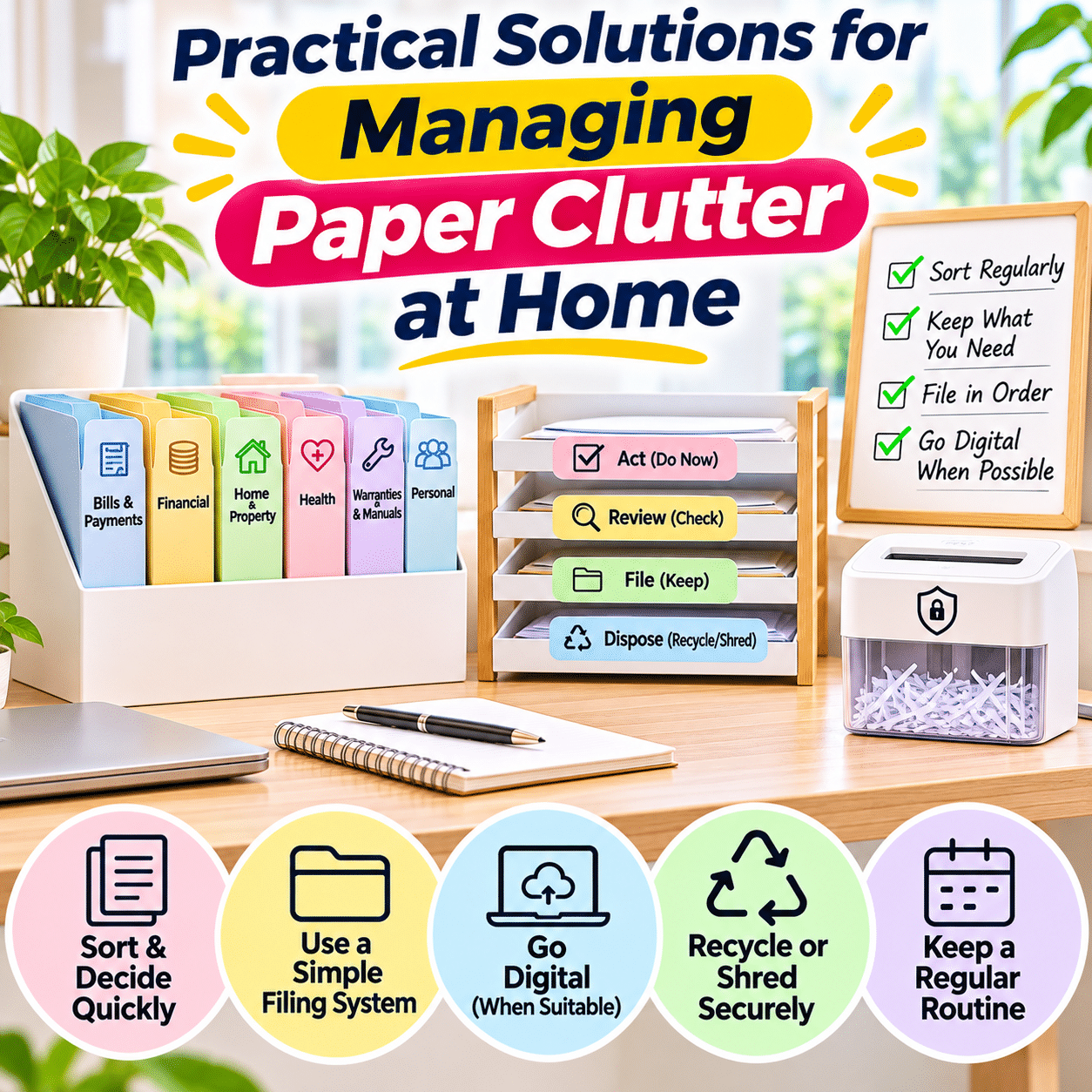
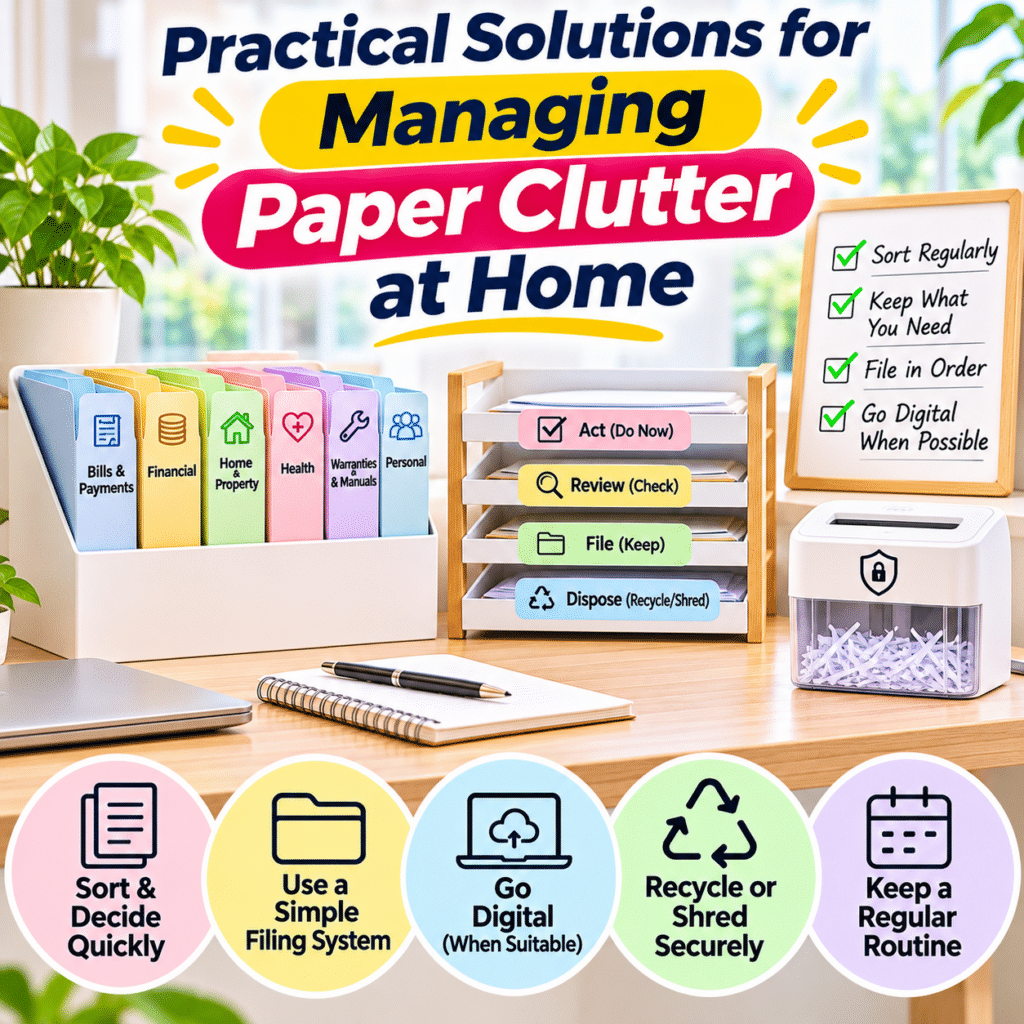
Fortunately, managing household paperwork does not require an elaborate filing cabinet, expensive organizational supplies, or a completely paperless lifestyle. A practical system can begin with a few clearly defined categories, a reliable place for incoming documents, and a consistent routine for processing paperwork.
The most effective approach is to reduce unnecessary paper at the source, make decisions about incoming documents promptly, protect important records, and create storage arrangements that are simple enough to maintain.
This guide explores practical ways to organize household paperwork, reduce paper accumulation, create functional filing systems, manage receipts and important records, incorporate digital storage, and establish sustainable habits that keep paper clutter under control.
1. Understand Why Paper Clutter Accumulates
Before organizing existing paperwork, it helps to understand why paper clutter develops in the first place.
Most households do not intentionally collect unnecessary documents. Paper accumulates because each item requires a small decision, and those decisions are frequently postponed.
Paper Arrives From Multiple Sources
Common sources include:
- Postal mail
- Shopping receipts
- Bills and statements
- School correspondence
- Medical and insurance documents
- Product warranties
- Instruction manuals
- Tax-related paperwork
- Event invitations
- Printed schedules
- Personal notes
- Delivery documentation
- Promotional materials
These items often enter the home at different times and through different locations.
Without a central processing system, they spread across tables, countertops, shelves, and drawers.
Documents Require Different Actions
Some paperwork needs to be:
- Read
- Paid
- Signed
- Filed
- Scanned
- Shared
- Returned
- Recycled
- Securely destroyed
When the next action is unclear, keeping the paper visible can feel safer than making a decision.
Fear of Discarding Important Information
Many people keep paperwork because they are uncertain whether it may be useful later.
This is understandable, particularly with legal, financial, medical, and property-related records.
However, keeping everything makes genuinely important documents harder to locate.
Paper Often Lacks a Permanent Home
A receipt may belong in a financial folder, while a warranty belongs with product documentation.
If neither has an assigned location, both may remain in a miscellaneous drawer.
Temporary Piles Become Permanent
A small pile labeled mentally as “deal with later” can become an established feature of the home.
The solution is not simply to move the pile into a decorative basket. It is to create a repeatable decision-making process.
2. Identify the Main Types of Paperwork in Your Home
Effective organization begins with recognizing that different documents serve different purposes.
A useful household filing system should reflect the types of paperwork you actually receive.
Everyday Action Documents
These are papers requiring a decision or task.
Examples include:
- Bills awaiting payment
- Forms requiring signatures
- Appointment notices
- Documents requiring a response
- School permission slips
- Return shipping paperwork
These should remain accessible until the required action is completed.
Important Long-Term Records
These may include:
- Property ownership documents
- Legal agreements
- Birth or marriage certificates
- Insurance policies
- Tax records
- Employment records
- Education certificates
- Important medical documentation
Storage and retention requirements vary by document and jurisdiction.
Household Reference Documents
These are useful for maintaining and managing the home.
Examples include:
- Appliance instructions
- Warranty information
- Maintenance records
- Home improvement documentation
- Equipment specifications
- Service provider information
Financial and Purchase Records
These may include:
- Receipts
- Invoices
- Payment confirmations
- Bank correspondence
- Loan documents
- Investment statements
- Tax-related purchase records
Personal and Sentimental Papers
Examples include:
- Handwritten letters
- Children’s artwork
- Greeting cards
- Personal journals
- Family recipes
- Meaningful photographs
- Special event keepsakes
These documents may have emotional rather than administrative value.
Disposable Paper
This category includes material that is no longer useful or necessary to retain.
Examples may include:
- Expired promotional flyers
- Duplicate printouts
- Unneeded advertisements
- Outdated shopping lists
- Irrelevant packaging inserts
Recognizing these categories helps prevent all paperwork from being treated as one undifferentiated collection.
3. Begin With a Manageable Paper Decluttering Session
Attempting to organize every document in the home at once can become overwhelming.
A smaller, structured approach is usually easier to complete.
Choose One Collection Area
Start with a specific location, such as:
- Kitchen counter
- Entryway table
- Desk drawer
- Bedside table
- Filing cabinet
- Bookshelf
- Mail basket
Avoid emptying every drawer and cabinet simultaneously.
Prepare a Sorting Surface
Use a clean table or desk with enough room to separate documents.
Keep drinks and food away from important papers.
Gather Basic Supplies
Useful supplies include:
- Several folders
- A pen
- Sticky notes
- A recycling container
- A secure disposal container
- A temporary box for uncertain documents
You do not need to purchase new supplies if existing containers can serve the same purpose.
Sort Before Filing
Avoid placing documents into permanent storage immediately.
First, determine what each paper represents and what action it requires.
Work in Short Sessions
A manageable session might focus on one drawer or one stack.
The objective is to complete a defined area rather than create a larger unfinished sorting project.
Finish With a Clear Result
At the end of the session:
- Return important documents to secure locations.
- Place action items in an accessible folder.
- Recycle unnecessary non-sensitive paper.
- Securely dispose of sensitive documents.
- Put uncertain records in a clearly labeled review folder.
This prevents the sorting process from creating additional clutter.
4. Use a Simple Five-Category Paper Sorting System
A practical sorting system should help you make decisions quickly.
Five categories are sufficient for many households.
| Category | Purpose | Examples | Next action |
|---|---|---|---|
| Act | Requires attention | Bills, forms, appointment notices | Complete the task |
| File | Must be retained | Legal records, important agreements | Store appropriately |
| Reference | Useful information | Manuals, maintenance instructions | Keep accessible |
| Review | Retention is uncertain | Older statements, unfamiliar documents | Verify requirements |
| Dispose | No longer needed | Junk mail, unnecessary duplicates | Recycle or securely destroy |
Category 1: Act
These documents require a specific next step.
Keep them in a visible but organized location.
Category 2: File
These documents have continuing administrative, legal, financial, or personal importance.
They belong in a structured storage system.
Category 3: Reference
Reference materials should be easy to locate when needed.
They do not necessarily need to remain on the main desk.
Category 4: Review
This category prevents uncertain paperwork from interrupting the entire organization process.
However, it should not become permanent storage.
Schedule time to determine the appropriate retention requirements.
Category 5: Dispose
Unnecessary documents should leave the household paper system.
Choose recycling or secure destruction according to the information they contain.
5. Create One Main Location for Incoming Paper
Paper clutter often begins at the moment documents enter the home.
A designated incoming-paper station prevents mail and paperwork from spreading across multiple surfaces.
Choose a Convenient Location
Possible locations include:
- Entryway console
- Home office desk
- Kitchen cabinet
- Hallway shelf
- Small wall organizer
Choose somewhere you naturally pass when entering the home.
Use One Clearly Defined Inbox
A tray, basket, or folder can collect unprocessed paperwork.
Avoid creating several separate incoming-paper piles.
Keep the Inbox for New Material Only
The inbox should not become permanent storage for old documents.
Once paperwork has been reviewed, move it to the appropriate category.
Separate Household Members’ Documents When Necessary
In a shared household, labeled folders can help distinguish personal correspondence.
Respect privacy and avoid opening documents addressed to others without permission.
Review Incoming Paper Regularly
Choose a frequency that matches how much paperwork you receive.
For some households, a brief daily review is practical.
Others may find several scheduled reviews per week sufficient.
The key is consistency.
6. Process Mail Before It Becomes Clutter
Postal mail is a common source of unnecessary paper accumulation.
A simple mail-processing routine can prevent envelopes and advertisements from occupying household surfaces.
Open Mail in One Designated Area
Keep a recycling container and a secure disposal option nearby.
Separate Important Correspondence
Identify documents requiring:
- Payment
- Response
- Filing
- Verification
- Appointment scheduling
Remove Unnecessary Packaging
Empty envelopes and promotional inserts may not need to be retained.
Check for important information before discarding them.
Record Deadlines Immediately
If a letter contains a payment deadline or appointment date, record the information in your preferred calendar or task system.
Do not rely exclusively on leaving the paper visible.
File Completed Correspondence
Once an action is finished, decide whether the document must be retained.
If not, dispose of it appropriately.
Reduce Unwanted Mail
Where available, use legitimate opt-out services for unnecessary promotional correspondence.
Avoid responding to suspicious messages or sharing personal information with unknown senders.
7. Build a Practical Home Filing System
A filing system should make important documents easy to find without requiring complicated maintenance.
The best structure is usually based on broad categories rather than dozens of highly specific folders.
Start With Main Categories
A household filing system might include:
Personal Records
- Identification-related documents
- Education records
- Employment documentation
- Important certificates
Home and Property
- Property documents
- Rental agreements
- Home maintenance
- Utilities
- Renovation records
Financial
- Banking
- Taxes
- Insurance
- Loans
- Important purchases
Health
- Medical records
- Insurance documentation
- Relevant treatment or vaccination records
Products and Warranties
- Purchase documentation
- Warranty records
- Manuals
- Service history
Use Clear Folder Names
Avoid vague labels such as “Miscellaneous” or “Important Stuff.”
Choose names that describe the contents.
Organize Within Categories Only When Necessary
A folder does not need subfolders until the volume of paperwork makes them useful.
Store Frequently Accessed Documents Separately
Everyday reference materials may belong in a more accessible location than long-term legal records.
Maintain Consistent Filing Rules
Decide where each type of document belongs and use the same arrangement over time.
Consistency is more valuable than creating a perfect classification system.
8. Choose the Right Storage Method for Different Documents
Not all paperwork requires the same type of storage.
Desktop File Organizers
Useful for active paperwork and frequently referenced materials.
Best for: Documents requiring near-term attention.
Expanding File Folders
Useful for separating several document categories in a compact format.
Best for: Households with moderate paperwork volume.
Filing Cabinets
Useful for larger collections of administrative records.
Best for: Long-term organization where sufficient space is available.
Document Boxes
Useful for records accessed infrequently.
Best for: Archived paperwork and selected personal records.
Protective Document Sleeves
Useful for certain delicate documents, provided the materials are suitable for long-term preservation.
Best for: Important certificates and selected keepsakes.
Secure Storage
Some records may require protection against theft, unauthorized access, fire, or water.
Choose storage appropriate to the document’s importance and risks.
| Storage method | Main advantage | Best use |
|---|---|---|
| Paper tray | Quick access | Incoming and active paperwork |
| Labeled folders | Simple organization | Everyday household records |
| Expanding file | Compact category separation | Moderate document collections |
| Filing cabinet | Structured capacity | Larger paper archives |
| Document box | Flexible storage | Infrequently accessed records |
| Secure storage | Additional protection | Sensitive or irreplaceable documents |
9. Organize Bills and Financial Paperwork
Financial paperwork can become especially confusing when documents arrive from different providers and at different times.
Separate Current Bills From Paid Records
Unpaid bills belong in an action system.
Paid records should be filed only when retention is necessary.
Record Payment Deadlines
Use a calendar, financial application, or written reminder system.
Do not rely on paper piles as the only reminder.
Keep Relevant Confirmation Information
Depending on your needs, retain appropriate payment confirmations or transaction records.
Group Financial Documents Logically
Possible categories include:
- Household utilities
- Banking
- Loans
- Insurance
- Taxes
- Major purchases
Review Retention Requirements
Financial and tax records may be subject to specific legal requirements.
Retention periods vary by jurisdiction, document type, and circumstances.
Consult applicable official guidance or qualified professionals before destroying potentially important records.
Protect Sensitive Information
Financial documents may contain account details, identification information, or other confidential data.
Store them securely and dispose of them appropriately.
10. Manage Shopping Receipts Without Keeping Everything
Receipts can accumulate rapidly because they are small and easy to forget.
A practical system distinguishes between receipts that serve a purpose and those that do not.
Identify Receipts Worth Keeping
Examples may include receipts needed for:
- Returns
- Warranty claims
- Reimbursements
- Tax documentation
- Business expenses
- Insurance purposes
- Significant purchases
Separate Temporary and Long-Term Receipts
A receipt needed only during a return period may not require permanent storage.
A receipt supporting a long-term warranty may need to remain accessible longer.
Use Envelopes or Small Folders
Organize receipts by purpose rather than storing them loose in drawers.
Consider Digital Copies
Scanning or photographing receipts can make them easier to locate.
However, confirm whether digital copies are accepted for the relevant legal, tax, warranty, or reimbursement purpose.
Be Aware of Thermal Paper
Some receipts are printed on thermal paper that can fade over time.
For important purchases, an appropriate digital copy may provide useful backup documentation.
Review Receipts Periodically
Remove receipts that are no longer required after confirming applicable retention needs.
11. Keep Warranties and Product Manuals Organized
Households often accumulate manuals, warranty cards, and product documentation.
These papers can become difficult to manage when stored separately from purchase information.
Create a Product Documentation Category
Use a folder or digital directory dedicated to important household equipment.
Group Information by Product
For each relevant item, keep:
- Product identification
- Purchase information
- Warranty terms
- Relevant receipt or invoice
- Maintenance instructions
- Service records
Check for Official Digital Manuals
Many manufacturers provide downloadable manuals.
A digital copy may reduce the need to store bulky paper instructions.
Retain Important Safety Information
Some instructions contain essential installation, operation, or maintenance requirements.
Ensure that important information remains accessible.
Remove Documentation for Products No Longer Owned
Once a product has been sold, donated, or discarded, review whether its documentation is still necessary.
Avoid Keeping Every Packaging Insert
Promotional leaflets and duplicate instructions may not provide lasting value.
12. Organize Medical and Health-Related Paperwork
Health-related paperwork often contains sensitive personal information and may be important for ongoing care.
Create Separate Health Folders
Depending on household needs, categories might include:
- Medical history
- Test results
- Prescriptions
- Insurance
- Vaccination records
- Treatment documentation
Organize Records Chronologically When Helpful
Dates can make it easier to understand the sequence of appointments and treatments.
Keep Current Information Accessible
Documents needed for upcoming appointments should be easy to retrieve.
Protect Confidentiality
Store sensitive health information where unauthorized individuals cannot access it.
Avoid Premature Disposal
Some records may be useful for long-term medical history, insurance claims, or legal purposes.
Retention needs vary.
Consider Secure Digital Copies
Digital storage can make records easier to access, provided appropriate privacy and backup measures are used.
13. Manage School, Work, and Personal Project Papers
Educational, professional, and personal project documents can accumulate quickly.
Separate Active Projects
Keep materials for current activities together.
Use Project-Specific Folders
A folder might contain:
- Instructions
- Reference documents
- Notes
- Forms
- Drafts
- Related correspondence
Archive Completed Projects
Once a project ends, decide which materials remain useful.
Avoid Retaining Every Draft
Not every preliminary version needs long-term storage.
Keep final documents and important supporting materials according to actual needs.
Review Professional Retention Requirements
Employment and business records may be subject to organizational policies or legal obligations.
Follow applicable requirements.
Keep Personal Creative Materials Intentionally
Sketches, writing drafts, and project notes may have ongoing creative value.
Choose a storage method that reflects how frequently you revisit them.
14. Handle Sentimental Paper Without Losing Meaningful Memories
Sentimental paperwork can be more difficult to organize than ordinary administrative documents.
A handwritten letter or childhood drawing may carry emotional significance even when it has no practical function.
Separate Sentimental Papers From Administrative Records
Keepsakes should not become mixed with bills, receipts, or tax documents.
Choose a Dedicated Memory Box
A suitable container can provide a defined home for meaningful paper items.
Organize by Person, Event, or Period
Examples include:
- Family memories
- School years
- Travel keepsakes
- Special celebrations
- Personal correspondence
Consider Selective Digitization
Scanning or photographing selected items can preserve accessible copies.
However, a digital image may not replace the emotional value of the original.
Avoid Rushing Emotional Decisions
You do not need to decide immediately whether to discard meaningful items.
Set aside time to review them thoughtfully.
Protect Delicate Paper
For valuable or fragile materials, consider archival-quality storage and appropriate environmental conditions.
Avoid adhesives or storage materials that may damage the originals.
15. Reduce Paper Clutter With Digital Documents
Digital organization can reduce the amount of paper entering and remaining in the home.
However, digitization works best when it serves a clear purpose.
Choose Electronic Statements Where Appropriate
Some service providers offer digital bills and account statements.
This may reduce incoming paper.
Use Official Digital Receipts
Where available, request electronic purchase confirmations.
Scan Frequently Needed Documents
Digital copies may be convenient for reference and retrieval.
Use Clear File Names
For example:
- Home_Insurance_Policy
- Washing_Machine_Warranty
- Property_Maintenance_Invoice
- Medical_Appointment_Notes
Add dates or other identifiers when they improve clarity.
Create Logical Digital Folders
A digital filing structure might mirror your physical categories.
Home Documents
- Personal
- Property
- Financial
- Health
- Warranties
- Receipts
- Archived Records
Protect Digital Files
Use appropriate access controls, strong authentication, and secure storage.
Maintain Backups
Important digital records should not exist in only one location.
Choose a suitable backup strategy and verify that files can be recovered.
Do Not Automatically Destroy Originals
Some documents require physical originals, certified copies, or specific forms of retention.
Confirm requirements before discarding paper after scanning.
16. Create a Reliable Paper-to-Digital Workflow
A consistent scanning process can prevent digital clutter from replacing physical clutter.
Step 1: Identify the Document
Determine whether the paper is worth retaining.
Do not scan everything automatically.
Step 2: Check Whether a Digital Copy Is Appropriate
Confirm whether the original must be retained.
Step 3: Capture a Clear Image
Ensure that all pages, dates, signatures, and relevant details are legible.
Step 4: Use a Descriptive File Name
Avoid generic names such as “Scan001” when possible.
Step 5: Save the File in the Correct Folder
Use the same category structure consistently.
Step 6: Verify the Saved Copy
Open the file and confirm that it is complete and readable.
Step 7: Back Up Important Records
Ensure that critical information is protected against device loss or failure.
Step 8: Handle the Original Appropriately
Retain, archive, recycle, or securely destroy the paper according to its requirements.
This process creates a usable digital record rather than an unorganized collection of images.
17. Understand Which Documents May Need Long-Term Retention
One of the most important aspects of paper organization is knowing when documents should not be discarded.
There is no universal retention schedule suitable for every household.
Requirements depend on jurisdiction, document type, legal obligations, and individual circumstances.
Documents Often Requiring Careful Long-Term Storage
Examples may include:
- Birth and marriage certificates
- Property ownership records
- Important legal agreements
- Education certificates
- Certain employment records
- Estate planning documents
- Significant financial agreements
- Relevant medical history
Documents With Conditional Retention Needs
Examples include:
- Tax records
- Receipts
- Insurance documentation
- Loan statements
- Warranty information
- Business expense records
Retention may depend on specific rules or the period during which a claim, audit, or dispute remains possible.
Documents That May Become Unnecessary
Examples include:
- Expired advertisements
- Duplicate nonessential printouts
- Outdated promotional materials
- Old shopping lists
- Superseded reference notes
Verify Before Discarding
When uncertain, consult the relevant government authority, issuing organization, or qualified professional.
Do not rely on generalized online retention timelines for legally significant records.
18. Protect Important Documents From Damage
Paper can deteriorate through exposure to moisture, heat, sunlight, pests, and physical handling.
Choose a Dry Storage Area
Avoid locations prone to leaks, condensation, or excessive humidity.
Protect Against Direct Sunlight
Prolonged sunlight exposure may fade certain inks and materials.
Avoid Excessive Heat
Store important documents away from heaters and other heat sources.
Use Suitable Containers
Choose folders and boxes appropriate for the type and value of the documents.
Consider Archival Materials
For irreplaceable or historically valuable papers, acid-free and archival-quality materials may help reduce deterioration.
Avoid Unnecessary Handling
Frequent handling can contribute to wear, especially for fragile documents.
Plan for Emergencies
Consider how important records would be protected or recovered during a household emergency.
Secure digital backups may provide additional resilience where legally appropriate.
19. Dispose of Paper Securely and Responsibly
Paper disposal should account for both environmental considerations and information security.
Separate Ordinary Paper From Sensitive Documents
Ordinary recyclable paper may include:
- Non-sensitive flyers
- Unneeded advertisements
- Certain packaging inserts
- Duplicate blank forms
Sensitive documents may contain:
- Identification numbers
- Account information
- Signatures
- Financial details
- Medical information
- Personal addresses combined with other confidential data
Use Secure Destruction for Sensitive Paper
Cross-cut shredding or an appropriate secure document destruction service may reduce the risk of information recovery.
Follow Local Recycling Rules
Recycling programs differ in what materials they accept.
Some coated, laminated, contaminated, or specialty papers may require different handling.
Avoid Unnecessary Printing
Before printing, consider whether a digital version is sufficient.
Reuse Suitable Paper When Practical
Blank reverse sides of non-sensitive documents may be useful for notes or drafts.
Do not reuse paper containing confidential information in ways that expose it to others.
20. Create Paper Organization Zones Throughout the Home
Different areas of the home may need different paper-handling solutions.
Entryway
Purpose: Receive incoming mail.
Useful setup: One inbox or mail tray.
Home Office
Purpose: Process and file documents.
Useful setup: Action folder, filing system, secure disposal access.
Kitchen
Purpose: Manage recipes, household notes, and occasional reference materials.
Useful setup: A small dedicated folder or digital reference system.
Bedroom
Purpose: Store selected personal records.
Useful setup: Secure folder or designated drawer.
Storage Area
Purpose: Archive infrequently accessed documents.
Useful setup: Clearly labeled boxes or folders in suitable conditions.
The objective is not to create paper storage in every room.
Instead, limit where paper is allowed to accumulate and establish a clear path toward its permanent location.
21. Manage Paper Clutter in Small Homes and Apartments
Limited storage space makes paper organization particularly important.
Prioritize Compact Systems
Expanding folders and small document boxes may provide sufficient capacity without requiring a large cabinet.
Use Vertical Storage
Wall-mounted organizers or shelves can keep active paperwork off countertops.
Install storage securely.
Avoid Oversized Filing Furniture
Choose storage based on actual document volume.
Digitize Appropriate Reference Materials
Digital copies may reduce the need to retain bulky manuals and routine paperwork.
Review Documents More Frequently
Smaller storage systems benefit from regular maintenance.
Limit Temporary Paper Containers
Multiple baskets can encourage unnecessary accumulation.
Use only as many as your workflow genuinely requires.
22. Prevent Paper Clutter From Returning
Organizing existing paperwork is only the first stage.
Long-term success depends on managing new paper consistently.
Establish an Incoming-Paper Rule
Every new document should enter one designated processing location.
Make Decisions Promptly
Whenever practical, identify whether the document requires action, filing, reference storage, review, or disposal.
Keep Action Items Separate
Documents requiring attention should not become mixed with archived records.
Reduce Unnecessary Paper Sources
Choose suitable electronic communication options and decline unwanted printed materials where possible.
Review Storage Periodically
Remove records that are no longer necessary after verifying retention requirements.
Maintain a Simple Filing Structure
Avoid adding new categories unless they solve a real organizational problem.
Make the System Easy for Household Members
Shared systems should use clear labels and straightforward rules.
A complicated filing structure is difficult to maintain consistently.
23. Common Paper Organization Mistakes
Mistake 1: Keeping Everything Just in Case
Why it causes problems: Important documents become buried among unnecessary paper.
Better approach: Identify retention requirements and make informed decisions.
Mistake 2: Creating Too Many Categories
Why it causes problems: Filing becomes slow and confusing.
Better approach: Begin with broad categories and add detail only when necessary.
Mistake 3: Using Multiple Unmanaged Paper Baskets
Why it causes problems: Paper is redistributed rather than processed.
Better approach: Maintain one main incoming-paper location.
Mistake 4: Mixing Active Tasks With Archives
Why it causes problems: Urgent documents become difficult to identify.
Better approach: Separate action items from records that require storage only.
Mistake 5: Scanning Without Organizing
Why it causes problems: Digital files become difficult to locate.
Better approach: Use consistent names and folder structures.
Mistake 6: Throwing Away Important Originals
Why it causes problems: Some records require original documents or specific legal forms.
Better approach: Verify requirements before disposal.
Mistake 7: Ignoring Privacy
Why it causes problems: Discarded paperwork may expose confidential information.
Better approach: Use secure storage and appropriate destruction methods.
Mistake 8: Buying Organizers Before Sorting
Why it causes problems: Storage products may not match actual needs.
Better approach: Declutter and categorize before selecting containers.
Mistake 9: Creating a Large Unfinished Sorting Project
Why it causes problems: Paper spreads across the home and becomes harder to manage.
Better approach: Complete one small area at a time.
Mistake 10: Never Reviewing Filed Documents
Why it causes problems: Outdated material continues occupying space.
Better approach: Schedule periodic reviews while respecting retention obligations.
24. Troubleshooting Common Paper Clutter Problems
Problem: Paper Keeps Accumulating on the Kitchen Counter
Possible cause: No designated incoming-paper location.
Solution: Place one inbox in a convenient area and process its contents regularly.
Problem: I Cannot Find Important Documents
Possible cause: Inconsistent categories or several storage locations.
Solution: Establish a central filing structure with clear labels.
Problem: I Am Afraid to Throw Anything Away
Possible cause: Uncertainty about retention requirements.
Solution: Create a temporary review category and verify important records before disposal.
Problem: My Filing Cabinet Is Full
Possible cause: Outdated records, duplicates, or overly broad retention.
Solution: Review contents systematically and remove only documents confirmed unnecessary.
Problem: Receipts Are Scattered Everywhere
Possible cause: No defined receipt-handling process.
Solution: Create separate temporary and long-term receipt categories.
Problem: Digital Scans Are Difficult to Find
Possible cause: Generic file names and inconsistent storage.
Solution: Use descriptive names and a simple folder hierarchy.
Problem: Household Members Leave Paper in Different Rooms
Possible cause: No shared routine.
Solution: Establish a common incoming-paper location and clear processing responsibilities.
Problem: Sentimental Papers Take Up Too Much Space
Possible cause: Emotional items are mixed with ordinary paperwork.
Solution: Create dedicated keepsake storage and review items thoughtfully.
Problem: Important Papers Are Becoming Damaged
Possible cause: Moisture, sunlight, poor containers, or excessive handling.
Solution: Move records to suitable protective storage and consider archival materials where appropriate.
Problem: I Organize Paper but the Clutter Returns
Possible cause: The system addresses existing piles but not incoming documents.
Solution: Establish a regular processing routine and reduce unnecessary paper at the source.
25. Build a Simple Paper Management Routine
A sustainable system does not require constant attention.
Short, consistent reviews are often sufficient.
Daily or As Needed
- Collect incoming mail.
- Place new paperwork in the designated inbox.
- Identify urgent documents.
- Record important deadlines.
- Dispose of obvious non-sensitive junk paper appropriately.
Weekly
- Review the inbox.
- Complete or schedule action items.
- File processed documents.
- Organize receipts.
- Securely destroy unnecessary sensitive paperwork.
- Clear temporary paper piles.
Monthly
- Review active folders.
- Check upcoming administrative deadlines.
- Organize new warranties or purchase records.
- Verify digital scans.
- Return misplaced documents to their correct locations.
Periodically
- Review archived paperwork.
- Verify retention requirements before disposal.
- Inspect storage conditions.
- Update filing categories if necessary.
- Review digital backups.
- Reassess whether incoming paper can be reduced.
The schedule should match your household’s actual paper volume.
26. Frequently Asked Questions
1. What is the easiest way to reduce paper clutter at home?
Start with one incoming-paper location and sort documents into action, filing, reference, review, and disposal categories.
2. How do I begin organizing years of paperwork?
Work through one small area at a time. Separate documents by purpose before creating permanent storage categories.
3. Should I keep every receipt?
No. Keep receipts needed for returns, warranties, taxes, reimbursements, or other relevant purposes, subject to applicable requirements.
4. How long should financial documents be kept?
Retention depends on document type, jurisdiction, and individual circumstances. Consult relevant official guidance before discarding important financial records.
5. Can I scan documents and throw away the originals?
Sometimes, but not always. Certain documents require original copies or specific forms of retention.
6. What is the best way to organize household bills?
Separate unpaid bills from completed records, track deadlines, and file retained documents by category.
7. How can I stop mail from piling up?
Use one incoming-mail station and review its contents consistently.
8. Do I need a filing cabinet?
Not necessarily. Many households can manage paperwork with labeled folders, an expanding file, or a compact document box.
9. How should I organize product warranties?
Group warranty terms, purchase information, and relevant receipts by product.
10. Is it safe to recycle documents containing personal information?
Sensitive documents should generally be securely destroyed before disposal. Follow appropriate privacy and recycling practices.
11. What should I do with old instruction manuals?
Check whether the information remains necessary and whether an official digital version is available. Retain important safety instructions as needed.
12. How do I organize sentimental letters and cards?
Store meaningful items separately from administrative paperwork, using suitable protective containers.
13. Can digital storage completely replace paper filing?
Not in every situation. Some documents require physical originals or have specific retention requirements.
14. How often should I review household paperwork?
A brief weekly review works well for many households, with occasional deeper reviews of stored records.
15. What should I do with documents I am unsure about?
Place them in a clearly labeled review folder and verify their importance before disposal.
16. How can I organize paper in a small apartment?
Use compact folders, limited paper collection points, suitable vertical storage, and selective digitization.
17. Should family members have separate folders?
Separate folders can help protect privacy and simplify organization, especially for personal records.
18. How do I prevent paper clutter on my desk?
Keep only active documents on the desk and assign permanent storage locations to completed paperwork.
19. What is the difference between active and archived paperwork?
Active paperwork requires current attention or frequent reference. Archived paperwork is retained but accessed less often.
20. How should I name scanned documents?
Use descriptive names that identify the document type and include dates or other useful identifiers when appropriate.
21. Is cloud storage suitable for important documents?
It can be useful when appropriate security, privacy controls, and backups are in place. Consider the sensitivity of the information and applicable requirements.
22. What should I do with duplicate documents?
Confirm whether additional copies are required. Dispose of unnecessary duplicates appropriately.
23. How can I reduce paper from shopping?
Choose digital receipts when suitable and avoid unnecessary printed materials.
24. Should I keep old medical records?
Some medical records may remain important for care, insurance, or legal purposes. Retention needs vary, so verify before disposal.
25. How can I protect important certificates?
Use suitable protective storage in a dry, secure location, avoiding damaging materials and unnecessary handling.
26. What is the best way to manage school paperwork?
Separate current action items from records and keepsakes, using folders appropriate to each purpose.
27. How do I organize paperwork for multiple properties?
Use separate property categories or folders for ownership records, maintenance, utilities, insurance, and relevant financial documentation.
28. Can I reuse old paper for notes?
Yes, when the paper is suitable and does not expose confidential information.
29. Why does paper clutter return after decluttering?
Usually because incoming paperwork is not processed consistently or the filing system is difficult to maintain.
30. What is the most important habit for long-term paper organization?
Make a clear decision about each incoming document and move it to the appropriate location rather than leaving it in an indefinite pile.
27. Practical Paper Clutter Management Checklist
Use this checklist to establish and maintain an organized household paper system.
Initial Decluttering
- Choose one paper collection area.
- Prepare a clear sorting surface.
- Gather basic folders and containers.
- Separate action documents.
- Identify important records.
- Group reference materials.
- Set aside uncertain documents for review.
- Remove unnecessary non-sensitive paper.
- Securely dispose of sensitive documents.
Incoming Paper
- Establish one main inbox.
- Open and review mail regularly.
- Record deadlines.
- Separate urgent correspondence.
- Remove unnecessary envelopes and inserts.
- Reduce unwanted promotional mail where possible.
Filing System
- Create clear main categories.
- Label folders consistently.
- Separate active and archived records.
- Store important documents securely.
- Keep frequently used references accessible.
- Avoid unnecessary subcategories.
- Review storage capacity periodically.
Financial and Household Records
- Organize bills.
- Track payment deadlines.
- Separate temporary receipts.
- Retain relevant purchase documentation.
- Organize warranties.
- Keep property records appropriately.
- Verify legal and financial retention requirements.
Digital Organization
- Scan suitable documents.
- Check image quality and completeness.
- Use descriptive file names.
- Save files in appropriate folders.
- Protect sensitive information.
- Maintain backups.
- Verify whether originals must be retained.
Document Protection
- Store papers away from moisture.
- Avoid excessive heat.
- Protect documents from direct sunlight.
- Use suitable folders or containers.
- Consider archival storage for valuable items.
- Secure confidential records.
- Plan for access during emergencies.
Ongoing Maintenance
- Review the inbox regularly.
- Complete outstanding paper-related tasks.
- File processed documents.
- Remove unnecessary duplicates.
- Review uncertain records.
- Recycle appropriate paper.
- Securely destroy sensitive material.
- Keep the filing system simple.
- Adjust the routine when household needs change.
Final Thoughts
Managing paper clutter at home is not simply about creating neat stacks or purchasing attractive storage containers. It is about establishing a reliable system that helps you recognize important information, complete necessary tasks, protect sensitive records, and prevent unnecessary paperwork from occupying valuable space.
The most effective approach begins with understanding the different roles paper plays in everyday life. Some documents require immediate action, others serve as useful references, and certain records must be preserved for legal, financial, medical, or personal reasons. Many other papers can be removed once their purpose has ended.
A simple incoming-paper station, a few clearly labeled folders, and a consistent sorting routine can make a meaningful difference. These tools reduce the need to make the same decisions repeatedly and help ensure that important documents remain easy to locate.
Digital organization can further simplify the process when used thoughtfully. Electronic statements, scanned receipts, and well-organized digital records may reduce physical storage needs, but they should be supported by appropriate security, backups, and careful attention to original-document requirements.
Paper management also involves balancing practicality with personal value. A legal certificate deserves secure protection, a warranty should remain accessible while relevant, and a treasured handwritten letter may deserve preservation for entirely different reasons.
There is no need to create a perfectly paperless household. The goal is to maintain a manageable amount of paper, organized according to its purpose and importance.
By processing incoming documents regularly, keeping storage categories straightforward, and reviewing retained records when appropriate, you can prevent paper clutter from becoming a recurring household frustration.
Over time, these small habits create a calmer, more functional home where important information is protected, everyday paperwork is easier to manage, and valuable space is no longer occupied by unnecessary piles of paper.