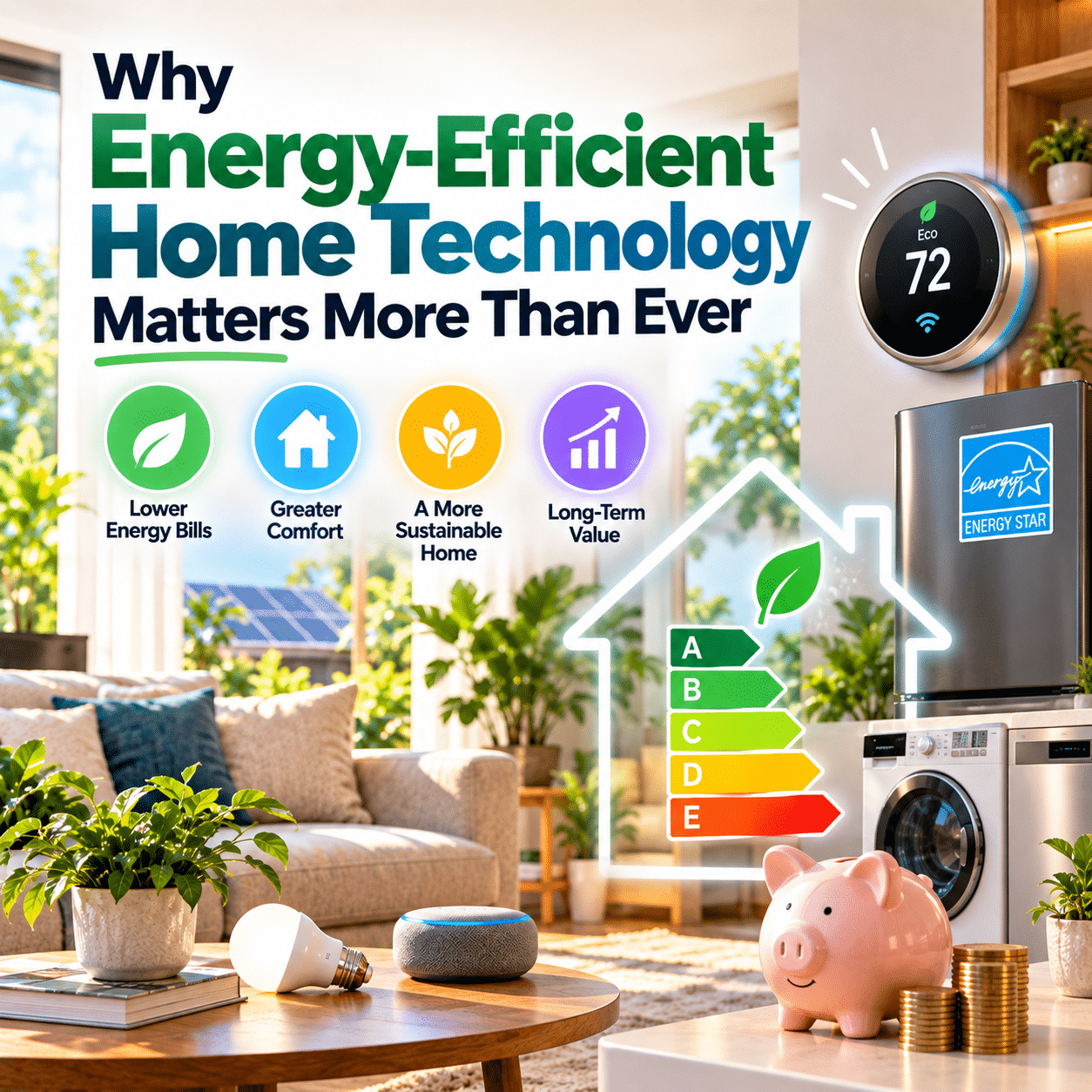
Every home needs energy to support everyday life. Lighting, refrigeration, cooking, heating, cooling, and household electronics all contribute to the energy required to keep a living space comfortable and functional.
But the amount of energy a home uses is not determined by its size or number of appliances alone. Equipment efficiency, building design, climate, maintenance, and daily habits all influence consumption.
This is where energy-efficient home technology makes a meaningful difference.
From advanced heating and cooling systems to efficient lighting, appliances, and intelligent energy controls, modern technology offers ways to deliver essential household services while reducing unnecessary energy use.
The importance of these improvements extends beyond electricity bills. Energy efficiency can support household affordability, indoor comfort, responsible resource use, and more resilient energy systems.
Understanding how these technologies work—and where they provide the greatest benefits—can help households make practical decisions without relying on exaggerated savings claims or unnecessary upgrades.
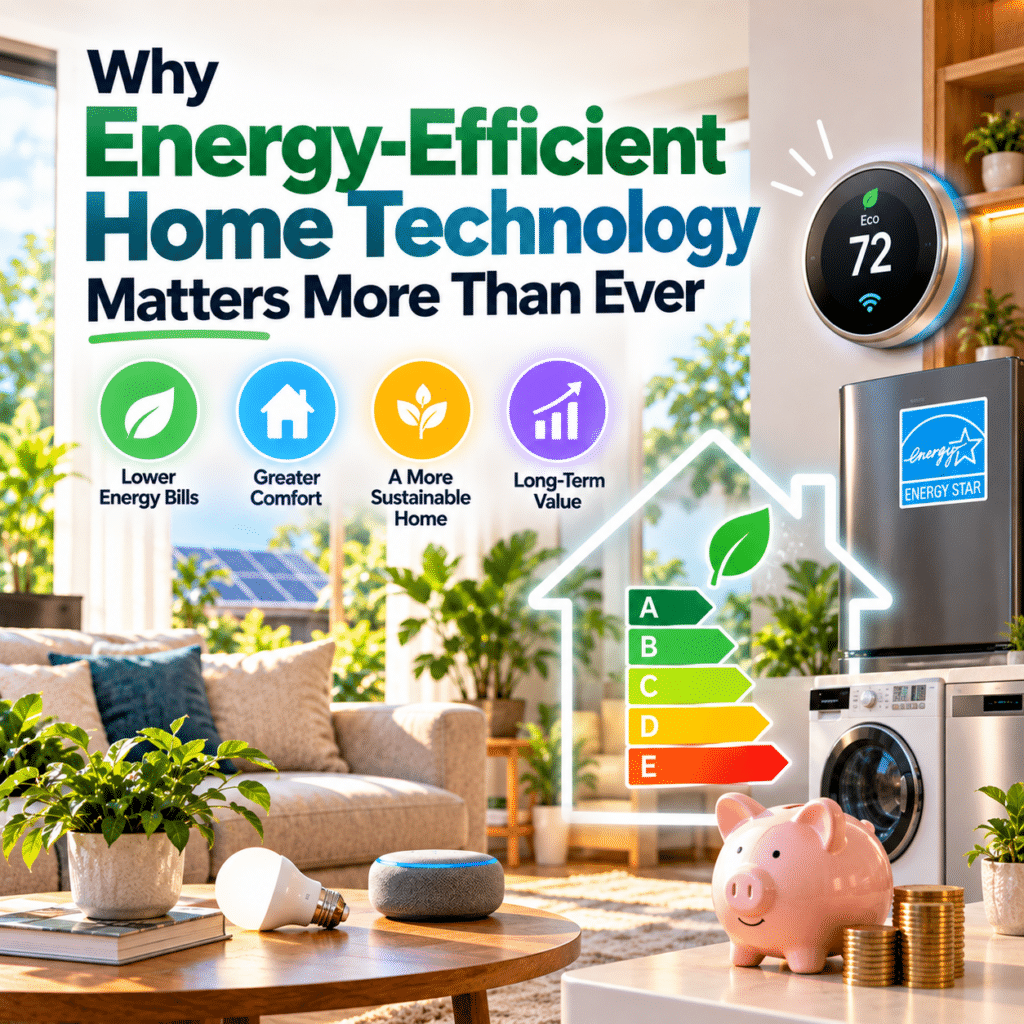
1. What Is Energy-Efficient Home Technology?
Energy-efficient home technology refers to equipment and systems designed to provide a useful service while consuming less energy than a less efficient alternative under comparable conditions.
The key concept is achieving the desired result with fewer energy inputs.
For example, an efficient refrigerator maintains appropriate food-storage temperatures while using less electricity than a comparable inefficient model.
An efficient air-conditioning system provides cooling with less electricity for a given cooling requirement.
Energy-efficient lighting delivers useful illumination while reducing the power needed to produce it.
Common Examples
Energy-efficient home technology includes:
- LED lighting and efficient lighting controls.
- High-efficiency air conditioners and heat pumps.
- Energy-efficient refrigerators, washing machines, and dishwashers.
- Heat pump water heaters and other efficient water-heating systems.
- Smart thermostats and compatible climate controls.
- Energy-monitoring devices and connected power management.
- Efficient ventilation equipment.
- Automated shading and compatible building controls.
Some technologies reduce energy consumption through improved hardware, while others help households avoid unnecessary operation.
Both approaches can contribute to better energy performance.
Energy Efficiency Versus Energy Conservation
Although closely related, energy efficiency and energy conservation are different.
Energy efficiency means using less energy to achieve the same useful result.
Energy conservation means reducing energy consumption by changing behavior or reducing demand.
Replacing an inefficient light bulb with an efficient LED is an example of energy efficiency.
Turning off unnecessary lighting is an example of energy conservation.
The most effective household energy strategies often combine both.
2. Why Home Energy Efficiency Has Become So Important
Energy efficiency matters because households depend on energy services while facing practical limits involving cost, infrastructure, and environmental resources.
The International Energy Agency identifies buildings as a major source of global energy demand. Homes account for a substantial portion of that demand, although the balance between heating, cooling, cooking, and appliances varies considerably across regions.
Several long-term factors explain the importance of improving household efficiency.
Household Energy Costs
Energy prices can fluctuate due to fuel markets, infrastructure conditions, weather, and local policies.
Efficient equipment can reduce exposure to energy costs by lowering the amount of energy required for a particular activity.
The financial benefit depends on local tariffs, equipment performance, and household usage.
Greater Demand for Cooling
Air conditioning is increasingly important in many warm regions.
As cooling needs expand, efficient equipment and well-designed buildings can help limit the additional electricity required.
This is particularly relevant in places where high temperatures create substantial cooling demand.
More Household Electronics
Homes may contain numerous connected devices, entertainment systems, computers, and appliances.
Individual devices vary widely in consumption, but their combined energy use deserves attention.
Environmental Considerations
Reducing energy demand can help lower the resources and emissions associated with supplying energy.
The environmental benefit depends partly on the energy source and the technology being replaced.
Long-Term Household Value
Energy efficiency can also improve comfort, reduce unnecessary equipment operation, and support better building performance.
These benefits make it relevant even when immediate financial savings are modest.
3. Efficient Heating and Cooling Can Make a Major Difference
Heating and cooling are important energy uses in many homes.
Their relative importance depends on climate, building design, and household needs.
In colder regions, space heating may dominate energy consumption. In warmer climates, air conditioning can be a major contributor to electricity demand.
High-Efficiency Air Conditioners
Air conditioners move heat from indoor spaces to the outdoors.
More efficient models can provide a given amount of cooling while consuming less electricity under comparable test conditions.
Efficiency ratings help consumers compare suitable equipment, although rating systems vary by region.
Examples include seasonal energy-efficiency measures used for air-conditioning systems.
Actual consumption depends on installation quality, outdoor temperature, thermostat settings, humidity, and operating hours.
Heat Pump Technology
Heat pumps transfer heat rather than generating it entirely through electrical resistance.
Depending on the system, they can provide heating, cooling, or both.
Under suitable conditions, heat pumps can deliver more thermal energy than the electrical energy they consume because they move existing heat.
However, performance varies with climate, system design, equipment selection, and installation.
Smart Temperature Controls
Compatible smart thermostats can adjust heating and cooling according to schedules, occupancy information, or user preferences.
This may reduce unnecessary operation when a home is unoccupied.
ENERGY STAR-certified smart thermostats are evaluated using real-world performance data to demonstrate energy savings.
Nevertheless, a thermostat cannot compensate for every source of inefficiency.
Poor insulation, unsuitable equipment, and inadequate maintenance may continue to cause excessive energy consumption.
Why Proper Sizing Matters
A heating or cooling system should be appropriately sized for the building and its expected load.
Oversized or undersized equipment can create performance, comfort, and efficiency problems.
Qualified professionals can evaluate the relevant building characteristics and equipment requirements.
Efficient technology delivers the greatest value when it is properly selected, installed, and maintained.
4. LED Lighting Shows How Efficiency Can Improve Everyday Technology
Lighting provides a clear example of technological improvement.
Traditional incandescent bulbs produce light by heating a filament, which releases much of the electrical input as heat.
LEDs use semiconductor technology to produce light more efficiently.
Why LEDs Are Useful
Compared with traditional incandescent lighting, suitable LEDs can provide similar illumination while using substantially less electricity.
They can also offer long service lives, depending on product quality and operating conditions.
This makes them useful for frequently operated household lighting.
Understanding Brightness and Power
Watts measure electrical power, while lumens measure the amount of visible light emitted.
A higher wattage does not necessarily mean a brighter light when comparing different lighting technologies.
Consumers should consider the required brightness, color temperature, fixture compatibility, and intended application.
Lighting Controls
Timers, occupancy sensors, dimmers, and smart controls can help avoid unnecessary lighting use.
However, energy savings depend on actual behavior and system design.
A connected light that remains illuminated longer than necessary may consume more energy than a conventional light used carefully.
Practical Lighting Improvements
A sensible approach includes choosing efficient bulbs, using appropriate brightness levels, and switching off lighting when it is not needed.
Technology and everyday habits work best together.
5. Energy-Efficient Appliances Can Reduce Long-Term Consumption
Refrigerators, washing machines, dishwashers, dryers, and other household appliances often remain in service for many years.
Their operating efficiency can therefore influence long-term energy costs.
Refrigerators and Freezers
Refrigeration equipment operates repeatedly to maintain safe storage temperatures.
Efficient compressors, insulation, temperature controls, and other design features can reduce electricity consumption.
When comparing models, consumers should consider energy-label information alongside usable capacity and required features.
A larger refrigerator may consume more electricity overall even when it is efficient for its size.
Washing Machines
Efficient washing machines may use improved motors, water management, and wash-cycle design.
Because heating water requires energy, water-temperature choices can also influence consumption.
Actual results depend on the appliance, selected program, load size, and local water-heating arrangement.
Dishwashers
Efficient dishwashers can reduce energy and water use through improved washing systems, cycle management, and drying methods.
However, consumption varies between programs.
Eco-oriented cycles may take longer while using less energy or water under suitable conditions.
Clothes Dryers
Drying technology can significantly affect energy use.
Heat pump dryers, for example, reuse heat within the drying process rather than relying on the same operating approach as conventional electric resistance dryers.
They may provide substantial efficiency benefits, although purchase cost, cycle duration, maintenance, and climate conditions should be considered.
Replacing Appliances Thoughtfully
An older appliance is not automatically worth replacing immediately.
A useful decision considers its current consumption, condition, repair costs, replacement efficiency, and expected remaining lifespan.
Replacing functional equipment unnecessarily can introduce additional financial and environmental costs.
6. Efficient Water Heating Deserves More Attention
Hot water is an important household energy service.
It is used for bathing, washing, cleaning, and other everyday activities.
The energy required depends on the amount of water heated, the temperature increase, and the efficiency of the heating system.
Heat Pump Water Heaters
Heat pump water heaters use electricity to move heat into stored water.
Under suitable conditions, they can use considerably less electricity than conventional electric resistance water heaters.
However, installation space, ventilation, surrounding temperature, noise, and household demand affect suitability.
Efficient Storage and Distribution
Heat loss can occur from water storage tanks and distribution pipes.
Appropriate insulation and well-designed systems can help reduce these losses.
Everyday Hot Water Habits
Efficiency improvements can be supported by sensible water use.
Examples include avoiding unnecessary hot-water consumption, repairing leaks, and selecting appropriate temperature settings.
Water-heater temperatures must also account for hygiene and scalding risks.
Households should follow manufacturer instructions and applicable public-health guidance rather than lowering storage temperatures indiscriminately.
7. Smart Energy Management Helps Households Understand Consumption
One of the advantages of connected home technology is the ability to collect and display energy-use information.
Monitoring does not automatically save energy, but it can make consumption patterns easier to understand.
Energy-Monitoring Plugs
Some smart plugs measure the electricity used by connected equipment.
These devices may help identify energy consumption during active use or standby operation.
Not all smart plugs include energy monitoring, and their electrical ratings must be appropriate for the connected load.
Whole-Home Monitoring
Compatible energy-monitoring systems can provide information about overall electricity consumption.
Some systems also estimate or identify usage patterns associated with particular appliances.
The accuracy and detail depend on the technology and installation.
Understanding Energy Data
Energy consumption is commonly measured in kilowatt-hours (kWh).
A kilowatt-hour represents the energy used by a one-kilowatt load operating for one hour.
For example, a device drawing 100 watts continuously for ten hours consumes approximately one kilowatt-hour.
This simple relationship helps explain why both power demand and operating time matter.
Turning Information Into Action
Energy data becomes useful when it supports decisions.
A household might discover that an appliance runs longer than expected or that unnecessary equipment remains powered overnight.
However, not every measured consumption pattern requires intervention.
Some appliances need continuous operation for safety or functionality.
The purpose of monitoring is to identify meaningful opportunities rather than minimize every watt indiscriminately.
8. Efficient Buildings Make Technology Work Better
Even highly efficient equipment can struggle in a poorly designed building.
Heat transfer through roofs, walls, windows, and air leaks affects the amount of heating or cooling required.
This makes the building itself an essential part of home energy efficiency.
Insulation
Insulation helps reduce unwanted heat transfer.
In cold climates, it can reduce heat loss from heated indoor spaces.
In warm climates, appropriate insulation can help limit heat entering cooled spaces.
Its effectiveness depends on material properties, installation, and the building’s overall design.
Air Sealing
Uncontrolled air leakage can increase heating and cooling demand.
Identifying and addressing suitable leakage points can improve efficiency and comfort.
However, air sealing should be coordinated with appropriate ventilation.
Windows and Shading
Windows influence solar heat gain, heat loss, daylight, and comfort.
Appropriate glazing and shading can help manage these effects.
In sunny climates, exterior shading may reduce unwanted solar heat entering certain rooms.
Ventilation
Ventilation is necessary for indoor air quality and moisture management.
Reducing energy waste should not mean eliminating essential fresh-air exchange.
Mechanical ventilation systems and suitable controls may help balance air quality with energy performance.
The Whole-Home Approach
Building improvements and efficient equipment often work best together.
For example, reducing unwanted heat gain may lower cooling demand, allowing a properly sized air-conditioning system to operate more effectively.
This is why energy assessments can be valuable before major equipment investments.
9. Energy Efficiency Is Not the Same as Smart Connectivity
Energy-efficient and smart technologies sometimes overlap, but they serve different purposes.
An energy-efficient appliance uses less energy to deliver a comparable service.
A smart appliance provides connected controls, monitoring, or automation.
A product can be efficient without being connected.
Likewise, a connected product can be inefficient.
Examples of the Difference
An efficient LED bulb may reduce lighting energy use without any wireless functionality.
A smart plug may offer scheduling and remote control but still consume electricity itself.
A high-efficiency air conditioner may perform well without smartphone connectivity.
A connected appliance may provide useful notifications without offering a significant efficiency advantage over a comparable conventional model.
Why This Distinction Matters
Marketing descriptions often emphasize connectivity and convenience.
Consumers interested in reducing energy consumption should prioritize verified efficiency information.
Connected features may support efficient operation, but they should not replace objective performance comparisons.
The most useful technology combines efficient hardware with controls that encourage appropriate operation.
10. How to Evaluate Energy-Efficient Home Technology
Understanding product efficiency requires more than looking for words such as “eco,” “green,” or “energy-saving.”
Reliable comparisons depend on measurable information.
| Evaluation factor | What to consider | Why it matters |
|---|---|---|
| Energy consumption | kWh per year or per operating cycle | Indicates expected energy use under stated conditions |
| Efficiency rating | Applicable regional test standard | Helps compare suitable products |
| Equipment capacity | Size or output relative to household needs | Oversized equipment may waste resources |
| Usage patterns | Operating hours, settings, and frequency | Determines actual consumption |
| Installation | Compatibility and professional requirements | Affects performance and safety |
| Maintenance | Filters, cleaning, servicing, and repairs | Helps preserve efficiency |
| Total ownership cost | Purchase, energy, maintenance, and lifespan | Provides a broader measure of value |
Read Energy Labels Carefully
Energy labels may provide annual consumption estimates, efficiency classes, or other performance measures.
Labeling systems differ between countries.
A rating from one region should not automatically be compared with a different region’s classification system.
Compare Similar Products
An energy-efficient large appliance may consume more electricity than a smaller appliance because it provides greater capacity.
Fair comparisons should consider products that meet similar household needs.
Consider Real Operating Conditions
Laboratory ratings provide standardized comparisons, but actual energy use depends on the environment and user behavior.
For example, air-conditioning consumption can vary significantly with climate, thermostat settings, and building insulation.
Look Beyond the Initial Price
A more efficient device may have a higher purchase price but lower operating costs.
Whether it offers better value depends on the price difference, expected energy savings, local energy tariffs, and product lifespan.
11. Understanding the Financial Value of Energy Efficiency
The economic value of an efficiency upgrade can be estimated using energy consumption and local prices.
A simple calculation helps illustrate the process.
Example: Comparing Two Appliances
Suppose two comparable appliances have the following estimated annual electricity consumption:
- Appliance A: 400 kWh per year.
- Appliance B: 250 kWh per year.
The difference is 150 kWh annually.
If electricity costs $0.20 per kWh, the estimated annual electricity-cost difference would be:
150 kWh × $0.20 = $30 per year.
This is a hypothetical example, not a claim about any particular product.
Actual results depend on real consumption and the applicable electricity tariff.
Calculating Simple Payback
If the more efficient appliance costs $120 extra and saves an estimated $30 per year, its simple payback period would be:
$120 ÷ $30 = 4 years.
This calculation excludes maintenance differences, financing costs, energy-price changes, and the time value of money.
It is a starting point rather than a complete financial analysis.
When Savings May Be Small
A highly efficient device used only occasionally may offer limited financial savings.
By contrast, improving a heavily used system can have a greater effect on annual energy consumption.
The best opportunities are usually identified by understanding where the household uses the most energy.
12. Energy Efficiency and Environmental Responsibility
Energy efficiency can reduce the amount of energy required to provide essential services.
This may reduce fuel consumption, electricity generation requirements, and associated emissions.
However, the environmental impact depends on the energy source, equipment manufacturing, and product lifecycle.
Lower Operational Energy Demand
Efficient appliances and building systems can reduce energy demand during operation.
When electricity or fuel production creates emissions, using less energy can reduce the emissions associated with those activities.
Supporting Energy Systems
Reducing unnecessary electricity demand can help ease pressure on energy infrastructure.
This may be particularly valuable during periods of high heating or cooling demand.
Manufacturing and Replacement Impacts
Producing new equipment requires materials and energy.
Replacing an existing device therefore creates environmental impacts before the new product begins operating.
The benefits of replacement depend on the efficiency improvement, remaining lifespan of the existing equipment, and characteristics of the new product.
Responsible Ownership
Maintaining appliances, repairing suitable equipment, and choosing durable products can complement energy-efficiency improvements.
Environmental responsibility involves both efficient operation and thoughtful purchasing decisions.
13. Common Misunderstandings About Energy-Efficient Technology
Several assumptions can lead to disappointing results.
“Every Smart Device Saves Energy”
Connectivity does not guarantee efficiency.
A smart device may add convenience without reducing consumption.
“The Most Efficient Product Is Always the Best Purchase”
A highly efficient product may be unsuitable because of cost, capacity, installation requirements, or household needs.
“Replacing Everything Immediately Is the Greenest Choice”
Premature replacement can create unnecessary waste and expense.
The decision should consider the complete product lifecycle.
“Energy Ratings Predict Exact Household Bills”
Standardized ratings support comparison but cannot predict every home’s operating conditions.
“Automation Eliminates the Need for Good Habits”
Automated controls can help, but inappropriate schedules and settings may still waste energy.
“Lower Energy Use Always Means Better Comfort”
Energy reductions should not compromise essential heating, cooling, ventilation, food safety, or other household requirements.
The goal is efficient performance—not simply the lowest possible consumption.
14. A Practical Approach to Improving Home Energy Efficiency
Households can make progress without replacing every appliance or investing in a complex smart home system.
Step 1: Understand Current Energy Use
Review utility bills and identify major energy-consuming activities.
Where practical, use appropriate monitoring equipment or a professional energy assessment.
Step 2: Identify High-Impact Opportunities
Heating, cooling, water heating, and frequently used appliances may offer meaningful opportunities, depending on the household.
Focus on actual consumption rather than assumptions.
Step 3: Address Unnecessary Energy Losses
Consider appropriate insulation, shading, air sealing, maintenance, and operating settings.
Some improvements may be more valuable than purchasing additional connected devices.
Step 4: Choose Efficient Replacements When Needed
When equipment reaches the end of its useful life, compare suitable replacements using recognized efficiency information.
Step 5: Use Controls Thoughtfully
Schedules, sensors, and monitoring can support better operation.
Keep essential controls understandable and accessible.
Step 6: Evaluate the Results
Compare energy use over meaningful periods while accounting for weather, occupancy, and changes in household activity.
A lower bill does not always mean better efficiency if energy prices or usage conditions have changed.
Step 7: Maintain the Improvements
Follow manufacturer guidance for cleaning, servicing, and safe operation.
Long-term efficiency depends on proper maintenance as well as equipment design.
15. The Future of Energy-Efficient Home Technology
Energy-efficient home technology continues to develop through improvements in equipment design, digital controls, and building systems.
Several long-term directions are especially relevant.
More Efficient Heating and Cooling
Improved heat pumps, air conditioners, and system controls can help deliver comfort with less energy.
Their effectiveness will continue to depend on proper installation and building conditions.
Better Coordination Between Devices
Connected systems may help households coordinate selected appliances, temperature settings, and energy-intensive activities.
These functions can be useful when they respond to actual needs and reliable information.
More Flexible Electricity Demand
Some compatible devices can adjust when they operate in response to electricity prices, utility programs, or household preferences.
This is known as demand flexibility.
Shifting electricity use to another time does not necessarily reduce total energy consumption, but it may help manage costs or reduce demand during peak periods.
Integration With Solar and Energy Storage
Homes equipped with suitable solar generation or battery systems may use energy-management technology to coordinate electricity production, storage, and consumption.
However, generating renewable electricity is different from reducing the amount of energy needed.
Efficiency remains valuable regardless of the energy source.
Greater Focus on Whole-Building Performance
Future improvements are likely to involve better coordination between building insulation, ventilation, heating, cooling, and controls.
The most effective solutions consider the home as a complete system rather than treating every appliance independently.
Conclusion: Energy Efficiency Is About Using Resources More Wisely
Energy-efficient home technology matters because it helps households obtain essential services while reducing unnecessary energy consumption.
Efficient lighting, heating and cooling equipment, appliances, water heaters, and building improvements can contribute to lower operating costs, better comfort, and more responsible resource use.
Smart controls and monitoring can provide additional support, but connectivity alone does not guarantee savings.
The greatest benefits come from matching technology to real household needs, understanding verified performance information, and maintaining equipment properly.
Energy efficiency is not about sacrificing comfort or constantly purchasing newer products.
It is about making thoughtful choices that allow a home to function well with fewer wasted resources.
As household energy needs continue to evolve, this principle will remain valuable: the most effective home technology is not simply the most advanced—it is the technology that delivers the right performance with the least unnecessary energy use.