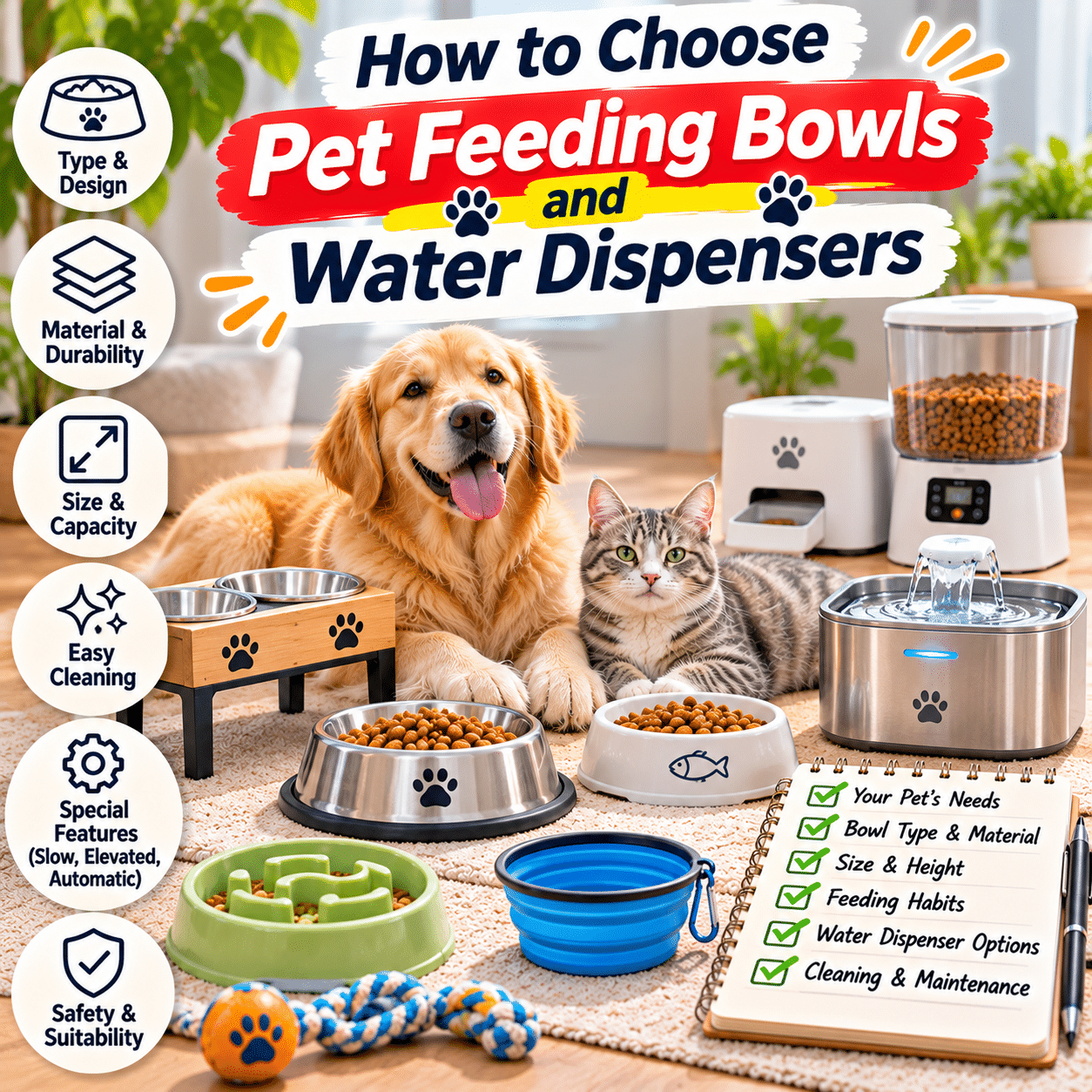
Choosing the right feeding bowls and water dispensers is an important part of creating a comfortable, practical, and hygienic daily routine for your dog or cat. Although these accessories may seem simple, their size, shape, materials, stability, and cleaning requirements can make a meaningful difference in how easily your pet eats and drinks.
From traditional stainless steel bowls and ceramic dishes to elevated feeding stations, slow feeders, automatic food dispensers, and circulating water fountains, pet owners have many options. Each design serves a different purpose, and not every feature is necessary or suitable for every animal.
A shallow bowl may be comfortable for a cat that dislikes having its whiskers pressed against the sides, while a large dog may need a wider, more stable feeding dish. A slow feeder may help some dogs eat at a more manageable pace, while a water fountain may encourage certain cats to investigate and drink more frequently.
However, convenience should never come at the expense of safety, hygiene, or your pet’s individual needs.
The best pet feeding bowls and water dispensers are not necessarily the most expensive or technologically advanced products. They are the ones that provide safe access to food and fresh water, are comfortable for your pet to use, and are easy to maintain consistently.
This comprehensive buying guide explains how to choose pet feeding bowls and water dispensers, compare materials and designs, understand important features, and build a practical feeding and hydration setup for dogs and cats.
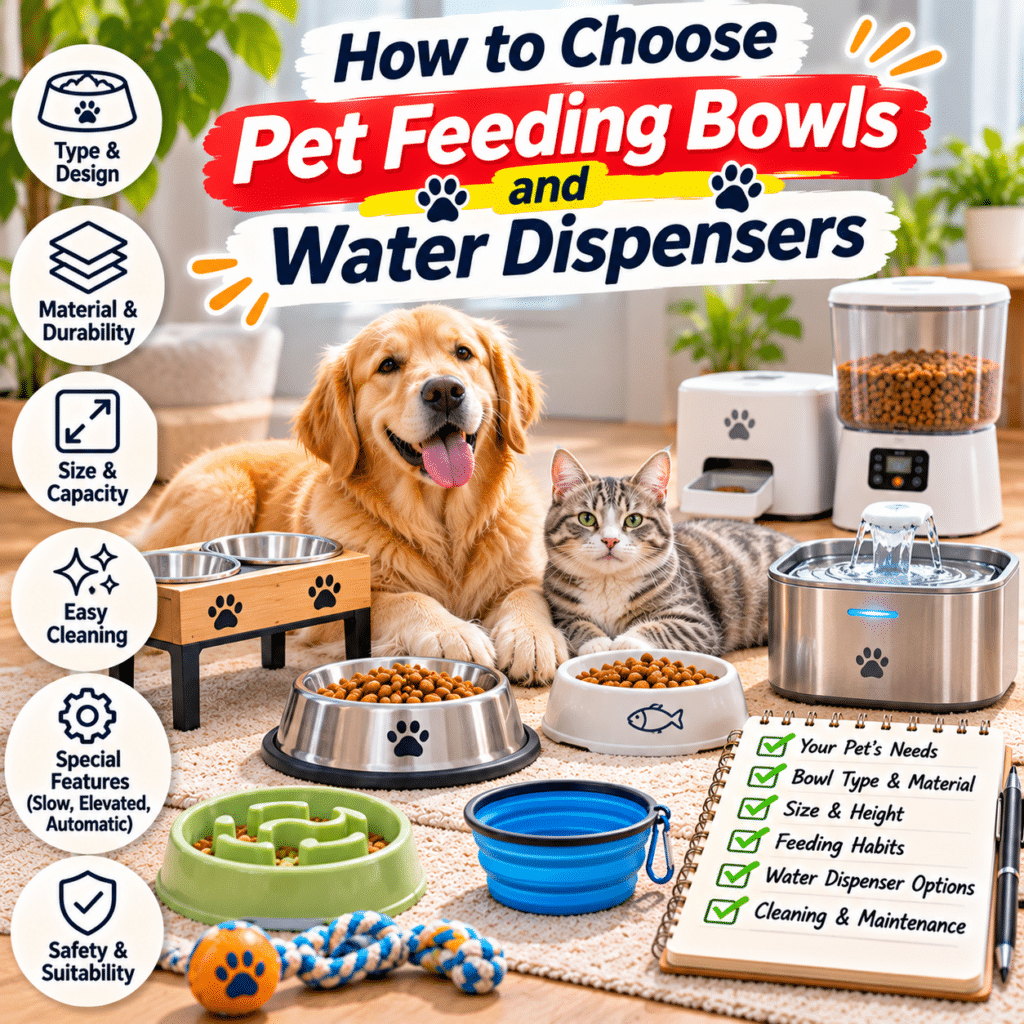
1. Understand Your Pet’s Feeding and Hydration Needs
Before buying a bowl or dispenser, consider your pet’s everyday habits.
Dogs and cats differ in body size, eating behavior, drinking preferences, and tolerance for different feeding arrangements.
Even animals of the same breed or size may have different preferences.
Important Factors to Consider
- Species
- Body size
- Age
- Muzzle and facial shape
- Eating speed
- Drinking habits
- Mobility
- Food type
- Household environment
- Number of pets
- Cleaning routine
- Available floor space
Questions to Ask Before Buying
- Does my pet eat dry food, wet food, or a combination?
- How much food is served at each meal?
- Does my pet push bowls across the floor?
- Does food frequently spill over the sides?
- Does my pet drink comfortably from a traditional bowl?
- Would a shallow or wide bowl be easier to use?
- Does my pet need help eating more slowly?
- Can I clean the equipment thoroughly every day?
- Will the equipment remain accessible during power outages?
- Do I need a simple bowl or a more specialized feeding system?
Answering these questions helps identify features that genuinely improve daily care.
2. Understand the Main Types of Pet Feeding Bowls
Pet feeding bowls come in several common designs.
| Bowl Type | Main Characteristics | Potential Uses |
|---|---|---|
| Standard bowl | Simple open container | Everyday food and water |
| Stainless steel bowl | Metal construction | Durable, easy-clean feeding |
| Ceramic bowl | Glazed ceramic construction | Stable indoor feeding |
| Plastic bowl | Lightweight molded design | Portable or occasional use |
| Shallow bowl | Low sides and wide opening | Some cats and flat-faced pets |
| Deep bowl | Taller sides and greater depth | Larger portions or certain dogs |
| Non-slip bowl | Rubberized or textured base | Reducing sliding |
| Elevated bowl | Bowl raised above floor level | Specific accessibility needs |
| Slow feeder | Ridges or compartments inside | Slowing some pets’ eating |
| Divided bowl | Separate food compartments | Serving different food components |
| Collapsible bowl | Foldable construction | Travel and outdoor activities |
| Automatic feeder | Controlled food dispensing | Scheduled meals |
Some products combine several features, such as a stainless steel bowl with a non-slip base or a ceramic bowl designed for an elevated stand.
3. Compare Common Pet Bowl Materials
Material selection affects durability, cleaning, weight, and long-term maintenance.
| Material | Advantages | Potential Limitations |
|---|---|---|
| Stainless steel | Durable, nonporous, easy to clean | Lightweight versions may slide |
| Ceramic | Stable, attractive, often dishwasher-safe | Can chip, crack, or break |
| Plastic | Lightweight and affordable | Can scratch and retain residue |
| Silicone | Flexible and portable | May retain odors or attract debris |
| Glass | Smooth, nonporous surface | Breakable and sometimes heavy |
| Bamboo-composite materials | Lightweight and decorative | Composition and durability vary |
No material is automatically ideal for every situation.
Choose based on construction quality, cleaning requirements, and your pet’s behavior.
4. Understand Stainless Steel Pet Bowls
Stainless steel is a popular choice for everyday pet feeding.
Advantages
- Durable construction
- Nonporous surface
- Generally easy to clean
- Resistant to many forms of staining
- Suitable for food and water
- Available in many sizes
- Often dishwasher-safe when specified
Potential Limitations
- Lightweight bowls can slide
- Some pets dislike metallic sounds
- Thin bowls may dent
- Quality and corrosion resistance vary
What to Look For
- Food-contact suitability
- Smooth interior surface
- Rounded edges
- Stable base
- Secure construction
- Clear cleaning instructions
Practical Buying Advice
Choose a bowl with smooth, well-finished surfaces and no sharp seams.
A heavier base or non-slip ring can improve stability.
5. Understand Ceramic Pet Bowls
Ceramic bowls are commonly chosen for their weight, appearance, and smooth surfaces.
Advantages
- Often heavier than plastic bowls
- Available in many shapes and colors
- Can remain stable during feeding
- Smooth glazed surfaces can be easy to clean
- Suitable for many indoor environments
Potential Limitations
- Can chip or crack
- May break if dropped
- Some decorative finishes may not be suitable for food contact
- Heavy bowls can be inconvenient for travel
Important Buying Considerations
Choose products specifically intended for food use.
Look for a durable, intact glaze and clear manufacturer information about food-contact safety.
Inspect Regularly
Replace bowls with cracks, chips, or damaged surfaces that cannot be cleaned safely.
6. Understand Plastic Pet Bowls
Plastic bowls are lightweight and widely available.
Advantages
- Affordable
- Easy to transport
- Available in many shapes
- Often resistant to breaking when dropped
- Convenient for some temporary uses
Potential Limitations
- May scratch with repeated use
- Scratches can make cleaning more difficult
- Some plastics retain odors or stains
- Lightweight bowls may move during feeding
- Durability varies by material
What to Look For
- Food-contact suitability
- Smooth construction
- Clear material information
- Appropriate cleaning instructions
- Durable, scratch-resistant design
Practical Advice
Replace plastic bowls that become deeply scratched, cracked, or difficult to clean.
7. Understand Silicone Pet Bowls
Silicone is commonly used for collapsible travel bowls and flexible feeding accessories.
Advantages
- Lightweight
- Flexible
- Compact storage
- Convenient for travel
- Often easy to rinse
Potential Limitations
- Flexible sides may spill
- Some products attract lint or debris
- Quality varies
- Certain designs may retain odors
Important Considerations
Choose food-contact-grade products from manufacturers that provide clear material and care information.
Best Uses
Silicone bowls are often practical for travel, hiking, road trips, and temporary feeding arrangements.
8. Choose the Correct Feeding Bowl Size
Bowl size should match your pet’s body size and meal portions.
A bowl that is too small may cause food to spill.
An excessively large bowl may be awkward for a small animal.
Consider
- Meal volume
- Food texture
- Pet size
- Muzzle width
- Bowl depth
- Eating style
Allow Some Extra Space
The bowl should comfortably hold the meal without being filled to the rim.
Avoid Relying on Size Labels
Manufacturer labels such as small, medium, and large are not standardized.
Compare actual bowl dimensions and usable capacity.
9. Understand Bowl Capacity
Bowl capacity is commonly listed in milliliters, liters, cups, or fluid ounces.
Important Distinction
A bowl’s maximum capacity is not necessarily its practical serving capacity.
Filling a bowl completely may cause spills.
Dry Food
Consider the volume of the typical meal.
Wet Food
A shallow, wider surface may be more convenient than a deep bowl.
Water
Choose enough capacity to provide ready access to fresh water while allowing frequent replacement and cleaning.
Practical Buying Advice
Measure a normal serving before selecting a bowl.
Do not use bowl size as a substitute for appropriate food portioning.
10. Choose a Bowl for Small Dogs
Small dogs may benefit from compact bowls with accessible sides.
Useful Features
- Suitable diameter
- Low or moderate depth
- Stable base
- Smooth edges
- Easy cleaning
Avoid Oversized Designs
A large, deep bowl may be uncomfortable for a small dog to reach into.
Consider Individual Preferences
Some small dogs prefer shallow dishes, while others use standard bowls comfortably.
11. Choose a Bowl for Medium and Large Dogs
Larger dogs often need wider bowls with sufficient capacity.
Useful Features
- Adequate diameter
- Suitable depth
- Durable construction
- Stable base
- Non-slip underside
- Easy cleaning
Consider Eating Behavior
Dogs that push bowls or eat enthusiastically may benefit from heavier or more stable designs.
Avoid Unnecessary Elevation
Bowl height should be selected according to individual needs rather than assuming raised feeding is better for all large dogs.
12. Choose a Bowl for Cats
Cats may prefer different bowl shapes and feeding locations.
Useful Features
- Wide opening
- Shallow or moderate depth
- Smooth interior
- Stable construction
- Easy cleaning
Consider Whisker Contact
Some cats appear to prefer dishes that reduce contact between their whiskers and the sides.
However, the idea of universal “whisker fatigue” is not firmly established as a medical condition.
Practical Advice
If your cat consistently removes food from a deep bowl or avoids reaching into it, try a wider, shallower dish.
13. Choose Bowls for Flat-Faced Pets
Some brachycephalic, or short-muzzled, dogs and cats may find certain bowl shapes easier to use.
Useful Features
- Wide opening
- Accessible food surface
- Moderate depth
- Stable base
- Smooth edges
Consider Angled Bowls
Some products tilt the food surface toward the animal.
These may be convenient for certain pets, but comfort and safety depend on the individual.
Avoid Unsupported Claims
An angled bowl is not a proven treatment for breathing, swallowing, or digestive problems.
Pets with difficulty eating or breathing should be evaluated by a veterinarian.
14. Understand Shallow Versus Deep Bowls
Bowl depth influences access and spillage.
Shallow Bowls
Potential advantages:
- Easy access
- Convenient for wet food
- May suit some cats
- Easier to inspect and clean
Potential limitations:
- Food may spill more easily
- Limited capacity
Deep Bowls
Potential advantages:
- Greater capacity
- May contain food more effectively
- Useful for some larger dogs
Potential limitations:
- Less convenient for some small or flat-faced pets
- Food may collect in difficult-to-reach areas
Best Choice
Select depth based on your pet’s facial shape and eating behavior.
15. Understand Non-Slip Pet Bowls
Non-slip bowls are designed to reduce movement during feeding.
Common Features
- Rubber rings
- Silicone bases
- Textured undersides
- Weighted construction
Advantages
- Reduced sliding
- More stable feeding
- Less noise on hard flooring
- Potentially fewer spills
Limitations
- Rubber components may wear
- Some bases trap moisture
- Effectiveness depends on flooring
Practical Buying Advice
Check whether the non-slip components can be cleaned and dried thoroughly.
16. Understand Elevated Feeding Bowls
Elevated feeding bowls are supported above floor level.
Potential Advantages
- May improve access for some pets with specific mobility limitations
- Can reduce the need to bend as far
- May help organize feeding areas
Potential Limitations
- Not necessary for most healthy pets
- Can create stability issues if poorly designed
- May be unsuitable for some dogs
- Fixed heights may not fit the individual animal
Important Health Consideration
Elevated feeding has not been shown to prevent gastric dilatation-volvulus, commonly called bloat.
Some observational research has associated raised feeding with increased risk in certain large and giant dog populations, although the evidence has limitations.
Consult your veterinarian before choosing an elevated feeder for a dog at increased risk of bloat.
17. Choose the Correct Elevated Bowl Height
When elevation is appropriate for an individual pet, the stand should allow comfortable access.
Important Factors
- Body height
- Neck mobility
- Standing posture
- Bowl depth
- Stability
- Veterinary recommendations
Avoid Universal Height Rules
There is no single bowl height that is ideal for every dog or cat.
Practical Advice
Observe whether your pet can eat comfortably without awkward stretching or positioning.
For pets with medical or mobility concerns, follow veterinary guidance.
18. Understand Slow Feeder Bowls
Slow feeders contain ridges, channels, or compartments that make food less accessible in a single mouthful.
Potential Advantages
- May slow eating
- Can provide a feeding challenge
- May reduce rapid gulping in some pets
- Offers an alternative feeding activity
Potential Limitations
- Some designs frustrate pets
- Deep channels can be difficult to clean
- May be unsuitable for certain facial shapes
- Not all foods work equally well
- Can encourage chewing of the feeder if poorly matched
Important Distinction
Slow feeders are not proven to prevent bloat or other serious digestive conditions.
19. Choose a Slow Feeder for Your Dog
A suitable slow feeder should provide a manageable challenge without making eating excessively difficult.
What to Look For
- Appropriate size
- Smooth ridges
- Stable base
- Food-safe materials
- Easy cleaning
- Suitable channel depth
Consider Food Type
Dry kibble and wet food may require different designs.
Monitor Your Dog
If your dog becomes frustrated, chews the feeder, or struggles to access food, choose a simpler design.
20. Consider Slow Feeding for Cats
Some cats benefit from puzzle feeders or food-dispensing toys that encourage gradual food access.
Potential Benefits
- Feeding enrichment
- Slower consumption
- Additional activity
- Opportunities for natural food-seeking behavior
Important Considerations
- Appropriate difficulty
- Food compatibility
- Easy cleaning
- Individual tolerance
Avoid Excessive Difficulty
A feeding device should not prevent a cat from consuming adequate food.
21. Understand Divided Feeding Bowls
Divided bowls contain separate compartments.
Potential Uses
- Separating food components
- Offering different textures
- Keeping wet and dry foods apart temporarily
Limitations
- Compartments may be difficult to clean
- Fixed sizes may not match portions
- Some pets mix the contents anyway
Practical Advice
Choose a divided bowl only when separate compartments serve a clear purpose.
22. Understand Automatic Pet Feeders
Automatic feeders dispense food according to a schedule or other programmed setting.
Common Features
- Timed meals
- Portion controls
- Food storage hopper
- Digital display
- Battery backup
- App connectivity
- Feeding records
Potential Advantages
- Convenient scheduled feeding
- Consistent meal timing
- Useful for some multi-meal routines
Potential Limitations
- Mechanical jams
- Portion inaccuracies
- Battery or power failure
- Food storage concerns
- Additional cleaning requirements
Important Reminder
Automatic feeders do not replace daily pet monitoring and responsible care.
23. Compare Gravity Feeders and Timed Feeders
Gravity Feeders
Gravity feeders allow dry food to refill the bowl as food is consumed.
Advantages
- Simple mechanism
- No programming required
- Often no electricity needed
Limitations
- Limited portion control
- Not suitable for pets that overeat
- Food may remain exposed for extended periods
Timed Feeders
Timed feeders dispense food at scheduled intervals.
Advantages
- More controlled meal timing
- Potential portion management
- Useful for some structured routines
Limitations
- Requires reliable mechanisms
- Needs power or batteries
- Can malfunction
Best Choice
Choose according to your pet’s feeding plan and need for portion control.
24. Evaluate Automatic Feeder Portion Accuracy
Portion accuracy matters when meals must be carefully managed.
Important Factors
- Kibble size
- Kibble shape
- Dispensing mechanism
- Portion calibration
- Hopper condition
- Software settings
Avoid Assuming Perfect Accuracy
A feeder’s programmed portion may not always match the actual amount dispensed.
Practical Advice
Test the device using your pet’s regular food and verify portions with an appropriate measuring method.
For medically prescribed feeding plans, follow veterinary guidance.
25. Understand Automatic Feeder Food Compatibility
Many automatic feeders are designed primarily for dry kibble.
Dry Food
Usually easier to store and dispense mechanically.
Wet Food
Requires more careful handling because of spoilage concerns.
Refrigerated Feeders
Some specialized products are designed for wet food with temperature-control features.
Important Consideration
Follow manufacturer instructions regarding food type, storage duration, and safe temperatures.
Do not leave perishable pet food unrefrigerated for extended periods.
26. Consider Automatic Feeder Power Options
Automatic feeders may use:
- Mains power
- Replaceable batteries
- Rechargeable batteries
- Combined power systems
Useful Features
- Battery backup
- Low-power alerts
- Secure power connection
- Reliable programming retention
Important Limitation
A backup battery does not guarantee continued operation under every failure condition.
Practical Advice
Test the feeder periodically and maintain an alternative feeding plan.
27. Understand Smart Pet Feeders
Smart feeders may connect to a phone application through Wi-Fi or another communication system.
Common Features
- Remote scheduling
- Feeding notifications
- Portion adjustments
- Feeding history
- Camera integration
- Voice recording
Potential Advantages
- Convenient schedule management
- Remote visibility into some feeder functions
- Additional customization
Potential Limitations
- Network dependence
- App compatibility changes
- Account requirements
- Privacy considerations
- Software updates
- Greater complexity
Choose Practical Features
A reliable basic feeder may be preferable to a complicated smart feeder that does not improve your routine.
28. Evaluate Smart Feeder Reliability
When comparing connected feeders, consider more than the advertised features.
Important Questions
- Can scheduled meals continue without internet access?
- What happens during a power outage?
- Are feeding settings stored locally?
- Does the device report dispensing errors?
- Can the food mechanism be cleaned?
- Is customer support available?
- Does the manufacturer provide software updates?
Test Before Relying on Automation
Observe several feeding cycles to confirm that the device operates correctly.
29. Understand Multi-Pet Feeding Challenges
Homes with multiple pets may require separate feeding arrangements.
Common Challenges
- Food stealing
- Different dietary requirements
- Unequal portions
- Resource guarding
- Different eating speeds
Potential Solutions
- Separate feeding locations
- Supervised mealtimes
- Individual bowls
- Controlled-access feeders
- Microchip or identification-based feeders
Important Consideration
Electronic identification systems are not perfect and should be tested carefully.
30. Understand Microchip-Activated Feeders
Some feeders open only for an animal with a compatible identification device.
Potential Advantages
- Helps separate diets
- May reduce food stealing
- Useful in some multi-pet households
Potential Limitations
- Compatibility requirements
- Mechanical complexity
- Battery maintenance
- Access-control errors
- Training period
Practical Advice
Verify identification compatibility and observe how each pet responds before depending on the system.
31. Understand the Main Types of Pet Water Dispensers
Water dispensers are available in several designs.
| Water Dispenser Type | Main Characteristics | Potential Uses |
|---|---|---|
| Traditional water bowl | Open water container | Simple daily hydration |
| Gravity water dispenser | Reservoir refills bowl | Larger water supply |
| Electric water fountain | Pump circulates water | Pets attracted to moving water |
| Filtered fountain | Circulation with filtration | Managing some debris and odors |
| Travel water bottle | Portable water container | Walks and travel |
| Collapsible water bowl | Foldable portable dish | Hiking and outdoor trips |
| Automatic refill system | Connected water supply | Specialized setups |
| Outdoor water station | Weather-appropriate water access | Supervised outdoor use |
Each design requires appropriate cleaning and monitoring.
32. Understand Traditional Water Bowls
A standard water bowl is one of the simplest hydration options.
Advantages
- Easy to inspect
- No electricity required
- Simple to clean
- Affordable
- Available in many sizes
Potential Limitations
- Requires frequent refilling
- Can collect hair and debris
- May spill
- Water may become warm in some locations
Practical Advice
A clean, appropriately sized bowl is a dependable choice for many pets.
33. Understand Gravity Water Dispensers
Gravity dispensers use a reservoir that releases water as the bowl level decreases.
Advantages
- Larger stored water supply
- No electricity required in many designs
- Convenient for some households
Potential Limitations
- Reservoirs can be difficult to clean
- Water may remain stored for extended periods
- Some designs spill during refilling
- Water quality still requires monitoring
Important Reminder
A large reservoir does not eliminate the need to replace water and clean the system.
34. Understand Electric Pet Water Fountains
Pet water fountains use a pump to circulate water.
Potential Advantages
- Moving water may attract some pets
- Continuous circulation
- Often includes filtration
- Available in multiple designs
Potential Limitations
- Requires electricity or battery power
- Pump maintenance
- Filter replacement
- Noise
- More components to clean
- Potential mechanical failure
Practical Buying Advice
Choose a fountain that can be disassembled and cleaned thoroughly.
35. Do Cats Prefer Running Water?
Some cats show interest in moving water.
Others are comfortable drinking from a traditional bowl.
Why Preferences Vary
- Familiarity
- Sound
- Movement
- Bowl location
- Water freshness
- Individual behavior
Important Distinction
A fountain may encourage some cats to drink, but it does not guarantee increased water consumption.
Monitor Hydration
If your cat appears to drink unusually little or much, consult a veterinarian.
Changes in drinking behavior can have medical significance.
36. Choose a Water Fountain for Your Cat
A cat-friendly fountain should provide comfortable access and manageable maintenance.
Useful Features
- Accessible drinking surface
- Quiet pump
- Stable construction
- Easy disassembly
- Replaceable filters
- Suitable reservoir capacity
- Smooth surfaces
Consider Whisker Contact
A wide drinking area may be more comfortable for some cats.
Consider Placement
Place the fountain in a quiet, accessible location away from litter boxes.
37. Choose a Water Dispenser for Your Dog
Dogs may require larger water capacities depending on size, activity, diet, and environmental conditions.
Useful Features
- Stable base
- Accessible drinking height
- Appropriate capacity
- Durable construction
- Easy cleaning
- Secure reservoir
For Large Dogs
A wider, heavier bowl may help reduce spills.
For Active Dogs
Water should remain readily accessible, particularly during warm weather and after activity.
38. Understand Water Dispenser Capacity
Water capacity should be selected according to household needs.
Important Factors
- Number of pets
- Body size
- Diet
- Activity level
- Temperature
- Refill frequency
- Cleaning schedule
Avoid Using Capacity as a Substitute for Monitoring
A large dispenser can still run low, malfunction, or become contaminated.
Practical Advice
Choose enough capacity for convenient use while maintaining regular water replacement.
39. Understand Water Filtration in Pet Fountains
Some fountains use replaceable filters.
Common Filter Components
- Activated carbon
- Mechanical filter pads
- Mesh screens
- Ion-exchange materials in some designs
Potential Functions
- Capture hair and debris
- Reduce certain odors
- Improve water appearance
- Remove some substances depending on filter design
Important Limitations
Filters do not necessarily remove pathogens or make unsafe water safe.
A filtered fountain still requires potable water and regular cleaning.
40. Understand Filter Replacement Requirements
Filter performance changes with use.
Important Considerations
- Manufacturer replacement schedule
- Water quality
- Number of pets
- Hair and debris accumulation
- Filter availability
- Replacement cost
Avoid Reusing Filters Beyond Instructions
A clogged or deteriorated filter may reduce flow and hygiene.
Long-Term Cost
Consider replacement filters when comparing fountain prices.
41. Evaluate Water Fountain Pump Quality
The pump is a central component of an electric fountain.
Important Features
- Reliable circulation
- Suitable flow rate
- Low operating noise
- Easy cleaning
- Accessible replacement parts
- Clear operating instructions
Pump Maintenance
Hair, mineral deposits, and debris may reduce performance.
Practical Buying Advice
Choose a design that allows the pump housing and accessible components to be cleaned according to manufacturer instructions.
42. Consider Water Fountain Noise
Pump noise can affect both pets and household comfort.
Common Noise Sources
- Pump vibration
- Water splashing
- Low water level
- Air trapped in the pump
- Loose components
Useful Features
- Quiet pump
- Stable housing
- Adjustable flow
- Appropriate water-level indicators
Practical Advice
Consider where the fountain will be placed, especially in bedrooms or quiet living areas.
43. Understand Adjustable Water Flow
Some fountains offer multiple flow settings.
Potential Advantages
- Adaptable drinking experience
- Reduced splashing
- Adjustable sound level
- Different water movement patterns
Limitations
- Additional controls
- More components
- Some pets may dislike stronger flow
Best Choice
Choose a fountain that allows comfortable drinking without excessive splashing.
44. Compare Stainless Steel, Ceramic, and Plastic Water Fountains
| Fountain Material | Advantages | Considerations |
|---|---|---|
| Stainless steel | Durable, smooth, often easy to clean | Metal quality and pump housing still matter |
| Ceramic | Stable and attractive | Heavy and breakable |
| Plastic | Lightweight and versatile | Scratching and cleaning concerns |
| Mixed materials | Flexible design possibilities | Different parts may require different cleaning methods |
Important Reminder
Even a stainless steel fountain may contain plastic pump components, tubing, or filter housings.
Evaluate the entire water-contact system.
45. Consider Fountain Cleaning Accessibility
Cleaning is one of the most important factors when choosing a water fountain.
What to Look For
- Removable reservoir
- Accessible pump
- Simple tubing
- Minimal narrow crevices
- Smooth water-contact surfaces
- Dishwasher-safe parts where specified
- Clear maintenance instructions
Avoid Overly Complex Designs
Decorative channels and hidden cavities can make thorough cleaning difficult.
Practical Advice
A simpler fountain that you clean consistently may be better than an elaborate design that is difficult to maintain.
46. Understand Biofilm in Pet Water Dispensers
Biofilm is a community of microorganisms attached to a surface within a protective matrix.
It can develop on wet surfaces, including water containers.
Why It Matters
Biofilm can be difficult to remove through rinsing alone.
Prevention and Management
- Clean water-contact surfaces regularly
- Follow manufacturer cleaning instructions
- Replace water frequently
- Clean pump components
- Replace filters as recommended
- Avoid leaving stagnant water
Important Distinction
Water circulation and filtration do not eliminate the need for physical cleaning.
47. Choose Easy-to-Clean Feeding Equipment
Daily cleaning convenience affects long-term hygiene.
Useful Features
- Smooth surfaces
- Minimal crevices
- Removable components
- Dishwasher compatibility
- Durable finishes
- Accessible corners
Avoid Complicated Designs
Deep grooves, fixed compartments, and inaccessible mechanisms can trap food residue.
Practical Buying Advice
Choose products that fit your actual cleaning routine.
48. Understand Dishwasher-Safe Claims
Some bowls and dispenser components are dishwasher-safe.
However, not all parts can be washed in a dishwasher.
Check
- Maximum temperature
- Rack placement
- Detergent compatibility
- Removable electrical components
- Rubber base compatibility
- Coating restrictions
Important Safety Rule
Never place pumps, motors, power adapters, or electrical assemblies in water or a dishwasher unless the manufacturer explicitly provides instructions allowing a specific cleaning method.
49. Choose Feeding Bowls for Wet Food
Wet food has different handling requirements from dry kibble.
Useful Features
- Shallow surface
- Smooth interior
- Easy cleaning
- Appropriate portion capacity
- Stable base
Food Safety
Wet food is perishable.
Follow product storage and serving instructions, and remove uneaten portions according to appropriate food-safety guidance.
Avoid Leaving Residue
Wash bowls after wet-food meals to prevent buildup.
50. Choose Feeding Bowls for Dry Food
Dry food can be served in standard bowls, slow feeders, or suitable automatic feeders.
Important Features
- Appropriate capacity
- Stable construction
- Easy cleaning
- Suitable shape
Portion Management
Measure meals according to the pet’s feeding plan rather than filling the bowl automatically.
Storage Considerations
Keep dry food in suitable storage conditions to protect freshness and reduce contamination.
51. Choose Feeding Equipment for Puppies
Puppies may require smaller, stable bowls and frequent cleaning.
Useful Features
- Low accessible sides
- Durable construction
- Non-slip base
- Appropriate portion capacity
- Smooth edges
Chewing Safety
Some puppies chew bowls or rubber components.
Inspect equipment and remove damaged items that expose swallowable pieces.
Growth
Reevaluate bowl size as the puppy grows.
52. Choose Feeding Equipment for Kittens
Kittens benefit from easy access to food and water.
Useful Features
- Shallow dishes
- Stable construction
- Small portions
- Smooth surfaces
- Easy cleaning
Avoid Deep Containers
Very deep bowls may be awkward for small kittens.
Observe Behavior
Make sure kittens can eat and drink comfortably without difficulty.
53. Choose Feeding Equipment for Senior Pets
Older dogs and cats may have changes in mobility or comfort.
Useful Features
- Stable bowls
- Accessible height
- Non-slip base
- Wide opening
- Easy-to-reach placement
Consider Medical Needs
Some pets may require individualized feeding arrangements because of arthritis, dental problems, or other conditions.
Veterinary Guidance
Consult a veterinarian before making major changes intended to address medical difficulties.
54. Choose Bowls for Pets With Limited Mobility
Pets with reduced mobility may benefit from adjustments to bowl placement.
Important Factors
- Comfortable access
- Stable positioning
- Safe floor surface
- Suitable height
- Easy approach
- Freedom of movement
Avoid Awkward Positions
The pet should not need to stretch excessively or balance uncomfortably.
Individual Assessment
For pets with significant mobility limitations, ask a veterinarian about appropriate feeding arrangements.
55. Consider Pets With Sensitive Skin
Some animals develop irritation around the mouth or chin.
Practical Considerations
- Smooth bowl surfaces
- Regular cleaning
- Avoidance of damaged materials
- Appropriate food-contact products
Cat Chin Acne
Some cats develop chin acne, but it can have multiple contributing factors.
Switching bowl materials alone is not a guaranteed treatment.
Veterinary Care
Persistent redness, swelling, lesions, or discomfort should be evaluated by a veterinarian.
56. Understand Food-Contact Safety
Feeding bowls and water dispensers should use materials suitable for contact with food and drinking water.
What to Look For
- Clear material identification
- Food-contact suitability
- Manufacturer documentation
- Appropriate cleaning instructions
- Durable surface finish
Avoid Vague Claims
Terms such as “premium,” “natural,” or “eco-friendly” do not automatically establish food-contact safety.
Important Consideration
Coatings, adhesives, pigments, and other components can matter as much as the primary material.
57. Evaluate Bowl and Dispenser Stability
Stability affects comfort and cleanliness.
Common Stability Features
- Weighted bases
- Wide footprints
- Non-slip rings
- Secure stands
- Balanced reservoirs
Potential Problems
- Sliding
- Tipping
- Water spills
- Food scattering
- Noise
Practical Advice
Test equipment on the flooring where it will be used.
58. Consider Feeding Mats and Trays
Feeding mats help contain spills and protect floors.
Common Materials
- Silicone
- Rubber
- Plastic
- Washable fabric
Useful Features
- Raised edges
- Non-slip surface
- Easy cleaning
- Appropriate dimensions
- Durable construction
Important Consideration
Mats should not trap moisture beneath them.
Lift and clean the floor regularly.
59. Choose Equipment for Multi-Pet Homes
Multiple pets may require separate feeding and drinking stations.
Important Considerations
- Number of animals
- Dietary differences
- Eating speed
- Resource guarding
- Individual preferences
- Household layout
Feeding Stations
Separate food bowls can help manage portions and reduce competition.
Water Stations
Providing several water locations can improve accessibility.
Monitor Interactions
Some pets may prevent others from approaching shared resources.
60. Consider Feeding Station Placement
Placement can influence whether pets feel comfortable eating and drinking.
Choose Locations That Are
- Accessible
- Relatively quiet
- Easy to clean
- Away from heavy foot traffic
- Free from unnecessary obstacles
- Appropriate for the household
For Cats
Some cats prefer food and water in separate locations.
Avoid placing food or water directly beside litter boxes.
For Dogs
Choose a stable area where the dog can eat without being disturbed.
61. Consider Separate Food and Water Locations
Some pets may prefer drinking water away from their food.
Potential Benefits
- More flexible access
- Reduced crowding
- Easier placement
- Multiple hydration opportunities
Individual Preference Matters
Not every animal requires separate locations.
Practical Advice
Observe your pet and adjust placement if drinking behavior appears to improve.
62. Choose Travel Feeding Bowls
Travel bowls should be portable, durable, and easy to clean.
Common Designs
- Collapsible silicone bowls
- Lightweight stainless steel bowls
- Foldable fabric-lined containers
- Compact travel feeding sets
Important Features
- Suitable capacity
- Leak-resistant construction where applicable
- Easy drying
- Compact storage
- Food-contact safety
Avoid Storing Wet Bowls
Dry travel bowls thoroughly before packing to reduce odors and microbial growth.
63. Choose Portable Water Dispensers for Walks
Portable water dispensers help provide drinking water away from home.
Common Designs
- Water bottle with attached drinking tray
- Squeeze bottle with integrated bowl
- Separate bottle and collapsible dish
Useful Features
- One-handed operation when practical
- Secure cap
- Appropriate capacity
- Easy cleaning
- Lightweight design
Important Consideration
Carry enough safe drinking water for the expected conditions and your pet’s needs.
64. Choose Outdoor Feeding and Water Equipment
Outdoor equipment may be exposed to dust, insects, rain, and temperature changes.
Useful Features
- Durable construction
- Stable base
- Easy cleaning
- Weather-appropriate materials
- Accessible placement
Avoid Direct Sunlight
Water can become uncomfortably warm in direct sunlight.
Food Safety
Do not leave perishable food outdoors for extended periods.
Important Reminder
Outdoor dispensers require regular inspection and cleaning.
65. Consider Water Access During Hot Weather
Warm conditions can increase hydration needs.
Practical Considerations
- Provide fresh water
- Offer shaded drinking locations
- Refill frequently
- Monitor water temperature
- Clean containers regularly
Do Not Rely Solely on Large Reservoirs
A dispenser may become empty, contaminated, or malfunction.
Recognize Warning Signs
Lethargy, weakness, repeated vomiting, or signs of overheating require prompt veterinary attention.
66. Understand Pet Hydration Needs
Water needs vary according to many factors.
Important Influences
- Body size
- Diet
- Activity
- Environmental temperature
- Age
- Health conditions
- Individual physiology
Wet Versus Dry Food
Pets eating wet food may obtain more water from their meals than pets eating dry kibble.
Avoid Universal Rules
No single daily water volume is appropriate for every dog or cat.
Veterinary Guidance
If your pet drinks unusually large or small amounts, seek veterinary advice.
67. Consider Water Quality
Pets should have access to safe drinking water.
Important Factors
- Potability
- Clean containers
- Regular replacement
- Appropriate storage
- Absence of contamination
Filtered Water
A fountain filter may improve certain water characteristics but does not automatically make unsafe water potable.
Practical Advice
Start with drinking water that is safe for household consumption, subject to any specific veterinary recommendations.
68. Evaluate Water Dispenser Safety Features
Electric water dispensers should be designed for safe operation.
Useful Features
- Secure electrical connections
- Low-water protection
- Stable housing
- Protected cables
- Reliable pump
- Clear operating instructions
Important Safety Considerations
- Keep electrical connections dry.
- Prevent pets from chewing cables.
- Follow manufacturer placement instructions.
- Avoid damaged power adapters.
- Unplug equipment before maintenance when instructed.
Low-Water Shutoff
Some fountains include protection that stops the pump when water becomes too low.
This can be useful but does not eliminate the need for regular monitoring.
69. Consider Automatic Refill Systems
Some specialized water systems connect to a household water supply.
Potential Advantages
- Reduced manual refilling
- Continuous water availability under normal operation
Potential Limitations
- Plumbing requirements
- Leak risk
- Cleaning complexity
- Water pressure considerations
- Installation requirements
Important Consideration
Automatic refill systems should use suitable potable-water components and appropriate backflow protection where required.
Professional installation may be appropriate.
70. Evaluate Smart Water Dispensers
Some water dispensers include electronic monitoring or app connectivity.
Common Features
- Water-level notifications
- Filter replacement reminders
- Pump status alerts
- Consumption estimates
- Remote monitoring
Potential Advantages
- Convenient maintenance reminders
- Better awareness of equipment status
- Additional monitoring information
Limitations
- Software dependence
- Sensor inaccuracies
- Connectivity issues
- Additional cost
- Privacy considerations
Practical Advice
Do not rely on consumer water-intake estimates as a substitute for veterinary assessment.
71. Understand Water Consumption Monitoring
Some advanced dispensers estimate how much water a pet drinks.
Potential Uses
- Observing broad patterns
- Identifying possible changes
- Supporting routine tracking
Important Limitations
Measurements may be affected by:
- Multiple pets
- Spillage
- Evaporation
- Sensor accuracy
- Water replacement
- Device calibration
Veterinary Context
A noticeable change in drinking habits may warrant medical evaluation even when a device reports normal values.
72. Evaluate Automatic Equipment Maintenance
Automatic feeders and water dispensers require more maintenance than simple bowls.
Common Maintenance Tasks
- Cleaning food hoppers
- Removing food residue
- Washing dispensing channels
- Cleaning water reservoirs
- Inspecting pumps
- Replacing filters
- Checking batteries
- Updating software when appropriate
Important Consideration
Complexity can reduce convenience if maintenance is difficult.
Long-Term Value
Choose equipment you can realistically maintain.
73. Consider Replacement Parts and Accessories
Replacement parts influence long-term ownership.
Common Components
- Water filters
- Pumps
- Power adapters
- Food dispensing mechanisms
- Reservoirs
- Seals
- Bowl inserts
- Non-slip rings
What to Check
- Manufacturer availability
- Compatibility
- Replacement cost
- Installation requirements
- Warranty terms
Practical Advice
A dispenser with readily available replacement parts may provide better long-term value.
74. Understand Pet Feeding Equipment Durability
Durability depends on material quality, construction, and usage.
Common Wear Points
- Plastic hinges
- Reservoir seals
- Rubber bases
- Pump components
- Motor mechanisms
- Electronic buttons
- Bowl coatings
Inspect Regularly
Look for cracks, corrosion, leaks, unstable parts, or damaged electrical components.
Replace Unsafe Equipment
Do not continue using damaged feeding equipment that may contaminate food or water or create injury risks.
75. Compare Simple and Advanced Feeding Systems
| Feature | Traditional Bowl | Automatic Feeder | Water Fountain |
|---|---|---|---|
| Main function | Holds food or water | Dispenses food | Circulates water |
| Electricity required | No | Often | Usually |
| Portion scheduling | Manual | Often available | Not applicable |
| Cleaning complexity | Usually low | Moderate to high | Moderate to high |
| Mechanical failure risk | Minimal | Present | Present |
| Replacement parts | Usually unnecessary | May be needed | Often needed |
| Travel convenience | Depends on design | Usually limited | Usually limited |
| Best use | Simple daily feeding | Structured feeding routines | Pets that prefer circulating water |
Advanced systems can offer convenience, but they also introduce additional responsibilities.
76. Consider Long-Term Operating Costs
The purchase price is only part of the total cost.
Potential Ongoing Expenses
- Replacement filters
- Pumps
- Batteries
- Electricity
- Cleaning supplies
- Replacement reservoirs
- Repairs
Simple Bowls
Generally have low ongoing costs.
Automatic Systems
May require regular replacement components.
Practical Buying Advice
Evaluate maintenance and operating costs before choosing a complex product.
77. Common Mistakes to Avoid When Buying Pet Bowls
Choosing by Appearance Alone
A decorative bowl may be uncomfortable or difficult to clean.
Better approach: Prioritize size, material, and usability.
Buying the Wrong Size
An unsuitable bowl may cause spills or awkward access.
Better approach: Compare actual dimensions.
Ignoring Stability
Lightweight bowls may slide or tip.
Better approach: Choose a suitable base.
Assuming Plastic Is Always Easy to Maintain
Scratched plastic can become difficult to clean.
Better approach: Inspect surfaces regularly.
Using Chipped Ceramic Bowls
Damaged surfaces may create cleaning and safety problems.
Better approach: Replace damaged bowls.
Assuming Elevated Bowls Are Better for Every Dog
Elevation is not universally beneficial.
Better approach: Consider individual needs and veterinary advice.
Choosing an Overly Difficult Slow Feeder
Excessive complexity can frustrate pets.
Better approach: Select an appropriate challenge level.
78. Common Mistakes to Avoid When Buying Water Dispensers
Assuming Filters Eliminate Cleaning
Filters do not prevent all residue or biofilm.
Better approach: Clean the entire system regularly.
Choosing a Fountain That Is Difficult to Disassemble
Complex designs can discourage maintenance.
Better approach: Prioritize accessible components.
Ignoring Pump Noise
Noise may discourage some pets.
Better approach: Choose an appropriately quiet design.
Relying Entirely on Electricity
Power failures can interrupt water circulation.
Better approach: Maintain an accessible backup water bowl.
Ignoring Filter Costs
Replacement filters can add substantial ongoing expense.
Better approach: Compare long-term costs.
Choosing Excessive Capacity
Large reservoirs can encourage infrequent water replacement.
Better approach: Balance capacity with hygiene.
Assuming Every Cat Prefers a Fountain
Preferences vary.
Better approach: Observe drinking behavior.
79. How to Choose Pet Feeding Bowls: Step by Step
Step 1: Identify Your Pet’s Needs
Consider species, size, age, and eating behavior.
Step 2: Determine the Main Purpose
Decide whether the bowl will hold dry food, wet food, or water.
Step 3: Choose a Material
Compare stainless steel, ceramic, plastic, and silicone.
Step 4: Select the Correct Size
Match bowl dimensions to your pet and typical serving.
Step 5: Evaluate Shape
Consider width, depth, and ease of access.
Step 6: Check Stability
Look for a suitable base and secure placement.
Step 7: Consider Specialized Features
Choose slow feeding or elevation only when appropriate.
Step 8: Evaluate Cleaning
Select a design that is easy to wash thoroughly.
Step 9: Review Safety
Check materials, edges, coatings, and construction.
Step 10: Compare Long-Term Value
Choose a durable bowl that supports everyday use.
80. How to Choose Pet Water Dispensers: Step by Step
Step 1: Observe Drinking Habits
Determine whether your pet comfortably uses a traditional bowl.
Step 2: Choose the Dispenser Type
Compare open bowls, gravity dispensers, and electric fountains.
Step 3: Select Appropriate Capacity
Consider the number of pets and refill frequency.
Step 4: Evaluate Materials
Choose suitable water-contact surfaces.
Step 5: Review Cleaning Accessibility
Ensure the system can be disassembled and cleaned.
Step 6: Check Filtration
Understand what the filter does and how often it must be replaced.
Step 7: Evaluate Pump Reliability
Consider noise, flow, and maintenance.
Step 8: Review Power Requirements
Determine how the device operates during power loss.
Step 9: Consider Placement
Choose a quiet, accessible location.
Step 10: Plan Backup Water Access
Keep a simple drinking option available.
Step 11: Compare Operating Costs
Account for filters, pumps, and electricity.
Step 12: Test Your Pet’s Response
Observe whether the animal drinks comfortably from the new system.
81. Feeding and Water Equipment Comparison by Pet Needs
| Pet or Situation | Feeding Bowl Recommendation | Water Setup Recommendation |
|---|---|---|
| Small dog | Compact stable bowl | Accessible standard bowl |
| Large dog | Wide durable bowl | Stable high-capacity bowl |
| Short-muzzled dog | Wide accessible dish | Comfortable wide water bowl |
| Adult cat | Shallow or wide bowl | Standard bowl or suitable fountain |
| Kitten | Small shallow dish | Low accessible water bowl |
| Puppy | Durable non-slip bowl | Stable accessible bowl |
| Senior pet | Easy-access stable bowl | Conveniently positioned water |
| Fast-eating dog | Suitable slow feeder | Standard accessible water |
| Multi-pet home | Separate feeding stations | Multiple water locations |
| Pet on a special diet | Controlled individual feeder | Appropriate separate access |
| Frequent traveler | Collapsible travel bowl | Portable water bottle and dish |
| Outdoor activities | Durable portable bowl | Fresh water in shaded location |
| Owner needing scheduled meals | Tested automatic feeder | Simple reliable water access |
| Cat interested in running water | Comfortable food dish | Easy-clean water fountain |
These are general suggestions.
Individual behavior, health conditions, and veterinary recommendations may change the best choice.
82. Practical Pet Feeding Bowl Buying Checklist
Size and Comfort
- The bowl suits my pet’s body size.
- The diameter is appropriate.
- The depth allows comfortable access.
- The capacity fits typical portions.
- The design matches my pet’s eating behavior.
Materials and Construction
- Materials are suitable for food contact.
- Surfaces are smooth.
- There are no sharp edges.
- The base is stable.
- Coatings and finishes are appropriate.
Cleaning and Maintenance
- The bowl is easy to wash.
- Care instructions are clear.
- There are no difficult-to-clean crevices.
- Components can be inspected.
- The bowl fits my daily cleaning routine.
Specialized Features
- Slow feeding is appropriate if included.
- Elevation is suitable if used.
- Non-slip features are practical.
- The bowl fits the intended feeding location.
- The overall design is safe and comfortable.
83. Practical Pet Water Dispenser Buying Checklist
Water Access
- My pet can drink comfortably.
- Capacity is appropriate.
- Water remains easy to inspect.
- The dispenser is stable.
- The drinking surface is accessible.
Cleaning and Hygiene
- The reservoir is easy to clean.
- Water-contact components are accessible.
- The pump can be maintained.
- Filter replacement is straightforward.
- Cleaning instructions are clear.
Electrical Features
- Power requirements are compatible.
- Electrical connections can remain dry.
- Cables are protected.
- Pump noise is acceptable.
- Low-water protection is available if needed.
- Backup water access is planned.
Long-Term Ownership
- Replacement filters are available.
- Pump replacement is possible if needed.
- Operating costs are reasonable.
- The design is durable.
- Maintenance fits my routine.
84. Frequently Asked Questions
What is the best material for dog food bowls?
Stainless steel is a practical option because it is durable, nonporous, and generally easy to clean.
High-quality ceramic and other food-contact-safe materials can also be suitable.
What is the best material for cat food bowls?
Stainless steel and food-safe ceramic are common choices.
Shape, stability, and cleaning convenience also matter.
Are stainless steel pet bowls safe?
Food-contact-suitable stainless steel bowls with smooth, intact surfaces are generally a good choice.
Are ceramic pet bowls better than stainless steel?
Neither is universally better.
Ceramic bowls may provide greater weight and decorative appeal, while stainless steel is typically more resistant to breakage.
Are plastic pet bowls safe?
Food-contact-suitable plastic bowls can be used, but they should be cleaned and inspected for scratches or damage.
Do cats need shallow bowls?
Some cats prefer shallow, wide dishes.
Others eat comfortably from standard bowls.
What is whisker fatigue?
The term is commonly used to describe proposed discomfort from repeated whisker contact with bowl sides.
However, evidence for it as a distinct medical condition is limited.
Should dog bowls be elevated?
Not routinely.
Elevation may be appropriate for certain individual needs, but it is not recommended as a universal health measure.
Do elevated bowls prevent bloat?
No reliable evidence establishes that elevated bowls prevent bloat.
Some observational evidence has raised concerns about elevated feeding in certain large and giant dogs.
Are slow feeder bowls good for dogs?
They may help some dogs eat more slowly.
However, they are not suitable for every pet and are not proven to prevent serious digestive conditions.
Can cats use slow feeders?
Yes, some cats can use suitable slow feeders or puzzle feeders.
The challenge should remain manageable.
Are automatic pet feeders reliable?
Some work well, but all mechanical and electronic systems can fail.
Test the device and monitor its operation.
Can automatic feeders dispense wet food?
Some specialized feeders support wet food.
Follow manufacturer food-safety and temperature instructions.
Are smart pet feeders worth buying?
They can be useful for scheduled feeding and remote monitoring.
However, added complexity is not necessary for every household.
Do cats drink more from fountains?
Some cats may drink more from circulating water, but results vary.
A fountain does not guarantee improved hydration.
Are pet water fountains better than bowls?
Fountains offer moving water and sometimes filtration.
Traditional bowls are simpler and easier to maintain.
The best choice depends on the pet and household.
Do pet water fountains need filters?
Many fountain designs use filters, but requirements vary.
Follow the manufacturer’s instructions.
How often should fountain filters be changed?
Replacement frequency depends on the filter design, manufacturer guidance, water conditions, and usage.
Do water fountains prevent bacteria?
No.
Circulation and filtration do not eliminate microbial growth.
Regular cleaning remains essential.
Are stainless steel pet fountains better than plastic ones?
Stainless steel surfaces may be durable and easy to clean, but overall hygiene also depends on the pump, tubing, filters, and maintenance.
Can I leave a pet water fountain running all day?
Many fountains are designed for continuous operation.
Follow the manufacturer’s instructions and monitor water levels and equipment condition.
What happens if the power goes out?
An electric fountain may stop circulating water.
Provide a separate accessible water bowl.
Are gravity water dispensers hygienic?
They can be used hygienically when properly cleaned and refilled.
Large reservoirs still require regular maintenance.
How many water bowls should I have for multiple pets?
Providing multiple accessible water locations is often helpful, particularly when pets have different preferences or compete for resources.
Should food and water bowls be next to each other?
They can be, but some pets prefer separate locations.
Observe your pet’s behavior.
How often should pet food bowls be cleaned?
Food bowls should be washed regularly, with prompt cleaning after wet-food meals.
Follow appropriate hygiene practices for the food being served.
How often should pet water bowls be cleaned?
Water bowls should be cleaned regularly and refilled with fresh water.
More frequent cleaning may be necessary when debris or residue accumulates.
Can I use human dishes for my pet?
Food-safe household dishes may be suitable if they are stable, appropriately sized, and free from damage.
Are collapsible bowls safe for travel?
Food-contact-suitable collapsible bowls can be practical when cleaned and dried properly.
What is the most important feature of a pet water dispenser?
Reliable access to clean, safe drinking water is the priority.
Capacity, stability, ease of cleaning, and maintenance are also important.
85. How to Clean Pet Feeding Bowls Properly
Regular cleaning helps prevent food residue and unpleasant odors.
Step 1: Remove Remaining Food
Discard uneaten food according to appropriate storage and food-safety guidance.
Step 2: Rinse the Bowl
Remove loose residue.
Step 3: Wash Thoroughly
Use a suitable dishwashing method and follow product instructions.
Step 4: Clean Corners and Edges
Pay attention to seams and textured areas.
Step 5: Rinse Properly
Remove cleaning product residue.
Step 6: Dry or Refill Appropriately
Follow hygienic handling practices.
Step 7: Inspect the Bowl
Check for cracks, scratches, or damaged finishes.
86. How to Maintain a Pet Water Fountain
A fountain requires regular cleaning beyond simply adding water.
Step 1: Disconnect Power
Follow the manufacturer’s shutdown instructions.
Step 2: Empty the Reservoir
Discard old water.
Step 3: Disassemble Approved Components
Remove accessible parts according to instructions.
Step 4: Clean Water-Contact Surfaces
Remove residue and deposits.
Step 5: Maintain the Pump
Clean accessible pump components as directed.
Step 6: Check the Filter
Replace when required.
Step 7: Rinse Thoroughly
Ensure cleaning products are removed.
Step 8: Reassemble Correctly
Check seals and component placement.
Step 9: Refill With Safe Water
Use suitable drinking water.
Step 10: Test Operation
Confirm proper circulation and absence of leaks.
87. Build a Practical Feeding and Hydration Station
A well-organized feeding area can simplify everyday pet care.
Food Bowl
Choose a suitable size and material.
Water Bowl or Fountain
Provide dependable access to fresh water.
Feeding Mat
Protect the floor and contain spills.
Food Storage
Keep pet food in appropriate storage conditions.
Cleaning Supplies
Maintain convenient access to suitable cleaning equipment.
Separate Feeding Areas
Use individual stations when needed in multi-pet homes.
Backup Water Bowl
Keep a simple alternative available if using an electric fountain.
A practical setup should be easy to clean, comfortable for the pet, and simple enough to maintain consistently.
88. Consider Your Pet’s Changing Needs
Feeding and hydration needs may change as your pet grows and ages.
Puppies and Kittens
Require accessible equipment sized for smaller bodies.
Adult Pets
May develop stable preferences for bowl shape and feeding location.
Senior Pets
May benefit from adjustments for comfort and mobility.
Medical Conditions
Some animals need specialized feeding arrangements under veterinary guidance.
Household Changes
New pets, travel routines, or changes in living space may require additional feeding stations.
Review your equipment periodically rather than assuming one setup will remain ideal forever.
Final Thoughts
Choosing pet feeding bowls and water dispensers involves balancing comfort, safety, hygiene, durability, and everyday convenience.
For many dogs and cats, a well-sized stainless steel or food-safe ceramic bowl provides a dependable starting point. Shallow dishes may be more comfortable for some cats, while stable non-slip bowls can help reduce spills for enthusiastic eaters.
Specialized products such as slow feeders, elevated stands, automatic food dispensers, and circulating water fountains can offer practical benefits in certain situations. However, they should be selected according to individual needs rather than marketing claims.
When comparing water dispensers, prioritize easy cleaning, reliable operation, accessible drinking surfaces, and regular water replacement. Filters and circulating pumps can be useful, but they do not eliminate the need for maintenance.
For automatic feeding systems, verify portion accuracy, food compatibility, power reliability, and backup arrangements before depending on scheduled operation.
Most importantly, observe how your dog or cat responds to the equipment. A bowl or dispenser that looks impressive may not be the most comfortable or practical choice for your pet.
The best pet feeding bowls and water dispensers are the ones that make everyday meals comfortable, keep fresh water readily available, and support a clean, dependable routine that you can maintain for years to come.