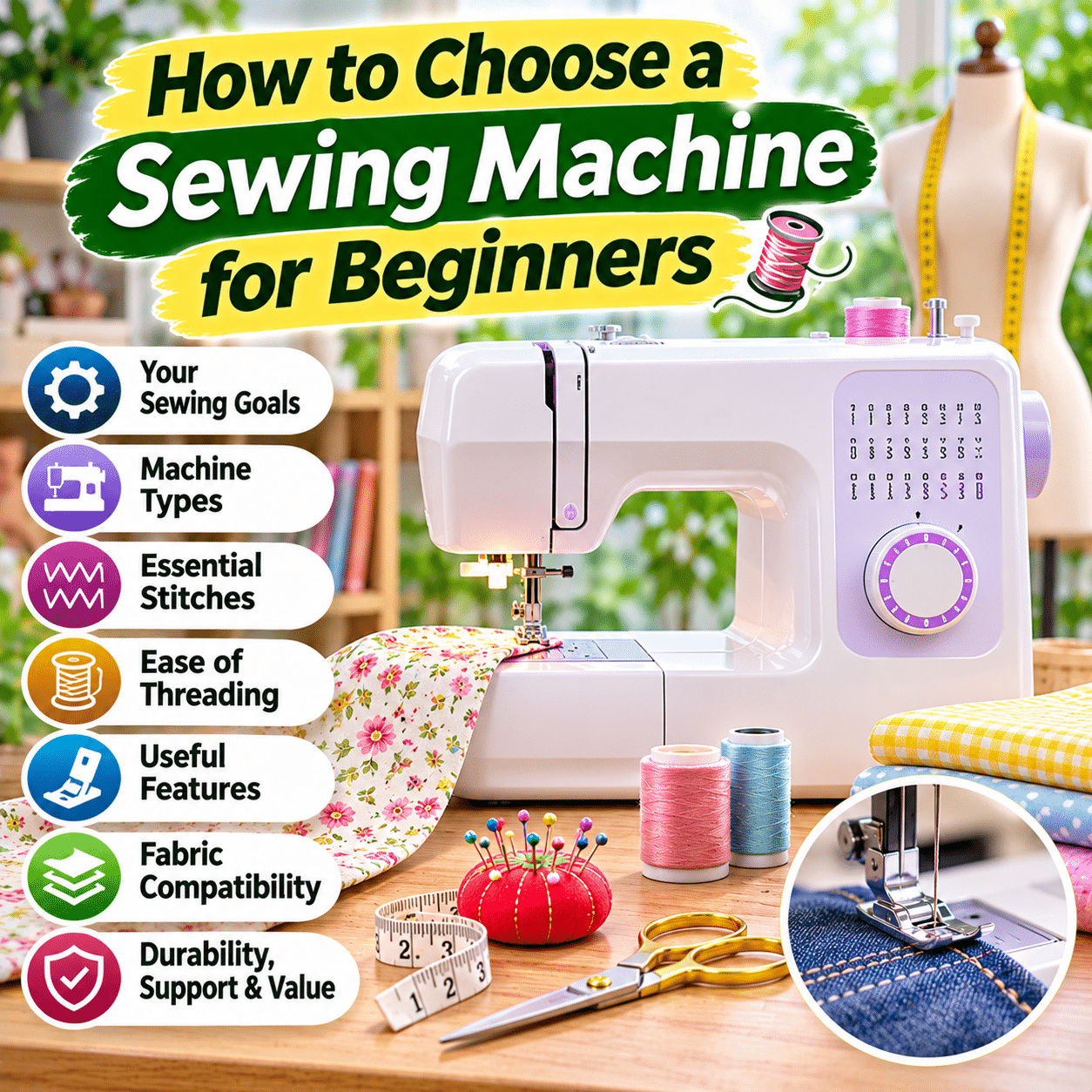
Learning to sew opens the door to a wide range of creative possibilities, from repairing clothing and making simple household accessories to designing handmade gifts and exploring personal fashion projects. Whether you want to shorten a pair of pants, create decorative pillow covers, sew reusable fabric bags, or eventually make your own garments, a suitable sewing machine can make the learning process more enjoyable and manageable.
However, choosing your first sewing machine can feel overwhelming. Manufacturers offer machines with different stitch selections, controls, threading systems, accessories, and automated features. Some models emphasize simplicity and affordability, while others provide advanced functions that beginners may not immediately need.
The best beginner sewing machine is not necessarily the one with the most stitches or the highest price. It is a machine that performs essential sewing tasks reliably, offers straightforward controls, and provides enough flexibility for your skills to develop.
A good first machine should help you understand fundamental techniques such as threading, winding a bobbin, selecting stitches, controlling seam allowances, and adjusting fabric handling without introducing unnecessary complexity.
This guide explains what to look for when buying a sewing machine for beginners, compares common machine types, and helps you choose a practical, dependable model that supports your sewing goals over time.
1. Understand What You Want to Sew
Before comparing sewing machines, consider the types of projects you want to complete.
Different sewing activities place different demands on a machine.
Basic Clothing Repairs
If your main goal is repairing everyday clothing, you may need a machine for:
- Repairing loose seams.
- Hemming pants.
- Fixing torn fabric.
- Reattaching fabric sections.
- Making simple alterations.
- Sewing replacement pockets.
A basic machine with reliable straight and zigzag stitches can handle many common repair tasks.
Simple Home Sewing Projects
Beginners often start with projects such as:
- Pillow covers.
- Fabric napkins.
- Reusable shopping bags.
- Table runners.
- Simple curtains.
- Storage pouches.
These projects help develop skills in measuring, cutting, pinning, and sewing straight seams.
Garment Making
If you plan to make clothing, consider a machine that supports:
- Straight stitching.
- Zigzag stitching.
- Buttonholes.
- Adjustable stitch length.
- Adjustable stitch width.
- Zipper installation.
- Different fabric types.
You do not necessarily need an advanced machine to begin making garments.
Quilting
Quilting involves joining fabric pieces and sewing through multiple layers.
A beginner interested in quilting may benefit from a larger work area, compatible quilting accessories, and reliable fabric feeding.
Decorative Sewing and Crafts
Creative projects may involve appliqué, decorative stitching, and different fabric textures.
A machine with a modest selection of utility and decorative stitches may offer useful flexibility.
Buying tip: Start with your most likely projects rather than purchasing features for sewing activities you may never pursue.
2. Understand the Main Types of Sewing Machines
Sewing machines are available in several categories.
Understanding their differences can help narrow your choices.
Mechanical Sewing Machines
Mechanical machines typically use physical dials, levers, and switches to control sewing functions.
Common adjustments include:
- Stitch selection.
- Stitch length.
- Stitch width.
- Reverse stitching.
- Thread tension, depending on the model.
Advantages:
- Straightforward controls.
- Often affordable.
- Suitable for learning fundamental sewing skills.
- Fewer electronic features to navigate.
- Available in compact designs.
Limitations:
- May require more manual adjustments.
- Stitch selection can be limited.
- Some convenience features may be absent.
Mechanical machines are often a practical starting point for beginners who prefer simple controls.
Computerized Sewing Machines
Computerized machines use electronic controls to manage stitch settings and other functions.
They may include digital displays, buttons, and automatic adjustments.
Advantages:
- Convenient stitch selection.
- Often provide a wider range of stitches.
- May include automatic buttonholes.
- Can offer needle-position controls.
- Some include speed limiting and programmable functions.
Limitations:
- Can cost more.
- May require additional time to learn.
- Electronic repairs can be more complex.
- Advanced features may be unnecessary for basic projects.
Computerized machines can still be beginner-friendly when their controls are intuitive.
Mini Sewing Machines
Mini machines are designed for compactness and portability.
Some are marketed toward beginners or occasional repairs.
Advantages:
- Small footprint.
- Lightweight construction.
- Convenient storage.
- Often inexpensive.
Limitations:
- Limited stitch options.
- Smaller working areas.
- May struggle with certain fabrics.
- Construction quality varies.
- Some lack features found on standard machines.
A compact full-size sewing machine may provide better long-term versatility than a very small mini model.
Serger Machines
A serger, also called an overlocker, trims and finishes fabric edges using multiple threads.
It is particularly useful for certain garment construction tasks.
However, a serger generally does not replace a conventional sewing machine for tasks such as standard buttonholes, many zipper applications, and certain topstitching techniques.
For most beginners, a regular sewing machine is the more versatile first purchase.
3. Compare Mechanical and Computerized Sewing Machines
| Feature | Mechanical machine | Computerized machine |
|---|---|---|
| Controls | Dials and levers | Buttons, screens, electronic controls |
| Learning experience | Direct, manual adjustments | Often convenient presets |
| Stitch selection | Usually fewer choices | Often more choices |
| Buttonholes | Commonly multi-step or automatic, depending on model | Often automatic |
| Speed control | Foot pedal, sometimes additional controls | Often includes adjustable speed limits |
| Maintenance | Varies by design | Varies; electronic repairs may be specialized |
| Typical cost | Often lower | Often higher |
| Best suited for | Beginners wanting simple operation | Beginners wanting convenience and room to explore |
Neither category is automatically better.
The best choice depends on which controls feel more comfortable and which features you will actually use.
4. Prioritize Essential Stitch Types
Stitch selection is one of the most heavily advertised sewing machine features.
However, beginners can complete many useful projects with a relatively small number of stitches.
Straight Stitch
The straight stitch is the foundation of most sewing projects.
It is used for:
- Joining fabric pieces.
- Sewing seams.
- Topstitching.
- Hemming.
- Basic garment construction.
- Many quilting tasks.
Look for consistent stitch formation and adjustable stitch length.
Zigzag Stitch
The zigzag stitch is useful for:
- Finishing certain raw edges.
- Sewing elastic.
- Some stretch fabric applications.
- Decorative stitching.
- Basic appliqué.
Adjustable stitch width and length provide greater flexibility.
Stretch Stitches
Some machines include stitches designed for knit or stretch fabrics.
These can be useful when sewing clothing made from jersey or other elastic materials.
However, suitable needles, thread, fabric handling, and stitch settings are also important.
Buttonhole Stitch
A buttonhole function is valuable if you plan to make garments, bags, or accessories with buttons.
Blind Hem Stitch
A blind hem stitch can help create less visible hems on certain garments.
Decorative Stitches
Decorative stitches can add creative details to projects.
They are enjoyable but not essential for learning basic sewing.
Buying tip: Reliable straight and zigzag stitches are more valuable than a large decorative stitch library that you rarely use.
5. Look for Adjustable Stitch Length and Width
Stitch adjustments help you work with different fabrics and sewing techniques.
Stitch Length
Stitch length controls the distance between stitches.
Shorter stitches may be useful for certain fine seams or detailed work.
Longer stitches can be useful for basting and some gathering techniques.
The appropriate setting depends on the fabric, thread, needle, and sewing purpose.
Stitch Width
Stitch width controls the side-to-side movement of the needle for stitches such as zigzag.
Adjustable width allows you to modify stitch appearance and function.
Why Adjustment Matters
A machine with only fixed stitch settings may limit your ability to adapt to different projects.
For beginners, simple and clearly marked adjustment controls are especially helpful.
Test the Controls
If possible, check whether stitch adjustments are intuitive and easy to repeat.
A clear dial or display can reduce confusion while learning.
6. Choose a Machine With Easy Threading
Threading is one of the first skills every beginner must learn.
A machine that is difficult to thread can make sewing unnecessarily frustrating.
Upper Thread Path
Look for clearly marked threading guides.
Many machines use arrows, numbers, or diagrams to show the correct thread path.
Needle Threading
Some models include a built-in needle threader.
This feature helps guide the thread through the needle eye.
It can be convenient, especially for users who find manual threading difficult.
Automatic Needle Threaders
The term automatic may describe different mechanisms.
Some require several manual steps, while others perform more of the process electronically.
Check how the feature actually works.
Threading Instructions
A clear manual and accessible instructional diagrams are important.
Video tutorials from the manufacturer can also help beginners understand the process.
Why Proper Threading Matters
Incorrect threading can contribute to:
- Thread breakage.
- Skipped stitches.
- Uneven tension.
- Thread bunching.
- Poor stitch formation.
A well-designed threading system makes it easier to learn and repeat the correct procedure.
7. Understand Bobbin Systems
A bobbin holds the lower thread used in conventional lockstitch sewing.
Different machines use different bobbin arrangements.
Top-Loading Bobbins
Top-loading systems commonly place the bobbin beneath a cover on the needle plate area.
Some feature a transparent cover.
Advantages:
- Convenient visibility.
- Often easy to access.
- Simple bobbin replacement on many designs.
Front-Loading Bobbins
Front-loading systems typically use a removable bobbin case accessed from the front of the machine.
Advantages:
- Established design.
- Used in many reliable machines.
- Allows direct access to the bobbin case.
Which Is Better for Beginners?
Both systems can work well.
A top-loading bobbin may feel more convenient to some beginners, but overall usability depends on the machine’s design.
Check Bobbin Compatibility
Not all bobbins are interchangeable.
Using an incorrect bobbin type can cause sewing problems or damage.
Choose the exact bobbin style specified by the manufacturer.
Bobbin Winding
Look for a straightforward bobbin winding system with clear instructions.
Some machines include automatic winding stops or other convenience features.
8. Consider an Automatic Needle Threader
A built-in needle threader is a convenience feature worth considering.
Threading a small needle eye can be challenging, particularly when working with fine thread or under poor lighting.
Benefits
A needle threader may:
- Reduce setup time.
- Make threading easier.
- Improve convenience during thread changes.
- Help beginners focus on sewing rather than repeated setup.
Important Limitations
Needle threaders may not work with every needle size or specialty needle.
They also require correct positioning and careful handling.
A damaged or misaligned threader may stop working.
Is It Essential?
No.
Manual threading remains a useful skill.
However, a reliable built-in threader can make everyday sewing more comfortable.
9. Look for Adjustable Sewing Speed
Controlling sewing speed is particularly important when learning.
Beginners often need time to guide fabric accurately around corners, curves, and seam allowances.
Foot Pedal Control
Most conventional machines use a foot pedal to control sewing speed.
The pedal should respond smoothly to pressure.
Speed Limiting
Some computerized machines include a speed slider or adjustable maximum speed.
This can help prevent the machine from sewing faster than intended.
Start and Stop Buttons
Certain models allow sewing without continuously using a foot pedal.
This feature may be convenient for some users, but it is not necessary for basic sewing.
Why Speed Control Matters
Slower sewing can help with:
- Learning straight seams.
- Following curved patterns.
- Sewing near corners.
- Working around small details.
- Maintaining consistent seam allowances.
A smooth, predictable machine is generally more beginner-friendly than one that feels difficult to control.
10. Evaluate the Presser Foot System
A presser foot holds fabric against the feed dogs while sewing.
Different presser feet are designed for different tasks.
Standard Presser Foot
A general-purpose foot is suitable for many basic stitches and seams.
Zipper Foot
A zipper foot helps position stitches close to zipper teeth or other raised edges.
Buttonhole Foot
A buttonhole foot supports the machine’s buttonhole function.
Blind Hem Foot
This foot can help guide fabric when creating certain blind hems.
Walking Foot
A walking foot helps feed multiple fabric layers more evenly in certain applications.
It may be useful for quilting, slippery fabrics, or layered projects.
What to Look For
Check:
- Which presser feet are included.
- How easily they can be changed.
- Whether additional feet are available.
- Compatibility with the machine’s attachment system.
Snap-On Presser Feet
Many machines use snap-on presser feet for convenient changes.
However, compatibility varies by machine design.
Do not assume every presser foot fits every sewing machine.
11. Understand Feed Dogs and Fabric Feeding
Feed dogs are the small toothed mechanisms beneath the presser foot that help move fabric through the machine.
Consistent fabric feeding is important for even stitches.
Why Feeding Performance Matters
Poor feeding can contribute to:
- Uneven stitch length.
- Fabric bunching.
- Difficulty sewing multiple layers.
- Inconsistent seams.
Drop Feed Function
Some machines allow the feed dogs to be lowered.
This can be useful for certain free-motion sewing and quilting techniques.
Adjustable Presser Foot Pressure
Some machines allow users to adjust the pressure applied by the presser foot.
This can help when sewing fabrics of different thicknesses or stretch characteristics.
Is Adjustable Pressure Necessary?
Not every beginner needs this feature immediately.
However, it can provide useful flexibility if you plan to work with a wide range of fabrics.
12. Consider the Types of Fabric You Want to Sew
Fabric compatibility is an important buying consideration.
Not every sewing machine performs equally well with every material.
Lightweight Cotton
Woven cotton is commonly recommended for beginner projects.
It is generally manageable and suitable for practicing basic seams.
Linen
Linen can be used for clothing and home accessories.
Its handling characteristics vary depending on weave and weight.
Knit Fabrics
Stretch fabrics may require:
- Suitable stretch or ballpoint needles.
- Appropriate stitch selection.
- Careful fabric handling.
- Compatible thread.
Some machines handle knits more easily than others.
Denim
Denim varies considerably in thickness.
Lightweight denim may be manageable on many domestic machines, while multiple layers of heavy denim can require greater machine capability.
Canvas
Canvas is commonly used for bags and household accessories.
Heavier canvas may require suitable needles, thread, and machine feeding performance.
Delicate Fabrics
Silk-like materials, chiffon, and other delicate fabrics may require fine needles, appropriate thread, and careful tension settings.
Avoid Unsupported Claims
Marketing descriptions such as heavy duty do not guarantee that a machine can sew every thick material.
Check the manufacturer’s recommendations and realistic sewing capacity.
13. Understand Needle Compatibility
Sewing machine needles are essential to stitch quality.
Different fabrics require different needle types and sizes.
Universal Needles
Universal needles are commonly used for many woven fabrics and some general-purpose sewing tasks.
Ballpoint Needles
Ballpoint needles are designed to pass between certain knit fabric fibers rather than cutting through them as readily.
Stretch Needles
Stretch needles are designed for certain elastic fabrics that may otherwise produce skipped stitches.
Denim Needles
Denim needles are intended for dense woven materials such as denim.
Microtex Needles
Microtex needles have a sharp point designed for precise penetration of certain tightly woven or fine fabrics.
Check the Needle System
Most modern domestic sewing machines use a common household needle system, but compatibility should always be confirmed.
Do not assume that industrial needles or specialized machine needles will fit a domestic machine.
Replace Worn Needles
Bent, dull, or damaged needles can cause poor stitches and fabric damage.
Needles are consumable items and should be replaced when necessary.
14. Consider Buttonhole Features
Buttonholes are useful for garments and accessories.
Machines offer different buttonhole methods.
Four-Step Buttonholes
A four-step system requires the user to select different stages of the buttonhole.
This can work well but requires more manual involvement.
One-Step Buttonholes
A one-step system typically creates the buttonhole through an automated sequence.
Some machines use a buttonhole foot that helps determine the required length.
Which Is Better for Beginners?
A one-step buttonhole function can be convenient, especially for users who plan to make clothing.
However, a well-designed four-step system can also produce satisfactory results.
Test Buttonhole Quality
If possible, check whether the machine creates consistent buttonholes on suitable test fabric.
A large number of decorative buttonhole styles is not essential for basic garment sewing.
15. Look for a Free Arm
A free arm is a narrow sewing area that becomes accessible when part of the machine’s accessory compartment or extension table is removed.
Why a Free Arm Is Useful
It makes it easier to sew around tubular fabric sections.
Common applications include:
- Pant hems.
- Sleeves.
- Cuffs.
- Children’s clothing.
- Small fabric openings.
Is It Essential?
A free arm is highly convenient for garment alterations, although many tasks can still be completed without one.
For beginners interested in clothing repairs, it is a worthwhile feature.
16. Evaluate Machine Size and Weight
Sewing machines vary in dimensions and portability.
The right size depends on your workspace and how frequently you need to move the machine.
Compact Machines
Compact models may be useful for:
- Small apartments.
- Shared workspaces.
- Occasional sewing.
- Limited storage.
However, very lightweight machines may move or vibrate more during certain tasks.
Full-Size Machines
Full-size domestic machines often provide:
- More stable construction.
- Larger working areas.
- Greater accessory compatibility.
- More comfortable fabric handling.
Weight Considerations
A heavier machine may feel more stable during sewing.
However, it may be inconvenient to lift or store.
Measure Your Workspace
Consider:
- Table width.
- Table depth.
- Space behind the machine.
- Room for fabric movement.
- Foot pedal placement.
- Storage clearance.
Choose a machine that fits comfortably without restricting your ability to guide fabric.
17. Consider the Sewing Work Area
The space between the needle and the machine body is often called the throat space.
This area affects how comfortably you can handle larger projects.
Small Projects
Basic repairs, small accessories, and simple garments may not require a large throat space.
Quilting
Larger quilts can be difficult to maneuver through a narrow work area.
Home Decor Projects
Curtains, large cushion covers, and other bulky items may benefit from additional working space.
Extension Tables
Some machines support removable extension tables.
These provide a larger surface for supporting fabric.
Before purchasing, check whether an extension table is included or available separately.
18. Look for Good Built-In Lighting
Adequate lighting helps you see the needle, seam guides, and fabric clearly.
Many modern machines include LED work lights.
Benefits of Built-In Lighting
Good illumination can help with:
- Threading.
- Following seam allowances.
- Sewing dark fabrics.
- Inspecting stitches.
- Working on small details.
What to Check
Consider:
- Brightness.
- Light placement.
- Shadows around the needle.
- Glare.
- Whether the light adequately covers the sewing area.
A built-in light is useful, but additional room or task lighting may still be necessary.
19. Consider Noise and Vibration
Sewing machines produce mechanical noise and vibration during operation.
The amount varies by design, speed, maintenance, and the surface on which the machine is placed.
Why Noise Matters
A machine used in a shared living space may need to operate without excessive disturbance.
Factors That Affect Noise
These include:
- Motor design.
- Internal mechanisms.
- Sewing speed.
- Table stability.
- Fabric thickness.
- Maintenance condition.
Test When Possible
If buying in person, try the machine at different speeds.
Listen for unusual rattling, grinding, or inconsistent operation.
Improve Stability
A sturdy sewing table and appropriate vibration-dampening mat may help reduce movement and transmitted noise.
Do not block ventilation openings or interfere with the machine’s normal operation.
20. Evaluate Build Quality and Durability
A beginner sewing machine should be reliable enough to support repeated practice.
Internal Construction
Some machines use metal internal frames or structural components.
These may contribute to stability, but overall quality depends on the complete design.
Exterior Housing
Plastic housings are common and do not automatically indicate poor quality.
What matters is the quality of construction, fit, and durability.
Controls
Check that:
- Dials turn smoothly.
- Buttons respond consistently.
- Stitch selectors feel secure.
- The handwheel operates properly.
- The presser foot lever moves reliably.
Stitch Consistency
A well-functioning machine should produce reasonably even stitches when correctly threaded and adjusted for the fabric.
Long-Term Support
Consider whether replacement parts, compatible accessories, and professional servicing are available.
A dependable basic machine can provide better long-term value than a feature-heavy model with poor support.
21. Consider Maintenance Requirements
All sewing machines require some level of maintenance.
Routine care helps maintain stitch quality and mechanical reliability.
Lint Removal
Fabric lint can accumulate around the bobbin area and feed dogs.
Follow manufacturer instructions for cleaning.
Needle Replacement
Replace damaged or worn needles.
Thread Quality
Poor-quality or unsuitable thread can contribute to sewing problems.
Use thread appropriate for the machine and project.
Lubrication
Some machines require periodic oiling, while others have different maintenance requirements.
Do not add oil unless the manufacturer instructs you to do so.
Professional Servicing
A sewing machine may occasionally require professional adjustment or repair.
Check whether local service support is available.
Avoid Unauthorized Disassembly
Do not attempt internal electrical or mechanical repairs without appropriate expertise.
Disconnect the machine from power before performing user-permitted cleaning and maintenance.
22. Check Included Accessories
Accessories can influence the overall value of a sewing machine package.
Common Included Items
Depending on the model, the package may include:
- General-purpose presser foot.
- Zipper foot.
- Buttonhole foot.
- Bobbins.
- Needle assortment.
- Seam ripper.
- Cleaning brush.
- Screwdriver.
- Spool caps.
- Foot pedal.
- Power cord.
- Dust cover.
- Instruction manual.
What Matters Most?
A practical starter accessory package should support common sewing tasks.
Do not assume a large accessory count means better quality.
Check Compatibility
Some accessories are specific to a machine brand, model, or attachment system.
Before purchasing additional accessories, verify compatibility with your exact machine.
23. Consider Instruction Manuals and Learning Resources
Clear instructions can make a major difference for beginners.
A Good Instruction Manual Should Explain
- Machine setup.
- Upper threading.
- Bobbin winding.
- Bobbin insertion.
- Needle replacement.
- Stitch selection.
- Thread tension.
- Presser foot changes.
- Basic troubleshooting.
- Cleaning and maintenance.
Visual Guides
Diagrams and photographs can make technical instructions easier to follow.
Video Tutorials
Manufacturer tutorials and educational sewing videos can help demonstrate procedures.
Beginner Projects
Some manufacturers provide introductory projects that teach fundamental skills.
Language Availability
Check whether the manual is available in a language you understand comfortably.
A machine with excellent instructions may be easier to learn than a more advanced model with limited support.
24. Compare Common Beginner Sewing Machine Features
| Feature | Why it matters | Priority for beginners |
|---|---|---|
| Straight stitch | Essential for most sewing projects | Essential |
| Zigzag stitch | Useful for edge finishing and stretch applications | Essential |
| Adjustable stitch length | Helps adapt to different techniques | High |
| Adjustable stitch width | Adds versatility | High |
| Reverse stitching | Secures many conventional seams | High |
| Easy threading | Simplifies setup | High |
| Reliable bobbin system | Supports consistent operation | High |
| Speed control | Helps beginners sew accurately | High |
| Automatic needle threader | Improves convenience | Useful |
| One-step buttonhole | Simplifies garment making | Useful |
| Free arm | Helps sew sleeves and pant hems | Useful |
| LED lighting | Improves visibility | High |
| Adjustable presser foot pressure | Helps with varied fabrics | Optional |
| Extension table | Supports larger projects | Optional |
| Decorative stitches | Adds creative options | Optional |
| Computerized controls | Offers convenience and presets | Preference-based |
The most important features are those that help you sew reliably and comfortably.
25. Decide How Much to Spend on Your First Sewing Machine
Sewing machines are available across a wide range of prices.
The right budget depends on your sewing goals and how often you expect to use the machine.
Entry-Level Machines
Basic machines may provide enough functionality for simple repairs and beginner projects.
Prioritize reliable construction and essential stitches over decorative features.
Mid-Range Machines
Mid-range models may offer:
- Better convenience features.
- More stitch options.
- Improved speed control.
- Additional presser feet.
- Larger working areas.
- More flexible fabric handling.
These features can be worthwhile for beginners who expect to sew regularly.
Advanced Machines
Higher-end machines may include extensive computerized functions, specialty stitches, and advanced controls.
Such features can be useful for experienced sewing enthusiasts but are not required for learning basic techniques.
Consider Total Ownership Cost
In addition to the machine, budget for:
- Sewing needles.
- Thread.
- Fabric.
- Scissors.
- Measuring tools.
- Pins or clips.
- Extra bobbins.
- Replacement accessories.
- Maintenance.
A reasonably priced machine with room in the budget for quality supplies may provide a better learning experience than spending everything on the machine itself.
26. Consider New, Used, and Refurbished Machines
Beginners can choose between new and pre-owned sewing machines.
Buying New
Advantages:
- Manufacturer warranty.
- Current documentation.
- Easier access to product support.
- Lower uncertainty about previous use.
Limitations:
- Higher initial cost in some cases.
- Basic new machines may have fewer features than older models at similar prices.
Buying Used
Advantages:
- Potential cost savings.
- Access to durable older machines.
- May offer good value when properly maintained.
Limitations:
- Unknown maintenance history.
- Possible missing accessories.
- Wear or mechanical problems.
- Limited warranty protection.
Buying Refurbished
Refurbished machines may have been inspected, serviced, or repaired before resale.
However, the meaning of refurbished varies by seller.
What to Check
Before buying a used or refurbished machine:
- Confirm it powers on safely.
- Test straight and zigzag stitches.
- Check reverse stitching.
- Inspect the bobbin system.
- Test the foot pedal.
- Listen for unusual noise.
- Check included accessories.
- Ask about servicing history.
- Confirm repair and parts availability.
For beginners without sewing experience, buying from a reputable seller who demonstrates the machine can reduce uncertainty.
27. Consider Warranty and After-Sales Support
A sewing machine is a mechanical appliance that may require service over time.
Warranty Coverage
Review:
- Warranty duration.
- Covered components.
- Exclusions.
- Service procedures.
- Required purchase documentation.
Some warranties apply different coverage periods to mechanical, electronic, and other components.
Local Service Availability
Check whether qualified technicians can service the model in your area.
Replacement Parts
Look for access to:
- Bobbin components.
- Presser feet.
- Needle plates.
- Foot pedals.
- Power adapters.
- Other model-specific parts.
Manufacturer Support
Accessible manuals, troubleshooting guides, and customer service can make ownership easier.
Do not choose a machine based on warranty length alone.
28. Common Mistakes to Avoid When Buying a Beginner Sewing Machine
Choosing Based Only on Stitch Count
A machine with hundreds of stitches may seem impressive.
However, beginners usually rely heavily on a small number of utility stitches.
Better approach: Prioritize stitch quality, ease of use, and reliability.
Buying the Cheapest Mini Machine
Some inexpensive mini machines offer limited control and inconsistent performance.
Better approach: Consider a basic full-size machine from a manufacturer with accessible support.
Ignoring Fabric Compatibility
A machine suitable for lightweight cotton may struggle with multiple layers of heavy fabric.
Better approach: Choose according to the materials you expect to sew.
Overlooking Threading Difficulty
Complicated threading can discourage beginners.
Better approach: Look for clear guides and convenient bobbin access.
Buying Too Many Accessories Immediately
Specialized feet and tools may remain unused.
Better approach: Begin with essential accessories and expand as your projects require.
Assuming Computerized Machines Are Always Difficult
Some computerized models are very intuitive.
Better approach: Evaluate the actual interface rather than the machine category alone.
Ignoring Workspace Requirements
A machine may fit on a table but leave insufficient space for fabric handling.
Better approach: Measure the complete sewing area.
Forgetting Maintenance and Support
A low purchase price may not be worthwhile if parts or repairs are difficult to obtain.
Better approach: Consider long-term service availability.
Expecting the Machine to Replace Sewing Skills
Even advanced machines require correct threading, fabric preparation, and suitable technique.
Better approach: Choose a machine that supports learning rather than relying on automation to solve every sewing challenge.
29. How to Choose a Sewing Machine for Different Beginner Goals
For Basic Clothing Repairs
Prioritize:
- Reliable straight stitch.
- Zigzag stitch.
- Reverse stitching.
- Free arm.
- Easy threading.
- Compact size.
A simple mechanical machine may be sufficient.
For Learning Garment Making
Look for:
- Adjustable stitch length and width.
- Buttonhole function.
- Zipper foot compatibility.
- Free arm.
- Good fabric feeding.
- Suitable stretch stitch options.
For Beginner Quilting
Consider:
- Consistent straight stitching.
- Adequate work area.
- Extension table compatibility.
- Walking foot compatibility.
- Adjustable needle position where available.
For Crafts and Home Decor
Useful features include:
- Reliable utility stitches.
- Adjustable stitch settings.
- Suitable fabric handling.
- Decorative stitches if desired.
- Compatibility with different presser feet.
For Small Apartments
Prioritize:
- Manageable dimensions.
- Reasonable weight.
- Easy storage.
- Stable operation.
- Convenient setup.
For Beginners Who Plan to Sew Regularly
A durable machine with comfortable controls, good accessory support, and room for skill development may offer better value than the simplest available model.
30. Step-by-Step Guide to Choosing Your First Sewing Machine
Step 1: Define Your Sewing Goals
Write down the projects you want to complete during your first year.
Step 2: Set a Realistic Budget
Include the cost of essential sewing supplies.
Step 3: Choose Mechanical or Computerized Controls
Select the type of interface that feels easiest to understand.
Step 4: Check Essential Stitches
Confirm that the machine provides reliable straight and zigzag stitches with useful adjustments.
Step 5: Evaluate Threading and Bobbin Access
Look for clear threading guides and a practical bobbin system.
Step 6: Consider Sewing Speed
Choose a machine with smooth, predictable speed control.
Step 7: Check Fabric Compatibility
Make sure the machine is appropriate for your intended materials.
Step 8: Review Presser Feet and Accessories
Confirm that essential accessories are included or readily available.
Step 9: Evaluate Workspace and Storage
Check the machine’s dimensions, weight, and working area.
Step 10: Review Support and Maintenance
Look for clear instructions, service availability, and replacement parts.
Step 11: Test the Machine When Possible
Try threading, straight stitching, zigzag stitching, reverse sewing, and speed control.
Step 12: Choose for Long-Term Practicality
Select a machine that is comfortable to learn on and capable of supporting your likely future projects.
31. Practical Beginner Sewing Machine Buying Checklist
Use this checklist before making a purchase.
Sewing Goals
- I know which projects I want to make.
- The machine supports my intended fabric types.
- The machine offers enough flexibility for future learning.
- I do not need unnecessary advanced features.
- The machine fits my available workspace.
Essential Functions
- Straight stitch is available.
- Zigzag stitch is available.
- Stitch length can be adjusted.
- Stitch width can be adjusted where needed.
- Reverse stitching is available.
- Buttonhole capability meets my needs.
Beginner Convenience
- Threading instructions are clear.
- The bobbin system is easy to understand.
- Sewing speed is manageable.
- Controls are clearly labeled.
- The sewing area has adequate lighting.
- Presser feet are easy to change.
Construction and Performance
- The machine feels stable.
- Stitch formation is consistent during testing.
- The foot pedal responds smoothly.
- The machine handles my intended fabrics.
- Noise and vibration are acceptable.
Accessories and Support
- Essential presser feet are included.
- Compatible bobbins and needles are available.
- The instruction manual is accessible.
- Learning resources are available.
- Warranty terms are clear.
- Repair support is reasonably accessible.
Long-Term Value
- The machine fits my total budget.
- Maintenance requirements are manageable.
- Replacement parts are available when relevant.
- The machine can support developing sewing skills.
- I am choosing functionality over unnecessary features.
32. Frequently Asked Questions
What type of sewing machine is best for beginners?
A reliable mechanical or beginner-friendly computerized machine can be a good choice.
The best option offers essential stitches, straightforward controls, manageable speed, and accessible learning resources.
Is a mechanical or computerized sewing machine easier to use?
It depends on personal preference and machine design.
Mechanical machines offer direct manual controls, while computerized machines may simplify certain adjustments through presets.
Both can be suitable for beginners.
How many stitches does a beginner need?
Most beginners can complete many projects with straight and zigzag stitches.
Buttonholes, stretch stitches, and a few additional utility stitches provide useful flexibility.
A large decorative stitch library is not essential.
Are mini sewing machines good for beginners?
Some can handle simple tasks, but many have limited features and working space.
A basic full-size machine may offer greater reliability and long-term versatility.
Do beginners need an automatic needle threader?
No, but it can be a convenient feature.
Manual threading is a useful skill, and many machines are easy to thread without automation.
Is a top-loading bobbin better than a front-loading bobbin?
Both designs can work well.
Top-loading systems may feel more convenient to some users, but the overall design and reliability matter more than the loading position alone.
Can a beginner sewing machine sew denim?
Many domestic machines can sew some denim fabrics when fitted with appropriate needles and thread.
However, heavy denim and multiple thick layers may exceed the capabilities of certain machines.
Check manufacturer recommendations.
Can I sew stretch fabric with a regular sewing machine?
Yes, many conventional sewing machines can sew stretch fabrics using suitable needles, stitches, thread, and techniques.
A serger is not always necessary.
Do I need a serger as a beginner?
Usually not.
A conventional sewing machine is more versatile for basic sewing, repairs, buttonholes, and many garment construction tasks.
A serger can be added later if your projects justify it.
What is a free arm on a sewing machine?
A free arm is a narrow sewing area designed to make it easier to sew tubular sections such as sleeves and pant legs.
Are expensive sewing machines better for beginners?
Not necessarily.
Higher-priced machines may offer useful features, but ease of use, reliability, and suitability for your projects matter more than price alone.
Should I buy a used sewing machine?
A used machine can offer good value if it is in proper working condition.
Beginners should ideally purchase from a seller who can demonstrate the machine and provide information about its condition.
What accessories should a beginner buy?
Useful supplies include:
- Sewing machine needles.
- Suitable thread.
- Fabric scissors.
- Measuring tape.
- Seam ripper.
- Pins or fabric clips.
- Extra compatible bobbins.
- Marking tools.
Additional accessories can be purchased as your skills develop.
How often should a sewing machine be serviced?
Service needs depend on usage, machine design, and manufacturer recommendations.
Regular cleaning and correct maintenance can help keep the machine operating reliably.
Can I teach myself to sew with a sewing machine?
Yes.
Many beginners learn through instruction manuals, structured tutorials, practice projects, and gradual skill development.
Starting with simple woven cotton projects can help build confidence.
What should I sew first as a beginner?
Good introductory projects include simple fabric napkins, pillow covers, reusable bags, and basic straight-seam accessories.
These projects help develop control, accuracy, and familiarity with the machine.
Final Thoughts
Choosing a sewing machine for beginners is about finding the right balance between simplicity, reliability, functionality, and room for creative growth.
A good first machine should make essential sewing tasks approachable without overwhelming you with unnecessary features. Reliable straight and zigzag stitches, adjustable stitch settings, clear threading instructions, manageable speed control, and a practical bobbin system are often more valuable than a long list of decorative functions.
Mechanical sewing machines can be excellent choices for beginners who prefer direct controls, while computerized machines may offer useful convenience features such as automatic buttonholes, speed limiting, and simplified stitch selection.
Consider the fabrics you want to sew, the space available in your home, the accessories you will need, and the quality of the manufacturer’s instructions and support. A machine that feels comfortable and predictable during everyday use is more likely to encourage regular practice.
It is also important to think beyond the initial purchase. Suitable needles, good thread, basic sewing tools, maintenance, and access to learning resources all contribute to a successful sewing experience.
Most importantly, remember that sewing is a skill developed through practice. Your first projects do not need to be perfect, and you do not need an advanced machine to create useful, attractive, and meaningful handmade items.
With a thoughtfully chosen sewing machine and a willingness to learn step by step, you can build a practical creative skill that supports clothing repairs, home projects, personal expression, and enjoyable handmade activities for years to come.