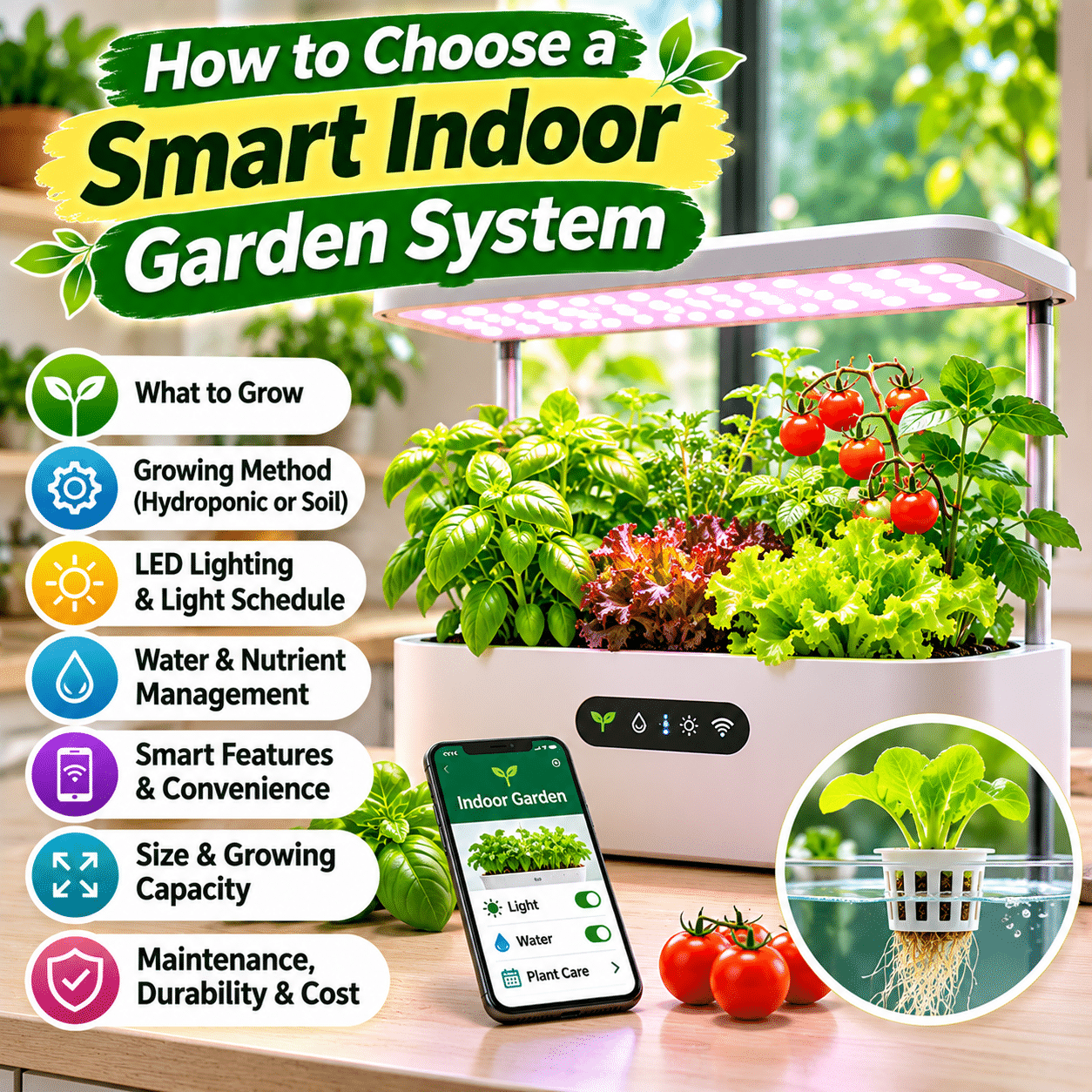
Growing fresh herbs, leafy greens, and small vegetables indoors has become more convenient with the development of smart indoor garden systems. These compact growing units combine plant containers, artificial lighting, and water management features into an organized setup that can fit on kitchen counters, shelves, or dedicated indoor growing spaces.
For people who have limited outdoor space, inconsistent natural sunlight, or busy schedules, a smart indoor garden can provide a practical way to explore home gardening. Some systems use hydroponic methods, while others rely on soil or alternative growing media. Depending on the design, features may include LED grow lights, automatic timers, water-level indicators, adjustable lamp heights, and app-based monitoring.
However, not every smart indoor garden system offers the same growing capacity, convenience, or long-term value. A compact countertop garden may be ideal for growing a few culinary herbs, while a larger system may be better suited to leafy vegetables or more ambitious indoor gardening projects.
Choosing the right system involves understanding what you want to grow, how the growing technology works, how much maintenance is required, and whether the system’s automated features genuinely support your gardening needs.
This guide explains the different types of smart indoor garden systems, the most important features to compare, and how to select a setup that balances plant health, convenience, space efficiency, durability, and long-term operating costs.
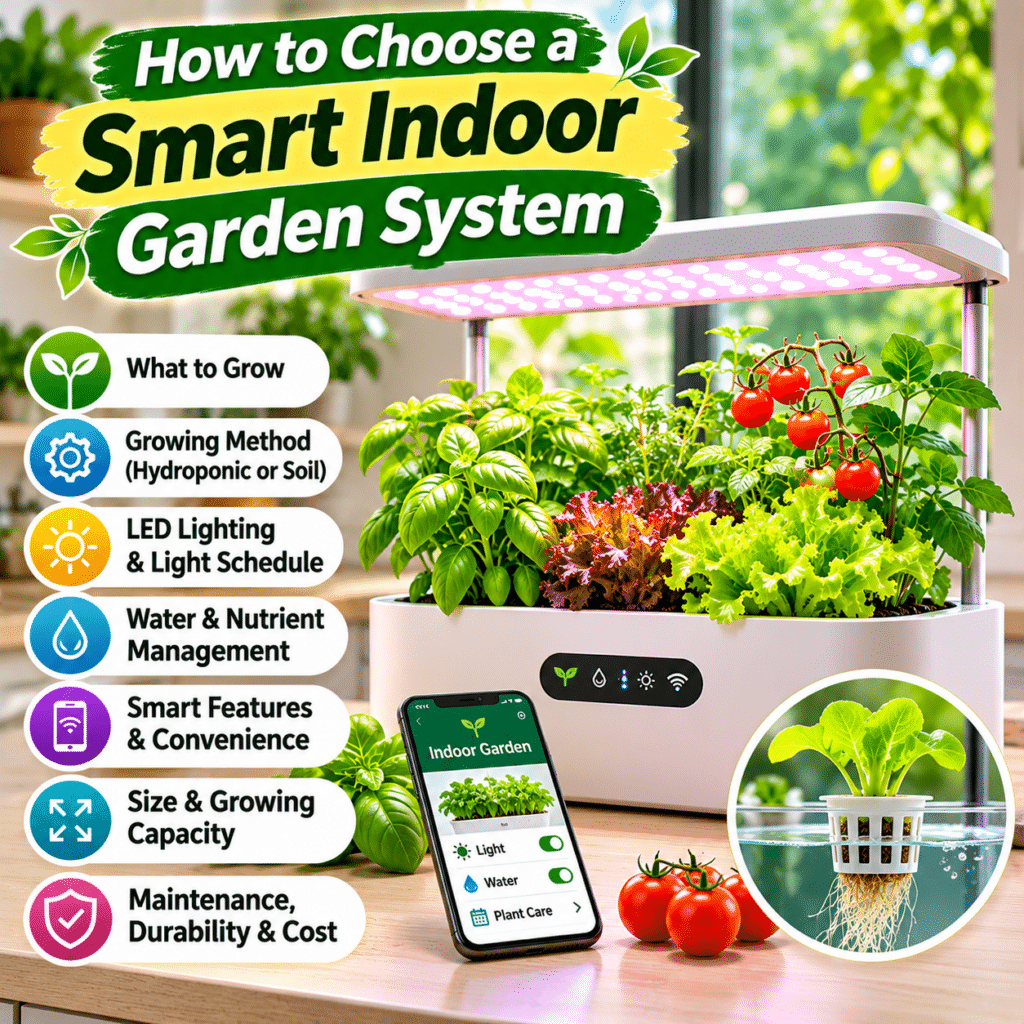
1. Understand What a Smart Indoor Garden System Is
A smart indoor garden system is a self-contained or integrated growing setup designed to help people cultivate plants indoors.
These systems typically combine several elements of plant care into one organized unit.
Common Components
Depending on the model, a smart indoor garden may include:
- Plant-growing containers or pods.
- An integrated LED grow light.
- A water reservoir.
- A water-level indicator.
- A pump or circulation mechanism.
- A programmable lighting timer.
- A nutrient delivery arrangement.
- Adjustable lighting height.
- Plant supports.
- Sensors or automated controls.
- Smartphone connectivity.
Not every system includes all these features.
Some products are relatively simple countertop planters with built-in lighting, while others provide more advanced environmental monitoring and automation.
What Makes an Indoor Garden Smart?
The term smart is used broadly in product marketing.
In some systems, it refers to automatic lighting schedules and water reminders.
In others, it describes connected features such as app controls, environmental sensors, or remote monitoring.
A system does not necessarily need Wi-Fi connectivity to be useful.
Reliable lighting, practical water management, and a suitable growing environment are often more important than advanced digital features.
2. Decide What You Want to Grow
The plants you intend to cultivate should guide your choice of indoor garden system.
Different crops have different requirements for root space, light intensity, nutrient availability, and growing height.
Culinary Herbs
Popular herbs include:
- Basil.
- Parsley.
- Mint.
- Chives.
- Thyme.
- Oregano.
- Cilantro.
Many herbs can be grown successfully in compact indoor systems when lighting and growing conditions are suitable.
However, their growth habits vary.
Mint can spread vigorously, while basil may grow tall and require regular harvesting.
Leafy Greens
Leafy vegetables are another common choice.
Examples include:
- Lettuce.
- Arugula.
- Kale.
- Bok choy.
- Certain Asian greens.
These crops may require more horizontal space than small herbs, especially as leaves mature.
Fruiting Vegetables
Some indoor garden systems are designed to support compact varieties of:
- Tomatoes.
- Peppers.
- Strawberries.
- Other small fruiting crops.
These plants often require greater light intensity, more root space, longer growing periods, and additional support.
Certain crops may also need pollination assistance indoors.
Decorative Plants
Some systems can support ornamental plants, but compatibility depends on the growing method.
Not every decorative houseplant is suited to a hydroponic pod system.
Match Plant Size to the System
Before buying, consider the mature dimensions of your chosen plants.
A system advertised as holding many plants may become crowded when those plants reach full size.
Buying tip: Evaluate usable growing space rather than relying only on the advertised number of planting positions.
3. Understand the Main Types of Smart Indoor Garden Systems
Smart indoor gardens use different growing methods.
Understanding these methods helps you choose a system that matches your preferences and maintenance expectations.
Hydroponic Indoor Garden Systems
Hydroponics involves growing plants without conventional soil, typically using a water-based nutrient solution.
Plants may be supported by baskets, sponges, plugs, or other growing media.
Advantages:
- Compact growing arrangements.
- Controlled nutrient delivery.
- Reduced need for conventional potting soil.
- Convenient water reservoirs.
- Potentially efficient water use in well-managed systems.
Limitations:
- Nutrient solution requires monitoring.
- Water quality matters.
- Pumps and other components may require cleaning.
- Some systems depend on proprietary pods.
- Equipment problems can affect plants relatively quickly.
Hydroponic systems are common among countertop smart gardens.
Soil-Based Smart Gardens
Some indoor garden systems use conventional potting media with integrated lighting or automated watering.
Advantages:
- Familiar growing method.
- Compatible with many common plants.
- May allow flexible choice of seeds and growing media.
- Often straightforward to understand.
Limitations:
- Potting mix can create mess during maintenance.
- Watering requirements vary.
- Drainage must be managed.
- Some systems offer less automation.
Soil-based systems may appeal to gardeners who prefer traditional growing methods.
Wick-Based Self-Watering Systems
These systems use capillary action to move water from a reservoir into a growing medium.
Advantages:
- Often simple.
- May operate without electricity for water delivery.
- Can reduce manual watering frequency.
- Relatively few mechanical components.
Limitations:
- Moisture delivery depends on the medium and wick design.
- Not suitable for every plant.
- Reservoirs still require cleaning.
- Water distribution may be uneven.
Circulating Hydroponic Systems
Some larger indoor gardens circulate nutrient solution through channels or growing chambers.
Advantages:
- Can support multiple plants.
- May provide controlled water circulation.
- Suitable for certain productive growing setups.
Limitations:
- Greater mechanical complexity.
- Pump maintenance.
- Potential operating noise.
- More demanding cleaning requirements.
- Dependence on reliable electricity.
4. Compare Indoor Garden Growing Methods
| Growing method | Main advantages | Important limitations | Suitable applications |
|---|---|---|---|
| Hydroponic reservoir | Compact, organized, soil-free growing | Nutrient and water management | Herbs and leafy greens |
| Soil-based system | Familiar method, flexible plant choices | Potting mix maintenance | Herbs and decorative plants |
| Wick-based system | Simple water delivery, fewer moving parts | Limited moisture control | Suitable small plants |
| Circulating hydroponics | Supports larger growing arrangements | Pump and system maintenance | Larger indoor growing projects |
The best method depends on your plants, available space, and willingness to perform regular maintenance.
5. Evaluate the Growing Capacity
Manufacturers often describe indoor garden capacity by the number of pods or planting positions.
However, pod count does not always reflect how many mature plants the system can comfortably support.
Small Systems
Compact units may be suitable for:
- A few culinary herbs.
- Small kitchen counters.
- Beginners.
- Limited growing space.
Medium Systems
Medium-sized systems may accommodate a broader selection of herbs and leafy greens.
They can be useful for households that regularly harvest small amounts of fresh produce.
Large Systems
Larger systems may support more plants or crops with greater space requirements.
However, they also need more room, lighting, water, and maintenance.
Consider Plant Spacing
Crowded plants may compete for light and space.
Dense foliage can also reduce airflow and make inspection difficult.
Some growing positions may need to remain empty when cultivating larger crops.
Look Beyond Pod Count
Check:
- Distance between planting positions.
- Maximum growing height.
- Reservoir capacity.
- Lighting coverage.
- Available root space.
- Plant support options.
A smaller system with appropriate spacing may be more practical than a crowded unit with a higher advertised capacity.
6. Choose a System With Suitable LED Grow Lights
Lighting is one of the most important features of an indoor garden system.
Plants need sufficient usable light for photosynthesis and healthy development.
Why Integrated Lighting Matters
Indoor gardens are often placed in kitchens or rooms where natural sunlight is limited.
Integrated LED lighting can provide a consistent source of illumination.
Full-Spectrum LED Lighting
Many systems advertise full-spectrum grow lights.
These generally provide a broad range of wavelengths intended to support plant growth.
However, the term full spectrum does not guarantee sufficient light intensity or even coverage.
Understand PPFD
Photosynthetic Photon Flux Density, or PPFD, measures the amount of photosynthetically active light reaching a surface per second.
It is commonly expressed in:
µmol/m²/s
PPFD measurements can help evaluate whether a lighting system provides suitable illumination at plant level.
Consider Light Distribution
A bright central light may not illuminate every planting position equally.
Look for information about:
- Coverage area.
- Light uniformity.
- Fixture position.
- Recommended plant height.
- Adjustable intensity.
Avoid Choosing Based Only on Wattage
Wattage describes electrical power consumption, not the amount of useful light reaching the plants.
Two systems with similar wattage may provide different growing performance.
When reliable lighting data is available, use it alongside the intended crop requirements.
7. Look for Adjustable Lighting Height
Plants grow at different rates and reach different heights.
An adjustable light fixture can help accommodate these changes.
Why Height Adjustment Matters
If the light is too far away, plants may receive insufficient illumination.
If it is too close, excessive intensity or heat may stress the foliage.
Common Adjustment Designs
Indoor garden systems may use:
- Telescoping light supports.
- Sliding lamp columns.
- Adjustable arms.
- Removable light extensions.
- Fixed-height lighting chambers.
Check Maximum Growing Height
A system suitable for lettuce may not accommodate a mature basil plant or compact tomato variety.
Check the maximum distance between the growing surface and the light fixture.
Consider Ease of Adjustment
The adjustment mechanism should be stable and easy to operate.
A light that slips downward or becomes difficult to reposition can create maintenance problems.
8. Understand Lighting Schedules and Timers
Plants respond to both light intensity and daily light duration.
Smart indoor gardens often include automatic lighting schedules.
Why Timers Are Useful
A timer can:
- Maintain consistent daily lighting.
- Reduce manual operation.
- Help manage energy consumption.
- Support a regular growing routine.
Daily Light Integral
Daily Light Integral, or DLI, measures the total quantity of photosynthetically active light received per square meter over a day.
It is expressed in:
mol/m²/day
DLI depends on both light intensity and duration.
A longer lighting schedule does not always compensate effectively for inadequate light intensity.
Avoid Continuous Lighting Without a Reason
Plants have species-specific photoperiod requirements.
Some also depend on dark periods for normal developmental processes.
Leaving the grow light on continuously is not automatically beneficial.
Timer Features to Compare
Look for:
- Adjustable lighting duration.
- Automatic daily repetition.
- Reliable schedule memory.
- Clear controls.
- Manual override options.
A dependable basic timer may be more valuable than complicated lighting presets.
9. Consider Water Reservoir Capacity
Water reservoirs are a central feature of many smart indoor garden systems.
Reservoir size influences refill frequency and maintenance convenience.
Small Reservoirs
Compact reservoirs help keep systems small and lightweight.
However, they may require more frequent refilling.
Large Reservoirs
Larger reservoirs can provide more water storage.
They may reduce refill frequency, depending on plant size, environmental conditions, and system design.
What Affects Water Consumption?
Water use depends on:
- Number of plants.
- Plant species.
- Growth stage.
- Temperature.
- Humidity.
- Airflow.
- Lighting intensity.
- Evaporation.
Water-Level Indicators
A clear water-level indicator can make maintenance easier.
Some systems use:
- Transparent windows.
- Floating indicators.
- Electronic sensors.
- App notifications.
Avoid Assuming the Reservoir Is Maintenance-Free
Even a large reservoir requires regular inspection.
Water may need to be replenished, replaced, or adjusted according to the system’s instructions.
10. Evaluate the Nutrient Delivery System
Plants need essential mineral nutrients in addition to water and light.
Hydroponic systems typically rely on nutrients dissolved in water.
Included Nutrients
Some indoor garden kits include starter nutrient solutions.
Others require separate purchases.
Check whether the included nutrients are suitable for the intended crops.
Proprietary Nutrient Products
Some manufacturers recommend or require their own nutrient formulations.
Before buying, determine whether compatible alternatives can be used.
Nutrient Management
Hydroponic nutrient requirements vary according to:
- Plant species.
- Growth stage.
- Water quality.
- Nutrient concentration.
- System design.
Electrical Conductivity
Electrical conductivity, or EC, is commonly used to estimate the concentration of dissolved ions in a nutrient solution.
It does not identify individual nutrients or guarantee that the nutrient balance is correct.
pH Considerations
Nutrient solution pH influences nutrient availability.
Appropriate pH ranges vary by crop and growing method.
Some advanced systems provide pH monitoring, but many compact countertop gardens do not.
What to Look For
Consider:
- Clear nutrient instructions.
- Easy reservoir access.
- Availability of replacement nutrients.
- Compatibility with different crops.
- Reasonable maintenance requirements.
11. Check Whether the System Uses Proprietary Seed Pods
Many smart indoor gardens use prepackaged seed pods.
These may contain seeds, growing media, and supporting materials.
Advantages of Prepackaged Pods
They can offer:
- Convenient setup.
- Reduced preparation.
- Coordinated components.
- Simple labeling.
- Beginner-friendly instructions.
Potential Limitations
Proprietary pods may:
- Cost more over time.
- Limit plant variety.
- Be difficult to replace.
- Depend on continued manufacturer support.
- Create additional packaging waste.
Refillable Pods
Some systems allow users to add their own seeds and growing media.
This can provide greater flexibility.
What to Check Before Buying
Ask:
- Can I use my own seeds?
- Are empty growing baskets available?
- Can the growing media be replaced?
- Are third-party compatible components supported?
- Are replacement pods readily available?
A system that accepts reusable or refillable components may offer better long-term flexibility.
12. Consider Pump Design and Water Circulation
Some hydroponic systems use pumps to circulate water or nutrient solution.
Others rely on passive water delivery.
Pump-Based Systems
A pump may help move nutrient solution through the growing system.
Depending on the design, circulation can support water distribution and mixing.
Important Features
Consider:
- Pump reliability.
- Operating noise.
- Energy consumption.
- Ease of cleaning.
- Replacement availability.
- Access for maintenance.
Noise Levels
A system placed in a kitchen or living room should not produce distracting mechanical noise.
Pump noise may vary with water level, mounting, and operating condition.
Power Interruptions
Some hydroponic systems depend heavily on continuous or scheduled circulation.
Check how the system behaves after a power outage.
A design with reliable restart behavior can reduce maintenance concerns.
Passive Systems
Passive systems have fewer mechanical components.
However, they may provide less control over water circulation and oxygen delivery.
Choose based on the plants and growing method rather than assuming that more moving parts mean better performance.
13. Decide Whether App Connectivity Is Worthwhile
Some smart indoor garden systems connect to smartphone applications.
Connected features can be convenient, but they are not essential for every gardener.
Common App Features
Depending on the product, an app may provide:
- Lighting schedule adjustments.
- Water reminders.
- Plant growth tracking.
- Maintenance notifications.
- Planting instructions.
- Remote monitoring.
- Device status information.
Benefits of App Connectivity
Connected controls may be useful when:
- Managing several growing systems.
- Adjusting schedules remotely.
- Tracking planting dates.
- Monitoring maintenance tasks.
Potential Limitations
App-connected products may depend on:
- Wi-Fi compatibility.
- Manufacturer servers.
- Account registration.
- Software updates.
- Continued app support.
Privacy and Account Requirements
Before buying, review:
- Whether an account is required.
- What information the app collects.
- Whether local control is available.
- Whether the device works without internet access.
- How long software support is expected.
Choose Practical Automation
A reliable standalone garden with a built-in timer may be preferable to a connected system with unnecessary complexity.
Smart features should make gardening easier rather than create additional maintenance obligations.
14. Evaluate Sensors and Automated Monitoring
Some indoor garden systems include sensors that monitor environmental or operating conditions.
Water-Level Sensors
These can alert users when the reservoir needs attention.
Temperature Sensors
Temperature monitoring may help identify unfavorable growing conditions.
However, sensor placement affects what is actually being measured.
Light Sensors
Some systems measure ambient light or provide information about lighting conditions.
The usefulness of these readings depends on sensor accuracy and whether they measure light relevant to plant growth.
Nutrient and pH Sensors
More advanced systems may monitor solution properties.
These features can be useful but may require calibration and maintenance.
Important Buying Considerations
Ask whether:
- Sensor measurements are clearly explained.
- Calibration is required.
- Replacement sensors are available.
- Alerts are reliable.
- The system remains usable if a sensor fails.
More sensors do not automatically mean healthier plants.
15. Consider System Size and Placement
Smart indoor gardens are often marketed as compact appliances, but dimensions vary significantly.
Kitchen Countertops
For kitchen use, consider:
- Available counter space.
- Height beneath cabinets.
- Access to electrical outlets.
- Water refill convenience.
- Lighting glare.
- Ease of cleaning.
Shelves
Check:
- Shelf load capacity.
- Vertical clearance.
- Ventilation.
- Access for harvesting.
- Protection from water spills.
Living Rooms
Consider:
- Appearance.
- Light color.
- Pump noise.
- Cable management.
- Overall footprint.
Dedicated Growing Areas
Larger systems may require:
- More floor space.
- Stronger lighting.
- Additional ventilation.
- Larger water reservoirs.
- Greater electrical capacity.
Measure the Complete Setup
Do not rely only on the base dimensions.
Include the maximum lamp height, plant growth space, and room needed for maintenance.
16. Consider Heat, Humidity, and Airflow
A smart garden system controls some aspects of the growing environment, but it does not automatically manage every condition.
Temperature
Plant growth depends on suitable temperatures.
Indoor systems placed near heating appliances, air-conditioning vents, or cold windows may experience unfavorable conditions.
Humidity
Humidity affects plant water loss and growing conditions.
However, excessively humid environments with poor airflow may encourage certain plant diseases.
Air Circulation
Adequate airflow can help maintain a more balanced growing environment.
Some larger systems include fans, while compact units rely on room ventilation.
LED Heat
LED grow lights still produce heat.
Check the manufacturer’s ventilation and clearance requirements.
Avoid Enclosed, Poorly Ventilated Placement
Do not install a system in a tightly enclosed space unless it is specifically designed for that environment.
17. Consider Ease of Cleaning and Maintenance
Even automated indoor gardens require regular cleaning.
Water reservoirs, plant baskets, pumps, and growing surfaces can accumulate deposits and organic residue.
Reservoir Cleaning
Look for:
- Wide access openings.
- Removable tanks.
- Smooth interior surfaces.
- Easy draining.
- Clear cleaning instructions.
Pump Maintenance
If the system includes a pump, check whether it can be accessed and cleaned without complicated disassembly.
Algae Management
Algae may develop when light reaches nutrient-rich water.
Opaque reservoirs and properly fitted covers can help limit light exposure.
Root Management
Roots may grow into water channels or around mechanical components.
Some systems require periodic inspection and trimming according to manufacturer guidance.
Cleaning Between Growing Cycles
After harvesting or removing plants, clean reusable components before starting another crop.
Follow the manufacturer’s instructions for suitable cleaning products.
Avoid mixing cleaning chemicals or leaving harmful residues.
18. Evaluate Build Quality and Durability
A smart indoor garden combines growing containers with electrical and sometimes mechanical components.
Construction quality influences long-term reliability.
Materials
Common materials include:
- Plastic.
- Stainless steel components.
- Aluminum light supports.
- Silicone seals.
- Electronic housings.
What to Look For
Consider:
- Stable construction.
- Secure lamp supports.
- Reliable reservoir seals.
- Durable growing baskets.
- Accessible controls.
- Quality electrical connectors.
- Replaceable components.
Water-Contact Materials
Check whether the manufacturer identifies materials intended for contact with water and nutrient solutions.
Avoid assuming that all plastics have the same durability or suitability.
Replacement Parts
Important replacement components may include:
- Pumps.
- Power adapters.
- LED light modules.
- Growing baskets.
- Seals.
- Water-level indicators.
A system with replaceable components may offer better long-term value than one that becomes unusable after a minor failure.
19. Check Electrical Safety
Smart indoor gardens combine water and electricity, making safe construction particularly important.
Electrical Ratings
Look for clear information about:
- Input voltage.
- Power consumption.
- Adapter specifications.
- Moisture protection.
- Installation requirements.
Water Protection
Electrical connections should be positioned and protected according to the manufacturer’s design.
Do not assume that every component is waterproof.
Safe Placement
Follow these precautions:
- Keep plugs away from standing water.
- Avoid overloaded outlets.
- Do not use damaged cords.
- Maintain required ventilation.
- Follow manufacturer instructions.
- Disconnect power before appropriate maintenance.
- Keep electrical components away from children and pets.
Safety Certification
Where applicable, look for credible electrical safety certification relevant to your market.
Verify claims rather than relying only on decorative logos.
20. Estimate Electricity Consumption and Operating Costs
Smart indoor gardens may operate lights and pumps for many hours each day.
Understanding energy consumption helps estimate long-term costs.
Calculate Lighting Energy Use
Use the formula:
Daily energy use (kWh) = Power (W) × Operating hours ÷ 1,000
For example, a 35-watt LED light operating for 14 hours uses:
35 × 14 ÷ 1,000 = 0.49 kWh per day
Over 30 days:
0.49 × 30 = 14.7 kWh
Multiply this amount by your electricity rate to estimate the lighting cost.
Include Other Components
If the system uses a pump, fan, or additional electronics, their electricity consumption should also be considered.
Actual usage may vary with automatic cycling and operating settings.
Consider Consumable Costs
Ongoing expenses may include:
- Seeds.
- Growing media.
- Nutrient solution.
- Replacement pods.
- Filters.
- Replacement components.
- Water.
Compare Total Cost of Ownership
A lower initial purchase price does not always mean lower long-term cost.
Consider both the equipment and the recurring supplies required to keep it operating.
21. Understand Realistic Harvest Expectations
Smart indoor gardens can produce useful quantities of fresh herbs and vegetables, but harvest expectations should remain realistic.
Factors Affecting Yield
Harvest size depends on:
- Plant variety.
- Light intensity.
- Daily light exposure.
- Growing space.
- Nutrient availability.
- Temperature.
- Plant health.
- Harvesting practices.
Herbs
Many herbs can provide repeated small harvests when grown under suitable conditions.
Leafy Greens
Some leafy greens can be harvested gradually, depending on the variety and growing method.
Fruiting Crops
Tomatoes, peppers, and strawberries generally require more time and resources before producing harvestable crops.
Avoid Unsupported Yield Claims
Be cautious of marketing statements promising unusually high yields or guaranteed harvest schedules.
Actual results vary significantly.
A compact countertop system is generally better viewed as a convenient source of fresh ingredients and an enjoyable gardening experience than as a guaranteed replacement for grocery shopping.
22. Compare Smart Indoor Garden Features
| Feature | Why it matters | What to check |
|---|---|---|
| Growing capacity | Determines how many plants can grow | Usable spacing and mature plant size |
| Growing method | Influences maintenance and plant compatibility | Hydroponic, soil-based, or passive |
| LED lighting | Supports photosynthesis | PPFD, coverage, adjustability |
| Light height | Accommodates plant growth | Maximum height and stability |
| Water reservoir | Influences refill frequency | Capacity and access |
| Nutrient system | Supports plant nutrition | Instructions and supply availability |
| Seed pods | Affects planting flexibility | Refillable or proprietary |
| Pump | Supports certain circulation systems | Noise, cleaning, replacement |
| Timer | Maintains consistent lighting | Reliability and adjustability |
| Sensors | Provide operating information | Accuracy and maintenance |
| App connectivity | Enables connected controls | Offline operation and software support |
| Cleaning design | Affects everyday convenience | Removable, accessible components |
| Replacement parts | Supports long-term use | Availability and compatibility |
23. Choose a Smart Indoor Garden for Your Experience Level
For Beginners
A beginner-friendly system should be easy to assemble, operate, and maintain.
Prioritize:
- Clear instructions.
- Reliable LED lighting.
- Simple water-level monitoring.
- Accessible reservoirs.
- Easy-to-replace growing media.
- Straightforward controls.
Avoid paying for advanced monitoring features that you do not expect to use.
For Casual Home Gardeners
A medium-sized system may provide a useful balance of growing capacity and convenience.
Look for flexible planting options and reliable maintenance features.
For Experienced Gardeners
More advanced users may value:
- Adjustable lighting.
- Flexible nutrient management.
- Refillable growing baskets.
- Monitoring tools.
- Replaceable components.
- Greater plant capacity.
However, additional complexity should provide a practical benefit.
24. Consider Different Household Needs
For Small Apartments
Choose a compact system with:
- Minimal footprint.
- Quiet operation.
- Integrated lighting.
- Easy cleaning.
- Manageable water capacity.
For Kitchen Herb Gardens
Prioritize:
- Convenient harvesting.
- Compact herb varieties.
- Accessible water reservoirs.
- Suitable lighting.
- Easy countertop placement.
For Families
Consider:
- Stable construction.
- Secure electrical components.
- Simple controls.
- Easy supervision.
- Safe placement away from young children.
For Busy Households
Useful features may include:
- Automatic light timers.
- Water-level reminders.
- Larger reservoirs.
- Simple maintenance.
- Reliable restart after power interruptions.
However, no indoor garden should be assumed to operate indefinitely without attention.
For Dedicated Indoor Gardeners
Larger modular systems may be appropriate when space, maintenance time, and growing goals justify them.
25. Consider Environmental and Sustainability Factors
Indoor growing systems can affect resource use in different ways.
Their overall environmental impact depends on equipment, electricity, consumables, manufacturing, and lifespan.
Water Use
Some recirculating hydroponic systems can use water efficiently compared with certain conventional growing methods.
However, actual water use depends on design and management.
Electricity
Artificial lighting consumes energy.
Efficient fixtures and appropriate schedules can help avoid unnecessary consumption.
Reusable Components
Look for systems with:
- Refillable growing baskets.
- Replaceable growing media.
- Durable reservoirs.
- Repairable components.
- Available spare parts.
Proprietary Consumables
Single-use pods and specialized cartridges may increase recurring material use.
Consider whether reusable alternatives are available.
Long-Term Durability
A durable system that remains useful for years may provide better long-term value than equipment that requires frequent replacement.
Avoid assuming that any system is automatically environmentally superior without considering its full lifecycle.
26. Common Mistakes to Avoid When Buying a Smart Indoor Garden
Choosing Based Only on Pod Count
A high pod count does not guarantee enough space for mature plants.
Better approach: Evaluate actual growing dimensions and plant spacing.
Assuming All Smart Gardens Are Fully Automated
Many systems still require water refills, nutrient management, cleaning, and harvesting.
Better approach: Review the maintenance requirements carefully.
Ignoring Light Performance
Integrated lighting may be insufficient for demanding crops.
Better approach: Check usable light output and coverage where reliable data is available.
Overlooking Maximum Plant Height
Tall herbs and fruiting plants may outgrow compact systems.
Better approach: Compare mature plant dimensions with available growing height.
Buying a System With Expensive Proprietary Pods
Recurring supplies may significantly increase long-term costs.
Better approach: Check compatibility with refillable baskets and your own seeds.
Ignoring Cleaning Requirements
Difficult-to-access reservoirs and pumps can make maintenance frustrating.
Better approach: Prioritize removable and accessible components.
Paying for Unnecessary App Features
Connected controls may add complexity without improving growing results.
Better approach: Choose automation that solves a practical problem.
Underestimating Noise
Pumps and fans may be distracting in quiet rooms.
Better approach: Consider operating noise and placement.
Expecting Large Harvests From a Small System
Compact gardens have limited growing area and light output.
Better approach: Match harvest expectations to the system’s capacity.
Overlooking Replacement Parts
A failed pump or light module may make some systems difficult to repair.
Better approach: Check long-term component availability.
27. Step-by-Step Guide to Choosing the Right Smart Indoor Garden
Step 1: Identify Your Growing Goals
Decide whether you want herbs, leafy greens, flowers, or compact fruiting crops.
Step 2: Determine Your Available Space
Measure the intended location, including height clearance.
Step 3: Choose the Growing Method
Compare hydroponic, soil-based, and passive systems.
Select the method that matches your preferences and maintenance expectations.
Step 4: Evaluate Growing Capacity
Consider mature plant size rather than relying only on pod count.
Step 5: Check Lighting Performance
Review LED coverage, adjustability, and available light-output information.
Step 6: Evaluate Water and Nutrient Management
Look for accessible reservoirs, clear instructions, and convenient refill procedures.
Step 7: Check Consumable Compatibility
Determine whether the system accepts your own seeds, growing media, and compatible nutrients.
Step 8: Consider Automation Features
Choose timers, sensors, and connected controls that offer genuine convenience.
Step 9: Review Maintenance and Safety
Check cleaning access, electrical specifications, pump reliability, and replacement parts.
Step 10: Estimate Long-Term Costs
Consider electricity, nutrients, growing media, seeds, and potential replacement components.
Choose the system that provides the best overall fit for your needs rather than the largest feature list.
28. Practical Smart Indoor Garden Buying Checklist
Use this checklist before purchasing.
Growing Requirements
- I know which plants I want to grow.
- The system supports those plant types.
- Growing positions provide adequate spacing.
- The maximum plant height is suitable.
- The system fits my available space.
Lighting
- The LED lighting is appropriate for my plants.
- Coverage reaches the intended growing positions.
- Light height can be adjusted if needed.
- The timer offers a suitable schedule.
- Lighting specifications are clearly explained.
Water and Nutrients
- Reservoir capacity is practical.
- Water levels are easy to monitor.
- The reservoir can be cleaned.
- Nutrient instructions are clear.
- Replacement supplies are available.
Convenience
- The system is easy to assemble.
- Controls are straightforward.
- Pump noise is acceptable.
- Plant baskets are accessible.
- Harvesting and maintenance are convenient.
Smart Features
- Automated functions are genuinely useful.
- App connectivity is optional or acceptable.
- Offline operation meets my needs.
- Sensors provide meaningful information.
- Software support and privacy requirements are acceptable.
Safety and Long-Term Value
- Electrical specifications are clear.
- Water and electrical components are appropriately protected.
- Construction appears stable and durable.
- Replacement parts are available where relevant.
- Recurring operating costs fit my budget.
29. Frequently Asked Questions
What is a smart indoor garden system?
A smart indoor garden is an integrated growing setup that helps cultivate plants indoors.
It commonly combines planting containers, artificial lighting, water management, and automated controls.
Some systems also offer sensors or smartphone connectivity.
Are smart indoor gardens worth buying?
They can be worthwhile for people who want a convenient, organized way to grow herbs and other suitable plants indoors.
Their value depends on growing goals, available space, maintenance requirements, and long-term costs.
Do smart indoor gardens need sunlight?
Many systems are designed to provide artificial lighting that can support plant growth without direct sunlight.
However, the integrated light must provide sufficient intensity and daily exposure for the intended plants.
Can I grow vegetables in a smart indoor garden?
Yes, many systems can grow leafy greens and certain compact vegetables.
Fruiting crops may require more light, root space, plant support, and pollination management.
Are hydroponic indoor gardens better than soil-based systems?
Neither is universally better.
Hydroponic systems can offer compact growing and controlled nutrient delivery, while soil-based systems may provide greater familiarity and flexibility.
The best choice depends on plant requirements and maintenance preferences.
How often do I need to add water?
Refill frequency depends on reservoir size, plant number, growth stage, temperature, humidity, and system design.
Check water levels regularly rather than relying on a fixed schedule.
Do smart indoor gardens require fertilizer?
Hydroponic systems generally require suitable dissolved nutrients.
Soil-based systems may also require fertilization depending on the growing medium and plant needs.
Follow the manufacturer’s instructions and crop-specific guidance.
Can I use my own seeds?
Some systems accept ordinary seeds and refillable growing baskets.
Others rely on proprietary seed pods.
Check compatibility before purchasing.
Do smart indoor gardens use a lot of electricity?
Electricity consumption varies with lighting power, operating hours, pumps, and other components.
Compact LED systems may have relatively modest consumption, but actual costs should be calculated using the product’s specifications.
Are smart indoor gardens noisy?
Some systems operate quietly, while others produce pump or fan noise.
Noise levels depend on the design, installation, and maintenance condition.
Do I need a smartphone to use a smart indoor garden?
Not necessarily.
Many systems operate with built-in controls and timers.
Some connected models require an app for certain functions, so check before buying.
How long does it take to grow herbs indoors?
Growth time varies by species, seed quality, light, temperature, nutrients, and harvesting method.
Avoid relying on guaranteed harvest timelines without considering actual growing conditions.
Can smart indoor gardens grow tomatoes?
Some larger or higher-output systems can support compact tomato varieties.
These plants generally need substantial light, adequate root space, nutrients, support, and appropriate pollination.
How often should I clean a smart indoor garden?
Cleaning frequency depends on the system and growing conditions.
Follow manufacturer guidance, inspect components regularly, and clean reusable parts between growing cycles.
What happens if the power goes out?
Lighting and powered circulation may stop during an outage.
The impact depends on outage duration, system design, and plant requirements.
Check whether the system restarts automatically and retains its settings.
Are expensive smart indoor gardens always better?
No.
Higher prices may reflect larger capacity, better lighting, stronger construction, or advanced controls, but these features are valuable only when they match your needs.
A simple, reliable system may be the better choice for a small herb garden.
Final Thoughts
Choosing the right smart indoor garden system begins with understanding what you want to grow and how much space, time, and maintenance you can realistically dedicate to indoor gardening.
The most important considerations include growing capacity, plant spacing, lighting performance, water management, nutrient compatibility, cleaning convenience, and long-term operating costs.
For beginners and casual home gardeners, a compact system with reliable LED lighting, an accessible water reservoir, simple controls, and refillable growing components may provide an excellent starting point. More experienced growers may benefit from larger systems with adjustable lighting, flexible nutrient management, and advanced monitoring features.
However, smart technology should support good gardening practices rather than replace them. Plants still need suitable light, water, nutrients, temperature, airflow, and regular observation.
Before purchasing, look beyond advertised pod counts, automation claims, and decorative design. Consider whether the system accommodates mature plants, provides adequate lighting, allows convenient cleaning, and offers affordable replacement supplies.
A thoughtfully chosen smart indoor garden can make home cultivation more accessible, help you enjoy fresh herbs and greens, and provide a satisfying way to experience plant growth throughout the year.
The best system is not necessarily the most advanced one. It is the one that fits your plants, your home, and your everyday routine while remaining practical and reliable over time.