Keeping plants healthy can be a rewarding experience, but it is not always as simple as adding water and placing a pot near a window. Different plants require different amounts of light, moisture, nutrients, and attention. Environmental conditions change throughout the year, and even experienced gardeners occasionally struggle to recognize what their plants need.
Smart gardening tools are helping make these challenges more manageable.
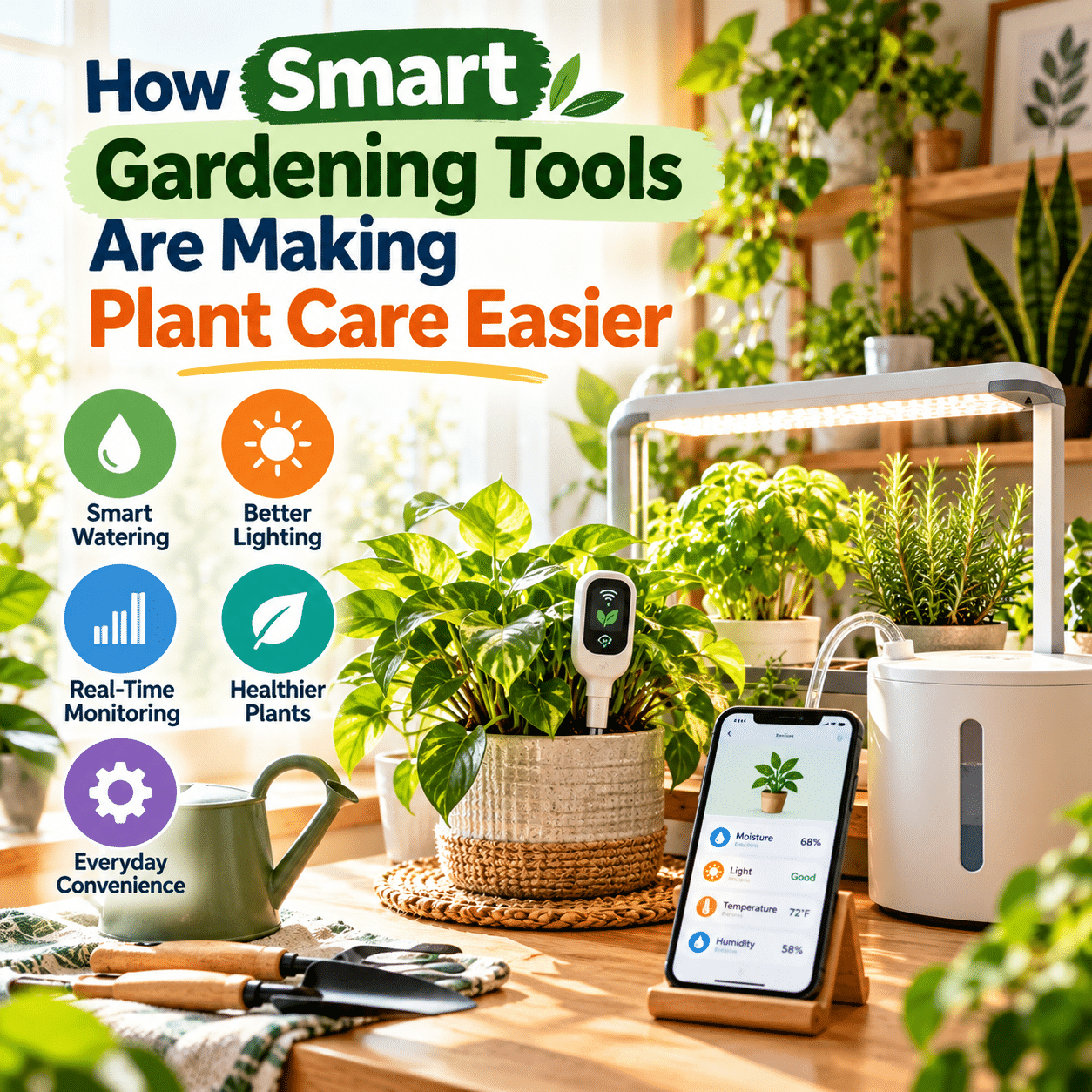
From moisture sensors and automated watering systems to programmable grow lights and connected indoor gardens, modern gardening technology offers practical ways to monitor growing conditions, simplify routine tasks, and make more informed plant-care decisions.
These tools are not intended to replace an understanding of plants. Instead, their greatest value comes from making important information easier to access and reducing the amount of repetitive work involved in maintaining a garden.
A beginner might use a moisture meter to avoid watering too frequently. Someone with a busy schedule might rely on an automatic irrigation timer. An indoor gardener with limited sunlight might use a programmable LED grow light to provide more consistent illumination.
Smart gardening is also becoming more adaptable. Some devices work independently, while others connect to smartphones or home automation systems. Many solutions can be used with ordinary pots and planters, making it possible to improve an existing garden without replacing everything.
However, not every smart gardening product is necessary, and advanced technology does not automatically produce healthier plants. Device accuracy, maintenance, installation, compatibility, and ongoing costs all influence whether a tool is genuinely useful.
Understanding these trade-offs is essential to making good decisions.
This guide explores how smart gardening tools work, the problems they can solve, their limitations, and how to build a practical plant-care system that combines useful technology with sound gardening habits.
1. What Are Smart Gardening Tools?
Smart gardening tools are devices or systems designed to help monitor, manage, or automate aspects of plant care.
Some provide information about growing conditions. Others perform tasks automatically, such as delivering water or controlling lighting schedules.
A device does not necessarily need internet connectivity or a smartphone application to be useful.
A simple digital moisture meter may help a gardener make better watering decisions, while a programmable timer can automate irrigation without connecting to a network.
More advanced systems may combine sensors, wireless communication, software, and automated equipment.
Common categories include:
- Soil moisture sensors.
- Automatic watering systems.
- Smart irrigation controllers.
- Programmable grow lights.
- Temperature and humidity monitors.
- Connected weather stations.
- Hydroponic growing systems.
- Nutrient and water-quality meters.
- Plant-care applications.
- Smart greenhouse controllers.
These tools generally serve three purposes: monitoring conditions, supporting decisions, and automating selected tasks.
The most appropriate technology depends on the plants being grown, the environment, and the specific problem the gardener wants to solve.
2. Why Traditional Plant Care Can Be Challenging
Plants respond to their surroundings, and those surroundings are rarely completely stable.
A houseplant may receive bright daylight during one season and substantially less light during another. An outdoor container may dry quickly during hot weather but remain moist for days after heavy rain.
Even plants of the same species can behave differently when grown in different containers or locations.
Several factors make plant care challenging.
Water Requirements Change
Water consumption depends on temperature, humidity, light exposure, plant size, root development, and growing medium.
A fixed watering schedule may not account for these changes.
Light Can Be Difficult to Evaluate
A room that looks bright to a person may not provide enough usable light for a particular plant.
Environmental Problems Are Not Always Visible
A plant may begin experiencing unfavorable root-zone conditions before obvious symptoms appear.
Busy Schedules Affect Consistency
Travel, work commitments, and changing routines can make regular inspection more difficult.
Different Plants Need Different Care
A succulent, tropical foliage plant, and culinary herb may require very different growing conditions.
Smart gardening tools can help address some of these challenges by providing measurements, reminders, or automated assistance.
They work best when the gardener understands what the information means.
3. The Shift From Guesswork to More Informed Plant Care
Traditional gardening relies heavily on observation and experience.
Gardeners examine leaves, feel the growing medium, consider the weather, and learn from the results of previous decisions.
These methods remain valuable.
Smart tools add another source of information by measuring selected environmental conditions.
For example, a moisture sensor may indicate that the growing medium remains wet below the surface even when the top looks dry.
A temperature monitor may reveal that a windowsill becomes much colder overnight than the rest of the room.
A light meter may help explain why a plant grows slowly in a location that appears visually bright.
Measurements Are Not the Same as Understanding
A numerical reading becomes useful only when interpreted correctly.
A soil moisture reading of 40%, for example, cannot automatically be classified as ideal without knowing how the device defines its measurement and what conditions the plant requires.
Different sensors may report relative moisture values, electrical properties, or estimated volumetric water content.
The numbers are not necessarily interchangeable.
Smart gardening therefore works best as a combination of:
- Plant knowledge.
- Environmental observation.
- Appropriate measurements.
- Practical decisions.
- Continued evaluation.
Technology can reduce uncertainty, but it cannot eliminate the biological complexity of growing plants.
4. Soil Moisture Sensors: A Practical Starting Point
Soil moisture sensors are among the most accessible gardening tools.
They help gardeners evaluate moisture conditions within the growing medium rather than relying entirely on the appearance of the surface.
This can be particularly useful because the top layer of potting mix may dry while deeper layers remain moist.
How Moisture Sensors Work
Different products use different measurement principles.
Resistive sensors estimate moisture-related changes through electrical resistance between probes.
Capacitive sensors detect changes in electrical properties associated with the surrounding medium.
Other devices use more specialized methods to estimate water content or water availability.
Sensor design affects accuracy, durability, and suitability for different growing media.
Benefits of Moisture Monitoring
A suitable sensor may help:
- Identify persistently wet growing conditions.
- Recognize when a container is drying.
- Compare moisture patterns over time.
- Reduce unnecessary watering.
- Support more consistent plant-care decisions.
Limitations
A sensor measures conditions near its sensing area.
It may not represent the entire container, especially when moisture distribution is uneven.
Readings can also be influenced by growing medium composition, salinity, temperature, probe placement, and calibration.
For these reasons, moisture sensors should complement physical inspection rather than replace it.
A gardener should still consider the plant’s species, root health, drainage, and overall condition.
5. Smart Watering Systems and Automated Irrigation
Watering is one of the most time-consuming recurring gardening tasks, particularly when maintaining multiple containers or outdoor growing areas.
Automated irrigation systems can deliver water according to a programmed schedule or selected sensor inputs.
Systems vary considerably in complexity.
A basic setup may consist of a timer connected to a water source.
A more advanced system may use moisture sensors, weather information, and programmable irrigation zones.
Common Types of Automated Watering
Timer-based irrigation: Delivers water at scheduled times.
Drip irrigation: Supplies water through emitters positioned near plants.
Reservoir-fed watering: Uses stored water to supply containers through pumps, tubing, or passive mechanisms.
Sensor-controlled irrigation: Activates watering based on selected moisture measurements or control rules.
Weather-responsive irrigation: Adjusts watering schedules using weather information or estimated landscape water requirements.
Why Automation Can Help
Automation may reduce repetitive work and make watering more consistent.
It can also be useful during short absences when a properly designed system has been tested beforehand.
Why Automation Requires Oversight
A malfunctioning valve, disconnected tube, blocked emitter, or inaccurate sensor can cause serious problems.
An automated system may deliver too much water, too little water, or no water at all.
For indoor installations, leaks can also damage flooring, furniture, and electrical equipment.
Automated watering should therefore include appropriate safeguards, regular inspections, and a practical plan for detecting failures.
6. Smart Irrigation Controllers for Outdoor Gardens
Outdoor gardens face additional variables, including rainfall, wind, sunlight, soil conditions, and seasonal weather changes.
Smart irrigation controllers can help manage these factors.
Many controllers allow users to create separate watering zones, which is useful when different parts of a garden have different needs.
For example, a sunny vegetable bed may require a different irrigation strategy from an established shrub border.
Weather-Based Scheduling
Some controllers use weather information to estimate irrigation requirements.
They may reduce or skip scheduled watering after sufficient rainfall or adjust watering based on changing conditions.
Soil-Moisture-Based Scheduling
Other systems use sensor measurements to help determine when irrigation is appropriate.
Potential Benefits
When properly selected, installed, and configured, smart irrigation controllers may:
- Reduce unnecessary watering.
- Improve scheduling consistency.
- Support different watering zones.
- Make irrigation adjustments more convenient.
- Provide useful operating information.
Important Considerations
Weather information may not reflect conditions at every part of a property.
Rainfall can vary over short distances, and soil moisture can differ substantially between locations.
A smart controller also cannot correct problems such as broken sprinklers, poor drainage, or unsuitable irrigation design.
The technology works best when combined with properly functioning equipment and appropriate watering practices.
7. Programmable LED Grow Lights
Light is essential for photosynthesis, yet indoor environments often provide less usable light than plants need.
Programmable LED grow lights can help supplement daylight or provide artificial lighting for indoor growing areas.
They are especially useful for seed starting, culinary herbs, and plants grown away from sufficiently bright windows.
What Makes a Grow Light Smart?
Smart or programmable grow lights may offer:
- Adjustable brightness.
- Scheduled operating periods.
- Different spectral settings.
- Smartphone controls.
- Grouped lighting zones.
- Integration with other automation devices.
Some systems allow users to adjust lighting schedules without manually switching fixtures on and off.
Understanding Plant Lighting
Plants respond to the amount of photosynthetically useful light they receive.
Two important concepts are:
Photosynthetic Photon Flux Density (PPFD): The rate at which photosynthetically active photons reach a given surface area.
Daily Light Integral (DLI): The total amount of photosynthetically active photons received over a day.
These measurements help describe light delivery in ways that are more relevant to plants than ordinary visual brightness alone.
Why More Light Is Not Always Better
Excessive light intensity or duration can stress plants.
Different species and growth stages require different conditions.
A lighting schedule should be based on plant needs, fixture performance, and the growing environment.
Electrical Safety
Use equipment suitable for the installation environment.
Keep electrical connections protected from water, follow mounting instructions, and avoid overloading outlets.
Programmable lighting can improve consistency, but successful results still depend on correct placement and appropriate settings.
8. Temperature and Humidity Monitoring
Temperature and humidity influence plant growth, water use, and susceptibility to certain problems.
Indoor conditions can vary significantly within the same home.
A location near a window may become warmer during direct sunlight and cooler overnight.
A shelf near an air-conditioning vent may experience drier airflow than another part of the room.
Digital temperature and humidity monitors help reveal these differences.
Why Temperature Matters
Temperature affects biological processes, including growth and respiration.
Different plants have different preferred temperature ranges.
Extreme temperatures or rapid fluctuations can cause stress.
Why Humidity Matters
Humidity influences the movement of water from plant leaves into the surrounding air.
Some tropical plants are more sensitive to dry conditions than species adapted to arid environments.
Understanding Relative Humidity
Relative humidity describes the amount of water vapor in the air relative to the maximum amount the air could hold at that temperature.
It changes as temperature changes.
Smart Monitoring Features
Connected monitors may provide:
- Current readings.
- Historical graphs.
- High- and low-temperature records.
- Alerts when conditions exceed selected thresholds.
- Remote monitoring through an application.
These features can be useful, but a monitor does not automatically correct environmental problems.
A gardener must still determine whether any adjustment is necessary and safe.
9. Smart Indoor Garden Systems
Integrated indoor garden systems combine several plant-care functions into one product.
A typical system may include a water reservoir, plant holders, growing medium, LED lighting, and programmable controls.
Some are designed for herbs or leafy greens, while others accommodate different crops.
Common Features
Depending on the system, features may include:
- Automatic lighting schedules.
- Water-level indicators.
- Pump-controlled circulation.
- Nutrient reminders.
- Adjustable lighting height.
- Plant growth presets.
- App-based notifications.
Why People Choose Integrated Systems
These systems can reduce the number of separate components a beginner needs to select.
They may also provide a compact growing arrangement suitable for a kitchen or other indoor space.
Practical Limitations
Integrated systems still require regular maintenance.
Water reservoirs must be refilled and cleaned.
Plants may need pruning, harvesting, or replacement.
Nutrients must be managed according to the system and crop requirements.
Some systems also depend on proprietary growing pods or replacement components.
Before purchasing, consider long-term supply availability, cleaning requirements, noise, electricity use, and replacement costs.
An integrated system can simplify selected tasks, but it does not make plant care completely automatic.
10. Hydroponic Monitoring Tools
Hydroponics involves growing plants with nutrients delivered through a water-based solution.
Because the root environment is managed differently from conventional container gardening, water quality and nutrient conditions become especially important.
Several measurement tools are commonly used.
pH Meters
A pH meter measures the acidity or alkalinity of a solution.
Solution pH influences nutrient availability, although appropriate ranges vary according to crop and system.
Electrical Conductivity Meters
Electrical conductivity, often abbreviated EC, provides information about the concentration of dissolved ions in a nutrient solution.
It does not identify individual nutrients or prove that the nutrient balance is correct.
Water Temperature Sensors
Water temperature influences root conditions and dissolved oxygen availability.
Water-Level Sensors
These devices help monitor reservoir levels and may trigger alerts or control equipment.
Automated Dosing Equipment
More advanced systems can add nutrients or pH-adjusting solutions according to programmed control rules.
However, dosing errors can damage plants and create chemical-handling hazards.
Why Calibration Matters
Measurement devices can drift or produce inaccurate readings.
Proper calibration, cleaning, storage, and maintenance are essential.
For beginners, reliable manual measurements may be more appropriate than complex automated dosing systems.
11. Plant-Care Apps and Digital Reminders
Plant-care applications are among the easiest ways to introduce technology into gardening.
They can help organize information about plants, care routines, and observations.
Common features include:
- Plant profiles.
- Watering reminders.
- Fertilizing reminders.
- Repotting records.
- Growth photographs.
- Care notes.
- Environmental information.
- Pest and symptom identification assistance.
The Value of Recordkeeping
A digital record can help gardeners identify patterns.
For example, photographs taken over several months may reveal gradual growth changes that are difficult to notice from day to day.
Notes about watering and light conditions can also help explain changes in plant health.
Why Reminders Should Be Flexible
A watering notification should be treated as a reminder to inspect the plant.
It should not automatically mean that water is required.
AI-Based Plant Identification
Some applications use image recognition to suggest plant identities or possible problems.
These features can be helpful starting points, but results may be incorrect.
Different species can look similar, and symptoms such as yellowing leaves may have multiple causes.
Important decisions should be supported by additional observation and reliable horticultural information.
12. Smart Weather Stations for Garden Planning
Weather conditions influence outdoor gardening decisions.
Connected weather stations can provide local measurements that may be more representative of a particular property than information from a distant weather station.
Depending on the equipment, measurements may include:
- Air temperature.
- Relative humidity.
- Rainfall.
- Wind speed.
- Wind direction.
- Barometric pressure.
- Solar radiation.
Practical Applications
Gardeners may use weather data to help plan irrigation, recognize temperature extremes, or evaluate conditions affecting outdoor plants.
Historical records can also reveal patterns over time.
Placement Matters
Weather sensors need suitable installation locations.
A temperature sensor placed against a sun-heated wall may produce readings that do not represent the surrounding air.
Rain gauges require appropriate exposure and maintenance.
Weather Forecasts Remain Uncertain
Local measurements describe current or past conditions.
Forecasts estimate future conditions and can be inaccurate.
Smart weather stations are useful sources of information, but they should not create a false sense of certainty about changing weather.
13. Smart Gardening and Water Conservation
Water conservation is one of the most practical potential benefits of smart gardening technology.
Traditional irrigation systems may operate according to fixed schedules regardless of recent rainfall or actual soil conditions.
Smart controllers can help reduce unnecessary watering when configured appropriately.
How Technology Can Reduce Waste
Moisture sensors may help identify when water is not needed.
Weather-responsive controllers may adjust irrigation after rainfall.
Drip systems can deliver water near plant roots.
Leak alerts may help identify certain equipment failures.
Water Savings Are Not Guaranteed
Actual results depend on the previous watering practices, system design, soil conditions, plant requirements, and maintenance.
An improperly configured smart system can waste more water than a carefully managed manual system.
Good Gardening Practices Still Matter
Mulching suitable outdoor planting areas can help reduce evaporation.
Choosing plants appropriate for local conditions can reduce unnecessary irrigation demand.
Improving soil structure and correcting drainage problems may also support better water management.
Smart technology is most effective when combined with sound horticultural practices.
14. How Smart Tools Help People With Busy Schedules
One reason smart gardening tools appeal to modern households is their ability to simplify repetitive tasks.
People who work long hours, travel occasionally, or maintain several plants may find certain automated features useful.
Reducing Repetitive Actions
A programmable light timer eliminates the need to switch a grow light on and off manually every day.
An appropriately designed irrigation system can deliver water according to a selected schedule.
Making Conditions Easier to Check
Connected sensors may allow users to review certain environmental measurements without visiting every growing location.
Supporting Consistency
Automation can help maintain regular operating schedules.
However, consistent operation is not necessarily the same as appropriate plant care.
A watering schedule can be perfectly consistent and still deliver too much water.
Avoiding Overdependence
A smart system should not encourage gardeners to ignore plants for extended periods.
Routine visual inspections remain important for detecting pests, disease, physical damage, and equipment problems.
The greatest benefit is often reducing unnecessary work while preserving meaningful attention to plant health.
15. Smart Gardening for Small Apartments
Small apartments can benefit from compact gardening solutions, especially where natural light or available floor space is limited.
Technology may help make certain growing arrangements more practical.
Compact Grow Lights
Small LED fixtures can support plants in locations where suitable natural light is insufficient.
Tabletop Growing Systems
Integrated indoor gardens can organize lighting and water delivery within a relatively small footprint.
Wireless Monitoring
Compact sensors can provide information without requiring large displays or extensive equipment.
Vertical Growing Arrangements
Shelving can make better use of available space, although lighting and watering must be considered at every level.
Important Apartment Considerations
Before installing equipment, evaluate:
- Electrical outlet locations.
- Water-spill risks.
- Equipment noise.
- Ventilation.
- Heat output.
- Shelf stability.
- Maintenance access.
- Household and building restrictions.
A compact smart garden should remain convenient and safe within the surrounding living space.
16. Smart Gardening for Larger Plant Collections
Managing a large collection of plants introduces organizational challenges.
Different plants may require different watering schedules, light levels, and growing conditions.
Digital tools can help organize this information.
Plant Inventory Systems
A spreadsheet or plant-care application can record species, locations, acquisition dates, and care observations.
Environmental Zones
Plants with similar requirements can be grouped into suitable areas.
Sensors may help monitor conditions within each zone.
Scheduled Lighting
Programmable lights can provide consistent schedules for different growing areas.
Automated Watering
Where appropriate, irrigation equipment may reduce repetitive watering tasks.
Why Individual Inspection Still Matters
Plants sharing a shelf may not have identical moisture requirements.
Container size, root development, and growing medium can create differences even when environmental conditions are similar.
Automation should support collection management rather than treat every plant as interchangeable.
17. Smart Gardening for Beginners Versus Experienced Gardeners
Different gardeners benefit from different levels of technology.
A beginner may need only a simple moisture meter and a reliable reminder system.
An experienced gardener managing a greenhouse may benefit from environmental monitoring and automated controls.
| Gardening experience | Useful starting tools | Main purpose |
|---|---|---|
| Beginner with a few houseplants | Moisture meter, care reminders | Build consistent observation habits |
| Indoor herb gardener | Grow light timer, temperature monitor | Support suitable growing conditions |
| Apartment gardener | Compact grow light, water-level indicator | Make limited spaces more practical |
| Outdoor container gardener | Irrigation timer, moisture monitoring | Manage changing water requirements |
| Hydroponic hobbyist | pH meter, EC meter, water-level monitor | Monitor nutrient solution conditions |
| Experienced greenhouse gardener | Environmental sensors, automated controls | Manage multiple interacting variables |
More advanced equipment is not inherently better.
The appropriate level of technology is the one that addresses real needs without introducing unnecessary complexity.
18. How to Choose the Right Smart Gardening Tools
Before purchasing a smart gardening device, identify the problem it is supposed to solve.
A tool should have a clear purpose.
Step 1: Identify the Main Challenge
Is the problem inconsistent watering, insufficient light, unpredictable temperatures, or difficulty managing many plants?
Step 2: Consider the Growing Environment
Indoor containers, outdoor gardens, hydroponic systems, and greenhouses have different requirements.
Step 3: Evaluate Measurement Quality
Look for information about sensor accuracy, calibration, measurement range, and limitations.
Step 4: Check Compatibility
Connected products may require particular wireless networks, operating systems, hubs, or applications.
Step 5: Consider Maintenance
Ask how often the device needs cleaning, calibration, charging, or replacement parts.
Step 6: Evaluate Safety
Electrical equipment used near water requires particular care.
Outdoor equipment should be appropriately rated for environmental exposure.
Step 7: Consider Long-Term Costs
Include batteries, electricity, subscriptions, replacement sensors, and proprietary consumables where applicable.
Step 8: Start Small
Test one useful tool before building an elaborate automated system.
A simple solution that works reliably is often more valuable than a complicated system that is difficult to maintain.
19. Understanding Connectivity and Smart Home Integration
Connected gardening devices may use Wi-Fi, Bluetooth, or other communication technologies.
Some operate independently, while others depend on a hub or cloud-based service.
Wi-Fi Devices
Wi-Fi connectivity may allow remote monitoring and control through a compatible network.
However, connection reliability depends on network coverage and device requirements.
Bluetooth Devices
Bluetooth can support nearby communication with compatible phones or controllers.
Remote access may require additional equipment.
Smart Home Platforms
Some gardening devices can integrate with broader home automation systems.
For example, a compatible sensor might trigger a notification when a selected threshold is reached.
Important Compatibility Questions
Before purchasing, check whether the device:
- Supports the intended platform.
- Requires a proprietary hub.
- Needs an ongoing internet connection.
- Offers local operation during outages.
- Depends on a paid subscription.
- Continues basic functions if the app becomes unavailable.
Connectivity should improve convenience, not create unnecessary dependence on unreliable services.
20. Data Privacy and Security in Connected Gardening Devices
Smart gardening products that connect to the internet may collect or transmit device information and usage data.
Depending on the product, an application may request access to account information, location, network details, or other permissions.
The amount and type of data collected vary by manufacturer.
Practical Privacy Considerations
Review the device’s privacy policy and app permissions.
Avoid granting unnecessary access.
Use strong, unique passwords when accounts are required.
Enable multifactor authentication where supported.
Keep firmware and applications updated.
Network Security
Connected devices should be configured using secure network settings.
For households with multiple connected devices, a separate guest or Internet of Things network may provide additional isolation when supported by the router.
Long-Term Software Support
Consider whether the manufacturer provides security updates and how the device functions if cloud services are discontinued.
A gardening device does not necessarily require extensive personal information to perform its basic purpose.
Privacy and security should be part of the purchasing decision, especially for connected products intended for long-term use.
21. The Importance of Calibration and Sensor Accuracy
Smart gardening depends on measurements, but no sensor is perfectly accurate under every condition.
Readings can change because of calibration drift, environmental interference, aging components, or improper placement.
Moisture Sensor Accuracy
Different growing media can affect moisture sensor readings.
A device calibrated for one type of soil may not perform identically in another medium.
Temperature and Humidity Accuracy
Sensors can be influenced by direct sunlight, nearby heat sources, or poor ventilation.
pH and EC Meter Accuracy
These instruments require appropriate calibration solutions and maintenance procedures.
Why Accuracy Matters
Incorrect measurements can lead to inappropriate decisions.
For example, a faulty moisture reading may trigger unnecessary irrigation.
Practical Ways to Improve Reliability
Follow manufacturer instructions.
Place sensors correctly.
Clean probes as recommended.
Calibrate instruments when required.
Compare unusual readings with physical observations or another suitable measurement method.
Replace damaged or unreliable components.
Smart gardening becomes more effective when measurements are treated as useful evidence rather than unquestionable facts.
22. Why Automation Cannot Replace Plant Knowledge
Plants are living organisms, not machines that respond identically to every programmed instruction.
Their needs vary by species, growth stage, environmental conditions, and overall health.
A sensor may detect moisture, but it cannot necessarily determine whether roots are healthy.
A light timer may maintain a consistent schedule, but it cannot guarantee that the light intensity is appropriate.
A fertilizer reminder may indicate that a planned interval has passed, but it cannot establish whether the plant currently needs additional nutrients.
Plant Observation Remains Essential
Gardeners should continue examining:
- Leaf color and condition.
- New growth.
- Root health when appropriate.
- Pest activity.
- Growing medium condition.
- Signs of environmental stress.
Technology Should Support Decisions
The most effective use of smart gardening tools is to improve the quality and consistency of decisions.
Automation should be adjusted when plant responses indicate that conditions are unsuitable.
The goal is not to remove the gardener from the process.
It is to make the process more manageable and informed.
23. Common Mistakes When Using Smart Gardening Technology
Smart gardening devices can create problems when users rely on them without understanding their limitations.
Assuming Every Sensor Is Accurate
Low-cost devices may provide inconsistent readings or lack suitable calibration.
Automating Before Understanding Plant Needs
An automatic watering system cannot compensate for incorrect watering targets.
Ignoring Equipment Maintenance
Blocked tubing, dirty sensors, and aging components can reduce reliability.
Installing Too Many Devices at Once
Complex systems can become difficult to troubleshoot.
Relying Entirely on Notifications
An application may fail to send an alert because of connectivity or software issues.
Overlooking Water and Electrical Safety
Poorly installed equipment can create hazards, especially indoors.
Purchasing Features That Are Never Used
A device with numerous advanced functions may provide little value if the gardener only needs one simple capability.
Forgetting Long-Term Costs
Subscriptions, replacement parts, and electricity can affect the total cost of ownership.
The most useful approach is to begin with a specific need and adopt technology gradually.
24. Troubleshooting Common Smart Gardening Problems
When a smart gardening system behaves unexpectedly, troubleshooting should begin with basic checks.
| Problem | Possible explanation | First steps |
|---|---|---|
| Moisture readings seem inconsistent | Placement, calibration, growing medium, or sensor fault | Check probe placement and compare with physical conditions |
| Irrigation does not start | Power, timer, valve, pump, or water-supply issue | Inspect the system safely and follow manufacturer instructions |
| Plants remain too wet | Excessive watering settings, poor drainage, or inaccurate sensing | Review irrigation settings and root-zone conditions |
| Grow light does not follow schedule | Timer settings, power interruption, or software issue | Check programming and device status |
| App cannot connect | Network coverage, compatibility, or service interruption | Review connectivity requirements and local device operation |
| Hydroponic readings drift | Calibration or probe maintenance issue | Clean and calibrate instruments appropriately |
| Water reservoir empties unexpectedly | Leak, increased consumption, or equipment malfunction | Inspect tubing, connections, and operating conditions |
Troubleshoot One Variable at a Time
Changing several settings simultaneously makes it harder to identify the cause of a problem.
Record what changed and observe the result.
Prioritize Safety
Disconnect electrical equipment before performing maintenance where appropriate.
Do not handle exposed electrical components near water.
Follow manufacturer guidance for pumps, valves, batteries, and chemical dosing systems.
A reliable smart garden depends on safe installation and regular maintenance as much as on software features.
25. The Environmental Trade-Offs of Smart Gardening
Smart gardening technology may support more efficient resource use, but its environmental impact is not automatically positive.
Potential benefits include reduced unnecessary irrigation, better lighting schedules, and fewer plant losses.
However, manufacturing electronic devices also requires materials, energy, packaging, and transportation.
Devices may eventually become electronic waste.
Electricity Consumption
Grow lights, pumps, controllers, and connected devices consume electricity.
Actual consumption depends on power ratings and operating duration.
Battery Use
Wireless sensors may require disposable or rechargeable batteries.
Product Durability
Long-lasting, repairable equipment may reduce the need for frequent replacement.
Water Efficiency
Smart irrigation can reduce waste when properly configured, but savings depend on the baseline system and actual operation.
Choosing Thoughtfully
Consider whether a device provides a meaningful benefit compared with a simpler alternative.
A mechanical timer may be sufficient where remote monitoring and complex automation are unnecessary.
Environmental responsibility comes from evaluating the complete system rather than assuming that digital technology is inherently sustainable.
26. Building a Simple Smart Gardening Setup
A beginner does not need a fully automated garden to benefit from technology.
A practical setup can be developed gradually.
Stage 1: Understand the Plants
Identify the species and learn their basic light, moisture, temperature, and growing-medium requirements.
Stage 2: Monitor One Important Condition
If watering is the main challenge, begin with a suitable moisture meter.
If light is uncertain, investigate the growing location and consider appropriate measurement tools.
Stage 3: Keep Basic Records
Record watering dates, environmental observations, and plant responses.
A notebook or spreadsheet can be as useful as a dedicated application.
Stage 4: Automate a Repetitive Task
A simple light timer may be a sensible first automation.
For outdoor irrigation, a properly installed controller may reduce manual scheduling work.
Stage 5: Evaluate Results
Determine whether the tool actually improves convenience or growing conditions.
Stage 6: Expand Only When Necessary
Additional sensors or automation may be worthwhile when a clear need emerges.
This approach reduces unnecessary spending and makes troubleshooting easier.
27. Comparing Manual, Assisted, and Automated Plant Care
Different levels of technology provide different advantages.
| Aspect | Manual plant care | Technology-assisted care | Automated care |
|---|---|---|---|
| Watering | Gardener decides and waters | Sensors help guide decisions | System delivers water according to controls |
| Lighting | Natural light or manual switching | Timers and measurements assist | Programmable lighting schedules |
| Environmental monitoring | Direct observation | Digital measurements and records | Continuous monitoring with selected alerts or responses |
| Initial complexity | Usually low | Low to moderate | Moderate to high |
| Equipment cost | Often lowest | Varies by tools | Often higher |
| Maintenance | Primarily plant care | Plant care plus device upkeep | Plant care plus system maintenance |
| Failure risks | Human error or missed tasks | Incorrect readings or interpretation | Sensor, software, power, or mechanical failures |
| Best suited for | Small, manageable collections | Gardeners seeking better information | Repetitive tasks or larger managed systems |
No single approach is ideal for everyone.
A gardener who enjoys checking plants daily may prefer manual care.
Someone managing numerous containers may benefit from monitoring tools.
A greenhouse operator may find automation useful for managing environmental conditions.
The best system is the one that matches the gardener’s needs, resources, and willingness to maintain the equipment.
28. The Future of Smart Gardening Tools
Smart gardening technology may continue to evolve as sensors, lighting systems, and automation become more capable.
Several developments are particularly relevant.
More Accessible Monitoring
Compact sensors may make environmental measurements easier for home gardeners.
Improved Automation
Controllers may offer more flexible scheduling and better integration with selected environmental measurements.
Better Data Visualization
Applications may present historical conditions in ways that help gardeners recognize patterns.
More Efficient Lighting
Advances in LED technology and fixture design may improve the efficiency and flexibility of plant lighting.
Greater Integration
Compatible devices may increasingly operate as parts of broader home or greenhouse management systems.
AI-Assisted Recommendations
Software may become more capable of analyzing images and sensor data to suggest possible plant-care actions.
However, recommendations will still depend on data quality, system limitations, and the complexity of plant biology.
These possibilities should not be interpreted as guarantees that future products will eliminate gardening work or reliably diagnose every plant problem.
The fundamentals of plant care will remain essential.
29. Frequently Overlooked Factors When Buying Smart Gardening Equipment
Product descriptions often emphasize automation, convenience, and connectivity.
Several practical details deserve equal attention.
Replacement Parts
Can pumps, sensors, tubing, and other components be replaced individually?
Offline Operation
Will essential functions continue if internet access is interrupted?
Cleaning Requirements
Can reservoirs, tubing, and probes be cleaned without excessive difficulty?
Measurement Documentation
Does the manufacturer explain what the sensor measures and how readings should be interpreted?
Power Requirements
Does the device use batteries, a power adapter, or a hardwired connection?
Physical Compatibility
Will the equipment fit existing containers, shelves, or irrigation systems?
Software Support
Is the application maintained, and are firmware updates available?
Warranty and Service
What support is available if the product fails?
Ease of Manual Override
Can the gardener stop or adjust automatic operation when necessary?
These considerations often determine whether a device remains useful after the initial excitement of installation has passed.
30. Making Smart Gardening Simpler Rather Than More Complicated
The purpose of smart gardening technology should be to make plant care easier, not to introduce unnecessary tasks.
A system that requires constant troubleshooting, frequent app adjustments, or expensive replacement components may create more work than it saves.
Simplicity begins with choosing tools that solve specific problems.
A moisture sensor may help someone who repeatedly overwaters houseplants.
A grow light timer may help maintain a consistent lighting schedule.
An irrigation controller may reduce repetitive outdoor watering adjustments.
None of these tools requires a fully connected home or an elaborate automated garden.
The most effective smart gardening approach combines three elements:
Reliable information: Measurements and observations that help explain growing conditions.
Appropriate action: Care decisions based on the needs of the plants.
Manageable technology: Equipment that is safe, maintainable, and genuinely useful.
When these elements work together, smart gardening can become a practical extension of ordinary plant care.
Frequently Asked Questions About Smart Gardening Tools
1. What are the most useful smart gardening tools for beginners?
A reliable moisture meter, a programmable grow light timer, and a simple plant-care record are useful starting points for many beginners. The best choice depends on the problem being addressed. Someone with adequate natural light may not need a grow light, while someone who already waters carefully may have little need for a moisture sensor.
2. Can smart gardening tools prevent overwatering?
Moisture sensors and appropriately configured irrigation systems can help reduce unnecessary watering. However, they cannot guarantee that overwatering will never occur. Sensor placement, calibration, drainage, plant requirements, and equipment reliability all influence the results.
3. Are smart indoor gardens suitable for apartments?
Yes. Many integrated indoor gardens and compact growing systems are designed for limited spaces. Before choosing one, consider its dimensions, lighting requirements, noise, electricity use, water-spill risks, and maintenance needs.
4. Do smart gardening devices need Wi-Fi?
Not necessarily. Many moisture meters, digital monitors, timers, and irrigation controllers operate without internet connectivity. Wi-Fi is generally needed only for devices or features that depend on network communication, remote access, or cloud services.
5. Can automated watering systems take care of plants while I travel?
A properly designed and tested system may maintain watering during some absences, but it cannot guarantee plant health. Pumps, valves, sensors, and water supplies can fail. For longer trips or valuable collections, additional safeguards and a reliable person who can inspect the plants may be appropriate.
6. Are smart gardening tools worth the money?
They can be worthwhile when they solve a recurring problem, save meaningful time, or help manage growing conditions more effectively. Their value depends on the gardener’s needs, the equipment’s reliability, and the total cost of ownership. A simple manual method may be more economical for a small plant collection.
7. Can artificial intelligence diagnose plant diseases accurately?
AI-assisted identification tools may suggest possible pests, diseases, or environmental problems, but their results are not always reliable. Similar symptoms can have different causes, and image quality can affect predictions. Important diagnoses should be supported by direct observation and credible horticultural guidance.
Conclusion: Smarter Tools, More Thoughtful Plant Care
Smart gardening tools are making plant care more convenient by helping gardeners monitor conditions, organize routines, and automate selected tasks.
Moisture sensors can provide useful information about growing media. Programmable grow lights can support more consistent lighting. Automated irrigation systems can reduce repetitive watering work. Connected monitors and digital records can make environmental changes easier to recognize.
These capabilities are valuable because gardening conditions are constantly changing, and maintaining healthy plants requires informed decisions.
However, technology is most effective when it supports an understanding of plant biology rather than attempting to replace it.
Sensors can provide measurements, but those measurements require interpretation. Automation can perform tasks, but equipment must be configured and maintained. Applications can offer reminders, but plants still need individual attention.
For most home gardeners, the best approach is to start with simple, reliable tools and expand only when a genuine need arises.
There is no requirement to transform every plant into part of a connected system.
A thoughtfully chosen moisture meter, a dependable light timer, or a well-designed watering setup may provide all the assistance a household needs.
Ultimately, the goal of smart gardening is not to make plant care entirely hands-free. It is to make gardening more manageable, informed, and enjoyable.
The smartest garden is not necessarily the one with the most technology. It is the one where useful tools and thoughtful care work together to help plants thrive.