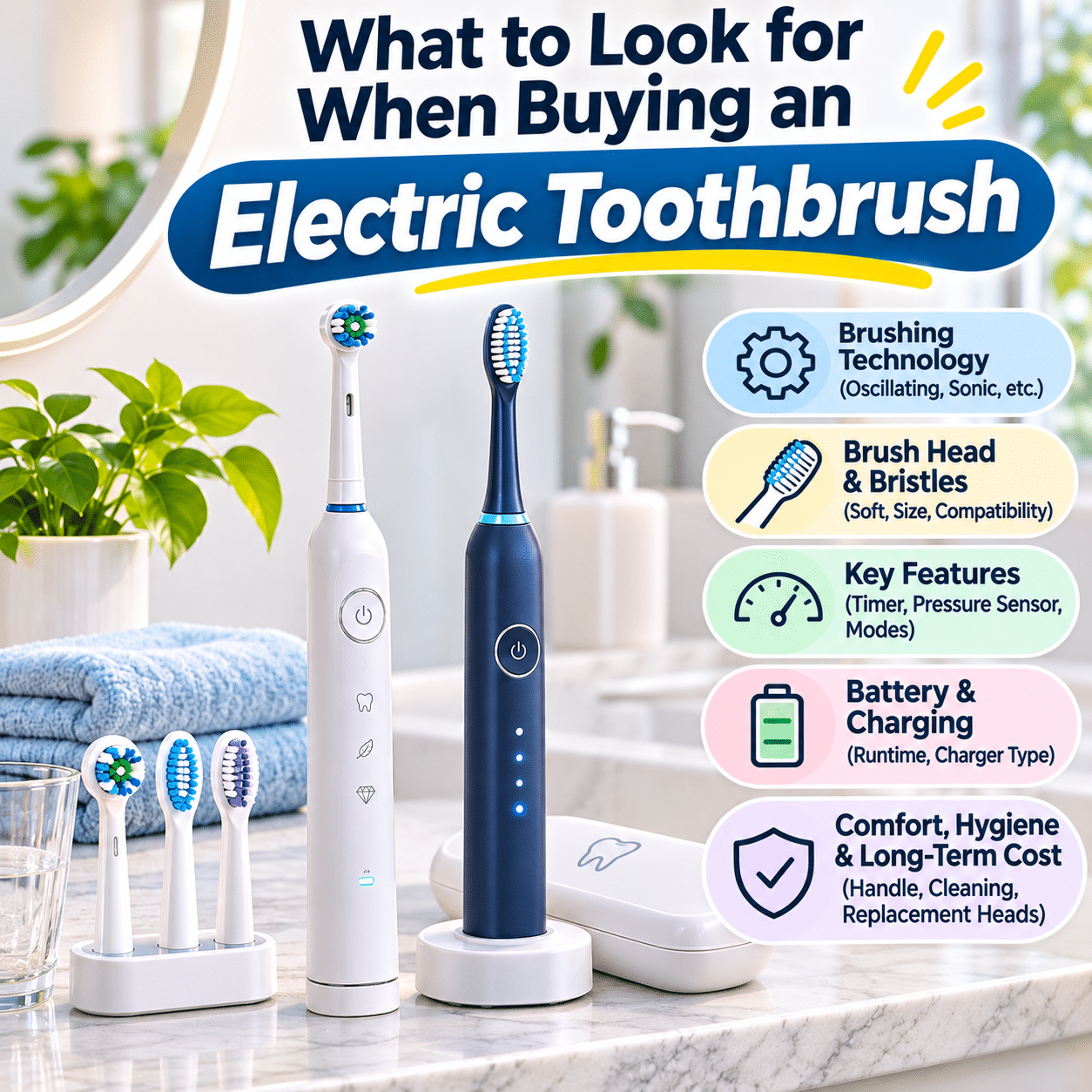
An electric toothbrush can be a valuable addition to an everyday oral care routine, helping users brush their teeth more consistently, manage brushing pressure, and clean different areas of the mouth with greater convenience. With numerous designs, cleaning technologies, brush head options, and additional features available, however, choosing the right electric toothbrush can feel more complicated than expected.
Some electric toothbrushes focus on straightforward daily cleaning, while others include pressure sensors, brushing timers, multiple operating modes, rechargeable batteries, travel cases, and smartphone connectivity. Although these features may improve convenience, not every user needs an advanced device to maintain effective oral hygiene.
The most suitable electric toothbrush is not necessarily the most expensive or technologically sophisticated model. It is one that fits comfortably in your hand, uses an appropriate brush head, supports gentle brushing, and encourages consistent oral care habits.
Several practical factors deserve attention before purchasing. These include the brushing mechanism, bristle softness, pressure control, battery performance, replacement head availability, cleaning requirements, and long-term ownership costs. Individual dental needs, such as sensitive gums, orthodontic appliances, or limited hand mobility, can also influence the decision.
This comprehensive buying guide explains how electric toothbrushes work, compares common brushing technologies, identifies useful features, explores oral care safety considerations, and provides practical steps for choosing a reliable toothbrush for everyday use.
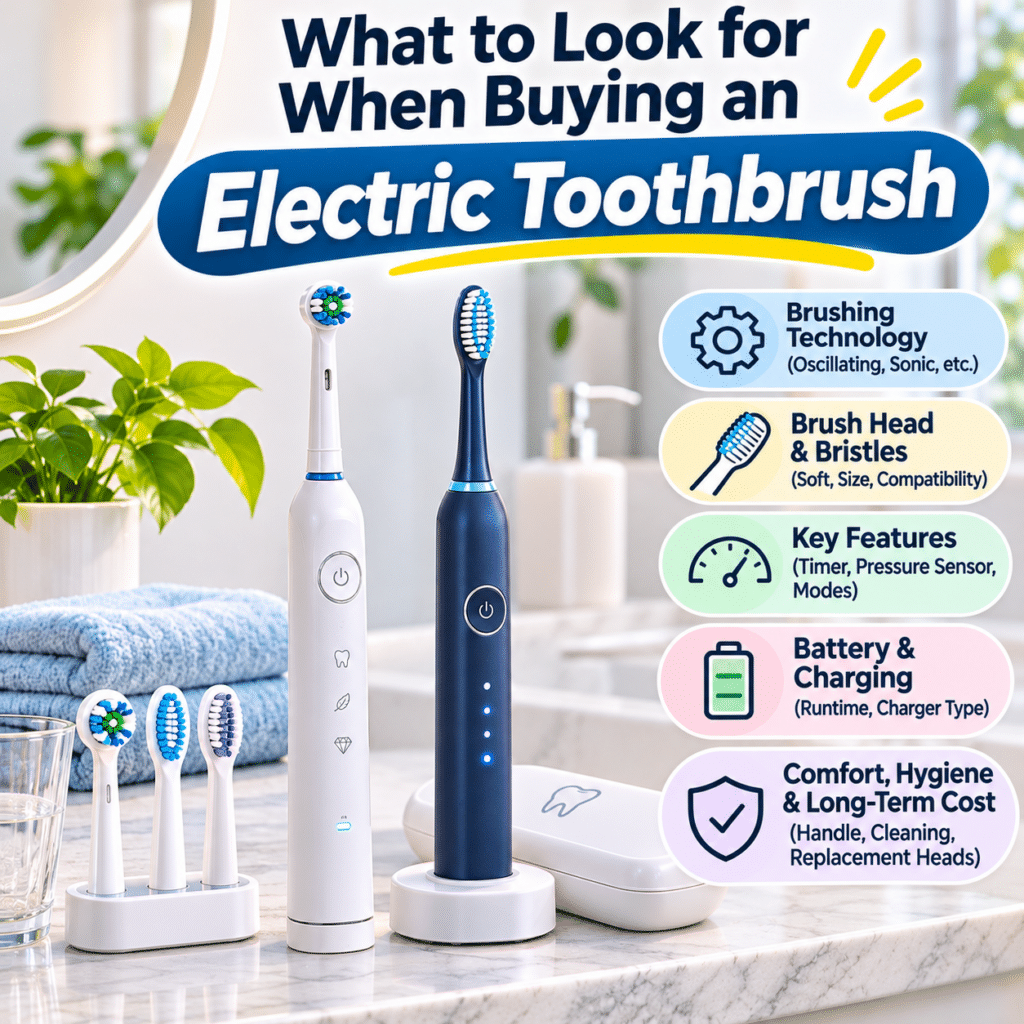
1. Understand How Electric Toothbrushes Work
Electric toothbrushes use a powered mechanism to move the brush head or bristles during brushing.
Unlike a manual toothbrush, which relies entirely on hand movements, an electric toothbrush provides some of the cleaning motion mechanically.
The user still needs to guide the brush across all tooth surfaces and maintain appropriate brushing habits.
Main Components of an Electric Toothbrush
Most electric toothbrushes include:
- A handle containing the motor and electronic components.
- A removable or integrated brush head.
- An on/off control.
- A power source, usually a rechargeable or replaceable battery.
- A mechanism that transfers motion to the bristles.
- A charging system, when applicable.
More advanced designs may also include pressure sensors, timers, operating modes, or wireless connectivity.
How Electric Brushing Helps Clean Teeth
Toothbrush bristles help disrupt and remove dental plaque from accessible tooth surfaces and along the gumline.
Plaque is a sticky biofilm containing microorganisms that accumulates naturally on teeth.
Regular plaque removal is important for maintaining oral health.
Electric toothbrushes provide repeated brushing movements that may help users achieve more consistent cleaning.
However, powered movement does not eliminate the need for proper technique.
Electric Toothbrushes Are Not Completely Automatic
Even when the brush head moves independently, the user must position it correctly.
Important areas include:
- Outer tooth surfaces.
- Inner tooth surfaces.
- Chewing surfaces.
- Areas near the gumline.
- Hard-to-reach back teeth.
A toothbrush cannot clean areas it never contacts.
2. Understand the Main Types of Electric Toothbrushes
Electric toothbrushes are commonly categorized by their brushing mechanism.
The main categories include oscillating-rotating, sonic, and simpler vibrating or powered designs.
Oscillating-Rotating Toothbrushes
Oscillating-rotating toothbrushes generally use a small, round brush head that moves back and forth through a rotating motion.
Some designs also incorporate pulsating movements.
Potential advantages include:
- A compact head that can reach individual teeth.
- Mechanically controlled brushing movements.
- Compatibility with specialized replacement heads.
- Pressure feedback on selected models.
Important considerations include:
- Brush head shape and size.
- Comfort around the gums.
- Noise and vibration.
- Replacement head availability.
- Proper positioning during brushing.
Sonic Toothbrushes
Sonic toothbrushes use rapid bristle movements, typically with a side-to-side sweeping action.
They often have elongated brush heads resembling traditional toothbrushes.
Potential advantages include:
- Familiar brush head shapes.
- Rapid brushing motion.
- Multiple cleaning intensity options on some models.
- Timers and pressure feedback on selected devices.
Important considerations include:
- Vibration comfort.
- Brush head dimensions.
- Bristle softness.
- Replacement head compatibility.
- Ease of controlling brushing pressure.
Basic Vibrating Toothbrushes
Some powered toothbrushes use relatively simple vibrating mechanisms.
They may resemble manual toothbrushes with added movement.
These products can offer a powered brushing experience without extensive electronic features.
However, performance varies by design, and the presence of vibration alone does not establish cleaning effectiveness.
Ultrasonic Toothbrushes
Some specialized toothbrushes use ultrasonic technology.
These should not automatically be confused with ordinary sonic toothbrushes.
The terms describe different physical mechanisms, and marketing descriptions are not always precise.
Consumers should examine the actual technology, evidence, and intended use rather than assuming that a higher-frequency mechanism necessarily provides better cleaning.
3. Compare Electric Toothbrush Technologies
| Feature | Oscillating-Rotating | Sonic | Basic Powered |
|---|---|---|---|
| Typical brush head | Small and round | Elongated | Varies |
| Main movement | Rotational oscillation | Rapid side-to-side movement | Vibration or other simple movement |
| Brushing approach | Guide around individual teeth | Guide across tooth surfaces | Depends on design |
| Pressure sensors | Available on selected models | Available on selected models | Less common |
| Multiple modes | Model-dependent | Model-dependent | Often limited |
| Replacement heads | Usually system-specific | Usually system-specific | Model-dependent |
| User experience | Focused head positioning | Familiar elongated head | Generally straightforward |
| Best choice | Depends on comfort and technique | Depends on comfort and technique | Basic powered brushing needs |
No brushing mechanism is universally ideal for every person.
Some clinical evidence supports advantages for certain powered toothbrush designs, but individual results depend on technique, consistency, and oral health needs.
4. Compare Electric and Manual Toothbrushes
Before purchasing an electric toothbrush, it is useful to understand how it differs from a manual toothbrush.
Manual Toothbrushes
Manual toothbrushes are simple, widely available, and do not require electricity.
Advantages include:
- Low initial cost.
- Lightweight construction.
- Easy portability.
- No charging requirements.
- Wide availability of replacement products.
However, effective cleaning depends heavily on brushing technique.
Electric Toothbrushes
Electric toothbrushes provide powered bristle movement.
Potential advantages include:
- Mechanically assisted brushing.
- Built-in timers.
- Pressure feedback.
- Reduced manual movement for some users.
- Additional brushing modes on selected models.
Limitations include:
- Higher initial cost.
- Replacement brush head expenses.
- Charging or battery requirements.
- Additional maintenance.
- Possible vibration or noise discomfort.
Does an Electric Toothbrush Clean Better?
Systematic reviews have found that powered toothbrushes, particularly certain oscillating-rotating designs, can provide modest improvements in plaque removal and gingivitis outcomes compared with manual brushing.
However, the size and clinical significance of the benefit vary, and effective manual brushing remains a valid option.
The most important factors include thorough brushing, appropriate pressure, consistent habits, and cleaning between teeth.
5. Prioritize Soft Bristles
Bristle softness is one of the most important considerations when choosing any toothbrush.
Why Soft Bristles Matter
Soft bristles can clean tooth surfaces while reducing the risk of unnecessary abrasion and gum irritation.
Dental professionals generally recommend soft-bristled toothbrushes for routine oral hygiene.
Avoid Assuming Firmer Means Cleaner
Harder bristles do not automatically remove plaque more effectively.
Excessive brushing force, especially when combined with stiff bristles, may contribute to damage to gums and tooth surfaces.
Consider Bristle End Quality
Well-manufactured brush heads should have appropriately finished bristles.
Poorly manufactured or damaged bristles may feel rough.
Replace Worn Bristles
Bristles that become bent, frayed, or excessively spread may clean less effectively.
Choose Comfort Over Aggressive Scrubbing
An electric toothbrush should support gentle, controlled brushing rather than encourage excessive pressure.
6. Evaluate Brush Head Size and Shape
Brush head dimensions affect comfort and access to different areas of the mouth.
Small Round Brush Heads
These are commonly used with oscillating-rotating toothbrushes.
Potential advantages include:
- Easy positioning around individual teeth.
- Access to selected hard-to-reach areas.
- Compact design.
Elongated Brush Heads
These are common on sonic toothbrushes.
Potential advantages include:
- A familiar shape.
- Coverage across multiple tooth surfaces.
- A brushing experience similar to manual toothbrushes.
Compact Brush Heads
Smaller heads may be helpful for users with limited mouth opening or difficulty reaching back teeth.
Avoid Oversized Heads
A brush head that is too large may be uncomfortable or difficult to position.
Consider Personal Anatomy
Mouth size, dental alignment, and orthodontic appliances can influence which head shape feels most practical.
7. Understand Replacement Brush Head Options
Replacement heads are a recurring ownership requirement.
Standard Cleaning Heads
These are designed for everyday plaque removal.
Sensitive Heads
Some manufacturers offer softer or gentler brush head designs.
Compact Heads
Smaller heads may improve access to selected areas.
Orthodontic Heads
Certain designs are intended to help clean around braces and orthodontic hardware.
Specialized Heads
Manufacturers may offer heads marketed for gum care, polishing, or other purposes.
Specialized designs should be evaluated based on their actual function rather than marketing terminology.
Check Compatibility
Replacement heads are often specific to a manufacturer, product family, or connection system.
Even products from the same brand may not use interchangeable heads.
8. Understand How Often Brush Heads Need Replacement
Brush heads gradually wear with regular use.
A common recommendation is to replace a toothbrush or brush head approximately every three to four months, or sooner if the bristles become frayed.
Factors That Influence Replacement
- Brushing frequency.
- Applied pressure.
- Bristle quality.
- Visible wear.
- Cleaning and storage conditions.
Watch for Fraying
Spread or flattened bristles may indicate excessive force or wear.
Do Not Depend Only on Color Indicators
Some brush heads include fading bristles as replacement reminders.
These can be useful, but visible wear and manufacturer guidance remain important.
Consider Replacement Costs
Before buying a toothbrush, check whether replacement heads are affordable and consistently available.
9. Look for a Pressure Sensor
A pressure sensor is one of the most practical features available on many electric toothbrushes.
What a Pressure Sensor Does
A pressure sensor detects when excessive force is applied during brushing.
Depending on the model, it may:
- Display a warning light.
- Produce a vibration alert.
- Reduce brushing speed.
- Change operating behavior.
- Record pressure information.
Why Pressure Control Matters
Brushing harder does not necessarily improve plaque removal.
Excessive pressure may irritate gums and contribute to mechanical wear.
Different Pressure Sensor Designs
Basic systems may only warn when pressure is excessive.
More advanced systems may provide feedback about both excessive and insufficient pressure.
Is a Pressure Sensor Necessary?
It is not essential for everyone, but it can be especially useful for people who tend to brush aggressively.
10. Choose a Toothbrush With a Brushing Timer
A timer helps users maintain a consistent brushing duration.
Two-Minute Timer
Many electric toothbrushes include a timer based on the commonly recommended two-minute brushing duration.
Quadrant Pacing
Some devices divide the brushing period into four intervals.
This can encourage users to distribute brushing time across different sections of the mouth.
Timer Alerts
Alerts may use:
- Brief pauses.
- Changes in vibration.
- Audible signals.
- Indicator lights.
Automatic Shutoff
Some toothbrushes stop automatically after a programmed interval.
Others continue operating until manually switched off.
Timers Do Not Guarantee Complete Cleaning
A timer helps with duration, but users must still brush all relevant surfaces.
People with specific dental needs may require individualized guidance.
11. Evaluate Different Brushing Modes
Many electric toothbrushes offer several operating modes.
Common labels include:
- Daily Clean.
- Sensitive.
- Gum Care.
- Deep Clean.
- Whitening.
- Massage.
- Polish.
These names are not standardized across manufacturers.
Daily Cleaning Mode
This is usually intended for routine brushing.
Sensitive Mode
Sensitive modes may reduce movement intensity or change the brushing pattern.
Gum Care Mode
These modes may provide a different movement pattern or intensity.
They should not be assumed to treat gum disease.
Whitening Mode
Some manufacturers use whitening terminology for specialized brushing patterns.
However, a toothbrush does not provide the same effects as professional whitening treatments.
Deep Cleaning Mode
This may involve a longer programmed brushing session or different operating pattern.
Longer or stronger brushing is not automatically more beneficial.
How Many Modes Do You Need?
For many users, a reliable daily cleaning mode and an optional gentler setting are sufficient.
Additional modes should provide a clear practical benefit.
12. Consider Adjustable Brushing Intensity
Adjustable intensity can make an electric toothbrush more comfortable.
Lower Intensity
A gentler setting may be helpful for users who find strong vibration uncomfortable.
Higher Intensity
Higher settings may produce more noticeable movement but should not encourage excessive pressure.
Transitioning From Manual Brushing
Some users prefer starting with a gentler setting while becoming familiar with powered brushing.
Comfort Matters
The ideal setting is one that supports effective, gentle brushing without discomfort.
Avoid Using Intensity as a Substitute for Technique
A powerful motor cannot compensate for incomplete brushing.
13. Evaluate Handle Comfort and Ergonomics
The toothbrush handle should be comfortable to hold and easy to control.
Handle Thickness
Some users prefer slim handles, while others benefit from larger grips.
Nonslip Surfaces
Textured surfaces can improve control when hands are wet.
Weight
A lighter handle may reduce fatigue.
Balance
A well-balanced toothbrush may feel easier to maneuver.
Button Placement
Controls should be accessible without awkward finger movements.
Grip Accessibility
People with arthritis, reduced dexterity, or limited hand strength may benefit from larger handles and simplified controls.
14. Consider Ease of Use for Beginners
A first electric toothbrush should be straightforward to operate.
Simple Controls
A single-button design may be sufficient.
Clear Operating Modes
Avoid confusing controls that make routine brushing unnecessarily complicated.
Gentle Start Features
Some toothbrushes include programs that gradually increase intensity over several uses.
Clear Instructions
The manufacturer should explain how to position the brush head and guide it around the mouth.
Easy Brush Head Replacement
Replacing the head should not require excessive force or complicated procedures.
Minimal Maintenance
A simple device may be more practical than one requiring frequent software updates or specialized accessories.
15. Understand Battery Types
Electric toothbrushes may use rechargeable or replaceable batteries.
Rechargeable Toothbrushes
These are common in mid-range and premium models.
Advantages include:
- Repeated use without replacing disposable batteries.
- Convenient charging systems.
- Often include battery indicators.
Considerations include:
- Charging time.
- Battery aging.
- Charger compatibility.
- Replacement or repair limitations.
Replaceable-Battery Toothbrushes
Some basic models use standard replaceable batteries.
Advantages include:
- Simple battery replacement.
- No dedicated charging station.
- Convenient occasional use.
Considerations include:
- Ongoing battery purchases.
- Battery disposal.
- Potentially limited features.
Which Is Better?
Rechargeable designs are often convenient for daily use.
Replaceable-battery models may be practical for occasional use or particular travel situations.
16. Evaluate Battery Runtime
Battery runtime affects convenience.
Daily Use
A toothbrush should provide enough operating time for regular brushing without inconvenient charging interruptions.
Travel Use
Longer runtime may be helpful when traveling.
Battery Capacity Claims
Manufacturers may express battery life in days or weeks.
These estimates often assume a particular brushing frequency and duration.
Real-World Performance
Runtime can vary with:
- Operating mode.
- Brushing frequency.
- Battery age.
- Temperature.
- Additional electronic features.
Avoid Comparing Runtime Without Context
A claimed three-week battery life may not be directly comparable to another product’s estimate if testing assumptions differ.
17. Compare Charging Systems
Electric toothbrushes use several charging approaches.
Charging Stands
A dedicated base holds the toothbrush upright while charging.
Inductive Charging
Some designs transfer energy without exposed electrical contacts.
USB Charging
Certain travel-oriented toothbrushes use USB-based charging systems.
Charging Cases
Some premium models include cases that can charge the toothbrush.
Proprietary Chargers
Dedicated chargers may be convenient but can create replacement difficulties.
Consider Replacement Availability
Check whether a lost or damaged charger can be purchased separately.
18. Understand Charging Safety
Electric toothbrushes are commonly used in bathrooms, where moisture is present.
Follow Manufacturer Instructions
Use only compatible charging equipment.
Keep Charging Equipment Appropriately Positioned
Chargers should be installed or placed according to their electrical safety requirements.
Avoid Damaged Equipment
Do not use chargers with damaged cords, exposed components, or abnormal heating.
Check Voltage Compatibility
International travelers should verify the charger’s input specifications.
Follow Local Electrical Requirements
Bathroom electrical installations may require specific protective devices and placement restrictions.
Do Not Assume Every Charger Is Waterproof
The toothbrush handle and charging equipment may have different water-resistance ratings.
19. Consider Water Resistance
Most electric toothbrushes are designed to tolerate moisture during normal brushing and cleaning.
However, water resistance varies.
Water-Resistant Handles
Some handles are designed to withstand rinsing or limited water exposure.
Waterproof Claims
The word “waterproof” should be interpreted according to the manufacturer’s stated testing conditions.
IP Ratings
Ingress Protection ratings describe specific levels of protection against solids and water.
Avoid Unnecessary Immersion
Do not immerse a toothbrush unless the manufacturer explicitly permits it.
Protect Charging Components
Charging equipment may have different limitations from the toothbrush itself.
20. Evaluate Cleaning and Hygiene Requirements
An electric toothbrush should be easy to clean and store.
Rinse the Brush Head
After brushing, rinse the head according to the manufacturer’s instructions.
Remove Toothpaste Residue
Residue may accumulate around the brush head connection.
Clean the Handle
Wipe or rinse the handle only as permitted by the manufacturer.
Allow Proper Drying
Store the toothbrush in a position that allows moisture to drain and surfaces to dry.
Avoid Unnecessary Enclosure While Wet
Keeping a wet brush head in a tightly sealed container for extended periods may interfere with drying.
Clean Charging Bases
Charging stands may accumulate toothpaste residue and moisture.
Disconnect and clean them according to the manufacturer’s guidance.
21. Consider Brush Head Storage
Proper storage supports hygiene and convenience.
Upright Storage
Many toothbrushes are designed to stand vertically.
Ventilation
Allow brush heads to dry between uses.
Avoid Contact Between Brush Heads
In shared bathrooms, separate storage can help prevent unnecessary contact.
Travel Covers
Protective covers are useful during transportation.
However, a wet brush head should not remain enclosed longer than necessary.
Replacement Head Storage
Keep unused heads in clean, dry conditions.
22. Consider Noise and Vibration
Electric toothbrushes produce varying levels of sound and vibration.
Motor Noise
Some designs are noticeably louder than others.
Vibration Sensation
Users may experience different levels of vibration through the handle and brush head.
Comfort During Brushing
A toothbrush that feels unpleasant may discourage consistent use.
Sensitive Users
People who are sensitive to noise or vibration may prefer models with gentler operating modes.
Compare Realistic Demonstrations
Product descriptions such as “whisper quiet” may not reflect standardized measurements.
23. Evaluate Smart Features and Connectivity
Some electric toothbrushes connect to smartphone applications.
Possible features include:
- Brushing duration tracking.
- Pressure feedback.
- Brushing coverage estimates.
- Personalized reminders.
- Progress summaries.
- Guided brushing routines.
Potential Benefits
Connected features may help users become more aware of brushing habits.
Important Limitations
Tracking systems may not measure plaque removal directly.
Coverage estimates and brushing scores are not equivalent to professional dental assessments.
Privacy Considerations
Connected devices may collect usage information.
Review data collection, account requirements, and privacy controls before using connected features.
Long-Term Software Support
Application features may change or become unavailable.
Are Smart Features Necessary?
No.
A well-designed toothbrush can support effective oral hygiene without smartphone connectivity.
24. Understand Brushing Coverage Tracking
Some advanced toothbrushes attempt to identify which areas of the mouth have been brushed.
Motion Sensors
Sensors may estimate toothbrush orientation and movement.
Position Tracking
Certain systems use software to infer brushing coverage.
Real-Time Feedback
Some applications display areas that may need additional attention.
Limitations
These systems may not accurately identify every tooth surface or measure cleaning quality.
Practical Value
Coverage tracking may help users develop more consistent routines, but it should be treated as guidance rather than proof of complete cleaning.
25. Consider Pressure Feedback Versus Brushing Tracking
Pressure feedback and brushing tracking serve different purposes.
| Feature | Main Purpose | Practical Benefit | Limitation |
|---|---|---|---|
| Pressure sensor | Detect excessive force | Encourages gentler brushing | Does not measure plaque removal |
| Two-minute timer | Track brushing duration | Supports consistent timing | Does not confirm complete coverage |
| Quadrant pacer | Divide brushing time | Encourages balanced attention | May not reflect individual needs |
| Motion tracking | Estimate brushing movement | Can improve awareness | Estimates may be imperfect |
| Smartphone app | Display usage information | Provides reminders and feedback | Adds complexity and possible privacy concerns |
| Intensity adjustment | Change brushing strength | Improves comfort | Does not replace proper technique |
For many users, pressure feedback and a timer provide more practical value than elaborate tracking systems.
26. Choose an Electric Toothbrush for Sensitive Teeth
Sensitive teeth can have several underlying causes.
An electric toothbrush should not be expected to diagnose or treat the cause.
Soft Bristles
Choose an appropriate soft-bristled head.
Gentle Operating Mode
Lower intensity may improve comfort.
Pressure Control
A pressure sensor may help prevent excessive force.
Comfortable Head Size
Choose a head that can be positioned without unnecessary pressure.
Avoid Aggressive Brushing
Do not scrub forcefully to compensate for sensitivity.
Seek Dental Guidance
Persistent or worsening tooth sensitivity should be evaluated by a dental professional.
27. Choose an Electric Toothbrush for Sensitive Gums
Sensitive or bleeding gums require careful attention.
Prioritize Gentle Brushing
Use soft bristles and controlled pressure.
Consider Pressure Sensors
These can help users recognize excessive force.
Avoid Assuming Gum Bleeding Is Normal
Occasional bleeding may occur for several reasons, including inflammation.
Persistent bleeding should be assessed by a dental professional.
Do Not Rely on Gum Care Modes as Treatment
A special operating mode does not replace professional evaluation or treatment.
Maintain Consistent Oral Hygiene
Gentle, thorough plaque removal remains important.
28. Choose an Electric Toothbrush for Braces
Orthodontic appliances create additional surfaces where plaque and food particles can accumulate.
Compact Brush Heads
Smaller heads may help reach areas around brackets.
Soft Bristles
Gentle bristles can support cleaning around orthodontic components.
Specialized Attachments
Some manufacturers offer orthodontic brush heads.
Pressure Control
Avoid excessive force around brackets and wires.
Additional Cleaning Tools
Interdental brushes, flossing aids, or other tools may be recommended.
Follow Orthodontic Guidance
The most suitable routine depends on the appliance and individual dental needs.
29. Choose an Electric Toothbrush for Dental Implants
Dental implants require consistent cleaning of the surrounding tissues.
Gentle Brush Heads
Choose suitable soft bristles.
Comfortable Access
A compact head may help reach difficult areas.
Avoid Excessive Pressure
Aggressive brushing may irritate surrounding tissues.
Consider Professional Recommendations
Implant restorations and surrounding tissues vary.
Do Not Assume a Special Mode Is Required
The appropriate technique and cleaning tools matter more than marketing labels.
30. Choose an Electric Toothbrush for Crowns and Bridges
Crowns and bridges require routine plaque control.
Choose Suitable Bristles
Soft bristles are generally appropriate.
Consider Brush Head Access
The head should reach around restorations comfortably.
Pay Attention to Margins
Cleaning around restoration margins is important.
Interdental Cleaning Still Matters
A toothbrush does not replace appropriate cleaning between teeth or beneath certain bridge structures.
Seek Individual Guidance
Dental professionals can recommend tools for specific restorations.
31. Choose an Electric Toothbrush for Children
Children’s electric toothbrushes should be age-appropriate.
Smaller Brush Heads
A compact head may better fit a child’s mouth.
Comfortable Handles
Handles should suit the child’s hand or caregiver-assisted brushing.
Gentle Operation
Choose a device appropriate for the child’s age and comfort.
Simple Timers
Timers may help establish consistent brushing habits.
Supervision
Young children generally need adult assistance or supervision to brush effectively.
Follow Age Recommendations
Use products intended for the child’s age group.
Avoid Treating Entertainment Features as Essential
Music, lights, or applications may encourage engagement, but brushing quality and safety remain the priorities.
32. Choose an Electric Toothbrush for Older Adults
Some older adults may benefit from powered brushing.
Larger Handles
A comfortable grip can help users with reduced dexterity.
Simple Controls
Clearly marked buttons reduce unnecessary complexity.
Manageable Weight
A lightweight, balanced handle may improve comfort.
Pressure Sensors
These may help users maintain gentle brushing.
Easy Brush Head Replacement
Avoid complicated attachment mechanisms when possible.
Individual Dental Needs
Dentures, implants, crowns, bridges, and gum conditions may require specific care routines.
33. Consider Users With Limited Hand Mobility
Electric toothbrushes can reduce the amount of manual brushing movement required.
Grip Design
Larger or textured handles may be easier to hold.
Button Accessibility
Controls should be simple and easy to activate.
Weight Distribution
A balanced handle can reduce strain.
Minimal Mode Switching
Complex controls may be inconvenient.
Stable Charging
A charging base should be easy to access and use.
Consider Adaptive Accessories
Some users may benefit from modified grips or assistive devices.
34. Choose an Electric Toothbrush for Travel
Travel convenience depends on size, battery life, charging, and protection.
Battery Runtime
A longer-lasting battery may reduce the need to pack a charger.
Compact Design
Slim handles and protective cases can save luggage space.
Travel Lock
Some models include a lock that prevents accidental activation.
Protective Case
A case can protect the toothbrush during transportation.
Charging Compatibility
Check charger specifications before international travel.
Replacement Head Availability
Consider whether compatible heads are easy to obtain when traveling for extended periods.
Airline Requirements
Battery-powered devices should be transported according to applicable airline and security rules.
35. Evaluate Travel Cases
Travel cases differ in materials, ventilation, and additional features.
Basic Protective Cases
These protect the handle and brush head from contact with other belongings.
Ventilated Cases
Ventilation may help moisture escape.
Charging Cases
Some premium cases include charging functionality.
Case Size
A bulky case may be inconvenient for compact luggage.
Ease of Cleaning
The case itself should be easy to maintain.
Avoid Sealing Wet Brush Heads for Long Periods
Allow the brush head to dry when practical.
36. Consider Family and Shared Household Use
Several household members may use the same bathroom.
Individual Brush Heads
Each person should have their own brush head.
Clear Identification
Color-coded rings or labeled storage may help distinguish heads.
Handle Sharing
Some electric toothbrush systems permit multiple users to share a handle with separate heads, but this arrangement may be inconvenient and requires careful hygiene.
Separate Storage
Avoid unnecessary contact between brush heads.
Replacement Scheduling
Track replacement needs for each user.
Practical Convenience
In some households, separate toothbrush handles may be easier to manage.
37. Evaluate Brand Reliability Without Relying on Brand Names Alone
Brand recognition can be useful, but it should not determine the entire purchasing decision.
Product Documentation
Look for clear specifications and instructions.
Replacement Head Availability
Established accessory support can improve long-term usability.
Warranty Coverage
Review warranty terms and service options.
Product Safety Information
Look for credible compliance information.
Independent Evidence
Relevant clinical studies or recognized acceptance programs may provide useful context.
Avoid Unsupported Rankings
A product should not be considered the best simply because it is heavily advertised.
38. Understand Dental Product Acceptance Programs
Some oral care products participate in professional acceptance or certification programs.
For example, the American Dental Association’s Seal of Acceptance evaluates eligible products against defined requirements.
What Acceptance May Indicate
Depending on the product category, an acceptance program may evaluate:
- Safety.
- Relevant performance claims.
- Supporting evidence.
- Product labeling.
What Acceptance Does Not Mean
Acceptance does not necessarily mean a product is superior to every alternative.
Absence of a Seal
A product without a particular seal is not automatically ineffective or unsafe.
Participation may be voluntary or unavailable in certain markets.
Verify Claims
Check the current official acceptance database rather than relying solely on packaging or advertising.
39. Understand the Difference Between Cleaning Performance and Extra Features
Electric toothbrushes are often marketed using motor speed, vibration frequency, or the number of operating modes.
These specifications do not automatically establish cleaning effectiveness.
Motor Speed
A higher movement count does not guarantee better plaque removal.
Brush Head Design
Bristle arrangement and head geometry can influence cleaning.
Pressure Control
Feedback may help reduce excessive brushing force.
Timer Features
Timers support consistent brushing duration.
Technique
Proper positioning remains essential.
Clinical Evidence
Well-designed comparative studies are more informative than isolated technical specifications.
40. Consider Environmental Impact
Electric toothbrushes contain materials and components that require resources to manufacture and dispose of.
Rechargeable Batteries
Rechargeable systems can reduce disposable battery use.
Replaceable Heads
Replacing only the head may extend the useful life of the handle.
Durability
A reliable device may avoid premature replacement.
Repairability
Battery replacement and repair options vary.
Packaging
Consider practical packaging rather than unnecessary accessories.
Electronic Waste
Dispose of electronic components and batteries through appropriate collection systems.
Avoid Oversimplified Sustainability Claims
Environmental impact depends on manufacturing, materials, energy use, product lifespan, and disposal.
41. Evaluate Long-Term Ownership Costs
The initial price of an electric toothbrush is only part of the total cost.
Initial Purchase Price
This includes the handle and any included accessories.
Replacement Brush Heads
Replacement heads create recurring expenses.
Charging Equipment
A damaged or lost charger may require replacement.
Battery Aging
Some toothbrushes cannot be easily repaired when their internal battery deteriorates.
Travel Accessories
Cases and additional chargers may increase costs.
Warranty and Repairs
Service availability can influence the product’s useful life.
Example of Long-Term Cost Comparison
Consider two hypothetical toothbrushes over three years.
| Cost Component | Toothbrush A | Toothbrush B |
|---|---|---|
| Initial purchase | $40 | $90 |
| Replacement heads per year | $24 | $18 |
| Replacement heads over 3 years | $72 | $54 |
| Total over 3 years | $112 | $144 |
These figures are illustrative rather than actual product prices.
The example shows why consumers should compare recurring expenses alongside the purchase price.
42. Compare Budget, Mid-Range, and Premium Electric Toothbrushes
Electric toothbrushes are available across a wide range of price levels.
Budget Electric Toothbrushes
Typical characteristics may include:
- Basic powered brushing.
- Simple controls.
- Limited operating modes.
- Basic battery systems.
Best suited for users who want straightforward powered brushing.
Mid-Range Electric Toothbrushes
Potential features include:
- Pressure sensors.
- Brushing timers.
- Rechargeable batteries.
- Multiple intensity settings.
- Improved ergonomic designs.
These features may provide a practical balance between convenience and cost.
Premium Electric Toothbrushes
Potential features include:
- Advanced pressure feedback.
- Motion tracking.
- Smartphone connectivity.
- Multiple specialized modes.
- Charging travel cases.
- Detailed brushing reports.
Premium features may be useful for some users but are not essential for effective oral hygiene.
Choose Based on Actual Benefits
Do not pay extra for features you are unlikely to use.
43. Which Electric Toothbrush Features Matter Most?
| Feature | Practical Importance | Who May Benefit Most |
|---|---|---|
| Soft brush head | Essential consideration | Most users |
| Comfortable handle | High | All users |
| Two-minute timer | High | Users building consistent routines |
| Pressure sensor | High for some users | People who brush too forcefully |
| Reliable cleaning mechanism | High | All users |
| Replacement head availability | High | Long-term owners |
| Battery runtime | Moderate to high | Frequent travelers |
| Multiple intensity settings | Moderate | Users sensitive to vibration |
| Travel lock | Situational | Travelers |
| Charging travel case | Optional | Frequent travelers |
| Smartphone connectivity | Optional | Users interested in detailed tracking |
| Multiple specialized modes | Optional | Users with specific preferences |
| Decorative displays | Low | Preference-based |
A simple toothbrush with a comfortable handle, soft brush head, reliable timer, and appropriate pressure control may be sufficient for many households.
44. Common Mistakes to Avoid When Buying an Electric Toothbrush
Mistake 1: Choosing Based Only on Price
A more expensive toothbrush does not automatically provide better cleaning.
Better approach: Compare essential features, comfort, and long-term costs.
Mistake 2: Ignoring Brush Head Availability
A toothbrush may become inconvenient if compatible heads are difficult to find.
Better approach: Check replacement options before purchasing.
Mistake 3: Choosing Hard Bristles
Hard bristles may increase the risk of unnecessary abrasion.
Better approach: Prioritize soft bristles.
Mistake 4: Assuming Stronger Vibration Means Better Cleaning
More intense movement does not guarantee superior plaque removal.
Better approach: Evaluate comfort, technique, and credible evidence.
Mistake 5: Overlooking Pressure Sensors
Users who brush aggressively may benefit from pressure feedback.
Better approach: Consider this feature before paying for less practical extras.
Mistake 6: Buying Too Many Operating Modes
Numerous modes may add cost without improving everyday usability.
Better approach: Choose modes you will actually use.
Mistake 7: Ignoring Handle Comfort
An uncomfortable toothbrush can discourage consistent use.
Better approach: Consider grip, weight, and balance.
Mistake 8: Forgetting Battery Requirements
Frequent charging may become inconvenient.
Better approach: Compare runtime and charging systems.
Mistake 9: Assuming Every Toothbrush Is Waterproof
Water-resistance specifications differ.
Better approach: Follow the manufacturer’s stated limitations.
Mistake 10: Neglecting Cleaning
Residue can accumulate around brush heads and handles.
Better approach: Choose an easy-to-clean design.
Mistake 11: Relying Completely on Smart Features
Applications cannot guarantee effective plaque removal.
Better approach: Focus on brushing technique and consistency.
Mistake 12: Ignoring Replacement Costs
Some replacement heads are relatively expensive.
Better approach: Calculate ownership costs over several years.
Mistake 13: Using Excessive Pressure
Powered movement does not require forceful scrubbing.
Better approach: Guide the toothbrush gently.
Mistake 14: Keeping Worn Brush Heads Too Long
Frayed bristles may reduce cleaning effectiveness.
Better approach: Replace heads according to wear and recommended intervals.
Mistake 15: Expecting the Toothbrush to Replace Flossing
Toothbrushes do not reliably clean every interdental surface.
Better approach: Include appropriate interdental cleaning in your routine.
45. How to Choose an Electric Toothbrush: Step by Step
A structured buying process can help you identify the most suitable model.
Step 1: Identify Your Oral Care Needs
Consider whether you have sensitive gums, orthodontic appliances, limited hand mobility, or other relevant needs.
Step 2: Choose a Brushing Mechanism
Compare oscillating-rotating and sonic designs.
Step 3: Evaluate Brush Head Comfort
Prioritize soft bristles and a suitable head size.
Step 4: Check Replacement Head Availability
Confirm that compatible heads are accessible and affordable.
Step 5: Consider a Pressure Sensor
This is particularly useful if you tend to brush forcefully.
Step 6: Look for a Timer
A two-minute timer and quadrant pacing can support consistent brushing.
Step 7: Evaluate Operating Modes
Choose only the modes that provide meaningful benefits.
Step 8: Check Handle Ergonomics
Consider grip, weight, balance, and control placement.
Step 9: Compare Battery Runtime
Make sure the device suits your normal brushing and travel habits.
Step 10: Review Charging Requirements
Check charger compatibility and replacement availability.
Step 11: Verify Water Resistance
Understand the manufacturer’s cleaning and moisture limitations.
Step 12: Consider Hygiene and Maintenance
Choose a design that is easy to rinse, dry, and store.
Step 13: Review Product Safety and Evidence
Look for credible documentation and realistic performance claims.
Step 14: Calculate Long-Term Costs
Include replacement heads and potential accessories.
Step 15: Select the Simplest Reliable Model That Meets Your Needs
Avoid paying for unnecessary complexity.
46. Practical Electric Toothbrush Buying Checklist
Use this checklist before purchasing.
Brushing Performance
- I understand the toothbrush’s brushing mechanism.
- The brush head is suitable for my mouth.
- Soft replacement heads are available.
- The device supports gentle, thorough brushing.
- I have reviewed relevant performance information.
Comfort and Usability
- The handle appears comfortable.
- The weight is manageable.
- The controls are easy to operate.
- The vibration level is acceptable.
- The brush head can reach difficult areas.
Practical Features
- A brushing timer is included if desired.
- Pressure feedback is available if needed.
- Operating modes are useful rather than excessive.
- Battery runtime meets my needs.
- Charging is convenient.
Hygiene and Safety
- The toothbrush is easy to clean.
- Water-resistance specifications are clear.
- Charging instructions are available.
- Brush heads can be replaced easily.
- The product has appropriate safety documentation.
Long-Term Value
- Compatible replacement heads are available.
- Replacement costs are reasonable.
- Warranty coverage is clear.
- Charging accessories can be replaced if necessary.
- The product fits my budget.
- I am not paying for unnecessary features.
47. Frequently Asked Questions
Is an Electric Toothbrush Better Than a Manual Toothbrush?
Some powered toothbrushes can provide modest improvements in plaque removal and gingivitis outcomes compared with manual toothbrushes.
However, effective brushing technique and consistency remain essential.
What Is the Best Type of Electric Toothbrush?
There is no universally best type.
Oscillating-rotating and sonic toothbrushes can both be suitable.
Choose based on comfort, brush head design, pressure control, replacement availability, and individual dental needs.
Are Sonic Toothbrushes Better Than Rotating Toothbrushes?
Research comparing specific designs has produced varying results.
Some studies favor certain oscillating-rotating systems for particular outcomes, but findings should not be generalized to every product.
What Is the Difference Between Sonic and Ultrasonic Toothbrushes?
Sonic toothbrushes use rapid mechanical bristle movements.
Ultrasonic technology involves higher-frequency acoustic energy and is used in certain specialized designs.
The terms should not be treated as interchangeable.
Do Electric Toothbrushes Remove More Plaque?
Certain powered designs have demonstrated improved plaque removal compared with manual brushing in clinical research.
However, results depend on the device, technique, and brushing consistency.
Can an Electric Toothbrush Damage Teeth?
Improper brushing technique, excessive pressure, or unsuitable bristles may contribute to tooth surface wear.
Choose soft bristles and use gentle pressure.
Can an Electric Toothbrush Cause Gum Recession?
Excessive or traumatic brushing may contribute to gum problems, but gum recession has multiple possible causes.
An electric toothbrush is not inherently responsible for gum recession.
Persistent concerns should be evaluated by a dental professional.
Are Electric Toothbrushes Safe for Sensitive Gums?
Many people with sensitive gums can use electric toothbrushes comfortably.
Soft heads, gentle settings, and pressure control may help.
Is a Pressure Sensor Worth Having?
A pressure sensor can be particularly useful for people who tend to brush too forcefully.
Do I Need Multiple Brushing Modes?
Not necessarily.
A reliable daily cleaning mode is sufficient for many users.
Is a Whitening Mode Necessary?
No.
Whitening modes do not replace professional whitening treatments and should not be assumed to produce dramatic color changes.
Does a Higher Vibration Frequency Mean Better Cleaning?
No.
Cleaning effectiveness depends on the complete design and proper use.
How Long Should I Brush With an Electric Toothbrush?
A common recommendation is to brush for two minutes, twice daily, using fluoride toothpaste.
Individual dental recommendations may differ.
Do I Need to Move an Electric Toothbrush Like a Manual Toothbrush?
The technique depends on the brush design.
Some powered toothbrushes are guided slowly from tooth to tooth, while others use a different recommended movement.
Follow the manufacturer’s instructions and dental guidance.
Should I Press Hard When Using an Electric Toothbrush?
No.
Excessive pressure is unnecessary and may cause irritation or wear.
How Often Should I Replace an Electric Toothbrush Head?
A common recommendation is approximately every three to four months, or sooner if bristles become frayed.
Can I Use Replacement Heads From Another Brand?
Only when compatibility and suitability are established.
Third-party heads may differ in fit, quality, and performance.
Are Electric Toothbrushes Good for Braces?
They can be useful for people with braces.
Appropriate brush heads and careful technique are important.
Can I Use an Electric Toothbrush With Dental Implants?
Many people with dental implants can use electric toothbrushes.
Individual cleaning recommendations should be obtained from a dental professional.
Can Electric Toothbrushes Be Used With Crowns and Bridges?
Yes, in many cases.
Proper brushing and interdental cleaning remain important.
Are Electric Toothbrushes Suitable for Children?
Age-appropriate electric toothbrushes can be suitable for children.
Caregiver supervision and assistance are important.
Are Electric Toothbrushes Good for Older Adults?
They may be helpful for users who find manual brushing difficult.
Comfortable handles and simple controls are particularly valuable.
Can an Electric Toothbrush Help People With Arthritis?
Powered brushing may reduce the need for certain repetitive hand movements.
Choose a handle that is comfortable and easy to control.
How Long Does an Electric Toothbrush Battery Last?
Runtime varies by product, operating mode, battery age, and usage pattern.
Check the manufacturer’s stated assumptions.
Should I Choose a Rechargeable or Battery-Powered Toothbrush?
Rechargeable models are often convenient for daily use.
Replaceable-battery models may suit occasional or travel use.
Can I Leave an Electric Toothbrush on Its Charger?
Follow the manufacturer’s instructions.
Charging systems vary, and continuous charging recommendations are product-specific.
Can I Take an Electric Toothbrush on an Airplane?
Electric toothbrushes are generally permitted, but battery-related transportation rules should be checked with the airline and relevant authorities.
Do I Need a Travel Case?
A travel case is useful for protecting the toothbrush during transportation, but it is not essential for everyday home use.
Are Electric Toothbrushes Waterproof?
Many are designed to tolerate normal bathroom moisture, but protection levels vary.
Check the specific model’s instructions.
Can I Use an Electric Toothbrush in the Shower?
Only if the manufacturer explicitly permits that use.
How Do I Clean an Electric Toothbrush Handle?
Follow the manufacturer’s cleaning instructions.
Avoid immersing or exposing charging components to water unless specifically permitted.
Should I Remove the Brush Head After Every Use?
Follow the manufacturer’s instructions.
Some designs benefit from periodic removal to clean accumulated residue around the connection.
Can Family Members Share an Electric Toothbrush Handle?
Some systems allow separate users to attach their own heads to a shared handle.
However, hygiene and convenience should be considered.
Do Smart Electric Toothbrushes Clean Better?
Smart features may help users monitor brushing habits, but connectivity alone does not establish superior cleaning performance.
Is Smartphone Connectivity Necessary?
No.
A toothbrush can support effective oral hygiene without an application.
Can an Electric Toothbrush Replace Dental Floss?
No.
Appropriate interdental cleaning remains important because toothbrush bristles cannot reliably reach every surface between teeth.
Does an Electric Toothbrush Remove Tartar?
Brushing helps remove plaque before it hardens.
Hardened tartar generally requires professional removal.
Can an Electric Toothbrush Whiten Teeth?
Brushing can help remove some surface stains, but it does not provide the same results as chemical whitening treatments.
Are Expensive Electric Toothbrushes Worth Buying?
They may offer useful features, but a higher price does not guarantee better oral health outcomes.
What Is the Most Important Electric Toothbrush Feature?
A suitable soft brush head, comfortable handling, reliable cleaning action, and proper technique are fundamental.
Pressure feedback and timers can provide additional practical benefits.
How Do I Know When to Replace the Entire Toothbrush?
Consider replacement if the handle becomes damaged, the motor performs abnormally, the battery no longer functions adequately, or the device cannot be maintained safely.
What Should I Look for When Buying My First Electric Toothbrush?
Start with a comfortable handle, soft brush head, reliable timer, reasonable battery performance, accessible replacement heads, and a pressure sensor if your budget allows.
48. Building an Effective Daily Routine With an Electric Toothbrush
Choosing the right toothbrush is only the beginning.
A consistent routine is essential for maintaining oral health.
Brush Twice Daily
A widely recommended routine is brushing twice daily with fluoride toothpaste.
Brush for an Appropriate Duration
Two minutes is a common general recommendation.
Use Gentle Pressure
Let the powered brushing mechanism assist with cleaning.
Cover All Tooth Surfaces
Guide the brush systematically around the mouth.
Clean Between Teeth
Use floss, interdental brushes, or another suitable method according to individual needs.
Maintain the Toothbrush
Clean and dry the device appropriately.
Replace Worn Heads
Do not continue using heavily frayed bristles.
Attend Regular Dental Appointments
Professional dental care remains important for prevention, assessment, and treatment.
Final Thoughts
Choosing an electric toothbrush is about finding a practical tool that supports effective, comfortable, and consistent oral hygiene.
The best model is not necessarily the one with the most brushing modes, the highest movement frequency, or the most sophisticated smartphone application. It is the one that suits your mouth, feels comfortable to use, encourages gentle brushing, and remains reliable over time.
Begin by comparing the main brushing technologies and choosing a suitable soft-bristled brush head. Then consider practical features such as a two-minute timer, pressure sensor, comfortable handle, and adjustable intensity.
Replacement head availability is particularly important because it directly affects long-term convenience and ownership costs. Battery runtime, charging compatibility, cleaning requirements, and warranty support also deserve attention.
For people with sensitive gums, braces, dental implants, or other specific oral health needs, individual professional guidance can help determine the most appropriate brushing approach.
Above all, remember that an electric toothbrush is a tool rather than a complete oral care solution. Effective results still depend on thorough brushing, appropriate pressure, interdental cleaning, fluoride use, and regular professional dental care.
The best electric toothbrush is one that makes proper brushing easier to maintain every day, provides comfortable and dependable performance, and supports healthy oral care habits for years to come.