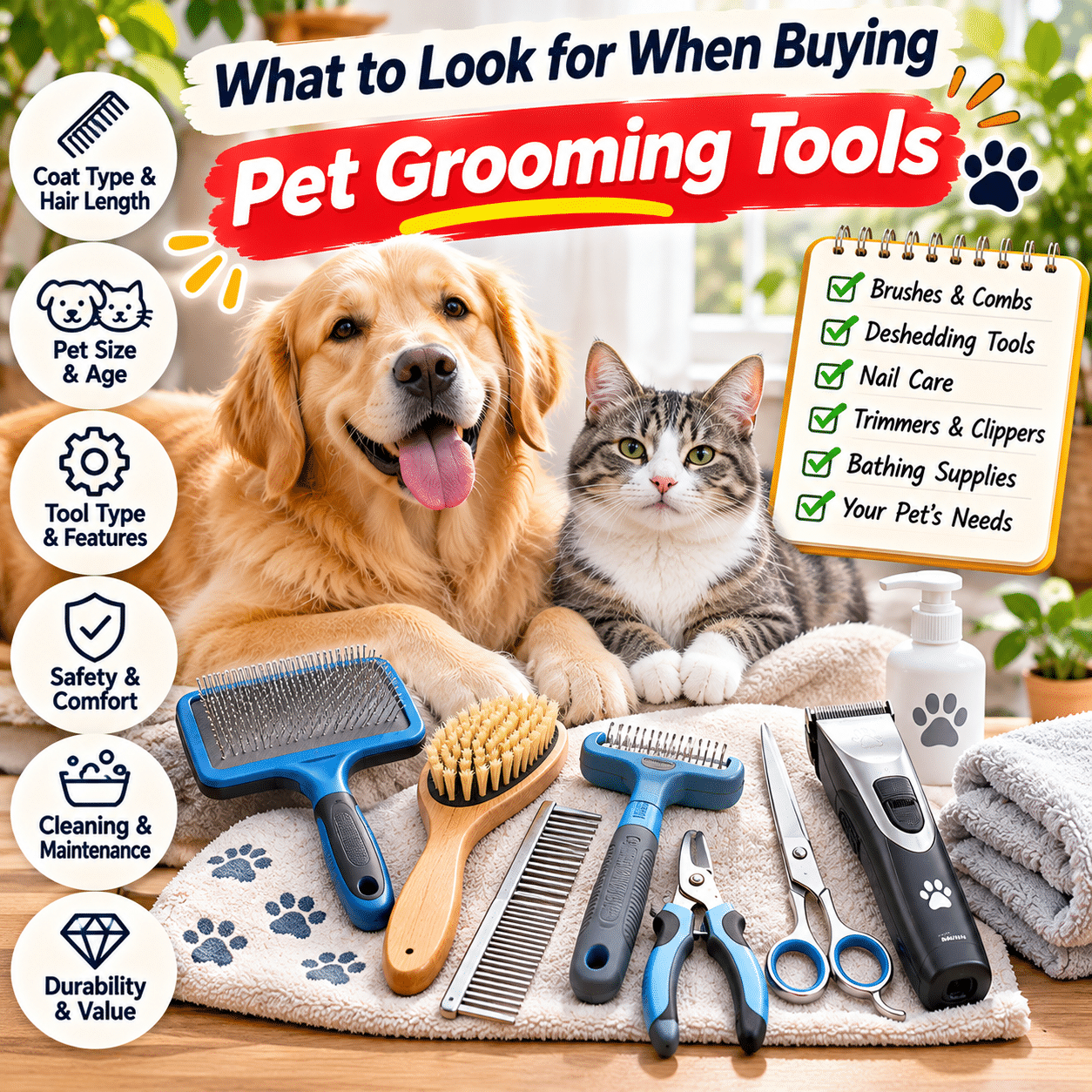
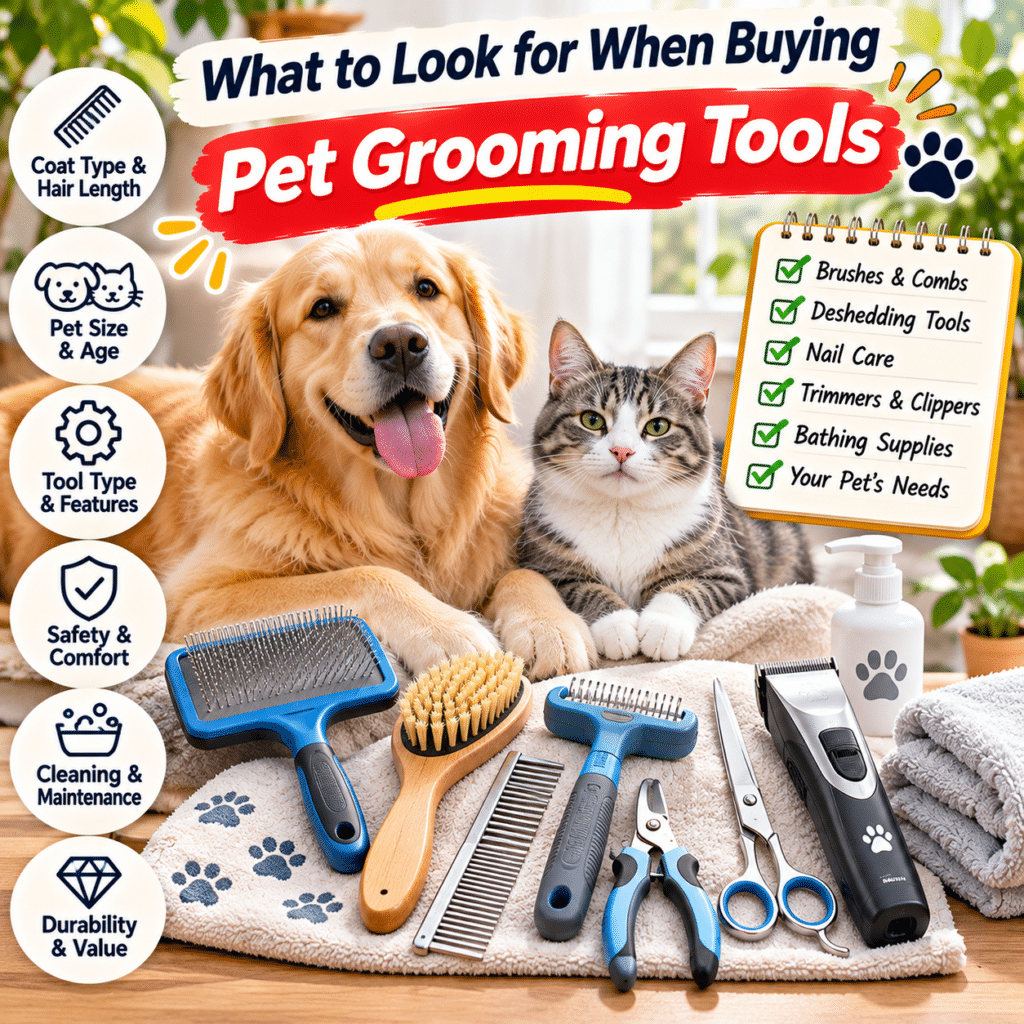
Keeping your dog or cat clean and comfortable is an important part of responsible pet care. Regular grooming helps maintain a healthy-looking coat, remove loose hair, reduce tangles, and make everyday hygiene easier. It also provides an opportunity to notice changes in your pet’s skin, coat, nails, ears, or overall condition.
However, choosing the right pet grooming tools can be confusing. Brushes, combs, deshedding tools, nail clippers, grinders, grooming scissors, bathing accessories, and electric clippers are available in many different designs. Some are intended for short, smooth coats, while others are designed for thick undercoats, long hair, or curly fur.
A grooming tool that works well for one pet may be uncomfortable or ineffective for another. Using the wrong brush, applying excessive pressure, or choosing poorly designed equipment can cause unnecessary discomfort and potentially damage the skin or coat.
The best grooming tools are not necessarily the most expensive or the most specialized. They are the tools that suit your pet’s coat type, size, grooming needs, and tolerance for handling.
This comprehensive buying guide explains what to look for when buying pet grooming tools, how to compare common grooming equipment, which features matter most, and how to build a practical grooming routine for your dog or cat.
1. Understand Your Pet’s Grooming Needs
Before buying grooming tools, identify what your pet actually needs.
Different animals require different levels of coat care, nail maintenance, bathing, and general hygiene.
Important Factors to Consider
- Species
- Breed or coat characteristics
- Coat length
- Coat density
- Shedding patterns
- Skin sensitivity
- Age
- Body size
- Activity level
- Grooming tolerance
- Existing tangles or mats
- Frequency of professional grooming
A short-haired cat may need only a gentle brush and nail trimmer, while a long-haired dog may require several grooming tools.
Questions to Ask Before Buying
- Does my pet have short, medium, or long hair?
- Is the coat smooth, curly, wiry, or double-layered?
- Does my pet shed heavily?
- Does the coat develop tangles?
- Is my pet sensitive to brushing?
- Do I need tools for routine maintenance or occasional trimming?
- Can I handle the tools comfortably and safely?
- Will my pet tolerate electric grooming equipment?
- Are the tools easy to clean?
- Would some grooming tasks be safer with professional assistance?
Understanding these needs helps prevent unnecessary purchases.
2. Understand the Main Types of Pet Grooming Tools
Pet grooming equipment covers several different purposes.
| Grooming Tool | Main Purpose | Common Applications |
|---|---|---|
| Slicker brush | Removes loose hair and works through minor tangles | Medium, long, and some curly coats |
| Bristle brush | Smooths the coat and removes surface debris | Short and smooth coats |
| Pin brush | Gently brushes longer hair | Long-haired dogs and some cats |
| Rubber grooming brush | Collects loose hair and provides gentle contact | Short-haired pets |
| Grooming comb | Checks for tangles and separates hair | Long, dense, or textured coats |
| Undercoat rake | Works through loose undercoat | Suitable double-coated breeds |
| Deshedding tool | Removes loose hair from certain coat types | Shedding coats when appropriate |
| Dematting tool | Helps separate some tangles | Limited mat removal by experienced users |
| Nail clipper | Shortens nails | Dogs and cats |
| Nail grinder | Gradually files nails | Pets comfortable with powered tools |
| Grooming scissors | Trims selected hair areas | Controlled finishing tasks |
| Electric clipper | Clips coat hair | Suitable coat types and grooming styles |
| Grooming glove | Gentle brushing and loose-hair collection | Short-haired pets and grooming beginners |
| Bathing brush | Helps distribute shampoo and loosen debris | Bathing routines |
| Grooming dryer | Dries the coat | Bathing and coat maintenance |
Not every pet needs every tool.
Choose equipment based on your regular grooming tasks.
3. Identify Your Pet’s Coat Type
Coat type is one of the most important factors when selecting brushes and combs.
Short, Smooth Coats
These coats often lie close to the body.
Gentle rubber brushes or soft bristle brushes may be suitable.
Medium-Length Coats
These may benefit from a combination of brushing and combing.
Long Coats
Long hair can develop tangles and may require regular, careful maintenance.
Curly Coats
Curly coats may trap loose hair and develop mats if not maintained appropriately.
Double Coats
Double-coated pets have a combination of outer guard hairs and a softer undercoat.
Wiry Coats
Some wiry coats require specialized grooming techniques.
Hairless Pets
Hairless animals may need skin care rather than conventional brushing.
The appropriate routine depends on the individual pet.
4. Choose Grooming Tools for Short-Haired Dogs
Short-haired dogs often need less detangling than long-haired breeds.
However, they can still shed significantly.
Useful Tools
- Rubber grooming brush
- Soft bristle brush
- Grooming glove
- Fine-to-medium grooming comb when appropriate
What to Look For
- Gentle contact surface
- Comfortable grip
- Easy cleaning
- Suitable brush size
- Minimal skin irritation
Avoid Excessive Pressure
Short coats provide less separation between grooming tools and the skin.
Aggressive brushing can cause irritation.
5. Choose Grooming Tools for Long-Haired Dogs
Long-haired dogs may require more frequent coat maintenance.
Useful Tools
- Slicker brush
- Pin brush
- Wide-tooth comb
- Fine-tooth finishing comb
- Appropriate detangling accessories
Important Considerations
- Pin length
- Brush flexibility
- Coat density
- Handle comfort
- Ease of cleaning
Check Beyond the Surface
A coat may look smooth on top while tangles remain near the skin.
Use an appropriate comb to check carefully without pulling.
Avoid Forceful Detangling
Severe mats can be painful and may require professional grooming.
6. Choose Grooming Tools for Short-Haired Cats
Short-haired cats may benefit from gentle brushing to remove loose fur.
Common Options
- Soft bristle brush
- Rubber grooming brush
- Grooming glove
- Gentle grooming comb
Important Features
- Soft contact surface
- Compact size
- Lightweight design
- Easy handling
- Minimal pulling
Respect Your Cat’s Preferences
Some cats enjoy brushing, while others tolerate only brief sessions.
Short, positive grooming experiences are generally preferable to prolonged restraint.
7. Choose Grooming Tools for Long-Haired Cats
Long-haired cats can develop tangles in areas such as the chest, abdomen, and behind the legs.
Useful Tools
- Gentle slicker brush
- Wide-tooth comb
- Fine-tooth comb
- Appropriate detangling accessories
Important Considerations
- Gentle pin design
- Suitable comb spacing
- Easy handling
- Controlled pressure
- Comfortable grooming position
Matting Risks
Tight mats can pull on the skin and cause discomfort.
Cat skin can be delicate and may tear if handled improperly.
Do not use scissors to cut close to a cat’s skin.
Severe matting is best addressed by a veterinarian or qualified professional groomer.
8. Understand Slicker Brushes
Slicker brushes typically feature numerous fine metal pins mounted on a flat or curved surface.
They are commonly used for removing loose hair and working through minor tangles.
Potential Advantages
- Effective on many medium and long coats
- Helps remove loose hair
- Useful for some curly coats
- Can assist with routine detangling
Potential Limitations
- May irritate skin if used aggressively
- Pin stiffness varies
- Not appropriate for every coat
- Excessive brushing can damage hair
What to Look For
- Appropriate pin length
- Flexible pin design
- Comfortable handle
- Suitable brush-head size
- Easy cleaning
Practical Advice
Use light pressure and follow the direction of hair growth when appropriate.
9. Understand Bristle Brushes
Bristle brushes use natural or synthetic bristles.
They are commonly used to smooth the coat and remove surface debris.
Advantages
- Gentle grooming
- Suitable for many short coats
- Helps distribute natural coat oils across the hair
- Often comfortable for pets sensitive to metal pins
Limitations
- Limited detangling ability
- Less effective on dense undercoats
- May not reach deeper layers of long coats
Best Uses
Bristle brushes are often useful for finishing and routine maintenance.
10. Understand Pin Brushes
Pin brushes resemble conventional hairbrushes.
They contain spaced pins mounted in a cushioned base.
Advantages
- Suitable for some long coats
- Helps separate hair
- Can be gentle when appropriately designed
- Useful for general brushing
Limitations
- May not remove deep tangles effectively
- Pin quality varies
- Some designs pull hair
What to Look For
- Smooth pin tips
- Flexible cushion
- Suitable pin spacing
- Comfortable handle
A pin brush should glide through the coat without excessive pulling.
11. Understand Rubber Grooming Brushes
Rubber brushes use flexible projections to contact the coat.
Advantages
- Gentle contact
- Useful for collecting loose hair
- Easy to clean
- Often suitable for short-haired pets
- Can be used during some bathing routines
Potential Limitations
- Limited effectiveness on deep tangles
- May not reach dense undercoats
- Rubber firmness varies
Practical Consideration
Choose a flexible design that does not create excessive friction on the skin.
12. Understand Grooming Gloves
Grooming gloves combine hand contact with a textured grooming surface.
Advantages
- Familiar petting motion
- Easy for beginners
- Suitable for some grooming-sensitive pets
- Convenient loose-hair collection
Limitations
- Less precise than specialized brushes
- Limited detangling capability
- May not work well on dense coats
Best Uses
Grooming gloves can be useful for short-haired pets and gentle introductory grooming sessions.
13. Understand Grooming Combs
Combs are useful for checking coat condition and identifying tangles.
Wide-Tooth Combs
Help separate longer or thicker hair.
Fine-Tooth Combs
Can assist with finishing and checking smaller tangles.
Combination Combs
Include both wide and narrow tooth spacing.
What to Look For
- Smooth tooth tips
- Appropriate spacing
- Durable construction
- Comfortable grip
- No sharp edges
Why Combs Matter
A brush may smooth the surface while leaving deeper tangles.
A suitable comb can help evaluate whether the coat is thoroughly maintained.
14. Understand Undercoat Rakes
Undercoat rakes are designed to work through loose hair in suitable double coats.
Potential Advantages
- Helps remove loose undercoat
- May reduce accumulated shedding hair
- Useful during seasonal coat changes
Potential Limitations
- Not appropriate for every coat
- Incorrect use can irritate skin
- Some designs may damage healthy hair
- Excessive pressure can cause discomfort
Choose Carefully
Look for appropriate tooth spacing, smooth contact surfaces, and manufacturer guidance for the intended coat type.
15. Understand Deshedding Tools
Deshedding tools are marketed for removing loose hair from shedding coats.
Potential Advantages
- Can collect substantial loose hair
- May help manage shedding in suitable coat types
- Can complement routine brushing
Important Limitations
Some designs can cut, scrape, or damage healthy coat hair when used incorrectly.
They are not universally suitable for curly, delicate, or certain specialized coat types.
Practical Buying Advice
Check the manufacturer’s coat-type recommendations and use gentle technique.
If uncertain, consult a professional groomer familiar with your pet’s coat.
16. Understand Dematting Tools
Dematting tools are designed to separate or remove tangled hair.
Some include sharp or cutting elements.
Potential Advantages
- May help with limited, manageable tangles
- Can assist experienced groomers with certain coat types
Important Risks
- Skin injury
- Hair pulling
- Coat damage
- Pain from tension
- Accidental cuts
Safety Recommendation
Do not attempt to remove severe mats with sharp tools at home.
Tight mats near the skin should be evaluated by a qualified groomer or veterinarian.
17. Understand Why Grooming Tool Size Matters
Grooming equipment should match your pet’s body size.
Small Pets
Compact brush heads can provide better control around narrow areas.
Medium Pets
Moderate-sized tools may balance coverage and precision.
Large Pets
Larger brush heads may reduce grooming time over broad coat areas.
Important Consideration
A large tool may be difficult to maneuver around ears, legs, or other sensitive regions.
Some owners benefit from using separate tools for general brushing and detailed grooming.
18. Evaluate Brush Pin Length
Pin length affects how deeply a brush can reach into the coat.
Short Pins
May be suitable for shorter coats.
Longer Pins
May help reach deeper into certain long or dense coats.
Potential Problems
Pins that are too short may not reach the necessary coat layers.
Pins that are too long or stiff may cause discomfort.
Practical Buying Advice
Match pin length to coat thickness and use only light, controlled pressure.
19. Evaluate Brush Flexibility
Brush flexibility can influence comfort.
Flexible Pin Cushions
May allow pins to move slightly with the coat.
Rigid Brush Heads
May provide controlled contact but require careful handling.
Flexible Brush Designs
Some brushes are designed to follow body contours.
Important Distinction
Flexibility alone does not guarantee safety.
Technique, pin quality, and coat compatibility remain important.
20. Consider Ergonomic Handles
Grooming can involve repetitive hand and wrist movements.
Useful Features
- Comfortable grip shape
- Non-slip surface
- Balanced weight
- Suitable handle length
- Easy control
Why Ergonomics Matters
A comfortable tool may help reduce hand fatigue and improve grooming precision.
Test the Grip
When possible, choose a tool that feels secure without requiring excessive force.
21. Understand Self-Cleaning Brushes
Some brushes include a mechanism that pushes collected hair away from the pins.
Advantages
- Convenient hair removal
- Faster cleaning
- Less direct contact with trapped fur
Potential Limitations
- Additional moving components
- Mechanisms may wear
- Cleaning systems vary in effectiveness
Practical Consideration
A self-cleaning feature is useful only if the brush itself suits your pet’s coat.
22. Understand Pet Nail Clippers
Nail trimming is an important grooming task for many dogs and cats.
Common nail clipper designs include:
- Scissor-style clippers
- Guillotine-style clippers
- Small cat nail scissors
- Larger dog nail clippers
Important Features
- Sharp, appropriate cutting blades
- Comfortable grip
- Secure handling
- Suitable cutting capacity
- Controlled operation
Choose by Nail Size
A clipper designed for small cat claws may not be suitable for thick dog nails.
Likewise, an oversized clipper may be difficult to control on small paws.
23. Compare Scissor-Style and Guillotine-Style Nail Clippers
| Feature | Scissor-Style Clipper | Guillotine-Style Clipper |
|---|---|---|
| Cutting action | Opposing blades | Blade moves through an opening |
| Handling | Familiar scissor-like motion | Requires positioning nail through an opening |
| Visibility | Depends on design | Depends on nail positioning |
| Nail compatibility | Available in multiple sizes | Depends on model and nail thickness |
| Maintenance | Blade sharpness matters | Blade replacement may be required |
| Best choice | Based on control and nail size | Based on user comfort and compatibility |
Neither design is automatically safer.
Proper technique and visibility are essential.
24. Understand the Nail Quick
The quick is the living tissue inside the nail containing blood vessels and nerves.
Cutting into it can cause pain and bleeding.
Light-Colored Nails
The quick may be easier to identify.
Dark Nails
The quick can be difficult to see.
Important Safety Principle
Trim only small amounts when the safe cutting point is uncertain.
If you are inexperienced or uncomfortable, ask a veterinarian or professional groomer to demonstrate the procedure.
25. Understand Nail Grinders
Nail grinders use a rotating abrasive surface to gradually shorten nails.
Potential Advantages
- Gradual material removal
- Ability to smooth rough edges
- Useful for some pets that tolerate powered grooming
Potential Limitations
- Noise
- Vibration
- Heat buildup
- Longer grooming time
- Risk of catching surrounding hair
Important Features
- Suitable speed control
- Comfortable grip
- Protective guard when appropriate
- Manageable noise
- Easy maintenance
Safety
Use brief, controlled contact and prevent excessive heat buildup.
Keep long fur away from rotating components.
26. Choose Between Nail Clippers and Grinders
Both tools can be useful.
Nail Clippers
May be preferable when:
- Your pet tolerates quick trimming
- You can clearly identify a safe cutting point
- You prefer simple equipment
Nail Grinders
May be preferable when:
- Your pet tolerates vibration and noise
- You want gradual nail shortening
- You need to smooth sharp edges
Combination Approach
Some owners use clippers for initial shortening and a grinder for finishing.
Only use techniques you can perform safely.
27. Understand Grooming Scissors
Grooming scissors are designed for controlled hair trimming.
Common Types
- Straight scissors
- Curved scissors
- Thinning shears
- Rounded-tip grooming scissors
Straight Scissors
Used for general trimming by experienced handlers.
Curved Scissors
May help shape certain coat areas.
Thinning Shears
Reduce hair volume or blend trimmed sections.
Rounded-Tip Scissors
May reduce some risks associated with pointed tips, but are not injury-proof.
Important Safety Warning
Do not use scissors to cut tight mats close to the skin.
Professional assistance is safer for difficult areas.
28. Understand Electric Pet Clippers
Electric clippers are used for trimming suitable coat types.
Important Features
- Appropriate blade system
- Adjustable cutting lengths
- Comfortable grip
- Manageable vibration
- Heat management
- Easy cleaning
- Manufacturer-supported replacement parts
Potential Limitations
- Noise sensitivity
- Blade heating
- Maintenance requirements
- Risk of cutting or irritating skin
Coat Compatibility
Not every coat should be clipped.
Some double-coated breeds require particular caution because shaving may affect coat regrowth and temperature protection.
Consult a knowledgeable veterinarian or groomer before making major coat changes.
29. Compare Corded and Cordless Clippers
Corded Clippers
Advantages
- Continuous operation with suitable power
- No battery runtime limitation
Potential limitations
- Cord management
- Restricted movement
- Electrical safety considerations
Cordless Clippers
Advantages
- Greater movement flexibility
- Convenient portability
- No trailing cord during use
Potential limitations
- Limited battery runtime
- Charging requirements
- Battery aging
Practical Buying Advice
Choose according to grooming frequency, pet size, and the complexity of trimming tasks.
30. Evaluate Clipper Noise and Vibration
Some pets are sensitive to mechanical sounds and vibration.
Important Considerations
- Operating noise
- Vibration intensity
- Motor smoothness
- Tool weight
- Handling comfort
Introduce Gradually
Allow your pet to become familiar with the equipment before grooming.
Avoid Forced Handling
If your pet becomes distressed, stop and reassess.
A professional groomer or veterinarian may be better equipped to manage difficult grooming situations.
31. Understand Clipper Blade Heat
Electric clipper blades can become hot during operation.
Why This Matters
Excessive blade temperature can cause discomfort or burns.
Practical Precautions
- Check blade temperature regularly.
- Follow manufacturer lubrication instructions.
- Use appropriate blade maintenance.
- Allow equipment to cool when necessary.
- Avoid prolonged contact with sensitive skin.
Never assume a clipper blade remains cool because the motor housing feels comfortable.
32. Understand Grooming Blade Lengths
Clipper blades and attachment combs determine how much hair remains after trimming.
Important Considerations
- Coat type
- Hair length
- Blade compatibility
- Attachment security
- Skin sensitivity
Avoid Guessing
Different manufacturers may use different blade numbering or attachment systems.
Follow the specific product’s instructions.
Professional Guidance
For unfamiliar coat types, consult a qualified groomer before attempting substantial trimming.
33. Understand Pet Bathing Brushes
Bathing brushes help distribute shampoo and loosen surface debris.
Common Designs
- Soft silicone brushes
- Rubber massage brushes
- Handheld bathing tools
Advantages
- Convenient shampoo distribution
- Gentle coat contact
- Easy rinsing
- Simple cleaning
Limitations
- Not suitable for every skin condition
- Excessive friction may irritate skin
- Some brushes are ineffective on dense coats
Practical Advice
Use gentle pressure and avoid irritated or damaged skin.
34. Choose Pet Shampoo Accessories Carefully
Bathing accessories may include:
- Measuring containers
- Rinse cups
- Spray attachments
- Bathing brushes
- Absorbent towels
- Non-slip mats
Important Features
- Easy handling
- Safe materials
- Simple cleaning
- Suitable size
- Secure grip
Water Temperature
Use comfortably lukewarm water unless veterinary guidance indicates otherwise.
Product Compatibility
Use shampoos formulated for the intended species and follow label instructions.
Human shampoos and some dog products may be unsuitable for cats.
35. Understand Pet Grooming Dryers
Grooming dryers help remove moisture after bathing.
Common Types
- Low-output pet dryers
- Adjustable airflow dryers
- Professional high-velocity dryers
Important Features
- Adjustable airflow
- Temperature control
- Manageable noise
- Appropriate attachments
- Safe handling
- Easy cleaning
Potential Risks
- Excessive heat
- Noise-related stress
- Skin irritation
- Uncomfortable airflow
- Air directed into sensitive areas
Practical Advice
Use suitable settings and maintain safe distance.
Never leave a pet unattended with a running dryer.
36. Compare Towels and Electric Dryers
Absorbent Towels
Advantages
- Quiet
- Simple
- No electricity required
- Suitable for many pets
Limitations
- May not fully dry dense coats
- Can require multiple towels
Electric Dryers
Advantages
- Can accelerate drying
- Useful for some dense coats
- May help separate hair during professional grooming
Limitations
- Noise and airflow sensitivity
- Heat and electrical safety concerns
- Additional maintenance
Choose Based on Tolerance
Some pets are more comfortable with towel drying.
37. Understand Ear-Cleaning Accessories
Ear care requires particular caution.
Common Accessories
- Veterinary-approved ear-cleaning solutions
- Soft cotton pads
- Suitable wiping materials
Avoid Unsafe Tools
Do not insert cotton swabs or other objects deeply into the ear canal.
Important Buying Consideration
Choose products intended for the specific species and follow veterinary guidance.
When to Seek Veterinary Care
Persistent odor, redness, discharge, head shaking, or pain may indicate an ear problem.
Do not attempt to treat these signs with grooming tools alone.
38. Understand Eye-Cleaning Accessories
Some pets develop discharge around the eyes.
Common Accessories
- Soft clean cloths
- Suitable pet eye wipes
- Veterinary-recommended cleaning products
Important Considerations
- Gentle materials
- Appropriate ingredients
- Easy handling
- No harsh fragrances
Avoid Direct Eye Contact With Unsuitable Products
Never use ordinary grooming chemicals near the eyes.
Persistent discharge, redness, squinting, or discomfort requires veterinary evaluation.
39. Understand Paw-Care Grooming Tools
Paws may collect dirt, debris, and moisture.
Common Accessories
- Soft paw-cleaning cloths
- Gentle paw brushes
- Paw-cleaning cups
- Suitable nail tools
Important Features
- Soft contact surfaces
- Easy cleaning
- Appropriate size
- Non-irritating materials
Inspect Paws Regularly
Look for debris, damaged nails, irritation, or signs of discomfort.
Avoid Aggressive Cleaning
Excessive scrubbing can irritate paw pads.
40. Understand Dental Grooming Tools
Oral care is another important part of pet hygiene.
Common Products
- Pet toothbrushes
- Finger brushes
- Species-appropriate toothpaste
Important Safety Consideration
Use toothpaste specifically formulated for pets.
Human toothpaste may contain ingredients unsuitable or toxic to animals.
Introduce Gradually
Some pets require slow, positive introduction to toothbrushing.
Professional Care
Home brushing does not replace veterinary dental examinations or treatment.
41. Choose Grooming Tools for Puppies
Puppies benefit from gentle introduction to grooming.
Useful Starter Tools
- Soft brush
- Small grooming comb
- Appropriate nail clipper
- Gentle bathing accessories
- Soft towel
Important Features
- Small size
- Comfortable handling
- Gentle contact
- Easy cleaning
Focus on Familiarity
Early grooming sessions should be brief and positive.
Avoid overwhelming a puppy with too many tools at once.
42. Choose Grooming Tools for Kittens
Kittens may need gentle brushing and nail care.
Useful Tools
- Small soft brush
- Fine grooming comb when appropriate
- Cat nail trimmer
- Soft cleaning cloth
Important Considerations
- Lightweight design
- Gentle contact
- Small working surfaces
- Minimal noise
Build Positive Associations
Allow exploration and reward calm behavior.
Do not force prolonged grooming.
43. Choose Grooming Tools for Senior Pets
Older dogs and cats may have reduced mobility or increased sensitivity.
Useful Features
- Gentle brushes
- Comfortable handles
- Lightweight tools
- Quiet equipment
- Controlled grooming surfaces
Consider Positioning
Avoid requiring your pet to stand for extended periods.
Watch for Discomfort
If grooming causes pain or unusual reactions, consult a veterinarian.
44. Choose Tools for Sensitive Skin
Some pets have skin that becomes irritated easily.
Important Features
- Soft brush surfaces
- Flexible pins
- Smooth comb teeth
- Gentle grooming contact
- Easy-to-clean tools
Avoid Excessive Grooming
Repeated aggressive brushing can irritate skin.
Veterinary Considerations
Redness, persistent itching, sores, or hair loss may indicate a medical condition.
Grooming tools should not be used as a substitute for diagnosis or treatment.
45. Consider Pets With Thick Undercoats
Double-coated pets may shed substantial amounts of undercoat.
Useful Tools
- Appropriate undercoat rake
- Suitable slicker brush
- Grooming comb
- Coat-compatible deshedding tool
Important Considerations
- Coat structure
- Tooth spacing
- Skin sensitivity
- Grooming frequency
Avoid Over-Grooming
Removing too much healthy hair or repeatedly scraping the skin can cause damage.
Seek Coat-Specific Guidance
Some breeds require specialized techniques.
46. Consider Pets With Curly Coats
Curly coats may require careful maintenance to prevent matting.
Useful Tools
- Appropriate slicker brush
- Metal grooming comb
- Gentle detangling accessories
Important Considerations
- Coat density
- Curl structure
- Tangle formation
- Brushing technique
Check for Hidden Mats
Curly coats may conceal tangles close to the skin.
Professional Grooming
Regular professional grooming may be necessary for some coat types.
47. Consider Pets With Wiry Coats
Wiry coats can require specialized maintenance.
Common Techniques
- Brushing
- Combing
- Coat-specific trimming
- Hand-stripping for suitable breeds when performed correctly
Important Distinction
Hand-stripping is not appropriate for every dog.
Professional Guidance
Consult a qualified groomer familiar with the breed and coat type before purchasing specialized stripping tools.
48. Consider Hairless Dogs and Cats
Hairless pets have different grooming needs.
Common Requirements
- Gentle skin cleaning
- Suitable bathing products
- Skin inspection
- Appropriate temperature protection
Avoid Conventional Deshedding Tools
These are unnecessary and potentially irritating on hairless skin.
Veterinary Guidance
Skin-care routines should reflect the individual animal’s needs.
49. Evaluate Grooming Tool Materials
Common grooming tool materials include:
- Stainless steel
- Aluminum
- Plastic
- Rubber
- Silicone
- Synthetic bristles
- Wood
Stainless Steel
Often used for comb teeth, blades, and grooming pins.
Plastic
Common in handles and lightweight housings.
Rubber and Silicone
Used for flexible grooming surfaces and grips.
Wood
May be used in brush handles.
Material Quality Matters
Smooth finishing, secure assembly, and corrosion resistance are more important than material names alone.
50. Evaluate Grooming Tool Durability
Grooming equipment should withstand regular use and cleaning.
Important Components
- Brush pins
- Comb teeth
- Handles
- Moving mechanisms
- Clipper blades
- Electrical cords
- Battery compartments
- Attachment systems
Look for
- Secure assembly
- Smooth edges
- Reliable moving parts
- Appropriate materials
- Available replacement components
Avoid Poorly Finished Tools
Sharp edges, loose pins, or unstable handles can create discomfort and safety risks.
51. Consider Tool Cleaning and Hygiene
Grooming tools collect hair, oils, dirt, and skin debris.
Important Cleaning Features
- Accessible surfaces
- Removable hair
- Corrosion-resistant materials
- Washable components
- Manufacturer-supported cleaning methods
Avoid Sharing Without Cleaning
Tools used on multiple pets should be cleaned appropriately between animals.
Skin Conditions
If a pet has a suspected contagious skin condition, consult a veterinarian about tool disinfection and cross-contamination prevention.
52. Consider Storage and Organization
Grooming tools last longer when stored appropriately.
Useful Storage Options
- Grooming pouch
- Drawer organizer
- Tool case
- Dedicated basket
- Protective blade covers
Important Considerations
- Dry storage
- Protection from damage
- Separation of sharp tools
- Easy access
- Child and pet safety
Electric Equipment
Store chargers and cords according to manufacturer instructions.
53. Understand Corded and Rechargeable Grooming Tools
Electric grooming equipment may use mains power or rechargeable batteries.
Corded Equipment
May provide uninterrupted operation with suitable power.
Rechargeable Equipment
Offers movement flexibility and portability.
Important Buying Factors
- Battery runtime
- Charging time
- Replacement battery availability
- Electrical safety
- Noise
- Weight
- Ease of maintenance
Avoid Relying on Battery Capacity Alone
Runtime depends on motor power, load, and operating conditions.
54. Evaluate Grooming Tool Noise
Noise can affect a pet’s willingness to tolerate grooming.
Common Noisy Equipment
- Electric clippers
- Nail grinders
- Grooming dryers
- Vacuum grooming systems
Important Considerations
- Operating sound
- Vibration
- Airflow
- Sudden changes in noise
Gradual Introduction
Introduce powered tools slowly and positively.
Stop When Necessary
If your pet shows significant distress, stop rather than forcing the session.
55. Understand Pet Grooming Vacuum Systems
Some grooming systems combine brushing or clipping with suction.
Potential Advantages
- Helps collect loose hair
- May reduce hair scattered around the home
- Convenient for some grooming routines
Potential Limitations
- Noise
- Hose restrictions
- Equipment bulk
- Cleaning requirements
- Pet sensitivity
Important Buying Considerations
- Adjustable suction
- Tool compatibility
- Noise level
- Filter maintenance
- Safe handling
Practical Advice
Never force a frightened pet to tolerate suction equipment.
56. Consider Grooming Tool Safety Features
Safety should be a primary buying consideration.
Useful Features
- Rounded contact surfaces
- Secure blade guards
- Stable grips
- Appropriate size
- Reliable electrical insulation
- Controlled operating speeds
- Protected moving components
Important Reminder
A safety feature does not eliminate the need for proper technique.
Even well-designed grooming tools can cause injury when used incorrectly.
57. Understand Grooming Frequency
Grooming frequency varies according to coat type and individual needs.
Short Coats
May require relatively simple routine brushing.
Long Coats
Often need more frequent detangling and coat checks.
Curly Coats
May require regular maintenance to prevent matting.
Double Coats
May need additional attention during shedding periods.
Nail Care
Depends on nail growth, activity, and natural wear.
Avoid Fixed Universal Schedules
No single grooming schedule suits every dog or cat.
Observe your pet and seek professional guidance when necessary.
58. Build a Positive Grooming Routine
A successful grooming routine should be comfortable for both pet and owner.
Step 1: Choose a Quiet Location
Reduce distractions.
Step 2: Introduce the Tool
Allow your pet to investigate it.
Step 3: Begin With Short Sessions
Start with a manageable duration.
Step 4: Use Gentle Movements
Avoid pulling or excessive pressure.
Step 5: Reward Calm Behavior
Use praise or suitable rewards.
Step 6: Monitor Body Language
Watch for signs of stress or discomfort.
Step 7: Stop Before Frustration Builds
End the session positively when possible.
Step 8: Increase Gradually
Build tolerance over time.
59. Recognize Signs of Grooming Discomfort
Pets may communicate discomfort through behavior.
Possible Signs
- Pulling away
- Growling
- Hissing
- Flattened ears
- Tail movements indicating agitation
- Sudden attempts to escape
- Repeated licking
- Vocalization
- Defensive biting or scratching
What to Do
Stop grooming and reassess the situation.
Avoid Punishment
Punishing a pet for expressing discomfort can increase fear.
Seek Help When Needed
A veterinarian or qualified behavior professional may help with persistent grooming-related distress.
60. Common Mistakes to Avoid When Buying Pet Grooming Tools
Choosing One Brush for Every Coat Type
Different coats require different tools.
Better approach: Match the tool to your pet’s coat characteristics.
Buying Aggressive Deshedding Tools Without Checking Compatibility
Some tools may damage healthy hair.
Better approach: Follow coat-specific guidance.
Choosing Oversized Tools
Large tools may be difficult to control on small pets.
Better approach: Match tool size to body size.
Ignoring Skin Sensitivity
Stiff pins can cause discomfort.
Better approach: Choose appropriate contact surfaces and use gentle pressure.
Buying Dull Nail Clippers
Dull blades may crush or split nails.
Better approach: Choose sharp, well-maintained equipment.
Assuming Nail Guards Prevent Every Injury
Safety guards do not reliably identify the quick in every nail.
Better approach: Learn proper trimming technique.
Choosing Loud Electric Tools for Noise-Sensitive Pets
Noise can make grooming stressful.
Better approach: Consider quieter equipment and gradual introduction.
Using Scissors on Tight Mats
This can cause serious skin injuries.
Better approach: Seek professional help for severe matting.
Ignoring Cleaning Requirements
Dirty tools can accumulate debris and microorganisms.
Better approach: Choose easy-to-clean equipment.
Buying Too Many Specialized Tools
A large collection may be unnecessary.
Better approach: Start with essential equipment.
61. How to Choose Pet Grooming Tools: Step by Step
Step 1: Identify Your Pet’s Coat Type
Determine hair length, density, and texture.
Step 2: Define Your Grooming Tasks
Decide whether you need brushing, detangling, nail care, bathing, or trimming.
Step 3: Choose Appropriate Tool Categories
Select equipment designed for those tasks.
Step 4: Match Tool Size to Your Pet
Consider body size and sensitive areas.
Step 5: Evaluate Contact Surfaces
Check brush pins, comb teeth, and blade quality.
Step 6: Consider Comfort
Choose ergonomic handles and manageable weight.
Step 7: Review Safety Features
Look for secure construction and appropriate protective elements.
Step 8: Consider Your Pet’s Tolerance
Evaluate noise, vibration, and handling sensitivity.
Step 9: Check Cleaning Requirements
Choose equipment that can be maintained hygienically.
Step 10: Evaluate Durability
Inspect materials and replacement options.
Step 11: Review Manufacturer Guidance
Confirm coat compatibility and operating instructions.
Step 12: Compare Long-Term Value
Choose tools that support regular, safe grooming without unnecessary complexity.
62. Pet Grooming Tool Comparison by Coat Type
| Coat Type | Commonly Useful Tools | Main Priorities |
|---|---|---|
| Short smooth dog coat | Rubber brush, bristle brush | Gentle loose-hair removal |
| Short-haired cat | Soft brush, grooming glove | Comfort and low pressure |
| Medium dog coat | Slicker brush, comb | Loose hair and tangle checks |
| Long dog coat | Slicker brush, pin brush, comb | Detangling and coat maintenance |
| Long-haired cat | Gentle slicker, grooming comb | Careful mat prevention |
| Dense double coat | Suitable undercoat rake, comb | Loose undercoat management |
| Curly coat | Appropriate slicker and comb | Preventing tangles |
| Wiry coat | Coat-specific brush and comb | Specialized maintenance |
| Hairless pet | Gentle skin-care accessories | Skin comfort |
| Sensitive skin | Soft brush or gentle grooming glove | Minimal irritation |
| Puppy or kitten | Small soft brush and appropriate nail tool | Positive introduction |
| Senior pet | Lightweight gentle tools | Comfort and accessibility |
These are general starting points.
Individual coat characteristics and professional recommendations may influence the final choice.
63. Practical Pet Grooming Tool Buying Checklist
Pet Compatibility
- I understand my pet’s coat type.
- The tool suits the intended species.
- The size is appropriate.
- The tool matches my grooming task.
- The design suits my pet’s sensitivity.
Brush and Comb Quality
- Pins or teeth are smoothly finished.
- Contact surfaces are appropriate.
- The tool does not pull excessively.
- The handle is comfortable.
- Cleaning is straightforward.
Nail and Trimming Equipment
- Nail tools match my pet’s nail size.
- Cutting components are sharp and secure.
- I understand the risks of trimming the quick.
- Clippers or grinders are manageable.
- I can operate the equipment safely.
Powered Equipment
- Noise and vibration are suitable.
- Controls are easy to use.
- Battery runtime or cord length is adequate.
- Heat management is appropriate.
- Maintenance instructions are clear.
Safety and Maintenance
- There are no hazardous sharp edges.
- Moving parts are secure.
- Tools can be cleaned properly.
- Storage is safe.
- Replacement parts are available when necessary.
- I know when professional grooming is preferable.
64. Frequently Asked Questions
What grooming tools does every dog owner need?
Many dogs benefit from a coat-appropriate brush or comb and suitable nail-care equipment.
Additional tools depend on coat type and grooming needs.
What grooming tools does every cat owner need?
A gentle brush or comb and cat-appropriate nail trimmers are common essentials.
Long-haired cats may require additional detangling tools.
Is a slicker brush good for all dogs?
No.
Slicker brushes are useful for many coat types but may be unsuitable or irritating for some short or sensitive coats.
Are rubber brushes good for short-haired dogs?
They can be useful for collecting loose hair and providing gentle grooming.
What brush is best for a long-haired cat?
A gentle slicker brush and suitable grooming comb may be useful.
The best choice depends on coat density, sensitivity, and matting.
Do deshedding tools damage pet coats?
Some can damage healthy hair or irritate skin when used incorrectly or on unsuitable coat types.
Follow manufacturer and coat-specific guidance.
What is the difference between a slicker brush and a pin brush?
Slicker brushes usually have many fine pins designed for loose-hair removal and detangling.
Pin brushes have more widely spaced pins and are often used for general brushing of longer coats.
Do I need both a brush and a comb?
Some pets benefit from both.
A brush can maintain the coat surface, while a comb helps check for deeper tangles.
Are grooming gloves effective?
They can be useful for gentle grooming and loose-hair collection, particularly on short coats.
How often should I brush my dog?
Frequency depends on coat type, shedding, and individual needs.
Long or curly coats often require more frequent maintenance than short smooth coats.
How often should I brush my cat?
Brushing frequency depends on coat length, shedding, and tolerance.
Long-haired cats generally need more frequent coat checks.
Should I use nail clippers or a grinder?
Choose the method you can use safely and your pet tolerates.
Both can be effective when used correctly.
Are nail grinders safer than clippers?
Not automatically.
Grinders can generate heat and may catch fur, while clippers can cut the quick.
Proper technique matters with both.
Can I trim my pet’s nails at home?
Many owners can learn safe nail trimming.
If you cannot identify a safe cutting point or your pet resists strongly, seek professional assistance.
Are pet grooming scissors safe?
They can be useful for controlled trimming, but sharp tools create injury risks.
Avoid cutting close to skin or attempting to remove tight mats.
Can I use human hair clippers on my dog?
Human hair clippers may not be designed for pet coat density, handling, or grooming requirements.
Use equipment specifically suitable for the intended animal and coat.
Should I shave my double-coated dog?
Not routinely without appropriate guidance.
Shaving can affect coat protection and regrowth in some breeds.
Consult a veterinarian or qualified groomer.
Are cordless pet clippers better?
Cordless clippers offer movement flexibility.
Corded models avoid battery runtime limits.
Choose according to your needs.
Do pet grooming vacuums work?
They can help collect loose hair during grooming, but effectiveness and pet tolerance vary.
What if my pet is afraid of grooming tools?
Introduce equipment gradually, keep sessions short, and avoid forcing contact.
Seek professional guidance for persistent fear.
Can I use the same brush for my dog and cat?
Only if the tool is suitable for both animals and cleaned appropriately between uses.
Separate tools may be more practical.
How do I clean grooming brushes?
Remove trapped hair and follow manufacturer cleaning instructions.
Allow washable components to dry thoroughly.
When should I replace grooming tools?
Replace tools with damaged pins, dull blades, broken handles, unreliable mechanisms, or components that can no longer be cleaned safely.
Are expensive grooming tools worth buying?
Higher-priced tools may offer improved construction or comfort, but price alone does not guarantee suitability.
Choose based on coat compatibility, safety, and practical value.
What is the most important feature of a pet grooming tool?
Suitability for your pet’s coat and grooming task is fundamental.
Comfort, safe construction, ease of handling, and maintenance are also important.
65. How to Clean and Maintain Pet Grooming Tools
Proper maintenance helps grooming tools remain hygienic and functional.
Remove Hair After Use
Clear trapped fur from brushes and combs.
Clean Contact Surfaces
Follow manufacturer instructions for washing or wiping.
Dry Thoroughly
Prevent moisture accumulation and corrosion.
Inspect Blades
Check nail clippers, scissors, and electric clipper blades for damage or dullness.
Maintain Moving Components
Lubricate or service equipment only as directed by the manufacturer.
Check Electrical Equipment
Inspect cords, charging connections, and housings.
Store Safely
Keep sharp tools protected and away from children and pets.
66. Build a Simple Pet Grooming Kit
A practical grooming kit does not need to contain every available tool.
Essential Coat Tool
Choose a brush suited to your pet’s coat.
Grooming Comb
Useful for checking tangles when appropriate.
Nail-Care Tool
Select suitable clippers or a grinder.
Soft Towel
Useful for cleaning and drying.
Bathing Accessories
Choose species-appropriate products when bathing is needed.
Storage Case
Keeps equipment organized and protected.
Optional Specialized Equipment
Add electric clippers, deshedding tools, or dryers only when necessary and suitable.
Start with a small, dependable set and expand according to actual needs.
67. Consider Long-Term Grooming Needs
Your pet’s grooming requirements may change over time.
Puppies and Kittens
Need gentle introduction and appropriately sized tools.
Adult Pets
May develop consistent grooming routines based on coat type.
Senior Pets
May require gentler handling and shorter sessions.
Seasonal Changes
Some pets shed more heavily during particular periods.
Health Changes
Skin conditions, reduced mobility, or coat changes may affect grooming needs.
Reevaluate equipment periodically to ensure it remains suitable.
Final Thoughts
Choosing the right pet grooming tools requires understanding your dog or cat’s coat, grooming needs, size, sensitivity, and comfort.
A gentle rubber brush may be ideal for a short-haired pet, while a long or curly coat may require a suitable slicker brush and grooming comb. Double-coated pets may benefit from carefully selected undercoat tools, and nail-care equipment should match the animal’s nail size and tolerance.
Before buying, examine contact surfaces, handle comfort, durability, cleaning requirements, and safety features. Avoid relying solely on marketing claims or purchasing specialized tools that do not match your pet’s coat.
Equally important, introduce grooming equipment gradually and pay attention to your pet’s behavior. Gentle handling and positive experiences can make routine care easier for both of you.
For severe matting, difficult nail trimming, skin problems, or grooming-related distress, professional assistance may be safer than attempting complicated procedures at home.
A thoughtful collection of grooming tools can support regular coat maintenance, improve everyday hygiene, and make it easier to notice changes in your pet’s condition.
The best pet grooming tools are not the ones with the most features—they are the ones that help you care for your dog or cat gently, safely, and effectively while keeping grooming a comfortable part of everyday life.