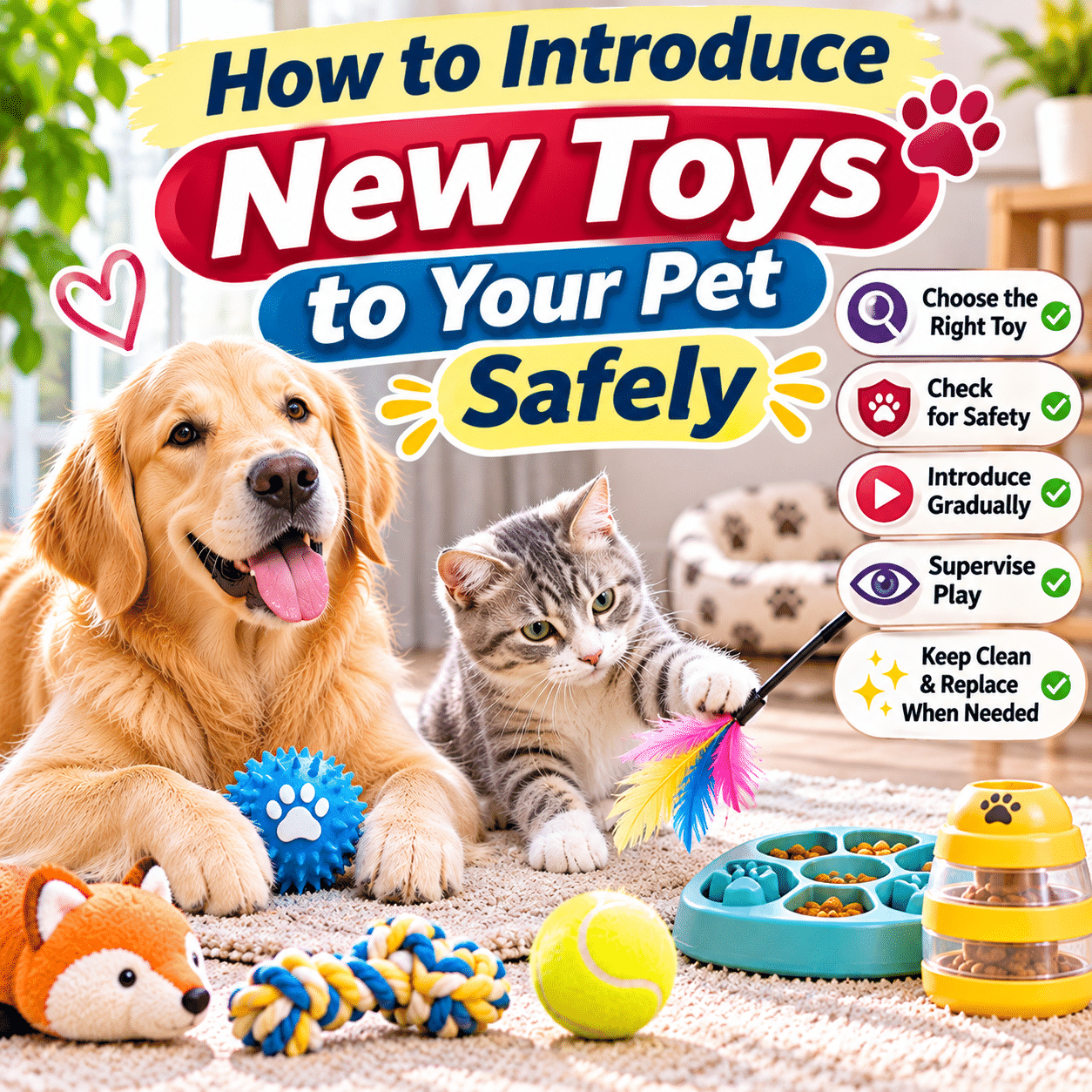
Bringing home a new toy for your pet can be an exciting experience. Whether it is a colorful ball, a soft plush animal, a puzzle feeder, or an interactive play accessory, a new toy can offer opportunities for exploration, movement, and enjoyable interaction.
However, introducing a toy involves more than simply placing it on the floor and waiting for your pet to play.
Pets explore unfamiliar objects in different ways. Some immediately approach a new toy with enthusiasm, while others prefer to observe it from a distance. Certain animals investigate objects by sniffing, pawing, carrying, or chewing them, and these natural behaviors can create safety concerns when a toy is unsuitable for the animal.
A toy that appears harmless may contain small detachable components, fragile materials, long strings, or openings that could cause injury. Even products marketed specifically for pets should be evaluated according to the individual animal’s size, strength, play habits, and supervision needs.
Introducing new toys gradually gives you an opportunity to observe your pet’s reactions, identify potential hazards, and encourage positive play experiences.
It also helps you understand which toys genuinely interest your pet instead of assuming that every new purchase will become an instant favorite.
This guide explains how to select appropriate toys, inspect them before use, introduce them through gradual play, recognize signs of discomfort, supervise different types of toys, maintain toy hygiene, and create a practical routine for safe, enjoyable play.
1. Understand Why Safe Toy Introductions Matter
Play is a natural behavior for many companion animals.
Depending on the species, play may involve chasing, searching, carrying, manipulating objects, chewing, or interacting with familiar people.
Appropriate toys can provide opportunities for these behaviors in a controlled environment.
Support Natural Play Behaviors
Different toys encourage different activities.
For example:
- Balls may encourage chasing and retrieving.
- Puzzle feeders may encourage problem-solving and food-seeking behaviors.
- Suitable chew toys may provide an appropriate chewing outlet.
- Wand toys may encourage cats to stalk and chase moving objects.
- Foraging toys may support natural searching behaviors in certain species.
The suitability of these activities depends on the animal.
Not every toy type is appropriate for every pet.
Reduce Preventable Injuries
A poorly chosen toy may create risks such as:
- Choking.
- Swallowing foreign objects.
- Dental damage.
- Cuts or abrasions.
- Entanglement.
- Digestive obstruction.
- Falls or collisions during play.
Careful selection and supervision can reduce some of these risks, although no toy can be guaranteed completely safe.
Help Pets Adjust to Unfamiliar Objects
Some pets are naturally cautious around new objects.
Introducing a toy gradually allows the animal to investigate it without pressure.
A calm introduction can be especially useful for shy animals, senior pets, and pets with limited experience using interactive toys.
Learn Your Pet’s Preferences
Observing early interactions helps you understand whether your pet enjoys the toy.
A dog may prefer carrying a soft toy rather than chewing a hard one.
A cat may respond more enthusiastically to a moving wand toy than a stationary ball.
These observations can guide future toy choices.
2. Consider Your Pet’s Individual Needs Before Choosing a Toy
The first step in safe toy introduction is selecting something appropriate for the animal.
Consider Species
Different species have different physical abilities and natural behaviors.
A toy suitable for a dog may not be appropriate for a cat, rabbit, bird, or small mammal.
Species-specific considerations include:
- Mouth and jaw structure.
- Typical chewing behavior.
- Dexterity.
- Natural foraging habits.
- Sensitivity to materials.
- Risk of swallowing small objects.
- Environmental requirements.
For birds, small mammals, reptiles, and other exotic pets, seek species-specific guidance when choosing unfamiliar enrichment equipment.
Consider Size
Toy size matters because an object that is too small may be swallowed or become lodged in the mouth or throat.
Choose toys that are appropriately sized for your pet.
For dogs, pay particular attention to balls and other objects that could fit too far into the mouth.
Consider Age
Young pets may need durable, age-appropriate toys that accommodate developing coordination and chewing behaviors.
Adult pets may enjoy a broader range of activities depending on their interests and physical abilities.
Senior pets may benefit from toys that require less strenuous movement or are easier to grasp and manipulate.
Consider Physical Health
Pets with dental problems, joint discomfort, mobility limitations, or other medical conditions may require modifications to their play activities.
Consult a veterinarian when you are unsure whether a particular toy or activity is appropriate.
Consider Play Style
Observe whether your pet tends to:
- Chew forcefully.
- Carry toys gently.
- Tear apart plush materials.
- Chase moving objects.
- Prefer food-based puzzles.
- Play independently.
- Seek interactive play with people.
A toy should suit the animal’s actual behavior rather than only its appearance or product description.
3. Inspect Every New Toy Before Giving It to Your Pet
Even a toy sold specifically for pets should be inspected before use.
Packaging and marketing claims do not eliminate the possibility of defects or unsuitable features.
Check for Small Detachable Parts
Look for components such as:
- Plastic eyes.
- Buttons.
- Bells.
- Decorative beads.
- Loose squeakers.
- Small wheels.
- Removable caps.
- Weakly attached ornaments.
These components may become choking or ingestion hazards.
Examine Seams and Construction
For fabric toys, inspect stitching and seams.
Check whether stuffing or internal components can be accessed easily.
For plastic or rubber toys, look for cracks, sharp edges, and weak connections.
Evaluate Material Suitability
Choose materials intended for the relevant animal and type of play.
Avoid toys with unknown coatings, strong chemical odors, or materials that appear to deteriorate easily.
A label describing a product as natural or nontoxic does not automatically establish that it is safe to chew or swallow.
Remove Packaging Completely
Before play, remove:
- Plastic wrapping.
- Tags.
- Fasteners.
- Packaging ties.
- Staples.
- Loose labels.
Dispose of packaging where your pet cannot access it.
Review Manufacturer Instructions
Read any guidance about:
- Intended animal size.
- Age suitability.
- Supervision.
- Cleaning.
- Use limitations.
- Replacement.
Treat these instructions as minimum precautions rather than guarantees of safety.
4. Compare Common Pet Toy Types and Their Safety Considerations
Different toy designs require different precautions.
| Toy Type | Typical Activity | Main Safety Consideration |
|---|---|---|
| Balls | Chasing and retrieving | Size, choking risk, surface damage |
| Plush toys | Carrying and gentle play | Loose stuffing, seams, detachable parts |
| Rubber chew toys | Chewing and manipulation | Material durability, size, hardness |
| Rope toys | Interactive play | Fraying fibers, ingestion, entanglement |
| Puzzle feeders | Food-seeking and problem-solving | Small parts, difficulty, food hygiene |
| Cat wand toys | Stalking and chasing | Strings, cords, detachable attachments |
| Electronic toys | Automated movement | Batteries, wires, moving mechanisms |
| Treat-dispensing toys | Food-motivated activity | Portion size, cleaning, openings |
| Foraging toys | Searching and exploration | Species suitability, material safety |
| Floating toys | Water-based play | Appropriate supervision and water safety |
No category is automatically safe for every animal.
The individual product and the pet’s behavior are equally important.
5. Prepare a Safe Play Environment
Before introducing a toy, choose a suitable location.
Clear the Surrounding Area
Remove objects that could create hazards during play.
Examples include:
- Loose electrical cords.
- Fragile decorations.
- Small household objects.
- Sharp furniture edges.
- Unstable storage containers.
- Cleaning chemicals.
- Unsafe plants.
Provide Enough Space
Active toys may encourage running, jumping, or sudden changes in direction.
Choose an area with enough room for the activity.
Avoid encouraging vigorous chasing near stairs, slippery floors, balconies, or breakable objects.
Consider Flooring
Smooth flooring may cause some pets to slip during energetic play.
A suitable nonslip surface can provide better traction.
Reduce Distractions
For a pet that is easily startled, begin in a familiar, relatively quiet location.
Avoid introducing a new toy during a noisy gathering or other stressful event.
Separate Pets When Necessary
In multi-pet households, unfamiliar toys may create competition or tension.
Introduce toys individually when appropriate.
Do not assume that pets will willingly share every play object.
6. How to Introduce a New Toy Step by Step
A gradual introduction allows your pet to explore the toy at a comfortable pace.
Step 1: Choose a Calm Moment
Select a time when your pet is relaxed and receptive to interaction.
Avoid introducing the toy when the animal is highly distressed, exhausted, or distracted.
Step 2: Place the Toy Nearby
Position the toy at a comfortable distance.
Allow your pet to notice it without forcing contact.
For some animals, placing the toy on the floor is sufficient.
Step 3: Allow Voluntary Investigation
Your pet may approach, sniff, look at, or gently touch the object.
Give the animal time to investigate.
Do not push the toy toward the pet’s face or place it directly into its mouth.
Step 4: Encourage Interest Gently
If your pet appears comfortable, demonstrate a simple play action.
For example:
- Roll a suitable ball a short distance.
- Move a cat wand toy slowly along the floor.
- Place an appropriate food reward inside a puzzle toy.
- Gently present a soft toy for investigation.
Keep movements predictable at first.
Step 5: Reward Comfortable Engagement
Offer praise, gentle interaction, or an appropriate reward when your pet voluntarily participates.
Avoid excessive excitement that could overwhelm a cautious animal.
Step 6: Keep the First Session Short
Begin with a brief session.
The appropriate duration depends on your pet’s response and the activity.
Stop before the animal becomes exhausted, frustrated, or overstimulated.
Step 7: Inspect the Toy After Play
Check for damage, loose parts, and signs of wear.
Remove the toy if it becomes unsafe.
Step 8: Repeat Gradually
If the first experience goes well, introduce the toy again during another suitable play session.
Increase complexity or activity gradually according to your pet’s comfort and abilities.
7. Learn to Recognize Positive and Negative Reactions
Understanding your pet’s behavior is an important part of safe play.
Signs of Comfortable Engagement
Depending on the species and individual animal, positive signs may include:
- Voluntarily approaching the toy.
- Exploring it with relaxed movements.
- Returning to the toy after a short break.
- Participating in familiar play behaviors.
- Remaining comfortable when the toy moves.
- Choosing to continue interaction.
Body language must always be interpreted in context.
Signs of Discomfort
Potential signs of stress or avoidance may include:
- Moving away repeatedly.
- Freezing.
- Hiding.
- Excessive vigilance.
- Tense body posture.
- Avoiding the play area.
- Defensive vocalizations.
- Sudden changes in normal behavior.
Some pets may show more subtle signals.
What to Do if Your Pet Appears Uncomfortable
Stop the activity.
Move the toy away and allow your pet to settle.
Do not punish avoidance or force interaction.
Try again later with a slower introduction, a different toy, or a more comfortable environment.
If unusual fear, pain, or behavior changes persist, seek appropriate veterinary or behavioral guidance.
8. Introducing New Toys to Dogs
Dogs may interact with toys through chasing, carrying, chewing, retrieving, or pulling.
These activities require different safety considerations.
Choose the Right Size
Select toys that cannot easily become lodged in your dog’s mouth or throat.
Consider the dog’s jaw size and chewing strength.
Evaluate Chew Toy Hardness
Very hard objects can contribute to dental injuries in some dogs.
Avoid assuming that a harder toy is always more durable or safer.
Ask your veterinarian about suitable chew options if your dog has dental problems or chews aggressively.
Introduce Fetch Toys Gradually
Begin with short, controlled retrieves in a safe area.
Avoid repeatedly throwing toys in ways that encourage dangerous jumping, abrupt twisting, or collisions.
Supervise Tug Games
Tug can be an enjoyable interactive activity for some dogs.
Use a suitable toy and maintain controlled play.
Stop if the toy begins to fray or the interaction becomes unsafe.
Monitor Destructive Chewing
Some dogs quickly tear apart toys.
If your dog removes and swallows pieces, the toy is unsuitable for unsupervised use.
Remove damaged toys immediately.
9. Introducing New Toys to Cats
Cats often respond strongly to toys that imitate aspects of hunting behavior.
However, different cats have different preferences.
Start With Gentle Movement
When introducing a wand toy, begin with slow movements along the floor.
Allow the cat to observe and approach.
Gradually vary movement if the cat remains comfortable.
Allow Successful Interaction
Cats may enjoy opportunities to catch or physically interact with the toy.
Avoid continuously keeping the toy out of reach in a way that causes frustration.
Store String Toys Securely
Wand toys, ribbons, yarn, and other string-based items can create serious ingestion or entanglement hazards.
Store them securely after supervised play.
Consider Toy Size
Small objects that can be swallowed should not be used as cat toys.
Inspect attachments carefully.
Provide Different Play Options
Some cats enjoy:
- Soft balls.
- Suitable plush toys.
- Puzzle feeders.
- Wand toys.
- Lightweight chasing toys.
- Safe interactive enrichment.
Offer variety without overwhelming the cat with too many unfamiliar objects at once.
10. Introducing Puzzle Feeders and Interactive Toys
Puzzle feeders can provide opportunities for food-seeking and problem-solving.
They should be introduced at an appropriate difficulty level.
Begin With an Easy Puzzle
Choose a design that allows your pet to obtain the reward without excessive difficulty.
For example, begin with visible food rewards or simple compartments.
Use Familiar Food
Use part of your pet’s regular food allowance or a suitable familiar treat.
Account for puzzle rewards when considering total daily food intake.
Demonstrate the Activity
Show your pet how the toy works when appropriate.
Allow the animal to explore independently afterward.
Increase Difficulty Gradually
Once your pet understands the basic activity, introduce more complex features if suitable.
Avoid making the puzzle so difficult that the animal becomes distressed or loses interest.
Clean Food-Contact Surfaces
Wash puzzle feeders according to manufacturer instructions.
Pay attention to compartments where food residue may accumulate.
Monitor for Damage
Inspect moving parts, lids, and openings.
Remove the toy if components become loose or unsafe.
11. Introducing Electronic and Battery-Operated Toys
Electronic toys may include moving objects, automatic launchers, or interactive mechanisms.
They require additional safety precautions.
Inspect Battery Compartments
Ensure batteries are securely enclosed and inaccessible to the pet.
Swallowed batteries can cause severe injury and require immediate veterinary attention.
Check Wires and Moving Parts
Avoid products with exposed wires, easily damaged cords, or mechanisms that could trap paws, fur, or other body parts.
Introduce Sounds Gradually
Some electronic toys produce unfamiliar noises.
Start at a distance and allow your pet to approach voluntarily.
Monitor Automatic Movement
Moving toys may behave unpredictably around furniture or obstacles.
Supervise initial use carefully.
Follow Charging Instructions
Charge products according to manufacturer instructions and keep charging equipment inaccessible during play.
Do not allow pets to chew charging cables.
12. Introducing Toys to Puppies and Kittens
Young pets are naturally curious, but their size and developing coordination require additional care.
Choose Age-Appropriate Designs
Select toys intended for the animal’s developmental stage.
Avoid small detachable components and materials that can be easily swallowed.
Expect Frequent Investigation
Puppies and kittens may explore unfamiliar objects by biting, pawing, carrying, or batting them.
Supervise closely.
Keep Sessions Manageable
Young animals may become tired or overstimulated.
Provide opportunities for rest.
Teach Appropriate Play Habits
Encourage interaction with suitable toys rather than hands, feet, or unsafe household objects.
Use gentle redirection instead of punishment.
Inspect Toys Frequently
Young pets may damage toys quickly during chewing or energetic play.
Check toy condition before and after sessions.
13. Introducing Toys to Senior Pets
Older pets can continue to enjoy play, but their needs may change.
Choose Comfortable Activities
Consider toys that encourage gentle movement, exploration, or problem-solving without excessive physical strain.
Reduce Unnecessary Jumping
Avoid encouraging senior pets with mobility limitations to jump repeatedly or chase objects across slippery surfaces.
Select Easy-to-Grasp Toys
Some animals may prefer softer, lighter toys that are easier to carry or manipulate.
Allow More Time
Senior pets may need longer to investigate unfamiliar objects.
Avoid rushing the introduction.
Watch for Discomfort
Stop play if your pet shows stiffness, pain, unusual fatigue, or difficulty moving.
Consult a veterinarian if these signs are persistent or concerning.
14. Manage Toy Introductions in Multi-Pet Households
Introducing a new toy when several pets share a home requires attention to individual behavior.
Begin With Individual Sessions
Allow each pet to investigate the toy separately when practical.
This can help you assess preferences and reduce competition.
Provide Separate Resources
If multiple pets enjoy similar toys, consider providing suitable individual options.
Watch for Resource Guarding
Some animals may become protective of toys.
Potential warning signs include tense posture, blocking access, growling, or other defensive behavior.
Do not punish warning signals.
Separate the animals safely and seek qualified behavioral guidance if guarding becomes a concern.
Avoid Forced Sharing
Pets do not need to share every toy.
Respect individual preferences and provide sufficient opportunities for separate play.
Supervise Group Play
Monitor interactions when introducing unfamiliar toys.
Stop the activity if tension develops.
15. How Long Should a First Play Session Last?
There is no universal duration for introducing a new toy.
The appropriate length depends on the pet, toy, activity, and environment.
Use Behavior Rather Than a Strict Timer
A few minutes may be enough for a cautious pet’s first introduction.
An enthusiastic animal may remain interested longer, but excitement does not necessarily mean the activity should continue indefinitely.
Watch for Fatigue
Possible signs include:
- Slower movement.
- Reduced coordination.
- Disengagement.
- Excessive panting in dogs.
- Reluctance to continue.
- Unusual irritability.
Panting, breathing changes, or other physical signs should be interpreted according to species and circumstances.
End on a Comfortable Note
Stop while your pet is still comfortable.
Allow time for rest and recovery.
Build Gradually
Increase activity only when your pet appears physically capable and comfortable.
Avoid sudden increases in strenuous play.
16. How to Clean New Pet Toys Before Use
Cleaning requirements vary by material and manufacturer.
Check Care Instructions
Some toys are washable, while others contain electronic components or materials that should not be immersed.
Wash Suitable Rubber and Plastic Toys
Use an appropriate cleaning method recommended by the manufacturer.
Rinse thoroughly and dry.
Clean Fabric Toys
If machine washing is permitted, follow the specified cycle and drying instructions.
Inspect seams and stuffing after washing.
Clean Puzzle Feeders
Food-contact surfaces should be cleaned before use and after feeding sessions as appropriate.
Ensure compartments are completely dry before storing dry food.
Avoid Harsh Chemicals
Do not use cleaning agents that leave unsafe residues or damage toy materials.
Dry Toys Thoroughly
Moisture trapped inside toys can contribute to unwanted odors and microbial buildup.
Allow toys to dry completely before storage.
17. Establish a Safe Toy Rotation System
Toy rotation can help organize pet belongings and provide variety.
It is not necessary for every pet, but it can be useful when many toys are available.
Sort Toys by Activity
Create categories such as:
- Chewing.
- Chasing.
- Retrieving.
- Interactive play.
- Puzzle feeding.
- Comfort.
Keep a Manageable Selection Available
Choose a small group of appropriate toys based on your pet’s interests.
Store additional toys securely.
Rotate Based on Interest
Change some toys when your pet appears ready for variety.
There is no required rotation schedule.
Keep Favorite Comfort Toys Available
Some pets develop strong preferences for particular objects.
Do not remove a familiar comfort toy solely to maintain a rotation system.
Inspect Before Reintroduction
Stored toys should be checked for damage, dirt, and deterioration before being offered again.
18. Recognize When a Toy Is No Longer Safe
Even durable toys can become hazardous after repeated use.
Warning Signs
Remove or replace a toy when you notice:
- Torn seams.
- Exposed stuffing.
- Loose squeakers.
- Cracked plastic.
- Sharp edges.
- Fraying rope.
- Detached components.
- Damaged battery compartments.
- Significant changes in material texture.
- Pieces small enough to swallow.
Do Not Rely on Appearance Alone
Some damage occurs inside toys.
Check whether the toy feels unusually soft, brittle, loose, or structurally unstable.
Be Careful With Repairs
Not every damaged toy can be repaired safely.
Household glue, tape, or improvised fasteners may introduce new hazards.
When structural safety is uncertain, replacement is usually preferable.
Respond Promptly to Suspected Ingestion
If you suspect your pet has swallowed part of a toy, contact a veterinarian promptly.
Do not induce vomiting or attempt home treatment unless specifically instructed by a veterinary professional.
19. Common Mistakes When Introducing New Pet Toys
Mistake 1: Choosing a Toy Based Only on Appearance
Bright colors and attractive designs do not guarantee suitability.
Consider size, construction, material, and play behavior.
Mistake 2: Giving the Toy Without Inspection
Small defects or loose components may be overlooked.
Inspect every toy before use.
Mistake 3: Forcing Interaction
A cautious pet may need time to investigate.
Forced contact can create unnecessary stress.
Mistake 4: Introducing Too Many Toys at Once
Offering several unfamiliar objects simultaneously may make it difficult to observe your pet’s response.
Introduce toys individually when practical.
Mistake 5: Leaving High-Risk Toys Unsupervised
String toys, easily damaged plush toys, and certain interactive products may require direct supervision.
Mistake 6: Ignoring Toy Size
Objects that are too small can create choking or swallowing hazards.
Mistake 7: Encouraging Excessively Rough Play
Repeated high-impact chasing, jumping, or pulling may be inappropriate for some pets.
Mistake 8: Using Food Toys Without Considering Diet
Treat-dispensing toys can add calories to daily intake.
Account for rewards in the overall feeding plan.
Mistake 9: Failing to Clean Toys
Food residue, saliva, dirt, and moisture can accumulate.
Maintain toys according to their materials and use.
Mistake 10: Keeping Damaged Toys
A favorite toy should still be removed when it becomes unsafe.
20. Troubleshooting Common Toy Introduction Problems
| Problem | Possible Explanation | Practical Solution |
|---|---|---|
| Pet ignores the toy | Low interest or unfamiliar design | Try a different activity or introduce it gradually |
| Pet appears frightened | Unexpected movement, sound, or appearance | Increase distance and allow voluntary investigation |
| Dog destroys the toy quickly | Unsuitable durability or chewing style | Remove damaged toy and choose a more appropriate design |
| Cat loses interest immediately | Movement or toy type does not match preference | Try shorter, varied interactive sessions |
| Pet becomes frustrated with a puzzle | Difficulty is too high | Simplify the puzzle |
| Pet guards the toy | Resource-related tension | Separate pets and seek behavioral guidance if needed |
| Toy becomes slippery or dirty | Saliva or food residue | Clean according to instructions |
| Pet swallows a toy component | Foreign-object ingestion | Contact a veterinarian promptly |
| Electronic toy startles the pet | Noise or unpredictable movement | Stop and reintroduce more gradually |
| Senior pet avoids active play | Physical discomfort or changing preferences | Offer gentler activities and seek veterinary advice when indicated |
21. Practical Toy Introduction Checklist
Use this checklist before offering a new toy.
Toy Selection
- The toy is intended for the appropriate species.
- The size suits the pet.
- The material is appropriate for the intended activity.
- The toy matches the pet’s age and physical abilities.
- The design suits the pet’s play style.
- Manufacturer instructions have been reviewed.
Safety Inspection
- No loose small components are present.
- Seams and connections are secure.
- No sharp edges are visible.
- The material is not cracked or deteriorating.
- Packaging has been removed.
- Battery compartments are secure when applicable.
- Any required cleaning has been completed.
Play Environment
- The play area is free from obvious hazards.
- Flooring provides suitable traction.
- There is enough room for the activity.
- Other pets are managed appropriately.
- The environment is reasonably calm.
- Supervision is available when required.
Introduction
- The pet is allowed to approach voluntarily.
- The first interaction is gentle.
- Play begins at an appropriate difficulty level.
- Comfortable engagement is encouraged.
- Signs of fear or frustration are respected.
- The session ends before excessive fatigue.
After Play
- The toy is inspected for damage.
- Food-contact toys are cleaned appropriately.
- String or high-risk toys are stored securely.
- The play area is checked for loose pieces.
- The pet’s response is considered before future use.
22. Frequently Asked Questions
1. How should I introduce a new toy to my pet?
Begin in a familiar, calm environment. Allow your pet to investigate the toy voluntarily, encourage gentle interaction, and supervise the first play session.
2. Should I wash new pet toys before giving them to my pet?
Follow the manufacturer’s cleaning instructions. Washing suitable toys before use can help remove dust and surface residue from handling and storage.
3. How do I know whether a toy is safe for my dog?
Consider size, construction, material, hardness, and your dog’s chewing behavior. Inspect the toy regularly and remove it if damage develops.
4. What size toy should I choose for my pet?
Choose a toy appropriate for the animal’s mouth and body size. Avoid objects that can be swallowed or become lodged in the mouth or throat.
5. Why is my pet afraid of a new toy?
The toy may have an unfamiliar appearance, texture, sound, or movement. Allow gradual investigation without forcing contact.
6. What should I do if my pet ignores a new toy?
Try introducing it during a different activity or offering another suitable design. Not every pet enjoys every toy.
7. Can I leave my dog alone with a chew toy?
It depends on the individual dog and the specific toy. Some products may be appropriate for limited unsupervised use, but no chew toy is completely risk-free. Follow manufacturer guidance and assess your dog’s behavior carefully.
8. Are plush toys safe for pets?
Some plush toys are suitable for gentle play, but loose stuffing, detachable parts, and torn seams can create hazards. Supervision and regular inspection are important.
9. Are rope toys safe for dogs?
Rope toys may be suitable for certain supervised activities, but frayed fibers and swallowed strands can be dangerous. Remove damaged rope toys.
10. Are string toys safe for cats?
String-based toys should generally be used under direct supervision and stored securely afterward because of ingestion and entanglement risks.
11. How can I introduce a puzzle feeder?
Start with an easy activity using familiar food. Allow your pet to learn the mechanism gradually before increasing difficulty.
12. How long should the first play session last?
Keep the session short enough for your pet to remain comfortable and engaged. Use behavior and physical condition rather than a fixed duration.
13. Can senior pets enjoy new toys?
Yes. Many senior pets enjoy appropriate play and enrichment. Choose activities that suit their mobility, health, and individual preferences.
14. Should puppies have different toys from adult dogs?
Puppies often need age-appropriate toys that account for their smaller size, developing teeth, and exploratory chewing behavior.
15. Can two pets share a new toy?
Some pets share comfortably, while others may compete over resources. Introduce toys carefully and provide separate options when necessary.
16. How often should I rotate pet toys?
There is no universal schedule. Rotate toys according to your pet’s interest and maintain access to appropriate favorites.
17. Are electronic pet toys safe?
Some can be suitable when properly designed and used according to instructions. Inspect battery compartments, moving parts, wires, and other potential hazards.
18. What should I do if my pet destroys a toy?
Remove damaged pieces immediately. Choose a more suitable toy and monitor whether your pet attempts to swallow fragments.
19. What if my pet swallows part of a toy?
Contact a veterinarian promptly. Swallowed objects can cause choking or internal obstruction, and symptoms may not appear immediately.
20. How do I know when to replace a pet toy?
Replace toys that develop cracks, tears, exposed stuffing, loose parts, sharp edges, significant fraying, or other damage affecting safety.
23. Building a Long-Term Safe Play Routine
Introducing a new toy is only the beginning.
Long-term toy safety depends on ongoing observation, maintenance, and adjustments as your pet’s needs change.
Before Each Play Session
- Inspect the toy.
- Check the surrounding environment.
- Choose an appropriate activity.
- Confirm that supervision is available when needed.
During Play
- Observe body language.
- Monitor chewing and manipulation.
- Avoid excessive physical strain.
- Stop if damage or distress develops.
After Play
- Remove loose or damaged components.
- Clean the toy when necessary.
- Store high-risk toys securely.
- Allow appropriate rest.
Periodically
- Review your pet’s toy collection.
- Remove unsuitable or damaged items.
- Reassess toy size and durability.
- Adjust activities for age and health.
- Consider new enrichment options based on observed preferences.
A consistent routine helps keep play enjoyable without turning it into an overly complicated task.
Final Thoughts
Introducing new toys to your pet safely is an important part of creating enjoyable, enriching everyday experiences.
A well-chosen toy can encourage natural behaviors, provide opportunities for physical activity, and create positive moments of interaction between pets and their owners.
However, safe play begins before the first interaction.
Choosing an appropriate toy, inspecting its construction, preparing a suitable environment, and allowing your pet to explore voluntarily all contribute to a more thoughtful introduction.
Different animals respond to unfamiliar toys in different ways. Some immediately begin playing, while others need time to investigate and become comfortable.
Respecting these individual preferences is just as important as selecting the right materials and design.
Remember that no toy is completely free from risk. Regular supervision when appropriate, careful inspection, proper cleaning, and timely replacement remain essential throughout the toy’s useful life.
As your pet grows older or its interests change, adjust the types of toys and activities you offer.
The goal is not to provide the largest collection of toys, but to create safe, meaningful opportunities for exploration and play.
With patience, observation, and a few consistent safety habits, introducing a new toy can become a simple and rewarding part of caring for your pet—one that supports curiosity, comfort, and enjoyable companionship.