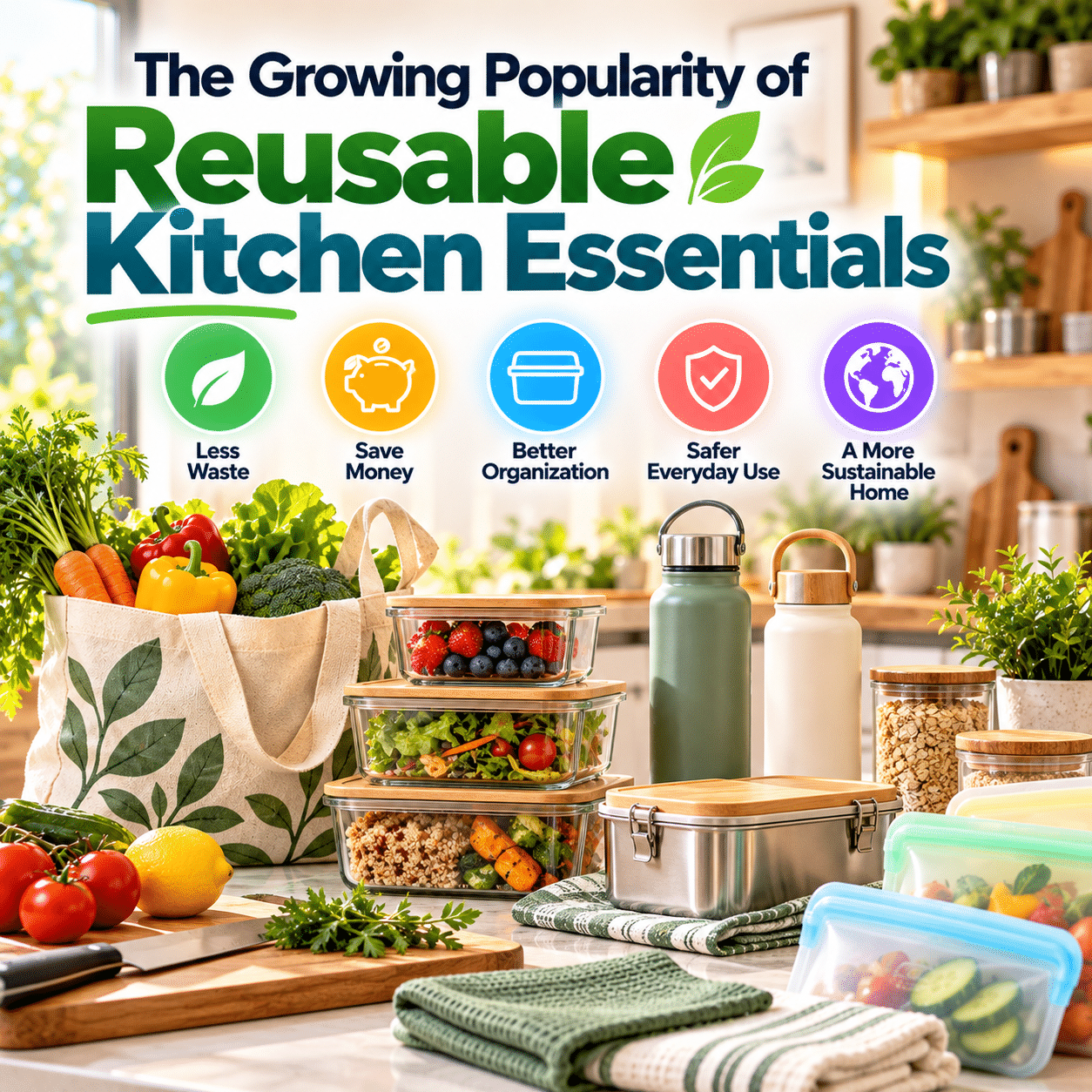
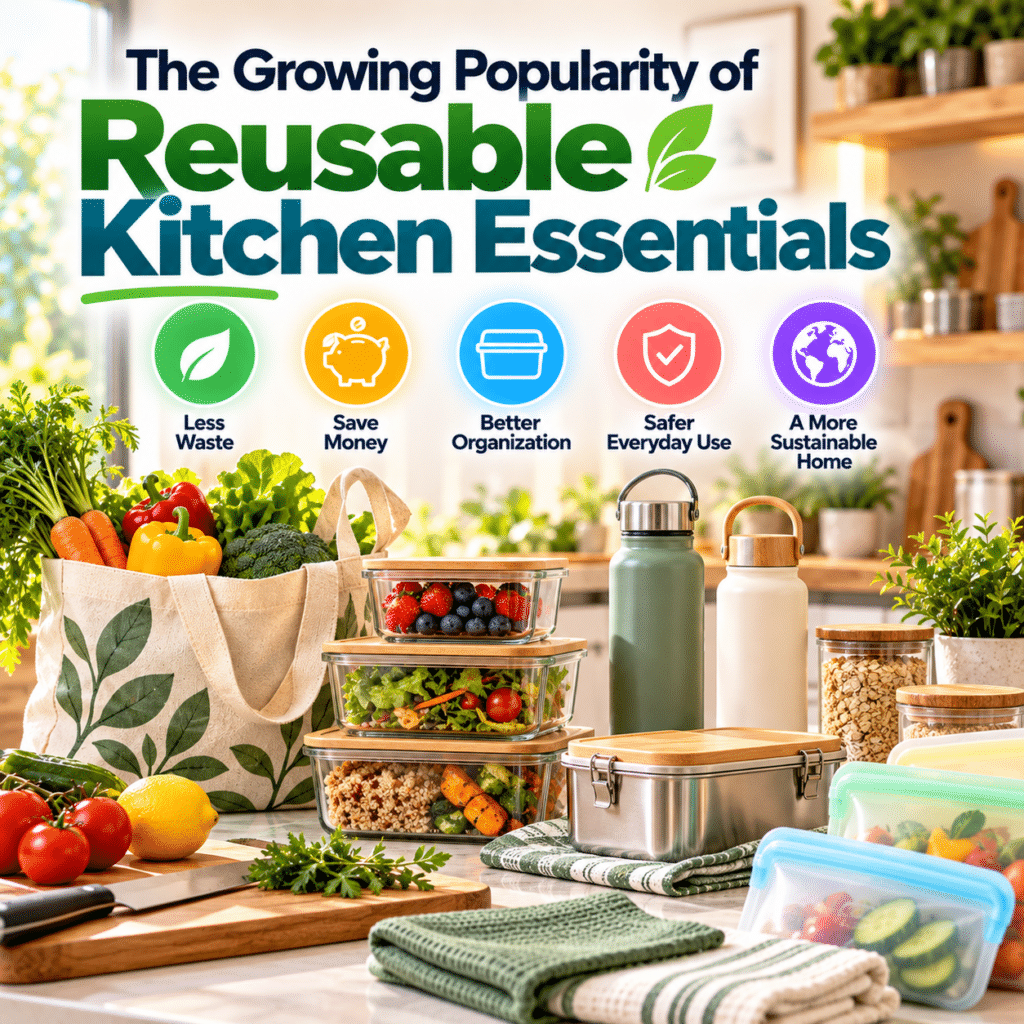
A kitchen can generate a surprising amount of everyday waste.
Disposable food packaging, paper towels, plastic wrap, single-use bags, and takeaway containers often become part of ordinary routines because they are convenient and widely available.
Yet many of the tasks these products perform—storing leftovers, carrying groceries, packing lunches, cleaning surfaces, and covering food—can also be handled by durable items designed for repeated use.
That simple idea helps explain the growing interest in reusable kitchen essentials.
Glass storage containers, washable cloths, reusable shopping bags, silicone food covers, refillable bottles, and other long-lasting tools offer alternatives to products that are discarded after a single use.
Their appeal goes beyond environmental concerns. Reusable products can make household routines more organized, reduce repeated purchases, and encourage people to think more carefully about the items they bring into their kitchens.
However, reusable does not automatically mean sustainable, economical, or safe in every situation.
Materials, manufacturing, cleaning requirements, product lifespan, and actual usage all influence the value of a reusable item.
Understanding these factors helps households make thoughtful choices rather than simply replacing disposable clutter with reusable clutter.
1. What Are Reusable Kitchen Essentials?
Reusable kitchen essentials are everyday kitchen items designed to perform their intended functions repeatedly rather than being discarded after one use.
They include products used for food preparation, storage, cleaning, shopping, and serving.
Common Examples
Reusable kitchen essentials may include:
- Glass, stainless steel, or suitable plastic food storage containers.
- Washable dishcloths and cleaning towels.
- Reusable grocery and produce bags.
- Durable water bottles and travel mugs.
- Reusable food covers and suitable silicone storage bags.
- Long-lasting cooking utensils and serving tools.
- Refillable dispensers and storage jars.
- Reusable lunch containers and cutlery.
Many of these products are not new inventions.
People have used durable containers, cloth towels, ceramic dishes, and reusable utensils for generations.
What has changed is the attention given to reusability as a deliberate household choice.
Reusable Does Not Mean Indestructible
A reusable item still has a limited service life.
Containers can crack, seals can deteriorate, fabrics can wear out, and surfaces can become difficult to clean.
A product should be reused only while it remains suitable for its intended purpose.
The goal is not endless use at any cost, but safe and practical use over an appropriate lifespan.
2. Why Reusable Kitchen Products Are Attracting More Attention
Interest in reusable kitchen products reflects several overlapping household priorities.
Reducing Everyday Waste
Disposable kitchen items can create recurring waste because they are discarded after brief use.
Replacing suitable single-use products with durable alternatives may reduce the number of items thrown away.
Avoiding Repeated Purchases
A washable cloth or durable food container can be used many times.
This may reduce the need to purchase equivalent disposable products repeatedly.
Whether it saves money depends on purchase cost, maintenance, lifespan, and frequency of use.
Creating More Organized Routines
Reusable containers can make it easier to establish consistent systems for storing ingredients and leftovers.
A set of appropriately sized containers may simplify refrigerator organization and meal preparation.
Greater Interest in Product Longevity
Some consumers increasingly consider how long an item will remain useful rather than focusing only on its initial price.
Repairability, replaceable parts, and durable materials can influence purchasing decisions.
Practical Environmental Awareness
Waste reduction and resource efficiency are increasingly discussed in public policy and household decision-making.
The United Nations Environment Programme has emphasized the importance of moving away from unnecessary single-use products and supporting systems that keep materials in use longer.
The appeal of reusable kitchen essentials is therefore not limited to one fashionable material or product category.
It reflects a broader interest in making everyday consumption more intentional.
3. Reusable Food Containers Have Changed Kitchen Storage Habits
Food storage is one of the most practical applications of reusable kitchen products.
Durable containers can hold prepared meals, ingredients, and leftovers while supporting repeated use.
Glass Food Storage Containers
Glass containers offer a nonporous surface and can be useful for storing many types of food.
They are often easy to inspect for residue and odors.
However, glass is heavier than many alternatives and can break if dropped.
Oven, freezer, and microwave suitability depend on the specific product and its components.
Stainless Steel Containers
Stainless steel containers can offer durability and resistance to impact.
They are useful for packed lunches and food storage when the design is appropriate.
Most conventional stainless steel containers should not be used in microwave ovens.
Some products also make it harder to see their contents without opening them.
Reusable Plastic Containers
Food-contact plastic containers can be lightweight, convenient, and relatively inexpensive.
However, products vary in heat tolerance, durability, and intended use.
Not all plastics are suitable for microwave heating, dishwashers, or freezing.
Manufacturer instructions should determine how a container is used.
Why Container Design Matters
The material is only one consideration.
Useful storage containers should also have:
- Appropriate capacity.
- Secure, functional lids.
- Surfaces that are easy to clean.
- A shape that fits available storage space.
- Suitable temperature compatibility.
- Durable seals when leak resistance is required.
A thoughtfully chosen container can be more useful than a large collection of poorly matched storage products.
4. Reusable Food Wraps and Covers Offer Alternatives to Disposable Packaging
Food wraps and covers are another area where reusable options have become more visible.
Their purpose is to protect suitable foods, cover containers, and reduce unnecessary exposure during storage.
Silicone Food Covers
Reusable silicone covers are available in different shapes and sizes.
Some stretch over compatible bowls or containers, while others are designed for specific applications.
Their usefulness depends on fit, sealing performance, material quality, and cleaning requirements.
Reusable Storage Bags
Certain reusable bags are designed for food storage and repeated washing.
They may be useful for snacks, prepared ingredients, or other appropriate foods.
However, not every reusable bag is suitable for hot liquids, freezing, or microwave use.
Beeswax Food Wraps
Beeswax-coated fabric wraps can be used for certain food-covering tasks.
Their suitability depends on the product and the food involved.
Many are not appropriate for raw meat or other applications where thorough sanitizing is necessary.
Heat exposure may also damage the coating.
Reusability Has Limits
A reusable cover is only practical if it protects food appropriately and can be cleaned effectively.
Some food-storage situations still require specialized packaging or containers.
The safest choice depends on the food, storage duration, temperature, and product instructions.
5. Washable Kitchen Cloths Can Reduce Reliance on Disposable Towels
Cleaning is a frequent kitchen activity.
Paper towels and disposable wipes can be convenient, but washable cloths provide an alternative for many routine tasks.
Dishcloths and Cleaning Towels
Reusable cloths can be used for suitable activities such as wiping counters, drying dishes, and cleaning certain surfaces.
Different fabrics have different absorbency and drying characteristics.
Reusable Cleaning Pads
Some cleaning pads are designed to withstand repeated washing.
Their durability depends on the materials, construction, and cleaning method.
Hygiene Must Come First
Kitchen cloths can accumulate moisture, food residue, and microorganisms.
They should be cleaned regularly and dried thoroughly.
Cloths used for high-risk contamination should be handled according to appropriate cleaning and sanitizing procedures.
Separate Cleaning Tasks
Using different cloths for different tasks can help reduce cross-contamination.
For example, a cloth used on a surface contaminated by raw poultry should not be used to dry clean dishes without proper laundering.
Reusable Is Not Always the Best Option
Disposable materials may be appropriate for certain contamination events or situations where safe laundering is impractical.
The objective is to reduce unnecessary waste without compromising kitchen hygiene.
6. Reusable Shopping and Produce Bags Support Everyday Habits
Reusable bags are among the most familiar alternatives to disposable kitchen-related products.
They connect grocery shopping with household storage and food preparation.
Grocery Bags
Durable grocery bags can be used repeatedly to carry packaged foods and other shopping items.
Materials may include woven fabrics, nonwoven polymers, and other suitable constructions.
The best choice depends on carrying capacity, durability, ease of cleaning, and expected usage.
Produce Bags
Washable produce bags can be convenient for transporting certain fruits and vegetables.
Their design should suit the produce being carried.
For example, breathable bags may be appropriate for some applications, while other foods require different storage conditions.
Food Safety Considerations
Reusable bags can become contaminated by raw meat juices, unwashed produce, or other materials.
Separate raw animal products from ready-to-eat foods.
Clean bags regularly and dry them thoroughly before storage.
Make Reuse Convenient
A reusable bag provides little benefit if it is repeatedly forgotten.
Keeping clean bags in a predictable location can make reuse easier to maintain.
A small, reliable set of bags may be more practical than purchasing many bags that are rarely used.
7. Refillable Bottles, Mugs, and Lunch Containers Extend Reuse Beyond the Kitchen
Reusable kitchen essentials are not limited to items that stay at home.
Some support routines involving work, school, travel, and meals away from home.
Refillable Water Bottles
A reusable bottle can reduce reliance on disposable beverage containers when clean, safe drinking water is available.
Its usefulness depends on portability, leak resistance, ease of cleaning, and personal habits.
Travel Mugs
Reusable mugs can help people carry beverages prepared at home.
Insulated models may maintain beverage temperature for longer periods.
However, they must be cleaned appropriately, including lids, seals, and drinking openings.
Lunch Containers
Durable lunch containers can make it easier to transport prepared meals.
Compartments may help separate foods, although food safety still depends on appropriate temperatures and storage.
Reusable Cutlery
Portable cutlery can replace disposable utensils in suitable situations.
Stainless steel and other durable materials may provide long service lives.
Everyday Use Matters
A reusable bottle carried daily may provide more practical value than an elaborate set of accessories used only occasionally.
Consistency is more important than the number of reusable products owned.
8. Understanding the Environmental Benefits of Reuse
The environmental argument for reusable products begins with a simple observation: making and discarding a new product for every use requires repeated material inputs.
A durable item can spread its manufacturing impacts across many uses.
However, this does not mean every reusable alternative is environmentally preferable after only one or two uses.
The Product Lifecycle
A product’s environmental impact can involve:
- Raw material extraction.
- Manufacturing.
- Packaging and transportation.
- Washing and maintenance.
- Repeated use.
- Disposal or recycling.
Lifecycle assessment considers these stages rather than focusing only on the waste visible at the end.
Why Repeated Use Is Essential
A reusable product may require more materials or manufacturing energy than a lightweight disposable alternative.
Its potential environmental advantage often depends on being used enough times to offset those initial impacts.
The required number of uses differs between products and environmental indicators.
There is no universal break-even number for all reusable kitchen items.
Washing Has an Environmental Cost
Reusable containers and cloths require cleaning.
Water use, detergent, electricity, and washing temperature can affect their overall environmental performance.
Cleaning should remain effective and hygienic, but unnecessary washing resource use can be avoided where appropriate.
Durability Makes a Difference
An item that breaks quickly may provide little advantage over a disposable alternative.
A durable product used regularly can spread its production impacts over a longer service life.
What Lifecycle Research Suggests
UNEP’s lifecycle work emphasizes the importance of moving beyond single-use systems while evaluating alternatives in context.
Material choice alone is not enough to determine the most sustainable option.
The most useful environmental principle is to choose appropriate products, use them repeatedly, and avoid unnecessary replacement.
9. Reusable Does Not Automatically Mean Plastic-Free
Some reusable kitchen products are made from glass, metal, or natural fibers.
Others are made from durable plastics or silicone.
A product does not need to be plastic-free to be reusable.
Durable Plastic Can Have a Role
A well-designed reusable plastic container may be lightweight and practical for repeated food storage.
Its value depends on food-contact suitability, condition, and how it is used.
Natural Materials Are Not Automatically Better
Cotton, bamboo, and other plant-derived materials may offer useful characteristics.
However, cultivation, processing, manufacturing, and maintenance all contribute to environmental impacts.
A natural label alone does not establish a product’s lifecycle performance.
Silicone Is Not a Universal Solution
Silicone can be flexible and useful for certain reusable food-contact applications.
But products differ in quality, durability, cleaning requirements, and end-of-life options.
Avoid Simplistic Material Rankings
Glass, stainless steel, plastic, silicone, and fabric each have strengths and limitations.
The best material depends on the intended task and expected service life.
For many households, using an existing suitable container for longer may be more sensible than replacing it solely to obtain a different material.
10. The Financial Value of Reusable Kitchen Essentials
Reusable products can reduce recurring purchases, but financial savings are not guaranteed.
The simplest way to evaluate their value is to compare the cost of repeated disposable use with the total cost of a reusable alternative.
A Simple Hypothetical Example
Imagine a household spends $5 per month on a particular disposable kitchen item.
Over one year, the total is:
$5 × 12 = $60
Suppose a reusable alternative costs $20 and remains functional throughout the year.
Ignoring washing and maintenance costs, the difference would be:
$60 − $20 = $40
This is an illustrative example, not a claim about a specific product.
Actual savings depend on how frequently the item is used and how long it lasts.
Include Cleaning Costs
Reusable products may require water, detergent, or electricity.
These costs should be included when they are meaningful.
Consider Replacement Frequency
A product that wears out after a few uses may be poor value.
A durable product that performs well over time may justify a higher initial cost.
Avoid Buying Too Many Reusables
Purchasing several sets of containers, bags, and wraps can become expensive.
The most economical approach is often to start with what is already available and replace disposable products gradually.
11. Reusable Kitchen Products Can Support Better Organization
Waste reduction is not the only reason households choose reusable essentials.
Some products make everyday kitchen routines easier to manage.
Consistent Storage Systems
Containers of compatible shapes and sizes may stack efficiently.
This can make shelves, cupboards, and refrigerators easier to organize.
Easier Meal Preparation
Reusable containers can help separate ingredients and store prepared components for later meals.
However, food must still be refrigerated, frozen, or otherwise stored appropriately.
Clearer Inventory
Transparent containers may make it easier to identify contents.
Labels and dates can also help households keep track of stored foods.
Less Packaging Clutter
Using durable storage solutions may reduce the accumulation of certain disposable wrappers and containers.
Organization Should Remain Flexible
An elaborate storage system is not necessarily better.
A small number of useful containers may be sufficient for a household with simple cooking routines.
The goal is practical organization, not a perfectly coordinated collection.
12. Food Safety Is Essential When Reusing Kitchen Products
Repeated use creates responsibilities that disposable products may not have.
Reusable items must remain clean, structurally sound, and suitable for food contact.
Clean Food Containers Thoroughly
Wash containers and lids according to manufacturer instructions.
Pay attention to seals, grooves, and other areas where residue can accumulate.
Allow items to dry appropriately before storage.
Prevent Cross-Contamination
Keep raw meat, poultry, and seafood separate from ready-to-eat foods.
Use appropriate cleaning and sanitizing procedures after contact with potentially contaminated materials.
Respect Temperature Limits
Not every reusable product is microwave-safe, oven-safe, freezer-safe, or dishwasher-safe.
These properties depend on the exact product.
Do not assume that a material name alone guarantees temperature compatibility.
Inspect Products for Damage
Cracks, damaged seals, peeling surfaces, and persistent contamination may make an item unsuitable for continued use.
Replace products when safe cleaning or intended performance can no longer be maintained.
Do Not Reuse Every Disposable Package
Some food packaging is designed and approved only for single use.
Examples can include certain meat trays, plastic wraps, and convenience-food packaging.
Reusing them for food storage may create contamination or material-suitability concerns.
Follow Local Food Safety Guidance
Food-contact standards and recommendations can vary by region.
Manufacturer instructions and applicable food-safety requirements should guide decisions.
Reuse should never come at the expense of safe food handling.
13. Common Mistakes When Switching to Reusable Kitchen Products
A few predictable mistakes can reduce the benefits of reuse.
Replacing Everything at Once
Discarding functional items to purchase new reusable alternatives may create unnecessary waste and expense.
A gradual transition is usually more practical.
Buying Products Without a Clear Purpose
A reusable gadget that is rarely used does little to reduce consumption.
Start with recurring household needs.
Ignoring Cleaning Requirements
A product that is difficult to clean may become inconvenient or unsafe.
Ease of maintenance should be considered before purchase.
Assuming Every Reusable Item Is Sustainable
Environmental benefits depend on manufacturing, repeated use, washing, and disposal.
A reusable label is not a complete lifecycle assessment.
Collecting Too Many Containers
Excessive purchases can create the same clutter problem that reusable products are intended to solve.
Using Products Beyond Their Safe Lifespan
Damaged containers and worn food-contact materials should not be kept indefinitely.
The purpose of reuse is responsible use, not avoiding replacement under all circumstances.
14. How to Choose Reusable Kitchen Essentials Wisely
Choosing reusable products becomes easier when the decision is based on function rather than marketing.
| Selection factor | Questions to ask | Why it matters |
|---|---|---|
| Intended use | What task will this replace or improve? | Prevents unnecessary purchases |
| Food-contact suitability | Is it designed for the intended food and temperature? | Supports safe use |
| Durability | Can it withstand repeated normal use? | Extends service life |
| Cleaning | Can it be cleaned and dried thoroughly? | Reduces hygiene risks |
| Capacity | Is the size appropriate? | Improves everyday usefulness |
| Storage | Will it fit available kitchen space? | Prevents clutter |
| Replacement parts | Are lids, seals, or components replaceable? | May extend product life |
| Cost | Is the long-term value reasonable? | Supports informed spending |
Prioritize Frequently Used Items
Reusable containers, cloths, and shopping bags may be sensible starting points when they replace products used regularly.
Check Product Instructions
Read the manufacturer’s guidance for cleaning, temperature exposure, and intended applications.
Prefer Practical Durability
A well-made item that performs a useful function is generally more valuable than one chosen mainly for appearance.
Use What You Already Own
Existing suitable jars, containers, utensils, and bags may already meet household needs.
Not every improvement requires a purchase.
15. Building a Reusable Kitchen One Habit at a Time
A reusable kitchen does not need to be created through a complete renovation or a large shopping trip.
Small, consistent changes can be easier to maintain.
Step 1: Identify Common Disposable Items
Notice which disposable products are used most frequently.
These might include paper towels, plastic bags, takeaway containers, or beverage bottles.
Step 2: Choose One Practical Alternative
Select an item that fits an existing routine.
For example, a washable cloth may replace some everyday paper-towel use.
Step 3: Make the Reusable Item Easy to Reach
Convenience influences behavior.
Store clean cloths where they are needed and keep reusable shopping bags in a predictable location.
Step 4: Establish a Cleaning Routine
Reusable items should be cleaned appropriately and stored dry.
A simple maintenance routine can make repeated use more reliable.
Step 5: Evaluate Whether the Change Works
Ask whether the product is convenient, durable, and used regularly.
If it creates more difficulty than it solves, another approach may be more suitable.
Step 6: Expand Gradually
Once one change becomes routine, consider another.
The goal is to build habits that last rather than achieve an unrealistic standard of zero waste.
16. The Future of Reusable Kitchen Essentials
The long-term development of reusable kitchen products is likely to involve both better product design and changes in how households access everyday goods.
More Durable Product Designs
Improved construction, stronger closures, and replaceable components may help reusable products remain functional longer.
Easier Cleaning
Products with fewer hard-to-reach areas and more accessible components can make maintenance simpler.
Refill and Return Systems
Some businesses offer refillable packaging or returnable container systems.
These approaches may reduce reliance on single-use packaging when the collection, washing, transport, and reuse processes are well designed.
Better Information About Materials
Clearer instructions about food-contact suitability, cleaning, and end-of-life handling can help consumers use products responsibly.
Greater Emphasis on Actual Lifespan
The number of times a product can be used safely and effectively may become a more meaningful consideration than whether it carries a particular sustainability label.
Simpler Household Consumption
Perhaps the most important direction is not the invention of more reusable gadgets.
It is the development of everyday systems that make durable products convenient enough to use repeatedly.
Successful reuse depends on habits, infrastructure, and product design working together.
Frequently Asked Questions
Are reusable kitchen products always better for the environment?
Not necessarily. Their environmental performance depends on manufacturing, transportation, cleaning, lifespan, and the number of times they are used. Reusable products generally need to be used repeatedly to realize their potential benefits.
Which reusable kitchen essentials are good starting points?
Items that replace frequently used disposables are sensible starting points. Examples include food storage containers, washable cleaning cloths, reusable shopping bags, and refillable bottles.
Are glass containers better than plastic containers?
Neither material is universally better. Glass can be durable and easy to clean but is heavier and breakable. Suitable reusable plastic containers can be lightweight and practical. The best choice depends on food-contact suitability, intended use, durability, and maintenance.
Can reusable silicone bags go in the microwave?
Only if the specific product is designed and labeled for microwave use. Temperature limits and manufacturer instructions must be followed.
How often should reusable grocery bags be washed?
They should be cleaned regularly and whenever they become soiled or contaminated. Bags exposed to raw meat juices require prompt and thorough cleaning, and they should be dried before storage.
Is it better to reuse existing containers or buy new ones?
When existing containers are safe, suitable, and functional, continuing to use them can avoid unnecessary purchases. New products are most useful when they address a genuine need that current items cannot meet.
Conclusion: Reuse Is Most Valuable When It Becomes a Lasting Habit
The growing popularity of reusable kitchen essentials reflects a practical shift in how people think about everyday household products.
Instead of treating every storage, cleaning, or shopping task as a reason to use something disposable, households can consider whether a durable alternative would work just as well—or better.
Reusable containers, cloths, bags, bottles, and other essentials can reduce reliance on certain single-use products while supporting more organized routines.
But their value depends on thoughtful choices.
Products must be suitable for their intended use, easy to clean, durable enough to justify repeated use, and safe throughout their service life.
A reusable label alone does not guarantee environmental or financial benefits.
The most effective approach is often the simplest: use existing items responsibly, replace disposable products where it makes sense, and avoid buying more than the household needs.
A more reusable kitchen is not defined by how many sustainable products it contains, but by how consistently its everyday tools are used, cared for, and valued.