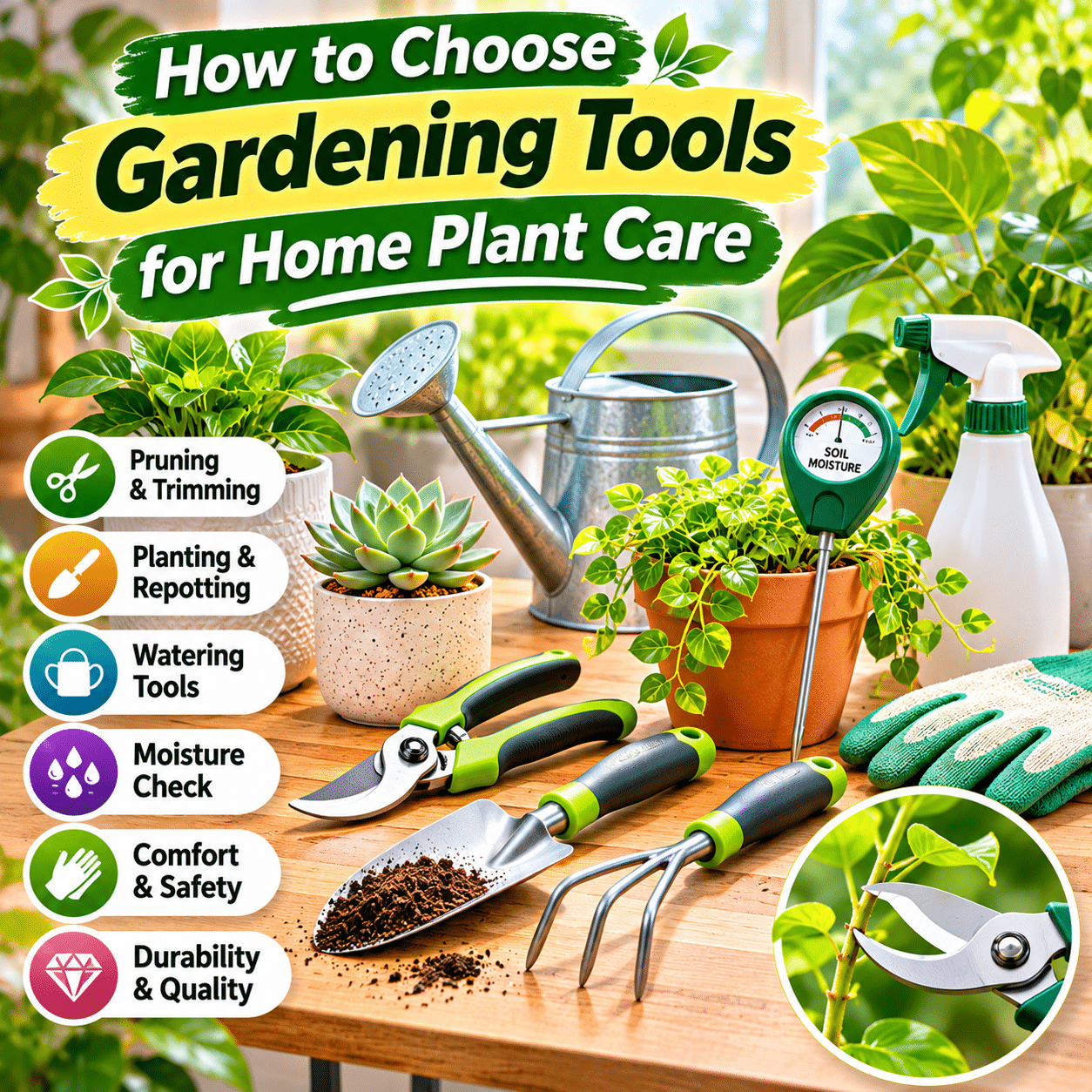
Caring for plants at home becomes easier, more enjoyable, and more effective when you have the right gardening tools. Whether you maintain a few indoor houseplants, grow herbs on a windowsill, tend a balcony garden, or care for a collection of outdoor potted plants, suitable tools can help you perform everyday maintenance with greater precision and less effort.
However, choosing gardening tools is not simply about buying a large collection of equipment. Different tools serve different purposes, and their usefulness depends on the plants you grow, the space available, and the tasks you perform regularly.
A small indoor plant collection may require only a watering can, pruning scissors, a hand trowel, and a few cleaning accessories. A larger container garden may benefit from additional tools for transplanting, soil preparation, pruning, and plant support.
This guide explains the essential types of gardening tools for home plant care, the features that matter when comparing products, and how to build a practical collection that supports healthy plants without unnecessary purchases.
1. Understand Your Home Gardening Needs Before Buying Tools
The first step in choosing gardening tools is identifying the type of plant care you actually perform.
A tool that is essential for one gardening setup may be unnecessary for another.
Indoor Houseplant Care
Indoor gardening often involves relatively small containers and delicate foliage.
Common tasks include:
- Watering potted plants.
- Removing damaged leaves.
- Repotting.
- Loosening or replacing potting mix.
- Cleaning foliage.
- Inspecting roots.
- Supporting climbing plants.
Compact, lightweight tools are generally more convenient for these activities.
Balcony and Patio Gardening
Balcony and patio gardens may include herbs, flowers, vegetables, and decorative plants.
Typical tasks include:
- Transplanting seedlings.
- Mixing potting media.
- Pruning stems.
- Maintaining containers.
- Supporting taller plants.
- Removing weeds from larger planters.
Durability and ease of cleaning become more important when tools are used outdoors.
Small Home Gardens
Garden beds and larger growing areas may require additional equipment for digging, cultivating, and maintaining soil.
However, this guide focuses primarily on tools suited to household plant care rather than heavy-duty landscaping equipment.
Start With Your Most Frequent Tasks
Before shopping, consider:
- How many plants do you maintain?
- Are they indoors, outdoors, or both?
- How often do you repot plants?
- Do you regularly prune stems or branches?
- Are your plants small and delicate or large and established?
- Do you have enough space to store gardening equipment?
These questions help identify which tools deserve priority.
2. Choose the Right Hand Trowel
A hand trowel is one of the most versatile tools for home gardening.
It is commonly used for moving potting mix, filling containers, transplanting small plants, and preparing planting spaces.
What to Look For
Blade material
Stainless steel blades generally offer good corrosion resistance and are relatively easy to clean.
Carbon steel can be strong and durable but may require more attention to prevent rust.
Some lightweight trowels use aluminum or plastic components.
Blade shape
A pointed blade can help with digging and loosening compacted material.
A broader, rounded blade may be more convenient for transferring potting mix.
Handle comfort
Look for a handle that feels secure and comfortable in your hand.
Textured or ergonomic grips may improve control, particularly during repetitive tasks.
Construction quality
Inspect how the blade connects to the handle.
A secure connection is important because this area experiences stress during digging and lifting.
Best Uses
A hand trowel is particularly useful for:
- Filling plant pots.
- Moving potting mix.
- Transplanting herbs and flowers.
- Preparing small planting holes.
- Removing loose material from containers.
For small indoor pots, a compact trowel may be easier to control than a standard garden-sized model.
3. Consider a Soil Scoop for Potting and Repotting
Although hand trowels and soil scoops have overlapping uses, their designs differ.
A soil scoop typically has a deeper or more enclosed shape that helps carry loose material.
Why a Soil Scoop Can Be Useful
When repotting indoor plants, potting mix often spills onto tables and floors.
A well-designed scoop can help transfer material more neatly.
Features to Compare
Look for:
- A comfortable handle.
- Smooth edges.
- Suitable capacity.
- Easy-to-clean surfaces.
- Lightweight construction.
- A shape that fits your containers.
When to Choose a Scoop Instead of a Trowel
A soil scoop may be preferable when you frequently:
- Fill nursery pots.
- Mix potting ingredients.
- Prepare multiple containers.
- Transfer loose growing media.
A hand trowel may be more versatile if you also need to dig or loosen material.
For a small plant collection, one well-chosen tool may be sufficient.
4. Choose Pruning Shears for Healthy Plant Maintenance
Pruning tools help remove damaged growth, shape plants, and manage stems.
However, different cutting tools are designed for different stem sizes and textures.
Bypass Pruning Shears
Bypass pruners use two blades that pass one another in a scissor-like motion.
They are commonly used for cutting living stems and small branches.
Advantages:
- Can produce clean cuts when sharp and properly adjusted.
- Suitable for many routine pruning tasks.
- Available in compact and full-size designs.
Considerations:
- Blade alignment matters.
- Dull blades can crush or tear stems.
- Cutting capacity varies by model.
Anvil Pruning Shears
Anvil pruners use a cutting blade that closes against a flat supporting surface.
They are often used for certain dry or dead woody stems.
However, they can crush softer living tissue, making bypass pruners a more common choice for many houseplant applications.
Pruning Scissors
Small pruning scissors or plant snips are useful for precise cutting.
They may be appropriate for:
- Removing damaged leaves.
- Trimming herbs.
- Cutting thin stems.
- Maintaining small ornamental plants.
- Performing delicate plant grooming.
Important Buying Features
Consider:
- Blade sharpness.
- Cutting capacity.
- Comfortable grip.
- Spring mechanism.
- Locking system.
- Corrosion resistance.
- Ease of cleaning.
Choose a tool designed for the thickness of the stems you expect to cut.
Do not force small pruning scissors through woody branches beyond their rated capacity.
5. Understand Blade Quality and Cutting Performance
Blade quality strongly influences how well pruning tools perform.
A sharp, properly aligned blade can make cleaner cuts with less effort.
Stainless Steel Blades
Stainless steel generally provides good corrosion resistance.
It can be convenient for tools exposed to water and plant sap.
However, performance depends on the steel grade, blade geometry, manufacturing quality, and maintenance.
Carbon Steel Blades
Carbon steel can offer good cutting performance and edge retention when properly manufactured and maintained.
It may be more susceptible to corrosion if left wet.
Coated Blades
Some tools feature protective or low-friction coatings.
These may help reduce sticking or improve corrosion resistance, depending on the coating and its durability.
A coating does not replace the need for cleaning and sharpening.
Replaceable Blades
Some higher-quality pruning tools allow blade replacement.
This can extend useful service life and reduce the need to replace the entire tool.
Before buying, check whether replacement parts are actually available.
6. Choose a Watering Can That Fits Your Plants
Watering is one of the most frequent home plant care tasks.
A suitable watering can should provide controlled water delivery without being awkward to lift or handle.
Capacity
A small watering can may be convenient for a few indoor plants.
Larger capacities reduce refill frequency but increase weight when filled.
Remember that one liter of water weighs approximately one kilogram, excluding the container itself.
Spout Design
A narrow spout can help direct water toward the potting mix without excessively wetting surrounding furniture.
Long spouts are particularly useful for reaching plants beneath dense foliage.
Removable Rose Attachments
Some watering cans include a perforated attachment, often called a rose, that distributes water more gently.
This can be useful for:
- Seedlings.
- Delicate potting surfaces.
- Small outdoor containers.
- Plants requiring gentle watering.
Handle Comfort
Check whether the watering can remains comfortable and balanced when full.
A poorly positioned handle can make controlled pouring difficult.
Material
Common options include:
- Plastic.
- Stainless steel.
- Painted metal.
- Galvanized metal.
Consider weight, corrosion resistance, durability, and ease of cleaning.
For indoor houseplants, a compact watering can with a narrow spout is often especially practical.
7. Consider a Spray Bottle or Plant Mister
Spray bottles are commonly used for cleaning foliage, applying certain plant-care products, and providing controlled surface moisture.
However, misting should not be confused with providing adequate root-zone watering.
Useful Applications
A spray bottle may help with:
- Moistening surfaces during propagation.
- Cleaning dust from suitable leaves.
- Applying water-based plant-care treatments according to product instructions.
- Lightly moistening certain growing media.
Important Features
Look for:
- An adjustable nozzle.
- Comfortable trigger.
- Reliable sealing.
- Suitable bottle capacity.
- Easy cleaning.
- Durable construction.
Understand the Limitations of Misting
Occasional misting usually provides only a temporary increase in moisture around foliage.
It is not a dependable substitute for maintaining appropriate ambient humidity.
Repeatedly wetting leaves can also increase disease risk for certain plants under poorly ventilated conditions.
Some plants with hairy, delicate, or moisture-sensitive foliage may not tolerate frequent spraying.
Choose a mister for a specific purpose rather than assuming every houseplant requires one.
8. Choose a Soil Moisture Meter Carefully
Soil moisture meters are marketed as tools for determining when plants need water.
They can be convenient, but their usefulness depends on the technology and how measurements are interpreted.
Common Consumer Moisture Meters
Many inexpensive meters use probes inserted into the growing medium.
Some rely on electrical properties that vary with moisture, salts, and other conditions.
Their readings may be affected by:
- Potting mix composition.
- Fertilizer concentration.
- Probe placement.
- Contact with the growing medium.
- Instrument quality.
What to Look For
Consider:
- Clear instructions.
- Appropriate probe length.
- Easy-to-read display.
- Suitable measurement range.
- Reliable construction.
- Manufacturer guidance for different growing media.
Understand Measurement Limitations
A simple moisture meter does not necessarily measure the exact water content of the potting mix.
Readings should be treated as indicators rather than absolute proof that watering is required.
Alternative Moisture Checks
Depending on the plant and container, useful methods include:
- Feeling the potting mix at an appropriate depth.
- Comparing pot weight before and after watering.
- Observing how quickly the medium dries.
- Inspecting roots when repotting.
- Monitoring plant responses over time.
A moisture meter can be a supplementary tool, but it should not replace understanding the plant’s watering requirements.
9. Consider a Hand Cultivator or Small Garden Fork
Hand cultivators are designed to loosen soil and work around plants.
They typically feature several short prongs.
Common Uses
They may help with:
- Loosening surface soil.
- Breaking up compacted material in garden beds.
- Removing small weeds.
- Incorporating amendments into suitable growing media.
Features to Consider
Look for:
- Strong prongs.
- Comfortable handle.
- Secure construction.
- Corrosion resistance.
- Suitable dimensions.
Be Careful Around Roots
Many houseplants develop roots close to the surface.
Aggressively cultivating potting mix can damage these roots.
For established indoor plants, avoid unnecessary disturbance.
A small cultivator is often more useful for outdoor containers and garden beds than for delicate houseplant collections.
10. Choose Tools for Repotting Indoor Plants
Repotting is an important part of long-term plant care.
Specialized tools can make the process cleaner and easier, especially when working with small containers.
Repotting Mats
A waterproof or water-resistant repotting mat provides a temporary workspace.
Useful features include:
- Raised or foldable edges.
- Easy cleaning.
- Suitable working area.
- Durable material.
- Compact storage.
A repotting mat can help contain loose potting mix when working indoors.
Root Hooks and Root Rakes
These tools may be used to separate roots or remove old growing media in certain repotting situations.
They are particularly common in bonsai and specialized plant cultivation.
However, aggressive root manipulation is unnecessary for many ordinary houseplants.
Small Planting Tools
Miniature trowels, scoops, and spatulas can be helpful for:
- Succulent arrangements.
- Small nursery pots.
- Terrariums.
- Compact decorative planters.
Choose tools that allow precise movement without excessive force.
11. Consider Specialized Tools for Succulents and Cacti
Succulents and cacti often require careful handling because of their compact size, delicate surfaces, or sharp spines.
Long Tweezers
Tweezers can help:
- Remove fallen leaves.
- Position small cuttings.
- Clear debris.
- Handle small objects in narrow spaces.
Soft Brushes
A soft brush can remove loose debris from suitable surfaces.
However, some succulents have protective waxy coatings that can be disturbed by brushing or touching.
Tongs
Suitable tongs may help position certain small cacti.
Use care to avoid crushing plant tissue or damaging spines.
Protective Gloves
Thorn-resistant gloves can help reduce puncture risks.
However, no ordinary gardening glove guarantees complete protection against sharp cactus spines.
For large or heavily spined plants, appropriate handling techniques and additional protective materials may be necessary.
12. Choose Gardening Gloves for Comfort and Protection
Gardening gloves help protect hands during many plant care activities.
However, different gloves provide different levels of protection.
Lightweight Gardening Gloves
These may be suitable for:
- General repotting.
- Handling potting mix.
- Light outdoor maintenance.
- Moving containers.
- Routine cleaning.
Coated Gloves
Gloves with textured or coated palms may provide better grip when handling tools and containers.
Thorn-Resistant Gloves
These are designed for tasks involving thorny or abrasive plants.
Protection varies by material and construction.
What to Look For
Consider:
- Proper fit.
- Finger flexibility.
- Breathability.
- Grip.
- Abrasion resistance.
- Ease of cleaning.
- Suitability for the task.
Oversized gloves can reduce precision, while overly tight gloves may cause discomfort.
For delicate indoor plant work, flexible gloves may be more practical than bulky protective designs.
13. Consider Plant Support Tools
Some houseplants require support as they grow taller or develop climbing habits.
Common support products include:
- Bamboo stakes.
- Plant support rings.
- Trellises.
- Moss poles.
- Coir poles.
- Soft plant ties.
- Adjustable clips.
Choosing Plant Stakes
Consider the plant’s height, weight, and growth habit.
A stake should provide adequate support without damaging roots during installation.
Choosing Plant Ties
Soft, flexible ties are often preferable for living stems.
Avoid tying stems so tightly that the material restricts growth or damages tissue.
Choosing Moss Poles and Climbing Supports
Certain climbing plants can benefit from suitable vertical structures.
However, not every climbing species requires a moisture-retaining moss pole.
Choose support based on the plant’s natural growth habit and your intended training method.
14. Compare Common Gardening Tool Materials
Tool materials influence weight, durability, maintenance, and comfort.
| Material | Common applications | Advantages | Considerations |
|---|---|---|---|
| Stainless steel | Trowels, scissors, pruning blades | Corrosion resistance, easy cleaning | Quality and hardness vary |
| Carbon steel | Pruners, cultivators, blades | Strength and cutting performance | Requires corrosion prevention |
| Aluminum | Lightweight hand tools | Low weight, corrosion resistance | May be less suitable for heavy leverage |
| Plastic | Scoops, watering cans, handles | Lightweight, affordable | Durability varies |
| Wood | Tool handles | Natural feel, traditional appearance | Requires drying and occasional maintenance |
| Rubber or synthetic grips | Handles and grips | Comfort, improved grip | May deteriorate with age or exposure |
No single material is best for every gardening tool.
Choose according to the tool’s purpose and expected frequency of use.
15. Evaluate Ergonomic Design
Gardening tools should feel comfortable during repeated use.
Poorly designed handles can increase hand fatigue and make precise tasks more difficult.
Handle Shape
A well-designed handle should allow a secure grip without requiring excessive force.
Grip Material
Textured rubber or similar materials may improve control, particularly when hands are damp.
Tool Weight
Heavy tools may provide strength and stability, but they can become tiring during extended use.
Lightweight tools are often preferable for small indoor gardening tasks.
Hand Size
A tool that feels comfortable to one person may be awkward for another.
When possible, check handle dimensions or test the grip before purchasing.
Spring-Assisted Cutting Tools
Some pruning shears include spring mechanisms that reopen the handles after each cut.
These can improve convenience, although the amount of force required depends on the design.
People with limited grip strength may benefit from specialized ergonomic tools, but suitability should be assessed individually.
16. Consider Tool Size and Precision
Home gardening often involves working in confined spaces.
Large tools can be awkward around delicate plants and small pots.
Miniature Tools
Compact tools are useful for:
- Terrariums.
- Small succulents.
- Seedling trays.
- Desk plants.
- Narrow planters.
Standard Hand Tools
Standard hand trowels and pruners may be more suitable for:
- Medium-sized houseplants.
- Balcony containers.
- Herb gardens.
- General repotting.
Larger Gardening Tools
Long-handled equipment may be useful for outdoor beds and larger growing areas.
However, it is often unnecessary for indoor plant care.
Buying tip: Choose the smallest tool that can comfortably and safely perform the intended task without sacrificing strength or control.
17. Look for Tools That Are Easy to Clean
Gardening tools come into contact with potting mix, moisture, plant sap, and organic debris.
Cleaning helps maintain performance and can reduce the transfer of certain plant pathogens.
Easy-to-Clean Designs
Look for:
- Smooth surfaces.
- Accessible blade joints.
- Minimal dirt-trapping gaps.
- Corrosion-resistant materials.
- Removable components where appropriate.
Cleaning After Routine Use
After gardening:
- Remove soil and plant debris.
- Wash tools when necessary.
- Dry metal components thoroughly.
- Inspect for damage.
- Store in a clean, dry location.
Cleaning Pruning Tools
Pruning blades may require additional attention when moving between plants, particularly if disease is suspected.
Use a disinfectant appropriate for the tool material and follow its label instructions.
Cleaning away visible debris before disinfection is important.
Not every household cleaning product is suitable for every blade finish or handle material.
18. Consider Maintenance and Replaceable Parts
A durable gardening tool should remain functional with reasonable maintenance.
Sharpening
Some pruning tools can be sharpened to restore cutting performance.
Follow the manufacturer’s guidance and maintain the intended blade geometry.
Lubrication
Moving joints may benefit from suitable lubrication.
Use products recommended for the tool and avoid excessive application.
Rust Prevention
Dry metal tools after use.
For susceptible materials, appropriate protective treatment may help reduce corrosion during storage.
Replacement Parts
For frequently used pruning tools, check whether the manufacturer offers:
- Replacement blades.
- Springs.
- Screws.
- Locking components.
Repairable tools can offer better long-term value than designs that must be discarded after minor component failure.
19. Decide Whether to Buy Individual Tools or a Gardening Tool Set
Gardening tools are available individually and in bundled sets.
Each approach has advantages.
Buying Individual Tools
Advantages:
- Select only the tools you need.
- Choose different brands for different purposes.
- Prioritize quality in frequently used equipment.
- Avoid unnecessary duplicates.
Limitations:
- May require more time to compare products.
- Storage accessories may need to be purchased separately.
Buying a Gardening Tool Set
Advantages:
- Convenient starting point for beginners.
- May include coordinated tools.
- Sometimes includes a storage bag or case.
- Can simplify purchasing.
Limitations:
- Some included tools may be unnecessary.
- Quality may vary between components.
- A large number of tools does not guarantee better value.
Which Is Better?
For a small indoor plant collection, purchasing a few useful tools individually may be the more practical approach.
A compact set can be worthwhile when most included tools match your gardening needs.
Evaluate the quality and usefulness of each component rather than the total number of pieces.
20. Essential Gardening Tools for Different Home Setups
Different plant collections benefit from different tool combinations.
| Gardening setup | Useful tools | Main priorities |
|---|---|---|
| Small indoor plant collection | Watering can, pruning scissors, compact trowel | Precision and easy storage |
| Medium houseplant collection | Trowel, soil scoop, pruners, repotting mat | Convenience and versatility |
| Succulent collection | Small scoop, tweezers, soft brush, suitable gloves | Delicate handling |
| Indoor herb garden | Watering can, harvesting scissors, trowel | Regular watering and harvesting |
| Balcony container garden | Trowel, pruners, gloves, watering can, cultivator | Durability and multipurpose use |
| Seedling propagation | Small scoop, watering attachment, labels, repotting tools | Gentle handling and consistency |
| Large indoor foliage collection | Pruners, plant ties, support tools, watering can | Stability and maintenance |
These are suggested combinations rather than mandatory equipment lists.
21. Consider Gardening Tool Storage
Proper storage protects tools and keeps them accessible.
Tool Bags
A gardening tool bag can organize frequently used equipment.
Look for:
- Durable fabric.
- Suitable compartments.
- Reinforced handles.
- Easy cleaning.
- Adequate capacity.
Storage Boxes
Boxes can protect tools from dust and accidental damage.
They may be useful for keeping sharp tools away from children and pets.
Wall Organizers
Wall-mounted storage can save floor space.
Ensure the mounting system is secure and appropriate for the weight of the equipment.
Drawer Storage
For compact indoor gardening tools, a dedicated drawer or container may be sufficient.
Use blade guards or protective covers for sharp tools.
Keep Tools Dry
Avoid storing wet tools in sealed bags or containers.
Allow equipment to dry before storage to reduce corrosion and deterioration.
22. Evaluate Durability and Long-Term Value
A gardening tool’s value depends on how well it performs over time.
A low-cost tool may be perfectly adequate for occasional use, while frequently used equipment may justify a more durable design.
Signs of Better Construction
Look for:
- Secure blade-to-handle connections.
- Solid joints.
- Comfortable grips.
- Consistent manufacturing quality.
- Appropriate material thickness.
- Reliable locking mechanisms.
- Clearly stated cutting capacity.
Warranty and Support
Manufacturer warranties can provide useful information about product support.
However, warranty length alone does not guarantee quality.
Review what the warranty actually covers.
Repairability
Tools with replaceable components may offer better long-term value.
Avoid Paying for Unnecessary Features
Decorative finishes, oversized bundles, and complex accessories may increase cost without improving practical performance.
Prioritize function, comfort, and durability.
23. Consider Safety When Choosing Gardening Tools
Even small gardening tools can cause injuries when used incorrectly.
Sharp Cutting Tools
Choose pruners and scissors with reliable locking mechanisms.
Keep blades closed and secured when not in use.
Tool Capacity
Never force a tool to cut material beyond its intended capacity.
This can damage the tool or cause loss of control.
Handle Security
Loose handles and unstable joints increase injury risk.
Inspect tools periodically.
Protective Equipment
Use suitable gloves and eye protection when the task requires them.
For thorny plants or cutting activities that may produce flying debris, additional protection may be appropriate.
Safe Storage
Keep sharp tools out of reach of children.
Store them securely rather than leaving them on plant shelves or accessible surfaces.
Electrical Gardening Tools
If using powered equipment, follow the manufacturer’s safety instructions and use devices suitable for the intended environment.
For most routine indoor plant care, manual tools are sufficient.
24. Common Mistakes to Avoid When Buying Gardening Tools
Buying Too Many Tools at Once
Large sets may include items that are rarely used.
Better approach: Begin with essential tools and expand only when specific needs arise.
Choosing Tools Based Only on Appearance
Attractive handles and matching colors do not guarantee good performance.
Better approach: Prioritize construction, comfort, and functionality.
Ignoring Handle Comfort
Uncomfortable tools can make repetitive tasks tiring.
Better approach: Consider grip size, shape, and weight.
Buying Oversized Equipment
Large tools may be difficult to use around small pots and delicate foliage.
Better approach: Match tool dimensions to your growing space.
Choosing Low-Quality Pruning Blades
Poorly aligned or dull blades may damage stems.
Better approach: Look for reliable cutting performance and maintainable blades.
Overlooking Cleaning Requirements
Tools that trap dirt or are difficult to dry may require more maintenance.
Better approach: Choose simple, accessible designs.
Assuming Every Moisture Meter Is Accurate
Basic meters can produce misleading readings in some growing media.
Better approach: Use readings alongside other moisture observations.
Neglecting Storage
Improper storage can damage tools and create safety risks.
Better approach: Plan a clean, dry, secure storage location.
Buying Specialized Tools Without a Clear Need
Specialized equipment may be useful for particular plants but unnecessary for general home gardening.
Better approach: Purchase specialty tools only when they solve a recurring problem.
25. Step-by-Step Guide to Choosing Home Gardening Tools
A structured approach can help you build a useful collection.
Step 1: List Your Regular Plant Care Tasks
Identify the activities you perform most often.
Examples include watering, pruning, repotting, cleaning, and supporting plants.
Step 2: Identify Essential Tools
Choose tools that address your most frequent tasks.
For many beginners, a watering can, compact trowel, and pruning scissors provide a practical foundation.
Step 3: Match Tool Size to Your Plants
Select compact tools for small containers and stronger tools for larger plants or outdoor work.
Step 4: Compare Materials
Consider corrosion resistance, durability, weight, and maintenance requirements.
Step 5: Evaluate Handle Comfort
Look for secure grips and suitable dimensions.
Step 6: Check Construction Quality
Inspect blade connections, joints, locks, and overall stability.
Step 7: Consider Cleaning and Maintenance
Choose tools that can be cleaned and stored easily.
Step 8: Review Safety Features
Prioritize reliable blade locks, protective covers, and appropriate tool capacity.
Step 9: Compare Individual Tools With Sets
Buy a set only when its contents are genuinely useful.
Step 10: Plan for Long-Term Use
Consider durability, replaceable parts, storage, and future gardening needs.
26. Practical Gardening Tool Buying Checklist
Use this checklist before purchasing gardening equipment.
Gardening Needs
- I know which plant care tasks I perform regularly.
- The tool is suitable for indoor or outdoor use as needed.
- Its size matches my plants and containers.
- It serves a clear practical purpose.
- I am not buying unnecessary duplicates.
Materials and Construction
- The working components are made from suitable materials.
- The handle is securely attached.
- Moving parts operate smoothly.
- Cutting blades are properly aligned.
- The tool appears durable enough for its intended use.
Comfort and Convenience
- The handle fits my hand comfortably.
- The tool is not unnecessarily heavy.
- The grip provides adequate control.
- The design allows precise use.
- Cleaning is straightforward.
Safety
- Sharp tools have suitable locking or protective features.
- The tool’s capacity matches the intended task.
- There are no loose or damaged components.
- I have appropriate protective equipment when needed.
- Safe storage is available.
Long-Term Value
- The tool is likely to be used regularly.
- Maintenance requirements are manageable.
- Replacement parts are available when relevant.
- The overall cost is reasonable for the expected use.
- The tool can remain useful as my plant collection develops.
27. Frequently Asked Questions
What are the most essential gardening tools for indoor plants?
For many indoor plant collections, a compact watering can, pruning scissors, and hand trowel are useful starting tools.
A soil scoop, repotting mat, and plant support accessories may become helpful as the collection grows.
Do beginners need a complete gardening tool set?
Not necessarily.
A few well-chosen tools can handle most basic plant care tasks.
A set may be convenient if it includes tools you will actually use.
What is the difference between a hand trowel and a soil scoop?
A hand trowel is generally designed for digging, loosening, and transferring material.
A soil scoop usually has a deeper shape that helps carry loose potting mix.
Their functions overlap, but their designs emphasize different tasks.
Are pruning scissors or pruning shears better for houseplants?
Small pruning scissors are often convenient for thin stems and delicate foliage.
Bypass pruning shears may be better for thicker stems and small branches within their rated cutting capacity.
Are stainless steel gardening tools better?
Stainless steel offers useful corrosion resistance and can be easy to maintain.
However, overall performance depends on construction quality, steel characteristics, and tool design.
Other materials can also perform well.
Do I need a soil moisture meter?
A moisture meter is optional.
It may provide additional information, but readings should be interpreted carefully.
Observing potting mix moisture, container weight, and plant requirements can also help guide watering decisions.
Is misting necessary for indoor plants?
Not all indoor plants benefit from misting.
Occasional misting is not a reliable substitute for appropriate humidity or root-zone watering.
Use a spray bottle only when it serves a suitable plant care purpose.
What tools are useful for repotting houseplants?
A hand trowel, soil scoop, repotting mat, and small pruning tool can be useful.
Specialized root tools may help in certain situations but are not essential for most routine repotting.
Are expensive gardening tools worth buying?
Higher-quality tools may offer better comfort, durability, cutting performance, or repairability.
However, expensive equipment is not automatically necessary for occasional home gardening.
Choose according to expected use and practical value.
How should I clean gardening tools?
Remove soil and debris, wash when appropriate, and dry thoroughly.
Pruning tools may require disinfection between plants when disease transmission is a concern.
Follow manufacturer instructions for cleaning and maintenance.
How often should gardening tools be replaced?
There is no fixed replacement schedule.
Replace tools when they become unsafe, structurally damaged, or no longer function effectively and cannot reasonably be repaired.
Can the same gardening tools be used for indoor and outdoor plants?
Many tools can serve both purposes.
However, cleaning is important when moving between growing areas, especially if pests or plant diseases may be present.
What is the best gardening tool for small pots?
Compact trowels, narrow soil scoops, and small plant snips are often useful for working in confined spaces.
Choose tools that provide control without damaging roots or foliage.
How can I make gardening tools last longer?
Clean tools after use, dry metal components, maintain cutting blades, inspect joints, and store equipment in a dry, secure location.
Following manufacturer maintenance guidance can extend useful service life.
Final Thoughts
Choosing gardening tools for home plant care is about building a practical collection that makes routine tasks easier, safer, and more precise.
The most useful tools are not necessarily the most expensive or the most specialized. They are the ones that match your plants, growing environment, and everyday maintenance needs.
For many indoor gardeners, a comfortable watering can, reliable pruning scissors, and well-made hand trowel provide an excellent foundation. As your plant collection expands, additional tools such as soil scoops, repotting mats, support accessories, and specialized pruning equipment can improve convenience.
Pay attention to material quality, ergonomic design, appropriate tool size, ease of cleaning, and safety features. Choose durable equipment that can be maintained over time, and avoid purchasing tools that do not serve a clear purpose.
Most importantly, remember that gardening tools support good plant care practices rather than replace them. Understanding each plant’s needs, using suitable growing media, watering appropriately, and maintaining healthy growing conditions remain essential.
With a thoughtfully selected set of gardening tools, caring for indoor plants, herbs, balcony containers, and small home gardens can become a more organized, comfortable, and rewarding part of everyday life.