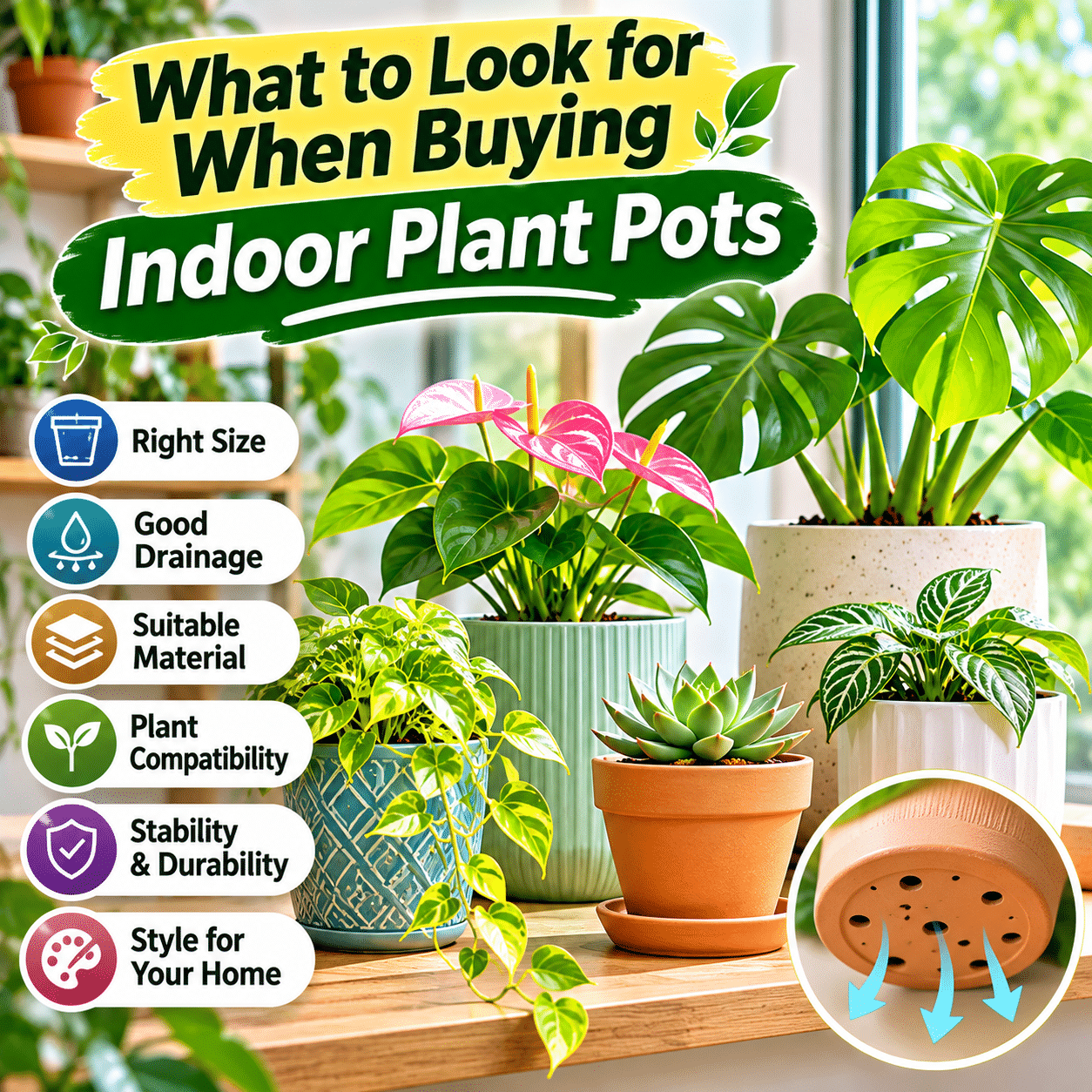
Indoor plant pots do more than hold soil and display greenery. The right pot helps create a suitable growing environment for roots, supports healthy moisture management, and makes everyday plant care more convenient. It can also contribute to the overall appearance of a room, whether you prefer a minimalist interior, a cozy botanical corner, or a collection of colorful houseplants.
However, choosing an indoor plant pot involves more than selecting an attractive color or shape. Pot size, drainage, material, weight, stability, and compatibility with your plant all influence how well the container performs over time.
A pot that is too large may keep potting mix wet longer than expected, while one that is too small can restrict root development and require frequent watering. Materials also behave differently: some allow moisture to evaporate through their walls, while others retain it within the growing medium.
This guide explains what to look for when buying indoor plant pots, compares common materials and designs, and offers practical advice for choosing containers that balance plant health, convenience, durability, and interior style.
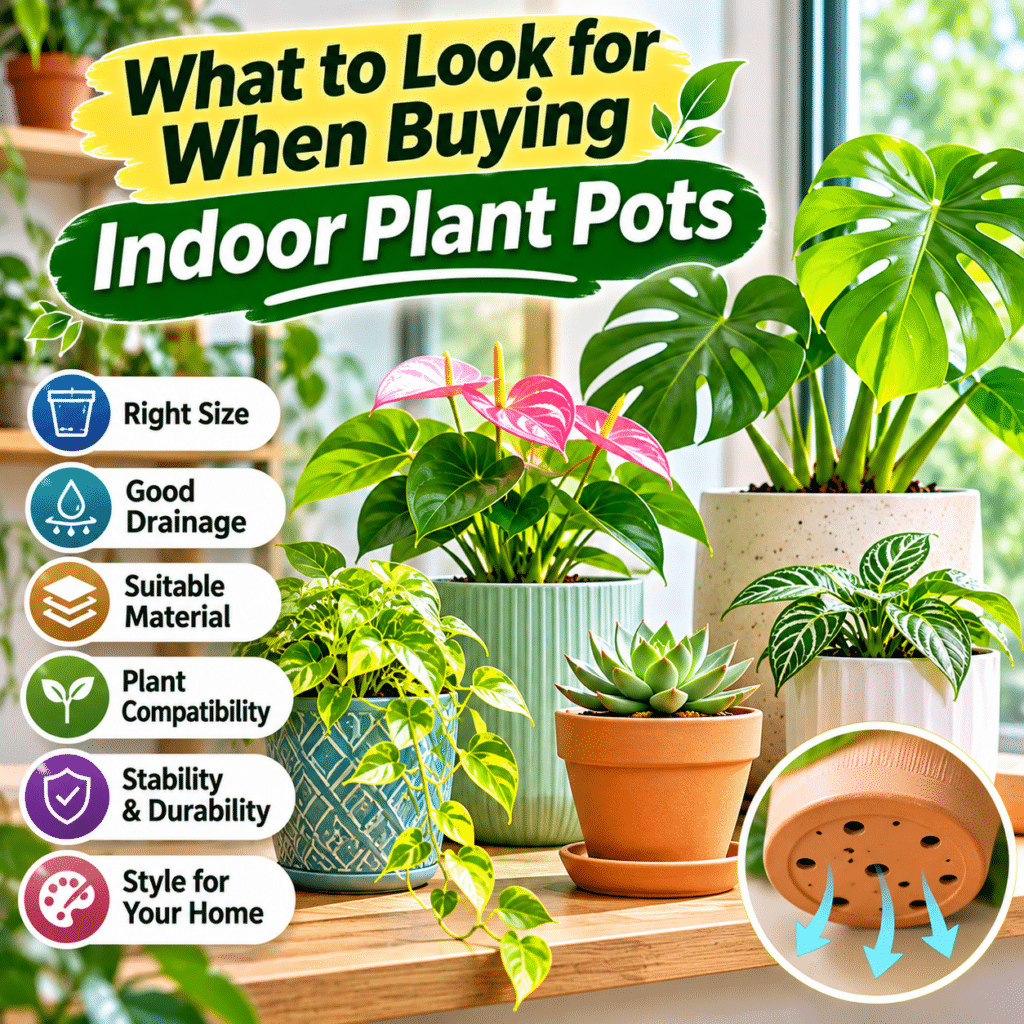
1. Understand Why Choosing the Right Plant Pot Matters
A plant pot creates the physical environment in which a houseplant’s root system grows.
Its design affects several important aspects of plant care.
Root Development
Roots need enough room to grow, absorb water, and access nutrients.
A suitable container provides space for healthy root development without introducing an unnecessarily large volume of potting mix.
Moisture Management
Different pots influence how quickly the growing medium dries.
Drainage holes, container material, size, and shape all contribute to moisture behavior.
Root Aeration
Roots require oxygen for normal functioning.
Poor drainage, compacted potting mix, and prolonged waterlogging can reduce oxygen availability around roots.
Plant Stability
Larger plants and those with tall or spreading foliage need containers that provide adequate physical support.
An unstable pot can tip over, damaging the plant or nearby belongings.
Indoor Convenience
The right pot should also be practical for the location where it will be used.
Consider:
- Ease of watering.
- Protection for furniture and flooring.
- Cleaning requirements.
- Weight when moving the plant.
- Compatibility with plant stands.
- Available space.
- Long-term maintenance.
A successful choice balances the needs of the plant with the practical requirements of your home.
2. Choose the Right Pot Size
Pot size is one of the most important considerations when selecting an indoor plant container.
A common mistake is assuming that a much larger pot will automatically encourage faster growth.
In reality, container size should match the plant’s root system and growing conditions.
Why Pot Diameter Matters
Pot diameter determines the horizontal growing space available to roots.
When repotting a typical houseplant that has outgrown its container, moving to a pot approximately 1–2 inches (2.5–5 cm) wider is often a reasonable starting point.
However, this is not a universal rule.
The appropriate increase depends on:
- Plant species.
- Root system size.
- Growth rate.
- Potting mix.
- Container shape.
- Environmental conditions.
Plants with relatively small root systems may benefit from a more conservative increase.
Problems With Oversized Pots
A pot that is significantly larger than the root system may contain more moisture-retaining potting mix than the plant can use efficiently.
Potential consequences include:
- Slower drying.
- Increased risk of prolonged waterlogging.
- Difficulty judging watering needs.
- Unfavorable root conditions.
- Greater risk of root problems in poorly managed growing media.
An oversized pot does not inevitably cause root rot, but it can make moisture management more difficult.
Problems With Undersized Pots
A pot that is too small may lead to:
- Crowded roots.
- Frequent drying.
- Reduced space for root expansion.
- Increased watering frequency.
- Reduced plant stability.
- Difficulty maintaining consistent moisture.
Some plants tolerate relatively snug containers, but severe root restriction can eventually affect growth.
Signs a Plant May Need a Larger Pot
Look for several indicators rather than relying on one symptom.
Common signs include:
- Roots densely circling the inside of the container.
- Roots emerging extensively through drainage holes.
- Potting mix drying unusually quickly.
- Water running through a root-filled container without wetting the medium effectively.
- A root ball occupying most of the available space.
- Reduced growth that cannot be explained by other conditions.
Visible roots near a drainage hole do not always mean immediate repotting is necessary.
The overall condition of the root system matters more.
3. Consider Pot Depth and Shape
Two pots with the same diameter can have very different internal volumes.
Depth and shape influence root space, moisture distribution, and stability.
Deep Pots
Deep containers may suit plants with larger or deeper root systems.
They can also provide physical support for taller plants when properly weighted.
However, excess depth can create a large volume of potting mix below a relatively shallow root system.
Shallow Pots
Shallow containers may be appropriate for plants with compact or relatively shallow root systems.
They are often used for:
- Certain succulents.
- Small decorative plant arrangements.
- Some bonsai applications.
- Plants with limited root depth.
Shallow containers may dry faster, depending on their material, dimensions, and growing conditions.
Wide Pots
Wide containers can accommodate spreading root systems or grouped plant arrangements.
They may also provide a broader base for stability.
Tall, Narrow Pots
Tall, narrow pots can create an elegant decorative appearance, but they may be less stable when supporting plants with heavy upper growth.
They can also be difficult to repot if the container narrows toward the opening.
Buying tip: Consider the internal shape of the container, not just its external appearance.
4. Prioritize Proper Drainage
Drainage is one of the most important features to evaluate when buying indoor plant pots.
Most common houseplants grow best when excess water can leave the container and the potting mix retains sufficient air space.
Why Drainage Holes Matter
Drainage holes allow excess water to escape after watering.
This helps reduce the likelihood of water remaining trapped at the bottom of the container.
A pot with drainage holes also makes it easier to water thoroughly and allow excess water to drain away.
How Many Drainage Holes Are Necessary?
There is no universal number.
Drainage performance depends on:
- Hole size.
- Number and placement of holes.
- Potting mix structure.
- Container shape.
- Root development.
- Watering practices.
A single adequately sized drainage hole may work well in some containers, while larger pots may benefit from multiple openings.
Are Pots Without Drainage Holes Suitable?
Pots without drainage holes can be used as decorative outer containers.
However, planting directly into them makes moisture management more challenging because excess water cannot escape.
A practical solution is to place a smaller nursery pot with drainage holes inside a decorative outer pot.
This arrangement allows the plant to be removed for watering and draining.
Avoid the Gravel-Layer Myth
Adding a layer of gravel or stones to the bottom of a pot without drainage holes does not create an effective drainage outlet.
In fact, a coarse layer beneath finer potting mix can alter water movement and leave moisture retained above the interface.
A better approach is to use a container with drainage holes and an appropriate potting medium.
5. Compare Common Indoor Plant Pot Materials
Plant pots are available in several materials, each with different characteristics.
Understanding these differences helps you select a container suited to your plants and home environment.
Terracotta Pots
Terracotta is a porous clay material commonly used for plant containers.
Advantages:
- Allows moisture to evaporate through unglazed walls.
- Provides a traditional, natural appearance.
- Often offers good stability due to its weight.
- Available in many simple shapes.
- Can be useful for plants that prefer relatively quick drying.
Limitations:
- May require more frequent watering.
- Can develop mineral deposits on the surface.
- May crack if dropped.
- Can be vulnerable to freeze damage when saturated.
- May leave moisture marks on furniture without suitable protection.
Terracotta is often a practical choice for many succulents and other plants that benefit from relatively fast-drying conditions.
However, the potting mix and watering routine remain important.
Ceramic Pots
Ceramic pots are available in glazed and unglazed finishes.
Glazed ceramic is particularly popular for decorative indoor plant displays.
Advantages:
- Wide variety of colors and finishes.
- Attractive appearance.
- Often relatively stable.
- Easy-to-clean glazed surfaces.
- Suitable for many interior design styles.
Limitations:
- Can be heavy.
- May chip or crack.
- Some decorative designs lack drainage holes.
- Glazed surfaces generally allow less evaporation through the walls than unglazed terracotta.
Ceramic pots are well suited to homeowners who want containers that function as decorative accents.
Plastic Pots
Plastic pots are common in nurseries and household plant collections.
Advantages:
- Lightweight.
- Often affordable.
- Available in many sizes.
- Easy to move.
- Generally resistant to breakage.
- Can retain moisture longer than porous terracotta under comparable conditions.
Limitations:
- Lightweight designs may tip over.
- Some plastics become brittle with age or ultraviolet exposure.
- Thin containers may deform.
- Appearance and durability vary considerably.
Plastic nursery pots are particularly convenient when used inside decorative outer containers.
Fiberglass and Composite Pots
Fiberglass and composite materials are often used for larger decorative planters.
Advantages:
- Can provide a lightweight alternative to heavy ceramic or concrete.
- Available in contemporary designs.
- Suitable for larger containers.
- Often easier to move than similarly sized stone planters.
Limitations:
- Quality varies by construction.
- Some finishes may scratch or fade.
- Lower-quality products may develop surface damage.
- Drainage arrangements differ between models.
These materials can be useful for large houseplants where weight is a concern.
Metal Pots
Metal containers can complement industrial, modern, or minimalist interiors.
Advantages:
- Distinctive appearance.
- Often durable when appropriately finished.
- Available in slim and decorative designs.
- Useful as outer planters.
Limitations:
- Can conduct heat readily.
- May corrode if not suitably protected.
- Some designs lack drainage.
- Direct planting may create moisture-management challenges.
Metal containers are often best used as decorative cachepots with removable inner pots.
Concrete and Stone Pots
Concrete and stone planters offer a substantial, architectural appearance.
Advantages:
- Often highly stable.
- Suitable for larger plants.
- Can complement minimalist interiors.
- Available in natural-looking finishes.
Limitations:
- Heavy and difficult to move.
- May be porous.
- Can damage floors if moved without protection.
- Some materials may affect the chemistry of water or growing media.
- Can crack under certain conditions.
For indoor use, check the container’s finish, drainage, and suitability for contact with furniture or flooring.
6. Indoor Plant Pot Material Comparison
| Material | Weight | Moisture behavior | Main advantages | Main considerations |
|---|---|---|---|---|
| Unglazed terracotta | Moderate to heavy | Allows evaporation through walls | Natural appearance, faster drying | Fragility, frequent watering |
| Glazed ceramic | Moderate to heavy | Limited wall evaporation | Decorative, easy to clean | Weight, drainage availability |
| Plastic | Light | Nonporous walls | Affordable, practical, easy to move | Stability, material quality |
| Fiberglass/composite | Often light for its size | Generally limited wall evaporation | Suitable for larger decorative planters | Construction and finish quality |
| Metal | Varies | Nonporous walls | Modern appearance | Heat transfer, corrosion |
| Concrete/stone | Heavy | Varies by material and finish | Stability, architectural style | Weight, floor protection |
These are general characteristics. Actual performance depends on pot construction, drainage, potting mix, and growing conditions.
7. Match the Pot to Your Plant Type
Different houseplants have different root structures and moisture preferences.
Choosing a suitable pot can make plant care easier.
Succulents and Cacti
Many succulents and cacti prefer growing media that drain readily and do not remain excessively wet.
Consider:
- Pots with drainage holes.
- Appropriate container size.
- Unglazed terracotta where faster drying is helpful.
- Shapes suited to the root system.
- Stable containers for top-heavy specimens.
Avoid assuming that every succulent has a shallow root system. Requirements vary by species.
Tropical Foliage Plants
Many tropical houseplants prefer consistent moisture without prolonged waterlogging.
Examples include:
- Monstera.
- Philodendron.
- Pothos.
- Peace lily.
- Certain calatheas.
Consider:
- Containers with reliable drainage.
- Plastic or glazed ceramic where moisture retention is desirable.
- Suitable root space.
- Stable designs for larger foliage.
The appropriate material depends on the species, potting mix, and indoor conditions.
Orchids
Many commonly grown epiphytic orchids have specialized root requirements.
Certain orchid containers feature:
- Side ventilation openings.
- Multiple drainage holes.
- Transparent walls.
- Designs compatible with coarse orchid media.
Transparent pots can make it easier to observe root conditions in some orchid-growing systems.
However, orchid requirements vary, and not every species needs the same container.
Indoor Herbs
Herbs grown indoors need containers that support their root systems and watering requirements.
Consider:
- Adequate depth.
- Reliable drainage.
- Stable placement.
- Easy cleaning.
- Sufficient room for growth.
Fast-growing herbs may need larger containers or more frequent repotting than slow-growing decorative plants.
Large Indoor Trees
Plants such as fiddle-leaf figs, rubber plants, and larger dracaenas may require greater stability.
Look for:
- A broad, stable base.
- Suitable root space.
- Durable construction.
- Adequate drainage.
- Manageable overall weight.
A decorative outer planter can help improve stability when used appropriately.
8. Understand the Difference Between Nursery Pots and Decorative Planters
Indoor plant containers generally fall into two practical categories.
Nursery Pots
Nursery pots are functional growing containers, commonly made from plastic.
They typically include drainage holes and are designed for straightforward plant care.
Benefits include:
- Easy watering.
- Convenient repotting.
- Lightweight construction.
- Compatibility with many decorative planters.
- Easy inspection of drainage.
Decorative Planters and Cachepots
A cachepot is an outer decorative container that holds a separate growing pot.
It may not have drainage holes.
Benefits include:
- Attractive appearance.
- Protection for furniture when used correctly.
- Easy changes to interior styling.
- Flexibility to replace or rearrange plants.
Why the Two-Pot Method Works Well
Using a nursery pot inside a decorative cachepot separates plant care from interior decoration.
You can remove the inner pot, water the plant, allow excess water to drain, and return it to the decorative container.
Always empty collected water from the outer pot so the roots do not remain submerged.
This approach is particularly useful for decorative containers that lack drainage holes.
9. Look for a Suitable Saucer or Drip Tray
Drainage holes are beneficial for plants, but water escaping from the pot can damage indoor surfaces.
A saucer or drip tray helps collect runoff.
Important Features
Look for:
- A diameter suitable for the pot.
- Enough depth to catch expected runoff.
- A stable, level base.
- Water-resistant construction.
- Easy cleaning.
- Compatibility with the container’s design.
Avoid Leaving Standing Water
After watering, remove excess water from the saucer once drainage has finished.
Prolonged contact with standing water can contribute to excessively wet root conditions.
Protect Furniture and Floors
Some porous containers and saucers may transfer moisture to wooden furniture or other sensitive surfaces.
Consider waterproof barriers, suitable plant stands, or protective mats where necessary.
Do not assume that every ceramic or terracotta saucer is completely waterproof.
10. Evaluate Pot Stability and Weight
Stability becomes increasingly important as plants grow taller or develop heavier foliage.
Why Stability Matters
A top-heavy plant in a lightweight or narrow container may tip over.
This can cause:
- Broken stems.
- Damaged leaves.
- Spilled potting mix.
- Scratched furniture.
- Injury risks for children or pets.
Features That Improve Stability
Consider:
- Broad bases.
- Appropriate pot weight.
- Balanced proportions.
- Secure placement.
- Stable plant stands.
When Lightweight Pots Are Better
Lightweight containers may be preferable for:
- Hanging plants.
- Wall-mounted displays.
- Shelves with limited load capacity.
- Plants that require frequent movement.
- Large planters that would otherwise be difficult to handle.
The best choice balances stability with safe handling.
11. Consider the Pot’s Interior Finish and Construction
The inside of a pot is just as important as its decorative exterior.
Smooth Interior Walls
Smooth interiors may make cleaning and removing plants easier.
Rough or irregular surfaces can sometimes make repotting more difficult.
Tapered Shapes
Pots that are wider at the top than at the bottom are often easier to remove plants from.
Containers with narrow openings or inward-curving rims may trap mature root balls.
Wall Thickness
Thicker walls can improve durability and insulation in some materials, but they also increase weight.
Thin plastic containers are lightweight but may flex or deform.
Drainage Hole Quality
Inspect drainage openings for:
- Adequate size.
- Smooth edges.
- Obstructions.
- Proper placement.
Poorly formed holes may restrict drainage or complicate cleaning.
12. Choose a Pot That Fits Your Indoor Environment
The same plant may require different care depending on where it is kept.
Pot selection should account for the surrounding environment.
Bright, Warm Rooms
In warm spaces with strong daylight, potting mix may dry more quickly.
Porous containers can increase drying further.
Plants with higher moisture requirements may need closer monitoring in these conditions.
Cool or Low-Light Rooms
Plants often use water more slowly when light and growth are limited.
Nonporous containers with large volumes of moisture-retaining mix may remain wet for extended periods.
Choose an appropriately sized pot and adjust watering to actual moisture conditions.
Humid Rooms
High humidity can reduce evaporation from the potting mix.
Good drainage and suitable growing media remain important.
Air-Conditioned Spaces
Air conditioning can affect humidity and temperature.
Dry indoor air may increase moisture loss from leaves and exposed growing media.
Monitor plant needs rather than relying on a fixed watering schedule.
13. Consider Self-Watering Plant Pots
Self-watering pots are designed to provide water from a reservoir to the growing medium.
Many use a wick or capillary system.
Potential Advantages
- Can reduce the frequency of manual watering.
- May help maintain more consistent moisture.
- Useful for certain moisture-loving plants.
- Convenient for some busy households.
- Can simplify care when properly managed.
Potential Limitations
- Not suitable for every plant.
- Reservoirs require cleaning.
- Water levels need monitoring.
- Poorly designed systems can keep the medium too wet.
- Mineral buildup may occur over time.
Which Plants May Benefit?
Some foliage plants and herbs may perform well in properly managed self-watering systems.
However, plants that prefer substantial drying between waterings may not be ideal candidates.
What to Check Before Buying
Look for:
- A removable or accessible reservoir.
- Clear water-level indicators.
- Easy cleaning.
- Suitable wicking design.
- Appropriate container size.
- Instructions for compatible growing media.
Self-watering pots are not maintenance-free, and their effectiveness depends on correct setup and plant requirements.
14. Evaluate Hanging Pots and Wall-Mounted Planters
Hanging and wall-mounted containers can make effective use of limited space.
They are particularly popular for trailing houseplants.
Hanging Pots
Consider:
- Total weight when filled and watered.
- Strength of the hanging hardware.
- Secure attachment points.
- Water containment.
- Accessibility for maintenance.
Wall-Mounted Planters
Check:
- Wall compatibility.
- Mounting hardware.
- Load capacity.
- Drainage arrangements.
- Ease of removing the plant.
Safety Considerations
Wet potting mix and mature plants can be considerably heavier than an empty container.
Use mounting systems rated for the expected load.
Avoid placing heavy hanging planters above areas where falling objects could cause injury.
15. Choose a Style That Complements Your Home
Plant pots contribute to interior design as well as plant care.
A coordinated selection can make a plant collection feel intentional without requiring every pot to match.
Minimalist Interiors
Simple shapes and neutral finishes often work well.
Consider:
- White ceramic.
- Matte black.
- Soft gray.
- Natural terracotta.
- Clean cylindrical designs.
Warm and Natural Interiors
Earthy materials and organic textures can complement wooden furniture and natural fabrics.
Options include:
- Unglazed terracotta.
- Textured ceramic.
- Stone-inspired finishes.
- Warm neutral colors.
Modern Interiors
Contemporary rooms may benefit from:
- Geometric shapes.
- Smooth finishes.
- Simple silhouettes.
- Raised planters.
- Coordinated container sets.
Colorful and Eclectic Interiors
Decorative pots can introduce personality through:
- Bold colors.
- Patterned surfaces.
- Mixed textures.
- Handmade finishes.
- Contrasting shapes.
Keep Plant Health First
A decorative container should still accommodate a suitable growing pot and practical watering routine.
Appearance should not require compromising drainage or stability.
16. Consider Cleaning and Maintenance
Plant pots accumulate dust, mineral deposits, algae, and organic residue over time.
The ease of cleaning can influence long-term convenience.
Glazed Ceramic and Plastic
These materials are often relatively easy to wipe clean.
Smooth surfaces may require less effort to maintain.
Terracotta
Unglazed terracotta can develop white mineral deposits and surface discoloration.
These changes are often cosmetic, although cleaning may be needed when reusing containers.
Textured and Porous Materials
Rough surfaces can trap dirt and may be more difficult to clean.
Reusing Old Plant Pots
Before reusing a container:
- Remove old potting mix and debris.
- Wash the pot thoroughly.
- Inspect for cracks or damage.
- Clean drainage holes.
- Disinfect when appropriate, particularly if the previous plant had a suspected disease.
- Rinse and dry according to the material and cleaning product instructions.
Avoid mixing cleaning chemicals or using products that could leave harmful residues.
17. Consider Durability and Long-Term Value
A well-chosen plant pot can remain useful for years.
However, durability varies by material and construction.
Signs of Better Construction
Look for:
- Even wall thickness.
- Stable bases.
- Smooth or properly finished edges.
- Secure handles or hanging attachments.
- Consistent glazing where applicable.
- Adequate drainage.
- Materials suited to the intended environment.
Inspect Fragile Materials
For ceramic, terracotta, concrete, and stone containers, check for:
- Cracks.
- Chips.
- Unstable bases.
- Poorly finished drainage holes.
- Structural weaknesses.
Think Beyond the Initial Price
An inexpensive pot may provide excellent value when it meets the plant’s needs.
A more expensive decorative container may also be worthwhile if it is durable, functional, and suited to long-term use.
Evaluate overall usefulness rather than price alone.
18. Consider Environmental and Sustainability Factors
Plant pots can have different environmental impacts depending on their materials, manufacturing processes, transport, and lifespan.
No single material is automatically the most sustainable in every situation.
Reuse Existing Containers
Reusing a suitable pot can reduce the need for additional purchases.
Check that it is clean, structurally sound, and appropriate for the plant.
Choose Durable Designs
A long-lasting container may reduce replacement frequency.
Consider Recycled Materials
Some plastic and composite pots contain recycled content.
When this matters to you, look for clear manufacturer information rather than unsupported environmental claims.
Avoid Unnecessary Replacement
A decorative change does not always require a new growing pot.
Using interchangeable cachepots can help refresh a plant display while retaining functional nursery containers.
19. Common Mistakes to Avoid When Buying Indoor Plant Pots
Choosing a Pot Based Only on Appearance
A beautiful container may be impractical if it lacks drainage or has an unsuitable shape.
Better approach: Evaluate plant requirements before selecting the decorative style.
Buying a Pot That Is Too Large
Oversized containers can complicate moisture management.
Better approach: Match the pot to the root system and increase size gradually when appropriate.
Ignoring Drainage
Containers without drainage can make watering difficult.
Better approach: Choose drainage holes or use a removable inner nursery pot.
Assuming Gravel Replaces Drainage Holes
Gravel at the bottom does not provide an outlet for excess water.
Better approach: Use a properly draining container and suitable potting mix.
Choosing an Unstable Pot
Tall plants may tip over in narrow or lightweight containers.
Better approach: Consider the plant’s mature size and center of gravity.
Overlooking the Weight of Large Planters
Heavy containers can be difficult to move and may exceed the capacity of shelves or stands.
Better approach: Estimate the weight of the complete setup, including wet potting mix and the plant.
Forgetting Furniture Protection
Water and moisture can damage indoor surfaces.
Better approach: Use appropriate saucers, waterproof barriers, and careful watering practices.
Ignoring Repotting Convenience
Narrow-necked or inward-curving containers can make root removal difficult.
Better approach: Choose practical shapes for plants likely to require repotting.
Assuming Self-Watering Pots Suit Every Plant
Different species have different moisture requirements.
Better approach: Match the watering system to the plant and growing medium.
20. How to Choose Indoor Plant Pots for Different Situations
For a Small Apartment
Prioritize:
- Compact dimensions.
- Lightweight materials.
- Easy watering.
- Suitable drainage.
- Stable placement.
Decorative cachepots with removable nursery pots can be especially convenient.
For a Large Plant Collection
Look for:
- Consistent sizing.
- Easy maintenance.
- Reliable drainage.
- Durable materials.
- Compatibility with shelves and plant stands.
Using similar functional pots can simplify watering and repotting routines.
For Decorative Living Room Plants
Consider:
- Attractive finishes.
- Stable construction.
- Furniture protection.
- Appropriate proportions.
- Removable inner pots.
For Busy Households
Useful features may include:
- Easy-to-clean materials.
- Accessible drainage.
- Manageable weight.
- Simple designs.
- Self-watering systems where suitable.
For Homes With Pets or Children
Prioritize:
- Stable bases.
- Secure placement.
- Shatter-resistant materials where practical.
- Avoidance of sharp or fragile decorative elements.
- Safe hanging and mounting systems.
Pot selection does not replace the need to check whether the plants themselves are safe around pets and children.
21. Step-by-Step Guide to Buying the Right Indoor Plant Pot
A simple process can help narrow your choices.
Step 1: Identify the Plant’s Needs
Consider the species, root system, growth rate, and preferred moisture conditions.
Step 2: Check the Current Root Ball
If repotting, inspect the roots to determine whether a larger container is necessary.
Avoid increasing pot size solely because the plant’s foliage looks large.
Step 3: Measure the Existing Container
Record its diameter and depth.
Compare these measurements with the dimensions of potential replacements.
Step 4: Choose a Suitable Material
Select a material based on moisture behavior, weight, durability, and appearance.
Step 5: Check Drainage
Prefer containers with suitable drainage holes for direct planting.
For decorative pots without drainage, plan to use a removable inner container.
Step 6: Evaluate Stability
Consider the mature plant’s height, weight, and growth habit.
Step 7: Plan for Water Collection
Choose a suitable saucer or other protective arrangement.
Step 8: Check the Pot’s Shape
Make sure the container provides adequate root space and allows practical repotting.
Step 9: Consider Maintenance
Choose a pot that is easy to clean, move, and water.
Step 10: Match the Style to Your Space
Once the functional requirements are satisfied, select a color, texture, and design that complements your home.
22. Practical Indoor Plant Pot Buying Checklist
Use this checklist before making a purchase.
Plant Compatibility
- The pot suits the plant species.
- The size matches the root system.
- The depth is appropriate.
- The shape supports healthy growth.
- There is reasonable room for future development.
Drainage and Moisture
- The growing pot has suitable drainage holes.
- The material suits the plant’s moisture preferences.
- The potting mix will be compatible with the container.
- A suitable saucer or drainage arrangement is available.
- Excess water can be removed easily.
Construction and Stability
- The pot has a stable base.
- The material is durable enough for the intended use.
- The weight is manageable.
- The container has no visible structural damage.
- The design allows practical repotting.
Indoor Convenience
- The pot fits the intended location.
- Furniture and flooring can be protected.
- Cleaning is straightforward.
- Watering access is convenient.
- The pot is compatible with any stand or hanging system.
Appearance and Value
- The design complements the room.
- The finish suits the intended environment.
- The container offers reasonable long-term value.
- Unnecessary features do not add complexity.
- The pot can remain useful as the plant grows.
23. Frequently Asked Questions
What is the best material for indoor plant pots?
There is no single best material for every plant.
Terracotta may suit plants that benefit from faster drying, while plastic and glazed ceramic can help retain moisture longer under comparable conditions.
The ideal choice depends on the plant, potting mix, environment, and watering habits.
Should indoor plant pots always have drainage holes?
For most common houseplants, drainage holes are strongly recommended.
They allow excess water to escape and make moisture management easier.
Decorative pots without drainage holes can be used as outer containers with removable nursery pots.
How much bigger should a new plant pot be?
For many established houseplants, moving to a container approximately 1–2 inches (2.5–5 cm) wider is a useful starting point.
However, the appropriate increase depends on root size, plant species, and growing conditions.
Are terracotta pots better than plastic pots?
Neither is universally better.
Terracotta allows moisture to evaporate through its walls, while plastic generally retains moisture longer.
Both can support healthy plants when appropriately sized and used with suitable growing media.
Can I plant directly into a decorative ceramic pot?
Yes, if the pot has appropriate drainage and is suitable for direct planting.
If it lacks drainage holes, using a removable nursery pot is usually a more manageable option.
Do self-watering pots work for indoor plants?
They can work well for certain plants when properly designed and maintained.
However, they are not ideal for every species, especially those that require substantial drying between waterings.
Are shallow pots suitable for all succulents?
No.
Succulents vary in root structure and growing requirements.
Some have relatively shallow roots, while others develop deeper or more extensive systems.
Choose a pot according to the specific plant.
Can a plant pot be too heavy?
Yes.
Heavy pots may be difficult to move and can place excessive loads on shelves, stands, or furniture.
Consider the combined weight of the pot, wet potting mix, and mature plant.
Do indoor plant pots need saucers?
Pots with drainage holes generally benefit from a saucer or another suitable water-collection arrangement when placed indoors.
Always remove excess standing water after drainage.
How often should indoor plant pots be replaced?
Pots do not need replacement on a fixed schedule.
Replace or change them when they are damaged, unsuitable for the plant, difficult to maintain, or no longer provide adequate root space.
Can I reuse old plant pots?
Yes.
Clean them thoroughly, inspect for damage, and disinfect when appropriate before introducing a new plant.
Are expensive decorative pots worth buying?
They can be worthwhile when they offer good construction, durability, functionality, and a design you value.
However, an affordable pot that meets the plant’s needs can perform just as well.
Final Thoughts
Choosing the right indoor plant pot is a combination of understanding plant requirements and making practical decisions about your living space.
Pot size, drainage, material, shape, and stability all influence how comfortably a plant can grow and how easily it can be maintained. Decorative appearance matters too, but it should complement rather than compromise the container’s function.
For many indoor gardeners, a simple nursery pot with reliable drainage placed inside an attractive decorative cachepot offers an effective balance of plant care and interior styling. Other options, including terracotta, glazed ceramic, lightweight composites, and self-watering containers, can also work well when matched to the right plants and growing conditions.
Before buying, consider the root system, watering requirements, available space, and long-term maintenance needs. Avoid choosing a much larger pot simply to encourage growth, and remember that drainage and suitable potting mix are essential parts of a healthy container-growing environment.
With the right combination of functionality, durability, and design, indoor plant pots can help support healthy greenery while making your home more comfortable, organized, and visually inviting for years to come.