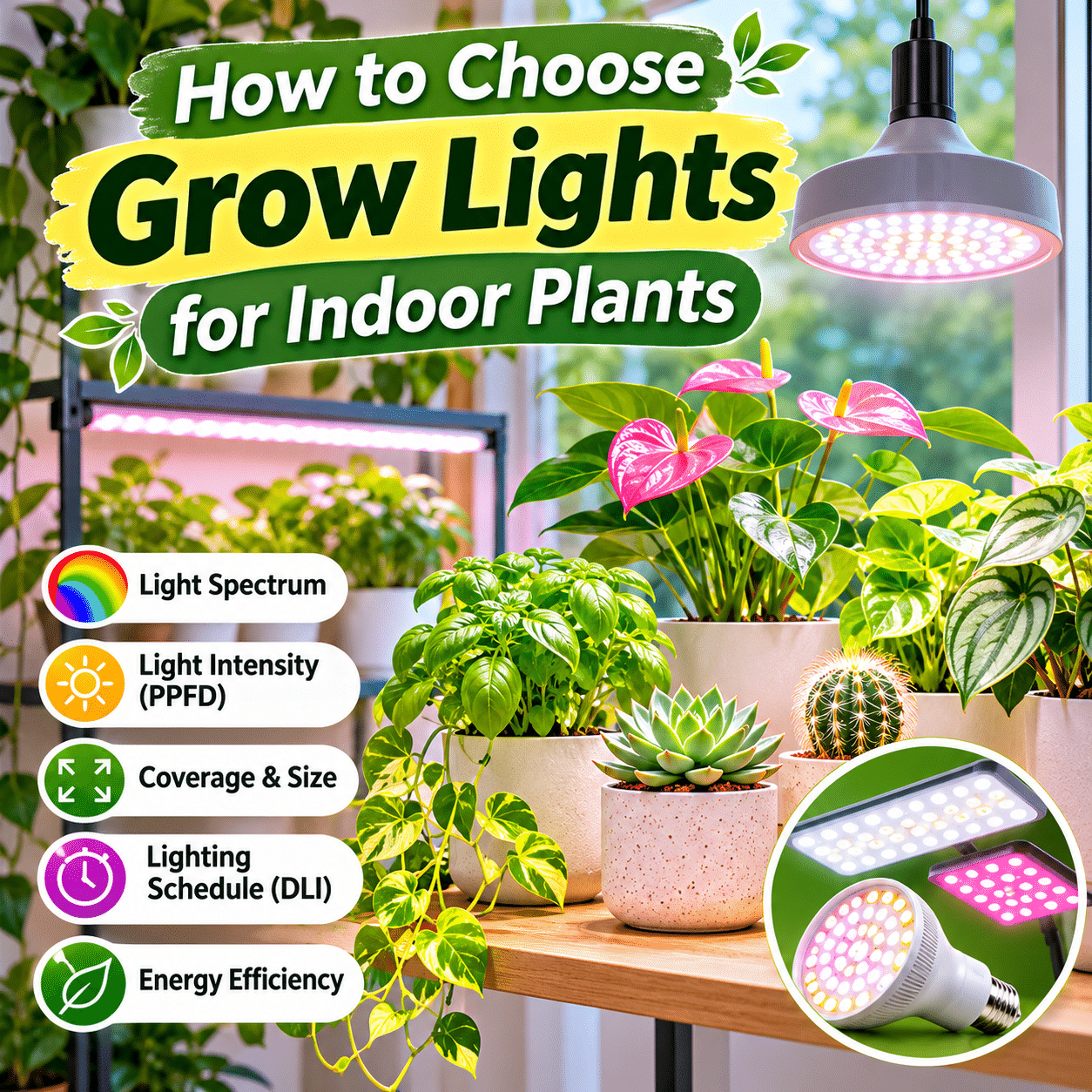
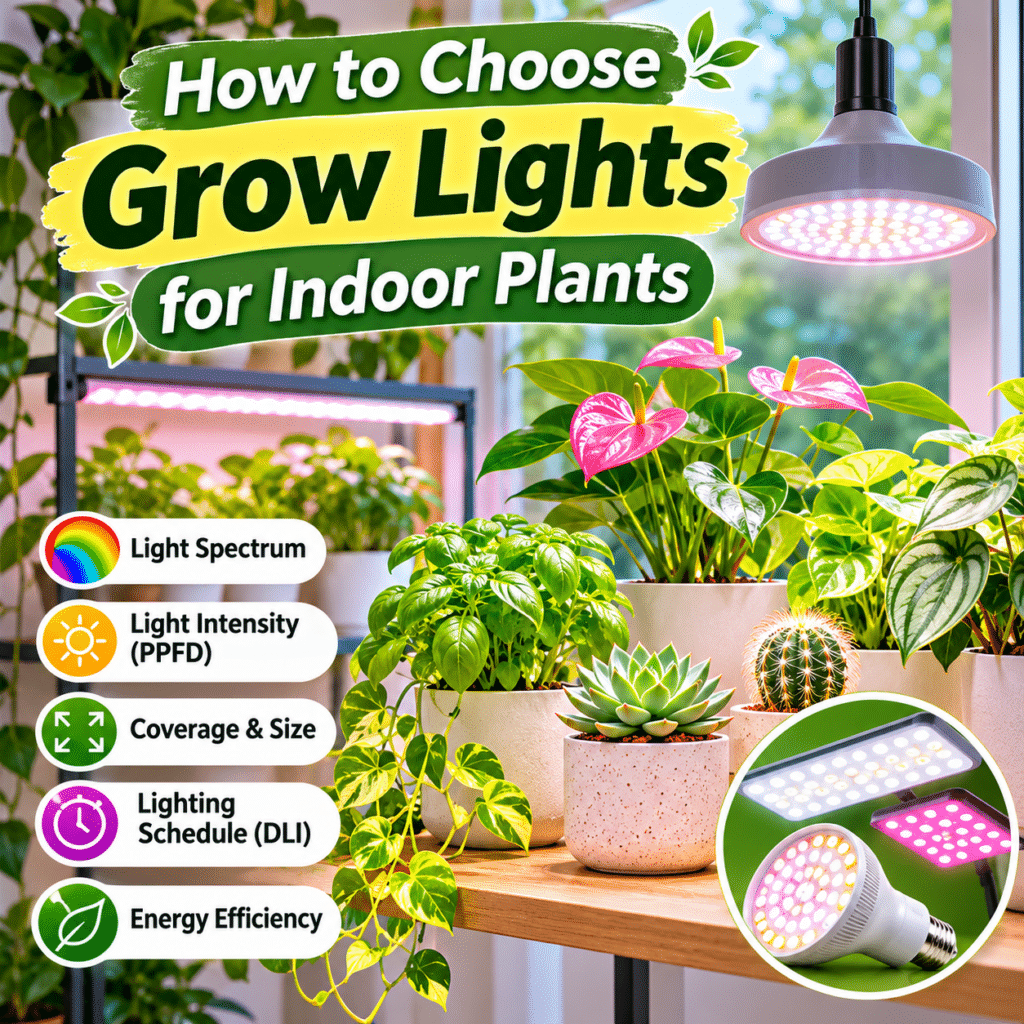
Growing plants indoors can be a rewarding way to bring greenery into your home, but natural sunlight is not always available in the right amount. Rooms with small windows, shaded apartments, short winter days, and indoor growing areas can make it difficult for plants to receive enough light for healthy growth.
Grow lights offer a practical way to supplement natural daylight or provide artificial illumination where sunlight is limited. However, choosing the right grow light involves more than finding a bright bulb. Different plants have different light requirements, and factors such as light intensity, spectrum, coverage, energy efficiency, and placement all influence how effectively a grow light supports plant growth.
This guide explains the main types of indoor grow lights, the features worth considering, and how to select a lighting setup that suits your plants, growing space, and everyday routine.
1. Understanding Why Indoor Plants Need Grow Lights
Light is essential for photosynthesis, the process through which plants use light energy to convert carbon dioxide and water into sugars that support growth.
When plants receive insufficient usable light, they may struggle to produce enough energy to maintain healthy development.
Common signs of inadequate lighting include:
- Slow or noticeably reduced growth.
- Long, weak stems with widely spaced leaves.
- Leaves leaning or stretching toward windows.
- Smaller new leaves.
- Reduced flowering in plants that normally bloom.
- Loss of compact growth habits.
- Gradual decline in plants kept in consistently dark conditions.
These symptoms can also result from watering problems, temperature stress, nutrient deficiencies, or other environmental factors. It is important to consider the plant’s overall growing conditions before assuming that additional light is the solution.
Natural Light Versus Artificial Grow Lights
Natural sunlight provides a broad spectrum of light that supports many aspects of plant development. However, the amount reaching indoor plants varies depending on window orientation, season, surrounding buildings, weather, and distance from the window.
Grow lights provide a more controllable source of illumination.
They can be useful for:
- Supplementing daylight during darker seasons.
- Growing plants in rooms with limited windows.
- Supporting seedlings and young plants.
- Maintaining indoor herb gardens.
- Growing plants on shelves or plant stands.
- Providing consistent lighting in dedicated growing areas.
A grow light does not automatically replace every benefit of a suitable natural growing environment. Temperature, humidity, airflow, watering, and plant nutrition remain important.
2. Understand the Different Types of Grow Lights
Several lighting technologies are used for indoor plant cultivation. Each has advantages and limitations.
LED Grow Lights
Light-emitting diode (LED) grow lights are widely used for indoor houseplants, seedlings, herbs, and compact growing systems.
Advantages:
- Generally energy-efficient.
- Available in many sizes and configurations.
- Can provide plant-appropriate light spectra.
- Often have long operating lifespans.
- Suitable for compact indoor installations.
- Available in adjustable and dimmable designs.
Limitations:
- Performance varies significantly between products.
- Some inexpensive models provide limited useful light.
- Higher-output fixtures can still generate considerable heat.
- Manufacturer specifications may not always be easy to compare.
LED grow lights are often a practical starting point for household indoor gardening because they offer flexibility without requiring large lighting installations.
Fluorescent Grow Lights
Fluorescent lighting has traditionally been used for seedlings, propagation, and indoor plant cultivation.
Common configurations include tubular fixtures and compact fluorescent lamps.
Advantages:
- Can provide suitable light for seedlings and low-to-moderate-light plants.
- Often distribute light across a relatively broad area.
- May be useful in existing fluorescent growing setups.
Limitations:
- Generally less energy-efficient than modern, well-designed LEDs.
- Bulbs may require periodic replacement.
- Some fixtures are bulky.
- Fluorescent lamps contain mercury and require appropriate disposal.
Fluorescent lights may still be useful where suitable fixtures are already available, although LEDs are often more convenient for new installations.
High-Intensity Discharge Grow Lights
High-intensity discharge (HID) systems include metal halide and high-pressure sodium lamps.
These technologies have historically been used for high-light growing applications.
Advantages:
- Can deliver substantial light output.
- May support plants with demanding lighting requirements.
- Can illuminate larger growing areas.
Limitations:
- Produce significant heat.
- Often require additional ventilation.
- May need specialized electrical components.
- Can consume considerable electricity.
- Are generally less convenient for small living spaces.
For most casual indoor houseplant collections, HID systems are unnecessarily complex.
3. Understand Full-Spectrum Grow Lights
The term full spectrum appears frequently in grow light descriptions, but it does not have one universally standardized meaning across consumer products.
In general, full-spectrum grow lights are designed to provide a relatively broad range of wavelengths that can support plant growth.
Why Light Spectrum Matters
Plants use light across portions of the visible spectrum for photosynthesis.
Different wavelengths can also influence plant development.
Blue light
Blue wavelengths contribute to processes involved in leaf development, plant form, and responses to the growing environment.
Red light
Red wavelengths are important for photosynthesis and influence developmental processes, including flowering responses in certain plants.
Green light
Green wavelengths also contribute to photosynthesis and can penetrate deeper into plant canopies than some other wavelengths.
Far-red light
Far-red wavelengths influence plant signaling and development, including shade responses and flowering behavior in some species.
The effects of these wavelengths depend on plant species, intensity, duration, and the balance of light provided.
White Full-Spectrum LEDs
White LED grow lights are often convenient for indoor homes because they provide illumination that looks relatively natural to human eyes.
They can be especially useful for decorative houseplant displays.
Potential benefits include:
- Easier observation of natural leaf colors.
- More comfortable lighting in living spaces.
- Broad-spectrum illumination.
- Compatibility with many common indoor plants.
Red-and-Blue Grow Lights
Some fixtures use combinations of red and blue LEDs, producing a purple or pink appearance.
These lights can support plant growth when their output and spectrum are appropriate.
However, the purple appearance does not automatically mean a fixture is more effective.
For a living room, bedroom, or home office, a white grow light may be more visually comfortable.
Practical takeaway: Choose a grow light based on measured plant-useful output and suitable coverage rather than relying only on a full-spectrum label or the color of the emitted light.
4. Understand Light Intensity Before Buying
One of the most important considerations when choosing grow lights is how much usable light reaches the plant.
A lamp can appear bright to human eyes without necessarily delivering enough photosynthetically useful light to the leaves.
What Is PPFD?
Photosynthetic Photon Flux Density, or PPFD, measures the number of photons within a specified photosynthetically active wavelength range reaching a surface each second.
It is commonly expressed in:
µmol/m²/s
PPFD is useful because it describes light reaching the growing area rather than simply the electrical power consumed by a fixture.
Higher PPFD means more photons are reaching the measured surface, but more light is not always better.
Different plants have different light requirements.
What Is PPF?
Photosynthetic Photon Flux, or PPF, describes the total amount of photosynthetically active photons emitted by a light source per second.
It is usually expressed in µmol/s.
PPF can help describe a fixture’s overall output, while PPFD helps show how that output is distributed over a growing area.
Why Wattage Is Not Enough
Wattage indicates electrical power consumption, not the amount of useful light reaching your plants.
Two LED grow lights with similar wattage ratings may deliver different levels of plant-useful illumination.
Differences can result from:
- LED efficiency.
- Fixture design.
- Optical lenses and reflectors.
- Light distribution.
- Mounting height.
- Driver efficiency.
- Thermal management.
When possible, look for independently measured or clearly documented PPFD information rather than comparing products by wattage alone.
5. Match Light Intensity to Your Plants
Indoor plants vary considerably in their lighting needs.
A grow light that works well for a shade-tolerant foliage plant may be insufficient for a fruiting vegetable.
Low-Light-Tolerant Houseplants
Examples include:
- Snake plants.
- ZZ plants.
- Certain pothos varieties.
- Some philodendrons.
- Peace lilies.
These plants may tolerate lower light levels, but low-light tolerance does not mean they thrive in complete darkness.
A moderate, well-positioned grow light may help maintain healthier growth where natural daylight is inadequate.
Moderate-Light Houseplants
Examples include:
- Many monstera varieties.
- Spider plants.
- Some peperomias.
- Certain indoor ferns.
- Many common foliage plants.
These plants often benefit from consistent, indirect illumination.
A grow light should provide enough intensity for healthy growth without creating excessive exposure.
High-Light Plants
Examples include:
- Many succulents.
- Numerous cacti.
- Rosemary.
- Basil.
- Certain flowering plants.
- Indoor fruiting vegetables.
These plants may need substantially greater light intensity than shade-tolerant foliage plants.
A small decorative grow bulb may not provide sufficient output for demanding species, particularly when it is positioned far from the canopy.
A Practical Comparison
| Plant category | General lighting priority | Suitable approach |
|---|---|---|
| Low-light-tolerant foliage | Gentle, consistent illumination | Compact LED or adjustable grow bulb |
| Moderate-light houseplants | Balanced intensity and coverage | Full-spectrum LED panel or bar |
| Succulents and cacti | Relatively strong illumination | Higher-output LED with appropriate positioning |
| Seedlings | Uniform light close to growing trays | Adjustable LED bars or panels |
| Culinary herbs | Consistent moderate-to-high light | Full-spectrum LED fixture |
| Fruiting vegetables | High usable light over the canopy | Higher-output fixture designed for productive growing |
These are general categories rather than universal light prescriptions. Requirements vary by species, growth stage, and environmental conditions.
6. Consider the Daily Light Integral
Light intensity is only part of the equation.
Plants also respond to the total quantity of light received over time.
Daily Light Integral, or DLI, measures the total number of photosynthetically active photons received per square meter during a day.
It is expressed in:
mol/m²/day
DLI combines light intensity and exposure duration.
For example, a plant receiving moderate light for a longer period may accumulate a similar daily light quantity to one receiving stronger light for a shorter period.
However, these conditions are not always biologically equivalent. Plant responses can depend on intensity, photoperiod, and species-specific characteristics.
Why DLI Matters
Considering DLI can help prevent two common problems:
- Providing insufficient total light even when the lamp appears bright.
- Increasing light duration excessively to compensate for a weak fixture.
When manufacturers provide reliable PPFD measurements, these values can help estimate the light delivered over a planned schedule.
For a constant PPFD:
DLI = PPFD × lighting hours × 0.0036
For example, a constant PPFD of 200 µmol/m²/s for 12 hours provides:
200 × 12 × 0.0036 = 8.64 mol/m²/day
This calculation is an estimate and assumes that the measured PPFD remains constant throughout the lighting period.
Natural daylight should also be considered when the grow light supplements a window.
7. Choose the Right Grow Light Size and Coverage
The physical size of a grow light influences how evenly it can illuminate your plants.
A fixture that works for one small pot may not cover an entire shelf.
Single-Plant Grow Lights
Compact grow bulbs, clip-on fixtures, and small adjustable lamps can work well for individual plants.
They are useful for:
- Desk plants.
- Small decorative displays.
- Isolated plants away from windows.
- Individual pots requiring supplemental illumination.
Look for adjustable positioning and a stable mounting arrangement.
Grow Light Bars
LED light bars are often suitable for plant shelves and narrow growing spaces.
They can provide relatively even illumination across rows of plants.
Common applications include:
- Plant propagation shelves.
- Seedling trays.
- Indoor herb collections.
- Multi-level plant stands.
Grow Light Panels
Panels can illuminate broader growing areas.
They may be useful for:
- Larger indoor plant collections.
- Compact growing tents.
- Dedicated plant-growing tables.
- Groups of plants with similar light requirements.
Check the Actual Coverage Area
A manufacturer’s stated coverage area should be interpreted alongside its recommended mounting height and PPFD measurements.
Light intensity typically decreases as the fixture is moved farther from the plants, although the exact distribution depends on fixture geometry and optics.
A large advertised coverage area does not necessarily mean that every part of the area receives sufficient light for demanding plants.
Buying tip: Look for a PPFD map showing measurements across the intended growing surface, including the center and edges.
8. Consider the Distance Between the Light and the Plants
Placement has a major effect on grow light performance.
If the light is too far away, plants may receive insufficient illumination.
If it is too close, excessive intensity or heat may cause stress.
Follow Fixture-Specific Recommendations
There is no single correct mounting distance for every grow light.
Appropriate placement depends on:
- Fixture output.
- Light distribution.
- Plant species.
- Growth stage.
- Canopy size.
- Temperature near the leaves.
Start with the manufacturer’s recommended distance and adjust according to reliable measurements and plant responses.
Signs That Light May Be Too Intense
Potential symptoms include:
- Bleached or unusually pale leaf areas.
- Leaf curling or stress.
- Scorched-looking patches.
- Growth that becomes unusually compact.
- Damage concentrated on leaves closest to the fixture.
These symptoms can have other causes, including heat, watering issues, and nutrient imbalances.
Signs That Light May Be Insufficient
Potential symptoms include:
- Stretched stems.
- Weak growth.
- Increased spacing between leaves.
- Plants leaning toward the fixture.
- Reduced growth over time.
When adjusting lighting, change one factor at a time when possible.
This makes it easier to identify whether the modification is helping.
9. Look for Adjustable Brightness and Height
Flexibility is particularly valuable for indoor gardeners who grow different plants or change their setups over time.
Dimmable Grow Lights
Dimmable fixtures allow light intensity to be adjusted without necessarily moving the lamp.
This can be helpful when:
- Acclimating plants to stronger light.
- Growing plants with different requirements.
- Adjusting seasonal supplemental lighting.
- Managing seedlings at different stages.
- Reducing unnecessary energy consumption.
Check whether the dimming controls are easy to use and whether the fixture maintains stable operation at lower settings.
Adjustable Mounting Systems
Height-adjustable fixtures allow the distance between the light and plant canopy to change as plants grow.
Useful mounting options include:
- Adjustable hanging cables.
- Telescoping stands.
- Clip-on arms.
- Shelf-mounted brackets.
- Height-adjustable plant-light frames.
Choose a mounting system that remains stable and securely supports the fixture’s weight.
10. Consider the Grow Light’s Operating Schedule
Plants generally benefit from a consistent lighting schedule that provides sufficient daily light while allowing an appropriate dark period.
The ideal schedule varies by species and growing conditions.
Common Indoor Lighting Schedules
Many indoor growing setups use approximately 12–16 hours of artificial illumination daily.
However, this is a broad operational range, not a universal requirement.
Some plants need different photoperiods, particularly when flowering is influenced by day length.
Plants receiving substantial natural daylight may require fewer hours of supplemental lighting.
Why Darkness Matters
Plants continue important physiological processes during dark periods.
Some species also use day length and night length as signals for flowering and other developmental changes.
Leaving a grow light on continuously is not automatically beneficial and can interfere with the needs of certain plants.
Built-In Timers
A grow light with a timer can make daily operation more consistent.
Useful features include:
- Adjustable lighting duration.
- Automatic daily scheduling.
- Reliable on/off memory.
- Compatibility with external timers.
- Easy schedule adjustments.
Check whether the timer retains its settings after a power interruption.
For many home gardeners, a dependable timer is more useful than complicated lighting effects.
11. Evaluate Energy Efficiency and Running Costs
Grow lights may operate for many hours each day, so electricity consumption matters.
Understanding Energy Use
A simple way to estimate electricity consumption is:
Daily energy use (kWh) = Power (W) × Operating hours ÷ 1,000
For example, a fixture consuming 40 watts for 12 hours daily uses:
40 × 12 ÷ 1,000 = 0.48 kWh per day
Over 30 days:
0.48 × 30 = 14.4 kWh
Multiply this figure by your local electricity rate to estimate the operating cost.
Actual consumption may vary with dimming, driver efficiency, and other operating conditions.
Compare Efficiency, Not Just Power
A higher-wattage fixture is not necessarily a poor choice if it delivers substantially more useful light.
When reliable data is available, photosynthetic photon efficacy can help compare fixtures.
This measurement is commonly expressed in:
µmol/J
It describes the amount of photosynthetically active photon output produced per unit of electrical energy.
Higher values generally indicate greater photon-production efficiency under the stated test conditions.
However, efficiency should be considered alongside light distribution, coverage, and actual plant requirements.
12. Consider Heat Management and Ventilation
Although LEDs are generally more efficient than many older lighting technologies, they still produce heat.
High-output fixtures can become warm or hot during operation.
Why Heat Management Matters
Excessive heat may:
- Stress nearby leaves.
- Increase moisture loss.
- Raise temperatures in enclosed growing areas.
- Affect fixture performance.
- Shorten component life if heat is poorly managed.
Features Worth Looking For
Consider fixtures with:
- Adequate heat sinks.
- Suitable ventilation.
- Appropriate thermal design.
- Clear installation instructions.
- Reliable electrical components.
Avoid enclosing a fixture or blocking ventilation openings unless the manufacturer specifically permits that installation.
Passive Versus Active Cooling
Some LED grow lights use passive cooling through heat sinks.
Others use fans.
Passive cooling may be quieter and require less maintenance, while fan-assisted cooling can help manage heat in certain high-output designs.
For living spaces, operating noise may be an important consideration.
13. Choose a Grow Light That Fits Your Indoor Space
A technically capable grow light is not necessarily the best choice if it is inconvenient to install or unpleasant to use.
Living Rooms
Consider:
- White light with a comfortable appearance.
- Attractive fixture design.
- Minimal operating noise.
- Discreet mounting options.
- Suitable light control.
A compact full-spectrum LED can blend more naturally into a living room than a large industrial-style fixture.
Home Offices
Useful features include:
- Adjustable positioning.
- Low glare.
- Quiet operation.
- Compact dimensions.
- Reliable timers.
Avoid positioning an intense grow light where it shines directly into your eyes or computer screen.
Plant Shelves
For shelves, prioritize:
- Even illumination.
- Slim fixture profiles.
- Secure mounting.
- Suitable clearance.
- Manageable cable routing.
LED bars are often convenient for this application.
Dedicated Growing Areas
For larger collections, consider:
- PPFD distribution.
- Total growing area.
- Fixture efficiency.
- Ventilation requirements.
- Mounting flexibility.
- Electrical capacity.
A dedicated setup may justify a more powerful and configurable lighting system.
14. Check Electrical Safety and Build Quality
Grow lights are electrical appliances that may operate near water, soil, humidity, and plant foliage.
Safety should be a major purchasing consideration.
Electrical Construction
Look for:
- Clear electrical ratings.
- Reliable connectors.
- Appropriate power supplies.
- Secure wiring.
- Suitable strain relief.
- Well-designed housings.
Where applicable, look for credible third-party electrical safety certification appropriate to your market.
Do not assume that a generic logo or an unsupported certification claim guarantees safety.
Moisture Exposure
Indoor gardening often involves watering, misting, and humid conditions.
Check whether the fixture is rated for the environment in which it will be installed.
An IP rating can describe protection against dust and water ingress, but the rating must be interpreted correctly.
A fixture without suitable moisture protection should not be placed where it can be splashed or exposed to excessive humidity.
Installation Safety
Always:
- Follow the manufacturer’s mounting instructions.
- Keep electrical connections away from watering areas.
- Avoid overloaded outlets.
- Use suitable mounting hardware.
- Maintain required ventilation clearances.
- Inspect cords and connectors periodically.
- Disconnect power before cleaning or maintenance.
Do not use damaged electrical equipment.
Eye Comfort and Exposure
High-intensity grow lights can cause glare and visual discomfort.
Avoid staring directly into bright LEDs.
For fixtures with unusual spectral output or ultraviolet components, follow the manufacturer’s exposure and safety guidance carefully.
For ordinary household plant displays, lighting designed for safe use in occupied indoor spaces is generally more convenient.
15. Compare Different Grow Light Designs
Grow lights are available in several physical formats.
Each format suits different growing arrangements.
| Grow light design | Best suited for | Main advantages | Important limitations |
|---|---|---|---|
| Grow bulb | Individual plants | Compact, flexible, often compatible with suitable lamp fixtures | Limited coverage |
| Clip-on grow light | Desks and small plant displays | Easy positioning and installation | Stability and output vary |
| LED light bar | Shelves and seedling trays | Even coverage across narrow spaces | Requires suitable mounting |
| LED panel | Groups of plants | Broad coverage and higher-output options | May require more space |
| Freestanding grow light | Decorative indoor plants | Adjustable placement without permanent installation | Occupies floor or table space |
| High-output grow fixture | Dedicated growing areas | Greater light output for demanding plants | Higher heat, cost, and installation requirements |
The best design depends on the arrangement of your plants, not simply the fixture’s appearance.
16. How to Choose Grow Lights for Different Indoor Plants
Different growing situations benefit from different lighting approaches.
For Succulents and Cacti
Many succulents and cacti need relatively strong light to maintain compact growth.
Prioritize:
- Adequate PPFD.
- Reliable light distribution.
- Adjustable mounting distance.
- Consistent daily scheduling.
Be cautious about relying on small decorative lamps without performance data.
For Tropical Foliage Plants
Many tropical houseplants prefer moderate light conditions, although requirements vary significantly.
Consider:
- Broad-spectrum white LEDs.
- Adjustable brightness.
- Even coverage.
- Placement that avoids excessive intensity.
Group plants with similar lighting requirements when possible.
For Indoor Herbs
Culinary herbs often need consistent, relatively strong light for productive growth.
Look for:
- Sufficient usable light.
- Coverage across all growing containers.
- Adjustable mounting height.
- Reliable timers.
- Easy cleaning.
The needs of basil, mint, parsley, rosemary, and other herbs are not identical.
For Seedlings
Young seedlings can become weak and elongated when light is inadequate.
Useful features include:
- Uniform illumination.
- Adjustable fixture height.
- Suitable intensity for the crop.
- Coverage across the entire tray.
- Consistent scheduling.
Light bars and panels are often practical for propagation shelves.
For Flowering Houseplants
Flowering plants may have more specific lighting requirements than foliage plants.
Some respond strongly to day length, while others depend more on overall light availability and growing conditions.
Check the species’ requirements before choosing a lighting schedule.
17. Decide Whether You Need Supplemental or Primary Lighting
Before buying, determine whether the grow light will supplement sunlight or serve as the plant’s main light source.
Supplemental Lighting
This is useful when a plant receives some daylight but not enough for its needs.
Examples include:
- A north-facing room in the Northern Hemisphere.
- A window shaded by nearby buildings.
- Seasonal reductions in daylight.
- A plant positioned away from a bright window.
A supplemental fixture may require less output or operating time than a system providing all of the plant’s light.
Primary Artificial Lighting
Plants grown without meaningful daylight depend on artificial lighting for their photosynthetic needs.
In this situation, pay closer attention to:
- PPFD.
- DLI.
- Spectrum.
- Coverage.
- Photoperiod.
- Fixture reliability.
- Long-term energy use.
A decorative lamp that provides occasional supplemental light may be inadequate as the sole light source for a demanding plant.
18. Common Mistakes to Avoid When Buying Grow Lights
Choosing Based Only on Wattage
Wattage does not directly indicate how much useful light reaches the leaves.
Better approach: Compare credible PPFD measurements and coverage information.
Assuming Every Full-Spectrum Light Performs Equally
The full-spectrum label alone does not establish output, distribution, or quality.
Better approach: Examine measurable performance data where available.
Buying a Fixture With Insufficient Coverage
A small light may illuminate the center of a shelf while leaving plants at the edges underlit.
Better approach: Match the fixture’s measured coverage to the growing area.
Ignoring Mounting Distance
Even a capable fixture may perform poorly when positioned incorrectly.
Better approach: Follow product-specific mounting recommendations and observe plant responses.
Using the Same Lighting for Every Plant
Shade-tolerant foliage plants and high-light succulents often have very different requirements.
Better approach: Group plants according to their lighting needs.
Overlooking Heat and Electrical Safety
Poor installation can create unnecessary risks.
Better approach: Choose suitable equipment and follow safe mounting and electrical practices.
Leaving Grow Lights On Continuously
More operating hours do not always produce healthier plants.
Better approach: Use an appropriate schedule that considers total daily light and the plant’s need for darkness.
Buying Too Many Features
Complex app controls and decorative lighting modes may add cost without improving plant growth.
Better approach: Prioritize light output, coverage, reliability, and ease of use.
19. Step-by-Step Guide to Choosing the Right Grow Light
A systematic approach can make the buying process easier.
Step 1: Identify Your Plants
List the plants you intend to grow and research their lighting requirements.
Pay particular attention to whether they are low-, moderate-, or high-light species.
Step 2: Evaluate Existing Natural Light
Observe how much daylight reaches the plants throughout the day.
Consider seasonal changes, window direction, and nearby obstructions.
Step 3: Measure Your Growing Area
Determine the width, depth, and available height of the space.
This helps identify suitable fixture sizes and mounting options.
Step 4: Decide on the Light Type
For most small indoor setups, LED grow lights offer a practical combination of efficiency and flexibility.
Choose the physical format according to your space.
Step 5: Compare Useful Light Output
Look for PPFD measurements at realistic mounting distances.
Check whether the fixture provides adequate illumination across the intended area.
Step 6: Evaluate Adjustability
Consider whether dimming, height adjustment, and timers would make the fixture easier to use.
Step 7: Check Safety and Installation Requirements
Review electrical specifications, moisture limitations, mounting instructions, and ventilation requirements.
Step 8: Estimate Operating Costs
Calculate approximate electricity consumption using the fixture’s power rating and expected daily operating hours.
Step 9: Plan the Lighting Schedule
Choose a photoperiod appropriate for the plants and account for natural daylight.
Step 10: Monitor and Adjust
After installation, observe plant growth and environmental conditions.
Make gradual adjustments based on reliable measurements and plant responses.
20. Practical Grow Light Buying Checklist
Before purchasing, use this checklist to evaluate whether a fixture fits your needs.
Plant Requirements
- I know which plants the light will support.
- I understand their general light requirements.
- I know whether the light will supplement or replace daylight.
- I have considered differences between plant growth stages.
Lighting Performance
- The fixture provides suitable usable light output.
- The stated coverage matches my growing area.
- PPFD information is available when needed.
- The spectrum is appropriate for the intended plants.
- The mounting distance is practical.
Design and Convenience
- The fixture fits the available space.
- The mounting system is secure.
- Brightness adjustment is available if needed.
- The timer meets my scheduling needs.
- The appearance and operating noise suit the room.
Safety and Durability
- Electrical ratings are clearly stated.
- The fixture is suitable for the expected environment.
- Heat management is adequate.
- The product has clear installation instructions.
- Warranty and manufacturer support are reasonable.
Long-Term Value
- Energy consumption is acceptable.
- Maintenance requirements are manageable.
- The fixture can accommodate plant growth.
- The light provides useful features rather than unnecessary extras.
- The overall cost fits my indoor gardening plans.
21. Frequently Asked Questions
Do indoor plants really need grow lights?
Not all indoor plants need artificial lighting. Many grow successfully near windows that provide suitable daylight.
Grow lights become useful when natural light is insufficient or when more consistent lighting is desired.
Are LED grow lights better than regular household bulbs?
Purpose-designed LED grow lights often provide more useful performance information, suitable light distribution, and convenient mounting options.
However, some ordinary white LED bulbs can support plant growth when they deliver sufficient usable light.
The important factors are actual light output, spectrum, coverage, and placement.
Can grow lights replace sunlight completely?
Yes, suitable artificial lighting can provide the light needed for photosynthesis without direct sunlight.
However, the setup must deliver adequate intensity, spectrum, and daily light exposure.
Plants still require appropriate watering, nutrients, temperature, and other growing conditions.
How many hours should grow lights stay on?
Many indoor growing arrangements use approximately 12–16 hours per day, but the appropriate duration depends on the species, light intensity, growth stage, and available natural daylight.
Some plants have specific photoperiod requirements.
How close should a grow light be to the plants?
There is no universal distance.
Follow the manufacturer’s recommendations for the specific fixture and use PPFD measurements when available.
Adjust the position according to plant requirements and observed responses.
Are purple grow lights better than white grow lights?
Not necessarily.
Both can support plant growth when their spectral output and intensity are suitable.
White grow lights are often more comfortable for decorative indoor spaces because they make plants appear more natural.
Can grow lights burn plant leaves?
Yes. Excessive light intensity, heat, or inappropriate placement can cause plant stress and damage.
Follow mounting recommendations and acclimate plants gradually when increasing exposure.
Do grow lights use a lot of electricity?
Electricity consumption depends on fixture wattage and daily operating time.
Efficient LEDs can provide useful illumination with relatively modest energy consumption, especially in small growing areas.
Calculate expected consumption rather than relying on general assumptions.
Can I use one grow light for several plants?
Yes, provided the fixture offers sufficient coverage and appropriate intensity for all the plants.
Grouping plants with similar light requirements makes this easier.
Do seedlings need different grow lights from mature plants?
Seedlings and mature plants may require different light intensities, coverage arrangements, and mounting heights.
An adjustable fixture can accommodate changing requirements as plants develop.
Should I choose a grow light with a timer?
A timer is useful for maintaining a consistent schedule and reducing the need for daily manual operation.
It is particularly convenient when grow lights operate for extended periods.
Are expensive grow lights always better?
No.
Higher prices may reflect greater output, efficiency, build quality, or additional features, but cost alone does not establish suitability.
A modest fixture that meets the needs of a small plant collection may provide better value than an oversized system.
Final Thoughts
Choosing the right grow lights for indoor plants begins with understanding the plants themselves.
Light intensity, daily exposure, spectrum, coverage, and mounting distance matter more than decorative features or impressive-sounding product descriptions.
For many household growing arrangements, a well-designed LED grow light provides a practical balance of energy efficiency, flexibility, and convenience. However, the ideal fixture depends on whether you are illuminating one small plant, maintaining a collection of tropical foliage, starting seedlings, or growing herbs and vegetables indoors.
Focus on measurable lighting performance where possible, choose a fixture that fits your available space, and consider electrical safety and long-term operating costs.
Most importantly, remember that successful indoor gardening involves more than light alone. Healthy plants depend on the right combination of illumination, watering, nutrients, temperature, airflow, and ongoing care.
With a thoughtfully selected grow light and a consistent growing routine, you can create a more reliable indoor environment that supports healthy plant development throughout the year.