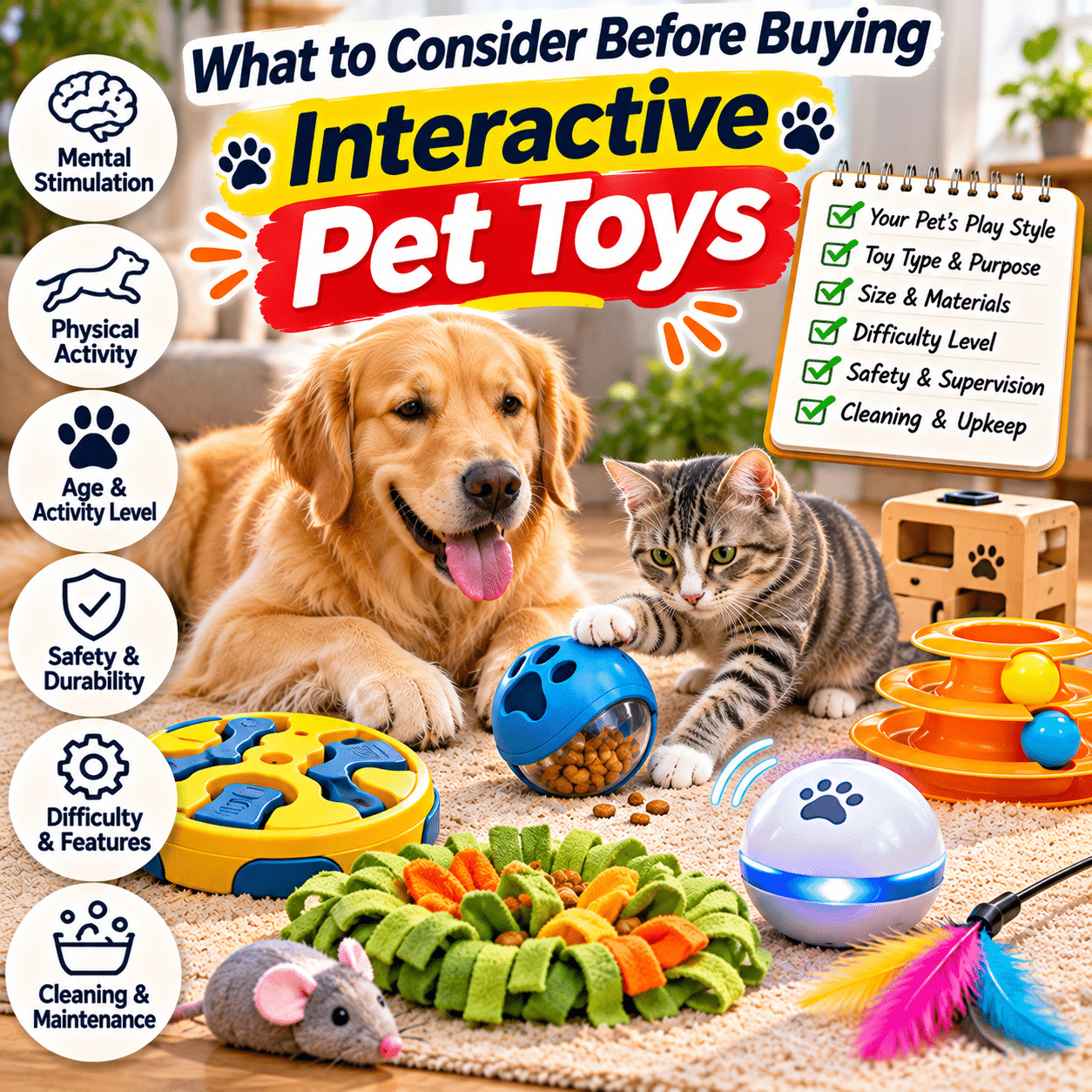
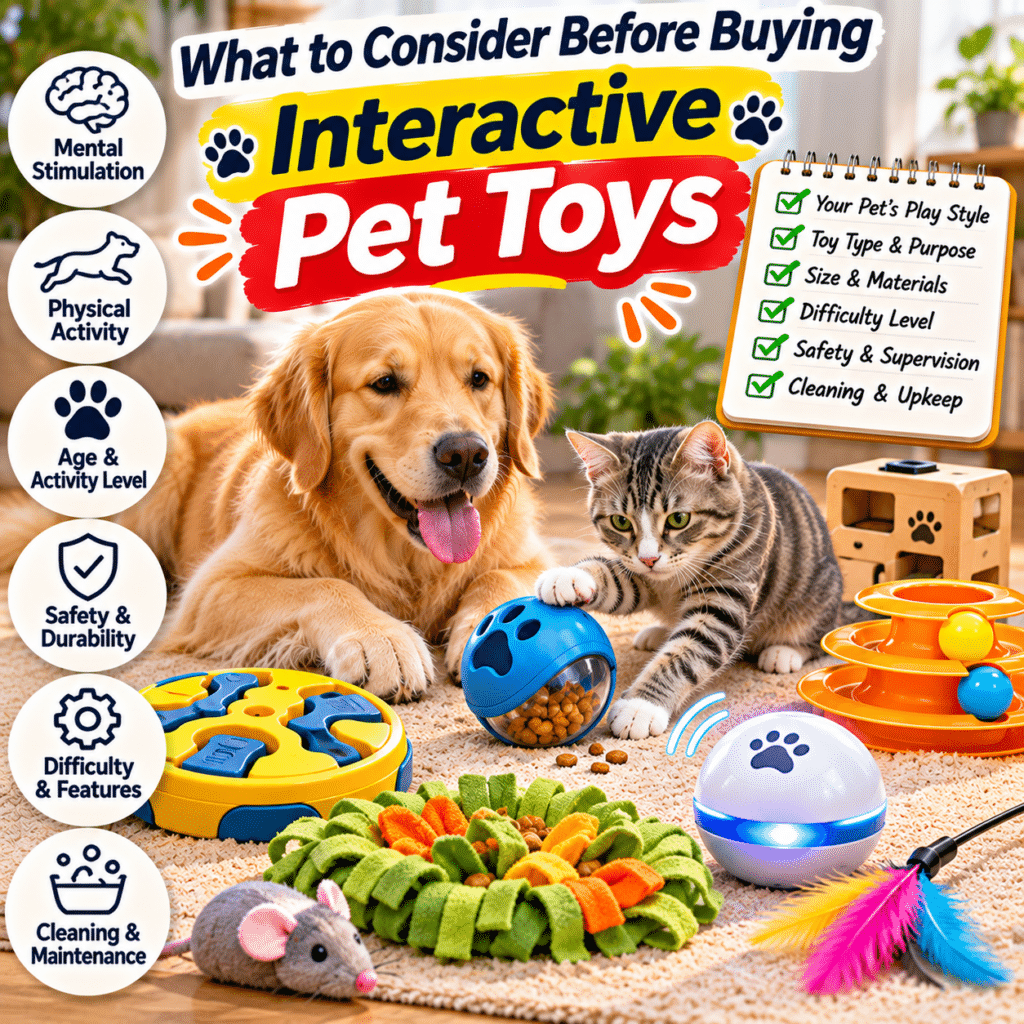
Interactive pet toys can make everyday life more engaging for dogs and cats by encouraging play, exploration, problem-solving, and natural behaviors. From treat-dispensing puzzles and rolling balls to electronic motion toys and interactive feeding games, these products offer different ways to keep pets mentally and physically active.
However, not every interactive toy is suitable for every animal. A puzzle that challenges an experienced dog may frustrate a puppy, while a fast-moving electronic toy may excite one cat but frighten another. Size, materials, durability, difficulty, noise, cleaning requirements, and supervision all influence whether a toy will be enjoyable and appropriate.
Choosing interactive pet toys is about more than finding something entertaining. The right toy should match your pet’s instincts, physical abilities, experience, and play preferences while minimizing avoidable safety risks.
This comprehensive buying guide explains what to consider before buying interactive pet toys, compares common toy categories, and provides practical advice for selecting engaging, durable, and easy-to-maintain toys for dogs and cats.
1. Understand What Interactive Pet Toys Are
Interactive pet toys are designed to encourage active participation rather than simply serving as objects for chewing or carrying.
Some require pets to solve problems, manipulate objects, or search for hidden rewards. Others respond to movement, dispense food, or create opportunities for interactive play with their owners.
Common Interactive Features
- Treat-dispensing mechanisms
- Sliding puzzle compartments
- Moving or rolling components
- Motion sensors
- Electronic movement
- Sound effects
- Hidden food compartments
- Tugging or chasing activities
- Adjustable difficulty
- Rechargeable motors
- Remote controls
- Automatic play cycles
Not every interactive toy requires batteries or electronic components.
A simple puzzle feeder or treat-searching game can provide meaningful enrichment without advanced technology.
2. Understand the Benefits of Interactive Play
Interactive toys can support several aspects of a pet’s daily routine.
Mental Engagement
Puzzle toys encourage pets to explore and discover how to obtain a reward.
Physical Activity
Moving toys may encourage walking, chasing, pawing, or other appropriate movement.
Natural Behaviors
Different toys can support behaviors such as sniffing, foraging, hunting, retrieving, and manipulating objects.
Variety
Rotating suitable toys can introduce different activities into a familiar environment.
Owner-Pet Interaction
Some interactive toys encourage shared play and positive engagement.
Important Limitation
Interactive toys are enrichment tools, not guaranteed solutions for anxiety, destructive behavior, obesity, or other health and behavioral conditions.
They work best as part of a balanced routine that includes appropriate exercise, rest, social interaction, and care.
3. Identify Your Pet’s Natural Play Preferences
Before purchasing a toy, observe how your dog or cat already plays.
Dogs May Enjoy
- Sniffing for hidden treats
- Retrieving objects
- Tugging
- Rolling toys
- Chewing appropriate materials
- Solving food puzzles
- Searching for hidden items
Cats May Enjoy
- Stalking moving objects
- Chasing
- Pouncing
- Batting small objects
- Exploring tunnels
- Searching for food
- Watching unpredictable movement
Why Observation Matters
A pet that enjoys food puzzles may have little interest in electronic toys.
A cat that loves chasing a wand may ignore a stationary puzzle board.
Choose toys based on demonstrated interests rather than assumptions about species or breed.
4. Understand the Main Types of Interactive Pet Toys
| Toy Type | Main Activity | Commonly Suitable For |
|---|---|---|
| Treat-dispensing toy | Manipulating an object to release food | Food-motivated dogs and some cats |
| Puzzle board | Moving pieces to reveal rewards | Pets interested in problem-solving |
| Snuffle mat | Searching through fabric for food | Dogs and some cats that enjoy foraging |
| Interactive ball | Rolling, pushing, or chasing | Active pets |
| Electronic moving toy | Responding to automated movement | Cats and some dogs |
| Wand toy | Chasing and pouncing during owner-led play | Cats |
| Tug toy | Interactive pulling | Dogs that enjoy tug games |
| Food puzzle feeder | Obtaining food through a challenge | Pets that benefit from feeding enrichment |
| Cat track toy | Batting balls within a track | Cats that enjoy paw-based play |
| Treat-search toy | Finding rewards in compartments or fabric | Sniffing-oriented pets |
| Remote-controlled toy | Chasing a user-controlled object | Pets comfortable with moving devices |
| Interactive plush toy | Manipulating hidden elements or responding to motion | Suitable gentle players |
Each type has different benefits, limitations, and safety considerations.
5. Choose Toys According to Species
Dogs and cats have different play patterns, physical abilities, and preferences.
Interactive Toys for Dogs
Dog toys often emphasize:
- Food puzzles
- Sniffing activities
- Retrieving
- Tugging
- Rolling objects
- Durable manipulation
Interactive Toys for Cats
Cat toys often emphasize:
- Chasing
- Stalking
- Pouncing
- Batting
- Hiding
- Foraging
Avoid Assuming Toys Are Interchangeable
A toy designed for a large dog may be too heavy for a cat.
A small cat toy may present a swallowing hazard for a dog.
Always check the intended species and size recommendations.
6. Match Toy Size to Your Pet
Toy size is one of the most important safety considerations.
Toys That Are Too Small
May be swallowed or become lodged in the mouth or throat.
Toys That Are Too Large
May be difficult to manipulate and reduce engagement.
Toys That Are Too Heavy
May be uncomfortable or unsafe for smaller animals.
What to Check
- Overall dimensions
- Weight
- Detachable parts
- Opening sizes
- Manufacturer recommendations
- Your pet’s mouth size and play behavior
A toy should be large enough to avoid foreseeable swallowing hazards while remaining manageable for the intended activity.
7. Consider Your Pet’s Age
Age influences coordination, strength, attention, and play tolerance.
Puppies
May benefit from simple puzzles, soft appropriately sized toys, and short interactive sessions.
Kittens
Often enjoy lightweight chasing toys and gentle exploratory games.
Adult Pets
May enjoy a broader range of puzzles and physical activities.
Senior Pets
May prefer slower movement, accessible puzzles, and toys that do not require excessive jumping or strenuous activity.
Individual Needs Matter
An older pet may remain highly playful, while a younger pet may prefer gentle activities.
Observe actual ability rather than relying on age alone.
8. Choose Toys for Puppies
Puppies are developing coordination and learning how to interact with their environment.
Useful Features
- Simple mechanisms
- Appropriate size
- Smooth edges
- Durable construction
- Easy cleaning
- Manageable difficulty
Avoid Excessive Complexity
A puzzle with many moving pieces may be frustrating for a beginner.
Consider Chewing Behavior
Puppies may chew toys instead of using them as intended.
Inspect toys frequently and remove damaged products that expose swallowable materials.
9. Choose Toys for Kittens
Kittens often respond enthusiastically to movement.
Suitable Options
- Lightweight rolling balls
- Wand toys used under supervision
- Simple ball tracks
- Small food puzzles designed for cats
- Gentle motion toys
Important Safety Considerations
Avoid accessible strings, ribbons, loose feathers, or small components that could be swallowed.
Store wand toys securely after play.
Keep Sessions Manageable
Short play sessions can help prevent overstimulation and fatigue.
10. Choose Toys for Senior Dogs
Senior dogs may have changes in mobility, vision, hearing, or stamina.
Useful Features
- Easy-to-reach compartments
- Low-resistance mechanisms
- Stable construction
- Moderate difficulty
- Lightweight materials
- Quiet operation
Consider Comfort
Avoid toys requiring repeated jumping, sharp turning, or strenuous movement when those activities are uncomfortable.
Veterinary Guidance
If your dog has arthritis, pain, or mobility limitations, ask a veterinarian about appropriate activities.
11. Choose Toys for Senior Cats
Older cats may still enjoy hunting-style play and food puzzles.
Suitable Options
- Slow-moving wand toys
- Easy-access treat puzzles
- Lightweight batting toys
- Stable puzzle feeders
- Gentle interactive balls
Consider Accessibility
Avoid activities requiring high jumps or difficult climbing if mobility is reduced.
Observe Interest
Some senior cats prefer shorter, quieter play sessions.
12. Understand Treat-Dispensing Toys
Treat-dispensing toys release food when pets roll, push, tilt, or manipulate them.
Potential Advantages
- Encourages exploration
- Supports food-based enrichment
- Can extend feeding time
- Provides a rewarding activity
Potential Limitations
- May not interest pets that are not food-motivated
- Some mechanisms jam
- Certain designs are difficult to clean
- Treats may scatter across the floor
What to Look For
- Appropriate dispensing openings
- Stable construction
- Easy filling
- Easy cleaning
- Suitable food compatibility
- Safe materials
13. Choose the Right Treat-Dispensing Difficulty
Difficulty should match your pet’s experience.
Beginner Toys
Release rewards after simple movement.
Intermediate Toys
Require repeated manipulation or a specific action.
Advanced Toys
May involve multiple steps or combinations of movements.
Start Simple
Allow your pet to understand the relationship between an action and a reward.
Increase Gradually
Choose more complex toys only when your pet remains engaged and successful.
The goal is enjoyable problem-solving, not maximum difficulty.
14. Understand Puzzle Boards
Puzzle boards contain compartments, sliders, rotating pieces, or removable covers.
Pets manipulate these elements to reach hidden food.
Advantages
- Encourages problem-solving
- Offers adjustable challenges in some designs
- Can support feeding enrichment
- Often suitable for indoor use
Potential Limitations
- Small components may detach
- Some pets chew puzzle pieces
- Complicated boards can be difficult to wash
- Lightweight boards may slide
Practical Buying Advice
Choose a stable puzzle with secure components and a difficulty level appropriate for your pet.
15. Compare Beginner and Advanced Puzzle Toys
| Feature | Beginner Puzzle | Advanced Puzzle |
|---|---|---|
| Mechanism | Simple movement | Multiple actions or steps |
| Learning curve | Usually shorter | Often longer |
| Reward access | Relatively easy | More challenging |
| Suitable users | First-time puzzle players | Experienced puzzle players |
| Frustration risk | Usually lower | May be higher |
| Supervision | Still necessary | Particularly important |
A more difficult puzzle is not automatically more beneficial.
A pet that enjoys completing a simple challenge may gain more from it than from an advanced toy that causes frustration.
16. Understand Snuffle Mats
Snuffle mats use fabric strips, folds, or pockets to hide food.
Pets search through the material using their sense of smell.
Potential Advantages
- Encourages sniffing
- Supports food-searching behavior
- Can be used indoors
- Often suitable for gentle activity
- Available in different difficulty levels
Potential Limitations
- Fabric may be chewed or swallowed
- Food residue can accumulate
- Some designs are difficult to dry
- Pets may pull apart loose sections
What to Look For
- Secure stitching
- Appropriate fabric construction
- Washable materials
- Stable base
- No easily detachable decorations
17. Choose a Snuffle Mat for Your Dog
Consider how your dog interacts with fabric.
For Gentle Foragers
A simple mat with accessible food hiding areas may be suitable.
For Experienced Searchers
A more layered design may provide additional challenge.
For Strong Chewers
Fabric-based mats may be unsuitable if the dog attempts to tear and swallow pieces.
Important Reminder
A snuffle mat is a supervised enrichment activity, not necessarily a safe unattended chew toy.
18. Can Cats Use Snuffle Mats?
Some cats enjoy searching for food in fabric-based enrichment toys.
Useful Features
- Shallow hiding spaces
- Lightweight construction
- Small accessible food portions
- Easy cleaning
Consider Cat Preferences
Cats may prefer pawing food out of compartments rather than searching through dense fabric.
Avoid Excessively Deep Folds
A mat that makes food difficult to retrieve may discourage participation.
19. Understand Interactive Rolling Balls
Interactive balls may roll freely, contain treats, or use motors to create movement.
Advantages
- Encourages chasing
- Can support physical activity
- Available in many sizes
- Some provide unpredictable movement
Potential Limitations
- May roll under furniture
- Hard surfaces can create noise
- Some pets become overstimulated
- Electronic versions require charging
What to Look For
- Suitable size
- Durable shell
- Smooth surfaces
- Appropriate movement speed
- Easy cleaning
- Secure battery compartment when applicable
20. Understand Electronic Moving Toys
Electronic toys use motors or sensors to create movement.
Common Features
- Automatic rolling
- Direction changes
- Motion activation
- Intermittent movement
- Rechargeable batteries
- Adjustable activity modes
Potential Advantages
- Provides varied movement
- May interest pets that enjoy chasing
- Can offer short periods of play variety
Potential Limitations
- Noise and vibration
- Battery limitations
- Mechanical failure
- Difficult cleaning
- Unpredictable movement near obstacles
Practical Advice
Test electronic toys in a safe, uncluttered area while supervising your pet.
21. Consider Motion-Activated Toys
Motion-activated toys respond when a pet approaches, touches, or moves near the device.
Potential Advantages
- Reacts to pet activity
- May reduce unnecessary operation
- Can provide spontaneous play opportunities
Potential Limitations
- Sensor sensitivity varies
- Unexpected activation may frighten some pets
- Sensors can malfunction
- Battery consumption depends on use
What to Check
- Activation method
- Operating duration
- Automatic shutoff
- Noise level
- Stability
- Cleaning requirements
22. Understand Automatic Cat Toys
Automatic cat toys may move feathers, strings, balls, or other attachments.
Potential Advantages
- Encourages chasing and pouncing
- Provides different movement patterns
- Can supplement owner-led play
Potential Limitations
- Loose attachments can create hazards
- Some cats become frustrated
- Motor noise may be distracting
- Moving parts can wear
Important Safety Consideration
Toys with strings, ribbons, feathers, or small detachable parts require particularly careful supervision.
Do not assume that an automatic toy is safe to leave running unattended.
23. Understand Cat Wand Toys
Wand toys allow owners to move an attached lure in ways that imitate prey.
Advantages
- Encourages shared play
- Supports stalking and chasing behaviors
- Allows adjustable speed
- Can be used in short sessions
Potential Limitations
- Strings may entangle pets
- Attachments may detach
- Some lures can be swallowed
- Requires active supervision
Safe Storage
Store wand toys where pets cannot access strings or loose attachments when playtime ends.
24. Consider Laser Toys for Cats
Laser toys create a moving point of light that some cats enjoy chasing.
Potential Advantages
- Encourages movement
- Can be used in small spaces
- Allows varied play patterns
Important Limitations
A laser point cannot be physically captured.
Some cats may become frustrated if the activity never leads to a tangible reward.
Safer Play Practices
- Never shine a laser into an animal’s or person’s eyes.
- Avoid directing light toward reflective surfaces.
- Keep movement within safe physical limits.
- Finish with an appropriate physical toy or reward the cat can actually interact with.
Laser play is not necessary for every cat.
25. Understand Interactive Tug Toys
Tug toys encourage shared pulling games, primarily with dogs.
Potential Advantages
- Supports owner-dog interaction
- Provides an active play opportunity
- Can be used for training games
- Encourages controlled engagement
Important Features
- Appropriate length
- Secure construction
- Comfortable grip
- Durable material
- No loose swallowable parts
Safety Considerations
Avoid violent jerking, twisting, or lifting the dog by the toy.
Use controlled movements appropriate for the dog’s size and physical condition.
26. Understand Interactive Plush Toys
Some plush toys include hidden compartments, removable elements, or sound-producing mechanisms.
Potential Advantages
- Soft texture
- Multiple play activities
- Suitable for some gentle players
- Can encourage searching or manipulation
Potential Limitations
- Fabric tearing
- Exposed stuffing
- Detachable squeakers
- Loose decorations
- Difficult cleaning
Practical Advice
Choose plush toys only when their construction suits your pet’s chewing and play behavior.
27. Consider Hide-and-Seek Toys
Hide-and-seek toys often contain smaller objects inside a larger container.
For example, a dog may pull soft pieces from a fabric structure.
Potential Advantages
- Encourages exploration
- Provides a multi-step activity
- Offers variety during play
Important Risks
Small removable pieces may be swallowed by larger pets.
What to Look For
- Appropriate component size
- Strong stitching
- Durable construction
- Easy cleaning
- Supervision requirements
28. Understand Interactive Feeding Toys
Interactive feeding toys turn some or all of a meal into an activity.
Common Designs
- Puzzle feeders
- Rolling kibble dispensers
- Snuffle mats
- Food-search boards
- Treat-dispensing balls
Potential Advantages
- Encourages slower food access
- Provides feeding enrichment
- Supports natural searching behaviors
Important Considerations
- Portion control
- Food compatibility
- Cleaning
- Difficulty
- Pet frustration
Feeding Safety
An interactive feeder should not prevent your pet from obtaining adequate nutrition.
29. Consider Food Portion Control
Treat-based toys can unintentionally increase daily calorie intake.
Practical Strategies
- Use part of the regular meal when appropriate.
- Measure treats before play.
- Consider the pet’s overall feeding plan.
- Avoid repeatedly refilling the toy without tracking food intake.
Important Distinction
A toy that dispenses food is not automatically a weight-management product.
Veterinary Guidance
Pets with obesity, diabetes, food allergies, or medically prescribed diets may need individualized feeding recommendations.
30. Check Food and Treat Compatibility
Not all treats work with every dispensing mechanism.
Important Factors
- Treat size
- Shape
- Moisture content
- Stickiness
- Crumbling
- Storage requirements
Dry Kibble
Often works well with rolling dispensers.
Soft Treats
May stick inside some mechanisms.
Wet Food
Requires products specifically designed for wet or spreadable foods.
Food Safety
Clean food-contact toys promptly and follow safe handling practices for perishable foods.
31. Evaluate Toy Materials
Interactive toys are made from different materials.
| Material | Potential Advantages | Important Considerations |
|---|---|---|
| Natural or synthetic rubber | Flexible, durable in suitable designs | Hardness and chewing resistance vary |
| Silicone | Flexible, easy to mold | Can tear under aggressive chewing |
| Plastic | Lightweight, supports complex mechanisms | May crack or develop sharp edges |
| Fabric | Soft, useful for searching games | Can tear or retain food residue |
| Rope | Useful for certain tug games | Loose fibers may be swallowed |
| Wood | Rigid construction | Splintering and coatings require evaluation |
| Metal | Durable components | Sharp edges, corrosion, and weight matter |
Material suitability depends on both the product’s design and your pet’s behavior.
32. Understand Food-Contact Materials
Toys designed to hold food should use materials suitable for that purpose.
What to Look For
- Clear material information
- Food-contact suitability
- Manufacturer cleaning instructions
- Smooth accessible surfaces
- Durable construction
Avoid Vague Claims
Terms such as “premium,” “natural,” or “pet-safe” do not necessarily establish comprehensive safety testing.
Check the Entire Toy
Coatings, adhesives, seals, and internal components may matter as much as the main material.
33. Evaluate Durability
Interactive toys experience different types of wear.
Common Stress Points
- Hinges
- Sliding compartments
- Seams
- Rolling mechanisms
- Electronic housings
- Treat openings
- Battery covers
- Detachable attachments
What to Look For
- Secure assembly
- Smooth edges
- Reliable moving parts
- Strong stitching
- Durable surfaces
- Clear manufacturer guidance
Important Reminder
No interactive toy should be assumed indestructible.
34. Consider Chewing Behavior
Some pets chew interactive toys instead of using them as intended.
Gentle Chewers
May tolerate a wider range of materials.
Strong Chewers
May damage plastic, fabric, silicone, or mechanical components.
Destructive Chewers
May require simpler, more robust designs or supervised alternatives.
Safety Rule
Remove toys that break, crack, splinter, or expose swallowable pieces.
A puzzle toy is not automatically suitable for chewing.
35. Understand Small-Part Hazards
Small components can present choking or ingestion risks.
Potentially Hazardous Parts
- Removable puzzle pieces
- Small balls
- Plastic caps
- Batteries
- Bells
- Squeakers
- Decorative eyes
- Loose magnets
- Detached feathers
What to Check
Inspect the toy before every use.
Important Consideration
A component that appears large enough for a cat may still be unsafe for a dog in the same household.
36. Understand String and Rope Hazards
Strings, ribbons, and loose fibers can create entanglement or ingestion hazards.
Cats are particularly vulnerable to complications from swallowing linear objects.
Important Precautions
- Supervise string-based play.
- Store wand toys after use.
- Remove frayed rope toys.
- Avoid toys with easily detached ribbons.
- Inspect fabric seams.
If Ingestion Is Suspected
Contact a veterinarian promptly.
Do not pull a visible string from your pet’s mouth or rectum.
37. Consider Battery Safety
Electronic toys may use disposable or rechargeable batteries.
Important Features
- Secure battery compartment
- Protected charging port
- Durable housing
- Appropriate electrical design
- Clear charging instructions
Major Risks
Swallowed batteries can cause serious injury.
Damaged rechargeable batteries may present additional hazards.
Practical Advice
Remove electronic toys from use if battery compartments become loose, damaged, or accessible to pets.
38. Evaluate Rechargeable Interactive Toys
Rechargeable toys can reduce the need for disposable batteries.
Advantages
- Convenient repeated charging
- No frequent battery replacement
- Suitable for some electronic designs
Potential Limitations
- Battery aging
- Charging downtime
- Limited runtime
- Charging-port damage
What to Check
- Charging method
- Battery runtime
- Charging duration
- Water resistance
- Replacement options
- Manufacturer safety instructions
39. Consider Noise and Vibration
Some interactive toys make sounds or vibrate.
Possible Reactions
- Excitement
- Curiosity
- Avoidance
- Fear
- Overstimulation
Important Buying Factors
- Operating volume
- Adjustable sound settings
- Motor vibration
- Sudden activation
- Automatic shutoff
Practical Advice
Introduce noisy toys gradually and observe your pet’s body language.
40. Understand Adjustable Movement Speed
Electronic toys may offer different movement speeds.
Slower Settings
May suit cautious pets or those with limited mobility.
Faster Settings
May interest energetic pets that enjoy chasing.
Important Considerations
- Available floor space
- Traction
- Furniture obstacles
- Pet coordination
- Risk of collisions
Avoid Excessive Speed
Fast movement is not always more engaging or safer.
41. Evaluate Automatic Shutoff Features
Some electronic toys stop after a preset operating period.
Potential Advantages
- Limits continuous operation
- Conserves battery power
- May reduce overstimulation
- Provides predictable play cycles
Important Limitation
Automatic shutoff does not make a toy automatically safe for unattended use.
Practical Advice
Continue supervising play when the toy contains moving components or potential ingestion hazards.
42. Consider Motion Sensors and Smart Features
Some toys include sensors or app-controlled functions.
Common Features
- Motion detection
- Remote activation
- Adjustable play modes
- Scheduled operation
- Activity tracking
Potential Advantages
- More customization
- Convenient controls
- Varied movement patterns
Potential Limitations
- Connectivity problems
- Software dependence
- Privacy considerations
- Greater complexity
- Higher maintenance requirements
Choose Based on Actual Value
A simple toy that your pet enjoys may be more useful than a sophisticated device with unnecessary features.
43. Consider Indoor Space Requirements
Interactive toys should suit the available environment.
Small Apartments
Compact puzzles and controlled movement toys may be practical.
Larger Rooms
Rolling and chasing toys may have more space to operate.
Homes With Stairs
Avoid using fast-moving toys near unprotected stairways.
Cluttered Spaces
Clear obstacles before active play.
Important Consideration
A toy’s movement pattern should not encourage unsafe jumping or collisions.
44. Consider Flooring Compatibility
Some electronic toys work differently on various surfaces.
Hard Floors
Rolling toys may move freely but create noise.
Carpets
Thick pile can restrict movement.
Rugs
Edges may catch wheels or moving components.
Slippery Floors
Fast chasing may cause pets to lose traction.
Practical Advice
Check manufacturer surface recommendations and observe how your pet moves during play.
45. Consider Outdoor Use
Not every interactive toy is suitable for outdoor environments.
Important Factors
- Water resistance
- Dust exposure
- Surface conditions
- Temperature
- Visibility
- Ease of cleaning
Outdoor Toys
Choose products specifically designed for the intended environment.
Electrical Safety
Do not expose indoor electronic toys to rain or wet ground unless the manufacturer explicitly permits it.
46. Understand Water Resistance
Some electronic toys advertise water resistance.
Important Distinction
Water-resistant does not necessarily mean waterproof.
What to Check
- Manufacturer specifications
- Charging-port protection
- Cleaning instructions
- Operating limitations
Avoid Submerging Electronic Toys
Unless explicitly approved by the manufacturer, do not immerse powered toys in water.
47. Evaluate Ease of Cleaning
Interactive toys often contain compartments that collect food, saliva, and debris.
Useful Features
- Removable parts
- Smooth surfaces
- Accessible openings
- Minimal narrow crevices
- Dishwasher-safe components when specified
- Clear maintenance instructions
Potential Problems
- Trapped food
- Moisture accumulation
- Difficult-to-clean mechanisms
- Hidden residue
Practical Advice
Choose toys that can be cleaned thoroughly after food-based play.
48. Consider Dishwasher Compatibility
Some non-electronic toys can be washed in a dishwasher.
Check
- Manufacturer instructions
- Temperature limits
- Detachable components
- Material compatibility
- Drying requirements
Important Safety Rule
Never place motors, batteries, charging assemblies, or electronic components in a dishwasher unless the manufacturer explicitly provides a safe method for specific removable parts.
49. Evaluate Toy Stability
Puzzle boards and treat dispensers should remain reasonably stable during use.
Useful Features
- Non-slip base
- Weighted construction
- Wide footprint
- Secure compartments
Potential Problems
- Sliding
- Tipping
- Food scattering
- Unintended movement
Practical Advice
Choose a stable design appropriate for your pet’s strength and enthusiasm.
50. Consider Portability and Storage
Some interactive toys are easier to transport and store than others.
Portable Options
- Compact puzzles
- Foldable snuffle mats
- Lightweight treat dispensers
- Small rolling toys
Larger Equipment
Electronic tracks and multi-part puzzle systems may require more storage space.
Important Features
- Manageable weight
- Secure components
- Compact design
- Easy cleaning before storage
51. Choose Toys for Small Dogs
Small dogs may enjoy interactive play but need appropriately sized equipment.
Useful Features
- Lightweight construction
- Accessible puzzle pieces
- Suitable treat openings
- Manageable resistance
- Stable base
Avoid Oversized Mechanisms
Large puzzle pieces or heavy rolling toys may be difficult for small dogs to manipulate.
52. Choose Toys for Large Dogs
Large dogs may require stronger construction and larger components.
Useful Features
- Appropriate overall size
- Durable housing
- Secure mechanisms
- Stable puzzle boards
- Larger food compartments
Important Consideration
A toy that works for a small dog may be unsafe for a large dog if components can be swallowed.
Check Chewing Behavior
Large size does not necessarily mean a dog is a destructive chewer, but greater jaw strength may affect durability.
53. Choose Toys for Highly Active Dogs
Active dogs may enjoy toys that combine movement and problem-solving.
Potential Options
- Rolling treat dispensers
- Owner-led retrieval games
- Appropriate tug toys
- Search activities
- Durable food puzzles
Balance Activity and Rest
Interactive toys should complement appropriate exercise and recovery.
Avoid Overexertion
Repeated high-impact chasing or sudden turns may be unsuitable for some dogs.
54. Choose Toys for Indoor Cats
Indoor cats may benefit from a variety of enrichment activities.
Useful Options
- Wand toys
- Ball tracks
- Food puzzles
- Treat-search games
- Safe electronic motion toys
Variety Matters
Different activities can support stalking, chasing, pouncing, and foraging.
Include Owner-Led Play
Automatic toys should supplement rather than replace interactive play with people.
55. Choose Toys for Shy or Cautious Pets
Some pets are hesitant around unfamiliar objects.
Useful Features
- Quiet operation
- Slow movement
- Simple design
- Familiar textures
- Low difficulty
Introduction Strategy
Place the toy nearby without activating it.
Allow voluntary exploration.
Avoid Forced Interaction
Do not chase or corner a frightened pet with an electronic toy.
56. Choose Toys for Pets With Limited Mobility
Pets with mobility limitations may still enjoy interactive enrichment.
Useful Options
- Stable food puzzles
- Easy-access treat compartments
- Gentle sniffing games
- Slow-moving toys
- Low-effort manipulation activities
Avoid
- High jumps
- Repeated sharp turns
- Difficult climbing
- Heavy resistance
- Excessive physical exertion
Veterinary Guidance
Seek advice about suitable activities for pets with significant pain or mobility conditions.
57. Consider Pets With Vision or Hearing Limitations
Some pets rely more heavily on certain senses.
Pets With Reduced Vision
May benefit from scent-based activities and predictable toy placement.
Pets With Reduced Hearing
May respond better to visual movement or tactile interaction.
Important Considerations
- Accessible placement
- Gentle introduction
- Stable construction
- Avoiding startling activation
Individual Adaptation
Choose activities that match your pet’s abilities rather than expecting every toy to work equally well.
58. Consider Multi-Pet Households
Interactive toys may create competition between animals.
Potential Challenges
- Resource guarding
- Food stealing
- Unequal access
- Toy conflicts
- Different play styles
Practical Solutions
- Separate play areas
- Individual puzzle toys
- Supervised sessions
- Appropriate toy sizes
- Separate feeding enrichment
Important Safety Consideration
Do not assume pets will safely share food-dispensing toys.
59. Understand Resource Guarding
Some pets become protective of food, toys, or other valued objects.
Possible Signs
- Stiff body posture
- Growling
- Blocking access
- Snapping
- Rapidly guarding or moving an object away
Practical Advice
Provide separate enrichment opportunities and avoid forcing pets to share.
Seek Professional Help
If guarding creates conflict or injury risk, consult a qualified veterinary behavior professional or appropriately credentialed trainer using humane methods.
60. Understand Play Frustration
Interactive toys should challenge pets without creating prolonged distress.
Possible Signs
- Repeated unsuccessful attempts
- Excessive barking or vocalizing
- Aggressive biting of the toy
- Abandoning the activity
- Pacing
- Agitation
What to Do
Reduce difficulty, demonstrate the activity, or choose another toy.
Important Principle
Successful engagement is more valuable than making a puzzle unnecessarily difficult.
61. Recognize Overstimulation
Some pets become excessively excited during play.
Possible Signs
- Frantic movement
- Difficulty disengaging
- Repeated collisions
- Rough biting
- Increased agitation
- Unusual vocalization
Practical Advice
Pause the activity and allow your pet to settle.
Choose slower or quieter play when necessary.
62. Consider Supervision Requirements
Interactive toys vary in how closely they should be supervised.
Toys Requiring Particular Attention
- String toys
- Feather toys
- Toys with removable components
- Electronic moving toys
- Treat puzzles with detachable pieces
- Fabric toys used by destructive chewers
Important Reminder
A product marketed for independent play is not necessarily safe for unsupervised use.
Follow Manufacturer Instructions
Supervision recommendations should be treated as important safety guidance.
63. Understand Independent Play Versus Shared Play
Some toys are designed for independent exploration.
Others are intended for owner-led interaction.
Independent Play
Examples include suitable rolling dispensers and simple food puzzles.
Shared Play
Examples include wand toys, tug toys, and interactive retrieval games.
Why Both Matter
Independent enrichment can provide variety, while shared play supports engagement and relationship-building.
Avoid Substitution
Automatic toys should not replace essential exercise, attention, or social interaction.
64. Consider Toy Rotation
Offering every toy at once may reduce novelty for some pets.
Rotation Strategy
Keep a selection of suitable toys available and periodically introduce others.
Potential Benefits
- Maintains variety
- Reduces clutter
- Encourages renewed interest
- Makes inspection easier
Important Consideration
Favorite comfort toys do not necessarily need to be removed.
Practical Advice
Rotate based on your pet’s interest rather than following a rigid schedule.
65. Understand Interactive Toy Training
Some pets need help learning how to use puzzle toys.
Step 1: Introduce the Toy
Allow your pet to inspect it.
Step 2: Make the Reward Easy to Access
Begin with a simple challenge.
Step 3: Demonstrate When Appropriate
Show how the mechanism moves without forcing your pet’s paws or mouth.
Step 4: Reward Exploration
Encourage calm investigation.
Step 5: Increase Difficulty Gradually
Adjust only when the pet is comfortable and successful.
Step 6: End Positively
Stop before the activity becomes frustrating.
66. Consider Adjustable Difficulty
Some interactive toys allow changes in challenge level.
Common Adjustments
- Treat opening size
- Sliding compartment positions
- Number of hidden rewards
- Movement speed
- Puzzle complexity
Potential Advantages
- Supports gradual learning
- Extends usefulness
- Accommodates different skill levels
Important Limitation
An adjustable toy is useful only if its mechanisms remain safe and practical.
67. Evaluate Treat Dispensing Consistency
A food-dispensing toy should release rewards in a reasonably predictable way for the intended activity.
Common Problems
- Food jams
- Openings too large
- Openings too small
- Uneven dispensing
- Difficult filling
Practical Buying Advice
Check recommended treat sizes and test the toy before relying on it for meal enrichment.
Avoid Excessive Frustration
If food repeatedly becomes trapped, the toy may be unsuitable for that food type.
68. Consider Electronic Toy Reliability
Electronic interactive toys introduce mechanical and electrical components.
Important Questions
- Does the toy operate consistently?
- Are movement modes reliable?
- Is the battery compartment secure?
- Can the toy be cleaned?
- Are replacement parts available?
- Does it shut off appropriately?
- Is manufacturer support accessible?
Practical Advice
Choose dependable basic functions over unnecessary complexity.
69. Evaluate Battery Runtime and Charging
Battery specifications affect convenience.
Important Factors
- Typical runtime
- Charging time
- Battery capacity
- Power-saving features
- Charging-port durability
- Replacement options
Avoid Relying on Capacity Alone
Actual runtime depends on motor activity, movement resistance, and operating mode.
Charging Safety
Follow manufacturer instructions and keep charging equipment away from pets that chew cables.
70. Consider Smart Toy Privacy
Some connected toys use apps, cameras, microphones, or remote controls.
Important Questions
- Does the toy require an account?
- What information does the app collect?
- Can features work without internet access?
- Are software updates provided?
- Can recordings be disabled?
- Are privacy controls understandable?
Practical Advice
Choose connected features only when they offer a meaningful benefit.
71. Understand Product Safety Claims
Interactive pet toys may be advertised as:
- Non-toxic
- BPA-free
- Food-safe
- Durable
- Chew-resistant
- Veterinarian-recommended
- Eco-friendly
Evaluate Claims Carefully
These terms may refer to different aspects of a product.
What to Look For
- Specific material information
- Clear manufacturer documentation
- Relevant testing details
- Appropriate usage instructions
- Traceable product information
Important Reminder
A safety claim does not guarantee that a toy is suitable for every pet or every type of play.
72. Evaluate Brand and Manufacturer Support
Manufacturer reliability can affect long-term ownership.
Useful Information
- Clear product specifications
- Customer support
- Replacement parts
- Warranty terms
- Cleaning instructions
- Safety warnings
- Recall information
Avoid Choosing by Brand Recognition Alone
A familiar brand does not guarantee that a particular toy suits your pet.
Practical Advice
Compare the specific product’s construction and intended use.
73. Consider Replacement Parts
Some interactive toys contain components that wear out.
Common Replacement Parts
- Batteries
- Charging cables
- Motors
- Wheels
- Puzzle inserts
- Removable lures
- Filters in specialized systems
Important Consideration
Use only manufacturer-approved replacement components where compatibility affects safety.
Long-Term Value
A toy with replaceable parts may be more practical than one that must be discarded after minor wear.
74. Compare Simple and Electronic Interactive Toys
| Feature | Non-Electronic Interactive Toy | Electronic Interactive Toy |
|---|---|---|
| Power required | No | Usually |
| Main activity | Manipulation, searching, puzzles | Movement, sensors, automation |
| Cleaning | Often simpler | May require extra care |
| Noise | Usually low | Varies |
| Maintenance | Generally limited | Batteries, motors, charging |
| Portability | Often convenient | Depends on size and power |
| Mechanical complexity | Usually lower | Usually higher |
| Best choice | Food enrichment and problem-solving | Pets interested in automated movement |
Neither category is universally better.
Choose according to your pet’s interests and your maintenance preferences.
75. Understand Interactive Pet Toy Pricing
Interactive toys are available across a broad range of price levels.
Basic Toys
May include simple puzzles, balls, and treat dispensers.
Mid-Range Toys
May offer adjustable difficulty, stronger construction, or more elaborate mechanisms.
Advanced Toys
May include electronic movement, sensors, rechargeable batteries, or app connectivity.
Important Consideration
Higher price does not automatically mean greater enrichment or safety.
A simple toy that your pet uses regularly may provide better value than an expensive device that is ignored.
76. Evaluate Long-Term Value
Consider the total ownership experience.
Important Factors
- Frequency of use
- Durability
- Cleaning requirements
- Replacement parts
- Battery life
- Pet engagement
- Storage needs
- Safety
- Adaptability
Practical Buying Advice
Prioritize toys that suit your pet’s established interests and can be maintained easily.
77. Common Mistakes to Avoid When Buying Interactive Pet Toys
Choosing by Appearance Alone
A colorful design may not match your pet’s interests.
Better approach: Consider play behavior and suitability.
Buying a Puzzle That Is Too Difficult
Excessive complexity may cause frustration.
Better approach: Start with an achievable challenge.
Ignoring Toy Size
Small parts can create ingestion hazards.
Better approach: Match dimensions to your pet.
Assuming Durable Means Indestructible
Even strong materials can break.
Better approach: Inspect toys regularly.
Ignoring Cleaning Requirements
Food residue can collect in hidden compartments.
Better approach: Choose accessible designs.
Buying Noisy Toys for Sensitive Pets
Unexpected sounds may cause fear.
Better approach: Consider quieter alternatives.
Assuming Automatic Toys Are Safe Unattended
Moving parts and detachable components can still be hazardous.
Better approach: Follow supervision instructions.
Overusing Treats
Food-based enrichment can increase calorie intake.
Better approach: Account for rewards within the daily feeding plan.
Ignoring Frustration
A pet may stop enjoying an activity that is too difficult.
Better approach: Adjust difficulty or change toys.
Buying Too Many Toys at Once
A large collection may create clutter without improving engagement.
Better approach: Start with a few different activity types.
78. How to Choose Interactive Pet Toys: Step by Step
Step 1: Observe Your Pet’s Play Style
Identify preferred activities.
Step 2: Determine the Main Purpose
Choose mental enrichment, physical activity, feeding engagement, or shared play.
Step 3: Select an Appropriate Toy Category
Compare puzzles, treat dispensers, moving toys, and owner-led games.
Step 4: Match Size and Weight
Ensure the toy suits your pet’s body and mouth size.
Step 5: Choose the Right Difficulty
Start with a manageable challenge.
Step 6: Evaluate Materials
Look for suitable construction and clear safety information.
Step 7: Inspect Components
Check for small detachable parts and potential hazards.
Step 8: Consider Noise and Movement
Choose features your pet can tolerate.
Step 9: Review Cleaning Requirements
Ensure the toy can be maintained hygienically.
Step 10: Consider Supervision
Understand when and how the toy should be used.
Step 11: Evaluate Durability
Choose construction appropriate for your pet’s play behavior.
Step 12: Compare Long-Term Value
Consider maintenance, replacement parts, and expected use.
Step 13: Introduce Gradually
Allow your pet to learn and explore.
Step 14: Observe Engagement
Keep toys that support enjoyable, safe activity.
79. Interactive Pet Toy Comparison by Pet Type
| Pet or Play Preference | Potentially Suitable Toys | Main Considerations |
|---|---|---|
| Puppy | Simple puzzle, suitable rolling toy | Size, chewing safety, easy difficulty |
| Kitten | Lightweight ball, supervised wand toy | Small-part and string safety |
| Small dog | Compact treat dispenser | Manageable size and resistance |
| Large dog | Appropriately sized durable puzzle | Construction and swallowing hazards |
| Senior dog | Stable easy-access puzzle | Low physical effort |
| Senior cat | Gentle wand play, simple food puzzle | Accessibility and comfort |
| Food-motivated dog | Treat dispenser, snuffle mat | Portion control and cleaning |
| Food-motivated cat | Puzzle feeder | Appropriate challenge |
| Active dog | Retrieval game, rolling dispenser | Safe movement and space |
| Indoor cat | Wand, track toy, suitable motion toy | Hunting-style enrichment |
| Shy pet | Quiet beginner puzzle | Gradual introduction |
| Strong chewer | Suitable robust supervised toy | Durability and ingestion risks |
| Multi-pet household | Separate individual puzzles | Preventing competition |
| Pet with limited mobility | Low-effort scent or food puzzle | Accessibility and comfort |
| Pet sensitive to noise | Non-electronic puzzle | Quiet operation |
These are general suggestions rather than universal recommendations.
80. Practical Interactive Pet Toy Buying Checklist
Pet Compatibility
- The toy is intended for my pet’s species.
- The size is appropriate.
- The weight is manageable.
- The activity matches my pet’s interests.
- The difficulty suits my pet’s experience.
- The toy fits my pet’s physical abilities.
Safety
- There are no easily swallowed components.
- Materials are suitable for the intended use.
- The toy has no sharp edges.
- Moving parts are appropriately protected.
- Strings and attachments are managed safely.
- Battery compartments are secure.
- Supervision requirements are clear.
Functionality
- The mechanism is easy to understand.
- Food dispensing works with appropriate treats.
- Movement speed is suitable.
- Noise is acceptable.
- The toy is stable during use.
- Adjustable features are useful.
Maintenance
- Cleaning is practical.
- Food-contact surfaces are accessible.
- Materials can be dried properly.
- Batteries or charging systems are manageable.
- Replacement parts are available if needed.
Long-Term Value
- The construction appears durable.
- The toy suits my home environment.
- Storage is convenient.
- Ongoing costs are reasonable.
- The toy offers an activity my pet is likely to enjoy.
81. Frequently Asked Questions
What are interactive pet toys?
Interactive pet toys encourage animals to participate in activities such as searching, solving puzzles, chasing, manipulating objects, or playing with people.
Are interactive toys good for dogs?
They can provide useful enrichment when matched to a dog’s interests, abilities, and safety needs.
Are interactive toys good for cats?
They can encourage natural behaviors such as stalking, chasing, pouncing, and foraging.
Do interactive toys help with boredom?
They may provide additional stimulation and variety, but they do not replace appropriate exercise, social interaction, and environmental enrichment.
Are puzzle toys good for puppies?
Simple, appropriately sized puzzles can be suitable for puppies when supervised.
What interactive toys are best for kittens?
Lightweight chasing toys, simple food puzzles, and supervised wand toys are common options.
What is the best interactive toy for a dog?
The best choice depends on the dog’s play preferences, size, chewing behavior, and experience.
What is the best interactive toy for an indoor cat?
Many indoor cats enjoy wand toys, ball tracks, food puzzles, and suitable moving toys.
Are treat-dispensing toys safe?
They can be appropriate when correctly sized, constructed, cleaned, and supervised.
Do puzzle toys make pets smarter?
Puzzle toys encourage problem-solving and learning, but claims about broad increases in intelligence should be treated cautiously.
How difficult should a pet puzzle be?
It should provide an achievable challenge without causing prolonged frustration.
Can dogs use cat puzzle toys?
Only when the toy’s size, construction, and manufacturer guidance make it suitable.
Small cat toys may be unsafe for dogs.
Can cats use dog puzzle toys?
Some simple food puzzles may be suitable, but size and difficulty must be appropriate.
Are electronic pet toys worth buying?
They can be useful for pets interested in moving objects, but electronic features are not essential for enrichment.
Are automatic cat toys safe?
Safety depends on the design, components, and supervision.
Toys with strings or detachable attachments require particular caution.
Can I leave interactive toys with my pet while I am away?
Only use products in ways specifically supported by their safety instructions and your knowledge of your pet’s behavior.
Many interactive toys require supervision.
Are laser toys safe for cats?
Laser devices must never be directed into the eyes.
Some cats may also become frustrated by chasing an object they cannot catch.
Are snuffle mats good for dogs?
They can encourage scent-based searching when used appropriately and supervised.
Can cats use snuffle mats?
Some cats enjoy them, especially when food is easy to locate and retrieve.
How do I choose a toy for a strong chewer?
Look for appropriate size, robust construction, and clear intended-use guidance.
Inspect frequently and remove damaged toys.
What if my pet destroys interactive toys?
Stop using damaged toys and consider simpler, more durable supervised activities.
How do I introduce a new puzzle toy?
Begin with an easy challenge, allow exploration, and gradually increase difficulty.
Why does my dog ignore a puzzle toy?
The reward may not be motivating, the difficulty may be unsuitable, or the activity may not match the dog’s interests.
Why is my cat afraid of an electronic toy?
Noise, movement, vibration, or unfamiliarity may cause fear.
Introduce gradually or choose a quieter alternative.
How often should I rotate pet toys?
Rotation frequency depends on your pet’s interest.
Introduce variety when existing toys become less engaging.
Should interactive toys replace walks?
No.
They can supplement but not replace appropriate physical exercise and other essential activities.
Can interactive toys help senior pets?
Yes, appropriately selected low-effort activities may provide enrichment.
Consider comfort and mobility.
Do interactive feeders help pets eat more slowly?
Some designs can slow food access, but effectiveness varies.
Can interactive toys help with separation anxiety?
They may provide enrichment but are not a reliable treatment for separation-related distress.
Seek professional guidance for significant anxiety.
How often should I clean treat-dispensing toys?
Clean them after food-based use according to manufacturer instructions, particularly when using moist or perishable foods.
Are rechargeable pet toys better?
Rechargeable designs can be convenient, but battery safety, durability, and runtime still matter.
Are expensive interactive toys better?
Not necessarily.
A simple, well-matched toy may provide more value than an expensive device your pet does not enjoy.
What is the most important feature of an interactive pet toy?
Suitability for your pet’s size, behavior, abilities, and interests is fundamental, alongside safe construction.
82. How to Introduce a New Interactive Toy
A gradual introduction can help your pet feel comfortable and confident.
Step 1: Choose a Calm Environment
Avoid crowded or noisy areas.
Step 2: Allow Inspection
Let your pet sniff or observe the toy.
Step 3: Begin With the Simplest Setting
Use an easy puzzle or slow movement.
Step 4: Demonstrate When Helpful
Show how a reward can be obtained.
Step 5: Encourage Voluntary Participation
Do not force interaction.
Step 6: Observe Body Language
Watch for curiosity, enjoyment, hesitation, or distress.
Step 7: Adjust Difficulty
Make the activity easier or harder based on your pet’s response.
Step 8: Keep Sessions Positive
End before frustration or fatigue develops.
83. How to Clean and Maintain Interactive Pet Toys
Regular maintenance helps preserve hygiene and functionality.
Remove Food Residue
Empty treat compartments after use.
Wash Approved Components
Follow manufacturer cleaning instructions.
Clean Moving Mechanisms
Remove accessible debris without damaging the device.
Dry Thoroughly
Prevent moisture accumulation.
Inspect for Damage
Check cracks, loose parts, worn seams, and damaged attachments.
Maintain Electronic Components
Follow charging, battery, and storage instructions.
Replace Unsafe Parts
Use compatible manufacturer-approved components when necessary.
Store Properly
Keep toys dry and secure, especially those containing strings, batteries, or detachable pieces.
84. Build a Balanced Interactive Toy Collection
A useful collection does not need to be large.
Instead, choose toys that support different activities.
One Food Puzzle
For problem-solving and feeding enrichment.
One Movement-Based Toy
For suitable chasing or rolling activities.
One Owner-Led Toy
For shared play and interaction.
One Scent-Based Activity
For searching and exploration.
One Alternative Activity
For variety based on your pet’s preferences.
Keep It Practical
Choose a small number of safe, engaging toys rather than accumulating products that are rarely used.
85. Consider Your Pet’s Changing Needs
Your pet’s ideal interactive toys may change over time.
Young Pets
Often need simple, safe learning experiences.
Adult Pets
May enjoy more complex challenges.
Senior Pets
May benefit from accessible, low-effort activities.
Changes in Health
Mobility, vision, hearing, and dental conditions may affect toy suitability.
Changes in Behavior
A previously enjoyable toy may become less interesting or uncomfortable.
Reevaluate Regularly
Review whether each toy remains safe, suitable, and engaging.
Final Thoughts
Choosing interactive pet toys involves understanding your dog or cat’s natural behaviors, play preferences, physical abilities, and safety needs.
Treat-dispensing toys and puzzle boards can provide enjoyable problem-solving opportunities, while snuffle mats encourage scent-based searching. Rolling balls, wand toys, and electronic moving toys may appeal to pets that enjoy chasing and active play.
However, more features do not automatically create a better toy. The most useful products are appropriately sized, durable enough for the intended activity, easy to clean, and matched to your pet’s experience.
Pay particular attention to small components, strings, batteries, chewing behavior, and supervision requirements. Introduce unfamiliar toys gradually, adjust difficulty when necessary, and stop activities that cause frustration or distress.
Interactive toys work best as part of a balanced daily routine that includes physical activity, rest, appropriate feeding, and meaningful interaction.
The best interactive pet toy is not the most complicated or expensive one—it is the toy that encourages your dog or cat to explore, think, move, and play in a way that is enjoyable, appropriate, and safe for their individual needs.