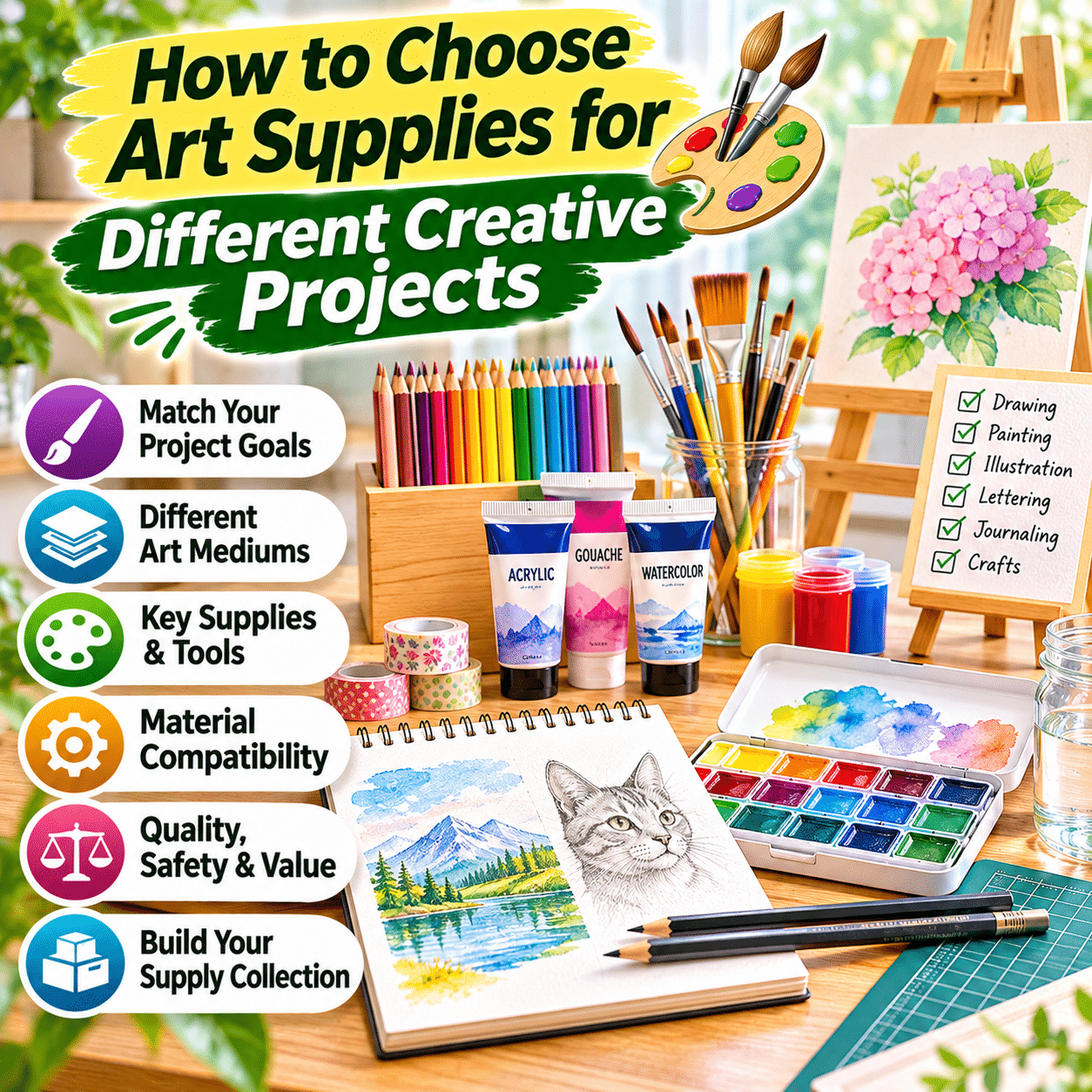
Art supplies play an important role in turning creative ideas into finished projects. Whether you enjoy sketching, painting, illustration, lettering, journaling, mixed-media art, or handmade crafts, the materials you choose can influence how comfortably you work, how your artwork develops, and how well the finished piece holds up over time.
However, choosing art supplies is not simply about purchasing the largest collection of pencils, paints, markers, or brushes. Different creative activities require different materials, surfaces, tools, and techniques. Supplies that work beautifully for watercolor painting may be unsuitable for acrylic painting, while paper designed for pencil sketches may not handle wet media effectively.
For beginners, the wide variety of art products can feel overwhelming. Even experienced artists may find it challenging to compare materials when exploring an unfamiliar medium.
The most practical approach is to begin with the creative projects you want to make, understand the properties of the materials involved, and select supplies that support your techniques without unnecessary complexity.
This guide explains how to choose art supplies for different creative projects, compares common materials and tools, and offers practical advice for building a versatile collection that balances quality, affordability, convenience, and long-term usefulness.
1. Start With the Type of Creative Project You Want to Make
Before buying art supplies, identify the kind of artwork you plan to create.
Different projects place different demands on materials.
Drawing and Sketching
Drawing projects may involve:
- Pencil sketches.
- Portrait studies.
- Architectural sketches.
- Nature drawings.
- Character illustrations.
- Gesture drawing.
- Everyday sketchbook practice.
These activities commonly use graphite pencils, charcoal, erasers, blending tools, and suitable drawing paper.
Painting
Painting projects may include:
- Watercolor landscapes.
- Acrylic paintings.
- Gouache illustrations.
- Oil paintings.
- Decorative canvas art.
- Abstract compositions.
Each painting medium requires compatible brushes, surfaces, and supporting materials.
Illustration
Illustration may combine:
- Ink.
- Colored pencils.
- Markers.
- Watercolor.
- Gouache.
- Mixed media.
The right supplies depend on the desired line quality, color application, and finished appearance.
Lettering and Calligraphy
These projects may use:
- Brush pens.
- Fineliners.
- Dip pens.
- Calligraphy nibs.
- Specialty inks.
- Smooth paper.
Journaling and Scrapbooking
Creative journals often combine drawing, writing, decorative paper, stickers, stamps, and adhesives.
Mixed-Media Art
Mixed-media projects combine multiple materials on one surface.
They may require stronger paper, suitable adhesives, and careful consideration of how different materials interact.
Buying tip: Build your art supply collection around your most frequent projects rather than buying materials for every creative technique at once.
2. Understand the Main Categories of Art Supplies
Art supplies can be divided into several functional categories.
| Category | Common examples | Main purpose |
|---|---|---|
| Drawing tools | Graphite pencils, charcoal, colored pencils | Lines, shading, and illustration |
| Painting materials | Watercolor, acrylic, gouache, oil paint | Applying color |
| Brushes and applicators | Round brushes, flat brushes, palette knives | Controlling paint application |
| Surfaces | Sketch paper, watercolor paper, canvas, boards | Supporting artwork |
| Inking tools | Fineliners, brush pens, dip pens | Outlining and lettering |
| Coloring tools | Markers, pastels, colored pencils | Color and texture |
| Cutting tools | Craft knives, scissors, cutting mats | Preparing materials |
| Adhesives | Glue sticks, craft glue, archival adhesives | Joining materials |
| Measuring tools | Rulers, compasses, templates | Accuracy and layout |
| Storage accessories | Cases, organizers, portfolios | Protection and organization |
Understanding these categories helps you decide which supplies are essential and which are optional.
3. How to Choose Graphite Pencils for Drawing
Graphite pencils are among the most versatile drawing tools.
They are suitable for beginners and experienced artists alike.
Understand Pencil Grades
Graphite pencils are commonly labeled using the H and B grading system.
- H pencils generally produce lighter marks with harder leads.
- B pencils generally produce darker marks with softer leads.
- HB pencils offer a useful balance for everyday drawing.
A higher H number generally indicates a harder grade.
A higher B number generally indicates a softer grade.
However, grading can vary slightly between manufacturers.
Which Grades Are Useful?
For general sketching, a small selection may include:
- HB for basic drawing.
- 2B for sketching and shading.
- 4B for darker values.
- 6B for expressive shading.
- 2H for lighter construction lines.
You do not need a complete pencil grading set to begin.
Consider Pencil Quality
Look for:
- Consistent graphite performance.
- Comfortable handling.
- Reasonable break resistance.
- Smooth sharpening.
- Clear grade labeling.
Mechanical Pencils
Mechanical pencils can be useful for fine lines, technical drawing, and consistent line widths.
However, traditional graphite pencils may offer greater flexibility for broad shading.
4. Choose Charcoal Supplies for Expressive Drawing
Charcoal is popular for figure drawing, portraits, and expressive artwork.
It can create deep dark values and soft tonal transitions.
Vine Charcoal
Vine charcoal is generally lightweight and easy to blend or erase.
It is useful for loose sketches and initial studies.
Compressed Charcoal
Compressed charcoal typically produces darker, more intense marks.
It can be useful for strong shadows and dramatic contrast.
Charcoal Pencils
Charcoal pencils provide greater control for detailed work.
What to Consider
Look for:
- Desired darkness.
- Ease of blending.
- Erasability.
- Compatibility with drawing paper.
- Dust and smudging characteristics.
Supporting Supplies
Useful accessories include:
- Kneaded erasers.
- Blending stumps.
- Drawing boards.
- Suitable textured paper.
- Fixative when appropriate.
Charcoal can produce airborne dust, so use sensible handling practices and avoid blowing loose particles into the air.
5. How to Choose Colored Pencils
Colored pencils are useful for illustration, coloring, botanical art, portraits, and detailed decorative work.
They differ in core composition, softness, pigment concentration, and blending characteristics.
Wax-Based Colored Pencils
Wax-based pencils are commonly used for smooth color application and layering.
Some formulations may develop a visible waxy film known as wax bloom.
Oil-Based Colored Pencils
Oil-based pencils may offer a different handling feel and layering behavior.
However, the distinction between wax-based and oil-based pencils is not always absolute because formulations can contain multiple binders.
Watercolor Pencils
Watercolor pencils contain water-soluble components that allow marks to be activated with water.
They can be used dry or combined with wet techniques.
Important Features
Consider:
- Pigment quality.
- Lightfastness.
- Core strength.
- Blendability.
- Color selection.
- Availability of individual replacement pencils.
Choose a Practical Color Range
A smaller collection of well-chosen colors can be more useful than a very large set with inconsistent performance.
For beginners, focus on a balanced range of primary colors, earth tones, neutrals, and useful accent colors.
6. Understand Watercolor Paint Options
Watercolor painting uses pigments suspended in a water-soluble binder.
It is valued for transparency, layering, and expressive color effects.
Watercolor Pans
Pans contain dried paint that is activated with water.
Advantages:
- Compact.
- Portable.
- Convenient for travel.
- Easy to organize.
- Suitable for sketchbooks.
Considerations:
- Large washes may require more preparation.
- Some colors reactivate more easily than others.
Watercolor Tubes
Tube watercolors contain moist paint.
Advantages:
- Convenient for mixing larger quantities.
- Useful for larger paintings.
- Flexible color preparation.
Considerations:
- Require suitable storage.
- Can be less convenient for compact travel setups.
Student-Grade Watercolors
Student-grade paints are often more affordable.
Pigment concentration, fillers, and color performance vary by product.
Artist-Grade Watercolors
Artist-grade paints may offer greater pigment transparency, color strength, and documented lightfastness.
However, quality varies across manufacturers and individual colors.
What to Compare
Look for:
- Pigment information.
- Transparency.
- Lightfastness.
- Color mixing behavior.
- Rewetting performance.
- Suitable packaging.
For beginners, a limited palette of reliable colors can be an excellent starting point.
7. Choose Watercolor Paper Carefully
Watercolor paper strongly influences painting results.
Ordinary printer paper or lightweight sketch paper may buckle, tear, or deteriorate when repeatedly wet.
Paper Weight
Watercolor paper is commonly available in different weights.
A frequently used option is approximately 300 gsm, which offers a useful balance between durability and handling.
Heavier papers may tolerate more water but can be more expensive.
Hot-Pressed Paper
Hot-pressed watercolor paper has a relatively smooth surface.
It is often suitable for:
- Detailed illustration.
- Fine lines.
- Controlled washes.
- Ink-and-watercolor combinations.
Cold-Pressed Paper
Cold-pressed paper generally has a moderate texture.
It is versatile for many watercolor techniques.
Rough Paper
Rough watercolor paper has a pronounced texture.
It can create expressive brush effects and visible granulation.
Cotton Versus Cellulose Paper
Cotton watercolor paper is often valued for its strength and water-handling properties.
Cellulose-based paper may be more affordable and suitable for practice.
However, performance varies by manufacturing quality.
Consider Paper Sizing
Sizing affects how water and pigment interact with the paper.
A well-sized watercolor paper can support controlled washes and lifting techniques.
8. How to Choose Acrylic Paints
Acrylic paints are popular for canvas art, decorative painting, crafts, and mixed-media projects.
They use an acrylic polymer binder and generally dry into a water-resistant film.
Heavy-Body Acrylics
Heavy-body acrylic paints have a thicker consistency.
They are useful for:
- Textured brushwork.
- Palette knife techniques.
- Impasto effects.
- Visible brush marks.
Fluid Acrylics
Fluid acrylics have a thinner consistency.
They can be useful for:
- Smooth color application.
- Fine details.
- Decorative painting.
- Certain pouring and mixed-media techniques.
Soft-Body Acrylics
Soft-body paints offer a consistency between heavy-body and very fluid formulations.
They may be useful for general painting and controlled brushwork.
Student-Grade Versus Artist-Grade
Differences may include pigment concentration, binder formulation, and color consistency.
However, a student-grade acrylic can be entirely suitable for learning and everyday crafting.
Important Buying Features
Consider:
- Color strength.
- Opacity.
- Consistency.
- Drying behavior.
- Lightfastness.
- Surface compatibility.
- Packaging.
Choose Paint for the Project
Thick acrylics may be useful for textured canvas paintings, while fluid acrylics may be more convenient for smooth decorative applications.
9. Understand Gouache Paints
Gouache is commonly used for illustration, design studies, and decorative artwork.
Traditional gouache is generally water-soluble and often produces an opaque, matte appearance.
Traditional Gouache
Traditional gouache can often be reactivated with water after drying.
It is useful for:
- Flat color illustrations.
- Graphic designs.
- Color studies.
- Detailed artwork.
Acrylic Gouache
Acrylic gouache uses an acrylic-based binder and typically dries into a more water-resistant film.
It is not interchangeable with traditional gouache in every technique.
What to Look For
Consider:
- Opacity.
- Color consistency.
- Rewetting behavior.
- Matte finish.
- Lightfastness.
- Compatibility with paper or board.
Best Surfaces
Suitable watercolor paper, mixed-media paper, or illustration board can provide a useful foundation.
The ideal surface depends on the paint formulation and application method.
10. How to Choose Oil Painting Supplies
Oil paints are valued for their blending characteristics, color depth, and generally extended working time.
However, they require different handling and maintenance practices from water-based paints.
Oil Paint Quality
Consider:
- Pigment concentration.
- Color consistency.
- Lightfastness.
- Drying characteristics.
- Binder formulation.
Suitable Surfaces
Oil paints are commonly applied to properly prepared canvas, panels, or other compatible surfaces.
Unprepared absorbent materials may be unsuitable because oil can affect the support over time.
Brushes
Both natural and synthetic brushes may be used, depending on technique and paint consistency.
Painting Mediums
Oil painting mediums can modify flow, transparency, and drying characteristics.
Use only products appropriate for the paint system and follow manufacturer guidance.
Safety Considerations
Some oil painting products and solvents require additional ventilation and careful storage.
Certain pigments may contain hazardous substances.
Review product safety information and avoid unnecessary exposure.
Beginners interested in oil painting may prefer a simple, well-documented setup rather than purchasing numerous specialty mediums immediately.
11. Choose Brushes Based on Painting Medium
Brushes differ in shape, size, stiffness, and fiber type.
A brush suitable for watercolor may not perform the same way with thick acrylic paint.
Round Brushes
Round brushes are versatile for:
- Lines.
- Details.
- Controlled strokes.
- General painting.
Flat Brushes
Flat brushes are useful for:
- Broad strokes.
- Edges.
- Blocking in color.
- Geometric shapes.
Filbert Brushes
Filbert brushes have rounded edges.
They can be useful for blending and softer brush marks.
Detail Brushes
Small detail brushes help with fine lines and precise painting.
Fan Brushes
Fan brushes can create certain textures and blending effects.
Synthetic Brushes
Synthetic fibers are widely used across different painting media.
Their performance depends on fiber design and construction.
Natural-Hair Brushes
Some natural-hair brushes are valued for particular handling characteristics, especially in traditional watercolor and oil painting.
However, quality, sourcing, cost, and care requirements vary.
What to Compare
Look for:
- Brush shape.
- Fiber flexibility.
- Point retention.
- Paint-holding capacity.
- Handle comfort.
- Ferrule security.
- Ease of cleaning.
A small collection of useful brushes is often more practical than a large set of unfamiliar shapes.
12. Consider Brush Size and Control
Brush sizes are not standardized across all manufacturers.
A size number alone may not indicate the exact dimensions.
Small Brushes
Useful for:
- Fine details.
- Lettering.
- Small illustrations.
- Controlled accents.
Medium Brushes
Suitable for:
- General painting.
- Color blocking.
- Blending.
- Everyday practice.
Large Brushes
Useful for:
- Backgrounds.
- Broad washes.
- Large canvases.
- Expressive marks.
Choose Based on Artwork Scale
Small brushes are not always better for beginners.
Using an excessively small brush for a large area can make painting slow and uneven.
Choose brush dimensions appropriate for the size of your project.
13. How to Choose Art Markers
Markers are popular for illustration, lettering, design, and decorative projects.
Different marker technologies behave differently on paper.
Alcohol-Based Markers
Alcohol-based markers are often used for smooth blending and illustration.
Advantages:
- Can produce smooth color transitions.
- Often suitable for layered coloring.
- Available in different nib styles.
Considerations:
- May bleed through thin paper.
- Require suitable ventilation and handling.
- Color lightfastness varies.
- Some formulations have noticeable odors.
Water-Based Markers
Water-based markers are commonly used for:
- Lettering.
- Journaling.
- Coloring.
- Illustration.
- Decorative crafts.
Some can be blended with water, depending on formulation.
Acrylic Paint Markers
Acrylic paint markers contain paint-like formulations.
They may work on compatible surfaces such as paper, wood, canvas, and certain prepared materials.
What to Compare
Consider:
- Ink or paint type.
- Nib design.
- Color range.
- Blendability.
- Surface compatibility.
- Refillability.
- Replacement nib availability.
14. Understand Marker Nib Types
The nib affects line width, control, and application style.
Fine Nibs
Useful for:
- Small details.
- Outlines.
- Technical illustration.
- Precise lettering.
Brush Nibs
Flexible brush nibs can produce varied line widths.
They are popular for expressive illustration and lettering.
Chisel Nibs
Chisel nibs provide broad strokes and defined edges.
They are commonly used for:
- Large color areas.
- Graphic lettering.
- Design rendering.
Bullet Nibs
Bullet nibs offer consistent rounded marks.
They can be useful for everyday drawing and coloring.
Dual-Tip Markers
Some markers combine two nib styles in one body.
This can provide versatility without requiring separate pens.
15. Choose Fineliners and Inking Pens
Fineliners are useful for precise linework.
They are commonly used in illustration, technical sketches, journaling, and mixed-media artwork.
Important Features
Look for:
- Consistent ink flow.
- Appropriate line width.
- Smudge resistance.
- Water resistance when needed.
- Suitable paper compatibility.
- Lightfastness information.
Waterproof Ink
Water-resistant or waterproof ink can be useful when combining linework with watercolor.
However, drying time and resistance vary by formulation.
Pigment-Based Ink
Pigment inks are often selected for durability and archival applications.
Still, archival performance depends on the complete ink and paper system.
Choose Practical Line Widths
A small selection of fine, medium, and broader line widths can support many illustration styles.
16. How to Choose Calligraphy and Lettering Supplies
Lettering projects may use brush pens, dip pens, markers, or traditional calligraphy tools.
Brush Pens
Brush pens are popular for modern lettering.
They use flexible tips to create varied stroke widths.
Dip Pens
Dip pens use removable nibs and bottled ink.
They offer expressive line variation but require practice and maintenance.
Fountain Pens
Some fountain pens support calligraphy through specialized nib designs.
Calligraphy Paper
Smooth paper can help reduce nib catching and ink feathering.
Important Buying Considerations
Consider:
- Nib flexibility.
- Ink compatibility.
- Paper smoothness.
- Ease of cleaning.
- Replacement nib availability.
- Intended lettering style.
For beginners, a few reliable pens and suitable practice paper may be enough.
17. Choose Sketchbooks for Everyday Creativity
A sketchbook can support regular drawing practice and creative exploration.
However, different sketchbooks are designed for different media.
Paper Weight
Lightweight paper may be suitable for graphite and some dry media.
Heavier paper may handle markers, ink, or light washes more effectively.
Paper Texture
Smooth paper is often useful for fine linework.
Textured paper may be better suited to certain pencil, charcoal, and pastel techniques.
Binding Types
Common options include:
- Spiral binding.
- Sewn binding.
- Glue binding.
- Hardcover binding.
- Softcover binding.
Spiral-Bound Sketchbooks
These can lie flat and allow pages to be turned easily.
Hardcover Sketchbooks
Hardcover designs may provide greater protection during travel.
Paper Color
White, cream, gray, and toned papers create different drawing experiences.
Toned paper can be useful for working with both highlights and shadows.
Choose for Your Medium
A sketchbook designed for dry media may not tolerate repeated watercolor washes.
Check paper specifications before buying.
18. Understand Paper Weight, Texture, and Archival Quality
Paper is not merely a background for artwork.
It influences how materials behave.
Paper Weight
Paper weight is commonly expressed in grams per square meter, or gsm.
Higher gsm generally indicates greater mass per unit area, but it does not guarantee better performance for every medium.
Smooth Paper
Often useful for:
- Technical drawing.
- Fineliners.
- Marker illustration.
- Detailed colored pencil work.
Textured Paper
Often useful for:
- Charcoal.
- Pastels.
- Expressive graphite.
- Certain painting techniques.
Acid-Free Paper
Acid-free paper is commonly selected for projects intended to last.
However, long-term preservation also depends on fiber composition, manufacturing, storage, and environmental conditions.
Archival Considerations
If artwork will be displayed or preserved, look for reliable information about paper stability and material permanence.
19. Choose Canvas and Painting Panels
Canvas and panels are common supports for acrylic and oil painting.
Stretched Canvas
Stretched canvas is fabric mounted over a wooden frame.
Advantages:
- Ready-to-use format when properly prepared.
- Suitable for display.
- Available in many sizes.
- Familiar painting surface.
Canvas Panels
Canvas panels are canvas-covered rigid boards.
Advantages:
- Compact.
- Often affordable.
- Convenient for practice.
- Easy to store.
Wooden Painting Panels
Prepared wooden panels provide a rigid surface.
They may be useful for detailed painting techniques.
Surface Preparation
Some supports are pre-primed, while others require preparation.
Check whether the surface is suitable for your chosen paint.
Choose the Right Size
Large canvases require more paint, workspace, and storage.
Beginners may find smaller or medium-sized surfaces easier to manage.
20. Consider Easels and Drawing Boards
An easel or drawing board can improve comfort and workspace organization.
Tabletop Easels
Useful for:
- Small paintings.
- Desk-based art.
- Limited spaces.
- Portable setups.
Standing Easels
Suitable for larger paintings or artists who prefer working upright.
Drawing Boards
Drawing boards provide a stable surface for paper-based projects.
What to Look For
Consider:
- Stability.
- Adjustable angle.
- Maximum artwork size.
- Portability.
- Storage requirements.
- Construction quality.
An easel is not essential for every creative activity.
For sketching and journaling, a comfortable desk may be sufficient.
21. How to Choose Erasers and Blending Tools
Erasers and blending accessories help refine drawings.
Kneaded Erasers
Kneaded erasers can lift graphite or charcoal and are useful for creating highlights.
Vinyl Erasers
Vinyl erasers can remove many graphite marks effectively.
However, aggressive rubbing may damage paper.
Precision Erasers
Small erasers are useful for detailed corrections.
Blending Stumps
Blending stumps are commonly used with graphite and charcoal.
Blending Brushes
Soft brushes may help distribute certain dry media.
What to Consider
Choose tools according to:
- Drawing medium.
- Paper texture.
- Desired precision.
- Ease of cleaning.
- Surface sensitivity.
Not every blending technique is suitable for every paper.
22. Choose Pastels for Different Artistic Effects
Pastels are available in several forms.
Soft Pastels
Soft pastels contain pigment with relatively little binder.
They are useful for expressive color application and blending.
Hard Pastels
Hard pastels are firmer and may be useful for controlled marks and preliminary drawing.
Oil Pastels
Oil pastels use an oil- or wax-based binder.
They behave differently from dry pastels and require different handling.
Pastel Pencils
Pastel pencils offer greater control for details.
Important Considerations
Look for:
- Pigment quality.
- Lightfastness.
- Texture.
- Blendability.
- Surface compatibility.
- Storage requirements.
Safety
Dry pastels can produce dust.
Avoid blowing dust from artwork and follow appropriate handling and ventilation practices.
23. Consider Mixed-Media Compatibility
Mixed-media art combines different materials in one project.
Examples include:
- Ink and watercolor.
- Acrylic and collage.
- Colored pencil and marker.
- Gouache and fineliner.
- Paper collage and paint.
- Drawing and decorative lettering.
Why Compatibility Matters
Different materials may interact in unexpected ways.
For example:
- Water may reactivate certain inks.
- Heavy paint may warp lightweight paper.
- Some adhesives may discolor over time.
- Certain markers may bleed through surfaces.
- Oil-based materials may require special preparation.
Test Materials First
Before beginning a large project, test combinations on a small sample.
Choose Stronger Surfaces
Mixed-media paper or prepared boards may be useful when combining dry and wet techniques.
However, the appropriate support depends on the materials and application methods.
24. How to Choose Adhesives for Creative Projects
Adhesives are important for collage, scrapbooking, paper crafts, and mixed-media work.
Glue Sticks
Often convenient for lightweight paper projects.
Liquid Craft Glue
Useful for various paper and decorative materials.
Drying time and compatibility vary.
Archival Adhesives
Certain adhesives are designed for long-term preservation applications.
Review manufacturer specifications rather than relying only on the word archival.
Double-Sided Tape
Useful for clean paper assembly and certain scrapbooking projects.
Specialty Adhesives
Some materials require specialized products.
Examples include adhesives formulated for fabric, wood, or other surfaces.
What to Compare
Consider:
- Material compatibility.
- Drying time.
- Bond strength.
- Flexibility.
- Visibility after drying.
- Acid content.
- Safety instructions.
Avoid using a strong adhesive simply because it is available.
Choose the product suited to the materials being joined.
25. Consider Cutting and Measuring Tools
Accurate preparation can improve the quality of creative projects.
Craft Scissors
Useful for paper, fabric, and general cutting tasks.
Different materials may require different scissors.
Craft Knives
Craft knives provide precision for detailed cutting.
Use a suitable cutting mat and follow blade safety precautions.
Cutting Mats
Self-healing cutting mats can protect work surfaces during compatible cutting activities.
Rulers
Metal rulers are often useful for straight cutting with a craft knife.
Measuring Tools
Useful options include:
- Rulers.
- Measuring tapes.
- Set squares.
- Compasses.
- Templates.
Safety Considerations
Keep sharp tools securely stored and replace damaged blades.
Children should use age-appropriate tools under suitable supervision.
26. Choose Art Supplies for Journaling and Scrapbooking
Creative journaling combines writing, drawing, decoration, and personal organization.
Useful Supplies
Depending on your style, you may need:
- A suitable journal.
- Fineliners.
- Colored pens.
- Highlighters.
- Washi tape.
- Stickers.
- Decorative paper.
- Stamps.
- Glue.
- Small scissors.
Paper Compatibility
Check whether the journal paper handles your preferred pens without excessive bleeding or feathering.
Decorative Materials
Choose decorations that suit your intended page thickness and binding.
Bulky embellishments may make some journals difficult to close.
Long-Term Preservation
If your journal is intended as a keepsake, consider lightfast inks, stable paper, and suitable adhesives.
Avoid Overbuying
A small coordinated collection can be more practical than purchasing large quantities of decorative accessories.
27. Choose Supplies for Botanical and Nature Illustration
Botanical illustration often emphasizes observation, detail, and natural forms.
Common Supplies
Useful tools may include:
- Graphite pencils.
- Fine erasers.
- Colored pencils.
- Watercolors.
- Fine brushes.
- Fineliners.
- Smooth or watercolor paper.
Precision
Fine-point tools can help capture leaf veins, petals, and small structural details.
Color Accuracy
A balanced palette with useful greens, earth tones, and floral colors can support botanical subjects.
Surface Choice
Smooth paper may be useful for detailed colored pencil work.
Watercolor paper is generally more suitable for repeated wet washes.
Portable Sketching
A compact sketchbook, pencil, and small watercolor palette can be useful for outdoor observation.
28. Choose Supplies for Portrait and Figure Drawing
Portrait and figure drawing often require tools that support tonal variation and controlled detail.
Graphite
Graphite pencils are useful for:
- Facial proportions.
- Shading.
- Hair texture.
- Structural studies.
Charcoal
Charcoal can help create expressive shadows and broad tonal shapes.
Colored Pencils
Colored pencils allow gradual color layering and fine details.
Pastels
Pastels may be useful for expressive portraits and color studies.
Paper
Choose paper that supports the intended medium and level of detail.
Supporting Tools
Useful accessories include:
- Kneaded erasers.
- Blending tools.
- Drawing boards.
- Pencil sharpeners.
- Reference holders.
For beginners, graphite and suitable drawing paper provide a practical foundation.
29. Choose Supplies for Abstract and Decorative Painting
Abstract painting allows experimentation with color, texture, and composition.
Acrylic Paints
Acrylics are popular for decorative and abstract projects because of their versatility and relatively convenient cleanup while wet.
Palette Knives
Palette knives can create textured marks and spread thicker paint.
Texture Mediums
Compatible acrylic mediums may modify paint consistency and surface texture.
Large Brushes
Large brushes can help create broad areas of color.
Painting Surfaces
Canvas, prepared panels, and suitable heavy paper may be used depending on technique.
Consider Workspace Protection
Abstract painting can involve broad gestures, splashes, and thick materials.
Use protective coverings and appropriate ventilation when necessary.
30. Consider Art Supply Quality Levels
Art supplies are often marketed as student-grade, artist-grade, or professional-grade.
These labels can be useful but are not universally standardized.
Student-Grade Supplies
Student-grade materials are often designed to balance affordability and usability.
They can be suitable for:
- Learning techniques.
- Practice.
- Sketchbook work.
- Creative experimentation.
Artist-Grade Supplies
Artist-grade products may provide:
- Greater pigment concentration.
- More consistent performance.
- Better documented lightfastness.
- Wider specialized color selections.
However, performance varies by product.
Professional-Grade Supplies
Professional-grade materials may emphasize durability, consistency, and archival performance.
They are not automatically necessary for every creative project.
Choose Based on Purpose
Practice projects do not always require premium materials.
Artwork intended for long-term display may justify greater attention to permanence and material quality.
31. Understand Lightfastness and Artwork Longevity
Lightfastness describes how well a color resists fading when exposed to light.
It is particularly important for artwork intended for display.
Why Lightfastness Matters
Some dyes and pigments may fade or change color over time.
Check Product Information
Manufacturers may provide lightfastness ratings or reference recognized testing standards.
However, rating systems vary across product categories.
Archival Quality
The term archival may refer to materials designed for long-term stability.
It does not guarantee that artwork will remain unchanged indefinitely.
Other Preservation Factors
Artwork longevity also depends on:
- Light exposure.
- Humidity.
- Temperature.
- Paper quality.
- Framing materials.
- Storage conditions.
- Interactions between materials.
Choose According to Intended Use
For casual practice, maximum permanence may not be essential.
For artwork intended as a lasting gift or display piece, lightfastness and material stability deserve greater attention.
32. Consider Safety and Material Handling
Art supplies can contain pigments, solvents, adhesives, powders, and other substances that require appropriate handling.
Read Product Labels
Follow manufacturer instructions and safety warnings.
Ventilation
Use suitable ventilation when working with products that release fumes, vapors, or airborne particles.
Avoid Inhaling Dust
Certain dry pigments, charcoal, and pastel materials can produce dust.
Avoid blowing loose particles from artwork.
Skin Contact
Some materials may cause irritation or contain substances unsuitable for prolonged skin contact.
Wash hands after working with paints, pigments, and adhesives.
Food and Drink
Keep art materials away from food preparation areas.
Do not use containers intended for art materials for drinking or food storage.
Children’s Art Supplies
Choose age-appropriate materials and supervise activities involving sharp tools, chemicals, or small components.
Product Certifications
Where relevant, look for credible safety labeling and applicable product standards.
Do not assume that every product described as non-toxic is safe for every use or exposure.
33. Consider Storage and Organization
Proper storage helps protect art supplies and keeps your workspace functional.
Pencil and Pen Storage
Use cases, organizers, or suitable containers to protect tips and prevent damage.
Paint Storage
Store paints according to manufacturer recommendations.
Protect products from inappropriate temperatures and contamination.
Brush Storage
Clean brushes after use and allow them to dry appropriately.
Avoid leaving brushes standing in water for extended periods.
Paper Storage
Keep paper flat or otherwise properly supported in a dry environment.
Protect it from excessive moisture and direct sunlight.
Finished Artwork
Use suitable folders, portfolios, or protective materials.
Small Workspace Solutions
Compact drawers, rolling carts, and modular organizers can help manage supplies without requiring a dedicated studio.
34. Build a Practical Beginner Art Supply Collection
A beginner does not need every available art material.
A small, carefully chosen collection can support many creative projects.
Basic Drawing Collection
Consider:
- HB pencil.
- 2B pencil.
- 4B pencil.
- Eraser.
- Sharpener.
- Sketchbook.
- Ruler.
Basic Watercolor Collection
Consider:
- Small watercolor palette.
- Round brushes.
- Watercolor paper.
- Mixing palette.
- Water containers.
- Absorbent cloth.
Basic Acrylic Collection
Consider:
- Limited acrylic color palette.
- Suitable brushes.
- Prepared painting surface.
- Mixing palette.
- Water container.
- Protective workspace covering.
Basic Illustration Collection
Consider:
- Fineliners.
- Graphite pencil.
- Eraser.
- Colored pencils or markers.
- Suitable illustration paper.
Basic Journaling Collection
Consider:
- Journal.
- Reliable writing pens.
- A few colored pens.
- Decorative tape.
- Small scissors.
- Adhesive.
These collections can be expanded as your interests develop.
35. Compare Art Supplies for Different Creative Projects
| Creative project | Essential supplies | Optional additions | Important consideration |
|---|---|---|---|
| Pencil sketching | Graphite pencils, eraser, sketchbook | Blending tools | Paper texture |
| Charcoal drawing | Charcoal, textured paper | Kneaded eraser, fixative | Smudging and dust |
| Colored pencil illustration | Colored pencils, suitable paper | Blending accessories | Pigment quality |
| Watercolor painting | Watercolors, brushes, watercolor paper | Masking fluid | Paper water handling |
| Acrylic painting | Acrylic paint, brushes, prepared surface | Palette knives, mediums | Paint consistency |
| Gouache illustration | Gouache, brushes, suitable paper | Fineliners | Opacity and rewetting |
| Oil painting | Oil paint, brushes, prepared support | Painting mediums | Ventilation and material safety |
| Marker illustration | Markers, compatible paper | Fineliners | Bleeding and blending |
| Calligraphy | Brush pens or nibs, smooth paper | Practice guides | Nib and ink compatibility |
| Scrapbooking | Paper, scissors, adhesive | Stamps, stickers | Material stability |
| Mixed-media art | Strong surface, compatible media | Texture materials | Layer compatibility |
| Botanical illustration | Pencils, watercolors or colored pencils | Fine brushes | Detail and color control |
36. Consider Budget and Long-Term Value
Art supplies are available across a wide range of prices.
A higher price does not automatically mean a product is the best choice for your needs.
Prioritize Frequently Used Materials
If you sketch daily, investing in comfortable pencils and reliable paper may provide more value than purchasing expensive painting accessories you rarely use.
Buy Smaller Sets First
Small sets allow you to evaluate materials before committing to larger collections.
Consider Individual Replacements
Some colored pencils, paints, and markers can be purchased individually.
This can reduce waste and allow you to replace frequently used colors.
Avoid Unnecessary Duplicates
Large bundles may include many similar colors or tools.
Consider Consumable Costs
Paint, paper, markers, and adhesives need replenishment.
Estimate how often you will use them.
Invest Where Quality Matters
For watercolor, paper quality can significantly influence the painting experience.
For drawing, suitable paper and consistent pencils may be more important than a large accessory collection.
Think Beyond Initial Price
Durability, refillability, replacement availability, and material performance all contribute to long-term value.
37. Common Mistakes to Avoid When Buying Art Supplies
Buying Large Sets Without a Clear Purpose
A large collection may contain materials you rarely use.
Better approach: Start with a focused set suited to your preferred medium.
Choosing Paper Based Only on Thickness
Paper weight does not fully describe surface performance.
Better approach: Consider texture, sizing, and intended media.
Assuming All Paints Behave the Same Way
Watercolor, acrylic, gouache, and oil paints have different properties.
Better approach: Choose compatible surfaces and tools.
Ignoring Lightfastness
Some colors may fade over time.
Better approach: Check permanence information for artwork intended for display.
Buying Too Many Brushes
A large brush collection may be unnecessary.
Better approach: Begin with a few versatile shapes and sizes.
Using the Wrong Paper for Markers
Some markers can bleed through unsuitable paper.
Better approach: Choose paper designed for the marker type.
Overlooking Material Safety
Some pigments, solvents, and adhesives require precautions.
Better approach: Follow product instructions and safety information.
Neglecting Storage
Poor storage can damage brushes, paper, and paints.
Better approach: Organize supplies according to material requirements.
Assuming Professional-Grade Supplies Are Always Necessary
Premium materials may not improve every beginner project.
Better approach: Match quality to purpose and skill development.
Buying Supplies Without Testing Compatibility
Mixed-media combinations may behave unpredictably.
Better approach: Test materials on a small sample before beginning a major project.
38. Step-by-Step Guide to Choosing Art Supplies
Step 1: Identify Your Creative Goals
Decide which projects you want to complete.
Step 2: Choose Your Main Medium
Select drawing, painting, illustration, lettering, or another creative activity.
Step 3: Identify Essential Materials
List the basic supplies needed for that medium.
Step 4: Choose a Suitable Surface
Match paper, canvas, or board to the materials you plan to use.
Step 5: Compare Material Quality
Consider consistency, durability, color performance, and ease of use.
Step 6: Evaluate Tool Comfort
Choose brushes, pencils, and pens that feel comfortable during use.
Step 7: Check Compatibility
Make sure paints, inks, papers, adhesives, and accessories work together.
Step 8: Consider Safety
Review material handling and storage requirements.
Step 9: Set a Practical Budget
Prioritize essentials and leave room for replacement supplies.
Step 10: Start Small and Expand Gradually
Add specialized tools as your techniques and interests develop.
39. Practical Art Supplies Buying Checklist
Use this checklist before purchasing.
Creative Goals
- I know which projects I want to create.
- The supplies match my preferred techniques.
- I have identified the essential materials.
- I am not buying unnecessary duplicates.
- The supplies fit my available workspace.
Material Quality
- The materials are suitable for my skill level.
- Color performance meets my needs.
- Paper or canvas is compatible with the medium.
- Lightfastness is appropriate for the intended artwork.
- Product information is clear.
Tools and Accessories
- Brushes or pens suit my techniques.
- Tool sizes are practical.
- Handles are comfortable.
- Necessary accessories are included or available.
- Replacement supplies can be purchased when needed.
Safety and Storage
- I understand the product’s safety requirements.
- Appropriate ventilation is available when needed.
- Sharp tools can be stored safely.
- Paints and inks can be stored properly.
- Finished artwork can be protected.
Long-Term Value
- The total cost fits my budget.
- I can replace frequently used materials.
- The supplies offer useful versatility.
- Quality matches the intended purpose.
- The collection can grow with my creative interests.
40. Frequently Asked Questions
What art supplies should a beginner buy first?
Beginners should start with supplies for one preferred creative activity.
For drawing, a few graphite pencils, an eraser, and a suitable sketchbook provide a practical foundation.
For painting, begin with a limited color palette, compatible brushes, and an appropriate surface.
Are expensive art supplies worth buying?
They can be worthwhile when better performance, consistency, or permanence matters.
However, affordable supplies can be excellent for learning and everyday creative practice.
What is the difference between student-grade and artist-grade materials?
Artist-grade materials may offer higher pigment concentration, more consistent performance, and better documented permanence.
However, these categories are not universally standardized.
What paper is best for drawing?
The best paper depends on the drawing medium.
Smooth paper may suit fine linework, while textured paper may be preferable for charcoal or expressive graphite.
Can I use regular paper for watercolor?
Regular paper may buckle or deteriorate under repeated wet applications.
Watercolor paper is generally better suited to watercolor techniques.
Are watercolor pans or tubes better for beginners?
Both can work well.
Pans are convenient for compact setups, while tubes may be useful for preparing larger quantities of paint.
What is the difference between acrylic and watercolor paint?
Watercolor is generally reworkable with water after drying, depending on the formulation and technique.
Acrylic paint typically dries into a more water-resistant polymer film.
They also differ in opacity, handling, and suitable surfaces.
What is the difference between gouache and acrylic gouache?
Traditional gouache is generally water-soluble after drying.
Acrylic gouache uses an acrylic binder and typically becomes more water-resistant when dry.
Which brushes should a beginner buy?
A small selection of round and flat brushes in useful sizes can support many painting techniques.
Choose brushes compatible with your paint medium.
Are synthetic brushes good for painting?
Yes.
Modern synthetic brushes can perform well across many painting media.
Their suitability depends on fiber design, stiffness, and intended use.
Are alcohol markers better than water-based markers?
Neither is universally better.
Alcohol-based markers are often chosen for smooth blending, while water-based markers may be preferred for lettering, journaling, and certain illustration techniques.
What are watercolor pencils used for?
Watercolor pencils can be used for dry drawing and activated with water to create watercolor-like effects.
What does lightfastness mean?
Lightfastness describes how well a color resists fading when exposed to light.
It is important for artwork intended for long-term display.
Do I need an easel to start painting?
No.
Many beginners can paint comfortably at a desk or table.
An easel may become useful depending on artwork size and preferred working position.
Can I combine different art materials?
Yes, but compatibility matters.
Test combinations before using them in important projects.
What supplies are best for creative journaling?
A suitable journal, reliable pens, a few coloring tools, and simple decorative accessories are often enough to begin.
How should I store art supplies?
Store materials according to manufacturer instructions.
Keep paper dry, clean brushes properly, protect delicate tools, and organize supplies to prevent damage.
Are non-toxic art supplies completely safe?
Not necessarily.
Safety depends on the product, intended use, exposure, and handling practices.
Always follow labeling and safety instructions.
How can I avoid wasting money on art supplies?
Start with a small collection, choose materials for specific projects, compare quality carefully, and expand only when new techniques require additional tools.
What is the most important factor when choosing art supplies?
Compatibility with your creative project is one of the most important considerations.
Supplies should support your chosen medium, techniques, working surface, and intended finished result.
Final Thoughts
Choosing art supplies for different creative projects begins with understanding what you want to create and how your materials work together.
Drawing, watercolor painting, acrylic painting, illustration, lettering, journaling, and mixed-media art all have different requirements. The most suitable supplies are those that support your techniques, provide reliable performance, and fit comfortably into your creative routine.
For beginners, a focused collection of essential materials is often more useful than a large assortment of unfamiliar products. A few dependable pencils, brushes, paints, pens, or papers can provide an excellent foundation for learning and experimentation.
As your skills develop, you can explore specialized materials, experiment with different surfaces, and invest in higher-quality supplies where they provide meaningful benefits.
Pay attention to material compatibility, paper characteristics, pigment quality, lightfastness, safety, storage, and ongoing costs. These factors influence both the creative process and the longevity of finished artwork.
Most importantly, remember that creativity does not depend on owning the most expensive or extensive collection of art supplies. Consistent practice, curiosity, and a willingness to experiment are often far more valuable.
With thoughtfully selected materials and a practical approach to building your collection, you can enjoy a wide variety of creative projects, develop new artistic skills, and create meaningful artwork that reflects your personal style for years to come.