A good coffee maker can turn an everyday routine into a more convenient and enjoyable experience. Whether you prefer a quick cup before work, a full pot to share with family, or a carefully prepared specialty drink, the right machine can make a meaningful difference in how you prepare and enjoy coffee at home.
However, choosing a coffee maker is not simply about selecting a popular brand or finding an appliance with the most features. Coffee makers vary significantly in brewing methods, capacity, temperature control, convenience, maintenance requirements, and the types of coffee they produce.
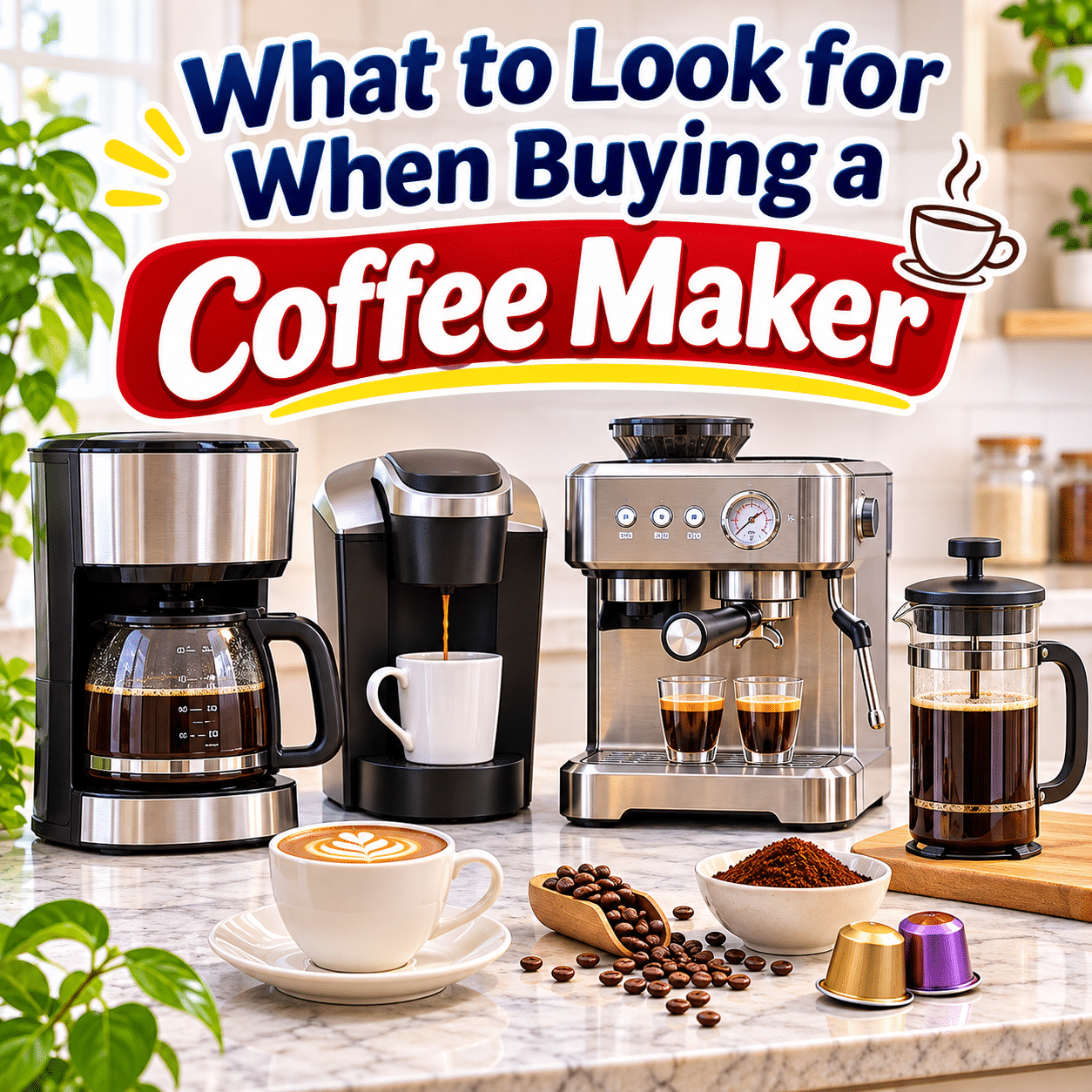
A basic drip coffee maker may be ideal for someone who enjoys several cups throughout the morning. A single-serve machine may suit a household with different schedules, while an espresso machine may appeal to people who enjoy concentrated coffee and milk-based drinks.
Understanding these differences helps you avoid unnecessary features, choose equipment that fits your kitchen, and invest in a machine that supports your daily habits.
This comprehensive buying guide explores the most important features to consider, compares common coffee maker types, explains how brewing performance affects flavor, and provides practical advice for choosing a reliable appliance that delivers long-term value.
1. Understand Your Coffee Drinking Habits Before Buying
The best place to begin is with your everyday coffee routine.
Before comparing coffee makers, consider how frequently you drink coffee, how many people will use the appliance, and what types of drinks you prefer.
How Many Cups Do You Drink Each Day?
Someone who drinks one cup in the morning may have very different needs from a household that prepares several servings throughout the day.
Consider:
- The number of coffee drinkers in your household.
- How many servings you typically prepare at once.
- Whether you drink coffee at predictable times.
- Whether different people prefer different coffee styles.
- Whether you frequently entertain guests.
A machine with a large brewing capacity may be convenient for multiple coffee drinkers but unnecessary for someone who only prepares a single cup.
What Type of Coffee Do You Enjoy?
Think about whether you prefer:
- Traditional brewed coffee.
- Espresso.
- Cappuccino.
- Latte.
- Americano.
- Cold brew.
- Iced coffee.
- Specialty coffee drinks.
Different machines are designed for different brewing methods.
A drip coffee maker cannot produce authentic espresso simply because it makes strong coffee, while an espresso machine may not be the most convenient option for preparing a large pot of traditional brewed coffee.
How Much Time Do You Want to Spend Brewing?
Some coffee makers prioritize convenience, while others allow greater control over the brewing process.
If you prefer minimal preparation, an automatic machine may be ideal.
If you enjoy adjusting grind size, coffee quantity, brewing time, and extraction, a more hands-on system may provide greater satisfaction.
2. Compare the Main Types of Coffee Makers
Understanding the major coffee maker categories is essential because each uses a different brewing process.
Drip Coffee Makers
Drip coffee makers heat water and distribute it over ground coffee held in a filter.
The brewed coffee flows into a glass or thermal carafe.
Advantages:
- Convenient for multiple servings.
- Straightforward operation.
- Widely available.
- Suitable for everyday brewed coffee.
- Often includes programmable features.
Limitations:
- Less control over individual servings.
- Some models struggle with brewing temperature consistency.
- Large batches may be unnecessary for small households.
Drip coffee makers are particularly useful for families, shared households, and people who enjoy traditional brewed coffee.
Single-Serve Coffee Makers
Single-serve machines prepare one portion at a time.
Some use prepackaged coffee pods or capsules, while others accept ground coffee.
Advantages:
- Convenient for individual servings.
- Minimal preparation.
- Quick cleanup on many models.
- Useful when household members drink coffee at different times.
Limitations:
- Pod-based systems can generate additional packaging waste.
- Beverage choices may depend on capsule compatibility.
- Cost per serving can be higher.
- Some machines offer limited brewing customization.
A single-serve coffee maker can be practical for small households or people with busy schedules.
Espresso Machines
Espresso machines force heated water through finely ground coffee under pressure.
They produce concentrated coffee that can be served alone or used as the foundation for milk-based beverages.
Advantages:
- Produces authentic espresso-style beverages.
- Supports cappuccinos, lattes, and Americanos.
- Offers greater control on certain models.
- Suitable for specialty coffee enthusiasts.
Limitations:
- Often requires more preparation.
- Cleaning can be more involved.
- Some machines require a separate grinder.
- Learning proper extraction techniques may take time.
Espresso machines are worth considering if espresso-based drinks are central to your coffee routine.
French Press Coffee Makers
A French press uses immersion brewing.
Ground coffee remains in contact with hot water before a mesh plunger separates most of the grounds from the liquid.
Advantages:
- Simple construction.
- No electricity required.
- Direct control over brewing time.
- Produces a full-bodied cup.
Limitations:
- Requires manual preparation.
- Fine sediment may remain in the cup.
- Coffee can become over-extracted if left in contact with the grounds.
- Cleaning the mesh filter requires attention.
A French press may appeal to people who enjoy a traditional, hands-on brewing process.
Pour-Over Coffee Makers
Pour-over systems allow water to pass through coffee grounds held in a filter.
Brewing usually involves manually pouring water over the coffee bed.
Advantages:
- Greater control over water distribution.
- Compact equipment.
- Relatively simple construction.
- Suitable for exploring different coffee characteristics.
Limitations:
- Requires attention during brewing.
- Results depend on pouring technique.
- A suitable kettle and grinder may improve consistency.
- Less convenient for large batches.
Pour-over equipment is often appealing to coffee drinkers who enjoy the preparation process.
Cold Brew Coffee Makers
Cold brew systems steep coffee grounds in cool or room-temperature water for an extended period.
The resulting coffee is usually filtered before serving.
Advantages:
- Convenient for preparing coffee in advance.
- Often produces a smooth flavor profile.
- Suitable for refrigerated coffee beverages.
- Requires relatively simple equipment.
Limitations:
- Long preparation time.
- Requires refrigerator or counter space during steeping.
- Brewing ratios and dilution may need adjustment.
- Proper storage and cleaning are important.
Cold brew makers are useful for people who regularly enjoy chilled coffee.
3. Compare Coffee Maker Types Side by Side
| Coffee maker type | Brewing method | Convenience | Best suited for |
|---|---|---|---|
| Drip coffee maker | Hot water passes through ground coffee | High | Multiple servings and everyday coffee |
| Single-serve machine | Individual pod or ground-coffee brewing | Very high | Quick individual cups |
| Espresso machine | Pressurized extraction | Varies | Espresso and milk-based drinks |
| French press | Full immersion | Moderate | Hands-on brewing |
| Pour-over system | Controlled gravity filtration | Moderate | Flavor exploration and manual brewing |
| Cold brew maker | Extended immersion in cool water | Moderate preparation, convenient after brewing | Chilled coffee prepared ahead |
No brewing method is universally superior.
The most suitable option depends on the beverages you enjoy and the amount of preparation you prefer.
4. Choose the Right Brewing Capacity
Capacity determines how much coffee a machine can prepare at once.
However, manufacturers do not always define a cup in the same way.
A coffee maker advertised as a 12-cup model may use a smaller serving measurement than a typical household mug.
Check Actual Volume
When comparing machines, look for capacity in milliliters, liters, or fluid ounces rather than relying entirely on cup counts.
General Capacity Considerations
| Household need | Capacity consideration | Practical priority |
|---|---|---|
| One occasional coffee drinker | Single serving | Compact design |
| One regular coffee drinker | One or several servings | Convenience and flexibility |
| Two coffee drinkers | Small to medium batch | Suitable serving volume |
| Family or shared household | Medium to large carafe | Consistent batch brewing |
| Frequent entertaining | Larger brewing capacity | Convenient serving and temperature retention |
Avoid Oversizing
A large coffee maker is not automatically better.
Some machines perform less consistently when brewing very small batches.
If you regularly prepare only one or two cups, look for a model specifically designed to handle smaller quantities.
5. Evaluate Brewing Temperature
Water temperature influences how coffee compounds dissolve during extraction.
Temperature that is too low may contribute to weak or under-extracted coffee.
Excessively high temperatures can influence extraction and may create undesirable flavors, depending on the coffee and brewing method.
For conventional hot filter coffee, brewing water temperatures around 90–96°C (195–205°F) are commonly used as a general reference.
However, ideal conditions vary with brewing method, coffee roast, grind size, and personal preference.
Why Temperature Stability Matters
A machine that maintains an appropriate brewing temperature can help produce more consistent results.
Large temperature fluctuations may affect extraction.
When comparing machines, consider whether the manufacturer provides meaningful information about brewing temperature control.
Do Not Confuse Brewing Temperature With Serving Temperature
Brewing temperature refers to the water used to extract coffee.
Serving temperature refers to the temperature of the beverage when consumed.
A machine may brew at an appropriate temperature but deliver coffee that cools quickly in the carafe.
These are separate considerations.
6. Understand Brewing Time and Extraction
Brewing time affects how long water interacts with ground coffee.
The appropriate contact time depends on the brewing method.
For example:
- Espresso uses relatively short extraction times.
- Drip brewing typically takes several minutes.
- French press brewing relies on immersion.
- Cold brew requires an extended steeping period.
Longer brewing is not automatically better.
Extraction depends on multiple factors, including:
- Grind size.
- Coffee-to-water ratio.
- Water temperature.
- Brewing time.
- Water distribution.
- Coffee characteristics.
Choose a coffee maker that supports the brewing method you prefer rather than assuming the fastest machine always produces the best results.
7. Look for Consistent Water Distribution
In drip coffee makers, water distribution affects how evenly coffee grounds become saturated.
Some machines use showerhead-style water outlets designed to spread water across the coffee bed.
Uneven distribution may leave some grounds under-extracted while others receive more water.
Features Worth Considering
- Well-designed water outlets.
- Consistent water flow.
- Suitable filter basket geometry.
- Reliable heating.
- Appropriate brewing time.
A machine with thoughtful brewing design may produce more consistent results than one with numerous decorative features.
8. Compare Glass and Thermal Carafes
Drip coffee makers commonly use glass or insulated thermal carafes.
Both have advantages.
Glass Carafes
Glass carafes are often paired with warming plates.
Advantages:
- Easy to see remaining coffee.
- Often lightweight.
- Simple appearance.
- Common in traditional drip machines.
Limitations:
- Can break if dropped.
- Coffee may continue heating on a warming plate.
- Extended heating can change flavor.
Thermal Carafes
Thermal carafes use insulated construction to slow heat loss.
Advantages:
- Keep coffee warm without continuous heating.
- Convenient for longer serving periods.
- Often durable.
- Useful for households with staggered coffee schedules.
Limitations:
- Remaining coffee may be difficult to see.
- Some designs are harder to clean.
- Heat retention varies by model.
Which Is Better?
Choose glass if visibility and simplicity are priorities.
Choose thermal insulation if you want coffee to remain warm without relying on a heating plate.
For best flavor, freshly brewed coffee is generally preferable to coffee held hot for extended periods.
9. Consider Programmable Brewing Features
Programmable coffee makers allow users to schedule brewing in advance.
This can be convenient for people with predictable morning routines.
Common features include:
- Delayed brewing.
- Automatic start.
- Automatic shutoff.
- Adjustable warming periods.
- Brewing strength selections.
- Clock and timer functions.
When Programmability Is Useful
A programmable machine may suit someone who wants coffee ready at a particular time.
However, scheduling coffee in advance may require placing ground coffee and water in the machine hours before brewing.
Coffee freshness can be affected by prolonged exposure to air, so convenience and flavor priorities should be balanced.
10. Understand Brew Strength Settings
Some coffee makers offer settings labeled regular, bold, strong, or similar terms.
These settings may adjust:
- Brewing time.
- Water flow.
- Contact time.
- Brewing cycle behavior.
However, a stronger setting does not necessarily increase the amount of coffee used.
If the coffee-to-water ratio remains unchanged, the resulting flavor may differ primarily because of extraction changes.
For greater control over strength, consider whether the machine allows easy adjustment of coffee quantity and water volume.
11. Decide Whether You Need a Built-In Grinder
Some coffee makers include integrated coffee grinders.
These machines may grind whole beans immediately before brewing.
Advantages of Built-In Grinders
- Convenient all-in-one operation.
- Fewer separate appliances.
- Fresh grinding before brewing.
- Potentially simpler daily preparation.
Limitations
- More components to maintain.
- Grinder noise.
- Additional cleaning.
- Limited grinder adjustment on some models.
- More complicated repairs.
Separate Grinder Versus Built-In Grinder
A separate grinder may provide greater flexibility, particularly when you use multiple brewing methods.
However, it requires additional countertop space and another purchase.
An integrated grinder may be a practical choice when convenience is your main priority.
12. Understand the Importance of Grind Size
Grind size affects how quickly coffee compounds dissolve during brewing.
Different brewing methods generally require different grind characteristics.
| Brewing method | Typical grind tendency | Important consideration |
|---|---|---|
| Espresso | Fine | Requires consistent particle size and suitable adjustment |
| Drip coffee | Medium | Depends on filter and machine design |
| Pour-over | Medium to medium-fine | Adjust according to brewer and flow |
| French press | Medium-coarse to coarse | Balance extraction and sediment |
| Cold brew | Often coarse | Depends on steeping method and filtration |
These are starting points rather than universal requirements.
The ideal grind depends on the equipment, coffee, and desired flavor.
Why Grinder Quality Matters
An inconsistent grind can produce a mixture of very fine and coarse particles.
This may contribute to uneven extraction.
If you plan to use whole beans regularly, grinder quality can be as important as coffee maker quality.
13. Consider Filter Type and Availability
Coffee makers use different filtration systems.
Paper Filters
Paper filters trap coffee particles and absorb some oils.
Advantages:
- Convenient disposal.
- Often produce a cleaner cup.
- Reduce sediment.
- Simple cleanup.
Limitations:
- Require ongoing replacement.
- Generate disposable waste.
- Must match the brewer’s size and shape.
Reusable Metal Filters
Reusable metal filters can be washed and used repeatedly.
Advantages:
- Reduce reliance on disposable filters.
- Allow more coffee oils into the beverage.
- Potentially lower recurring filter costs.
Limitations:
- Require regular cleaning.
- May allow more fine particles into the cup.
- Can affect flavor and texture.
Reusable Cloth Filters
Cloth filters are another option for certain manual brewing methods.
They require thorough cleaning and appropriate storage to prevent unwanted odors or contamination.
Check Filter Compatibility
Before purchasing, confirm that replacement filters are readily available.
A coffee maker that requires unusual or proprietary filters may be less convenient over time.
14. Evaluate Water Reservoir Design
The water reservoir influences daily convenience.
Look for a reservoir that is:
- Easy to fill.
- Clearly marked.
- Accessible beneath kitchen cabinets.
- Simple to clean.
- Appropriately sized.
- Resistant to accidental spills during filling.
Removable Reservoirs
Removable reservoirs can make filling and cleaning easier.
However, not every removable design is equally convenient.
Check whether the reservoir is easy to lift, reinstall, and secure.
Water Level Indicators
Clear markings help prevent incorrect water quantities.
This can improve brewing consistency and reduce accidental overfilling.
15. Consider Water Quality and Filtration
Water makes up most of a brewed coffee beverage.
Its mineral composition, taste, and cleanliness can influence flavor and machine maintenance.
Water Taste
Water with unpleasant odors or flavors can affect the finished coffee.
Use potable water that tastes acceptable on its own.
Mineral Content
Water containing substantial dissolved minerals can contribute to scale buildup.
Very low-mineral water may also affect extraction and flavor.
The ideal water composition depends on the brewing method and equipment.
Built-In Water Filters
Some machines include water filtration cartridges.
These may help reduce certain substances or improve taste, depending on the filter design.
However, filtration cartridges require replacement and may not remove all minerals responsible for scaling.
Follow the manufacturer’s water recommendations.
16. Look for Easy Cleaning and Maintenance
A coffee maker that is difficult to clean can become frustrating over time.
Coffee oils, mineral deposits, and moisture can accumulate in different parts of the appliance.
Look for:
- Removable filter baskets.
- Accessible reservoirs.
- Easy-to-clean carafes.
- Removable drip trays.
- Clear maintenance instructions.
- Dishwasher-safe components where specified.
- Descaling reminders when useful.
Daily Cleaning
Depending on the machine, routine cleaning may include:
- Discarding used coffee grounds.
- Rinsing removable components.
- Washing the carafe.
- Emptying drip trays.
- Wiping exterior surfaces.
- Allowing components to dry.
Periodic Descaling
Mineral deposits can accumulate inside heated water pathways.
Descaling frequency depends on:
- Water hardness.
- Brewing frequency.
- Machine design.
- Manufacturer recommendations.
Use the descaling method and products approved for your appliance.
Avoid assuming that household vinegar is appropriate for every coffee maker.
17. Understand Maintenance Differences Between Coffee Maker Types
Different brewing systems require different levels of maintenance.
| Coffee maker type | Routine maintenance | Additional consideration |
|---|---|---|
| Drip coffee maker | Clean filter basket and carafe | Periodic descaling |
| Single-serve machine | Clean pod area and drip tray | Capsule disposal and descaling |
| Espresso machine | Clean portafilter, brew components, and steam wand | More involved maintenance |
| French press | Wash carafe and plunger | Clean mesh filter thoroughly |
| Pour-over brewer | Clean dripper and serving vessel | Maintain reusable filters if used |
| Cold brew maker | Wash container and filter | Careful cleaning and refrigerated storage |
Choose a system whose maintenance requirements fit your willingness and available time.
18. Evaluate Countertop Space and Kitchen Compatibility
Coffee makers vary significantly in size.
A compact single-serve machine may occupy relatively little counter space.
An espresso machine with a grinder and accessories may require a dedicated preparation area.
Before purchasing, measure:
- Available countertop width.
- Countertop depth.
- Clearance beneath cabinets.
- Space needed to open lids.
- Access to the water reservoir.
- Distance to electrical outlets.
- Storage space for coffee and accessories.
Consider the Complete Coffee Setup
Remember that the machine may not be the only item you need.
Additional equipment may include:
- Coffee grinder.
- Kettle.
- Coffee scale.
- Tamper.
- Milk pitcher.
- Filters.
- Bean storage containers.
- Cleaning tools.
Plan for the entire preparation area rather than only the appliance.
19. Consider Noise Levels
Coffee makers generate different types of noise.
Potential sources include:
- Water pumps.
- Built-in grinders.
- Heating systems.
- Steam production.
- Mechanical brewing components.
A basic drip coffee maker may be relatively quiet, while a machine with an integrated grinder can be noticeably louder during grinding.
If you prepare coffee early in the morning, noise may be worth considering.
Independent reviews can provide useful information, especially when they compare machines under similar conditions.
20. Evaluate Energy Consumption
Coffee makers consume electricity during heating and, on some models, warming or standby operation.
Energy use depends on:
- Power rating.
- Heating efficiency.
- Brewing duration.
- Standby consumption.
- Warming plate operation.
- Frequency of use.
A simplified calculation is:
Energy consumption (kWh) = Power (kW) × Operating time (hours)
For example, a machine drawing 1 kW continuously for 10 minutes would consume approximately 0.167 kWh.
Actual consumption can differ because heating systems may cycle on and off.
Energy-Saving Considerations
Look for:
- Automatic shutoff.
- Efficient brewing cycles.
- Appropriate brewing capacity.
- Thermal carafes where useful.
- Low standby power consumption.
Brewing only the quantity you need can also help reduce unnecessary energy use.
21. Understand Coffee Pod Compatibility
If you are considering a capsule-based machine, compatibility is especially important.
Different systems use different capsule shapes and brewing technologies.
A capsule designed for one system may not work with another.
Questions to Ask
- Which capsules are compatible?
- Are compatible capsules widely available?
- Can the machine use reusable capsules?
- Are there restrictions on reusable accessories?
- What beverage varieties are available?
- How much packaging waste is generated?
- What is the recurring cost per serving?
Think Beyond Convenience
A pod-based machine may simplify preparation, but long-term costs and waste should be considered.
Some systems provide recycling programs, although availability and accepted materials vary by region.
22. Consider Milk Frothing Capabilities
If you regularly drink cappuccinos, lattes, or other milk-based beverages, milk preparation may influence your choice.
Steam Wands
Traditional espresso machines may include steam wands.
These use steam to heat and texture milk.
They offer control but require technique and cleaning.
Automatic Milk Systems
Some machines automatically heat and froth milk.
These systems can simplify preparation but may require additional cleaning and maintenance.
Separate Milk Frothers
A standalone milk frother can be paired with many coffee makers.
This may be a practical alternative if you only occasionally prepare milk-based drinks.
Choose Based on Frequency
If you rarely drink milk-based coffee, a complicated integrated milk system may be unnecessary.
If you prepare lattes daily, convenience and cleaning requirements become more important.
23. Evaluate Espresso Machine Features Carefully
Espresso machines require additional considerations beyond those of traditional drip coffee makers.
Pressure
Espresso brewing relies on pressure, but advertised maximum pump pressure does not independently determine extraction quality.
For conventional espresso, extraction pressure around 9 bar at the coffee puck is a common reference point, although actual profiles vary.
A machine advertising a very high maximum pump pressure is not automatically superior.
Temperature Control
Stable brewing temperature can help produce more consistent espresso.
Some machines use electronic temperature regulation systems.
Portafilter Design
Portafilter size and basket design influence compatibility with accessories and preparation methods.
Steam Performance
If milk drinks are important, consider steam capability and ease of use.
Grinder Compatibility
Espresso generally requires fine and consistent grinding.
A suitable grinder can have a major influence on results.
Ease of Maintenance
Check how the machine handles cleaning, descaling, and maintenance of brewing components.
24. Consider Smart Features and Connectivity
Some modern coffee makers include connected features such as:
- Mobile app controls.
- Remote scheduling.
- Custom drink profiles.
- Maintenance notifications.
- Personalized brewing settings.
These features may improve convenience for certain users.
However, connectivity also introduces additional considerations.
Questions Worth Asking
- Does the machine function fully without an app?
- Are essential controls available on the appliance?
- Does the manufacturer provide software updates?
- Are connected features dependent on an online service?
- Is account registration required?
- What happens if the app or service becomes unavailable?
For long-term reliability, basic brewing functions should ideally remain accessible without unnecessary digital dependencies.
25. Compare Materials and Build Quality
Coffee makers use combinations of plastic, stainless steel, glass, silicone, and other materials.
Material choice influences:
- Durability.
- Weight.
- Cleaning.
- Heat resistance.
- Appearance.
- Repairability.
Plastic Components
Plastic can help reduce appliance weight and manufacturing cost.
However, material quality varies.
Look for appropriate food-contact materials and compliance with applicable safety standards.
Stainless Steel
Stainless steel is commonly used for exterior panels, thermal carafes, and certain brewing components.
It can offer durability and a professional appearance.
However, stainless steel construction does not automatically guarantee superior internal brewing performance.
Glass
Glass is common in carafes and manual brewing vessels.
It allows visual monitoring but requires careful handling.
Evaluate Construction as a Whole
Consider component fit, stability, handle design, and the quality of frequently used moving parts.
A well-designed appliance should feel secure and practical during normal operation.
26. Consider Safety Features
Coffee makers combine electricity, heated water, and sometimes steam.
Useful safety features may include:
- Automatic shutoff.
- Overheating protection.
- Stable nonslip feet.
- Secure carafe placement.
- Heat-resistant handles.
- Clear water level limits.
- Accessible operating instructions.
Electrical Compatibility
Check voltage, frequency, and plug requirements.
Imported appliances may not be compatible with every local electrical supply.
Hot Water and Steam
Coffee makers can cause burns if handled improperly.
Avoid opening pressurized components or placing hands near steam outlets during operation.
Safe Placement
Place the machine on a stable surface according to manufacturer instructions.
Keep electrical cords away from hot surfaces and water.
27. Understand Warranty and Customer Support
A coffee maker is a long-term household appliance, so support matters.
Before purchasing, review:
- Warranty duration.
- Parts covered.
- Exclusions.
- Repair availability.
- Customer service accessibility.
- Replacement component availability.
- Return conditions.
Replacement Parts
Common replaceable components may include:
- Carafes.
- Filter baskets.
- Water filters.
- Seals.
- Drip trays.
- Portafilter accessories.
Availability varies by manufacturer and model.
A machine that can be maintained or repaired may offer better long-term value than one with limited support.
28. Calculate the Total Cost of Ownership
The initial purchase price does not represent the full cost of owning a coffee maker.
Long-term expenses may include:
- Coffee beans or grounds.
- Capsules.
- Paper filters.
- Water filters.
- Descaling products.
- Cleaning supplies.
- Electricity.
- Replacement components.
- Repairs.
Example: Pod Versus Ground Coffee
A capsule machine may have a relatively low initial purchase price but a higher recurring cost per serving.
A drip coffee maker may require filters and ground coffee but offer lower ingredient costs per serving, depending on the products used.
An espresso machine may involve a larger initial investment, particularly when a separate grinder is needed.
Focus on Your Actual Usage
A machine used several times daily should be evaluated differently from one used only occasionally.
Consider the total cost over several years rather than focusing only on the purchase price.
29. Common Mistakes to Avoid When Buying a Coffee Maker
Choosing Based Only on Appearance
An attractive machine may not suit your preferred brewing method or daily routine.
Prioritize functionality before design.
Buying More Capacity Than Necessary
Large machines can occupy valuable counter space and may not perform optimally with very small batches.
Ignoring Maintenance Requirements
Complicated cleaning procedures can discourage regular use.
Overlooking Coffee Pod Costs
Convenience can come with recurring expenses.
Calculate the approximate cost per serving.
Assuming More Features Mean Better Coffee
Brewing consistency, temperature control, and appropriate extraction matter more than an extensive feature list.
Ignoring Grinder Quality
Freshly ground coffee can improve flavor, but inconsistent grinding may limit results.
Confusing Strong Coffee With Espresso
Espresso requires a specific pressurized extraction process.
Concentrated drip coffee is not the same beverage.
Forgetting Replacement Parts
A broken carafe or unavailable filter component can reduce the useful life of an otherwise functional machine.
Ignoring Kitchen Dimensions
Lids, reservoirs, and accessories may require more space than the machine’s exterior measurements suggest.
Choosing an Overly Complicated Machine
A coffee maker should support your routine rather than create unnecessary work.
30. How to Choose the Right Coffee Maker Step by Step
A structured approach makes comparing coffee makers easier.
Step 1: Identify Your Preferred Coffee Style
Decide whether you primarily enjoy drip coffee, espresso, single-serve beverages, or manual brewing.
Step 2: Estimate Your Typical Brewing Volume
Consider how many servings you prepare at once.
Step 3: Decide How Much Control You Want
Choose between automatic convenience and hands-on brewing.
Step 4: Measure Your Kitchen Space
Include clearance for lids, reservoirs, and accessories.
Step 5: Compare Brewing Performance
Prioritize appropriate temperature control, consistent extraction, and suitable brewing design.
Step 6: Review Maintenance Requirements
Understand daily cleaning and periodic descaling.
Step 7: Evaluate Recurring Costs
Consider filters, capsules, coffee, and cleaning supplies.
Step 8: Check Materials and Safety
Review construction, electrical compatibility, and manufacturer instructions.
Step 9: Consider Warranty and Repairability
Look for dependable customer support and replacement parts.
Step 10: Choose Based on Long-Term Convenience
Select the machine that best fits your normal routine rather than occasional or imagined needs.
31. Practical Coffee Maker Buying Checklist
Use this checklist to compare potential purchases.
Brewing Preferences
- I know which coffee style I prefer.
- I have estimated how many servings I need.
- I know whether I want automatic or manual brewing.
- I have considered whether I need espresso capability.
- I have decided whether milk frothing is important.
Brewing Performance
- The brewing method matches my preferences.
- Temperature control is appropriate.
- Brewing capacity suits my routine.
- The machine offers sufficient control.
- Compatible filters or capsules are available.
Kitchen Compatibility
- The appliance fits my countertop.
- I have enough clearance to operate it.
- The water reservoir is accessible.
- Electrical requirements are compatible.
- I have room for necessary accessories.
Maintenance and Convenience
- Removable components are easy to clean.
- Descaling instructions are clear.
- Replacement filters are available.
- Daily operation is straightforward.
- Noise levels are acceptable.
Long-Term Value
- The purchase price fits my budget.
- Recurring costs are reasonable.
- Warranty terms are understood.
- Replacement parts can be obtained when needed.
- The machine’s features match my actual needs.
32. Frequently Asked Questions About Buying a Coffee Maker
1. What type of coffee maker is best for everyday use?
A drip coffee maker is a practical option for households that enjoy traditional brewed coffee. Single-serve machines may be more convenient for individual cups, while espresso machines suit people who prefer espresso-based beverages.
2. Is an expensive coffee maker worth buying?
It depends on whether the additional cost provides meaningful improvements in brewing performance, durability, convenience, or features you regularly use.
3. What size coffee maker should I buy?
Choose a capacity that matches your typical serving requirements. Check actual volume measurements because manufacturer cup sizes vary.
4. Are programmable coffee makers useful?
They can be convenient for predictable routines, especially when you want brewing to begin automatically.
5. Is a thermal carafe better than a glass carafe?
A thermal carafe is useful for keeping coffee warm without continuous heating. A glass carafe offers visibility and often a simpler design.
6. Do coffee makers need regular descaling?
Most machines that heat water can develop mineral deposits. Descaling requirements depend on water quality, usage, and manufacturer instructions.
7. Can I use any coffee grounds in any coffee maker?
Not always. Grind size should match the brewing method and equipment.
8. Is freshly ground coffee better?
Fresh grinding can preserve desirable aromas and allow greater control over grind size, but coffee quality and brewing technique also influence the result.
9. Do I need a coffee maker with a built-in grinder?
Not necessarily. A built-in grinder adds convenience, while a separate grinder may offer greater flexibility.
10. Are pod coffee makers economical?
They can be convenient, but recurring capsule costs may be higher than using ground coffee. Actual costs depend on the system and products used.
11. Can a drip coffee maker make espresso?
No. Traditional espresso requires pressurized extraction that standard drip coffee makers do not provide.
12. What temperature should a coffee maker use?
For conventional hot filter brewing, approximately 90–96°C (195–205°F) is a commonly used reference range. Suitable temperatures vary by method and coffee.
13. Are reusable coffee filters worth using?
They can reduce disposable filter use and recurring costs, but they require cleaning and may produce a different beverage texture.
14. How often should I clean my coffee maker?
Removable components should generally be cleaned after use. Follow manufacturer guidance for deeper cleaning and descaling.
15. Can I use distilled water in a coffee maker?
Follow the manufacturer’s recommendations. Very low-mineral water may affect flavor and may not be suitable for every machine.
16. Are smart coffee makers necessary?
No. Connected features may improve convenience, but they are not essential for producing good coffee.
17. What matters most in an espresso machine?
Important factors include temperature stability, extraction control, grinder compatibility, ease of use, and maintenance requirements.
18. Is a French press better than a drip coffee maker?
Neither is universally better. A French press produces a different cup profile and requires more manual involvement, while drip machines offer greater convenience for batch brewing.
19. Is pour-over coffee difficult to make?
It requires some practice, particularly with pouring technique and grind adjustment, but the basic equipment is relatively simple.
20. Can I make iced coffee with a regular coffee maker?
Yes. Brewed coffee can be cooled and served over ice. Adjusting brewing concentration may help compensate for dilution.
21. Is cold brew the same as iced coffee?
No. Cold brew is extracted using cool or room-temperature water over an extended period. Iced coffee is commonly brewed hot and then cooled.
22. Do coffee makers use a lot of electricity?
Consumption varies by machine and usage. Heating, warming, and standby functions all influence total energy use.
23. How long should a coffee maker last?
Useful life depends on build quality, maintenance, frequency of use, and repairability. No single lifespan applies to every model.
24. Are stainless steel coffee makers better than plastic models?
Material choice affects durability and appearance, but brewing performance depends on the overall design and components.
25. Should I buy a coffee maker with a milk frother?
A milk frother is useful if you regularly prepare lattes or cappuccinos. It may be unnecessary for people who primarily drink black coffee.
26. What is the most important feature in a coffee maker?
The most important feature is compatibility with your preferred brewing method and daily routine. Brewing consistency, ease of cleaning, and suitable capacity are also important.
27. Can a coffee maker improve the taste of inexpensive coffee?
A well-designed machine can improve extraction consistency, but it cannot completely compensate for poor-quality or stale coffee.
28. How can I reduce waste when making coffee?
Consider reusable filters, appropriate brewing quantities, responsibly managed coffee grounds, and machines with durable or replaceable components.
33. Final Thoughts: Choosing a Coffee Maker That Fits Your Lifestyle
Buying the right coffee maker begins with understanding how you enjoy coffee and what you expect from the brewing process.
For some households, a straightforward drip coffee maker offers the ideal combination of convenience, capacity, and reliability. Others may prefer the speed of a single-serve machine, the versatility of an espresso system, or the hands-on experience of a French press or pour-over brewer.
The most important considerations include brewing method, serving capacity, temperature consistency, ease of operation, cleaning requirements, kitchen compatibility, and long-term ownership costs.
It is also worth considering the entire coffee preparation experience. Fresh coffee, appropriate grinding, suitable water, and consistent brewing practices all contribute to the final beverage.
Rather than selecting a machine based solely on appearance, advertised features, or price, focus on the qualities that will make your daily coffee routine easier and more enjoyable.
A thoughtfully chosen coffee maker should provide dependable performance without unnecessary complexity, fit naturally into your kitchen, and remain practical to maintain over time.
The best coffee maker is not necessarily the most advanced or expensive machine. It is the one that consistently prepares the coffee you enjoy, suits your everyday habits, and delivers lasting value in your home.