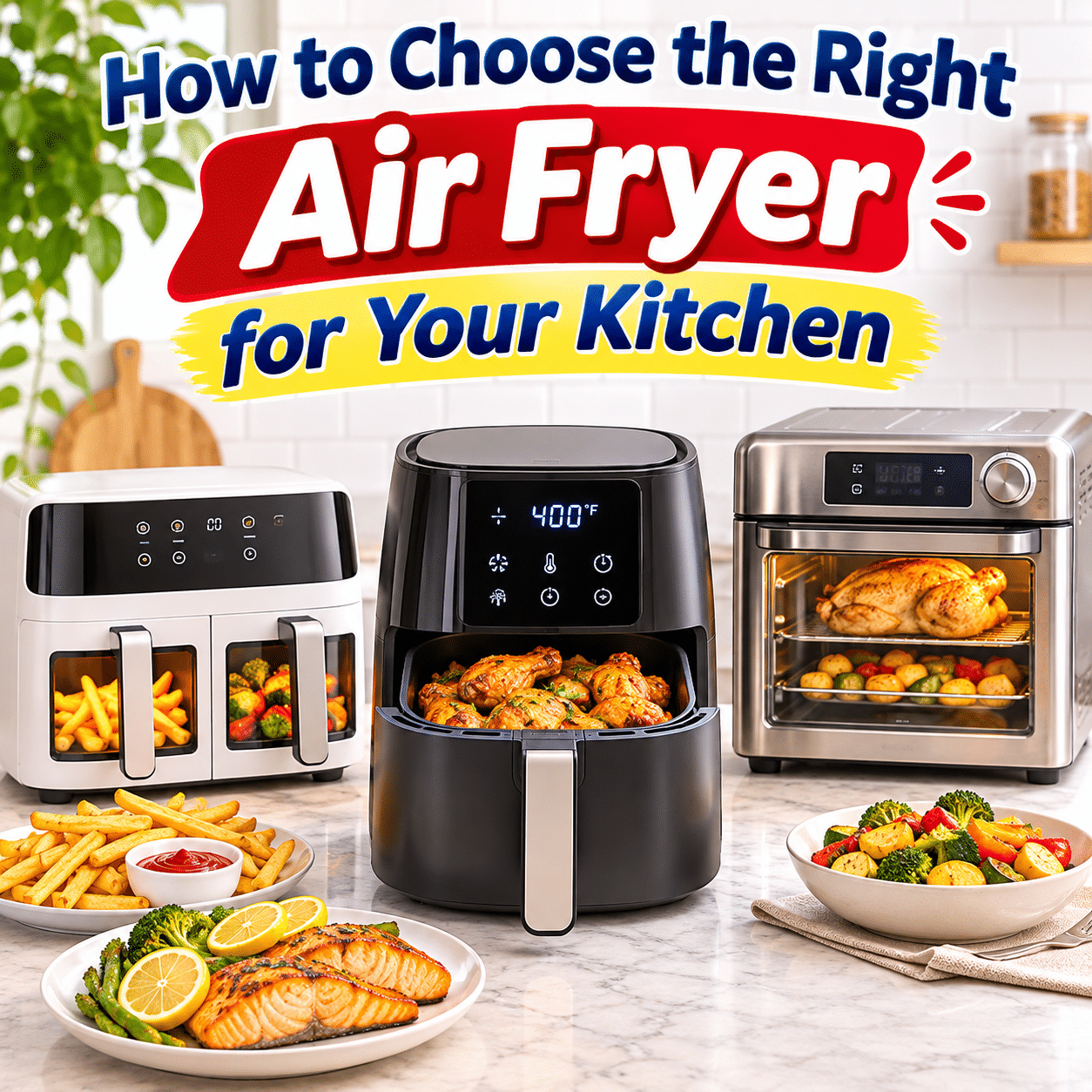
An air fryer can be a practical addition to a modern kitchen, offering a convenient way to prepare crispy vegetables, roasted proteins, frozen snacks, and a wide range of everyday meals. By circulating hot air around food, air fryers can produce browned, crisp surfaces while often requiring less added oil than traditional deep frying.
However, choosing the right air fryer involves more than selecting an attractive appliance or the largest available model. Air fryers differ in capacity, cooking performance, basket design, controls, cleaning requirements, and the amount of counter space they occupy.
A compact basket-style air fryer may be ideal for someone preparing small meals, while a larger dual-basket model may suit a household that frequently cooks several dishes at once. An air fryer oven may offer additional flexibility, but it can also require more space and cleaning effort.
Understanding these differences helps you choose an appliance that fits your cooking habits, kitchen layout, and long-term needs.
This guide explains the most important factors to consider when buying an air fryer, compares common designs, explores practical features, and provides a detailed checklist to help you make a confident decision.
1. Understand How an Air Fryer Works
Before comparing models, it helps to understand the basic cooking process.
An air fryer is essentially a compact convection cooking appliance. It uses an electric heating element and a fan to circulate hot air around food.
This combination promotes:
- Surface browning.
- Moisture evaporation.
- Crisp textures.
- Relatively fast cooking for small portions.
- More even heating when food is arranged properly.
Many air fryers include perforated baskets or trays that allow air to move around the food.
Unlike deep frying, air frying does not immerse ingredients in hot oil. A small amount of oil may improve browning and texture for certain foods, but many frozen foods already contain enough fat to cook without additional oil.
Air frying is particularly useful for foods that benefit from dry heat and surface crisping.
However, it does not perfectly reproduce every result associated with deep frying. Wet-battered foods, for example, may not cook successfully unless the batter is adapted for air frying.
Understanding this distinction helps establish realistic expectations before purchasing.
2. Identify Your Main Cooking Needs
The most useful air fryer is one that matches the meals you actually prepare.
Consider how you expect to use the appliance throughout a typical week.
Everyday Cooking
If you plan to prepare vegetables, chicken, fish, potatoes, and simple meals regularly, prioritize:
- Reliable temperature control.
- Convenient basket access.
- Easy cleaning.
- Suitable cooking capacity.
- Consistent heating.
Quick Snacks and Reheating
For frozen snacks, leftovers, and small portions, a compact model may be sufficient.
Look for straightforward controls and a basket that is easy to remove.
Family Meal Preparation
Households preparing several servings may benefit from a larger cooking area or multiple baskets.
The ability to cook different ingredients simultaneously can be particularly valuable.
Versatile Cooking
If you want to roast, toast, bake, reheat, and occasionally dehydrate food, consider an air fryer oven or multifunction model.
Remember that additional functions are only valuable when you intend to use them.
3. Compare the Main Types of Air Fryers
Air fryers come in several designs, each offering different advantages.
Basket-Style Air Fryers
Basket-style models are among the most familiar options.
They typically include a removable cooking basket that slides into the main appliance.
Advantages:
- Simple operation.
- Convenient food access.
- Relatively compact design.
- Easy shaking or tossing.
- Suitable for everyday portions.
Limitations:
- Restricted cooking surface.
- Limited ability to cook several dishes separately.
- Some models cannot accommodate larger food items.
Basket-style air fryers are often a practical starting point for smaller households.
Dual-Basket Air Fryers
Dual-basket models provide two separate cooking compartments.
Depending on the appliance, each basket may have independent temperature and time settings.
Advantages:
- Cook different foods simultaneously.
- Separate foods with different cooking requirements.
- Reduce the need for consecutive cooking batches.
- Useful for preparing proteins and vegetables together.
Limitations:
- Larger countertop footprint.
- More components to clean.
- Each individual basket may be smaller than expected.
- Some models have power-sharing limitations when both compartments operate.
A dual-basket air fryer is especially useful when meal components require different temperatures or cooking times.
Air Fryer Ovens
Air fryer ovens resemble compact countertop ovens.
They often use racks, trays, or baskets rather than a deep removable drawer.
Advantages:
- Greater cooking flexibility.
- Potentially larger flat cooking surfaces.
- Ability to accommodate different tray arrangements.
- Additional functions such as toasting or baking.
Limitations:
- Larger exterior dimensions.
- More surfaces to clean.
- Rack positions may affect cooking consistency.
- Some foods require rotating trays during cooking.
An air fryer oven may suit households that want a multifunction countertop appliance.
Multifunction Pressure Cooker and Air Fryer Combinations
Some appliances combine pressure cooking with air frying.
These models may use interchangeable lids or integrated heating systems.
They can be useful when kitchen space is limited and both functions are frequently needed.
However, multifunction appliances may involve additional accessories, storage requirements, and operational complexity.
Choose one only when its combined functions align with your cooking routine.
4. Choose the Right Air Fryer Capacity
Capacity is one of the most important purchasing considerations.
Air fryers are commonly described using liters, quarts, or other volume measurements.
However, advertised volume does not always indicate how much food can cook effectively in a single batch.
A wide basket with a relatively shallow cooking area may accommodate certain foods better than a deep, narrow basket with a similar advertised volume.
General Capacity Guidelines
| Household or cooking need | Capacity worth considering | Important consideration |
|---|---|---|
| Individual meals | Approximately 2–3 liters | Compact portions and limited counter space |
| One or two people | Approximately 3–5 liters | Everyday cooking flexibility |
| Small family | Approximately 5–7 liters | Larger batches and meal preparation |
| Larger household | Approximately 7 liters or more | Cooking surface and basket arrangement matter |
| Multiple dishes | Dual-basket or oven-style design | Separate cooking zones may be more useful than total volume |
These ranges are general starting points, not guaranteed serving capacities.
Actual suitability depends on the ingredients, portion sizes, and shape of the cooking compartment.
Why Basket Shape Matters
Imagine two air fryers with similar advertised capacities.
One has a wide rectangular basket, while the other has a deeper, narrower basket.
The wider model may accommodate more chicken pieces or vegetables in a single layer.
The deeper model may hold a larger volume of loose ingredients but require more shaking or cooking in batches.
For foods that benefit from direct exposure to circulating air, usable surface area can be more important than total volume.
5. Consider the Number of People You Cook For
Household size is useful when estimating capacity, but it should not be the only factor.
Someone cooking for one person may still prefer a larger air fryer if they regularly prepare meals in advance.
Likewise, a family may use a smaller air fryer primarily for side dishes.
Ask yourself:
- How many portions do I normally prepare?
- Do I cook complete meals or individual components?
- Do I frequently prepare food in batches?
- Will I use the air fryer for meal preparation?
- Do I need to cook different ingredients simultaneously?
Choose capacity based on your most common cooking situations rather than an occasional unusually large meal.
6. Measure Your Available Kitchen Space
An air fryer needs more than enough space to fit on the countertop.
It also requires appropriate ventilation and convenient access.
Before purchasing, measure:
- Countertop width.
- Available depth.
- Clearance beneath cabinets.
- Space around ventilation openings.
- Room needed to pull out baskets or open doors.
- Distance to a suitable electrical outlet.
Account for Ventilation
Air fryers release heat and steam during operation.
Ventilation requirements vary by manufacturer and model.
Follow the specific clearance instructions in the appliance manual rather than assuming every air fryer needs the same amount of surrounding space.
Avoid positioning an air fryer where exhaust heat may damage cabinets, walls, or nearby objects.
Consider Storage
If you plan to store the appliance after each use, evaluate its weight and ease of handling.
A large multifunction air fryer may be inconvenient to move repeatedly.
An appliance that fits naturally into your kitchen routine is more likely to be used consistently.
7. Evaluate Cooking Performance
Cooking performance depends on several interacting factors.
These include:
- Heating element design.
- Fan performance.
- Temperature regulation.
- Cooking chamber geometry.
- Airflow around food.
- Basket or tray arrangement.
A larger air fryer does not automatically cook better than a smaller one.
Even Heating
Good air circulation helps food brown more consistently.
However, most air fryers still benefit from shaking, turning, or rearranging food during cooking.
Temperature Consistency
An appliance that maintains reasonably stable temperatures can help produce more predictable results.
Temperature fluctuations may affect browning, moisture loss, and cooking time.
Recovery After Opening
Opening an air fryer releases heat.
Some appliances recover their cooking temperature more quickly than others.
This can matter when food requires frequent checking or turning.
Realistic Performance Expectations
Air fryers vary in how quickly they cook particular foods.
Recipes should be treated as starting points rather than universal instructions.
Adjust cooking times according to the appliance, food quantity, and actual doneness.
8. Understand Temperature Range and Control
Air fryers typically offer adjustable cooking temperatures, although available ranges differ.
A broader range can support more cooking methods.
Lower Temperatures
Lower settings may be useful for:
- Gentle reheating.
- Drying certain ingredients.
- Dehydrating foods on supported models.
- Preparing delicate items.
Moderate Temperatures
Moderate heat can work well for:
- Vegetables.
- Fish.
- Certain baked foods.
- Reheating meals.
Higher Temperatures
Higher settings are often used for:
- Crisping potatoes.
- Browning chicken.
- Cooking frozen snacks.
- Producing roasted surfaces.
The ideal temperature depends on the food and recipe.
For foods requiring a safe internal temperature, use a food thermometer rather than relying solely on the appliance setting.
9. Compare Digital and Manual Controls
Air fryers generally use either mechanical controls or electronic interfaces.
Manual Controls
Manual models often include temperature and timer dials.
Advantages:
- Straightforward operation.
- Minimal menu navigation.
- Familiar physical controls.
- Convenient for simple cooking routines.
Limitations:
- Less precise setting adjustments on some models.
- Limited presets.
- Fewer advanced functions.
Digital Controls
Digital models typically use buttons, touch panels, or electronic displays.
Advantages:
- More precise time selection.
- Convenient preset programs.
- Clear cooking information.
- Additional functions on some models.
Limitations:
- More complicated interfaces.
- Touch controls may be less convenient with wet hands.
- Some features may require additional navigation.
Neither control style is inherently better for every household.
Choose the interface that feels intuitive and supports your preferred cooking habits.
10. Decide Whether Cooking Presets Are Useful
Many air fryers include presets for foods such as:
- French fries.
- Chicken.
- Fish.
- Vegetables.
- Frozen snacks.
- Baking.
- Reheating.
Presets generally select predetermined time and temperature combinations.
They can simplify routine cooking, especially for beginners.
However, presets do not automatically account for every variation in food size, quantity, thickness, or starting temperature.
For example, fresh potato wedges may require different settings from frozen fries.
Treat presets as convenient starting points and adjust them when necessary.
11. Consider Single-Basket Versus Dual-Basket Cooking
One of the most meaningful design decisions is whether you need separate cooking compartments.
When a Single Basket Makes Sense
A single basket may be sufficient when:
- You usually prepare one dish at a time.
- You cook for one or two people.
- Countertop space is limited.
- You prefer fewer components.
- Simplicity matters more than simultaneous cooking.
When Dual Baskets Make Sense
A dual-basket model may be useful when:
- You frequently cook proteins and vegetables together.
- Different foods require different temperatures.
- You want to prepare separate portions.
- You regularly cook several meal components.
- You want to reduce sequential cooking.
Some dual-basket models offer synchronization functions that coordinate cooking completion.
Check how these functions operate because implementation varies.
12. Examine Basket Materials and Coatings
The cooking basket is exposed to repeated heating, food contact, cleaning, and handling.
Common designs use metal baskets or trays, sometimes with nonstick coatings.
Nonstick-Coated Baskets
Nonstick surfaces can make food removal and cleaning easier.
However, coatings may deteriorate when scratched, overheated beyond manufacturer limits, or cleaned with unsuitable tools.
Follow the manufacturer’s care instructions.
Avoid abrasive cleaning materials when they are not recommended.
Stainless Steel Components
Some air fryer ovens use stainless steel racks or trays.
These can be durable and may tolerate different cleaning methods depending on their construction.
However, food may adhere more readily to certain uncoated surfaces.
Ceramic-Coated Surfaces
Some models advertise ceramic-based nonstick coatings.
The exact formulation and performance vary.
Do not assume that a ceramic coating is automatically more durable, safer, or easier to clean than every alternative.
Evaluate the manufacturer’s material disclosures and care instructions.
13. Look for a Basket That Is Easy to Clean
Cleaning convenience strongly influences long-term satisfaction.
An air fryer that is difficult to clean may become less appealing for daily use.
Look for:
- Removable cooking baskets.
- Accessible interior surfaces.
- Minimal hard-to-reach corners.
- Easy-to-remove trays.
- Clear cleaning instructions.
- Dishwasher-safe components where specified.
Dishwasher-Safe Does Not Mean Maintenance-Free
Even when a basket is labeled dishwasher-safe, repeated machine washing may affect its appearance or coating over time.
Follow the manufacturer’s recommendations.
Handwashing with a soft sponge and mild detergent may help preserve certain finishes.
Check the Heating Area
Food particles and grease can accumulate near the upper interior of some air fryers.
Consider whether the appliance allows safe access for routine cleaning after it has cooled and been unplugged.
Never immerse the main electrical housing in water unless the manufacturer explicitly states that it is designed for such cleaning.
14. Understand Wattage and Electrical Requirements
Air fryers use electric heating elements, and their power ratings vary.
Wattage affects electrical demand, but it does not independently determine cooking quality.
A higher-wattage appliance is not automatically more efficient or faster in every situation.
Actual performance depends on:
- Appliance design.
- Cooking chamber size.
- Heat retention.
- Air circulation.
- Food quantity.
- Cooking temperature.
- Operating time.
Check Electrical Compatibility
Before buying, verify:
- Rated voltage.
- Frequency requirements.
- Plug type.
- Electrical power rating.
- Manufacturer instructions.
Use an outlet and electrical circuit suitable for the appliance.
Avoid using extension cords or power strips unless the appliance manufacturer explicitly permits them and the electrical setup is appropriately rated.
For imported appliances, confirm compatibility with your local electrical supply.
15. Evaluate Energy Efficiency
Air fryers can be energy-efficient for certain cooking tasks because they heat relatively small cooking chambers.
They may use less total energy than a full-size oven when preparing small portions.
However, this is not guaranteed for every meal.
Energy consumption depends on power draw and operating time.
A simplified calculation is:
Energy consumption (kWh) = Power (kW) × Operating time (hours)
For example, an appliance drawing an average of 1.2 kW for 30 minutes would consume approximately 0.6 kWh.
This is an illustrative calculation. Actual power consumption may vary because heating elements cycle during operation.
When Air Fryers May Save Energy
Potential advantages include:
- Smaller portions.
- Shorter cooking sessions.
- Reduced need to heat a large oven.
- Efficient reheating.
When the Advantage May Be Smaller
Energy savings may be reduced when:
- Food requires several batches.
- A larger oven is already being used.
- The air fryer operates for an extended period.
- Multiple appliances are needed to complete a meal.
Consider your normal cooking routine rather than relying on general energy-saving claims.
16. Consider Noise Levels
Air fryers use fans to circulate hot air.
As a result, they produce operating noise.
Noise levels depend on fan design, airflow, housing construction, and operating conditions.
If your kitchen is connected to a quiet living or working area, noise may be an important consideration.
When reliable information is available, compare independent reviews that describe fan noise under similar conditions.
Avoid assuming that appliance size or wattage alone predicts noise.
17. Evaluate Safety Features
Safety should be a central consideration when choosing any countertop cooking appliance.
Useful features may include:
- Automatic shutoff.
- Overheating protection.
- Stable nonslip feet.
- Secure basket positioning.
- Clearly marked hot surfaces.
- Insulated or heat-resistant handles.
- Accessible operating instructions.
Automatic Shutoff
Some models pause or stop cooking when the basket is removed.
Others may continue operating or behave differently.
Check the specific model’s instructions.
Exterior Heat
Air fryers can become hot during use.
Even models marketed with cool-touch features may have hot ventilation areas or other exposed surfaces.
Use appropriate precautions.
Stable Placement
Position the appliance on a stable, heat-resistant surface according to the manufacturer’s instructions.
Keep it away from combustible materials and ensure adequate ventilation.
Children and Pets
Keep hot appliances, electrical cords, and cooking baskets out of reach of children and pets.
Do not leave cooking appliances operating unattended contrary to the manufacturer’s instructions.
18. Consider Visibility During Cooking
Some air fryers include transparent windows and interior lights.
These features allow users to observe food without opening the basket or door.
Potential benefits include:
- Monitoring browning.
- Reducing unnecessary interruptions.
- Checking delicate foods.
- Improving convenience.
However, visibility features do not guarantee better cooking performance.
Windows may also require additional cleaning.
Choose this feature if it genuinely improves your cooking routine.
19. Evaluate Additional Cooking Functions
Multifunction air fryers may include settings such as:
- Roast.
- Bake.
- Reheat.
- Broil.
- Dehydrate.
- Toast.
- Keep warm.
These functions can increase versatility.
However, the presence of a labeled function does not guarantee the same performance as a dedicated appliance.
For example, a compact air fryer with a baking preset may not accommodate the same pans or produce the same results as a conventional oven.
Consider the actual cooking chamber design and supported accessories.
Prioritize Functions You Will Use
A model with numerous cooking programs is not necessarily better than a simpler appliance.
If you primarily cook vegetables, chicken, and frozen snacks, reliable air frying may matter more than specialized functions.
20. Compare Air Fryer Designs Side by Side
The following table summarizes common differences.
| Feature | Single-basket air fryer | Dual-basket air fryer | Air fryer oven |
|---|---|---|---|
| Countertop space | Often compact | Usually wider | Often larger |
| Cooking compartments | One | Two | One chamber, potentially multiple rack levels |
| Best suited for | Simple everyday meals | Multiple meal components | Versatile cooking |
| Cleaning | Often straightforward | Two baskets to clean | Multiple racks and interior surfaces |
| Food access | Pull-out basket | Separate pull-out baskets | Front-opening door |
| Cooking flexibility | Moderate | High for separate foods | High for different cooking methods |
| Storage convenience | Often easier | Less compact | May require dedicated counter space |
| Main consideration | Usable basket area | Individual basket sizes | Overall dimensions and rack performance |
These are general design tendencies. Individual models may differ substantially.
21. Match the Air Fryer to Your Kitchen Lifestyle
Different cooking habits call for different priorities.
For Small Apartments
Prioritize:
- Compact footprint.
- Adequate ventilation clearance.
- Easy storage.
- Straightforward cleaning.
- Suitable capacity for daily portions.
A compact basket-style model may be sufficient.
For Busy Professionals
Look for:
- Intuitive controls.
- Convenient reheating.
- Easy cleaning.
- Reliable temperature adjustment.
- Capacity for commonly prepared meals.
Convenience may matter more than a long list of presets.
For Families
Consider:
- Larger usable cooking area.
- Multiple cooking compartments.
- Easy basket handling.
- Durable components.
- Practical cleaning requirements.
A dual-basket design may help when preparing separate meal components.
For Home Cooking Enthusiasts
Useful features may include:
- Flexible temperature controls.
- Multiple cooking modes.
- Compatible accessories.
- A spacious cooking surface.
- Convenient monitoring.
An air fryer oven may offer additional flexibility.
For Meal Preparation
Focus on:
- Batch capacity.
- Consistent results.
- Easy food removal.
- Cleaning efficiency.
- Appropriate storage of prepared food.
A larger basket or oven-style design may be worthwhile.
22. Think About the Foods You Cook Most Often
Your preferred ingredients can influence the ideal air fryer design.
Vegetables
Vegetables generally benefit from good airflow and enough space to avoid excessive crowding.
A wide cooking surface may be particularly useful.
Chicken and Other Proteins
Consider whether the basket can accommodate your typical portions without stacking them excessively.
For food safety, check internal temperatures with a suitable thermometer.
Frozen Foods
Frozen fries, nuggets, and similar foods are often convenient to prepare in air fryers.
A basket that allows easy shaking can improve cooking consistency.
Fish
Delicate fish may benefit from easy temperature adjustment and a cooking surface that allows careful removal.
Baked Foods
If baking is a priority, examine tray dimensions, temperature control, and the types of baking accessories supported.
An oven-style model may provide more flexibility for certain recipes.
23. Consider Accessories and Replacement Parts
Some air fryers include accessories such as:
- Cooking racks.
- Baking trays.
- Grill plates.
- Skewers.
- Silicone inserts.
- Crisper plates.
- Removable dividers.
Accessories can expand cooking options, but they must be compatible with the appliance.
Check Compatibility
An accessory should:
- Fit properly.
- Allow adequate airflow.
- Be rated for the intended temperature.
- Avoid contact with heating elements.
- Be approved or permitted by the appliance manufacturer.
Do not assume that an accessory designed for one air fryer will work safely in another.
Replacement Parts
Before purchasing, consider whether replacement baskets, trays, or other wear-prone components are available.
Access to suitable replacement parts can improve long-term appliance value.
24. Understand the Total Cost of Ownership
The purchase price is only one part of an appliance’s long-term cost.
Other considerations include:
- Electricity consumption.
- Replacement components.
- Cleaning supplies.
- Accessories.
- Maintenance requirements.
- Expected useful life.
A lower-priced appliance may provide good value if it meets your needs and performs reliably.
A more expensive model may be worthwhile when its additional capacity, construction, or features deliver meaningful benefits.
Avoid paying for functions that are unlikely to be used.
Evaluate Warranty and Support
Review:
- Warranty duration.
- Coverage conditions.
- Availability of customer service.
- Repair options.
- Replacement part availability.
- Return policies.
Warranty terms vary by manufacturer, retailer, and region.
25. Common Mistakes to Avoid When Buying an Air Fryer
Choosing Capacity Based Only on Advertised Volume
A large volume rating does not guarantee a spacious cooking surface.
Check the basket’s actual dimensions when possible.
Buying the Largest Model Available
An oversized appliance may occupy unnecessary space and be inconvenient for small meals.
Choose a size that matches your typical cooking needs.
Ignoring Ventilation Requirements
Insufficient clearance can create safety concerns and affect appliance placement.
Always follow the manufacturer’s instructions.
Assuming More Presets Mean Better Cooking
Presets provide convenience but do not replace reliable heating and appropriate cooking techniques.
Overlooking Cleaning Requirements
Complicated baskets, racks, and interior surfaces can make daily maintenance frustrating.
Ignoring Electrical Compatibility
Voltage, plug type, and circuit suitability must be checked before use.
Assuming Every Air Fryer Cooks Identically
Airflow, temperature control, and chamber design differ.
Recipes may require adjustment.
Paying for Unnecessary Features
Extra functions add little value when they do not match your cooking habits.
26. How to Choose an Air Fryer Step by Step
A structured selection process can simplify the decision.
Step 1: Define Your Primary Use
Decide whether the air fryer will mainly handle snacks, everyday meals, family cooking, or multifunction cooking.
Step 2: Estimate Your Typical Portion Size
Think about the meals you prepare most frequently.
Avoid choosing capacity based only on occasional special occasions.
Step 3: Measure Your Kitchen
Check countertop dimensions, ventilation clearance, and access to a suitable electrical outlet.
Step 4: Select the Appropriate Design
Compare basket-style, dual-basket, and oven-style appliances.
Choose the configuration that best supports your routine.
Step 5: Compare Usable Cooking Space
Look beyond advertised volume.
Consider basket width, depth, shape, and cooking surface.
Step 6: Review Controls and Features
Prioritize reliable temperature adjustment, convenient timers, and functions you will actually use.
Step 7: Examine Cleaning Requirements
Check removable components, coating care, and access to interior surfaces.
Step 8: Verify Safety and Electrical Requirements
Review manufacturer instructions, safety features, and local electrical compatibility.
Step 9: Consider Long-Term Support
Evaluate warranty coverage, replacement parts, and customer service.
Step 10: Compare Overall Value
Select the appliance that offers the most appropriate combination of performance, convenience, capacity, and durability for your needs.
27. Practical Air Fryer Buying Checklist
Use this checklist before making a purchase.
Cooking Needs
- I know which foods I will cook most often.
- I have estimated my typical portion sizes.
- I know whether I need one or multiple cooking compartments.
- I have identified the cooking functions I will actually use.
Kitchen Compatibility
- The appliance fits my available countertop space.
- I can meet the manufacturer’s ventilation requirements.
- The basket or door can open comfortably.
- A suitable electrical outlet is available.
- The appliance can be stored conveniently if necessary.
Performance and Convenience
- The usable cooking area meets my needs.
- The temperature range is appropriate.
- The controls are easy to understand.
- The cleaning process is manageable.
- The included accessories are useful.
Safety and Long-Term Value
- Electrical specifications are compatible with my location.
- Safety instructions and features are clear.
- Basket materials and care requirements are acceptable.
- Warranty coverage is understood.
- Replacement parts or service options have been considered.
- The overall cost fits my budget.
28. Frequently Asked Questions About Choosing an Air Fryer
1. What size air fryer is best for one person?
A compact model of approximately 2–3 liters may be sufficient for small individual portions. However, someone who prepares larger meals or cooks in batches may prefer additional capacity.
2. Is a 5-liter air fryer big enough for two people?
A 5-liter model may be suitable for many two-person households, depending on the basket shape and typical meals. Usable cooking area matters more than volume alone.
3. Is a larger air fryer always better?
No. Larger models require more space and may be unnecessary for small portions. The best size matches your cooking habits.
4. Should I choose a basket air fryer or an air fryer oven?
Choose a basket model for straightforward everyday air frying. Consider an oven-style model if you want more flexible tray arrangements and additional cooking functions.
5. Are dual-basket air fryers worth considering?
Yes, particularly when you regularly cook different foods that require separate temperatures or cooking times.
6. Do air fryers need oil?
Many foods can cook without added oil, especially products that already contain fat. A small amount of oil may improve browning and texture for certain fresh ingredients.
7. Can an air fryer replace a conventional oven?
An air fryer can handle many small roasting, reheating, and baking tasks. However, it may not replace a conventional oven for large dishes, extensive baking, or high-volume cooking.
8. Are digital air fryers better than manual models?
Not necessarily. Digital controls can offer precise settings and presets, while manual controls may be simpler. Cooking performance depends on more than the interface.
9. Do air fryers cook food evenly?
Air fryers promote even heating through circulating air, but food arrangement and basket design matter. Shaking or turning may still be necessary.
10. What is the most important feature in an air fryer?
The most important feature depends on your needs, but usable cooking capacity, reliable heating, easy cleaning, and safe operation are strong priorities.
11. Are nonstick air fryer baskets safe?
Food-contact safety depends on the specific materials, applicable standards, and proper use. Follow the manufacturer’s temperature limits and care instructions, and replace damaged components when recommended.
12. Is stainless steel better than nonstick?
Neither is universally better. Stainless steel may offer durability, while nonstick surfaces can simplify food removal and cleaning.
13. Do air fryers use a lot of electricity?
Energy use varies by wattage and cooking duration. Air fryers may be efficient for smaller meals, but actual consumption depends on the cooking task.
14. Can I cook frozen food in an air fryer?
Yes. Many frozen foods are suitable for air frying. Follow package instructions when available and adjust for the appliance.
15. Can I bake in an air fryer?
Many air fryers support baking, although available space and temperature control vary. Use compatible baking accessories.
16. Are air fryer presets necessary?
No. Presets are convenient but not essential. Adjustable time and temperature controls can handle many cooking tasks.
17. How important is basket shape?
Basket shape is important because it affects food arrangement, airflow, and usable cooking area.
18. Do I need an air fryer with a viewing window?
A viewing window can improve convenience, but it is not essential for good cooking results.
19. Are air fryer ovens harder to clean?
They may require more cleaning because of additional racks, trays, and interior surfaces. Actual maintenance depends on the design.
20. Can I put aluminum foil in an air fryer?
Some manufacturers permit foil under specific conditions, while others restrict its use. Follow the appliance instructions and never allow loose foil to contact heating elements or obstruct necessary airflow.
21. Can I use parchment paper in an air fryer?
Only when permitted by the manufacturer and suitable for the cooking temperature. Loose parchment can be lifted by airflow and contact heating elements, so it should not be placed in an operating air fryer without food holding it securely.
22. How long should an air fryer last?
Useful life depends on construction quality, frequency of use, maintenance, and availability of replacement parts. There is no universal lifespan that applies to every model.
23. Is a more expensive air fryer necessarily better?
No. Higher prices may reflect additional features, branding, or construction differences, but they do not guarantee better performance for every household.
24. What safety features should I look for?
Consider automatic shutoff, overheating protection, stable construction, secure handles, and clear manufacturer safety instructions.
25. Can I cook different foods together in one basket?
Yes, when their cooking requirements are compatible and there is sufficient space. Foods requiring different temperatures or times may be easier to prepare separately.
26. Should I buy an air fryer if I already own a convection oven?
It depends on your cooking habits. An air fryer may offer convenience for small portions, but a convection oven can perform many similar tasks.
27. How can I tell whether an air fryer will fit my kitchen?
Measure the appliance’s exterior dimensions and compare them with your available space, including the manufacturer’s required ventilation clearances and room for opening the basket or door.
28. What should I prioritize when comparing similar air fryers?
Focus on usable cooking space, temperature control, cleaning convenience, safety, warranty, and how well each model supports your most frequent meals.
29. Final Thoughts: Choosing an Air Fryer That Fits Your Everyday Life
Choosing the right air fryer is ultimately about finding an appliance that supports your kitchen routine rather than simply purchasing the model with the most features.
A compact basket-style air fryer may be ideal for small meals and limited spaces. A dual-basket design may make family meal preparation more convenient, while an air fryer oven can offer greater flexibility for households that regularly use multiple cooking methods.
The most important considerations are usable cooking capacity, kitchen compatibility, consistent heating, convenient controls, cleaning requirements, and safe operation.
It is also worth thinking beyond the initial purchase. Durable components, accessible replacement parts, suitable electrical specifications, and reliable manufacturer support can contribute to a better long-term experience.
Rather than focusing exclusively on advertised capacity, preset counts, or appearance, evaluate how each appliance will perform in the situations that matter most to you.
The right air fryer is not necessarily the largest, most expensive, or most feature-rich model. It is the one that makes your everyday cooking easier, fits comfortably into your kitchen, and provides dependable value over time.