Watering is one of the most important responsibilities in indoor plant care, yet it is also one of the most common sources of confusion. Many houseplants experience problems not because they receive too little attention, but because they receive more water than their roots can comfortably manage.
Overwatering can affect plants of almost any type, from tropical foliage plants to succulents and flowering houseplants. Although water is essential for healthy growth, excessive moisture can reduce oxygen availability around the roots and create conditions that encourage root deterioration.
The challenge is that indoor plants do not all need water at the same frequency. Their requirements depend on the species, container size, potting media, root system, light exposure, temperature, humidity, and stage of growth.
A plant placed beside a bright window may use water differently from the same species growing in a shaded corner. A plant in a porous terracotta pot may also dry more quickly than one in a nonporous plastic container.
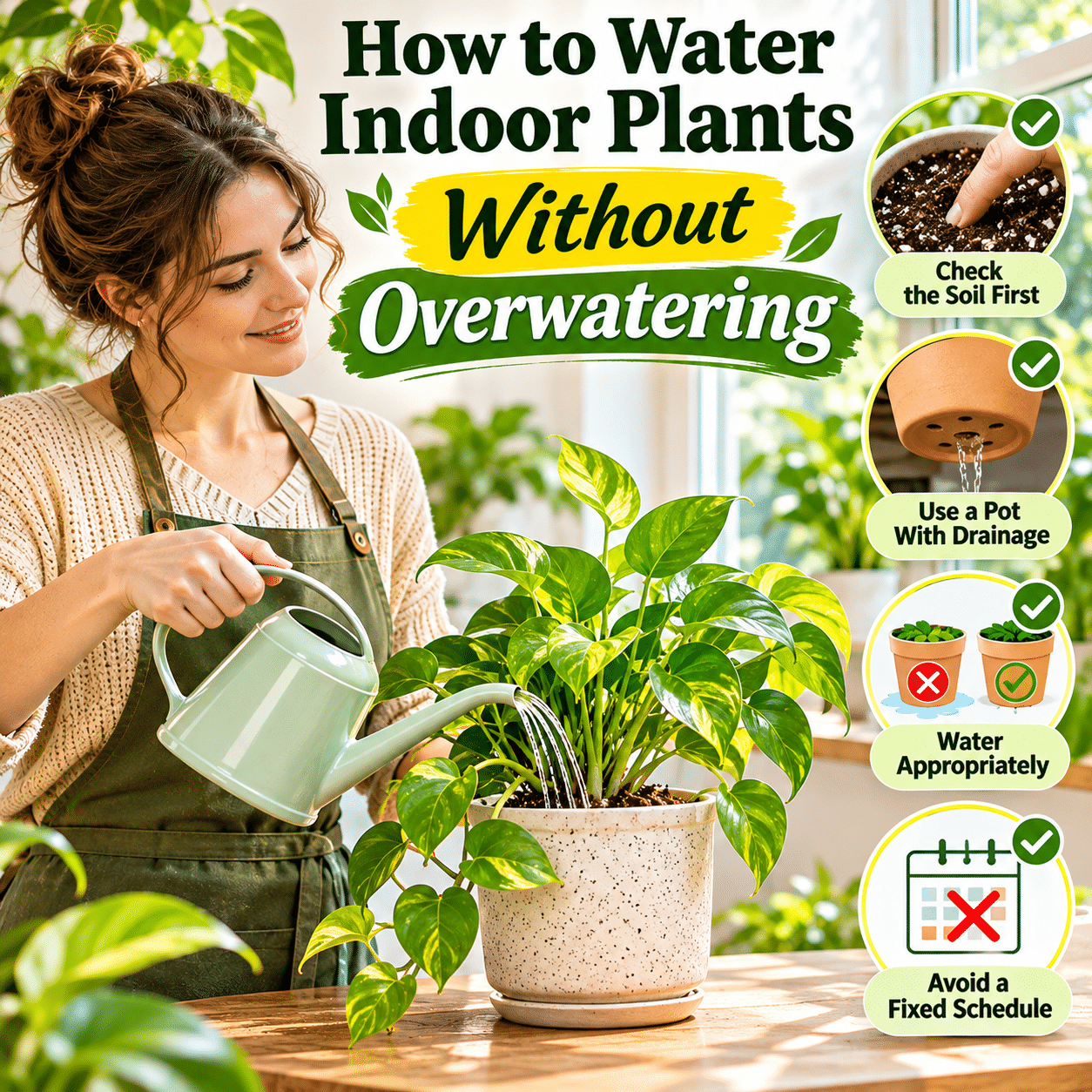
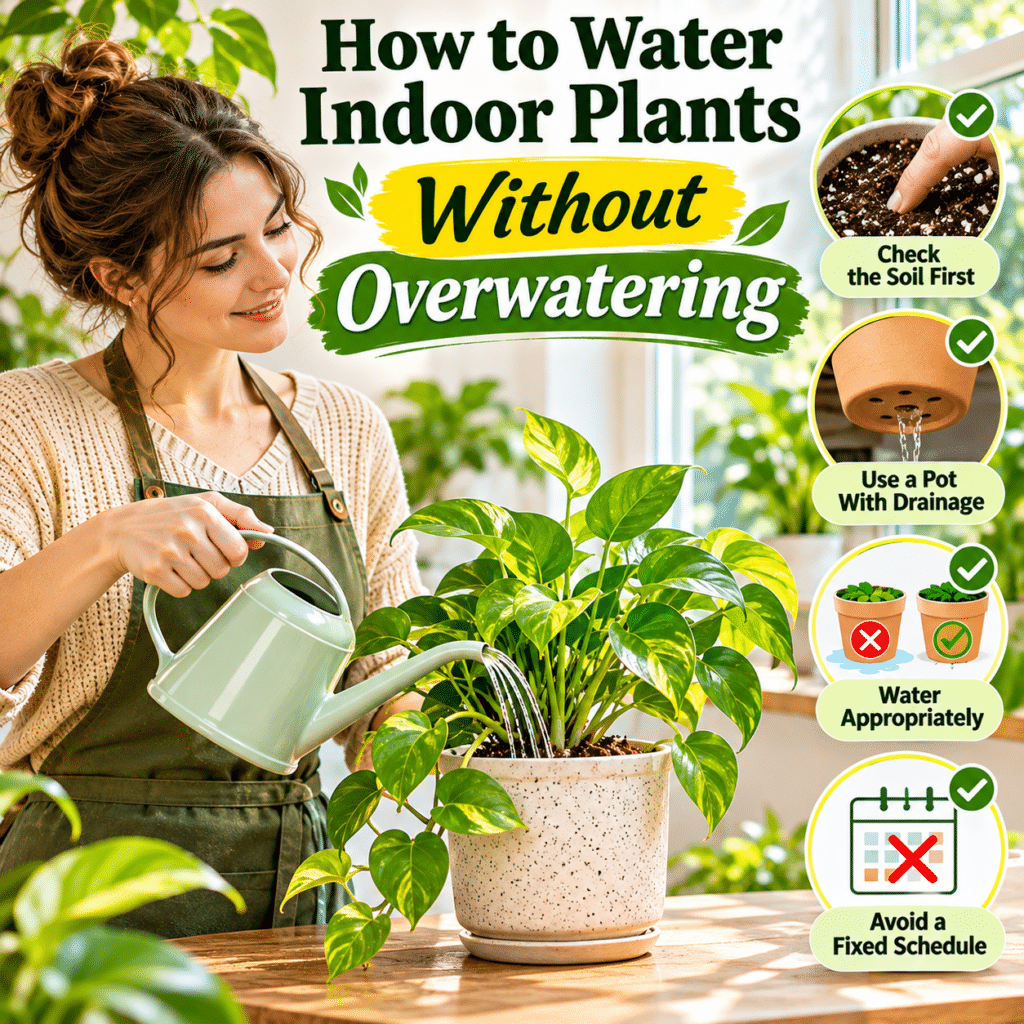
This means that successful watering involves observation rather than following a rigid calendar.
Learning to recognize when a plant genuinely needs water can prevent unnecessary stress, improve root health, and make everyday plant care more predictable.
This guide explains how to understand indoor plant watering needs, identify the signs of excessive moisture, check potting media correctly, choose suitable containers, establish practical watering habits, and respond when a plant has received too much water.
With a thoughtful approach, watering can become a simple, manageable routine that supports healthy indoor greenery over the long term.
1. Understand Why Indoor Plants Need Water
Water plays several essential roles in plant growth and survival.
Plants use water to support photosynthesis, transport dissolved nutrients, maintain cell structure, and regulate temperature through transpiration.
Water also helps maintain the internal pressure that keeps many leaves and stems firm.
Without sufficient moisture, plants may wilt, slow their growth, or develop dry and damaged tissues.
However, roots need more than water alone.
They also require access to oxygen for normal cellular respiration.
Healthy watering practices must therefore balance moisture availability with adequate air around the roots.
2. Understand What Overwatering Really Means
Overwatering does not simply mean pouring a large amount of water into a pot during one watering session.
In many cases, it refers to keeping the root zone excessively wet for too long.
A plant can receive a thorough watering without being overwatered if the growing medium drains properly and the roots have access to oxygen afterward.
Conversely, adding small amounts of water too frequently can create persistently wet conditions.
Overwatering risk depends on:
- Watering frequency.
- Drainage performance.
- Potting media composition.
- Container size.
- Root development.
- Light exposure.
- Temperature.
- Plant species.
The central issue is whether the root environment remains suitable between watering sessions.
3. Understand Why Roots Need Oxygen
Plant roots carry out respiration to obtain energy for growth and maintenance.
In a healthy container, spaces between potting media particles contain varying amounts of water and air.
When these spaces remain filled with water for extended periods, oxygen movement becomes restricted.
Poor oxygen availability can weaken roots and interfere with normal function.
Under unfavorable conditions, damaged roots may become more vulnerable to decay and certain disease-causing organisms.
This is why good drainage and appropriate watering intervals are closely connected.
Healthy roots generally require a balance of moisture and aeration rather than permanently saturated conditions.
4. Recognize the Difference Between Thorough Watering and Overwatering
A common misunderstanding is that watering until liquid drains from the bottom of a pot is automatically excessive.
For many ordinary houseplants grown in suitable containers, watering thoroughly and allowing excess water to escape is an effective method.
The problem develops when the growing medium remains too wet afterward or when watering is repeated before the plant needs additional moisture.
Consider two situations.
Situation A: A plant receives a thorough watering, excess water drains away, and the medium gradually dries to an appropriate level before the next watering.
Situation B: A plant receives small amounts of water every day, and the growing medium never has an opportunity to lose enough moisture.
Depending on the species and conditions, Situation B may create a greater risk of overwatering.
The frequency and duration of wet conditions matter more than the amount poured during a single appropriate watering.
5. Learn the Watering Needs of Your Plant Species
Different plants have different moisture preferences.
Some tropical foliage plants prefer their growing media to remain lightly moist.
Other plants tolerate partial drying between watering sessions.
Many succulents and cacti require more substantial drying before additional water is provided.
Examples include:
| Plant group | General moisture preference | Important consideration |
|---|---|---|
| Many tropical foliage plants | Moderately moist with good aeration | Avoid prolonged saturation |
| Pothos and many philodendrons | Some drying between watering sessions | Adjust to light and potting mix |
| Peace lilies | More consistent moisture than many drought-tolerant plants | Avoid both severe drying and waterlogging |
| Snake plants | Significant drying between watering sessions | Excess moisture can damage roots |
| ZZ plants | Relatively dry intervals | Thick underground structures store water |
| Many succulents | Thorough watering followed by substantial drying | Use a suitable fast-draining medium |
| Many ferns | More consistent moisture | Avoid allowing delicate roots to remain waterlogged |
| Many orchids | Species-specific moisture and aeration | Often require specialized growing media |
These are general tendencies rather than universal schedules.
Always consider the exact species and growing environment.
6. Avoid Watering Every Plant on the Same Schedule
A collection of houseplants may contain species with very different watering requirements.
Watering every plant on the same day simply because it is convenient can lead to unnecessary moisture problems.
For example, a fern in a bright, warm room may need water more frequently than a snake plant in a cooler location.
Even two plants of the same species may have different needs if their containers and growing conditions differ.
A better approach is to establish regular inspection days rather than mandatory watering days.
Check each plant and water only when its condition indicates that moisture is needed.
7. Check the Potting Mix Before Watering
One of the simplest ways to prevent overwatering is to check the growing medium before adding water.
The surface may appear dry while deeper layers remain moist.
This is especially common in large containers or dense potting mixes.
Useful methods include:
- Checking the medium with a finger.
- Using a wooden skewer.
- Lifting the pot to assess its weight.
- Observing changes in moisture over time.
- Using a moisture meter as a supplementary tool.
No single method is perfect.
Combining observations can provide a more reliable understanding of the root environment.
8. Use the Finger Test Correctly
The finger test is a practical method for many common houseplants.
Gently insert a clean finger into the growing medium to assess moisture below the surface.
For plants that prefer some drying, check whether the upper portion of the medium feels dry before watering.
For moisture-loving species, watering may be appropriate while deeper layers remain slightly moist.
The correct depth depends on the plant, container, and growing medium.
Avoid applying a fixed depth to every species.
For large pots, checking only the surface may not reveal conditions near the lower root zone.
9. Use a Wooden Skewer to Check Deeper Moisture
A wooden skewer can help assess moisture in containers where finger testing is difficult.
Insert a clean skewer carefully into the potting medium, avoiding excessive disturbance to the roots.
Leave it briefly, then remove it.
Observe whether the skewer appears damp or has moist growing media attached.
A relatively dry skewer may suggest that the surrounding medium has dried.
However, results can vary depending on the composition of the potting mix.
Use the skewer as one indicator rather than an absolute measurement.
10. Learn to Judge Pot Weight
Container weight can provide useful information about moisture levels.
A pot filled with wet growing medium is generally heavier than the same pot after some water has been used or evaporated.
After watering a manageable container, lift it carefully and notice its weight.
Compare that feeling with the weight after the medium has dried to an appropriate level.
Over time, this method can become surprisingly useful.
However, it is less practical for large or heavy containers.
Never lift a pot that is too heavy to handle safely.
11. Understand the Limitations of Moisture Meters
Moisture meters can help estimate conditions inside the growing medium.
However, inexpensive meters may respond differently depending on media composition, salinity, probe contact, and other factors.
A reading that suggests wet or dry conditions should not automatically determine watering.
Use moisture meters alongside:
- Visual observations.
- Pot weight.
- Finger or skewer testing.
- Knowledge of the plant’s needs.
Clean and maintain the device according to its instructions.
Avoid leaving a probe inserted permanently unless the device is specifically designed for continuous use.
12. Observe the Plant’s Leaves and Stems
Plants sometimes show visible changes when their water balance becomes unsuitable.
Possible symptoms include:
- Drooping leaves.
- Yellowing foliage.
- Reduced growth.
- Soft stems.
- Leaf loss.
- Dry leaf edges.
- Changes in leaf firmness.
However, these symptoms are not specific to watering problems.
For example, drooping can occur when roots lack water, but it can also occur when damaged roots cannot absorb water effectively from excessively wet media.
Always check the growing medium before responding with additional water.
13. Recognize Common Signs of Overwatering
Potential signs of excessive moisture include:
- Potting media remaining wet for unusually long periods.
- Yellowing leaves.
- Drooping despite wet soil.
- Soft or deteriorating stems.
- Unpleasant odors from the root zone.
- Increased root decay.
- Repeated moisture-related problems.
Not every symptom confirms overwatering.
Yellowing leaves may also result from natural aging, insufficient light, nutritional problems, or pests.
The most useful diagnosis combines plant symptoms with an assessment of root-zone moisture and drainage.
14. Understand Why Overwatered Plants May Wilt
Wilting is commonly associated with underwatering, but it can also occur when roots are damaged by prolonged wet conditions.
Healthy roots absorb water and transport it through the plant.
When roots lose function because of oxygen deprivation or decay, water uptake may become impaired.
The leaves may then droop even though the potting medium remains wet.
Adding more water in this situation can worsen the underlying problem.
Check the root environment before assuming that wilting means the plant is thirsty.
15. Recognize the Signs of Underwatering
Underwatering occurs when a plant does not receive enough moisture to support normal function.
Possible symptoms include:
- Dry potting media.
- Reduced leaf firmness.
- Wilting.
- Crispy leaf edges.
- Leaf curling in some species.
- Slower growth.
- Premature leaf drop.
Some plants recover quickly after appropriate watering.
Others may experience permanent damage if dehydration is severe or prolonged.
The goal is to avoid both extremes.
16. Compare Overwatering and Underwatering Symptoms
Some symptoms overlap, making diagnosis difficult.
| Observation | Possible overwatering explanation | Possible underwatering explanation |
|---|---|---|
| Drooping leaves | Damaged roots cannot absorb water effectively | Insufficient available moisture |
| Yellowing leaves | Root stress or impaired function | Prolonged moisture deficiency |
| Leaf loss | Root deterioration or environmental stress | Severe or repeated dehydration |
| Slow growth | Poor root aeration | Limited water availability |
| Brown leaf edges | Root stress or related problems | Drying of leaf tissues |
| Potting media condition | Often persistently wet | Often excessively dry |
| Root condition | May become soft or decayed | May become dry or damaged |
The condition of the growing medium and roots helps distinguish between these possibilities.
17. Understand How Pot Size Affects Watering
Container size influences how much growing medium surrounds the roots.
A large container may hold substantial moisture.
If the root system is relatively small, water may remain in unused areas of the medium for extended periods.
This can increase the risk of prolonged saturation.
A very small container may dry quickly and require more frequent attention.
Choose pot size according to the root system rather than the foliage alone.
When repotting, avoid unnecessarily large increases in container size.
18. Understand How Pot Material Affects Moisture
Different pot materials influence evaporation.
Unglazed terracotta is porous and allows moisture to evaporate through the container walls.
Plastic and glazed ceramic generally retain moisture longer because their walls are less porous.
This means identical plants in different containers may need different watering intervals.
Other factors, including airflow, temperature, light, and potting mix, also influence drying.
Learn how each container behaves rather than relying on material alone.
19. Choose Containers With Proper Drainage
For many common houseplants, containers with drainage holes make watering easier to manage.
Drainage holes allow excess water to escape after watering.
Without drainage, water may accumulate at the bottom of the container.
This can create unfavorable conditions around roots.
Decorative containers without holes can still be used as outer pots.
Keep the plant in a suitable inner container with drainage and remove accumulated water after watering.
20. Avoid Leaving Pots in Standing Water
After watering, excess water may collect in saucers or decorative outer containers.
If the pot remains in standing water, moisture can move back into the growing medium through drainage openings.
This may keep the lower root zone wetter than intended.
For ordinary houseplant care, empty excess drainage water after it has finished draining.
Some specialized self-watering systems use reservoirs intentionally, but these require appropriate design and plant-specific management.
Do not treat an ordinary saucer filled with water as a substitute for a properly managed reservoir system.
21. Understand the Role of Potting Mix
Potting media influence how water enters, moves through, and remains within the root zone.
A suitable mix provides both moisture retention and air spaces.
Different components affect these properties.
For example:
- Coco coir can help retain moisture.
- Peat-based materials often hold water effectively.
- Perlite can improve aeration.
- Pumice contributes durable mineral structure.
- Bark particles can create larger air spaces.
- Some fine-textured ingredients may increase water retention.
The best combination depends on the plant’s needs.
A mix suitable for moisture-loving tropical plants may be inappropriate for a drought-tolerant succulent.
22. Avoid Using Dense or Compacted Growing Media
Potting media can become compacted or lose structure over time.
When air spaces are reduced, drainage and root aeration may become less favorable.
Water may also move unevenly through the container.
Signs of problematic media can include:
- Persistent wetness.
- Poor drainage.
- Hard, compacted surfaces.
- Unusual water movement.
- Root deterioration.
If the growing medium has become unsuitable, repotting into an appropriate fresh mix may be necessary.
23. Understand Why Gravel Layers Do Not Solve Overwatering
Placing gravel or stones at the bottom of a container is sometimes recommended as a drainage solution.
However, a coarse layer beneath finer potting media does not necessarily improve drainage.
Water can remain held in the finer material above the coarse layer.
The gravel also reduces the space available for roots.
For most common houseplants, appropriate potting media and functional drainage holes are more useful than a gravel layer.
24. Consider Light Exposure When Watering
Light affects photosynthesis, growth, and water use.
Plants receiving adequate bright light may use water more quickly than similar plants in dim conditions.
A plant moved to a darker location may need less frequent watering.
Conversely, a plant placed in brighter conditions may dry more rapidly.
However, stronger light can also increase heat and evaporation.
Observe the actual growing environment rather than assuming that all plants of the same species need identical watering intervals.
25. Understand How Temperature Influences Water Use
Temperature affects evaporation and plant activity.
Warm conditions may increase moisture loss from the growing medium.
Cooler conditions may slow water use, especially when plant growth is reduced.
However, temperature interacts with humidity, airflow, and light.
A warm but humid room may behave differently from a warm, dry room.
Adjust watering according to actual moisture conditions.
26. Consider Humidity and Air Circulation
Humidity influences how quickly water evaporates from leaves and surrounding surfaces.
Dry air can increase moisture loss under some conditions.
Higher humidity may reduce the rate of evaporation.
Air circulation also influences drying.
Gentle airflow can help prevent stagnant conditions, but strong drafts may increase moisture loss.
Avoid adjusting watering based on humidity alone.
Check the growing medium and plant response.
27. Adjust Watering During Seasonal Changes
Many indoor plants experience changes in growth as daylight and temperature vary throughout the year.
During slower growing periods, plants may use less water.
Continuing a frequent watering routine without checking moisture can lead to excessive wetness.
During active growth, water use may increase.
Seasonal adjustments should be based on observed conditions rather than fixed calendar rules.
In tropical climates or consistently controlled indoor environments, seasonal differences may be less pronounced.
28. Understand How Plant Size Affects Watering
Larger plants often have more foliage and extensive root systems.
They may use more water than smaller plants under similar conditions.
However, the relationship is not always straightforward.
A large plant in a cool, dim location may use water slowly.
A small plant in a bright, warm location may dry quickly.
Container size and growing medium also matter.
Evaluate the entire growing environment rather than judging water needs from foliage size alone.
29. Water Thoroughly When Appropriate
For many common houseplants grown in well-draining containers, thorough watering is an effective method.
Apply water gradually and evenly across the surface of the growing medium.
Continue until the root zone has been adequately moistened and excess water begins to drain.
Allow the container to drain completely.
Avoid leaving the pot in accumulated water.
Then wait until the growing medium reaches the appropriate moisture level before watering again.
This approach is generally more reliable than repeatedly adding small amounts of water without checking moisture.
30. Avoid Shallow Watering as a Permanent Habit
Adding only a small amount of water to the surface may leave deeper roots insufficiently moistened.
Repeated shallow watering can create uneven moisture distribution.
The surface may appear damp while parts of the root ball remain dry.
For plants that benefit from thorough watering, apply enough water to moisten the growing medium appropriately.
However, avoid assuming that every plant requires the same volume.
The goal is adequate root-zone moisture, not a fixed quantity of water.
31. Understand Top Watering
Top watering involves applying water directly to the surface of the growing medium.
It is convenient for many houseplants and allows the grower to observe drainage.
To top-water effectively:
- Check whether the plant needs water.
- Apply water slowly.
- Distribute water across the growing medium.
- Allow excess water to drain.
- Empty accumulated drainage water.
Avoid directing strong streams of water onto delicate stems or exposed roots.
32. Understand Bottom Watering
Bottom watering involves allowing water to move upward into the growing medium through drainage openings.
The pot is placed temporarily in a shallow container of water.
This method may help rewet some dry growing media.
However, bottom watering requires monitoring.
Do not leave ordinary houseplants soaking indefinitely.
Remove the pot once the medium has absorbed sufficient moisture and allow it to drain.
Bottom watering is not automatically safer than top watering.
Either method can contribute to overwatering if the growing medium remains excessively wet.
33. Recognize Hydrophobic Potting Media
Some potting media become difficult to rewet after drying excessively.
Water may run around the edges of the root ball and exit through drainage holes without adequately moistening the interior.
This is sometimes described as hydrophobic behavior.
Possible signs include:
- Water draining unusually quickly.
- A pot remaining unexpectedly light after watering.
- Dry areas inside the root ball.
- Water separating from the surface rather than soaking in.
Gradual watering or a carefully monitored soaking method may help rewet suitable media.
Severely degraded mixes may need replacement.
34. Use Water at a Suitable Temperature
Extremely hot or cold water can stress plant roots.
For many common houseplants, water near ordinary room temperature is a practical choice.
Avoid exposing sensitive tropical plants to very cold water.
The exact ideal temperature varies by species.
There is generally no need to heat water precisely for routine houseplant care.
35. Understand Water Quality Considerations
Water quality can influence plant health over time.
Some plants are sensitive to dissolved salts, fluoride, or other substances.
Water quality concerns depend on the species and local water supply.
Possible options include:
- Suitable tap water.
- Filtered water.
- Rainwater collected and stored safely.
- Distilled water for particularly sensitive plants.
Do not assume that all tap water is harmful.
Many common houseplants grow successfully with ordinary municipal water.
For sensitive species, consult reliable plant-specific guidance.
36. Avoid Misting as a Replacement for Proper Watering
Misting leaves does not reliably provide the water needed by the root system.
Although misting may briefly wet foliage, it is not a substitute for watering the growing medium.
Frequent leaf wetting can also be undesirable for some plants, particularly when airflow is poor.
If a plant requires higher humidity, consider appropriate environmental management rather than relying solely on misting.
Focus on maintaining suitable root-zone moisture.
37. Be Careful With Self-Watering Pots
Self-watering containers can simplify moisture management when used correctly.
Many systems rely on a water reservoir and a mechanism that transfers moisture into the growing medium.
However, they are not suitable for every plant.
Potential concerns include:
- Persistently wet growing media.
- Poor aeration.
- Incorrect reservoir management.
- Unsuitable potting mix.
- Difficulty detecting root problems.
Choose systems appropriate for the species and follow their instructions.
Monitor the plant rather than assuming the system eliminates all watering risks.
38. Understand How Mulch Affects Indoor Containers
Some indoor growers use decorative or functional materials on the surface of potting media.
These may include bark, mineral particles, or other coverings.
Surface materials can influence evaporation and make it harder to assess moisture visually.
A thick covering may slow drying in some conditions.
If using decorative top dressing, check moisture beneath the surface rather than judging the pot by appearance alone.
Avoid covering sensitive crowns or stems with moisture-retaining material.
39. Learn What to Do After Accidental Overwatering
If a plant has received too much water, the appropriate response depends on the severity of the problem.
For a healthy plant that was watered earlier than necessary:
- Stop adding water.
- Allow excess water to drain.
- Empty the saucer.
- Check the growing medium.
- Resume watering only when appropriate.
If the medium remains saturated for an unusually long period or the plant shows signs of root damage, further investigation may be necessary.
Avoid automatically repotting every plant after a single watering mistake.
Unnecessary root disturbance can create additional stress.
40. Know When Root Inspection or Repotting May Be Necessary
Persistent wetness, worsening wilting, unpleasant odors, or soft roots may indicate a serious root-zone problem.
If root deterioration is suspected, carefully inspect the plant.
Possible corrective steps include:
- Removing severely unsuitable growing media.
- Trimming clearly decayed roots with clean tools when appropriate.
- Choosing a properly sized container.
- Using fresh, suitable potting mix.
- Improving drainage.
- Adjusting watering practices.
Severely damaged plants may not recover.
Addressing the cause of excessive moisture is essential to preventing recurrence.
Practical Step-by-Step Guide: How to Water Indoor Plants Without Overwatering
A consistent observation-based method can simplify watering decisions.
Step 1: Identify the Plant
Determine the species or variety whenever possible.
Learn whether it prefers consistently moist conditions, partial drying, or substantial drying between watering sessions.
Step 2: Check the Container
Confirm that the pot has suitable drainage.
Look for accumulated water in saucers or decorative outer containers.
Step 3: Evaluate the Growing Medium
Consider whether the potting mix is appropriate for the plant.
A mix that retains excessive moisture may require adjustment.
Step 4: Check Moisture Below the Surface
Use a finger, wooden skewer, or another suitable method.
Do not rely only on the appearance of the top layer.
Step 5: Observe the Plant
Look for changes in leaf firmness, growth, and overall appearance.
Remember that symptoms can have several causes.
Step 6: Decide Whether Watering Is Necessary
Compare the moisture level with the plant’s requirements.
If the medium is still sufficiently moist, wait and check again later.
Step 7: Apply Water Gradually
When watering is appropriate, distribute water evenly across the growing medium.
For many common houseplants, water thoroughly enough to moisten the root zone.
Step 8: Allow Excess Water to Drain
Make sure water can escape through drainage openings.
Avoid leaving the container standing in accumulated water.
Step 9: Return the Plant to Its Suitable Location
Place the plant where it receives appropriate light, temperature, and airflow.
Avoid unnecessary environmental changes.
Step 10: Monitor Moisture Over Time
Observe how quickly the growing medium dries.
Use this information to improve future watering decisions.
Step 11: Adjust for Changing Conditions
Reassess watering frequency when:
- The plant grows larger.
- The container changes.
- The potting mix is replaced.
- The plant is moved.
- Seasonal conditions change.
- Indoor heating or cooling patterns change.
Step 12: Build a Flexible Routine
Establish regular plant-checking habits rather than rigid watering dates.
Water according to actual needs.
Practical Indoor Plant Watering Checklist
Use this checklist before watering.
Plant Requirements
- I know the plant’s general moisture preferences.
- I understand whether the plant tolerates drying between watering sessions.
- I have considered the plant’s current growth stage.
- I have checked for species-specific watering guidance.
Container and Potting Mix
- The container has appropriate drainage.
- The pot size suits the root system.
- The potting mix provides suitable aeration.
- The growing medium is not severely compacted.
- No excess water is trapped in the outer container.
Moisture Assessment
- I checked moisture below the surface.
- I considered the pot’s weight when practical.
- I did not rely solely on a fixed calendar schedule.
- I evaluated the plant’s overall condition.
- I confirmed that watering is actually necessary.
Watering Process
- I used water at a suitable temperature.
- I applied water gently.
- I moistened the root zone appropriately.
- Excess water was allowed to drain.
- I emptied accumulated drainage water.
Ongoing Care
- I will check moisture again before the next watering.
- I will adjust watering when light or temperature changes.
- I will monitor for signs of root stress.
- I will avoid unnecessary watering.
- I will review the potting mix and container if problems persist.
Common Indoor Plant Watering Problems and Solutions
| Problem | Possible cause | Practical solution |
|---|---|---|
| Potting mix stays wet for many days | Low light, oversized pot, dense media, or excessive watering | Review growing conditions, container size, and watering frequency |
| Leaves droop despite wet media | Root stress or impaired water uptake | Inspect moisture and root condition before adding water |
| Leaves become yellow | Watering stress or other environmental factors | Evaluate roots, light, and overall care |
| Water drains immediately | Hydrophobic media or dense root crowding | Check the root ball and rewet appropriately |
| Potting mix dries too quickly | Small pot, porous container, strong light, or extensive roots | Reassess container and watering needs |
| Water collects in a decorative pot | Inadequate drainage management | Remove accumulated water |
| Brown leaf tips appear | Watering, humidity, salts, or other stress | Investigate several possible causes |
| Fungus gnats become common | Persistently moist organic media may support larvae | Improve moisture management and use appropriate pest controls |
| Surface mold develops | Moisture and organic material | Improve moisture management and airflow |
| Roots become soft or mushy | Possible root decay | Inspect roots and correct growing conditions |
| Moisture meter readings seem inconsistent | Media composition or device limitations | Confirm with other moisture-checking methods |
| Plant receives water too frequently | Rigid watering schedule | Switch to regular inspections rather than automatic watering |
| Plant wilts after repotting | Root disturbance or moisture imbalance | Check root-zone conditions and provide suitable aftercare |
| Leaves curl or become crispy | Possible dehydration or other stress | Check moisture before watering |
| Plant struggles in a dark room | Reduced light and water use | Improve lighting and adjust watering appropriately |
The most effective solution begins with understanding the actual root environment.
Frequently Asked Questions
1. How often should I water indoor plants?
There is no universal watering interval.
Frequency depends on the species, potting mix, container size, light, temperature, humidity, and growth rate.
Check the growing medium regularly and water when the plant needs moisture.
2. Is watering once a week too much?
Not necessarily.
Weekly watering may be suitable for some plants under certain conditions and excessive for others.
A fixed schedule should not replace checking moisture.
3. How can I tell if my indoor plant is overwatered?
Potential signs include persistently wet potting media, yellowing leaves, drooping despite moisture, and root deterioration.
Because these symptoms can have other causes, inspect the growing medium and roots when necessary.
4. Can a plant recover from overwatering?
Some plants recover when excessive moisture is corrected before severe root damage occurs.
Recovery depends on the species, extent of root injury, and growing conditions.
Severely damaged plants may not survive.
5. Should I let indoor plant soil dry completely?
That depends on the species.
Many succulents and drought-tolerant plants benefit from substantial drying.
Some tropical plants and ferns prefer more consistent moisture.
Avoid applying the same rule to every plant.
6. Is it better to water plants from the top or bottom?
Both methods can work when used correctly.
Top watering is convenient and allows excess water to drain.
Bottom watering can help moisten certain dry growing media.
Neither method prevents overwatering automatically.
7. Should water come out of the drainage holes?
For many common houseplants grown in suitable containers, some drainage after thorough watering is normal and useful.
However, rapid drainage does not always mean the entire root ball has absorbed enough water.
Check the growing medium when necessary.
8. Can I overwater a plant even if the pot has drainage holes?
Yes.
Drainage holes allow excess water to escape, but the growing medium may still remain excessively wet if watering is too frequent or the container is unsuitable.
9. Why is my plant drooping when the soil is wet?
Wet-soil wilting can occur when roots are damaged or unable to function properly.
Other environmental factors may also contribute.
Check drainage, root health, and growing conditions before watering again.
10. Are yellow leaves always a sign of overwatering?
No.
Yellow leaves can result from natural aging, watering problems, inadequate light, nutrient issues, pests, or other causes.
Consider the entire plant and its environment.
11. Do indoor plants need less water in winter?
Many plants use less water during periods of reduced light and slower growth.
However, indoor conditions vary.
Some heated homes remain warm and dry, while tropical environments may have different seasonal patterns.
Check actual moisture conditions.
12. Can I use a moisture meter for every houseplant?
Moisture meters can be helpful, but their accuracy and usefulness vary with growing media and device design.
Use readings alongside other observations.
13. Is misting the same as watering?
No.
Misting wets foliage temporarily but does not reliably provide sufficient water to the root system.
Proper watering should address moisture in the growing medium.
14. What should I do if I accidentally water my plant twice?
Check whether excess water can drain and remove accumulated water from the saucer.
Allow the medium to reach an appropriate moisture level before watering again.
If persistent saturation or plant decline occurs, inspect the root environment.
15. What is the easiest way to avoid overwatering?
The simplest habit is to check the growing medium before every watering session.
Combine that observation with knowledge of the plant’s moisture preferences, appropriate drainage, and suitable potting media.
Final Thoughts
Watering indoor plants successfully is not about following the same schedule every week or giving every plant an identical amount of water.
It is about understanding how moisture behaves within a container and recognizing what each plant needs under its particular growing conditions.
Healthy roots require both water and oxygen. When potting media remain excessively wet, roots may struggle to function properly, even though moisture is abundant.
By choosing suitable containers, using appropriate growing media, checking moisture below the surface, and allowing excess water to drain, indoor plant owners can reduce the risk of overwatering.
Equally important is learning to observe plants without reacting automatically to every yellow leaf or drooping stem. Many symptoms have multiple possible causes, and thoughtful inspection leads to better decisions than unnecessary watering.
Over time, a flexible watering routine becomes easier as you become familiar with how individual plants respond to their environment.
The secret to watering indoor plants without overwatering is not giving them less water at every opportunity. It is giving them the right amount of moisture at the right time, while allowing their roots the air and growing conditions they need to stay healthy.