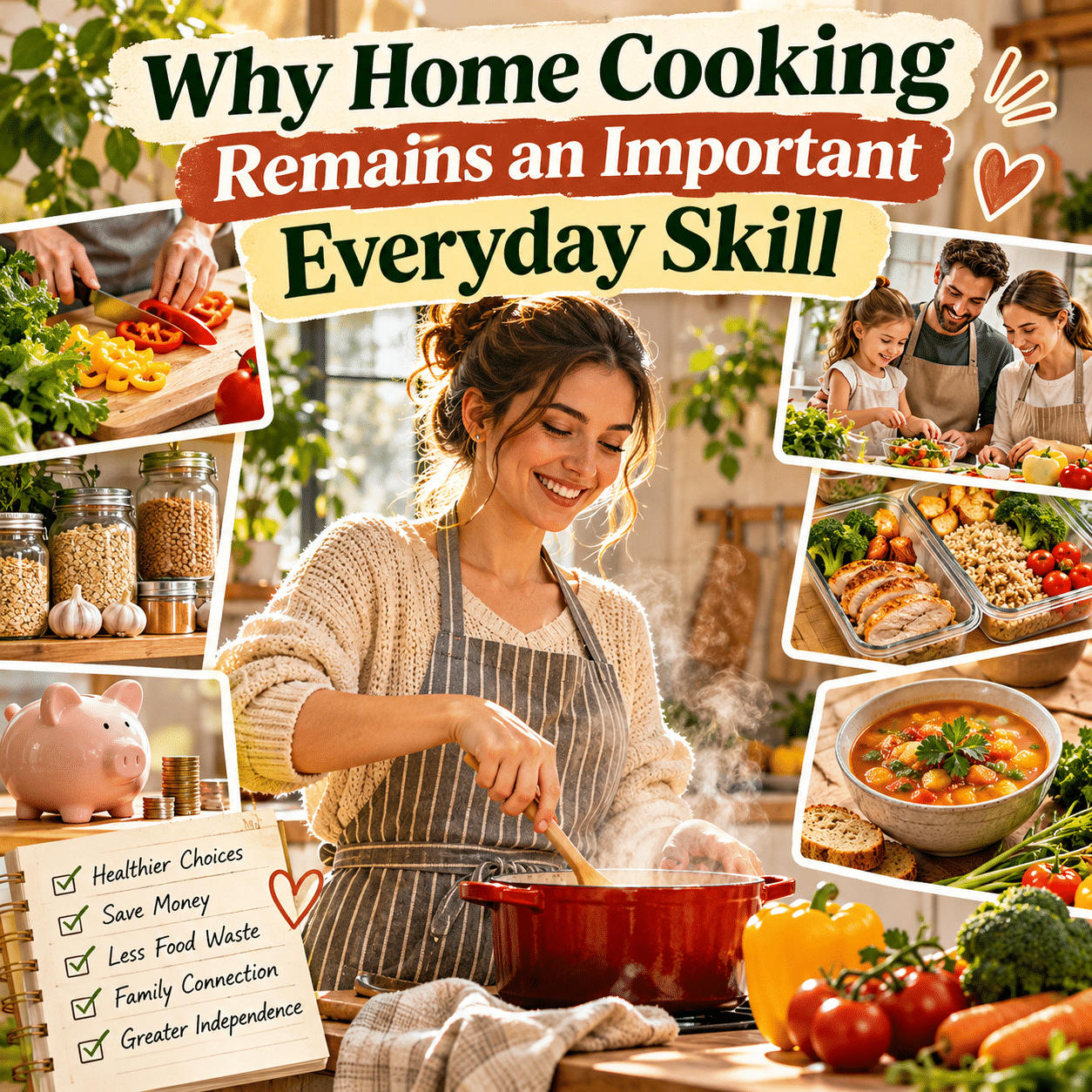
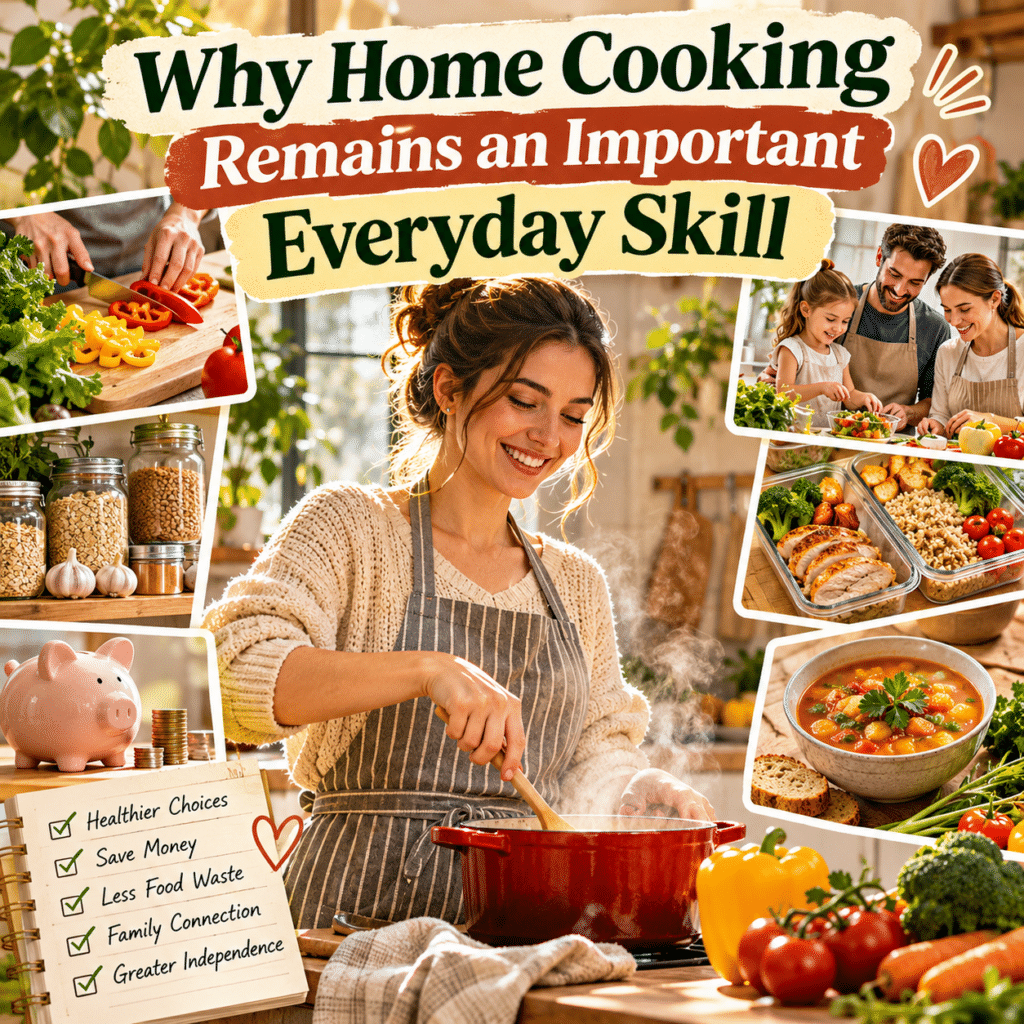
Home cooking has been part of everyday life for generations, yet its importance continues to evolve as lifestyles, technology, and food habits change. With restaurants, delivery services, prepared meals, and convenient packaged foods widely available in many communities, cooking at home may seem less essential than it once was.
However, the ability to prepare a meal remains one of the most practical skills a person can develop. It provides greater independence, flexibility, and awareness of what goes into everyday food.
Home cooking does not require elaborate recipes, expensive appliances, or professional culinary knowledge. Even simple skills such as preparing vegetables, cooking grains, making soup, or assembling a balanced meal can make daily life easier.
For many households, cooking also creates opportunities to spend time together, preserve family traditions, and establish familiar routines. The kitchen can become a place where practical responsibilities and personal creativity naturally meet.
At the same time, home cooking should fit individual circumstances. People have different schedules, budgets, abilities, dietary needs, and access to ingredients. A useful cooking routine is one that supports daily life rather than adding unnecessary pressure.
Understanding why home cooking remains valuable can help people approach meal preparation with greater confidence, flexibility, and appreciation.
The following sections explore the practical, nutritional, financial, social, and personal benefits of developing everyday cooking skills.
1. Home Cooking Encourages Everyday Independence
One of the most important benefits of home cooking is the independence it provides.
Knowing how to prepare basic meals reduces the need to rely entirely on restaurants, takeaway services, or commercially prepared foods.
This independence becomes especially useful when convenient food options are unavailable, expensive, or unsuitable for personal preferences.
Cooking skills also allow individuals to respond to changing circumstances, such as unexpected schedule adjustments or limited grocery choices.
Even a small collection of reliable recipes can provide a meaningful foundation for everyday self-sufficiency.
2. Cooking Helps People Understand What They Eat
Preparing food at home creates greater visibility into the ingredients used in a meal.
People can observe how vegetables, grains, proteins, seasonings, and cooking methods contribute to the finished dish.
This awareness may help individuals make food choices that better reflect their nutritional needs and preferences.
It can also encourage curiosity about ingredient quality, preparation techniques, and portion sizes.
Home cooking does not automatically guarantee healthier meals, but it provides opportunities to make more informed decisions.
3. Basic Cooking Skills Support Balanced Meals
A balanced eating pattern generally includes a variety of foods that provide different nutrients.
Home cooking makes it easier to combine vegetables, fruits, whole grains, protein sources, and other ingredients according to individual needs.
For example, a simple meal might include roasted vegetables, rice, and beans, fish, tofu, or another suitable protein.
Learning how to combine familiar ingredients can make balanced meals more approachable.
Rather than following complicated dietary rules, home cooks can focus on variety, appropriate portions, and practical preparation methods.
4. Home Cooking Can Make Food Spending More Manageable
Food expenses are an important part of household budgeting.
Preparing meals at home can reduce spending in some circumstances, particularly when ingredients are purchased thoughtfully and used across several meals.
Staple foods such as rice, pasta, beans, oats, and seasonal vegetables may provide flexible foundations for affordable dishes.
However, savings depend on local prices, household size, food waste, equipment, and cooking costs.
The greatest financial advantage often comes from planning realistic meals and making effective use of ingredients already available.
5. Cooking Develops Practical Problem-Solving Skills
Cooking involves a series of small decisions.
A person may need to adjust a recipe when an ingredient is unavailable, change the cooking time, or find a different preparation method.
These situations encourage flexibility and practical thinking.
For example, a missing vegetable might be replaced with another ingredient that provides a similar texture or function.
Over time, cooks become more comfortable making adjustments without depending on exact instructions for every meal.
6. Simple Recipes Build Everyday Confidence
Confidence in the kitchen develops through repetition and experience.
Preparing a familiar dish several times helps people understand cooking temperatures, ingredient combinations, and preparation sequences.
Early attempts do not need to be perfect.
A slightly different texture or seasoning level can provide useful information for the next attempt.
Starting with manageable recipes allows cooking confidence to grow naturally without overwhelming expectations.
7. Home Cooking Supports Personal Food Preferences
People have different tastes, cultural backgrounds, and dietary preferences.
Cooking at home provides greater flexibility to accommodate those differences.
A dish can be prepared with less spice, a different seasoning combination, or an alternative ingredient.
Families may also adjust recipes to suit different preferences while maintaining a shared meal.
This flexibility is particularly useful when commercially prepared foods do not offer suitable options.
8. Cooking Makes Ingredient Substitutions Easier
Ingredient substitutions are an essential part of practical cooking.
Learning the purpose of an ingredient helps determine whether another food can serve a similar role.
For example, different vegetables may work in a soup, while various grains can accompany a simple protein dish.
Some substitutions require more care, especially in baking, where ingredient proportions affect structure and texture.
Developing substitution skills makes everyday cooking more adaptable and reduces unnecessary shopping trips.
9. Home Cooking Encourages Better Grocery Planning
Cooking and grocery shopping are closely connected.
People who prepare meals regularly often become more familiar with the ingredients they use most frequently.
This knowledge can support practical shopping lists and reduce purchases that do not fit planned meals.
Checking pantry supplies before shopping also helps prevent duplicate purchases.
A flexible grocery plan makes it easier to prepare meals without requiring a rigid weekly schedule.
10. Cooking Can Help Reduce Household Food Waste
Food waste often occurs when ingredients are forgotten, improperly stored, or purchased in excessive quantities.
Home cooking creates opportunities to use available ingredients before they spoil.
Extra vegetables may become part of a soup, while safely stored cooked grains can be incorporated into another meal.
Understanding storage conditions and food safety is essential when reusing ingredients.
Thoughtful planning and appropriate portion sizes can help households make better use of the food they purchase.
11. Cooking Encourages Awareness of Portion Sizes
Preparing food at home allows people to decide how much to cook and serve.
This flexibility can be helpful when individual appetites, activity levels, and nutritional needs differ.
Rather than relying on fixed restaurant portions, home cooks can adjust serving sizes according to the situation.
Preparing reasonable quantities may also reduce unnecessary leftovers.
Portion awareness should remain practical and flexible rather than becoming a source of anxiety around eating.
12. Home Cooking Can Support Consistent Eating Routines
Regular meal preparation may help establish predictable eating habits.
Knowing that ingredients and simple recipes are available can reduce uncertainty about what to eat.
Some households benefit from preparing meals at approximately similar times each day.
Others need flexible schedules because of work, caregiving, or other responsibilities.
The goal is not to create a perfect timetable but to develop a routine that makes everyday meals easier to manage.
13. Cooking Teaches Useful Time-Management Skills
Preparing a meal involves organizing several tasks within a limited period.
Ingredients may need washing, chopping, cooking, and serving in a logical sequence.
With practice, people learn which activities can happen simultaneously and which require full attention.
For example, vegetables can be prepared while rice cooks, provided the cooking process remains safely supervised.
These planning skills can make meal preparation more efficient and less stressful.
14. Home Cooking Does Not Require Complicated Recipes
One common misconception is that worthwhile home cooking must involve elaborate dishes.
In reality, many satisfying meals rely on simple ingredients and straightforward techniques.
A vegetable omelet, bean soup, stir-fried tofu, or roasted potato dish can be prepared without advanced culinary skills.
Simple recipes are often easier to repeat and adapt.
Developing a dependable collection of uncomplicated meals can be more useful than mastering occasional restaurant-style dishes.
15. Cooking Skills Become More Valuable Through Repetition
Cooking is a practical skill that improves through experience.
Repeatedly preparing familiar dishes helps people recognize visual, aromatic, and textural changes during cooking.
They may become better at judging when vegetables are tender or when a sauce needs adjustment.
For food safety, however, appearance alone is not a reliable indicator that meat, poultry, or seafood has reached a safe temperature.
Repetition builds familiarity, while accurate food-safety practices help make that familiarity dependable.
16. Home Cooking Creates Opportunities for Creativity
Cooking combines practical tasks with creative choices.
Different herbs, spices, vegetables, sauces, and preparation methods can transform familiar ingredients.
A simple bowl of rice, for example, can become many different meals depending on its accompaniments.
Experimenting with flavor combinations may make routine meal preparation more enjoyable.
Creativity does not require expensive ingredients or complicated presentations.
17. Cooking Helps Preserve Family Food Traditions
Recipes often carry memories and cultural meaning.
Preparing traditional dishes can help preserve cooking techniques, ingredients, and food customs across generations.
Family recipes may also reflect regional history, seasonal availability, or personal experiences.
Learning these dishes provides opportunities to understand the stories behind them.
Traditional cooking can evolve as ingredients and household circumstances change while still maintaining its cultural significance.
18. Home Cooking Can Strengthen Family Connections
Shared meal preparation creates opportunities for cooperation.
Family members can participate in age-appropriate activities such as washing vegetables, setting the table, or preparing simple ingredients.
These activities encourage communication and shared responsibility.
Cooking together may also provide informal opportunities for conversation.
Not every household has the time or circumstances to cook together regularly, but occasional shared preparation can still be meaningful.
19. Cooking Offers Opportunities to Teach Children Life Skills
Children can learn valuable practical skills through supervised kitchen activities.
Depending on their age and abilities, they may help measure ingredients, mix foods, or organize utensils.
These tasks introduce basic concepts related to measurement, sequencing, hygiene, and responsibility.
Adults should provide appropriate supervision, particularly around knives, heat, electricity, and potential choking hazards.
The goal is to develop familiarity and confidence rather than expect children to prepare complete meals independently.
20. Home Cooking Supports Lifelong Learning
Cooking offers opportunities to learn at every stage of life.
Beginners may focus on boiling, steaming, sautéing, and roasting.
More experienced cooks might explore bread making, fermentation, regional cuisines, or advanced preparation techniques.
Learning can happen through recipes, demonstrations, family knowledge, or personal experimentation.
Because cooking combines knowledge with repeated practice, it remains a skill that can continue developing over time.
21. Cooking Can Encourage Greater Appreciation for Food
Preparing a meal reveals the effort involved in transforming raw ingredients into something ready to eat.
Washing vegetables, preparing grains, adjusting seasoning, and monitoring cooking times all require attention.
This process may encourage greater appreciation for ingredients and the work involved in food production.
It can also help people recognize the value of meals prepared by others.
Appreciation does not require cooking everything from scratch; even partial meal preparation can build awareness.
22. Home Cooking Makes Seasonal Ingredients More Accessible
Seasonal foods can provide variety throughout the year.
Cooking skills make it easier to incorporate locally available fruits, vegetables, and other ingredients into meals.
A cook might prepare vegetable soups during cooler weather or fresh salads when suitable produce is abundant.
Seasonal ingredients are not always cheaper or more accessible, since prices and availability vary by region.
Nevertheless, understanding how to prepare different ingredients can make shopping and meal planning more flexible.
23. Cooking Helps People Adapt to Dietary Needs
Some individuals need to consider food allergies, intolerances, medical dietary requirements, or personal restrictions.
Home cooking can provide greater control over ingredient selection and preparation.
However, avoiding an allergen requires careful attention to labels, utensils, surfaces, and possible cross-contact.
People following medically necessary diets should use guidance from qualified healthcare professionals when appropriate.
Cooking knowledge can support dietary management, but it does not replace professional nutritional or medical advice.
24. Home Cooking Can Make Leftovers More Useful
Leftovers can become valuable ingredients for future meals.
Cooked vegetables might be added to a soup, while safely refrigerated beans can be incorporated into a salad or grain bowl.
This approach can save preparation time and reduce waste.
Food should be cooled, stored, reheated, and consumed according to appropriate safety guidance.
Leftovers should not be reused when storage conditions or freshness are uncertain.
25. Cooking Encourages Organization in the Kitchen
An organized kitchen can make everyday meal preparation easier.
Frequently used utensils, cookware, and ingredients should be stored where they are practical to access.
Clear storage containers, labeled supplies, and designated preparation areas may reduce unnecessary searching.
Kitchen organization does not require a large space or expensive storage products.
A simple, functional arrangement can support cooking even in a compact kitchen.
26. Home Cooking Helps People Understand Food Safety
Food safety is a fundamental part of cooking.
Learning to wash hands, prevent cross-contamination, store perishable ingredients correctly, and cook foods to safe temperatures protects household health.
Raw meat and poultry should be kept separate from foods that will be eaten without further cooking.
A food thermometer is particularly useful for checking the internal temperature of foods that require thorough cooking.
Reliable food-safety guidance should take priority over assumptions based only on appearance, smell, or cooking time.
27. Cooking Builds Familiarity With Kitchen Equipment
Basic cooking skills include understanding how to use common kitchen tools.
Knives, cutting boards, saucepans, skillets, ovens, and measuring utensils each serve different purposes.
Learning their functions helps people choose appropriate equipment for everyday tasks.
Safe handling and maintenance are equally important.
A small collection of reliable tools is often sufficient for preparing a wide variety of meals.
28. Home Cooking Can Be Adapted to Small Kitchens
Limited kitchen space does not necessarily prevent effective meal preparation.
Compact cooking areas can support simple dishes when storage and preparation surfaces are organized thoughtfully.
One-pot meals, sheet-pan recipes, and recipes requiring few utensils may be particularly practical.
Multipurpose equipment can reduce the need for numerous appliances.
The most useful kitchen setup is one that matches the available space, cooking habits, and safety requirements.
29. Cooking Skills Help During Unexpected Changes
Everyday circumstances are not always predictable.
A restaurant may be closed, a delivery service may be unavailable, or a household budget may temporarily change.
Knowing how to prepare basic meals from available ingredients provides useful flexibility.
Shelf-stable staples and appropriately stored frozen foods can support meal preparation when fresh ingredients are limited.
Cooking skills are not a substitute for emergency planning, but they can contribute to everyday preparedness.
30. Home Cooking Can Support More Sustainable Food Habits
Cooking at home may create opportunities to reduce certain forms of packaging and food waste.
Using reusable containers, planning portions, and making use of ingredients can support more resource-conscious habits.
However, home cooking is not automatically more environmentally sustainable than every prepared-food option.
Environmental impact depends on ingredients, production methods, transport, energy use, packaging, and waste.
Practical improvements are often more achievable when they focus on reducing unnecessary waste rather than pursuing perfect sustainability.
31. Cooking Can Become an Enjoyable Personal Activity
Some people experience cooking as a creative or relaxing activity.
Preparing a familiar recipe may provide a pleasant change from other daily responsibilities.
Others may enjoy experimenting with flavors or learning new techniques.
Cooking can also feel tiring or stressful, particularly when time and energy are limited.
Recognizing these differences helps people develop routines that reflect their preferences rather than treating cooking as an obligation that must always be enjoyable.
32. Home Cooking Encourages Mindful Attention to Everyday Tasks
Cooking requires attention to ingredients, timing, temperature, and preparation.
For some people, focusing on these activities can provide a useful opportunity to engage with the present task.
Chopping vegetables, stirring a sauce, or arranging ingredients may encourage a slower and more deliberate pace.
However, mindfulness is not guaranteed, and kitchen activities can be demanding.
The practical goal is to work attentively and safely rather than expect every cooking session to provide relaxation.
33. Cooking Makes Everyday Meals More Adaptable
Daily schedules and appetites can change.
Home cooking allows meals to be adjusted according to available time, ingredients, and household preferences.
A simple vegetable dish might accompany rice one day and become part of a pasta meal the next.
Recipes can also be scaled when serving different numbers of people.
This adaptability makes basic cooking knowledge useful across many everyday situations.
34. Home Cooking Can Complement Modern Convenience
Cooking at home does not require rejecting convenient food products.
Frozen vegetables, canned beans, prepared sauces, and other practical ingredients can reduce preparation time.
Many convenience foods can be incorporated into nutritious, satisfying meals.
For example, frozen vegetables and canned chickpeas can become part of a quick soup or grain bowl.
The most sustainable cooking routine often combines basic skills with convenient ingredients that fit personal needs.
35. Cooking Helps Develop Realistic Meal-Preparation Habits
Meal preparation is most effective when it matches everyday circumstances.
Some people prefer cooking several portions in advance, while others enjoy preparing smaller meals daily.
A realistic approach considers refrigerator space, food safety, available time, and personal preferences.
Preparing ingredients ahead of time can sometimes be more practical than cooking complete meals.
Flexible preparation habits can make cooking easier without requiring a complicated weekly system.
36. Home Cooking Can Make Shared Meals More Meaningful
Meals provide opportunities for social connection.
Cooking for friends, family members, or neighbors can become an expression of hospitality and care.
A shared meal does not need to be elaborate to feel welcoming.
Simple dishes prepared with attention to guests’ preferences may be more meaningful than complicated menus.
The value often comes from the experience of gathering together rather than the sophistication of the food.
37. Cooking Encourages Respect for Different Food Cultures
Learning to prepare foods from different culinary traditions can broaden everyday food knowledge.
Recipes introduce unfamiliar ingredients, techniques, and flavor combinations.
Exploring their cultural context can also encourage appreciation for the communities that developed them.
It is helpful to distinguish traditional preparations from personal adaptations.
Approaching unfamiliar cuisines with curiosity and respect can make cooking a meaningful form of cultural learning.
38. Home Cooking Can Remain Useful Throughout Life
Cooking needs change over time.
A student living independently may rely on simple, affordable meals.
A busy household may prioritize batch preparation and efficient recipes.
Older adults or people with physical limitations may benefit from accessible tools, simplified techniques, or additional assistance.
Because cooking skills are adaptable, they can remain valuable across different life stages and living arrangements.
39. Cooking Supports a More Flexible Approach to Everyday Living
Modern lifestyles often require balancing work, family responsibilities, personal interests, and household tasks.
Cooking skills provide options rather than imposing a single way of eating.
A person might prepare breakfast at home, use a convenient lunch option, and cook dinner when time permits.
This flexibility can reduce pressure to follow unrealistic standards.
Home cooking is most useful when it becomes one practical resource among several ways of meeting everyday food needs.
40. The Lasting Value of Home Cooking Lies in Practical Confidence
The importance of home cooking extends beyond the meals themselves.
Cooking knowledge supports independence, informed choices, adaptability, and everyday problem-solving.
It can also encourage creativity, cultural appreciation, and meaningful social experiences.
The greatest benefit does not come from preparing every meal from scratch or achieving professional results.
It comes from having enough knowledge and confidence to prepare suitable food when needed.
That practical confidence is what makes home cooking a valuable everyday skill across changing lifestyles.
Understanding the Everyday Benefits of Home Cooking
Home cooking can support several aspects of daily life, although the benefits vary according to individual circumstances.
| Everyday Cooking Practice | Potential Benefit | Practical Example |
|---|---|---|
| Preparing simple meals | Greater independence | Cooking breakfast without relying on takeaway |
| Planning ingredients | More organized shopping | Creating a short grocery list |
| Using familiar staples | Flexible meal preparation | Combining rice, vegetables, and beans |
| Learning basic techniques | Improved confidence | Practicing steaming and sautéing |
| Preparing appropriate portions | More manageable leftovers | Cooking quantities suited to the household |
| Reusing safe leftovers | Reduced food waste | Adding cooked vegetables to soup |
| Cooking with family | Shared responsibility | Preparing dinner together |
| Exploring new recipes | Greater food variety | Trying a new vegetable dish |
| Following food-safety practices | Safer meal preparation | Checking cooking temperatures |
| Using convenient ingredients | Less preparation time | Adding frozen vegetables to a quick meal |
| Organizing kitchen tools | Easier daily cooking | Keeping frequently used utensils accessible |
| Adjusting recipes | Greater flexibility | Replacing an unavailable ingredient |
The most useful cooking habits are those that can be maintained comfortably over time.
How to Build Home Cooking Skills Step by Step
Developing cooking skills does not require a complete lifestyle change. A gradual approach allows beginners to build confidence while keeping everyday responsibilities manageable.
Step 1: Identify Your Current Cooking Experience
Consider which kitchen activities already feel familiar.
You may know how to prepare breakfast but feel less confident cooking a complete dinner.
Recognizing your starting point helps identify practical skills to develop next.
Step 2: Choose a Few Simple Meals
Begin with two or three dishes that use familiar ingredients.
Suitable examples might include vegetable soup, scrambled eggs, a rice bowl, or a simple pasta dish.
Choose recipes that match your equipment, dietary needs, and available time.
Step 3: Learn Essential Kitchen Safety
Practice safe knife handling, proper handwashing, and appropriate food storage.
Understand how to prevent cross-contamination and how to check cooking temperatures when necessary.
These habits should become part of every cooking routine.
Step 4: Become Familiar With Basic Ingredients
Learn how commonly used vegetables, grains, proteins, herbs, and seasonings behave during cooking.
Notice differences in texture, flavor, and preparation requirements.
Ingredient familiarity makes recipes easier to understand and adapt.
Step 5: Practice Fundamental Cooking Techniques
Focus on a few useful methods, such as boiling, steaming, sautéing, roasting, and simmering.
Practice each technique with simple ingredients.
Understanding these methods provides a foundation for many different recipes.
Step 6: Create a Practical Grocery List
Choose meals before purchasing ingredients.
Check existing pantry supplies and identify what is genuinely needed.
Try to select ingredients that can be used in more than one dish.
Step 7: Organize Your Cooking Space
Keep frequently used utensils within easy reach.
Clear enough preparation space for safe food handling.
A functional kitchen setup can make cooking easier, even when space is limited.
Step 8: Repeat Familiar Recipes
Prepare the same dishes several times before introducing too many new techniques.
Repetition helps develop confidence with timing, seasoning, and ingredient preparation.
Make small adjustments as experience grows.
Step 9: Experiment With One Change at a Time
Try a different vegetable, seasoning, or suitable cooking method.
Changing one element makes it easier to understand how that adjustment affects the result.
For baking or food-safety-sensitive recipes, follow tested instructions when substitutions could affect the outcome.
Step 10: Develop a Flexible Cooking Routine
Decide how often home cooking realistically fits your schedule.
Some people may cook daily, while others prefer a few meals each week.
Adjust the routine as responsibilities, preferences, and circumstances change.
Consistency is more useful when it remains manageable.
Choosing Home Cooking Approaches for Different Lifestyles
There is no single cooking routine that suits everyone.
| Lifestyle or Situation | Practical Cooking Approach | Useful Starting Point |
|---|---|---|
| Busy working schedule | Quick meals with limited preparation | Stir-fries and grain bowls |
| Single-person household | Small portions and flexible ingredients | One-pot meals |
| Family with children | Shared preparation and adaptable recipes | Simple family dinners |
| Limited kitchen space | Minimal equipment and multipurpose tools | Skillet and saucepan recipes |
| Tight food budget | Affordable staples and careful planning | Beans, rice, and seasonal produce |
| Beginner cook | Repeated practice with familiar dishes | Soup, eggs, and basic vegetables |
| Irregular working hours | Flexible preparation and safe storage | Refrigerated or frozen prepared portions |
| Interest in creative cooking | Gradual experimentation | New herbs, spices, and techniques |
| Limited physical energy | Simplified preparation and accessible tools | Pre-cut vegetables and one-pan dishes |
| Shared accommodation | Coordinated storage and kitchen schedules | Simple meals requiring limited equipment |
The best approach balances convenience, safety, affordability, and personal preferences.
Essential Cooking Skills Worth Learning First
A beginner does not need to master dozens of techniques immediately.
Several foundational skills can support a wide range of meals.
Preparing Ingredients Safely
Learn to wash produce appropriately, handle knives safely, and organize ingredients before cooking.
Keep raw animal products separate from ready-to-eat foods.
Cooking Grains and Starches
Understand how to prepare common staples such as rice, pasta, potatoes, and oats.
These ingredients provide flexible foundations for many dishes.
Preparing Vegetables
Practice steaming, roasting, sautéing, and simmering vegetables.
Different methods can create different textures and flavors.
Cooking Protein Sources
Learn suitable methods for preparing eggs, beans, tofu, fish, meat, or other preferred protein sources.
Follow food-safety guidance appropriate to each ingredient.
Building Flavor
Experiment with herbs, spices, acidity, and seasoning.
Small adjustments can make simple dishes more satisfying.
Storing Food Correctly
Learn safe refrigeration, freezing, labeling, and reheating practices.
Appropriate storage helps preserve food quality and reduce foodborne illness risks.
Cleaning as You Cook
Wash or organize utensils when practical and safe.
Keeping preparation surfaces clear can make the cooking process easier to manage.
Common Home Cooking Mistakes to Avoid
1. Starting With Recipes That Are Too Complicated
Highly detailed recipes may overwhelm beginners.
Start with manageable dishes and gradually introduce additional techniques.
2. Buying Too Many Ingredients Without a Plan
Purchasing large quantities of unfamiliar ingredients can lead to waste.
Choose recipes first and shop according to realistic needs.
3. Assuming Every Meal Must Be Made From Scratch
Prepared ingredients can be useful parts of home cooking.
Frozen vegetables, canned legumes, and other convenient options can simplify meal preparation.
4. Ignoring Food-Safety Guidelines
Improper storage, cross-contamination, and insufficient cooking can create health risks.
Use reliable food-safety guidance and suitable equipment.
5. Preparing More Food Than Can Be Used Safely
Large batches are not always practical.
Consider household needs, storage space, and recommended storage periods.
6. Expecting Immediate Cooking Confidence
Cooking requires practice.
Early mistakes are normal opportunities to improve technique and planning.
7. Purchasing Expensive Equipment Too Early
Many meals can be prepared with basic cookware.
Learn which tools are genuinely useful before investing in specialized appliances.
8. Following Recipes Without Understanding Their Purpose
Recipes become easier to adapt when the role of each ingredient and technique is understood.
Pay attention to why a step is included, especially when it affects safety or texture.
9. Creating an Unrealistic Meal Schedule
A rigid cooking plan can become difficult to maintain.
Leave room for changing schedules, convenient meals, and unexpected responsibilities.
10. Comparing Everyday Meals With Professional Food Photography
Home cooking does not need to look like a restaurant advertisement.
Flavor, suitability, food safety, and practicality are more important than perfect presentation.
A Practical Home Cooking Checklist
Use this checklist to evaluate and gradually improve everyday cooking habits.
Kitchen Readiness
- Frequently used cookware is clean and accessible.
- Knives and other tools are stored safely.
- Preparation surfaces are clear enough for cooking.
- Basic utensils are available for everyday meals.
- Food-storage containers are suitable for their intended use.
Ingredient Planning
- Common pantry ingredients are checked before shopping.
- Grocery purchases reflect realistic meal plans.
- Perishable ingredients are stored appropriately.
- Available ingredients are considered before buying more.
- A few flexible staple foods are kept on hand when practical.
Everyday Cooking Skills
- At least three simple meals can be prepared confidently.
- Basic vegetable preparation techniques are familiar.
- Common grains or starches can be cooked appropriately.
- Simple recipes can be followed safely.
- Ingredient substitutions are considered thoughtfully.
Food Safety
- Hands are washed before and during food preparation as needed.
- Raw animal products are kept separate from ready-to-eat foods.
- Foods requiring thorough cooking reach safe temperatures.
- Perishable leftovers are refrigerated promptly.
- Uncertain or improperly stored food is discarded.
Sustainable Cooking Habits
- Meal preparation fits the available schedule.
- Cooking responsibilities are shared when appropriate.
- Convenient ingredients are used without unnecessary guilt.
- Food waste is reduced through realistic planning.
- Cooking remains flexible as household needs change.
Frequently Asked Questions About Home Cooking
1. Why is home cooking still important today?
Home cooking provides practical independence, greater control over ingredients, and flexibility in everyday meal preparation. It can also support budgeting, family traditions, and useful life skills.
2. Is home cooking always healthier than restaurant food?
Not necessarily. Nutritional quality depends on ingredients, portions, preparation methods, and overall eating patterns. Home cooking offers more control but does not automatically guarantee a balanced meal.
3. Can beginners learn to cook without formal training?
Yes. Many basic cooking skills can be learned through clear instructions, demonstrations, and repeated practice. Starting with simple recipes is often an effective approach.
4. What are the most important cooking skills to learn first?
Useful foundational skills include safe food handling, basic knife techniques, boiling, steaming, sautéing, cooking staple foods, and storing leftovers correctly.
5. Does cooking at home always save money?
No. Savings depend on ingredient costs, portion sizes, household needs, food waste, and energy expenses. Thoughtful planning can make home cooking more economical in many situations.
6. How can busy people find time to cook?
Quick recipes, prepared ingredients, flexible meal planning, and occasional batch cooking can reduce preparation time. A manageable routine is more useful than an overly ambitious schedule.
7. Is cooking for one person worthwhile?
Yes. Cooking for one can provide independence and flexibility. Smaller recipes, portion planning, and safe storage can help reduce waste.
8. Can frozen and canned ingredients be part of home cooking?
Absolutely. Frozen vegetables, canned beans, and other convenient ingredients can support nutritious and practical meals. Check labels when specific dietary requirements apply.
9. How many recipes should a beginner learn?
There is no required number. Learning three to five dependable meals can provide a useful starting point before exploring additional recipes.
10. Does home cooking help reduce food waste?
It can. Planning portions, storing ingredients properly, and using safe leftovers may reduce unnecessary waste. Results depend on household habits and food-management practices.
11. Can children benefit from learning cooking skills?
Yes. Age-appropriate cooking activities can teach measurement, organization, responsibility, and food awareness. Adult supervision and appropriate safety precautions are essential.
12. What if someone does not enjoy cooking?
Cooking does not need to become a hobby. Learning a few basic techniques can still provide practical independence, while convenient food options can remain part of everyday life.
13. Is expensive kitchen equipment necessary?
No. Many everyday meals can be prepared with a small collection of basic tools. Equipment choices should reflect available space, budget, and cooking needs.
14. How can someone become more confident in the kitchen?
Begin with familiar recipes, practice consistently, learn basic techniques, and make gradual adjustments. Confidence usually develops through repeated experience.
15. What is the most important principle of everyday home cooking?
The most important principle is practicality. Home cooking should help people prepare suitable, safe, and satisfying meals in ways that fit their real circumstances.
Final Thoughts
Home cooking remains an important everyday skill because it provides practical knowledge that can be used throughout life. Despite the convenience of modern food services, knowing how to prepare meals continues to offer meaningful independence and flexibility.
The value of cooking extends beyond nutrition. It can support household budgeting, encourage thoughtful grocery shopping, reduce certain forms of food waste, and help people understand the ingredients they consume.
Cooking also has a personal and social dimension. Family recipes preserve traditions, shared preparation creates opportunities for connection, and experimenting with ingredients allows individuals to express creativity.
However, the benefits of home cooking should not be measured by how frequently someone prepares elaborate meals. A simple breakfast, vegetable soup, or familiar dinner can be just as meaningful as a complicated recipe.
Modern convenience and home cooking can work together. Prepared ingredients, frozen foods, and occasional restaurant meals can all fit within a practical approach to everyday eating.
The most useful cooking skills are those that match individual circumstances. Available time, kitchen space, physical ability, household responsibilities, and personal preferences should all influence how a cooking routine develops.
Learning to cook is a gradual process. Each familiar recipe, successful substitution, and new technique contributes to greater confidence.
Ultimately, home cooking remains valuable not because everyone must prepare every meal themselves, but because the ability to cook provides choices, independence, and practical confidence in everyday life.