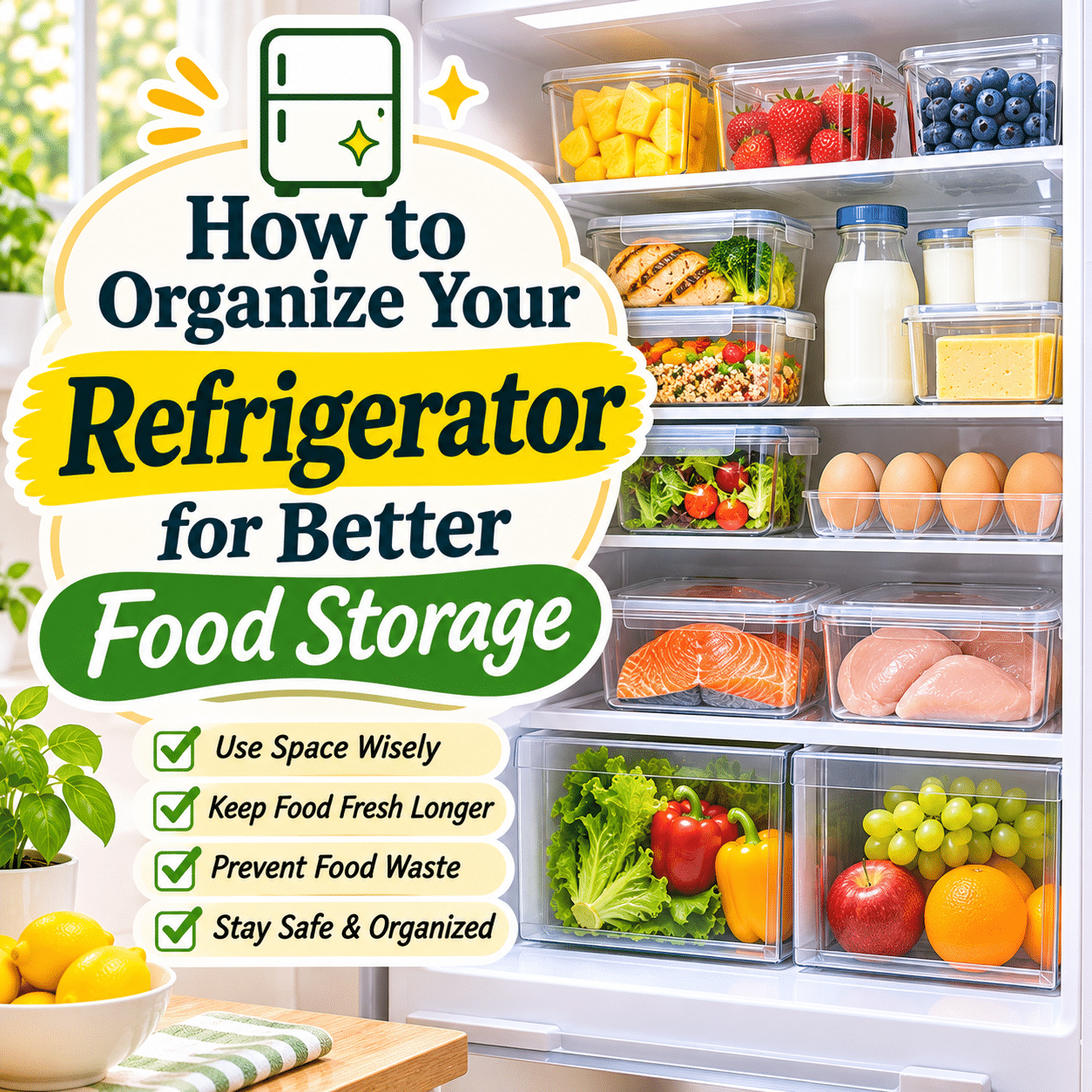
A well-organized refrigerator does more than make your kitchen look neat. It helps you find ingredients quickly, maintain appropriate food storage conditions, reduce unnecessary waste, and make everyday meal preparation more convenient.
The refrigerator is one of the most frequently used appliances in a home. Fresh produce, dairy products, beverages, leftovers, condiments, and prepared meals all compete for limited shelf space. Without a practical organization system, food can easily become hidden behind other containers, forgotten in crowded drawers, or stored in locations that are not ideal for maintaining freshness.
Over time, these small problems can create larger inconveniences. You may purchase ingredients you already own, discover spoiled food too late, or spend unnecessary time searching for items while cooking.
Fortunately, effective refrigerator organization does not require expensive storage accessories or a perfectly arranged collection of matching containers.
The most important steps involve understanding refrigerator temperature zones, grouping foods appropriately, preventing cross-contamination, improving visibility, and establishing simple habits that keep the system working.
Whether you have a compact refrigerator in a small apartment or a larger family refrigerator with multiple compartments, the same basic principles can help you make better use of available space.
This guide explains how to organize refrigerator shelves, drawers, and door compartments, store different food categories safely, manage leftovers, and create a practical maintenance routine that supports everyday kitchen efficiency.
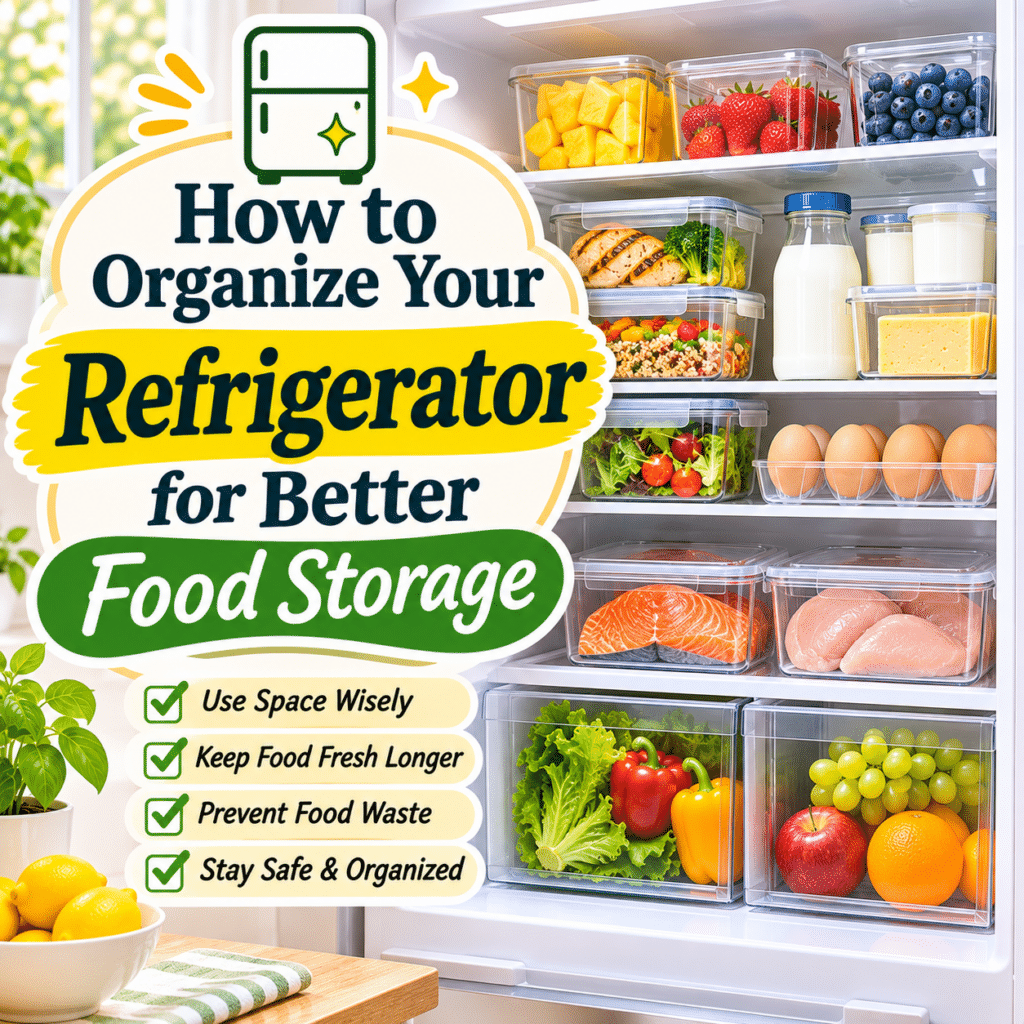
1. Understand Why Refrigerator Organization Matters
Refrigerator organization serves several important purposes.
First, it helps protect food by supporting appropriate storage conditions.
Second, it makes ingredients easier to find and retrieve.
Third, it reduces the likelihood of forgetting food until it becomes unusable.
Finally, it makes grocery shopping, cooking, and cleaning more manageable.
A practical refrigerator organization system can help you:
- Locate frequently used ingredients quickly.
- Reduce unnecessary duplicate purchases.
- Keep raw foods separate from ready-to-eat items.
- Improve visibility of foods that should be used soon.
- Maintain adequate airflow around stored items.
- Make meal preparation more efficient.
- Simplify refrigerator cleaning.
- Reduce avoidable household food waste.
However, organization alone does not guarantee food safety.
Correct temperatures, appropriate packaging, hygienic handling, and suitable storage times are equally important.
2. Understand How Refrigerator Temperature Affects Food Storage
Refrigeration slows the growth of many microorganisms that can cause food spoilage or foodborne illness.
However, refrigeration does not stop all microbial growth or make food safe indefinitely.
For general household food safety, the U.S. Food and Drug Administration recommends maintaining refrigerator temperatures at or below 40°F (4°C).
A practical target is approximately 37°F (3°C), provided the refrigerator maintains safe and consistent temperatures without unintentionally freezing sensitive foods.
Freezers should generally be maintained at 0°F (-18°C) or below.
Use an appliance thermometer to check actual temperatures rather than relying entirely on a refrigerator’s control dial.
Temperature can vary according to appliance design, door-opening frequency, loading conditions, and ambient temperature.
3. Learn the Main Refrigerator Storage Zones
Most refrigerators contain several storage areas designed for different purposes.
These may include:
- Upper shelves.
- Middle shelves.
- Lower shelves.
- Crisper drawers.
- Door compartments.
- Specialty temperature-controlled drawers.
The temperature and humidity characteristics of these areas vary by refrigerator model.
In many conventional refrigerators, door compartments experience greater temperature fluctuations because they are exposed to warmer air when the door opens.
Some appliances also have specialized compartments with independent temperature controls.
Always follow the manufacturer’s guidance for your specific refrigerator.
A general organization framework can still help you decide where different foods belong.
| Refrigerator Area | Common Storage Uses | Important Consideration |
|---|---|---|
| Upper shelves | Ready-to-eat foods, suitable leftovers | Keep food covered and accessible |
| Middle shelves | Dairy products, prepared foods, packaged ingredients | Maintain appropriate refrigeration |
| Lower shelves | Securely contained raw meat, poultry, seafood | Prevent drips and cross-contamination |
| Crisper drawers | Fruits and vegetables | Adjust humidity where available |
| Door compartments | Condiments, suitable beverages | Avoid highly temperature-sensitive foods |
| Specialty drawers | Foods specified by the manufacturer | Follow temperature settings and instructions |
These are general guidelines rather than universal rules.
4. Start by Emptying and Assessing Your Refrigerator
Before reorganizing, examine the current contents.
For a thorough cleaning, remove food in manageable sections.
Keep perishable foods appropriately chilled while you work, especially if cleaning will take more than a brief period.
Use a cooler with sufficient ice or cold packs when necessary.
As you remove items, group them into categories.
For example:
- Fresh vegetables.
- Fresh fruit.
- Dairy products.
- Eggs.
- Raw meat and seafood.
- Cooked leftovers.
- Prepared meals.
- Condiments.
- Beverages.
- Packaged foods.
This process helps reveal overcrowded areas, forgotten ingredients, and unnecessary duplicates.
It also provides an opportunity to inspect containers for leaks or damage.
5. Check Food Condition Before Restocking
Refrigerator organization should begin with a careful review of what is safe and useful to keep.
Inspect food packaging, storage dates, and visible condition.
Discard food that is clearly spoiled or has been stored beyond applicable safety guidance.
Do not taste questionable food to determine whether it is safe.
Some harmful microorganisms do not produce noticeable changes in smell, taste, or appearance.
Also distinguish between different date labels.
A quality-related date such as “best if used by” does not always indicate a food safety deadline.
However, certain products have specific safety-related dating requirements.
Follow product instructions and applicable food safety guidance rather than relying on dates alone.
6. Clean Refrigerator Shelves and Drawers
An organized refrigerator should begin with clean storage surfaces.
Remove detachable shelves and drawers according to the appliance instructions.
Wash suitable components with mild detergent and water.
Avoid exposing cold glass shelves to sudden temperature changes, which may cause damage.
Wipe interior surfaces using cleaning methods recommended by the refrigerator manufacturer.
Pay attention to:
- Shelf corners.
- Drawer tracks.
- Door compartments.
- Seals and gaskets.
- Areas beneath containers.
- Locations where liquids may have spilled.
Dry surfaces appropriately before replacing food.
For spills involving raw meat juices or other potentially hazardous contamination, follow appropriate cleaning and sanitizing guidance.
Never mix incompatible cleaning chemicals.
7. Create Clear Food Storage Categories
Grouping similar foods makes the refrigerator easier to navigate.
Common categories include:
- Ready-to-eat meals.
- Dairy and eggs.
- Fresh vegetables.
- Fresh fruit.
- Raw proteins.
- Condiments and sauces.
- Beverages.
- Meal preparation ingredients.
- Foods that should be used soon.
Each category should have a reasonably consistent storage location.
However, do not force unrelated foods into one compartment simply to create visual symmetry.
Food safety, temperature requirements, and accessibility should guide the arrangement.
8. Organize Upper Refrigerator Shelves
Upper shelves can be convenient for ready-to-eat foods and prepared meals.
Suitable items may include:
- Covered leftovers.
- Prepared lunches.
- Ready-to-eat snacks.
- Cooked ingredients.
- Packaged foods requiring refrigeration.
Keep food in clean, suitable containers.
Place frequently used items toward the front.
Avoid stacking containers so high that they become unstable or obstruct airflow.
If you use a refrigerator with a different cooling configuration, follow its recommended storage arrangement.
9. Organize Middle Refrigerator Shelves
Middle shelves are often practical for foods that require consistent refrigeration.
Depending on refrigerator design, these may include:
- Milk.
- Yogurt.
- Cheese.
- Eggs.
- Tofu.
- Prepared ingredients.
- Suitable refrigerated packaged foods.
Keep highly perishable foods away from areas with significant temperature fluctuations.
Avoid placing containers directly against cooling vents when the manufacturer advises against it.
Use clear grouping so that frequently used ingredients remain easy to locate.
10. Store Raw Meat, Poultry, and Seafood Safely
Raw animal proteins require careful storage to prevent cross-contamination.
Keep raw meat, poultry, and seafood in secure packaging or leakproof containers.
Place them on a lower shelf or in a dedicated compartment where leaking juices cannot drip onto ready-to-eat foods.
Do not place uncovered raw proteins above cooked meals, vegetables, or dairy products.
Follow food-specific refrigerated storage recommendations.
For example, under general U.S. FoodSafety.gov guidance:
| Raw Food | Typical Refrigerator Storage Time at 40°F / 4°C or Below |
|---|---|
| Raw poultry | 1–2 days |
| Raw ground meat | 1–2 days |
| Raw beef, pork, lamb, or veal steaks and roasts | 3–5 days |
| Raw fish | Commonly 1–3 days, depending on type |
| Raw sausage | Often 1–2 days |
These are general examples. Specific products, packaging, and manufacturer instructions may require different handling.
Freeze suitable foods promptly if they will not be used within their recommended refrigerated storage period.
11. Organize Refrigerator Crisper Drawers
Crisper drawers are designed to help manage conditions around fresh produce.
Some refrigerators provide adjustable humidity settings.
High-humidity settings can help certain vegetables retain moisture.
Low-humidity settings may be more suitable for produce that benefits from greater moisture release.
However, the ideal arrangement depends on the appliance and the specific fruits and vegetables.
Use the manufacturer’s recommendations as your starting point.
Avoid overcrowding drawers.
Allow enough space to inspect produce and remove individual items without damaging others.
12. Understand High-Humidity and Low-Humidity Storage
Different fruits and vegetables have different storage requirements.
A general approach is:
| Produce Category | Common Storage Preference | Examples |
|---|---|---|
| Leafy vegetables | Higher humidity | Lettuce, spinach, leafy greens |
| Many firm vegetables | Higher humidity | Carrots, broccoli |
| Certain fruits | Lower humidity | Apples, pears |
| Some ripening fruits | Lower humidity or appropriate separate storage | Selected stone fruits |
| Produce sensitive to chilling | May require room-temperature storage | Certain tropical fruits and vegetables |
These are broad guidelines.
Some produce releases ethylene gas, which can accelerate ripening or deterioration in ethylene-sensitive produce.
Separating incompatible produce categories can help maintain quality.
Not all fruits and vegetables belong in the refrigerator.
13. Store Leafy Greens Properly
Leafy vegetables can deteriorate quickly when exposed to excess moisture or poor storage conditions.
Common examples include:
- Lettuce.
- Spinach.
- Kale.
- Arugula.
- Fresh herbs.
Remove visibly damaged leaves.
Follow appropriate produce washing guidance.
If washing before storage, dry the leaves thoroughly.
Use suitable containers or packaging that help manage moisture without trapping excessive water.
Keep leafy greens refrigerated when required.
Avoid placing heavy produce on top of delicate leaves.
Check their condition regularly.
14. Organize Fresh Vegetables by Type
Vegetables differ in their sensitivity to moisture, temperature, and physical damage.
For example, carrots and broccoli generally benefit from refrigeration, while whole potatoes and dry onions are usually better stored in appropriate cool, dry, ventilated locations outside the refrigerator.
Tomatoes may be stored differently depending on ripeness and intended use.
Cut vegetables typically require refrigeration.
Group compatible vegetables together.
Use suitable containers or produce bags.
Avoid washing every vegetable in advance unless you can dry and store it appropriately.
The objective is to maintain freshness while keeping ingredients visible.
15. Store Fresh Fruit Appropriately
Not every fruit should be refrigerated immediately.
Some fruits benefit from ripening at room temperature before being moved to the refrigerator.
Others are best refrigerated soon after purchase.
Examples of fruits commonly refrigerated include:
- Berries.
- Grapes.
- Cherries.
- Cut melon.
- Cut fruit mixtures.
Whole bananas and certain tropical fruits may be sensitive to chilling.
Store fruit according to its ripeness, type, and recommended conditions.
Keep cut fruit refrigerated promptly.
Avoid placing delicate berries beneath heavier produce.
16. Separate Ethylene-Producing and Ethylene-Sensitive Produce
Ethylene is a naturally occurring plant hormone involved in ripening.
Certain fruits release substantial amounts of ethylene.
Examples include apples, ripe bananas, pears, and some stone fruits.
Some vegetables are sensitive to ethylene exposure.
When incompatible produce is stored together, quality may decline more quickly.
Separate categories when practical.
For example, storing leafy greens away from high-ethylene-producing fruits may help maintain their quality.
However, produce behavior varies by type, ripeness, and storage conditions.
Use this principle as a practical guide rather than assuming every fruit and vegetable requires a separate container.
17. Organize Dairy Products for Consistent Refrigeration
Milk, yogurt, cheese, and other dairy products should be stored according to their packaging instructions.
Highly perishable dairy products generally benefit from consistent refrigeration.
In many refrigerators, interior shelves provide more stable conditions than door compartments.
Keep containers closed when not in use.
Avoid leaving dairy products at room temperature unnecessarily.
For cheese, choose storage methods appropriate to the type.
Soft cheeses and hard cheeses may have different handling and storage requirements.
Discard products that show unsafe deterioration or exceed applicable food safety recommendations.
18. Store Eggs in an Appropriate Location
Egg storage recommendations vary across countries because production, washing, processing, and distribution practices differ.
In the United States, commercially refrigerated eggs should remain refrigerated.
Store them in their original carton on an interior refrigerator shelf rather than a frequently opened door compartment.
The carton helps protect eggs and preserves important product information.
In other countries, guidance may differ for eggs sold unrefrigerated.
Follow local food safety recommendations and the storage instructions applicable to the eggs you purchase.
Avoid moving refrigerated eggs repeatedly between warm and cold environments.
19. Organize Refrigerator Door Compartments
Refrigerator doors are convenient but often experience greater temperature fluctuations.
They are generally better suited to foods that tolerate these changes within their labeled storage requirements.
Examples may include:
- Certain condiments.
- Some bottled sauces.
- Suitable beverages.
- Pickles and preserved products requiring refrigeration after opening.
However, not all sauces or condiments have identical storage requirements.
Follow product labels.
Avoid using door compartments for highly perishable foods when more stable interior storage is available.
Do not overload door shelves beyond their intended capacity.
20. Organize Condiments and Sauces
Condiments can gradually occupy a surprising amount of refrigerator space.
Common examples include:
- Mustard.
- Ketchup.
- Salad dressings.
- Mayonnaise.
- Hot sauces.
- Cooking sauces.
- Pickled products.
- Opened spreads.
Group them by purpose or frequency of use.
Check storage instructions after opening.
Review expiration and opening dates when relevant.
Avoid keeping multiple nearly empty bottles when their contents are no longer useful.
Clean sticky container exteriors before returning them to shelves.
21. Create a Dedicated Leftovers Area
Leftovers are easier to manage when they have a consistent location.
Choose an accessible shelf or clearly defined section.
Use suitable food-safe containers.
Label leftovers with their contents and preparation date.
Place older usable leftovers toward the front.
Do not store newly prepared food in front of older containers if this makes the older food easy to forget.
A dedicated leftovers area can help reduce unnecessary food waste.
However, follow food-specific safety timelines rather than assuming all leftovers remain safe for the same number of days.
22. Understand Safe Leftover Storage Times
Under general U.S. food safety guidance, many cooked leftovers can be refrigerated for approximately three to four days when handled and stored properly.
However, some foods have shorter recommended storage periods.
For example, certain food safety authorities recommend refrigerating cooked rice promptly and consuming it within 24 hours.
Cooked rice requires particular care because Bacillus cereus spores may survive cooking and grow when rice is held at unsafe temperatures.
Always follow applicable food-specific guidance.
If suitable leftovers will not be eaten within their safe refrigerated storage period, freeze them promptly.
Do not rely on reheating to make improperly stored food safe.
23. Cool Cooked Food Before Long-Term Storage
Cooked food should be cooled promptly and refrigerated safely.
Under general U.S. food safety guidance, perishable food should be refrigerated within two hours, or within one hour when ambient temperatures exceed 90°F (32°C).
Large quantities should be divided into shallow containers to promote faster cooling.
You do not need to leave hot food on the counter until it reaches room temperature.
Suitable shallow containers of hot food can be placed directly into the refrigerator.
Avoid placing a large, tightly covered pot of hot food in a crowded refrigerator if it prevents effective cooling.
Follow appropriate rapid-cooling practices for large batches.
24. Use Clear Containers to Improve Visibility
Transparent containers can help you identify prepared food without opening every lid.
They may be useful for:
- Leftovers.
- Cut vegetables.
- Prepared fruit.
- Meal prep components.
- Suitable snacks.
- Cooked ingredients.
Choose containers that are appropriate for food contact and refrigeration.
Avoid purchasing large quantities before measuring your refrigerator shelves.
Containers should improve accessibility rather than consume unnecessary space.
Opaque containers can also work well when labeled clearly.
25. Choose Suitable Refrigerator Storage Containers
Different containers serve different purposes.
| Container Type | Common Uses | Important Considerations |
|---|---|---|
| Glass containers | Leftovers and prepared meals | Heavy and breakable |
| Food-grade plastic containers | Portable meals and ingredients | Check temperature and use instructions |
| Produce containers | Selected fruits and vegetables | Match ventilation and moisture needs |
| Sealed containers | Suitable prepared foods | Use only when appropriate for the contents |
| Shallow containers | Cooling and storing cooked foods | Promote more efficient cooling |
| Divided containers | Separating meal components | Check sealing and cleaning requirements |
| Reusable bags | Suitable produce and ingredients | Clean and maintain appropriately |
Avoid assuming that every container is suitable for microwaving, freezing, or dishwashing.
Follow manufacturer instructions.
26. Avoid Overcrowding Refrigerator Shelves
A refrigerator needs adequate airflow to maintain consistent cooling.
Overcrowding may restrict air circulation and create uneven temperatures.
Avoid pressing containers tightly against vents.
Do not stack items in unstable arrangements.
Leave enough space to retrieve food without removing several unrelated containers.
If the refrigerator is consistently full, review whether you are storing unnecessary items.
Some foods may not require refrigeration.
Others may be better frozen if they will not be used soon.
Efficient refrigerator organization is not about filling every available space.
27. Arrange Food According to Frequency of Use
Frequently used foods should be easy to reach.
Examples may include:
- Milk or preferred beverages.
- Yogurt.
- Everyday vegetables.
- Prepared lunch ingredients.
- Common condiments.
- Frequently used cooking ingredients.
Place these items in accessible locations that also meet their storage requirements.
Occasional-use foods can occupy secondary spaces.
Avoid placing highly perishable foods in unsuitable temperature zones simply because those locations are convenient.
Safety and accessibility should work together.
28. Create a “Use First” Section
A designated “Use First” area can help reduce food waste.
This section is intended for food that remains safe but should be consumed relatively soon.
Examples include:
- Produce approaching the end of its useful quality period.
- Opened ingredients with limited remaining storage time.
- Properly stored leftovers nearing their recommended consumption date.
- Dairy products that should be used soon.
Use a small labeled container or designated shelf area.
Check food safety requirements before deciding what belongs there.
Do not place spoiled or potentially unsafe food in this section.
The purpose is to prioritize suitable ingredients, not extend their storage life.
29. Practice First In, First Out Organization
First In, First Out, often abbreviated FIFO, is a simple inventory management principle.
It means using older suitable products before newer ones when appropriate.
For example, when adding a new container of yogurt, place it behind an older unopened container that remains safe to use.
Apply the same principle to suitable packaged ingredients.
However, actual use order should consider expiration dates, opening dates, and food condition.
An item purchased more recently may have an earlier use-by date.
Prioritize food safety and relevant product dates over purchase order alone.
30. Label Prepared and Opened Foods
Labels can help track refrigerator contents.
Useful information may include:
- Food name.
- Preparation date.
- Opening date.
- Relevant storage instructions.
- Intended consumption date.
For example:
Vegetable Soup — Prepared Monday
or
Opened Tomato Sauce — Wednesday
Use removable labels or a marker suitable for the container.
Keep the system simple enough to maintain consistently.
Not every packaged product needs an additional label if its original information remains clear.
31. Organize Meal Prep Ingredients Efficiently
Meal prepping can become easier when prepared ingredients have dedicated storage locations.
Group suitable items such as:
- Cooked proteins.
- Prepared vegetables.
- Sauces.
- Grains.
- Ready-to-assemble meal components.
Keep raw animal proteins separate from cooked and ready-to-eat ingredients.
Use containers that allow easy identification.
Arrange foods according to their safe storage periods.
If you prepare meals for several days, freeze suitable later portions promptly rather than keeping everything refrigerated for the entire week.
32. Organize a Small Refrigerator
Compact refrigerators require careful prioritization.
Begin by identifying foods that genuinely need refrigeration.
Avoid storing unnecessary duplicates.
Use appropriately sized containers.
Group similar items without creating unstable stacks.
Keep frequently used foods visible.
Avoid oversized storage bins that consume more shelf space than they save.
Check that door compartments and shelves can support the intended loads.
In a small refrigerator, a simple arrangement is often more effective than an elaborate system.
33. Organize a Large Family Refrigerator
Larger refrigerators provide more storage space but can also make food easier to forget.
Create clear zones for different categories.
For example:
- Ready-to-eat meals.
- Dairy products.
- Fresh produce.
- Raw proteins.
- Leftovers.
- Beverages.
- Condiments.
Consider labeling shared storage areas when multiple household members use the refrigerator.
Keep frequently used family foods accessible.
Review large quantities of perishable food regularly.
More space does not automatically prevent waste.
A clear system remains important.
34. Adapt Refrigerator Storage for Different Household Needs
Refrigerator organization should reflect the people using it.
A household that cooks frequently may need more space for raw ingredients.
Someone who meal preps may require additional space for prepared portions.
Families may benefit from accessible snack sections.
People with mobility limitations may need frequently used items at comfortable reaching heights.
However, storage accessibility should never compromise food safety.
For example, raw meat should still be contained and positioned to prevent contamination.
Choose an arrangement that balances convenience, hygiene, and the refrigerator’s design.
35. Establish a Weekly Refrigerator Reset
A short weekly review can prevent clutter from accumulating.
Choose a convenient time, such as before grocery shopping.
During the review:
- Check leftovers.
- Inspect fresh produce.
- Remove spoiled or unsafe food.
- Review opened containers.
- Identify ingredients that should be used soon.
- Wipe visible spills.
- Rearrange items for accessibility.
- Update your grocery list.
This process does not need to involve a complete refrigerator cleaning every week.
The goal is to maintain visibility and prevent forgotten food.
36. Create a Monthly Refrigerator Cleaning Routine
A more thorough cleaning can be scheduled periodically according to actual conditions.
Possible tasks include:
- Cleaning shelves.
- Washing removable drawers.
- Wiping door compartments.
- Inspecting door seals.
- Cleaning accessible interior surfaces.
- Checking for leaks.
- Reviewing storage containers.
- Confirming refrigerator temperature.
Follow appliance instructions.
Avoid using abrasive tools or unsuitable chemicals.
If you notice persistent temperature problems, unusual condensation, or damaged seals, investigate the cause.
Cleaning cannot compensate for a refrigerator that fails to maintain safe temperatures.
37. Reduce Refrigerator Odors Through Better Storage
Unpleasant refrigerator odors may result from spoiled food, spills, leaking containers, or neglected surfaces.
The most effective response is to identify and remove the source.
Check hidden corners, drawers, and container lids.
Clean affected surfaces appropriately.
Keep strong-smelling foods in suitable closed containers.
Avoid using fragrances to cover persistent odors without investigating their cause.
If odors continue despite cleaning, inspect the refrigerator according to manufacturer guidance.
Do not assume that odor-absorbing products can replace hygienic food storage and regular cleaning.
38. Avoid Common Refrigerator Organization Mistakes
Several mistakes can reduce refrigerator efficiency.
1. Overcrowding shelves.
Leave space for appropriate airflow.
2. Storing raw meat above ready-to-eat food.
Prevent drips and cross-contamination.
3. Keeping highly perishable foods in unstable temperature zones.
Use appropriate interior storage.
4. Ignoring refrigerator temperature.
Check actual conditions with an appliance thermometer.
5. Keeping leftovers without dates.
Label prepared food when useful.
6. Storing every fruit and vegetable together.
Consider produce-specific storage requirements.
7. Using oversized organizers.
Measure shelves before purchasing accessories.
8. Forgetting food hidden at the back.
Improve visibility and review contents regularly.
9. Leaving cooked food at room temperature too long.
Cool and refrigerate promptly.
10. Relying on smell to determine food safety.
Follow appropriate storage times and handling guidance.
11. Ignoring leaks and moisture problems.
Investigate underlying causes.
12. Organizing only for appearance.
Prioritize food safety and everyday functionality.
39. Troubleshoot Common Refrigerator Storage Problems
| Problem | Possible Cause | Practical Solution |
|---|---|---|
| Food gets forgotten | Poor visibility | Group categories and create a “Use First” area |
| Produce spoils quickly | Unsuitable humidity or storage | Adjust produce storage according to type |
| Refrigerator feels overcrowded | Too many items or oversized containers | Review contents and simplify storage |
| Leftovers accumulate | No consumption plan | Label dates and freeze suitable portions |
| Raw food leaks | Inadequate packaging | Use secure, leakproof containers |
| Food freezes unexpectedly | Cold spots or incorrect settings | Check temperature and appliance guidance |
| Refrigerator smells unpleasant | Spoiled food or spills | Identify the source and clean appropriately |
| Dairy products warm too quickly | Unstable storage location | Use a suitable interior shelf |
| Containers are difficult to stack | Incompatible sizes | Choose practical, stable storage formats |
| Condiments occupy too much space | Duplicates or forgotten bottles | Review opened products |
| Refrigerator temperature varies | Door openings, loading, or appliance issues | Monitor temperature and investigate |
| Organization does not last | Categories are unclear | Simplify storage zones and maintain a weekly reset |
40. Build Refrigerator Organization Habits That Last
A refrigerator organization system should be easy to maintain during ordinary household routines.
Give major food categories consistent locations.
Return ingredients after use.
Keep raw foods securely contained.
Label leftovers when necessary.
Review produce before buying more.
Use suitable older foods before newer purchases when appropriate.
Clean spills promptly.
Check refrigerator temperature periodically.
Avoid purchasing more perishable food than your household can reasonably use.
As your cooking habits, household size, and shopping routines change, adjust the organization system accordingly.
The best arrangement is one that supports daily food preparation while maintaining appropriate storage conditions.
Step-by-Step Guide: Organize Your Refrigerator From Start to Finish
Follow this process to create a practical refrigerator storage system.
Step 1: Check the Temperature
Confirm that the refrigerator maintains an appropriate temperature, generally at or below 40°F (4°C).
Step 2: Prepare a Temporary Cold Storage Area
Use suitable cooling equipment if perishable foods will be outside the refrigerator for an extended period.
Step 3: Remove and Sort Food
Group items by category.
Step 4: Inspect Food Condition
Discard spoiled or unsafe products.
Step 5: Clean Shelves and Drawers
Follow appliance cleaning instructions.
Step 6: Identify Refrigerator Storage Zones
Review the manufacturer’s guidance for shelves, drawers, and specialty compartments.
Step 7: Assign Food Categories
Choose suitable locations for produce, dairy, prepared foods, raw proteins, and condiments.
Step 8: Store Raw Proteins Safely
Use leakproof packaging and prevent cross-contamination.
Step 9: Organize Fruits and Vegetables
Consider humidity, ethylene sensitivity, and produce-specific requirements.
Step 10: Arrange Prepared Foods and Leftovers
Use suitable containers and labels.
Step 11: Create a “Use First” Area
Place safe foods that should be consumed soon in an accessible location.
Step 12: Check Airflow and Accessibility
Avoid overcrowding and unstable stacks.
Step 13: Establish a Weekly Review
Check contents before grocery shopping.
Step 14: Adjust the System as Needed
Update storage locations according to your household’s changing needs.
Practical Refrigerator Organization Checklist
Food Safety
- Maintain refrigerator temperature at or below 40°F (4°C).
- Use an appliance thermometer.
- Keep raw meat and seafood securely contained.
- Prevent raw food juices from contacting ready-to-eat foods.
- Follow appropriate refrigerated storage times.
- Cool cooked food promptly.
- Freeze suitable food before its safe refrigerated storage period ends.
- Avoid relying on smell alone to determine food safety.
Shelf Organization
- Assign clear storage zones.
- Keep frequently used foods accessible.
- Group similar ingredients.
- Avoid overcrowding.
- Maintain airflow around stored food.
- Use suitable containers.
- Keep heavy containers stable.
- Follow appliance-specific storage recommendations.
Produce Storage
- Separate fruits and vegetables when appropriate.
- Use suitable crisper humidity settings.
- Protect delicate leafy greens.
- Refrigerate cut produce promptly.
- Consider ethylene-producing and sensitive produce.
- Remove spoiled produce.
- Review produce before buying more.
Leftovers and Meal Prep
- Use clean food-safe containers.
- Label prepared meals when useful.
- Record preparation dates.
- Create a dedicated leftovers area.
- Prioritize foods that should be used soon.
- Follow food-specific storage guidance.
- Freeze suitable extra portions promptly.
Regular Maintenance
- Review refrigerator contents weekly.
- Wipe spills promptly.
- Check opened condiments.
- Inspect door seals.
- Clean drawers and shelves as needed.
- Monitor refrigerator temperature.
- Update grocery lists based on existing ingredients.
- Adjust storage zones when household needs change.
Frequently Asked Questions
1. What is the best way to organize a refrigerator?
Group foods by category, use appropriate temperature zones, keep raw animal proteins separate from ready-to-eat foods, and maintain clear visibility. Follow the refrigerator manufacturer’s storage recommendations.
2. What temperature should a refrigerator be?
General U.S. food safety guidance recommends maintaining refrigerator temperatures at or below 40°F (4°C). A target around 37°F (3°C) can provide a useful margin when the appliance operates consistently.
3. Where should raw meat be stored in the refrigerator?
Store raw meat, poultry, and seafood in secure, leakproof packaging on a lower shelf or in a designated compartment where juices cannot contaminate ready-to-eat foods.
4. Should milk be stored in the refrigerator door?
Interior shelves generally provide more consistent temperatures than door compartments. Highly perishable dairy products are usually better stored in a suitable interior location.
5. Where should eggs be stored?
For eggs sold under refrigerated distribution systems, such as those commonly used in the United States, store them in their original carton on an interior shelf. Follow local guidance for eggs sold under different handling systems.
6. What should go in refrigerator crisper drawers?
Crisper drawers are generally intended for fruits and vegetables. Use humidity settings according to the produce type and the refrigerator manufacturer’s instructions.
7. How do I keep vegetables fresh longer?
Store vegetables according to their individual requirements, manage excess moisture, use appropriate containers, and avoid overcrowding. Separate ethylene-sensitive produce from high-ethylene-producing fruits when practical.
8. How long can leftovers stay in the refrigerator?
Many cooked leftovers can generally be refrigerated for three to four days under U.S. guidance when handled properly. Certain foods may have shorter recommended storage periods, so follow food-specific guidance.
9. Should I use clear containers in my refrigerator?
Clear containers can improve visibility, but they are not essential. Suitable labeled opaque containers may work equally well. Choose containers based on food safety, dimensions, and convenience.
10. How can I organize a small refrigerator?
Prioritize foods that require refrigeration, use appropriately sized containers, group similar items, and avoid overcrowding. Keep frequently used ingredients visible and accessible.
11. What is a “Use First” refrigerator bin?
It is a designated area for safe food that should be consumed soon. It can help prevent ingredients and leftovers from being forgotten.
12. How often should I clean my refrigerator?
Clean spills promptly, review food regularly, and perform more thorough cleaning according to actual conditions and appliance guidance. There is no universal cleaning frequency suitable for every household.
13. Why does food spoil quickly in my refrigerator?
Possible causes include incorrect temperatures, poor packaging, unsuitable humidity, extended storage, or appliance problems. Check the refrigerator temperature and food-specific storage requirements.
14. Can an overcrowded refrigerator affect cooling?
Yes. Excessive crowding can restrict airflow and contribute to uneven temperatures. Arrange food so that cooling vents and necessary air circulation remain unobstructed.
15. How can refrigerator organization reduce food waste?
Clear categories, visible ingredients, labeled leftovers, appropriate storage conditions, and regular reviews can help you use food before it becomes spoiled or forgotten.
Final Thoughts
Organizing your refrigerator for better food storage is about creating a practical balance between food safety, accessibility, freshness, and everyday convenience.
A well-arranged refrigerator makes it easier to locate ingredients, prepare meals, manage leftovers, and understand what food is already available before shopping.
The process begins with maintaining appropriate temperatures and understanding how different refrigerator compartments function. From there, grouping foods by category, protecting raw ingredients from cross-contamination, and choosing suitable containers can improve storage efficiency.
Fresh produce benefits from thoughtful humidity management and produce-specific storage methods. Dairy products, eggs, prepared meals, and leftovers require appropriate refrigeration and attention to storage times.
Regular maintenance is equally important. A short weekly review, prompt spill cleanup, and occasional deeper cleaning can prevent clutter and help identify food that needs attention.
You do not need a refrigerator filled with matching organizers or perfectly arranged containers. Simple, consistent storage categories are often more useful than elaborate systems.
As your household’s cooking habits and food preferences change, your refrigerator organization can change with them.
The best refrigerator organization system is not the one that looks the most perfect, but the one that keeps food safer, makes ingredients easier to find, and helps your household waste less while enjoying everyday meals.