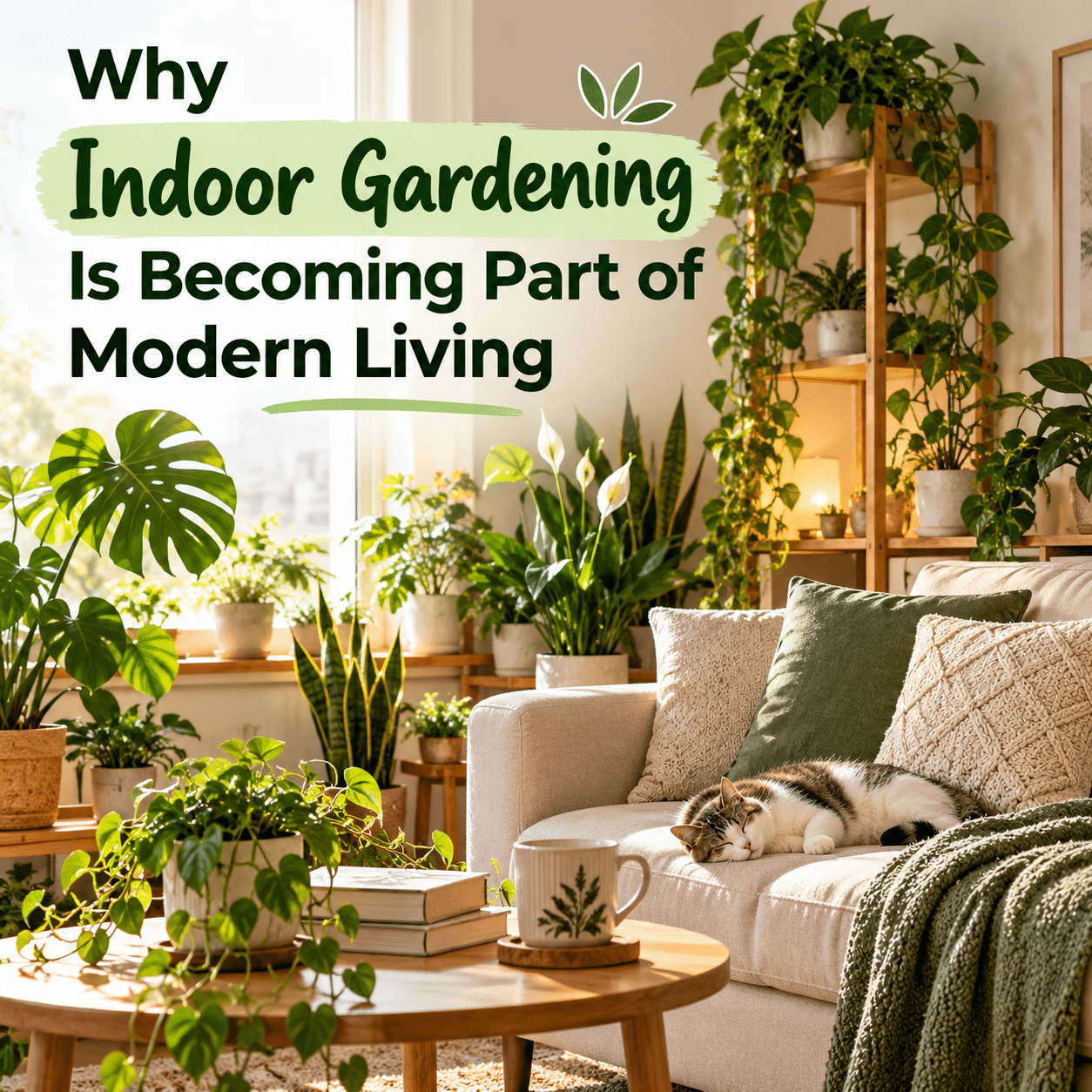
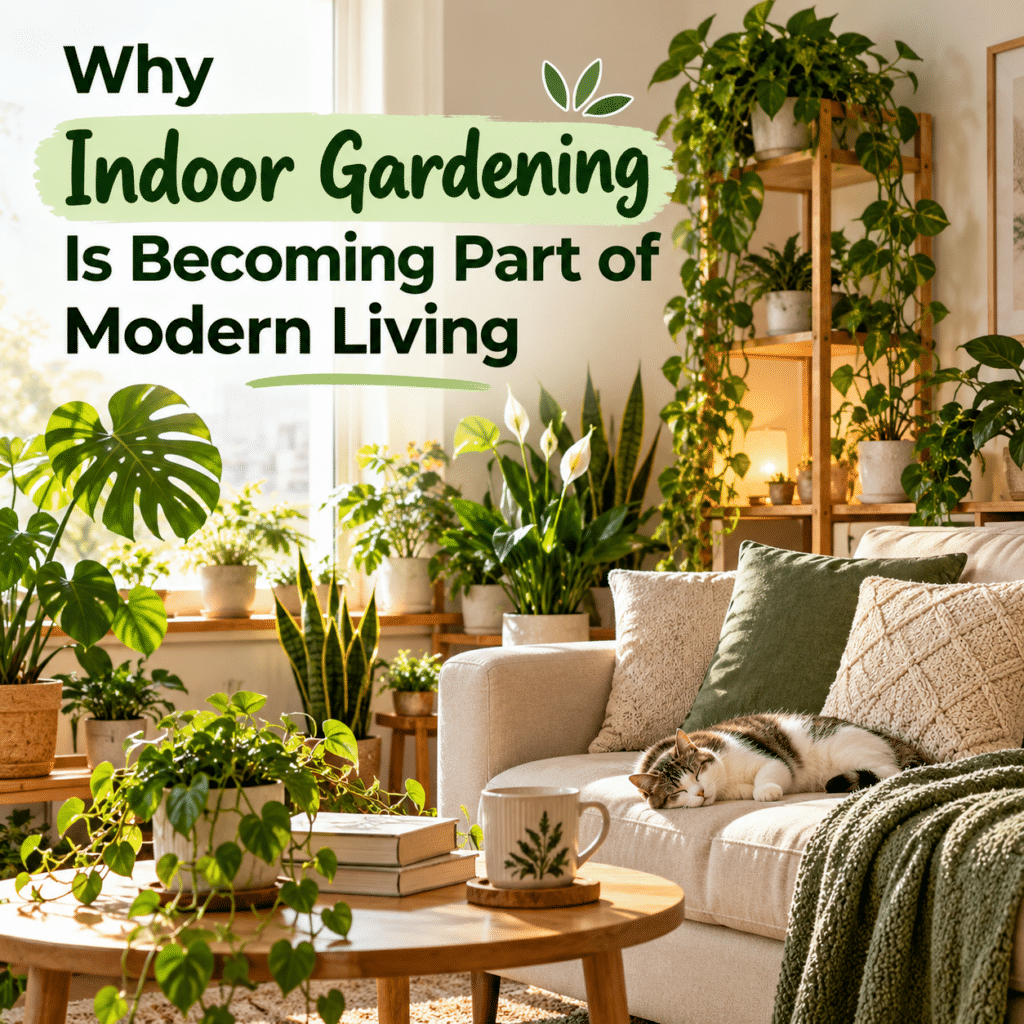
Indoor gardening is no longer limited to a few decorative plants on a windowsill. It has become a practical, creative, and increasingly accessible way to bring nature into everyday living spaces. From compact apartments and home offices to spacious family homes, people are discovering that growing plants indoors can add beauty, encourage mindful routines, and make better use of available space.
What makes indoor gardening particularly appealing is its flexibility. A small collection of houseplants can brighten a room, a kitchen herb garden can provide fresh ingredients for cooking, and a carefully designed indoor growing area can become a rewarding hobby. There is no single approach that works for everyone, and that adaptability is one of indoor gardening’s greatest strengths.
Modern homes are also changing. More people are looking for living spaces that support comfort, personal expression, practical activities, and a closer connection with natural elements. Indoor gardening fits naturally into these priorities without requiring a backyard or extensive gardening experience.
Understanding why indoor gardening has become part of modern living involves more than appreciating attractive greenery. It means exploring how plants interact with interior design, everyday routines, technology, available space, and the desire to create a more enjoyable home environment.
This guide examines the practical benefits, limitations, design possibilities, and essential considerations behind indoor gardening—and how anyone can begin developing a growing space that suits their lifestyle.
1. What Is Indoor Gardening?
Indoor gardening is the practice of growing and caring for plants within enclosed or partially enclosed spaces, including homes, apartments, offices, and other buildings.
Unlike traditional outdoor gardening, indoor gardening depends on managing conditions that plants would normally experience outdoors. Light, water, temperature, humidity, airflow, and growing media all influence how successfully plants adapt to an indoor environment.
Indoor gardening can include several different approaches:
- Decorative houseplants: Plants grown primarily for their appearance, foliage, or flowers.
- Indoor herb gardens: Culinary herbs grown near kitchens or other convenient locations.
- Container gardening: Plants cultivated in pots, planters, or specialized containers.
- Hydroponic gardening: Growing plants with nutrients supplied through water-based systems rather than conventional soil.
- Vertical gardening: Using shelves, wall-mounted systems, or other upright structures to organize plants.
- Indoor seed starting: Growing seedlings indoors before transferring them outdoors when conditions are suitable.
- Terrariums: Small enclosed or partially enclosed plant environments designed around compatible species.
These approaches serve different purposes. Some focus on decoration, others on producing edible plants, and many combine aesthetic and practical goals.
Indoor gardening does not have to involve advanced equipment. A suitable plant, an appropriately sized container, and adequate natural light may be enough to begin.
The most successful approach is usually the one that matches the available environment and the gardener’s willingness to provide consistent care.
2. Why Indoor Gardening Fits Modern Lifestyles
Modern living often involves balancing limited space, busy schedules, changing work arrangements, and a desire for comfortable surroundings.
Indoor gardening offers a flexible activity that can be adapted to these circumstances.
A person living in a small apartment might maintain three low-maintenance plants on a shelf. Someone working from home might create a collection of greenery around a desk. A household that enjoys cooking might dedicate a bright kitchen corner to growing herbs.
Each arrangement reflects a different lifestyle, yet all fall within the same gardening practice.
Several characteristics make indoor gardening especially compatible with contemporary homes.
It Does Not Require Outdoor Property
A backyard, patio, or balcony can be useful for gardening, but none is essential for growing many indoor plants.
Containers allow plants to occupy spaces that already exist within a home.
It Can Be Scaled Gradually
Indoor gardening does not require a large initial investment.
A beginner can start with one plant and expand only after understanding its care requirements.
It Supports Personal Expression
Plant varieties, container styles, shelving arrangements, and decorative combinations allow individuals to create environments that reflect their preferences.
It Can Become Part of Everyday Routines
Watering, checking leaves, rotating containers, and observing new growth can fit into ordinary household activities.
It Works Across Different Home Sizes
Indoor gardening can be adapted to studio apartments, shared homes, family houses, and dedicated hobby rooms.
Its usefulness comes from adaptability rather than the size of the collection.
3. The Growing Desire to Bring Nature Indoors
One important reason people are drawn to indoor gardening is the appeal of natural elements within built environments.
Homes contain many manufactured materials, electronic devices, artificial lighting sources, and visually structured surfaces. Plants introduce organic shapes, natural colors, and living textures that contrast with these elements.
A leafy plant beside a reading chair can soften the appearance of a room. A trailing vine on a shelf can make a rigid storage arrangement feel less formal. A group of plants near a bright window can create a visual connection between indoor and outdoor surroundings.
This preference is often associated with biophilic design, an approach that incorporates nature and nature-inspired elements into buildings and interiors.
Biophilic design may involve:
- Living plants and natural materials.
- Access to daylight and outdoor views.
- Natural textures and patterns.
- Organic shapes and forms.
- Visual connections with gardens or landscapes.
- Spaces that encourage comfortable interaction with natural surroundings.
Indoor gardening is one accessible expression of this broader design philosophy.
However, bringing nature indoors does not require transforming a room into a dense collection of greenery.
A single well-positioned plant can contribute to a natural atmosphere without overwhelming the available space.
The goal is to create a comfortable relationship between plants, furniture, lighting, and everyday activities.
4. Indoor Gardening and the Appeal of a More Comfortable Home
Comfort is influenced by more than furniture and room temperature. Visual organization, lighting, personal preferences, and the character of a space also contribute to how welcoming it feels.
Indoor plants can play a role in shaping that atmosphere.
Their foliage introduces softer outlines into rooms dominated by straight edges. Different shades of green provide visual variety without necessarily requiring bold decorative colors.
Plants can also help establish a sense of continuity between separate areas of a home.
For example, using similar containers in the living room, dining area, and home office can create a consistent decorative theme.
Creating Visual Balance
Large furniture pieces and empty corners can sometimes make a room feel visually unbalanced.
A floor plant with an appropriate growth habit may help fill an otherwise unused corner.
Smaller plants can complement bookshelves, side tables, and windowsills.
Adding Seasonal Interest
Some indoor plants produce flowers, change their growth patterns, or develop new foliage throughout the year.
These changes introduce subtle visual variety into a familiar environment.
Making Spaces Feel More Personal
A plant grown from a cutting or cared for over several years can become a meaningful part of a home.
The value is not necessarily monetary. It may come from the experience of maintaining and watching something grow.
Indoor gardening therefore contributes to home comfort through both visual design and personal involvement.
5. The Relationship Between Indoor Gardening and Everyday Well-Being
Many people find caring for plants enjoyable, calming, or satisfying.
Indoor gardening offers opportunities to focus attention on simple physical tasks, observe gradual changes, and engage with living things.
Some research on gardening and nature exposure suggests potential psychological benefits, including improvements in mood or perceived stress under certain conditions.
However, the evidence varies by study design, activity, population, and environment. Indoor gardening should not be presented as a guaranteed treatment for anxiety, depression, or other health conditions.
Its value is better understood as a potentially enjoyable lifestyle activity that may complement other healthy routines.
A Reason to Slow Down
Checking a plant’s soil, removing a damaged leaf, or examining new growth can encourage brief periods of focused attention.
These activities may offer a welcome change from screen-based work.
A Sense of Progress
Plants grow gradually, and visible changes can make consistent care feel rewarding.
A new leaf or successful propagation attempt provides tangible feedback.
An Opportunity to Learn
Indoor gardening encourages curiosity about plant biology, environmental conditions, and problem-solving.
A Creative Outlet
Choosing plant combinations, arranging containers, and experimenting with displays can provide opportunities for creative expression.
Importantly, indoor gardening should remain enjoyable rather than becoming another demanding responsibility.
A manageable collection is often more satisfying than a large number of plants that require more attention than someone can comfortably provide.
6. Why Indoor Gardening Appeals to Apartment Dwellers
Apartments present particular challenges for traditional gardening.
Outdoor space may be limited or unavailable, and residents may have restrictions on balconies, exterior fixtures, or permanent modifications.
Indoor gardening provides alternatives that work within many of these constraints.
A compact arrangement might include:
- A small plant on a bright windowsill.
- A trailing plant on a secure shelf.
- A tabletop herb planter.
- A narrow plant stand beside a window.
- A compact growing system in a suitable indoor location.
The key is choosing plants and equipment according to actual conditions rather than assuming every apartment provides the same growing environment.
Light Availability Matters More Than Floor Area
A small apartment with a bright, unobstructed window may support certain plants better than a large home with limited natural light.
Window direction, surrounding buildings, seasonal daylight, and glazing all affect usable light.
Vertical Space Can Be Useful
Shelving and plant stands can organize several containers without occupying large areas of the floor.
However, shelves must support the combined weight of containers, wet growing media, and water.
Portability Is an Advantage
Container plants can often be relocated when furniture arrangements change or residents move.
Larger plants and complex growing systems may be less convenient to transport.
For apartment residents, successful indoor gardening is usually about making thoughtful use of existing conditions rather than trying to recreate an outdoor garden indoors.
7. Indoor Gardening as Part of Modern Interior Design
Indoor plants have become a familiar element of contemporary interior styling because they complement a wide range of design approaches.
Their appearance can be adjusted through plant selection, container materials, placement, and surrounding decor.
Minimalist Interiors
Minimalist rooms often benefit from a limited number of carefully chosen plants.
A single sculptural plant in a simple container can provide a focal point without introducing visual clutter.
Scandinavian-Inspired Spaces
Light wood, neutral fabrics, daylight, and understated furniture can work well with soft green foliage.
Simple ceramic or woven-look outer planters can reinforce the overall aesthetic.
Modern and Contemporary Interiors
Architectural foliage, clean-lined planters, and structured arrangements can complement contemporary furniture.
Cozy and Eclectic Interiors
Mixed plant sizes, decorative containers, books, and natural materials can create a layered atmosphere.
Small-Space Interiors
Compact plants and restrained arrangements can add character without interfering with movement or storage.
The important principle is proportion.
A large plant may look attractive in a spacious room but create inconvenience in a narrow passageway. A collection of small pots may suit a broad windowsill but clutter a compact kitchen counter.
Indoor gardening works best when plants support the room’s function instead of competing with it.
8. Choosing Indoor Plants According to Real Conditions
One of the most common beginner mistakes is choosing plants entirely for their appearance.
A plant may look attractive in a photograph but struggle in a home that cannot provide its preferred growing conditions.
Before purchasing plants, evaluate the environment.
Natural Light
Observe how much light enters the intended location throughout the day.
Consider whether the area receives direct sunlight, bright indirect light, or relatively low light.
Temperature
Most commonly sold tropical houseplants prefer relatively stable indoor temperatures, although exact requirements differ by species.
Avoid locations exposed to extreme heat, cold drafts, or frequent temperature fluctuations.
Humidity
Some plants tolerate typical indoor humidity, while others perform better in more humid conditions.
Available Space
Consider mature plant size rather than only the dimensions of the plant at purchase.
Maintenance Requirements
Some species tolerate occasional missed watering more readily than others.
Household Safety
Plant toxicity matters when children or pets may chew leaves, stems, or other plant parts.
A plant suitable for one household may be inappropriate for another.
The best indoor plant is not necessarily the most fashionable or visually dramatic. It is one whose needs match the environment and the household’s practical requirements.
9. Beginner-Friendly Indoor Plants and Their Characteristics
Several commonly available houseplants are popular among beginners because they can tolerate a range of ordinary indoor conditions.
However, no living plant is entirely maintenance-free.
| Plant | General characteristics | Important considerations |
|---|---|---|
| Snake Plant | Upright foliage; tolerates relatively low light | Avoid consistently wet growing media; toxic if ingested by pets |
| ZZ Plant | Glossy foliage; tolerates relatively low light | Allow suitable drying between watering; toxic if ingested |
| Spider Plant | Arching foliage; produces plantlets | Prefers adequate indirect light; generally considered non-toxic to cats and dogs |
| Pothos | Trailing growth; adaptable to various displays | Brighter indirect light supports stronger growth; toxic if ingested |
| Heartleaf Philodendron | Trailing foliage; useful for shelves | Avoid waterlogged soil; toxic if ingested |
| Cast Iron Plant | Slow-growing foliage plant; tolerates lower light | Growth may be slow; avoid excessive watering |
| Peperomia | Compact forms and varied leaf textures | Requirements vary by species; avoid assuming all varieties need identical care |
The term low light does not mean no light.
Plants still require enough light to support photosynthesis. A windowless room may need an appropriately selected grow light if live plants are to remain healthy over time.
It is also important to distinguish between tolerating a condition and thriving in it.
A plant may survive in a dim location while producing little new growth.
For households with pets, verify the exact botanical species using a reliable plant-toxicity reference before bringing it home.
10. The Rise of Indoor Herb Gardening
Indoor gardening is not limited to decorative plants.
Growing culinary herbs indoors appeals to people who enjoy cooking and want convenient access to certain fresh ingredients.
A small herb garden can also provide an opportunity to learn how edible plants respond to light, water, and harvesting.
Common choices include:
- Basil.
- Mint.
- Parsley.
- Chives.
- Cilantro.
- Thyme.
- Oregano.
- Rosemary.
These herbs do not all have identical growing requirements.
Basil generally benefits from strong light and warm conditions. Rosemary also needs substantial light but typically prefers a different moisture balance from many leafy herbs.
Mint can grow vigorously and is often easier to manage in its own container.
The Importance of Adequate Light
Many culinary herbs need considerably more light than foliage plants commonly marketed for low-light interiors.
A bright window may work for some herbs, but supplemental lighting can be useful where natural light is insufficient.
Harvesting Responsibly
Frequent harvesting can be enjoyable, but removing too much foliage at once may weaken a small plant.
Allow plants to establish healthy growth and harvest according to the species.
Food Safety
Use clean containers, suitable growing materials, and water appropriate for edible plants.
Avoid applying pesticides or other treatments unless they are specifically labeled for the intended edible crop and use.
Indoor herb gardening can be rewarding, but it should not be assumed to replace grocery shopping or produce large quantities of food.
Its greatest practical appeal often lies in convenience, freshness, and the experience of growing ingredients at home.
11. How Grow Lights Have Expanded Indoor Gardening Possibilities
One significant development in indoor gardening is the availability of compact LED grow lights.
These lights can supplement natural daylight or provide artificial illumination in locations where windows do not supply enough usable light.
Plants require light for photosynthesis, but the amount and quality needed vary by species and growth stage.
Modern grow lights offer different combinations of:
- Light intensity.
- Spectral output.
- Coverage area.
- Energy consumption.
- Fixture dimensions.
- Mounting options.
- Adjustable operating schedules.
Why Ordinary Room Lighting May Not Be Enough
A room can appear bright to human eyes while delivering insufficient photosynthetically useful light to a plant.
Human visual brightness and plant lighting requirements are not the same.
Understanding Light Duration
Plants respond to both light intensity and the amount of light received over time.
A suitable lighting schedule depends on the plant and the grow light’s output.
More hours are not automatically better. Excessive exposure can be unnecessary or harmful for some plants.
Choosing a Grow Light
Consider the plant species, growing area, distance from the fixture, and manufacturer-provided performance information.
For more technical comparisons, photosynthetic photon flux density (PPFD) and daily light integral (DLI) can help describe plant-relevant light delivery.
Using Lights Safely
Choose appropriately certified electrical equipment where applicable, follow manufacturer instructions, and protect electrical connections from water.
Avoid overloading outlets or using fixtures in ways that trap excessive heat.
Grow lights make indoor gardening more flexible, but they do not eliminate the need to manage watering, nutrients, temperature, and airflow.
12. Smart Indoor Gardening Systems and Everyday Convenience
Technology has introduced new ways to manage indoor growing conditions.
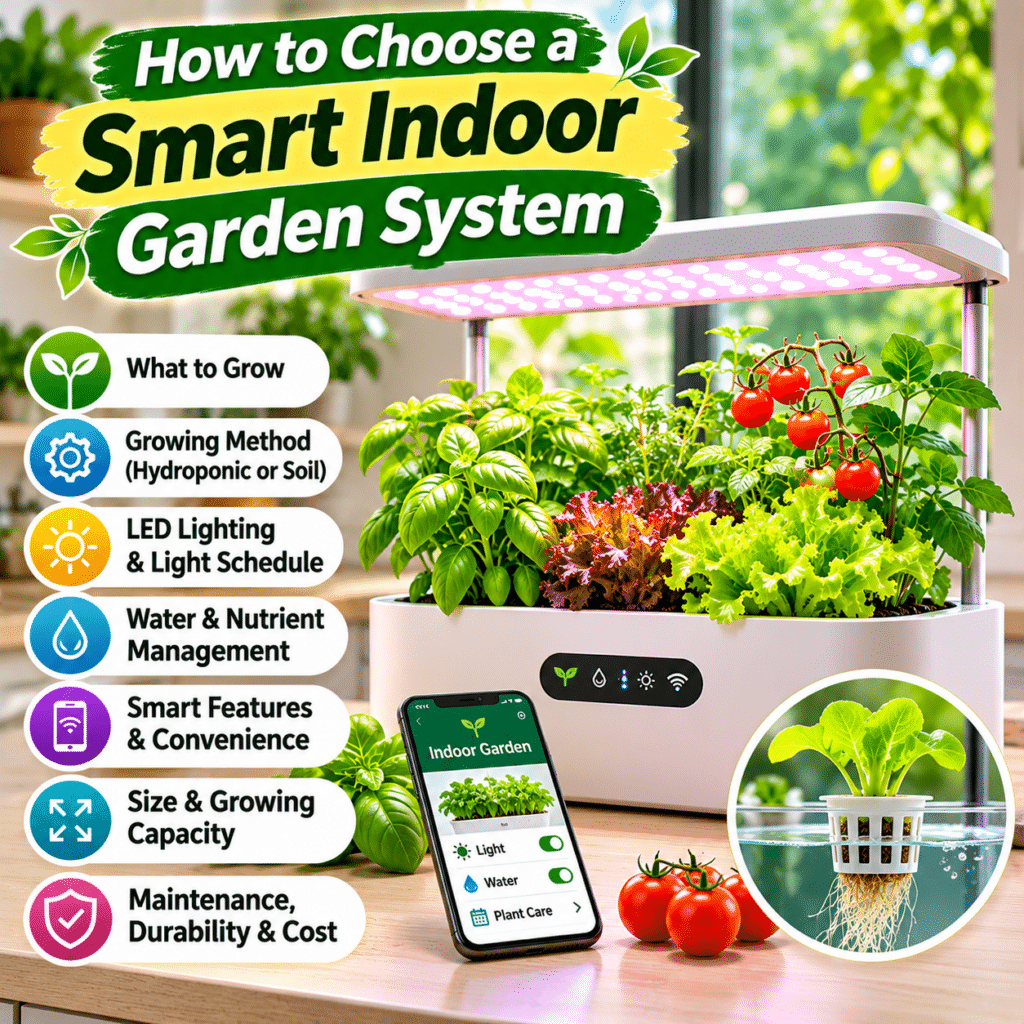
Some indoor gardening systems combine containers, lighting, water reservoirs, and automated operating schedules into a single unit.
Others use sensors or connected devices to monitor selected environmental conditions.
Common features may include:
- Programmable lighting.
- Water-level indicators.
- Automated irrigation.
- Temperature monitoring.
- Humidity monitoring.
- Nutrient reminders.
- App-based notifications.
These features can make certain tasks more convenient, particularly for people who prefer structured routines.
However, automation should not be confused with complete independence from human care.
Smart Systems Still Require Maintenance
Reservoirs need cleaning and refilling. Plants may require pruning, harvesting, or replacement. Pumps and sensors can malfunction.
Sensors Have Limitations
A moisture sensor measures conditions at its location and may not represent the entire root zone.
Sensor accuracy and reliability vary.
Convenience Comes With Trade-Offs
Integrated systems may cost more than ordinary containers and can depend on proprietary components or replacement supplies.
For some households, a simple planter and a regular care routine will be more appropriate.
For others, an automated growing system may provide a useful combination of convenience and experimentation.
The right choice depends on the gardener’s goals rather than the number of technological features available.
13. Hydroponics and the Possibility of Soil-Free Growing
Hydroponics is a growing method in which plants receive nutrients through a water-based solution rather than relying on conventional soil.
Some hydroponic systems use inert growing media to support roots, while others suspend roots in or near nutrient solution.
Indoor hydroponics is often associated with herbs, leafy greens, and compact edible crops.
Potential Advantages
Depending on the system and how it is operated, hydroponics can offer:
- Controlled nutrient delivery.
- Compact growing arrangements.
- Reduced handling of conventional potting soil.
- Opportunities to recirculate water.
- Convenient integration with artificial lighting.
Practical Challenges
Hydroponics requires attention to factors such as:
- Nutrient concentration.
- Water quality.
- Solution pH.
- Root oxygen availability.
- Water temperature.
- Equipment cleanliness.
- Pump and electrical reliability.
It can also involve additional materials, energy use, and ongoing maintenance.
Claims that hydroponics always uses less water or is inherently more environmentally friendly should be treated cautiously. Results depend on system design, operation, crop selection, and the basis of comparison.
Hydroponics is an interesting option for indoor gardening, but it is not automatically the best method for every household or plant.
14. Vertical Gardening and the Efficient Use of Space
Vertical gardening organizes plants upward rather than spreading them across floors, counters, or other horizontal surfaces.
This approach can be particularly useful in homes where space is limited.
Common arrangements include:
- Freestanding plant shelves.
- Tiered plant stands.
- Hanging planters.
- Wall-mounted planters.
- Modular growing racks.
- Vertical hydroponic structures.
Advantages of Vertical Arrangements
Vertical displays can make use of underutilized wall areas and create attractive visual compositions.
They may also help organize plants according to size or maintenance needs.
Challenges to Consider
Plants placed at different heights may receive different amounts of light.
Water draining from upper containers can damage lower shelves, furniture, or flooring.
Heavy planters require secure supports, and hanging arrangements must be installed with appropriate hardware.
Wall-mounted systems should be evaluated for moisture protection and load capacity.
In homes with children or pets, stability is especially important.
A successful vertical garden should remain easy to water, inspect, clean, and maintain.
If reaching a plant requires awkward climbing or repeated moving of furniture, the arrangement may be less practical than it initially appears.
15. Indoor Gardening and More Intentional Consumption
Indoor gardening can encourage people to think more carefully about what they bring into their homes.
Rather than purchasing decorations solely for immediate visual appeal, gardeners may begin considering durability, maintenance, plant suitability, and long-term use.
This can support a more intentional approach to home organization and consumption.
For example, a gardener might choose a reusable ceramic planter instead of repeatedly purchasing short-lived decorative arrangements.
Another might propagate an existing plant rather than buying a new one.
However, indoor gardening is not automatically environmentally beneficial.
Its environmental impact depends on factors such as:
- Container materials and durability.
- Growing media production.
- Water consumption.
- Electricity used for artificial lighting.
- Fertilizer and pesticide use.
- Packaging and transportation.
- Replacement frequency.
- Disposal practices.
Practical Ways to Reduce Unnecessary Waste
Choose plants suited to the environment to reduce repeated plant losses.
Reuse appropriate containers when possible, ensuring they are clean and provide suitable drainage.
Avoid purchasing equipment that exceeds actual growing needs.
Use water thoughtfully without compromising plant health.
Maintain growing systems so components last longer.
For peat-containing potting mixes, gardeners may also consider suitable peat-free alternatives while recognizing that different growing media have their own environmental and horticultural trade-offs.
Indoor gardening can align with thoughtful consumption, but meaningful improvements come from specific decisions rather than from the presence of plants alone.
16. Can Indoor Plants Really Improve Air Quality?
One of the most frequently repeated claims about houseplants is that they purify indoor air.
This idea deserves careful explanation.
Laboratory experiments have demonstrated that certain plants and associated microorganisms can remove selected airborne compounds under controlled conditions.
However, those experiments do not necessarily reflect the complexity of occupied buildings.
In ordinary homes, the number of plants needed to produce a meaningful reduction in many indoor air pollutants through passive removal would generally be impractical compared with normal building air exchange.
Therefore, a few decorative plants should not be relied upon as an air purification system.
What Actually Matters for Indoor Air Quality?
Effective indoor air quality management generally emphasizes:
- Reducing pollution sources.
- Providing appropriate ventilation.
- Maintaining heating and cooling systems.
- Using suitable filtration where needed.
- Controlling excessive indoor moisture.
- Addressing mold and water damage promptly.
Indoor plants may contribute visual comfort and personal enjoyment, but they are not substitutes for these measures.
Plants Can Also Introduce Moisture-Related Concerns
Overwatered growing media, standing water, and poorly maintained containers may encourage mold growth or fungus gnats.
For people sensitive to mold or certain allergens, maintenance and plant selection deserve additional attention.
The most reliable reason to keep indoor plants is that they can enrich the living environment aesthetically and personally—not that they provide guaranteed air purification.
17. Understanding the Importance of Watering and Drainage
Watering is one of the most important aspects of indoor plant care.
It is also a common source of problems.
Plants need water, but roots also require oxygen. Growing media that remains excessively saturated can limit oxygen availability and contribute to root damage.
Why Fixed Watering Schedules Can Be Misleading
A recommendation to water every seven days may be appropriate for one plant in one environment but unsuitable for the same species elsewhere.
Water needs depend on:
- Plant species.
- Container size.
- Growing medium.
- Temperature.
- Humidity.
- Light exposure.
- Seasonal growth.
- Root development.
A Better Approach
Check the growing medium and consider the needs of the specific plant before watering.
For many common houseplants, checking moisture below the surface is more informative than judging only the topmost layer.
Water thoroughly when appropriate, and allow excess water to drain.
Drainage Holes Matter
Containers with drainage holes make it easier to remove excess water and manage moisture.
Decorative outer pots without drainage can still be used, but water should not be allowed to accumulate around the inner container.
Recognizing Problems
Yellowing leaves, wilting, and leaf drop can have multiple causes.
They should not automatically be interpreted as signs that a plant needs more water.
Examining growing conditions and root health is more useful than reacting to a single symptom.
Understanding watering is often more valuable than purchasing additional accessories.
18. Soil, Potting Mixes, and Healthy Root Development
Indoor plants need a growing environment that supports their roots.
For most container-grown houseplants, this means using an appropriate potting mix rather than ordinary garden soil.
Garden soil may compact excessively in containers and can introduce unwanted organisms or drainage problems.
Potting mixes are formulated to balance several characteristics:
- Moisture retention.
- Drainage.
- Air-filled pore space.
- Physical support.
- Nutrient availability.
- Structural stability.
Different plants require different balances.
Tropical Foliage Plants
Many tropical foliage plants benefit from mixes that retain some moisture while allowing excess water to drain.
Succulents and Cacti
Many succulents and cacti require particularly well-draining conditions and careful watering.
Orchids
Many commonly grown epiphytic orchids need coarse, airy media rather than conventional fine-textured potting soil.
Herbs and Edible Plants
Choose a growing medium appropriate for container-grown edible crops and their specific moisture requirements.
When to Repot
Repotting may be useful when roots have substantially filled the container, the growing medium has deteriorated, or watering becomes difficult to manage.
However, moving a plant into a much larger pot can increase the volume of wet medium surrounding the roots.
Repotting should address a genuine need rather than follow an arbitrary schedule.
19. Creating an Indoor Garden That Fits a Busy Schedule
One reason indoor gardening appeals to modern households is that it can be adjusted to different levels of available time.
Not everyone wants a hobby that requires daily attention.
A manageable indoor garden begins with realistic expectations.
Start With Fewer Plants
One or two well-chosen plants provide opportunities to learn without creating unnecessary complexity.
Group Plants by Similar Needs
Plants with comparable light and humidity requirements may be easier to maintain in the same area.
However, each container should still be checked individually.
Keep Basic Supplies Accessible
A small watering can, clean pruning tool, and suitable cleaning materials can make maintenance more convenient.
Use Reminders as Prompts, Not Commands
Calendar reminders can encourage regular inspection.
They should not automatically trigger watering regardless of soil conditions.
Inspect Plants Regularly
Brief checks can reveal changes in leaf condition, moisture, pests, and growth.
Avoid Expanding Too Quickly
A large collection can become difficult to manage if acquired before the gardener understands the care requirements.
Indoor gardening should fit the household’s routine rather than require the household to reorganize everything around it.
20. Common Indoor Gardening Problems and How to Approach Them
Even experienced gardeners encounter problems.
Indoor conditions are dynamic, and plant health can change as daylight, temperature, and household routines shift.
Understanding common issues helps prevent unnecessary frustration.
| Problem | Possible causes | Practical response |
|---|---|---|
| Yellowing leaves | Overwatering, underwatering, aging, nutrient issues, or environmental stress | Review watering, light, and root conditions |
| Brown leaf tips | Moisture stress, salt accumulation, dry air, or species-specific sensitivity | Evaluate water quality, humidity, and care routine |
| Leggy growth | Insufficient light in many species | Improve suitable light exposure gradually |
| Fungus gnats | Persistently moist growing media | Adjust moisture management and inspect the growing medium |
| Wilting | Water shortage, root damage, heat, or other stress | Check soil and roots before watering |
| Slow growth | Low light, seasonal changes, limited nutrients, or normal species behavior | Assess conditions and realistic growth expectations |
| Leaf scorching | Excessive direct light or abrupt exposure changes | Adjust placement and acclimate plants gradually |
| Pest infestations | Introduction of pests or favorable conditions for their spread | Identify the pest and use appropriate controls |
A single symptom rarely provides a complete diagnosis.
For example, a wilting plant may have dry roots, but it may also be suffering from root damage caused by excessive moisture.
Adding more water without checking the cause can make the problem worse.
Prevention Is Often Easier Than Treatment
Inspect new plants before placing them near an established collection.
Keep leaves and containers reasonably clean.
Provide appropriate spacing and airflow.
Avoid allowing water to stand in saucers.
When pests appear, identify them before selecting a treatment.
If pesticides are necessary, follow the product label and confirm that the treatment is appropriate for the plant, location, and intended use.
21. Designing an Indoor Garden Room by Room
Different areas of a home offer different opportunities for indoor gardening.
The best location depends on actual growing conditions, not simply the room’s name.
Living Room
A living room may accommodate larger decorative plants, grouped containers, or a carefully arranged plant stand.
Choose locations that do not obstruct walkways or interfere with furniture.
Kitchen
A kitchen can be convenient for herbs, particularly when a suitable bright location is available.
Keep plants away from cooking heat, grease accumulation, and areas where they could interfere with food preparation.
Bedroom
Small foliage plants may complement a calm bedroom design.
Consider available light, household allergies, pets, and ease of maintenance.
There is no need to keep plants in a bedroom for supposed overnight oxygen or air-purification benefits.
Home Office
A compact plant can add visual interest to a desk or nearby shelf.
Avoid placing water-filled containers where spills could damage electronics.
Bathroom
Some plants may tolerate humid bathroom environments, provided they receive adequate light.
A windowless bathroom is not automatically suitable for live plants.
Hallway or Entryway
These areas may support decorative greenery if light and space are sufficient.
Keep plants clear of doors and walking routes.
A room-by-room approach helps indoor gardening become part of the home’s existing design rather than an unrelated collection of objects.
22. The Role of Indoor Gardening in Home Offices
Home offices have become an important part of many living environments.
They often combine computer equipment, storage, task lighting, and functional furniture.
Indoor plants can introduce visual contrast and help personalize these spaces.
Creating a More Welcoming Workspace
A small plant beside a monitor or a larger plant near a window may soften the appearance of an equipment-heavy room.
Encouraging Short Activity Breaks
Plant care can provide a natural reason to stand up, move around, and briefly shift attention away from a screen.
However, indoor plants do not automatically improve productivity or concentration.
Any benefits depend on individual preferences, working conditions, and the broader environment.
Maintaining Practical Boundaries
Plants should not block ventilation openings, obstruct work surfaces, or create water hazards around electronics.
Grow lights should also be positioned to avoid uncomfortable glare.
For a home office, a small, manageable arrangement is often more useful than a dense collection that competes with the workspace.
23. Indoor Gardening as a Family Learning Activity
Indoor gardening can provide practical learning opportunities for children and adults.
Watching seeds germinate or cuttings develop roots introduces basic concepts of plant biology through direct observation.
Activities can include:
- Comparing how different plants grow.
- Observing changes in leaves and stems.
- Learning about roots and water uptake.
- Recording plant growth.
- Practicing responsible watering.
- Exploring plant propagation.
- Understanding how light influences development.
Keeping Activities Age-Appropriate
Young children should use safe containers and participate under appropriate supervision.
Avoid sharp tools, hazardous chemicals, and plants with toxic or irritating parts.
Choosing Suitable Projects
Growing a bean seed for observation, caring for a non-toxic houseplant, or maintaining a small herb container can provide approachable starting points.
Encouraging Observation
Rather than treating gardening as a competition for the fastest growth, encourage curiosity.
Why did one seed germinate before another? Why does a plant lean toward a window? Why do some leaves look different from others?
These questions can make indoor gardening an engaging educational activity.
The emphasis should remain on learning and enjoyment rather than producing perfect plants.
24. Propagation and the Satisfaction of Growing New Plants
Plant propagation involves producing new plants from seeds, cuttings, divisions, or other plant material.
For many indoor gardeners, propagation becomes one of the most rewarding parts of the hobby.
Some houseplants can be propagated from stem cuttings placed in water or suitable growing media.
Others are more effectively propagated through division or specialized methods.
Why Propagation Appeals to Indoor Gardeners
It offers an opportunity to observe root development.
It can help expand a collection without purchasing an entirely new plant.
It may allow gardeners to share suitable plants with friends or family.
It also encourages a deeper understanding of how different species grow.
Propagation Is Species-Specific
Not every plant can be propagated successfully from an ordinary leaf or stem cutting.
The cutting must contain the structures needed to produce new growth.
For example, many aroids require an appropriate stem node for successful propagation.
Hygiene Matters
Use clean tools and containers to reduce the risk of spreading disease.
Avoid propagating visibly unhealthy material.
Patience Is Essential
Root development varies according to species, temperature, light, and other conditions.
Some cuttings establish quickly, while others take much longer.
Propagation illustrates one of indoor gardening’s enduring attractions: the experience of watching a living process unfold gradually.
25. Indoor Gardening Through Seasonal Changes
Although indoor plants are protected from many outdoor weather conditions, they are still influenced by seasonal changes.
Day length, sunlight angle, heating, cooling, and indoor humidity may vary throughout the year.
These changes affect plant growth and water use.
During Brighter Periods
Some plants may grow more actively when light and temperature conditions are favorable.
They may require more frequent moisture checks and appropriate nutrient management.
During Darker Periods
Growth may slow when light availability decreases.
Watering requirements can change accordingly.
Heating and Air Conditioning
Indoor climate-control systems may alter humidity and create drafts.
Plants placed near vents can experience localized environmental stress.
Avoiding Rigid Seasonal Rules
Not all plants follow identical growth cycles, and indoor conditions differ across climates.
A home in a tropical region may experience different seasonal patterns from a home in a temperate climate.
Observe the plant and its actual environment rather than assuming every indoor garden needs the same seasonal schedule.
26. The True Cost of Starting an Indoor Garden
Indoor gardening can be affordable, but costs depend on the chosen approach.
A simple arrangement may require only a plant, suitable container, growing medium, and basic care supplies.
More advanced systems may involve grow lights, shelving, irrigation equipment, sensors, or hydroponic components.
Basic Costs
Common expenses include:
- Plants or seeds.
- Pots and saucers.
- Growing medium.
- Watering supplies.
- Fertilizer when needed.
- Occasional replacement materials.
Optional Costs
Additional expenses may include:
- LED grow lights.
- Timers.
- Plant stands.
- Humidity monitors.
- Automated watering systems.
- Hydroponic equipment.
- Decorative outer planters.
Ongoing Costs
Electricity, water, nutrients, and replacement components may contribute to long-term expenses.
For grow lights, electricity consumption depends on the fixture’s actual power draw, daily operating hours, and local electricity rates.
Avoiding Unnecessary Purchases
Beginners rarely need every accessory marketed to indoor gardeners.
Start with the conditions plants actually require.
Purchase additional equipment when it solves a clearly identified problem.
A carefully maintained collection of inexpensive plants can be just as satisfying as an elaborate automated setup.
27. How to Start Your First Indoor Garden
Beginning an indoor garden is easier when approached as a series of manageable decisions.
Step 1: Define Your Purpose
Decide whether the main goal is decoration, growing herbs, learning about plants, or developing a longer-term hobby.
This decision will influence plant selection and equipment needs.
Step 2: Evaluate Your Space
Identify suitable locations and observe natural light.
Consider temperature, airflow, humidity, access to water, and household safety.
Step 3: Select One or Two Appropriate Plants
Choose species that match the available environment.
Avoid selecting plants solely because they look attractive in promotional photographs.
Step 4: Choose Suitable Containers
Select containers with appropriate drainage and enough space for healthy root development.
Step 5: Use the Right Growing Medium
Match the potting mix to the plant’s requirements.
Step 6: Establish a Simple Inspection Routine
Check moisture, leaf condition, and visible growth regularly.
Water according to actual need.
Step 7: Observe Before Making Major Changes
Plants need time to adjust after relocation.
Avoid repeatedly changing light, water, fertilizer, and container size without understanding the problem.
Step 8: Expand Gradually
Once basic care becomes familiar, consider adding plants with different growth habits or experimenting with propagation.
A small successful garden creates a stronger foundation than an ambitious collection that becomes difficult to maintain.
28. Common Mistakes Beginners Should Avoid
Indoor gardening becomes more enjoyable when common mistakes are recognized early.
Buying too many plants at once: A large collection creates multiple care requirements before the gardener has developed a routine.
Ignoring natural light: Attractive locations are not always suitable growing locations.
Watering on a rigid schedule: Plant needs change with environmental conditions.
Using containers without proper drainage management: Excess moisture can damage roots and surrounding surfaces.
Assuming all houseplants need the same care: Species differ in light, moisture, temperature, and nutrient requirements.
Overusing fertilizer: Excess fertilizer can damage roots and contribute to salt accumulation.
Moving plants constantly: Frequent environmental changes can create additional stress.
Ignoring pests on new plants: Early inspection can help prevent problems from spreading.
Believing every online plant-care tip: Advice should be evaluated according to the species, growing environment, and credibility of the source.
Expecting immediate results: Healthy growth takes time, and some plants naturally grow slowly.
The goal is not to avoid every mistake. It is to understand how plants respond and make informed adjustments.
29. How Indoor Gardening May Continue to Evolve
Indoor gardening is likely to remain relevant because it addresses enduring interests: comfortable homes, personal hobbies, adaptable living spaces, and the enjoyment of growing plants.
Several developments may influence how people practice it.
More Compact Growing Equipment
Smaller lighting fixtures, modular shelves, and integrated growing systems may make indoor gardening more accessible in limited spaces.
Better Environmental Monitoring
Sensors and connected devices may provide increasingly convenient ways to observe selected growing conditions.
Their usefulness will still depend on accuracy, maintenance, and appropriate interpretation.
Greater Interest in Practical Growing
Herbs, leafy greens, and compact edible plants may continue to appeal to households interested in hands-on food-growing experiences.
More Thoughtful Design Integration
Plant displays may increasingly be considered alongside furniture, storage, lighting, and room layout.
Greater Attention to Resource Use
Gardeners may become more interested in durable containers, efficient lighting, responsible growing media, and maintaining plants successfully over time.
These are possibilities rather than guarantees about future markets or consumer behavior.
The central principle is unlikely to change: plants need suitable growing conditions, and successful indoor gardening depends on understanding those needs.
Technology can assist, but it cannot replace the fundamentals of plant care.
30. Finding the Right Balance Between Plants and Everyday Living
Indoor gardening should enhance a living space rather than make it harder to use.
A beautiful plant arrangement is less successful if it blocks a walkway, creates water damage, or demands more time than the household can comfortably provide.
The right balance varies from person to person.
Some people enjoy maintaining dozens of plants and experimenting with propagation or hydroponics.
Others prefer one resilient houseplant beside a favorite chair.
Neither approach is inherently better.
A useful indoor garden is one that:
- Fits the available light and space.
- Matches the gardener’s experience and interests.
- Remains manageable over time.
- Supports household safety.
- Complements the room’s function.
- Provides enjoyment without unnecessary pressure.
The most meaningful indoor gardens are often developed gradually.
As gardeners learn which plants thrive in their homes, they become better equipped to choose suitable species, recognize problems, and create arrangements that feel natural.
Frequently Asked Questions About Indoor Gardening
1. Why is indoor gardening becoming part of modern living?
Indoor gardening fits modern lifestyles because it allows people to grow plants without requiring a backyard or extensive outdoor space. It can complement interior design, provide an enjoyable hobby, support personal routines, and make use of compact living areas. Improvements in grow lighting and indoor gardening equipment have also expanded the range of possible growing arrangements.
2. Can I start an indoor garden in a small apartment?
Yes. Many indoor plants can grow in containers on windowsills, shelves, desks, or compact plant stands. The most important considerations are suitable light, appropriate watering, adequate space for growth, and safe placement. Starting with one or two plants is often the easiest approach.
3. What are the easiest indoor plants for beginners?
Snake plants, ZZ plants, spider plants, cast iron plants, and some peperomia varieties are commonly recommended for beginners. However, their suitability depends on the home’s conditions. Some popular easy-care plants are toxic to pets, so household safety should be considered before purchasing.
4. Do indoor plants need direct sunlight?
Not all indoor plants need direct sunlight. Some prefer bright indirect light, while others tolerate lower light levels. Many culinary herbs and flowering plants require stronger illumination. The appropriate amount depends on the species, and grow lights may be useful when natural light is insufficient.
5. Does indoor gardening improve air quality?
Houseplants can remove certain airborne compounds in controlled laboratory experiments, but ordinary collections of indoor plants should not be relied upon to meaningfully purify the air in a typical home. Ventilation, source control, moisture management, and suitable filtration are more effective approaches to indoor air quality.
6. Is indoor gardening expensive?
It does not have to be. A basic indoor garden can begin with a small number of plants, suitable containers, and appropriate growing media. Advanced lighting, automated systems, and hydroponic equipment are optional investments. The most economical approach is to purchase equipment based on actual growing needs.
7. Can indoor gardening be successful without natural sunlight?
Yes, some plants can grow under properly selected artificial grow lights. Success depends on providing suitable light intensity, duration, and coverage for the species, along with appropriate water, nutrients, temperature, and airflow. Ordinary household lighting may not deliver enough plant-usable light.
Conclusion: Bringing Nature Into the Way We Live
Indoor gardening has become part of modern living because it combines several enduring interests: creating comfortable spaces, expressing personal style, learning practical skills, and maintaining a connection with living plants.
Its appeal does not depend on having a large home, expensive equipment, or advanced gardening knowledge.
A carefully chosen houseplant can add character to a room. A small herb garden can make cooking more engaging. A compact growing system can provide opportunities to explore plant care and technology. Even the simple routine of observing new growth can make indoor gardening a rewarding part of everyday life.
At the same time, successful indoor gardening requires realistic expectations. Plants need appropriate light, water, growing media, and environmental conditions. They do not automatically purify indoor air, eliminate stress, or provide environmental benefits simply by being present.
The most sustainable approach is to choose plants thoughtfully, understand their needs, avoid unnecessary purchases, and develop a routine that fits the household.
Ultimately, indoor gardening is not about filling every available corner with greenery. It is about creating a living environment where plants and people can comfortably coexist.
A modern indoor garden does not need to be large or complicated. It only needs to be thoughtfully designed, realistically maintained, and genuinely enjoyed.