Home cooking involves more than following a recipe.
Preparing a meal often means coordinating several tasks: measuring ingredients, adjusting temperatures, monitoring cooking progress, remembering timers, and making sure everything is ready at the right moment.
Even a simple dinner can require constant attention when several dishes are being prepared at once.
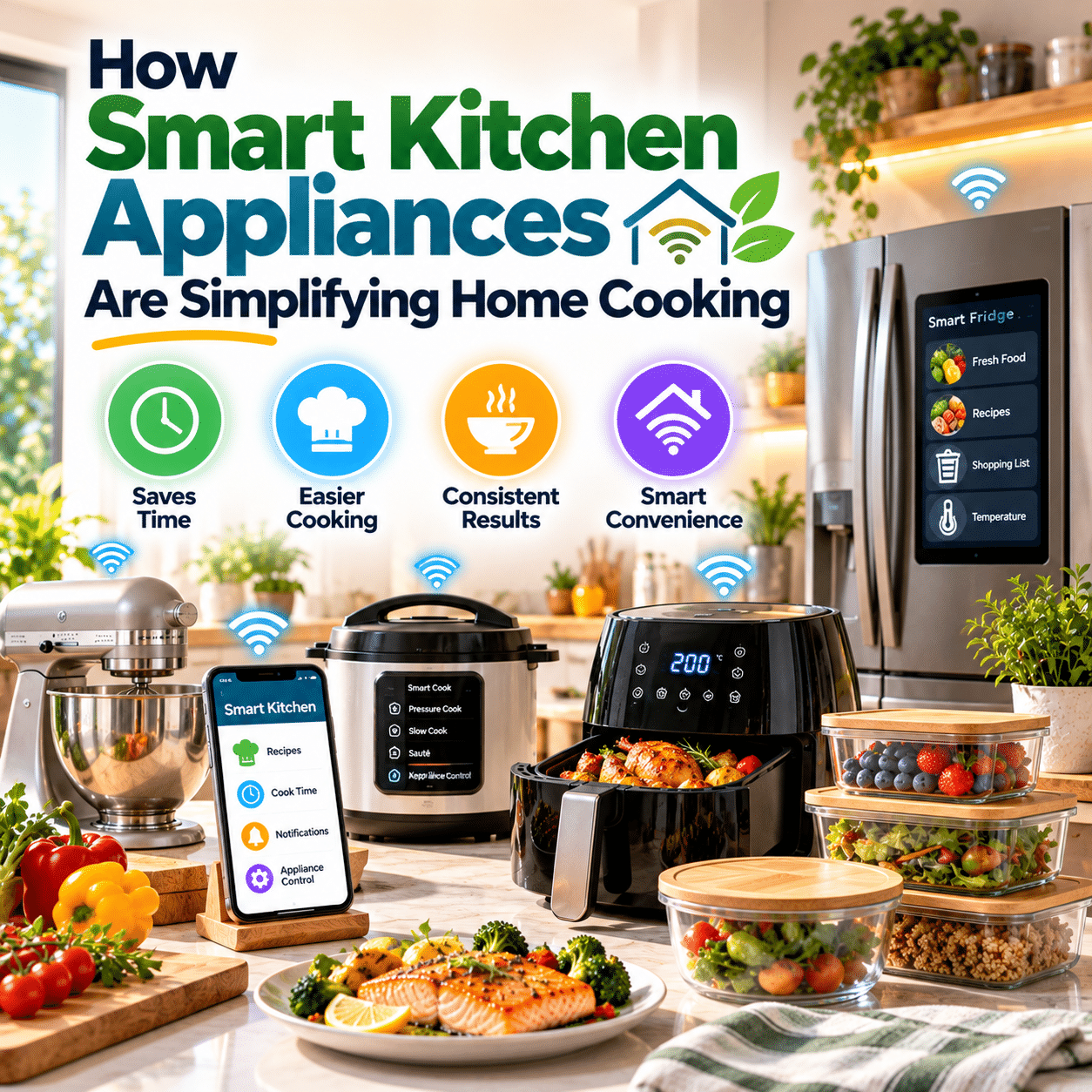
Smart kitchen appliances aim to make some of these responsibilities easier to manage.
By combining sensors, electronic controls, programmable settings, and sometimes wireless connectivity, these appliances can help home cooks monitor food, repeat familiar cooking processes, and receive useful information while preparing meals.
A connected oven might send a notification when a cooking program finishes. A temperature-controlled cooker can help maintain a selected heating condition. A smart refrigerator may provide alerts about an open door or other operating conditions.
These features do not eliminate the need for cooking knowledge or supervision. They also do not guarantee better food.
Their real value lies in reducing unnecessary complexity and helping people focus on the parts of cooking that matter most.
Understanding how smart kitchen appliances work—and where their limitations begin—can help households decide which innovations genuinely improve everyday cooking.
1. What Makes a Kitchen Appliance Smart?
The term smart kitchen appliance can describe several different types of technology.
Some appliances use built-in sensors and automated programs without connecting to the internet.
Others communicate with smartphones, home networks, or compatible digital services.
The distinction matters because advanced electronic controls and internet connectivity are not the same thing.
Built-In Sensors
Sensors collect information about operating conditions.
Depending on the appliance, they may measure temperature, moisture, weight, or other variables.
The appliance can use this information to adjust its operation or inform the user.
Programmable Cooking Controls
Electronic controls allow users to select cooking modes, temperatures, and durations.
Some appliances can move through multiple stages of a cooking process automatically.
Wireless Connectivity
Connected appliances may use Wi-Fi, Bluetooth, or another supported communication technology.
Connectivity can enable status monitoring, notifications, software updates, and compatible app-based features.
Guided Cooking Functions
Certain appliances provide step-by-step instructions, suggested settings, or recipes designed for their capabilities.
These functions can make unfamiliar cooking methods easier to approach.
The Most Important Distinction
An appliance can be useful and sophisticated without being connected to the internet.
Likewise, an internet-connected product is not necessarily better at cooking than a well-designed conventional appliance.
Smart functionality should be judged by the practical problem it solves, not simply by the number of digital features it offers.
2. Automatic Cooking Programs Reduce Repetitive Decisions
One of the most practical features of modern kitchen appliances is the ability to automate familiar cooking settings.
Instead of manually selecting every parameter, users may be able to choose a program designed for a particular task.
Preset Cooking Modes
Some ovens, rice cookers, multicookers, and other appliances offer programs for common preparations.
These may control heating intensity, cooking duration, or the sequence of cooking stages.
A rice cooker, for example, can use its control system to manage heating during a cooking cycle.
Consistency Across Repeated Meals
When an appliance follows a repeatable process, it may help produce more consistent results.
This can be useful for foods prepared frequently under similar conditions.
However, variations in ingredient quantity, size, moisture, and starting temperature can still affect the outcome.
Less Need for Constant Adjustment
Automated controls can reduce the number of settings a cook must manage manually.
This may make it easier to coordinate multiple dishes.
Automation Has Boundaries
A preset does not know every detail of the food being prepared.
Cooking programs should be treated as useful starting points rather than guarantees.
Users still need to follow instructions, monitor food when necessary, and verify safe cooking temperatures.
3. Precision Temperature Control Makes Cooking More Predictable
Temperature has a major influence on food texture, moisture, browning, and safety.
Smart cooking appliances may use electronic sensors and feedback controls to regulate heat more consistently.
How Feedback Control Works
A temperature sensor measures a condition within the appliance.
The control system compares the measurement with a selected target.
It can then adjust heating to bring the measured condition closer to the intended setting.
Actual performance depends on sensor placement, appliance design, and control accuracy.
Smart Ovens
Some ovens use electronic temperature regulation and specialized cooking programs.
Certain models may incorporate probes or additional sensors.
These features can help users monitor cooking progress, although they do not remove the need for appropriate food-safety checks.
Temperature-Controlled Water Baths
Sous vide equipment uses controlled water temperature to cook appropriately packaged food.
This can support repeatable results when suitable time-temperature procedures are followed.
Food safety depends on more than selecting a temperature. Food thickness, cooking duration, handling, cooling, and storage also matter.
Smart Cooking Thermometers
Some food thermometers can communicate readings to a compatible display or mobile device.
They may provide alerts when a selected temperature is reached.
This can be helpful for monitoring certain foods, but the probe must be positioned correctly and used according to its instructions.
Precision Supports Judgment
A sensor can provide information, but it cannot evaluate every aspect of a meal.
Taste, aroma, texture, and ingredient quality still require human attention.
Smart controls work best when they support cooking decisions rather than replace them.
4. Connected Appliances Can Make Cooking Easier to Monitor
One advantage of connected kitchen technology is the ability to receive information without standing directly beside an appliance.
Depending on the product, a smartphone app may show cooking status, remaining time, or selected settings.
Cooking Progress Notifications
A connected oven or multicooker may notify the user when a program finishes.
This can be useful when preparing several parts of a meal.
Temperature Alerts
A compatible thermometer may provide an alert when food reaches a selected temperature.
This reduces the need to repeatedly check a display, although proper monitoring remains important.
Appliance Status Information
Some connected appliances can report operational conditions or maintenance reminders.
These may include an open refrigerator door or a completed dishwasher cycle.
The Limits of Remote Monitoring
A notification is not a substitute for safe cooking practices.
Connections can fail, alerts can be delayed, and electronic sensors can malfunction.
Cooking appliances must still be used according to manufacturer instructions.
Remote control features, where available, may be restricted for safety reasons.
Convenient monitoring should never be interpreted as permission to leave cooking equipment operating unattended when supervision is required.
5. Smart Multicookers Simplify Multi-Step Meal Preparation
Multicookers demonstrate how automation can simplify certain cooking processes.
Depending on their design, they may combine functions such as pressure cooking, slow cooking, steaming, sautéing, or rice preparation.
Combining Cooking Stages
A suitable multicooker may allow ingredients to be sautéed before continuing with another cooking program.
This can reduce the number of cooking vessels needed for some recipes.
Automated Timing
Electronic controls can manage selected cooking durations and operating modes.
This may make repeated recipes easier to prepare.
Useful for Familiar Meals
Multicookers can be particularly practical when households regularly prepare dishes suited to their functions.
Examples may include soups, stews, grains, or pressure-cooked ingredients.
Important Safety Considerations
Pressure-cooking functions require careful attention to filling limits, sealing components, pressure-release procedures, and manufacturer instructions.
Automatic settings do not eliminate pressure-related hazards.
When a Multicooker Is Not Ideal
Some recipes require precise surface browning, rapid evaporation, or direct visual control.
A stovetop pan or conventional oven may be better suited to those tasks.
The main advantage of a smart multicooker is not that it can cook everything.
It is that it can simplify a useful group of related cooking activities.
6. Smart Ovens Can Help Coordinate Complex Cooking Tasks
Ovens have traditionally required cooks to manage temperature, timing, rack placement, and cooking progress.
Modern electronic controls can make some of these tasks easier.
Guided Cooking Programs
Some ovens provide programs for particular foods or cooking methods.
These may suggest or automatically select operating conditions.
Integrated Temperature Probes
Compatible probes can help monitor the internal temperature of food.
This is useful when cooking results depend on reaching an appropriate temperature.
Multiple Heating Modes
Certain ovens combine conventional heating, convection, broiling, or other supported modes.
Electronic controls can make switching between functions more convenient.
Connected Features
Some models offer app-based status monitoring or notifications.
The available functions vary significantly between products.
Why Oven Fundamentals Still Matter
Food placement, airflow, cookware, portion size, and recipe technique continue to influence results.
An advanced control panel cannot compensate for every preparation mistake.
The best smart oven features make useful information easier to access and cooking settings easier to manage.
7. Smart Refrigerators Can Support Food Storage Routines
Not every smart kitchen appliance directly cooks food.
Refrigerators can also contribute to a more organized kitchen by helping households monitor storage conditions and appliance status.
Door-Open Alerts
Some connected refrigerators can notify users when a door remains open.
This may help identify situations that could affect food storage or waste energy.
Temperature Monitoring
Certain models provide information about compartment temperatures or operating conditions.
However, users should still follow safe food-storage guidance.
Inventory Features
Some refrigerators offer cameras, digital lists, or other inventory-related functions.
These features may help users remember what they have stored.
Their accuracy depends on the system and how consistently information is maintained.
Meal Planning Support
Knowing which ingredients are available can make it easier to plan meals and use food before it spoils.
However, technology cannot reliably determine the safety of every stored item.
Smart Storage Is Not Automatic Food Safety
Refrigeration does not make food safe indefinitely.
Storage temperature, handling, contamination, and time remain important.
Connected features can support good habits, but they cannot replace them.
8. Guided Recipes Can Make Unfamiliar Cooking Techniques More Approachable
Some smart appliances offer recipe guidance through built-in displays or companion apps.
These systems may provide instructions tailored to the appliance’s available functions.
Step-by-Step Preparation
Guided cooking can divide a recipe into manageable stages.
This may help beginners understand the sequence of tasks.
Suggested Appliance Settings
A recipe may recommend suitable cooking modes, times, or temperatures.
These suggestions can reduce uncertainty when using unfamiliar equipment.
Coordinating Multiple Steps
Some systems provide reminders for adding ingredients, stirring, or moving to the next stage.
Understanding Recipe Limitations
Guided recipes may assume particular ingredient quantities, cookware, or food dimensions.
Substitutions can change cooking behavior.
The user still needs to assess whether the instructions suit the actual ingredients.
Learning Rather Than Following Blindly
Guided cooking is most useful when it helps users understand why a step matters.
Learning about heat, moisture, seasoning, and food safety builds skills that remain useful even without the appliance.
9. Smart Appliances May Help Households Manage Cooking Time
Time management is one of the biggest challenges in preparing meals.
Different ingredients require different cooking durations, and several tasks may need attention at once.
Smart appliances can reduce some of this coordination work.
Timers and Alerts
Automatic timers help users keep track of cooking stages.
Notifications may make it easier to manage other kitchen tasks while waiting.
Repeatable Programs
Frequently used settings can sometimes be saved or selected again.
This reduces repeated setup for familiar meals.
Coordinating Appliances
Certain connected systems may provide information about several appliances through compatible interfaces.
However, support depends on the manufacturers, apps, and integration features.
A Practical Example
Imagine preparing a dinner with rice, vegetables, and a roasted protein.
A rice cooker may manage its cooking cycle automatically.
An oven with a suitable probe may help monitor the protein.
A separate timer can remind the cook to check the vegetables.
The advantage is not that the kitchen runs itself.
It is that fewer routine details need to be remembered at the same time.
Time Savings Are Not Guaranteed
An appliance with complicated setup or cleaning requirements may add work rather than reduce it.
The most valuable automation simplifies the complete cooking process, not just one stage.
10. Voice Controls and Smart Home Integration Add Convenience
Some connected kitchen appliances work with compatible voice assistants or home automation systems.
These features can provide additional ways to access information or manage supported functions.
Hands-Free Information
Voice controls may be useful for setting timers, checking supported appliance status, or accessing recipe instructions.
This can be convenient when hands are occupied with food preparation.
Compatibility Matters
Not every appliance works with every voice assistant or smart home platform.
Some features require specific apps, accounts, hubs, or network conditions.
Reliability Concerns
Voice recognition may be affected by background noise, unclear commands, or connectivity problems.
Kitchen environments can be particularly noisy.
Safety Restrictions
Manufacturers may restrict certain remote or voice-activated functions involving heat or mechanical movement.
Such restrictions should not be bypassed.
Keep Essential Controls Accessible
Physical buttons and straightforward local controls remain important.
A household should not need a complicated digital setup for every basic cooking task.
11. Smart Kitchen Technology Can Support Energy Awareness
Connected appliances may provide information or operating features that help households understand energy use.
However, smart functionality does not automatically make an appliance energy-efficient.
Monitoring Consumption
Some connected appliances can report electricity use or operating patterns.
This information may help users identify how equipment is being used.
Avoiding Unnecessary Operation
Alerts and scheduling functions may help reduce certain forms of waste.
For example, an open refrigerator door notification can draw attention to an avoidable problem.
Energy-Saving Programs
Some appliances offer operating modes designed to manage energy use.
Actual savings depend on the equipment, program, and usage conditions.
Comparing Smart and Efficient
A connected appliance can still consume substantial electricity.
Likewise, a nonconnected appliance may be highly efficient.
ENERGY STAR distinguishes certified energy performance from connected functionality, even when both are available in the same product.
Measure the Real Outcome
To evaluate energy performance, consider the appliance’s relevant energy label, rated consumption, capacity, and typical operating conditions.
Smart features should be treated as possible tools for better management rather than proof of lower electricity costs.
12. Smart Kitchen Appliances Compared With Conventional Models
The practical differences between conventional and smart appliances depend on the specific features offered.
| Kitchen task | Conventional approach | Possible smart feature | Main benefit |
|---|---|---|---|
| Monitoring oven cooking | Checking the oven and a separate timer | Status notifications or probe alerts | Easier progress tracking |
| Cooking rice | Manual stovetop monitoring | Automatic cooking cycle | Reduced routine adjustment |
| Managing multicooker settings | Manually selecting each stage | Programmable cooking modes | Repeatable processes |
| Measuring food temperature | Reading a thermometer directly | Connected temperature monitoring | Convenient access to readings |
| Tracking refrigerator conditions | Checking appliance indicators | Door or status alerts | Earlier awareness of issues |
| Following unfamiliar recipes | Printed or digital recipe | Guided cooking interface | Structured instructions |
| Reviewing energy use | Separate meter or utility information | Compatible energy reporting | Greater usage visibility |
These are possible capabilities, not features shared by every smart appliance.
A conventional product may remain preferable when it offers the same cooking performance with simpler controls, lower cost, or easier maintenance.
13. Smart Kitchen Appliances Still Have Important Limitations
Advanced features can be helpful, but they also introduce new considerations.
Higher Purchase Prices
Connected and sensor-rich appliances may cost more than simpler alternatives.
The additional expense should be justified by useful functions.
App Dependence
Some features require a smartphone, an account, or a compatible app.
This can make the experience less convenient for users who prefer independent appliance controls.
Connectivity Problems
Wi-Fi interruptions and service outages can affect connected functions.
Basic cooking capabilities should be evaluated separately from online features.
Software Support
Connected devices may need updates to maintain functionality and security.
Long-term support policies differ between manufacturers.
Learning Curves
A complicated interface can make an appliance harder to use.
Clear controls may matter more than an extensive feature list.
Repairs and Replacement Parts
Sensors, electronic boards, and specialized components may add repair complexity.
Service availability and product longevity should be considered before purchase.
Too Many Notifications
Frequent alerts can become distracting.
Useful systems should allow users to manage notification preferences.
The best smart appliances balance functionality with reliability, simplicity, and long-term support.
14. Privacy and Cybersecurity Matter in Connected Kitchens
A connected appliance is part of a household’s digital environment.
Like other internet-connected devices, it may introduce privacy and security considerations.
Understand What Data Is Collected
Some products collect device status, usage information, account details, or other data.
The scope varies by manufacturer and service.
Review privacy settings and documentation before enabling optional features.
Use Strong Account Security
Choose unique passwords and enable multifactor authentication when supported.
Avoid sharing account credentials unnecessarily.
Keep Software Updated
Install manufacturer-provided security updates through trusted channels.
Updates may address vulnerabilities or reliability problems.
Secure the Home Network
Use a properly configured home router with current security settings.
Consider a separate network for connected devices when appropriate and supported.
Check the Support Period
Before purchasing a connected appliance, investigate how long the manufacturer intends to provide security updates.
A product that loses support may become less suitable for long-term connected use.
Disable Features You Do Not Need
If remote access, microphones, or optional integrations provide little value, consider disabling them when the product allows it.
Consider Offline Functionality
A kitchen appliance should ideally remain useful for essential local tasks even if an app or internet service becomes unavailable.
Privacy and security are part of practical product quality, not merely technical details.
15. Smart Features Do Not Replace Food Safety
Cooking automation can help monitor conditions, but safe food preparation still requires appropriate procedures.
Verify Internal Temperatures
Automatic programs and visual appearance cannot always establish whether food has reached a safe internal temperature.
Use a suitable food thermometer when temperature verification is required.
For example, U.S. guidance specifies 165°F (74°C) as the minimum internal temperature for poultry.
Other foods have different requirements.
Handle Raw Foods Safely
Keep raw meat, poultry, and seafood separate from ready-to-eat foods.
Clean relevant utensils and surfaces to reduce cross-contamination.
Follow Appliance Instructions
Respect temperature limits, maximum capacities, ventilation requirements, and approved accessories.
Do Not Assume Remote Control Is Safe
Heating appliances should not be started or operated remotely unless the specific appliance, manufacturer instructions, and circumstances permit it.
Even then, required supervision and safety precautions remain essential.
Understand Sensor Limitations
A temperature sensor measures conditions at its location.
Incorrect probe placement or sensor malfunction can produce misleading information.
Maintain the Equipment
Inspect seals, cords, probes, and removable parts regularly.
A smart appliance is only useful when its mechanical and electrical components remain safe.
16. How to Choose Smart Kitchen Appliances That Are Actually Useful
The best buying decisions begin with household cooking habits rather than technology trends.
Identify the Problem First
Consider which tasks are inconvenient.
Do you frequently forget cooking timers?
Do you need better temperature monitoring?
Would repeatable cooking programs simplify meals you prepare regularly?
A clear need makes it easier to evaluate whether a smart feature is worthwhile.
Compare Cooking Performance
A smart interface cannot compensate for poor heating performance, unsuitable capacity, or difficult cleaning.
Start with the appliance’s fundamental cooking capabilities.
Evaluate Ease of Use
Controls should be understandable and accessible.
Check whether important functions can be operated without an app.
Review Compatibility
If connectivity matters, verify support for your smartphone, network, and preferred digital services.
Do not assume different brands will integrate automatically.
Consider Long-Term Support
Look for clear information about software updates, warranty coverage, repairs, and replacement parts.
Check Safety and Maintenance
Review relevant certifications, operating instructions, cleaning requirements, and ventilation needs.
Assess Total Ownership Cost
Consider the purchase price along with electricity use, accessories, maintenance, and any optional subscriptions.
Avoid Paying for Unused Features
A simpler appliance may offer better value when advanced connectivity does not improve the tasks you perform.
The right smart kitchen appliance should make a familiar routine easier—not create a new routine devoted to managing the appliance itself.
17. A Practical Way to Build a Smarter Kitchen
Creating a more convenient kitchen does not require replacing every appliance.
A gradual approach allows households to discover which features are genuinely helpful.
Step 1: Improve Measurement
A reliable food thermometer or kitchen scale can make many cooking tasks more predictable.
These tools do not necessarily require internet connectivity.
Step 2: Simplify Repetitive Cooking
Consider whether a programmable rice cooker, oven, or multicooker would improve a frequently repeated task.
Step 3: Add Monitoring Where It Helps
Connected alerts may be useful for certain long cooking processes or appliance-status checks.
Choose features that reduce meaningful inconvenience.
Step 4: Preserve Simple Workflows
Keep essential utensils and straightforward cooking methods available.
Not every activity benefits from automation.
Step 5: Review Actual Use
After adopting a new appliance, consider whether it saves effort, produces satisfactory results, and fits existing routines.
If a feature is rarely used, it may not justify future purchases.
Step 6: Maintain the Technology
Keep devices clean, inspect components, update supported software, and review privacy settings.
A smart kitchen works best when the technology remains dependable and easy to manage.
18. The Future of Smart Kitchen Appliances
Smart kitchen technology may continue to develop through improvements in sensing, software, interfaces, and appliance design.
The most meaningful progress is likely to focus on practical usefulness.
Better Cooking Feedback
Improved sensors and controls may provide more accurate information about cooking conditions.
Their value will depend on reliability and appropriate interpretation.
More Intuitive Interfaces
Clearer displays, simpler menus, and accessible controls could make advanced functions easier to use.
Improved Appliance Coordination
Compatible devices may become better at sharing status information or supporting household routines.
However, interoperability and security will remain important considerations.
More Transparent Energy Information
Better reporting may help households understand how appliances consume electricity during different tasks.
Longer Software Support
As connected appliances become long-term household purchases, dependable security updates and offline functionality will become increasingly important.
Technology That Supports Cooking Skills
Guided cooking may become more useful when it explains techniques rather than simply instructing users to press buttons.
The most promising direction is not a kitchen that removes every human decision.
It is one that helps people cook with greater confidence, awareness, and control.
Frequently Asked Questions
What is a smart kitchen appliance?
A smart kitchen appliance uses features such as sensors, electronic controls, programmable settings, or connectivity to assist with kitchen tasks. Not every smart appliance requires internet access.
Do smart kitchen appliances need Wi-Fi?
No. Some appliances use built-in automation without wireless connectivity. Others require Wi-Fi or a compatible network for app controls, notifications, or online services.
Can smart appliances cook food automatically?
Certain appliances can manage parts of the cooking process, such as heating and timing. However, ingredient preparation, safe handling, monitoring, and final checks may still require human involvement.
Are smart kitchen appliances more energy-efficient?
Not necessarily. Connectivity alone does not establish energy efficiency. Energy performance depends on the appliance’s design, capacity, operating conditions, and actual use.
Are connected kitchen appliances safe?
They can be used safely when installed, maintained, and operated according to manufacturer instructions. Connected functions also require appropriate cybersecurity and privacy precautions.
Is a smart appliance worth the extra cost?
It may be worthwhile when its additional features solve recurring problems and are used regularly. A conventional appliance may offer better value when smart functions provide little practical benefit.
Conclusion: Smarter Cooking Should Feel Simpler
Smart kitchen appliances are changing home cooking by making certain tasks easier to monitor, repeat, and coordinate.
Automatic programs can reduce repetitive adjustments. Temperature sensors can provide useful information. Connected notifications can help people track cooking progress, while guided interfaces may make unfamiliar techniques more approachable.
These improvements can support more convenient and confident cooking.
But technology introduces tradeoffs.
Connected appliances may require software updates, compatible networks, additional maintenance, and attention to privacy. Automated settings also cannot replace food-safety practices or every form of culinary judgment.
The most valuable smart kitchen is not necessarily the one filled with connected devices.
It is the one where each appliance serves a clear purpose, works reliably, and supports the household’s real cooking habits.
Smart kitchen technology succeeds when it makes cooking easier to manage while keeping people informed, capable, and in control.