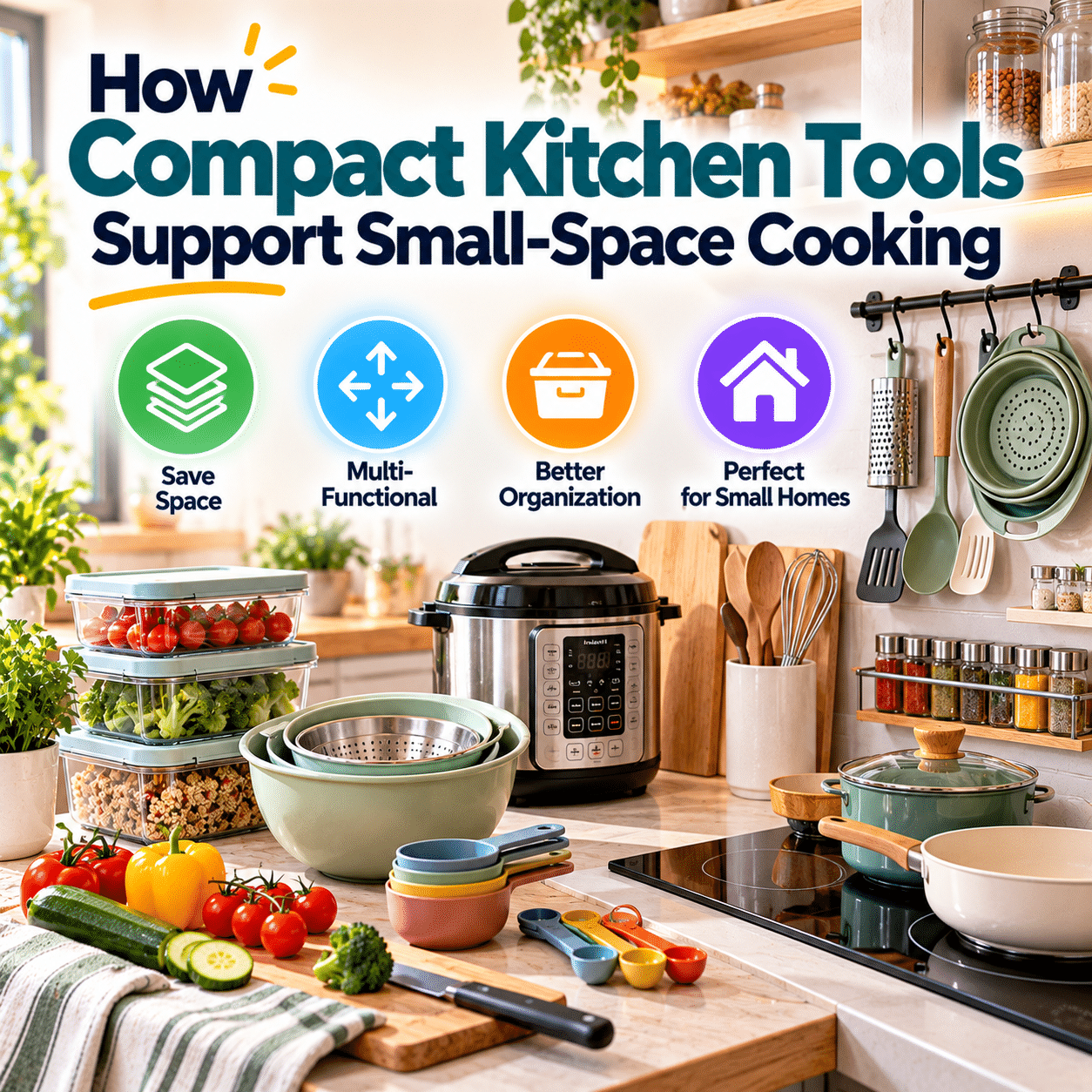
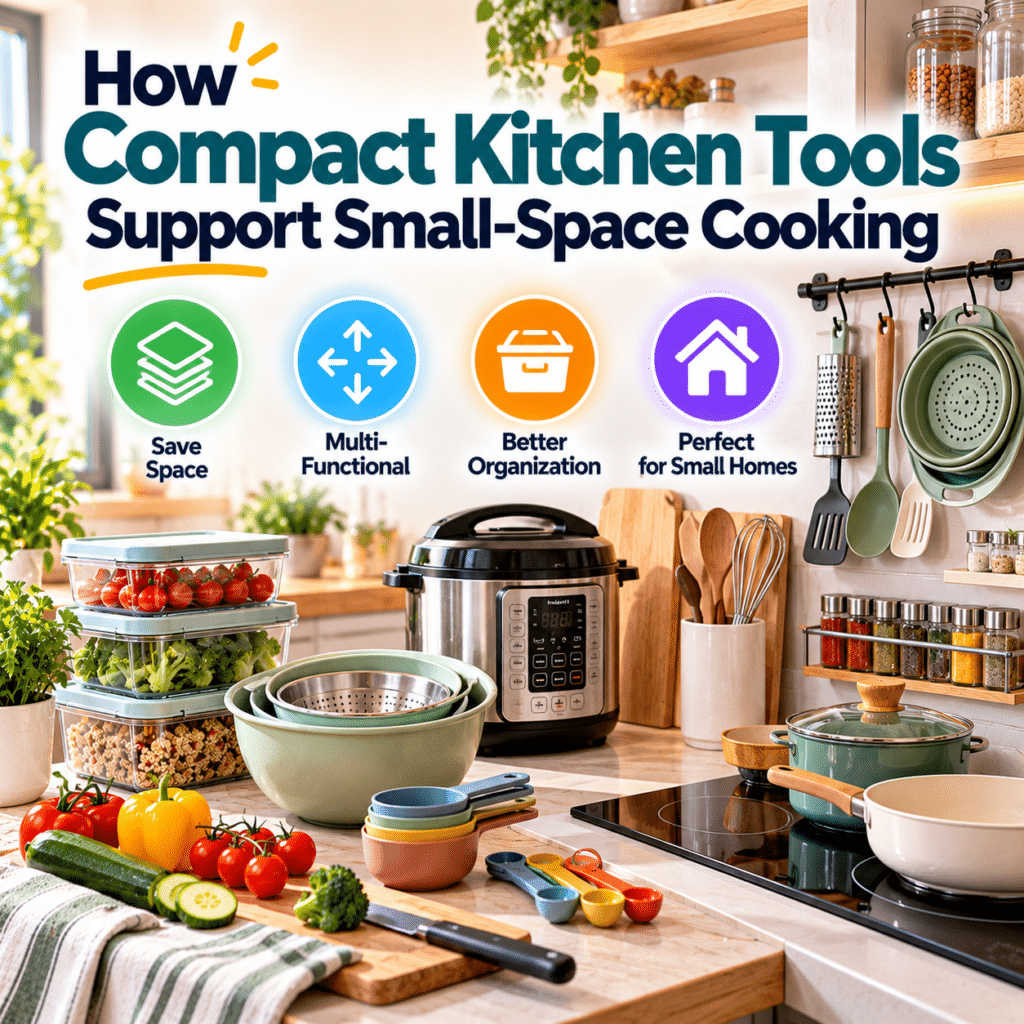
A small kitchen does not have to limit the meals you can prepare.
Whether you cook in a studio apartment, a compact family kitchen, a shared living space, or a kitchenette, the real challenge is often not the size of the room itself. It is how effectively the available space supports everyday cooking.
A crowded countertop can make chopping vegetables difficult. Oversized appliances can leave little room for food preparation. Drawers filled with rarely used gadgets may turn simple tasks into frustrating searches.
Compact kitchen tools offer a practical way to address these problems.
From nesting measuring cups and foldable colanders to smaller appliances and multifunctional utensils, thoughtfully designed equipment can help preserve working space while supporting a wide range of cooking activities.
But smaller is not always better.
A tool that is too small for the task may create extra work, while a collapsible product that is difficult to clean may be less convenient than a traditional alternative.
The goal is not to fill a small kitchen with miniature gadgets. It is to create a functional cooking environment using tools that fit the space, the meals, and the people who use them.
Understanding how compact kitchen tools support small-space cooking can help households make better decisions about storage, preparation, equipment, and everyday kitchen routines.
1. What Makes Small-Space Cooking Different?
Cooking in a limited area introduces challenges that may be less noticeable in a larger kitchen.
These challenges often involve working surfaces, storage access, appliance placement, and the movement required to prepare a meal.
Limited Countertop Space
Food preparation requires room for cutting boards, ingredients, bowls, and utensils.
When appliances or storage containers occupy most of the counter, even simple tasks can become difficult.
Restricted Storage
Small kitchens may have fewer cabinets, shallow drawers, or limited pantry space.
Large tools can occupy a disproportionate amount of available storage.
Fewer Dedicated Work Zones
In a spacious kitchen, washing, chopping, mixing, and cooking may take place in separate areas.
In a compact kitchen, the same surface may need to serve several purposes.
Appliance Placement Challenges
Countertop appliances require space not only for their physical dimensions but also for safe operation.
Ventilation, access to electrical outlets, opening lids, and handling hot components all matter.
The Need for Flexible Equipment
A small kitchen often benefits from tools that are easy to move, store, and use for multiple appropriate tasks.
Compact equipment can help, but the overall layout and cooking habits are equally important.
2. Why Compact Kitchen Tools Are Useful
Compact kitchen tools are designed to occupy less space than comparable conventional products, although their features and performance vary.
Some are physically smaller.
Others fold, collapse, nest, stack, or combine related functions.
Preserving Preparation Space
A smaller appliance or neatly stored utensil can free up countertop area for preparing ingredients.
This can make everyday cooking more comfortable.
Reducing Storage Demands
Nesting bowls, stackable containers, and compact utensils can use cabinet space more efficiently.
Supporting Flexible Routines
Tools that are easy to retrieve and put away can help a small kitchen shift between preparation, cooking, cleaning, and other activities.
Making Equipment Easier to Manage
Lighter or smaller products may be easier to move, depending on their design.
However, stability and safe handling remain essential.
Encouraging Intentional Ownership
Limited space can encourage households to choose tools based on how often they are used.
A smaller collection of reliable equipment may serve everyday needs better than many specialized gadgets.
3. Compact Kitchen Tools Come in Several Useful Designs
Not all space-saving tools work in the same way.
Understanding their design approaches makes it easier to choose equipment that suits a particular kitchen.
Nesting Tools
Nesting products fit inside one another when stored.
Examples include measuring cups, mixing bowls, and some cookware sets.
They can reduce storage volume when the shapes are compatible.
Stackable Tools
Stackable items are designed to sit securely on top of one another.
Food containers and certain kitchen accessories may use this approach.
Stable stacking is important, particularly when items are stored above shoulder height.
Collapsible Tools
Collapsible products can be folded or compressed when not in use.
Examples include some colanders, funnels, and storage containers.
Their hinges and flexible materials must remain durable and easy to clean.
Foldable Tools
Foldable designs may include handles, cutting surfaces, or other components that move into a smaller storage configuration.
They can be useful, but moving parts should lock securely when required.
Multifunctional Tools
Some products combine related tasks.
For example, a suitable utensil may incorporate measuring features, or a compact appliance may support several cooking modes.
The combined functions should be genuinely useful rather than included merely to increase the feature count.
Wall-Mounted and Hanging Tools
Certain utensils can be stored on rails, hooks, or compatible wall systems.
This may free up drawer space, provided the mounting system is secure and appropriate for the load.
Each design solves a different storage problem. The best choice depends on the kitchen’s actual constraints.
4. Nesting and Stackable Tools Make Cabinets More Efficient
Cabinet organization can have a major effect on how easy a small kitchen feels to use.
Nesting and stackable products are particularly useful because they reduce the amount of space occupied by stored equipment.
Nesting Mixing Bowls
A set of bowls that fits together may occupy less shelf space than several unrelated bowls.
Different sizes can support mixing, preparation, and serving.
However, the set should include sizes that are genuinely useful.
Measuring Cups and Spoons
Nested measuring sets can fit into a small drawer or container.
Clear markings and durable construction are more important than decorative design.
Stackable Food Containers
Containers with compatible shapes can make storage more predictable.
Matching lids and bases may reduce clutter.
However, food-storage suitability, sealing performance, and cleaning requirements still matter.
Compact Cookware Storage
Some cookware sets use removable or folding handles to reduce storage volume.
These systems require careful attention to handle attachment, weight limits, and manufacturer instructions.
A Practical Storage Principle
Choose items that fit together naturally rather than forcing unrelated products into unstable stacks.
Efficient storage should also make frequently used tools easy to retrieve.
5. Collapsible Tools Can Save Space Between Uses
Collapsible kitchen products are designed to become smaller when stored.
They can be useful in kitchens where cabinet depth or drawer height is limited.
Collapsible Colanders
A foldable colander may provide enough capacity for rinsing produce or draining suitable foods while occupying less storage space.
The material must be appropriate for the temperature and task.
Foldable Funnels
Compact funnels can help transfer liquids or dry ingredients into suitable containers.
Their value depends on stability and ease of cleaning.
Collapsible Storage Containers
Some containers use flexible walls to reduce storage volume when empty.
However, seals, structural strength, and temperature compatibility vary.
Why Collapsible Is Not Always Better
Flexible components can develop wear, collect residue, or become difficult to dry.
A rigid tool may be preferable when durability, stability, or cleaning is more important than storage size.
How to Evaluate a Collapsible Product
Consider whether it opens securely, supports the intended load, cleans thoroughly, and folds without excessive effort.
A space-saving mechanism is only useful when it performs reliably.
6. Smaller Appliances Can Fit Everyday Cooking Needs
Countertop appliances can consume a large portion of a small kitchen’s working area.
Compact versions may offer a better fit when their capacity matches the household’s cooking habits.
Mini Food Processors
Small food processors can be useful for chopping herbs, onions, or other suitable ingredients in modest quantities.
They may be easier to store than full-sized models.
However, their limited capacity can make larger preparation tasks inefficient.
Compact Blenders
Personal or compact blenders may suit individual portions and certain simple blending tasks.
Performance depends on motor design, container shape, ingredients, and intended use.
Small Rice Cookers
A compact rice cooker can be practical for households that prepare relatively small portions.
Its value depends on capacity, cooking performance, and ease of cleaning.
Compact Air Fryers
Smaller air fryers may suit one or two portions of foods that benefit from hot-air cooking.
However, limited basket space can require multiple batches.
Small Electric Kettles
A compact kettle may fit a limited countertop area and provide enough capacity for everyday beverage preparation.
Electrical safety and stable placement remain important.
Match Capacity to Real Needs
A small appliance should be selected according to typical meals, not simply its dimensions.
An undersized appliance may create more work than a slightly larger alternative.
7. Multifunctional Tools Can Reduce Equipment Clutter
One way to make a kitchen more efficient is to reduce unnecessary duplication.
Multifunctional tools can help when they combine tasks that are naturally related.
A Single Tool for Several Tasks
Certain utensils incorporate more than one practical function.
However, the design should not compromise comfort, hygiene, or performance.
Multifunctional Cooking Appliances
Some compact appliances combine cooking methods such as steaming, slow cooking, or pressure cooking.
They may reduce the need for separate devices when those functions are used regularly.
Reversible or Dual-Purpose Accessories
Certain cutting boards, preparation trays, and storage accessories are designed to serve more than one purpose.
Their usefulness depends on safe construction and appropriate cleaning.
The Tradeoff Between Versatility and Performance
A multifunctional tool may not perform every task as effectively as a dedicated product.
Complex mechanisms can also increase cleaning and maintenance requirements.
When Separate Tools Are Better
A reliable knife, cutting board, and saucepan may be more useful than a complicated gadget that performs several tasks poorly.
Multifunctionality should simplify cooking rather than introduce unnecessary compromises.
8. Small-Space Cooking Benefits From a Clear Preparation Zone
The available countertop should support the most important cooking activities.
Even a compact kitchen can feel more functional when preparation space is kept accessible.
Establish a Primary Work Surface
Choose a stable area for chopping, mixing, and assembling ingredients.
Keep it clear of unnecessary equipment.
Use Portable Tools
Lightweight preparation bowls and compact utensils can be moved when the space needs to serve another purpose.
Prepare Ingredients in Stages
Instead of spreading every ingredient across the counter, prepare items sequentially.
Return ingredients to appropriate storage when they are no longer needed.
Use a Cutting Board That Fits
A cutting board should provide enough space for safe cutting while fitting securely on the available surface.
A board that is too small can make knife work difficult.
Avoid Overloading the Workspace
Hot cookware, sharp utensils, and unstable stacks can create hazards in crowded areas.
Maintaining a clear working zone is a safety consideration as well as an organizational preference.
9. Vertical Storage Can Expand the Usefulness of a Small Kitchen
When horizontal storage is limited, walls and cabinet interiors may offer additional possibilities.
Vertical storage should be planned carefully to avoid creating obstacles or safety risks.
Wall Rails and Hooks
Suitable rails can hold frequently used utensils.
They should be mounted securely and kept away from locations where hanging items could interfere with cooking.
Magnetic Knife Storage
A properly installed magnetic strip can store compatible knives without occupying drawer space.
However, knives must be held securely and positioned where they cannot be accidentally knocked loose.
Cabinet Door Organizers
Some organizers use the interior surfaces of cabinet doors.
Their dimensions must account for shelves, hinges, and door clearance.
Adjustable Shelves
Shelf inserts or risers can create additional storage levels where cabinet height permits.
Loads should remain stable and within the organizer’s limits.
Keep Frequently Used Items Accessible
Items used daily should be easy to reach.
Heavy objects should generally be stored where they can be lifted safely.
Vertical storage works best when it improves access rather than simply fitting more objects into a small area.
10. Smart Storage Is More Important Than Perfectly Matching Containers
Coordinated storage systems can look attractive, but appearance alone does not determine functionality.
A practical small kitchen needs storage that fits the food, tools, and routines of the household.
Choose Appropriate Container Sizes
Oversized containers waste storage space when they are used for small quantities.
Very small containers can create unnecessary complexity.
Use Clear Labels
Labels can help identify ingredients and track storage dates.
This is particularly useful when containers are opaque.
Keep Similar Items Together
Grouping baking tools, preparation utensils, or food-storage accessories can reduce searching.
Avoid Excessive Decanting
Moving every packaged ingredient into a separate container may create extra cleaning and labeling work.
Decanting is most useful when it improves access, storage, or product protection.
Maintain Food Safety
Storage containers must be appropriate for the food and intended temperature.
Perishable ingredients require suitable refrigeration or freezing regardless of how organized the kitchen appears.
The most effective storage system is one that is easy to maintain during ordinary life.
11. Choosing the Right Tools for a Small Kitchen
A compact kitchen does not require an entirely different set of cooking principles.
It requires a more deliberate approach to selecting equipment.
| Kitchen need | Useful compact option | Main consideration |
|---|---|---|
| Measuring ingredients | Nesting cups and spoons | Clear markings and durability |
| Mixing small batches | Nesting mixing bowls | Practical sizes and stability |
| Draining suitable foods | Collapsible colander | Heat tolerance and cleaning |
| Chopping small quantities | Mini food processor | Capacity and blade safety |
| Blending individual portions | Compact blender | Suitable ingredients and motor performance |
| Cooking small meals | Compact countertop appliance | Capacity and ventilation |
| Storing leftovers | Stackable food containers | Food safety and lid compatibility |
| Organizing utensils | Wall rail or drawer organizer | Secure installation and access |
| Preparing ingredients | Appropriately sized cutting board | Stability and safe working area |
The right tool is the one that performs the task reliably while fitting the available space.
Compactness should be considered alongside durability, performance, and maintenance.
12. Cooking for One or Two People in a Small Kitchen
Household size can influence which compact tools are most useful.
People who regularly prepare one or two portions may benefit from equipment that handles smaller quantities efficiently.
Smaller Mixing and Preparation Bowls
A modest bowl may be sufficient for many everyday tasks.
Large bowls can remain useful for occasional baking or larger recipes.
Appropriate Cookware Sizes
A small saucepan or frying pan may suit frequent individual meals.
However, cookware should still be large enough to prevent overcrowding and allow safe handling.
Compact Appliances
Smaller appliances may reduce storage demands and suit modest portions.
Their performance should be assessed against the household’s usual recipes.
Simple Meal Preparation
Preparing ingredients in manageable quantities can reduce clutter and simplify cleanup.
Avoid Excessive Specialization
A household may not need a separate appliance for every food or cooking technique.
Versatile, dependable tools often provide greater value.
The objective is to support the meals people actually cook rather than build a collection around occasional possibilities.
13. Shared Kitchens Require Additional Organization
Small kitchens are sometimes shared by roommates, family members, or people with different cooking routines.
In these environments, compact tools can support better use of limited storage.
Assign Clear Storage Areas
Designated shelves or containers can help prevent confusion.
Choose Easy-to-Clean Equipment
Shared tools should be straightforward to clean and maintain.
Avoid Duplicate Purchases
When appropriate, households may benefit from sharing reliable equipment rather than storing several similar appliances.
Respect Different Cooking Needs
A tool that works for one person may not suit another’s dietary requirements, accessibility needs, or cooking preferences.
Keep Safety Rules Consistent
Shared kitchens benefit from clear practices for cleaning, food storage, and electrical appliance use.
Compact equipment is most helpful when it supports cooperation rather than simply increasing the number of stored items.
14. Safety Matters More When Space Is Limited
Crowded kitchens can increase the risk of accidents if equipment is poorly positioned.
Space-saving choices should never compromise basic safety.
Maintain Appliance Clearance
Countertop appliances may require ventilation space around or above them.
Follow manufacturer instructions rather than placing appliances tightly against walls or cabinets.
Protect Electrical Connections
Avoid overloading outlets or using unsuitable extension cords.
Keep electrical equipment away from water and heat sources.
Stabilize Cutting Surfaces
Use a secure cutting board on a stable countertop.
Do not prepare food on unstable covers or improvised surfaces.
Store Sharp Tools Safely
Knives should be stored in a way that protects both the blades and the people handling them.
Handle Hot Equipment Carefully
Leave sufficient room to open appliance doors, remove hot trays, and set down cookware safely.
Keep Walkways Clear
Portable carts, stools, and storage accessories should not obstruct movement or exits.
Avoid Unsafe Overhead Storage
Heavy appliances and cookware should not be placed where they are difficult to retrieve safely.
A compact kitchen is only successful when its layout remains comfortable and safe to use.
15. Common Mistakes When Buying Space-Saving Kitchen Gadgets
Some products are marketed as space-saving without delivering meaningful practical benefits.
Recognizing common mistakes can help avoid unnecessary purchases.
Choosing the Smallest Product Automatically
An appliance that is too small may require repeated batches.
A cutting board that is too narrow may be uncomfortable or unsafe.
The correct size is the smallest one that still performs the intended task effectively.
Buying Too Many Specialized Tools
Several compact gadgets can occupy more total storage space than a few versatile utensils.
Ignoring Cleaning Requirements
Complex folding mechanisms and narrow compartments may be difficult to clean.
Overlooking Durability
Moving parts, hinges, and removable handles can wear out.
Construction quality matters.
Forgetting Operational Space
An appliance may fit on a shelf but require much more room when opened or used.
Prioritizing Appearance Over Function
A coordinated collection may look attractive but still be inconvenient.
Replacing Useful Equipment Unnecessarily
Discarding functional tools simply to purchase smaller alternatives may create avoidable expense and waste.
A more thoughtful approach is to improve storage first and replace equipment only when a genuine problem remains.
16. How to Evaluate Compact Kitchen Tools Before Buying
Before choosing a space-saving product, consider both its stored dimensions and its everyday performance.
Measure Available Space
Check cabinet depth, shelf height, drawer width, and countertop clearance.
Account for handles, cords, lids, and moving parts.
Think About Working Dimensions
A tool may be compact in storage but require additional room during use.
For example, a foldable appliance accessory may need space to open fully.
Check Capacity
Choose a size that matches the quantities you normally prepare.
Evaluate Stability
Lightweight or collapsible products should remain stable during their intended tasks.
Review Cleaning Instructions
Look for accessible surfaces and appropriate washing procedures.
Consider Materials
Verify food-contact suitability and relevant temperature limits.
Assess Storage Convenience
A product that requires complicated disassembly may be less convenient than a slightly larger alternative.
Consider Long-Term Value
Durability, replaceable components, and reliable performance are often more important than a clever mechanism.
A compact product should earn its place by being useful repeatedly.
17. A Step-by-Step Approach to Improving a Small Kitchen
Improving a compact kitchen does not require purchasing a complete set of new equipment.
A gradual process can reveal which changes provide the greatest benefit.
Step 1: Identify the Main Frustration
Is the problem limited counter space, crowded drawers, difficult appliance storage, or insufficient preparation room?
Different problems require different solutions.
Step 2: Review Existing Equipment
Identify tools used frequently and items that have not been needed for a long time.
Keep essential equipment accessible.
Step 3: Reorganize Before Buying
Try grouping similar items, adjusting shelf layouts, or moving rarely used equipment to appropriate storage.
Step 4: Select One Practical Improvement
A nesting bowl set, compact utensil organizer, or appropriately sized appliance may solve a recurring problem.
Step 5: Test the New Workflow
Prepare several familiar meals and observe whether the change improves convenience.
Step 6: Adjust Based on Actual Use
If a tool is difficult to retrieve, clean, or operate, reconsider its placement or suitability.
Step 7: Maintain Clear Surfaces
Return tools to their storage locations and avoid allowing unnecessary equipment to accumulate.
Small improvements can make a meaningful difference when they are maintained consistently.
18. Compact Kitchen Design Is About Flexibility, Not Minimalism Alone
Small-space cooking is sometimes associated with minimalist living.
Owning fewer tools can help, but minimalism is not the only objective.
A kitchen should support the meals its occupants enjoy preparing.
Different Cooks Need Different Equipment
Someone who bakes frequently may need more mixing and measuring tools.
A person who prepares simple stovetop meals may require fewer specialized items.
Cooking Culture Matters
Kitchen equipment needs also vary according to ingredients, cuisines, and cooking traditions.
A tool considered optional in one household may be essential in another.
Accessibility Matters
Compact handles, folding mechanisms, and small controls are not always suitable for people with limited dexterity or grip strength.
Comfort and safe operation should guide decisions.
Flexibility Supports Long-Term Use
Tools that can adapt to different meals and changing household needs may remain useful longer.
Practicality Is More Important Than Appearance
A well-functioning small kitchen does not need to look empty.
It needs enough space to prepare food safely and enough organization to make tools easy to use.
19. The Future of Compact Kitchen Tools
Compact kitchen equipment is likely to continue evolving through improvements in materials, mechanical design, and appliance integration.
Several directions may be particularly useful.
Better Folding and Nesting Mechanisms
Improved designs may make compact products more durable and easier to operate.
More Efficient Appliance Layouts
Manufacturers may continue developing equipment that uses internal space more effectively without sacrificing necessary capacity.
Thoughtful Multifunctionality
Combining related functions may help reduce duplicate equipment when performance remains reliable.
Easier Maintenance
Simpler components and accessible cleaning surfaces can improve the long-term usefulness of compact tools.
Greater Attention to Repairability
Replaceable parts and durable construction may help reduce unnecessary appliance replacement.
More Inclusive Design
Compact products can become more useful when they accommodate different physical abilities and cooking preferences.
The most valuable innovations will not simply make tools smaller.
They will help households use limited space more effectively while preserving cooking quality, safety, and convenience.
Frequently Asked Questions
What are the most useful compact kitchen tools for small spaces?
Useful options often include nesting measuring cups, stackable food containers, appropriately sized cookware, compact preparation bowls, and organizers that fit existing cabinets. The best choices depend on cooking habits and available storage.
Are multifunctional kitchen tools better than separate utensils?
Not always. Multifunctional tools can reduce clutter when their combined functions work well. Separate utensils may be preferable when they provide better performance, comfort, or cleaning convenience.
Do compact appliances use less electricity?
Not necessarily. Energy consumption depends on power, cooking duration, efficiency, portion size, and operating conditions. A smaller appliance may be efficient for some tasks but less practical for larger batches.
Are collapsible kitchen tools durable?
Durability varies by design, materials, and construction quality. Hinges, flexible sections, and moving components should be evaluated for wear, stability, and cleaning requirements.
How can I organize a small kitchen without buying new products?
Start by grouping frequently used tools, reorganizing cabinet shelves, clearing unnecessary countertop items, and using existing storage containers. New purchases should address specific problems that remain.
Can a small kitchen support regular home cooking?
Yes. A small kitchen can support many cooking routines when it has a stable preparation surface, appropriate equipment, safe appliance placement, and practical storage. The best layout depends on the meals being prepared.
Conclusion: The Right Tools Make Small Kitchens More Capable
Compact kitchen tools can make limited cooking spaces more functional by reducing storage demands, preserving preparation surfaces, and supporting flexible everyday routines.
Nesting bowls, collapsible colanders, stackable containers, smaller appliances, and thoughtfully designed organizers can all contribute to a more manageable kitchen.
However, compactness is only one part of good equipment design.
A tool must also be safe, durable, comfortable, easy to clean, and large enough for its intended purpose.
The most effective approach is to begin with real cooking habits, improve organization, and choose additional equipment only when it solves a meaningful problem.
A small kitchen does not need to imitate a larger one to work well.
With carefully chosen tools and a practical layout, even a limited cooking space can support satisfying meals, efficient routines, and enjoyable home cooking.