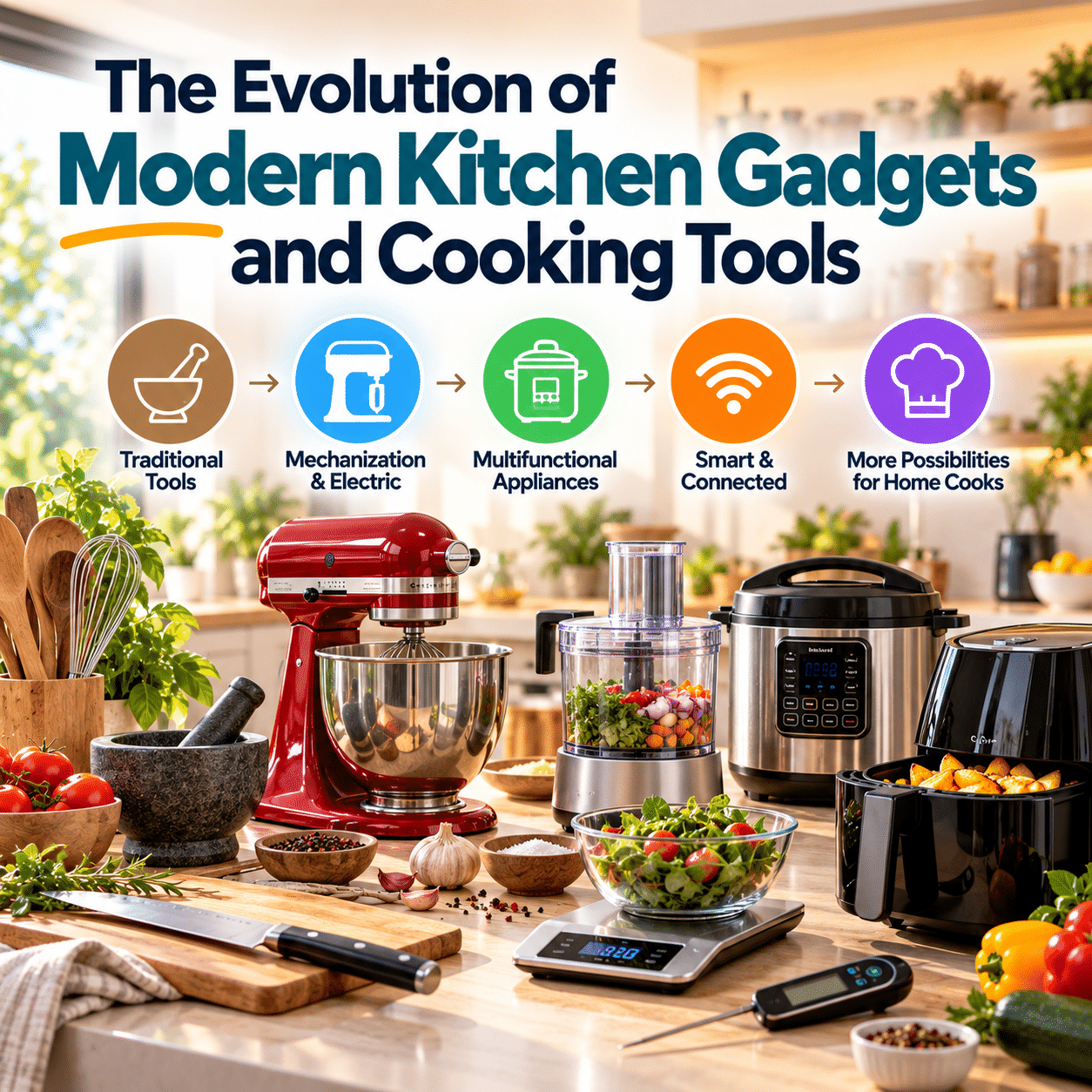
The kitchen has always been a place of invention.
Long before electric appliances and digital controls became familiar, people developed knives, grinding stones, mortars, cooking vessels, and other practical tools to make food preparation easier.
Many of those basic tools remain essential today. Yet the ways people chop, mix, heat, measure, and prepare ingredients have changed considerably.
Modern kitchen gadgets and cooking tools now combine traditional culinary principles with improved materials, electric motors, temperature sensors, electronic controls, and thoughtful ergonomic design.
Some innovations reduce physical effort. Others improve consistency, expand cooking possibilities, or make specialized techniques more accessible to home cooks.
But progress does not necessarily mean replacing every traditional utensil with an electronic device. The most valuable kitchen innovations solve real problems while preserving the control, reliability, and enjoyment of cooking.
Understanding how kitchen tools have evolved helps explain not only what modern gadgets can do, but also which improvements genuinely matter in everyday food preparation.
1. From Traditional Utensils to Modern Kitchen Equipment
The history of kitchen tools begins with practical needs: cutting ingredients, grinding grains, mixing food, controlling heat, and storing prepared meals.
Early cooking tools relied primarily on human effort and relatively simple materials.
Knives and cutting surfaces supported food preparation. Mortars and pestles helped crush or grind ingredients. Pots and pans made it possible to cook food using controlled exposure to heat.
These tools were developed and refined across different cultures, with designs shaped by local ingredients, cooking methods, and available materials.
Why Traditional Tools Remain Relevant
Many traditional utensils continue to perform their intended functions exceptionally well.
A sharp kitchen knife provides precise control over cutting.
A mortar and pestle allows ingredients to be crushed and combined through direct physical pressure.
A sturdy pan can serve multiple cooking purposes without electronic components.
Their continued usefulness illustrates an important principle: innovation does not always make an older design obsolete.
What Modern Tools Added
Modern kitchen equipment introduced new ways to improve familiar tasks.
Mechanical mechanisms increased leverage and consistency. Electric motors reduced repetitive manual effort. Temperature controls helped regulate cooking conditions.
More recently, sensors and programmable electronics have made certain operations easier to monitor and repeat.
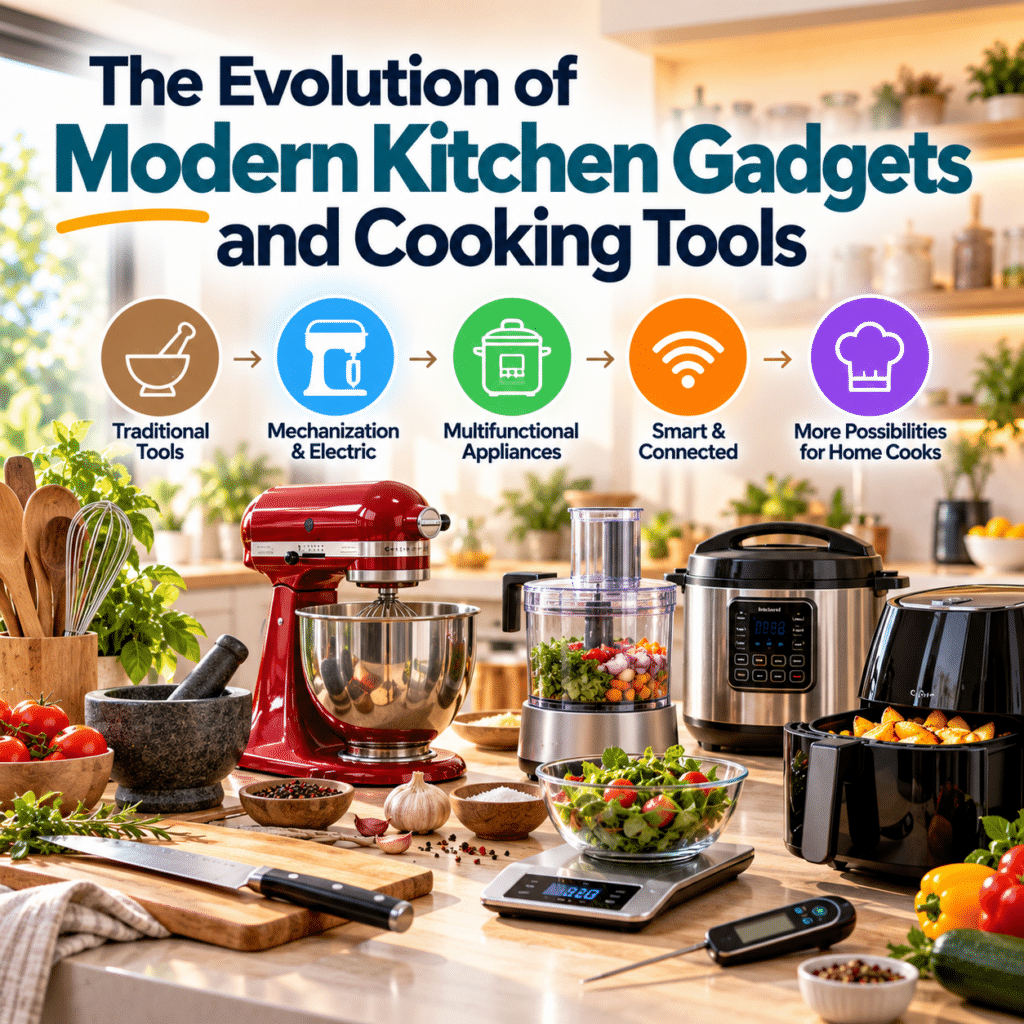
The evolution of kitchen technology is therefore best understood as a series of practical improvements rather than a complete replacement of traditional cooking methods.
2. Mechanization Changed the Way Ingredients Are Prepared
One major development in kitchen technology was the use of mechanical systems to perform repetitive tasks.
Hand-cranked grinders, rotary beaters, food mills, and other mechanisms allowed cooks to apply force more efficiently.
Later, electric motors expanded these possibilities.
Electric Mixers
Electric mixers reduce the manual effort involved in beating, whisking, and combining ingredients.
Hand mixers provide a relatively portable solution for many mixing tasks.
Stand mixers can support longer or more demanding mixing operations, depending on their capacity and design.
For activities such as preparing dough or whipping mixtures, motorized equipment may offer greater convenience and consistency.
However, small quantities and delicate preparations may still be easier to manage by hand.
Food Processors
Food processors combine a motor-driven mechanism with interchangeable blades or discs to perform suitable chopping, slicing, shredding, and mixing tasks.
They can be particularly useful when preparing larger quantities of ingredients.
The Smithsonian’s National Museum of American History documents how food processors became important additions to home kitchens during the second half of the twentieth century.
Their popularity reflects a practical advantage: reducing repetitive preparation work while expanding the range of tasks one appliance can perform.
Blenders
Blenders use rapidly rotating blades to process suitable ingredients, often with liquid present.
They are commonly used for soups, smoothies, sauces, and other mixtures.
Different designs serve different purposes, including countertop blenders and immersion blenders.
The most appropriate option depends on texture requirements, batch size, and ease of cleaning.
What Mechanization Really Improved
The main contribution of motorized preparation tools is not simply speed.
They can also reduce repetitive effort and help produce more consistent results under suitable conditions.
Nevertheless, proper technique, ingredient selection, and equipment maintenance remain essential.
3. New Materials Improved Durability and Convenience
Kitchen innovation has also been shaped by materials science.
Changes in metals, glass, ceramics, polymers, and surface treatments have influenced the performance and maintenance of cooking tools.
Stainless Steel
Stainless steel is widely used in kitchen equipment because suitable grades offer corrosion resistance, durability, and relatively straightforward cleaning.
It appears in cookware, utensils, appliance housings, and food-contact components.
However, stainless steel products vary in construction and performance.
For cookware, heat distribution depends on factors such as thickness and whether conductive layers are incorporated into the design.
Nonstick Surfaces
Nonstick cookware can make certain foods easier to release from a cooking surface.
It may also simplify cleaning.
However, coatings vary in composition, temperature limitations, and maintenance requirements.
Users should follow manufacturer guidance concerning heating, utensils, cleaning, and replacement.
A nonstick surface should not be assumed suitable for every cooking technique.
Heat-Resistant Glass and Ceramics
Specialized glass and ceramic materials have expanded options for baking, serving, and food storage.
Some products are designed to tolerate particular temperature conditions, but thermal-shock resistance and oven compatibility differ.
Not every glass or ceramic container can safely move between extreme temperatures.
Silicone and Modern Polymers
Suitable food-contact silicone and polymer products are used in spatulas, baking accessories, containers, and other kitchen tools.
Their flexibility and relatively light weight can be useful.
However, temperature limits, material quality, and intended applications must be respected.
Better Materials Do Not Eliminate Maintenance
Even durable kitchen tools require appropriate care.
Correct cleaning, storage, sharpening, and inspection can be more important to long-term performance than having the newest material or finish.
4. Cooking Technology Evolved Beyond Traditional Stoves
Controlling heat is one of the most important aspects of cooking.
Different heating technologies have changed how quickly cookware responds, how heat is transferred, and how cooking conditions are managed.
Gas Cooking
Gas burners generate heat through combustion.
They offer visible flame control and can accommodate a broad range of cookware.
However, performance depends on burner design, ventilation, and operating conditions.
Gas combustion also produces indoor air pollutants, making appropriate kitchen ventilation important.
Electric Resistance Cooking
Electric resistance cooktops convert electrical energy into heat through heating elements.
These systems may use exposed coils or smooth cooking surfaces.
They provide an alternative to combustion-based cooking, although response times and heat distribution vary between designs.
Induction Cooking
Induction cooking uses an electromagnetic field to generate heat in compatible cookware.
Rather than relying primarily on a heated burner to transfer energy to the pan, induction produces heat directly within suitable cookware.
This can support responsive temperature control and efficient energy transfer.
However, induction requires compatible cookware and an appropriate electrical installation.
The cooking surface can also become hot from contact with heated cookware, so normal burn precautions still apply.
Why Different Heating Methods Remain Useful
Each cooking method has strengths and limitations.
The right choice depends on cooking habits, cookware, energy availability, installation requirements, ventilation, and personal preferences.
Technological progress has expanded the available options rather than creating one universal solution for every kitchen.
5. Microwave Ovens Changed Expectations About Cooking Time
Microwave ovens represent a significant development in modern food preparation.
They use electromagnetic energy to heat food through interactions with its components.
The technology developed from research involving microwave-generating equipment and became commercially available during the twentieth century.
Early microwave ovens were large and expensive.
Over time, smaller and more practical designs made the technology suitable for domestic kitchens.
Everyday Benefits
Microwave ovens can be convenient for:
- Reheating prepared meals.
- Warming suitable beverages.
- Defrosting food using appropriate procedures.
- Cooking certain vegetables and other foods.
- Preparing dishes designed for microwave cooking.
Their convenience is particularly noticeable when handling relatively small portions or tasks that do not require conventional browning.
Why Microwaves Do Not Replace Every Cooking Method
Microwave heating behaves differently from conventional oven heating.
It does not generally create the same surface browning and crisping effects without additional technology or specialized accessories.
Heating can also be uneven.
Stirring, rotating, standing time, and checking food temperature may be necessary.
Safety and Suitable Containers
Only microwave-safe containers should be used according to manufacturer instructions.
Food must be heated sufficiently and evenly when safety depends on reaching an appropriate temperature.
The microwave’s development illustrates how a new cooking technology can become an everyday tool without replacing traditional ovens and stovetops.
6. Precision Cooking Tools Help Improve Consistency
Cooking results often depend on variables that are difficult to judge by appearance alone.
Temperature, timing, ingredient proportions, and moisture all affect the final dish.
Modern measuring and control tools make these variables easier to manage.
Digital Kitchen Scales
Digital scales allow ingredients to be measured by weight.
This is especially useful in baking, where ingredient proportions can strongly influence texture and structure.
Weighing ingredients can also reduce variation caused by differences in measuring cups, packing methods, or ingredient density.
Digital Food Thermometers
Food thermometers help measure internal temperature rather than relying only on appearance or cooking time.
This is important for both cooking quality and food safety.
Different thermometer designs serve different purposes, including instant-read models and leave-in probes.
Programmable Timers
Timers help cooks manage multiple preparation and cooking stages.
Some appliances include automatic timing functions, while standalone timers remain useful because they are simple and easy to operate.
Temperature-Controlled Cooking
Certain cooking systems allow users to select and maintain relatively precise temperature settings.
For example, sous vide equipment circulates temperature-controlled water around appropriately packaged food.
This can support consistent results when suitable cooking procedures are followed.
However, precise temperature control does not remove the need for correct food-handling practices.
Time, temperature, food thickness, and storage conditions all matter.
Precision Is a Tool, Not a Substitute for Skill
Measurement can improve repeatability, but cooking also involves sensory judgment.
A scale cannot determine whether a sauce tastes balanced.
A thermometer cannot replace every consideration of texture or preparation technique.
The best results come from combining accurate information with practical cooking knowledge.
7. Multifunctional Appliances Expanded Cooking Possibilities
Another important development is the integration of several cooking functions into one appliance.
Modern multicookers may support combinations of pressure cooking, slow cooking, steaming, sautéing, and other functions.
Combination ovens may offer multiple heating modes.
Why Multifunctional Appliances Are Attractive
Combining related functions may reduce the need for separate equipment.
It can also make certain cooking processes easier to coordinate.
For example, a suitable multicooker may allow ingredients to be sautéed before continuing with a pressure-cooking program in the same vessel.
This can reduce the number of pots used for some recipes.
The Role of Programmable Controls
Electronic controls allow compatible appliances to regulate selected operating conditions.
These may include cooking duration, heating mode, or temperature.
However, automatic programs cannot guarantee ideal results for every ingredient or recipe.
Important Limitations
Multifunctional appliances vary in capacity, performance, cleaning requirements, and available cooking modes.
Some functions may involve compromises compared with dedicated equipment.
Pressure-cooking features also require particular attention to safe operation, including sealing, filling limits, and pressure-release instructions.
A multifunctional appliance is most valuable when its combined capabilities match the household’s actual cooking habits.
8. Air Fryers Reflect Changes in Cooking Convenience
Air fryers are a familiar example of how established cooking principles can be packaged into a convenient countertop appliance.
Most air fryers use electric heating elements and forced hot-air circulation to cook food.
This approach is related to convection oven cooking.
What Makes Air Fryers Practical
Air fryers can be useful for cooking or reheating suitable foods in relatively small batches.
Depending on the recipe and appliance, they may provide a crisp exterior with less added oil than traditional deep-frying methods.
They can also be convenient when a household does not want to operate a larger oven for a small portion.
Why Results Vary
Cooking performance depends on airflow, basket loading, food size, temperature, and cooking time.
Overcrowding can reduce even cooking.
Different models also vary in capacity and heat distribution.
Understanding the Limitations
Air frying is not identical to deep-frying.
The cooking method, texture, and flavor can differ.
An air fryer also does not automatically make every food nutritious or guarantee lower energy consumption in every situation.
Its value lies in convenience and suitability for particular cooking tasks.
9. Ergonomic Design Has Made Kitchen Tools Easier to Use
Not all important innovations involve electronics.
Changes in handle design, grip materials, weight distribution, and control placement can make kitchen tools more comfortable and practical.
Better Grip Design
A thoughtfully designed handle may reduce slipping and make a tool easier to hold.
This matters when hands are wet or when a task requires repeated movement.
Reduced Physical Effort
Certain peelers, can openers, jar openers, and other utensils use mechanical design to improve leverage.
These improvements may help people who find conventional tools difficult to operate.
Clearer Controls
Large, readable markings and straightforward controls can make kitchen equipment easier to understand.
A complicated appliance may offer advanced functions while being less convenient than a simpler alternative.
Accessibility Matters
Users differ in grip strength, dexterity, vision, height, and mobility.
A tool that is comfortable for one person may not work well for another.
Inclusive design considers these differences instead of assuming that every cook has identical needs.
Comfort Supports Better Cooking
An ergonomic tool can make repeated tasks less tiring and improve control.
However, ergonomics should be evaluated in practice rather than inferred from marketing descriptions alone.
10. Connected Kitchen Gadgets Introduced New Types of Control
Wireless communication and digital connectivity have also reached household kitchens.
Some appliances can communicate with smartphones or compatible home systems.
These features may provide monitoring, notifications, or access to additional settings.
Remote Monitoring
A connected thermometer may display temperature readings on a compatible device.
A connected appliance may provide a notification when a program finishes.
These functions can reduce the need to check equipment constantly.
Recipe Guidance
Certain appliances offer guided instructions or preconfigured cooking programs.
These features may help users follow multi-stage processes.
However, recipes and presets still require judgment, especially when ingredients or quantities differ.
Maintenance Information
Connected devices may provide status updates or reminders.
The usefulness of these functions depends on their accuracy and whether the household actually needs them.
Connectivity Does Not Equal Better Cooking
A kitchen tool does not need Wi-Fi or Bluetooth to be effective.
A reliable thermometer, well-designed knife, or straightforward mixer may be more useful than a complicated connected gadget.
Connectivity should provide a clear benefit rather than exist simply as an additional feature.
11. Food Safety Remains Essential as Cooking Tools Evolve
Modern kitchen technology can support food safety, but it cannot eliminate the need for safe handling and preparation.
Measuring Safe Internal Temperatures
Food appearance is not always a reliable indicator of safety.
A suitable food thermometer is an important tool for checking whether foods requiring temperature verification have reached the appropriate internal temperature.
As an example, U.S. food-safety guidance specifies a minimum internal temperature of 165°F (74°C) for poultry.
Different foods have different requirements, and some also require a resting period.
Preventing Cross-Contamination
Kitchen gadgets should be cleaned appropriately after contact with raw foods.
Cutting boards, blades, containers, and attachments may require special attention.
Separate handling of raw and ready-to-eat foods helps reduce cross-contamination.
Using Appliances Correctly
Automatic cooking programs do not guarantee that food is safe.
Users must consider food quantity, thickness, initial temperature, and appliance instructions.
Understanding Specialized Techniques
Methods such as sous vide require appropriate time-temperature combinations and safe cooling or storage practices.
Precision equipment should be used with validated food-safety procedures.
Maintaining Equipment
Damaged cords, worn components, cracked containers, and defective seals can create safety risks.
Regular inspection and proper maintenance remain important regardless of technological sophistication.
12. How Modern Kitchen Gadgets Compare With Traditional Tools
The differences between traditional and modern kitchen tools are often practical rather than absolute.
| Cooking task | Traditional approach | Modern alternative | Main consideration |
|---|---|---|---|
| Mixing ingredients | Whisk or wooden spoon | Electric hand or stand mixer | Batch size and effort |
| Chopping vegetables | Knife and cutting board | Food processor or electric chopper | Precision and cleanup |
| Measuring ingredients | Measuring cups and spoons | Digital kitchen scale | Consistency and recipe requirements |
| Checking doneness | Time and visual judgment | Digital food thermometer | Accuracy and food safety |
| Heating cookware | Gas or electric resistance burner | Induction cooktop | Cookware and installation compatibility |
| Cooking several ways | Separate pots and appliances | Multifunctional cooker | Performance and versatility |
| Reheating food | Stovetop or conventional oven | Microwave oven | Food type and heating uniformity |
| Grinding ingredients | Mortar and pestle | Electric grinder | Texture and control |
The best option depends on the intended task.
A food processor may save time when preparing a large batch, but a knife may be quicker for cutting one small ingredient.
Likewise, a digital scale can improve baking consistency, while a measuring spoon may be sufficient for a simple task.
The goal is not to replace every traditional tool. It is to choose the most suitable method.
13. Why Some Kitchen Gadgets Become Essentials and Others Do Not
Kitchen gadgets often promise convenience, but not every innovation becomes part of a household’s regular routine.
Several factors determine whether a tool delivers lasting value.
Frequency of Use
A device used every day may justify dedicated storage space.
A gadget needed only once or twice a year may be less practical.
Quality of Results
Convenience matters, but the food still needs to meet the cook’s expectations.
A device that saves time while consistently producing disappointing results may not be worthwhile.
Cleaning Requirements
Some gadgets reduce preparation time but introduce complicated cleaning.
Blades, seals, removable components, and narrow openings may require extra attention.
Storage Space
Countertop space is limited in many kitchens.
A large appliance can become inconvenient if it is difficult to move or store.
Reliability
A simple, durable tool may offer better long-term value than an electronic gadget with unnecessary features.
Learning Curve
A product should be understandable enough to use regularly.
If the controls are confusing or the instructions are unclear, its theoretical capabilities may remain unused.
Successful kitchen innovations become useful habits rather than occasional novelties.
14. How to Choose Cooking Tools That Fit Your Kitchen
Choosing the right tools starts with the meals you prepare and the tasks you perform most often.
Identify Repetitive Tasks
Consider which activities take the most effort.
If you frequently prepare large quantities of chopped vegetables, a suitable food processor may be useful.
If you bake regularly, a reliable kitchen scale may offer greater value.
Consider Available Space
Measure storage and countertop areas before choosing larger appliances.
Include the clearance required for ventilation, opening lids, and operating the equipment.
Check Capacity
A compact appliance may be suitable for one or two people but inconvenient for larger batches.
Capacity should reflect realistic cooking needs.
Evaluate Cleaning and Maintenance
Look at how easily parts can be removed, cleaned, dried, and reassembled.
Follow manufacturer instructions for dishwasher compatibility.
Review Safety Features
Consider relevant protections, including stable bases, appropriate guards, heat-resistant handles, and suitable electrical ratings.
Safety features vary between product categories.
Think About Long-Term Support
Replaceable parts, available accessories, clear instructions, and service options can extend a product’s useful life.
Avoid Buying Features Without a Purpose
A long feature list is not the same as practical value.
Choose tools that improve cooking activities you already perform or genuinely want to learn.
15. Sustainability and the Lifespan of Kitchen Equipment
Kitchen technology also has environmental implications.
Appliances require materials and energy to manufacture, transport, operate, and eventually dispose of.
Durable Tools Can Offer Long-Term Value
A well-maintained knife, pan, or mechanical utensil may remain useful for many years.
Replacing functional tools unnecessarily can create avoidable waste.
Efficient Operation Matters
Certain modern appliances can reduce energy use for particular cooking tasks.
However, energy performance depends on the appliance, portion size, cooking method, and operating conditions.
A smaller appliance is not automatically more efficient in every situation.
Repairability Is Important
Products with replaceable parts and accessible service support may remain useful longer.
Highly integrated designs can sometimes make repairs difficult.
Thoughtful Ownership
Practical habits include maintaining equipment, using suitable cooking methods, avoiding duplicate purchases, and recycling electronics through appropriate programs.
Sustainable kitchen innovation is not simply about owning newer technology.
It is about choosing equipment that provides lasting usefulness with reasonable resource consumption.
16. What the Future of Kitchen Gadgets May Look Like
The evolution of kitchen equipment is likely to continue through improvements in materials, sensing, control systems, and usability.
Several long-term directions are worth considering.
More Accurate Sensors
Temperature and other measurement technologies may help compatible appliances monitor cooking conditions more effectively.
Their usefulness will depend on sensor accuracy and the quality of the control system.
Better Integration of Cooking Functions
Multifunctional appliances may continue to combine related cooking processes.
Successful designs will need to balance versatility with ease of use and reliability.
Improved Energy Management
Advances in heating technology and appliance controls may help reduce unnecessary energy use.
However, actual performance should be evaluated using relevant measurements rather than marketing claims.
More Accessible Controls
Clear interfaces, ergonomic features, and adaptable settings can help make cooking tools useful to a wider range of people.
Greater Attention to Repairability
Durable components, replaceable accessories, and better service support may become increasingly important considerations for consumers.
Technology That Supports Cooking Skills
Guided functions and monitoring tools may help people learn unfamiliar techniques.
The most useful systems will provide understandable information while allowing cooks to retain meaningful control.
The future of kitchen technology is not necessarily a fully automated kitchen.
It may instead be a collection of well-designed tools that make cooking easier while respecting the skills and preferences of the person preparing the food.
Conclusion: Kitchen Innovation Works Best When It Solves Real Problems
The evolution of modern kitchen gadgets and cooking tools reflects a long history of practical problem-solving.
Traditional utensils established the foundations of food preparation. Mechanical inventions reduced repetitive effort. Electric appliances expanded what home cooks could accomplish, while modern sensors and controls introduced greater precision and flexibility.
Materials science, ergonomic design, and multifunctional equipment have also improved the ways people interact with kitchen tools.
Yet newer technology is not automatically superior.
A dependable knife, a simple measuring tool, or a well-made pan may remain the best choice for many everyday tasks.
The real value of kitchen innovation lies in making food preparation more manageable, consistent, safe, and enjoyable.
The best modern kitchen is not the one with the most gadgets. It is the one equipped with tools that genuinely support the way its occupants cook.