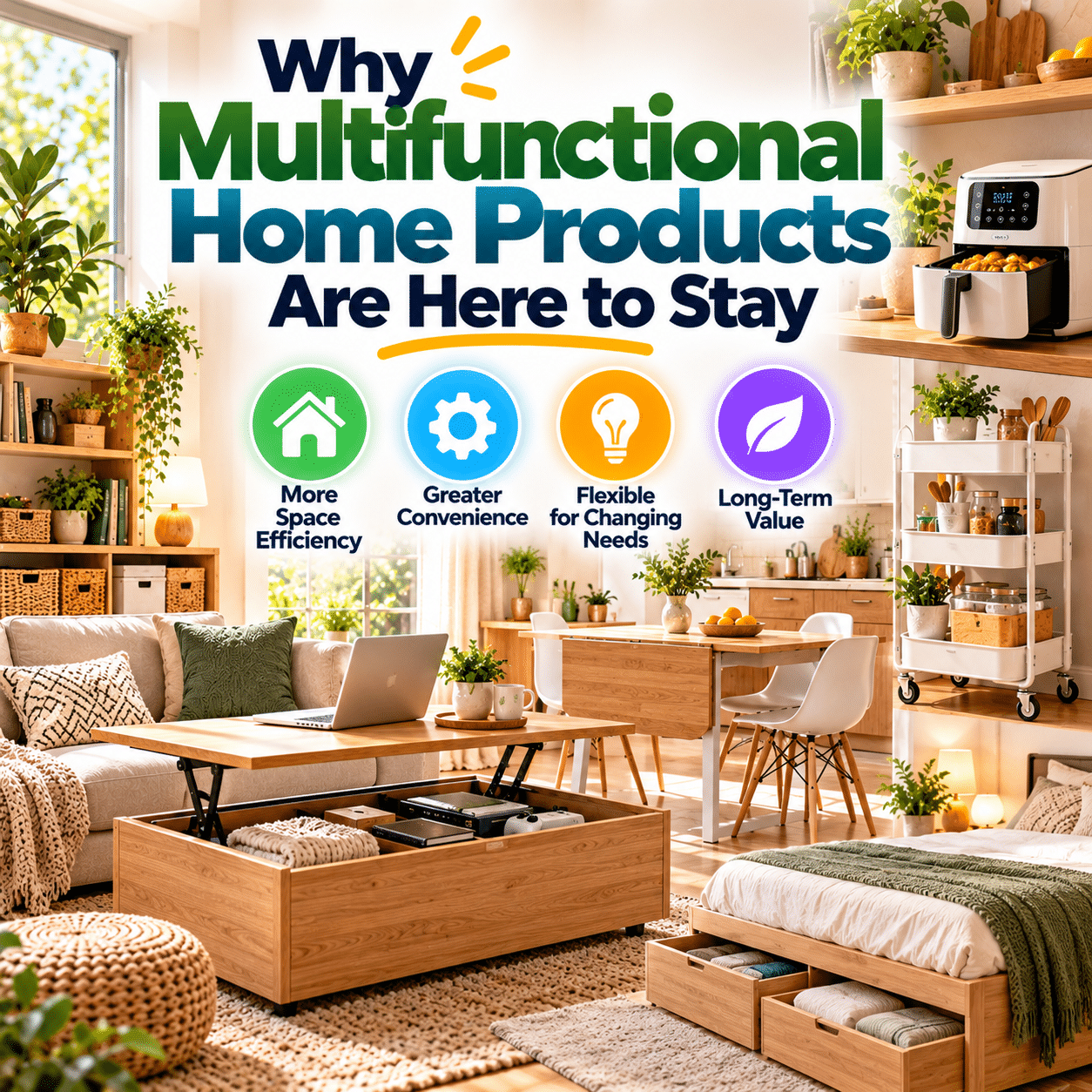
A coffee table that provides storage, a desk that converts into a dining surface, or a kitchen appliance that performs several cooking functions can change how a home is used.
These products share a common idea: one item can serve more than one practical purpose.
Multifunctional home products are often associated with compact apartments and space-saving design. Yet their appeal extends well beyond small homes.
Households of different sizes may benefit from furniture, appliances, organizers, and accessories that adapt to changing routines.
A guest room may occasionally become a workspace. A living room may need additional storage. A kitchen may benefit from an appliance that handles several frequently used cooking tasks.
In these situations, multifunctional design can reduce the need for separate products and make existing space more useful.
However, combining several features does not automatically create a better product.
A multifunctional item may be difficult to operate, expensive to repair, or less effective than a dedicated alternative.
The long-term appeal of multifunctional home products depends on whether they solve genuine problems without introducing unnecessary complexity.
Understanding their strengths, limitations, and practical applications can help households make better decisions about what belongs in their homes.
1. What Are Multifunctional Home Products?
Multifunctional home products are items designed to perform two or more useful functions.
They may combine functions within one physical object or change configuration to serve different purposes.
Examples include:
- Storage benches that provide seating and concealed storage.
- Sofa beds that function as seating and occasional sleeping furniture.
- Kitchen appliances with multiple cooking modes.
- Convertible desks that adapt to different activities.
- Mirrors with integrated storage.
- Lighting fixtures with adjustable task and ambient settings.
- Cleaning tools with interchangeable attachments.
- Modular organizers that support several storage arrangements.
The defining feature is not simply the number of advertised capabilities.
It is whether those capabilities provide meaningful value during normal use.
A product with three well-designed functions may be more useful than one offering ten poorly executed features.
2. Why Multifunctional Design Has Lasting Appeal
Multifunctional products respond to several enduring household needs.
Space Is a Limited Resource
Every home has physical boundaries.
Even large houses benefit from efficient furniture arrangements and practical storage.
Daily Routines Change
Rooms may serve different purposes throughout the day.
Flexible products can support these transitions.
Households Want Practical Convenience
Combining compatible functions may reduce the need to retrieve, assemble, or store multiple separate items.
Purchasing Decisions Involve Trade-Offs
Consumers often compare cost, quality, maintenance, and usefulness.
A multifunctional product may provide good value when it replaces several items effectively.
Adaptability Matters
Households change as people move, work arrangements evolve, or family needs shift.
Products that remain useful across different situations may offer lasting benefits.
These needs are not tied to a temporary decorating trend.
They help explain why multifunctional design remains relevant.
3. Multifunctional Products Are Not Just for Small Homes
Space-saving benefits are easy to recognize in compact apartments.
However, multifunctional products can be equally useful in larger homes.
Apartments
Convertible furniture can help one room support several activities.
Family Homes
Storage seating, adaptable tables, and flexible organizers may support changing family routines.
Home Offices
Desks and accessories with integrated storage or adjustable configurations can help manage equipment and supplies.
Guest Rooms
A sofa bed or foldaway workspace may allow a room to serve multiple purposes.
Kitchens
Appliances with compatible functions may reduce the number of separate devices needed.
Hobby Areas
Adaptable work surfaces and organizers can accommodate different projects.
Entryways
Benches with shoe storage or integrated hooks may simplify daily routines.
The relevant question is not how large the home is.
It is whether a multifunctional product helps the household use its space more effectively.
4. Different Types of Multifunctional Home Products
Multifunctional products can be grouped by how they combine or change functions.
Integrated Products
These combine multiple functions within one item.
Examples include storage mirrors and furniture with built-in lighting.
Convertible Products
These change configuration.
Examples include sofa beds and extendable dining tables.
Modular Products
These use compatible components that can be rearranged.
Examples include adjustable storage systems and modular furniture.
Products With Multiple Operating Modes
These perform different tasks through selectable settings.
Examples include some cooking appliances and cleaning devices.
Products With Interchangeable Attachments
These use accessories to perform related tasks.
Examples include certain vacuum cleaners and food-preparation tools.
Hybrid Products
Some products combine several approaches.
A convertible piece of furniture may also include integrated storage.
Understanding the type of multifunctionality helps consumers evaluate whether the design is practical.
5. Multifunctional Furniture Makes Rooms More Flexible
Furniture is one of the most visible applications of multifunctional design.
Storage Ottomans
An ottoman may provide a footrest, occasional seating, and concealed storage.
Its suitability depends on construction and manufacturer guidance.
Sofa Beds
A sofa bed combines everyday seating with a sleeping surface.
Comfort in both configurations should be evaluated.
Extendable Tables
An extendable table can support everyday dining and occasional gatherings.
Storage Benches
A bench may provide seating and a place for shoes, blankets, or other belongings.
Convertible Desks
Some desks fold, extend, or change configuration for different activities.
Beds With Integrated Storage
Drawers or lift-up storage can make use of space beneath a bed.
Important Considerations
Moving mechanisms, weight capacity, stability, and access to storage all influence practicality.
A piece of furniture should remain comfortable and safe in every intended configuration.
6. Multifunctional Kitchen Appliances Can Simplify Cooking
Kitchens frequently contain tools designed for specific tasks.
Some multifunctional appliances combine related cooking functions.
Multicookers
Depending on the model, a multicooker may support pressure cooking, slow cooking, steaming, sautéing, or other modes.
Countertop Ovens
Certain countertop ovens combine baking, toasting, broiling, and convection functions.
Food Processors
Food processors may use different blades or attachments for chopping, slicing, shredding, or mixing.
Blenders With Additional Functions
Some blender systems include compatible containers or attachments for different preparation tasks.
Coffee Machines
Certain coffee machines support multiple beverage styles or brewing options.
Evaluate Performance, Not Feature Count
A combined appliance may perform some tasks better than others.
Consumers should consider the functions they will actually use.
Consider Capacity
A compact appliance may not accommodate the same quantities as larger dedicated equipment.
Cleaning Matters
Multiple attachments and complex components may increase cleanup time.
Follow Safety Instructions
Cooking appliances have specific electrical, heat, pressure, and cleaning requirements.
A multifunctional appliance is useful when its capabilities fit real cooking habits.
7. Cleaning Products Benefit From Flexible Design
Cleaning routines often involve different surfaces, spaces, and tools.
Multifunctional cleaning equipment may reduce the need for several separate devices.
Vacuum Cleaners With Attachments
Compatible attachments may support floors, upholstery, stairs, and tight spaces.
Convertible Vacuum Designs
Some models convert between upright, stick, or handheld configurations.
Steam Cleaning Equipment
Certain products are designed for multiple suitable surfaces.
However, steam is not appropriate for every material.
Cleaning Tools With Replaceable Heads
Interchangeable heads can support different tasks when they are compatible with the tool.
Storage Convenience
One device may be easier to store than several separate products.
Important Limitations
Attachment changes can take time.
Some tools may be too heavy or awkward for certain tasks.
Surface Compatibility
Always verify whether a cleaning method is appropriate for flooring, upholstery, finishes, and other materials.
A versatile cleaner should improve the cleaning process rather than complicate it.
8. Multifunctional Storage Supports Changing Needs
Storage needs often change as households acquire, use, and reorganize belongings.
Multifunctional storage products can provide additional flexibility.
Shelving With Adjustable Components
Adjustable shelves can accommodate items of different heights.
Storage Furniture
Cabinets, benches, and tables may combine organization with another function.
Rolling Carts
A suitable rolling cart may serve as a kitchen organizer, craft station, or office supply holder.
Modular Drawer Systems
Compatible drawers and compartments can be rearranged to suit different belongings.
Wall-Mounted Organizers
Some systems combine shelves, hooks, and other accessories.
Compatibility Matters
Not all modular products are interchangeable.
Expansion options should be checked before purchasing.
Stability and Installation
Tall furniture and storage systems may require anchoring.
Wall-mounted products must be installed according to manufacturer instructions and suitable wall conditions.
The best storage solutions remain useful when household needs change.
9. Multifunctional Lighting Can Support Different Activities
Lighting is another area where combining functions may provide practical value.
Adjustable Desk Lamps
Some lamps allow users to change position, brightness, or light appearance.
Task and Ambient Lighting
Certain fixtures provide both focused and general illumination.
Integrated Lighting and Storage
Some furniture combines lighting with shelves or other useful features.
Rechargeable Portable Lights
Suitable portable lighting may support several locations or activities.
Smart Lighting Controls
Compatible systems may allow scheduling, dimming, or scene selection.
Avoid Feature Overload
Complex controls can make simple tasks frustrating.
Lighting Quality Still Matters
Adequate illumination, glare control, and appropriate placement are more important than the number of settings.
Multifunctional lighting is valuable when it supports different activities without sacrificing usability.
10. Convenience Is More Important Than the Number of Features
A product may advertise many functions while offering little everyday convenience.
The real benefit depends on how easily those functions can be used.
Consider Setup Time
A convertible table that requires extensive assembly each time may be inconvenient.
Evaluate Switching Between Modes
Changing attachments or configurations should be manageable.
Look at Accessibility
Frequently used functions should be easy to reach and operate.
Think About Cleaning
An appliance that replaces several tools may still require more complicated maintenance.
Consider Storage
Attachments and accessories need suitable storage space.
Assess Reliability
A product with many components may have more potential points of failure.
Focus on Actual Habits
Features that are rarely used may not justify additional cost or complexity.
Convenience is measured by how a product improves daily routines, not by how impressive its specification list appears.
11. Multifunctional Versus Single-Purpose Products
Neither category is always the better choice.
The appropriate option depends on the task.
| Factor | Multifunctional product | Single-purpose product |
|---|---|---|
| Space use | May reduce the number of separate items | May require additional storage |
| Flexibility | Can support several tasks | Designed around one primary task |
| Performance | Quality may vary between functions | May be optimized for a specific function |
| Learning curve | Can involve multiple modes or controls | Often simpler to operate |
| Maintenance | May involve several components or attachments | May be easier to service |
| Replacement | One failure can affect multiple functions | Failure affects one dedicated tool |
| Cost | May offer value if several functions are used | May cost less for a single needed task |
| Suitability | Useful when needs overlap | Useful for frequent or specialized tasks |
For example, a household that occasionally uses several cooking methods may appreciate a multifunctional appliance.
Someone who relies heavily on one specialized cooking technique may prefer dedicated equipment.
The best choice depends on frequency, performance requirements, and convenience.
12. How Multifunctional Products May Save Money
Multifunctional products can sometimes reduce purchasing costs.
However, savings are not guaranteed.
Replacing Multiple Items
One product may perform tasks that would otherwise require separate purchases.
Reducing Storage Needs
Fewer items may make existing storage more manageable.
Avoiding Duplicate Purchases
A versatile product can reduce the temptation to buy several tools with overlapping functions.
Supporting Changing Needs
Adaptable furniture may remain useful when a room changes purpose.
Potential Cost Disadvantages
A multifunctional product may have a higher initial price.
Complex mechanisms may also be more expensive to repair.
A Simple Value Comparison
Imagine a household considering a multifunctional appliance priced at $180.
Three separate appliances that perform the relevant tasks might cost $70, $80, and $90, for a total of $240.
The combined appliance would appear to save $60 in initial purchases.
However, that comparison is meaningful only if the combined product performs the required tasks adequately.
Capacity, energy use, maintenance, reliability, and replacement costs may change the long-term calculation.
These figures are hypothetical and illustrate a comparison method rather than actual market prices.
13. Multifunctional Design Can Reduce Clutter, but Not Automatically
One potential benefit of multifunctional products is having fewer separate objects.
However, this outcome depends on purchasing habits.
Replacing Rather Than Adding
A multifunctional product reduces clutter only when it replaces items or prevents unnecessary purchases.
Attachments Need Space
Some systems include numerous accessories that require organization.
Large Products Can Create New Problems
A bulky appliance may occupy more space than expected.
Hidden Storage Can Become Overfilled
Storage furniture is helpful only when belongings remain organized and accessible.
Simplicity Requires Intentional Choices
A product should solve a real need.
Buying multifunctional items simply because they appear innovative may create more clutter.
The goal is a home that functions better, not one with the greatest number of clever products.
14. Durability and Repairability Affect Long-Term Value
A multifunctional product often depends on several components working together.
This makes durability an important purchasing consideration.
Moving Mechanisms
Hinges, sliding rails, folding joints, and lifting systems should be suitable for repeated use.
Electrical Components
Appliances with multiple functions may include motors, heating elements, sensors, or electronic controls.
Replaceable Parts
Availability of compatible replacement components can influence useful lifespan.
Serviceability
Some products are easier to repair than others.
Warranty Coverage
Warranty terms may differ for the main product, accessories, and moving parts.
Material Quality
A versatile design does not compensate for weak construction.
Consider Failure Consequences
If a combined appliance stops working, several functions may become unavailable simultaneously.
Long-term value depends on the complete product, not merely its list of capabilities.
15. Safety Should Never Be Sacrificed for Versatility
Multifunctional products can involve additional mechanisms, operating modes, or electrical components.
These features require appropriate safety considerations.
Convertible Furniture
Check stability, locking mechanisms, and intended weight limits.
Folding Products
Moving parts may create pinch points.
Storage Furniture
Tall or heavy furniture may require anchoring to reduce tip-over hazards.
Electrical Appliances
Use products according to electrical ratings and manufacturer instructions.
Heating and Cooking Equipment
Follow guidance for ventilation, clearance, pressure, temperature, and cleaning.
Children’s Products
Do not assume a general-purpose product is appropriate for children.
Installation
Wall-mounted or mechanically complex products may require professional installation.
Avoid Improvised Uses
A product should not be used for an unapproved purpose simply because it appears capable of performing it.
Multifunctionality is beneficial only when every intended function can be used appropriately and safely.
16. Multifunctional Products and More Responsible Consumption
Combining several functions may reduce the number of products a household purchases.
This can sometimes support more resource-conscious consumption.
However, the environmental benefits depend on the complete product lifecycle.
Potential Material Savings
One combined product may use fewer materials than several separate items.
This is not guaranteed.
Manufacturing Complexity
Additional components and electronics may increase production requirements.
Product Lifespan
A durable multifunctional product may remain useful for years.
A poorly made one may require early replacement.
Repairability
Products that can be repaired may reduce unnecessary disposal.
Energy Use
A combined appliance is not automatically more energy-efficient.
Actual consumption depends on operating mode, usage, and product design.
End-of-Life Challenges
Products that combine multiple materials or electronics may be difficult to disassemble or recycle.
Buy Only What Is Useful
The most responsible choice may be to continue using an existing product.
Multifunctional design can support thoughtful consumption, but it is not inherently sustainable.
17. How to Choose the Right Multifunctional Home Product
A structured evaluation can help separate useful products from unnecessary complexity.
Step 1: Identify the Primary Need
Determine the main task the product must perform.
Step 2: List the Secondary Functions
Consider which additional capabilities would genuinely be useful.
Step 3: Estimate Frequency of Use
A rarely used feature may not justify a higher price.
Step 4: Measure the Available Space
Check dimensions in all intended configurations.
A folding table may need additional clearance when extended.
Step 5: Evaluate Each Function
Do not assume that every mode performs equally well.
Step 6: Check Ease of Operation
Consider setup, adjustments, attachments, and cleaning.
Step 7: Review Safety Requirements
Look for appropriate stability, installation, and operating guidance.
Step 8: Consider Maintenance and Repair
Check whether parts and service support are available.
Step 9: Compare Alternatives
A dedicated product may be simpler or more effective.
Step 10: Think About Long-Term Use
Consider whether the item will remain useful if household routines change.
A successful purchase should improve daily life without creating unnecessary obligations.
18. Common Mistakes When Buying Multifunctional Products
Several purchasing mistakes can reduce the benefits of multifunctional design.
Choosing the Product With the Most Features
More functions do not necessarily mean better performance.
Ignoring the Main Function
A product should perform its primary task well.
Underestimating Space Requirements
Convertible products may need clearance in multiple positions.
Forgetting About Attachments
Accessories may require additional storage and cleaning.
Assuming All-in-One Means Lower Cost
Higher purchase prices or repair costs can offset potential savings.
Overlooking Maintenance
Complex products may require more care.
Ignoring Compatibility
Modular systems and replacement accessories may be specific to particular models.
Buying for Imagined Routines
A product may seem useful for activities the household rarely performs.
Replacing Working Products Too Early
Existing equipment may already meet the need adequately.
The best multifunctional product is not necessarily the newest or most complicated.
It is the one that provides reliable value in real use.
19. A Practical Example: Making One Room Serve Several Purposes
Consider a household with a spare room used occasionally by guests.
The room also needs to support remote work, storage, and hobbies.
A multifunctional approach might include:
A Sofa Bed
This provides seating during normal use and sleeping space for visitors.
A Compact Desk
A desk with an appropriate folding or adjustable design may free floor space when not needed.
A Rolling Storage Cart
The cart could hold office supplies or hobby materials and move as required.
Adjustable Lighting
A suitable lamp could support focused work and softer general lighting.
Modular Shelving
Adjustable shelves could accommodate changing storage needs.
What Makes the Arrangement Successful?
Each item serves a clear purpose.
The room can change functions without requiring a complete rearrangement.
What Could Go Wrong?
An uncomfortable sofa bed may disappoint guests.
A folding desk may be unstable or awkward.
A cart may obstruct movement.
The example demonstrates that multifunctional design works best when usability and safety guide the choices.
20. Why Multifunctional Home Products Have a Lasting Future
Multifunctional design is likely to remain relevant because the underlying needs are enduring.
Homes must accommodate changing activities, limited space, practical budgets, and personal preferences.
Several design priorities may shape future products.
Simpler Operation
Consumers benefit when multiple functions are easy to understand and use.
Better Durability
Long-lasting mechanisms and materials can improve value.
Repairable Construction
Replaceable parts may help products remain useful longer.
Modular Compatibility
Adaptable systems can accommodate changing needs when components remain compatible.
Thoughtful Integration
Combining related functions can be more useful than adding unrelated features.
Accessible Design
Products should accommodate a range of physical abilities and household needs.
More Transparent Product Information
Clear specifications, safety guidance, and maintenance instructions help consumers evaluate claims.
The strongest multifunctional products will not necessarily be those with the greatest number of features.
They will be those that make everyday tasks easier while remaining dependable over time.
Frequently Asked Questions
What is a multifunctional home product?
A multifunctional home product is an item designed to perform two or more useful functions, such as a storage bench, sofa bed, multicooker, or adjustable lighting fixture.
Are multifunctional products only useful in small apartments?
No. They can also benefit larger homes by improving flexibility, convenience, organization, and the use of existing space.
Do multifunctional products save money?
Sometimes. They may replace several separate purchases, but long-term value depends on performance, durability, maintenance, and repair costs.
Are multifunctional appliances as good as single-purpose appliances?
Performance varies by product and task. A multifunctional appliance may be sufficient for everyday needs, while a dedicated appliance may be preferable for frequent or specialized use.
Can multifunctional furniture be durable?
Yes, when it is appropriately designed and constructed. Moving mechanisms, materials, weight limits, and maintenance requirements should be evaluated.
Are multifunctional products environmentally friendly?
Not automatically. Environmental impact depends on manufacturing, materials, energy use, lifespan, repairability, and disposal.
What should I check before buying a multifunctional product?
Consider the primary function, useful secondary features, dimensions, ease of operation, safety, maintenance, durability, and available alternatives.
Conclusion: The Best Multifunctional Products Make Everyday Life Easier
Multifunctional home products are more than a response to limited living space.
They reflect a practical approach to using furniture, appliances, storage, and accessories more effectively.
A well-designed multifunctional product can support several activities, reduce the need for separate items, and adapt to changing household routines.
Yet versatility alone is not enough.
Performance, comfort, durability, safety, and ease of maintenance determine whether a product delivers lasting value.
The most useful multifunctional products are those that combine genuinely related functions without sacrificing the quality of the primary task.
Multifunctional home products are here to stay because the desire for practical, flexible, and comfortable living is not a passing trend. It is a lasting part of how people make their homes work better.