Indoor plants bring natural beauty, freshness, and a welcoming atmosphere into everyday living spaces. From leafy tropical plants on bookshelves to compact succulents on windowsills, houseplants can make a home feel more comfortable and connected to nature.
However, successful indoor plant care involves more than choosing attractive containers, providing suitable light, and remembering to water regularly. One of the most important—and frequently overlooked—aspects of houseplant maintenance is proper pot drainage.
When water cannot move through a plant container effectively, the growing medium may remain excessively wet. This can reduce oxygen availability around roots, contribute to root deterioration, and create conditions that favor certain plant diseases. On the other hand, water that drains too quickly may leave the growing medium insufficiently hydrated.
Drainage problems can also affect the surrounding home. Overflowing saucers, leaking decorative pots, and moisture trapped beneath containers may damage wooden furniture, stain flooring, or create unnecessary cleanup.
Fortunately, many common plant pot drainage problems can be prevented through simple choices involving container design, potting mix, watering habits, and regular maintenance.
The goal is not to make every pot drain as quickly as possible. Instead, effective drainage should allow excess water to escape while maintaining the moisture and air balance appropriate for the plant.
This guide explores practical ways to identify drainage problems, choose suitable pots, improve growing media, prevent water accumulation, and create a healthier, cleaner indoor plant environment.
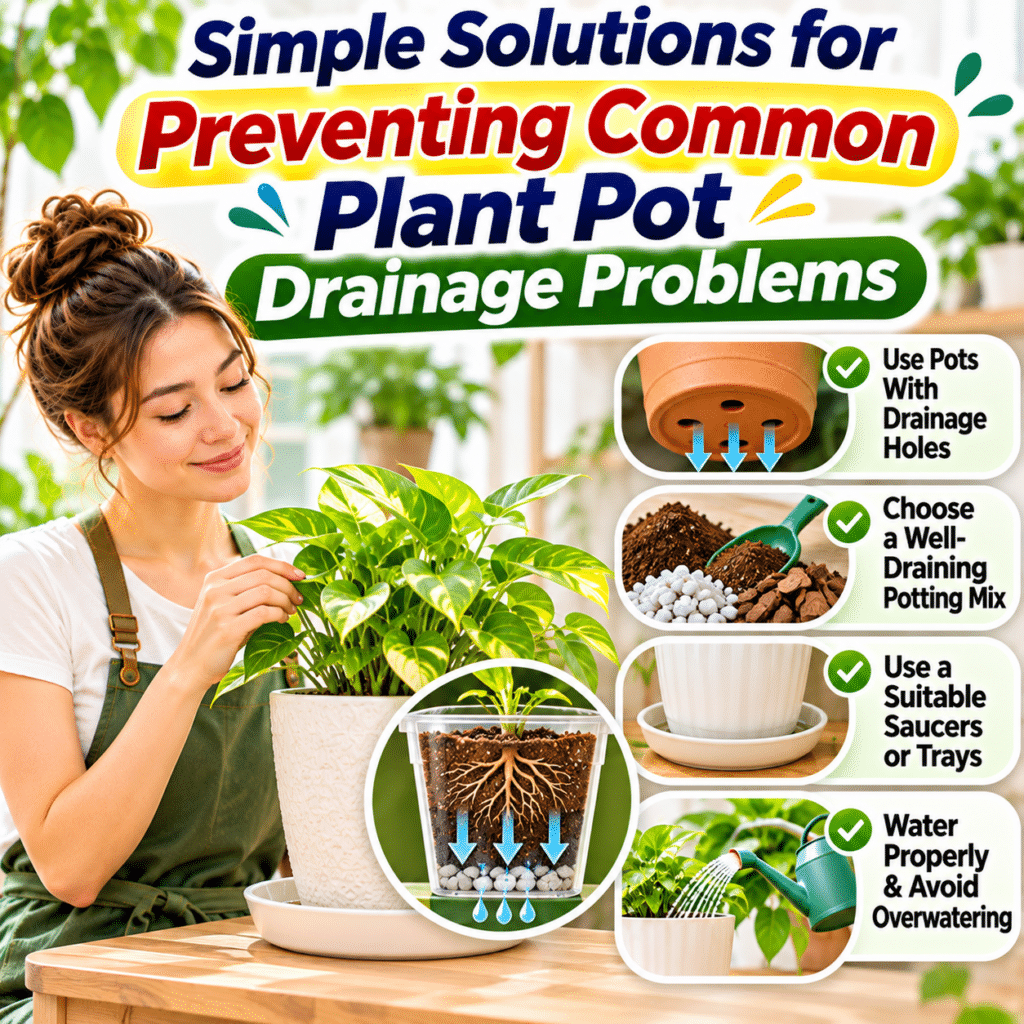
1. Understand Why Proper Plant Pot Drainage Matters
Plant roots need more than water to remain healthy.
They also require access to oxygen, which supports essential cellular processes.
In a well-structured growing medium, spaces between particles contain varying amounts of air and water.
Drainage Helps Maintain Root Oxygen
When a potting medium becomes saturated, water occupies many of the spaces that would otherwise contain air.
If saturation continues for too long, oxygen availability may become limited.
This can interfere with normal root function.
Drainage Reduces Prolonged Waterlogging
Excess moisture may contribute to:
- Root stress.
- Reduced nutrient uptake.
- Yellowing foliage.
- Wilting despite wet growing media.
- Root decay.
- Increased susceptibility to certain pathogens.
These symptoms can have multiple causes, so drainage should be assessed alongside other growing conditions.
Drainage Supports More Predictable Watering
A suitable drainage system makes it easier to water thoroughly when appropriate and allow excess water to leave the container.
Drainage Protects Household Surfaces
Proper drainage management also prevents uncontrolled water from reaching:
- Wooden tables.
- Bookshelves.
- Desks.
- Windowsills.
- Hardwood floors.
- Storage furniture.
A healthy drainage system benefits both the plant and the surrounding living space.
2. Recognize the Signs of Poor Plant Pot Drainage
Drainage problems often develop gradually.
Recognizing early warning signs can help prevent more serious plant health issues.
Water Remains on the Soil Surface
If water consistently pools on top of the growing medium, it may indicate:
- Compacted potting mix.
- Poor water absorption.
- Blocked drainage.
- Excessively wet growing media.
- A poorly structured substrate.
Temporary pooling during watering is not always a problem, but persistent standing water deserves attention.
The Growing Medium Stays Wet for Too Long
A pot that remains saturated well beyond the plant’s normal moisture needs may have inadequate drainage or excessive water retention.
Water Collects Inside Decorative Pots
An outer decorative container may hide drainage water from an inner nursery pot.
Unpleasant Odors Develop
Persistent sour or musty odors may indicate excessively wet organic material or deteriorating roots.
Leaves Become Yellow or Wilted
These symptoms can occur when roots are stressed by poor drainage.
However, they can also result from underwatering, temperature stress, pests, or other conditions.
Roots Appear Damaged
When a plant is removed for necessary inspection, unhealthy roots may appear soft, discolored, or deteriorated.
Healthy root appearance varies by species, so color alone is not a reliable diagnosis.
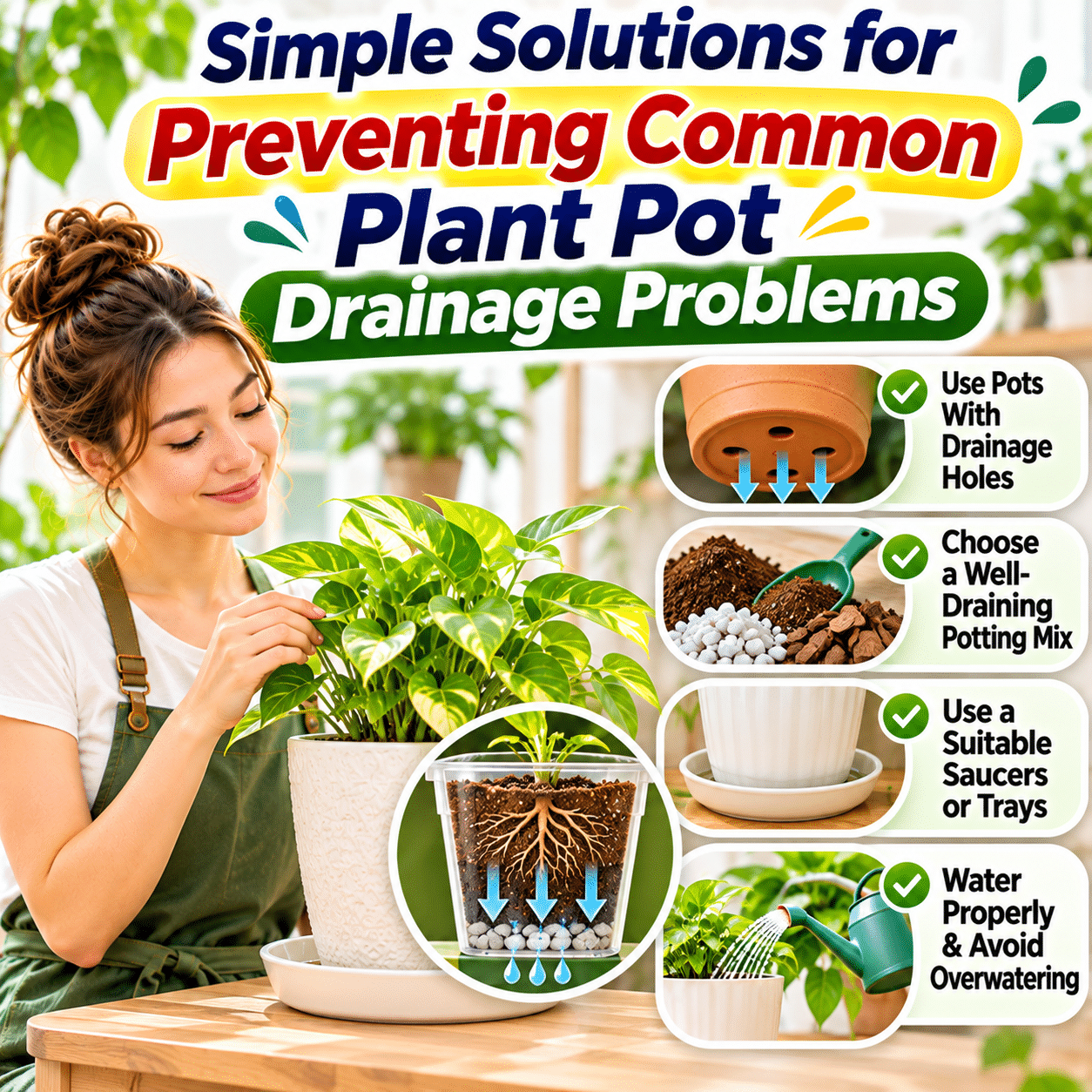
3. Choose Plant Pots With Suitable Drainage Holes
Container design is one of the simplest ways to prevent drainage problems.
Understand the Function of Drainage Holes
Drainage holes allow excess water to leave the pot.
They help prevent water from accumulating indefinitely at the bottom of the container.
Check Before Purchasing
Decorative pots may have:
- One central drainage hole.
- Multiple drainage openings.
- Removable drainage plugs.
- Integrated water reservoirs.
- No drainage holes.
Inspect the container rather than assuming that every planter is designed for direct planting.
Use a Nursery Pot Inside a Decorative Container
For many common houseplants, a practical arrangement is to grow the plant in a nursery pot with drainage holes and place it inside a decorative outer pot.
This allows the inner container to be removed for watering and draining.
Avoid Relying on Pot Shape Alone
A deep or wide pot does not automatically provide better drainage.
The growing medium, root system, drainage openings, and watering practices all influence moisture behavior.
Keep Drainage Openings Functional
Inspect holes when repotting or cleaning containers.
Remove obvious blockages carefully without damaging the pot or roots.
4. Avoid the Common Mistake of Adding Gravel for Drainage
A traditional gardening suggestion is to place gravel, pebbles, or broken pottery at the bottom of a pot to improve drainage.
However, this method does not generally improve drainage in ordinary container growing systems.
Why Gravel Layers Can Be Problematic
Water movement between materials with different pore sizes can create a perched water zone above the coarse layer.
Instead of allowing water to drain more effectively, the gravel layer may reduce the depth of usable growing medium.
Use a Suitable Potting Mix Throughout the Container
For most conventional houseplants, a properly formulated growing medium combined with drainage holes is more effective.
Prevent Soil Loss Without Blocking Drainage
If potting mix escapes through large drainage openings, a small piece of suitable mesh may help retain particles.
The mesh should allow water to pass freely.
Understand the Difference Between Drainage and Decoration
Decorative stones placed on the soil surface serve a different purpose from gravel placed beneath the growing medium.
Neither should be assumed to solve underlying drainage problems.
5. Select Potting Mix That Balances Moisture and Airflow
The growing medium has a major influence on how water behaves inside a plant container.
Understand Potting Mix Structure
A suitable potting medium should provide:
- Moisture retention appropriate for the plant.
- Adequate air spaces.
- Physical support for roots.
- Suitable drainage.
- Reasonable structural stability.
Avoid Using Dense Garden Soil in Ordinary Indoor Pots
Outdoor garden soil may compact in containers and drain poorly.
It may also contain organisms or materials that are undesirable indoors.
Choose Species-Appropriate Mixes
Different plants require different growing conditions.
For example:
- Many tropical foliage plants benefit from moisture-retentive but aerated mixes.
- Many succulents prefer faster-draining growing media.
- Some orchids require coarse, highly aerated substrates.
- Certain moisture-loving plants tolerate wetter conditions than drought-adapted species.
Consider Common Potting Components
Depending on the plant, suitable mixes may contain:
- Coir.
- Peat-based materials.
- Perlite.
- Pumice.
- Pine bark.
- Compost-based ingredients.
- Other horticultural amendments.
Each material affects moisture retention and aeration differently.
Avoid Assuming One Mix Works for Every Plant
Choose growing media based on the species and its environmental conditions.
6. Prevent Potting Mix From Becoming Compacted
Over time, some growing media become dense or lose their original structure.
Why Compaction Matters
Compaction can reduce air spaces and affect water movement.
Common Causes
Potential contributors include:
- Breakdown of organic materials.
- Repeated compression.
- Poor-quality growing media.
- Excessively fine particles.
- Long-term settling.
Inspect the Growing Medium
Look for:
- Hard surface crusts.
- Persistent pooling.
- Poor water penetration.
- Unusual density.
- Slow drainage.
Avoid Aggressive Soil Loosening
Repeatedly pushing tools deep into the pot can damage roots.
Refresh the Mix When Necessary
If the growing medium has significantly deteriorated, repotting into an appropriate fresh mix may be more effective than repeatedly disturbing the surface.
7. Understand Why Water Sometimes Drains Too Quickly
Fast drainage is not always a sign of a healthy watering system.
Water may escape before the growing medium absorbs enough moisture.
Extremely Dry Potting Mix
Some peat-based and other organic growing media can become difficult to rewet after drying excessively.
Water may run down the inside of the pot rather than penetrating evenly.
Large Gaps Along Pot Edges
Shrunken growing medium may pull away from the container walls.
This can create pathways for water to bypass much of the root zone.
Very Coarse Growing Media
Some substrates drain rapidly by design.
They may require different watering methods or frequencies.
Practical Solutions
Depending on the plant:
- Water gradually.
- Pause to allow absorption.
- Repeat as needed.
- Consider controlled bottom watering.
- Assess whether the growing medium remains suitable.
Avoid assuming that rapid runoff means the plant has received enough water.
8. Use Bottom Watering When Appropriate
Bottom watering can help certain dry growing media absorb moisture more evenly.
How It Works
A pot with drainage holes is placed in a shallow container of water.
Moisture moves upward through the growing medium by capillary action.
Basic Method
- Place the pot in a suitable waterproof tray.
- Add an appropriate amount of water.
- Allow the growing medium to absorb moisture.
- Check whether the root zone has been adequately watered.
- Remove the pot.
- Allow excess water to drain.
- Empty the remaining water.
Potential Benefits
Bottom watering may:
- Reduce splashing.
- Help rehydrate some dry growing media.
- Provide a controlled watering environment.
- Reduce disturbance of loose surface material.
Important Limitations
Bottom watering is not suitable for every plant.
It may also allow dissolved fertilizer salts to accumulate near the surface over time.
Some plants benefit from occasional appropriate top watering to help flush accumulated salts.
Avoid Prolonged Soaking
Do not leave ordinary houseplants standing in water indefinitely.
Follow species-specific requirements.
9. Prevent Water From Accumulating in Plant Saucers
Plant saucers protect household surfaces, but they must be managed correctly.
Choose an Appropriate Size
A saucer should be wide enough to collect water leaving the drainage holes.
Consider Water Capacity
Very shallow saucers may overflow during thorough watering.
Empty Excess Water
After watering and allowing drainage to occur, remove standing water unless the growing system specifically requires a reservoir.
Keep Saucers Clean
Remove soil particles, mineral deposits, and plant debris.
Inspect for Cracks
Damaged saucers may leak onto furniture or flooring.
Avoid Hidden Moisture
Lift saucers periodically to inspect the surface underneath.
A waterproof saucer can still trap moisture beneath its base.
10. Manage Decorative Pots Without Drainage Holes
Decorative containers without drainage holes are common in indoor plant displays.
They can be attractive but require careful moisture management.
Use a Removable Inner Pot
A draining nursery pot inside a decorative outer container is often the simplest arrangement.
Remove the Inner Pot for Watering
Water the plant in a suitable contained area.
Allow excess water to drain before returning it.
Check for Collected Water
Inspect the bottom of the outer pot after watering.
Avoid Leaving Roots Submerged
Standing water inside a decorative pot can keep the lower growing medium excessively wet.
Consider Specialized Reservoir Systems Separately
Some self-watering planters are designed to hold water in a controlled reservoir.
These should be managed according to their specific instructions rather than treated like ordinary sealed decorative pots.
11. Choose the Right Pot Size for Healthy Drainage
Container size affects how much growing medium surrounds the root system.
Avoid Excessively Large Pots
A large volume of growing medium may remain wet for longer than a small root system can use water.
Avoid Extremely Small Pots
A severely root-bound plant may dry rapidly or become difficult to water evenly.
Increase Pot Size Gradually
When repotting, choose a container appropriate for the plant’s root system and expected growth.
Consider Plant Growth Rate
Slow-growing plants may not require frequent pot size increases.
Match the Container to the Growing Medium
A larger container with highly moisture-retentive growing media may behave differently from a smaller container with a more aerated mix.
Avoid Repotting Solely Because of Slow Growth
Low light, temperature, seasonal conditions, and other factors can also affect growth.
Inspect the overall plant before deciding to repot.
12. Understand How Different Pot Materials Affect Moisture
Pot material can influence evaporation and growing medium moisture.
| Pot Material | Typical Moisture Behavior | Potential Advantage | Important Consideration |
|---|---|---|---|
| Unglazed terracotta | Allows moisture to evaporate through porous walls | May help some mixes dry more readily | Can require more frequent watering |
| Plastic | Generally limits evaporation through pot walls | Lightweight and retains moisture | Growing medium may remain wet longer |
| Glazed ceramic | Usually limits moisture loss through glazed surfaces | Decorative and relatively stable | Can be heavy and may lack drainage holes |
| Metal | Generally nonporous | Durable appearance | Temperature changes and corrosion may matter |
| Glass | Nonporous | Allows visibility in some specialized systems | Conventional soil planting without drainage requires care |
| Fabric grow bags | Permit air and moisture movement through fabric | Can support aeration | May leak onto household surfaces |
| Resin planters | Usually limit wall evaporation | Lightweight and versatile | Drainage design varies |
The best container material depends on the plant, growing medium, household environment, and watering habits.
13. Adjust Watering Habits to Prevent Drainage Problems
Even a well-designed pot can develop moisture problems when watering practices do not match plant needs.
Check Moisture Before Watering
Assess the growing medium rather than relying exclusively on a fixed calendar.
Water According to Species Requirements
Different plants tolerate different moisture levels.
Consider Light Exposure
Plants receiving less light may use water more slowly.
Consider Temperature and Humidity
Warm, dry, well-ventilated conditions may increase water loss.
Cooler or more humid environments may slow drying.
Water Thoroughly When Appropriate
For many conventional container-grown plants, watering sufficiently to moisten the root zone and allowing excess water to drain can be effective.
However, this method should be adjusted for the species and growing system.
Avoid Repeated Small Surface Watering Without Assessment
Frequent tiny additions may wet only the upper layer while leaving deeper roots inadequately hydrated.
Do Not Automatically Water When Leaves Droop
Wilting can result from both insufficient moisture and root problems associated with excessive wetness.
Check the growing medium first.
14. Prevent Drainage Problems in Self-Watering Planters
Self-watering containers use reservoirs to supply moisture over time.
Their drainage behavior differs from that of conventional pots.
Understand the Reservoir System
Many designs use wicking materials or capillary movement.
Follow Water-Level Indicators
Do not exceed the manufacturer’s recommended fill level.
Choose Suitable Plants
Not every species benefits from consistently moist growing media.
Inspect Reservoir Components
Check for:
- Cracks.
- Blocked openings.
- Damaged seals.
- Improper assembly.
- Residue buildup.
Clean the Reservoir
Follow manufacturer instructions to prevent accumulation of debris and deposits.
Monitor the Root Zone
A reservoir does not eliminate the need to assess plant health and growing medium moisture.
15. Prevent Drainage Problems in Hanging Planters
Hanging plants require particular attention because drainage water can fall onto surrounding surfaces.
Use Secure Containers
Choose hanging planters designed for the full weight of the plant, wet growing medium, and water.
Check Drainage Collection
Some hanging pots include attached saucers or reservoirs.
Inspect them regularly.
Water in a Separate Area When Practical
Remove suitable hanging plants and water them in a sink or contained tray.
Allow Dripping to Stop
Return plants only after significant drainage has finished.
Inspect Hanging Hardware
Check hooks, brackets, and supports for stability.
Protect Areas Below
Avoid placing draining hanging pots directly above electronics, delicate furniture, or slippery walkways.
16. Prevent Drainage Problems in Large Floor Planters
Large indoor plants may be difficult to move, making drainage management more challenging.
Use Adequately Sized Trays
Choose collection trays capable of containing expected runoff.
Inspect Hidden Water
Large decorative pots may conceal substantial amounts of drainage water.
Consider Suitable Plant Caddies
Wheeled caddies can help move heavy containers when rated for the full load.
Avoid Overwatering Based on Pot Size
A large container does not automatically mean the plant needs a large amount of water at every watering.
Check Moisture Below the Surface
The upper growing medium may feel dry while deeper layers remain wet.
Use appropriate methods to assess moisture within the root zone.
Maintain Stable Placement
Ensure the container and support remain secure after watering.
17. Prevent Drainage-Related Damage to Household Surfaces
Drainage management is also an important household maintenance task.
Protect Wooden Furniture
Use waterproof trays beneath plant containers.
Protect Flooring
Keep drainage water away from wood and laminate floor seams.
Inspect Windowsills
Check for standing water, condensation, and stains.
Keep Water Away From Electronics
Avoid watering plants near electrical equipment whenever possible.
Wipe Spills Promptly
Remove standing water before it penetrates sensitive materials.
Check Beneath Pots Periodically
Hidden moisture may remain even when the surrounding area appears dry.
Use a Dedicated Watering Area
Watering suitable plants in a sink, utility tray, or other contained location can reduce accidental damage.
18. Troubleshoot Common Plant Pot Drainage Problems
Use this table to identify possible causes and practical responses.
| Problem | Possible Cause | Practical Solution | Important Precaution |
|---|---|---|---|
| Water pools on soil surface | Compaction or poor absorption | Assess and refresh growing medium | Avoid damaging roots |
| Water drains immediately | Dry or shrunken medium | Rehydrate gradually | Check whether roots receive moisture |
| Soil stays wet too long | Excess water retention or low water use | Review mix, pot size, and watering | Check for root problems |
| No water exits drainage holes | Blockage or limited water movement | Inspect openings and medium | Do not force tools into roots |
| Water collects in outer pot | Hidden drainage runoff | Empty decorative container | Avoid prolonged root saturation |
| Saucer overflows | Insufficient capacity | Use a larger collection tray | Protect nearby surfaces |
| Pot leaks from the side | Cracked container | Replace or appropriately repair | Check structural stability |
| Plant wilts in wet soil | Possible root stress | Inspect root and moisture conditions | Do not assume more water is needed |
| Potting mix shrinks from edges | Excessive drying | Rehydrate or replace unsuitable mix | Avoid abrupt overwatering |
| Water stains appear on furniture | Leaking or trapped moisture | Improve waterproof protection | Dry affected surfaces promptly |
Drainage problems should be evaluated alongside light, temperature, humidity, root health, and plant-specific requirements.
19. Avoid Common Plant Pot Drainage Mistakes
Mistake 1: Assuming Every Pot Has Drainage Holes
Decorative containers may be completely sealed.
Better approach: Inspect containers before planting.
Mistake 2: Adding Gravel to Improve Drainage
A gravel layer does not reliably improve drainage in ordinary pots.
Better approach: Use a suitable growing medium and functional drainage openings.
Mistake 3: Leaving Water in Decorative Outer Pots
Hidden standing water can keep roots excessively wet.
Better approach: Empty collected water after drainage.
Mistake 4: Using the Same Potting Mix for Every Plant
Different species have different moisture and aeration requirements.
Better approach: Choose species-appropriate growing media.
Mistake 5: Repotting Into an Excessively Large Container
A large volume of unused growing medium may remain wet too long.
Better approach: Match pot size to the root system.
Mistake 6: Watering on a Fixed Schedule Without Checking Moisture
Environmental conditions change.
Better approach: Assess moisture before watering.
Mistake 7: Assuming Fast Drainage Means Proper Watering
Water may bypass dry growing media.
Better approach: Confirm that the root zone is adequately hydrated.
Mistake 8: Ignoring Persistent Wetness
Repeated saturation may stress roots.
Better approach: Investigate the container, growing medium, and watering frequency.
Mistake 9: Blocking Drainage Holes
Improper liners or decorative materials may obstruct water flow.
Better approach: Keep openings functional.
Mistake 10: Treating All Wilting as Underwatering
Wilted leaves may occur even when the growing medium is saturated.
Better approach: Check moisture and root condition before adding water.
20. Create a Simple Plant Pot Drainage Maintenance Routine
A consistent routine helps prevent small drainage issues from becoming serious problems.
Before Watering
- Check growing medium moisture.
- Inspect the saucer.
- Confirm the pot is stable.
- Look for standing water.
- Check whether the plant needs watering.
During Watering
- Pour gradually.
- Observe water absorption.
- Watch for unexpected runoff.
- Avoid overflowing the collection tray.
After Watering
- Allow appropriate drainage.
- Empty excess water.
- Wipe container exteriors.
- Dry surrounding surfaces.
- Return the plant to a stable location.
Monthly Maintenance
- Inspect drainage openings when accessible.
- Clean saucers.
- Check decorative outer pots.
- Look for persistent moisture.
- Assess growing medium condition.
- Inspect containers for cracks.
Seasonal Maintenance
- Review watering frequency.
- Reassess plant light conditions.
- Inspect root growth when repotting is warranted.
- Replace deteriorated growing media when necessary.
- Evaluate whether containers remain suitable.
21. Make Plant Pot Drainage More Sustainable and Cost-Effective
Preventing drainage problems can reduce unnecessary plant loss, damaged containers, and household maintenance.
Reuse Suitable Pots
Clean and reuse durable containers when they remain safe and functional.
Choose Appropriate Potting Mix
Using suitable growing media from the beginning can reduce avoidable repotting.
Avoid Unnecessary Accessories
A reliable pot, suitable saucer, and appropriate growing medium are often sufficient.
Repair Minor Problems When Safe
Some replaceable plugs or saucers can be repaired or replaced without discarding an entire planter.
Prevent Water Damage
Effective drainage containment helps protect furniture and flooring from repeated moisture exposure.
Avoid Excessive Watering
Water according to plant needs rather than adding unnecessary amounts.
Maintain Existing Plants
Early identification of drainage problems may prevent more serious root damage and reduce the need for replacement plants.
22. Frequently Asked Questions
1. Why is drainage important for indoor plant pots?
Drainage helps excess water leave the container and supports a healthier balance of moisture and oxygen around roots.
2. Do all indoor plant pots need drainage holes?
Many common houseplants benefit from drainage holes. Specialized growing systems may use other methods, but they require appropriate moisture management.
3. Can I grow plants directly in decorative pots without holes?
It is possible with careful management, but a removable inner pot with drainage is often easier for beginners.
4. Does putting gravel at the bottom of a pot improve drainage?
Generally, no. Gravel layers can create an unfavorable moisture distribution and reduce usable growing medium depth.
5. Why does water stay on top of my potting mix?
Possible causes include compaction, poor absorption, or excessively wet growing media.
6. Why does water run straight through my plant pot?
Very dry growing media, shrinkage along pot edges, or coarse substrates may allow rapid runoff.
7. Can poor drainage cause root rot?
Prolonged saturation can reduce root oxygen and contribute to conditions associated with root deterioration and certain root diseases.
8. How do I know if my plant pot drains properly?
Observe how water enters the growing medium, whether excess water can leave, and how moisture changes over time.
9. Should I leave water in a plant saucer?
For most ordinary houseplants, remove excess standing water after drainage unless the growing system specifically requires otherwise.
10. Are terracotta pots better for drainage?
Unglazed terracotta allows moisture to evaporate through its walls, but proper drainage also depends on holes, growing medium, and watering.
11. Do plastic pots cause root rot?
Plastic pots do not automatically cause root rot. Moisture management, growing media, and environmental conditions are more important.
12. Can a pot be too large for a plant?
Yes. Excess growing medium may remain wet longer than the root system can use water.
13. How often should I check drainage holes?
Inspect them during repotting, cleaning, or when drainage problems appear.
14. What is the best potting mix for drainage?
The best mix depends on the species. Many houseplants benefit from media that balance moisture retention with aeration.
15. Can bottom watering solve drainage problems?
Bottom watering can help rehydrate some dry media, but it does not correct every drainage issue.
16. Why is my plant wilting even though the soil is wet?
Root stress, poor oxygen availability, or other problems may interfere with water uptake.
17. Should I repot a plant with poor drainage?
Repotting may help when the growing medium has deteriorated or the container is unsuitable, but first identify the underlying cause.
18. Can I drill drainage holes in a decorative pot?
Some materials can be drilled using suitable equipment and safety precautions, but others may crack or become unsafe. A draining inner pot is often simpler.
19. Why does my plant pot smell unpleasant?
Persistent moisture, decomposing organic material, or root problems may contribute.
20. Can drainage problems damage furniture?
Yes. Leaking pots and overflowing saucers may cause stains, swelling, or finish damage.
21. Are self-watering pots good for drainage?
They can work well for suitable plants when used correctly, but they require monitoring and maintenance.
22. How can I prevent hanging planters from dripping?
Use appropriate drainage collection or water removable plants in a contained area.
23. How can I prevent waterlogging in winter?
Check moisture carefully, account for reduced growth and water use, and avoid unnecessary watering.
24. Should I use mesh over drainage holes?
A small piece of suitable mesh may help retain growing media while allowing water to pass.
25. What is the simplest way to prevent plant pot drainage problems?
Use a container with functional drainage holes, suitable growing media, appropriate watering habits, and a properly maintained collection saucer.
23. Practical Plant Pot Drainage Prevention Checklist
Use this checklist to maintain healthier roots and cleaner indoor plant displays.
Pot Selection
- Choose containers appropriate for the plant.
- Check for functional drainage holes.
- Inspect pots for cracks.
- Avoid unnecessarily oversized containers.
- Use removable inner pots when helpful.
- Keep decorative outer pots free of standing water.
Growing Medium
- Select species-appropriate potting mix.
- Avoid dense garden soil in ordinary indoor containers.
- Maintain suitable aeration.
- Watch for compaction.
- Check for poor water absorption.
- Refresh deteriorated media when necessary.
Watering Practices
- Check moisture before watering.
- Water according to plant needs.
- Pour gradually.
- Observe drainage behavior.
- Avoid repeated unnecessary saturation.
- Adjust watering as environmental conditions change.
Drainage Collection
- Use appropriately sized saucers.
- Empty excess water.
- Clean trays regularly.
- Check for hidden moisture.
- Replace cracked collection containers.
- Protect nearby furniture and flooring.
Plant Health
- Monitor leaf condition.
- Watch for persistent wilting.
- Investigate unusual yellowing.
- Check for unpleasant odors.
- Assess root health when necessary.
- Avoid assuming every symptom is caused by watering.
Long-Term Maintenance
- Inspect drainage openings when appropriate.
- Review pot size as plants grow.
- Reassess growing medium condition.
- Adjust watering seasonally.
- Maintain self-watering systems.
- Inspect large and hanging planters.
- Keep surrounding surfaces clean and dry.
Final Thoughts
Preventing common plant pot drainage problems is an essential part of maintaining healthy indoor plants and a comfortable living environment. While watering is one of the most familiar houseplant-care activities, the way water moves through a container can be just as important as the amount supplied.
A well-designed drainage system allows excess water to escape while helping the growing medium maintain an appropriate balance of moisture and air. This supports healthy root function and reduces the likelihood of prolonged waterlogging.
Fortunately, most drainage problems can be addressed through straightforward practices. Choosing pots with suitable drainage holes, using species-appropriate growing media, avoiding unnecessary gravel layers, and managing collected water can make a significant difference.
Watering habits also matter. Rather than following a rigid schedule, plant owners can assess growing medium moisture, observe plant condition, and adjust care according to light, temperature, humidity, and seasonal changes.
Equally important is protecting the surrounding home. Proper saucers, contained watering areas, and regular checks for hidden moisture help prevent water damage to furniture, shelves, and flooring.
The goal is not to create a complicated plant-care system. It is to understand how containers, growing media, and watering practices work together.
With a few thoughtful choices and consistent maintenance habits, indoor plant owners can prevent many common drainage problems, support healthier roots, and enjoy attractive greenery without unnecessary mess or frustration.
A thriving indoor plant collection begins beneath the surface—with roots that have the right balance of water, air, and room to grow.