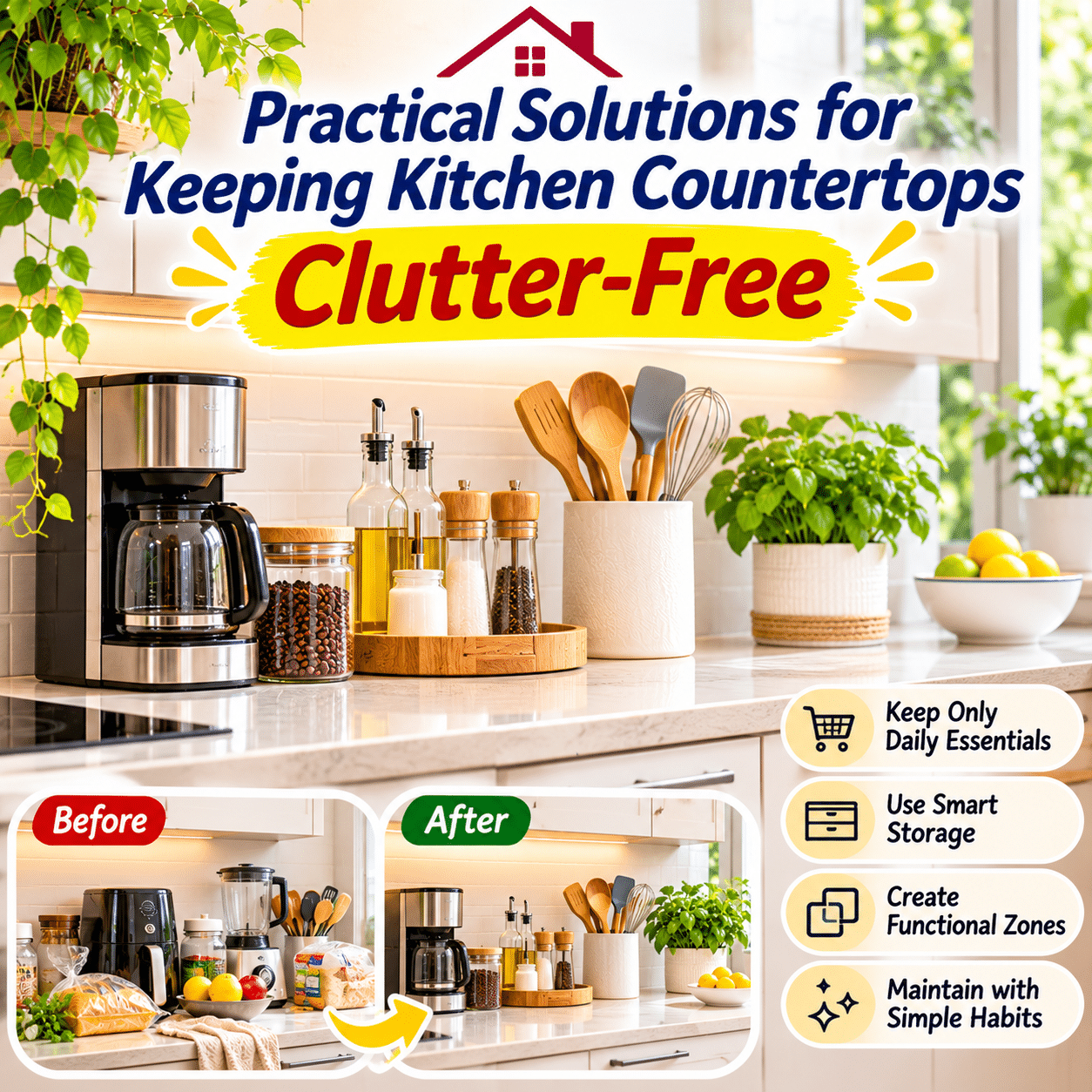
Kitchen countertops are among the busiest surfaces in a home. They provide space for preparing meals, arranging ingredients, serving food, and completing countless small everyday tasks. Yet because they are convenient and frequently used, they can also become places where unrelated belongings gradually accumulate.
A few unopened grocery packages, cooking utensils, small appliances, mail, reusable shopping bags, and miscellaneous household objects may not seem like much individually. Over time, however, these items can occupy valuable workspace and make everyday cooking more difficult.
A cluttered countertop can create several practical problems. Food preparation may require moving objects from one place to another, cleaning becomes more complicated, and frequently used tools may be difficult to locate. Excessive clutter can also interfere with safe appliance operation and proper food handling.
Keeping kitchen countertops clutter-free does not mean removing every useful object or maintaining an unrealistic, perfectly empty surface. A practical kitchen should support the activities that happen there. The goal is to keep necessary items accessible while ensuring that the available workspace remains functional, hygienic, and comfortable.
Fortunately, effective countertop organization rarely requires a complete kitchen renovation. Small changes in storage habits, appliance placement, meal preparation routines, and everyday cleanup can make a noticeable difference.
This guide explores practical solutions for keeping kitchen countertops organized, reducing unnecessary clutter, improving food preparation space, and creating simple systems that remain manageable over time.
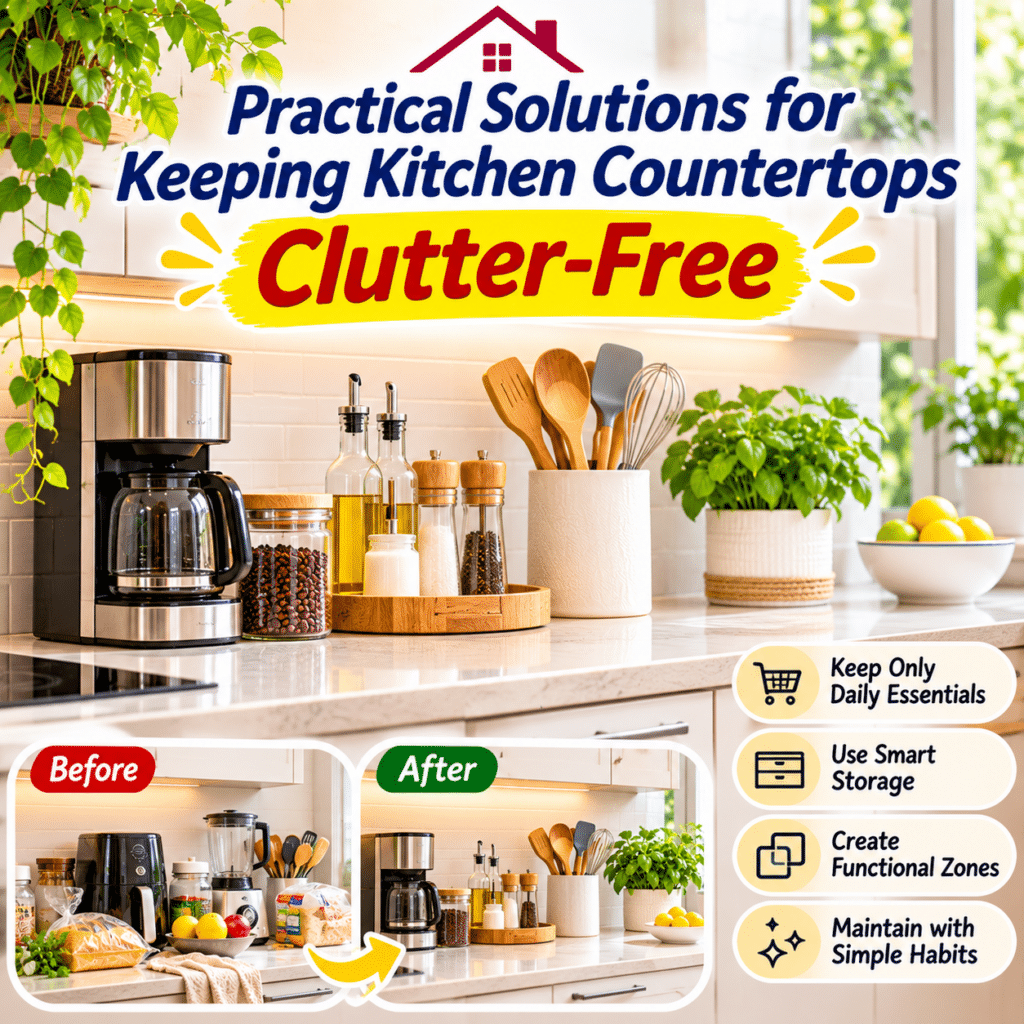
1. Understand Why Kitchen Countertops Become Cluttered
Before reorganizing a countertop, it helps to understand why objects accumulate there.
Kitchen counters are convenient horizontal surfaces. When an item does not have a designated storage location, the countertop often becomes its temporary home.
Unfortunately, temporary storage can gradually become permanent.
Common Sources of Countertop Clutter
| Clutter Source | Why It Accumulates | Practical Solution |
|---|---|---|
| Small appliances | Frequently used or difficult to store | Keep essential appliances accessible and relocate occasional-use equipment |
| Cooking utensils | No convenient drawer or holder | Create a dedicated utensil storage area |
| Grocery packages | Items are not put away promptly | Establish an unpacking routine |
| Mail and paperwork | Countertop becomes a household drop zone | Create a separate paperwork location |
| Spices and condiments | Products remain out after cooking | Organize them in suitable cabinets or drawers |
| Reusable shopping bags | No assigned storage location | Store folded bags near the entryway or another convenient area |
| Cleaning supplies | Products are left beside the sink | Create appropriate and safe cleaning storage |
| Food containers | Containers lack organized cabinet space | Sort matching containers and lids |
| Personal belongings | Keys, wallets, and accessories are placed on the counter | Establish a designated entryway area |
| Decorative objects | Too many items occupy useful workspace | Limit decorations to suitable locations |
| Unwashed dishes | No consistent dishwashing routine | Clear dishes promptly |
| Ingredients awaiting use | Meal preparation is interrupted | Create a temporary preparation zone |
Recognizing the main sources of clutter helps identify which changes will have the greatest impact.
2. Define the Primary Purpose of Your Countertops
A kitchen countertop should primarily support kitchen activities.
These may include washing and preparing ingredients, assembling meals, handling suitable appliances, and serving food.
When unrelated objects occupy the same surfaces, the kitchen becomes less efficient.
Identify Essential Countertop Activities
Common activities include:
- Washing and preparing vegetables.
- Chopping ingredients.
- Mixing and assembling food.
- Preparing beverages.
- Using small kitchen appliances.
- Plating meals.
- Temporarily placing groceries.
- Cleaning and drying suitable kitchen items.
Consider which activities take place most frequently.
Prioritize Functional Space
A kitchen with limited countertop space may need to reserve most of its available surface for food preparation.
A larger kitchen may comfortably accommodate a dedicated coffee station or small appliance area.
The best arrangement depends on how the kitchen is actually used.
Avoid Treating Countertops as General Storage
Countertops should not become the default location for objects that belong elsewhere.
When possible, assign permanent storage locations to non-kitchen belongings.
3. Start With a Complete Countertop Reset
A useful first step is removing unnecessary items from the countertop so the available space can be evaluated clearly.
This does not mean throwing everything away.
Instead, it provides an opportunity to decide what genuinely needs to remain accessible.
Step 1: Remove Loose Items
Temporarily clear suitable movable objects from the countertop.
Leave permanently installed equipment in place.
Step 2: Clean the Surface
Clean the countertop using methods appropriate for its material.
Follow manufacturer guidance for stone, wood, laminate, stainless steel, and other finishes.
Step 3: Sort the Removed Items
Divide belongings into practical categories:
- Frequently used kitchen essentials.
- Occasionally used kitchen tools.
- Food and pantry items.
- Cleaning supplies.
- Decorative accessories.
- Items belonging in other rooms.
- Unnecessary or damaged belongings.
Step 4: Return Only Suitable Essentials
Choose a limited number of items that genuinely benefit from remaining on the countertop.
Step 5: Assign Storage Locations to Everything Else
Use existing drawers, cabinets, pantry shelves, and other suitable storage areas.
The objective is to make the countertop easier to use without making everyday items difficult to access.
4. Create Functional Countertop Zones
Organizing countertops into zones can make kitchen activities more efficient.
A zone is simply an area associated with a particular task.
It does not require special furniture or complicated organizers.
Common Countertop Zones
| Zone | Main Function | Typical Items |
|---|---|---|
| Food preparation | Washing, chopping, and assembling ingredients | Cutting board and appropriate preparation tools during use |
| Cooking support | Supporting cooking activities | Suitable utensils and ingredients during preparation |
| Beverage preparation | Making coffee, tea, or other drinks | Frequently used beverage equipment |
| Serving | Plating and transferring food | Plates and serving tools during meals |
| Cleaning support | Dishwashing and surface cleaning | Suitable cleaning tools |
| Temporary grocery area | Unpacking groceries | Shopping items before storage |
Not every kitchen needs all these zones.
In a compact kitchen, one clear countertop section may support several activities at different times.
Keep Zones Flexible
A preparation area should remain available when needed.
Avoid filling it with permanent objects that must be moved before every meal.
Maintain Safe Separation
Keep raw foods separated from ready-to-eat foods and clean equipment.
Position appliances according to their safety and ventilation requirements.
5. Keep Only Frequently Used Appliances on the Countertop
Small appliances are among the largest contributors to countertop clutter.
Coffee makers, air fryers, blenders, toasters, rice cookers, mixers, and electric kettles can occupy substantial space.
Evaluate Appliance Frequency
Consider how often each appliance is used.
| Usage Frequency | Suggested Approach |
|---|---|
| Daily | Consider a suitable permanent countertop location |
| Several times weekly | Keep accessible if space allows |
| Occasionally | Store in an appropriate cabinet or pantry area |
| Rarely | Use secondary storage if safe and practical |
Consider Appliance Size
A large appliance may consume valuable preparation space even when used regularly.
Balance convenience against the amount of workspace it occupies.
Group Compatible Appliances
A coffee maker and suitable beverage accessories may fit together in a designated area.
Avoid overcrowding electrical equipment.
Follow Safety Requirements
Maintain manufacturer-recommended clearances around appliances.
Keep cords away from water, heat, and sharp edges.
Do not operate appliances inside enclosed cabinets unless the installation is specifically designed and approved for that use.
Avoid Unnecessary Duplicates
If two appliances perform similar functions, consider whether both are genuinely needed.
6. Make Better Use of Kitchen Drawers
Drawers can provide convenient storage for frequently used kitchen tools without leaving them exposed.
However, poorly organized drawers can become difficult to use.
Organize by Function
Possible categories include:
- Everyday utensils.
- Measuring tools.
- Food preparation accessories.
- Small baking tools.
- Suitable kitchen gadgets.
- Reusable food storage accessories.
Use Simple Dividers
Drawer dividers can help prevent small objects from mixing together.
Choose sizes that fit the drawer and its contents.
Keep Frequently Used Tools Accessible
Place everyday tools in the easiest-to-reach sections.
Move occasional-use accessories to less prominent storage.
Avoid Overfilling
Leave enough room to open drawers and retrieve items comfortably.
Store Sharp Tools Securely
Knives and other sharp equipment require suitable protective storage.
Do not leave exposed blades loose in crowded drawers.
7. Organize Cabinets to Reduce Countertop Storage
Countertop clutter often develops because cabinets are difficult to access or already overcrowded.
Improving cabinet organization can create space for objects that would otherwise remain on the counter.
Review Cabinet Contents
Identify items that are:
- Used frequently.
- Used occasionally.
- Duplicated unnecessarily.
- Damaged.
- No longer needed.
Group Similar Items
Store related cookware, dishes, containers, and accessories together.
Keep Everyday Items at Comfortable Heights
Frequently used belongings should be accessible without unnecessary reaching.
Heavy cookware should be stored at appropriate lower levels.
Avoid Stacking Too Many Objects
Excessive stacking makes retrieval inconvenient and may encourage people to leave items on the countertop.
Use Existing Space Efficiently
Simple shelf arrangements and appropriately sized organizers can improve cabinet accessibility without adding furniture.
8. Create a Practical Coffee and Tea Station
Coffee and tea supplies often remain on countertops because they are used regularly.
A dedicated beverage area can keep these items organized without allowing them to spread across the kitchen.
Identify Essential Supplies
Depending on household preferences, these may include:
- Coffee maker or kettle.
- Coffee or tea.
- Suitable filters or infusers.
- Mugs.
- Measuring tools.
- Frequently used beverage accessories.
Use Nearby Cabinets
Not every beverage accessory needs to remain visible.
Keep mugs, tea, and other suitable supplies in a nearby cabinet or drawer.
Limit Countertop Equipment
Only leave appliances and accessories that genuinely benefit from immediate access.
Keep the Station Easy to Clean
Avoid overcrowding the area with decorations or unnecessary containers.
Consider Electrical Safety
Position appliances on stable, appropriate surfaces.
Keep electrical connections away from water and follow manufacturer clearance instructions.
9. Keep Cooking Utensils Organized
Frequently used utensils should be easy to access during cooking.
However, leaving every utensil on the countertop can create clutter.
Choose Between Drawers and Utensil Holders
A nearby drawer may be ideal for most cooking tools.
A small utensil holder can be useful for selected frequently used items.
Limit the Number of Exposed Utensils
Avoid filling countertop holders with rarely used equipment.
Keep Tools Away From Heat
Position utensil holders away from burners and other hazardous heat sources.
Clean Holders Regularly
Countertop utensil containers can collect dust, grease, and food residue.
Review Utensil Collections
Remove damaged tools and reconsider unnecessary duplicates.
10. Store Spices and Condiments More Efficiently
Spices, oils, sauces, and condiments can quickly occupy large sections of countertop space.
Although convenient access is important, permanent exposure may not be ideal for every product.
Use Cabinet or Drawer Storage
Store suitable spices in a cool, dry location away from excessive heat and moisture.
Group Similar Products
Examples include:
- Everyday seasonings.
- Baking spices.
- Cooking oils.
- Sauces.
- Beverage ingredients.
Keep Labels Visible
Clear identification makes ingredients easier to locate.
Avoid Storing Products Too Close to the Stove
Heat, steam, and light can affect the quality of some ingredients.
Follow Refrigeration Instructions
Certain sauces and condiments require refrigeration after opening.
Always follow product-specific storage guidance.
11. Keep Food Containers From Taking Over the Countertop
Food storage containers are useful for leftovers and meal preparation, but they can become clutter when left out.
Match Containers With Lids
Sort containers and lids into usable sets.
Remove Damaged Containers
Discard or appropriately recycle containers that are cracked, excessively worn, or unsuitable for food use.
Organize by Size
Stack compatible containers where practical.
Store lids in a designated section.
Avoid Excessive Collections
Keep quantities that match actual household needs.
Return Clean Containers Promptly
After drying, place containers back into their assigned storage area rather than leaving them on the counter.
12. Establish a Grocery Unpacking Routine
Grocery bags and packages can occupy countertops long after shopping is finished.
A simple unpacking routine can prevent temporary clutter from becoming permanent.
Put Perishable Foods Away First
Refrigerate or freeze perishable groceries promptly.
Group Pantry Items
Place dry goods in their designated storage areas.
Remove Unnecessary Packaging Appropriately
Recycle or discard packaging according to local requirements.
Preserve important product labels, instructions, and food-safety information.
Return Shopping Bags
Fold reusable bags and store them in a consistent location.
Clear the Counter After Unpacking
Once groceries are stored, wipe the surface if necessary and return the area to its normal function.
13. Prevent Mail and Paperwork From Accumulating in the Kitchen
Kitchen countertops often become household drop zones for mail, receipts, bills, and miscellaneous paperwork.
These objects can quickly interfere with food preparation.
Create a Separate Paperwork Location
Choose an appropriate drawer, shelf, or organizer outside the main food preparation area.
Sort Papers Promptly
Separate documents that require action from those that should be filed or discarded.
Avoid Mixing Papers With Food Preparation
Keep documents away from spills, grease, and food-contact surfaces.
Establish a Short Sorting Routine
Review incoming paperwork regularly so it does not accumulate.
Keep Important Documents Secure
Sensitive or valuable documents should be stored appropriately rather than left exposed on shared surfaces.
14. Give Personal Belongings a Different Home
Keys, wallets, sunglasses, phones, and bags often end up on kitchen counters because they are convenient.
However, these objects can reduce workspace and introduce unnecessary dirt or contamination.
Establish an Entryway Drop Zone
A tray, drawer, or suitable hook near the entrance can provide a consistent location for everyday belongings.
Create a Charging Area
Choose a suitable location for charging electronic devices away from water, heat, and food preparation.
Avoid Placing Bags on Food Preparation Surfaces
Bags may contact floors and other potentially dirty surfaces during daily use.
Keep them away from areas used for handling food.
Encourage Consistent Habits
Returning belongings to the same location is more effective than repeatedly moving them from one countertop section to another.
15. Keep the Sink Area Organized
The area around the kitchen sink can accumulate sponges, brushes, dish soap, towels, and other cleaning accessories.
A compact arrangement can make cleaning supplies accessible without overcrowding the counter.
Keep Only Essential Cleaning Tools Nearby
Choose the tools regularly used for washing dishes and cleaning the sink.
Allow Sponges and Brushes to Dry
Use suitable holders or storage arrangements that allow drainage and airflow.
Replace Worn Cleaning Tools
Inspect sponges and brushes regularly and replace them when necessary.
Store Chemicals Appropriately
Cleaning chemicals should be stored according to their labels and kept away from food, children, and pets.
Keep the Sink Functional
Avoid leaving unnecessary containers and accessories around the sink.
16. Use Trays to Contain Small Countertop Essentials
Trays can help organize small objects that genuinely need to remain accessible.
They also create a clear visual boundary.
Choose a Specific Purpose
A tray may hold suitable beverage accessories or selected frequently used items.
Avoid Overloading
A tray filled with unrelated objects simply becomes a smaller cluttered surface.
Keep Trays Easy to Move
Portable trays can make countertop cleaning easier.
Clean Underneath Regularly
Remove trays periodically to clean the surface below.
Use Food-Safe Materials Where Necessary
Any organizer that directly contacts food should be appropriate for that purpose.
17. Use Vertical Storage Carefully
Vertical storage can reduce countertop clutter by moving suitable objects to nearby walls or cabinet interiors.
Consider Wall-Mounted Hooks
Hooks may hold lightweight, appropriate kitchen accessories.
Use Suitable Rails
A properly installed rail can organize selected utensils or towels.
Make Use of Cabinet Doors
Some cabinet interiors can accommodate appropriate organizers.
Check that added accessories do not interfere with doors, hinges, or stored objects.
Avoid Overloading Wall Fixtures
Follow installation instructions and weight limits.
Preserve Safe Clearance
Do not install storage where hanging objects could interfere with cooking equipment, ventilation, or movement.
18. Make Small Kitchen Countertops More Functional
Compact kitchens require careful prioritization because even a few objects can occupy much of the available surface.
Identify the Most Valuable Work Area
Choose the countertop section most suitable for food preparation.
Keep it as clear as practical.
Limit Permanent Appliances
Consider storing occasional-use appliances elsewhere.
Use Nearby Drawers and Cabinets
Move utensils, containers, and accessories into convenient storage.
Choose Compact Organizers
Avoid large organizers that consume more countertop space than the objects they contain.
Keep Decorations Minimal
A small kitchen often benefits from fewer permanent decorative items.
Preserve Safe Appliance Clearance
Do not sacrifice ventilation, electrical safety, or safe food preparation space simply to fit more equipment.
19. Balance Countertop Organization With Everyday Convenience
An extremely minimal countertop may look attractive but become inconvenient if every useful object is stored too far away.
The best system balances accessibility with available workspace.
Keep Genuine Daily Essentials Nearby
Frequently used appliances or tools may deserve accessible locations.
Store Occasional-Use Equipment
Items used only occasionally can remain in suitable cabinets or other storage.
Avoid Complicated Storage Systems
If retrieving a common utensil requires moving several containers, the arrangement may be too complicated.
Match Storage to Actual Habits
A household that prepares coffee daily may benefit from a beverage station.
A household that rarely uses a blender may prefer to keep it stored.
Adjust as Routines Change
Countertop organization should evolve with cooking habits and household needs.
20. Create a Quick Countertop Reset After Cooking
A simple post-cooking routine can prevent clutter from accumulating.
Step 1: Put Away Ingredients
Return refrigerated and shelf-stable foods to appropriate storage promptly.
Step 2: Handle Leftovers Safely
Refrigerate perishable leftovers within recommended time limits.
Step 3: Clear Used Utensils
Move used cookware and utensils to the appropriate cleaning area.
Step 4: Return Equipment
Put suitable tools and accessories back in their designated locations.
Step 5: Clean Food-Contact Surfaces
Use appropriate cleaning methods for the countertop material and the foods prepared.
Step 6: Restore the Workspace
Leave the main preparation area ready for the next meal.
The process should be simple enough to repeat regularly.
21. Maintain Hygienic Countertop Surfaces
Clutter reduction and kitchen hygiene are closely connected.
Clear surfaces are generally easier to clean thoroughly.
Clean Before and After Food Preparation
Follow appropriate cleaning practices for food-contact surfaces.
Prevent Cross-Contamination
Keep raw meat, poultry, seafood, and their juices away from ready-to-eat foods and clean equipment.
Use Appropriate Cleaning Products
Follow countertop manufacturer instructions and product labels.
Not every cleaning product is suitable for every surface.
Clean High-Contact Areas
Frequently touched objects and nearby surfaces may require regular attention.
Avoid Leaving Dirty Objects on Preparation Surfaces
Shopping bags, personal belongings, and other potentially contaminated objects should have separate storage locations.
Do Not Mix Cleaning Chemicals
Combining certain cleaning products can create dangerous reactions.
Always follow label instructions.
22. Reduce Visual Clutter Without Sacrificing Function
Visual clutter occurs when too many objects compete for attention.
A kitchen may be reasonably clean yet still feel crowded because every available surface is occupied.
Group Related Items
A small number of organized groups can look more intentional than scattered objects.
Avoid Excessive Decorative Accessories
Choose decorations that do not interfere with food preparation.
Use Consistent Storage Containers When Helpful
Coordinated containers can create a calmer appearance.
However, appearance should not override food safety, labeling, or practicality.
Leave Some Surface Space Empty
Open countertop space is useful for daily activities.
It does not need to be filled simply because it is available.
Prioritize Practical Organization
A visually attractive arrangement should also be easy to clean and maintain.
23. Avoid Buying Too Many Countertop Organizers
Organizers can be useful, but purchasing more containers does not automatically reduce clutter.
Sometimes organizers simply create additional objects that occupy valuable space.
Identify the Problem First
Determine whether the issue is too many belongings, inconvenient storage, or poor daily habits.
Use Existing Storage Before Shopping
Reorganizing drawers and cabinets may solve the problem without additional purchases.
Choose Organizers That Save Space
An organizer should improve access or reduce clutter rather than consume unnecessary workspace.
Avoid Complicated Systems
Simple storage arrangements are often easier to maintain.
Review Purchases Carefully
Consider dimensions, materials, cleaning requirements, and intended use before adding new accessories.
24. Create Household Habits That Prevent Countertop Clutter
Even a well-organized kitchen can become cluttered if everyday habits do not support the arrangement.
Give Every Item a Home
Frequently used belongings should have clear storage locations.
Return Items After Use
Avoid leaving utensils, ingredients, and accessories on the countertop indefinitely.
Clear Temporary Clutter Promptly
Grocery packages, paperwork, and personal belongings should be moved to their proper locations.
Share Responsibilities
In households with multiple people, simple shared expectations can help keep the kitchen functional.
Keep Routines Realistic
A complicated system may be difficult to maintain.
Focus on habits that fit normal daily activities.
25. Common Mistakes When Organizing Kitchen Countertops
Keeping Every Appliance Visible
Too many appliances reduce usable workspace.
Better approach: Prioritize equipment used frequently and store occasional-use appliances appropriately.
Using Countertops as Permanent Storage
Objects gradually accumulate when they lack designated locations.
Better approach: Assign storage space in drawers, cabinets, or other suitable areas.
Buying Organizers Before Decluttering
Additional organizers may make an overcrowded counter even busier.
Better approach: Reduce unnecessary objects before choosing storage accessories.
Overcrowding Utensil Holders
Large collections of utensils can become difficult to manage.
Better approach: Keep selected essentials accessible and store the rest in drawers.
Leaving Groceries Unpacked
Shopping bags and packages can occupy preparation areas.
Better approach: Establish a consistent unpacking routine.
Ignoring the Sink Area
Cleaning accessories can spread across nearby surfaces.
Better approach: Use compact, suitable storage and allow tools to dry properly.
Keeping Food Near Excessive Heat
Some ingredients deteriorate when stored close to cooking appliances.
Better approach: Follow product storage requirements.
Sacrificing Safety for Appearance
Appliances placed too close together or in unsuitable locations can create hazards.
Better approach: Follow manufacturer clearance and ventilation instructions.
Creating Storage That Is Difficult to Access
Inconvenient storage encourages items to remain on the countertop.
Better approach: Keep frequently used belongings in accessible locations.
Expecting Perfect Countertops All Day
Cooking naturally involves temporary activity and mess.
Better approach: Focus on restoring the workspace after tasks rather than maintaining an unrealistic appearance during use.
26. Troubleshooting Common Countertop Clutter Problems
| Problem | Possible Cause | Practical Solution |
|---|---|---|
| Countertop is covered with appliances | Too many permanent appliance locations | Keep essentials accessible and store occasional-use equipment |
| Utensils spread across the counter | Inadequate utensil storage | Organize a nearby drawer or suitable holder |
| Grocery bags remain after shopping | No unpacking routine | Put groceries away promptly |
| Mail accumulates in the kitchen | No dedicated paperwork area | Create a separate document location |
| Spices occupy too much space | No suitable cabinet organization | Group and relocate spices appropriately |
| Sink area feels crowded | Excess cleaning accessories | Keep only essential tools nearby |
| Food containers remain on the counter | Cabinet storage is disorganized | Sort containers and lids |
| Preparation space is too small | Permanent objects occupy the main work area | Relocate nonessential items |
| Countertop looks cluttered despite cleaning | Excessive visible objects | Simplify displays and group essentials |
| Organizers take up too much space | Products are oversized or unnecessary | Replace with simpler storage |
| Items return to the counter repeatedly | Assigned storage is inconvenient | Move storage closer to the point of use |
| Appliances create crowded electrical connections | Poor equipment placement | Reorganize appliances and follow electrical safety guidance |
| Kitchen becomes messy after every meal | No reset routine | Establish a short post-cooking cleanup |
| Multiple household members leave belongings | Shared expectations are unclear | Agree on practical countertop habits |
| Countertop storage blocks cleaning | Too many permanent objects | Reduce exposed items and improve access |
27. A Step-by-Step Plan for Keeping Kitchen Countertops Clutter-Free
Improving countertop organization does not require changing the entire kitchen at once.
A gradual approach can produce lasting results.
Step 1: Observe Current Countertop Use
Notice which activities take place on the counter and which objects repeatedly accumulate.
Step 2: Identify the Main Preparation Area
Choose the most practical section for food preparation.
Step 3: Remove Unnecessary Objects
Temporarily clear movable items and sort them by purpose.
Step 4: Review Appliance Placement
Decide which appliances genuinely need permanent countertop locations.
Step 5: Improve Drawer and Cabinet Storage
Make frequently used tools easy to retrieve and return.
Step 6: Create Functional Zones
Assign suitable areas for preparation, beverages, and other common activities.
Step 7: Organize Small Essentials
Use simple trays or appropriate containers only where they improve functionality.
Step 8: Establish Alternative Drop Zones
Give paperwork, bags, keys, and personal belongings locations outside food preparation areas.
Step 9: Introduce a Daily Reset
Clear temporary clutter and clean appropriate surfaces after cooking.
Step 10: Review the Arrangement
After using the kitchen normally for several days, identify anything that remains inconvenient.
Adjust storage locations and routines as necessary.
28. Frequently Asked Questions
1. How can I keep my kitchen countertops clutter-free?
Keep only genuinely useful items on the countertop, organize drawers and cabinets, assign storage locations to other belongings, and establish a simple daily cleanup routine.
2. Should kitchen countertops be completely empty?
No. Frequently used appliances and suitable essentials may remain accessible. The goal is to preserve functional workspace.
3. What appliances should stay on the countertop?
Appliances used regularly may deserve permanent locations if space and safety requirements allow. Occasional-use equipment can often be stored elsewhere.
4. How can I organize a kitchen with very little countertop space?
Prioritize a clear preparation area, limit permanent appliances, use existing cabinets efficiently, and avoid oversized organizers.
5. Are countertop organizers worth using?
They can be useful when they improve accessibility or reduce clutter. However, unnecessary organizers may occupy additional space.
6. How do I organize cooking utensils without cluttering the counter?
Use nearby drawers for most utensils and reserve a suitable holder for selected frequently used tools.
7. Where should I keep spices?
Store suitable spices in a cool, dry location away from excessive heat and moisture, such as an appropriate cabinet or drawer.
8. How can I organize a coffee station without using too much space?
Keep essential beverage equipment together and store mugs, coffee, tea, and accessories in nearby cabinets or drawers.
9. What should I do with mail that accumulates on the kitchen counter?
Create a dedicated paperwork location away from the main food preparation area.
10. How can I stop grocery bags from cluttering the counter?
Unpack groceries promptly, store perishable foods first, and return reusable bags to a consistent storage location.
11. How should I organize food storage containers?
Match containers with lids, remove damaged pieces, and store usable sets in designated cabinet sections.
12. How do I keep the sink area organized?
Limit exposed cleaning tools, use suitable holders that allow drying, and store cleaning chemicals safely.
13. Can wall hooks help reduce countertop clutter?
Yes. Properly installed hooks and rails can hold suitable lightweight accessories without occupying countertop space.
14. How do I prevent countertops from becoming cluttered again?
Give every item a storage location and return temporary objects after use.
15. Should I buy matching containers for my kitchen?
Matching containers may improve appearance, but they are not necessary. Practicality, labeling, and food safety are more important.
16. How can I keep a small kitchen looking organized?
Reduce unnecessary visible objects, group related essentials, and preserve open workspace.
17. What is the best way to organize small appliances?
Evaluate frequency of use, size, available storage, and manufacturer safety requirements before assigning locations.
18. How often should I clean kitchen countertops?
Clean food-contact surfaces as needed before and after food preparation, especially when handling raw animal products or other contamination risks.
19. Can I store cleaning products on the countertop?
Cleaning products should be stored according to their labels and kept away from food, children, and pets. Secure storage is often preferable.
20. How can I keep kitchen countertops organized with children?
Provide appropriate storage for household belongings, establish simple routines, and keep hazardous products and sharp tools secured.
21. How do I keep countertops organized in a shared household?
Agree on practical expectations for putting away groceries, returning personal belongings, and clearing shared preparation surfaces.
22. Why does my countertop become cluttered so quickly?
Common causes include inconvenient storage, too many permanent objects, and using the counter as a general drop zone.
23. Is it better to keep utensils in drawers or on the counter?
Both can work. Drawers reduce visible clutter, while a small holder may be convenient for selected tools.
24. How can I reduce countertop clutter without spending money?
Rearrange existing storage, remove unnecessary objects, relocate occasional-use appliances, and establish simple daily habits.
25. What is the most important rule for clutter-free countertops?
Preserve enough clear, safe, and hygienic workspace for everyday kitchen activities while giving other belongings convenient storage locations.
29. Practical Checklist for Keeping Kitchen Countertops Clutter-Free
Use this checklist to build a manageable organization system.
Evaluate Countertop Use
- Identify the main food preparation area.
- Observe which objects accumulate regularly.
- Separate essential items from unnecessary clutter.
- Identify appliances used daily.
- Review available drawer and cabinet storage.
- Consider the needs of everyone using the kitchen.
Organize Countertop Essentials
- Keep only suitable frequently used appliances accessible.
- Create a practical beverage preparation area if needed.
- Organize selected cooking utensils.
- Keep spices and condiments in appropriate storage.
- Avoid excessive decorative objects.
- Use trays only where they improve organization.
- Preserve sufficient open preparation space.
Improve Drawers and Cabinets
- Group utensils by function.
- Organize food storage containers and lids.
- Keep everyday items at comfortable heights.
- Store heavy objects safely.
- Move occasional-use appliances into suitable storage.
- Avoid overcrowded drawers.
- Secure sharp tools appropriately.
Prevent Temporary Clutter
- Unpack groceries promptly.
- Refrigerate perishable food appropriately.
- Store reusable shopping bags.
- Move paperwork to a designated location.
- Keep keys and personal belongings away from food preparation areas.
- Return ingredients after cooking.
- Put clean containers away after drying.
Maintain Kitchen Safety and Hygiene
- Follow appliance clearance and ventilation instructions.
- Keep electrical connections away from water.
- Avoid overloaded outlets.
- Keep cleaning chemicals secured.
- Prevent cross-contamination.
- Clean food-contact surfaces appropriately.
- Keep sharp tools safely stored.
- Avoid obstructing essential access and movement.
Build Sustainable Habits
- Give every frequently used item a designated location.
- Clear temporary clutter after meals.
- Keep the sink area manageable.
- Review countertop organization periodically.
- Remove unnecessary duplicates.
- Avoid buying organizers without a clear purpose.
- Adjust storage when routines change.
- Focus on practical functionality rather than perfection.
Final Thoughts
Keeping kitchen countertops clutter-free is not about creating a kitchen that looks untouched or removing every useful object from sight. It is about maintaining a practical balance between accessibility, organization, hygiene, and everyday comfort.
Kitchen countertops are valuable working surfaces. When they become crowded with appliances, utensils, packages, paperwork, and unrelated belongings, simple cooking activities can require unnecessary effort.
Thoughtful organization begins with understanding how the kitchen is used. By identifying the most important preparation areas, limiting permanent countertop items, improving drawer and cabinet storage, and assigning suitable locations to household belongings, it becomes easier to preserve functional workspace.
Small routines are equally important. Putting groceries away promptly, returning ingredients after cooking, clearing dishes, and restoring the countertop after meals can prevent clutter from gradually accumulating.
The most effective solutions are often inexpensive. Rearranging existing storage, reducing unnecessary duplicates, and simplifying everyday habits may provide greater benefits than purchasing additional organizers.
Safety and hygiene should remain central to every decision. Electrical appliances require appropriate clearance, food-contact surfaces need regular cleaning, and hazardous products must be stored securely.
A well-organized countertop does not need to remain perfectly clear throughout the day. Cooking naturally involves temporary activity, ingredients, and equipment. What matters is having a system that allows the space to return easily to a clean and functional condition afterward.
Over time, practical storage choices and consistent routines can make kitchen countertops easier to clean, more comfortable to use, and better suited to everyday meal preparation.
The result is not simply a tidier kitchen, but a more efficient and welcoming environment where the space supports daily activities rather than getting in their way.