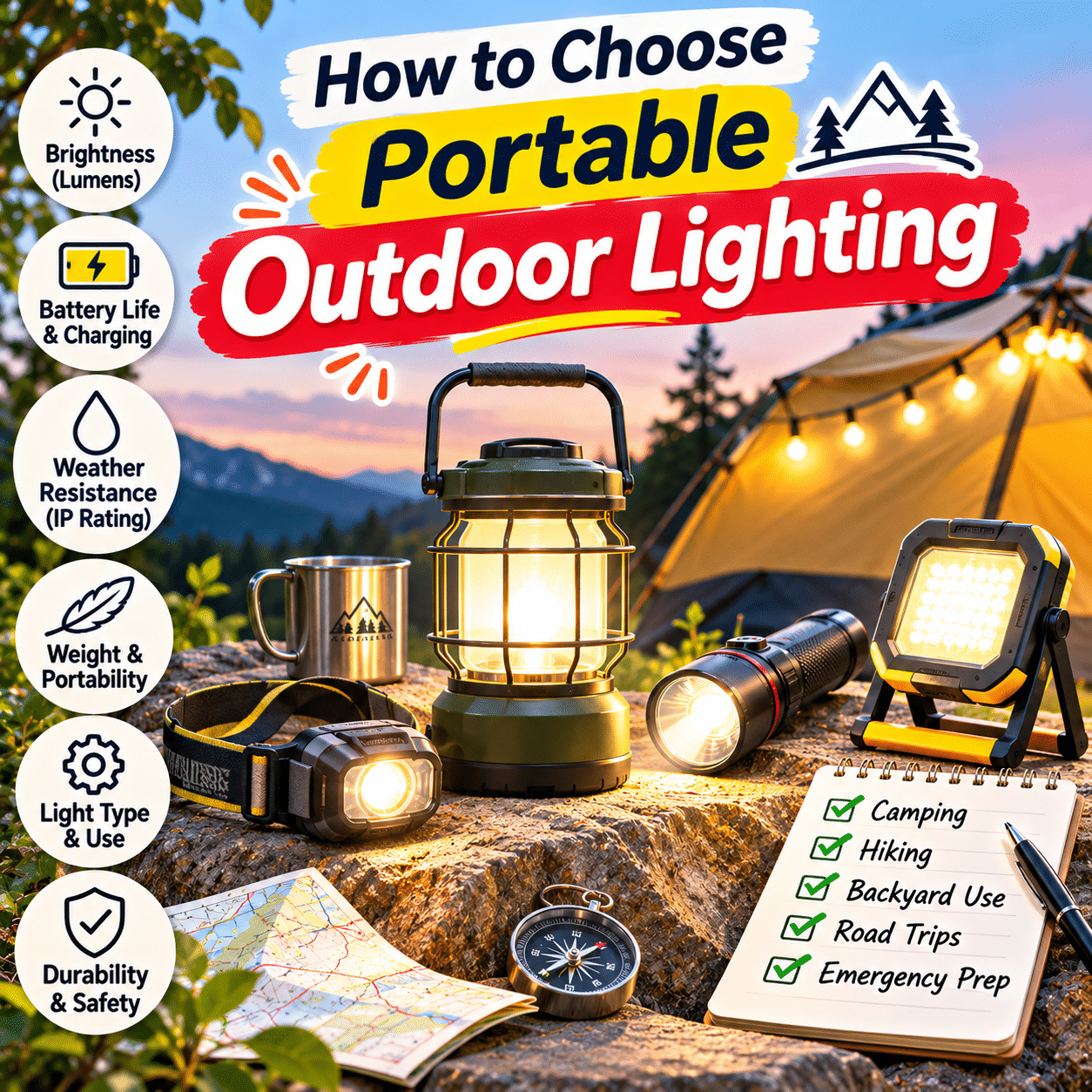
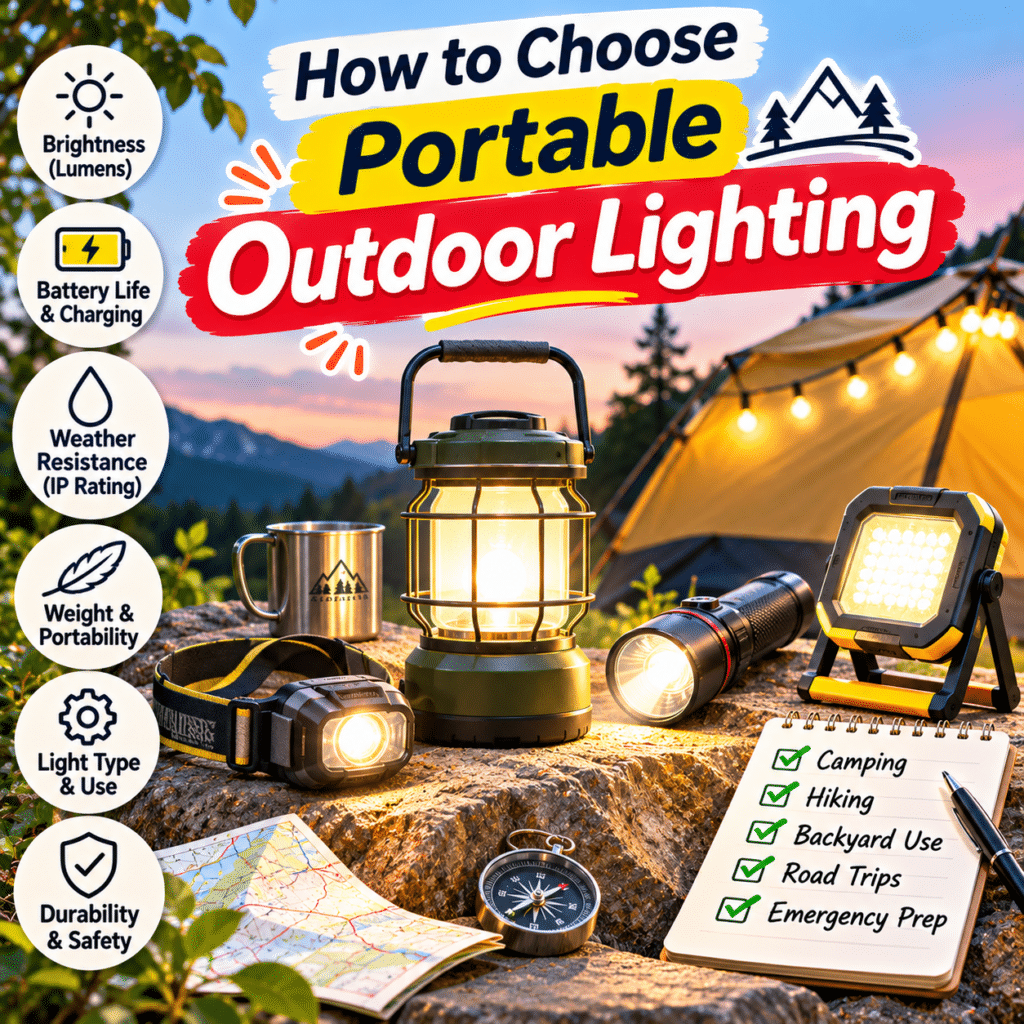
Portable outdoor lighting can make camping trips, evening picnics, backyard gatherings, hiking adventures, and other outdoor activities safer, more comfortable, and more enjoyable. Whether you need to illuminate a campsite, navigate a dark trail, prepare food after sunset, or create a relaxing atmosphere outdoors, choosing the right lighting equipment can make a meaningful difference.
However, not all portable outdoor lights serve the same purpose. A compact headlamp designed for hiking provides a different experience from a camping lantern intended to illuminate a shared space. A rechargeable work light may deliver strong directional illumination, while a decorative string light may prioritize atmosphere over practical visibility.
Brightness, battery life, beam pattern, weather resistance, portability, charging options, and ease of operation all influence how useful a light will be in real outdoor conditions.
The best portable outdoor lighting is not necessarily the brightest or most expensive option. It is the lighting solution that provides the right amount of illumination, in the right direction, for the right length of time.
This comprehensive buying guide explains how to choose portable outdoor lighting, compare different lighting types, understand important technical specifications, and select dependable equipment for camping, travel, recreation, and everyday outdoor use.
1. Understand Your Outdoor Lighting Needs
Before comparing portable lights, consider where, when, and how you expect to use them.
Different activities require different lighting characteristics.
For example, reading inside a tent requires relatively gentle, controlled illumination, while navigating an unfamiliar trail may require a focused beam that reaches farther ahead.
Questions to Ask Before Buying
- Will I mainly use the light for camping, hiking, backyard activities, or emergency preparedness?
- Do I need to illuminate a large area or a specific object?
- Will I carry the light while walking?
- Do I need hands-free operation?
- How many hours of lighting will I require?
- Will the light be exposed to rain, dust, or moisture?
- Can I recharge the light during my trip?
- Do I prefer replaceable batteries or a built-in rechargeable battery?
- How much weight and storage space can I accommodate?
- Will one light be sufficient, or would several specialized lights be more practical?
Answering these questions helps narrow the available options.
2. Understand the Main Types of Portable Outdoor Lighting
Portable outdoor lights come in several common designs.
| Lighting Type | Main Purpose | Common Advantages | Potential Limitations |
|---|---|---|---|
| Camping lantern | General area illumination | Wide light distribution | Less suitable for long-distance visibility |
| Flashlight | Directional illumination | Focused beam and easy aiming | Requires a hand unless mounted |
| Headlamp | Hands-free task and navigation lighting | Convenient while moving | Comfort and beam positioning vary |
| Portable work light | Task and workspace illumination | Strong, adjustable lighting | May be bulky |
| Rechargeable LED light | General portable use | Reusable charging system | Requires charging access |
| Solar-powered light | Supplemental outdoor illumination | Can recharge from sunlight | Performance depends on solar exposure |
| String lights | Decorative ambient lighting | Pleasant atmosphere | Usually limited practical visibility |
| Clip-on light | Localized lighting | Compact and easy to attach | Limited coverage |
| Emergency lantern | Backup lighting | Often designed for extended readiness | Features and runtime vary |
Many products combine several of these functions.
For example, a lantern may include a directional flashlight, or a headlamp may offer both focused and wide beams.
3. Choose Lighting Based on Your Outdoor Activity
Your primary activity should guide the type of lighting you purchase.
Camping
Camping often benefits from a combination of area lighting and personal lighting.
A lantern can illuminate a shared campsite, while a headlamp provides hands-free visibility for individual tasks.
Hiking
Headlamps and compact flashlights are generally more practical than large lanterns.
Weight, beam reach, battery reliability, and weather resistance are especially important.
Backyard Gatherings
Lanterns, portable table lights, and string lights can create comfortable ambient illumination.
Fishing
Directional lighting and hands-free task lighting may be useful, depending on the activity.
Road Trips
Compact rechargeable lanterns and flashlights can provide convenient lighting during stops and campsite setup.
Emergency Preparedness
Reliable battery operation, accessible controls, long-term storage suitability, and backup power options are important.
4. Understand Brightness and Lumens
Brightness is one of the most visible specifications in portable lighting.
Manufacturers commonly describe total light output in lumens.
What Are Lumens?
Lumens measure the total quantity of visible light emitted by a source.
A higher lumen rating generally indicates greater total light output.
However, lumens do not describe how that light is distributed.
Why More Lumens Are Not Always Better
A very bright light can be uncomfortable when used inside a small tent.
It may also consume more battery power.
For close-up tasks, moderate brightness with a well-designed beam can be more useful than maximum output.
Illustrative Brightness Ranges
| Light Output | Potential Applications |
|---|---|
| Under 50 lumens | Low-level orientation and small tasks |
| 50–150 lumens | Reading, personal lighting, and gentle illumination |
| 150–400 lumens | General camping and close-range activities |
| 400–800 lumens | Larger work areas and stronger portable lighting |
| 800–1,500 lumens | High-output directional or area lighting |
| Above 1,500 lumens | Specialized high-output applications |
These are approximate examples, not universal requirements.
Beam pattern, mounting position, and surrounding conditions can make a lower-output light more effective for a particular task.
5. Understand Lumens Versus Lux
Lumens and lux measure different aspects of lighting.
Lumens
Describe total visible light output.
Lux
Describe illuminance: the amount of light reaching a surface per unit area.
One lux equals one lumen per square meter.
Why This Matters
Two flashlights may have similar lumen ratings but produce very different illumination at a particular distance.
A narrow beam concentrates light over a smaller area.
A wide beam spreads light across a larger area.
Practical Buying Advice
For area lighting, evaluate beam coverage and light distribution.
For long-distance visibility, consider beam intensity and throw distance in addition to lumens.
6. Understand Beam Distance
Beam distance describes how far a light can project usable illumination under a specified measurement method.
Some manufacturers provide beam distance according to standardized testing.
Important Factors
- Beam intensity
- Reflector design
- Lens construction
- LED configuration
- Battery output
- Brightness setting
Why Advertised Beam Distance Needs Context
A beam may technically reach a distant point while providing only limited illumination there.
A long-distance beam is not necessarily comfortable for reading or cooking.
Choose beam reach according to your actual activity.
7. Compare Floodlights and Spotlights
Beam shape strongly influences lighting usefulness.
Floodlights
Floodlights spread illumination across a relatively wide area.
Advantages
- Broad coverage
- Useful for campsite activities
- Convenient for food preparation
- Suitable for shared spaces
Potential limitations
- Less concentrated long-distance illumination
- May create glare when positioned poorly
Spotlights
Spotlights concentrate illumination into a narrower beam.
Advantages
- Better directional reach
- Useful for identifying distant objects
- Suitable for navigation in some conditions
Potential limitations
- Narrower coverage
- Less convenient for illuminating a whole campsite
Combination Beams
Some lights provide both flood and spot modes.
These can offer flexibility when moving between tasks.
8. Consider Adjustable Brightness
Multiple brightness levels improve versatility.
Low Mode
Useful for:
- Reading
- Tent interiors
- Nighttime orientation
- Conserving battery power
Medium Mode
Useful for:
- General campsite activities
- Walking around established areas
- Cooking and organizing equipment
High Mode
Useful for:
- Temporary high-visibility needs
- Searching for equipment
- Illuminating larger areas
Adjustable Dimming
Some lights allow continuous brightness adjustment rather than fixed modes.
This can help users select comfortable illumination without unnecessary energy consumption.
9. Understand Battery Runtime
Runtime describes how long a light can operate under specified conditions.
However, advertised runtime can be misleading without understanding the test method.
Important Factors
- Brightness setting
- Battery capacity
- LED efficiency
- Temperature
- Battery condition
- Power management
- Automatic brightness reduction
High Brightness Versus Long Runtime
A light may operate for many hours at its lowest setting but only a short time at maximum output.
Brightness Regulation
Some lights maintain relatively stable output before shutting down.
Others gradually become dimmer as the battery discharges.
Practical Buying Advice
Look for runtime information at several brightness settings, not only the longest advertised duration.
10. Understand Sustained Brightness
Some portable lights advertise extremely high maximum brightness.
However, that output may be available only briefly.
Why Brightness May Decrease
High-output LEDs generate heat.
To manage temperature and power consumption, a light may automatically reduce output.
Turbo Modes
Some flashlights include temporary high-output modes.
These are not necessarily intended for continuous operation.
What to Compare
- Initial output
- Sustained output
- Runtime at useful brightness levels
- Thermal management
- Automatic step-down behavior
For most outdoor activities, dependable sustained brightness matters more than a short maximum-output burst.
11. Choose Between Rechargeable and Replaceable Batteries
Battery design affects convenience and long-term usability.
Rechargeable Lights
Rechargeable lights commonly use lithium-ion batteries or other rechargeable chemistries.
Advantages
- Convenient repeated use
- Reduced need for disposable batteries
- Often compatible with USB charging
- Practical for frequent outdoor activities
Potential limitations
- Require access to charging power
- Built-in batteries may be difficult to replace
- Battery capacity declines with age and use
Replaceable-Battery Lights
These use compatible removable batteries.
Advantages
- Convenient replacement when spare batteries are available
- Useful when charging access is limited
- Some designs support long-term storage with batteries removed
Potential limitations
- Ongoing battery purchases
- Additional spare-battery storage
- Battery compatibility requirements
Hybrid Systems
Some lights accept both approved rechargeable and primary batteries.
Always follow manufacturer compatibility instructions.
12. Understand Battery Capacity
Battery capacity is commonly expressed in milliampere-hours (mAh) or watt-hours (Wh).
Milliampere-Hours
mAh describes electrical charge capacity.
Watt-Hours
Wh describes stored energy.
Why Watt-Hours Can Be More Useful
Battery energy depends on both capacity and voltage.
For nominal values:
Watt-hours = Ampere-hours × Volts
Avoid Comparing mAh Alone
Two batteries with identical mAh ratings may store different amounts of energy if their nominal voltages differ.
Real-World Runtime
Actual runtime also depends on power consumption, conversion efficiency, temperature, and battery condition.
13. Evaluate Charging Options
Charging convenience can be important during extended outdoor trips.
USB-C Charging
USB-C is common in modern portable electronics.
However, the connector alone does not guarantee support for every charging protocol or power source.
Other USB Charging Systems
Some lights use different USB connectors.
Proprietary Charging Cables
These may be convenient but can be difficult to replace during travel.
Removable Rechargeable Batteries
Some products allow batteries to be charged in an approved external charger.
Practical Buying Advice
Choose a charging system compatible with equipment you already use, while following the manufacturer’s power requirements.
14. Consider Solar-Powered Outdoor Lights
Solar-powered portable lights use photovoltaic panels to convert sunlight into electrical energy.
The energy is stored in a battery for later use.
Advantages
- Can reduce reliance on external charging
- Useful for extended outdoor activities
- Convenient for certain emergency preparations
Limitations
- Charging depends on sunlight
- Panel size affects energy collection
- Cloud cover and shading reduce performance
- Charging may require substantial time
- Battery storage capacity remains limited
Understand Solar Charging Claims
A small integrated solar panel may provide supplemental charging rather than quickly restoring a depleted battery.
Check manufacturer information about solar input and realistic charging conditions.
15. Evaluate Power Bank Compatibility
Portable power banks can extend lighting availability during outdoor trips.
Useful Considerations
- Charging connector
- Required input voltage
- Supported charging protocols
- Power bank capacity
- Charging time
- Cable durability
Power Bank Runtime
Actual available energy is lower than the nominal battery energy because of conversion losses.
Plan for Multiple Devices
If a power bank also charges phones, cameras, or navigation devices, account for those energy requirements.
16. Understand LED Lighting Technology
Most modern portable outdoor lights use light-emitting diodes.
Advantages of LEDs
- High energy efficiency
- Compact construction
- Long potential operating life
- Broad range of brightness levels
- Flexible beam design
- Low maintenance under normal conditions
LED Performance Depends on Design
Overall lighting quality depends on more than the LED component.
Important factors include:
- Driver electronics
- Heat management
- Optical design
- Power supply
- Housing construction
A well-designed moderate-output light may provide a better experience than a poorly designed high-output model.
17. Understand Color Temperature
Color temperature describes the apparent warmth or coolness of white light.
It is commonly expressed in kelvins (K).
Warm White
Approximately 2,700–3,500 K.
Often produces a softer, warmer appearance.
Useful for relaxed campsite environments and ambient lighting.
Neutral White
Approximately 3,500–4,500 K.
Offers a balance between warm and cool appearance.
Often suitable for general tasks.
Cool White
Approximately 5,000–6,500 K.
Produces a cooler-looking light.
Some users prefer it for certain task-oriented applications.
Choose Based on Comfort and Purpose
Color temperature is not the same as brightness.
A warmer light can be bright, and a cooler light can be dim.
18. Understand Color Rendering
Color rendering describes how accurately a light source reveals object colors compared with a reference illuminant.
Color Rendering Index
The Color Rendering Index, or CRI, is one commonly used metric.
Why Color Rendering Matters
Good color rendering may be useful when:
- Preparing food
- Identifying equipment
- Reading maps
- Working with colored objects
- Performing detailed tasks
Limitations of CRI
CRI does not describe every aspect of color quality.
Other characteristics, including spectrum and color consistency, can also affect appearance.
Practical Buying Advice
For general campsite tasks, look for lighting that renders colors naturally and comfortably.
19. Consider Red-Light Modes
Some headlamps and portable lights include red LEDs.
Potential Benefits
- Lower perceived brightness when used at suitable levels
- Less disruptive illumination for some nighttime activities
- Useful for close-range orientation
- Convenient when bright white light is unnecessary
Important Limitations
Red light does not automatically preserve night vision in every situation.
Brightness, exposure duration, and individual visual adaptation matter.
Appropriate Uses
Red-light modes may be useful for nighttime campsite movement, reading certain materials, and reducing disturbance to nearby campers.
20. Consider Amber and Warm-Light Modes
Some outdoor lights offer amber or extra-warm lighting.
Potential Advantages
- Comfortable ambient atmosphere
- Reduced visual harshness for some users
- Useful for evening relaxation
Limitations
Warm or amber light is not automatically better for every task.
Color recognition and visibility can vary.
Practical Choice
Choose adjustable color modes when you regularly alternate between task lighting and relaxed ambient illumination.
21. Understand Weather Resistance
Outdoor lights may be exposed to rain, dust, humidity, and accidental splashes.
Weather resistance is therefore an important buying consideration.
Common Environmental Hazards
- Rain
- Dust
- Mud
- Humidity
- Condensation
- Accidental splashes
- Temporary water exposure
Look for Clear Specifications
Avoid relying only on descriptions such as “weatherproof” or “outdoor ready.”
Check the manufacturer’s stated protection rating and operating limitations.
22. Understand IP Ratings
Ingress Protection ratings describe resistance to the entry of solid objects and water under specified test conditions.
An IP rating commonly includes two digits.
First Digit
Indicates protection against solid-object ingress, including dust.
Second Digit
Indicates protection against water ingress.
Common Examples
| IP Rating | General Meaning |
|---|---|
| IPX4 | Protection against splashing water |
| IPX5 | Protection against water jets |
| IPX7 | Protection against temporary immersion under specified conditions |
| IP54 | Limited dust ingress protection and splash resistance |
| IP65 | Dust-tight enclosure and water-jet resistance |
| IP67 | Dust-tight enclosure and temporary immersion protection |
An X means the corresponding category has not been assigned a rating.
Important Limitations
An IP rating does not guarantee resistance to every outdoor condition.
Water temperature, pressure, duration, wear, and damaged seals can affect protection.
Do not assume a light is suitable for underwater use unless explicitly rated and approved for that purpose.
23. Evaluate Impact Resistance
Portable lights may be dropped or knocked against equipment.
Important Factors
- Housing material
- Lens protection
- Internal component mounting
- Battery compartment construction
- Sealing
- Overall assembly quality
Drop-Test Claims
Some manufacturers provide impact-resistance information based on specified tests.
These ratings are useful only when the test conditions are understood.
Practical Buying Advice
Choose a durable design appropriate for expected handling rather than assuming any rugged-looking light is indestructible.
24. Compare Common Housing Materials
Portable outdoor lights use different housing materials.
Aluminum
Often used in flashlights and high-output lights.
Potential advantages include strength and heat dissipation.
Engineered Plastics
Common in lanterns, headlamps, and compact lighting products.
They can provide low weight and design flexibility.
Rubberized Components
May improve grip or provide some impact protection.
Silicone
Sometimes used in flexible diffusers, collapsible lanterns, and protective components.
Material Quality Matters
Construction, sealing, and internal design influence durability more than material names alone.
25. Consider Light Weight and Portability
Portability is essential when carrying lighting equipment outdoors.
Backpacking
Low weight and compact dimensions are important.
Car Camping
Larger lanterns may be practical because equipment is transported by vehicle.
Backyard Use
Weight may be less important than stability and lighting coverage.
Emergency Kits
Compact, easy-to-store designs are often useful.
Evaluate Total Weight
Consider batteries, charging cables, mounting accessories, and protective cases.
26. Evaluate Lantern Design
Camping lanterns provide broad illumination for shared spaces.
Common Lantern Features
- Diffused light
- Carrying handles
- Hanging hooks
- Adjustable brightness
- Rechargeable batteries
- Stable bases
- Multiple lighting modes
Diffused Lighting
A diffuser spreads light and reduces the harshness of a concentrated LED source.
Directional Lanterns
Some lanterns allow light to be directed toward a specific area.
Practical Consideration
A lantern that provides even, comfortable illumination may be more useful than one that produces excessive glare.
27. Choose a Camping Lantern for General Use
A versatile camping lantern should balance brightness, runtime, and convenience.
Important Features
- Suitable area coverage
- Adjustable output
- Stable base
- Convenient carrying handle
- Hanging capability
- Weather resistance
- Manageable charging requirements
Consider Multiple Lanterns
Two moderate-output lanterns placed strategically may illuminate a campsite more comfortably than one extremely bright light.
Avoid Excessive Brightness
High-output lanterns can disturb nearby campers and reduce visual comfort.
28. Choose a Headlamp for Hands-Free Lighting
Headlamps are particularly useful for tasks requiring both hands.
Common Applications
- Setting up tents
- Preparing meals
- Walking on trails
- Organizing equipment
- Reading maps
- Performing repairs
Important Features
- Comfortable headband
- Adjustable tilt
- Appropriate beam pattern
- Multiple brightness modes
- Reliable battery system
- Weather resistance
Fit Matters
A headlamp should remain stable without creating excessive pressure.
29. Evaluate Headlamp Comfort
Headlamp comfort becomes important during extended use.
Consider Weight Distribution
Heavy front-mounted batteries may feel uncomfortable over time.
Adjustable Straps
A secure, adjustable headband improves stability.
Padding
Padding can reduce pressure points.
Battery Placement
Some designs position batteries at the rear of the head.
This may improve balance but can increase overall complexity.
Test Movement
A headlamp should remain secure while walking, bending, and turning.
30. Choose a Flashlight for Outdoor Use
Flashlights are useful for directional lighting and general outdoor preparedness.
Important Features
- Appropriate beam distance
- Comfortable grip
- Reliable switch
- Multiple brightness settings
- Durable housing
- Weather resistance
- Practical battery system
Consider Size
Compact flashlights are convenient for everyday carrying.
Larger models may offer greater battery capacity or specialized performance.
Avoid Choosing by Maximum Lumens Alone
Beam design, runtime, and sustained output are equally important.
31. Consider Portable Work Lights
Portable work lights are designed to illuminate specific work areas.
Common Applications
- Campsite repairs
- Vehicle maintenance
- Equipment setup
- Outdoor projects
- Food preparation areas
Useful Features
- Adjustable stand
- Wide beam
- Stable base
- Magnetic mounting on suitable surfaces
- Hanging hooks
- Adjustable brightness
- Rechargeable battery
Evaluate Mounting Stability
A powerful work light is less useful if it cannot be positioned securely.
32. Consider Clip-On and Magnetic Lights
Compact mounting lights can provide convenient localized illumination.
Clip-On Lights
Can attach to suitable edges, straps, or equipment.
Magnetic Lights
Can attach to compatible ferromagnetic surfaces.
Advantages
- Hands-free positioning
- Compact storage
- Flexible placement
Limitations
- Limited mounting compatibility
- Smaller battery capacity in some models
- Potential instability on unsuitable surfaces
Safety
Ensure the light is securely attached and cannot fall onto people, food, or sensitive equipment.
33. Consider Portable String Lights
String lights are often used for decorative campsite and backyard lighting.
Advantages
- Pleasant atmosphere
- Flexible arrangement
- Broad decorative coverage
- Suitable for social gatherings
Limitations
- Limited directional illumination
- Additional cables or attachment points
- Potential tangling
- Variable weather resistance
Outdoor Suitability
Use only string lights rated for the intended outdoor environment.
Follow manufacturer guidance for power connections and mounting.
34. Consider Inflatable and Collapsible Lanterns
Some portable lanterns use collapsible or inflatable diffusers.
Advantages
- Compact packed size
- Lightweight construction
- Diffused illumination
- Convenient storage
Limitations
- Material durability varies
- Some designs provide limited output
- Inflation or folding mechanisms may require care
Practical Uses
These lights may be useful for backpacking, travel, and emergency storage when compactness is a priority.
35. Evaluate Mounting and Hanging Options
A light’s placement affects how effectively it illuminates an area.
Common Mounting Features
- Hanging hooks
- Carabiner-style attachments
- Tripod sockets
- Magnetic bases
- Adjustable stands
- Clips
- Straps
Consider Stability
Mounting systems should support the light securely.
Avoid Improvised Electrical Installations
Do not modify charging cables, electrical connections, or fixtures to create unsupported mounting arrangements.
Consider Light Direction
A well-positioned moderate-output light can outperform a poorly positioned brighter one.
36. Understand Glare
Glare occurs when bright light causes discomfort or reduces visibility.
Common Causes
- Exposed high-output LEDs
- Lights positioned at eye level
- Narrow beams directed toward people
- Excessive brightness in dark environments
Ways to Reduce Glare
- Choose diffused lanterns
- Use lower brightness settings
- Position lights above or beside work areas
- Direct beams away from faces
- Use indirect lighting when practical
Comfortable lighting improves the overall outdoor experience.
37. Understand Light Distribution
Light distribution describes how illumination spreads through an area.
Omnidirectional Lighting
Spreads light around the source.
Useful for shared campsite areas.
Directional Lighting
Concentrates light toward a specific location.
Useful for walking, repairs, and focused tasks.
Adjustable Distribution
Some lights allow users to change beam width or direction.
Practical Consideration
Select a light distribution that matches the task rather than relying only on total brightness.
38. Choose Lighting for Tent Interiors
Tent lighting should be comfortable, compact, and easy to control.
Useful Features
- Low brightness mode
- Diffused light
- Lightweight construction
- Hanging attachment
- Quiet operation
- Simple controls
Avoid Excessive Brightness
A small tent does not require the same light output as an open campsite.
Battery-Powered LED Lighting
Battery-powered LED lights are generally more appropriate for tent interiors than flame-based lighting.
Never use fuel-burning lanterns or other combustion lighting inside tents because of fire and carbon monoxide hazards.
39. Choose Lighting for Campsite Cooking
Cooking areas require practical task lighting.
Important Features
- Adequate brightness
- Good color rendering
- Directional control
- Stable mounting
- Weather resistance
- Convenient cleaning
Positioning
Place the light where it illuminates the preparation area without shining directly into the cook’s eyes.
Heat Safety
Keep lights, batteries, and cables away from stove flames, hot cookware, and other heat sources.
Follow equipment clearance instructions.
40. Choose Lighting for Outdoor Dining
Outdoor dining benefits from comfortable, evenly distributed illumination.
Useful Options
- Table lanterns
- Warm-white portable lights
- Low-output string lights
- Adjustable rechargeable lanterns
Consider Atmosphere
Soft lighting can make outdoor dining more relaxing.
Avoid Direct Glare
Position lights to illuminate food and the table rather than shining into people’s eyes.
Balance Function and Comfort
Enough light should be available for safe food handling and movement.
41. Choose Lighting for Hiking
Hiking lighting requires a balance of visibility, reliability, and portability.
Important Features
- Hands-free operation
- Appropriate beam reach
- Comfortable fit
- Reliable battery life
- Weather resistance
- Multiple brightness modes
Consider Trail Conditions
Uneven terrain may require stronger directional illumination than a smooth established path.
Backup Lighting
For activities where darkness could create significant navigation risks, carrying a suitable backup light is prudent.
42. Choose Lighting for Backpacking
Backpackers often prioritize weight and energy efficiency.
Useful Features
- Compact dimensions
- Low weight
- Efficient low-output modes
- Reliable controls
- Practical battery capacity
- Weather resistance
Consider Multi-Use Designs
A headlamp may serve for navigation, tent setup, and close-up tasks.
Avoid Unnecessary Accessories
Choose equipment that provides genuine value without adding excessive weight.
43. Choose Lighting for Car Camping
Car camping allows greater flexibility in size and power options.
Useful Lighting Setup
- Main campsite lantern
- Personal headlamp
- Cooking-area light
- Compact backup flashlight
Consider Rechargeable Systems
USB-rechargeable lighting may be convenient when suitable charging power is available.
Avoid Overcomplication
A small number of well-placed lights can provide excellent coverage.
44. Choose Lighting for Family Camping
Family camping may require several lighting zones.
Main Shared Area
A lantern can provide general illumination.
Individual Lighting
Headlamps or compact flashlights may help family members move around.
Tent Lighting
Gentle, diffused lights are useful for bedtime activities.
Safety Considerations
Choose age-appropriate equipment and supervise children.
Avoid small loose batteries where they could create ingestion hazards.
45. Choose Lighting for Backyard Gatherings
Backyard lighting often combines function and atmosphere.
Useful Options
- Portable lanterns
- Rechargeable table lights
- Outdoor-rated string lights
- Portable spotlights
- Accent lighting
Consider Layout
Identify dining, seating, walking, and activity areas.
Use Multiple Lighting Layers
Combining ambient and task lighting can create a more comfortable environment.
Weather Protection
Choose products suitable for the expected outdoor exposure.
46. Choose Lighting for Fishing and Waterside Activities
Waterside environments introduce moisture and stability challenges.
Important Features
- Appropriate water resistance
- Secure mounting
- Reliable battery system
- Hands-free operation when needed
- Suitable beam pattern
Avoid Water Glare
Position lights to reduce unwanted reflections.
Consider Local Regulations
Certain fishing activities and locations may have rules governing artificial lighting.
Safety
Do not assume a water-resistant light is suitable for immersion.
47. Choose Lighting for Road Trips
Portable lighting can be useful during road trips and overnight stops.
Practical Options
- Rechargeable lantern
- Compact flashlight
- Headlamp
- Portable work light
Common Uses
- Organizing luggage
- Setting up a campsite
- Inspecting equipment
- Preparing meals outdoors
- Navigating unfamiliar surroundings
Storage
Keep emergency lighting accessible without allowing loose equipment to interfere with vehicle safety.
48. Choose Lighting for Emergency Preparedness
Portable lighting can support preparedness for power outages and other disruptions.
Important Features
- Reliable operation
- Long usable runtime
- Simple controls
- Practical battery system
- Durable construction
- Easy storage
- Backup power options
Consider Battery Storage
Follow manufacturer recommendations for long-term storage and periodic charging.
Test Equipment Periodically
A light that has not been checked for years may have a depleted or damaged battery.
Consider Redundancy
More than one independent light source can be useful when lighting is important for safety.
49. Understand Lighting Controls
Control design affects convenience, especially in darkness.
Common Controls
- Push buttons
- Rotary dials
- Sliding switches
- Touch controls
- Motion sensors
- Remote controls
Simple Controls
May be easier to operate while wearing gloves.
Multiple Modes
Offer flexibility but can introduce unnecessary complexity.
Lockout Functions
Some lights include a lockout mode to prevent accidental activation during transport.
Practical Buying Advice
Choose controls that are easy to understand and operate in your expected conditions.
50. Consider Motion Sensors
Some portable lights include motion-activated operation.
Potential Benefits
- Convenient automatic lighting
- Reduced need to locate switches
- Energy savings in some applications
Potential Limitations
- Unwanted activation
- Limited sensor coverage
- Sensitivity to positioning
- Reduced usefulness for continuous tasks
Best Applications
Motion sensing may be useful for temporary orientation lighting around suitable outdoor areas.
51. Consider Emergency Flashing Modes
Some portable lights include flashing or signaling modes.
Potential Uses
- Attracting attention
- Temporary signaling
- Increasing visibility in certain situations
Important Limitations
A flashing light does not automatically meet emergency signaling standards.
It should not replace appropriate emergency communication equipment.
Avoid Misuse
High-intensity flashing modes may disturb others or create discomfort.
Use them responsibly.
52. Evaluate Battery Safety
Rechargeable outdoor lights commonly use lithium-ion batteries.
These batteries require appropriate handling.
Important Precautions
- Use approved chargers and cables.
- Avoid damaged batteries.
- Do not expose batteries to excessive heat.
- Follow manufacturer temperature limits.
- Avoid crushing or puncturing battery packs.
- Do not attempt unauthorized battery modifications.
Charging Safety
Charge equipment according to manufacturer instructions.
Avoid charging damaged or visibly swollen batteries.
Battery Replacement
Use only compatible replacement batteries where user replacement is supported.
53. Understand Charging in Outdoor Conditions
Outdoor charging introduces environmental challenges.
Moisture
Keep charging connectors dry unless the manufacturer explicitly supports charging under specific wet conditions.
Dust
Inspect ports for debris before connecting cables.
Temperature
Charging performance and safety can be affected by extreme temperatures.
Power Source Compatibility
Use suitable power banks, adapters, or solar charging systems.
Avoid Improvised Connections
Do not modify cables or connectors to force compatibility.
54. Consider Repairability and Battery Replacement
Long-term usability depends partly on whether important components can be replaced.
Useful Features
- Replaceable batteries
- Available charging cables
- Accessible service support
- Durable switches
- Replaceable straps or mounting accessories
Built-In Batteries
Some compact lights use sealed batteries that are not intended for user replacement.
Long-Term Value
A slightly more expensive light with replaceable components may offer better long-term value for frequent users.
55. Compare Budget and Premium Outdoor Lights
Portable outdoor lighting is available across a wide range of prices.
Budget Lights
May provide adequate performance for occasional use.
Potential limitations include basic controls, shorter runtime, or limited repair support.
Mid-Range Lights
May balance brightness, battery performance, weather resistance, and convenience.
Premium Lights
May offer refined optics, regulated output, advanced battery management, durable construction, and specialized features.
Evaluate Practical Value
Consider:
- Frequency of use
- Brightness requirements
- Sustained runtime
- Comfort
- Durability
- Weather resistance
- Charging convenience
- Warranty
- Repairability
Higher price does not automatically guarantee better suitability.
56. Consider Sustainability and Long-Term Use
Durable lighting equipment can reduce unnecessary replacement.
Rechargeable Batteries
Rechargeable systems may reduce disposable battery consumption when used repeatedly.
Replaceable Components
Repairability can extend product life.
Efficient Lighting
Appropriate brightness settings reduce unnecessary energy use.
Avoid Overbuying
Choose lights that meet real needs rather than collecting redundant equipment.
Responsible Disposal
Batteries and electronic devices should be recycled or disposed of according to local requirements.
Do not place damaged lithium-ion batteries into ordinary waste streams where prohibited.
57. Common Mistakes to Avoid When Buying Portable Outdoor Lighting
Choosing Based Only on Maximum Lumens
Maximum output does not guarantee practical lighting quality.
Better approach: Compare beam pattern, sustained brightness, and runtime.
Ignoring Battery Life
A powerful light may provide limited runtime at high settings.
Better approach: Review runtime at realistic operating levels.
Overlooking Beam Distribution
A narrow flashlight beam may not illuminate a campsite effectively.
Better approach: Match beam shape to the activity.
Buying an Uncomfortable Headlamp
Poor fit can make hands-free lighting unpleasant.
Better approach: Evaluate weight distribution and strap adjustment.
Assuming All Outdoor Lights Are Waterproof
Weather-resistance ratings vary.
Better approach: Check the stated IP rating and operating limits.
Relying Entirely on Solar Charging
Small solar panels may charge slowly.
Better approach: Understand realistic solar performance and maintain backup power.
Ignoring Color Temperature
Very cool or harsh lighting may be uncomfortable for relaxed activities.
Better approach: Choose suitable light color and adjustable modes.
Forgetting Mounting Options
A light may be difficult to position without hooks, stands, or clips.
Better approach: Consider placement before purchasing.
Choosing a Nonreplaceable Battery Without Considering Lifespan
Built-in batteries eventually degrade.
Better approach: Evaluate service and replacement options.
Buying One Light for Every Possible Task
A single design may not provide ideal area lighting, navigation lighting, and close-up task lighting.
Better approach: Consider a small complementary lighting system.
58. How to Choose Portable Outdoor Lighting: Step by Step
Step 1: Identify Your Main Activities
Determine whether you need lighting for camping, hiking, backyard use, travel, or emergency preparedness.
Step 2: Define the Lighting Task
Decide whether you need area lighting, directional lighting, or hands-free task lighting.
Step 3: Choose the Light Type
Compare lanterns, headlamps, flashlights, work lights, and decorative options.
Step 4: Evaluate Brightness
Choose practical light output rather than maximum advertised lumens.
Step 5: Check Beam Pattern
Consider flood, spot, or adjustable beam designs.
Step 6: Compare Runtime
Review battery life at the brightness levels you expect to use.
Step 7: Choose a Power System
Decide between rechargeable, replaceable-battery, solar-assisted, or other appropriate designs.
Step 8: Consider Weather Resistance
Check the IP rating and environmental limitations.
Step 9: Evaluate Portability
Consider weight, dimensions, and carrying convenience.
Step 10: Review Mounting Options
Choose a design that can be positioned securely.
Step 11: Evaluate Durability
Inspect construction, controls, and battery protection.
Step 12: Consider Maintenance
Review cleaning, charging, storage, and battery replacement requirements.
Step 13: Compare Long-Term Value
Choose the light that best balances usability, reliability, and cost.
59. Portable Outdoor Lighting Comparison by Activity
| Activity | Suitable Lighting Type | Main Priorities |
|---|---|---|
| Tent interior | Compact diffused lantern | Gentle light and low output |
| Campsite gathering | Camping lantern | Wide coverage and runtime |
| Backpacking | Lightweight headlamp | Low weight and efficiency |
| Night hiking | Headlamp with suitable beam | Visibility and reliability |
| Outdoor cooking | Directional task light | Good color rendering and positioning |
| Backyard dining | Warm portable lantern | Comfortable ambient light |
| Fishing | Weather-resistant headlamp or task light | Hands-free use and secure mounting |
| Road trips | Rechargeable lantern and flashlight | Versatility and storage |
| Equipment repair | Portable work light | Adjustable positioning |
| Emergency preparedness | Reliable lantern and flashlight | Runtime and backup power |
| Decorative outdoor gathering | Outdoor-rated string lights | Atmosphere and safe installation |
These suggestions are general starting points rather than fixed requirements.
60. Practical Portable Outdoor Lighting Buying Checklist
Intended Use
- I have identified my main outdoor activities.
- I know whether I need area or directional lighting.
- I understand how long the light must operate.
- I have considered the number of people using the illuminated area.
- I know whether hands-free operation is important.
Lighting Performance
- Brightness is appropriate for my tasks.
- Beam pattern suits the intended use.
- Multiple brightness settings are available if needed.
- Sustained output meets my requirements.
- Color temperature is comfortable.
- Light distribution minimizes unnecessary glare.
Battery and Charging
- Runtime is sufficient at useful brightness levels.
- Battery type suits my travel plans.
- Charging connections are convenient.
- Backup power is available when necessary.
- Battery replacement options are understood.
- Charging requirements are compatible with my equipment.
Durability and Portability
- Weight is manageable.
- Packed size is practical.
- Weather resistance suits expected conditions.
- Housing and lens construction appear durable.
- Mounting options are secure.
- Controls are easy to operate.
Long-Term Ownership
- Maintenance requirements are manageable.
- Warranty terms are clear.
- Replacement accessories are available when appropriate.
- The light is versatile enough for future trips.
- Overall value matches my expected use.
61. Frequently Asked Questions
What is the best type of portable lighting for camping?
A camping lantern is useful for general area illumination, while a headlamp is convenient for hands-free tasks.
Many campers benefit from having both.
How many lumens do I need for camping?
The appropriate brightness depends on the task.
Gentle lighting may be sufficient inside a tent, while larger campsite areas may benefit from several hundred lumens or more.
Beam distribution matters as much as total output.
Is a lantern better than a flashlight?
Lanterns are generally better suited to illuminating shared areas.
Flashlights provide more directional lighting.
The better option depends on how the light will be used.
Are rechargeable outdoor lights worth buying?
Rechargeable lights can be convenient and economical for frequent use.
However, charging access and battery lifespan should be considered.
Are solar camping lanterns reliable?
Solar lanterns can be useful, but charging performance depends on sunlight, panel size, battery capacity, and operating conditions.
A backup charging option may be valuable.
What does IPX4 mean?
IPX4 indicates protection against splashing water under specified test conditions.
It does not mean the light is suitable for immersion.
What does IP67 mean?
IP67 indicates dust-tight construction and protection against temporary immersion under specified conditions.
Always follow the manufacturer’s stated limits.
Is a brighter flashlight always better?
No.
Higher brightness can increase battery consumption, glare, and heat.
Choose output appropriate for the task.
What is the difference between flood and spot lighting?
Flood lighting spreads illumination across a wider area.
Spot lighting concentrates illumination into a narrower beam for greater directional reach.
Should I choose warm or cool white light?
Warm light may be more comfortable for relaxed campsite activities.
Neutral or cool light may suit certain tasks.
Personal preference and color rendering also matter.
Do red headlamp modes preserve night vision?
Low-intensity red light can be useful for some nighttime activities, but night-vision adaptation depends on brightness, duration, and other factors.
How long do rechargeable camping lights last?
Runtime varies according to battery capacity, brightness, electronics, temperature, and battery condition.
Review runtime specifications at several output levels.
Can I charge a camping lantern with a power bank?
Many USB-rechargeable lanterns can be charged from compatible power banks.
Check voltage, connector, and charging requirements.
Are portable outdoor lights safe inside tents?
Battery-powered LED lights are generally suitable when used according to their instructions.
Avoid combustion-based lanterns inside tents because of fire and carbon monoxide risks.
Are string lights practical for camping?
They can provide comfortable ambient lighting.
However, they may not replace task lighting or navigation lighting.
What is the best light for nighttime hiking?
A comfortable, weather-resistant headlamp with appropriate beam reach and reliable battery life is often practical.
Do I need a backup flashlight?
For activities where lighting failure could create safety problems, carrying a backup light is prudent.
Are expensive outdoor lights better?
Premium models may offer advanced optics, regulated output, stronger construction, and better service support.
However, a simpler light may meet your needs effectively.
Can outdoor lights be left in the rain?
Only when the manufacturer’s weather-resistance specifications support the expected exposure.
Inspect charging-port covers and seals before use.
How should I store rechargeable outdoor lights?
Follow manufacturer guidance, avoid extreme temperatures, and check battery condition periodically.
What is the most important feature of portable outdoor lighting?
The most important feature depends on intended use.
For hiking, reliable directional lighting may be essential.
For camping, comfortable area coverage and runtime may matter most.
For emergencies, dependable power and ease of operation are especially important.
62. How to Arrange Lighting Around a Campsite
A thoughtful lighting layout can improve visibility without creating unnecessary glare.
Main Gathering Area
Place a lantern where it provides broad illumination.
Cooking Area
Use a directional light positioned away from heat sources.
Tent Interior
Choose gentle, diffused lighting.
Walking Routes
Use appropriate portable lighting when moving between areas.
Personal Tasks
Keep a headlamp or flashlight accessible.
Avoid Excessive Illumination
Use only the amount of light needed for safe and comfortable activities.
Respect Nearby Campers
Direct bright beams away from neighboring tents and shared spaces.
63. How to Extend Portable Lighting Runtime
Battery life can often be improved through practical usage habits.
Use Lower Brightness Settings
Select the lowest output that provides adequate visibility.
Avoid Unnecessary Turbo Modes
High-output modes may consume substantial energy.
Turn Lights Off When Not Needed
Reduce unnecessary operation.
Use Efficient Beam Placement
Proper positioning can reduce the need for higher brightness.
Keep Batteries Within Recommended Temperatures
Extreme temperatures can affect performance.
Maintain Charging Equipment
Use compatible, undamaged cables and connectors.
Plan Backup Power
Carry suitable spare batteries or charging equipment when necessary.
64. How to Clean and Maintain Portable Outdoor Lights
Regular maintenance helps preserve performance and reliability.
Clean Exterior Surfaces
Remove dust, dirt, and debris using manufacturer-approved methods.
Inspect Lenses
Clean lenses carefully to avoid scratching protective surfaces.
Check Seals
Inspect accessible gaskets and covers for wear or damage.
Maintain Charging Ports
Keep connectors clean and dry.
Inspect Straps and Mounts
Replace damaged accessories when appropriate.
Check Battery Condition
Follow manufacturer instructions for storage, charging, and replacement.
Avoid Unauthorized Repairs
Do not open sealed electrical assemblies or modify battery systems unless the product is specifically designed for user servicing.
65. Build a Flexible Outdoor Lighting System
Rather than relying on one light for every situation, consider a small collection of complementary lighting tools.
Main Lantern
Provides general campsite illumination.
Headlamp
Supports hands-free movement and tasks.
Compact Flashlight
Offers directional lighting and backup capability.
Task Light
Useful for cooking, repairs, or equipment organization.
Charging Equipment
Supports rechargeable devices when appropriate.
Protective Storage
Keeps lighting equipment organized and accessible.
Not every traveler needs all these items.
Start with the essentials and add specialized equipment only when it solves a genuine problem.
66. Consider Long-Term Outdoor Lighting Needs
Portable lighting can support many activities beyond a single camping trip.
A versatile lighting setup may also be useful for:
- Backyard gatherings
- Road trips
- Outdoor dining
- Hiking
- Fishing
- Emergency preparedness
- Home maintenance
- Travel
- Recreational activities
Consider whether your needs may change over time.
A durable, rechargeable lantern with adjustable brightness may serve several purposes, while a comfortable headlamp can remain useful across many outdoor activities.
However, versatility should not come at the expense of essential performance.
Choose equipment that reliably supports your most common uses.
Final Thoughts
Choosing portable outdoor lighting involves balancing brightness, beam pattern, battery life, portability, weather resistance, durability, and ease of operation.
A camping lantern may be ideal for illuminating shared spaces, while a headlamp offers hands-free convenience for hiking and campsite tasks. A compact flashlight provides directional visibility, and portable work lights can help with detailed activities. Decorative string lights may enhance the atmosphere of outdoor gatherings but should not replace essential task lighting.
Before purchasing, consider where the light will be used, how much illumination is actually needed, and how long it must operate. Compare sustained brightness rather than relying only on maximum lumen claims, and evaluate charging options alongside battery capacity and expected runtime.
Weather protection, comfortable controls, secure mounting, and long-term maintenance also deserve attention.
A thoughtfully selected lighting setup can make outdoor activities more practical, comfortable, and enjoyable while reducing unnecessary equipment and energy use.
The best portable outdoor lighting is not simply the brightest light available—it is the lighting that provides dependable visibility, comfortable illumination, and practical convenience wherever your outdoor adventures take you.