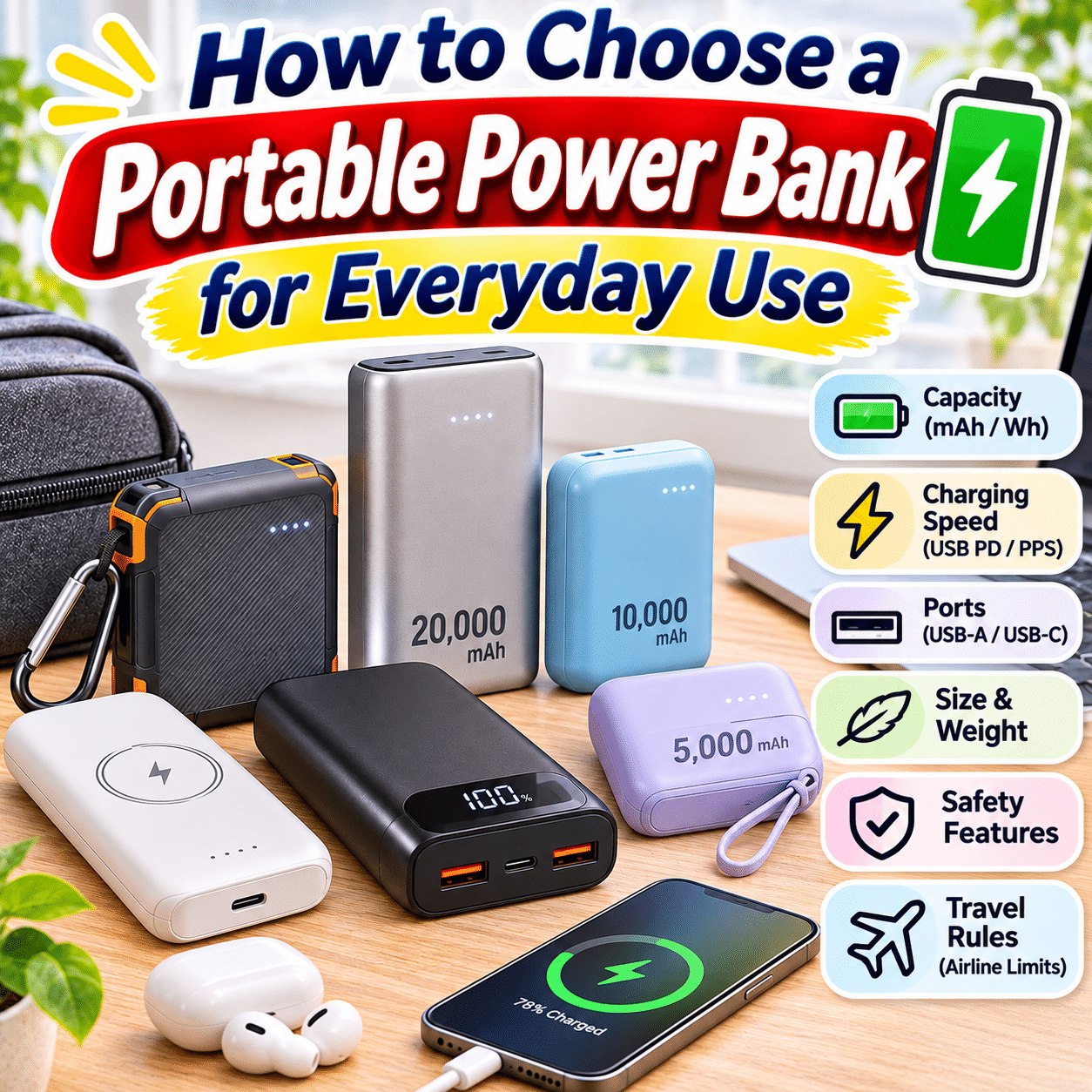
A portable power bank can be one of the most useful accessories for modern everyday life. Whether you are commuting, traveling, working away from home, studying, or spending time outdoors, having a reliable source of backup power can help keep essential electronic devices operating when a wall outlet is unavailable.
Smartphones, wireless earbuds, tablets, smartwatches, and other portable electronics have become important tools for communication, navigation, entertainment, and productivity. Although battery technology continues to improve, daily usage patterns can still leave devices running low on power at inconvenient moments.
A power bank offers a practical solution by storing electrical energy in a rechargeable battery and transferring that energy to compatible devices when needed.
However, choosing the right power bank involves more than selecting the model with the largest advertised battery capacity.
Capacity, charging speed, output power, port configuration, battery quality, physical size, charging standards, safety protections, and long-term durability all influence how well a power bank performs.
A compact model may be ideal for everyday smartphone charging, while a higher-capacity power bank may be more appropriate for extended travel or charging several devices. Some models support laptops, wireless charging, or fast charging, but these features require careful compatibility checks.
This comprehensive buying guide explains the most important specifications, compares common power bank designs, explores charging technologies, and provides practical advice for choosing a safe, reliable, and convenient portable power bank for everyday use.
1. Understand What a Portable Power Bank Does
A power bank is a rechargeable battery system designed to supply electrical energy to compatible electronic devices.
Most modern power banks contain lithium-ion or lithium-polymer battery cells, electronic control circuits, charging ports, and protective components.
How a Power Bank Works
The basic process involves three stages:
- The power bank receives electricity from an external charger.
- Its internal battery stores electrical energy.
- The power bank transfers energy to connected devices when needed.
During charging and discharging, electronic circuits regulate voltage, current, and other operating conditions.
Common Devices Powered by Power Banks
Depending on output capabilities, a power bank may charge:
- Smartphones.
- Wireless earbuds.
- Smartwatches.
- Tablets.
- E-readers.
- Bluetooth speakers.
- Portable gaming devices.
- Cameras.
- Rechargeable lights.
- Selected laptops.
- Other compatible USB-powered electronics.
Important Limitation
Not every power bank can charge every device.
Compatibility depends on connector type, voltage, power delivery, charging protocol, and the device’s requirements.
2. Identify Your Everyday Charging Needs
Before comparing power banks, consider how you expect to use one.
Questions to Ask
- Which devices will I charge?
- How often will I need backup power?
- Will I carry the power bank every day?
- Do I need to charge multiple devices?
- Will I use it while traveling?
- Is fast charging important?
- Do I need laptop charging?
- How much weight am I comfortable carrying?
Everyday Commuting
For short daily commutes, a compact power bank may provide enough backup energy for a smartphone.
Long Workdays
People who spend many hours away from electrical outlets may benefit from greater capacity.
Travel
Travelers may prioritize:
- Higher capacity.
- Multiple charging ports.
- Reliable fast charging.
- Compact construction.
- Clear battery labeling.
- Airline compliance.
Laptop Use
Laptop charging requires special attention to USB-C Power Delivery capabilities and output wattage.
Choose Based on Real Use
The most useful power bank is one that provides enough energy for your routine without unnecessary weight or complexity.
3. Understand Power Bank Battery Capacity
Battery capacity is one of the first specifications buyers notice.
It is commonly expressed in milliampere-hours, abbreviated as mAh.
Examples include:
- 5,000 mAh.
- 10,000 mAh.
- 15,000 mAh.
- 20,000 mAh.
- 25,000 mAh.
- 30,000 mAh.
What Does mAh Mean?
Milliampere-hours describe electrical charge capacity.
However, mAh alone does not fully describe stored energy because voltage also matters.
Why Capacity Matters
Higher-capacity power banks generally store more energy.
This can allow:
- More smartphone charging.
- Longer backup availability.
- Charging multiple devices.
- Greater flexibility during travel.
Why Bigger Is Not Always Better
Larger batteries generally increase:
- Weight.
- Physical size.
- Charging time.
- Purchase cost.
For everyday carry, a smaller power bank may be more convenient.
4. Understand Watt-Hours: A More Useful Energy Measurement
Watt-hours, abbreviated as Wh, describe electrical energy.
This measurement is especially useful when comparing battery systems and checking airline restrictions.
Basic Formula
Watt-hours can be calculated using:
Wh = (mAh × Nominal Voltage) ÷ 1,000
For example, a battery rated at 10,000 mAh with a nominal cell voltage of 3.7 V contains approximately:
10,000 × 3.7 ÷ 1,000 = 37 Wh
A 20,000 mAh battery at the same nominal voltage contains approximately:
74 Wh
Why Nominal Voltage Matters
Power banks typically use lithium battery cells with nominal voltages around 3.6–3.7 V, depending on chemistry and design.
However, their USB outputs commonly operate at different voltages.
Therefore, the advertised mAh rating should not be interpreted as the amount of charge available at every USB output voltage.
Practical Buying Advice
When possible, check the manufacturer’s stated watt-hour rating.
It provides a clearer measure of stored energy than mAh alone.
5. Understand Why Actual Charging Capacity Is Lower Than Advertised Capacity
A common misconception is that a 10,000 mAh power bank will deliver exactly 10,000 mAh to a smartphone battery.
In practice, charging involves energy losses.
Sources of Energy Loss
These may include:
- Voltage conversion.
- Internal circuit resistance.
- Cable resistance.
- Battery heating.
- Charging electronics.
- Wireless energy transfer.
- Device operation during charging.
Why This Matters
The usable energy delivered to a device will generally be lower than the energy stored in the power bank.
Example
A power bank with a nominal energy capacity of 37 Wh may deliver less than 37 Wh to a connected device after conversion and other losses.
The actual amount depends on operating conditions and system efficiency.
Avoid Exact Charging Claims
A power bank’s advertised capacity does not guarantee a fixed number of complete smartphone charges.
Actual performance depends on both the power bank and the device being charged.
6. Estimate How Many Times a Power Bank Can Charge Your Phone
A useful estimate compares stored energy rather than simply dividing mAh ratings.
Step 1: Find the Power Bank’s Energy Capacity
Look for its watt-hour rating.
Step 2: Estimate Usable Output Energy
Account for conversion and charging losses.
Step 3: Find Your Phone Battery’s Energy Capacity
If the phone battery capacity is provided in mAh, its nominal voltage is also needed to calculate Wh.
Step 4: Compare the Values
Divide estimated usable power bank energy by the phone battery’s energy requirement.
Illustrative Example
Suppose:
- A power bank stores 74 Wh.
- Approximately 60 Wh is delivered under the assumed operating conditions.
- A smartphone battery stores 18 Wh.
Theoretical full-charge equivalents would be approximately:
60 ÷ 18 = 3.3
However, this is only an illustration.
Real-world results vary with charging efficiency, phone usage, battery condition, and temperature.
Practical Recommendation
Use capacity estimates as planning tools rather than guaranteed charging counts.
7. Compare Common Power Bank Capacities
| Advertised capacity | Approximate energy at 3.7 V | Typical suitability | Main trade-off |
|---|---|---|---|
| 5,000 mAh | 18.5 Wh | Emergency smartphone backup | Limited stored energy |
| 10,000 mAh | 37 Wh | Everyday commuting and travel | Moderate capacity |
| 15,000 mAh | 55.5 Wh | Longer days away from outlets | More weight |
| 20,000 mAh | 74 Wh | Travel and multiple devices | Larger size |
| 25,000 mAh | 92.5 Wh | Extended use and selected laptops | Higher weight and cost |
| 30,000 mAh | 111 Wh | Specialized high-capacity needs | Greater travel restrictions |
These energy values assume a nominal cell voltage of 3.7 V. Actual product ratings may differ.
8. Choose the Right Capacity for Everyday Carry
For many people, portability is just as important as capacity.
Small-Capacity Power Banks
Models around 5,000 mAh may be suitable for:
- Emergency backup.
- Short commutes.
- Occasional charging.
- Minimalist everyday carry.
Mid-Capacity Power Banks
Models around 10,000 mAh often provide a practical balance between size and stored energy.
They can be useful for:
- Workdays.
- University.
- Daily commuting.
- City travel.
- Routine smartphone charging.
Larger Power Banks
Models around 20,000 mAh may be useful for:
- Extended travel.
- Multiple devices.
- Long days without outlets.
- More demanding charging routines.
Practical Principle
Choose the smallest capacity that comfortably meets your needs.
A power bank that is too heavy to carry regularly may provide less everyday value than a smaller model you consistently bring with you.
9. Understand Power Bank Output Power
Output power determines how much electrical power a power bank can provide to a connected device.
It is commonly expressed in watts, abbreviated as W.
Basic Formula
Power (W) = Voltage (V) × Current (A)
For example:
5 V × 2 A = 10 W
A USB-C power bank supporting a negotiated output of 9 V at 3 A can provide:
9 V × 3 A = 27 W
Why Output Power Matters
Higher supported output power can allow faster charging when the connected device supports it.
However, charging speed depends on more than the power bank’s maximum rating.
Device Compatibility
A smartphone that supports a particular maximum charging power will not necessarily charge faster simply because the power bank advertises a much higher output.
The devices must negotiate compatible charging conditions.
10. Understand Fast Charging
Fast charging refers to charging methods that deliver more power than basic charging configurations.
Different devices use different charging technologies.
Common Factors
Charging speed depends on:
- Power bank output.
- Device charging capability.
- Supported protocol.
- Cable rating.
- Battery temperature.
- Battery charge level.
- Device software.
Charging Speed Changes Over Time
Many devices charge faster when their batteries are relatively low.
Charging power often decreases as the battery approaches full capacity.
Important Reminder
A power bank advertised as supporting 65 W does not guarantee that every connected device will charge at 65 W.
The actual power is limited by compatible negotiated capabilities and operating conditions.
11. Understand USB Power Delivery
USB Power Delivery, commonly called USB PD, is a charging standard used with compatible USB connections.
It allows connected devices to negotiate supported voltage and current levels.
Common Applications
USB PD is used by many:
- Smartphones.
- Tablets.
- Laptops.
- Portable gaming devices.
- Other USB-C electronics.
Potential Advantages
- Broad compatibility.
- Flexible power negotiation.
- Support for higher-power charging.
- Convenient use across multiple device categories.
What to Check
Before purchasing, confirm:
- Supported USB PD version or capabilities.
- Maximum output wattage.
- Available voltage profiles.
- Port-specific limits.
- Cable requirements.
Practical Advice
USB PD support can be particularly valuable when charging several types of modern USB-C devices.
12. Understand USB PD Programmable Power Supply
Programmable Power Supply, abbreviated as PPS, is an optional feature within USB Power Delivery.
It allows compatible devices to request adjustable voltage and current within supported ranges.
Why PPS Matters
Certain smartphones use PPS to optimize charging behavior.
Potential Benefits
- More flexible power regulation.
- Improved compatibility with selected fast-charging devices.
- Potentially more efficient charging under suitable conditions.
Important Limitation
Not every USB PD power bank supports PPS.
Likewise, not every smartphone requires PPS for its preferred charging method.
Buying Advice
If your phone specifies USB PD PPS requirements, confirm that the power bank supports the relevant voltage and current range.
13. Understand Proprietary Fast-Charging Technologies
Some manufacturers use additional charging protocols.
These may require:
- Specific chargers.
- Compatible power banks.
- Specialized cables.
- Manufacturer-approved accessories.
Why Compatibility Matters
A power bank may advertise high output power but provide slower charging when used with a device requiring a different protocol.
Before Buying
Check the device manufacturer’s charging specifications.
Look for explicit compatibility rather than assuming that a high wattage rating is sufficient.
Avoid Marketing Confusion
Terms such as ultra-fast or super-fast are not universal technical standards.
The actual supported protocol and power profiles are more informative.
14. Understand USB-A and USB-C Ports
Power banks commonly include USB-A, USB-C, or both.
USB-A
USB-A is the traditional rectangular USB connector.
It remains useful for older charging cables and accessories.
USB-C
USB-C is a reversible connector widely used by modern portable electronics.
Depending on the product, USB-C may support:
- Power input.
- Power output.
- USB Power Delivery.
- Higher charging power.
- Charging in both directions.
Important Distinction
A USB-C connector does not automatically guarantee fast charging or USB PD support.
The product’s electronic capabilities determine what the port can do.
Practical Recommendation
For modern everyday devices, a power bank with at least one capable USB-C port is often a sensible choice.
15. Evaluate the Number of Charging Ports
Multiple ports allow a power bank to charge more than one device.
Single-Port Models
These may be:
- Compact.
- Lightweight.
- Simple.
- Suitable for one primary device.
Two-Port Models
These offer flexibility for charging a smartphone and another accessory.
Three or More Ports
These may be useful for:
- Travel.
- Families.
- Multiple gadgets.
- Laptop and smartphone combinations.
Important Limitation
Maximum output power may be shared between ports.
A power bank advertising 100 W maximum output may not provide 100 W to every port simultaneously.
Always check the manufacturer’s multi-port power distribution specifications.
16. Understand Input Charging Speed
Input power determines how quickly the power bank itself can recharge.
Why This Matters
A large-capacity power bank may take many hours to recharge with a low-power charger.
Factors Affecting Recharge Time
- Battery capacity.
- Maximum input wattage.
- Charger compatibility.
- Cable capabilities.
- Battery temperature.
- Charging efficiency.
- Charging management.
Illustrative Example
A power bank storing approximately 74 Wh would require more than 3.7 hours to recharge from empty at a constant 20 W of delivered battery power.
Actual recharge time will be longer or otherwise vary because charging power is not constant and losses occur.
Practical Advice
If you use your power bank frequently, consider a model with sufficiently fast input charging and a compatible wall charger.
17. Consider Pass-Through Charging
Pass-through charging refers to a power bank receiving external power while also supplying power to another device.
Potential Convenience
It may allow a phone and power bank to be connected during a single charging session.
Important Limitations
Not all power banks support pass-through charging.
Even when supported, there may be restrictions involving:
- Output power.
- Heat.
- Port combinations.
- Charging priority.
- Battery management.
Safety Considerations
Use pass-through charging only when explicitly supported by the manufacturer.
Do not assume that a power bank can safely operate as a permanent uninterruptible power supply.
18. Consider Power Banks With Built-In Cables
Some power banks include integrated charging cables.
Advantages
- Fewer accessories to carry.
- Convenient everyday use.
- Reduced risk of forgetting a cable.
- Compact organization.
Limitations
- Cable length may be short.
- Cable may not support maximum output.
- Connector type may limit compatibility.
- Cable damage can reduce usefulness.
What to Check
Verify:
- Connector type.
- Supported charging power.
- Cable durability.
- Replacement options.
- Whether the cable supports both input and output.
Best Use
Built-in cables can be especially convenient for commuting and lightweight travel.
19. Consider Wireless Charging Power Banks
Wireless charging power banks transfer energy to compatible devices without a physical charging cable between the power bank and device.
Common Features
- Wireless smartphone charging.
- Magnetic alignment.
- USB-C wired charging.
- Compact attachment designs.
- Charging status indicators.
Advantages
- Convenient cable-free operation.
- Easy short charging sessions.
- Useful for compatible smartphones.
- Reduced cable clutter.
Limitations
- Lower efficiency than many wired configurations.
- Additional heat generation.
- Alignment sensitivity.
- Potentially slower charging.
- Greater energy loss.
Practical Advice
Wireless charging can be convenient, but wired charging is often preferable when maximizing usable energy and charging efficiency is important.
20. Understand Qi and Qi2 Wireless Charging
Qi is a wireless charging standard developed by the Wireless Power Consortium.
Qi2 introduces standardized magnetic alignment for supported implementations and devices.
Why Alignment Matters
Wireless charging depends on effective positioning between charging components.
Poor alignment can reduce efficiency and increase heat.
Important Considerations
Check:
- Wireless charging certification.
- Supported charging power.
- Device compatibility.
- Magnetic alignment requirements.
- Case compatibility.
Avoid Assuming Universal Compatibility
A magnetic power bank may attach to a device without necessarily supporting its maximum wireless charging speed.
Certification and device compatibility should be verified.
21. Consider Magnetic Power Banks
Magnetic power banks attach to compatible devices or cases using magnets.
Advantages
- Convenient attachment.
- Compact charging setup.
- Reduced cable use.
- Useful for short periods away from outlets.
Limitations
- Added phone weight.
- Potential heat buildup.
- Alignment requirements.
- Compatibility limitations.
- Reduced charging efficiency compared with wired charging.
Case Compatibility
Some protective cases interfere with magnetic attachment or wireless charging.
Use compatible cases and accessories.
Practical Recommendation
Choose magnetic charging when convenience is the main priority, rather than assuming it offers the greatest charging efficiency.
22. Evaluate Power Bank Size and Weight
Portability is a major reason to buy a power bank.
Common Form Factors
- Slim rectangular models.
- Compact pocket-sized models.
- Magnetic attachment models.
- Larger high-capacity models.
- Laptop-oriented power banks.
Consider Where You Carry It
A power bank for a handbag or backpack may have different size requirements from one intended for a trouser pocket.
Weight Versus Capacity
Higher-capacity batteries generally require more battery material and may weigh more.
However, enclosure design and battery chemistry also influence weight.
Practical Advice
Compare actual dimensions and weight rather than relying only on product photographs.
23. Evaluate Build Quality and Durability
A power bank should withstand normal everyday handling.
Important Construction Features
- Secure enclosure.
- Well-fitted ports.
- Durable connectors.
- Stable buttons.
- Clear labeling.
- Reliable cable connections.
- Appropriate protection against impacts.
Common Wear Points
- USB ports.
- Integrated cables.
- Charging connectors.
- Buttons.
- Exterior casing.
Avoid Excessive Physical Stress
Lithium battery products should not be crushed, punctured, bent, or exposed to severe impacts.
Important Warning Signs
Stop using a power bank if it develops:
- Swelling.
- Cracks exposing internal components.
- Unusual odors.
- Smoke.
- Leaking material.
- Excessive unexplained heat.
- Repeated charging malfunctions.
Follow appropriate battery safety and disposal guidance.
24. Understand Lithium-Ion and Lithium-Polymer Batteries
Most portable power banks use rechargeable lithium-based battery technology.
Lithium-Ion
Lithium-ion is a broad category of rechargeable battery chemistries.
Cells may be packaged in cylindrical, prismatic, or pouch formats.
Lithium-Polymer
The term lithium-polymer is commonly used in consumer products to describe certain lithium battery designs, often involving pouch cells.
However, marketing terminology does not always provide a precise description of the battery’s electrochemistry.
Which Is Better?
Neither label alone guarantees:
- Better safety.
- Longer lifespan.
- Higher energy density.
- Faster charging.
- Greater reliability.
What Matters More
Prioritize:
- Battery quality.
- Protective circuitry.
- Thermal design.
- Manufacturer reliability.
- Appropriate certification.
- Product construction.
25. Understand Power Bank Safety Protections
Safety should be a major purchasing consideration.
Reliable power banks incorporate electronic protection systems intended to reduce electrical and thermal risks.
Common Protective Functions
- Overcharge protection.
- Over-discharge protection.
- Overcurrent protection.
- Short-circuit protection.
- Temperature monitoring.
- Overvoltage protection.
- Undervoltage protection.
Why These Features Matter
Lithium batteries can be hazardous if improperly designed, damaged, charged, or used.
Important Limitation
Safety features reduce risk but do not make a battery completely risk-free.
Buying Advice
Choose products from manufacturers that provide clear safety information and relevant compliance documentation.
26. Understand Battery Certifications and Compliance Claims
Power banks may display safety or regulatory marks.
However, different marks have different meanings.
Relevant Considerations
Depending on the product and market, documentation may refer to:
- IEC 62133-2.
- UL 2056.
- UN 38.3.
- Applicable regional electrical or electromagnetic compatibility requirements.
Understand the Differences
IEC 62133-2 addresses safety requirements for certain portable sealed secondary lithium cells and batteries.
UL 2056 addresses safety considerations for power banks.
UN 38.3 concerns transport testing of lithium cells and batteries.
These standards do not all serve the same purpose.
Avoid Misleading Claims
A product displaying a logo does not automatically establish genuine certification.
Where possible, verify documentation through credible manufacturer or certification sources.
Practical Recommendation
Prioritize traceable product information over vague claims such as completely safe or explosion-proof.
27. Consider Temperature Management
Temperature affects charging performance, battery health, and safety.
Heat During Charging
Some warmth is normal during energy transfer.
However, excessive heat may indicate a problem.
Factors That Increase Heat
- High charging power.
- Wireless charging.
- Poor ventilation.
- High ambient temperature.
- Direct sunlight.
- Heavy device use during charging.
Safe Usage Practices
- Follow the manufacturer’s operating temperature limits.
- Keep the power bank away from direct sunlight.
- Avoid covering it with insulating materials while charging.
- Do not leave it in a hot parked vehicle.
- Stop using it if abnormal heat or damage occurs.
Cold Conditions
Low temperatures can temporarily reduce battery performance.
Avoid charging lithium batteries outside the manufacturer’s permitted temperature range.
28. Understand Battery Cycle Life
Rechargeable batteries gradually lose usable capacity over time.
What Is a Charge Cycle?
A charge cycle generally represents cumulative discharge equivalent to the battery’s rated capacity, rather than necessarily one individual charging session.
Factors Affecting Battery Aging
- Charge and discharge cycles.
- Operating temperature.
- Storage temperature.
- Time spent at high charge levels.
- Depth of discharge.
- Battery chemistry.
- Charging management.
Why Cycle Life Matters
A power bank may continue operating after years of use but provide less stored energy than when new.
Practical Advice
Choose a product with clear warranty coverage and realistic manufacturer information about battery longevity.
Avoid assuming that a power bank will maintain its original capacity indefinitely.
29. Consider Charging Efficiency
Charging efficiency describes how much stored energy reaches the connected device.
Sources of Loss
- Internal voltage conversion.
- Cable resistance.
- Heat generation.
- Wireless transfer.
- Device charging circuits.
Wired Versus Wireless Charging
Wired charging often delivers better overall energy efficiency than wireless charging under comparable conditions.
Why Efficiency Matters
A highly efficient power bank may provide more useful charging energy from the same nominal battery capacity.
Important Limitation
Manufacturers do not always report efficiency using comparable testing methods.
Look for credible standardized testing where available.
30. Consider Power Banks for Smartphones
Smartphones are among the most common devices charged by power banks.
Important Features
- Suitable capacity.
- Compatible fast charging.
- USB-C output.
- Compact size.
- Reliable cable connection.
- Safe thermal performance.
Everyday Use
For many smartphone users, a 10,000 mAh power bank offers a practical balance of portability and backup energy.
However, larger phones and more demanding routines may justify greater capacity.
Check Charging Protocols
Confirm whether your phone supports:
- USB PD.
- PPS.
- Wireless charging.
- Manufacturer-specific fast charging.
Practical Recommendation
Choose a power bank that supports your phone’s actual charging requirements rather than paying for unused maximum wattage.
31. Consider Power Banks for Tablets
Tablets often have larger batteries than smartphones.
Important Features
- Greater energy capacity.
- Suitable USB-C output.
- Compatible charging protocols.
- Reliable cables.
- Manageable recharge time.
Why Capacity Matters
A small power bank may provide only limited additional tablet runtime.
Practical Recommendation
For frequent tablet charging, consider a medium- or high-capacity power bank with appropriate output power.
32. Consider Power Banks for Laptops
Laptop charging requires more careful specification checks.
Important Requirements
- USB-C Power Delivery compatibility.
- Sufficient output wattage.
- Suitable voltage profiles.
- Compatible cable.
- Adequate battery capacity.
Common Laptop Charging Needs
Different laptops may use adapters rated around:
- 30 W.
- 45 W.
- 65 W.
- 90 W.
- 100 W.
- Higher power levels.
These are examples, not universal requirements.
Important Limitation
A power bank with insufficient output may charge a laptop slowly, only when idle, or not at all.
Check the Laptop’s Specifications
Confirm that the laptop supports charging through the intended USB-C port.
Some laptops require proprietary connectors or specific charging arrangements.
33. Understand High-Power USB-C Charging
Some power banks support high-power USB-C output suitable for compatible laptops and other electronics.
What to Check
- Maximum output wattage.
- Supported USB PD profiles.
- Single-port power limits.
- Multi-port power distribution.
- Cable ratings.
- Thermal limitations.
USB PD Extended Power Range
Certain USB PD implementations support Extended Power Range, or EPR, for higher-power applications.
Using these capabilities requires compatible equipment and appropriately rated cables.
Practical Advice
Do not assume that every USB-C cable can safely or effectively support the maximum power advertised by a power bank.
Use cables meeting the required specifications.
34. Consider Charging Multiple Devices
If you carry several electronics, multi-device charging may be useful.
Common Combinations
- Smartphone and earbuds.
- Smartphone and smartwatch.
- Tablet and phone.
- Laptop and smartphone.
- Camera and portable light.
Power Distribution Matters
A power bank may reduce output power to individual ports when multiple devices are connected.
Example
A power bank might support high output through one USB-C port when used alone but distribute a lower total amount across several ports during simultaneous charging.
The exact arrangement depends on the product.
Buying Advice
Review the manufacturer’s power allocation table.
Choose a model that can support your most demanding expected combination.
35. Consider Low-Power Charging Modes
Some small electronics require relatively low charging currents.
Examples include:
- Wireless earbuds.
- Fitness trackers.
- Small rechargeable accessories.
- Certain portable lights.
Why Low-Power Mode May Help
Some power banks automatically stop output when they detect very little current.
A low-power mode may allow charging to continue for compatible small devices.
Important Limitation
Not every accessory needs a special low-power mode.
Compatibility depends on the accessory and the power bank’s output management.
Practical Advice
If you frequently charge small electronics, check whether the manufacturer documents support for low-current devices.
36. Evaluate Battery Level Indicators
Power banks use different methods to display remaining battery energy.
LED Indicator Lights
These commonly show approximate charge levels.
Percentage Displays
Some models display a numerical percentage.
Advanced Displays
Certain power banks show:
- Battery percentage.
- Input wattage.
- Output wattage.
- Estimated charging information.
- Port activity.
Which Is Best?
Simple LED indicators may be sufficient for occasional use.
A percentage display can be convenient for larger-capacity power banks.
Important Limitation
Displayed percentages and runtime estimates may not always be perfectly accurate.
37. Consider Solar Power Banks Carefully
Some portable power banks include small integrated solar panels.
Potential Advantages
- Supplemental charging under suitable sunlight.
- Useful emergency functionality.
- Outdoor-oriented designs.
Important Limitations
Small integrated solar panels typically have limited power output.
Charging a large internal battery through a small panel can take a very long time.
Solar Charging Depends On
- Panel area.
- Sunlight intensity.
- Panel orientation.
- Weather.
- Conversion efficiency.
- Battery capacity.
Practical Recommendation
For meaningful solar charging during outdoor activities, a properly sized external solar panel and compatible power bank may be more practical than relying on a tiny built-in panel.
38. Consider Rugged and Outdoor Power Banks
Outdoor use introduces additional environmental challenges.
Useful Features
- Durable enclosure.
- Protected ports.
- Suitable operating temperature range.
- Clear battery indicators.
- Reliable charging cables.
- Appropriate environmental resistance.
Water Resistance
Some models advertise an IP rating.
An IP rating describes specified protection against solids and water under defined test conditions.
Important Limitation
Water resistance does not necessarily mean waterproof under every condition.
Port covers and charging restrictions may affect protection.
Outdoor Safety
Avoid exposing the power bank to extreme heat, freezing conditions outside its rated range, or direct water contact beyond its specifications.
39. Understand Airline Rules for Power Banks
Air travel introduces important restrictions because power banks contain lithium batteries.
General Principle
Power banks are generally treated as spare lithium batteries and must be carried in cabin baggage rather than checked baggage.
Watt-Hour Limits
Under widely used international aviation guidance:
- Power banks up to 100 Wh are generally permitted in carry-on baggage, subject to applicable airline and regulatory rules.
- Batteries above 100 Wh and up to 160 Wh may require airline approval and are subject to additional restrictions.
- Batteries above 160 Wh are generally prohibited in passenger baggage.
Important Qualification
Airlines and national aviation authorities may impose stricter requirements, including restrictions on quantity, onboard use, or charging.
Some airlines prohibit using or charging power banks during flights.
Before Traveling
Check:
- Your airline’s current policy.
- Applicable aviation authority rules.
- Battery watt-hour rating.
- Quantity restrictions.
- Carry-on requirements.
- Whether onboard use is permitted.
Practical Recommendation
For frequent air travel, a clearly labeled power bank below 100 Wh is often easier to manage, but current airline rules must always be verified.
40. Understand Why 20,000 mAh Power Banks Are Popular for Travel
A 20,000 mAh power bank with a nominal cell voltage of 3.7 V stores approximately 74 Wh.
This offers substantial backup energy while remaining below the commonly referenced 100 Wh aviation threshold.
Potential Advantages
- Useful energy reserve.
- Multiple device charging.
- Suitable for longer travel days.
- Often available with fast USB-C output.
Limitations
- More weight.
- Larger dimensions.
- Longer recharge time.
- Potentially higher cost.
Important Reminder
Not every 20,000 mAh power bank has identical energy ratings or specifications.
Check the product’s actual Wh label.
41. Consider Power Banks for Emergency Preparedness
A power bank can be useful during short power interruptions or other situations where access to electricity is limited.
Potential Uses
- Keeping a smartphone charged.
- Powering a compatible USB light.
- Charging communication accessories.
- Supporting selected small electronics.
Useful Features
- Reliable battery capacity.
- Clear charge indicators.
- Multiple output ports.
- Durable construction.
- Appropriate charging cables.
Maintenance Matters
A power bank stored for emergencies should be checked periodically.
Follow manufacturer guidance for storage charge levels and recharging intervals.
Important Limitation
A standard consumer power bank is not a substitute for specialized medical power systems, home backup generators, or other critical infrastructure.
42. Consider Everyday Convenience Features
Small design details can significantly influence the ownership experience.
Useful Features
- Built-in cable.
- Reversible USB-C ports.
- Clear battery display.
- Compact dimensions.
- Easy-grip exterior.
- Multiple ports.
- Low-power charging mode.
- Automatic device detection.
Avoid Feature Overload
Not every feature is necessary.
For example, a large display may be useful for monitoring laptop charging but unnecessary for occasional smartphone backup.
Practical Advice
Prioritize features that reduce everyday inconvenience.
43. Evaluate Warranty and Manufacturer Support
Power banks contain rechargeable batteries and electronic control circuits.
Reliable manufacturer support can provide additional confidence.
Important Questions
- What is the warranty period?
- What defects are covered?
- Is local support available?
- Are charging specifications clearly documented?
- Is there a reliable customer service channel?
- Are product safety notices available?
Why Manufacturer Reputation Matters
Established support practices can make it easier to address defective products or obtain accurate technical information.
Avoid Relying Only on Brand Recognition
Evaluate the specific product’s specifications, safety documentation, and warranty terms.
44. Understand the Total Cost of Ownership
A power bank’s initial price does not always reflect its long-term value.
Potential Additional Costs
- Compatible charging cables.
- Higher-power wall chargers.
- Protective carrying cases.
- Replacement accessories.
- Battery replacement, where supported.
- Product replacement after aging.
Consider Durability
A well-built power bank that remains useful for years may offer better value than a cheaper model with unreliable performance.
Avoid Unnecessary Capacity
Buying more battery capacity than you need increases cost and weight without necessarily improving convenience.
Practical Recommendation
Choose the combination of capacity, power output, and portability that provides the best value for your actual usage.
45. Compare Power Bank Features by Everyday Need
| Everyday situation | Features to prioritize | Features that may be optional |
|---|---|---|
| Daily commuting | Compact size, 5,000–10,000 mAh, USB-C | Laptop-level output |
| Office and university | 10,000–20,000 mAh, fast charging | Solar charging |
| Long travel days | Higher capacity, multiple ports, clear Wh rating | Decorative displays |
| Smartphone charging | Compatible fast charging, portability | Very high laptop wattage |
| Tablet charging | Medium-to-high capacity, USB-C PD | Magnetic phone attachment |
| Laptop charging | Adequate USB-C PD output, cable compatibility | Low-power-only ports |
| Wireless charging | Qi/Qi2 compatibility, alignment, thermal performance | Maximum wired-only output |
| Outdoor activities | Durable design, suitable capacity, environmental protection | Premium display features |
| Emergency backup | Reliable stored energy, clear indicators, periodic maintenance | Advanced wireless charging |
The right features depend on your actual devices and routines.
46. Choose a Power Bank for a Small Everyday Bag
If you carry a compact handbag, sling bag, or small backpack, portability becomes especially important.
Prioritize
- Lightweight construction.
- Slim dimensions.
- Sufficient smartphone backup.
- Reliable USB-C charging.
- Minimal accessories.
Avoid Excessive Capacity
A large power bank may be inconvenient for short daily trips.
Practical Recommendation
A compact model around 5,000–10,000 mAh may be appropriate when occasional smartphone charging is the main requirement.
47. Choose a Power Bank for Work and Study
People who work or study away from home may need more flexibility.
Common Charging Needs
- Smartphone.
- Wireless earbuds.
- Tablet.
- Portable keyboard.
- Selected laptops.
Useful Features
- Medium capacity.
- USB-C PD.
- Multiple ports.
- Fast input charging.
- Clear battery indicators.
Consider Your Daily Schedule
If you have access to wall outlets during the day, a smaller power bank may be sufficient.
If you spend long periods away from outlets, greater capacity may be worthwhile.
48. Choose a Power Bank for Frequent Travel
Travelers often benefit from a balance of capacity and portability.
Important Features
- Clearly labeled watt-hour capacity.
- Airline-compatible energy rating.
- Reliable USB-C output.
- Multiple charging ports.
- Durable construction.
- Manageable weight.
Consider Charging Multiple Devices
A traveler may need to charge a phone, earbuds, and tablet during the same day.
Check Airline Rules
Always verify current airline restrictions before departure.
Practical Recommendation
Choose a power bank with enough energy for your travel routine without approaching capacity limits unnecessarily.
49. Choose a Power Bank for Outdoor Activities
Outdoor activities may involve limited access to electrical outlets.
Useful Features
- Sufficient battery capacity.
- Durable casing.
- Reliable connectors.
- Clear charge indicators.
- Suitable environmental resistance.
- Convenient carrying dimensions.
Consider Trip Duration
A short day hike may require only emergency smartphone backup.
A multi-day trip may justify additional stored energy or a separate charging strategy.
Avoid Overreliance on Solar Features
Small built-in solar panels may not provide meaningful charging under many conditions.
Plan energy needs conservatively.
50. Common Mistakes to Avoid When Buying a Power Bank
Choosing Only by mAh
Capacity alone does not describe output power, charging efficiency, or compatibility.
Ignoring Watt-Hour Ratings
Wh is important for understanding stored energy and aviation restrictions.
Assuming Advertised Capacity Equals Delivered Capacity
Energy losses reduce the amount available to connected devices.
Buying the Highest Wattage Without Checking Compatibility
High output power is useful only when supported by the connected device and cable.
Ignoring USB-C PD Requirements
Some laptops and smartphones require specific charging capabilities.
Overlooking Input Charging Speed
A large power bank may take a long time to recharge.
Assuming Every USB-C Port Has the Same Function
Port capabilities can vary within the same product.
Ignoring Multi-Port Power Sharing
Charging several devices simultaneously may reduce output per port.
Buying Excessive Capacity
A large battery can become inconvenient for everyday carry.
Choosing Unverified Products
Poorly documented battery products may present safety and reliability concerns.
Ignoring Heat Management
High temperatures can affect battery performance and safety.
Assuming Wireless Charging Is Always Better
Wireless charging is convenient but may involve greater energy losses.
Forgetting Airline Restrictions
High-capacity power banks may face additional travel limitations.
Overlooking Warranty and Support
Battery products benefit from clear manufacturer accountability.
51. How to Choose a Portable Power Bank Step by Step
A structured buying process can help you avoid unnecessary features and compatibility problems.
Step 1: Identify Your Devices
List the electronics you plan to charge.
Step 2: Estimate Your Energy Needs
Consider how much additional battery life you typically require.
Step 3: Choose an Appropriate Capacity
Select a capacity that balances stored energy and portability.
Step 4: Check Watt-Hour Ratings
Review the product’s stated Wh value, especially for travel.
Step 5: Verify Charging Protocols
Confirm USB PD, PPS, wireless charging, or proprietary requirements.
Step 6: Evaluate Output Wattage
Make sure the power bank can supply the power required by your devices.
Step 7: Review Port Configuration
Choose enough compatible ports for your routine.
Step 8: Check Input Charging Speed
Consider how quickly you can recharge the power bank itself.
Step 9: Evaluate Size and Weight
Make sure the power bank is practical to carry.
Step 10: Review Safety Information
Look for credible documentation, protective features, and appropriate compliance information.
Step 11: Consider Long-Term Value
Compare warranty, construction, and expected usage.
Step 12: Choose the Best Practical Fit
Select the power bank that meets your charging needs without unnecessary capacity, weight, or expense.
52. Practical Portable Power Bank Buying Checklist
Use this checklist before purchasing.
Capacity and Energy
- I know which devices I need to charge.
- The capacity matches my everyday routine.
- The watt-hour rating is clearly stated.
- I understand that delivered energy is lower than stored energy.
- I am not buying unnecessary capacity.
Charging Compatibility
- The power bank supports my devices.
- Required charging protocols are available.
- USB-C PD support is sufficient if needed.
- PPS compatibility is verified where relevant.
- Output wattage matches my requirements.
Ports and Convenience
- The number of ports is adequate.
- Multi-port power sharing is understood.
- Input charging speed is acceptable.
- Built-in cables are suitable if included.
- The battery indicator is easy to understand.
Portability and Design
- Dimensions fit my bag or carrying method.
- Weight is comfortable.
- The enclosure appears durable.
- Connectors are well constructed.
- Wireless charging features are useful if included.
Safety and Long-Term Value
- Manufacturer information is clear.
- Relevant safety documentation is available.
- Temperature limits are understood.
- Warranty coverage is acceptable.
- The price reflects useful features.
Travel Considerations
- The Wh rating meets applicable travel requirements.
- I have checked airline rules.
- The power bank will be carried in the permitted baggage.
- Quantity restrictions are understood.
- Onboard use restrictions have been reviewed.
53. Frequently Asked Questions About Portable Power Banks
1. What is the best power bank capacity for everyday use?
For many smartphone users, around 10,000 mAh provides a practical balance of stored energy and portability. The ideal capacity depends on device usage and charging needs.
2. Is a 5,000 mAh power bank enough?
It may be sufficient for emergency backup or occasional smartphone charging, but it provides less stored energy than larger models.
3. Is a 10,000 mAh power bank good for travel?
It can be a convenient option for short trips and everyday travel, particularly when portability is important.
4. Is a 20,000 mAh power bank too large for everyday use?
Not necessarily, but it is generally heavier and bulkier than smaller models.
5. What does mAh mean?
mAh stands for milliampere-hours, a measure of electrical charge capacity.
6. What does Wh mean?
Wh stands for watt-hours, a measure of electrical energy.
7. Why is watt-hour capacity important?
It helps compare stored energy and determine compliance with certain transportation restrictions.
8. Why does a power bank deliver less capacity than advertised?
Voltage conversion, heat, cable resistance, and device charging processes consume some energy.
9. How many times can a 10,000 mAh power bank charge a phone?
The number depends on the phone’s battery energy, charging efficiency, and operating conditions. There is no universal guaranteed number.
10. Does higher wattage mean faster charging?
It can, but only when the connected device, cable, and charging protocol support the higher power.
11. What is USB Power Delivery?
USB PD is a charging standard that allows compatible devices to negotiate supported power levels.
12. What is PPS charging?
PPS is a USB PD feature that allows compatible devices to request adjustable voltage and current.
13. Do all USB-C power banks support fast charging?
No. USB-C describes the connector, while charging capabilities depend on the product’s electronics and supported protocols.
14. Can a power bank charge a laptop?
Some can, provided they support the laptop’s required charging method, voltage, and power level.
15. Is a 20 W power bank enough for a laptop?
Many laptops require more power. Check the laptop’s charging specifications.
16. Can a 65 W power bank charge a smartphone?
It may charge a compatible smartphone, but the phone will draw power according to supported charging conditions rather than automatically using the full 65 W.
17. Can I charge multiple devices simultaneously?
Yes, if the power bank supports multiple outputs. Available power may be shared between ports.
18. What is pass-through charging?
It allows certain power banks to receive external power while supplying power to another device.
19. Is pass-through charging safe?
Use it only when the manufacturer explicitly supports the function and follow the stated operating limits.
20. Are built-in power bank cables convenient?
They can reduce cable clutter, but durability, connector compatibility, and charging power should be checked.
21. Are wireless power banks worth buying?
They can be convenient for compatible devices, but wired charging often provides better energy efficiency.
22. What is Qi2?
Qi2 is a wireless charging standard that includes standardized magnetic alignment in supported implementations.
23. Do magnetic power banks work with every phone?
No. Magnetic attachment and wireless charging compatibility depend on the phone, case, and power bank design.
24. Do wireless power banks generate heat?
Yes. Wireless energy transfer can produce additional heat, particularly when alignment is imperfect.
25. Are lithium-polymer power banks better than lithium-ion power banks?
Neither label alone establishes superior performance or safety. Product design and battery quality matter more.
26. How long does a power bank last?
Useful lifespan depends on battery aging, usage, storage conditions, and construction quality.
27. Do power banks lose capacity over time?
Yes. Rechargeable batteries gradually lose capacity with age and use.
28. Should I fully discharge my power bank before recharging?
Modern lithium-based batteries generally do not require routine full discharge. Follow the manufacturer’s recommendations.
29. Can I leave a power bank charging overnight?
Use only appropriate chargers and follow manufacturer guidance. Avoid charging damaged products or placing them where heat cannot dissipate.
30. Why does my power bank become warm?
Energy conversion and charging processes generate heat. Excessive or unusual heating should be treated as a warning sign.
31. Can I use a power bank in hot weather?
Only within its specified operating temperature range. Avoid direct sunlight and hot enclosed spaces.
32. Are power banks waterproof?
Most are not. Some have specified water-resistance ratings, but protection varies.
33. Are solar power banks useful?
They can provide supplemental energy, but small integrated solar panels often charge slowly.
34. Can I bring a power bank on an airplane?
Power banks are generally permitted in carry-on baggage subject to capacity, quantity, and airline restrictions. Check current rules before traveling.
35. Can I put a power bank in checked luggage?
Power banks are generally prohibited in checked baggage because they are treated as spare lithium batteries.
36. Is a 20,000 mAh power bank allowed on flights?
Many are below the commonly referenced 100 Wh threshold, but actual ratings and airline rules must be verified.
37. Is a 30,000 mAh power bank allowed on flights?
It may exceed 100 Wh depending on nominal voltage and product design. Additional restrictions or airline approval may apply, and some airlines may prohibit it.
38. What safety features should a power bank have?
Look for protection against overcurrent, short circuits, inappropriate charging conditions, and excessive temperatures.
39. What does UN 38.3 mean?
UN 38.3 refers to transport testing requirements for lithium cells and batteries.
40. Is a certified power bank completely safe?
No battery product is completely risk-free. Relevant testing and compliance can help reduce risk, but proper use remains important.
41. Can I use a power bank while charging my phone?
Yes, when the power bank is operating normally and the connected device is compatible. Follow manufacturer instructions and avoid excessive heat.
42. Can a power bank damage a phone battery?
A properly designed, compatible power bank should provide regulated charging, but defective products, unsuitable accessories, or excessive heat can create risks.
43. What is low-current charging mode?
It is a feature that can help certain power banks continue supplying power to small devices with low charging demands.
44. Should I buy a power bank with a digital display?
A digital display can improve convenience, but it is not essential for every user.
45. What is the biggest mistake when buying a power bank?
Choosing solely by advertised capacity without checking charging compatibility, safety, output power, and portability is a common mistake.
46. Are expensive power banks always better?
No. Higher prices may reflect useful features or construction quality, but suitability and reliability matter more than price alone.
47. How should I store a power bank when not using it?
Follow manufacturer storage guidance, avoid extreme temperatures, and periodically check its condition and charge level.
48. What should I do if a power bank swells?
Stop using or charging it. Keep it away from combustible materials when safe to do so and follow local hazardous battery disposal guidance.
49. Can I throw an old power bank in household trash?
Lithium battery products generally require appropriate collection or recycling rather than ordinary household disposal. Follow local regulations.
50. What should I prioritize when buying my first power bank?
Prioritize sufficient capacity, compatible charging, reliable safety protections, convenient size, clear specifications, and dependable manufacturer support.
54. Final Thoughts: Choosing a Power Bank That Makes Everyday Charging Easier
Choosing the right portable power bank is about balancing stored energy, charging performance, portability, safety, and long-term reliability.
Battery capacity is important, but it should not be the only factor guiding your decision. Understanding watt-hours, charging efficiency, output wattage, and device compatibility helps explain why power banks with similar advertised capacities can deliver different real-world results.
For everyday smartphone charging, a compact or medium-capacity power bank may provide the most practical balance between convenience and backup energy. Larger models can be useful for travel, tablets, laptops, and multiple devices, but their additional size and weight should be justified by genuine charging needs.
USB-C Power Delivery, PPS, and other charging technologies deserve attention when fast charging matters. The power bank, cable, and connected device must support compatible charging conditions to achieve the intended performance.
Safety is equally essential. Choose products with clear technical specifications, credible safety documentation, suitable protective circuitry, and reliable manufacturer support. Proper handling, temperature management, and responsible disposal contribute to safer long-term use.
If you travel frequently, pay particular attention to the power bank’s watt-hour rating and current airline rules. Capacity restrictions and onboard usage policies can vary, making advance verification important.
Ultimately, a portable power bank should make your daily routine easier rather than adding unnecessary bulk, expense, or complexity.
The best portable power bank is not necessarily the one with the largest battery or highest advertised charging speed. It is the one that provides dependable backup energy, works correctly with your devices, fits comfortably into your everyday routine, and delivers safe, practical value over time.