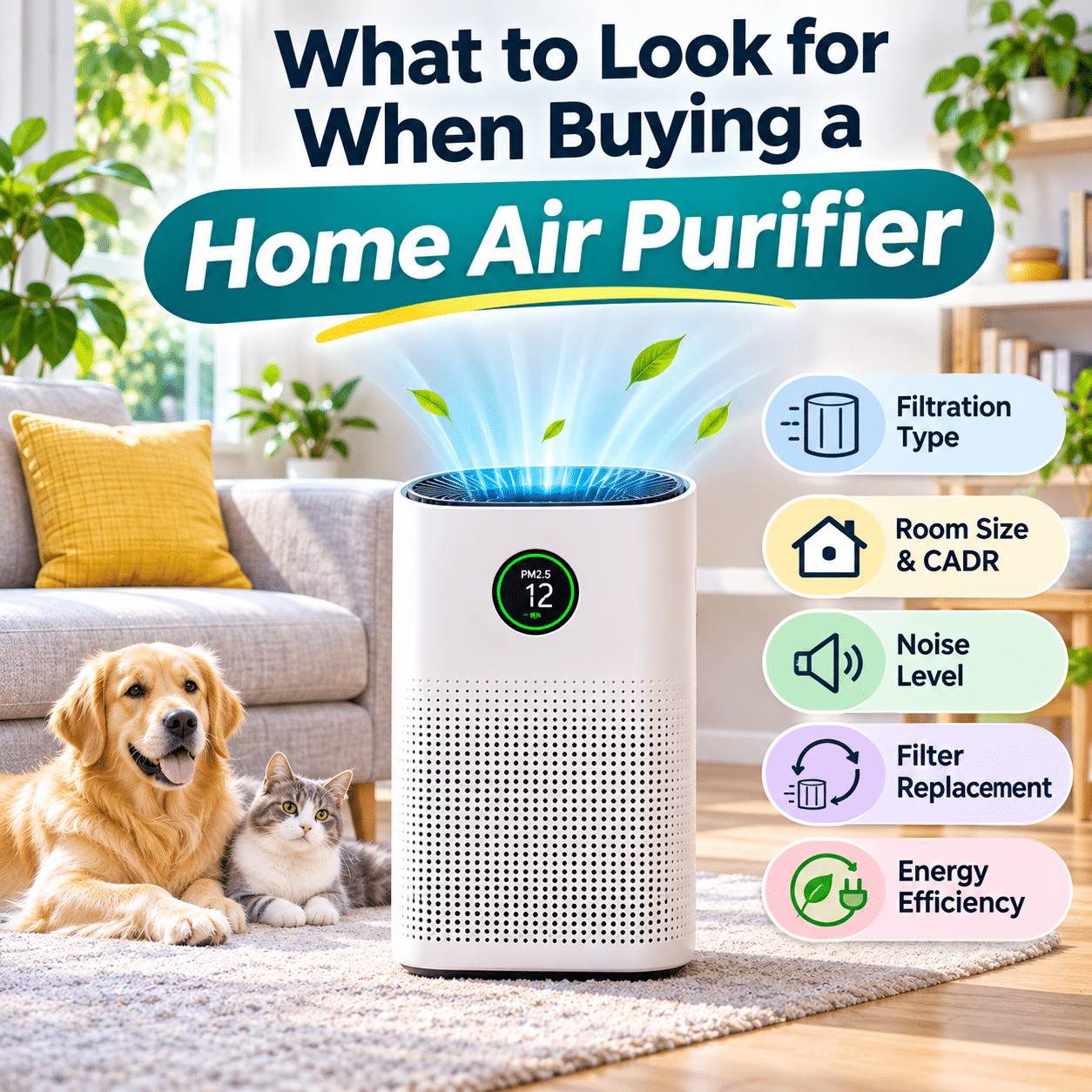
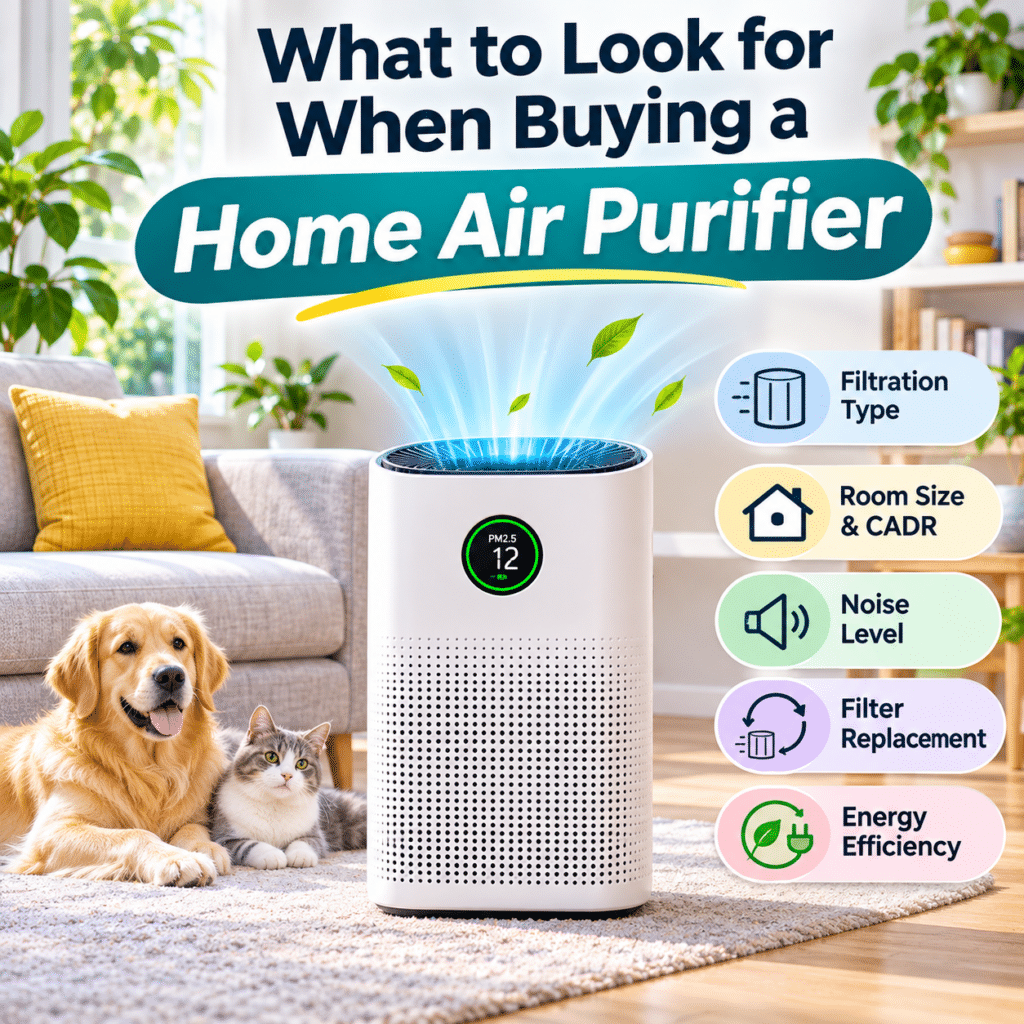
Indoor air quality is an important part of creating a comfortable and healthy living environment. Although homes provide shelter from outdoor conditions, indoor air can still contain airborne particles such as dust, pollen, pet dander, smoke, and other pollutants that enter from outside or originate from everyday household activities.
Cooking, cleaning, burning candles, using certain household products, and simply moving around a room can all influence indoor air quality. In spaces with limited ventilation, some pollutants may accumulate over time.
A home air purifier can help reduce certain airborne contaminants by drawing room air through a filtration system and returning filtered air to the surrounding space. However, not all air purifiers perform equally, and the most suitable model depends on the pollutants you want to address, room size, filtration technology, airflow capacity, noise levels, and ongoing maintenance requirements.
Choosing the right air purifier involves more than comparing product appearance or advertised features. Understanding how air purification works, what different filters can and cannot remove, and how performance is measured will help you make a more informed purchase.
This comprehensive guide explains what to look for when buying a home air purifier, how to compare filtration technologies, how to calculate appropriate cleaning capacity, and which practical features matter most for long-term everyday use.
1. Understand What a Home Air Purifier Actually Does
Before comparing products, it is important to understand the purpose and limitations of an air purifier.
A typical portable air purifier uses a fan to pull air into the device, passes that air through one or more filters, and releases the filtered air back into the room.
As the process continues, the purifier can reduce the concentration of certain airborne pollutants.
Common Airborne Pollutants
Depending on its filtration technology, an air purifier may help capture:
- Household dust and fine airborne particles.
- Pollen from trees, grasses, and other plants.
- Airborne pet dander.
- Some airborne mold spores.
- Smoke particles.
- Particulate pollution entering from outdoors.
- Certain particles produced during cooking.
- Other airborne allergens and particulate matter.
The effectiveness of removal depends on the filter, airflow, pollutant characteristics, and operating conditions.
What an Air Purifier Cannot Do
An air purifier is not a complete solution to every indoor air quality problem.
Most portable particle-filtering purifiers do not:
- Remove carbon dioxide generated by occupants.
- Supply fresh outdoor air.
- Correct inadequate ventilation.
- Eliminate moisture problems.
- Remove mold growing on damp surfaces.
- Remove all gases and odors.
- Prevent pollutants from being generated indoors.
- Guarantee protection from airborne infections.
Air purification works best as part of a broader indoor air quality strategy that includes source control, appropriate ventilation, cleaning, and moisture management.
2. Identify Your Main Air Quality Concerns
Different households have different reasons for purchasing an air purifier.
Identifying your primary concern helps you choose a filtration system suited to the problem.
Dust and General Household Particles
If your main concern is airborne dust, prioritize effective particle filtration and sufficient clean air delivery.
A well-sized purifier can reduce airborne particles, but settled dust still requires regular surface cleaning and vacuuming.
Pollen and Seasonal Allergens
Pollen particles can enter homes through doors, windows, clothing, and ventilation systems.
A purifier with effective particle filtration may reduce airborne pollen concentrations.
However, symptom improvement varies, and an air purifier should not replace appropriate medical care for allergies.
Pet Dander
Pets can contribute airborne allergens and particles to the indoor environment.
A suitable particle-filtering purifier may help reduce airborne pet-related particles.
It will not remove allergens already embedded in carpets, upholstery, bedding, or other surfaces.
Regular cleaning remains important.
Smoke and Fine Particles
Smoke contains fine particles and a complex mixture of gases.
A purifier with a sufficiently high particle clean air delivery rate can help reduce airborne smoke particles.
However, particle filtration alone does not address all harmful gases associated with smoke.
For smoke entering from outdoors, reducing infiltration and following relevant public health guidance are also important.
Cooking-Related Pollution
Cooking can release particles, odors, and gases.
An air purifier may help reduce some airborne cooking particles, but a properly functioning range hood that vents outdoors is generally a more direct method of controlling cooking emissions.
Air purification should complement rather than replace effective kitchen ventilation.
Household Odors
Odors often originate from gases or volatile compounds rather than particles.
For these concerns, activated carbon or another appropriate gas-phase filtration medium may be useful.
However, odor-removal performance varies significantly between products.
3. Understand the Main Types of Air Purification Technology
Air purifiers use different technologies, and some products combine multiple methods.
Understanding these differences is essential when evaluating performance claims.
Mechanical Particle Filtration
Mechanical filtration captures particles as air passes through a filter medium.
This is the primary technology used in many portable air purifiers.
Effective particle filters can capture a broad range of particle sizes, including fine airborne particles.
Activated Carbon Filtration
Activated carbon is commonly used to adsorb certain gases and odors.
Its effectiveness depends on factors such as:
- The amount of carbon.
- Carbon characteristics.
- Pollutant type.
- Contact time.
- Airflow.
- Filter saturation.
A thin carbon-coated sheet may provide limited gas-removal capacity compared with a substantial, appropriately designed carbon filter.
Electrostatic Precipitation
Electrostatic precipitators use electrical charging to collect particles.
Their performance varies by design, and some electrically operated air-cleaning technologies may generate ozone.
Consumers should evaluate verified performance and emissions information rather than assuming electrical particle collection is inherently superior.
Ionizers
Ionizers release charged particles or ions intended to influence airborne particle behavior.
Some systems may cause particles to settle onto nearby surfaces rather than capture them within the device.
Certain ionizing technologies can also generate ozone.
For many households, a well-performing mechanical filtration purifier is a simpler choice.
Ultraviolet Germicidal Technology
Some air-cleaning products incorporate ultraviolet technology intended to inactivate certain microorganisms.
Effectiveness depends on the wavelength, exposure dose, airflow, device design, and organism.
A UV feature does not automatically establish that a purifier provides effective whole-room air cleaning.
Some UV-related technologies may also have ozone or other byproduct concerns.
Evaluate independently verified performance and safety information.
Photocatalytic and Other Electronic Technologies
Some products use photocatalytic oxidation, plasma, or other electronic processes.
Performance and potential byproducts vary by technology and device design.
Consumers should be cautious about broad claims that these technologies remove all pollutants or completely sanitize indoor air.
4. Understand HEPA Filtration
HEPA filtration is one of the most widely recognized technologies for removing airborne particles.
HEPA stands for High-Efficiency Particulate Air.
A filter meeting a commonly referenced HEPA definition can capture at least 99.97% of particles measuring 0.3 micrometers under specified test conditions.
The 0.3-micrometer reference is associated with challenging particle sizes; it does not mean that particles smaller than this size necessarily pass through the filter.
How HEPA Filters Capture Particles
Mechanical filters use several physical mechanisms, including:
- Interception.
- Inertial impaction.
- Diffusion.
- Other particle-fiber interactions.
These mechanisms allow properly designed filters to capture particles across a range of sizes.
True HEPA Versus HEPA-Type
Terms such as “HEPA-type,” “HEPA-like,” and “HEPA-style” do not necessarily indicate compliance with a recognized HEPA performance standard.
When HEPA filtration is important, look for clear information about the applicable test standard and filter classification.
Filter Performance Versus Whole-Device Performance
A highly efficient filter does not automatically make an entire air purifier effective.
Overall performance also depends on:
- Airflow through the filter.
- Air leakage around the filter.
- Fan capacity.
- Filter installation.
- Device design.
- Operating speed.
A purifier with an excellent filter but insufficient airflow may clean a room more slowly than a properly sized alternative.
Is HEPA Always Necessary?
For many households focused on airborne particles, a well-designed HEPA-based purifier is a practical choice.
However, measured clean air delivery and overall device performance are often more useful for comparing room-cleaning capability than marketing terminology alone.
5. Understand Clean Air Delivery Rate (CADR)
Clean Air Delivery Rate, commonly abbreviated as CADR, is one of the most important measurements when comparing portable air purifiers.
CADR represents the rate at which a device delivers air cleaned of a specified pollutant under defined test conditions.
It combines particle-removal performance with airflow.
Why CADR Matters
A purifier must process enough air to make a meaningful difference in the room.
Even a highly efficient filter may provide limited room-level benefit if the device moves air too slowly.
A higher CADR generally indicates faster particle removal under comparable conditions.
Common CADR Categories
Some standardized testing programs report separate values for:
- Smoke.
- Dust.
- Pollen.
These pollutants have different particle characteristics.
For fine-particle concerns, smoke CADR is often a useful comparison measure.
CADR Units
CADR may be expressed in:
- Cubic feet per minute (CFM).
- Cubic meters per hour (m³/h).
The units must be considered when comparing products.
For reference:
1 CFM is approximately 1.699 m³/h.
Why Verified CADR Is Important
Some manufacturers advertise maximum fan airflow rather than measured clean air delivery.
These are not necessarily equivalent.
A fan’s airflow rating does not establish how much filtered air the complete device delivers.
Look for CADR values associated with a recognized testing method or independent verification program.
6. Choose an Air Purifier Based on Room Size
Room size is a major factor in selecting an appropriate purifier.
A device that works well in a small bedroom may not provide enough clean air for a large living room.
Measure the Floor Area
For a rectangular room:
Room Area = Length × Width
For example, a room measuring 4 meters by 5 meters has an area of:
4 × 5 = 20 m²
However, floor area alone does not describe the entire volume of air.
Account for Ceiling Height
A room with high ceilings contains more air than a room with the same floor area and lower ceilings.
Calculate room volume using:
Room Volume = Length × Width × Ceiling Height
For a room measuring:
- Length: 4 meters.
- Width: 5 meters.
- Ceiling height: 2.5 meters.
The volume is:
4 × 5 × 2.5 = 50 m³
This volume helps estimate the amount of clean air needed for a target equivalent air change rate.
7. Understand Air Changes per Hour (ACH)
Air Changes per Hour, or ACH, describes how many times an amount of air equal to the room’s volume is exchanged or processed in one hour.
For portable particle air cleaners, the more precise concept is often equivalent clean air changes per hour, because filtered air is recirculated rather than necessarily replaced with outdoor air.
Calculate Equivalent Clean Air Changes
For a purifier with CADR expressed in cubic meters per hour:
Equivalent Clean Air Changes per Hour = CADR ÷ Room Volume
For example:
- Room volume: 50 m³.
- Purifier CADR: 250 m³/h.
Equivalent clean air changes:
250 ÷ 50 = 5 per hour
This means the purifier delivers an amount of particle-cleaned air equivalent to five room volumes per hour under the assumed operating conditions.
It does not mean every particle in the room is removed five times per hour.
Actual particle concentrations depend on mixing, pollutant sources, infiltration, deposition, and other factors.
What ACH Should You Look For?
There is no single universal target for every household or pollutant.
For general particle reduction, approximately four to five equivalent clean air changes per hour is a useful comparison target for many residential applications.
Higher clean-air delivery may be desirable in some situations, particularly when fine-particle exposure is a significant concern.
However, this should not be interpreted as a guarantee of infection prevention or as a substitute for building ventilation requirements.
Example CADR Requirements
The following table illustrates approximate CADR values for four and five equivalent clean air changes per hour, assuming a 2.5-meter ceiling.
| Room Area | Room Volume | CADR for 4 eACH | CADR for 5 eACH |
|---|---|---|---|
| 10 m² | 25 m³ | 100 m³/h | 125 m³/h |
| 15 m² | 37.5 m³ | 150 m³/h | 188 m³/h |
| 20 m² | 50 m³ | 200 m³/h | 250 m³/h |
| 25 m² | 62.5 m³ | 250 m³/h | 313 m³/h |
| 30 m² | 75 m³ | 300 m³/h | 375 m³/h |
| 40 m² | 100 m³ | 400 m³/h | 500 m³/h |
| 50 m² | 125 m³ | 500 m³/h | 625 m³/h |
These values are illustrative calculations, not universal performance requirements.
They assume that the advertised CADR applies to the operating speed being considered.
Real-world performance may differ because of airflow patterns, room layout, pollutant generation, and operating conditions.
8. Be Careful With Advertised Room Coverage
Manufacturers sometimes advertise very large coverage areas.
However, coverage claims may be based on different assumptions about operating time, ceiling height, or air changes.
A purifier advertised for a large room may achieve only a relatively low equivalent air change rate in that space.
Questions to Ask
Before relying on a room coverage claim, determine:
- What ceiling height was assumed?
- What equivalent air change rate was used?
- Is the claim based on maximum fan speed?
- Is the CADR independently verified?
- Does the rating apply to particle removal?
- Can the device operate comfortably at the required speed?
For meaningful comparisons, calculate capacity from verified CADR whenever possible.
9. Evaluate Fan Speeds and Airflow Control
Most portable air purifiers offer multiple fan speeds.
These settings influence cleaning performance, noise, and energy consumption.
Low Fan Speed
Low speed generally provides quieter operation and lower power consumption.
However, it also typically delivers less clean air.
Medium Fan Speed
Medium speed may provide a practical balance between cleaning capacity and noise.
High Fan Speed
High speed generally provides the greatest clean air delivery.
It may be useful when rapid particle reduction is desired, but noise and power consumption are often higher.
Automatic Fan Control
Some purifiers adjust fan speed using built-in sensors.
Automatic operation can be convenient, but the device’s effectiveness depends on the pollutants the sensor detects and the control algorithm.
A purifier may remain at low speed even when pollutants not detected by its sensor are present.
Why Operating Speed Matters
CADR is commonly reported at a particular tested speed, often the highest setting.
If you intend to operate the purifier at a quieter speed, its actual clean air delivery may be lower.
Look for performance information at the speeds you expect to use.
10. Consider Noise Levels for Everyday Comfort
Noise is one of the most important practical considerations for a home air purifier.
A device that is too loud may be used less frequently, reducing its real-world benefit.
Understand Decibel Ratings
Air purifier noise is often reported in decibels, abbreviated dB.
However, comparisons are meaningful only when measurements use comparable methods and conditions.
Some manufacturers provide sound pressure levels, while others may report sound power or use different measurement distances.
Typical Noise Considerations
| Operating Environment | What to Prioritize |
|---|---|
| Bedroom | Quiet operation with sufficient cleaning capacity |
| Living room | Comfortable noise during conversation and entertainment |
| Home office | Low distraction during focused work |
| Nursery | Appropriate sound level, safety, and placement |
| Open-plan area | Adequate airflow without excessive noise |
| Utility space | Cleaning capacity may matter more than quietness |
Sleep Mode
Sleep mode often reduces fan speed and dims indicator lights.
This can improve nighttime comfort.
However, the quieter setting may also provide substantially less particle removal.
A useful bedroom purifier should deliver adequate clean air at a sound level you can tolerate.
Check Independent Noise Measurements
When available, independent reviews that measure noise at several fan speeds can provide more useful comparisons than a single minimum-noise claim.
11. Understand Activated Carbon Filters for Odors and Gases
Many air purifiers combine particle filtration with activated carbon.
However, not all carbon filters have meaningful capacity for gas removal.
What Activated Carbon Can Do
Activated carbon can adsorb certain gaseous pollutants and odor-causing compounds.
Its performance depends on the chemical involved and the design of the filter.
Why Carbon Quantity Matters
A thin carbon sheet may provide limited capacity compared with a substantial bed of activated carbon.
More carbon can be useful, but carbon mass alone does not guarantee performance.
Airflow, contact time, carbon treatment, and pollutant characteristics also matter.
Carbon Filters Become Saturated
As adsorption sites become occupied, the filter’s ability to capture additional pollutants can decline.
Replacement requirements depend on exposure conditions and the manufacturer’s guidance.
What Carbon Filters Cannot Guarantee
A carbon filter does not necessarily remove:
- Every volatile organic compound.
- Carbon monoxide.
- Carbon dioxide.
- All cooking gases.
- All smoke-related gases.
If a specific gaseous pollutant is your main concern, look for credible testing that directly addresses that pollutant.
For carbon monoxide, use appropriate certified alarms and address the source of the hazard. An ordinary home air purifier is not a substitute.
12. Compare Air Purifier Filtration Technologies
| Technology | Primary Purpose | Advantages | Limitations |
|---|---|---|---|
| Mechanical HEPA filtration | Airborne particles | Effective particle capture when properly designed | Requires filter replacement |
| Activated carbon | Certain gases and odors | Can complement particle filtration | Capacity varies; saturation occurs |
| Washable pre-filter | Larger particles and debris | May extend main filter service life | Does not replace fine-particle filtration |
| Electrostatic precipitation | Airborne particles | Can collect particles electrically | Performance varies; possible ozone concerns |
| Ionization | Particle charging | May influence particle behavior | Some systems generate ozone; particles may settle |
| UV-based systems | Certain microorganisms under suitable conditions | Can provide targeted inactivation in appropriately designed systems | Effectiveness depends on dose and design |
| Photocatalytic systems | Selected pollutants under specific conditions | Potential targeted applications | Variable effectiveness and possible byproducts |
For households primarily concerned with airborne particulate pollution, a mechanical filtration purifier with verified CADR is generally a straightforward starting point.
13. Look for an Effective Pre-Filter
Many air purifiers include a pre-filter positioned before the main filtration stage.
Purpose of a Pre-Filter
A pre-filter captures larger particles and debris, such as:
- Hair.
- Lint.
- Larger dust particles.
- Some visible household debris.
This can reduce the amount of larger material reaching the main filter.
Washable Pre-Filters
Some pre-filters are designed to be washed.
Follow the manufacturer’s instructions and allow washable components to dry completely before reinstalling them.
Vacuum-Cleanable Pre-Filters
Other pre-filters may be cleaned using a vacuum or soft brush.
Do not wash components unless the manufacturer specifically permits it.
Why Pre-Filter Maintenance Matters
A heavily clogged pre-filter can restrict airflow.
Reduced airflow may decrease clean air delivery even when the main filter remains functional.
14. Check Filter Replacement Requirements
Air purifiers require ongoing maintenance to remain effective.
Filter replacement is one of the most important long-term ownership considerations.
Understand Replacement Intervals
Manufacturers may recommend replacement based on:
- Operating hours.
- Calendar time.
- Air pollution levels.
- Filter condition.
- Sensor or usage estimates.
Actual service life varies with household conditions.
Check Filter Availability
Before purchasing a purifier, verify that replacement filters are available through reliable suppliers.
A purifier can become difficult to maintain if compatible filters are discontinued or difficult to obtain.
Compare Replacement Costs
Consider the expected annual cost of filters rather than looking only at the purifier’s initial price.
Avoid Unsupported Filter Cleaning
HEPA filters are not automatically washable.
Washing a filter that is not designed for cleaning may damage the filter medium or compromise performance.
Follow the manufacturer’s maintenance instructions.
Evaluate Filter Indicators
Some devices use timers to estimate filter life.
Others may incorporate operating conditions or sensor information.
A filter replacement indicator should be treated as a maintenance aid rather than a direct measurement of every aspect of filter performance.
15. Understand the Total Cost of Ownership
A home air purifier is an ongoing household appliance expense.
The total cost includes more than the initial purchase.
Main Cost Categories
- Purchase price.
- Replacement particle filters.
- Replacement carbon filters.
- Electricity consumption.
- Optional accessories.
- Repairs or replacement components.
Example of Long-Term Cost Comparison
Consider two hypothetical purifiers.
| Cost Factor | Purifier A | Purifier B |
|---|---|---|
| Initial price | Lower | Higher |
| Replacement filters | More expensive | Less expensive |
| Filter availability | Limited | Widely available |
| Electricity use | Higher | Lower |
| Expected maintenance | More frequent | Less frequent |
Although Purifier A costs less initially, Purifier B could be more economical over several years.
The actual comparison requires verified prices, replacement schedules, and electricity consumption.
Calculate Estimated Electricity Use
Use the formula:
Energy Consumption (kWh) = Power (W) × Operating Hours ÷ 1,000
For example, a purifier consuming 40 watts and operating 12 hours per day uses:
40 × 12 ÷ 1,000 = 0.48 kWh per day
Over 30 days:
0.48 × 30 = 14.4 kWh
Multiply this figure by the applicable electricity rate to estimate energy cost.
Actual consumption varies by fan speed and operating mode.
16. Look for Energy Efficiency
Air purifiers may operate for many hours each day.
Energy efficiency can therefore influence long-term running costs.
Compare Power Consumption
Check the manufacturer’s rated power consumption and, when available, measured consumption at different speeds.
Consider Clean Air Delivery per Unit of Energy
A useful efficiency measure compares clean air delivery with electrical power consumption.
For example:
Clean Air Delivery Efficiency = CADR ÷ Power Consumption
If CADR is expressed in m³/h and power in watts, the resulting unit is m³/h per watt.
Compare devices only when the measurements use consistent conditions and units.
Look for Recognized Energy Certifications
Where applicable, recognized energy-efficiency programs can help identify products meeting specified performance criteria.
For example, ENERGY STAR certification may provide useful efficiency information for qualifying air cleaners.
Check the current certification listing rather than relying solely on packaging claims.
Avoid Choosing Solely by Wattage
A low-power purifier is not necessarily efficient if it delivers very little clean air.
Evaluate energy consumption alongside verified cleaning performance.
17. Evaluate Air Quality Sensors
Many modern air purifiers include built-in sensors that estimate indoor air conditions.
These features can be convenient, but their limitations should be understood.
Particle Sensors
Some devices estimate airborne particulate concentrations using optical sensing technology.
They may display values associated with PM2.5 or other particle measurements.
Sensor accuracy varies by design, calibration, humidity, particle characteristics, and operating conditions.
Gas Sensors
Some products include sensors intended to respond to certain gases or volatile compounds.
These sensors may not identify individual pollutants or provide laboratory-grade measurements.
Color-Coded Indicators
A purifier may display air quality using colored lights or simplified numerical scales.
These indicators can be useful for observing relative changes, but they should not automatically be interpreted as precise health-based measurements.
Automatic Mode Limitations
A sensor-driven purifier responds to what its sensors detect.
It may not increase fan speed for pollutants outside the sensor’s measurement capability.
For consistent particle removal, a manually selected continuous fan speed may sometimes be more predictable.
18. Consider Smart Features and Connectivity
Smart air purifiers may offer additional convenience through mobile applications and connected home systems.
Common features include:
- Remote fan-speed control.
- Operating schedules.
- Filter replacement notifications.
- Air quality history.
- Voice assistant compatibility.
- Automatic operating modes.
- Energy monitoring.
- Device status notifications.
Are Smart Features Necessary?
Not necessarily.
A purifier with strong filtration performance, appropriate CADR, and reliable controls may perform its main function well without internet connectivity.
Check Connectivity Requirements
Some connected purifiers require specific Wi-Fi bands, mobile applications, or cloud services.
Verify compatibility before purchasing.
Consider Privacy and Longevity
Connected appliances may collect usage information or depend on software services.
Review privacy policies, update support, and whether essential functions remain available without internet access.
Prioritize Cleaning Performance
Smart features should complement, not replace, effective air purification.
19. Consider Airflow Design and Room Placement
The location of an air purifier affects how effectively filtered air circulates.
Check Air Intake and Outlet Locations
Some devices draw air from the sides, rear, or bottom.
Others release filtered air upward or forward.
These design differences influence placement requirements.
Avoid Blocking Airflow
Do not place the purifier directly against furniture or curtains if doing so obstructs air intake or discharge.
Follow the manufacturer’s recommended clearances.
Consider Room Layout
Large furniture, partitions, and irregular room shapes can affect air circulation.
A purifier located in an enclosed corner may distribute clean air differently from one positioned in a more open location.
Avoid Unnecessary Obstructions
Keep the purifier away from areas where clothing, blankets, or household objects may cover its openings.
Consider Electrical Access
Choose a location with suitable access to a power outlet.
Avoid unsafe cord arrangements or placing cords across walkways.
20. Understand Portable Versus Whole-Home Air Purification
Air purification can be provided by portable devices or integrated into building heating, ventilation, and air-conditioning systems.
Portable Air Purifiers
Portable purifiers are designed to clean air in individual rooms or zones.
Advantages include:
- Flexible placement.
- Independent operation.
- No major building modifications.
- Room-specific filtration.
Limitations include:
- Limited coverage beyond the intended room.
- Separate maintenance for multiple devices.
- Potential noise in occupied spaces.
Whole-Home Filtration
Central HVAC systems may incorporate filters that remove particles as air circulates through the system.
Their effectiveness depends on filter performance, system airflow, operating time, and installation.
MERV Ratings
HVAC filters may use Minimum Efficiency Reporting Value, or MERV, ratings.
Higher MERV ratings generally indicate better capture of certain particle sizes under the relevant test method.
However, the HVAC system must be compatible with the filter’s airflow resistance.
Can Portable Purifiers Replace HVAC Filtration?
Portable purifiers and HVAC filtration serve overlapping but different roles.
A portable purifier can provide additional cleaning in a specific room.
An HVAC system may distribute filtered air across multiple spaces when operating appropriately.
Neither automatically replaces the need for ventilation.
21. Consider Whether You Need One or Multiple Purifiers
A single large purifier is not always the best choice for an entire home.
Separate Rooms
Closed doors and walls limit air mixing between rooms.
A purifier operating in the living room may have limited effect on airborne particles in a closed bedroom.
Open-Plan Spaces
A large open-plan room may benefit from a sufficiently sized purifier or multiple units positioned to improve distribution.
Multiple Smaller Devices
Multiple purifiers can provide flexibility and room-specific control.
However, they also introduce additional filter replacement and maintenance requirements.
Compare Combined CADR Carefully
In a well-mixed shared space, the clean air delivery from multiple devices can contribute to overall particle removal.
However, simply adding their CADR values does not guarantee uniform cleaning throughout a complex floor plan.
Room boundaries, placement, and airflow still matter.
22. Evaluate Air Purifiers for Bedrooms
Bedrooms are a common location for air purifiers because people spend extended periods sleeping.
Prioritize Quiet Cleaning Performance
Look for sufficient clean air delivery at a fan speed that is comfortable during sleep.
Check Indicator Lights
Bright displays may disturb some sleepers.
A dimming or display-off feature can be useful.
Consider Physical Size
A bedroom purifier should fit without blocking movement or creating tripping hazards.
Review Nighttime Operation
Some sleep modes reduce airflow substantially.
Check whether the purifier remains effective at the speed you intend to use overnight.
Avoid Unnecessary Ozone-Producing Features
For occupied bedrooms, choosing a purifier that does not intentionally generate ozone is a prudent approach.
23. Evaluate Air Purifiers for Living Rooms
Living rooms often contain multiple people, upholstered furniture, and larger open areas.
Consider Room Volume
Measure the full space, especially when the living room connects directly to a dining area or kitchen.
Evaluate Noise During Conversation
A powerful purifier may be effective at high speed but intrusive during television viewing or conversation.
Consider Placement Flexibility
Choose a device that can operate without obstructing furniture or pathways.
Look for Practical Controls
Simple speed adjustment and accessible filter maintenance can be more valuable than unnecessary decorative features.
24. Evaluate Air Purifiers for Homes With Pets
Homes with pets may experience additional airborne dander, hair, and dust.
Focus on Particle Filtration
Effective mechanical filtration can help reduce airborne pet-related particles.
Consider Pre-Filter Maintenance
Pet hair may accumulate on intake screens and pre-filters.
Choose a design that makes routine cleaning straightforward.
Evaluate Noise Sensitivity
Some animals may react to unfamiliar appliance noise.
Introduce the purifier thoughtfully and place it where pets cannot knock it over or interfere with the airflow.
Maintain Surface Cleaning
Air purification does not remove all pet allergens from bedding, upholstery, carpets, or floors.
Regular cleaning remains necessary.
25. Evaluate Air Purifiers for Smoke and Outdoor Pollution
Fine particulate pollution can enter homes from outdoor sources, including traffic, industrial emissions, and wildfire smoke.
Prioritize Fine-Particle Removal
A purifier with verified smoke CADR and suitable particle filtration is a useful starting point.
Consider Sufficient Capacity
Choose a device capable of delivering meaningful particle removal in the intended room.
Reduce Pollutant Entry When Appropriate
During outdoor smoke events, follow local public health recommendations regarding windows, ventilation, and indoor activities.
Understand the Limits of Particle Filtration
Smoke contains both particles and gases.
A particle-filtering purifier does not remove all hazardous smoke components.
Avoid Indoor Pollution Sources
During periods of poor outdoor air quality, reducing unnecessary indoor particle generation may help maintain cleaner indoor air.
26. Evaluate Air Purifiers for Odor Concerns
Odor control requires different considerations from particle removal.
Identify the Odor Source
Common sources include:
- Cooking.
- Pets.
- Household waste.
- Cleaning products.
- Damp materials.
- Furnishings and finishes.
Address the Source First
Removing the source, improving appropriate ventilation, and cleaning contaminated materials are generally more effective than attempting to mask persistent odors.
Look for Appropriate Gas Filtration
If an air purifier is intended for odor reduction, examine the carbon filter design and any relevant independent gas-removal testing.
Avoid Fragrance-Based Solutions
Products that add fragrance may mask odors without removing the underlying pollutants.
Some fragrance products can also contribute additional indoor chemical emissions.
Investigate Persistent Musty Odors
A persistent musty smell may indicate moisture or mold problems.
An air purifier cannot correct the underlying water or moisture source.
27. Understand Ozone and Air Purifier Safety
Ozone is a reactive gas that can irritate the respiratory system.
It should not be confused with beneficial oxygen.
Avoid Intentional Ozone Generation
Ozone generators marketed for occupied indoor spaces are not a suitable general-purpose air-cleaning solution.
At concentrations considered safe for occupants, ozone is not an effective solution for removing many indoor pollutants.
Higher concentrations can pose health risks.
Check Electronic Air Cleaning Technologies
Some ionizers, electrostatic devices, and other electronic systems may produce ozone.
Look for credible emissions testing and applicable certifications.
Understand Certification Claims
A low-ozone-emission certification addresses a specific safety characteristic.
It does not necessarily establish that a device effectively removes particles, gases, or microorganisms.
Prefer Transparent Product Information
Manufacturers should clearly identify the technologies used and provide meaningful performance and safety information.
28. Understand Air Purifier Certifications and Testing
Independent testing can help distinguish measurable performance from marketing claims.
AHAM Verifide
The Association of Home Appliance Manufacturers operates the AHAM Verifide program for qualifying air cleaners.
Verified listings can provide standardized CADR information.
Check current program listings for the specific model.
ENERGY STAR
ENERGY STAR certification can provide information about energy efficiency for qualifying room air cleaners.
It should not be interpreted as proof that a purifier removes every type of indoor pollutant.
CARB Certification
The California Air Resources Board maintains requirements and certification information related to ozone emissions from indoor air-cleaning devices sold in California.
Certification addresses applicable emissions requirements rather than guaranteeing broad pollutant-removal effectiveness.
Electrical Safety Certification
Depending on the market, relevant electrical safety testing and certification can provide additional assurance.
Look for certifications appropriate to the product and region.
Avoid Misleading Labels
Terms such as “medical grade,” “hospital quality,” or “advanced purification” may be used in marketing without clearly identifying a recognized whole-device performance standard.
Ask what was tested, how it was tested, and whether the claim applies to the complete product.
29. Compare Air Purifiers Using Measurable Performance
When evaluating multiple models, focus on meaningful specifications.
| Feature | Why It Matters | What to Check |
|---|---|---|
| Particle CADR | Indicates particle-cleaning capacity | Verified value and units |
| Room suitability | Helps match purifier to space | Room volume and target eACH |
| Filter type | Determines pollutant-removal approach | Recognized filter specifications |
| Gas filtration | Relevant for selected odors and gases | Carbon design and gas-specific testing |
| Noise | Affects everyday usability | Noise at practical fan speeds |
| Power consumption | Influences running costs | Watts at intended operating speed |
| Replacement filters | Determines maintenance feasibility | Availability, cost, replacement guidance |
| Safety | Reduces avoidable risks | Electrical safety and ozone emissions |
| Physical dimensions | Affects placement | Size and airflow clearances |
| Controls | Influences convenience | Manual speeds, schedules, display settings |
| Warranty | Supports long-term ownership | Coverage and service terms |
The strongest choice is not necessarily the model with the most features.
It is the one that provides appropriate cleaning performance with acceptable noise, maintenance, energy use, and cost.
30. Common Mistakes to Avoid When Buying a Home Air Purifier
Mistake 1: Choosing Based Only on Advertised Room Coverage
Coverage claims may use different assumptions.
Better approach: Compare verified CADR with the room’s volume and desired equivalent air change rate.
Mistake 2: Assuming All HEPA Claims Are Equivalent
Marketing terminology does not always identify a recognized filter standard.
Better approach: Look for clear filtration specifications and measured whole-device performance.
Mistake 3: Ignoring Noise at Useful Fan Speeds
A purifier may be quiet only at a setting that provides limited cleaning.
Better approach: Compare noise and cleaning capacity at the speeds you expect to use.
Mistake 4: Expecting Particle Filters to Remove All Odors
HEPA filtration primarily addresses particles.
Better approach: Evaluate appropriate gas-phase filtration when odors or gases are a significant concern.
Mistake 5: Overlooking Replacement Filter Costs
A low purchase price may be offset by expensive maintenance.
Better approach: Estimate several years of filter expenses.
Mistake 6: Assuming Smart Sensors Detect Every Pollutant
A sensor may measure only selected particle or gas characteristics.
Better approach: Understand what the sensor measures and how automatic mode responds.
Mistake 7: Blocking Air Intake or Exhaust
Poor placement can reduce airflow and cleaning effectiveness.
Better approach: Follow the manufacturer’s clearance instructions.
Mistake 8: Buying an Ozone Generator for Everyday Use
Ozone can create respiratory risks and is not an appropriate general indoor air cleaning method.
Better approach: Choose effective filtration technologies without intentional ozone generation.
Mistake 9: Expecting Air Purification to Replace Ventilation
Recirculating air cleaners do not necessarily introduce outdoor air or remove carbon dioxide.
Better approach: Combine appropriate filtration with source control and ventilation.
Mistake 10: Ignoring Filter Availability
A purifier may become difficult to maintain when compatible filters are unavailable.
Better approach: Verify replacement filter supply before purchasing.
Mistake 11: Using One Small Purifier for an Entire Home
Closed rooms and limited air mixing reduce whole-home effectiveness.
Better approach: Evaluate each occupied room or air-cleaning zone separately.
Mistake 12: Assuming More Technology Means Better Performance
Additional electronic features do not automatically improve cleaning.
Better approach: Prioritize verified pollutant removal, safety, and usability.
31. How to Choose a Home Air Purifier: Step by Step
A systematic purchasing process makes it easier to compare products objectively.
Step 1: Identify Your Main Pollutant Concern
Determine whether you primarily want to reduce dust, pollen, pet dander, smoke particles, odors, or another specific pollutant.
Step 2: Measure the Room
Record the room’s length, width, and ceiling height.
Calculate the approximate room volume.
Step 3: Determine a Suitable Cleaning Capacity
Use verified CADR to estimate equivalent clean air changes per hour.
Choose a capacity appropriate for your intended use.
Step 4: Select the Filtration Technology
For airborne particles, prioritize effective mechanical filtration.
For certain odors or gases, evaluate appropriate additional filtration and pollutant-specific evidence.
Step 5: Compare Verified Performance
Look for standardized testing, credible certification listings, and transparent specifications.
Step 6: Evaluate Noise
Determine whether the purifier can provide adequate cleaning at a comfortable sound level.
Step 7: Check Filter Maintenance
Review replacement intervals, filter costs, cleaning instructions, and long-term availability.
Step 8: Compare Energy Consumption
Estimate electricity use at the speeds you expect to operate.
Step 9: Review Safety
Check electrical safety information and avoid unnecessary ozone-producing technologies.
Step 10: Evaluate Placement Requirements
Confirm that the device fits the intended location with adequate airflow clearance.
Step 11: Consider Convenience Features
Decide whether automatic mode, scheduling, smart connectivity, or display controls are useful for your household.
Step 12: Compare Total Ownership Costs
Include purchase price, replacement filters, energy consumption, and expected maintenance.
Step 13: Choose the Most Practical Model
Select the purifier that best balances effective cleaning, comfort, reliability, and long-term value.
32. Practical Home Air Purifier Buying Checklist
Use this checklist before making a purchase.
Air Cleaning Performance
- I have identified the main pollutants I want to reduce.
- The purifier uses suitable filtration technology.
- I have checked its CADR and measurement units.
- The cleaning capacity is appropriate for my room volume.
- I understand the limitations of the filtration system.
Filter Quality and Maintenance
- The filter specifications are clearly explained.
- Replacement filters are readily available.
- Replacement costs are reasonable.
- Maintenance instructions are practical.
- I understand which filters can and cannot be washed.
Everyday Comfort
- The purifier fits the intended location.
- Noise levels are acceptable at useful fan speeds.
- Air intake and exhaust will not be obstructed.
- Controls are convenient to use.
- Display lights can be adjusted if necessary.
Energy and Long-Term Value
- I have reviewed power consumption.
- I have considered expected operating hours.
- I have estimated ongoing electricity costs.
- I have compared total ownership costs.
- Warranty and service information are available.
Safety and Reliability
- I have reviewed applicable safety certifications.
- I have checked ozone-related information.
- Performance claims are supported by credible evidence.
- The manufacturer provides clear operating instructions.
- I understand that air purification does not replace ventilation or source control.
33. Frequently Asked Questions
What Is the Most Important Feature to Look for in an Air Purifier?
For airborne particle removal, verified Clean Air Delivery Rate is one of the most useful specifications because it reflects the amount of particle-cleaned air the device delivers.
Filtration technology, room size, noise, maintenance, and safety also matter.
Is a HEPA Air Purifier Worth Buying?
A well-designed HEPA-based purifier can be a practical option for reducing airborne particles.
Its value depends on appropriate room sizing, sufficient airflow, operating conditions, and maintenance.
What Is the Difference Between HEPA and Activated Carbon?
HEPA filtration primarily captures airborne particles.
Activated carbon is used to adsorb certain gases and odor-causing compounds.
The two technologies address different pollutant categories and may complement each other.
Can an Air Purifier Remove Dust From a Room?
An effective particle-filtering purifier can reduce airborne dust.
It does not remove all dust already settled on furniture, floors, and other surfaces.
Regular cleaning remains necessary.
Can an Air Purifier Help With Pollen?
A properly sized particle-filtering purifier can reduce airborne pollen concentrations.
However, individual allergy symptom responses vary.
Can an Air Purifier Remove Pet Dander?
Air purifiers with effective particle filtration may reduce airborne pet dander.
They cannot eliminate allergens already deposited on carpets, upholstery, and bedding.
Can an Air Purifier Remove Smoke?
A suitable purifier can reduce smoke particles.
However, smoke also contains gases that ordinary particle filters do not necessarily remove.
Can an Air Purifier Remove Cooking Smells?
Some purifiers with appropriate activated carbon filtration may reduce certain cooking odors.
Effective kitchen ventilation and controlling the source remain important.
Can an Air Purifier Remove Mold?
An effective particle filter can capture some airborne mold spores.
It cannot remove mold growing on surfaces or solve moisture problems that allow mold to develop.
Can an Air Purifier Remove Carbon Dioxide?
Ordinary portable HEPA air purifiers do not remove meaningful amounts of carbon dioxide.
Appropriate ventilation is needed to manage indoor carbon dioxide generated by occupants.
Does an Air Purifier Bring in Fresh Air?
Most portable room air purifiers recirculate indoor air.
They do not introduce fresh outdoor air unless specifically designed with a ventilation function.
How Do I Know What Size Air Purifier I Need?
Measure the room volume and compare it with the purifier’s verified CADR.
Calculate the approximate equivalent clean air changes per hour to evaluate suitability.
Is a Higher CADR Always Better?
A higher CADR generally indicates faster particle removal under comparable conditions.
However, noise, energy use, filter costs, and practical operating speed should also be considered.
How Many Air Changes per Hour Should an Air Purifier Provide?
The appropriate target depends on the application.
Approximately four to five equivalent clean air changes per hour can be a useful residential particle-cleaning comparison, but it is not a universal requirement or a guarantee of specific health outcomes.
Can One Air Purifier Clean an Entire House?
A single portable purifier is usually most effective within its intended room or connected air space.
Closed doors and limited air mixing can reduce its effectiveness in separate rooms.
Where Should I Place an Air Purifier?
Choose a location with unobstructed air intake and exhaust, suitable electrical access, and adequate clearance.
Follow the manufacturer’s placement instructions.
Should an Air Purifier Run All Day?
Continuous operation can provide more consistent particle removal when pollutants are continually entering or being generated.
The appropriate operating schedule depends on indoor conditions, noise tolerance, energy use, and manufacturer guidance.
Is It Better to Run an Air Purifier on High or Low Speed?
Higher speeds generally provide more clean air but also produce more noise and may consume more electricity.
Choose the highest practical speed that balances cleaning performance with comfort.
Does Sleep Mode Reduce Air Purifier Effectiveness?
Sleep mode commonly lowers fan speed, which may reduce clean air delivery.
Check performance at the selected nighttime setting.
How Often Should I Replace an Air Purifier Filter?
Replacement frequency depends on the filter design, operating hours, pollutant levels, and manufacturer instructions.
There is no universal interval suitable for every purifier.
Can I Wash a HEPA Filter?
Only wash a filter if the manufacturer specifically identifies it as washable.
Many HEPA filters are not designed for washing, and improper cleaning may damage them.
Do Air Purifiers Use a Lot of Electricity?
Consumption varies by model and fan speed.
Many portable purifiers have relatively modest power requirements, but continuous operation can still contribute to electricity costs.
Compare measured power consumption and expected operating hours.
Are Air Purifiers With Ionizers Better?
Not necessarily.
Ionization does not automatically provide better particle removal, and some systems may generate ozone.
Verified cleaning performance and emissions information are more useful than the presence of an ionizer alone.
Are Ozone Air Purifiers Safe?
Devices that intentionally generate ozone are not recommended for routine air cleaning in occupied spaces.
Ozone can irritate the respiratory system and create additional indoor air quality concerns.
Are Smart Air Purifiers More Effective?
Smart connectivity does not inherently improve filtration.
Cleaning performance depends primarily on the device’s air-cleaning technology, airflow, and operating conditions.
Can an Air Purifier Help During Wildfire Smoke Events?
A properly sized purifier with effective particle filtration can help reduce indoor smoke particles.
It should be used alongside appropriate measures to reduce smoke entry and follow relevant public health guidance.
Do Air Purifiers Eliminate Airborne Viruses?
Some air purifiers can remove particles that carry respiratory viruses from the air passing through the device.
However, no ordinary portable purifier guarantees elimination of infection risk.
Air cleaning should be considered one part of a broader approach to reducing airborne exposure.
How Can I Tell Whether an Air Purifier Is Working?
Verified CADR provides a useful indication of expected particle-cleaning capability.
Independent particle measurements may help evaluate changes in airborne particle concentrations, although consumer sensors have limitations.
A quieter room or a change in odor is not necessarily proof of effective fine-particle removal.
What Should I Do if My Air Purifier Starts Smelling Unusual?
Check the manufacturer’s troubleshooting guidance.
Inspect permitted components for accumulated debris, moisture, or overdue replacement.
If the device produces a burning smell, unusual heat, smoke, or signs of electrical malfunction, turn it off, disconnect it safely, and seek appropriate service.
Is an Expensive Air Purifier Always Better?
No.
A higher price may reflect additional features, design, branding, or materials rather than superior cleaning performance.
Compare verified CADR, filtration, noise, maintenance costs, and safety before deciding.
What Is the Best Air Purifier for Everyday Home Use?
The best choice is a purifier that addresses your primary pollutant concerns, provides sufficient verified clean air delivery for the intended room, operates at an acceptable noise level, and can be maintained affordably.
For many households focused on airborne particles, a properly sized mechanical filtration purifier is a practical starting point.
Final Thoughts
Choosing a home air purifier is ultimately about matching effective air-cleaning performance to your household’s actual needs.
Rather than focusing on dramatic marketing claims, decorative features, or advertised room coverage alone, prioritize measurable specifications such as Clean Air Delivery Rate, appropriate filtration technology, room volume, and realistic operating conditions.
For households primarily concerned with airborne particles, a well-designed mechanical filtration purifier with verified performance can provide a useful addition to indoor air quality management. When odors or gaseous pollutants are the main concern, additional filtration may be necessary, and the source of the pollution should always be considered.
Noise, replacement filter availability, electricity consumption, and ease of maintenance are equally important for long-term satisfaction. A purifier that is comfortable and affordable to operate consistently may be more useful than a powerful device that is rarely switched on.
Most importantly, remember that air purification is only one part of maintaining better indoor air. Reducing pollution at its source, maintaining appropriate ventilation, controlling moisture, and cleaning regularly remain essential.
The right home air purifier is not the one with the longest feature list. It is the one that delivers reliable, appropriately sized air cleaning, operates safely and comfortably, and remains practical to maintain for years to come.