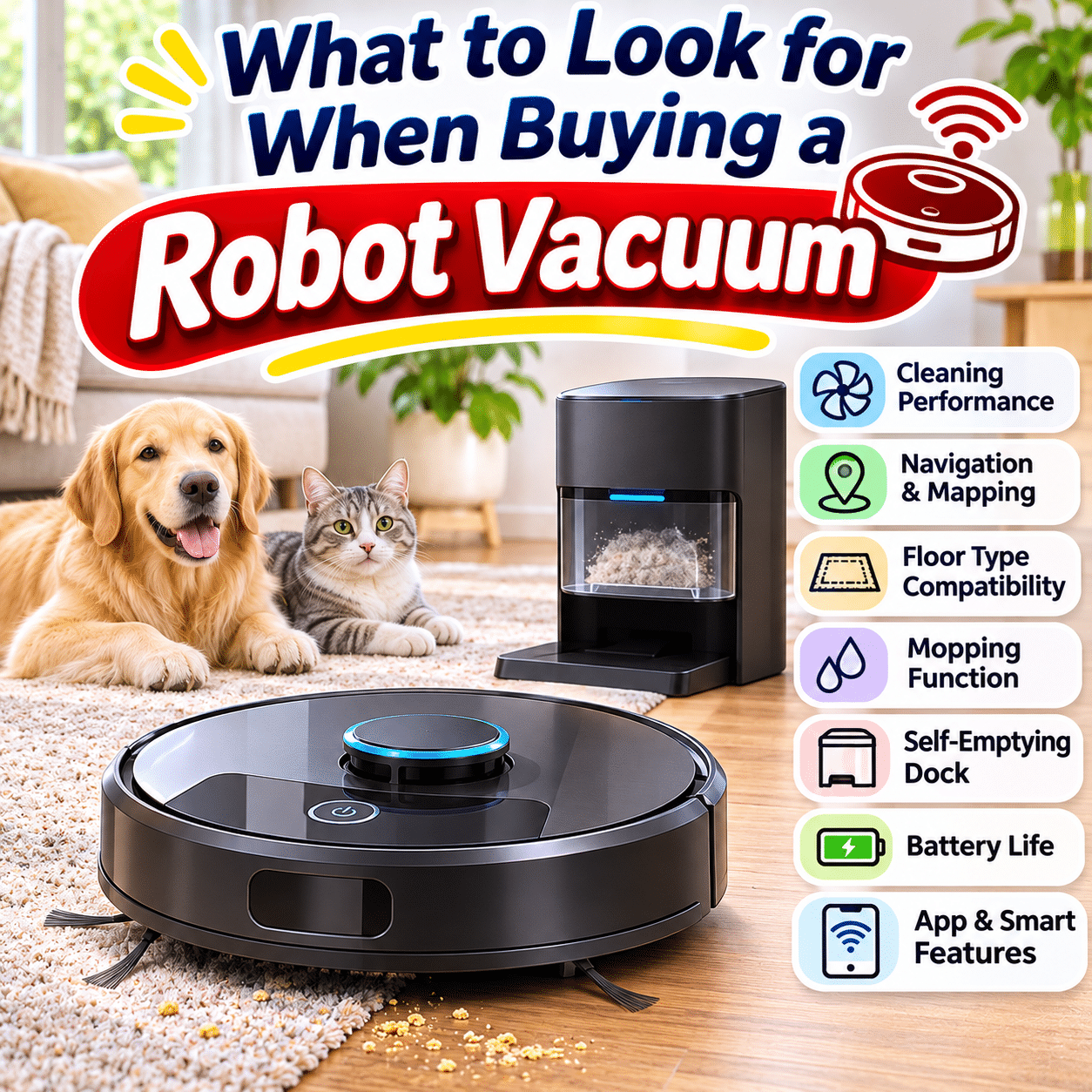
A robot vacuum can make everyday floor cleaning more convenient by automatically collecting dust, crumbs, pet hair, and other loose debris from compatible surfaces. Instead of manually vacuuming every room each day, homeowners can schedule routine cleaning sessions and allow a compact robotic device to handle selected maintenance tasks.
However, choosing the right robot vacuum is not as simple as selecting the model with the highest suction rating or the longest list of smart features.
Different homes have different cleaning requirements. A small apartment with hard floors may benefit from a straightforward robot vacuum with reliable navigation, while a larger home with carpets, pets, and multiple rooms may require stronger cleaning performance, advanced mapping, and a more capable docking station.
Modern robot vacuums also vary in their ability to avoid obstacles, cross thresholds, clean along walls, recognize carpets, and mop hard floors. Some models require frequent manual maintenance, while others can automatically empty collected debris, wash mop pads, or refill water tanks.
The best robot vacuum is not necessarily the most expensive or technologically advanced. It is the one that matches your flooring, home layout, cleaning habits, and maintenance expectations.
This comprehensive buying guide explains the most important robot vacuum features, compares navigation and cleaning technologies, explores practical limitations, and provides a step-by-step framework for choosing a dependable robot vacuum for everyday household cleaning.
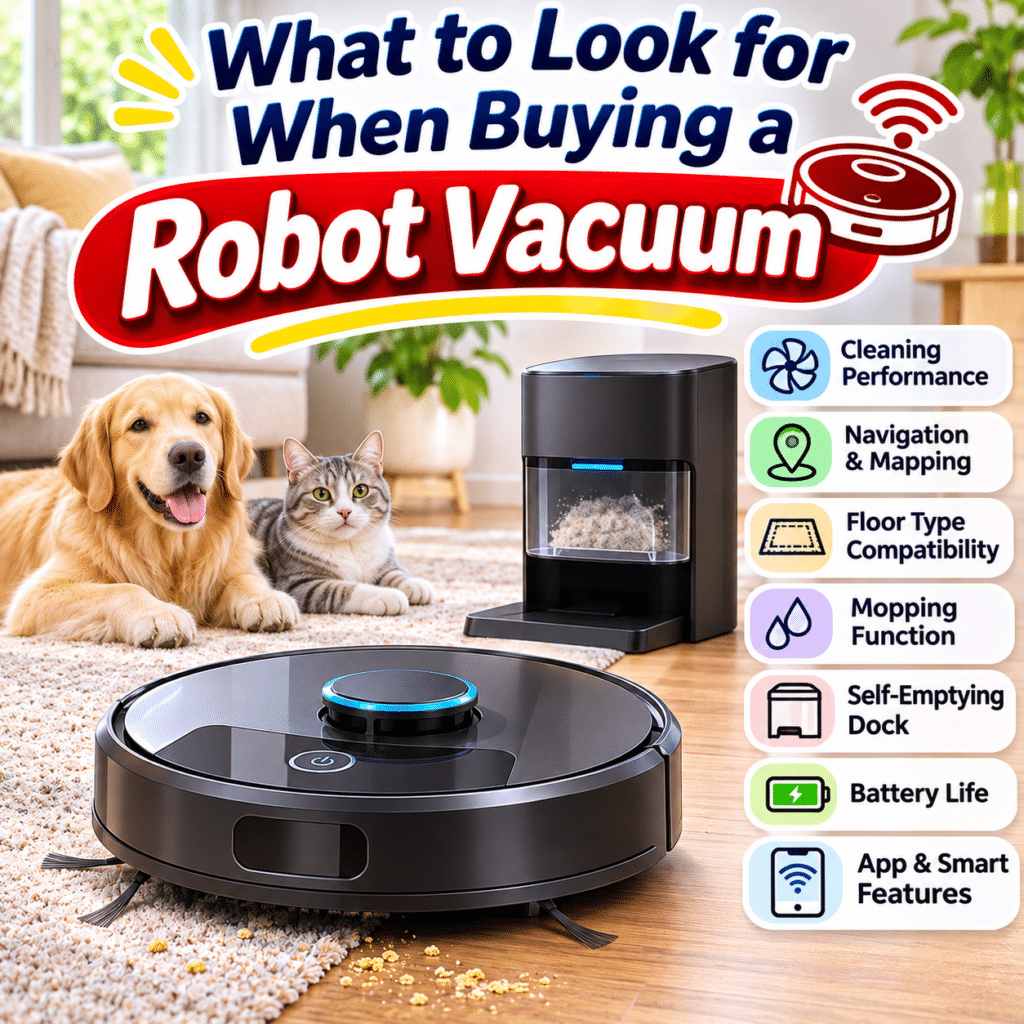
1. Understand What a Robot Vacuum Can and Cannot Do
Before purchasing a robot vacuum, it is important to understand its intended purpose.
Robot vacuums are designed primarily for routine floor maintenance.
They can help collect everyday debris from accessible floor surfaces and reduce the frequency of manual vacuuming.
Common Tasks Robot Vacuums Can Handle
Depending on the model, a robot vacuum may be able to:
- Collect dust from hard floors.
- Pick up crumbs and small debris.
- Remove some pet hair.
- Clean low-pile carpets.
- Vacuum beneath compatible furniture.
- Follow scheduled cleaning routines.
- Clean selected rooms.
- Return automatically to a charging dock.
- Mop compatible hard floors.
- Avoid certain household obstacles.
Tasks That May Still Require Manual Cleaning
Robot vacuums generally cannot replace every household cleaning tool.
You may still need a traditional vacuum or other cleaning equipment for:
- Stairs.
- Upholstered furniture.
- Curtains.
- High shelves.
- Tight corners.
- Deep carpet cleaning.
- Large spills.
- Heavy debris.
- Areas inaccessible to the robot.
Set Realistic Expectations
A robot vacuum can be a valuable maintenance tool, but it should not be expected to eliminate all manual cleaning.
Its greatest benefit often comes from consistent, repeated cleaning rather than occasional intensive cleaning sessions.
2. Identify Your Home’s Cleaning Requirements
The first step in choosing a robot vacuum is evaluating your living environment.
Consider:
- Total floor area.
- Number of rooms.
- Flooring materials.
- Carpet coverage.
- Furniture arrangement.
- Door thresholds.
- Pet ownership.
- Household activity.
- Available storage space.
Small Homes
A compact apartment with relatively open floors may not require the most advanced navigation system.
Large Homes
Larger homes may benefit from:
- Detailed mapping.
- Room-specific cleaning.
- Long battery life.
- Automatic recharge and resume.
- Efficient navigation.
- Multi-floor map storage.
Homes With Pets
Pet owners may prioritize:
- Hair pickup.
- Brush resistance to tangling.
- Effective filtration.
- Large debris capacity.
- Reliable obstacle avoidance.
Homes With Mixed Flooring
A home containing tile, wood, rugs, and carpet may benefit from adjustable suction and reliable surface detection.
Choosing based on your actual environment is more useful than comparing specifications in isolation.
3. Understand the Main Types of Robot Vacuums
Robot vacuums can be grouped according to their cleaning capabilities.
Vacuum-Only Robots
These models focus on collecting dry debris.
They may be suitable for homes where mopping is handled separately.
Vacuum-and-Mop Robots
These combine vacuuming with some form of wet floor cleaning.
Mopping systems vary significantly in effectiveness.
Self-Emptying Robot Vacuums
These use a docking station that transfers collected debris from the robot into a larger container or bag.
Advanced Maintenance Dock Systems
Some premium models can perform additional tasks such as:
- Washing mop pads.
- Drying mop pads.
- Refilling clean water.
- Collecting dirty water.
- Dispensing cleaning solution.
Which Type Is Best?
The answer depends on how much cleaning and maintenance you want the robot to handle.
A simpler model may be sufficient for routine vacuuming, while a combined cleaning system may be more convenient for homes with extensive hard flooring.
4. Evaluate Cleaning Performance Before Suction Numbers
Suction power is one of the most heavily advertised robot vacuum specifications.
However, suction ratings alone do not determine cleaning performance.
What Is Suction Power?
Manufacturers often express suction pressure in pascals (Pa).
This describes pressure difference under specified testing conditions.
Why Higher Pa Does Not Always Mean Better Cleaning
Real-world debris pickup also depends on:
- Airflow.
- Brush design.
- Cleaning head geometry.
- Floor contact.
- Robot movement.
- Debris type.
- Carpet characteristics.
- Dustbin design.
- Cleaning algorithms.
Two robot vacuums with different advertised suction ratings may perform similarly on certain floors.
What to Prioritize
Look for credible cleaning tests that evaluate actual debris pickup on the surfaces found in your home.
A robot that consistently collects dust and crumbs may be more useful than one with an impressive suction figure but poor brush design.
5. Consider Hard Floor Cleaning Performance
Hard floors are common in apartments and modern homes.
Examples include:
- Ceramic tile.
- Porcelain tile.
- Sealed hardwood.
- Laminate.
- Vinyl.
- Stone.
Important Features
For hard floors, consider:
- Fine dust pickup.
- Edge cleaning.
- Brush design.
- Debris scattering.
- Navigation accuracy.
- Floor-safe wheels.
- Mopping compatibility.
Avoid Debris Scattering
Some side brushes can scatter lightweight debris rather than directing it toward the suction inlet.
A well-designed cleaning system should collect debris efficiently without repeatedly pushing it away.
Floor Protection
Check whether the robot is suitable for your flooring material.
Inspect wheels and brushes regularly for trapped grit that could scratch sensitive surfaces.
6. Evaluate Carpet and Rug Cleaning
Carpets present different cleaning challenges from hard floors.
Debris can become trapped among carpet fibers, making effective agitation and airflow important.
Low-Pile Carpets
Many robot vacuums can maintain low-pile carpets reasonably well.
Medium-Pile Carpets
These may require stronger brush performance and effective suction.
High-Pile Carpets
Some robot vacuums struggle with thick or plush carpeting.
Potential problems include:
- Reduced mobility.
- Increased resistance.
- Brush tangling.
- Incomplete cleaning.
- Navigation errors.
Rugs With Tassels
Fringed rugs may become tangled in brushes or wheels.
Carpet Boost
Some models automatically increase suction when carpet is detected.
This can be useful, but it may increase noise and battery consumption.
Practical Advice
Choose a robot vacuum with demonstrated performance on your specific carpet type rather than relying only on marketing descriptions.
7. Understand Robot Vacuum Navigation Systems
Navigation technology determines how a robot moves through your home.
It influences:
- Cleaning coverage.
- Efficiency.
- Obstacle handling.
- Room recognition.
- Cleaning time.
- Ability to resume unfinished tasks.
Common navigation approaches include:
- Basic sensor-based navigation.
- Camera-based navigation.
- LiDAR navigation.
- Hybrid navigation systems.
8. Basic Sensor-Based Navigation
Entry-level robot vacuums may use bump sensors, infrared sensors, and movement algorithms to navigate.
Advantages
- Often affordable.
- Simple operation.
- Suitable for some small, uncomplicated spaces.
Limitations
- Less predictable cleaning paths.
- Repeated coverage of certain areas.
- Possible missed sections.
- Limited room-specific control.
- Less efficient operation in complex layouts.
Who Might Choose This Type?
A basic robot may be adequate for a small room with relatively few obstacles.
However, systematic navigation is often more convenient for multi-room cleaning.
9. LiDAR Navigation: Accurate Room Mapping
LiDAR stands for Light Detection and Ranging.
It uses emitted light and reflected signals to estimate distances and map surrounding structures.
Potential Advantages
- Systematic cleaning routes.
- Detailed room maps.
- Efficient coverage.
- Room-specific cleaning.
- Virtual boundaries.
- Reliable navigation in many low-light conditions.
Limitations
- Mapping accuracy varies by implementation.
- Small or low-profile objects may still be missed.
- Reflective surfaces can create challenges.
- Some LiDAR modules increase robot height.
Who Should Consider LiDAR?
LiDAR navigation can be particularly useful for:
- Multi-room homes.
- Complex layouts.
- Scheduled cleaning.
- Room-specific routines.
- Homes with frequently used no-go zones.
It is often a practical feature to prioritize when choosing a robot vacuum for everyday use.
10. Camera-Based Navigation
Some robot vacuums use cameras and visual processing to recognize their surroundings.
Potential Advantages
- Visual landmark recognition.
- Room mapping.
- Detection of selected objects.
- Support for advanced obstacle avoidance.
Limitations
- Performance may depend on lighting.
- Some systems require additional processing.
- Privacy considerations may be important.
- Recognition accuracy varies.
Privacy Considerations
If a robot uses cameras, review:
- Whether images are stored.
- Whether processing occurs locally or in the cloud.
- Available privacy controls.
- Data retention practices.
- Account security options.
Not every camera-equipped robot stores or transmits household images in the same way.
11. Hybrid Navigation Systems
Some advanced robot vacuums combine multiple technologies.
These may include:
- LiDAR.
- Cameras.
- Structured light.
- Infrared sensors.
- Ultrasonic sensors.
- Bump sensors.
- Cliff sensors.
Why Combine Sensors?
Different sensors detect different environmental characteristics.
A hybrid system may use one technology for mapping and another for recognizing obstacles.
Important Limitation
More sensors do not automatically guarantee better performance.
Software quality and system integration are equally important.
Buying Advice
Evaluate how reliably the robot navigates real homes rather than counting the number of sensors.
12. Understand Obstacle Avoidance
Obstacle avoidance is the robot’s ability to detect and navigate around objects.
Common obstacles include:
- Shoes.
- Toys.
- Chair legs.
- Cables.
- Pet bowls.
- Clothing.
- Furniture.
- Small household items.
Basic Obstacle Detection
Simple robots may rely on physical bump sensors or basic proximity detection.
Advanced Object Recognition
Some models attempt to identify specific objects and adjust their paths.
Why This Matters
Effective obstacle avoidance can reduce:
- Stuck cleaning sessions.
- Tangled cables.
- Displaced objects.
- Unexpected interruptions.
- Manual rescue efforts.
Important Limitation
No obstacle avoidance system should be assumed capable of detecting every object.
Small cables, thin fabrics, and unusual items may still cause problems.
13. Consider Homes With Pets
Pets introduce specific cleaning challenges.
These may include:
- Shedding hair.
- Fine dander.
- Tracked-in dirt.
- Food crumbs.
- Litter particles.
- Toys.
- Water bowls.
Useful Features for Pet Owners
Look for:
- Effective hair pickup.
- Anti-tangle brush designs.
- Easy brush removal.
- Reliable filtration.
- Strong edge cleaning.
- Large dust capacity.
- Suitable obstacle avoidance.
Pet Waste Detection
Some premium robot vacuums advertise recognition of certain pet waste hazards.
However, recognition systems are not infallible.
Do not rely on them as a guarantee against accidental contact.
Practical Recommendation
Inspect the floor before scheduled cleaning when pets may leave unexpected obstacles.
A robot vacuum can help manage shedding, but it should not replace appropriate pet hygiene or routine inspection.
14. Evaluate Main Brush Design
The main brush is a central component of debris collection.
Common designs include:
- Bristle brushes.
- Rubber rollers.
- Mixed bristle-and-rubber brushes.
- Dual-roller systems.
- Specialized anti-tangle designs.
Bristle Brushes
These may provide useful agitation, especially on carpets.
However, hair can become wrapped around the bristles.
Rubber Rollers
Rubber rollers can be easier to clean in certain designs.
Their performance depends on geometry and floor contact.
Dual-Roller Systems
Some robots use two coordinated rollers.
These may improve debris handling under certain conditions, but performance varies.
Anti-Tangle Systems
Some models use brush shapes, combs, or cutting mechanisms intended to reduce hair accumulation.
What to Prioritize
Choose a brush system that performs well on your flooring and is easy to maintain.
15. Consider Side Brush Performance
Side brushes sweep debris from edges toward the main cleaning path.
Useful Functions
- Cleaning along baseboards.
- Reaching around furniture legs.
- Collecting debris near corners.
- Moving dust toward the suction inlet.
Common Limitations
Side brushes may:
- Scatter lightweight debris.
- Tangle with hair.
- Wear over time.
- Miss certain tight corners.
Advanced Edge Cleaning
Some robot vacuums use extendable side brushes or specialized edge-cleaning movements.
These features may improve access to certain areas.
However, effectiveness depends on the design and room geometry.
16. Understand Robot Vacuum Mopping Systems
Robot vacuum mopping features vary significantly.
Some provide light surface wiping, while others use powered scrubbing mechanisms.
Common Mopping Designs
- Passive mop pads.
- Electronically controlled water delivery.
- Vibrating mop pads.
- Rotating mop pads.
- Roller-based mopping systems.
Passive Mop Pads
These typically drag a damp cloth across the floor.
They may help remove light dust but can struggle with stubborn stains.
Vibrating Mop Pads
These use repeated movement to increase scrubbing action.
Rotating Mop Pads
These use spinning pads to provide mechanical cleaning.
Roller-Based Systems
Some robots use powered rollers that contact the floor and may include mechanisms for managing dirty water.
Important Consideration
Mopping performance depends on more than the mechanism.
Water management, floor contact, pad cleanliness, and navigation all matter.
17. Decide Whether You Need Vacuuming and Mopping Together
A combined robot can reduce the need for separate routine cleaning devices.
Advantages
- Convenient floor maintenance.
- Scheduled vacuuming and mopping.
- One device for multiple tasks.
- Potentially less manual work.
- Room-specific cleaning options.
Limitations
- Higher cost on some models.
- Additional maintenance.
- Water tank cleaning.
- Mop pad replacement.
- Possible limitations on carpets.
- More complex docking systems.
Who Benefits Most?
Combined vacuum-and-mop robots are often useful in homes with extensive tile or other compatible hard flooring.
When Vacuum-Only May Be Better
A vacuum-only robot may be preferable if:
- Most floors are carpeted.
- You already have a preferred mopping system.
- You want simpler maintenance.
- Your budget is limited.
18. Evaluate Carpet Detection and Mop Lifting
For homes with both hard floors and carpets, mop management is important.
Carpet Detection
Some robots detect carpeted areas and adjust cleaning behavior.
Mop Lifting
Certain models lift their mop pads when moving onto carpets.
Mop Removal or Dock Storage
Other systems can leave mop components at the dock before vacuuming carpets.
Important Limitation
Mop-lifting height varies.
A robot may lift its mop enough for low-pile carpet but still contact thicker rugs.
Buying Advice
Check the manufacturer’s stated carpet compatibility and mop clearance.
Do not assume that automatic mop lifting makes every carpet safe from moisture.
19. Understand Water Tank Capacity
Robot mops use clean water tanks, dirty water tanks, or both, depending on their design.
Robot-Mounted Tanks
Smaller tanks may require more frequent refilling.
Dock-Mounted Tanks
Advanced docks may store larger quantities of clean and dirty water.
What Capacity Means in Practice
Actual cleaning coverage depends on:
- Water flow settings.
- Mopping method.
- Floor area.
- Cleaning frequency.
- Pad washing cycles.
- Surface conditions.
Avoid Comparing Capacity Alone
A larger tank does not necessarily mean better cleaning.
Efficient water delivery and maintenance design are equally important.
20. Consider Water Management and Floor Compatibility
Excess moisture can damage certain floor materials.
Tile and Porcelain
These are commonly compatible with damp mopping, subject to grout and manufacturer guidance.
Sealed Hardwood
Some sealed wood floors may tolerate controlled damp cleaning.
However, excess moisture can cause damage.
Laminate
Laminate floors may be sensitive to water entering joints.
Natural Stone
Certain stone surfaces require specific cleaning products and methods.
Practical Recommendation
Verify that the robot’s mopping system and cleaning solution are suitable for your flooring.
Use only manufacturer-approved cleaning products.
21. Understand Self-Emptying Docking Stations
Self-emptying docks transfer debris from the robot’s dustbin into a larger collection system.
Potential Advantages
- Less frequent manual dustbin emptying.
- Convenient scheduled cleaning.
- Useful for homes with pets.
- Reduced direct handling of collected debris.
- Better support for larger cleaning areas.
Limitations
- Larger docking station.
- Additional purchase cost.
- Noise during emptying.
- Replacement bags on some models.
- Occasional clogging.
- Continued maintenance requirements.
Bagged Versus Bagless Docks
Bagged systems may simplify disposal and reduce dust exposure during emptying.
Bagless systems avoid disposable bags but may require more frequent container cleaning.
Neither design is universally better.
22. Evaluate Advanced Cleaning Docks
Some robot vacuum docks perform several maintenance functions.
These may include:
- Dust collection.
- Mop washing.
- Mop drying.
- Clean water refilling.
- Dirty water collection.
- Cleaning solution dispensing.
Advantages
- Reduced routine intervention.
- More consistent mop cleaning.
- Convenient multi-room cleaning.
- Improved support for frequent cleaning schedules.
Limitations
- Higher cost.
- Larger footprint.
- More components to maintain.
- Water tank cleaning.
- Potential plumbing requirements on selected systems.
- Additional failure points.
Important Reminder
A highly automated dock is not maintenance-free.
Users must still inspect and clean components according to manufacturer instructions.
23. Consider Docking Station Size and Placement
Dock dimensions are often overlooked.
A robot vacuum may be compact, but its docking station can require substantial floor space.
Before Buying
Measure:
- Dock width.
- Dock depth.
- Dock height.
- Available wall space.
- Nearby electrical outlets.
- Required clearance.
Placement Considerations
Choose a location that allows the robot to approach and leave the dock reliably.
Avoid placing the dock where it obstructs walkways or doors.
Water-Handling Docks
If the dock includes water tanks, consider accessibility for filling, emptying, and cleaning.
Long-Term Convenience
A docking station that is difficult to access may make routine maintenance frustrating.
24. Understand Battery Life
Battery life affects how much floor area a robot can clean before recharging.
Manufacturers may advertise operating time under specific test conditions.
Factors Affecting Runtime
- Suction level.
- Carpet coverage.
- Mopping operation.
- Navigation efficiency.
- Battery condition.
- Cleaning mode.
- Obstacle density.
Why Advertised Runtime Can Be Misleading
Maximum runtime may be measured using low-power settings.
Actual cleaning time can be shorter under demanding conditions.
What Matters Most
Consider whether the robot can complete your usual cleaning area efficiently.
For larger homes, automatic recharge-and-resume capability may be more important than maximum advertised runtime.
25. Evaluate Recharge-and-Resume Functionality
Some robot vacuums automatically return to their docks when battery power becomes low.
After recharging, they resume cleaning unfinished areas.
Advantages
- Useful for large homes.
- Reduces manual intervention.
- Supports longer cleaning sessions.
- Helps maintain consistent coverage.
Limitations
- Cleaning may take longer overall.
- Resumption accuracy depends on mapping and software.
- Dock access must remain unobstructed.
Who Needs It?
Recharge-and-resume functionality is especially useful for larger floor areas or cleaning routines that exceed one battery cycle.
26. Consider Robot Height and Furniture Clearance
Robot vacuum height affects which spaces it can reach.
Common Obstacles
- Sofas.
- Beds.
- Cabinets.
- TV stands.
- Low shelves.
- Furniture support bars.
Measure Before Buying
Measure the clearance beneath furniture you want the robot to clean.
Compare it with the robot’s total height, including any raised navigation module.
Allow Practical Clearance
A robot may technically fit under furniture but still become stuck if clearance is uneven.
Why This Matters
Under-furniture cleaning is one of the major conveniences of robot vacuums.
A model that cannot reach your most important areas may provide less value.
27. Evaluate Threshold-Climbing Ability
Door thresholds and floor transitions can prevent a robot from reaching certain rooms.
Common Challenges
- Raised door tracks.
- Tile-to-wood transitions.
- Thick rugs.
- Small steps.
- Uneven flooring.
Manufacturer Ratings
Some manufacturers specify maximum obstacle-crossing height.
However, real-world performance depends on:
- Threshold shape.
- Surface friction.
- Approach angle.
- Wheel design.
- Robot weight.
Practical Advice
Measure the highest threshold in your home.
Compare it with independent performance information when available.
Do not assume that a robot rated for a particular height can cross every obstacle of that height.
28. Consider Multi-Floor Mapping
Multi-floor mapping allows compatible robots to store separate maps for different levels.
Potential Benefits
- Room recognition across floors.
- Different cleaning schedules.
- Floor-specific no-go zones.
- Efficient navigation.
Important Limitation
Most conventional robot vacuums cannot climb stairs.
They must be carried between floors unless a specialized system provides another solution.
Check Docking Requirements
Some robots may require manual relocation or different procedures when cleaning away from their dock.
29. Understand Cliff Sensors and Stair Safety
Cliff sensors are designed to detect drop-offs.
They help reduce the risk of a robot driving over stairs or other elevated edges.
Important Considerations
- Sensor effectiveness varies.
- Dark or reflective surfaces may affect certain sensors.
- Dirty sensors can reduce reliability.
- Unusual stair geometry can create challenges.
Practical Safety Advice
Keep sensors clean and follow manufacturer guidance.
For elevated areas, consider using physical barriers or virtual boundaries when appropriate.
Do not treat cliff detection as an absolute guarantee against falls.
30. Evaluate Room Mapping and Cleaning Zones
Mapping allows a robot to recognize and manage different areas of a home.
Useful Features
- Room-specific cleaning.
- Custom room names.
- No-go zones.
- No-mop zones.
- Virtual walls.
- Scheduled room cleaning.
- Targeted spot cleaning.
Why These Features Matter
You may want the robot to:
- Clean the kitchen after dinner.
- Vacuum the living room daily.
- Avoid a pet feeding area.
- Skip a room during certain hours.
- Mop only compatible hard floors.
Practical Benefit
Flexible mapping can make the robot more useful without requiring complex manual setup for every cleaning session.
31. Consider App Quality and Ease of Use
The smartphone application is an important part of many robot vacuum systems.
Useful App Features
- Clear maps.
- Easy scheduling.
- Room selection.
- Cleaning history.
- Maintenance reminders.
- Suction adjustment.
- Mopping controls.
- Firmware updates.
Common App Problems
- Confusing menus.
- Unreliable connections.
- Delayed commands.
- Poor translation.
- Difficult map editing.
- Frequent account issues.
Buying Advice
Look for clear product documentation and credible user feedback about the application.
A powerful robot with an unreliable app may be frustrating to use.
32. Evaluate Smart Home Integration
Some robot vacuums work with connected home ecosystems or voice assistants.
Potential integrations include:
- Apple Home.
- Google Home.
- Amazon Alexa.
- Samsung SmartThings.
- Matter-compatible systems.
Possible Functions
Depending on the product and platform, integration may support:
- Starting cleaning.
- Pausing cleaning.
- Returning to the dock.
- Selected room cleaning.
- Automation routines.
- Device status.
Important Compatibility Consideration
Support varies by model, firmware, region, and ecosystem.
Matter support, where available, does not guarantee that every manufacturer-specific function will be exposed through every platform.
Practical Advice
Verify the exact functions you want before purchasing.
33. Understand Wi-Fi Requirements
Many robot vacuums use Wi-Fi for connected functions.
Common Requirements
Some models support only 2.4 GHz Wi-Fi.
Others support additional networking options.
Why Connectivity Matters
Poor Wi-Fi coverage can affect:
- Remote commands.
- Map synchronization.
- Notifications.
- Firmware updates.
- Cloud-based features.
Offline Operation
Some robots can continue basic cleaning without internet access.
Others have more limited functionality when disconnected.
Before Buying
Check:
- Supported Wi-Fi bands.
- Router compatibility.
- App requirements.
- Offline behavior.
- Account requirements.
34. Consider Privacy and Data Security
Robot vacuums with mapping and camera features may process information about your home.
Potentially Sensitive Information
Depending on the product, data may include:
- Room maps.
- Cleaning history.
- Device location.
- Camera images.
- Obstacle information.
- Household activity patterns.
Questions to Ask
- Is mapping data stored locally or remotely?
- Does the robot use a camera?
- Are images uploaded?
- Can data sharing be limited?
- Are security updates provided?
- Can stored maps be deleted?
- What happens when the device is sold or discarded?
Practical Security Measures
- Use strong account credentials.
- Enable multifactor authentication if available.
- Keep firmware updated.
- Review app permissions.
- Secure the home Wi-Fi network.
Privacy and security should be considered alongside cleaning performance.
35. Evaluate Robot Vacuum Noise
Robot vacuums produce noise from motors, brushes, wheels, and docking systems.
Noise Sources
- Vacuum motor.
- Main brush.
- Side brush.
- Wheels.
- Self-emptying dock.
- Mop washing.
- Mop drying fans.
Why Noise Matters
Noise may be particularly important in:
- Apartments.
- Shared homes.
- Bedrooms.
- Home offices.
- Homes with noise-sensitive pets.
Quiet Modes
Some robots offer lower-power cleaning modes.
These may reduce noise but can also reduce cleaning performance.
Dock Noise
Self-emptying docks can produce short periods of relatively loud noise.
Consider whether the dock can be scheduled to operate at convenient times.
36. Consider Maintenance Requirements
Every robot vacuum requires maintenance.
Even models with advanced docks need periodic inspection.
Common Maintenance Tasks
- Emptying dust containers.
- Replacing dust bags.
- Cleaning filters.
- Removing hair from brushes.
- Cleaning wheels.
- Wiping sensors.
- Washing mop pads.
- Cleaning water tanks.
- Inspecting charging contacts.
Maintenance Frequency
The required frequency depends on:
- Cleaning area.
- Debris quantity.
- Pet shedding.
- Usage frequency.
- Manufacturer recommendations.
Why Maintenance Matters
Neglected maintenance can reduce cleaning performance and reliability.
A robot that is difficult to maintain may eventually become less convenient than expected.
37. Evaluate Filter Design
Filters help capture particles from air moving through the vacuum.
Common Filter Types
Robot vacuums may use:
- Mesh filters.
- Foam filters.
- Pleated filters.
- Multi-stage filtration systems.
HEPA Claims
Some products advertise HEPA filtration.
However, filter terminology and testing claims vary.
A HEPA-labeled filter alone does not establish that the entire vacuum system prevents fine-particle leakage.
Important Considerations
Check:
- Filter replacement availability.
- Cleaning instructions.
- Replacement frequency.
- Dustbin sealing.
- Manufacturer filtration specifications.
For Allergy-Conscious Households
Consider the complete dust-handling system, including how collected debris is emptied.
A sealed bagged dock may reduce direct dust exposure compared with certain manual emptying methods.
38. Understand Dustbin Capacity
Robot dustbins are relatively small compared with many traditional vacuums.
Small Dustbins
These may require frequent emptying in homes with:
- Pets.
- Heavy shedding.
- High foot traffic.
- Large floor areas.
Larger Dustbins
These may reduce maintenance frequency but can affect robot dimensions.
Self-Emptying Systems
A self-emptying dock can reduce the frequency of manual dust disposal.
Practical Consideration
Dustbin capacity matters, but ease of emptying and resistance to clogging are equally important.
39. Consider Replacement Parts and Consumables
Robot vacuums contain components that wear over time.
Common replacement items include:
- Main brushes.
- Side brushes.
- Filters.
- Mop pads.
- Dust bags.
- Batteries.
- Certain seals and cleaning accessories.
Before Buying
Check whether replacement parts are:
- Readily available.
- Reasonably priced.
- Easy to install.
- Supported by the manufacturer.
Long-Term Value
A robot with inexpensive, accessible replacement parts may be more economical over time than a cheaper model with limited parts availability.
40. Understand Battery Replacement and Lifespan
Rechargeable batteries gradually lose capacity with use and age.
Factors Affecting Battery Life
- Charge cycles.
- Operating temperature.
- Storage conditions.
- Battery chemistry.
- Charging management.
- Usage patterns.
Important Buying Questions
- Is the battery replaceable?
- Are replacement batteries available?
- Does replacement require professional service?
- What warranty applies?
- How does the manufacturer recommend storing the robot?
Avoid Assuming Battery Life Is Permanent
Battery performance will change over time.
Long-term repairability can influence the overall value of the robot.
41. Consider Warranty and Customer Support
A robot vacuum combines mechanical, electronic, and software systems.
Reliable support can be valuable if problems arise.
What to Check
- Warranty duration.
- Coverage exclusions.
- Local service availability.
- Repair options.
- Replacement parts.
- Firmware support.
- Return policy.
Why Local Support Matters
A product purchased from an unsupported region may have limited warranty coverage or difficult repair arrangements.
Evaluate Manufacturer Documentation
Clear manuals, troubleshooting instructions, and maintenance guides can improve the ownership experience.
42. Understand the Total Cost of Ownership
The purchase price is only one part of robot vacuum ownership.
Potential Ongoing Costs
- Dust bags.
- Filters.
- Brushes.
- Mop pads.
- Cleaning solution.
- Batteries.
- Repairs.
- Electricity.
- Optional subscriptions.
Basic Models
Lower-priced robots may require more manual maintenance.
Premium Models
Higher-priced robots may reduce certain maintenance tasks but can introduce more expensive replacement components.
Best Value
The best value comes from balancing purchase cost, useful features, reliability, maintenance, and expected lifespan.
43. Compare Robot Vacuum Features by Household Need
| Household situation | Features worth prioritizing | Features that may be optional |
|---|---|---|
| Small apartment | Reliable navigation, compact dock, hard floor pickup | Large automated dock |
| Large home | Mapping, recharge-and-resume, efficient routes | Advanced mopping if mostly carpet |
| Home with pets | Hair pickup, anti-tangle brush, easy dust disposal | Decorative app features |
| Mostly hard floors | Fine dust pickup, edge cleaning, suitable mopping | Maximum carpet suction |
| Mostly carpets | Brush performance, carpet pickup, carpet detection | Advanced mop washing |
| Mixed flooring | Surface detection, mapping, mop management | Specialized features for one floor type |
| Multi-story home | Multi-floor maps, portable handling | Fully automatic floor transitions |
| Busy household | Scheduling, self-emptying, reliable obstacle avoidance | Complex voice routines |
| Small budget | Core cleaning performance, parts availability | Premium maintenance dock |
Choose features according to your home rather than purchasing every available technology.
44. Choose a Robot Vacuum for a Small Apartment
Small apartments often benefit from efficient, compact cleaning devices.
Useful Features
- Reliable hard floor cleaning.
- Compact dimensions.
- Easy scheduling.
- Simple maintenance.
- Suitable furniture clearance.
- Quiet operation.
Is Advanced Mapping Necessary?
It can be useful, especially when the apartment has several rooms.
However, a simpler robot may be sufficient for an open layout.
Consider Dock Size
In a compact apartment, docking station dimensions can be just as important as robot dimensions.
Practical Recommendation
Prioritize cleaning reliability and convenience over unnecessary advanced features.
45. Choose a Robot Vacuum for a Large Home
Larger homes create additional demands.
Important Features
- Systematic navigation.
- Accurate mapping.
- Long battery life.
- Recharge-and-resume.
- Room-specific cleaning.
- Reliable dock return.
- Suitable dust capacity.
Consider Cleaning Time
A robot may require several hours to complete a large area, particularly when mopping and recharging are involved.
Multi-Room Scheduling
Room-specific schedules can help spread cleaning tasks across the week.
Practical Recommendation
Choose a robot that can maintain consistent coverage without requiring frequent manual intervention.
46. Choose a Robot Vacuum for Homes With Pets
Pet hair and tracked-in debris can accumulate quickly.
Prioritize
- Strong real-world hair pickup.
- Anti-tangle brush performance.
- Easy brush cleaning.
- Suitable filtration.
- Effective edge cleaning.
- Reliable obstacle avoidance.
Consider Self-Emptying
A self-emptying dock may be particularly convenient for households with heavy shedding.
Avoid Overlooking Maintenance
Even anti-tangle systems may require occasional hair removal.
Important Safety Consideration
Inspect the cleaning area for pet waste, toys, and other hazards before running the robot.
47. Choose a Robot Vacuum for Homes With Mostly Hard Floors
Hard floor cleaning requires effective dust collection without excessive debris scattering.
Useful Features
- Efficient suction and airflow.
- Well-designed side brushes.
- Accurate edge cleaning.
- Floor-safe wheels.
- Suitable mopping.
- Controlled water delivery.
Consider Mopping Quality
If your home has extensive tile or sealed hard flooring, a capable mopping system may offer meaningful convenience.
Avoid Overpaying for Carpet Features
If your home has no carpets, specialized deep-carpet performance may be less important.
48. Choose a Robot Vacuum for Carpeted Homes
Carpet cleaning places greater emphasis on brush agitation and debris extraction.
Prioritize
- Demonstrated carpet pickup.
- Effective brush design.
- Carpet detection.
- Suitable suction modes.
- Reliable navigation.
- Easy hair removal.
Consider Carpet Thickness
Check whether the robot can move effectively on your carpet pile.
Mopping May Be Less Important
If most rooms are carpeted, an expensive mop-washing dock may provide limited additional value.
49. Choose a Robot Vacuum for Mixed Flooring
Homes with both hard floors and carpets benefit from adaptable cleaning systems.
Useful Features
- Carpet detection.
- Automatic suction adjustment.
- No-mop zones.
- Mop lifting or removal.
- Detailed mapping.
- Room-specific settings.
Why Floor Recognition Matters
A robot should ideally adjust its behavior when moving between surfaces.
Practical Limitation
Automatic detection may not work perfectly with every rug or floor material.
Review the product’s stated limitations.
50. Consider Robot Vacuums for Homes With Children
Households with children may have additional floor obstacles.
Examples include:
- Toys.
- Small objects.
- Art supplies.
- Clothing.
- Cables.
- Food crumbs.
Useful Features
- Reliable obstacle avoidance.
- Easy scheduling.
- Room-specific cleaning.
- Clear no-go zones.
- Durable brushes.
- Convenient maintenance.
Important Safety Practice
Small objects should be removed from the floor before cleaning.
Robot vacuums are not designed to identify every potentially hazardous item.
Schedule Thoughtfully
Cleaning sessions may be more convenient when play areas are clear.
51. Consider Robot Vacuums for Older Adults
Robot vacuums may reduce the physical effort associated with routine floor cleaning.
Helpful Features
- Simple controls.
- Reliable automatic operation.
- Easy dust disposal.
- Accessible docking stations.
- Clear maintenance reminders.
- Straightforward scheduling.
Avoid Excessive Complexity
A robot with complicated menus and frequent troubleshooting may be difficult to manage.
Consider Physical Maintenance
Self-emptying systems can reduce dustbin handling, but water tanks and other components may still require lifting and cleaning.
Choose a system that matches the user’s practical needs.
52. Common Robot Vacuum Buying Mistakes
Choosing Only by Suction Rating
High advertised suction does not guarantee superior debris pickup.
Ignoring Navigation Quality
Poor navigation can result in missed areas and inefficient cleaning.
Overlooking Furniture Clearance
A robot that cannot fit beneath important furniture may provide less value.
Forgetting Door Thresholds
Raised transitions can prevent access to certain rooms.
Assuming All Mopping Systems Are Equal
Passive wiping and powered scrubbing can deliver very different results.
Buying an Oversized Dock
Advanced docks may require more space than expected.
Ignoring Replacement Part Costs
Consumables can add significantly to long-term ownership costs.
Overlooking App Reliability
A confusing or unreliable app can reduce convenience.
Assuming Obstacle Avoidance Is Perfect
Cables, pet waste, and small objects may still cause problems.
Ignoring Privacy
Camera-equipped robots may require additional data and account considerations.
Expecting Completely Maintenance-Free Operation
Every robot vacuum requires some level of care.
Buying Features That Do Not Match the Home
Premium carpet features may offer little value in a home with only tile floors.
53. How to Choose a Robot Vacuum Step by Step
A structured approach can simplify the buying process.
Step 1: Identify Your Flooring Types
Determine how much of your home contains hard floors, carpets, and rugs.
Step 2: Measure Your Cleaning Area
Estimate the floor area the robot will regularly clean.
Step 3: Evaluate Home Layout
Consider furniture, thresholds, stairs, and obstacles.
Step 4: Choose Your Preferred Cleaning Functions
Decide whether you need vacuuming only or combined vacuuming and mopping.
Step 5: Prioritize Navigation
Select a navigation system appropriate for your home’s complexity.
Step 6: Evaluate Real-World Cleaning Performance
Look for reliable information about debris pickup on your flooring.
Step 7: Consider Obstacle Avoidance
Determine whether advanced detection would be useful.
Step 8: Review Maintenance Requirements
Check dust disposal, brush cleaning, filters, and mop care.
Step 9: Evaluate Docking Station Features
Choose between basic charging, self-emptying, and advanced maintenance docks.
Step 10: Compare Long-Term Costs
Include replacement parts, consumables, and potential repairs.
Step 11: Verify Support and Compatibility
Check warranty, local service, app requirements, and connectivity.
Step 12: Choose the Best Practical Fit
Select the model that offers reliable cleaning and manageable maintenance without unnecessary complexity.
54. Practical Robot Vacuum Buying Checklist
Use this checklist before making a purchase.
Home Compatibility
- I know my main flooring types.
- The robot is suitable for my carpets or rugs.
- I have measured important furniture clearances.
- I have checked door thresholds.
- I have considered stairs and elevated areas.
Cleaning Performance
- The robot has demonstrated suitable debris pickup.
- Brush design matches my flooring.
- Edge cleaning is adequate.
- Pet hair performance meets my needs.
- Mopping performance is suitable if required.
Navigation and Smart Features
- Navigation is appropriate for my home layout.
- Mapping features meet my needs.
- Obstacle avoidance is adequate.
- Room-specific cleaning is available if needed.
- The app is understandable and reliable.
Battery and Docking
- Battery performance suits my cleaning area.
- Recharge-and-resume is available if needed.
- The dock fits my available space.
- Dust disposal requirements are manageable.
- Water tank maintenance is practical if applicable.
Maintenance and Long-Term Value
- Filters are easy to access.
- Brushes are easy to clean.
- Replacement parts are available.
- Consumable costs are reasonable.
- Warranty and service support are acceptable.
Privacy and Reliability
- Wi-Fi requirements are compatible.
- Offline behavior is understood.
- Data and privacy settings are acceptable.
- Firmware updates are supported.
- Basic controls remain practical.
55. Frequently Asked Questions About Buying a Robot Vacuum
1. Are robot vacuums worth buying?
They can be worthwhile for households that want convenient routine floor maintenance. Their value depends on flooring, home layout, cleaning expectations, and maintenance requirements.
2. Can a robot vacuum replace a traditional vacuum cleaner?
Usually not completely. Traditional vacuums may still be needed for stairs, upholstery, deep carpet cleaning, and inaccessible areas.
3. What is the most important feature in a robot vacuum?
Reliable cleaning performance on your flooring is fundamental. Navigation and maintenance convenience are also important.
4. Is higher suction power always better?
No. Brush design, airflow, floor contact, and navigation also influence actual cleaning performance.
5. What does Pa mean in robot vacuum specifications?
Pa stands for pascal, a unit of pressure. Manufacturers use it to describe suction pressure under specified conditions.
6. Is LiDAR navigation worth having?
LiDAR can be valuable for efficient mapping and systematic cleaning, particularly in multi-room homes.
7. Are camera-based robot vacuums better than LiDAR models?
Not necessarily. Each technology has strengths and limitations, and overall performance depends on implementation.
8. Do robot vacuums work in the dark?
Some navigation systems, including many LiDAR-based designs, can operate effectively in low light. Camera-dependent functions may be more sensitive to lighting conditions.
9. Can robot vacuums clean carpets?
Many can clean low- and medium-pile carpets, but performance varies. Thick carpets may create mobility and cleaning challenges.
10. Can robot vacuums clean hardwood floors?
Many are suitable for compatible sealed hardwood floors. Follow flooring and robot manufacturer guidance, particularly for mopping.
11. Are robot vacuums good for pet hair?
Some perform well on pet hair, especially models with effective brush designs and easy maintenance.
12. Do anti-tangle brushes eliminate hair wrapping?
Not always. They may reduce tangling, but periodic cleaning can still be necessary.
13. Can robot vacuums avoid pet waste?
Some models attempt to recognize certain pet waste hazards, but detection is not guaranteed.
14. Do robot vacuums mop floors effectively?
Some provide useful routine mopping, while others offer only light wiping. Performance depends on the mopping system and floor conditions.
15. Are rotating mop pads better than passive pads?
Powered rotating pads may provide more mechanical scrubbing, but overall cleaning performance depends on the complete system.
16. Can robot vacuums mop carpets?
Most conventional mopping systems are intended for compatible hard floors, not carpets.
17. What is automatic mop lifting?
It is a feature that raises mop components when the robot detects certain surfaces, such as carpets.
18. Do self-emptying robot vacuums require maintenance?
Yes. Dust bags or containers, filters, brushes, and other components still require attention.
19. Are self-emptying docks worth the extra cost?
They can be convenient for larger homes, frequent cleaning, or heavy pet shedding.
20. What is the difference between a basic dock and an advanced dock?
A basic dock primarily charges the robot. Advanced docks may also empty debris, wash mop pads, dry pads, or manage water.
21. How long does a robot vacuum battery last?
Runtime varies by model, cleaning mode, flooring, battery condition, and operating conditions.
22. What is recharge-and-resume?
It allows the robot to recharge and then continue an unfinished cleaning task.
23. Can robot vacuums clean multiple floors?
Many can store maps for multiple floors, but most must be carried between levels.
24. Can a robot vacuum climb stairs?
Conventional robot vacuums generally cannot climb stairs.
25. Can robot vacuums cross door thresholds?
Some can cross small thresholds, but performance depends on obstacle height, shape, and robot design.
26. How do I know if a robot will fit under my sofa?
Measure the available clearance and compare it with the robot’s full height.
27. Do robot vacuums need Wi-Fi?
Some can perform basic cleaning without Wi-Fi, but connected features may require network access.
28. Can a robot vacuum work without internet access?
Some support local cleaning functions, while others depend more heavily on cloud services.
29. Do robot vacuums require smartphone applications?
Many use applications for advanced features, but some provide physical controls for basic operation.
30. Can robot vacuums work with voice assistants?
Some support compatible voice assistants and smart home platforms. Features vary by model.
31. Are robot vacuums noisy?
Noise varies by model and cleaning mode. Self-emptying docks can be particularly loud during debris transfer.
32. How often should I empty a robot vacuum?
It depends on dustbin capacity, cleaning frequency, debris quantity, and whether the robot has a self-emptying dock.
33. How often should robot vacuum filters be replaced?
Follow the manufacturer’s recommendations, adjusting maintenance according to usage and observed condition.
34. Can robot vacuum batteries be replaced?
Some models support battery replacement, while others require professional service or have limited replacement options.
35. How long should a robot vacuum last?
Lifespan depends on construction, maintenance, battery condition, repairability, and software support.
36. Are expensive robot vacuums always better?
No. Premium features may be useful, but a simpler model can provide better value when it matches your household needs.
37. What robot vacuum features matter most for small apartments?
Compact dimensions, reliable navigation, suitable floor cleaning, manageable noise, and convenient storage are often important.
38. What features matter most for large homes?
Efficient mapping, recharge-and-resume, room-specific cleaning, reliable navigation, and appropriate dust capacity are useful.
39. Are robot vacuums safe around children and pets?
They can be used in households with children and pets, but small objects, cables, and hazards should be removed, and manufacturer safety guidance should be followed.
40. Can robot vacuums damage furniture?
Some robots may contact furniture or become stuck. Suitable navigation, careful setup, and appropriate no-go zones can reduce these problems.
41. Do robot vacuums scratch floors?
Properly maintained robots designed for compatible flooring should minimize this risk, but trapped grit, damaged wheels, or unsuitable components can cause scratches.
42. Are robot vacuums with cameras a privacy concern?
They may raise additional privacy considerations. Review image processing, data storage, account security, and manufacturer policies.
43. What is the best robot vacuum for mixed flooring?
Look for reliable surface detection, suitable carpet cleaning, accurate mapping, and appropriate mop management.
44. Should I buy a vacuum-only robot or a vacuum-and-mop model?
Choose based on flooring and cleaning habits. Combined models can be convenient for hard floors, while vacuum-only models may be sufficient for carpet-focused homes.
45. What should I prioritize when buying my first robot vacuum?
Prioritize real-world cleaning performance, suitable navigation, home compatibility, manageable maintenance, replacement parts, and long-term reliability.
56. Final Thoughts: Choosing a Robot Vacuum That Fits Your Home
Choosing the right robot vacuum is about understanding your home and selecting features that make routine cleaning more manageable.
Flooring type should be one of the first considerations. Hard floors, carpets, rugs, and mixed surfaces place different demands on brushes, suction systems, and mopping mechanisms. A robot that performs well on one surface may be less effective on another.
Navigation is equally important. Reliable mapping and systematic cleaning can improve coverage, reduce unnecessary movement, and make room-specific routines easier to manage. Obstacle avoidance, furniture clearance, and threshold-climbing ability also influence how independently a robot can operate.
Maintenance requirements deserve careful attention. Self-emptying docks and automated mop-washing systems may reduce daily intervention, but they introduce additional components, consumables, and cleaning responsibilities. A simpler robot with accessible parts may be more practical for some households.
Long-term value depends on more than purchase price. Replacement filters, brushes, batteries, repair support, software updates, and docking station requirements all contribute to the ownership experience.
Most importantly, choose a robot vacuum that fits your actual lifestyle. A small apartment may need only reliable basic cleaning, while a larger household with pets and mixed flooring may benefit from advanced navigation, anti-tangle brushes, and automated maintenance.
A robot vacuum should support everyday cleaning rather than create additional complexity. When selected thoughtfully and maintained properly, it can become a dependable part of a practical household cleaning routine.
The best robot vacuum is not necessarily the one with the highest suction rating, the largest docking station, or the most advanced technology. It is the one that cleans your floors effectively, navigates your home reliably, requires a manageable amount of maintenance, and makes everyday living easier over time.