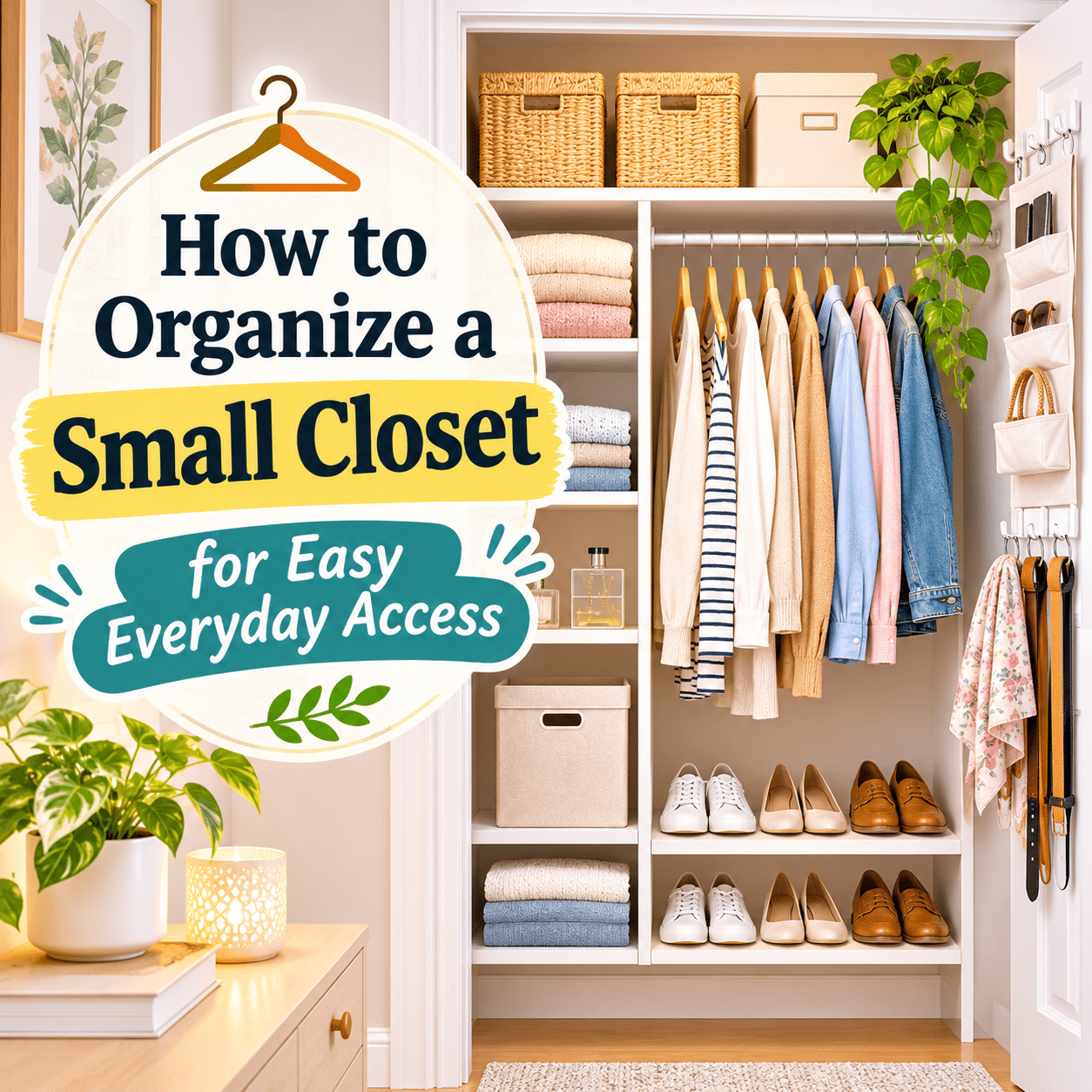
A small closet can be one of the most useful storage spaces in a home, but it can also become one of the most frustrating. When clothing is tightly packed, accessories disappear behind other belongings, and shelves are difficult to reach, even simple daily routines can become unnecessarily complicated.
The challenge is not always a lack of storage space. Often, the real problem is how that space is divided, what is being stored inside it, and whether frequently used belongings are easy to access.
A thoughtfully organized small closet can hold a surprising variety of essentials without feeling overcrowded. By evaluating what you own, arranging items according to how often you use them, and making better use of available vertical space, you can create a storage system that supports your everyday routine.
The goal is not to transform a small closet into a perfectly styled display. It is to make finding, using, and returning your belongings easier.
Whether you have a narrow bedroom wardrobe, a compact reach-in closet, or a small shared clothing area, this guide explains how to organize the space step by step, choose practical storage solutions, avoid common mistakes, and maintain an arrangement that works over time.
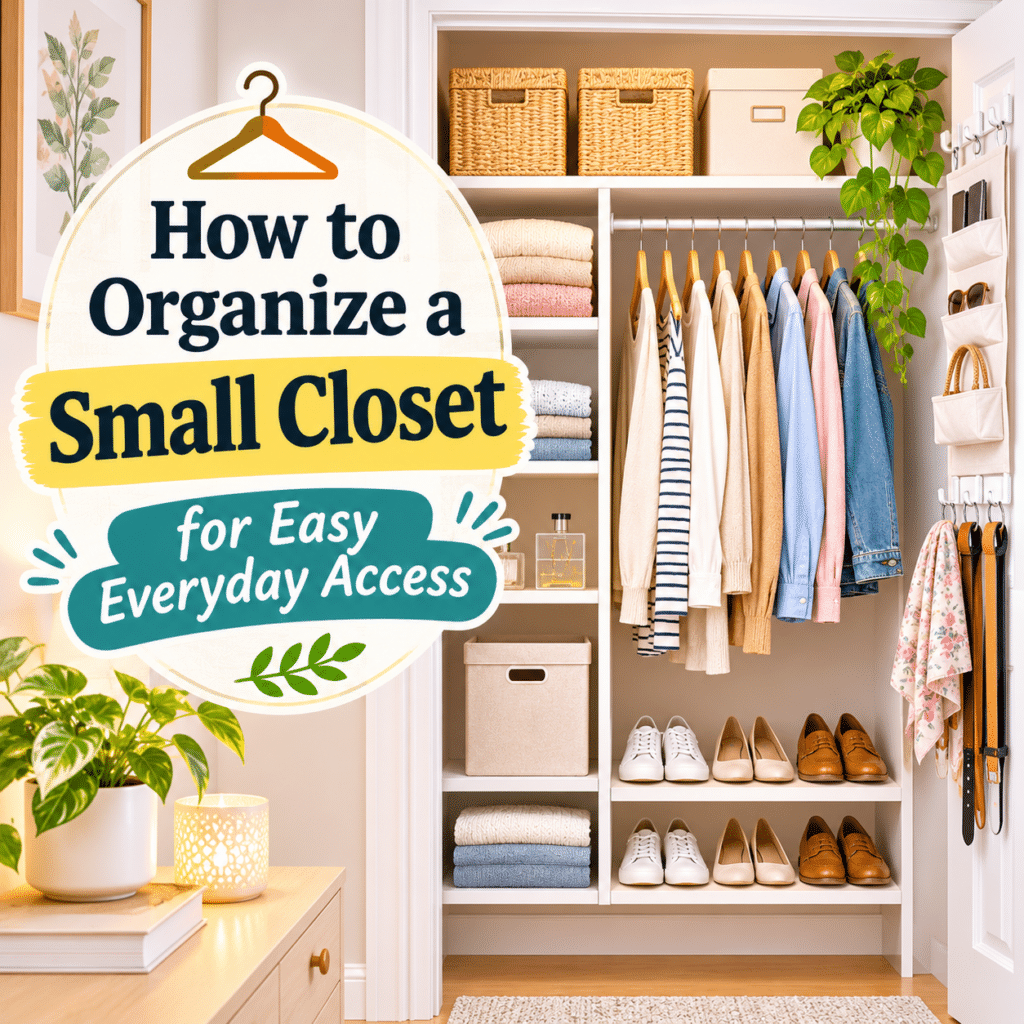
1. Understand the Challenges of a Small Closet
Small closets often have limited hanging space, shallow shelves, narrow door openings, or awkward corners.
These physical limitations become more noticeable when the closet contains a mixture of clothing, shoes, bags, accessories, seasonal belongings, and miscellaneous household items.
Common difficulties include:
- Clothing packed too tightly to browse comfortably.
- Shoes stacked without a clear arrangement.
- Accessories becoming tangled or misplaced.
- Upper shelves that are difficult to reach.
- Unused space beneath hanging garments.
- Storage containers that block access to other items.
- Seasonal clothing competing with everyday essentials.
- Frequently used belongings stored behind rarely used items.
The solution is not necessarily to add more shelves or containers.
Effective organization begins by understanding how the available space can support your actual storage needs.
2. Define Your Closet’s Main Purpose
Before reorganizing anything, decide what the closet should primarily store.
A bedroom closet may need to accommodate everyday clothing, shoes, and accessories.
A hallway closet may serve a different purpose, holding jackets, umbrellas, bags, and seasonal outerwear.
A shared closet may require separate storage zones for multiple people.
Identifying the primary purpose helps prevent unrelated belongings from gradually occupying valuable space.
Ask yourself:
- What do I need to access every day?
- Which items are used only occasionally?
- What belongs in this closet rather than elsewhere?
- Which belongings currently create the most inconvenience?
- What would make my morning or evening routine easier?
Your answers will guide the layout and organization system.
3. Measure Your Available Closet Space
Accurate measurements are essential before changing shelves, purchasing organizers, or rearranging storage.
Measure the closet’s width, height, and usable depth.
Also examine the available space around existing rods, shelves, doors, and drawers.
Important measurements include:
| Closet Feature | What to Measure | Why It Matters |
|---|---|---|
| Overall width | Side wall to side wall | Determines available storage capacity |
| Usable depth | Front opening to back wall | Helps select suitable organizers |
| Hanging height | Rod to floor or lower obstruction | Determines garment clearance |
| Upper shelf | Width, depth, and clearance | Helps plan occasional-use storage |
| Floor area | Width and usable depth | Identifies shoe or basket storage space |
| Door clearance | Space needed to open and close | Prevents interference with organizers |
| Side gaps | Remaining space beside storage fixtures | Reveals opportunities for narrow accessories |
Measure at more than one point if the closet has uneven walls or built-in features.
Keep these dimensions available when evaluating storage products.
A well-designed organizer is not useful if it does not fit the actual space.
4. Gather Basic Organization Supplies
You can begin with simple household materials.
Useful supplies include:
- Laundry baskets or sorting containers.
- Donation bags.
- A measuring tape.
- A cleaning cloth.
- Labels and a marker.
- Existing baskets or storage boxes.
- Suitable hangers.
- A small container for accessories.
Optional supplies may include drawer dividers, shelf separators, hanging organizers, or stackable containers.
Avoid purchasing these immediately.
First determine what you intend to keep and how much space those belongings require.
5. Empty the Closet in Manageable Sections
Removing belongings allows you to see the available storage space and evaluate what has accumulated.
For a very small closet, emptying everything may be practical.
For a larger or heavily packed closet, work one section at a time.
Start with a shelf, hanging category, or floor area.
Place belongings on a clean surface where they can be sorted comfortably.
Avoid creating piles that block doorways or walking paths.
As you remove items, notice which parts of the closet are difficult to access and which areas remain underused.
These observations can help you design a more functional arrangement.
6. Sort Everything Into Useful Categories
Grouping similar belongings makes it easier to identify duplicates and understand your storage needs.
Separate items into categories such as:
- Shirts and tops.
- Trousers and jeans.
- Dresses and skirts.
- Jackets and outerwear.
- Sweaters and knitwear.
- Shoes.
- Bags.
- Belts and scarves.
- Jewelry and small accessories.
- Seasonal clothing.
- Miscellaneous belongings.
If the closet contains household items unrelated to clothing, place them in a separate category.
This is also an opportunity to decide whether those objects would be better stored elsewhere.
7. Declutter Before You Organize
A small closet becomes more functional when it contains belongings that genuinely deserve the available space.
Evaluate each item according to its condition, usefulness, comfort, and relevance to your lifestyle.
Consider whether clothing fits properly, whether shoes remain comfortable, and whether accessories are still used.
Do not automatically discard occasional-use items.
Formal clothing, seasonal outerwear, and specialized equipment may be worth keeping even when used infrequently.
However, damaged items, unnecessary duplicates, and belongings that no longer suit your needs may be candidates for repair, donation, recycling, or responsible disposal.
Use a simple sorting system:
| Category | Meaning | Action |
|---|---|---|
| Keep | Useful, necessary, or meaningful belongings | Return to organized storage |
| Repair | Items worth fixing | Set a realistic repair plan |
| Donate | Clean, usable belongings no longer needed | Give to an appropriate recipient |
| Sell | Items with realistic resale value | Set a reasonable listing deadline |
| Recycle | Materials accepted by local services | Follow local recycling guidance |
| Discard | Unusable items without suitable recovery options | Dispose of responsibly |
The purpose is to create usable space without removing belongings that genuinely support your life.
8. Clean the Closet Before Reorganizing
Once a section is empty, clean the exposed surfaces.
Dust shelves, wipe accessible walls, and vacuum the floor.
Inspect corners for accumulated dust, moisture, or signs of pests.
Allow surfaces to dry before returning clothing or storage containers.
If you notice persistent dampness, investigate the source before placing fabrics back into the area.
Cleaning at this stage is easier than attempting to reach surfaces around crowded belongings later.
9. Divide the Closet Into Functional Zones
One of the most effective small-closet strategies is to assign different areas to different storage purposes.
A practical arrangement may include three vertical zones.
Upper Zone: Occasional-Use Storage
Use higher shelves for lightweight belongings that are needed less frequently.
Examples include seasonal accessories, spare linens, or protected clothing.
Middle Zone: Everyday Essentials
Reserve the easiest-to-reach area for frequently worn clothing and accessories.
This is usually the most valuable part of the closet.
Lower Zone: Shoes and Compact Storage
Use floor-level space for shoes, suitable baskets, or other items that can be accessed without obstructing hanging garments.
The exact arrangement depends on your closet dimensions and physical accessibility needs.
The principle is simple: the items you use most often should require the least effort to retrieve.
10. Prioritize Everyday Clothing
Frequently worn clothing should occupy the most accessible positions.
If you wear certain shirts, trousers, or jackets several times each week, store them where they can be reached without moving other items.
Place less frequently worn garments toward the sides or in secondary storage areas.
Avoid storing daily essentials behind large boxes or beneath heavy stacks.
Think about the order in which you get dressed.
Keeping commonly paired clothing categories near one another may simplify your routine.
For example, work shirts and suitable trousers can be stored in adjacent sections.
A closet should support your habits rather than force you to adapt to an inconvenient arrangement.
11. Choose the Right Hangers
Hangers affect how efficiently clothing fits along a closet rod.
Slim hangers can reduce the amount of space occupied by bulky hanger frames.
However, the narrowest hanger is not always the best choice.
Structured jackets, heavy coats, and delicate garments may require appropriate support to maintain their shape.
Consider these options:
| Hanger Type | Suitable Use | Important Consideration |
|---|---|---|
| Slim hangers | Many everyday shirts and lightweight garments | Choose sufficient strength |
| Broad-shoulder hangers | Jackets and structured clothing | Help support garment shape |
| Trouser hangers | Trousers and selected skirts | Avoid sharp creases where possible |
| Clip hangers | Skirts and compatible garments | Protect delicate fabrics |
| Padded hangers | Certain delicate garments | May occupy more space |
| Multi-tier hangers | Selected lightweight items | Can reduce visibility and accessibility |
Use consistent hanger styles where practical, but prioritize garment care and ease of use over visual uniformity.
12. Arrange Hanging Clothes by Category
Grouping hanging clothes by type makes it easier to find specific garments.
A simple order might be:
- Jackets and coats.
- Dresses.
- Shirts and blouses.
- Trousers.
- Skirts.
- Frequently used specialty clothing.
Within each category, you can arrange items by color, length, or frequency of use.
Color organization may create a visually consistent appearance, but it is optional.
For everyday convenience, grouping by garment type is often more useful than arranging everything by color alone.
Leave enough space between garments to browse comfortably.
If clothing is packed so tightly that items cannot be removed without pulling several others along, consider reducing the hanging quantity or changing the storage arrangement.
13. Use Double Hanging Rods When Appropriate
A second hanging rod can increase usable hanging capacity in closets that have sufficient height.
This arrangement works especially well for shorter garments such as shirts, blouses, and folded trousers on suitable hangers.
However, it is not appropriate for every closet.
Long dresses, coats, and other full-length garments require more vertical clearance.
Before installing another rod, measure the longest garments intended for each section.
Confirm that the rod, brackets, and supporting structure can safely handle the expected load.
If installation is not practical, consider other ways to improve storage without modifying the closet.
14. Fold Clothing That Does Not Need Hanging
Not every garment belongs on a hanger.
Sweaters, knitwear, casual shirts, jeans, and some activewear can often be stored folded.
Folding may also help preserve the shape of garments that could stretch when hung.
Choose a method that matches your available storage.
Traditional horizontal stacks work well on shelves when the stacks remain manageable.
Vertical folding can improve visibility inside suitable drawers or bins.
Avoid forcing garments into containers that are too small.
The best folding method is one that protects the fabric and makes clothing easy to retrieve and return.
15. Organize Closet Shelves Efficiently
Shelves can provide valuable storage, but deep or crowded shelves often hide belongings.
Group similar items together.
Use shelf dividers when they help prevent folded stacks from collapsing.
Keep stacks low enough to remain stable and accessible.
Place frequently used clothing toward the front.
Reserve higher or deeper shelf positions for occasional-use belongings.
If a shelf is too deep to reach comfortably, consider a removable basket that allows you to retrieve its contents together.
Avoid stacking heavy containers overhead.
16. Make Better Use of Vertical Space
Vertical space is often underused in compact closets.
Depending on the layout, useful options may include:
- Additional adjustable shelves.
- Hanging fabric compartments.
- Narrow wall-mounted hooks.
- Shelf dividers.
- Suitable over-door organizers.
- Compact stacked storage containers.
However, vertical storage should not interfere with doors, ventilation, or access to other belongings.
Install wall-mounted fixtures according to their instructions and appropriate weight limits.
Tall freestanding units may require anchoring to reduce tipping hazards.
The objective is not to fill every available inch.
It is to use the space without making the closet difficult or unsafe to operate.
17. Organize Shoes Without Crowding the Floor
Shoes can quickly occupy a disproportionate amount of space.
Begin by grouping them according to type and frequency of use.
Keep everyday footwear in the most accessible location.
Occasional-use shoes can be stored in less prominent areas.
Possible storage arrangements include low shoe racks, suitable shelves, individual compartments, or breathable storage containers.
Avoid stacking delicate shoes in ways that deform them.
Clean and dry footwear before long-term storage.
If the closet is extremely narrow, consider whether some shoes would be better stored in an entryway or another designated area.
18. Store Bags and Handbags Properly
Bags vary in size, shape, and storage requirements.
Frequently used bags should be easy to retrieve.
Smaller bags may fit inside shelf compartments or suitable organizers.
Structured handbags may benefit from upright storage that helps preserve their shape.
Avoid hanging heavy bags from hooks that cannot support their weight or that may damage the straps.
For occasional-use bags, remove unnecessary contents before storing them.
Keep delicate materials away from excessive moisture, direct sunlight, and conditions that may cause deterioration.
If space permits, separate everyday bags from travel or special-occasion accessories.
19. Organize Belts, Scarves, and Small Accessories
Small accessories often become difficult to find because they are mixed with larger belongings.
Create dedicated storage for each category.
Belts can be rolled, hung, or placed in compartments depending on their material and construction.
Scarves may be folded or arranged on suitable organizers.
Jewelry and delicate accessories benefit from protective compartments that reduce tangling and friction.
Keep frequently used pieces visible or easily accessible.
Avoid storing too many unrelated accessories in one container.
Simple categorization can make a significant difference without requiring specialized products.
20. Use Closet Doors Carefully
Closet doors may offer additional storage opportunities.
Over-door organizers can hold lightweight accessories, scarves, selected shoes, or other suitable items.
Hooks may also provide convenient locations for frequently used belongings.
However, door-mounted storage is not always appropriate.
Check that the door can open and close normally.
Ensure that organizers do not interfere with hinges, handles, frames, or nearby furniture.
Avoid overloading doors or placing heavy objects where they could fall.
For sliding closet doors, consider alternatives that do not obstruct movement.
21. Choose Storage Baskets and Bins Thoughtfully
Baskets and bins can help organize smaller categories.
They are especially useful for belongings that would otherwise become scattered.
Examples include seasonal accessories, spare clothing, workout equipment, and small personal items.
Choose containers based on the actual dimensions of your shelves.
Transparent containers make contents easier to identify.
Opaque baskets may create a calmer appearance when labels are used.
Fabric containers can be lightweight and convenient, but they should be suitable for the items being stored.
Avoid buying more containers than you need.
A container should solve a specific storage problem rather than simply hide clutter.
22. Label Storage Areas for Easier Access
Labels are particularly useful when several similar containers share a shelf.
Use short, specific descriptions such as:
- Winter Accessories.
- Workout Clothing.
- Travel Essentials.
- Spare Linens.
- Seasonal Scarves.
- Special-Occasion Accessories.
Avoid vague labels such as “Extra Stuff” or “Miscellaneous.”
Specific labels make it easier to retrieve belongings without opening every container.
For shared closets, labels can also help household members understand where items belong.
Keep the system simple enough to update as your storage needs change.
23. Store Seasonal Clothing Separately
Seasonal clothing may occupy valuable space even when it is not currently needed.
Consider moving infrequently used seasonal garments to suitable upper shelves, under-bed storage, or another designated location.
Clean and fully dry clothing before storing it.
Use containers or garment protection appropriate to the fabric and storage conditions.
Avoid tightly compressing delicate garments or items that may lose their shape.
Keep a small selection of transitional clothing accessible if weather conditions vary.
When seasons change, review stored items before returning them to everyday storage.
This creates an opportunity to identify clothing that no longer fits your needs.
24. Protect Delicate and Special-Occasion Clothing
Formalwear, delicate fabrics, and structured garments may require more careful storage.
Follow garment care instructions when available.
Use appropriate hangers or folding methods.
Avoid overcrowding delicate clothing against rough accessories or hardware.
Choose breathable protective storage when suitable for the material.
Inspect stored garments periodically for moisture, pests, or fabric deterioration.
Do not assume that airtight compression storage is appropriate for every fabric.
Protecting valuable clothing can be more important than maximizing storage density.
25. Organize a Shared Small Closet
A shared closet requires clear boundaries and cooperative planning.
Begin by identifying each person’s storage needs.
Divide hanging rods, shelves, drawers, or containers into practical sections.
The allocation does not necessarily need to be equal.
One person may have more hanging garments, while another may need more folded storage.
Discuss which areas should remain shared and which should be personal.
Avoid reorganizing or discarding another person’s belongings without permission.
A shared system works best when everyone can understand and maintain it.
26. Make a Small Closet Work for Different Clothing Needs
Closet organization should reflect your lifestyle.
Someone who wears professional clothing regularly may need more hanging space.
A person who prefers casual clothing may benefit from additional shelves or drawers.
A household with many outdoor activities may require accessible storage for jackets and accessories.
Consider how your clothing needs change throughout the week.
Organize around your most common routines rather than creating a rigid system that looks attractive but feels inconvenient.
A functional closet is personalized.
27. Improve Visibility Inside the Closet
Poor lighting can make a small closet feel more crowded and difficult to use.
Begin by checking whether existing lighting adequately illuminates shelves and hanging areas.
If additional lighting is needed, consider suitable battery-operated or professionally installed fixtures.
Choose lighting appropriate to the environment and follow manufacturer instructions.
Avoid unsafe wiring, overloaded outlets, or fixtures that generate excessive heat near fabrics.
Light-colored shelf surfaces and clear organization can also improve visibility.
The purpose is to make belongings easier to identify without creating unnecessary complexity.
28. Keep Frequently Used Items at Comfortable Heights
Accessibility is essential for everyday convenience.
Place commonly used clothing and accessories within a comfortable reaching range.
Avoid requiring a step stool for routine items whenever possible.
Store heavier objects on lower, stable surfaces.
Reserve high shelves for lightweight belongings that are needed occasionally.
If you have limited mobility or other accessibility needs, adapt shelf heights, handles, and storage locations accordingly.
A closet should be arranged for the people who use it.
29. Use the Space Beneath Hanging Clothes
The area below shorter hanging garments can provide additional storage.
Depending on the available clearance, it may accommodate:
- Low shoe racks.
- Compact drawers.
- Small baskets.
- Folded clothing containers.
- Selected accessories.
Measure the available height before adding anything.
Ensure that hanging garments do not become crushed against lower storage.
Avoid placing containers where they obstruct the closet opening.
This area is particularly useful when a closet has one long hanging rod but limited shelving.
30. Avoid Overcrowding the Closet
A small closet does not need to be filled to its maximum physical capacity.
When shelves, rods, and drawers are overloaded, belongings become difficult to retrieve.
Crowding can also cause clothing to wrinkle, accessories to become damaged, and storage systems to experience unnecessary strain.
Leave enough room to browse hanging garments.
Keep drawers easy to open and close.
Avoid unstable stacks.
If every section is completely full, reconsider whether some belongings could be stored elsewhere or whether unnecessary items remain.
Accessible storage is more valuable than storage that merely holds the greatest possible quantity.
31. Create a Practical Everyday Closet Layout
A simple layout can help translate organization principles into action.
Consider the following arrangement for a compact reach-in closet.
| Closet Area | Recommended Contents | Accessibility |
|---|---|---|
| Upper shelf | Lightweight seasonal clothing and occasional-use accessories | Occasional |
| Main hanging section | Frequently worn shirts, jackets, and dresses | Daily |
| Secondary hanging section | Shorter garments where space permits | Regular |
| Middle shelves | Folded clothing and everyday accessories | Daily |
| Lower shelves | Shoes and suitable compact storage | Regular |
| Door or side area | Lightweight scarves, belts, or small accessories | Daily or weekly |
| Labeled containers | Less frequently used categories | As needed |
This is only a starting point.
Adjust the arrangement according to your closet dimensions, garment lengths, and personal routines.
32. Follow a Step-by-Step Small Closet Organization Plan
Use the following sequence to complete the project efficiently.
Step 1: Identify Your Main Storage Problems
Determine whether the greatest challenge is overcrowded hanging space, inaccessible shelves, scattered shoes, or mixed accessories.
Step 2: Measure the Closet
Record usable dimensions and note doors, fixtures, and awkward areas.
Step 3: Remove Belongings by Section
Work in manageable categories to avoid unnecessary disorder.
Step 4: Sort Similar Items Together
Group clothing, shoes, bags, and accessories.
Step 5: Decide What to Keep
Evaluate usefulness, condition, fit, and personal importance.
Step 6: Clean the Available Space
Remove dust and inspect surfaces before replacing belongings.
Step 7: Assign Storage Zones
Reserve the easiest-to-reach areas for everyday essentials.
Step 8: Arrange Hanging and Folded Clothing
Use suitable hangers, shelves, and folding methods.
Step 9: Organize Shoes and Accessories
Give smaller categories designated locations.
Step 10: Add Storage Accessories Only Where Needed
Use measurements to select suitable organizers.
Step 11: Label Secondary Storage
Make occasional-use belongings easy to identify.
Step 12: Test the Closet During Normal Use
Observe how easily you can retrieve and return items.
Make adjustments when necessary.
33. Organize a Small Closet on a Limited Budget
An effective closet organization project does not require expensive custom cabinetry.
Begin by using existing shelves, rods, hangers, and containers.
Repurpose suitable baskets or boxes already available in your home.
Rearrange clothing to make better use of existing space.
Use simple labels rather than purchasing elaborate storage systems.
If additional equipment is necessary, prioritize the items that solve your biggest accessibility problems.
For example, a basic shelf divider may be more useful than a large decorative organizer.
Spend money only after identifying a specific need.
34. Adapt the System for a Rental Home
Renters may need closet organization solutions that do not require permanent modifications.
Consider removable organizers, freestanding storage, suitable hanging compartments, or existing shelf arrangements.
Check lease conditions before drilling or installing fixtures.
Do not assume that adhesive hooks or temporary rods can safely support heavy loads.
Follow product instructions and weight limits.
A flexible storage system can also be easier to relocate when moving to another home.
35. Organize a Closet With Awkward Corners or Shallow Shelves
Not every closet has a rectangular, evenly divided interior.
Some contain sloped ceilings, narrow side sections, deep corners, or shallow shelves.
Rather than forcing standard organizers into these spaces, identify what each area can comfortably accommodate.
Shallow shelves may work well for folded clothing or small accessories.
Deep corners may be more suitable for occasional-use belongings stored in removable containers.
Narrow side spaces may accommodate lightweight hanging accessories.
Avoid storing frequently used items in locations that require moving several other objects.
The arrangement should reduce effort rather than create additional obstacles.
36. Maintain Your Closet With Simple Daily Habits
Closet organization becomes sustainable when returning items is easy.
Hang clothing back in its designated section.
Return folded garments to appropriate shelves.
Keep shoes in their assigned locations.
Place laundry in a separate basket rather than allowing it to accumulate on closet surfaces.
Avoid using the closet as temporary storage for unrelated belongings.
These habits do not need to be rigid.
A few consistent actions can prevent the space from gradually becoming overcrowded again.
37. Review Your Closet Periodically
Your clothing needs may change with the seasons, work routines, personal preferences, and household circumstances.
Review the closet periodically to ensure that the arrangement still works.
Look for clothing that is no longer worn, storage containers that are difficult to access, and areas where clutter repeatedly accumulates.
Reevaluate the placement of everyday essentials.
If a particular system consistently fails, simplify it.
Organization should evolve with your needs rather than remain fixed indefinitely.
38. Avoid Common Small Closet Organization Mistakes
Several mistakes can reduce the effectiveness of an otherwise thoughtful arrangement.
1. Buying organizers before measuring.
Measure the space and identify your needs first.
2. Keeping every garment on a hanger.
Fold suitable clothing to free hanging space.
3. Storing everyday items too high.
Keep frequently used belongings within comfortable reach.
4. Overloading shelves and rods.
Respect structural and product weight limits.
5. Mixing unrelated categories.
Group similar belongings for easier retrieval.
6. Using containers without labels.
Identify secondary storage clearly.
7. Hiding frequently used items behind boxes.
Prioritize visibility and access.
8. Ignoring the space beneath shorter garments.
Evaluate whether compact lower storage would help.
9. Keeping unnecessary duplicates.
Review quantities according to realistic needs.
10. Choosing appearance over function.
A beautiful closet is not useful if everyday items are difficult to reach.
11. Creating overly complicated folding systems.
Choose methods that are easy to maintain.
12. Failing to adjust the arrangement.
Review the system after using it in daily life.
39. Troubleshoot Common Small Closet Problems
Even after organizing, certain difficulties may remain.
| Problem | Possible Cause | Practical Solution |
|---|---|---|
| Clothes are difficult to browse | Hanging rod is overcrowded | Reduce hanging quantity or fold suitable garments |
| Shelves become messy quickly | Stacks are too high or categories are mixed | Use smaller groups or dividers |
| Shoes occupy too much floor space | No designated arrangement | Add a suitable low rack or relocate occasional-use shoes |
| Accessories disappear | Small items are mixed together | Use dedicated compartments |
| Upper shelves are inconvenient | Everyday items are stored too high | Move frequent-use items lower |
| Closet doors do not close properly | Organizers or clothing obstruct movement | Remove or reposition the obstruction |
| Storage bins are difficult to access | Containers are too large or deep | Use smaller, removable containers |
| Clothing becomes wrinkled | Garments are compressed together | Allow more space or change storage methods |
| Closet smells musty | Possible moisture or ventilation issue | Investigate and address the underlying cause |
| Organization does not last | Storage locations are inconvenient | Simplify the system around everyday routines |
Persistent moisture, structural damage, or unsafe fixtures should be addressed before further storage modifications.
40. Design a Closet That Can Adapt Over Time
A small closet should not require a complete redesign whenever your clothing needs change.
Choose flexible arrangements where possible.
Adjustable shelves, movable containers, and simple categories can accommodate new belongings or changing routines.
Avoid filling every available space permanently.
Leave enough flexibility to reorganize seasonal clothing or accommodate different garment types.
Review the arrangement when your lifestyle changes.
A closet that remains easy to use over time is more valuable than one that looks perfectly arranged for only a few days.
Practical Small Closet Organization Checklist
Use this checklist to organize your closet systematically.
Planning and Preparation
- Identify the main problems with the current closet.
- Define the closet’s primary storage purpose.
- Measure width, height, depth, and available clearance.
- Gather sorting supplies.
- Choose a manageable starting section.
- Plan safe storage for heavy or hazardous belongings.
Decluttering
- Group clothing by category.
- Review fit, condition, and usefulness.
- Identify unnecessary duplicates.
- Separate items for donation, repair, or disposal.
- Review shoes, bags, and accessories.
- Remove unrelated belongings where appropriate.
Organizing Hanging Space
- Group hanging garments by type.
- Place everyday clothing within easy reach.
- Use appropriate hangers.
- Leave enough room to browse garments.
- Evaluate whether double hanging is practical.
- Protect delicate and structured clothing.
Shelves and Accessories
- Fold suitable clothing.
- Keep shelf stacks manageable.
- Organize shoes in a designated area.
- Assign storage for bags and accessories.
- Use labeled containers where helpful.
- Reserve upper shelves for lightweight occasional-use items.
- Keep doors and walking areas unobstructed.
Long-Term Maintenance
- Return clothing to designated locations.
- Keep laundry separate from clean storage.
- Review seasonal belongings periodically.
- Avoid unnecessary storage purchases.
- Adjust the arrangement when routines change.
- Check that shelves, rods, and organizers remain secure.
Frequently Asked Questions
1. What is the best way to organize a very small closet?
Begin by decluttering, measuring the available space, and assigning storage zones. Keep everyday clothing accessible, fold suitable garments, and use vertical space carefully without overcrowding.
2. How can I make a small closet hold more clothes?
Improve the use of existing shelves and hanging space, fold suitable garments, and consider additional storage only when dimensions and weight limits allow. Reducing unnecessary duplicates can also free valuable space.
3. Should I hang or fold my clothes in a small closet?
Hang garments that benefit from maintaining their shape or avoiding wrinkles. Fold suitable knitwear, casual clothing, and other items that do not require hanging. Follow garment care recommendations when available.
4. Are slim hangers better for small closets?
Slim hangers can reduce the space occupied by hanger frames, but they may not support every garment appropriately. Use stronger or broader hangers for clothing that requires additional support.
5. How should I organize a small closet without drawers?
Use existing shelves, suitable baskets, hanging compartments, or compact organizers. Group small items by category and keep frequently used belongings accessible.
6. What should I store on the top shelf of a closet?
Upper shelves are generally suitable for lightweight, occasional-use items such as seasonal accessories or spare linens. Avoid storing heavy objects overhead.
7. How do I organize shoes in a narrow closet?
Use a compact shoe rack, low shelf, or suitable individual compartments. Keep everyday footwear accessible and consider storing occasional-use shoes elsewhere.
8. Can I use two hanging rods in a small closet?
Yes, if the closet has sufficient height and the supporting structure can safely accommodate the installation. Double hanging is especially useful for shorter garments.
9. How do I organize a shared small closet?
Discuss storage needs, divide space into practical zones, and establish clear locations for shared and personal belongings. Avoid changing another person’s storage without agreement.
10. How can I organize a small closet without buying anything?
Declutter unnecessary items, rearrange existing clothing, group belongings by category, reuse suitable containers, and make better use of current shelves and hanging space.
11. What is the best way to store seasonal clothing?
Clean and fully dry garments before storage. Use suitable containers or protective coverings, avoid damaging compression, and keep seasonal items in an appropriate environment.
12. How can I keep folded clothes from becoming messy?
Create smaller stacks, group garments by category, and use shelf dividers or containers when helpful. Choose a folding method that is easy to repeat.
13. Should I organize my closet by color or clothing type?
Clothing type is often more practical for everyday access. Color organization can be added within categories if it helps you find items or creates a preferred appearance.
14. How often should I reorganize a small closet?
Review the arrangement whenever your clothing needs change or access becomes inconvenient. Seasonal reviews and simple daily habits may be sufficient for many households.
15. How do I prevent my small closet from becoming cluttered again?
Maintain designated storage locations, return belongings after use, review unnecessary purchases, and periodically remove items that no longer serve your needs. Keep the system simple enough to maintain.
Final Thoughts
Organizing a small closet is less about maximizing the number of belongings it can hold and more about making the available space practical, accessible, and comfortable to use.
A successful arrangement begins with understanding your storage needs, evaluating what belongs in the closet, and dividing the space into functional zones. Frequently used clothing should be easy to reach, while seasonal and occasional-use belongings can occupy less accessible areas.
Simple improvements such as grouping garments, folding suitable clothing, using appropriate hangers, organizing accessories, and labeling secondary storage can make a meaningful difference without requiring major renovations.
It is equally important to avoid overcrowding. A closet that holds fewer belongings but allows you to find and return everything comfortably may serve you better than one packed to its physical limits.
As your lifestyle and wardrobe evolve, your organization system can evolve as well. Flexible storage, occasional reviews, and manageable daily habits help preserve the benefits of your efforts.
The most effective small closet is not the one that stores the most, but the one that makes everyday life easier with the space you already have.