Everyday life involves a constant flow of products, packaging, household supplies, and personal belongings. From shopping bags and storage containers to clothing, furniture, jars, and office materials, many items pass through our homes as we cook, clean, organize, work, and enjoy our routines.
Some products are designed for a single use, while others can remain useful for months or years. Yet even items that have completed their original purpose may still have practical value.
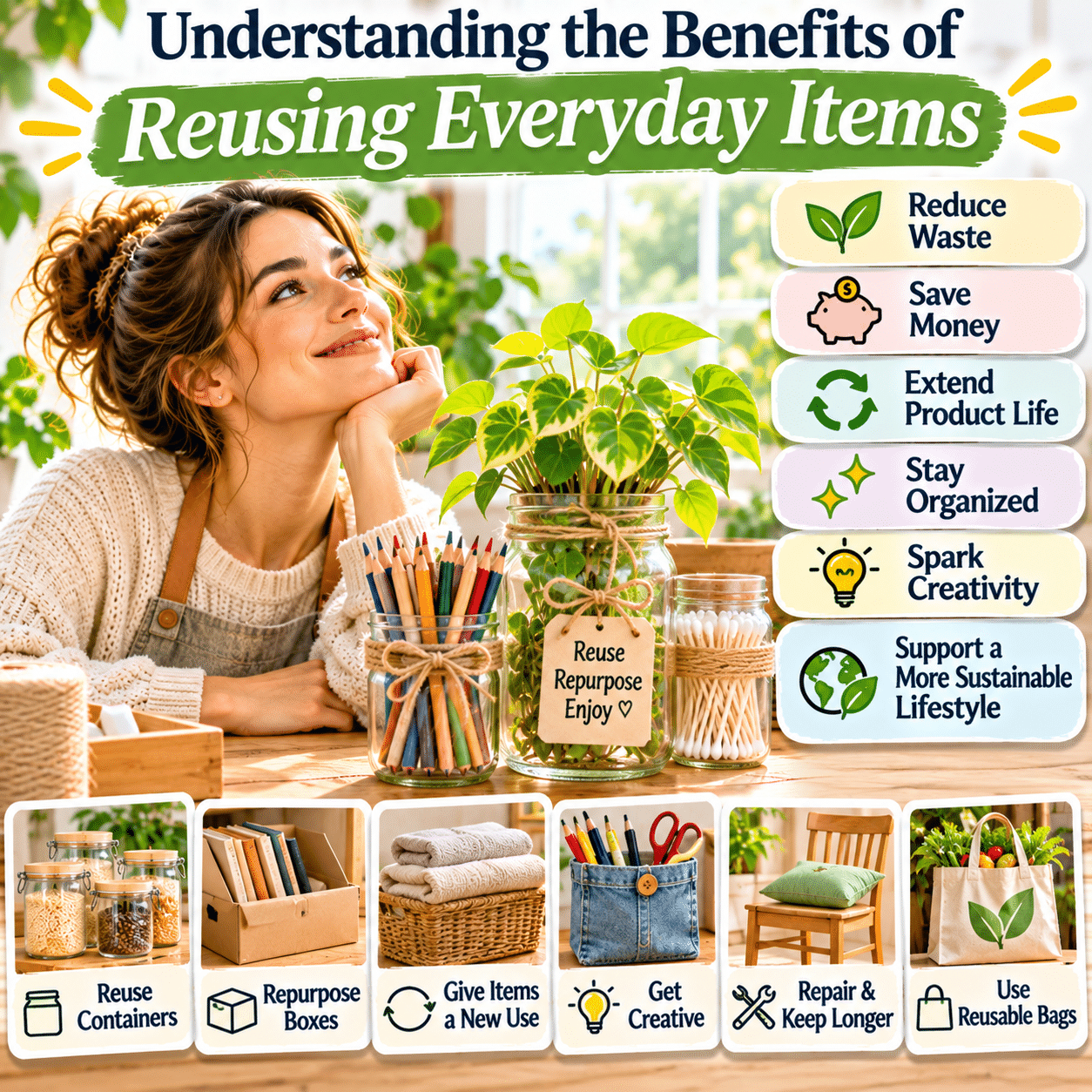
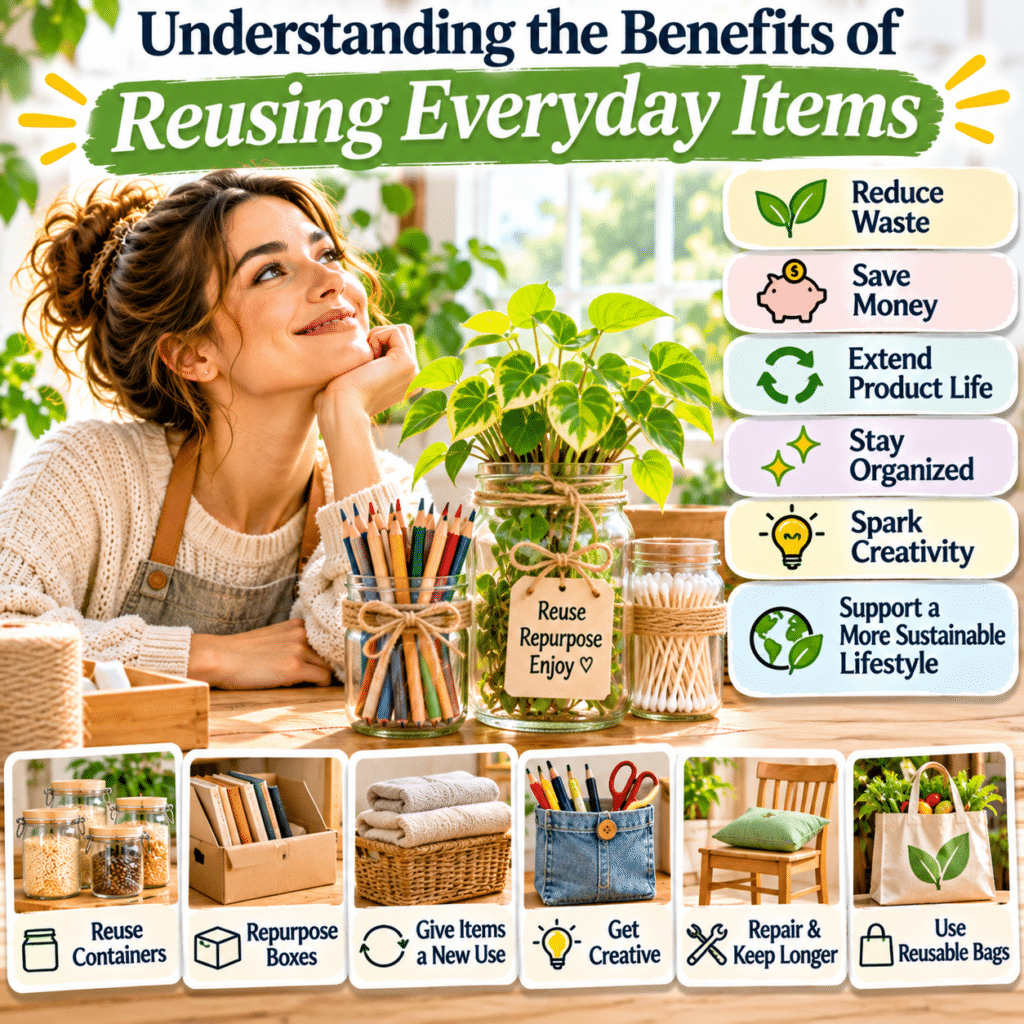
A glass jar that once held food might become a container for small household supplies. A sturdy cardboard box may help organize a closet. A reusable shopping bag can serve countless shopping trips when cared for appropriately. An old piece of furniture may continue providing useful service after minor repairs or a change of location.
These examples illustrate the idea of reusing everyday items.
Reuse means using an item again, either for its original purpose or for another suitable purpose, without necessarily transforming it through industrial processing. It differs from recycling, which generally involves collecting and processing materials to produce new materials or products.
Reusing belongings can offer several potential benefits. It may reduce unnecessary purchases, make better use of available resources, support household organization, encourage creativity, and sometimes reduce the amount of material discarded.
However, reuse is not automatically the best choice in every situation. Safety, hygiene, practicality, maintenance, and the environmental impacts of different alternatives must also be considered.
A container designed for nonfood chemicals should not be repurposed for food storage. Damaged electrical equipment should not remain in service simply to avoid replacement. Likewise, keeping large quantities of unwanted objects in the name of reuse can create clutter rather than meaningful value.
The most effective approach is thoughtful and selective: recognize opportunities to extend the useful life of appropriate items while respecting their limitations.
Understanding the benefits of reusing everyday items can help households develop practical habits that support convenience, financial awareness, and more intentional consumption.
1. Reuse Begins With Recognizing Existing Value
Many objects are discarded because their original purpose has ended, not necessarily because they have become unusable.
A storage box may no longer be needed for its original contents but remain suitable for organizing another area.
A piece of fabric may no longer function as clothing but still be useful for an appropriate household task.
Recognizing remaining value encourages people to consider an item’s condition and possible applications before discarding it.
This does not mean every object must be saved.
The goal is to identify useful opportunities rather than preserve belongings without a clear purpose.
2. Reusing Items Can Reduce Unnecessary Purchases
One of the most practical benefits of reuse is the possibility of avoiding purchases that are not genuinely needed.
Before buying a new organizer, container, or household accessory, consider whether something already available can serve the same purpose.
A sturdy box may organize stationery.
An existing basket may hold cleaning supplies.
A suitable jar may store small nonfood items.
When an existing object meets the need safely and effectively, purchasing a replacement may be unnecessary.
This approach can help households use their resources more intentionally.
3. Reuse Can Support Household Budget Management
Everyday expenses accumulate through frequent small purchases.
Storage accessories, shopping bags, cleaning supplies, decorative containers, and organizational products may seem inexpensive individually.
However, repeated spending can become significant over time.
Reusing suitable belongings may reduce some of these costs.
The financial benefit depends on the value of the avoided purchase and any costs involved in cleaning, repairing, or adapting the item.
Reuse is most economical when the process remains simple and practical.
4. Reuse Can Extend the Useful Life of Products
Many products retain useful functions beyond their first period of ownership.
A sturdy piece of furniture may serve different rooms over time.
A reusable container may support various organizational needs.
A durable bag may remain useful for years when maintained appropriately.
Extending useful life allows more value to be obtained from products that have already been manufactured.
However, continued use should remain safe and appropriate.
Longevity is beneficial only when the item still performs a meaningful purpose.
5. Reuse May Reduce Household Waste
Discarded products contribute to household waste streams.
When suitable items are reused instead of immediately thrown away, disposal may be delayed or avoided.
For example, using an existing shipping box for storage can reduce the need to discard that box and purchase another container.
The actual waste reduction depends on what would otherwise have happened.
If reuse creates additional unnecessary purchases or requires substantial new materials, the benefit may be smaller.
Thoughtful reuse focuses on genuine substitution.
6. Reuse Can Reduce Demand for New Materials
Manufacturing new products generally requires materials, energy, and other resources.
Using an existing item in place of a newly manufactured alternative may reduce demand for additional production.
However, environmental outcomes depend on the products being compared.
Material composition, transportation, cleaning, durability, and frequency of use can all influence the result.
Reuse should therefore be considered within a broader understanding of product lifecycles.
It is a useful strategy, but not an automatic guarantee of lower environmental impact.
7. Reuse Encourages More Thoughtful Consumption
Reusing belongings encourages people to evaluate what they already own.
Instead of treating every practical need as a reason to shop, they can consider existing resources first.
This habit supports more intentional purchasing.
It may also help reveal patterns of unnecessary accumulation.
For example, a household might discover that it already has enough containers, bags, or small tools.
Awareness can improve future purchasing decisions.
8. Reuse Is Different From Recycling
Reuse and recycling are related but distinct approaches to managing materials.
Reuse generally involves using an existing product again without breaking it down into raw materials.
Recycling involves collecting and processing materials so they can become inputs for new products.
For example, using a glass jar to store suitable household items is reuse.
Processing discarded glass into material for manufacturing new glass products is recycling.
Both can play useful roles.
However, reuse may avoid some processing steps when an item remains suitable for continued use.
9. Reuse Is Not the Same as Repair
Repair involves restoring an item that is damaged or no longer functioning properly.
Reuse involves using an item again, whether or not repair is necessary.
The two practices often overlap.
A repaired chair may continue serving its original purpose.
A repaired wooden drawer might also be adapted into an appropriate storage feature.
Understanding these distinctions helps households consider different options for extending product usefulness.
10. Reusing Shopping Bags Is a Familiar Starting Point
Reusable shopping bags are among the most recognizable examples of everyday reuse.
A durable bag can accompany repeated shopping trips and other errands.
Its practical value depends on suitable construction, load capacity, and regular use.
Bags should be cleaned when necessary, particularly if they have carried raw foods or substances that could cause contamination.
Damaged bags may need repair or replacement.
A manageable number of frequently used bags is generally more practical than accumulating large collections that remain unused.
11. Glass Jars Can Have Useful Secondary Purposes
Glass jars may be suitable for organizing certain household materials after appropriate cleaning.
They can hold craft supplies, buttons, small stationery items, or other dry nonfood objects.
However, not every jar is suitable for repeated food storage, heating, freezing, or pressure processing.
Food-contact suitability, lid condition, and manufacturer guidance matter.
Ordinary commercial food jars should not be assumed safe for home canning.
Choosing safe secondary purposes helps make reuse practical.
12. Containers Can Support Better Household Organization
Reusable containers can help organize belongings across different rooms.
Suitable containers may hold office supplies, craft materials, accessories, or small household objects.
The best choice depends on size, material, condition, and intended contents.
Containers previously used for hazardous substances should not be repurposed for food or personal care products.
Clear labeling can also prevent confusion.
Good organization should make belongings easier to access rather than create unnecessary storage complexity.
13. Cardboard Boxes Can Serve Temporary Storage Needs
Shipping boxes and packaging cartons often remain structurally useful after delivery.
They may help organize seasonal decorations, paperwork, or lightweight household items.
However, cardboard is sensitive to moisture, crushing, pests, and repeated handling.
Boxes should be clean, dry, and suitable for the weight of their contents.
They should not be used where structural failure could create hazards.
Temporary storage is often a practical application.
14. Clothing Can Remain Useful Beyond Its Original Role
Clothing may become unsuitable for regular wear because of changing preferences, fit, or visible wear.
Some garments can still serve another appropriate purpose.
Clean, suitable fabrics may be used for simple craft projects or certain household cleaning tasks.
However, materials should be selected according to their properties.
Not every fabric is appropriate for cleaning delicate surfaces, handling chemicals, or use near heat.
Clothing in good condition may also be passed on to someone who can continue wearing it.
15. Textile Reuse Can Encourage Creative Projects
Fabric remnants, old linens, and unused textiles may provide materials for creative activities.
Simple sewing projects, fabric decorations, or handmade accessories can offer opportunities for personal expression.
The value often lies in making something useful or enjoyable from existing materials.
However, creativity should not become an excuse to accumulate more fabric than can reasonably be used.
Projects are most practical when they match available time, skills, and household needs.
16. Furniture Can Be Reused in Different Rooms
Furniture may remain functional even when household arrangements change.
A small table previously used in a bedroom may become useful in a living area.
A sturdy shelf may serve books, plants, or appropriate household supplies.
Moving furniture between rooms can reduce the need for new purchases.
However, dimensions, stability, load capacity, and safety must be considered.
Furniture should not be modified in ways that compromise its structural integrity.
17. Reusing Furniture Can Preserve Familiar Belongings
Some household objects carry personal memories or sentimental value.
A familiar chair, table, or cabinet may remain meaningful because of its history.
Continued use can preserve these connections.
Minor cosmetic changes may help an item suit a different room, provided they are appropriate for the material.
However, emotional significance should not override safety.
Damaged or unstable furniture may require professional repair or replacement.
18. Kitchen Reuse Requires Particular Attention to Hygiene
Kitchens offer many opportunities for reuse, but food safety is essential.
Containers used for food should be suitable for food contact, cleanable, and appropriate for the intended temperature and contents.
Not every plastic container is designed for repeated heating or long-term storage.
Cracked, damaged, or difficult-to-clean containers may need replacement.
Containers previously used for cleaning chemicals or other hazardous substances should never be repurposed for food.
Safe reuse is more important than avoiding disposal.
19. Reusing Food Packaging Has Important Limitations
Food packaging varies widely in material and intended function.
Some packaging is designed for repeated use, while other packaging is intended for a single application.
Thin plastic containers, disposable utensils, and certain flexible packages may not tolerate repeated washing, heating, or mechanical stress.
Labels and manufacturer guidance should be followed.
When suitability is uncertain, choose a purpose that does not involve food contact or potential exposure to hazardous conditions.
Reuse should not introduce unnecessary health risks.
20. Office Supplies Can Often Be Used More Efficiently
Workspaces frequently contain paper, folders, boxes, clips, and other small supplies.
Some items can be used repeatedly.
Folders may hold different documents over time.
Paper with one blank side may be suitable for informal notes when confidentiality is not a concern.
Storage trays can be rearranged to accommodate changing needs.
However, confidential documents should be handled according to appropriate privacy and disposal requirements.
21. Reuse Can Support More Organized Creative Hobbies
Creative activities often involve small tools, materials, and unfinished projects.
Existing containers, trays, and suitable packaging can help organize these supplies.
For example, clean jars may hold brushes or pencils.
Sturdy boxes may separate craft materials.
This can reduce the need for specialized organizers.
However, tools with sharp edges, chemicals, or other hazards require storage appropriate to their safety needs.
22. Gift Packaging Can Sometimes Be Reused
Gift bags, ribbons, boxes, and decorative materials may remain in good condition after an occasion.
When appropriate, they can be saved for future gifts.
This may reduce repeated purchases of packaging.
However, materials should be stored neatly and protected from moisture or damage.
Reusing gift packaging is most practical when it remains attractive and suitable for the next recipient.
There is no need to preserve every piece of wrapping material.
23. Seasonal Decorations Can Be Used Across Many Years
Holiday and seasonal decorations are often used for relatively short periods each year.
Storing durable decorations carefully can allow repeated use.
Protective packaging, organized containers, and appropriate storage conditions may help preserve their condition.
Some decorations can also be adapted for different occasions.
However, electrical decorations should be inspected for damage and used according to safety instructions.
Repeated use should not compromise safety.
24. Reuse Can Help Households With Limited Storage
Small living spaces benefit from careful selection of belongings.
Multipurpose items can reduce the need for additional products.
A suitable basket might organize different categories of items as household needs change.
A portable container may move between work and hobby areas.
However, reuse should not lead to excessive accumulation.
Keeping only items with clear practical value is particularly important in limited spaces.
25. Reuse Encourages Problem-Solving Skills
Finding appropriate new uses for existing objects involves observation and practical thinking.
People learn to consider dimensions, materials, construction, and functionality.
This can encourage creative problem-solving.
For example, someone may discover that an existing tray is suitable for organizing frequently used desk accessories.
The goal is not to invent complicated projects.
It is to recognize simple solutions using available resources.
26. Children Can Learn About Reuse Through Everyday Activities
Age-appropriate reuse activities can introduce children to practical resource awareness.
They might use clean cardboard for simple crafts or decorate suitable containers for storing art supplies.
Adult supervision is important.
Sharp objects, small choking hazards, unsuitable materials, and potentially contaminated packaging should be avoided.
The purpose is to encourage creativity and responsible habits through safe activities.
27. Reuse Can Become a Shared Household Practice
Household members may identify different opportunities to use existing belongings.
One person might organize reusable bags, while another maintains storage containers.
Shared awareness can reduce unnecessary duplication.
However, reuse systems should remain easy for everyone to understand.
Complicated rules may discourage participation.
Simple, practical habits are often more sustainable than elaborate household projects.
28. Passing Items to Others Extends Their Usefulness
An item that no longer serves one household may still be valuable to someone else.
Books, clothing, furniture, and suitable household goods can sometimes be donated, sold, or given away.
Condition and safety should be evaluated first.
Damaged, unsafe, or unusable products should not be passed on simply to avoid disposal.
Respectful reuse means offering items that another person can genuinely use.
29. Secondhand Markets Support Continued Product Use
Secondhand purchasing and selling allow products to move between owners.
This can extend the useful life of suitable goods.
Books, furniture, clothing, and certain tools may remain useful through multiple ownership periods.
However, product condition, recalls, hygiene, and safety requirements should be considered.
Some categories, particularly safety-critical equipment, require special caution.
Secondhand reuse is valuable when products remain appropriate for continued service.
30. Borrowing and Sharing Are Related to Reuse
Borrowing allows one item to serve multiple people without each person needing to own a separate product.
Tools, books, and occasional-use equipment may be suitable for sharing.
This approach can reduce unnecessary purchases.
However, availability, maintenance, responsibility, and transportation must be considered.
Borrowing is most practical when expectations are clear.
For frequently used essentials, personal ownership may remain more convenient.
31. Reuse Can Reduce Shopping and Replacement Effort
Purchasing new items often involves research, comparison, delivery, and organization.
When an existing item can meet a need, these steps may be avoided.
This can save time as well as money.
For example, using a suitable container already available may be easier than searching for a specialized organizer.
However, extensive cleaning or modification can sometimes require more effort than purchasing an appropriate product.
Practicality should guide the decision.
32. Reuse May Encourage Better Product Care
People who expect to use belongings repeatedly may pay more attention to maintenance.
Cleaning reusable bags, storing containers properly, and protecting furniture can help preserve useful items.
This awareness may also influence future purchases.
Consumers may begin favoring products that are durable, easy to clean, and suitable for repeated use.
Reuse and product care can reinforce each other.
33. Reuse Is Not Always Environmentally Preferable
Although reuse can reduce the need for new products, environmental outcomes depend on context.
An older energy-intensive appliance may consume substantially more electricity than an efficient replacement.
Some reusable products require water, energy, or cleaning supplies after each use.
Transportation and material characteristics may also affect overall impact.
Therefore, reuse should not be treated as an absolute environmental rule.
The most appropriate choice depends on the full situation.
34. Safety Should Always Come Before Reuse
Some products should not be reused after damage, expiration, contamination, or excessive wear.
Examples may include certain medical supplies, damaged electrical equipment, compromised safety products, and unsuitable food containers.
Product-specific instructions and applicable safety guidance should take priority.
An item that appears physically intact may still be unsafe for another purpose.
Responsible reuse involves recognizing limitations.
35. Reuse Should Not Create Unnecessary Clutter
Keeping objects because they might be useful someday can lead to overcrowded storage areas.
Boxes, jars, packaging, and fabric scraps may accumulate faster than they are used.
A practical approach involves keeping items with a clear purpose or realistic near-term use.
Available storage space should also be considered.
Reuse is most helpful when it improves everyday living rather than creating additional management tasks.
36. Not Every Item Needs a Creative Transformation
Online reuse ideas sometimes involve elaborate projects requiring tools, paint, adhesives, or additional materials.
These projects can be enjoyable, but they are not always necessary.
A simple secondary use may provide greater practical value.
For example, using an existing box for storage may be more efficient than transforming it into a decorative object.
Reuse does not need to be visually impressive.
Functionality is often enough.
37. Reuse Should Be Evaluated Against Real Needs
An item is worth reusing when it meets a genuine purpose.
If a household does not need another container, decoration, or organizer, creating one may offer little benefit.
Before keeping or modifying an object, consider whether it will actually be used.
This helps distinguish meaningful reuse from unnecessary accumulation.
The most effective approach connects available items with real household requirements.
38. Reuse Can Complement Repair and Recycling
Reuse, repair, and recycling are not competing ideas.
They can work together throughout a product’s lifecycle.
A product may first be maintained and reused for its original purpose.
Later, a suitable repair may extend its usefulness.
When it can no longer be used safely, appropriate recycling or disposal may be considered.
The best option depends on product condition, available services, and local regulations.
39. Small Reuse Habits Are Often Easier to Maintain
Major household changes are not required to begin reusing items.
Keeping a few reusable shopping bags accessible, using suitable containers already owned, or saving a sturdy box for a specific purpose can be simple starting points.
These habits are easier to maintain when they fit existing routines.
The objective is not to reuse everything.
It is to recognize practical opportunities consistently.
40. The Greatest Benefit of Reuse Is Making Better Use of What Exists
Reusing everyday items encourages a broader understanding of value.
An object’s usefulness does not always end when its original role changes.
With appropriate care and thoughtful selection, some belongings can continue serving practical purposes.
This can support financial awareness, organization, creativity, and more intentional consumption.
However, reuse should always remain safe, manageable, and relevant to real needs.
Its greatest value lies in using existing resources wisely rather than accumulating or transforming objects without purpose.
Understanding Reuse, Repair, Repurposing, and Recycling
These approaches are closely related but serve different functions.
| Approach | Meaning | Everyday example |
|---|---|---|
| Reuse | Using an item again | Using a shopping bag for repeated trips |
| Repair | Restoring a damaged item | Replacing a broken furniture fitting |
| Repurposing | Giving an item a different suitable function | Using a clean jar for craft supplies |
| Refurbishing | Improving an existing item’s condition | Restoring a suitable piece of furniture |
| Sharing | Allowing multiple people to use an item | Sharing an occasional-use tool |
| Donating | Passing a usable item to another owner | Giving away clothing in good condition |
| Recycling | Processing discarded materials for new production | Sending accepted glass to a recycling facility |
| Responsible disposal | Handling unusable items appropriately | Taking hazardous waste to an approved collection point |
These practices can complement one another.
The best option depends on condition, safety, usefulness, and available local services.
Practical Everyday Items That May Be Suitable for Reuse
| Item | Possible reuse | Important consideration |
|---|---|---|
| Reusable shopping bags | Groceries and errands | Clean appropriately and respect load limits |
| Glass jars | Nonfood storage for small items | Inspect for cracks and sharp edges |
| Sturdy cardboard boxes | Temporary organization | Keep dry and avoid overloading |
| Fabric bags | Carrying lightweight belongings | Check seams and cleanliness |
| Old clothing | Suitable craft materials | Choose clean, appropriate fabrics |
| Furniture | Use in another room | Verify stability and load suitability |
| Gift bags | Future gift packaging | Store clean and undamaged |
| Decorative containers | Organizing accessories | Match material to contents |
| Office folders | Repeated document organization | Protect confidential information |
| Storage baskets | Household organization | Avoid overloading |
| Books | Sharing, lending, or donating | Keep in usable condition |
| Plant pots | Repeated planting | Clean appropriately and ensure drainage |
| Shipping envelopes | Suitable noncritical packaging | Check condition and shipping requirements |
| Textile remnants | Simple sewing projects | Avoid unsuitable or contaminated materials |
| Durable trays | Organizing household items | Ensure stability and appropriate use |
Not every item is suitable for every suggested application.
Material compatibility and safety should always be checked before reuse.
How to Decide Whether an Item Is Worth Reusing
A simple decision process can help prevent unnecessary clutter.
Step 1: Inspect the Item
Check its physical condition.
Look for cracks, sharp edges, contamination, loose components, or other damage.
Unsafe items should not be reused.
Step 2: Identify a Genuine Need
Ask whether the household currently needs something the item could provide.
Avoid keeping objects solely because a hypothetical future use is possible.
Step 3: Consider Material Suitability
Determine whether the item’s materials are appropriate for the intended purpose.
Pay particular attention to food contact, heat, moisture, chemicals, and physical loads.
Step 4: Evaluate Cleaning Requirements
Consider whether the item can be cleaned safely and effectively.
Some packaging materials are difficult to sanitize or maintain.
Step 5: Compare Effort and Value
Estimate the time, supplies, and effort required.
A complicated transformation may not be worthwhile if the resulting item has little practical use.
Step 6: Consider Storage Space
Make sure the item can be stored conveniently.
An object that creates persistent clutter may not be worth keeping.
Step 7: Choose an Appropriate Next Step
If reuse is suitable, put the item into service.
Otherwise, consider donation, recycling, or responsible disposal according to its condition and local options.
A Simple Room-by-Room Guide to Reusing Everyday Items
Kitchen
Potential opportunities include using appropriate durable containers repeatedly and keeping reusable shopping bags accessible.
Food safety, material suitability, and cleaning requirements are essential.
Living Room
Existing baskets, trays, and suitable furniture may be rearranged to meet changing needs.
Avoid overcrowding the space.
Bedroom
Storage boxes, fabric organizers, and suitable furniture can sometimes serve different purposes.
Prioritize accessibility and comfort.
Home Office
Folders, trays, and suitable containers may help organize stationery and documents.
Confidential materials should be handled securely.
Bathroom
Some durable organizers can be cleaned and reused for appropriate supplies.
Avoid repurposing containers that previously held hazardous chemicals for personal care or food-related uses.
Balcony or Garden
Suitable plant pots and gardening containers may be reused after appropriate cleaning.
Check drainage, structural condition, and suitability for the intended plants.
Storage Areas
Sturdy boxes and baskets may organize seasonal belongings.
Use clear labels and avoid excessive stacking or overloading.
Reuse Ideas for Different Household Needs
| Household situation | Useful reuse approach | Main benefit |
|---|---|---|
| Small apartment | Multipurpose storage containers | Better use of limited space |
| Family household | Reusable bags and organized supplies | More convenient routines |
| Home office | Reused folders and desk organizers | Reduced duplication |
| Creative hobbyist | Suitable jars and boxes for materials | Practical organization |
| Budget-conscious household | Using existing items before buying | Potential expense reduction |
| Frequent online shopper | Reusing suitable delivery packaging | Less immediate disposal |
| Gardening enthusiast | Reusing appropriate plant containers | Reduced need for new pots |
| Student | Reusing folders and suitable supplies | More economical organization |
| Seasonal decorator | Reusing decorations and gift packaging | Less repeated purchasing |
| Household decluttering | Donating usable belongings | Continued usefulness for others |
Reuse should be adapted to actual needs rather than treated as a universal requirement.
Ten Simple Reuse Habits to Try at Home
1. Keep Reusable Bags Where They Are Needed
Store a manageable number near the entrance, in a suitable vehicle compartment, or alongside shopping essentials.
2. Check Existing Containers Before Buying Organizers
Look through cupboards and storage areas before purchasing new boxes or baskets.
3. Save Packaging Only for a Clear Purpose
Keep suitable boxes when they are likely to be used soon.
Avoid accumulating packaging indefinitely.
4. Reuse Gift Bags in Good Condition
Store a small selection neatly for future occasions.
5. Rearrange Existing Furniture
Consider whether an item can serve another room before replacing it.
6. Maintain Reusable Products
Clean, inspect, and store reusable belongings according to their materials and intended use.
7. Use Suitable Fabric Remnants
Choose manageable projects that meet a real need or provide meaningful enjoyment.
8. Share Occasional-Use Items
Consider borrowing or sharing tools when practical and safe.
9. Pass On Useful Belongings
Donate, sell, or give away items that remain safe and functional but are no longer needed.
10. Review What You Have Kept
Periodically check whether saved materials have been used.
Release items that no longer serve a realistic purpose.
These habits can be introduced gradually without creating a complicated household system.
When Reuse May Not Be the Best Choice
Reuse has limitations, and recognizing them is part of responsible consumption.
| Situation | Why reuse may be unsuitable | Better consideration |
|---|---|---|
| Damaged electrical equipment | Potential shock or fire hazards | Qualified repair or appropriate disposal |
| Contaminated containers | Possible chemical or biological exposure | Safe disposal according to material |
| Cracked food containers | Difficult cleaning or material damage | Replace with suitable food-safe containers |
| Compromised safety equipment | Reduced protective performance | Follow manufacturer replacement guidance |
| Severely unstable furniture | Risk of collapse or injury | Professional repair or replacement |
| Excessive stored packaging | Clutter and potential pest problems | Keep only useful quantities |
| Energy-intensive old appliances | Potentially high ongoing resource use | Compare continued use with efficient alternatives |
| Materials requiring costly transformation | Additional expense and resource use | Evaluate whether reuse is worthwhile |
| Unwanted items with no practical purpose | Storage burden | Donate, recycle, or dispose appropriately |
| Products with expiration-related safety limits | Possible loss of safe performance | Follow product-specific guidance |
The purpose of reuse is to extend meaningful usefulness, not to preserve every object regardless of condition.
Common Mistakes When Reusing Everyday Items
Mistake 1: Keeping Everything for Possible Future Use
Saving excessive materials can create clutter.
Better approach: Keep items with a clear purpose and realistic likelihood of use.
Mistake 2: Ignoring Food Safety
Not all containers are suitable for repeated food contact.
Better approach: Follow material and manufacturer guidance, and never reuse hazardous chemical containers for food.
Mistake 3: Assuming Reuse Always Saves Money
Some projects require additional tools, materials, or extensive labor.
Better approach: Compare the total effort and cost with the practical benefit.
Mistake 4: Using Damaged Items Beyond Safe Limits
Extending product life should not create hazards.
Better approach: Repair appropriately or replace unsafe items.
Mistake 5: Buying Supplies Specifically to Create Unnecessary Reuse Projects
A project may consume more resources than it saves.
Better approach: Begin with existing materials and a genuine need.
Mistake 6: Overlooking Cleaning Requirements
Some reused products require regular cleaning or maintenance.
Better approach: Choose items that can be maintained appropriately.
Mistake 7: Reusing Containers Without Labels
Unclear contents can create confusion or safety risks.
Better approach: Label storage containers clearly, especially when contents are not immediately recognizable.
Mistake 8: Assuming Every Material Is Suitable for Every Purpose
Heat, moisture, chemicals, and physical loads affect materials differently.
Better approach: Match materials to intended conditions.
Mistake 9: Keeping Unusable Items Instead of Passing Them On
Items may remain in storage despite having no realistic household use.
Better approach: Consider appropriate donation, recycling, or disposal.
Mistake 10: Treating Reuse as a Competition
The goal is not to reuse the greatest number of objects.
Better approach: Focus on safe, practical, meaningful applications.
Everyday Reuse Checklist
Use this checklist to support practical decisions.
Before Reusing an Item
- The item remains in suitable physical condition.
- It has a clear practical purpose.
- Its materials are appropriate for the intended use.
- It can be cleaned or maintained adequately.
- There are no relevant safety concerns.
- Reuse will not create unnecessary expense or effort.
- The item fits available storage space.
- The reuse idea meets a real household need.
During Continued Use
- I follow relevant care and safety guidance.
- I inspect the item when appropriate.
- I avoid exceeding its intended capacity.
- I keep containers clearly labeled.
- I maintain suitable hygiene.
- I replace or repair items when necessary.
- I stop using products that become unsafe.
Household Organization
- Reusable shopping bags are accessible.
- Existing containers are considered before new purchases.
- Packaging is saved only when useful.
- Unused materials are reviewed periodically.
- Suitable belongings are passed on when no longer needed.
- Local recycling and disposal requirements are respected.
- Reuse habits remain simple and manageable.
The checklist is intended as a guide, not a requirement to reuse every available object.
Frequently Asked Questions About Reusing Everyday Items
1. What does reusing everyday items mean?
Reusing everyday items means using existing products again, either for their original purpose or for another suitable purpose, rather than immediately discarding them.
2. What are the main benefits of reuse?
Potential benefits include reducing unnecessary purchases, extending product usefulness, supporting household organization, encouraging creativity, and reducing some forms of waste.
3. How is reuse different from recycling?
Reuse involves continued use of an existing item. Recycling generally involves processing discarded materials into inputs for new products.
4. Does reusing items always save money?
No. Savings depend on the avoided purchase and any costs involved in cleaning, repairing, storing, or modifying the item.
5. Is reuse always environmentally better?
Not necessarily. Environmental outcomes depend on materials, cleaning requirements, energy use, transportation, and the alternatives being compared.
6. What household items are easiest to reuse?
Reusable shopping bags, suitable storage containers, sturdy boxes, gift bags, folders, baskets, and certain furniture items are common examples.
7. Can glass jars be reused safely?
Some jars can be reused for suitable purposes after cleaning and inspection. However, not every jar is appropriate for food storage, heating, freezing, or home canning.
8. Can plastic food containers be reused?
Only when the material and product design are suitable for the intended repeated use. Follow manufacturer guidance, especially regarding heating, cleaning, and food contact.
9. How can reuse help reduce clutter?
Using existing containers and furniture can reduce unnecessary purchases. However, keeping excessive materials for hypothetical future projects can increase clutter.
10. Can old clothing be reused?
Yes. Clothing in good condition may be worn by someone else, while suitable fabrics may be used for certain crafts or household purposes. Material safety and cleanliness should guide the choice.
11. Is it better to donate an item than repurpose it?
It depends on whether the item has a genuine use in the household and whether someone else could benefit from it. Both can be appropriate options.
12. How can children learn about reuse?
Children can participate in age-appropriate activities using clean, safe materials, such as simple cardboard crafts or organizing supplies. Adult supervision is important.
13. Should I keep every box and jar for future reuse?
No. Keep only manageable quantities with realistic uses. Excessive accumulation can create storage and hygiene problems.
14. What items should not be reused?
Items that are unsafe, contaminated, structurally compromised, or unsuitable for a new purpose should not be reused. Product-specific safety instructions take priority.
15. What is the easiest way to start reusing more items?
Before buying a nonessential household accessory, check whether something already owned can meet the same need safely and conveniently.
Final Thoughts
Reusing everyday items is a practical way to recognize the value that existing belongings may still provide.
A product does not always lose its usefulness when its original purpose changes. With appropriate care and thoughtful evaluation, some items can continue supporting household routines, organization, creativity, and convenience.
Reuse may also reduce unnecessary spending and delay the disposal of suitable materials.
However, its benefits depend on how thoughtfully it is practiced.
Saving every container, box, or piece of packaging does not automatically create a more efficient household. Likewise, extending the life of unsafe or unsuitable products can introduce unnecessary risks.
The most useful approach is selective.
Begin with items that remain in good condition and can meet a genuine need. Consider whether they are safe, easy to maintain, and appropriate for their intended purpose.
When reuse is not practical, repair, donation, recycling, or responsible disposal may provide better alternatives.
Small habits can make a difference in everyday decision-making. Checking existing supplies before shopping, keeping reusable bags accessible, maintaining household belongings, and passing on usable items can gradually support more intentional consumption.
These practices do not require elaborate projects or a perfectly organized home.
They simply encourage people to make better use of what is already available.
Ultimately, reuse is not about keeping possessions forever. It is about extending meaningful usefulness while balancing convenience, safety, affordability, and responsible resource management.
The greatest benefit of reusing everyday items is learning to recognize lasting value in what we already have—and making practical choices that allow useful belongings to serve us well for longer.