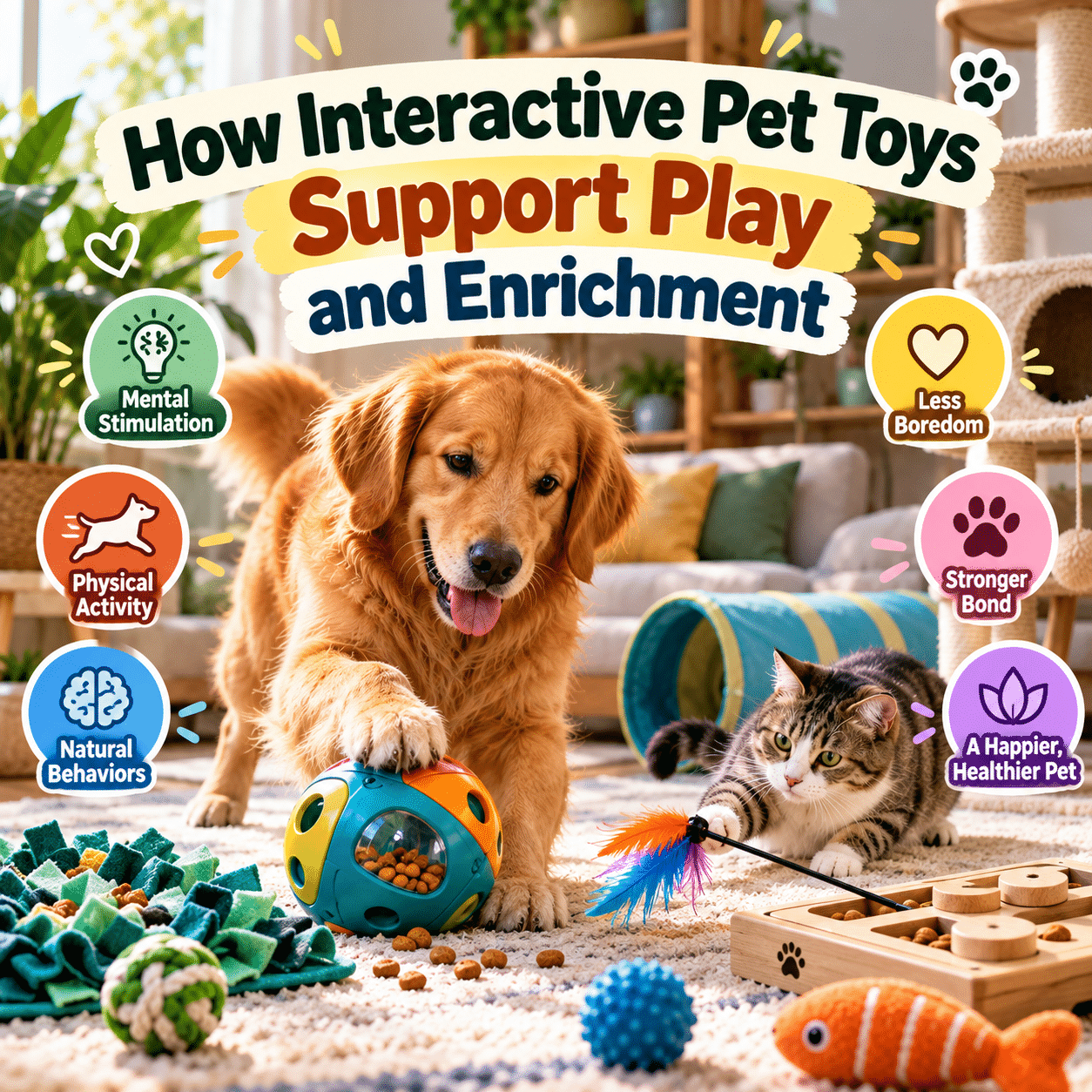
Play is one of the most important parts of a companion animal’s daily life. For dogs, cats, and many other pets, play is more than a source of entertainment. It provides opportunities to explore, investigate, move, solve problems, practice natural behaviors, and interact with the surrounding environment.
Yet modern household routines do not always make it easy to provide varied activities throughout the day.
Indoor living, limited outdoor space, predictable schedules, and long periods of inactivity can reduce the opportunities some pets have to engage in stimulating experiences. While a comfortable home, appropriate nutrition, and regular veterinary care remain essential, animals also benefit from environments that encourage curiosity and meaningful activity.
This is where interactive pet toys can play a valuable role.
Unlike conventional toys that simply remain available for chewing, carrying, or batting, interactive toys invite animals to participate in activities that involve movement, exploration, decision-making, or problem-solving.
A puzzle feeder may encourage a dog to investigate different compartments to find food. A wand toy can give a cat an opportunity to stalk, chase, and capture a moving object. A treat-dispensing ball may combine physical activity with the challenge of obtaining a reward.
These experiences can contribute to environmental enrichment, a broader approach to animal care that focuses on providing opportunities for species-appropriate behavior and positive engagement.
However, interactive toys are not automatically beneficial simply because they move, make sounds, or contain electronic components. Their value depends on how well they match an animal’s abilities, preferences, safety requirements, and natural motivations.
Understanding the relationship between play and enrichment can help pet owners select more meaningful activities, avoid common mistakes, and create balanced routines that support both physical and mental well-being.
This guide explores how interactive pet toys work, the different forms of enrichment they can provide, and how to use them thoughtfully in modern households.
1. Understanding the Difference Between Play and Enrichment
Play and enrichment are closely connected, but they are not identical.
Play generally involves voluntary activities that may include chasing, wrestling, manipulating objects, exploring, or interacting socially.
Enrichment refers more broadly to changes in an animal’s environment or daily routine that provide appropriate opportunities for behavioral expression and engagement.
Interactive toys can contribute to both.
What Is Play in Companion Animals?
Play can take many forms depending on the species, age, personality, and environment.
Dogs may enjoy retrieving objects, tugging, searching for hidden toys, or interacting with other compatible dogs.
Cats often engage in activities resembling hunting sequences, including watching, stalking, chasing, pouncing, and capturing objects.
Rabbits may investigate tunnels, move lightweight objects, or explore safe environments.
Some birds engage with manipulable objects, foraging activities, and opportunities to investigate their surroundings.
Although these activities may look different, they often share important characteristics.
They are voluntary, engaging, and influenced by the animal’s natural behavioral tendencies.
What Is Environmental Enrichment?
Environmental enrichment aims to improve an animal’s opportunities to engage with its surroundings in meaningful ways.
It may involve:
- Physical enrichment through movement and exploration.
- Cognitive enrichment through problem-solving.
- Sensory enrichment through appropriate smells, textures, and sounds.
- Feeding enrichment through searching and foraging.
- Social enrichment through suitable interaction.
- Environmental enrichment through varied spaces and opportunities for choice.
Interactive toys are one possible tool within this broader approach.
A puzzle feeder may provide cognitive and feeding enrichment.
A wand toy may encourage movement and predatory play.
A scent-based searching game may engage a dog’s powerful sense of smell.
The most effective enrichment activities allow the animal to participate willingly and successfully.
Why the Distinction Matters
Not every toy automatically provides meaningful enrichment.
A complicated electronic device may attract attention briefly without encouraging sustained, appropriate engagement.
Meanwhile, a simple cardboard box may provide a cat with opportunities to hide, investigate, and play.
The purpose of enrichment is not to surround animals with increasingly sophisticated objects.
It is to create opportunities for behaviors that matter to them.
2. Why Mental Stimulation Matters for Pets
Animals interact with their environments through their senses, movement, memory, learning, and behavioral preferences.
When opportunities for engagement are limited, some pets may become less active, frustrated, or more likely to engage in unwanted behaviors.
However, behavioral changes have many possible causes, including health conditions, anxiety, insufficient exercise, environmental stress, and unmet social needs.
Interactive toys can support a richer daily routine, but they should not be treated as a universal solution to behavioral problems.
Encouraging Curiosity
Curiosity motivates animals to investigate unfamiliar objects, environments, and experiences.
A toy that offers an appropriate challenge may encourage exploration.
For example, a dog may investigate how to move a rolling dispenser to release kibble.
A cat may explore a track toy to understand how a ball moves through its channels.
These activities create opportunities for discovery.
Supporting Problem-Solving
Puzzle toys can encourage animals to learn relationships between their actions and outcomes.
An animal might discover that moving a sliding panel reveals a treat.
With repeated experience, it may become more efficient at completing the task.
This does not mean every puzzle toy improves general intelligence or produces measurable cognitive benefits.
Rather, it provides an opportunity to practice specific behaviors and learn through interaction.
Creating Variety in Daily Routines
Predictable routines can provide comfort and security.
However, a routine does not have to be monotonous.
Small variations in appropriate activities can create new experiences without disrupting essential daily habits.
For example, a dog might enjoy a food puzzle in the morning, a scent-searching activity later in the day, and a short training game in the evening.
A cat might alternate between wand play, exploring a cardboard tunnel, and investigating a treat puzzle.
Variety can help maintain engagement when it is introduced at a comfortable pace.
3. How Interactive Toys Encourage Natural Behaviors
One of the strongest reasons to provide interactive toys is that they can create opportunities for animals to express natural behaviors in a safe household environment.
Different species have different motivations.
A useful toy should reflect those differences.
Hunting-Related Play in Cats
Cats are predators, and many play behaviors resemble elements of hunting.
They may watch a moving object, approach carefully, chase it, pounce, and attempt to capture it.
Wand toys, rolling balls, and suitable moving toys can provide opportunities for these behaviors.
The movement of the toy matters.
An object that moves unpredictably, pauses, or changes direction may resemble prey more closely than one that moves continuously in a straight line.
However, play should include opportunities for successful capture.
Repeatedly preventing a cat from reaching the toy may cause frustration.
Searching and Foraging in Dogs
Dogs use their sense of smell to investigate their surroundings.
Scent-based enrichment can be especially engaging because it allows them to use this natural ability.
Snuffle mats, treat-searching games, and suitable food-dispensing toys encourage sniffing and investigation.
For example, a household may hide a few pieces of a dog’s regular food in a snuffle mat and allow the dog to locate them.
The activity should be appropriate to the animal’s dietary needs and supervised when necessary.
Chewing and Object Manipulation
Chewing is a natural behavior for many dogs and some other species.
Appropriate chew toys can provide an outlet for this behavior.
Interactive designs may combine chewing with food retrieval or manipulation.
However, materials must be selected carefully.
Very hard chews can damage teeth, while easily destroyed toys may create choking or gastrointestinal obstruction hazards.
Exploration in Small Companion Animals
Rabbits, guinea pigs, and other small mammals often benefit from safe opportunities to investigate their surroundings.
Species-appropriate tunnels, hiding areas, foraging materials, and manipulable objects may contribute to enrichment.
These products must be chosen with particular attention to safe materials, ventilation, and the animal’s natural behavior.
Not every product marketed for small animals is suitable for every species.
4. Different Types of Interactive Pet Toys
Interactive toys are available in many forms, from simple manual puzzles to automated electronic devices.
Understanding the main categories makes it easier to select products based on purpose rather than novelty.
Puzzle Feeders
Puzzle feeders require animals to perform actions to access food.
Common designs include:
- Sliding compartments.
- Rotating sections.
- Removable covers.
- Treat-dispensing balls.
- Food-release mazes.
- Manipulable feeding boards.
These toys combine feeding with problem-solving.
Difficulty levels vary considerably.
A beginner may need a simple design that provides an obvious reward.
An experienced animal may enjoy a more challenging task.
Treat-Dispensing Toys
Treat-dispensing toys release small amounts of food when manipulated.
Some roll across the floor, while others require pushing, tipping, or rotating.
They may encourage movement and exploration.
However, the amount of food provided must be considered within the animal’s daily diet.
For pets with dietary restrictions, the regular food ration may be more appropriate than additional treats.
Wand and Chase Toys
Wand toys are particularly popular for cats.
They usually consist of a handle, a flexible rod or string, and an attached object.
They allow owners to imitate different movement patterns.
Because the person controls the activity, wand toys also create opportunities for direct interaction.
String, ribbon, and detachable attachments can be dangerous if swallowed.
These toys should be stored securely after supervised play.
Motion-Activated Toys
Electronic toys may respond to movement, touch, or nearby activity.
Some roll, vibrate, rotate, or change direction automatically.
These features may attract interest, but individual reactions vary.
Some pets enjoy electronic movement, while others find unfamiliar sounds or unpredictable motion frightening.
Snuffle Mats
Snuffle mats use fabric strips or other suitable structures to conceal small portions of food.
Animals search through the material to locate the food.
They can be useful for dogs that enjoy sniffing activities.
The mat should be durable, washable, and used with appropriate supervision.
Animals that chew or swallow fabric may require a different form of enrichment.
Interactive Track Toys
Track toys typically contain a ball or other moving object inside a partially enclosed channel.
Cats can bat the object and watch it move around the track.
These toys may support independent play.
However, the toy must be stable and free of small detachable components.
Foraging Toys
Foraging toys encourage animals to search for food or manipulate materials to obtain it.
They are particularly relevant for species that naturally spend significant time investigating food sources.
Designs should reflect the species’ feeding behavior and dietary requirements.
5. Comparing Common Interactive Pet Toys
Different toy categories provide different opportunities.
| Toy Type | Main Activity | Potential Benefits | Important Considerations |
|---|---|---|---|
| Puzzle feeder | Solving food-access challenges | Problem-solving and feeding engagement | Appropriate difficulty and hygiene |
| Treat-dispensing ball | Rolling or manipulating an object | Movement and food-based motivation | Size, durability, and portion control |
| Wand toy | Chasing and capturing | Predatory play and human interaction | Supervision and secure storage |
| Snuffle mat | Searching for hidden food | Scent exploration and foraging | Fabric safety and cleaning |
| Motion-activated toy | Responding to moving objects | Novelty and independent engagement | Noise, battery safety, and suitability |
| Track toy | Batting and observing movement | Object manipulation and play | Stability and secure components |
| Foraging toy | Investigating and retrieving food | Species-appropriate feeding activity | Safe materials and dietary suitability |
The most appropriate option depends on the animal.
A toy that is highly engaging for one pet may be ignored by another.
6. How Interactive Toys Support Physical Activity
Interactive toys can encourage movement by making activity enjoyable and purposeful.
However, they should complement rather than replace appropriate exercise.
Encouraging Movement Indoors
Indoor environments sometimes provide fewer opportunities for spontaneous activity.
Interactive toys can introduce movement into familiar spaces.
For example, a cat may chase a wand toy across a room or climb onto a stable platform during play.
A dog may push a suitable food-dispensing toy across a floor.
These activities can encourage movement without requiring specialized equipment.
Supporting Coordination
Some play activities involve changes in direction, balance, reaching, and object manipulation.
These movements may help animals practice coordination within their normal abilities.
However, toys should not encourage unsafe jumping, sudden twisting, or excessive exertion.
Young, elderly, injured, or physically limited animals may require modified activities.
Avoiding Overexertion
More activity is not always better.
Signs that a pet may need a break include unusual panting, slowing down, avoidance, distress, or difficulty recovering after play.
Owners should consider temperature, physical condition, and the animal’s normal activity tolerance.
Animals with relevant health conditions may need veterinary guidance before beginning more demanding activities.
7. Cognitive Enrichment Through Problem-Solving
Puzzle toys are often associated with mental stimulation because they require animals to investigate and learn.
The most useful puzzles offer a challenge that is achievable but not completely effortless.
Learning Through Cause and Effect
A simple puzzle may teach an animal that pushing an object causes food to appear.
Repeated interaction can help the animal learn the relationship between its actions and the outcome.
More advanced designs may require several steps.
However, complexity should increase gradually.
Building Confidence Through Successful Experiences
An animal that can solve a manageable challenge may become more willing to engage with similar activities.
For example, a dog that learns to move a simple puzzle lid may later attempt a slightly more complex design.
The objective is to create positive experiences rather than repeatedly test the animal’s limits.
Recognizing Frustration
Not every animal enjoys puzzles.
Signs of frustration may include abandoning the toy, repeatedly pawing without progress, excessive vocalization, or becoming unusually agitated.
If this happens, the owner can simplify the activity or demonstrate an easier solution.
Forcing an animal to continue is unlikely to improve the experience.
Matching Difficulty to Experience
A practical progression might involve:
- Placing food in an open, easily accessible compartment.
- Partially covering the compartment.
- Introducing a simple movable lid.
- Increasing the number of steps only after the animal is comfortable.
Progression should be guided by the animal’s response, not by a fixed schedule.
8. Interactive Toys and Emotional Well-Being
Enrichment can contribute to a more engaging environment, but emotional well-being is influenced by many factors.
These include physical health, social relationships, predictability, opportunities for choice, and the animal’s sense of safety.
Interactive toys may support positive experiences when they are used appropriately.
Providing Opportunities for Choice
Animals benefit from having some control over their activities.
A pet may choose whether to approach a toy, investigate it, or disengage.
Allowing these choices can make enrichment more comfortable.
Supporting Positive Engagement
A toy that matches an animal’s preferences may encourage voluntary interaction.
For example, a cat that enjoys chasing moving objects may eagerly participate in wand play.
A dog that enjoys sniffing may prefer scent-searching games.
These activities can become enjoyable parts of the daily routine.
Avoiding the Assumption That Toys Cure Anxiety
Interactive toys are sometimes marketed as solutions for separation anxiety, stress, or destructive behavior.
Such claims should be evaluated carefully.
A toy may provide distraction or enrichment, but it does not necessarily address the underlying cause of distress.
Separation-related problems, persistent fear, or significant behavioral changes may require veterinary or qualified behavioral support.
9. Why Interactive Play With People Still Matters
Automated toys can be convenient, but direct interaction remains important.
Human-guided play allows owners to adjust activities in response to the animal’s behavior.
Strengthening Positive Relationships
Shared activities can create opportunities for communication and enjoyable interaction.
A dog may enjoy a short game of retrieving an appropriate toy.
A cat may engage in a hunting-style play session with a wand.
These experiences can become predictable parts of the household routine.
Adjusting the Challenge in Real Time
During direct play, a person can change the speed, direction, or difficulty of an activity.
If a cat becomes less interested, the owner may pause the toy briefly or change its movement.
If a dog struggles with a puzzle, the owner can simplify the task.
This flexibility is difficult for many automated devices to reproduce.
Observing Individual Preferences
Interactive play also helps owners learn what their pets enjoy.
Some dogs prefer searching activities over chasing games.
Some cats enjoy short, energetic play sessions followed by rest.
These observations can guide future enrichment choices.
10. Choosing Interactive Toys for Dogs
Dogs vary widely in size, physical ability, motivation, and play style.
A successful toy selection should reflect these differences.
Food-Motivated Dogs
Dogs that enjoy food-based activities may respond well to puzzle feeders and treat-dispensing toys.
Start with simple designs.
Use appropriate food portions and clean the toy regularly.
Dogs That Enjoy Searching
Scent games and snuffle mats may provide opportunities for investigation.
Simple household activities can also work.
For example, an owner may hide a few pieces of kibble in safe, accessible locations and encourage the dog to search.
Dogs That Enjoy Retrieving
Suitable balls and retrieving toys can encourage active play.
The size and material should reduce choking and dental risks.
Avoid throwing objects into unsafe locations or encouraging repetitive high-impact activity beyond the dog’s physical capacity.
Strong Chewers
Dogs that chew intensely need carefully selected toys.
Durability matters, but excessively hard materials can damage teeth.
Owners should inspect toys frequently and remove damaged items.
Senior Dogs
Older dogs may enjoy slower puzzles, gentle scent games, or soft toys that are easy to manipulate.
Activities should accommodate mobility, sensory changes, and comfort.
11. Choosing Interactive Toys for Cats
Cats often have strong preferences for particular movements, textures, and play patterns.
Interactive toys should support natural feline behavior without creating unnecessary stress.
Wand Toys for Predatory Play
Wand toys allow owners to simulate the movement of prey.
A useful play sequence may include:
- Initial observation.
- Slow movement.
- Short bursts of activity.
- Pauses.
- Opportunities to chase.
- Successful capture.
The activity should be adjusted to the cat’s interest and physical abilities.
Puzzle Feeders for Food Exploration
Some cats enjoy working for small portions of food.
Puzzle feeders can introduce opportunities to investigate and manipulate objects.
However, not every cat readily accepts a puzzle feeder.
Begin with a simple design and maintain access to adequate nutrition.
Track Toys for Independent Activity
Track toys may provide entertainment when the owner is occupied.
The toy should be stable and appropriately sized.
Avoiding Unsafe Strings and Small Parts
Cats may swallow string, ribbon, thread, or small toy components.
Linear foreign bodies can cause serious gastrointestinal injury.
String-based toys should be used under supervision and stored securely afterward.
Laser Pointers and Frustration
Some cats chase laser dots enthusiastically.
However, laser play does not provide a physical object to capture.
If a laser pointer is used, it should never be directed into the eyes, and the activity should transition to a suitable tangible toy or reward.
For some cats, conventional wand toys may provide a more satisfying play experience.
12. Interactive Enrichment for Small Pets and Birds
Interactive enrichment is not limited to dogs and cats.
However, products must be adapted carefully to each species.
Rabbits
Rabbits may enjoy exploring tunnels, manipulating safe objects, and searching for appropriate food.
Foraging activities can be incorporated into species-appropriate feeding routines.
Materials should be safe for chewing and should not contain hazardous coatings or small detachable parts.
Guinea Pigs
Guinea pigs may benefit from safe hiding spaces, tunnels, and opportunities to investigate food.
Enrichment should not interfere with their need for suitable housing, companionship where appropriate, and species-specific nutrition.
Birds
Some companion birds engage with foraging toys, manipulable objects, and problem-solving activities.
Toy safety is particularly important.
Hazards may include inappropriate metals, loose threads, sharp edges, and components that could trap toes or beaks.
Products should be selected for the bird’s species, size, and chewing strength.
Species-Specific Needs Come First
A toy designed for a dog or cat should not automatically be offered to another animal.
Differences in anatomy, behavior, and digestive systems can make otherwise ordinary materials unsafe.
13. How to Introduce a New Interactive Toy
A thoughtful introduction can improve the chances that a pet will enjoy a new toy.
Step 1: Choose a Familiar Environment
Introduce the toy in a comfortable area where the animal normally feels secure.
Avoid combining the introduction with other stressful changes.
Step 2: Allow Exploration
Place the toy nearby and allow the pet to investigate voluntarily.
Do not force contact.
Some animals need more time than others.
Step 3: Make the First Challenge Easy
For food puzzles, begin with easily accessible food.
For moving toys, start with slow and predictable movement.
The first experience should be manageable.
Step 4: Reward Comfortable Engagement
Appropriate rewards may include food, praise, or access to a preferred activity.
The reward should suit the animal and the situation.
Step 5: Increase Difficulty Gradually
Once the animal is comfortable, introduce slightly more challenging activities.
Avoid sudden increases in complexity.
Step 6: Monitor the Response
Watch for signs of enjoyment, frustration, fear, or fatigue.
Adjust the activity accordingly.
Step 7: End Positively
Stop while the animal is still comfortable.
Short, successful experiences are often preferable to prolonged sessions that become tiring or frustrating.
14. Creating a Balanced Enrichment Routine
Interactive toys are most useful when they form part of a broader daily routine.
A balanced approach includes appropriate physical activity, social interaction, rest, and opportunities for species-specific behavior.
Example Routine for an Indoor Cat
| Time | Activity | Enrichment Focus |
|---|---|---|
| Morning | Short wand-toy session | Chasing and predatory play |
| Midday | Simple puzzle feeder | Food exploration |
| Afternoon | Access to climbing and resting areas | Environmental choice |
| Evening | Interactive play with a person | Movement and social interaction |
| Before rest | Quiet exploration or familiar resting area | Comfortable transition to rest |
This is an illustrative routine rather than a universal schedule.
Some cats prefer several very short play sessions.
Others may have different activity patterns.
Example Routine for a Dog
| Time | Activity | Enrichment Focus |
|---|---|---|
| Morning | Walk with opportunities to sniff | Physical and sensory enrichment |
| Late morning | Food puzzle | Problem-solving |
| Afternoon | Appropriate chew or resting activity | Independent engagement |
| Evening | Training game or interactive play | Learning and social interaction |
| Later | Calm companionship | Relaxation and routine |
The amount and intensity of activity should reflect the dog’s health, age, and individual needs.
Why Rest Is Part of Enrichment
A stimulating environment should also provide opportunities for uninterrupted rest.
Constant noise, movement, or automatic toy activation can become stressful.
Animals need the ability to disengage from activities and retreat to comfortable spaces.
15. Rotating Toys to Maintain Interest
Buying new toys continuously is not necessary for providing variety.
A thoughtful rotation system can help households use existing toys more effectively.
How Toy Rotation Works
Instead of leaving every toy available at all times, owners can provide a smaller selection and periodically exchange some items.
For example, a household might keep several safe everyday toys accessible while rotating a few puzzle or novelty toys.
Benefits of Rotation
Toy rotation may:
- Introduce variety.
- Reduce household clutter.
- Make cleaning and inspection easier.
- Help owners observe preferences.
- Encourage renewed interest in familiar toys.
However, not every toy should be rotated.
A pet may have a preferred comfort object that should remain available.
A Simple Rotation System
Organize toys into categories such as:
- Food puzzles.
- Chase toys.
- Chew toys.
- Scent activities.
- Comfort toys.
Select a few appropriate options from different categories.
Clean and inspect stored toys before returning them to use.
When Rotation Is Not Necessary
Some animals remain interested in the same toys for long periods.
Others may become distressed when familiar objects disappear.
Rotation should be flexible rather than mandatory.
16. DIY Interactive Toys and Household Enrichment
Meaningful enrichment does not always require purchasing specialized products.
Simple household materials can sometimes support engaging activities.
However, homemade toys require careful attention to safety.
Cardboard Exploration Boxes
A sturdy cardboard box may provide cats with a place to investigate or hide.
For dogs, a supervised cardboard search activity may involve locating food placed inside an appropriate container.
Remove staples, tape, sharp edges, and other hazardous materials.
Do not use cardboard activities for animals that are likely to swallow large pieces.
Simple Food Searches
A few pieces of appropriate food can be placed in safe, accessible locations.
The animal can then search for them.
This activity may be particularly suitable for dogs that enjoy scent-based exploration.
Avoid hiding food near hazardous objects or in locations that encourage unsafe climbing.
Towel-Based Food Puzzles
A clean towel may be used to create a simple food-searching activity for some dogs.
Food can be placed in loose folds.
The activity must be supervised, especially for animals that chew or ingest fabric.
Reusing Safe Containers
Some sturdy containers can be adapted for supervised food exploration.
However, containers with sharp edges, brittle plastic, narrow openings, or detachable components should not be used.
Safety Before Creativity
Homemade enrichment should never rely on the assumption that common household materials are automatically safe.
If the animal is likely to swallow, destroy, or become trapped in an object, choose a safer alternative.
17. Important Safety Considerations for Interactive Toys
Safety should be a central part of every toy selection.
Appropriate Size
Toys should be large enough to reduce the risk of accidental swallowing while remaining manageable for the animal.
Size recommendations vary by product and species.
Durable Materials
Inspect toys for cracks, exposed stuffing, loose components, and other signs of damage.
Replace unsafe items promptly.
Battery Safety
Electronic toys may contain batteries or rechargeable components.
Battery compartments should be secure.
Damaged batteries can cause serious injury if swallowed or exposed to an animal.
Charging equipment should be kept away from chewing and moisture.
Strings and Cords
Strings, ribbons, and cords can create swallowing or entanglement hazards.
Use them only in appropriate supervised activities.
Food Hygiene
Food-dispensing toys should be cleaned according to manufacturer instructions.
Moisture and food residue can encourage microbial growth.
Supervision
New toys should generally be introduced under supervision.
Some toys may be suitable for independent use once their safety has been established for the individual animal.
Others require direct supervision every time.
Recognizing Unsafe Behavior
Remove a toy if the pet begins swallowing pieces, becomes trapped, shows distress, or uses the object in an unsafe way.
No toy should be considered completely risk-free.
18. How to Evaluate the Quality of an Interactive Pet Toy
A useful interactive toy should offer more than attractive packaging or complicated features.
Consider the following criteria.
| Evaluation Factor | Questions to Ask |
|---|---|
| Species suitability | Is the toy designed for this type of animal? |
| Size | Can the animal manipulate it safely? |
| Materials | Are the materials appropriate and durable? |
| Difficulty | Can the animal understand and complete the activity? |
| Cleaning | Can food residue and dirt be removed easily? |
| Supervision | Does the toy require constant observation? |
| Noise | Could the sound frighten or disturb the animal? |
| Maintenance | Are replacement parts or batteries required? |
| Engagement | Does the toy encourage meaningful activity? |
| Long-term value | Will the product remain useful over time? |
A simple, durable toy that consistently engages an animal may offer better value than an expensive device that is rarely used.
19. Common Mistakes When Using Interactive Pet Toys
Even well-designed toys can be used in ways that reduce their value.
Introducing Toys That Are Too Difficult
An overly complicated puzzle may cause frustration.
Begin with easy tasks and increase complexity gradually.
Leaving Unsafe Toys Unsupervised
Some products contain strings, small parts, or materials that can be swallowed.
Supervision requirements should be taken seriously.
Using Too Many Food Rewards
Food-based enrichment can contribute to excessive calorie intake if additional treats are not accounted for.
Where appropriate, use part of the animal’s regular food allowance.
Assuming Every Pet Enjoys the Same Activities
Individual preferences vary.
A dog that ignores a rolling toy may enjoy scent searches.
A cat that avoids electronic toys may prefer a simple wand.
Replacing Human Interaction With Devices
Automated toys can supplement activity, but they do not replace companionship, exercise, or direct care.
Ignoring Signs of Stress
Avoidance, freezing, excessive vocalization, or repeated attempts to escape may indicate that an activity is unsuitable.
The animal’s response should guide adjustments.
Expecting Toys to Resolve Medical or Behavioral Problems
Persistent changes in behavior require careful evaluation.
Interactive toys are not substitutes for veterinary assessment or individualized behavioral support.
20. Interactive Toys for Different Life Stages
Animals’ play preferences and abilities may change over time.
Puppies and Kittens
Young animals are often curious and active.
Simple toys can support exploration and learning.
However, young animals may chew, swallow, or misuse objects.
Close supervision and appropriate sizing are essential.
Adult Pets
Adult animals may enjoy a wider range of activities depending on their established preferences.
Puzzle feeders, chase games, scent activities, and interactive play can provide variety.
Senior Pets
Older animals may benefit from lower-intensity activities.
Examples include simple food puzzles, gentle scent searches, and toys that are easy to manipulate.
Changes in mobility, vision, hearing, or dental health may influence toy selection.
Pets With Physical Limitations
Animals with disabilities or chronic conditions may still benefit from enrichment.
Activities should be adapted to their abilities.
For example, a dog with limited mobility may enjoy a stationary scent puzzle rather than a toy that requires chasing.
Veterinary guidance may be helpful when physical limitations affect safe activity.
21. How to Tell Whether an Interactive Toy Is Working
The success of an interactive toy should be evaluated through the animal’s behavior rather than the product’s advertised features.
Signs of Positive Engagement
Depending on the species and individual, positive indicators may include:
- Voluntary approach.
- Repeated interest.
- Comfortable exploration.
- Appropriate play behavior.
- Successful completion of manageable tasks.
- Willingness to return to the activity.
Signs That Adjustments May Be Needed
Possible concerns include:
- Persistent avoidance.
- Fear of movement or sound.
- Repeated frustration.
- Aggressive interaction with the object.
- Attempts to swallow unsafe components.
- Excessive physical exertion.
Engagement Is Not Always Constant
Some animals interact with a toy briefly and then move away.
This does not automatically mean the toy has failed.
Short activities can still provide variety.
The goal is not to keep pets occupied continuously.
Observe Patterns Over Time
A toy’s value becomes clearer through repeated observation.
Does the pet continue to enjoy it?
Is it easy to maintain?
Does it support a useful routine?
Does it remain safe as the animal’s behavior changes?
These questions help determine whether the product deserves a permanent place in the household.
22. The Future of Interactive Pet Toys
Interactive pet toys are likely to continue evolving as manufacturers explore new materials, sensors, and designs.
However, technological complexity alone does not guarantee better enrichment.
More Adaptive Toys
Some future products may offer adjustable difficulty or respond differently depending on an animal’s interaction.
Such features could make certain activities more flexible.
However, their effectiveness will depend on reliability and how well they reflect actual animal behavior.
Improved Safety and Durability
Better construction, secure battery compartments, washable components, and replaceable parts could improve long-term usability.
Greater Species-Specific Design
Products may become more closely tailored to natural behaviors rather than applying the same design principles to every animal.
Better Integration With Household Routines
Interactive toys may increasingly complement feeding schedules, home organization, and supervised play.
The most successful designs will likely be those that are easy to use consistently.
Continued Importance of Simple Enrichment
Despite technological advances, simple activities will remain valuable.
A cardboard hiding place, a scent-searching game, or a supervised wand session can provide meaningful engagement without electronic components.
The future of enrichment should be measured by animal welfare and practical usefulness, not by the number of features a device contains.
23. Frequently Asked Questions
1. What are interactive pet toys?
Interactive pet toys are products designed to encourage animals to participate actively through movement, exploration, manipulation, problem-solving, or other forms of engagement.
Examples include puzzle feeders, treat-dispensing balls, wand toys, snuffle mats, and motion-activated toys.
2. Do interactive toys help prevent boredom in pets?
Interactive toys can provide additional opportunities for engagement and may help reduce monotony in some environments.
However, they do not guarantee that an animal will avoid boredom or unwanted behavior.
A balanced routine also requires appropriate exercise, social interaction, rest, and opportunities for natural behavior.
3. Are puzzle toys good for dogs and cats?
Puzzle toys can be useful when they match the animal’s abilities and interests.
They may encourage investigation and food-related problem-solving.
The difficulty should be introduced gradually, and food portions should remain appropriate.
4. Can pets use interactive toys while home alone?
Some toys may be suitable for independent use, but others require direct supervision.
Suitability depends on the product’s construction, the animal’s behavior, and potential hazards.
String toys, easily damaged objects, and unfamiliar electronic devices should not automatically be left with unsupervised pets.
5. How often should pets play with interactive toys?
There is no universal schedule.
The appropriate frequency depends on species, age, health, temperament, and activity needs.
Several short, enjoyable activities may be more suitable than one prolonged session.
Owners should observe their pets and adjust accordingly.
6. Are electronic pet toys better than traditional toys?
Not necessarily.
Electronic toys may offer convenient movement or automated activity, but traditional toys can provide equally meaningful engagement.
The best toy is one that safely supports behaviors the individual animal enjoys.
7. How can pet owners provide enrichment without spending much money?
Simple activities such as supervised food searches, appropriate cardboard exploration, toy rotation, and interactive play can provide enrichment at relatively low cost.
Safety, suitability, and meaningful engagement matter more than price.
Conclusion: Meaningful Play Creates a More Enriching Life
Interactive pet toys can make everyday life more engaging by encouraging movement, exploration, problem-solving, and species-appropriate behavior.
From puzzle feeders and scent games to wand toys and interactive objects, these products provide opportunities for animals to participate actively in their environments.
Yet meaningful enrichment does not depend on expensive equipment or constant technological stimulation.
It depends on understanding the animal.
A dog that enjoys sniffing may benefit from simple searching activities. A cat that loves chasing may prefer a supervised wand game. An older pet may find satisfaction in a gentle puzzle that matches its abilities.
The most effective approach combines appropriate toys with thoughtful routines, opportunities for choice, direct human interaction, and plenty of comfortable rest.
By observing individual preferences and introducing activities safely, households can create environments that are more interesting, supportive, and enjoyable for their companion animals.
The best interactive toy is not the one with the most features. It is the one that gives a pet a safe, enjoyable opportunity to explore, play, and express natural behavior.