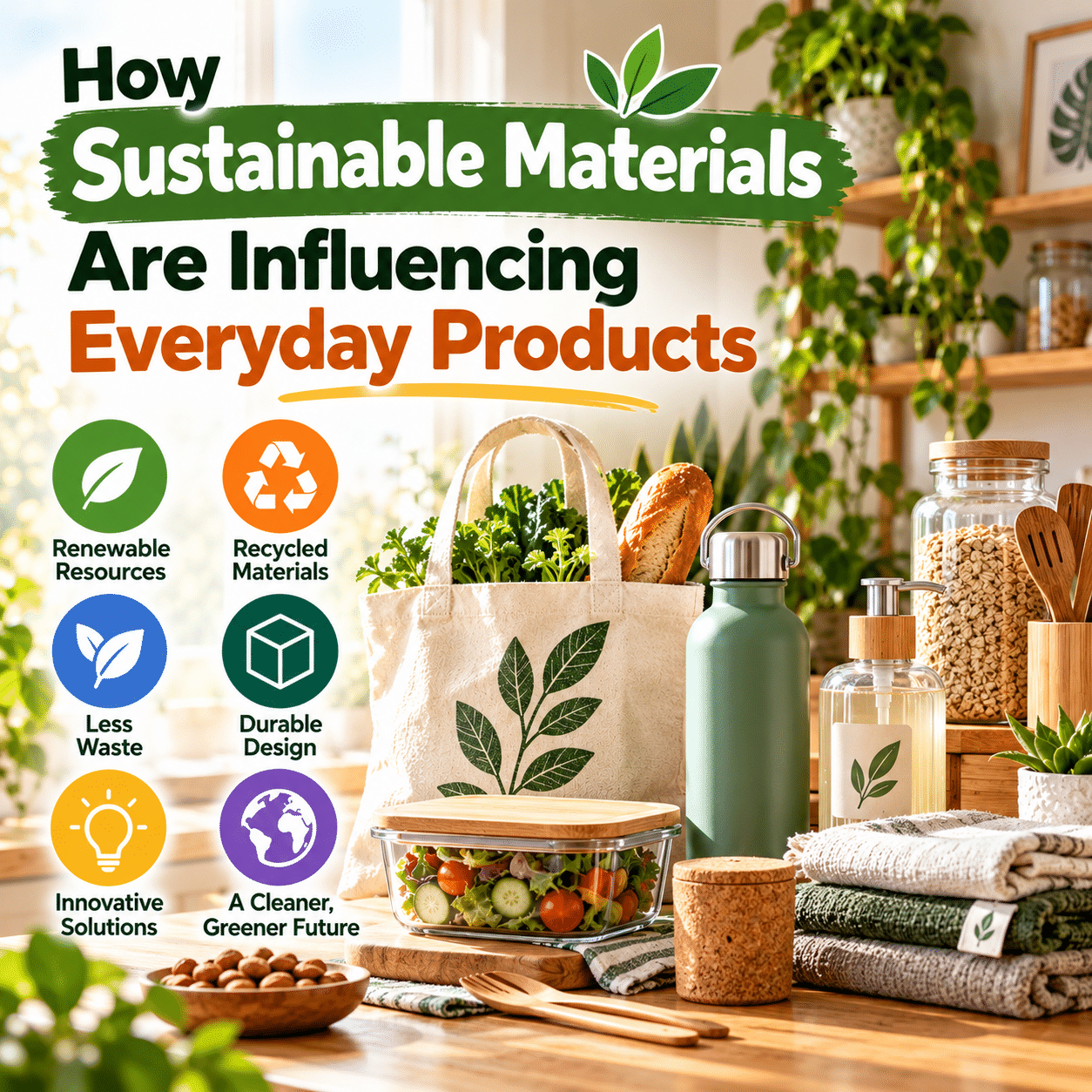
The materials used to make everyday products are becoming an increasingly important part of how people evaluate what they buy. A kitchen container is no longer judged only by its appearance or storage capacity. A piece of furniture may attract attention because of its wood sourcing, durability, or repairability. Clothing, cleaning accessories, packaging, and personal-care products are also being examined through a broader lens that includes material choices and long-term use.
This growing interest reflects a fundamental question: Can everyday products be designed to meet practical needs while using resources more responsibly?
Sustainable materials are central to that discussion.
From recycled metals and responsibly sourced wood to plant-based fibers, recycled plastics, and innovative packaging materials, manufacturers are exploring ways to reduce certain environmental impacts while maintaining functionality, safety, and affordability.
However, sustainability is rarely determined by material choice alone.
A product made from a renewable resource may still require substantial energy, water, or chemical processing. A recycled material may offer environmental advantages in one application but perform poorly in another. A durable conventional material used for many years may sometimes be preferable to a supposedly greener alternative that needs frequent replacement.
These complexities make sustainable material selection both promising and challenging.
For consumers, understanding materials helps distinguish meaningful improvements from vague environmental marketing. For manufacturers, material innovation creates opportunities to rethink how products are designed, produced, used, repaired, and eventually recovered or disposed of.
This guide explores how sustainable materials are influencing everyday products, the benefits and trade-offs of different material categories, and the practical principles that help people make more informed purchasing decisions.
1. What Are Sustainable Materials?
Sustainable materials are materials selected, produced, and used with the aim of reducing environmental and, where relevant, social impacts over their life cycle while meeting the functional requirements of a product.
There is no single universal material that is sustainable in every situation.
The suitability of a material depends on factors such as:
- Raw material sourcing.
- Resource availability.
- Energy consumption.
- Water use.
- Chemical processing.
- Manufacturing emissions.
- Transportation.
- Product durability.
- Repairability.
- Reuse potential.
- Recycling infrastructure.
- End-of-life disposal.
For example, recycled aluminum may reduce the need for energy-intensive primary aluminum production, but the environmental performance of a finished aluminum product also depends on its manufacturing process, design, and use.
Similarly, wood can be renewable when forests are managed responsibly, but poor sourcing practices can contribute to deforestation and ecological damage.
The most useful way to understand sustainable materials is not as a fixed list of environmentally friendly substances.
Instead, they are part of a broader effort to improve how products use resources throughout their life cycles.
2. Why Material Choices Matter in Everyday Products
Every physical product begins with materials.
A reusable bottle may contain stainless steel, plastic, silicone, and coatings. A chair may combine wood, metal, foam, fabric, and adhesives. A food package may use several layers of different materials to protect its contents.
These choices influence much more than appearance.
Environmental Impact
Material extraction, processing, and manufacturing can consume energy and water, generate emissions, and affect ecosystems.
Product Performance
Materials determine strength, flexibility, weight, insulation, heat resistance, and other functional characteristics.
Durability
Some materials withstand repeated use better than others in specific applications.
Safety
Materials must be suitable for their intended use, particularly when they contact food, skin, heat, or chemicals.
Repairability
Product construction and material selection influence whether components can be repaired or replaced.
End-of-Life Management
Some materials can be recycled through established systems, while others require specialized facilities or are difficult to recover.
Material selection therefore influences the entire experience of owning and using a product.
A thoughtful design balances environmental considerations with safety, performance, affordability, and realistic consumer behavior.
3. The Shift Toward Life-Cycle Thinking
One of the most important developments in sustainable product design is the growing emphasis on life-cycle thinking.
Instead of examining only the raw material, life-cycle thinking considers the stages a product passes through.
These commonly include:
- Raw material extraction or cultivation.
- Material processing.
- Product manufacturing.
- Packaging and distribution.
- Consumer use.
- Maintenance and repair.
- Reuse, recycling, or disposal.
Why This Matters
A material may have relatively low manufacturing impacts but require frequent replacement.
Another material may involve higher initial impacts yet remain useful for many years.
A lightweight package may reduce transportation requirements but be difficult to recycle.
A heavier reusable container may require repeated use before its environmental advantages become meaningful.
Life-Cycle Assessment
Life-cycle assessment, commonly called LCA, is a structured method for evaluating environmental impacts across defined stages of a product or system.
An LCA may consider greenhouse gas emissions, energy use, water consumption, resource depletion, and other environmental indicators.
Results depend on assumptions, system boundaries, data quality, and the specific impacts being measured.
This explains why simple claims such as “natural materials are always better” or “plastic is always worse” can be misleading.
Environmental performance is contextual.
4. Recycled Materials and Their Growing Role
Recycled materials are increasingly used in packaging, furniture, clothing, accessories, and household products.
Recycling involves collecting and processing materials so they can serve as inputs for new products.
Common recycled materials include:
- Aluminum.
- Steel.
- Glass.
- Paper and cardboard.
- Certain plastics.
- Selected textile fibers.
Potential Benefits
Using recycled feedstock can reduce demand for some virgin raw materials.
It may also reduce energy consumption or emissions compared with primary production, depending on the material and process.
Limitations
Recycling requires collection, sorting, cleaning, processing, and transportation.
Contamination can reduce material quality.
Some materials lose performance characteristics through repeated processing.
Others can be recycled repeatedly under suitable conditions.
Recycled Content Versus Recyclability
These terms describe different properties.
Recycled content refers to material that has already been recovered and incorporated into a product.
Recyclability refers to whether a product or material can be collected and processed into usable material through an appropriate recycling system.
A product can contain recycled material without being easily recyclable at the end of its life.
Understanding this distinction helps consumers evaluate product claims more accurately.
5. Recycled Plastics in Everyday Products
Plastics are widely used because they can be lightweight, versatile, durable, and economical.
They are found in storage containers, furniture, packaging, electronics, textiles, and many other products.
Recycled plastics provide one way to reduce demand for virgin plastic feedstock in suitable applications.
Common Applications
Recycled plastics may be used in:
- Outdoor furniture.
- Storage organizers.
- Packaging.
- Plant pots.
- Household accessories.
- Textile fibers.
- Selected automotive components.
Mechanical Recycling
Mechanical recycling generally involves sorting, cleaning, shredding, melting, and reforming suitable plastic materials.
Chemical Recycling
Chemical recycling refers to several processes that chemically transform plastic waste into other substances or feedstocks.
These processes differ substantially in energy requirements, outputs, and environmental performance.
Important Limitations
Not all plastics can be recycled through the same systems.
Additives, mixed materials, contamination, and product design can complicate recycling.
Repeated processing may also affect material properties.
Food-Contact Safety
Recycled plastic intended for food contact must meet applicable safety requirements.
Consumers should not assume that any recycled plastic container is suitable for food storage.
The most useful recycled-plastic products combine appropriate material quality with durable design and a realistic end-of-life pathway.
6. Recycled Aluminum and Metal Products
Metals play an important role in household products because of their strength, durability, and versatility.
Aluminum and steel are widely used in cookware, furniture, packaging, appliances, and structural components.
Aluminum
Producing primary aluminum from mined raw materials is energy-intensive.
Recycling aluminum can substantially reduce energy requirements compared with primary production under many conditions.
However, actual savings depend on the recycling process, energy sources, and product system.
Steel
Steel can be recycled and incorporated into new products.
Recycled steel is used in many industrial and consumer applications.
Everyday Applications
Recycled metals may appear in:
- Beverage containers.
- Kitchen accessories.
- Furniture frames.
- Storage systems.
- Lighting fixtures.
- Household hardware.
- Appliance components.
Durability and Repair
Metal products can sometimes be repaired or maintained for extended use.
However, coatings, corrosion, mixed-material construction, and specialized components may affect their lifespan and recyclability.
Metal sustainability depends on more than the presence of recycled content.
Product design, energy sources, durability, and recovery systems all matter.
7. Responsibly Sourced Wood and Bamboo
Wood and bamboo are frequently associated with natural and renewable materials.
They are used in furniture, kitchen accessories, storage products, flooring, and decorative items.
However, renewability alone does not guarantee responsible sourcing.
Wood
Wood can be replenished through forest growth when harvesting and management practices are appropriate.
Poor forestry practices can contribute to habitat loss, soil degradation, and other environmental problems.
Bamboo
Bamboo is a group of grasses, many species of which grow relatively quickly.
It can be used in furniture, textiles, utensils, and other products.
However, bamboo products vary widely in processing methods.
Processing Matters
Some bamboo products involve relatively straightforward mechanical processing.
Others require adhesives, chemical treatments, or energy-intensive manufacturing.
Certification and Traceability
Credible forest-management and chain-of-custody certification systems can provide information about sourcing practices.
However, certification scope and claims should be checked rather than assumed.
Durability Matters
A responsibly sourced wooden product that lasts for years may offer practical value.
A poorly constructed item that breaks quickly may not.
The most meaningful approach combines responsible sourcing with appropriate manufacturing and long-term usability.
8. Cork as a Renewable Material
Cork is obtained from the bark of cork oak trees.
Under appropriate harvesting practices, bark can be removed periodically without cutting down the tree.
This makes cork an interesting material for certain applications.
Common Uses
Cork may be used in:
- Coasters.
- Flooring.
- Bulletin boards.
- Insulation.
- Decorative accessories.
- Selected footwear components.
- Packaging.
Useful Properties
Cork is lightweight, compressible, and has insulating characteristics.
Its cellular structure contributes to these properties.
Environmental Considerations
The sustainability of cork products depends on forest management, harvesting practices, processing, adhesives, coatings, transportation, and product lifespan.
Limitations
Cork may not be suitable for applications requiring high structural strength or prolonged exposure to certain conditions.
Some products combine cork with synthetic binders or other materials.
Cork demonstrates how a renewable natural material can support useful product designs, but its environmental performance still requires context.
9. Natural Fibers in Textiles and Household Products
Natural fibers are used in clothing, bedding, towels, upholstery, cleaning accessories, and reusable bags.
Common examples include:
- Cotton.
- Linen.
- Hemp.
- Wool.
- Jute.
- Sisal.
These fibers have different properties and production requirements.
Cotton
Cotton is widely used because of its softness, breathability, and versatility.
However, cotton cultivation can involve substantial water use, agricultural inputs, and land requirements depending on the region and farming practices.
Linen
Linen is produced from flax fibers.
It is valued for its texture, breathability, and strength.
Hemp
Hemp fibers can be used in textiles and other products.
Their environmental performance depends on cultivation, processing, and manufacturing methods.
Wool
Wool is a natural animal-derived fiber with useful insulation properties.
Its impacts depend on livestock management, land use, processing, and other factors.
Jute and Sisal
These fibers are often used in bags, rugs, ropes, and household accessories.
The Important Distinction
Natural fibers are not automatically environmentally superior to synthetic fibers.
Durability, laundering, cultivation, processing, and disposal all influence the comparison.
10. Recycled Textiles and Fabric Innovation
Textile production involves complex supply chains and significant material flows.
Recycled fibers are one approach to reducing reliance on virgin textile materials.
Recycled Polyester
Recycled polyester is commonly produced from suitable plastic feedstocks, including recovered bottles and textile waste.
It can be used in clothing, bags, upholstery, and other products.
Recycled Cotton
Recycled cotton may be produced from manufacturing scraps or recovered textiles.
Fiber length and quality can be affected by mechanical recycling.
Blended Materials
Recycled fibers are sometimes blended with virgin fibers to achieve desired performance.
Challenges
Textile recycling is complicated by mixed fibers, dyes, finishes, trims, and contamination.
Some recycling systems produce materials suitable for lower-value applications rather than equivalent new garments.
Microfiber Considerations
Synthetic textiles can release microfibers during use and washing.
Recycled synthetic fibers do not automatically eliminate this issue.
Better Product Design
Durable construction, repairability, appropriate care, and realistic recycling options are important complements to recycled content.
The most responsible textile choice is not determined by fiber origin alone.
11. Plant-Based Plastics and Bioplastics
Plant-based plastics are attracting interest because they can use biological feedstocks instead of relying entirely on fossil-derived raw materials.
However, the terminology can be confusing.
Bio-Based Plastics
Bio-based plastics are made wholly or partly from biological resources.
These may include plant-derived sugars, starches, or other feedstocks.
Biodegradable Plastics
Biodegradable plastics are designed to break down through biological processes under specified conditions.
A plastic can be bio-based without being biodegradable.
A biodegradable plastic can also be made from fossil-derived materials.
Compostable Plastics
Compostable plastics must meet defined requirements under specified composting conditions.
Industrial compostability does not necessarily mean a material will break down in a home compost pile.
Environmental Trade-Offs
Plant-based feedstocks may involve agricultural land, water, fertilizers, and processing energy.
End-of-life infrastructure also matters.
Consumer Guidance
Do not assume that a plant-based plastic can be placed in ordinary recycling or composting systems.
Follow the product’s verified disposal instructions and local waste-management rules.
Bioplastics illustrate the potential of material innovation, but terminology must be interpreted carefully.
12. Paper, Cardboard, and Fiber-Based Packaging
Paper and cardboard are widely used for packaging because they can be lightweight, printable, and compatible with established recycling systems in many locations.
Fiber-based packaging may replace certain plastic formats in suitable applications.
Common Uses
- Shipping boxes.
- Product cartons.
- Protective inserts.
- Food packaging.
- Paper bags.
- Molded fiber trays.
Potential Advantages
Paper-based materials can be produced from renewable fiber sources and recycled feedstock.
Many clean, uncoated paper products can be recycled through established systems.
Limitations
Paper production requires energy, water, and processing chemicals.
Some packaging uses coatings, adhesives, or multi-layer structures that complicate recycling.
Moisture and Barrier Performance
Paper often requires additional treatment when used for products needing strong moisture or grease barriers.
Product Protection
Packaging must protect the product effectively.
If inadequate packaging leads to damaged or spoiled goods, the environmental impact of the wasted product may outweigh packaging savings.
The best packaging design balances material efficiency with adequate protection and realistic disposal options.
13. Glass and Its Role in Reusable Packaging
Glass is used in food containers, beverage bottles, storage jars, and personal-care packaging.
It offers several useful properties.
Chemical Stability
Glass is generally resistant to many substances and is widely used for suitable food-contact applications.
Reusability
Durable glass containers can be washed and reused when designed for repeated use.
Recyclability
Glass can be recycled through appropriate collection and processing systems.
Limitations
Glass is relatively heavy and can break.
Its manufacturing process requires high temperatures.
Transportation impacts may be significant in some systems because of weight.
Reusable Versus Single-Use Glass
A returnable glass bottle used repeatedly may perform differently from a single-use glass bottle that is recycled after one use.
Cleaning, transportation distances, return rates, and bottle lifespan influence the comparison.
Glass is a useful material, but its environmental advantages depend on how it is incorporated into the product system.
14. Sustainable Materials in Kitchen Products
Kitchen products must balance durability, hygiene, heat resistance, and food-contact safety.
Material choices are particularly important because many items are exposed to moisture, food residues, and repeated cleaning.
Cutting Boards
Wood, bamboo, and suitable plastics are common options.
Each requires appropriate cleaning and maintenance.
Food Storage
Glass, stainless steel, and food-contact-approved plastics offer different advantages.
Cooking Utensils
Wood, stainless steel, silicone, and other materials may be appropriate depending on the task.
Reusable Cleaning Accessories
Washable cloths and durable brushes may replace certain disposable alternatives.
Important Safety Considerations
Not every material is suitable for high temperatures, microwave use, dishwashers, or prolonged food contact.
Follow manufacturer instructions.
Long-Term Value
A durable kitchen product that performs well and can be maintained safely may provide more value than a poorly constructed alternative marketed primarily for its material.
Practical performance and sustainability should be evaluated together.
15. Sustainable Materials in Furniture and Home Decor
Furniture is a major area where material choices influence durability, repairability, and resource use.
A single piece of furniture may combine multiple materials.
Solid Wood
Properly sourced and maintained wood furniture can remain functional for many years.
Engineered Wood
Engineered wood products can make efficient use of wood fibers or smaller pieces, but adhesives, emissions, durability, and end-of-life options vary.
Recycled Metals
Metal frames and components may incorporate recycled feedstock.
Natural Fibers
Linen, cotton, wool, jute, and other fibers may be used in upholstery and decorative textiles.
Recycled Fabrics
Selected upholstery products use recycled synthetic or natural fibers.
Design for Repair
Replaceable cushions, accessible fasteners, and modular components can extend furniture life.
Why Durability Matters
Furniture that remains useful for many years may reduce replacement demand.
Material sourcing is important, but construction quality and maintainability often determine long-term value.
16. Sustainable Materials in Personal-Care Products
Personal-care products involve packaging, applicators, accessories, and formulations.
Material innovation may influence several of these components.
Refillable Containers
Durable outer packaging can be paired with compatible refills.
Recycled Packaging
Selected bottles and containers may incorporate recycled materials.
Paper-Based Packaging
Some products use fiber-based cartons or protective packaging.
Reusable Accessories
Durable grooming tools and washable accessories may reduce repeated purchases of disposable items in suitable applications.
Safety and Hygiene
Personal-care packaging must protect product quality and prevent contamination.
A material change should not compromise stability or safe use.
Product-Specific Requirements
Some formulations require particular barriers, closures, or dispensing systems.
The most useful innovations maintain product safety while reducing unnecessary material use where feasible.
17. Sustainable Materials in Electronics and Accessories
Electronics contain metals, plastics, glass, circuit boards, and specialized components.
Their environmental impacts involve complex manufacturing and supply chains.
Material improvements may include:
- Recycled metals.
- Recycled plastic housings.
- Reduced packaging materials.
- Replaceable components.
- More durable external materials.
- Modular product designs.
Why Repairability Matters
Extending the useful life of electronics can reduce the need for replacement products.
Battery Considerations
Batteries require appropriate handling and recycling systems.
They should not be disposed of casually with ordinary household waste where separate collection is required.
Recycled Content Is Only One Factor
A device containing recycled plastic may still have significant environmental impacts associated with electronics manufacturing.
Software Support
Long-term software and security updates can influence how long a device remains useful.
Sustainable electronics require attention to materials, design, energy use, repairability, and end-of-life recovery.
18. How Sustainable Materials Influence Product Packaging
Packaging is one of the most visible areas of material innovation.
Manufacturers may explore:
- Recycled-content packaging.
- Lightweight containers.
- Refillable formats.
- Reusable shipping systems.
- Fiber-based alternatives.
- Mono-material packaging.
- Concentrated products.
- Reduced unnecessary components.
Mono-Material Design
Packaging made primarily from one compatible material may be easier to process through certain recycling systems than complex multi-material structures.
However, local collection and processing capabilities remain important.
Lightweighting
Reducing packaging weight can lower material use and sometimes transportation impacts.
Refill Systems
Durable containers may be paired with lighter refill packaging.
Product Protection
Packaging must still prevent damage, leakage, contamination, and spoilage.
The most effective packaging changes reduce unnecessary impacts without compromising the product’s essential functions.
19. The Importance of Durability in Sustainable Product Design
Durability is one of the most important characteristics of many everyday products.
A durable product can remain functional through repeated use, reducing the need for replacement.
However, durability must be evaluated in context.
Physical Durability
Can the product withstand normal wear, handling, and environmental exposure?
Functional Durability
Does it continue performing its intended task?
Repairability
Can damaged components be replaced or repaired?
Maintainability
Can the product be cleaned and serviced without excessive difficulty?
Design Longevity
Will the product remain useful as needs change?
When Durability Has Trade-Offs
A more durable product may require additional materials or energy to manufacture.
Its benefits depend partly on how long it is actually used.
Durability is therefore most valuable when it supports meaningful, repeated use.
20. Repairability and Modular Design
Repairability is increasingly recognized as an important part of responsible product design.
A product that can be repaired may remain useful longer than one that must be replaced after a minor component fails.
Replaceable Parts
Lids, seals, handles, batteries, and other components can sometimes be replaced individually.
Accessible Fasteners
Screws and other removable fasteners may make disassembly easier than permanent adhesives.
Modular Components
Modular designs allow selected parts to be upgraded or replaced.
Repair Information
Clear instructions and available replacement parts can support maintenance.
Material Compatibility
Products designed with separable materials may be easier to repair or recycle.
Practical Limitations
Repairability does not guarantee that repair will always be economical or safe.
Some repairs require specialized skills or equipment.
The goal is to make reasonable maintenance and repair possible where appropriate.
21. Understanding Environmental Certifications
Environmental certifications can provide useful information about certain aspects of material sourcing or product performance.
However, certifications differ in scope.
Some focus on forest management.
Others address recycled content, chemical restrictions, organic production, environmental management, or compostability.
What to Check
Before relying on a certification, consider:
- What the standard evaluates.
- Whether independent verification is involved.
- Which product or component is covered.
- Whether the claim applies to the entire product.
- Whether the certification is current.
- Whether the certification body is credible.
Certification Is Not a Universal Guarantee
A certified material may meet specific criteria without proving that the finished product is environmentally superior in every respect.
Beware of Vague Labels
Terms such as “eco-friendly,” “green,” and “planet-safe” may lack meaningful definitions unless supported by specific evidence.
Credible certifications can support informed decisions, but they should be understood within their actual scope.
22. Greenwashing and Misleading Material Claims
Greenwashing occurs when environmental claims create a misleading impression about a product, company, or practice.
Material-related claims can be particularly confusing because technical terms are often simplified in marketing.
Common Warning Signs
Vague language: Claims such as “environmentally friendly” without explanation.
Selective information: Highlighting recycled packaging while ignoring other relevant impacts.
Unclear percentages: Advertising recycled content without identifying which component contains it.
Unsupported comparisons: Claiming a material is better without explaining the comparison.
Misleading imagery: Using leaves, forests, or natural colors to imply environmental benefits.
Confusing terminology: Treating bio-based, biodegradable, compostable, and recyclable as equivalent.
How Consumers Can Respond
Look for specific, verifiable claims.
Check whether the claim applies to the whole product or only one component.
Consider durability and intended use.
Review available certification details.
Avoid assuming that attractive environmental language guarantees meaningful performance.
The most trustworthy claims explain exactly what has improved and under what conditions.
23. The Economic Trade-Offs of Sustainable Materials
Products made with selected recycled, responsibly sourced, or innovative materials may have different cost structures from conventional alternatives.
Raw Material Costs
Material prices depend on supply, quality, processing, and market conditions.
Manufacturing Requirements
Some materials require specialized equipment or production methods.
Scale
Large-scale manufacturing may reduce certain costs, while emerging materials may initially be more expensive.
Durability
A higher purchase price may be offset by longer useful life.
Maintenance
Cleaning, repair, and replacement parts contribute to ownership costs.
End-of-Life Value
Some materials may retain recoverable value, depending on local systems.
Cost Per Use
For durable products, cost per use can be more informative than purchase price alone.
Cost per use = Total ownership cost ÷ Number of actual uses
A product that costs more initially but remains useful for years may provide better value than a cheaper alternative requiring frequent replacement.
However, higher prices do not automatically indicate better environmental performance.
24. How Consumers Can Compare Material Choices
Comparing materials requires more than identifying which one sounds natural or innovative.
A useful evaluation considers several dimensions.
| Evaluation factor | Questions to ask |
|---|---|
| Functionality | Does the material perform the intended task safely and effectively? |
| Durability | How well does it withstand repeated use? |
| Sourcing | Is the raw material obtained through responsible practices? |
| Manufacturing | What energy, water, and processing requirements are involved? |
| Maintenance | Does the product require intensive cleaning or special care? |
| Repairability | Can damaged parts be replaced or repaired? |
| Recycled content | Does the product contain verified recycled material? |
| End of life | Are suitable reuse, recycling, or disposal options available? |
| Cost | Is the total ownership cost reasonable? |
| Evidence | Are environmental claims specific and supported? |
Not every consumer will have access to complete life-cycle data.
However, asking these questions can help avoid simplistic assumptions and identify products that provide practical long-term value.
25. Sustainable Materials and the Circular Economy
The circular economy is an approach that seeks to keep products and materials in use, reduce waste, and support the regeneration of natural systems.
Material choices play an important role, but circularity involves more than recycling.
Designing Out Unnecessary Waste
Products can be designed to use materials efficiently and avoid unnecessary components.
Extending Product Life
Durability, maintenance, repair, and refurbishment can keep products useful longer.
Reuse
Containers and other products may be designed for repeated use.
Recycling
Materials can be recovered when products reach the end of their useful lives.
Responsible Biological Cycles
Certain biological materials may be managed through appropriate recovery pathways when conditions permit.
Why Design Matters
A product made from recyclable materials may still be difficult to recycle if its components cannot be separated.
A durable product may be discarded early if replacement parts are unavailable.
Circular design therefore considers how materials move through the entire product system.
26. Challenges Facing Sustainable Material Innovation
Developing and adopting alternative materials involves technical and economic challenges.
Performance Requirements
Materials must meet the strength, flexibility, barrier, or safety requirements of their intended applications.
Manufacturing Compatibility
Existing factories may need new equipment or processes.
Cost Competitiveness
Alternative materials must compete with established supply chains.
Supply Availability
Some feedstocks are limited by geography, production capacity, or seasonal conditions.
Quality Consistency
Manufacturers need materials with predictable properties.
Recycling Infrastructure
A theoretically recyclable material may have limited practical value where collection and processing systems are unavailable.
Consumer Understanding
Confusing terminology can make purchasing decisions difficult.
Unintended Trade-Offs
A material may reduce one environmental impact while increasing another.
These challenges explain why meaningful material innovation requires careful testing and evaluation rather than simply replacing one substance with another.
27. Emerging Materials Worth Understanding
Researchers and manufacturers are exploring several material categories that may support new product designs.
Mycelium-Based Materials
Mycelium, the network-like structure produced by fungi, can be grown with suitable substrates to create certain packaging and composite materials.
Performance and environmental impacts depend on production methods and applications.
Agricultural Residue Fibers
Residues from agricultural production may be processed into packaging, boards, or other materials.
Their suitability depends on availability, processing, and competing uses.
Algae-Derived Materials
Algae-based feedstocks are being investigated for selected packaging, polymers, and other applications.
Commercial performance varies by technology.
Cellulose-Based Films
Cellulose-derived materials may provide alternatives for certain packaging uses.
Barrier properties, coatings, and disposal requirements differ.
Recycled Composite Materials
Recovered materials can be combined into new products, although mixed-material construction may complicate future recycling.
Important Perspective
Emerging does not automatically mean environmentally superior.
New materials should be evaluated through credible performance testing and life-cycle analysis.
Their long-term value depends on whether they can meet real needs at practical scale.
28. Why Sustainable Materials Must Also Be Safe
Environmental goals should never compromise product safety.
Materials must be appropriate for their intended applications.
Food Contact
Containers and utensils must meet applicable food-contact requirements.
Heat Exposure
Materials used near heat must withstand expected temperatures.
Chemical Compatibility
Cleaning products and other chemicals require compatible containers.
Skin Contact
Textiles and personal-care accessories should meet relevant safety expectations.
Structural Strength
Furniture and household equipment must support expected loads.
Fire Safety
Some applications require specific flammability performance.
Product Testing
Manufacturers may need to evaluate migration, emissions, mechanical strength, or other characteristics depending on the product.
A material cannot be considered a successful alternative if it fails essential safety or performance requirements.
29. Practical Ways to Make Better Material Choices
Consumers do not need advanced technical knowledge to make more thoughtful purchasing decisions.
Several habits can help.
Buy Only What Is Needed
Avoiding unnecessary purchases can reduce material demand.
Prioritize Products That Last
Choose appropriate construction quality and durability.
Maintain Existing Items
Cleaning and repair can extend product life.
Consider Recycled Content
Look for specific, credible information when recycled materials are relevant.
Check Sourcing Claims
Evaluate certifications and traceability where available.
Avoid Unnecessary Replacement
A functional existing product may be more practical than purchasing a new alternative.
Choose Appropriate Materials
Match material properties to the intended task.
Understand Local Disposal Options
Recycling and composting capabilities vary by location.
Be Skeptical of Broad Claims
Specific evidence is more useful than vague environmental language.
Thoughtful consumption is often more effective than constantly searching for the newest material innovation.
30. The Future of Sustainable Materials in Everyday Living
Sustainable material development may continue to influence how everyday products are designed and manufactured.
Several long-term directions are particularly relevant.
Greater Use of Recovered Materials
Manufacturers may expand the use of suitable recycled feedstocks where quality and supply permit.
More Durable Product Design
Longer-lasting products may reduce replacement demand.
Better Repairability
Modular construction and replacement parts may help extend useful life.
Improved Material Traceability
Digital systems and supply-chain documentation may make sourcing information easier to verify.
More Efficient Manufacturing
Process improvements may reduce energy, water, and material waste.
Better Packaging Design
Manufacturers may continue exploring lighter, reusable, refillable, and more easily recoverable packaging systems.
More Transparent Environmental Information
Clearer product-level information could help consumers compare environmental claims.
These developments are possibilities rather than guarantees.
Their success will depend on technology, infrastructure, economics, regulation, and consumer behavior.
The underlying goal remains consistent: creating products that perform well while using resources more thoughtfully.
Frequently Asked Questions About Sustainable Materials
1. What makes a material sustainable?
A material may be considered more sustainable when its sourcing, production, use, and end-of-life management reduce relevant environmental or social impacts compared with suitable alternatives. However, sustainability depends on the specific application and life-cycle conditions. No material is automatically sustainable in every situation.
2. Are natural materials always better than synthetic materials?
No. Natural materials can be renewable or biodegradable under certain conditions, but cultivation and processing may require substantial resources. Synthetic materials may offer durability, lightweight construction, or other advantages. A meaningful comparison considers the complete product life cycle.
3. Is recycled plastic better than virgin plastic?
Recycled plastic can reduce demand for virgin feedstock and may lower certain environmental impacts. However, results depend on the recycling process, material quality, energy sources, and product application. Recycled content alone does not establish the overall sustainability of a finished product.
4. What is the difference between biodegradable and compostable materials?
Biodegradable materials can break down through biological processes under particular conditions. Compostable materials must meet defined requirements within specified composting environments. A product labeled industrially compostable may not break down effectively in a home compost system or natural environment.
5. Are bamboo products environmentally friendly?
Bamboo can be a renewable feedstock, but environmental performance depends on cultivation, harvesting, processing, adhesives, transportation, and product lifespan. Not all bamboo products have the same impacts, and the term bamboo alone does not guarantee sustainability.
6. How can I identify greenwashing in product descriptions?
Look for vague claims, unsupported comparisons, unclear recycled-content percentages, misleading environmental imagery, and missing certification details. Credible claims should identify specific attributes, explain their scope, and provide verifiable evidence.
7. Is buying a new sustainable product always better than keeping an old one?
Not necessarily. Continuing to use a safe, functional product may avoid the material and manufacturing impacts of a replacement. The best decision depends on product efficiency, durability, safety, repairability, and the environmental implications of continued use versus replacement.
Conclusion: Better Materials, Better Product Decisions
Sustainable materials are influencing everyday products by encouraging manufacturers and consumers to think beyond appearance, price, and immediate convenience.
Recycled metals, responsibly sourced wood, natural fibers, recycled plastics, alternative packaging materials, and emerging bio-based technologies offer opportunities to reconsider how products are made.
Yet the most important lesson is that material choice cannot be separated from product design and use.
A renewable material may involve significant processing impacts. A recycled material may be difficult to recover again. A durable conventional product may provide years of reliable service, while a poorly designed alternative may need frequent replacement.
Meaningful sustainability therefore requires a broader perspective.
Products should be safe, functional, appropriately durable, and designed with realistic maintenance and end-of-life options.
For consumers, better decisions often begin with simple questions: Is this product necessary? Will it last? Can it be repaired? Are the material claims credible? Does it suit the intended use?
These questions help turn sustainability from a marketing concept into a practical purchasing consideration.
The future of everyday products will likely involve continued experimentation with materials, manufacturing methods, and circular design approaches.
But progress will depend on evidence, thoughtful engineering, and responsible use—not merely replacing familiar materials with fashionable alternatives.
The most sustainable material choice is not always the newest, most natural, or most heavily promoted. It is the one that helps a well-designed product deliver lasting value with responsible use of resources.