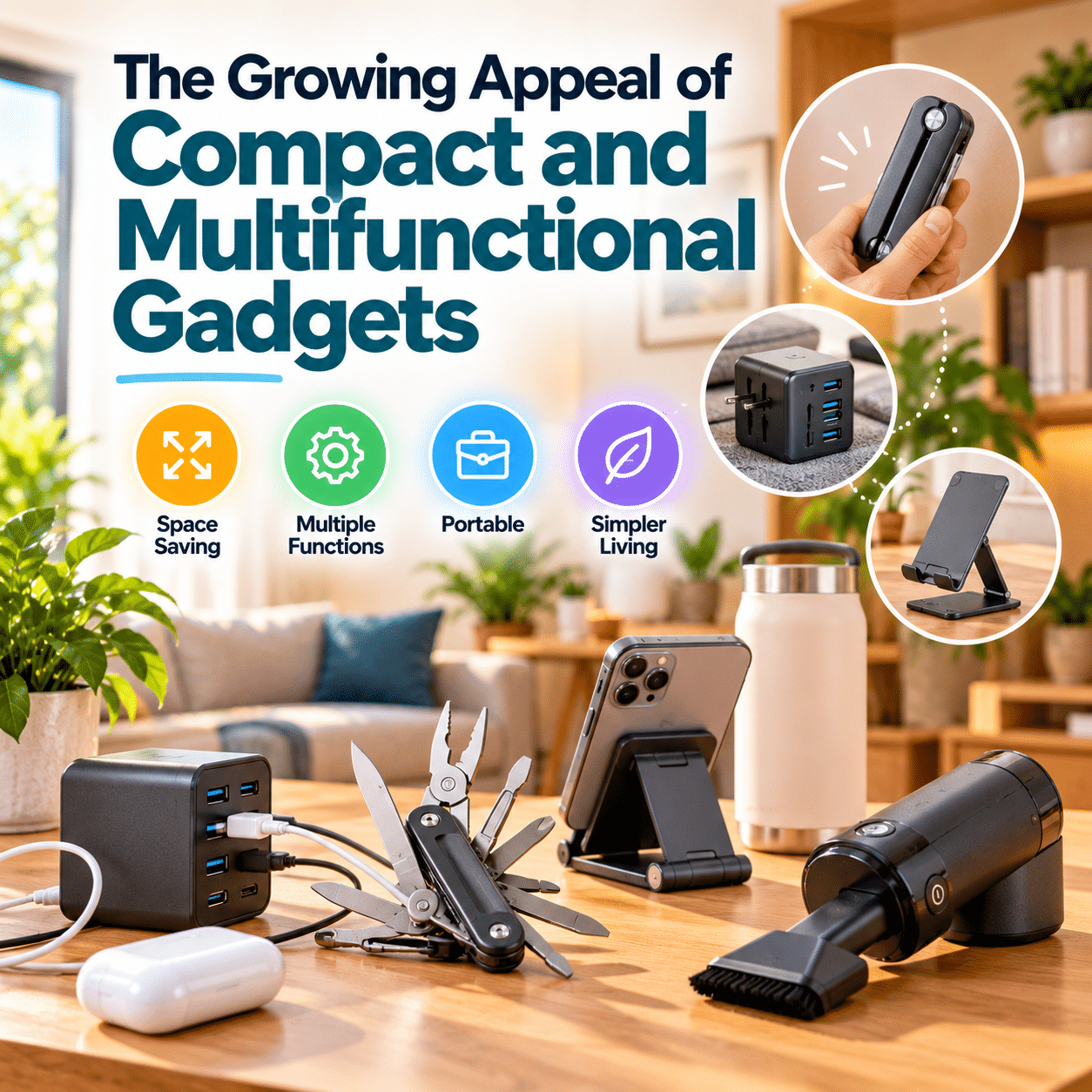
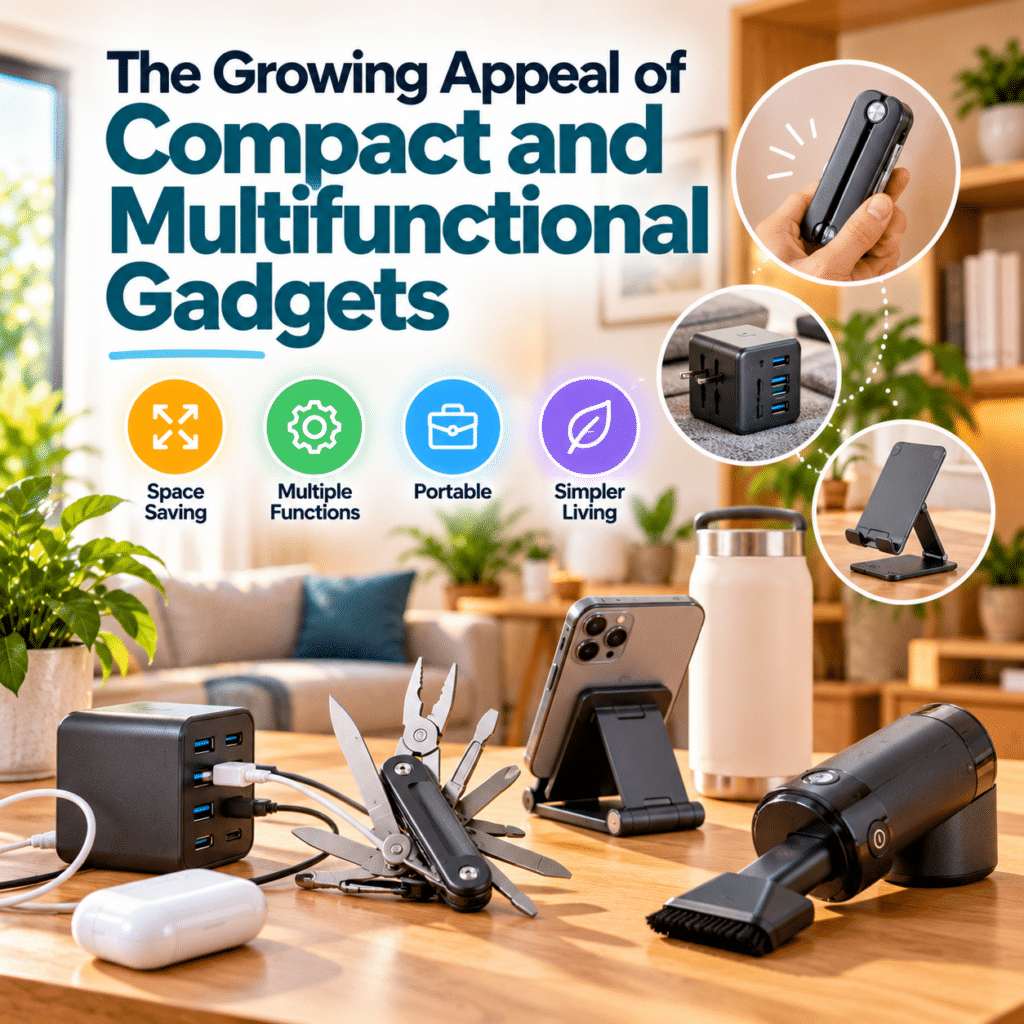
A desk charger that powers several devices, a portable tool that performs multiple tasks, or a kitchen appliance that combines different cooking functions may seem like a small convenience. Yet these examples reflect a broader shift in how people think about everyday technology.
Instead of focusing only on what a gadget can do, many consumers are also interested in how much space it occupies, how easily it fits into their routines, and whether it can replace several separate items.
Compact and multifunctional gadgets address these practical considerations by combining useful capabilities into smaller, more versatile designs.
Their appeal is particularly easy to understand in homes with limited storage, shared workspaces, travel environments, and households seeking to simplify everyday possessions.
However, smaller devices and additional features do not automatically make a product better. Performance, durability, usability, and long-term value still matter.
Understanding the advantages and limitations of compact, multifunctional design can help explain why these gadgets attract interest—and how to recognize when they offer genuine convenience.
1. What Are Compact and Multifunctional Gadgets?
Compact gadgets are devices designed to occupy relatively little space while performing a particular function.
Multifunctional gadgets combine two or more capabilities that might otherwise require separate products.
Although these characteristics often appear together, they are not identical.
A small portable speaker is compact but may serve only one primary purpose. A large kitchen appliance that supports several cooking methods is multifunctional without necessarily being compact.
Some devices successfully combine both qualities.
Common Examples
Compact and multifunctional gadgets appear across many everyday categories:
- Multiport chargers: Provide connections for charging several compatible devices.
- Portable power banks: Offer backup power, sometimes with integrated cables or additional charging features.
- USB-C hubs: Expand the connectivity options of compatible laptops and tablets.
- Multitools: Combine several basic tools into one portable item.
- Combination kitchen appliances: Support multiple preparation or cooking functions.
- Portable cleaning devices: May include interchangeable attachments for different surfaces.
- Compact desk accessories: Combine functions such as lighting, device support, or cable organization.
- Travel adapters: Provide compatible plug configurations and, in some models, USB charging ports.
These products share a common design objective: making useful functions available without requiring a separate full-sized device for every task.
The value of that approach depends on how well the combined functions work.
2. Why Smaller Living Spaces Encourage Practical Design
Living space influences the way people choose and organize household products.
A gadget that works well in a spacious workshop may be inconvenient in a small apartment.
Likewise, a household with limited cabinets or counter space may prefer equipment that can be stored easily.
Making Better Use of Available Space
Compact devices can help preserve valuable surfaces and storage areas.
For example, a small charging station may keep several devices organized in one location instead of requiring multiple charging accessories across a desk.
A combination kitchen appliance may also reduce the need to store separate equipment for occasional tasks.
These benefits are particularly relevant when storage is limited.
Supporting Flexible Rooms
Many rooms serve more than one purpose.
A dining table might become a temporary workspace, while a bedroom corner may function as a study area.
Portable and compact gadgets can make these transitions easier.
A foldable laptop stand, for instance, can be put away after use. A small rechargeable task light can be moved between suitable locations.
The ability to reorganize a room without managing numerous bulky items can improve everyday convenience.
Compact Does Not Always Mean Space-Saving
A multifunctional product may still be large or awkwardly shaped.
It may also require extra accessories, attachments, or clearance during operation.
Before choosing a device for a small space, it is important to consider its complete footprint, including storage, ventilation, and operating requirements.
The best space-saving design is one that fits the actual environment, not simply one advertised as compact.
3. Multifunctional Gadgets Can Simplify Everyday Routines
Convenience is one of the strongest reasons to consider multifunctional products.
When related functions are combined thoughtfully, users may need fewer separate devices and fewer steps to complete ordinary tasks.
Reducing Equipment Changes
Consider a desk setup with a laptop, external display, keyboard, and other accessories.
A compatible USB-C hub may provide several connections through one accessory, making it easier to connect or disconnect the laptop.
Similarly, a suitable multiport charger can reduce the number of separate charging adapters required in a shared area.
These examples illustrate how multifunctional design can simplify equipment management.
Keeping Useful Functions Together
A multitool can provide several basic functions in one portable object.
For occasional household adjustments, this may be more convenient than locating individual tools.
However, a multitool is not necessarily a replacement for dedicated equipment when precision, leverage, or specialized performance is required.
Reducing Repetitive Setup
Products that combine frequently used capabilities can make everyday activities more straightforward.
The greatest benefit often comes when the combined functions are naturally related.
A gadget that performs several unrelated tasks may be less convenient if its controls become confusing or its design compromises the primary function.
Multifunctionality is most valuable when it reduces effort rather than simply increasing the feature count.
4. Portability Is Making Compact Gadgets Useful Beyond the Home
Compact design is particularly relevant when people need to carry technology between locations.
Work, travel, study, and everyday errands can involve changing environments and limited access to equipment.
Supporting Flexible Work
Portable laptop stands, compact keyboards, and multiport accessories can help users adapt a workspace to different locations.
A lightweight setup may be easier to transport and organize than a collection of larger accessories.
However, ergonomics should not be sacrificed for portability.
A compact keyboard or stand that causes discomfort during prolonged use may be unsuitable as a primary workstation accessory.
Simplifying Travel Essentials
Travelers often need to manage luggage space and weight.
A suitable combination charging accessory may reduce the number of individual adapters carried.
Compact grooming devices, portable organizers, and multifunctional travel accessories may also help simplify packing.
Nevertheless, compatibility and safety requirements remain important.
For example, a travel plug adapter does not necessarily convert voltage, and electrical equipment must be suitable for the destination’s power supply.
Everyday Carry Convenience
Small gadgets can also be useful for daily commuting or short outings.
A compact power bank, foldable phone stand, or portable cable organizer may provide practical convenience without occupying much bag space.
The key is selecting items that address recurring needs.
Carrying numerous compact gadgets can create just as much clutter as carrying a few larger ones.
5. Better Component Integration Supports Smaller Designs
Compact gadgets are possible partly because electronic components and manufacturing methods allow multiple capabilities to be integrated into relatively small products.
However, miniaturization involves several different engineering approaches.
Integrated Electronic Components
Modern electronic designs can combine processing, communication, and control functions into compact components.
This may reduce the space required for certain circuit designs.
The resulting benefits depend on the product architecture, performance requirements, and manufacturing choices.
More Efficient Power Management
Power-management technology helps devices regulate how electricity is supplied to their components.
In portable electronics, efficient power use can support practical battery-powered operation.
However, smaller size does not guarantee longer battery life.
Battery capacity, processor activity, wireless communication, display characteristics, and other factors all affect runtime.
Compact Charging Technology
Certain charging products use advanced power electronics and semiconductor technologies, including gallium nitride in suitable designs.
These technologies can support efficient power conversion and compact charger designs.
Still, charger size and performance depend on the entire engineering design, not on one component material alone.
Mechanical Design Improvements
Folding mechanisms, interchangeable attachments, and carefully arranged components can also make products easier to transport or store.
These features demonstrate that compact design is not limited to electronics.
Thoughtful mechanical engineering can be just as important as advanced circuitry.
6. Multifunctional Design Can Reduce Clutter
Household clutter often develops when many separate objects are needed for related activities.
Combining appropriate functions may reduce the number of products stored on shelves, countertops, and desks.
A More Organized Workspace
A desk with multiple devices can accumulate charging cables, adapters, stands, and accessories.
A well-chosen docking station or charging hub may consolidate some of these functions.
This can make the workspace easier to maintain and rearrange.
A More Manageable Kitchen
Kitchen storage can become crowded with specialized appliances and tools.
A combination appliance may be useful when it performs several frequently needed tasks well.
However, one large multifunctional appliance is not automatically more space-efficient than a few small tools.
The amount of storage required, cleaning effort, and frequency of use should all be considered.
Fewer Items to Maintain
Using one device for several related tasks may reduce the number of separate products requiring storage and maintenance.
But it also creates a dependency: if the multifunctional device fails, several capabilities may become unavailable at once.
The goal should be manageable ownership, not simply minimizing the number of objects.
7. Compact Gadgets Can Offer Better Value—But Not Always
A multifunctional device may appear economical because it replaces several separate products.
In some situations, that can be true.
However, value should be evaluated according to performance, reliability, and actual use.
When Combining Functions Makes Financial Sense
A multifunctional gadget may provide good value when:
- Its combined functions are all useful.
- It performs those functions adequately.
- It replaces equipment that would otherwise be purchased.
- It has reasonable maintenance requirements.
- Its expected lifespan suits the intended use.
For example, someone who occasionally needs several basic tools may find a reliable multitool sufficient.
A professional who uses those tools intensively may prefer dedicated equipment.
When Separate Devices Are Better
Specialized products may offer advantages in performance, repairability, precision, or ease of use.
A dedicated kitchen appliance may be more appropriate for someone who performs one particular cooking task frequently.
Likewise, a full-sized ergonomic keyboard may be preferable to a compact travel keyboard for extended daily work.
Consider the Total Cost of Ownership
The purchase price is only one part of value.
Replacement accessories, battery degradation, repair costs, and product lifespan can affect long-term affordability.
A cheaper multifunctional gadget that fails quickly may provide less value than a durable single-purpose product.
The most economical choice depends on the intended tasks and how frequently the device will be used.
8. The Tradeoffs of Compact and Multifunctional Design
Combining more functions into less space creates engineering and usability challenges.
These tradeoffs deserve attention before purchasing.
| Design advantage | Possible tradeoff |
|---|---|
| Smaller physical footprint | Reduced controls, capacity, or working area |
| Multiple functions in one product | More complicated operation |
| Greater portability | Smaller batteries or reduced comfort |
| Fewer separate accessories | One failure may affect several functions |
| Convenient integrated components | More difficult repair or replacement |
| Simplified storage | Extra attachments may still require space |
| Consolidated charging | Shared power limits between ports |
These limitations are not inevitable, but they illustrate why product design involves balancing competing priorities.
Performance Limitations
A compact device may have less room for cooling, larger motors, or other performance-related components.
This can matter for equipment that produces heat or requires sustained power.
Usability Challenges
Small buttons, tightly spaced controls, and complicated mode selection can make compact products harder to operate.
This is particularly relevant for users with limited dexterity or vision difficulties.
Repairability Concerns
Highly integrated designs can make individual components harder to replace.
Some products use sealed enclosures, proprietary batteries, or specialized parts.
Repairability depends on the specific construction and availability of support.
Reliability and Maintenance
Combining several functions increases the importance of overall reliability.
If a single device becomes essential for multiple daily activities, a failure may create more inconvenience than the loss of one specialized tool.
The best multifunctional products manage these tradeoffs thoughtfully.
9. Everyday Situations Where Compact Gadgets Make Sense
The usefulness of a compact or multifunctional gadget becomes clearer when connected to a specific situation.
Small Home Offices
A compact desk setup may benefit from a laptop stand, a compatible connectivity hub, and organized charging equipment.
These accessories can help keep a limited workspace flexible.
Shared Charging Areas
A suitable multiport charger may provide a central location for charging several devices.
Users should verify total power output, individual port capabilities, and compatibility.
Occasional Household Repairs
A quality multitool may be convenient for light, appropriate tasks.
Dedicated tools remain important when safety, precision, or substantial force is involved.
Compact Kitchens
A multifunctional cooking appliance may reduce the need for certain separate devices.
Its usefulness depends on cooking habits, available counter space, cleaning requirements, and performance.
Travel and Temporary Workspaces
Portable accessories can make it easier to set up familiar functions in unfamiliar environments.
Weight, compatibility, durability, and packing efficiency matter more than the number of advertised features.
Hobby and Creative Activities
Compact crafting tools or combination accessories may suit occasional projects or limited work areas.
However, specialized tools may offer better control and results for demanding activities.
Across these situations, the same principle applies: a gadget is practical when it matches the task and environment.
10. How to Choose a Compact or Multifunctional Gadget
Selecting the right product begins with understanding how it will actually be used.
Instead of starting with feature counts or marketing claims, consider the following questions.
What Problem Should It Solve?
Identify the inconvenience or limitation you want to address.
This might be insufficient desk space, too many charging accessories, or the need to carry equipment between locations.
A clear purpose makes product comparisons easier.
Which Functions Will You Really Use?
List the features that matter.
A product offering ten functions may be less valuable than one that performs three essential tasks reliably.
Avoid paying for capabilities that do not fit your routine.
Does Its Size Work in Practice?
Check dimensions, weight, and storage requirements.
For equipment used on a desk or countertop, consider the space needed during operation, not just when stored.
Are the Core Functions Good Enough?
Examine performance specifications that are relevant to the task.
For a charger, these may include supported charging standards and available output power.
For a portable tool, material quality, grip, and suitability for the intended work may matter more.
Is It Comfortable and Easy to Use?
Consider button placement, visibility, handling, and accessibility.
A compact design should not make ordinary operation unnecessarily difficult.
Can It Be Maintained?
Look for information about warranties, replaceable components, batteries, accessories, and repair support.
Long-term usability is part of practical design.
Is It Safe and Compatible?
Check relevant electrical ratings, device compatibility, operating instructions, and applicable safety certifications.
Do not assume that an adapter, charger, or multifunctional electrical device is suitable for every appliance or power system.
Would Separate Products Work Better?
Compare the multifunctional option with the equipment it is intended to replace.
If one task requires specialized performance, a dedicated device may be the better choice.
A useful purchase decision balances convenience with realistic expectations.
11. Compact Design and Environmental Considerations
Compact and multifunctional gadgets are sometimes associated with reduced material use and less household clutter.
However, environmental benefits cannot be assumed from size alone.
Potential Benefits
A multifunctional device may reduce the need to manufacture and purchase several separate products when it genuinely replaces them.
Smaller products may also use less packaging or occupy less shipping space in certain circumstances.
These outcomes depend on product design and supply-chain conditions.
Potential Drawbacks
Highly integrated devices can be difficult to repair.
If one component fails and the entire product must be replaced, the environmental cost may outweigh some benefits of consolidation.
Short-lived electronics also contribute to waste when they are discarded rather than maintained or recycled appropriately.
A More Sustainable Approach
Practical habits include:
- Choosing durable products suited to actual needs.
- Avoiding unnecessary duplicate purchases.
- Considering repairability and replacement parts.
- Maintaining rechargeable batteries according to manufacturer guidance.
- Using appropriate electronics recycling programs.
- Keeping functional equipment rather than replacing it solely for newer features.
The environmental value of a gadget depends on its full lifecycle, not simply its physical dimensions.
12. Why Simplicity Is Becoming an Important Design Goal
Multifunctional products can become complicated when manufacturers add features without considering how people use them.
A device may offer numerous modes, menus, and accessories while making its primary task harder to perform.
Good design takes the opposite approach.
Prioritizing Essential Functions
A well-designed gadget makes its main purpose obvious.
Secondary features should support that purpose rather than compete with it.
Reducing Unnecessary Steps
Convenience improves when common actions require fewer adjustments.
For example, a charging accessory that automatically negotiates appropriate power with compatible devices can be easier to use than one requiring complicated manual settings.
Clear Controls and Feedback
Users should be able to understand what the device is doing.
Readable indicators, logical buttons, and understandable instructions improve usability.
Designing for Different Users
Compact products should consider people with different hand sizes, visual abilities, and technical experience.
A smaller device is not necessarily more accessible if its controls become difficult to operate.
The most successful multifunctional design is not the one that includes the most features. It is the one that makes useful features easy to access.
13. The Future of Compact and Multifunctional Gadgets
The development of compact gadgets is closely connected to advances in electronics, materials, manufacturing, and product design.
Several long-term directions are worth understanding.
Greater Functional Integration
Manufacturers may continue combining related capabilities into unified products.
The challenge will be maintaining usability and reliability as functionality increases.
More Efficient Components
Advances in power management and electronic integration can support smaller or more capable devices.
Actual benefits will depend on engineering choices and product requirements.
Modular Accessories
Interchangeable attachments and modular components may allow certain products to support multiple tasks without permanently combining every function.
This approach can offer flexibility, although additional modules may increase cost and storage requirements.
Better Portable Workflows
As people use devices across different locations, compact connectivity, charging, and workspace accessories may remain relevant.
Compatibility and ergonomic design will continue to influence their usefulness.
Greater Attention to Product Longevity
Repairability, replaceable batteries, software support, and durable construction can help determine whether multifunctional devices provide lasting value.
More Thoughtful Feature Selection
Rather than adding functions simply because they are technically possible, effective design can focus on combinations that make sense together.
The future of compact gadgets may be shaped less by how many features fit into a small enclosure and more by how effectively those features serve everyday needs.
Conclusion: Small Devices Can Offer Meaningful Convenience
The appeal of compact and multifunctional gadgets comes from their ability to address familiar challenges: limited space, portable routines, equipment clutter, and the desire to simplify everyday tasks.
When designed well, these products can combine useful capabilities, reduce the need for separate accessories, and make living or working environments easier to organize.
However, compactness and multifunctionality are not guarantees of quality.
Performance, comfort, safety, repairability, and long-term value remain essential considerations.
The smartest choice is not always the smallest gadget or the one with the longest feature list. It is the device that performs the necessary tasks reliably while fitting naturally into the user’s space, routine, and budget.
Ultimately, the growing appeal of compact and multifunctional gadgets reflects a practical idea: good technology should make everyday life simpler without introducing unnecessary complexity.